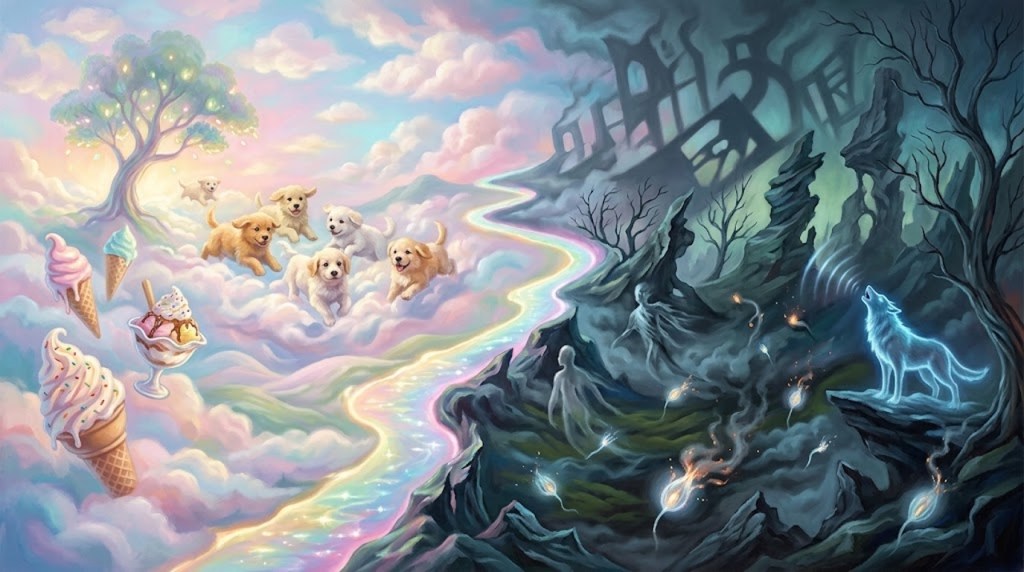
Some dream ghosts whisk by nearly unremarkable: No broken hearts, no public nudity, no murderers Closing in on your heels, just puppies and ice cream,
While others baffle and throw you off kilter. They invade, painting you in a scene You would never have willingly entered.
Why should you couple with this one For whom you have no attraction in the light of day? Who seems to walk out of some distant past
Entering the space occupied by another— Recognized, yet unrecognized, in this dream-mare? Karma is sometimes a bitch that barks at you
And other times growls, trying to get your attention You suppose, but for what purpose? You know you have seeds to burn. You know you could
Have been coupled in a past life. But why Are you forced to revisit it now against your will? Oh, you do know dreams come to you against your will.
You may enjoy some, scorn others; still, they come Spewing forth from the old memory hole. Life is a series of lessons; you have learned that much
From God and experience. You can control What you do with your eyes open, but when you close them And try to rest that brain and its soldiers, you would
Have your rest be peaceful and unfettered by past Emotional, and possibly physical ties, that time And death and life again have broken—
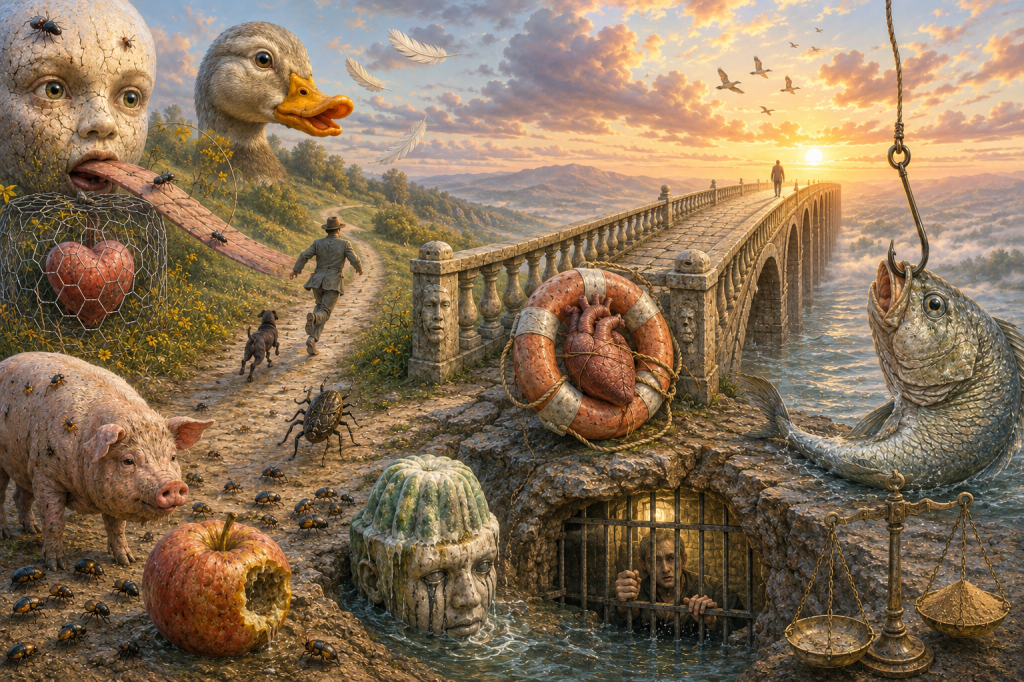
The riddle takes the black tick and runs laughing Down the path to the doggy life of flukes. Don’t get me going if you won’t follow For questions may continue to erupt.
Being strong may be illusive in the dusk. But weakness has its own sundowning Flipping and flopping like a big fish on a hook. Stay gutless if you can, while you ring the mold From your lips, as sunlight defies your spin.
Righting each wrong will take forever, It will seem, as you sculpt each lie To connect your heart to a lifejacket Tacked onto the bridge of eternity.
Love cannot seep through chicken wire And your smooth tongue will plaster your eyeballs. Satan will not pluck the weed of sorrow Even as you wait for feathers from the duck face— Whose nose will enjoy your scent?
Don’t listen to me, for I have nothing to say To pigs and fleas, and I insist you defy matter By displaying both. Selfish bloat and twitches. You resemble bitter fruit, displayed but seasonless.
The crimes we commit will tackle us And some of us will lie and try to avoid Our just deserts as if we deserve more. But prison waits as sure as your moldy tongue And we cannot avoid what is coming to us.
Image: Emily Dickinson – Amherst College – Daguerrotype of the poet at age 17, circa 1847 – likely the only authentic, extant likeness of the poet
Emily Dickinson’s “When Roses cease to bloom, Sir”
Emily Dickinson’s “When Roses cease to bloom, Sir” features prominently a surprising demand of the Divine Belovèd Creator. The Dickinsonian speaker always holds in great reverence and regard the Creator of the cosmic universe and all of earthly nature.
Introduction with Text of “When Roses cease to bloom, Sir”
Emily Dickinson’s poem, “When Roses cease to bloom, Sir,” demonstrates the poet’s depth of scientific knowledge of the world as well as her insight into the spiritual significance that such scientific knowledge implies for human evolution.
The poem features prominently a surprising demand of the Divine Belovèd Creator. The Dickinsonian speaker always holds in great reverence and regard the Creator of the cosmic universe and all of earthly nature.
She dramatizes in poetic form her physical world observations to reveal her awareness of the Divine Creator’s existence both within the natural world and outside of that natural world, extending into the realm of spirit.
The octave is structured by a “when-then” time sequence: when one thing happens, then the other may be expected to happen or may be desired to happen. In this poem, the structure adds a complex sub-feature to the equation.
Not only is the speaker offering a “when” structure that encompasses three natural phenomena of plant and animal kingdom activity, but she is also adding a third element from the human realm to the “when” clause.
The speaker has thus inserted herself into the narrative in an unobtrusive way through the employment of the synecdochic”hand.” After setting up the “when” application, she engages her own action and then offers the second half of the “when-then” function.
That “then” application, however, delivers a subtle demand of the Belovèd Creator—one that may at first appear somewhat shocking but yet remains comprehensible and infinitely appropriate.
When Roses cease to bloom, Sir
When Roses cease to bloom, Sir, And Violets are done – When Bumblebees in solemn flight Have passed beyond the Sun – The hand that paused to gather Upon this Summer’s day Will idle lie – in Auburn – Then take my flowers – pray!
“When Roses cease to bloom, Sir” rendered in song
Commentary on “When Roses cease to bloom, Sir”
Emily Dickinson’s “When Roses cease to bloom, Sir” demonstrates the poet’s depth of knowledge of the science of the evolutionary progress, as well as her insight into the spiritual significance that such knowledge suggests for the human mind and heart on its path through evolutionary advancement.
First Movement: Emphasis on Beauty
When Roses cease to bloom, Sir, And Violets are done –
The speaker begins the “when” function by addressing the Divine Ineffable Reality. She suggests that she will be asking for some favor after flowers have come and gone. She allows “Roses” and “Violets” to represent all natural vegetation, which would include all plants growing in the fields, along the streets, and in her own vegetable garden.
By allowing only two lovely flowers to represent all of the plant kingdom, the speaker is demonstrating her emphasis on her love of beauty. The speaker then demonstrates that she is including both domesticated plants—roses, and those that continue to grow wild—violets.
The Blessèd Author of creation as well as the speaker’s listeners/readers are invited to observe that the speaker keeps her mind firmly on her goal, her own creation of beauty and engagement in health and wholesomeness.
Second Movement: Evolution from Plant to Animal
When Bumblebees in solemn flight Have passed beyond the Sun –
The speaker then turns to the animal kingdom, allowing the simple bumblebee to represent that kingdom. The “Bumblebees” have engaged in “solemn flight” and like the roses and violets are now passing out of existence.
Unlike the rose that “cease[s] to bloom” and the violet whose passing out of existence is qualified as merely “done,” the bee, an evolutionarily higher-stationed member of the animal kingdom, “pass[es] beyond the Sun.”
The speaker makes the distinction between the two kingdoms in this marvelously ingenious way–how they cease their summer sojourn. As flowers simply pass away by simple cessation, the bees have engaged in the physical act of moving, which is denied plants rooted to the earth; thus, the speaker creates the bees’ metaphorical passing beyond light.
Even though the souls of all those creatures remain distinct entities in the mind of their Creator, they express in very different ways according to their current incarnation on earth, representative of their individual and collective karma. It is only natural that the higher evolved bee would demonstrate an ability beyond that of the lower plant world.
And the speaker’s ability to place this distinction in such a minimalist setting demonstrates this speaker’s understanding regarding the existence of the hierarchy to which earthly creatures remain attached until their final liberation. All created beings must pass through this hierarchical system on their way from lowest to highest form on the evolutionary scale.
Third Movement: The Human in Creation
The hand that paused to gather Upon this Summer’s day
The speaker has now quit her focus on the plant and animal kingdoms and is focusing on the simple human feature of a “hand,” a synecdochic representative of the human physical encasement.
That hand pauses. Instead of moving to pluck and collect those flowers before they are gone, this hand leaves them in place. Instead of shooing away the bees, the speaker simply takes the measure of their movement, while fashioning the observation that distinguishes the flowers from the bees.
All summer long, the speaker has observed the bees extracting nectar from the flowers. The relationship between the flowers and the nectar-gathering bees has impressed upon the mind of the speaker the symbiotic relationship that exists in nature and that extends to the human being as an integral part of that natural scenario.
But the speaker now holds her request of the Divine Creator until she has described her own situation, her own participation in the drama that she has created in the garden of her mind, heart, and soul.
Her poetic garden contains multitudes, and the ability to grow metaphorical, metaphysical flowers, bees, human hands remains her greatest challenge and strongest ability.
Fourth Movement: The Metaphysical Garden of Verse
Will idle lie – in Auburn – Then take my flowers – pray!
That human hand that pauses does so to continue its construction of her own metaphysical, poetic creation—that original garden into which she had early on invited her brother to visit.
After that hand becomes “idle,” it will cease creating those metaphysical flowers and those metaphysical bees. Therefore, the speaker then demands of the Belovèd “Sir” that He “take [her] flowers”—adding for emphasis, “pray!”
After the speaker herself has ceased blooming and flying beyond the sun and pausing from the labor of metaphorical, metaphysical garden creation, her physical form will exist like a bug in amber and become unresponsive and “lie – in Auburn.” Thus, the clever speaker is requesting through a strong demand that the Divine Gardener accept her metaphysical flowers.
Such a demand may seem infinitely cheeky of a mere created child of the Master Creator of the Cosmos, but the speaker has demonstrated repeatedly that she remains steadfast in her devotion and confident in her ability to create flowers—offerings—that are acceptable to a most discriminating Divine Creator.
Image: Emily Dickinson – Amherst College – Daguerrotype of the poet at age 17, circa 1847 – likely the only authentic, extant likeness of the poet
Emily Dickinson’s “So has a Daisy vanished”
The speaker in Emily Dickinson’s “So has a Daisy vanished” wonders if the dead Daisy and other departing plant creatures of the field have gone off to be “with God.”
Introduction and Text of “So has a Daisy vanished”
The speaker of Emily Dickinson’s “So has a Daisy vanished,” who has a keen ability to observe her natural surroundings, has been moved to wonder about the soul of “a Daisy” and many other “slipper[s]” who have given up their physical encasements of beautiful blooms and glorious green stems and simply vanished. She wonders where they went, as she dramatizes their final days of earthly glory.
So has a Daisy vanished
So has a Daisy vanished From the fields today – So tiptoed many a slipper To Paradise away –
Oozed so in crimson bubbles Day’s departing tide – Blooming – tripping – flowing Are ye then with God?
Commentary on “So has a Daisy vanished”
The speaker in this brief drama wonders if the dead Daisy and other departing plant creatures of the field have gone off to be “with God.”
First Stanza: A Flower in Heaven
So has a Daisy vanished From the fields today – So tiptoed many a slipper To Paradise away –
The speaker begins with a statement informing her readers and listeners that a lovely flower has gone, disappeared “from the fields today.” She begins with the conjunctive adverb “so,” seeming to indicate that she is merely taking up a thought that began somewhere else and at an earlier interval.
Then again employing the telling “so,” the speaker adds that many other flowers have also tripped off to “Paradise.” Along with the lovely “Daisy,” the other “slipper[s]” have all gone missing, but the speaker suggests that they have metaphorically died and gone to Heaven. While the “Daisy” has rather generically “vanished,” the others have “tiptoed” off “to Paradise.”
The speaker is playing with the language of loss, which almost always produces a melancholy in the very sensitive hearts of keen observers. Instead of merely dying, the flowers vanish from the fields and tiptoe away.
That they all have metaphorically gone on to “Paradise” demonstrates that the faith and courage of the sensitive heart of this deep observer are fully operational. That the speaker allows that these creatures of nature have gone to Heaven or Paradise shows that she has a firm grasp on the existence of the soul as a permanent life force that plants as well as animals possess.
This speaker understands that all life is divinely endowed. The flowers leave behind their physical encasements, but they take their soul encasement and then scurry off to the astral world, from where they will likely return to the Earth or some other planet to continue working out their karma–an eventuality that informs the procedure for the animal kingdom as well.
Second Stanza: To Be with the Divine Creator
Oozed so in crimson bubbles Day’s departing tide – Blooming – tripping – flowing Are ye then with God?
While the speaker remains aware that plant life force is as eternal as that of the animal kingdom, she is not so sure about where each individual plant goes after its demise. Thus she wonders if they are “with God.”
Likely influenced by the Christian concepts of Heaven and Hell, the speaker no doubt wonders if plant behavior while on Earth may require a reckoning that leads to Heaven or Hell. That she asks in the more affirmative mood demonstrates her optimistic sensitivity.
Paramahansa Yogananda has likened life on Earth to vanishing bubbles. He has explained that many deep thinking philosophers, sages, and poets have realized that the things of this world are like bubbles in the ocean; those individual things such as stars, flowers, animals, and people suddenly appear, experience a life only for a brief period of time, and then they disappear as swiftly as they appeared.
In his poem, “Vanishing Bubbles,” the great yogi dramatizes that brief earthly sojourn of the myriad life forms, as he unearths the solution for those sensitive minds and hearts that grieve after the loss of those individuals whom they had loved and who yet must vanish like bubbles.
And that solution is the simple knowledge that although the physical encasement of each individual has indeed vanished, the soul of each individual continues to exist; therefore, there is no actual vanishing or death.
The speaker in Dickinson’s poem is suggesting that she is aware of the eternal, everlasting nature of the soul. After the lovely bloom has been maneuvered into the world on “crimson bubbles,” it will live its brief life, prancing about with the breeze, and then with the “departing tide,” its day will come to an end, but only for its physical encasement, which it will leave behind.
The speaker knows that its soul–its life force–will continue, and she wonders if those souls of all those lovely flowers she has been enjoying will then be “with God.” That she would ask hints that she believes the answer is yes.
Most important to remember: fear “. . . attracts the very thing you fear.”
Paramahansa Yogananda: “Whatever it is that you fear, take your mind away from it and leave it to God. Have faith in Him. Much suffering is due simply to worry. Why suffer now when the malady has not yet come? Since most of our ills come through fear, if you give up fear you will be free at once. The healing will be instant. Every night, before you sleep, affirm: “The Heavenly Father is with me; I am protected.” Mentally surround yourself with Spirit….You will feel His wonderful protection.”
Paramahansa Yogananda: “Trust in God and destroy fear, which paralyzes all efforts to succeed and attracts the very thing you fear.”
Status in Astral World: because of failure to attain goal
Losing Ron
Gaining weight: not losing to desired goal
Not being able to quit coffee
Accidents, diseases, old age losing ability to function and pain in general
Overcoming Fear of Pain for Each Source
Status in Astral World: because of failure to attain samadhi:
I don’t remember being born in this incarnation. So I don’t remember what it was like when I was last in the Astral World. Leave it to God and Guru: “Leave a few mysteries to explore in Eternity,” says Sri Yukteswar in Paramahansa Yogananda’s Autobiography of a Yogi
2. Losing Ron: One day at a time. With guidance from God and Guru. We are not given more than we can deal with. Guruji says: “You should be prepared to deal with all problems of health, mind, and soul by common sense methods and faith in God, knowing that in life or death your soul remains unconquered.” I am more likely to shuffle off first, but if I do not, I know I would do what I had to do . . . still . . . ?!
3. Gaining weight or not losing to desired goal: From SRF talk, Brother Anantananda: “Fear disrupts our natural inner harmony, causing physical, mental, and spiritual disturbances. But as we learn to live more in the calm interior silence of the soul, we discover an inner sanctuary where worries and fears cannot intrude — and where we are ever safe and secure in our oneness with the Divine.”
4. Not being able to quit coffee: Remember the little drunk devotee in the lesson “The Bad Man Who Was Preferred By God.”
5. Accidents, diseases, and pain in general: “Daily devotional contact with the Eternal Source of security and resilience is the way to train ourselves to a constant, lived affirmation of our souls’ power to ‘stand unshaken amidst the crash of breaking worlds’.” —A New Year’s Message From Brother Chidananda 2022
Whenever a stray fear pops up such as fear of losing physical and cognitive ability—just let it go just like the others, give it God and Guruji. They are in control, not me.
Most important to remember:
fear “. . . attracts the very thing you fear.”
And then there are regrets:
Biggest regret: that I have not been able to to influence my family to study and follow the spiritual teachings of Paramahansa Yogananda. I must not be a good enough example for them to follow or even wonder about.
Answer: I cannot control the karma of others. I must take care of my own soul. The others belong to God. God is guiding them as He sees fit. Again, let it go and leave it to God and Gurus.