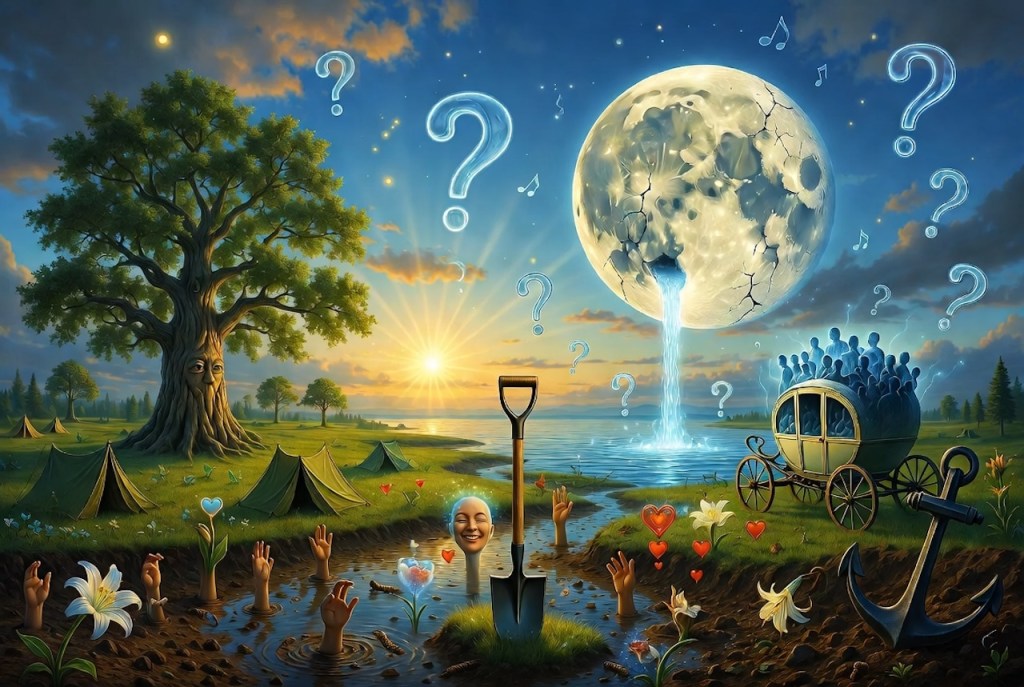
Posing on the brink of an idea Losing sunlight in the afternoon Starting to blink in the glow of fire Righting the water of despair Sweltering sun and deep notions
The mind can filter The edges of questions Where the heart tenders Make smiles a target No stealing blooms
They held their tents But let the trees think Left open the stars Cracked open the moon Waited by the ink waters
Blaming the grid of eyeless sorrow Shaming the beauty lost on stress Naming each blossom after its fist Cramming mud into the valley Deluding a masterful stroke
Do you stand with the anchor? Is your soil too heavy to bear? Do you hope to vanish before dawn? Do you blame fingers for stopping? Are you spilling courage over rocks?
Maybe the shovel will move to the center Where indifferent buds fling frost to the wind Maybe the carriage is already full of bodies Perhaps a stiff branch will stop the breeze Perhaps craving hope will erase blind fury
Will an insult count in the bosom of dankness Where the lilies grow bleak from taint Where the roses tend worms and minutes? Will the dream come slow and forceful Or will the nightmare block all sight?
Using the breath to rise from the ground Amusing the tickle in the brain of sound.
The Art of Living Life as a Poet: A Response to Braciamore’s “Why poets cannot be lovers”
My essay “The Art of Living Life as a Poet” offers a response to Beatrice Braciamore’s essay “Why poets cannot be lovers,” which is a loose musing on the tensions between poetic reflection and lived experience. Often inelegantly phrased but drawing upon respectable sources such as Pirandello and Thomas Mann, the piece ultimately loses itself, resting upon a romanticized false dichotomy.
Human Consciousness Requires Retrospection
Braciamore’s awkwardly structured piece is suggesting that the poet’s retrospective gaze necessarily alienates the poet from authentic living and loving. This view, convoluted as it is, also undervalues the poet’s capacity for integrated consciousness and grossly mischaracterizes the role of intensity in human relationships.
Braciamore defines art as a “summary of the retrospective view the poet has on reality,” positioning poetry as thought rendered into structured words. From this sterile definition, she concludes that constant analysis curses the poet with overthinking.
She then cites Pirandello’s notion that “to know ourselves is to die.” Yet her facile interpretation stretches the quotation. Pirandello explores the absurdity of fixed identity, not a blanket prohibition against reflection.
Human consciousness requires retrospection; without it, experience remains unprocessed and shallow. The poet does not stand outside life but engages it more fully by shaping its raw material into form. Far from a withdrawal, this process often deepens participation.
As T.S. Eliot argued in “Tradition and the Individual Talent,” the poet’s mind is a catalyst that transforms emotion and experience into something universal without sacrificing sincerity.
Dangerous Detachment
The claim that “art for art’s sake” leads to dangerous detachment also warrants scrutiny. While excess can distort, the Aesthetic Movement, as articulated by Wilde, defended beauty against crude moralizing or utilitarian reduction. It did not demand abandonment of reality but rather insisted that art’s primary fidelity is to aesthetic truth.
Many poets have thrived by integrating this sensibility with passionate engagement. Elizabeth Barrett Browning’s Sonnets from the Portuguese demonstrate how poetic craft can intensify rather than dilute romantic love. The verses do not aestheticize the belovèd into irrelevance; they exalt the belovèd making the love more vivid and enduring.
Similarly, the Romantic poets—Wordsworth, Coleridge, Shelley—channeled intense personal experience into art without becoming mere spectators. Their lives were often complex and vital, not coldly observational.
Braciamore further posits that when everything becomes potentially beautiful, nothing stands out as uniquely loved, rendering muses mere expedients for creation. This view risks conflating discernment with indifference.
The true poet does not flatten experience but refines and enhances it. Finding poetry in the ordinary does not preclude singular devotion; it deeply enriches it. Possessing talent and skill in writing poetry does not limit human ability but broadens it according to the depth of spiritual devotion of the dedicated poet.
Engagement, not Suppression
Dante’s Beatrice was both muse and spiritual guide, her influence profoundly real rather than purely instrumental. The notion that genuine love for an poet must be “un-poetic” and grounding—essentially pulling the poet out of their nature—carries an implicit devaluation of heightened sensibility.
Why assume ordinary lightness is superior to luminous intensity? Many individuals seek relationships that elevate consciousness rather than mute it. A worthy partner engages the poet’s vision instead of demanding its suppression.
The essay’s appeal to Greek tragedy as a model for “controlled catharsis” against hubris is relevant but applied too narrowly. Tragedy does not counsel moderation by diminishing feeling; it affirms the grandeur and terror of human passion while revealing its excesses.
Aristotle’s Poetics presents catharsis as emotional clarification, not evacuation. Poets who embrace dramatic sensibility are not necessarily inauthentic; they may simply refuse the numbness that characterizes much of modern routine existence.
The real cultural problem, as critics of postmodern relativism have noted, is often the opposite: a flattening of meaning where skepticism devolves into nihilism and all values become interchangeable “narratives.” Note that Braciamore states, “anything can be art, and anyone can be an [sic] poet.” Such flattening reduces art to nothingness, and from this stance comes the absurd notion that “a poem can mean anything you want it to mean.”
This critique aligns with broader concerns about relativism’s influence on art and culture. When experience is reduced solely to personal “truths” without reference to shared reality or enduring form, both poetry and relationships suffer.
Braciamore’s call to “drop the act” occasionally has merit as a guard against self-indulgence, but it should not become a prescription for poets to abandon their distinctive mode of being. The solution lies in balance and self-awareness, not in trading poetic vision for prosaic grounding.
Poets Love Deeply
History demonstrates that poets can and do love deeply. The correspondences between Robert and Elizabeth Browning reveal a union of minds and hearts that fueled, rather than hindered, their creative output.
Frida Kahlo’s relationship with Diego Rivera, though turbulent, produced art inseparable from lived passion. These examples suggest that the poetic temperament, when mature, enhances rather than obstructs connection.
Braciamore concludes by encouraging readers to love poets in ways that help them escape obsession. A more constructive approach recognizes that the poetic life, with its retrospective depth, offers a richer engagement with reality.
The challenge is not to diminish poetic consciousness but to ensure it remains tethered to truth, empathy, and genuine encounter. In an age prone to fragmented perspectives and diminished meaning, the poet’s ability to find form and beauty remains not a curse but a vital gift.
Rather than asking poets to love less poetically, we might ask them—and their partners—to love with full awareness: attentive to both the retrospective glance and the living moment. This integrated approach honors the complexity of human experience without forcing a false choice between art and life.
 Linda's Literary Home