Linda's Literary Home

Tag: love

  • Original Short Literary Fiction: “Transformation through the Ages: Two Letters to Myself”

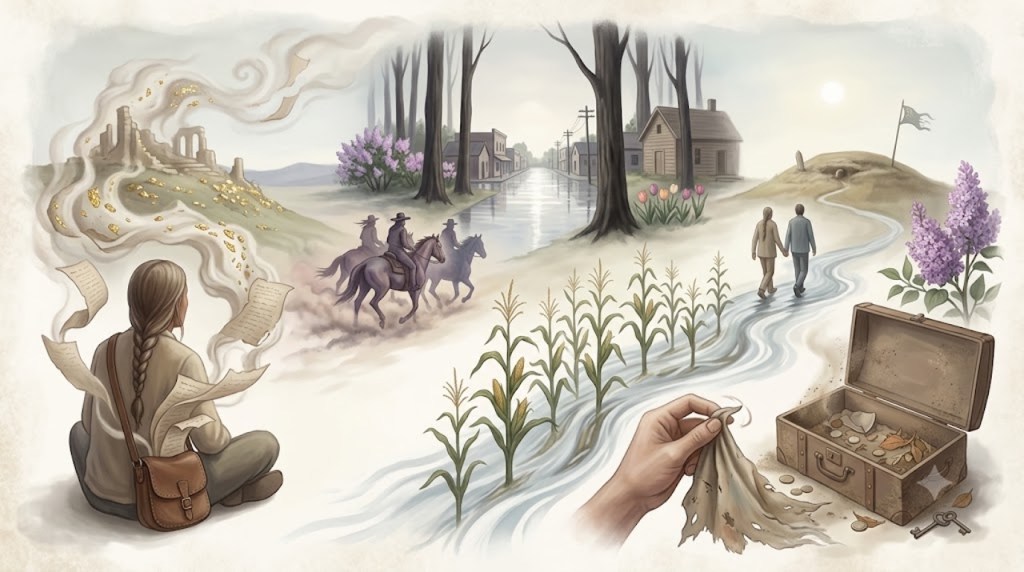
    Image-Created by ChatGPT inspired by the text
    Image: Created by ChatGPT inspired by the text

    Original Short Literary Fiction: “Transformation through the Ages: Two Letters to Myself

    The process of aging asks us to move from one version of ourselves into another—slowly learning how to carry memory, change, loss, wisdom, and time within the same person.

    Dear Older Me,

    I’m writing to you from age twenty, which feels impossibly young and impossibly certain all at once, right on the edge of adulthood. Everyone keeps telling me that life will change me, but I still wake up every morning believing I will somehow remain recognizable to myself forever. I wonder if you remember feeling that way.

    Lately I’ve been thinking about aging—not in the dramatic sense of illness or endings, but in the quieter sense of becoming someone new over time. I look at photographs from just a few years ago and already feel strange about them. 

    The girl in those pictures is me, but also not entirely me anymore. Her worries were smaller. Her body was different, plumper, rosier, full of some kind of strange awareness.  But her understanding of herself was unfinished.

    I wonder what it’s like for you now, at nearly ninety, carrying six plus decades of former selves inside you.

    Do you still feel connected to me? Or do I seem like a distant relative you remember fondly but imperfectly?

    People talk so much about youth as though it’s the truest version of a person, and aging as though it’s some slow departure from that truth. But I’m beginning to suspect that every age is temporary, and every version of ourselves eventually becomes a kind of memory.

    That thought frightens me sometimes.

    I notice already how language changes around age. Adults speak of young people with nostalgia, impatience, envy, and tenderness all at once. And young people speak about aging as though it’s something abstract—something happening to other people. Yet every day we are all moving quietly toward another stage of ourselves.

    I wonder what it feels like to look into the mirror at eighty plus. Do you still recognize your expressions even if the face has changed? Do you still feel young somewhere underneath everything time has altered?

    I’ve also been thinking about photographs and memories. Right now, my room is full of snapshots from childhood, school dances, birthdays, awkward haircuts, and vacations that already feel far away. I can’t imagine ever wanting to hide those versions of myself, even the embarrassing ones. But I wonder if, by your age, those images begin to feel less like evidence and more like archaeology.

    Do old photographs comfort you, or do they ache?  I hope you’ve kept them all anyway.

    I hope you understand that the younger versions of yourself were not mistakes. I hope you speak kindly about us—the insecure teenager, the reckless twenty-year-old, the exhausted middle-aged woman trying to hold everything together. I hope you see all of them not as separate people, but as chapters in the same long story.  Most of all, I hope you haven’t become embarrassed by change itself.

    Right now, growing older seems terrifying because everything around me celebrates beginnings and quietly fears decline. But perhaps aging is not a process of disappearing. Maybe it’s a process of accumulation. Maybe the older face simply carries more life within it.  If you could tell me anything from where you are now, I think I’d want reassurance that becoming older does not mean becoming less.

    I hope you still laugh easily.  I hope you still feel wonder.  I hope you still believe your life mattered.  And I hope, somehow, that you are grateful for me too—for this young girl standing at the beginning, trying so hard to understand time before she has truly lived it.

    Love,
    Your Former Self

    Dear Former Self,

    Your letter arrived like a voice carried across water—young, searching, and achingly sincere. I read it slowly, not because age has made me slower, though perhaps it has, but because your words reopened rooms in my memory I had not visited in years.

    Yes, I remember you.  More importantly, I remember being you.

    At twenty, you believe identity is something you must discover once and then defend forever. What age eventually teaches is that the self is not a monument. It is weather. It shifts continuously—sometimes gently, sometimes violently—and survives through adaptation rather than permanence.

    You ask whether I still feel connected to you. I do, though not in the simple way you imagine. You are not buried beneath the years; you are woven through them. I still recognize your idealism, your sensitivity, your fear of being forgotten or diminished by time. Those things remain, though softened now by experience.

    And yes, there are moments when I look into the mirror and feel startled. Aging happens so gradually that you scarcely notice it while living through it, and then suddenly you catch sight of your mother’s face in your own reflection, or your grandmother’s hands resting in your lap.

    The body changes first in obvious ways. The knees complain. The spine stiffens. Sleep becomes lighter. Faces hollow and soften simultaneously. But the deeper transformation  is stranger: the realization that inside the aging body, consciousness remains largely untouched by chronology.

    I am eighty-nine, yet some mornings I still feel eighteen until I stand up.  That is one of the great hidden truths of aging: the young self never fully leaves. She simply becomes surrounded by additional selves gathered over a lifetime.

    You asked whether old photographs comfort or ache. The answer is both.  Photographs become less about appearance and more about vanished worlds. You stop focusing on how pretty you once were and begin noticing who is no longer standing beside you. An old picture can break your heart because time is visible there in a way it never feels while you are living it.

    But keep the photographs anyway.  Keep all of them.  One day you will treasure the evidence that ordinary afternoons once existed at all.

    You fear that aging may mean becoming less. I understand that fear because our culture speaks of aging almost entirely in the language of loss. Loss of beauty. Loss of relevance. Loss of strength. Loss of possibility.

    And yes, there are losses. I will not lie to you about that.  You will lose people you cannot imagine living without.  You will lose certain ambitions.  You will lose versions of your body that once felt effortless.  But aging is not merely subtraction.  It is also refinement.

    At twenty, you experience life intensely because everything is new. At ninety, you experience life intensely because you finally understand how temporary everything always was. A simple morning light across the kitchen table can move you to tears. An ordinary conversation can feel sacred.  Youth burns brightly, but age glows.

    You asked whether I still laugh easily. I do—more easily, in fact. Young people often believe seriousness gives life meaning, but age teaches the opposite. Much of survival depends upon learning when to laugh at yourself gently.

    And wonder? Yes, wonder remains too. Perhaps even more so. The older you become, the more miraculous existence itself begins to feel. Not because life becomes easier, but because you finally understand how improbable it always was.

    As for whether your life mattered: meaning does not arrive as a grand declaration. It accumulates quietly through small acts of love, attention, endurance, forgiveness, and presence. A meaningful life rarely feels monumental from the inside.

    You hoped I would be grateful for you.  I am.

    I am grateful for your impatience, your hunger for understanding, your belief that life must contain something beautiful and true. You carried us forward. Without your courage to begin, I would never have arrived here with so much tenderness intact.

    So let me leave you with this:

    Do not spend your youth mourning age in advance. Become fully each version of yourself when it arrives.

    The frightened girl, the ambitious woman, the joyful grandmother—they all belong to you. None of them are failures of the others. They are simply the many forms a human life must take in order to become complete.

    Love and blessings,
    Myself Now

  • The True Love of My Life

    Image:Created by ChatGPT inspired by the poem
    Image: Created by ChatGPT inspired by the poem

    The True Love of My Life

    —after “Thou Art My Life”

    O Divine Belovèd, Thou art the true love of my life,
    The sweetness that lets me taste joy.

    Thy name on my tongue is sweeter
    Than a thousand well-filled honeycombs.

    Let them know Thee.
    Let them all know Thee.

    In the haven of love, I seek Thee
    Again and again, and repeat
    Again and again:  Thou art the true Love of my life,
    The sweetness that lets me taste joy.

  • Emily Dickinson’s “If those I loved were lost”

    Image: Emily Dickinson – Amherst College – Daguerrotype of the poet at age 17, circa 1847 – likely the only authentic, extant likeness of the poet

    Emily Dickinson’s “If those I loved were lost”

    The speaker in Emily Dickinson’s “If those I loved were lost” is emphasizing the value she places on her loved ones.  She likens their importance to significant events from the community level to the world stage, where bells ring to announce important happenings.

    Introduction and Text of “If those I loved were lost” 

    Emily Dickinson’s “If those I loved were lost” features two stanzas, each with two movements.  The speaker’s musing targets how the speaker would react to both losing and finding loved ones.  Her emotions and behaviors signal the importance of those loved ones to her.  The value she places on these individuals can only be suggested and not directly stated.

    If those I loved were lost 

    If those I loved were lost
    The Crier’s voice would tell me –
    If those I loved were found
    The bells of Ghent would ring –

    Did those I loved repose
    The Daisy would impel me.
    Philip – when bewildered
    Bore his riddle in!

    Commentary on “If those I loved were lost” 

    This highly allusive poem takes readers from life in a small village to the world stage, on which famous bells herald momentous events.  The allusions emphasize the significance the speaker places on those to whom she refers. 

    First Movement:   An Important Announcement 

    If those I loved were lost
    The Crier’s voice would tell me –

    The speaker is speculating about her emotions and behaviors after having lost a loved one, and then she adds a speculative note about those emotions and behavior as she suddenly has found a beloved. 

    The first movement finds the speaker claiming that the loss of a loved one would herald a “Crier” to announce the event.  In earlier times, a “town crier” was employed to spread local news events on the streets of small villages.   

    The town crier’s position was noticeable because of his manner and elaborate dress:  such a crier might be adorned in bright colors, a coat of red and gold with white pants, a three-cornered hat (tricon), and black boots.  He usually carried a bell that he would ring to attract attention of the citizens.  He often would begin his announcement with the cry, “Oyez!  Oyez!  Oyez!” 

    By making this simple claim that a “crier” would be letting her know about the loss of a loved one, the speaker is elevating the importance of everyone she loves to the status of a noted official or famous name in the community.  

    Second Movement:  The Significance of Loss 

    If those I loved were found
    The bells of Ghent would ring – 

    The speaker then alludes to the famous Ghent Belfry, whose construction began in 1313 with ringing bells to announce religious events, later employed to signal other important occurrences.    

    The inscription on the belfry tower indicates the historical and legendary important of the construction:   “My name is Roland. When I toll there is fire. /  When I ring there is victory in the land.” 

    Dickinson was likely aware of Henry Wadsworth Longfellow’s lines, “Till the bell of Ghent responded o’er lagoon and dike of sand, I am Roland! I am Roland! there is victory in the land!”   

    Because the famous bells ring to herald important events, the speaker assigns great importance to the fact that she has found a loved one.  Thus the speaker has molded her losing and finding those she loves into great and momentous events. 

    Third Movement:  Daisy and Death 

    Did those I loved repose
    The Daisy would impel me.

    The speaker then speculates about her reaction to the death of her loved ones.  She refers to the flower, the “Daisy,” stating that it would “impel her.”  The employment of the Daisy is likely prompted by the flower’s association with growing on graves as in Keats’ reference in the following excerpt from one of his letter to a friend:  

    I shall soon be laid in the quiet grave – thank God for the quiet grave – O! I can feel the cold earth upon me – the daisies growing over me – O for this quiet – it will be my first. 

    And, too, there is the old expression, “pushing up daisies,” of which Dickinson was, no doubt, aware.  The flower would drive her to some of kind reaction which she fails to describe but only hints at.  Although she simply suggests her reaction, she leaves a significant clue in the next movement, as she alludes again to Ghent, this time the leader named Philip.

    Fourth Movement:  The Riddle of Loss

    Philip – when bewildered
    Bore his riddle in!

    The speaker is then alluding to Philip van Artevelde (1340–82), who was a popular Flemish leader. He led a successful battle against the count of Flanders, but later met defeat and death.  The Dickinson household library contained a book with a play that featured Philip’s last words before dying, “What have I done?  Why such a death?  Why thus?”

    Thus the speaker makes it known that she would have many questions as she struggles with the death of a loved one.  She would, like Philip, be overcome, having to bear such a “riddle.” 

    The speaker has shown how important and necessary her loved ones are to her, and she has also demonstrated that their loss would be devastating, and she has done all this through suggestions and hints, without any direct statement of pain and anguish.  All of the sorrow is merely suggested by the high level of importance she is assigning to her loved ones.  

  • Elizabeth Barrett Browning’s Sonnet 36 “When we met first and loved, I did not build”

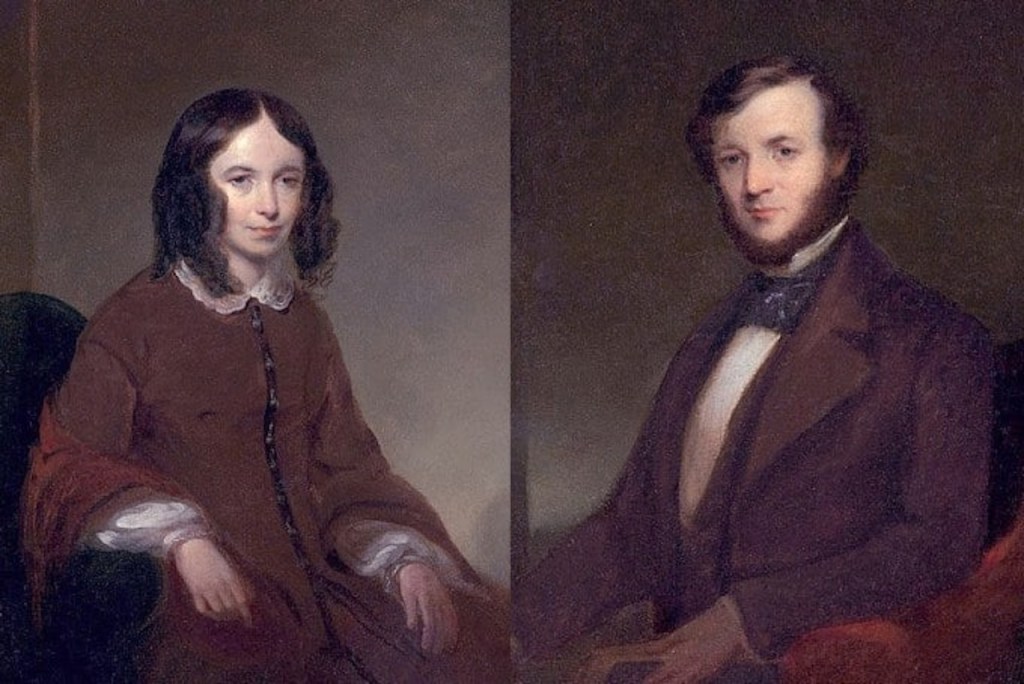
    Image: Elizabeth Barrett Browning and Robert Browning – 1852. Portraits painted by Thomas Buchanan Read

    Elizabeth Barrett Browning’s Sonnet 36 “When we met first and loved, I did not build”

    In sonnet 36 “When we met first and loved,” the speaker reveals her inability to fully accept the love relationship that is growing with her belovèd suitor.  She is constantly trying to prevent her heart from being broken, in case the relationship fails to reach it full potential.

    Introduction and Text of Sonnet 36 “When we met first and loved, I did not build”

    Elizabeth Barrett Browning’s sonnet 36 “When we met first and loved, I did not build”  from Sonnets from the Portuguese reveals the speaker’s apprehension that the first moments of a new love might prove to be illusive; thus, she refuses to believe unwaveringly in the possibility that love had arrived.

    This speaker always remains aware that she must protect her heart from disaster.  And at this point in their relationship, she knows that she could suffer a terrible broken heart if the relationship fails to flourish.

    Sonnet 36 “When we met first and loved, I did not build”

    When we met first and loved, I did not build
    Upon the event with marble. Could it mean
    To last, a love set pendulous between
    Sorrow and sorrow? Nay, I rather thrilled,
    Distrusting every light that seemed to gild
    The onward path, and feared to overlean
    A finger even. And, though I have grown serene
    And strong since then, I think that God has willed
    A still renewable fear … O love, O troth …
    Lest these enclaspèd hands should never hold,
    This mutual kiss drop down between us both
    As an unowned thing, once the lips being cold.
    And Love, be false! if he, to keep one oath,
    Must lose one joy, by his life’s star foretold.

    Commentary on Sonnet 36 “When we met first and loved, I did not build”

    The speaker again is demonstrating her inability to fully accept the love relationship that is growing with her belovèd suitor.  The speaker must protect her poor heart, which could so easily be shattered if the love relationship should end.

    First Quatrain:  Love between Sorrow

    When we met first and loved, I did not build
    Upon the event with marble. Could it mean
    To last, a love set pendulous between
    Sorrow and sorrow? Nay, I rather thrilled,

    The speaker says that when she and her belovèd first met and love began to flower, she did not readily accept that the feelings were genuine; she refused to imagine that such a relationship could become solid.  She must continue to guard her heart by holding in abeyance only the possibility of a lasting love relationship.

    She questions whether love could endure for her because of the many sorrows she has experienced.  She, instead, continued to think of only the potential of love, existing between one sorrow after the next sorrow.  She felt more confident that sorrow would remain in the offing than that love would come to rescue her out of her melancholy.

    The reader is by now quite familiar with the sadness, pain, and grief this speaker has suffered in her life and that she continues to suffer these maladies.   For this melancholy speaker to accept the balm of love remains very difficult. Her doubts and fears continue to remain more real to her than these new, most cherished feelings of love and affection.

    Second Quatrain:   Continuing Fear

    Distrusting every light that seemed to gild
    The onward path, and feared to overlean
    A finger even. And, though I have grown serene
    And strong since then, I think that God has willed

    Answering her own question in the negative, the speaker asserts that she preferred to remain skeptical of the hints that seemed to suggest a progression toward the loving relationship.   

    The speaker’s fears continue to prompt her  to hold back her heart because she continued to remains afraid that if she gave way at even a “finger[’s]” length, she would regret the loss so much that she would suffer even more than she already had done.

    Quite uncharacteristically, the speaker admits that since that early time at the very beginning of this love relationship, she has, indeed, “grown serene / And strong.”   Such an admission is difficult for the  personality of this troubled speaker, but she does remain aware that she must somehow come to terms with her evolving growth.

    First Tercet:   Skepticism for Protection

    A still renewable fear … O love, O troth …
    Lest these enclaspèd hands should never hold,
    This mutual kiss drop down between us both

    Still, even though this wary speaker is cognizant of her growth in terms of serenity and strength, she believes that God has instilled in her the ability to remain somewhat skeptical in order to protect herself from certain torture at having been wrong about the relationship.

    This speaker knows that if, “these enclaspèd hands should never hold,” she would be devastated if she had not protected her heart by retaining those doubts.   If the “mutual kiss” should “drop between us both,” this ever-thinking speaker is sure her life would be filled with even more grief and sorrow.

    Second Tercet:  Wrenching Feeling

    As an unowned thing, once the lips being cold.
    And Love, be false! if he, to keep one oath,
    Must lose one joy, by his life’s star foretold.

    The speaker then spreads across the border of the tercets the wrenching feeling that her words are causing her.   This melancholy speaker feels that she must give utterance to these thoughts, but she knows that they will cause pain, even to her belovèd. But if, “Love, be false,” then she simply must acknowledge that possibility for both their sakes.

    The speaker anticipates the likelihood that she might have to “lose one joy” which may already be written in her stars, and not knowing which joy that might be, she must remain watchful that it might be the very love she is striving so mightily to protect.

  • Elizabeth Barrett Browning’s Sonnet 3 “Unlike are we, unlike, O princely Heart!”

    Image:  Elizabeth Barrett Browning –  Getty Images

    Elizabeth Barrett Browning’s Sonnet 3 “Unlike are we, unlike, O princely Heart!”

    The speaker in Elizabeth Barrett Browning’s sonnet 3 muses on how unlikely it seems that a plain individual such as herself would begin a relationship with a person who has attracted royalty.

    Introduction and Text of Sonnet 3  “Unlike are we, unlike, O princely Heart!”

    The speaker of Elizabeth Barrett Browning’s sonnet 3 from Sonnets from the Portuguese contemplates the differences between her belovèd and her humble self.  She continues her study of unlikely love employing the use of the Petrarchan sonnet form for the sequence.  

    The speaker thus is dramatizing her musings as they focus on her relationship with her belovèd partner. She explores her many doubts and self-deprecation seeming to be looking for a reason to change her mind about what seems to be an impossible liaison.

    Sonnet 3 “Unlike are we, unlike, O princely Heart!”

    Unlike are we, unlike, O princely Heart!
    Unlike our uses and our destinies.
    Our ministering two angels look surprise
    On one another, as they strike athwart
    Their wings in passing. Thou, bethink thee, art
    A guest for queens to social pageantries,
    With gages from a hundred brighter eyes
    Than tears even can make mine, to play thy part
    Of chief musician. What hast thou to do
    With looking from the lattice-lights at me,
    A poor, tired, wandering singer, singing through
    The dark, and leaning up a cypress tree?
    The chrism is on thine head,—on mine, the dew,—
    And Death must dig the level where these agree.

    Commentary on Sonnet 3:  “Unlike are we, unlike, O princely Heart!”

    The speaker in sonnet 3 is musing on how unlikely it seems that an unknown simple individual such as herself could attract and begin a relationship with a person who has attracted the attention and respect of royalty.

    First Quatrain:  Contemplating Differences

    Unlike are we, unlike, O princely Heart!
    Unlike our uses and our destinies.
    Our ministering two angels look surprise
    On one another, as they strike athwart

    The speaker begins with an excited utterance.  The humble speaker and her newly formed romantic partner perform very different roles in life; thus, they would naturally be on the road to very different “destinies,” one would assume, as the speaker seems to do.  The speaker then paints a fantastic image wherein a pair of angels look with surprise, “On one another, as they strike athwart / / Their wings in passing.” 

    This unusual pair of lovers possesses very different guardian angels, and those angels find themselves taken aback that such a couple with very differing stations in life should come together. Even more remarkable is that they seem to begin to flourish as they engaging in their new relationship.  The angels’ wings begin fluttering, as they questioningly peer upon the unlikely couple.

    Second Quatrain:  A Guest of Royalty

    Their wings in passing. Thou, bethink thee, art
    A guest for queens to social pageantries,
    With gages from a hundred brighter eyes
    Than tears even can make mine, to play thy part

    The speaker reports that her new belovèd has often been the guest of royalty at their social events—something this speaker could never have accomplished. The speaker is only a shy and retiring individual; she thus offers the contrast between her own social station and skills to that of one who has shined so brightly as to attract the acceptance into the company of kings and queens.

    The speaker assumes that the folks he surely meets at the spectacular affairs of royalty no doubt look at him with “a hundred brighter eyes” than her own.   Even her tears cannot be enough to render her eyes as bright as what he must experience at such high level social affairs.

    First Tercet:  Her Lowly Self

    Of chief musician. What hast thou to do
    With looking from the lattice-lights at me,
    A poor, tired, wandering singer, singing through

    The speaker then contends that unlike her lowly self, her new found love has played the role of “chief musician” at those gatherings of royalty.  She, therefore, must question the notion that he would even bother to give her a second thought, after encountering the glamor and glitz of upper class events. 

    The speaker then puts the question to her romantic partner in order to become informed as to why one such as he would be “looking from the lattice-lights” at one such as herself. 

    The speaker wants to know why one who can so easily attract and associate with royalty can at the same time seem to be like a commoner, as he “lean[s] up a cypress tree,” while peering up at her through her shaded-window.

    She seems to harbor a suspicion that her new relationship might be based on some frivolous curiosity instead of genuine interest and affection. Thus, she continues to muse and examines all aspects of this new liaison, until she feels comfortable in allowing herself to enjoy the relationship.

    Second Tercet:  A Precious Oil

    The dark, and leaning up a cypress tree?
    The chrism is on thine head,—on mine, the dew,—
    And Death must dig the level where these agree.

    Finally, the speaker declaims that her loved one sustains  “chrism” on his head, but she possesses only “dew.” The precious oil coming together with only plain dew boggles her mind; thus, she evokes the image, “Death must dig the level where these agree.”   

    On the earthly plane and in a definitely class based society, the speaker cannot reconcile the differences between herself and her beloved.  She therefore suggests that she will just allow “Death” to establish the meaning and purpose of this seemingly bizarre, but happy, occurrence.

  • Elizabeth Barrett Browning’s Sonnet 5  “I lift my heavy heart up solemnly”

    Image: Elizabeth Barrett Browning – NPG, London

    Elizabeth Barrett Browning’s Sonnet 5 from Sonnets from the Portuguese focuses on the speaker’s lack of confidence that her budding relationship will continue to grow.

    Introduction with Text of Sonnet 5 “I lift my heavy heart up solemnly”

    The speaker’s lack of confidence in her own value as a person and poet makes her doubt that  budding relationship will continue to blossom.  

    Her little dramas continue to exude her lack of self esteem, while she also makes it known the she holds her beloved in the highest regard.  Likely she feels unworthy of such an accomplished individual.

    Sonnet 5 “I lift my heavy heart up solemnly”

    I lift my heavy heart up solemnly,
    As once Electra her sepulchral urn,
    And, looking in thine eyes, I overturn
    The ashes at thy feet. Behold and see
    What a great heap of grief lay hid in me,
    And how the red wild sparkles dimly burn
    Through the ashen greyness. If thy foot in scorn
    Could tread them out to darkness utterly,
    It might be well perhaps. But if instead
    Thou wait beside me for the wind to blow
    The grey dust up,… those laurels on thine head,
    O My beloved, will not shield thee so,
    That none of all the fires shall scorch and shred
    The hair beneath. Stand further off then! Go.

    Reading  

    Commentary on Sonnet 5  “I lift my heavy heart up solemnly”

    The speaker in sonnet 5 focuses on her lack of confidence that her budding relationship will continue to grow.

    First Quatrain:  Dramatic Ashes

    I lift my heavy heart up solemnly,
    As once Electra her sepulchral urn,
    And, looking in thine eyes, I overturn
    The ashes at thy feet. Behold and see

    In the first quatrain of Sonnet 5 from Elizabeth Barrett Browning’s Sonnets from the Portuguese, the speaker likens her heart to the urn held by Electra, who thought she was holding the ashes of her dead brother Orestes in Sophocles’ tragic Greek play, Electra. The speaker is raising the “sepulchral urn” of her heart to her beloved, and then suddenly, she spills the ashes at his feet. She commands him to look at those ashes.

    The speaker has established in her opening sonnets that not only is she but a humble poet shielded from the eyes of society, but she is also one who has suffered greatly from physical maladies as well as mental anguish.  She has suffered thinking that she may never have the opportunity to love and be loved.

    Second Quatrain:  Dropping Grief

    What a great heap of grief lay hid in me,
    And how the red wild sparkles dimly burn
    Through the ashen greyness. If thy foot in scorn
    Could tread them out to darkness utterly

    The speaker continues the metaphor of her heart as filled with ashes by commanding her beloved to look and see, “What a great heap of grief lay hid in me.” She metaphorically compares the ashes held within the urn of her heart to her grief.

    Now she has dropped those ashes of grief at the feet of her beloved. But she notices that there seem to be some live coals in the heap of ashes; her grief is still burning “through the ashen greyness.”  She speculates that if her beloved could stomp out the remaining burning coals of her grief, that might be all well and good.

    First Tercet:  Burning Coals of Grief

    It might be well perhaps. But if instead
    Thou wait beside me for the wind to blow
    The grey dust up,… those laurels on thine head,

    If, however, he does not tread on those burning coals of grief and merely remains still beside her, the wind will stir up those ashes, and they may land on the head of the beloved, a head that is garlanded with laurels.

    It will be remembered that the speaker has, in the two preceding sonnets, made it clear that her beloved has prestige and the attention of royalty. Thus, he is as one who is declared a winner with the reward of laurels.

    Second Tercet:  In the Throes of Sorrow

    O My beloved, will not shield thee so,
    That none of all the fires shall scorch and shred
    The hair beneath. Stand further off then! Go.

    The speaker avers that even those laurels will not be able to protect his hair from being singed, once the wind has blown those live coals upon his head. She therefore bids him, “Stand farther off then! go.”

    In the throes of incredible sorrow, the speaker is awakening slowly to the possibility that she can be loved by someone whom she deems her superior in every way. Her head is bare, not garlanded with laurels as is his.

    She must give him leave to forsake her because she believes that he will do so after he fully comprehends who she really is.   Although she, of course, hopes he will protest and remain beside her, she does not want to deceive herself, falsely believing that he will, in fact, remain with her.

  • ANCIENT LETTERS

    ANCIENT LETTERS

    Published by Barnwood Press, Daleville IN, 1987.

    Ancient Letters

    One wonders whom the next elected
    Criminal for these troubled times
    Will the feckless public, suspect,
    Lever in the long direction
    (Between the last war and the next)
    We take in our quotidian crimes;
    How long our matrons skirt the leering
    Lawless on main ways to market;
    How long our aged folk in fear
    Imprisoned at their portals peering
    On them convicted in their derring
    And that with such cocksureness wear
    The scutum of their darknesses,
    Petronius? (I pray you, burn these letters.) 

    Agrippina

    After the last trick had been turned in the game,
    The bumpers drunk, the galley fallen apart;
    The lying maid having drunk to a different name
    A cup for the journey, so to speak, at the start;
    One wonders whether that harried dame ever thought
    In terms of that fat man she and she father had wrought.
    Surely in knowing she would have aborted that plan
    Before it came forth in this world and assumed the shape of a man,
    Perhaps.  Nine gods were enough of a problem; she laid it on fate;
    She even exclaimed on how simple it was and absurd
    (She was dead for some time before they came to kill her, too late)
    To have birthed and been part of the proof and power of Hate.
    The guise it assumed and its manner have also endured:
    Took its place in the capitol, developed a merchant for fire,
    Was witty and sullen, hired artists to teach it the lyre,
    Gave games for the people, and like an innocent bird.

    Homage to Catullus

    1

    SWEET Lesbia,would you know the half
    of all my pleasure when your husband laughs
    delighted at your flyting and the flashing spite
    that lights your countenance when we two fight?
    watch out, my girl, your fat fool’s treasure,
    I may absent myself and rob the only pleasure
    he takes in both of us.  O, what frustration
    should I reave your table of my conversation—
    no, no, do not start up so hastily to weep;
    this is a lover’s promise not to keep.
    but still . . . his pleasure when your latest insult flies
    against me, and the room lights from your brilliant eyes
    as when I goad you fast between your thighs.

    2

    OCTAVIA, you bitch, when you deride
    me in the taverns, it is time you knew
    you build the envious world you hide in,
    and every drunkard there suspects the true.
    why is it now, fat forty, you should blame
    my cold pursuits at something you’d not give
    me years ago, now when you wear my best friends’s name?
    sweet Mercury, the weird world we live in!
    how you condemn me, now I am a poet
    who never knew you slim, nor know you fat,
    so stop pretending, dear, your friends all know it,
    even they know that.

    3

    FLAVIVS, do you know rising in the Forum,
    lisping your meums, tuums, how your colleagues
    snicker to one another common knowledge
    about your extra-curricular quorums?
    could you believe the pupils would not talk you
    in their graffiti in the public stalls?
    why have you let the praetors and plebeians mock your
    courses you offer on the taverns walls?
    O tempora, mores! we all know you, dear,
    each several senator and charioteer.

    to be continued, check back for updates

    Publication Status of Ancient Letters

    Amazon currently features one copy available at $7.00.  This copy does not feature the original book cover.  An additional option is offered by another seller, priced at $85.00 plus shipping.

  • Graveyard Whistler on “The Lucy Light Letters”

    Image:  “Letters”   Photo by Ron Grimes

    Literary letters have always been a marvelous find in literature.  Graveyard Whistler found this series of letters and although they do not address his main interest in irony, they do offer an interesting take on some of life’s most intriguing conflicts.

    Graveyard Whistler’s Introduction to “The Lucy Light Letters”

    As my faithful readers know by now, I am pursuing a PhD in literary history with a concentration on “irony.”  The thing is I am finding such marvelous gems that do not actually address the issue of irony but which are just so fascinating I can’t let them drop without exposing their emotional plights to light.

    This series of letters offers a delightful exchange between a professor and former student.  They are obviously very much in love but have much baggage that prevents their ability to requite that love, that is, until certain unpleasant facts of life are overcome. 

    I apologize ahead of time for not being able to offer a completely satisfying ending to this story.  I know my readers will be left with questions:  did LJ succeed in persuading JL to relocate to SoCal.?  does their love ever become physical?  do they resume writing that corroborative collection that seems to have started this whole thing?  and simply, do they live happily ever after?

    I know I would like answers to those questions, and I will certainly keep looking for them.  But for now, please enjoy the exchange.  Their writing includes some clever and quirky turns of phrase.  They both were definitely lovers of literary language, and they definitely loved each other with a rare love and affection that many of us only dream about finding on this fuzzy-mudded planet.

    Letter #1

    April 19, 19—
    Encinitas  CA

    Dear Jefferton,

    It’s still difficult to call you that, even though I know it would be ridiculous to call you Professor Lawrence, considering our past relationship.  I know you must be surprised getting a letter from me now; maybe you are shocked or annoyed, and are not even bothering to read this, so maybe I am writing in vain, but I will continue in the faith that you do still have at least a spark of interest in me and my life.  

    I owe you a huge apology for just vanishing the way I did, without one word of explanation or even good-bye.  I hope you will accept it and know that I am truly sorry.  I don’t really understand myself that well even now, but at the time of our relationship, I was thoroughly confused.  That confusion—or my desire to try to work it out—is part of the reason I am writing you now.  But there are other parts.  I hope I will be clear; I’m not even sure I can be.  

    Before I get into that, I wanted to tell you that when I saw your book on our library’s new arrival shelf, I was tempted to check it out, but then I rushed over to the bookstore and ordered my own copy.  You can be sure I will read it carefully and cover to cover as soon as it arrives.

    Well, there are some things I have to say, and I might as well jump right into them.  At the time we were working on that collection of poems, I was in a constant state of turmoil.  I had written what I considered some of my best poems for the collection, but I feared they were too revealing, I mean, I feared they showed too clearly how I felt about you, and our growing closeness.  I feared that if anyone we knew (your wife for example, and my parents and brothers) saw those poems, and saw that we, a professor and student, had authored them, they would make assumptions about the nature of our relationship.  I could not face that.  And I did not have the courage to tell you about my fears.  You had such confidence in me, and you thought I was so bright and sophisticated for a twenty-year-old, but I didn’t feel that way, and it scared me and upset me to have you find out.  I just couldn’t let you know how weak and insecure I felt, so I transferred to Miami to finish my BA in English.

    Living at home was hell, but I’ll tell you about that later, if you are still speaking to me or listening and you still care.  

    I had thought I’d tell you everything I had been doing and thinking lately in this one letter, but I see that it is getting too long.  And I really should not be so presumptuous as to assume you are still interested.  Instead, I will just come right out and ask you: Are you still interested in hearing from me?  Do you think we can be friends?  I have never forgotten you for a minute.  I really do love you, and I have missed our talks. 

    You were always so insightful; I look back now, and realize that I surely could have trusted you with my insecurities back then, but I just didn’t know it then.  I am learning, but I am still full of confusion.

    I hope you will let me know if it’s all right to write you more.  Please let me know soon.

    Your “Lucy Light” (I hope still)
    Lucinda Janson

    Letter #2

    21 May 19—
    Muncie, Indiana

    My Dear Lucy Light,

    I was delighted to get your letter.  I have wondered about how you are doing and where you are.  I have wondered if I had been the cause of your sudden disappearance and from your letter I gather I must bear some guilt in that regard.  I should have realized that you were too young and inexperienced to become equal partners in that endeavor of authorship.  But I will never take back what I said about your intelligence; you are still the brightest and most perceptive student ever to sit for my class in Mod Brit Poetry.  You are also one of the most creative.  I had occasion to teach a creative writing section last fall; as you know, I hated every minute of it, but at least now I know why I hate it so much.  Because I totally agree with Auden that artists who take academic positions should do academic work.  If I had my way, all creative writing courses would summarily be banished from the university.  I have gotten upon my soapbox, and now I shall descend again to finish my lecturing to you alone.

    Dear, dear girl—as you have apologized to me, let me say that if you truly think you owe one, then I accept it.  But let me apologize to you in return.  I am so sorry for what you have been through.  I am more than willing to do anything that you feel will help you; I am more than willing to accept you back into my friendship, and may I say this, without pressure, if you feel you would like to resume collaboration on that collection, I would be happy to do it.  I put the project away and have not had the heart to pick it up again, since my Lucy Light was extinguished.

    I am so glad you are going to read my book; it’s just one of those critical pieces that takes up much more time to write than it is worth.  But it did me favors when it came time to apply for promotion, which I did and won full professorship; now I have occupied the Glossmere Distinguished Chair in Rhetoric and Writing for the past five years.  Unfortunately, my share of committee work has not lightened, but I do intend to take steps to reduce all outside distractions, so I can concentrate on my own poetry.  I have published maybe five poems in the past two years, and I feel that is a disgrace, but as I said, I do plan to remedy that.

    So Lucy, as you may have gathered thus far, I will be watching my mailbox with a greedy eye for your letter.  Your place in my mind and heart has not been filled by another nor erased by time.  Come back into my life, and let’s make life brighter and fuller for both of us.

    I too have much news for you, but I wait for yours first.  I wait and watch.

    Yours for the works,
    JL

    Letter #3

    May 30, 19—
    Encinitas CA

    Oh my dear Distinguished Professor,

    You have made me so happy for accepting my foolishness and forgiving it.  Now I feel relieved and confident that I can tell you my reasons for contacting you.

    Do you remember Nathan Glass?  He was a student in the Mod Brit Poetry the same semester I was.  And maybe you remember that he and I were dating off and on, while you and I were working on that collection.  Just before I transferred to Miami, Nathan asked me to marry him.  I told him I couldn’t marry him because I was in love with someone else.  And he pressured me to tell him who it was, but I never did tell him.  

    Without my knowing it, he was watching me; he contacted me at Miami, and insisted I see him, and when I did, he told me he knew that you and I were having an affair.  I denied it, of course, but he said he had pictures of us.  Well, I laughed in his face because I knew that was impossible, but he showed me pictures that looked exactly like us entering the Bevon Motel.  He said it didn’t matter if they were real, because they looked so real, real enough to get you fired and divorced.  Anyway, he insisted I marry him or he would show those pictures to your wife and department head.  So that’s what I did, I married him.  I hated him; I feel so guilty now, but I hated every minute of being married to him.  Every time he touched me, I wished he were dead.  He raped me; he never ever made love to me; he raped me, and he’d call me whore, slut, bitch, in love with that prig of professor, here bitch take this.  That’s what he’d say.  He would never leave bruises on me, and he bragged that I would never have any proof that he continued to rape me and curse me.

    That went on for three years.  I was working on my masters at the University of San Diego, and he was an assistant professor in history.  At the beginning of last year, his department head gave a party for the new members of the department.  It was some kind of record; they hired something like five new members, and they had many more new TAs than usual, so they wanted to celebrate.  The department head held the party on his boat, and everyone got real boozed up.  Nathan usually never drank, except for beer, and he had told me he was allergic to vodka; this is why I feel so guilty.  The bartender set out on a tray three glasses of drinks, two had gin in them, and one had vodka;  I picked up the one with vodka and took it to Nathan, and I said, “Here’s your gin.”  He was talking to one of his colleagues and didn’t pay any attention and just drank it.  About a half hour later, there was a big commotion and people looking over the side of the boat.  And a couple of TAs jumped in.  I rushed over to see what it was, and it was Nathan in the water.  A female TA said he tried to unhook her bra, and she slapped his face, then he told her to watch, he could walk along the edge of the boat like a tight rope, but he couldn’t, and he fell in.  They pulled him out, and he was dead. 

    Oh, Jefferton, I hate myself for these next words, but I can’t help them:  I was so relieved, so happy.  I cried and cried for days; of course, everyone thought I was crying in mourning for my dead husband, but I was crying in relief for myself.

    Of course, I don’t miss him and I’m still glad he’s out of my life, but I also know that I never wished he was dead.  I just wished he were a decent human being.  But the guilt is eating me up.  Jefferton, help me, if you can.  I have no friends here yet.  I am teaching two classes of composition at MiraCosta College in Oceanside, and I also work as a waitress in a natural foods restaurant.  They think I will eventually get hired full time in both jobs.  But for now, all I have is two jobs, and I need a friend with some advice. 

    LJ

    Letter #4

    1 September 19—
    Indianapolis  IN 

    Dear Lucy,

    I must apologize for not answering your last letter sooner.  After I recovered somewhat from the shock of your plight, I discovered that Marie has been having an affair with—well, never mind with whom—but the horrific scene that played itself out at our home on the third of July this year has left me a shambles.  I don’t want to go into the details of that yet though, because I know I must attend to your request.  Let me just add that Marie and I have finally decided to end our thirty year marriage; you must have noticed my address change.  I can no longer live in the town where I was born, the town where I fell in love, the town where I grew to manhood—leaving only to pursue my graduate degrees, and then returning to the town I had taken to my heart for what I thought was a lifetime.  No, the very trees here mock me that my Marie would deceive me so, and so I have moved to Indianapolis and become a commuter to my beloved Ball State to finish out my days as Professor of Rhetoric and Writing.  I cannot leave my undergraduate alma mater, the university that took me to its bosom to allow me to blossom in my career as professor of English and now Distinguished Professor of Rhetoric and Writing.  No, I shall live those fifty miles away and drive to my university every day, and leave as soon as my teaching and other duties are over.  

    One other thing—Martha-Marie Vandover Lawrence will never teach at this university again.  Over and over I thank my God in Heaven that we bore no offspring to suffer this slice of hell on earth.

    I just re-read this opening paragraph, and I am tempted to delete it, but no, I want you to know my state of mind, so that you may better judge any “advice” I give you.

    First, you are not guilty of anything.  That lout simply got what he deserved and in that, you are getting what you deserve:  to be rid of him.  Yes, I remember that knot-head.  His putrid essays left a stench on my fingers; I hated having to mark them, and how I would have reviled having to discuss further with him any point I might have marked, and if I had marked any of his inanities, he would have engaged me after class to elucidate further stupidities.  So I always marked him A and let it fall at that, no comment, nothing to invite his further attention. 

    How I would give anything had you told me that that bastard was blackmailing you.  Oh so many years between that blackguard’s deeds and now—but I would not have allowed him to get away with it.  Still, nothing we can do to remedy that, except that I convince you that you have no reason for guilt, and you must know that—I insist.  Of course, you did not wish him dead, and you did not kill him.  His own perversion killed him; his overweening pride, his misogyny, his blatant disregard of decency and humanity.

    Lucy, if you could come here I would so cherish a visit from you.  I have my own confusions.  All the years of my marriage I was never unfaithful to Marie, though I have found out that she was unfaithful many times.  But she claims my infidelity was mental and emotional, and she found your letters, and uses them as evidence I was just as guilty of infidelity as she.  Maybe I am just old and out of touch, but I do not see it that way.  To me there must be a physical consummation to constitute marital infidelity, and you know that we never so much as held hands. 

    Dear Lucy, if there is anyway you could travel back to Indiana, I would cherish a visit from you.  I feel that we both need a balm that we cannot hope to receive from anyone other than each other.  I simply must convince you that you must leave any guilt for that villain’s death to the wolves.  You deserve to make your life a haven of peace.

    I will be waiting for your response with prayer that we may meet soon, resume a blessed friendship, and find the strength to live out the rest of our lives in harmony with each other and the world.

    In love and friendship,
    JL

    Letter #5

    September 5, 19—
    Encinitas CA

    Dear Jeff,

    How to express the relief I feel from your kind words!  No, I cannot.  I am overwhelmed by the invitation to return to Hoosierland.  You can be sure that I will begin immediately making preparations for that return.  

    It’s all so breathtaking—it makes me dizzy.  My work here is not without its perks, and I do love the climate.  A thought, maybe a crazy thought!, just popped into my head:  how might I persuade you to relocate to southern Cali?  No, we can jump off that bridge if and when we come to it.  But just maybe your love for your school and native state has run its course?  

    Now, I am off to make a flight reservation.  Before I go further than that, I feel we need to reconnect in person to discuss all the details of my relocation.  Please know how grateful I am to you, and that I so look forward to seeing you, listening to your sage advice, and just generally unburdening myself of cares and issues that I know you have the wisdom to address.

    I will let you know my flight information as soon as it is confirmed!

    Thank you again, dear Professor!

    With love and gratitude,
    LJ  

    PS/ Just in case, here is my phone number (760) 701-4619.

    Letter #6

    Post Card
    15 Sept 19—
    Indianapolis IN

    Lucy—

    Our talk left me stunned and so grateful for our re-connection. Oct 7 cannot come soon enough.  See you at the airport! 

    Always,
    JL

    Final Word from the Graveyard Whistler

    This couple remains a mystery.  I wonder if they really re-connect and what re-connecting really means to them.  Will they remain professor and student?  Will they write and publish works together?  Will they begin a steamy affair?  Will they marry?

    That’s the intriguing feature of this sequence: that it heralds more questions than answers.  I guess the true value of studying this sequence of letters rests in analyzing the styles of each writer.  The professor, for sure, has a unique voice, and the student, his “Lucy Light,” brings off some unique features of her own.

    Interestingly, I did not revise a single word in this sequence of letters.  Except for blocking out the date, I have left everything exactly the way I found it. I have been asked where I found these letters, but revealing that location would prove problematic for I don’t know if these people are alive or dead.  

    By the dates, they could very well still be living, and they would be quite old now, and if they happened to learn that their letters were now being spread all over the Internet, they might not approve, and they might even be hurt. So I simply must refuse to divulge the exact source for these letters.

    Again, my purpose in publishing these letters is simply to reveal what I think is an interesting, unique professor-student relationship that is conveyed in unique literary language.  Who they are is not important for the purpose.  If I ever hear from anyone who knows who these people are, I will divulge whatever that individual will allow about the issue.

    Literarily yours,
    Belmonte Segwic
    (aka Graveyard Whistler)


  • Life Sketch of Belmonte Segwic aka Graveyard Whistler

    Image 1: “Whistling past the graveyard”  

    Belmonte Segwic, aka Graveyard Whistler, is a persona that I created to tell a story about a unique individual’s interaction with the study of the literary arts.

    Introduction by Graveyard Whistler

    We cannot choose what we are free to love.”  —W. H. Auden, “Canzone”

    Greetings! My name is Belmonte Segwic, aka “Graveyard Whistler,” a handle I used in my many Internet writings and communications in grad school.  I fairly recently completed a master of arts degree in creative writing at the Iowa Writers’ Workshop at the University of Iowa. 

    After achieving that step in my education, I have been batting around the idea of pursuing a PhD in the history of letters. 

    Thus, I have transferred to a large university in the eastern United States that will remain nameless.  My advisor advised me to keep it nameless because of my intentions to engage heavily on the Internet. 

    I guess she felt that my style might cramp that of this “prestigious” institution of higher learning.  

    Being the opinionated fool that I am, I would love nothing better than to engage in poking holes in the inflated balloon of reputation that these Ivy League monstrosities like to float over the heads of their inferiors.  

    But I will have to save that for another day because now I intend to seek, read, and research, looking backward into the history of literature.

    I am particularly drawn to irony as a literary device, and likely I will offer lots of stuff pertaining to that device.  

    But I’m also easily swayed by intriguing narratives of all sorts, from flash fiction to gigantic tomes that seem never ending.  

    For my writing purposes though, I will likely stick to mid-sized works that can be handled in 1000 to 4000 words for the Internet, where attention spans diminish daily. 

    So those honorable mentions represent a brief overview of my literary intentions at the present time, and of course, I reserve the right change directions as speedily as I can close one text and open another.  

    My apparent lack of direction is somewhat upsetting to my advisor, but I have assured her that I will have a dandy dissertation all tied up in bows by end of the three-year limitation that has been imposed upon me.

    A Little Bit about My Background

    I was born on an undisclosed day in an undisclosed small hamlet in eastern Kentucky.  I’d like nothing more than to disclose those bits of bio, but my parents are important people in Kentucky politics.

    And I refuse commit any act that would limit where I will go in my Internet scribblings, which I would most definitely be called upon to do if it got out who my important parents are.  No!  Forget about it!  It ain’t Mitch McConnell or the Pauls.)

    Just let me say that they are decent, hard-working folks, highly educated, and even to my own politics-blighted view, important to the societal, cultural, as well as political fabric of Kentucky and the mid-South in general.

    I am an only child and feel that I have not missed out on anything important by not having siblings.  I did grow up with about a dozen cousins who seemed like siblings, some staying with us for extended visits. 

    It seems that there were always a cousin or two filling up our extra bedrooms, keeping our refrigerator perpetually empty but offering the best company a young tyke could ask for.  

    I always enjoyed having those cousins visit, learned a great deal from the older ones and was constantly entertained by the younger ones.

    What I remember most is writing and putting on plays. All of cousins loved movies, theater, and books about imaginary characters. 

    From my age of six to seventeen we must have written and performed a couple hundred plays, all influenced by something some cousin had read and loved.  

    I hated acting but was always recruited to be one of the main characters.  I loved doing the art for the backgrounds and working props like swords, capes, pistols, wands, fairy dust, make-up and other costumes—whatever we needed to make the play more colorful and life-like.

    My Favorite Play

    The summer after high school graduation when I seventeen, four of my cousins (all of us getting ready for college in the fall) came to stay for the entire summer.  

    The first few days we just goofed off—swimming, throwing baseballs around, riding bikes, watching TV, and cooking large meals every night.  

    Then about two weeks into the visit, the oldest cousin blurted out while we were sitting around trying to decide what to do that day, “Let’s do a play!”  Everyone shouted in unison, “Of course, a play!”

    The next question was—what will it be about?  And after batting around ideas for about an hour, we decided it would be a play based on a Shakespeare play. 

    One girl-cousin then insisted it be based on The Tragedy of Romeo and Juliet, but then the other girl-cousin objected saying that one always made her “cryyy.”  

    But then a boy-cousin piped up, saying, no, let’s make it a comedy.  It doesn’t have to be exactly like the Shakespeare, let’s turn it into a comedy.  That will be a barrel of fun to turn a tragedy into a comedy.

    To make a really, really long story much shorter than the original, we began right away to write our version of the Shakespeare tragedy into a comedy.  We titled it “Raymond and Julie:  A Funny Tale with a Happy Ending.”  

    We worked and worked.  I painted sets, helped make costumes, and we then asked the principal of our high school to let us use the auditorium to put on the play.  Then we got the brilliant idea of selling tickets.  

    I typed up a ticket, took it to Kinko’s and ran off a thousand copies. And we sold every one of them!

    The auditorium only held 850 people.  So on performance night, roughly 200 people had to stand around to watch this amateur group of ragamuffins scuffling across a stage performing their original version of one the great bard’s masterpieces.  

    Luckily, the play went off without a hitch, the audience loved it, some even asked if we would do it again!

    Then all hell broke loose!  The county clerk’s office contacted the principal of the high school and asked if a certain unapproved event had taken place at the high school.  

    The clerk asked for details such as tickets sold, capacity of the room, and what permits the administrators of the event had applied for and obtained.  

    Well, we had not applied for and obtained any permits, and when the clerk had gathered all that information, he sent the sheriff to our house for a little sit-down with our parents.  

    The sheriff found that we were in violation of a number of county and city ordinances, and the fines for those violations amounted to $15,000!

    We had sold tickets for 50 cents each.  We sold a 1000, so that means we took in $500 for the sale of the tickets.  My parents were stupefied about all those ordinances and that’s how they got into politics.  

    They first ran for council positions to try to eliminate the coercive nature of government into the lives of young people who were actually doing good creative work.  

    But for the time being, before they could actually do anything politically, my parents owed $15,000 in fines for allowing us to perform a play for the community. 

    Luckily, they were friends with a neighbor who was a tax attorney.  He also knew quite a lot about the ordinances that we had violated. He came over to our house one evening to explain what he had found out about satisfying that ridiculous fine.  

    He told us that we could retro-actively apply for a permit for the play, but that we would have to perform the play again after we received it—that is—if we received it.  

    He then said that if we apply and receive the permit and re-perform the play, we must turn over the proceeds to a county or city charity.  We didn’t have to sell tickets again, we could just turn over the money we had collected from the first performance.

    So here is how it went down:  we had paid $50 to get the tickets copied.  We took in $500 for the first performance of the play, which had left us with $450.  

    After the lawyer-friend told us about getting the permit, we shelled out $100 for the permit.  

    It didn’t cost us anything to re-perform the play, and actually we loved getting to do it again, and our audience loved it so much that they donated money because we had not charged them for the second performance.

    And they donated big time:  the 1000 people who attended, donated roughly $60 each. 

    That meant after we gave the original $500 to the charity (our three sets of parents made up the $150 missing from the original intake of $500 that paid for the tickets and application for the permit)—we chose to give to the “Little Brothers and Sisters of Saint Francis”—we ended up with roughly $55,000!  

    We did not have to pay the fines because we donated our $500 to the “Saint Francis” charity, so all that money was ours.  So we gave $5000 more to “Saint Francis” and split up the rest of it among ourselves.  

    We each got $10,000, and we all were entering college in the fall.  

    When we get together now, we all wonder how we would have managed to enter college that fall without that windfall.  

    Sometimes we get silly and say things like, we should do that again, I got car payments that could use it, or who knew we could sell our skills so cheap and then reap a big payout like that?

    It all seems surreal now, but the play, “Raymond and Julie:  A Funny Tale with a Happy Ending,” will always be my favorite.  I have a worn-out copy that I take out from time to time when I need a smile or two.  

    I thus have no doubt about what sealed my interest in the literary arts.   Our play had included rich dialog, poems, songs, jokes, biography, and even a play within a play.  

    Thank you to those who have stayed with me to this point.  I will now go off to play in the world of literary arts, and wherever you go off to, I wish you as much fun as I will have in mine.

    Literarily yours,
    Belmonte Segwic
    aka Graveyard Whistler

    Some good whistlin’ goin’ on!! Enjoy!

  • Original Short Story: “Dedalus”

    Image 1:  A Dog Named Spot – Helen Richardson – Family Album

    Dedalus

    “To live, to err, to fall, to triumph, to recreate life out of life!”  —James Joyce, A Portrait of the Artist as a Young Man

    They had kids. Their kids were their dogs. Their kids may be strange; they had never asked for a dog.

    At 4 a.m.

    Lane Rushington rolled out of bed at four a.m. as usual, heated her new favorite morning drink orange juice, sewed a patch on her fast-becoming-threadbare jeans, before she began writing. She heated her juice, because she had quit coffee but still craved something hot before breakfast. 

    She could have drunk herbal beverages, as Jane Ralston had recommended, but she didn’t like those beverages, so she stayed with what she liked—orange juice, and it was working out quite nicely. 

    It kept her from bouncing back into the caffeine habit. It had worked for a year. So what if the heat destroyed the vitamin C—what did caffeine ever do for her but make her nervous and forgetful and cause her heart to beat funny? At least, she always blamed the caffeine for making her heart beat funny—sort of skip a beat and flutter once in a while. So what? As long as it helped her stay off coffee.

    About 6:15 a.m.

    About six fifteen right as she was popping bread into the toaster, the phone rang. It was Jane. She was the best friend Lane had in the English department, a college instructor like Lane, who wanted to write great novels that would become best-sellers. Of course, they always complained that great novels do not become best-sellers, but they could hope, couldn’t they? 

    They had published short stories in literary journals. Jane had even sold one to Redbook, but that was ten years before Lane met her. They both blamed teaching for their slow progress in their writing careers. 

    They had that complaint in common, but actually little else. It’s the little else that caused Lane to feel not quite the camaraderie with Jane that she might have liked. And except for their riming names, they found little else to joke about.

    Lane thought that Jane acted like a victim of a great conspiracy. Jane insisted that her writing was a great calling that would profit mankind—womankind, she always said, that is, if it were ever recognized for its true worth. She disparaged anything new—including the one new thing that could aid her the most in her writing career, the computer. 

    When Lane got her computer, she didn’t tell Jane for three months. They weren’t close on a personal basis. They never visited each other’s homes. Lane had a husband. Jane had a husband. But they had never met each other’s husband.

    A James Joyce Symposium

    So that morning, when Jane called, Lane was surprised.

    “Hi, where have you been? I haven’t seen you yet this semester. How’s everything?” Lane tried to sound friendly despite the surprise.

    “Lane, dear, I need to ask you a big favor and I’m somewhat overcome by, oh, a bit of shyness. I don’t want to take advantage of our quiet friendship,” Jane prefaced her request.

    “Oh, well, gee, what is it? I’ll do whatever I can,” she tried to sound willing but not too committed so that she could back out if the favor was too distasteful.

    “Jason has to go to Hawaii for a literary convention—a Joyce symposium, and I’m going with him,” Jane explained, sounding somewhat humble at first. “Hawaii, can you imagine what that will do for my repertoire of place names? I’ve longed to cross the Pacific, but the opportunity has thus far eluded me. And Jason is ecstatic that his paper on Joyce was accepted. There are so few opportunities to present the work—the seminal work—Jason is doing on Joyce. We both feel that this trip is much more than the ordinary tourist on holiday. We both feel that this is the opportunity to grow and contribute.”

    “Sure, you’re right, what a great chance,” Lane said.

    One Concern

    “There is one concern, and that’s why I’m calling you. We have a dog, a Dalmatian named Dedalus, and he’s in great need of some loving care while we are gone. We just don’t have the heart to board him. I remember your telling me about a Dalmatian you had when you were growing up, and I recalled the love in your voice as you spoke of him.   And when this concern over Dedi arose I thought of you immediately and hoped so much that you could keep him for us. Oh, I do hope you do this, and we will pay you more than the boarding kennel charges. We are just so concerned that our baby gets the best of care. We know that he will miss us terribly.”

    “Oh, well, gosh, I haven’t had a dog since Duke—he was a great dog, and I’ve always thought that if I ever had another dog, it would be a Dalmatian like Duke.”

    Lane was stalling, unsure about this venture. Keeping a dog. What would Rob think? They’d never thought about having a dog. Of course not. They had kids. Their kids were their dogs. Their kids may be strange; they had never asked for a dog. They only wanted turtles and mice. 

    Why did their kids never ask for a dog? All kids want dogs. But their kids were twenty-three and twenty-five now. Come to think of it, they both had dogs now. Maybe they should have a dog—she and Rob. Well, if she kept Jane’s dog, they could get a taste of dog ownership. Who knows, maybe it would be an opportunity for them to grow and contribute. 

    “Well, I just might do it, but I’d better check with Rob first to make sure he doesn’t mind or have some plans that would make it impossible. How soon do you need us as dog-sitters?”

    Leaving Next Week

    “We leave early next week, let’s see, the 3rd of October and we’ll arrive back the 13th. We’d like to bring him over perhaps the 1st—just in case it doesn’t work out, and we have to make other arrangements.”

    “Well, I’ll talk to Rob about it and let you know tonight. I get home around 5:30, and I could call you then, if that’s OK,” replied Lane.

    “That will be superb, I’ll be expecting your call around 5:30.”

    Later that morning, before Rob left for the hospital, Lane brought up the topic of dog-sitting. After explaining who Jane was, and what she and her husband would be doing in Hawaii, she emphasized their reason for asking her to be in charge of their dog. He thought for a moment and said he had been thinking about getting a dog. And that it was OK with him. 

    But he added that he thought she would get attached to the animal and not want to give him up, and that she would probably be hoping they never came back. She told him that was just silly, and besides they could get their own dog if they really liked having one around.

    No Survivors

    Lane called Jane and told her that they would be glad to keep Dedalus. Jane was relieved and couldn’t thank her enough.

    Jane and Jason brought Dedalus to Lane’s house as planned on the first of October. Dedalus and Lane fell immediately in love. He followed her everywhere around the house that evening. He ate blackberries from her hand, and Jane and Jason were amazed; they claimed that he ate only the finest cuts of prime steak from Lamphen’s Butcher Shop. But the dog would became a vegetarian in Lane’s house. 

    Of course, she did not tell Jane and Jason that only vegetarian meals would be served to their dog. Surely, they would have reconsidered letting the animal stay with Lane. But they soon departed, and Dedalus did not grieve or act as if he much cared that they were gone.

    On the last day that they were to enjoy each other’s company, Lane got up that morning, as usual, heated her juice, shared some with her charge—she had been calling him Duke, feeling a little guilty, that maybe she and Duke/Dedi had grown too close—and just as she was sitting down to brush him, the phone rang. 

    It was Martha Cruelling, chairman of the English department; Jason and Jane had left careful emergency instructions for contacting everyone who had anything to do with their trip, and Professor Cruelling was calling to tell Lane that the plane carrying Jason and Jane back to the mainland had crashed near Maui, leaving no survivors.

    🕉

    You are welcome to join me on the following social media:
    TruthSocial, Locals, Gettr, X, Bluesky, Facebook 

    🕉

    Share