Linda's Literary Home

Tag: meditation

  • Louder than the Moon

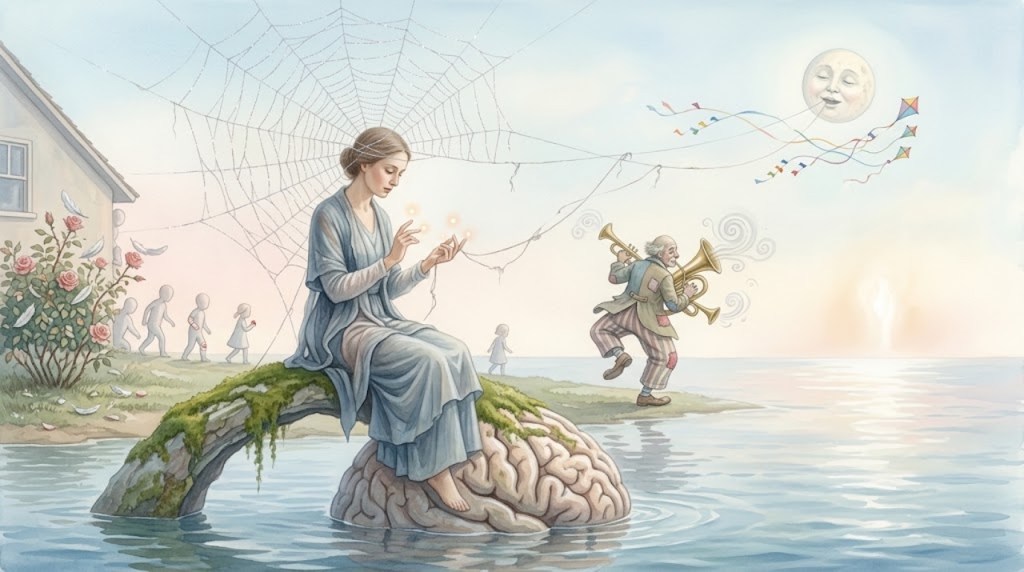
    Image:  Created by Grok inspired by the poem
    Image: Created by Grok inspired by the poem

    Louder than the Moon

    The glow of moon sets me to musing
    On moving in the distance of surprise.

    Fear cannot conquer itself, you might think,
    But how to know courage might also be
    A subject to muse on and to fuse then
    Your sorrow to the ilk of betrayal
    Not searching for the end but the stop.

    The glow of moon sets me again to musing
    On moving surprise into the distance far.

    Doing all I can to state what I mean
    In the space around divided worries
    I will not go beyond words to wield
    The sword of hatred that may blind
    Too many eyeballs blinkered by power.

    The glow of moon musing sets me to wink
    At surprising moves that go the distance.

    After I learn to see and feel and know
    My own will as it exerts itself strong
    I will never sit in the same seat
    Where wrong has overcome right—
    Where night has pretended day.

    The glowing moon is musing on me, inspiring
    Distances with humble, intimate surprises.

    I will question, I will inquire, I will query—
    As I meditate on the glowing light,
    Where I go to transcend, where I move
    And meet this flesh-housed treasure
    That glows louder and brighter than the moon.

  • Emily Dickinson’s “The Soul’s distinct connection”

    Image: Emily Dickinson - Amherst College - Daguerrotype of the poet at age 17, circa 1847 - likely the only authentic, extant likeness of the poet
    Image: Emily Dickinson – Amherst College – Daguerrotype of the poet at age 17, circa 1847 – likely the only authentic, extant likeness of the poet

    Emily Dickinson’s “The Soul’s distinct connection”

    The speaker in Emily Dickinson’s “The Soul’s distinct connection” reveals that immortality is suddenly disclosed through shock and danger experiences.

    Introduction and Text of “The Soul’s distinct connection”

    The speaker presents “The Soul’s distinct connection” as a compressed American-Innovative lyric exploring spiritual perception. Its short lines and slant rimes create a sudden movement from idea to visionary image. The speaker suggests immortality is not gradual knowledge but a flash of direct awareness.

    The speaker frames immortality as something revealed through sudden crisis rather than gradual understanding. The structure anticipates a metaphysical shock that disrupts ordinary perception.

    The Soul’s distinct connection”

    The Soul’s distinct connection
    With immortality
    Is best disclosed by Danger
    Or quick Calamity –

    As Lightning on a Landscape
    Exhibits Sheets of Place –
    Not yet suspected – but for Flash –
    And Click – and Suddenness.

    Commentary on “The Soul’s distinct connection”

    The speaker frames immortality as something revealed through sudden crisis rather than gradual understanding. The structure anticipates a metaphysical shock that disrupts ordinary perception.  Her vision aligns with Paramahansa Yogananda’s teaching that immortality is perceived through sudden inner awakening beyond ordinary awareness.

    First Stanza: The Soul and Immortality

    The Soul’s distinct connection
    With immortality
    Is best disclosed by Danger
    Or quick Calamity –

    In the first stanza, the speaker defines a direct relationship between the soul and immortality, presenting the connection as inherent rather than acquired, embedded within the very structure of consciousness itself. This connection is not continuously visible in ordinary perception, but it becomes evident when danger or sudden calamity interrupts the expected flow of life and thought. 

    Paramahansa Yogananda explains that the soul perceives immortality most clearly when the mind is startled into higher awareness beyond sensory routine, allowing intuitive consciousness to rise above temporal limitation enabling perception of immortality as immediate experience rather than abstract belief grounded in time-bound reasoning.

    In the phrase “Danger / Or quick Calamity,” the speaker emphasizes the disruptive force required to awaken spiritual perception, suggesting that only extreme interruption can break habitual mental patterns. 

    On my literary website Linda’s Literary Home, I have discussed the fact that Dickinson often uses shock imagery to reveal hidden spiritual states, where disruption becomes a gateway to deeper awareness of the soul. 

    Here the speaker suggests that spiritual awareness emerges when normal continuity is broken, forcing consciousness into a heightened state of perception that resembles awakening from illusion aligning consciousness with a sudden intuitive shift beyond habitual cognition.

    Second Stanza: Soul Suddenness

    As Lightning on a Landscape
    Exhibits Sheets of Place –
    Not yet suspected – but for Flash –
    And Click – and Suddenness.

    In the second stanza, the speaker uses lightning as the central image to describe how spiritual perception suddenly reveals the hidden structure of reality, revealing perception as a sudden cognitive rupture rather than a gradual interpretive process unfolding in time. 

    This revelation is not gradual but instantaneous, exposing “Sheets of Place” across the landscape of experience implying hidden dimensionality within ordinary perception itself. 

    Paramahansa Yogananda explains that divine insight often arrives like a flash of lightning, dissolving mental obscurity and awakening superconscious awareness where consciousness transcends linear reasoning and enters intuitive cognition.

    The speaker suggests that reality is composed of layers that are normally invisible, only becoming apparent when perception is abruptly illuminated suggesting that ordinary awareness conceals deeper structures until disrupted by sudden insight. 

    On my literary website Linda’s Literary Home, I have noted that Dickinson compresses vast metaphysical ideas into brief, electric imagery that mimics sudden spiritual awakening where brevity intensifies metaphysical meaning through concentrated symbolic expression that emphasizes non-linear cognition characteristic of mystical experience. 

    This structure mirrors mystical experience, where understanding arrives all at once rather than through linear reasoning reinforcing the immediacy of perception as a sudden cognitive awakening beyond temporal sequence, dissolving fragmentation into unified awareness that transcends sensory division aligning sensory faculties into a single integrated perception of truth.

    The imagery of flash and click emphasizes immediacy, suggesting a sudden recognition of truth that cannot be delayed or extended over time emphasizing that spiritual understanding arrives as a decisive moment rather than gradual accumulation. 

    Paramahansa Yogananda explains that when consciousness rises above sensory limitation, truth is perceived as a single unified moment of clarity marking transformation from illusion to awakened recognition within consciousness. 

    The speaker frames this experience as both visual and auditory, merging perception into one unified spiritual event where poetic compression mirrors expanded metaphysical insight through condensed language.

  • Emily Dickinson’s “The Soul that hath a Guest”

    Image: Emily Dickinson - Amherst College - Daguerrotype of the poet at age 17, circa 1847 - likely the only authentic, extant likeness of the poet
    Image: Emily Dickinson – Amherst College – Daguerrotype of the poet at age 17, circa 1847 – likely the only authentic, extant likeness of the poet

    Emily Dickinson’s “The Soul that hath a Guest”

    Emily Dickinson’s “The Soul that hath a Guest” dramatizes the soul’s complete fulfillment after welcoming the Divine Presence within consciousness.

    Introduction and Text of “The Soul that hath a Guest”

    Emily Dickinson’s “The Soul that hath a Guest” features a speaker contemplating the disposition of a soul that has become inwardly united with the Divine Reality. The compressed little lyric contains only two quatrain stanzas, yet the speaker manages to suggest an entire metaphysical philosophy regarding the soul’s preference for spiritual companionship over worldly diversion.

    The poem advances through two balanced, harmonious movements. The first quatrain establishes the soul’s contentment in remaining inwardly absorbed because of the “Diviner Crowd” dwelling within. The second quatrain stanza reveals that spiritual courtesy itself forbids abandoning one’s inward sanctuary while entertaining “The Emperor of Men.”

    This Dickinsonian drama recalls the teachings of the “Father of Yoga in the West” Paramahansa Yogananda, who often taught that communion with the Divine becomes so absorbing that worldly restlessness naturally diminishes. Dickinson’s speaker reveals the same intuition regarding the soul’s preference for inner bliss over outward entertainment.

    The Soul that hath a Guest

    The Soul that hath a Guest 

    Doth seldom go abroad –
    Diviner Crowd at Home –
    Obliterate the need –

    And Courtesy forbid
    A Host’s departure when
    Upon Himself be visiting
    The Emperor of Men –

    Commentary on “The Soul that hath a Guest”

    Emily Dickinson’s “The Soul that hath a Guest” portrays the soul’s inward fulfillment after receiving the companionship of the Divine Belovèd.

    First Stanza: God and Solitude

    The Soul that hath a Guest
    Doth seldom go abroad –
    Diviner Crowd at Home –
    Obliterate the need –

    The speaker begins with the remarkable assertion that the soul possessing “a Guest” no longer feels compelled to “go abroad.” The term “abroad” suggests worldly involvement, social distraction, and outward seeking among transient pleasures that can never permanently satisfy the human heart. The soul’s newfound inward richness renders external wandering increasingly unnecessary.

    The identity of the “Guest” gradually emerges through implication rather than direct declaration. Dickinson’s speakers often employ riddling language that hints rather than explains.

    And here the speaker permits the reader to infer that the “Guest” is none other than God or Divine Consciousness Itself. The presence of the “Diviner Crowd at Home” confirms that the soul has become inhabited by spiritual reality greater than ordinary earthly companionship.

    The phrase “Diviner Crowd” possesses a curious and mystical resonance because the speaker refers to a singular “Guest” but then transforms that singularity into a “Crowd.” Such language suggests the infinite qualities of Spirit that accompany divine communion: peace, joy, wisdom, harmony, and intuitive understanding. One divine Presence contains more richness than the multitude of worldly associations.

    The speaker then explains that the “Diviner Crowd” can “Obliterate the need.” The verb “obliterate” demonstrates the completeness of spiritual fulfillment because the soul no longer merely suppresses worldly cravings; instead, those cravings dissolve altogether in the greater attraction of divine companionship.

    The speaker understands that spiritual realization does not operate through deprivation but through replacement of lesser satisfactions with greater bliss.  Paramahansa Yogananda frequently emphasized that the soul’s true happiness arises from inward communion with God rather than dependence upon external entertainments. 

    Paramahansa Yogananda teaches, “When you know God as peace within, you will realize Him as peace existing in the universal harmony of all things without.” Dickinson’s speaker reveals that same calm inward certainty resulting from spiritual companionship.

    The speaker’s little drama also focuses on the same theme that Dickinson explores often because of her fascination with the soul’s hidden life.   Her speakers repeatedly suggest that external society pales beside the soul’s own immense inward kingdom. This speaker likewise demonstrates that once the soul discovers the Divine Reality, ordinary worldly movement loses much of its fascination.

    Second Stanza:  God and Hospitality

    And Courtesy forbid
    A Host’s departure when
    Upon Himself be visiting
    The Emperor of Men –

    The second stanza deepens the speaker’s conceit by employing the metaphor of hospitality. The soul now becomes a “Host,” while the divine Presence remains the honored “Guest.” Because the soul is entertaining such exalted company, ordinary “Courtesy” itself forbids departure from the inward sanctuary.

    The speaker’s use of “Courtesy” lends a delicate social elegance to the spiritual circumstance. Even in worldly etiquette, a gracious host would never abandon an honored visitor. Thus, the soul absorbed in divine awareness naturally remains inwardly attentive because no earthly obligation could surpass the importance of entertaining “The Emperor of Men.”

    The final phrase majestically identifies the Guest’s true stature. The “Emperor of Men” clearly symbolizes God as sovereign over all humanity and creation itself. The speaker therefore implies that once divine consciousness enters the soul’s awareness, all lesser attractions become secondary beside the majesty of that Presence.

    Dickinson’s speaker carefully avoids theological dogma while still conveying unmistakable spiritual intimacy. The poem remains experiential rather than doctrinal because the speaker focuses not upon religious systems but upon the soul’s transformed condition after inwardly realizing divine companionship. Such subtlety allows the poem to retain both mystical suggestiveness and artistic restraint.

    Paramahansa Yogananda similarly taught that the soul discovers its deepest fulfillment through interior communion with God. Paramahansa Yogananda explains, “The more you appreciate the divine image in everyone, the more you are alive with God’s consciousness.” 

    Dickinson’s speaker reveals a consciousness already so absorbed in the divine realm that outward movement appears unnecessary in comparison to the bliss of inward companionship.

    The speaker’s reverent inwardness also recalls Paramahansa Yogananda’s frequent emphasis on stillness and soul awareness. Divine realization requires inward receptivity, not ceaseless outward motion. Dickinson’s speaker therefore dramatizes the soul quietly remaining at home because the greatest conceivable Guest already dwells within.

  • Where Soldiers of the Soul Come to Pray

    Image:  Created by Grok inspired by the poem
    Image: Created by Grok inspired by the poem

    Where Soldiers of the Soul Come to Pray

    —after “Who Is in My Temple?”

    The dark rooms of my mind
    Resembled a ramshackle cabin
    Abandoned in the river
    Left to invading rodents,
    Birds building nests in its loft.

    Where did this light come from?
    Who is this that without hands

    Has flipped on the light,
    Cleared out the rodents,
    And caused to scurry all the dim birds
    That long held court in this fluttering space?

    Who has transformed this tumbledown cabin
    Into a fine temple where the soldiers of the soul
    Now come to pray?

  • William Butler Yeats’ “Sailing to Byzantium”

    Image:  William Butler Yeats

    William Butler Yeats’ “Sailing to Byzantium”

    William Butler Yeats’ “Sailing to Byzantium” is a profound meditation on aging, art, and the quest for spiritual transcendence, despite his failure to clearly grasp the Eastern religious/philosophical concepts he strived to portray.

    Introduction and Excerpt from “Sailing to Byzantium”

    William Butler Yeats’ “Sailing to Byzantium” is a profound meditation on aging, art, and the quest for spiritual transcendence. However, despite Yeats’ deep engagement with Eastern religion and philosophy, his interpretation and application of these concepts in his poetry often reveal a “Romantic misunderstanding,” as T.S. Eliot astutely observed. 

    This misunderstanding is clearly evident in “Sailing to Byzantium,” especially in its fourth stanza, where Yeats’ vision of eternal existence through art diverges significantly from Eastern religious/philosophical principles.

    Yeats wrote “Sailing to Byzantium” in 1926, at the age of 61,  as a reflection on the aging process and the spiritual journey required to maintain vitality in the face of physical decline. 

    Sailing to Byzantium

    That is no country for old men. The young
    In one another’s arms, birds in the trees
    —Those dying generations—at their song,
    The salmon-falls, the mackerel-crowded seas,
    Fish, flesh, or fowl, commend all summer long
    Whatever is begotten, born, and dies.
    Caught in that sensual music all neglect
    Monuments of unageing intellect.

    An aged man is but a paltry thing,
    A tattered coat upon a stick, unless
    Soul clap its hands and sing, and louder sing
    For every tatter in its mortal dress,
    Nor is there singing school but studying
    Monuments of its own magnificence;
    And therefore I have sailed the seas and come
    To the holy city of Byzantium.

    O sages standing in God’s holy fire
    As in the gold mosaic of a wall,
    Come from the holy fire, perne in a gyre,
    And be the singing-masters of my soul.
    Consume my heart away; sick with desire
    And fastened to a dying animal
    It knows not what it is; and gather me
    Into the artifice of eternity.

    Once out of nature I shall never take
    My bodily form from any natural thing,
    But such a form as Grecian goldsmiths make
    Of hammered gold and gold enamelling
    To keep a drowsy Emperor awake;
    Or set upon a golden bough to sing
    To lords and ladies of Byzantium
    Of what is past, or passing, or to come.

    Commentary on “Sailing to Byzantium”

    The poem “Sailing to Byzantium” uses a journey to Byzantium (Constantinople now Istanbul,) as a metaphor for a spiritual quest, with the speaker seeking to transcend the limitations of the mortal body and achieve a form of immortality through art.

    First Stanza:  Contrasting Vividly

    That is no country for old men. The young
    In one another’s arms, birds in the trees
    —Those dying generations—at their song,
    The salmon-falls, the mackerel-crowded seas,
    Fish, flesh, or fowl, commend all summer long
    Whatever is begotten, born, and dies.
    Caught in that sensual music all neglect
    Monuments of unageing intellect.

    The opening stanza of “Sailing to Byzantium” presents a vivid contrast between the vitality of youth and the poet’s sense of alienation from the natural world as he ages. Yeats paints a picture of a country teeming with life, where “The young / In one another’s arms, birds in the trees” and “the mackerel-crowded seas” represent the cyclical nature of life and death. 

    The phrase “Those dying generations” underscores the transient nature of all living things, a concept that aligns with Eastern philosophy’s emphasis on impermanence.  However, Yeats’ reaction to this natural cycle reveals a departure from Eastern thought. 

    While Buddhism and Hinduism often advocate for acceptance of life’s impermanence, Yeats expresses a desire to escape it. His assertion that “all neglect / Monuments of unageing intellect” suggests a privileging of human intellect and art over the natural world, a distinctly Western perspective that contradicts the Eastern emphasis on harmony with nature.

    Second Stanza:  Aging and the Quest for Renewal

    An aged man is but a paltry thing,
    A tattered coat upon a stick, unless
    Soul clap its hands and sing, and louder sing
    For every tatter in its mortal dress,
    Nor is there singing school but studying
    Monuments of its own magnificence;
    And therefore I have sailed the seas and come
    To the holy city of Byzantium.

    In the second stanza, Yeats further develops the theme of aging and the quest for spiritual renewal. The image of an aged man as “a paltry thing, / A tattered coat upon a stick” vividly conveys the physical deterioration that comes with age. However, Yeats proposes that this decline can be transcended if the soul can “clap its hands and sing, and louder sing / For every tatter in its mortal dress.”

    This concept of the soul triumphing over bodily decay echoes certain Eastern philosophical ideas, particularly the Hindu concept of the soul, which is the eternal self, transcending the physical body. 

    However, Yeats’ emphasis on the soul’s need to “sing” and study “Monuments of its own magnificence” reveals a more Western, ego-centric approach to spiritual transcendence. In contrast, many Eastern philosophies advocate for the dissolution of the ego and the realization of the soul’s unity with the Divine Reality.

    Third Stanza:  The Concept of Transformation 

    O sages standing in God’s holy fire
    As in the gold mosaic of a wall,
    Come from the holy fire, perne in a gyre,
    And be the singing-masters of my soul.
    Consume my heart away; sick with desire
    And fastened to a dying animal
    It knows not what it is; and gather me
    Into the artifice of eternity.

    The third stanza introduces the “sages standing in God’s holy fire,” whom the speaker implores to be the “singing-masters of my soul.”  This imagery draws on both Western and Eastern concepts, blending Christian imagery of holy fire with the Eastern idea of spiritual masters or gurus. The speaker’s desire to have his heart consumed away and to be gathered into “the artifice of eternity” reflects a yearning for spiritual transformation.

    However, Yeats’ conception of this transformation as an “artifice” created by sages diverges from Eastern philosophical traditions.  In many Eastern spiritual practices, enlightenment or liberation is seen not as an artificial state created by external forces, but as the realization of one’s true nature, of uniting the individual soul with the Oversoul, or God.  Yeats’ portrayal suggests a more Western, interventionist approach to spiritual transformation.

    Fourth Stanza: Romantic Misunderstanding

    Once out of nature I shall never take
    My bodily form from any natural thing,
    But such a form as Grecian goldsmiths make
    Of hammered gold and gold enamelling
    To keep a drowsy Emperor awake;
    Or set upon a golden bough to sing
    To lords and ladies of Byzantium
    Of what is past, or passing, or to come.

    The final stanza of “Sailing to Byzantium” most clearly demonstrates Yeats’ “Romantic misunderstanding” of Eastern philosophy. Here, the speaker envisions his eternal form not as a dissolution into God-consciousness (self-realization), as many Eastern traditions insist, but as a golden artifact created by “Grecian goldsmiths.”  This vision of immortality through art is fundamentally at odds with Eastern concepts of liberation from the cycle of birth and death.

    Yeats’ desire to take a form “Of hammered gold and gold enamelling” to entertain “lords and ladies of Byzantium” reveals a distinctly Western preoccupation with individual identity and artistic legacy. This contrasts sharply with Eastern religious/philosophical concepts such as the Buddhist non-self upon entering nirvana or the Hindu idea of samadhi or liberation from cycles of death and rebirth.

    Furthermore, the speaker’s intention to “sing / To lords and ladies of Byzantium / Of what is past, or passing, or to come” suggests a linear view of time that is more aligned with Western thought than with the cyclical time concepts expounded in Eastern religion/philosophy.

    While “Sailing to Byzantium” is undoubtedly a masterpiece of poetic craft, it also reveals the limitations of Yeats’ understanding and application of Eastern philosophical concepts. 

    His vision of spiritual transcendence, particularly as expressed in the fourth stanza, remains rooted in Western ideas of individual immortality and artistic legacy, rather than the Eastern concepts of ego dissolution and unity with the Divine Creator. 

    This “Romantic misunderstanding” of Eastern philosophy, as Eliot termed it, is indeed on full display in this poem, showcasing both the brilliance of Yeats’ poetic vision and the cultural limitations that shaped his interpretation of Eastern thought.

    🕉

    You are welcome to join me on the following social media:
    TruthSocial, Locals, Gettr, X, Bluesky, Facebook, Pinterest 

    🕉

    Share

  • Gerard Manley Hopkins’ “To seem the stranger lies my lot, my life”

    Gerard Manley Hopkins – National Portrait Gallery, London

    Gerard Manley Hopkins’ “To seem the stranger lies my lot, my life”

    The speaker in Gerard Manley Hopkins’ sonnet “To seem the stranger lies my lot, my life” explores the sense of spiritual, national, and personal estrangement during years in Ireland.  Written with the same intensity that characterizes Hopkins’ work, the poem dramatizes exile as both an external condition and an inward trial. 

    In the octave, the speaker is focusing on separation from family and his country England, and in the sestet, he turns inward to the silence imposed by his vocation, leaving him isolated yet faithful.

    Introduction and Text of “To seem the stranger lies my lot, my life”

    Father Gerard Manley Hopkins, who was a Jesuit priest as well as a poet, wrote many of his most profound poems during periods of emotional strain and vocational doubt.  He wrote “To seem the stranger lies my lot, my life” in 1889 during his final years in Ireland; he created a speaker in the poem who is reflecting an acute sense of displacement—geographical, familial, and spiritual. 

    Although Father Hopkins remained consistently obedient to his religious calling, he often felt alienated from England, misunderstood by authority, and silenced as a poet. This sonnet, however, reveals not rebellion but suffering endured with disciplined faith, unveiling exile as a severe trial for spiritual testing.

    As the first of the six “terrible sonnets,” “To seem the stranger lies my lot, my life” remains distinctive because its sense of despair is aimed less at abstract spiritual terror and more at everyday human loss—failed relationships, missed vocations, and social estrangement. 

    However, like the others, it offers little comfort and speaks in a raw, urgent voice.  It is unusual in how little it turns to nature or directly to Christ. Instead, it keeps its focus on the speaker’s painful isolation from family, community, and any sense of being useful as a priest.

    To seem the stranger lies my lot, my life

    To seem the stranger lies my lot, my life
    Among strangers. Father and mother dear,
    Brothers and sisters are in Christ not near
    And he my peace my parting, sword and strife.
    England, whose honour O all my heart woos, wife
    To my creating thought, would neither hear
    Me, were I pleading, plead nor do I: I wear-
    y of idle a being but by where wars are rife.

    I am in Ireland now; now I am at a thírd
    Remove. Not but in all removes I can
    Kind love both give and get. Only what word
    Wisest my heart breeds dark heaven’s baffling ban
    Bars or hell’s spell thwarts. This to hoard unheard,
    Heard unheeded, leaves me a lonely began.

    Reading

    Commentary on “To seem the stranger lies my lot, my life”

    Father Hopkins’ sonnet is a meditation on exile and silence. The octave emphasizes outward separation—from family, country, and recognition—while the sestet deepens the conflict by revealing an inward blockage: the poet’s inability to speak or be heard. 

    Octave: “To seem the stranger lies my lot, my life”

    To seem the stranger lies my lot, my life
    Among strangers. Father and mother dear,
    Brothers and sisters are in Christ not near
    And he my peace my parting, sword and strife.
    England, whose honour O all my heart woos, wife
    To my creating thought, would neither hear
    Me, were I pleading, plead nor do I: I wear-
    y of idle a being but by where wars are rife.

    The speaker open the octave with a stark declaration: “To seem the stranger lies my lot, my life.” The phrasing is deliberate and emphatic, with “lot” and “life” placed side by side to suggest that estrangement is not incidental but foundational. The speaker does not merely feel like a stranger; seeming a stranger has become the defining pattern of his existence. The verb “lies” suggests fate or destiny, implying that this condition is imposed rather than chosen.

    The repetition of “stranger” in the second line—“Among strangers”—reinforces the sense of isolation. The speaker is not simply alone; he is surrounded by others from whom he feels fundamentally divided. This alienation is then specified in personal terms: separation from “Father and mother dear” and from “Brothers and sisters.” 

    These lines resonate deeply, as Hopkins had consciously embraced a religious vocation at the cost of ordinary familial intimacy. Yet the phrase “are in Christ not near” reveals a crucial nuance. The separation is not merely geographical or emotional but mediated through faith. His family exists “in Christ,” but spiritual unity does not erase physical absence.

    Line four intensifies the tension through paradox: “And he my peace my parting, sword and strife.” The “he” here refers unmistakably to Christ, echoing Christ’s own words in the Gospel that he came not to bring peace but a sword. 

    Christ is simultaneously the speaker’s source of peace and the cause of painful division.  This line crystallizes the poem’s central conflict: obedience to God has fractured his earthly attachments.

    England emerges next as a figure of longing and betrayal. The speaker personifies the nation as a beloved woman: “England, whose honour O all my heart woos, wife / To my creating thought.” England is not merely homeland; it is the imaginative and cultural source of his poetry. 

    The speaker’s “creating thought” is bound to England’s landscape, language, and traditions. Yet this beloved “wife” refuses to listen. England “would neither hear / Me, were I pleading.” The rejection is imagined even before the plea is made.

    Significantly, the speaker then states, “plead nor do I.” Either Pride, humility, or exhaustion restrains him from petitioning for recognition or return. The enjambment underscores weariness: “I wear- / y of idle a being but by where wars are rife.” The broken word “weary” visually enacts fatigue. 

    The speaker feels useless, idle, unless he is placed where conflict exists. The “wars” here may be literal—cultural and political unrest in Ireland—or spiritual, referring to inner trials. Either way, the octave closes with a man who sees struggle as the only justification for his continued existence.

    Throughout the octave, the speaker’s syntax becomes knotted and his clauses have become compressed. This density mirrors his emotional burden. There is no lyric ease, no pastoral consolation. Instead, the octave establishes exile as a lived reality—accepted but not softened.

    Sestet: “I am in Ireland now; now I am at a thírd”

    I am in Ireland now; now I am at a thírd
    Remove. Not but in all removes I can
    Kind love both give and get. Only what word
    Wisest my heart breeds dark heaven’s baffling ban
    Bars or hell’s spell thwarts. This to hoard unheard,
    Heard unheeded, leaves me a lonely began.

    The sestet shifts from the general condition of estrangement to a precise location: “I am in Ireland now.” The repetition of “now” emphasizes immediacy and finality. Ireland is not a temporary assignment but a present, enduring state. 

    The speaker then deepens the sense of displacement by calling this “a thírd / Remove.” The word “remove” suggests not travel but distance layered upon distance—England removed from family, and Ireland removed yet again from England.

    (Note the acute accent mark over the “i” in third:  Hopkins often placed accent marks to indicate a stress that might be passed over in a quick reading.  He wanted to assure that his sprung rhythm received its full impact.)

    The speaker then immediately qualifies this isolation: “Not but in all removes I can / Kind love both give and get.” Despite exile, he affirms the possibility of charity. This assertion is a theologically critical.

    Love is not extinguished by displacement; grace operates even in separation. The line resists self-pity and aligns the speaker’s world view with Jesuit discipline, which demands adaptability and service wherever one is sent.

    However, the speaker’s deepest anguish follows:  “Only what word / Wisest my heart breeds dark heaven’s baffling ban / Bars or hell’s spell thwarts.” Here the speaker turns inward, focusing not on where he is but on what he cannot do. His “wisest” words—his poetry—are blocked. 

    Heaven itself seems to be imposing a “ban,” a prohibition that frustrates expression. The phrase “dark heaven” is especially striking. Heaven, normally associated with clarity and illumination, becomes obscure and baffling.  The alternative force is equally terrifying: “hell’s spell.” Whether divine silence or demonic interference, the result is the same—his words are thwarted. 

    This line reveals one of the most painful aspects of the poet’s late life: the sense that his poetic gift, given by God, is simultaneously withheld by God. Silence becomes both command and punishment.

    The final couplet intensifies the tragedy: “This to hoard unheard, / Heard unheeded, leaves me a lonely began.” The speaker is forced to “hoard” his words, storing them without release. Even when heard, they are “unheeded.” 

    The repetition emphasizes futility. The phrase “a lonely began” is deliberately and strangely ungrammatical. “Began” suggests something unfinished, a life or vocation that never reached fulfillment.  The speaker is not calling himself a failure, but he is implying that he feel incomplete.

    Yet even here, the speaker sees despair as part of his discipline. He is not accusing God; he is only lamenting his lot.  The speaker conclude his revelation with witness not rebellion.  The speaker is recording his condition faithfully; he trusts that meaning may lie well beyond his own understanding. Although the loneliness is real, he can bear it through obedience.

    In the sestet, then, exile becomes interiorized. The outer fact of Ireland gives way to the inner trial of silence.  The speaker’s greatest suffering is not being far from England but being cut off from utterance. 

    For this speaker, this wound is the deepest. Yet the very existence of the poem contradicts the ban it describes. In writing this sonnet, the poet speaks from within silence, transforming isolation into testimony.

    Taken together, the octave and sestet reveal a soul suspended between fidelity and desolation. “To seem the stranger lies my lot, my life” is not a cry for rescue but a record of endurance. 

    The speaker/poet accepts exile as part of his vocation, even when it costs him voice, recognition, and comfort. The sonnet stands as one of his most austere achievements—a poem that does not resolve suffering but sanctifies it through truthful speech.