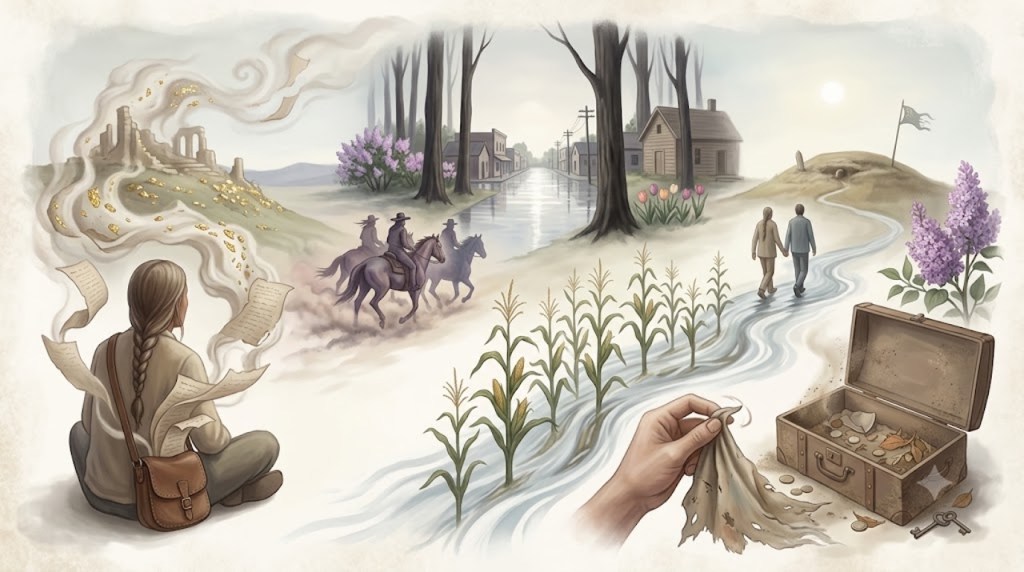
You belong to that world of long braids, and pipesmoke coats papers you pull out of your weathered bag and hand me and riddle my brain. Your poetry is what I think ancient ruins are made of. Gold glimmering from the domes of exotic dreams. Riders on horseback come dragging in the dust of a Montana evening and you capture their essence, and the streets of this Indiana town shine in the rain as it blackens the tree trunks,
then the yard shines, smell that rain and remember when the lilacs first tempted you to spring. Our lives sprawl out before us begging us to inspect them and spindle the corners and ransack the trunks for bits of our living. You have an eye that gathers the corn and when I finally squeeze out a word
about how cold the river was that May, even though the tulips flooded the houses on Main Street, you look so surprised that I remember, and I have to remind you that I have lived here a long time, even longer than when I knew you, took summer classes, drove a car without a license, but I didn’t mean to confess, and I know you
wouldn’t let me confess any real sins, like the ones I committed when I thought feminism had arrived to save the world, before I knew that each soul has to save its own life,
but you didn’t know me then, and I am always so glad, because that was not me, the person you see here and care to listen to; I have news and a flag, and as we walk to the burial ground where the chief proclaimed this land sacred,
I know you feel the stream flowing under our feet and you hear the call to come home.
Remembering the beautiful soul of a friend and fellow poet
This heart bore the weight of a drifting cloud, Echoing winds that gathered at your voice. I watched your steady stance before the crowd— The youth in me yearned for your compass-light.
Not like a father, not like flame, more like a pole star. You sensed it too but kept your orbit clean, As honor demands. Vows are like planted seeds Kept in the garden soil of thought.
Years before our encounter, A gifted wordsmith scribbled me into fog, Through brittle leaves and frost-laced paths we stumbled. But frost gave way to dew-soaked petals, Then meadow runners cut through the grass Beyond the chapel stones.
He cannot equal you—except in the call to art. Both gave me canvas, color, possibilities. And seeing now how all fields lead to dusk, The harvest waits—calm as the grain that bends in wind.
Crossing this field, slow, purposeful, Nothing roots the rhythm of the day— Your essence and mine will scatter Through the breath of the Divine,
But only the Divine knows The shape of how and why—or if . . .
In his poem, “The Hill Maiden,” Malcolm M. Sedam has created a speaker voicing cheerful vaticination that his teenage angst-ridden protégé will one day shed her nihilism and burst into life affirming joy. The best teachers are those who can inspire as well as instruct their students. This poem represents a stellar example of that kind of inspirational educator.
Introduction and Text of “The Hill Maiden”
Malcolm M. Sedam‘s “The Hill Maiden” features a teacher dramatizing his observations about a particularly inquisitive but melancholy student. His ultimate purpose is to instill in the student the notion that she will ultimately be able to appreciate the life that she seems to disdain.
The poem plays out in three movements of unrimed stanzas. This organization allows the speaker to touch lightly on the physical reality of the subject but then move more intensely to the mental and finally the spiritual possibility of the subject’s inclinations.
Because the speaker can only infer certain facts about his student, the poem remains metaphorically and imagistically implicative instead of unequivocally literal. For example, the teacher has no exact idea what the student does at her home; thus he places her in an image of “moving among the phantom rocks of reverie.”
The teacher/speaker knows from the negativity the student has been expressing to him that she mentally resides among hardness that causes her to imagine that things are worse than they are.
Mentally she travels like a rocket through her ghostly musings until night fall when she sleeps but likely gets little rest, accounting for the nervous, brittle energy the educator perceives in his young scholar.
Likely the adolescent girl is simply suffering the turbulence of teenage angst through which most individuals of that age group must travel. But the best, most effective teachers are those who can inspire as well as instruct their students. This poem represents a stellar example of that kind of inspirational educator.
As an educator, Mr. Malcolm M. Sedam wrote poems to many of his students, always with the goal of inspiring them to high thinking and plain living. Mr. Sedam once said he felt that his function as an educator was “to kick the dirt off of his students.” By that he meant to help them see life more clearly without the fog of stereotypes, prejudice, and provincialism.
The Hill Maiden
(for Linda, over in the valley)
She is moving among the phantom Rocks of reverie hurtling through By mind bringing days into darkness Where the pull of growth rings The heart and spurs the soul
Where her wish strings questions In the mysterious night of snow Bringing a promise that only the hills can sing. Her smile waits behind a frown of swords That rend her days
In the melancholy of the deep valley Of dreams where she lives among flowers Gathering her moods that may bring peace Once the sorrow of lonely distance Has closed on hands—
The same hands that Zen-like reach To answer each knock at the door of her heart Broken to be mended by tender time. Her mind is speeding through a galaxy Of intensity where the blood rose
Will speak to her frozen will All forgiven by decree in warring winds— The nature of her plight? Without wings She will still spring into flight.
Commentary on “The Hill Maiden”
Malcolm M. Sedam’s “The Hill Maiden” features a teacher, who is also a practicing poet, dramatizing his observance of an inquisitively intelligent but extremely melancholy student.
His only purpose is to instill in the student the notion that she will ultimately be able to appreciate the life that she seems now to disdain.
First Movement: Dreaming amongst the Hills
She is moving among the phantom Rocks of reverie hurtling through By mind bringing days into darkness Where the pull of growth rings The heart and spurs the soul
Where her wish strings questions In the mysterious night of snow Bringing a promise that only the hills can sing.
The speaker begins by placing the object of his speculative musing in an image that implies sharp but dream-like rigidity. Rocks appear ghost-like through a dream-scape as they bewilder the mental musings of the young girl with whom the mature educator is engaging both as a poetry mentor as well as a teacher.
Teachers often counsel their students who seek out their advice and direction even in issues outside of the academic sphere as well as within the educational arena. Those teachers who must essentially become counselors will either direct the students to other professionals, or they will attempt to offer their own gleanings from their life experience.
The teacher in this poem demonstrates that he is the latter kind of teacher, and he has given the mind of the young student some serious analysis. Thus he not only describes her environment, but he also speculates and then foreshadows what is likely to befall the girl once she is able to erase her current adolescent fog.
Until that glowing day arrives, however, the speaker sees that the girl’s maturing process weighs heavily on her heart and soul. She is full of questions brought on by the mystery of life.
The “snow” that brings beauty as it covers the hills also brings bitter cold and slippery conditions the cause the girl to miss the music that her hill-valley home affords her.
By pointing out these images of beauty and placing them a context of mystery and difficulty, the speaker hopes to allow his charge to contemplate the possibility that life is real and offers hope to those who search its reaches with an open mind and cheerful heart.
Second Movement: Frowning Swords
Her smile waits behind a frown of swords That rend her days
In the melancholy of the deep valley Of dreams where she lives among flowers Gathering her moods that may bring peace Once the sorrow of lonely distance Has closed on hands—
The same hands that Zen-like reach To answer each knock at the door of her heart Broken to be mended by tender time.
The speaker has observed the teen’s unwillingness to show a cheerful countenance. Her bitterness “behind a frown of swords” likely often gives the mentor a shudder at the likelihood that the girl is suffering intensely.
No doubt, he believes that at this point in her life, she should be dancing merrily among “flowers” and allowing her sorrowful moods to dissolve in the “deep valley of dreams.”
But again, he returns to prognostication that once she has learned to fold her hands in wonder and listen to the love that knocks at the “door of her heart,” her melancholy will be rendered null and void as “tender time” moves her through the rough spots of her anguish.
Again, the speaker chooses beauty—”flowers gathering”—to balance the “frown.” He offers the image of the heart’s door to harmonize with the environment that will reach her with the “Zen-like” hands of mystery and the ultimate gain-of-wisdom.
Like a Zen koan, the riddle of life will remain before her as she continues to search for answers to her perplexing questions.
Third Movement: Springing into Flight
Her mind is speeding through a galaxy Of intensity where the blood rose
Will speak to her frozen will All forgiven by decree in warring winds— The nature of her plight? Without wings She will still spring into flight.
Finally, the speaker makes his most striking vaticination after asserting that his young charge has a strong mind but also a tender heart that is quick to show intense emotion.
That the “blood rose” will speak itself undeniably to the girl’s will portends that all of her negativity and nihilism will be “forgiven” as she continues to navigate through the conflicts that life bestows on all searching souls.
Then the speaker offers the question that he is likely very content to answer. The frustrating situation that befuddles the young scholar’s mind and heart has been implied by all the imagery that went before, but then what will eventually be the path chosen by and/or for the student?
She will be able to navigate through all the trials and tribulations as a bird that so easily lifts it wings to the wind and takes to the air through the abundant space of sky.
The speaker is not so naïve as to insist that such navigation will come easily, but he does remain assured that the path will open to the girl, and she will become willing to follow it. Thus the speaker can conclude affirmatively that “Without wings, she will still spring into flight.”
Offered by a beloved and well-respected mentor, such faith in a young scholar’s ability to navigate life is bound to redound in blessings, despite the pitfalls and rough spots that her life, no doubt, will place sphinx-life before her mind and heart.