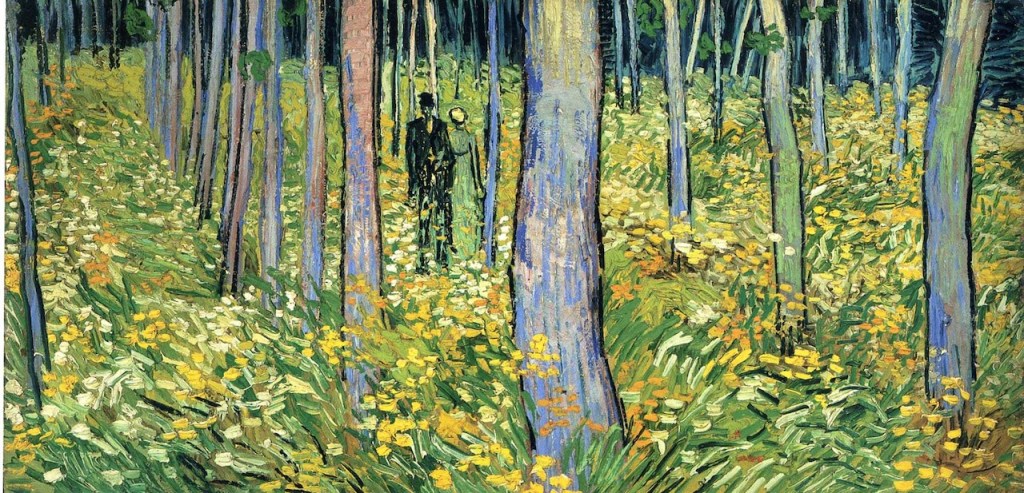
We walked out that day to get some air, the conversation had left me not knowing if we were coming or going,
the trees are a comfort always. even if you held my hand you would not touch my heart you could not say my name your tongue forked my brain,
your eyes reflected the lush, my yellow moon face opened to you like the wildflowers expectant, holding back nothing offering up to you everything,
when you spoke, you seemed to address the trees, you said they would build a sturdy bed for you and your bride. if i could hide here, i would not feel the need to tell you that she will
crash as soon as she eyes you face to face, as soon as she knows what i have learned about your poisoned honey; she is sinking in kisses, you are prickling beneath your smooth lies popping like mushrooms.
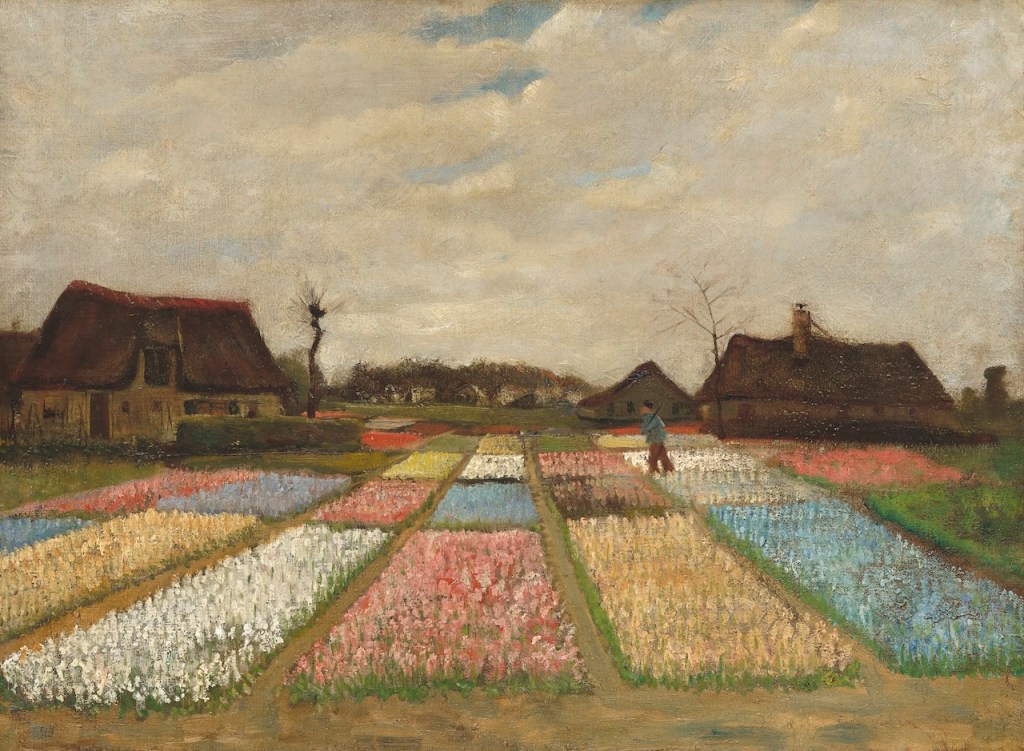
Who is that man walking between the white tulips Carrying a rifle? we will hunker down out of sight Until he has passed. he will probably disappear beyond That cottage in a moment and then we can pull up close To the tulips and watch their lips cup the bees. you Will say my lips are the color of the frosty pinks, and I Will say your eyes match the dreamy blues. someday, I tell you, I will have a dress like those golden-hues and You will have a shirt as delicious as the peach-blush. You tell me that your mother grows beautiful flowers, But she has never been able to cultivate a healthy African violet, so I say, let’s go back into the house And I pick one out for her. you take her the plant. And leave me contemplating the painting. years Of contemplating and many poems later I study the Flower Beds in Holland and wonder About the African violet in your mother’s house.
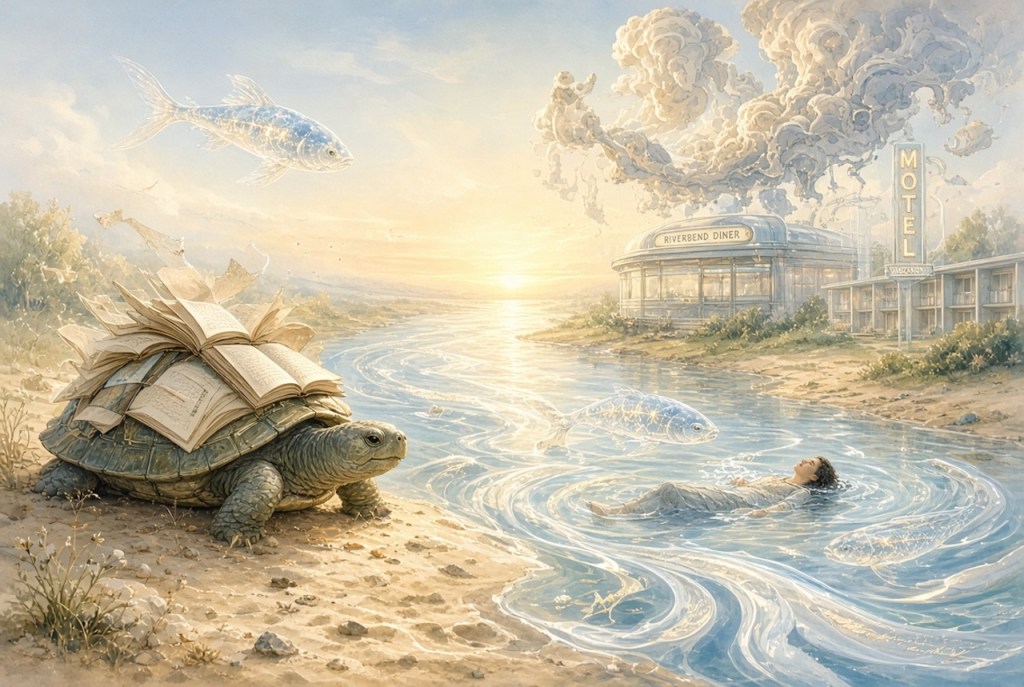
They have plowed, sowed, And reaped their fields in peace. Upon the riverbanks, They cast their eye. Yet, they have never prayed For quick release From tasks that last Until the last goodbye. They went about on wings, Helped others rise. They raised their food And used their useful tools. Their little worries sparked With shouts and cries, But then their product proved They knew the rules.
Bridges, buildings, gardens Grew year by year. Their music wafted nightly From their strings. Exalted words went Sparkling far and near: The king would dance, And then the queen could sing. They plowed the fields And many came to see That rustic life As robust as a tree.
II. The Fisherman
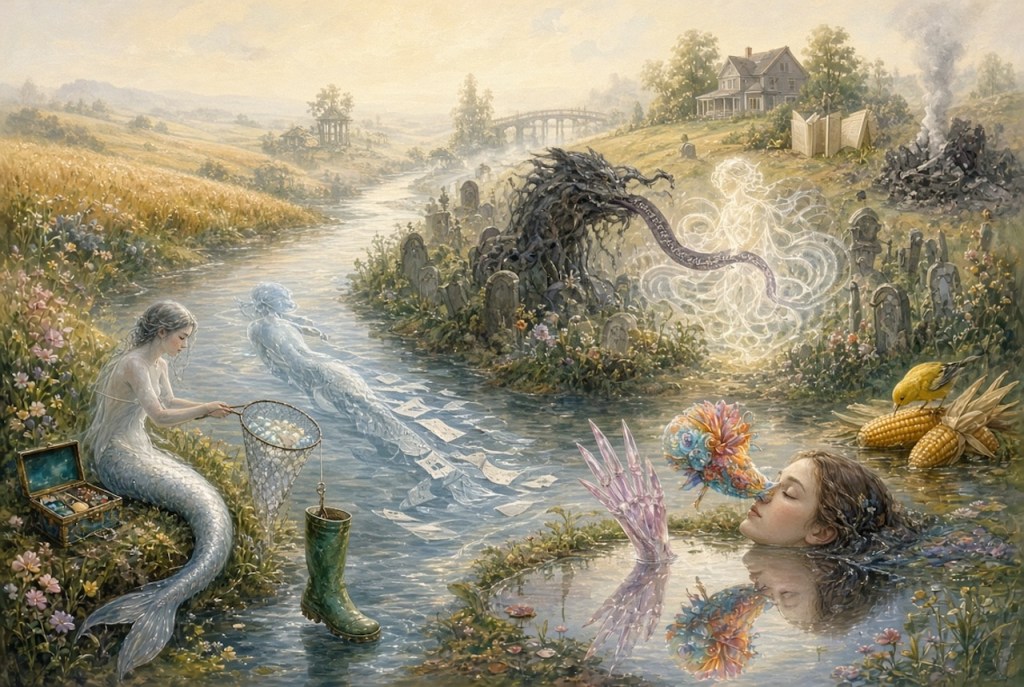
I used to write poems that left a fish smell on the page. You had to scale them to taste them so they left too much of me out And made me sound as if I were about to sprout Fins, but that was before I met the man with the net— The man whose tackle box opened like Pandora’s.
He tried to humor me with night crawlers big a fingers, Called me his little mermaid, which made me half happy. We’d sit by the river, his pole in his hand ready to land a big one.
Once I asked him to let me hold it but he said My hands were too small and being a woman I wouldn’t give enough slack to the line.
Suddenly, he yelled, “I got one! It’s big! Grab the net!” I grabbed it, handed it to him, Then jumped in a started swimming upstream.
As I looked back, I saw him Pulling his hook out of a big, green, rubber boot.
I used to write poems that left a fish smell on the page, But that was before I met the fisherman who showed me his sole.
III. Never Poke a Rough Beast from the Past
Never poke a rough beast from the past: Likely, you will find yourself ambling Among tombstones in the rain Through a ramshackle garden From which you fled So many years ago.
Out of that moldy drizzle, you emerged. Into healing waves, you progressed.
From a death-star specter, into the life-breathing spirit, You returned, grateful that the Unsensed Force Had directed your return home, Where poetry could spray in joy.
Never poke a rough beast from the past, Unless you are willing to be singed By the bile spewing through his forked tongue. Unleashing his aggressions, he is rabid To strangle you with his tangled verbiage, To erase you as he covets your triumphs.
Never poke a rough beast from the past— The present will secure your future As you walk in Spirit.
IV. A Colorful Flowerhorn
The incarnation began with a bright foot Curling her toes in the dark hours— She confessed to greater sins In the brute waters of the river Where she gasped as she Imagined she was drowning In the muddy gloom of the dark waters. She was without canoe or paddles As a colorful flowerhorn bloomed from her nose; She sought myriad breathes In the steel blanks of the rose rims. The colorful flowerhorn loomed Before her bulging eyeballs Searching the reaches of a netherworld. She would not sense the essence Of some monster’s soul. Her pink fingers become knives. A yellow finch pecks at ears of corn. She can no longer feel her hands. Her head no longer moves to speak. She snores but does not wake up yet Until morning blasts sunlight through the window. Staggering to the bathroom Nearly falling over the colorful flowerhorn She squeaks the shower tap Starts in relief That she sees water and not blood— A quick glance at the mirror, And the colossal flowerhorn blooms again from her nose. She is ready to meet the new day.
V. City Slacker
Richmond, Indiana, April 1968
His preening smothered his brain. His high school shelved him Into the Air Force Which booted him for acting Like a loon. He grew up In the north end, married A co-ed, country girl way south Of the south end— Two wrong sides of all the tracks, But he did own a set Of Encyclopaedia Britannica.
The day the town exploded, He took his wife for a walk To look at the rubble. Back In their tiny apartment, He returned to his Machinations in lunacy; She went on stumbling Down the course That would blow up Inevitably in divorce.
Maybe his memories are locked Under a grin With rolling paper bags To keep them in. He probably pushes doll dresses Or stages wakes. You won’t see him in the thick Of things like shipwrecks, Although he might canoe downstream, If someone else paddles. He may use tools with short handles But no one knows where he keeps them. He is not a mystery, only a puzzle With a few missing pieces. He is volcanic but not violent. His flair for luster is sometimes bold. His lack of tolerance is rolled In mixed nerves and senses. He could be struggling for self-seizure Or maybe he is just getting off on the flowertops And saving the stems for later.
Image: Emily Dickinson – Amherst College – Daguerrotype of the poet at age 17, circa 1847 – likely the only authentic, extant likeness of the poet
Emily Dickinson’s “‘Sown in dishonor’!”
Emily Dickinson’s “‘Sown in dishonor’!” reveals the speaker’s firm suspicion that the human form does not begin in shame or decay. She asserts its inherent fineness with quiet certainty. She is likely aware of the decadent original of the material level of existence, but her deep faith that that level derives from Spirit keeps her from dishonoring any extant form.
Introduction and Text of “‘Sown in dishonor’!”
In Emily Dickinson’s “‘Sown in dishonor’!,” the speaker of the poem addresses a scriptural claim about the body’s origin. She questions the notion of dishonor attached to physical existence and finds the idea itself doubtful.
The speaker wonders aloud whether such dishonor can truly exist. She declares that if she possessed even half the excellence of that form, she would remain oblivious to others. Her focus rests on inner worth rather than external judgment.
On a second note, she turns to the companion claim of corruption. She slows the assertion at once and finds the Apostle’s account somewhat misaligned with deeper, spiritual truth. The biblical narrative merely records certain events without settling the matter of the body’s true nature.
“Sown in dishonor”!
“Sown in dishonor”! Ah! Indeed! May this “dishonor” be? If I were half so fine myself I’d notice nobody!
“Sown In corruption”! Not so fast! Apostle is askew! Corinthians I. 15. narrates A Circumstance or two!
Commentary on “‘Sown in dishonor’!”
Emily Dickinson’s “‘Sown in dishonor’!” reveals the speaker’s confidence in the body’s essential dignity. She refuses to accept suggestions of initial shame or decay.
First Stanza: “‘Sown in dishonor’!”
“Sown in dishonor”! Ah! Indeed! May this “dishonor” be? If I were half so fine myself I’d notice nobody!
In the first stanza, the speaker echoes the scriptural phrase with a sharp note of surprise. She registers the claim of dishonor and then questions its validity at once. The word itself becomes doubtful under her scrutiny. She asks whether such dishonor can truly apply. Her tone carries quiet defiance rather than acceptance. The query opens space for a different understanding of the physical form.
The speaker then offers a personal measure of worth. If she possessed even half the excellence that she attributes to that form, she would remain unaware of surrounding opinions. Outer judgments would lose all force.
This stance privileges inner evidence over public valuation. In my earlier essays on Dickinsonian poems, I have discussed the speaker’s habit of challenging the value of outer awareness when contrasted to inner realization. The same exercise appears here with calm assurance.
Paramahansa Yogananda explains that the soul is immortal and is not slain when the body is killed. The physical form therefore cannot begin in true dishonor, for it houses an eternal essence. The Dickinsonian speaker’s confidence rests on that same recognition of inherent fineness.
Second Stanza: “‘Sown In corruption’!”
“Sown In corruption”! Not so fast! Apostle is askew!
In the second stanza the speaker addresses the companion claim of corruption. She halts the assertion immediately with a firm command. The pace of acceptance must slow before any final judgment is reached. She finds the Apostle’s position again misaligned with deeper reality. The statement stands askew rather than true. Her correction arrives without hesitation or apology.
The speaker then notes that the cited chapter simply narrates certain events. It records a circumstance or two without exhausting the full truth of the body’s nature. The narrative remains partial rather than conclusive.
This measured response continues the speaker’s preference for direct inner insight. Contemplative musing on the scriptural text leads her to reject any notion of initial decay. The form itself carries no such stain.
Paramahansa Yogananda explains that man is essentially of incorporeal nature and that the soul outlasts every physical change. The Dickinsonian speaker’s refusal of corruption aligns with that enduring spiritual identity. Her quiet correction upholds the body’s deeper dignity.
Image: SRF Mother Center Lotus – Photo by Ron W. G.
My Spiritual Sanctuary
My spiritual journey began in earnest in 1978, when I became a devotee of Paramahansa Yogananda’s teachings and a member of his organization Self-Realization Fellowship. As a Kriyaban since 1979, I have completed the four Kriya Initiations, and I continue to study the teachings and practice the yoga techniques as taught by the great spiritual leader, who is considered to be the “Father of Yoga in the West.”
I practice the chants taught by the great guru accompanying myself on the harmonium and serve at the local SRF Meditation Group as one of the chant leaders.
“By ignoble whips of pain, man is driven at last into the Infinite Presence, whose beauty alone should lure him.” –a wandering sadhu, quoted in Autobiography of a Yogi by Paramahansa Yogananda
Salvation Is a Personal Responsibility
I am a Self-Realization Yogi because the teachings of Paramahansa Yogananda, who in 1920 founded Self-Realization Fellowship, make sense to me. Paramahansa Yogananda teaches that we are immortal souls, already connected to the Divine Reality, but we have to “realize” that divine connection.
Knowing the Great Spirit (God) is not dependent upon merely claiming to believe in a divine personage, or even merely following the precepts of a religion such as the Ten Commandments.
Knowing the Creator is dependent upon “realizing” that the soul is united with that Creator. To achieve that realization we have to develop our physical, mental, and spiritual bodies through exercise, scientific techniques, and meditation.
There are many good theorists who can help us understand why proper behavior is important for our lives and society, but Paramahansa Yogananda’s teachings offer definite, scientific techniques that we practice in order to realize our oneness with the Divine Power or God.
It makes sense to me that my salvation should be primarily my own responsibility.
No Religious Tradition
I did not grow up with a religious tradition. My mother was a Baptist, who claimed that at one time she felt she was saved, but then she backslid. I learned some hymns from my mother. But she never connected behavior with religion.
My father was forced to attend church when he was young, and he complained that his church clothes were uncomfortable as was sitting on the hard pews.
My father disbelieved in the miracles of Jesus, and he poked fun at people who claimed to have seen Jesus “in the bean rows.” My mother would not have doubted that a person might see Jesus, because she saw her father after he had died.
My mother characterized my father as agnostic, and she lived like an agnostic, but deep down I think she was a believer after the Baptist faith.
Here’s a little story that demonstrates how ignorant about religion I was as a child: When I was in first or second grade, I had a friend. At recess one day at the swings, she wanted to confide something to me, and she wanted me to keep it secret.
She said I probably wouldn’t believe it, but she still wanted to tell me. I encouraged her to tell me; it seemed exciting to be getting some kind of secret information. So she whispered in my ear, “I am a Quaker.”
I had no idea what that was. I thought she was saying she was magic like a fairy or an elf or something. So I said, “Well, do something to prove it.” It was my friend’s turn to be confused then.
She just looked very solemn. So I asked her to do something else to prove it. I can’t remember the rest of this, but the point is that I was so ignorant about religion.
The Void in My Life and My First Trauma
Looking back on my life as a child, teenager, young adult, and adult up to the age of 32, I realize that the lack of a religious tradition left a great void in my life. Although my father was on the fence regarding religion, he would listen to Billy Graham preach on TV.
I hated it whenever Billy Graham was preaching on TV. His message scared me. Something like the way I felt when my father’s mother would come and visit us, and when my father would let out a “Goddam” or other such swear word, Granny would say he was going to hell for talking that way.
I was afraid for my father. And Billy Graham made me afraid for myself and all of us because we did not attend church. I never believed that things like swearing and masturbation could send a soul to hell. But then back then I had no concept of “soul” or “hell.” I believed it was wrong to kill, steal, and to lie. But I’m not sure how these proscripts were taught to me.
I guess by example. It seems that I had no real need for God and spirituality until I was around thirty years old.
My life went fairly smoothly except for two major traumas before age thirty. The first trauma was experiencing a broken heart at age eighteen and then undergoing a failed marriage, after which I thought I would never find a mate to love me. But I did meet a wonderful soulmate when I was 27.
Heretofore I had thought finding the proper marriage partner would solve all my problems, but I learned that my difficulties were very personal and at the level where we are all totally alone, despite any outward relationships.
The Second Trauma
A second trauma that added to my confusion was being fired twice from the same job at ages 22 and 27. By age 27 things started to make no sense. And it started to bother me intensely that things made no sense.
I had always been a good student in grade school and high school, and I was fairly good in college, graduating from Miami University with a 3.0 average. That grade point average bothered me because I thought I was better than that, but I guess I was wrong.
But then not being able to keep my teaching job and not being able to find another one after I had lost it very much confused me. It seemed that I had lost touch with the world. School had been my world, and my teachers and professors had expected great things from me. But there I was at age 27 and couldn’t get connected to school again.
Feminism and Zen
I began reading feminist literature starting with Betty Friedan’s Feminine Mystique, continuing with Ms. Magazine, and many others. The result of taking in the feminist creed led me to believe that I had someone to blame for my failure—men; men had caused the world to be arranged so that women cannot succeed outside the home.
I began writing again, an endeavor I have sporadically engaged in most of my life from about age sixteen.
I decided to apply for a graduate assistantship in English at Ball State University, feeling that I was ready to get out in the man’s world and show it what a woman could do. I felt confident that I could succeed now that I knew what the problem was. But that didn’t work out either.
I finished the year without a master’s degree in English, and then there I was, confused again, and still searching for something that made sense.
I had heard about the Eastern philosophy known as “Zen” at Ball State, and I started reading a lot about that philosophy. Zen helped me realize that men were not the problem, attitude was. I kept on writing, accumulating many poems, some of which I still admire.
And I kept reading Zen, especially Alan Watts, but after a while the same ideas just kept reappearing with no real resolution, that is, even though the Zen philosophy did help me understand the world better, it was not really enough. I got the sense that only I could control my life, but just how to control it was still pretty much a mystery.
Autobiography of a Yogi
In 1977, my husband Ron and I went on one of our book shopping trips. I spied a book, Paramahansa Yogananda’s “Autobiography of a Yogi,” and I recommended it to Ron because he liked biographies. Strangely, I said to him about the man on the cover: “He’s a good guy!” Strange, because I had no idea if the individual was a good guy or not, being the first time I ever saw him. So, we purchased poetry books, and we also purchased the autobiography for him.
Ron did not get around to reading it right away, but I did, and I was totally amazed at what I read. It all made sense to me; it was such a scholarly book, clear and compelling. There was not one claim made in the entire 500 plus pages that made me say “what?” or even feel any uncertainty that this writer knew exactly whereof he spoke.
Paramahansa Yogananda was speaking directly to me, at my level, where I was in my life, and he was connecting with my mind in a way that no writer had ever done. For example, the book offers copious notes, references, and scientific evidence that academics will recognize as thorough research.
This period of time was before I had written a PhD dissertation, but all of my years of schooling including the writing of many academic papers for college classes had taught me that making claims and backing them up with explanation, analysis, evidence, and authoritative sources were necessary for competent, persuasive, and legitimate exposition.
Paramahansa Yogananda’s autobiography contained all that could appeal to an academic and much more because of the topic he was addressing. As the great spiritual leader recounted his own journey to self-realization, he was able to elucidate the meanings of ancient texts whose ideas have remained misunderstood for many decades and even centuries.
The book contained a postcard that invited the reader to send for lessons that teach the techniques for becoming self-realized. I sent for them, studied them, and I have been practicing them since 1978. They do, indeed, hold the answer to every human problem.
I know it is difficult for most educated people to believe that all human problems can be solved, but that’s because they get stuck in the thought that they cannot.
If you believe that you can never really know something, then you can’t, because if you believe that you can never really know something, you won’t try to know it.
Yogananda gives a map with directions to reaching God, and realizing that one’s soul is united with God brings about the end of all sorrow and the beginning of all joy.
Just knowing the precepts intellectually does not cause this realization, but it goes a long way toward eliminating much suffering.
The faith that we can overcome all suffering is a great comfort, even if we are not there yet. I realize that God is knowable, but most important is that I know I am the only one who can connect my soul to God—and that is the spiritual journey I am now on.