“Perhaps the time has already come . . . when the sluggard intellectof this continent will look from under its iron lids and fill the postponed expectation of the world with something better than the exertions of mechanical skill.” —Ralph Waldo Emerson, “The American Scholar” 1837
You have mistaken the hands for the heart, The craft for the art, The brain for the mind, The plane for the destination.
The scholar schooled on Man Thinking must ask:
When the fountain replaced the quill, Did the masters tout it as the solution To all pedagogical problems? a fount of creativity?
When the ball point edged out the fountain, Did they once again shout “panacea”? Ideas become more liquid?
When typewriters lined up in classrooms, Did English professors march their students in to improve The essay? keys take on mind power?
All are fragile, who would teach and learn. But our students know the difference Between a tool and a work.
They come to us to search, if not seek, their souls. If we demand that Man Thinking is Man Computing We impede their ability to search and seek.
II. Those Who Fear Big Brother
“Let the scholar not quit his belief that a popgun is a popgun, though the ancient and honorable of the earth affirm it to be the crack of doom.” —Ralph Waldo Emerson, “The American Scholar” 1837
You finger the edge of the new page But refuse to read it: Maybe you can’t control the syntax, Maybe you’ll have to ask someone to help you— Someone who is not as good as you are, Some morale-less underling.
You do fine with your pen and ink— You do write type, though, if the machine Does not plug into the wall.
You suspect that invisible criminal activity Is playing in the network of the system: Whiz-kids accessing your bank accounts, Administrators processing your thoughts.
Your students laugh loud at the clever insults You spit at the machine, But they know the difference between A stagecoach and an airplane.
Emily Dickinson’s “Some Rainbow – coming from the Fair!”
Emily Dickinson’s “Some Rainbow – coming from the Fair!” reveals the speaker’s rapturous response to the sudden return of spring. Nature appears as an exotic, magnificent procession whose colors, sounds, creatures, and vegetation restore the earth after winter’s apparent emptiness.
Introduction and Text of “Some Rainbow – coming from the Fair!”
In Emily Dickinson’s “Some Rainbow – coming from the Fair!,” the speaker beholds an ordinary seasonal transformation and renders it extraordinary. The landscape seems to arrive from an Eastern fairyland, bearing brilliant color, activity, and mystery.
The speaker does not attempt a botanical report. Instead, she permits imagination and intuition to enlarge the natural scene until birds, bees, flowers, woods, hills, and waters become a vast spectacle of renewal.
In my earlier essays on Dickinsonian poems, I have discussed the speaker’s close attention to natural details and her ability to discover spiritual suggestion in familiar scenes. The poet’s life sketch observes that her speakers frequently make flowers, birds, and changing seasons vehicles for deeper contemplative musing.
Some Rainbow – coming from the Fair!
Some Rainbow – coming from the Fair! Some Vision of the World Cashmere – I confidently see! Or else a Peacock’s purple Train Feather by feather – on the plain Fritters itself away!
The dreamy Butterflies bestir! Lethargic pools resume the whir Of last year’s sundered tune! From some old Fortress on the sun Baronial Bees – march – one by one – In murmuring platoon!
The Robins stand as thick today As flakes of snow stood yesterday – On fence – and Roof – and Twig! The Orchis binds her feather on For her old lover – Don the Sun! Revisiting the Bog!
Without Commander! Countless! Still! The Regiments of Wood and Hill In bright detachment stand! Behold! Whose Multitudes are these? The children of whose turbaned seas – Or what Circassian Land?
Commentary on “Some Rainbow – coming from the Fair!”
The speaker encounters spring as an astonishing pageant, not as a merely predictable change in weather. Every element of the newly awakened landscape seems to have traveled from a realm of splendor beyond ordinary experience.
First Stanza: “Some Rainbow – coming from the Fair!”
Some Rainbow – coming from the Fair! Some Vision of the World Cashmere – I confidently see! Or else a Peacock’s purple Train Feather by feather – on the plain Fritters itself away!
The opening exclamation catches the speaker at the moment of perception. She sees “Some Rainbow,” but the tentative “Some” does not communicate uncertainty so much as wonder. The vision exceeds her ability to name it precisely.
The rainbow seems to be “coming from the Fair,” as though spring has emerged from a lavish festival. The word “Fair” suggests beauty, brightness, and a festive gathering. The speaker’s landscape is not bleak or passive; it is freshly adorned.
She then calls the scene “Some Vision of the World Cashmere.” Cashmere becomes a figure for remote loveliness, jeweled color, luxurious fabric, and an almost legendary richness. The speaker looks at her familiar American plain, yet her imagination permits it to become a distant and enchanted country.
The exclamation—“I confidently see!”—is deliciously emphatic. The speaker makes no apology for her imaginative sight. She does not diminish the vision by calling it fanciful. Instead, she confidently affirms that the world before her possesses a beauty adequate to her startling comparisons.
The alternative image is equally colorful. The plain seems to receive the “purple Train” of a peacock. The bird’s splendid tail does not simply rest upon the ground; it “Fritters itself away,” feather by feather, across the field.
The term “Fritters” suggests scattering in small fragments. Purple blossoms, shifting shadows, or the variegated colors of spring may seem to distribute themselves over the plain like detached peacock feathers. The speaker perceives nature’s beauty as lavishly spent rather than carefully rationed.
The stanza demonstrates a mind delighted by abundance. Rather than reducing the scene to a single explanation, the speaker offers rainbow, Cashmere, and peacock imagery. Each figure intensifies the others and keeps the reader within the bright movement of contemplative musing.
Paramahansa Yogananda explains that divine beauty may be perceived through creation, describing nature as an art gallery of the Divine. The speaker’s ecstatic vision of color and form accords with such an awareness: the visible world becomes an occasion for glimpsing an inexhaustible beauty beyond the merely practical.
Second Stanza: “The dreamy Butterflies bestir!”
The dreamy Butterflies bestir! Lethargic pools resume the whir Of last year’s sundered tune! From some old Fortress on the sun Baronial Bees – march – one by one – In murmuring platoon!
The second stanza turns from broad color to the newly awakened motion and sound of spring. The effusion—“The dreamy Butterflies bestir!”—captures creatures moving from inactivity toward delicate animation. The butterflies are “dreamy” because their flight retains softness and unreality even as it begins.
The speaker’s choice of “bestir” makes the awakening seem purposeful. Winter’s stillness has held the landscape in a kind of sleep, but the return of warmth calls each creature back into its characteristic activity.
The phrase “Lethargic pools” likewise signifies entities that are recovering their life. The pools were not merely quiet; they have been lethargic, exhausted, and slow. Their resumption of “the whir / Of last year’s sundered tune” suggests that spring restores a music interrupted by winter.
The phrase “last year’s sundered tune” is especially revealing. The tune was not destroyed; it was separated or broken off for a season. The speaker recognizes recurrence in nature. What had seemed absent returns with its former identity and sound.
The bees then become noble figures. They march “From some old Fortress on the sun,” an image that turns their golden origin into a splendid solar citadel. Their home seems ancient, secure, and bright, as though the sun itself has dispatched them.
Calling the bees “Baronial” grants them aristocratic dignity. These tiny workers become lords emerging from a fortress. Their movements are measured, orderly, and ceremonial, even while their humming remains natural and familiar.
The phrase “murmuring platoon” combines military order with musical sound. The bees advance “one by one,” but their collective hum merges into a gentle murmur. The speaker notices that individual creatures can form a larger, harmonious body without losing their particular liveliness.
In my earlier essays on Dickinsonian poems, I have revealed the speaker’s habit of transforming small natural beings into bearers of large imaginative significance. Here, butterflies and bees are not reduced to decoration; they become evidence that life has resumed its hidden but dependable order.
Paramahansa Yogananda explains that lasting joy is found through conscious relationship with the Divine, whose presence shines through all creation. The speaker’s delight in revived water, insects, sound, and sunlight shows a consciousness receptive to that renewing presence.
Third Stanza: “The Robins stand as thick today”
The Robins stand as thick today As flakes of snow stood yesterday – On fence – and Roof – and Twig! The Orchis binds her feather on For her old lover – Don the Sun! Revisiting the Bog!
The third stanza offers the poem’s most vivid contrast between winter and spring. Robins now gather “as thick” as snowflakes had gathered “yesterday.” The exaggerated nearness of “today” and “yesterday” heightens the suddenness with which the seasonal landscape has changed.
Snow had covered “fence – and Roof – and Twig,” making the common structures of the outdoor world appear white, cold, and uniform. Now robins occupy the same surfaces, replacing whiteness and silence with red breasts, movement, and song.
The comparison does not deny winter; it transforms winter’s former image. The snowflakes and robins both appear in great numbers, but they carry opposite emotional suggestions. Snow quiets and covers, while robins announce warmth, sound, and reviving life.
The speaker thus discovers balance in the sequence of seasons. The snow’s abundance has given way to the birds’ abundance. Nature does not remain fixed, yet each transformation possesses its own impressive completeness.
The “Orchis” then enters as a personified flower preparing herself for reunion. She “binds her feather on,” suggesting the delicate shape, color, or ornamental beauty of an orchid-like blossom. The flower dresses herself as one preparing to greet a beloved visitor.
Her “old lover” is “Don the Sun.” “Don” lends gallant, courtly dignity to the sun, who returns to the bog as a noble suitor. The speaker treats sunlight not as an impersonal physical force but as an intimate presence welcomed by the flower.
The bog is a particularly striking setting for this delicate romance. A bog may appear lowly, wet, or unremarkable, but the speaker finds there a flower able to receive the sun with elegance. Beauty need not depend upon grand scenery.
The phrase “Revisiting the Bog!” also underscores recurrence. The sun is an “old lover” because this meeting has occurred before. Yet the speaker experiences it with fresh pleasure, as though the repeated relationship of flower and sun remains endlessly worthy of astonishment.
In my earlier essays on Dickinsonian poems, I have discussed the speaker’s confidence that ordinary natural objects can disclose a more elevated reality. The robin, fence, twig, orchid, sun, and bog become participants in a little drama of return, recognition, and renewal.
Paramahansa Yogananda explains that one may find divine companionship in the beauty of the natural world. The speaker’s “old lover – Don the Sun!” presents a similar intuition: the returning light is not merely seen but welcomed as a beloved and life-
Without Commander! Countless! Still! The Regiments of Wood and Hill In bright detachment stand! Behold! Whose Multitudes are these? The children of whose turbaned seas –
Or what Circassian Land?
The final stanza broadens the speaker’s gaze until the entire landscape appears to be an immense military and geographical spectacle. Woods and hills form “Regiments,” but unlike human armies, they stand “Without Commander!” Their order arises naturally.
The exclamation—“Countless! Still!”—captures the paradox of the scene. The regiments are innumerable, yet they remain motionless. Trees and hills do not march, but their arrangement across the landscape suggests disciplined ranks standing at attention beneath the spring light.
The phrase “bright detachment” gives the landscape both separation and unity. Each hill, tree, and patch of wood remains distinct, like an individual troop. Yet the whole scene is also perceived as one great gathering, glowing in a shared brilliance.
The speaker’s command “Behold!” directs attention outward with renewed amazement. The exclamation does not demand a literal answer. Instead, it dramatizes the mind’s joyful inability to contain the magnitude and strangeness of what it sees.
The inquiry—“Whose Multitudes are these?”—becomes a riddle. The speaker sees no ordinary Tennessee, Massachusetts, or New England landscape. Her imagination again translates the natural world into a distant, exotic procession of “turbaned seas” and “Circassian Land.”
The references to “turbaned” seas and “Circassian Land” continue the poem’s Eastern and legendary atmosphere. The speaker’s comparisons must be read as imaginative nineteenth-century figures, not as geographical description. She is attempting to find language expansive enough for the unfamiliar splendor of spring.
The question also suggests that the natural world belongs to a larger order than human possession. Woods and hills do not require a commander because their law is not political or military. Their disciplined beauty seems to arise from a deeper source.
Paramahansa Yogananda explains that the Creator’s intelligence operates throughout the universe. The speaker’s commanderless regiments of “Wood and Hill” imply a similar intuition: visible forms stand in an order that does not depend upon human direction.
The poem concludes without resolving its riddle because resolution would lessen the speaker’s wonder. She does not need to identify the exact country from which the radiant multitude seems to come. The experience of beholding it has already enlarged her world.
The speaker’s imaginative comparisons render spring a revelation. Rainbow, peacock, fortress, platoon, snowflakes, lover, regiments, and distant lands all become parts of one exuberant perception: nature has awakened, and its beauty appears almost too abundant for ordinary speech.
Image: Emily Dickinson – Amherst College – Daguerrotype of the poet at age 17, circa 1847 – likely the only authentic, extant likeness of the poet
Emily Dickinson’s “I know a place where Summer strives”
In Emily Dickinson’s “I know a place where Summer strives,” the speaker personifies summer as a woman who struggles to overcome the coldness of late spring.
Introduction with Text of “I know a place where Summer strives”
The poet especially loved summer, and in this fascinating poem, she allows her speaker to convert summer into a gardener who experiences the obstacles that sometimes accompany the difficult birth of the summer season.
Sometimes it seems that it takes great effort or striving to overcome the coldness of late spring in New England, where residents may suffer snow and frost before the warmth of summer blossoms into the promised reality.
The poem offers a unique look at the arrival of the summer season. The speaker’s personification of summer as a woman tending her garden creates a magnificent drama that occurs every late spring.
Emily Dickinson’s poem, “I know a place where Summer strives,” consists of three stanzas. Each stanza has the rime scheme ABCB. The poems is #337 in Thomas H. Johnson’s The Complete Poems of Emily Dickinson.
I know a place where Summer strives
I know a place where Summer strives With such a practised Frost – She – each year – leads her Daisies back – Recording briefly – “Lost” –
But when the South Wind stirs the Pools And struggles in the lanes – Her Heart misgives Her, for Her Vow – And she pours soft Refrains
Into the lap of Adamant – And spices – and the Dew – That stiffens quietly to Quartz – Upon her Amber Shoe –
Commentary on “I know a place where Summer strives”
In Emily Dickinson’s “I know a place where Summer strives,” the speaker personifies summer as a woman who struggles to overcome the coldness of late spring.
First Stanza: Summer Endeavoring to Become
I know a place where Summer strives With such a practised Frost – She – each year – leads her Daisies back – Recording briefly – “Lost” –
In the first stanza, the speaker makes the puzzling claim that she knows “a place where Summer strives.” This remark is startling; one does not think of seasons as having the ability or the need to “strive.”
Only people are capable of striving. But in this poem, the speaker is, in fact, dramatizing the onset of summer by personifying Summer as a woman; Summer becomes a gardener who is endeavoring to accomplish the arrival of the summer growing season.
Unlike those who find the arrival of each season an automatic transition that is hardly noticeable, this speaker dramatically reveals that sometimes the Summer growing season is won by fits and starts. The speaker says that Summer “strives / With such a practised Frost.”
Late spring can remain cold in New England, where Dickinson lived all of her life. So it would seem that summer sometimes had a difficult birth, contending with frost and even snow. But Summer makes a great effort, and her endeavors result in bringing back the flowers, which seemed lost during the winter.
Second Stanza: A Helping Hand
But when the South Wind stirs the Pools And struggles in the lanes – Her Heart misgives Her, for Her Vow – And she pours soft Refrains
The speaker then asserts that for all the difficult attempts at arriving, a situation arises that offers a helping hand to Summer in bringing the season to full bloom. The “South Wind stirs the Pools,” and a summer storm blows up.
But Summer then still has some doubt about her success, and she has a promise to keep in delivering summer qualities of warmth and fertility so that seeds in the ground may grow into viable plants for food for people and animals. But then the rains begin, and Summer does absolutely arrive. All her striving has paid off.
Third Stanza: A Fierce Attempt
Into the lap of Adamant – And spices – and the Dew – That stiffens quietly to Quartz – Upon her Amber Shoe –
Summer “pours soft Refrains // Into the lap of Adamant”; she strives fiercely to arrive. She brings rain to the plants that will flourish during the growing season, which she had promised.
The rains will convert the landscape to a glowing green grassy hue that will illuminate the summer’s growing season. The Summer as a woman will tend her garden, and she will get mud on her shoes. That mud will become hardened like “Quartz.” Thus “Sumner” will sport shoes of “Amber.”
But happily, all her arduous striving will have succeeded: the flowers will gloriously come back. The frost will have finally departed, and the summer rains will be moistening the thirsty mouths of the plants.
Marvelous spices will result from Summer’s loving care of sun and rain. And even the gardener’s shoes will wear a beautiful “amber” because she has trampled in the mud caring for all the varieties of plants that help fill her larder for winter.
Dickinson’s “I know a place where Summer strives” rendered in song
Image: Percy Bysshe Shelley – Amelia Curran 1819 – National Portrait Gallery, London
Percy Bysshe Shelley’s “The Sensitive Plant”
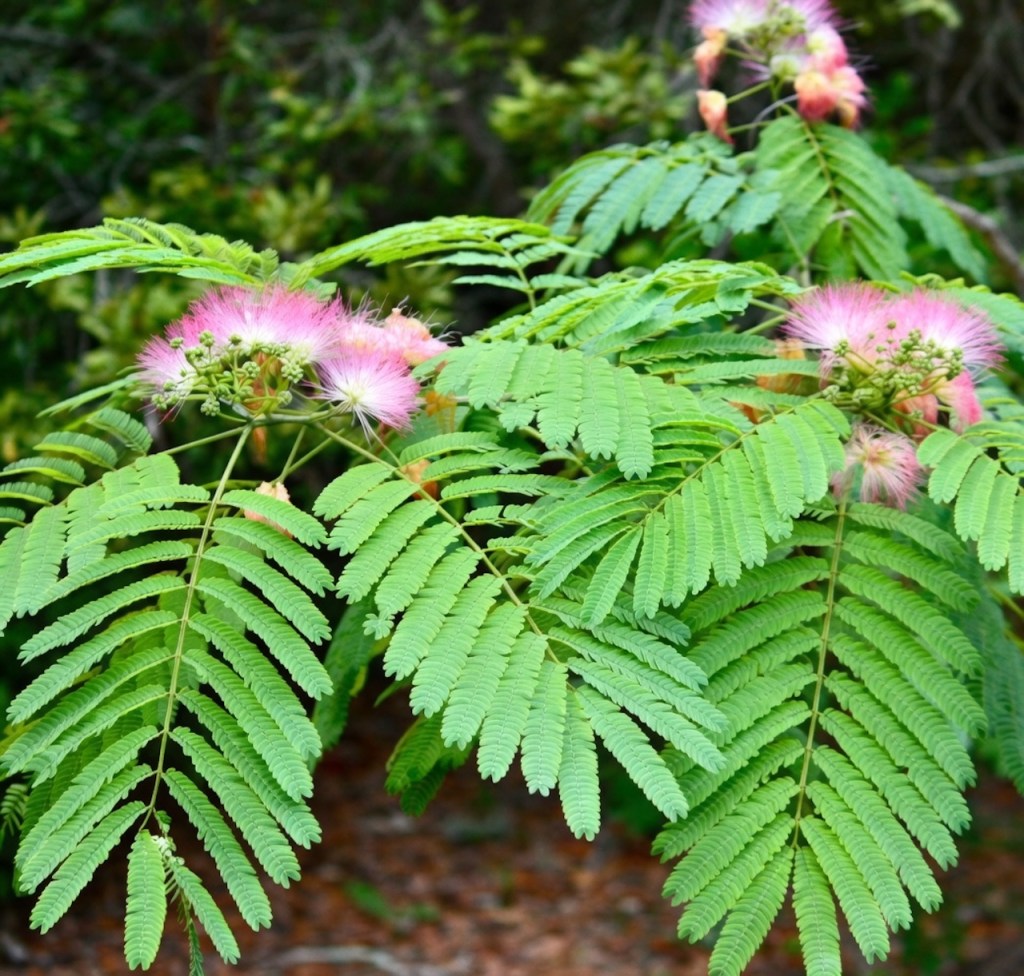
Percy Bysshe Shelley’s “The Sensitive Plant” features a poetic drama of an Eden-like garden with the mimosa plant and a Mother-Nature-like personification, a presence that tends the garden. After the drama plays out, the speaker engages in a philosophical musing on the meaning of life and death.
Introduction with Text of “The Sensitive Plant”
Percy Bysshe Shelley’s “The Sensitive Plant” plays out in three numbered parts and a conclusion.
Part 1 yields a whopping 28 stanzas: 26 quatrains and 2 cinquains); Part 2 contains 15 quatrains; Part 3 again another whopping 27 quatrains and one cinquain; the Conclusion plays out with only 6 quatrains.
The piece is a rather long 311-line poem with its 74 quatrains, each of which consists of two riming couplets, and three cinquains, each featuring a riming couplet and a riming tercet.
Shelley’s philosophical bent is on full display in this piece. While it portends to describe the mimosa plant, whose leaves will move in response to touch, it also offers a statement about humankind by comparison.
The Sensitive Plant
Part 1
A Sensitive Plant in a garden grew, And the young winds fed it with silver dew, And it opened its fan-like leaves to the light. And closed them beneath the kisses of Night.
And the Spring arose on the garden fair, Like the Spirit of Love felt everywhere; And each flower and herb on Earth’s dark breast Rose from the dreams of its wintry rest.
But none ever trembled and panted with bliss In the garden, the field, or the wilderness, Like a doe in the noontide with love’s sweet want, As the companionless Sensitive Plant.
The snowdrop, and then the violet, Arose from the ground with warm rain wet, And their breath was mixed with fresh odour, sent From the turf, like the voice and the instrument.
Then the pied wind-flowers and the tulip tall, And narcissi, the fairest among them all, Who gaze on their eyes in the stream’s recess, Till they die of their own dear loveliness;
And the Naiad-like lily of the vale, Whom youth makes so fair and passion so pale That the light of its tremulous bells is seen Through their pavilions of tender green;
And the hyacinth purple, and white, and blue, Which flung from its bells a sweet peal anew Of music so delicate, soft, and intense, It was felt like an odour within the sense;
And the rose like a nymph to the bath addressed, Which unveiled the depth of her glowing breast, Till, fold after fold, to the fainting air The soul of her beauty and love lay bare:
And the wand-like lily, which lifted up, As a Maenad, its moonlight-coloured cup, Till the fiery star, which is its eye, Gazed through clear dew on the tender sky;
And the jessamine faint, and the sweet tuberose, The sweetest flower for scent that blows; And all rare blossoms from every clime Grew in that garden in perfect prime.
And on the stream whose inconstant bosom Was pranked, under boughs of embowering blossom, With golden and green light, slanting through Their heaven of many a tangled hue,
Broad water-lilies lay tremulously, And starry river-buds glimmered by, And around them the soft stream did glide and dance With a motion of sweet sound and radiance.
And the sinuous paths of lawn and of moss, Which led through the garden along and across, Some open at once to the sun and the breeze, Some lost among bowers of blossoming trees,
Were all paved with daisies and delicate bells As fair as the fabulous asphodels, And flow’rets which, drooping as day drooped too, Fell into pavilions, white, purple, and blue, To roof the glow-worm from the evening dew.
And from this undefiled Paradise The flowers (as an infant’s awakening eyes Smile on its mother, whose singing sweet Can first lull, and at last must awaken it),
When Heaven’s blithe winds had unfolded them, As mine-lamps enkindle a hidden gem, Shone smiling to Heaven, and every one Shared joy in the light of the gentle sun;
For each one was interpenetrated With the light and the odour its neighbour shed, Like young lovers whom youth and love make dear Wrapped and filled by their mutual atmosphere.
But the Sensitive Plant which could give small fruit Of the love which it felt from the leaf to the root, Received more than all, it loved more than ever, Where none wanted but it, could belong to the giver,—
For the Sensitive Plant has no bright flower; Radiance and odour are not its dower; It loves, even like Love, its deep heart is full, It desires what it has not, the Beautiful!
The light winds which from unsustaining wings Shed the music of many murmurings; The beams which dart from many a star Of the flowers whose hues they bear afar;
The plumed insects swift and free, Like golden boats on a sunny sea, Laden with light and odour, which pass Over the gleam of the living grass;
The unseen clouds of the dew, which lie Like fire in the flowers till the sun rides high, Then wander like spirits among the spheres, Each cloud faint with the fragrance it bears;
The quivering vapours of dim noontide, Which like a sea o’er the warm earth glide, In which every sound, and odour, and beam, Move, as reeds in a single stream;
Each and all like ministering angels were For the Sensitive Plant sweet joy to bear, Whilst the lagging hours of the day went by Like windless clouds o’er a tender sky.
And when evening descended from Heaven above, And the Earth was all rest, and the air was all love, And delight, though less bright, was far more deep, And the day’s veil fell from the world of sleep,
And the beasts, and the birds, and the insects were drowned In an ocean of dreams without a sound; Whose waves never mark, though they ever impress The light sand which paves it, consciousness;
(Only overhead the sweet nightingale Ever sang more sweet as the day might fail, And snatches of its Elysian chant Were mixed with the dreams of the Sensitive Plant);—
The Sensitive Plant was the earliest Upgathered into the bosom of rest; A sweet child weary of its delight, The feeblest and yet the favourite, Cradled within the embrace of Night.
Part 2
There was a Power in this sweet place, An Eve in this Eden; a ruling Grace Which to the flowers, did they waken or dream, Was as God is to the starry scheme.
A Lady, the wonder of her kind, Whose form was upborne by a lovely mind Which, dilating, had moulded her mien and motion Like a sea-flower unfolded beneath the ocean
Tended the garden from morn to even: And the meteors of that sublunar Heaven, Like the lamps of the air when Night walks forth, Laughed round her footsteps up from the Earth!
She had no companion of mortal race, But her tremulous breath and her flushing face Told, whilst the morn kissed the sleep from her eyes, That her dreams were less slumber than Paradise:
As if some bright Spirit for her sweet sake Had deserted Heaven while the stars were awake, As if yet around her he lingering were, Though the veil of daylight concealed him from her.
Her step seemed to pity the grass it pressed; You might hear by the heaving of her breast, That the coming and going of the wind Brought pleasure there and left passion behind.
And wherever her aery footstep trod, Her trailing hair from the grassy sod Erased its light vestige, with shadowy sweep, Like a sunny storm o’er the dark green deep.
I doubt not the flowers of that garden sweet Rejoiced in the sound of her gentle feet; I doubt not they felt the spirit that came From her glowing fingers through all their frame.
She sprinkled bright water from the stream On those that were faint with the sunny beam; And out of the cups of the heavy flowers She emptied the rain of the thunder-showers.
She lifted their heads with her tender hands, And sustained them with rods and osier-bands; If the flowers had been her own infants, she Could never have nursed them more tenderly.
And all killing insects and gnawing worms, And things of obscene and unlovely forms, She bore, in a basket of Indian woof, Into the rough woods far aloof,—
In a basket, of grasses and wild-flowers full, The freshest her gentle hands could pull For the poor banished insects, whose intent, Although they did ill, was innocent.
But the bee and the beamlike ephemeris Whose path is the lightning’s, and soft moths that kiss The sweet lips of the flowers, and harm not, did she Make her attendant angels be.
And many an antenatal tomb, Where butterflies dream of the life to come, She left clinging round the smooth and dark Edge of the odorous cedar bark.
This fairest creature from earliest Spring Thus moved through the garden ministering All the sweet season of summer tide, And ere the first leaf looked brown—she died!
Part 3
Three days the flowers of the garden fair, Like stars when the moon is awakened, were, Or the waves of Baiae, ere luminous She floats up through the smoke of Vesuvius.
And on the fourth, the Sensitive Plant Felt the sound of the funeral chant, And the steps of the bearers, heavy and slow, And the sobs of the mourners, deep and low;
The weary sound and the heavy breath, And the silent motions of passing death, And the smell, cold, oppressive, and dank, Sent through the pores of the coffin-plank;
The dark grass, and the flowers among the grass, Were bright with tears as the crowd did pass; From their sighs the wind caught a mournful tone, And sate in the pines, and gave groan for groan.
The garden, once fair, became cold and foul, Like the corpse of her who had been its soul, Which at first was lovely as if in sleep, Then slowly changed, till it grew a heap To make men tremble who never weep.
Swift Summer into the Autumn flowed, And frost in the mist of the morning rode, Though the noonday sun looked clear and bright, Mocking the spoil of the secret night.
The rose-leaves, like flakes of crimson snow, Paved the turf and the moss below. The lilies were drooping, and white, and wan, Like the head and the skin of a dying man.
And Indian plants, of scent and hue The sweetest that ever were fed on dew, Leaf by leaf, day after day, Were massed into the common clay.
And the leaves, brown, yellow, and gray, and red, And white with the whiteness of what is dead, Like troops of ghosts on the dry wind passed; Their whistling noise made the birds aghast.
And the gusty winds waked the winged seeds, Out of their birthplace of ugly weeds, Till they clung round many a sweet flower’s stem, Which rotted into the earth with them.
The water-blooms under the rivulet Fell from the stalks on which they were set; And the eddies drove them here and there, As the winds did those of the upper air.
Then the rain came down, and the broken stalks Were bent and tangled across the walks; And the leafless network of parasite bowers Massed into ruin; and all sweet flowers.
Between the time of the wind and the snow All loathliest weeds began to grow, Whose coarse leaves were splashed with many a speck, Like the water-snake’s belly and the toad’s back.
And thistles, and nettles, and darnels rank, And the dock, and henbane, and hemlock dank, Stretched out its long and hollow shank, And stifled the air till the dead wind stank.
And plants, at whose names the verse feels loath, Filled the place with a monstrous undergrowth, Prickly, and pulpous, and blistering, and blue, Livid, and starred with a lurid dew.
And agarics, and fungi, with mildew and mould Started like mist from the wet ground cold; Pale, fleshy, as if the decaying dead With a spirit of growth had been animated!
Spawn, weeds, and filth, a leprous scum, Made the running rivulet thick and dumb, And at its outlet flags huge as stakes Dammed it up with roots knotted like water-snakes.
And hour by hour, when the air was still, The vapours arose which have strength to kill; At morn they were seen, at noon they were felt, At night they were darkness no star could melt.
And unctuous meteors from spray to spray Crept and flitted in broad noonday Unseen; every branch on which they alit By a venomous blight was burned and bit.
The Sensitive Plant, like one forbid, Wept, and the tears within each lid Of its folded leaves, which together grew, Were changed to a blight of frozen glue.
For the leaves soon fell, and the branches soon By the heavy axe of the blast were hewn; The sap shrank to the root through every pore As blood to a heart that will beat no more.
For Winter came: the wind was his whip: One choppy finger was on his lip: He had torn the cataracts from the hills And they clanked at his girdle like manacles;
His breath was a chain which without a sound The earth, and the air, and the water bound; He came, fiercely driven, in his chariot-throne By the tenfold blasts of the Arctic zone.
Then the weeds which were forms of living death Fled from the frost to the earth beneath. Their decay and sudden flight from frost Was but like the vanishing of a ghost!
And under the roots of the Sensitive Plant The moles and the dormice died for want: The birds dropped stiff from the frozen air And were caught in the branches naked and bare.
First there came down a thawing rain And its dull drops froze on the boughs again; Then there steamed up a freezing dew Which to the drops of the thaw-rain grew;
And a northern whirlwind, wandering about Like a wolf that had smelt a dead child out, Shook the boughs thus laden, and heavy, and stiff, And snapped them off with his rigid griff.
When Winter had gone and Spring came back The Sensitive Plant was a leafless wreck; But the mandrakes, and toadstools, and docks, and darnels, Rose like the dead from their ruined charnels.
Conclusion
Whether the Sensitive Plant, or that Which within its boughs like a Spirit sat, Ere its outward form had known decay, Now felt this change, I cannot say.
Whether that Lady’s gentle mind, No longer with the form combined Which scattered love, as stars do light, Found sadness, where it left delight,
I dare not guess; but in this life Of error, ignorance, and strife, Where nothing is, but all things seem, And we the shadows of the dream,
It is a modest creed, and yet Pleasant if one considers it, To own that death itself must be, Like all the rest, a mockery.
That garden sweet, that lady fair, And all sweet shapes and odours there, In truth have never passed away: ’Tis we, ’tis ours, are changed; not they.
For love, and beauty, and delight, There is no death nor change: their might Exceeds our organs, which endure No light, being themselves obscure.
Parts 1–3 dramatize spring/summer growth in a garden and fall/winter death and decay. In the conclusion, the speaker offers his philosophical musing on the meaning of it all.
Part 1: Observing a Unique Plant
In Part 1 of Percy Bysshe Shelley’s long piece, the speaker makes the observation that the mimosa plant is the only one that “tremble[s]” when touched.
He adds the claim that when touched, the plant not only trembled, but it also “panted with bliss.” He calls the “Sensitive Plant” companionless, likely because it is the only plant that produces that movement upon being touched.
The speaker goes through all manner of machinations to imbue the plant with favorable yet ultimately human qualities.
An example is in the 26th stanza when the speaker remarks that the plant actually has “consciousness”—not a new idea entirely but one seldom observed in intellectual discourse.
Part 2: The Ministering Lady
In Part 2 of Shelley’s long drama, the speaker introduces the presence of “A Lady,” who tends the garden.
This feminine presence is also referred to as “a Power” and an “Eve in this Eden,” whose relationship with the inmates of the garden resembles that of “God [ ] to the starry scheme.”
While this “Lady” functions as Mother Nature in many ways with her caring for the plants, her own nature departs markedly from Mother Nature, for as summer moves into autumn, the Lady dies.
Mother Nature does not die; she continues to minister through all seasons and all weather conditions. Indeed, Mother Nature is simply a metaphoric mother aspect of the one father God, Who is the Creator of all things.
Nevertheless, the “Lady,” who ministers in Shelley’s edenic piece, remains a Mother-Nature-like presence; she is the personification of the force that maintains the plants and other garden creations during their heyday of spring and summer.
Thus, in this piece, after the Lady dies, autumn brings on what that season always fetches—death and decay.
Without the presence of this nurturing Lady, a sinister force takes hold and as always happens during the cooling of the weather, the plant kingdom experiences death or dormancy until the reawakening the next spring.
Part 3: The Lady’s Death Heralds Autumn/Winter
Part 3 features the continued act of dying and decaying of the plants in the garden. After a three-day respite, the on-set of autumn becomes apparent to the “Sensitive Plant,” which “Felt the sound of the funeral chant.”
The speaker reports the mourning of the garden members for the late Lady; her passing has brought about great sorrow in the garden.
Images of darkness and dread engulf the atmosphere as the Lady’s dead presence is laid to rest: “And the smell, cold, oppressive, and dank, / Sent through the pores of the coffin-plank.”
The fourth quatrain of Part 3 exemplifies the mood heralded by the passing of the Lady: the grass is dark; the flowers yielded tears and sighs that resulted in a “mournful tone,” and the pines sent out many groans.
The speaker then turns the seasonal onset into a drama with images that describe the result from death of the mother-like presence.
In the final cinquain, the onset of autumn is revealed: the garden is now “cold and foul” wherein it once was “fair.” It resembles a corpse, having lost its “soul.” It becomes so grievous as to make men tremble.
Such a change in the countenance of the garden creatures was enough to affect even the most guarded manly qualities of those men who “never weep,” but yet now they “tremble” at the onslaught of the deathly season.
The remaining quatrains continue to provoke sorrow and loss with such couplets as “Swift Summer into the Autumn flowed, / And frost in the mist of the morning rode” and “Then the rain came down, and the broken stalks / Were bent and tangled across the walks.”
And the “Sensitive Plant” itself suffered the changing conditions: it “wept” and the tears caused its “folded leaves” to turn into “a blight of frozen glue.”
Then winter arrives: “For Winter came: the wind was his whip: / One choppy finger was on his lip.” And winter continues to perform his duties of transforming all living things to brown, stiff, still models of their former selves.
The speaker describes the “weeds” as being “forms of living death” and as those forms flee from the frost, their “decay” is likened to the “vanishing of a ghost!”
Again, the speaker returns to the “Sensitive Plant” to describe how under the plant’s roots “mold and dormice died for want.” And birds simply stiffen and drop from the sky, their lifeless bodies “caught in the branches naked and bare.”
After a “thawing rain,” whose “dull drops” immediately froze in the trees, a freezing dew “steamed up” which continued the freeze.
The speaker then describes this severe winter with its “northern whirlwind” as a “wolf” that has sniffed out “a dead child.” That wind shook the frozen tree limb so hard they snapped.
Then suddenly, winter is gone and spring is returning, but the Sensitive Plant is now a “leafless wreck.”
However, other woodland creatures, including “the mandrakes, and toadstools, and docks, and darnels,” “rose like the dead from their ruined charnels.”
Thus, the speaker has ended his foray into reimagining the changes involved in seasonal moving from spring/summer with its fecund growth and beauty to fall/winter with its death and decay.
Conclusion: A Philosophical Musing
The speaker now engages in a philosophical discourse which includes his musing on his description of the natural occurrence and what it all means.
He first confesses that he does not know how the “Sensitive Plant” might have felt about “this change.”
Furthermore, he cannot hazard a guess as to how the “Lady” felt about the situation.
He wonders if she felt sadness. And though he dares not guess how the “Sensitive Plant” and the “Lady” felt, he is now ready to offer his own thoughts on the issue of life and death.
He declares that this life is filled with “error, ignorance, and strife,” and “we” (humanity) seem to be little more than the “shadows of a dream.”
Thus, he has determined what he calls a “modest creed” is nevertheless pleasant to consider that “death” is nothing more than a “mockery.”
In fact, it is all a mockery. He then states that all of the sweetness and beauty contained within the Edenic garden, which he has so thoroughly described, remain, that is, those etheric qualities did not and do not change.
He says, “’Tis we, ’tis ours, are changed; not they.”
He then declares that love, beauty, and delight do not die or change. Those qualities, being ineffable, possess a power (“might”) that surpasses the human ability to comprehend.
Our human capacity—presented here by “our organs”—remains in darkness for those “organs” “endure / No light, being themselves obscure.”
The speaker is implying that the human heart and mind are, in fact, capable of enduring light.
But because of a willful blindness, many remain in a state of moribund, abject mental and spiritual poverty—where light cannot penetrate until a change of heart and mind is effected.
Note: Use of “Rime” vs “Rhyme”
Dr. Samuel Johnson introduced the form “rhyme” into English in the 18th century, mistakenly thinking that the term was a Greek derivative of “rythmos.”
Image: Emily Dickinson – Amherst College – Daguerrotype of the poet at age 17, circa 1847 – likely the only authentic, extant likeness of the poet
Emily Dickinson’s “Nobody knows this little Rose”
Emily Dickinson loved flowers, as well as all other creatures of nature. The rose became a symbol for her, signifying beauty and the evanescence of all natural beings. From a lament for a single rose, she begins to muse on the relationship of the Divine to His creation, including her own creations.
Introduction with Text of “Nobody knows this little Rose”
The speaker in Emily Dickinson’s “Nobody knows this little Rose” is bemoaning the sadness that a “little Rose” will surely die without having attracted attention during its sojourn on the earthly plane. Only a bee, a bird, a butterfly, along with a gentle wind and the speaker will likely have even noticed that such a beautiful entity had existed.
In observing that it is quite easy for this little rose to succumb to death, the speaker goes into mourning for that death. Such beauty, the speaker opines, should not be so easily lost but instead should attract the attention it deserves.Perhaps it should even have its stature elevated to a higher plane of being than the mere physical level of being, which it is so easily vanquished.
Nobody knows this little Rose
Nobody knows this little Rose – It might a pilgrim be Did I not take it from the ways And lift it up to thee. Only a Bee will miss it – Only a Butterfly, Hastening from far journey – On its breast to lie – Only a Bird will wonder – Only a Breeze will sigh – Ah Little Rose – how easy For such as thee to die!
Commentary on “Nobody knows this little Rose”
The speaker is musing about the death of a small rose. She imagines its family mourning the rose’s absence. The speaker, while musing to herself, incidentally addresses God in the opening movement and then the rose itself in the final movement.
First Movement: Lamentation for the Unknown
Nobody knows this little Rose – It might a pilgrim be Did I not take it from the ways And lift it up to thee.
The speaker begins her lament by claiming that no one is acquainted with her subject, a simple, small rose. She has plucked this little rose, which apparently was growing in the wild.
The speaker speculates that this little rose might be “a pilgrim” for it was growing away from other flower beds. She then rather casually asks someone, likely God, or Mother Nature about her own act.
Although formed as a question, the speaker actually reveals the fact that she did pluck the little flower and then offered it up to “thee.” It remains a strange confession, but it is likely that the act of plucking the rose has set her off to realizing that it will now die. But instead of just enjoying its beauty, she continues to speculate about the life of the little flower.
Second Movement: Only Missing
Only a Bee will miss it – Only a Butterfly, Hastening from far journey – On its breast to lie –
In her speculation, the speaker takes into account who might have been its visitors. She exaggerates that a solitary bee “will miss” the rose because of the speaker’s act. But after saying “only” a bee will note that the little rose is missing, she remembers that likely a “butterfly” will also note its absence.
The butterfly will have traveled perhaps miles to rest upon the little rose’s “breast.” And the butterfly, the speaker speculates, will have been hurrying to finish its “journey” that led it to the rose’s abode. Now after it makes that hastened trip, it will be astonished, or perhaps frustrated, that the little flower has gone missing.
Third Movement: The Ease of Dying
Only a Bird will wonder – Only a Breeze will sigh – Ah Little Rose – how easy For such as thee to die!
The speaker continues to catalogue those creatures who will be missing the little rose. She notes that in addition to the bee and the butterfly, some bird is going to wonder what happened to the flower. The last entity to ponder the absence of the little rose is the “Breeze,” which will “sigh” as it wafts over the location that once held the sweet fragrance of the rose.
After the speaker’s intense musing to herself and to the Blessèd Creator of nature, she then addresses the rose itself, but all she can do is offer a simple, humble remark about how “easy” it is for a creature such as the “Little Rose” “to die!” Her excited utterance, however, belies the simplicity of the words. Her heart is filled with the sadness and sorrow that accompany the missing of loved ones.
The speaker has created and assembled a family for the little rose: a bee, a butterfly, a bird, and a breeze. All of these creatures of nature have interacted with the rose, and now the speaker is musing on how they will be affected by the flower’s absence.
They will all miss her, and the speaker knows how missing a loved one feels. The ease with which a little unknown creature dies does not assuage the pain its absence will cause.
Image: Emily Dickinson – Amherst College – Daguerrotype of the poet at age 17, circa 1847 – likely the only authentic, extant likeness of the poet
Emily Dickinson’s “Garland for Queens, may be”
The speaker in Emily Dickinson’s “Garland for Queens, may be” is paying tribute to the beautiful flower, the rose. The treatment of this “Rose” contrasts greatly with the treatment of the “Little Rose” in Dickinson’s “Nobody knows this little Rose.”
Introduction with Text of “Garland for Queens, may be”
The speaker in Emily Dickinson’s “Garland for Queens, may be” holds a ceremony to announce that holy orders have been bestowed on this certain “Rose” that she has encountered and is visiting.
The speaker begins by hinting at the traditional description of the nature of garlanding and bestowing laurels on royalty and on others who have excelled in certain areas of achievement.
The treatment of this “Rose” contrasts greatly with the treatment of the “Little Rose” in Emily Dickinson’s “Nobody knows this little Rose.”
The speaker holds the rose in such high regard that she feels it deserves more credit than a simple observance of its beauty and wonderful fragrance would afford. Instead of offering a poem of ordinary appreciation, she is offering her highly formalized ceremony to honor that rose.
While some may argue that such exaggeration borders on the pathetic fallacy, it should be noted that the elegance with which the poet has crafted her ceremony is simply offering a way of looking at a natural object, and that way is filled with love and appreciation.
Garland for Queens, may be
Garland for Queens, may be – Laurels – for rare degree Of soul or sword. Ah – but remembering me – Ah – but remembering thee – Nature in chivalry – Nature in charity – Nature in equity – This Rose ordained!
Commentary on “Garland for Queens, may be”
Honoring with a solemn and formalized tribute, the speaker makes the “Rose” the honored guest on whom she is bestowing holy orders. Her love for the beauty of the rose allows her to set the flower alongside queens and other high achievers without trepidation.
First Movement: Traditional Yet Unique
Garland for Queens, may be – Laurels – for rare degree Of soul or sword.
The speaker begins her tribute by offering a unique defining description of the nature of the garland and laurels for queens. Although her definition hints at the traditional employment of those items, she does stipulate that that employment “may be”—indicating that such laurels and garlands may also be at times other than residing within the framework of her unique definition.
The speaker does acknowledge that the presenting of “laurels” remains “rare.” But they remain within the purview of “soul or sword.”
One becomes garlanded with laurels for some uncommon, special achievement within the realm of creativity of accomplishment in any number of areas such a literature, science, or even sports as marked by “soul” or likely even more often in the realm of patriotic defense of one’s nation through service in the nation’s military or for vanquishing enemies foreign or domestic, that is, by “sword.”
Second Movement: Back to Everyday
Ah – but remembering me – Ah – but remembering thee –
The speaker’s opening remark of her tribute has taken her listeners to supernal realms often considered far from the ordinary, everyday life of the average citizen. She thus brings the discourse back to herself and to her listeners.
She insists that while keeping in mind the profound and royal plane of the employment of garlands and laurels, we must include ourselves in the vast journey of accomplishment or what’s tradition for?
The speaker quite literally commands through the present participle that minds take their attention from the high and mighty to the representatives of the vast ordinary—”me” and “thee.”
Her employment of the informal second person demonstrates the intimate nature that she gently guides her listeners to accept with her otherwise highly formalized tribute. Without such intimacy, she knows their acceptance of her ultimate bestowal on a flower of such a claim as she intends to make would be impossible.
Third Movement: Deserving Qualities
Nature in chivalry – Nature in charity – Nature in equity –
The speaker then directs her audience, whom she envisions as gathered for such as a coronation or ceremony, to visualize the bestowing of a garland of laurels upon an important personage. She thus announces the qualities that the target of her tribute possesses. The nature of that important target can be detected in three qualities that guarantee the superior achievement of the recipient: chivalry, charity, and equity.
That recipient excels in “chivalry,” as she places herself in the arms of those who celebrate important events such as birthdays, christenings, and even funerals. The nature of the recipient also includes that quality of excellence in offering “charity.”
Flowers bloom, spread their beauty, their fragrance freely, gayly, as well as chivalrously. This particular flower remains fair and evenhanded (“equity”) on all occasions in which it is often featured.
Its nature allows it to ascend to all sensibilities through its various physical parts as well as its strong impression on the minds and hearts of those who are fortunate enough to have been offered the rose in bouquets.
Fourth Movement: Bestowal of Holy Orders
This Rose ordained!
Finally, the speaker reveals the target of her praise, the recipient of this garland of praise. She reports that the “Rose” has been ordained, singled out for its special achievement in the areas she has just specified.
By employing the term “ordain,” the speaker implies that not only is the rose to be garlanded with the ordinary laurels for praise, but that this Rose is receiving holy orders.
This Rose may now go forth during its summer of splendor and preach its beauty and its fragrance to all who are fortunate enough to behold it. The beauty of this particular rose has motived this speaker to praise it to high heaven.
After pronouncing the importance of garlanded queens through sometimes even mundane circumstances and achievement, and after assigning near divine qualities to this rose, the speaker had nowhere else to go for praise but to bestow those holy orders on it.
And to this speaker the truth that the rose speaks to her allows her to view its beautiful blossom and to breathe in the marvelous fragrance of the rose with even more joy and abandon.
Image: Emily Dickinson – Amherst College – Daguerrotype of the poet at age 17, circa 1847 – likely the only authentic, extant likeness of the poet
Emily Dickinson’s “So has a Daisy vanished”
The speaker in Emily Dickinson’s “So has a Daisy vanished” wonders if the dead Daisy and other departing plant creatures of the field have gone off to be “with God.”
Introduction and Text of “So has a Daisy vanished”
The speaker of Emily Dickinson’s “So has a Daisy vanished,” who has a keen ability to observe her natural surroundings, has been moved to wonder about the soul of “a Daisy” and many other “slipper[s]” who have given up their physical encasements of beautiful blooms and glorious green stems and simply vanished. She wonders where they went, as she dramatizes their final days of earthly glory.
So has a Daisy vanished
So has a Daisy vanished From the fields today – So tiptoed many a slipper To Paradise away –
Oozed so in crimson bubbles Day’s departing tide – Blooming – tripping – flowing Are ye then with God?
Commentary on “So has a Daisy vanished”
The speaker in this brief drama wonders if the dead Daisy and other departing plant creatures of the field have gone off to be “with God.”
First Stanza: A Flower in Heaven
So has a Daisy vanished From the fields today – So tiptoed many a slipper To Paradise away –
The speaker begins with a statement informing her readers and listeners that a lovely flower has gone, disappeared “from the fields today.” She begins with the conjunctive adverb “so,” seeming to indicate that she is merely taking up a thought that began somewhere else and at an earlier interval.
Then again employing the telling “so,” the speaker adds that many other flowers have also tripped off to “Paradise.” Along with the lovely “Daisy,” the other “slipper[s]” have all gone missing, but the speaker suggests that they have metaphorically died and gone to Heaven. While the “Daisy” has rather generically “vanished,” the others have “tiptoed” off “to Paradise.”
The speaker is playing with the language of loss, which almost always produces a melancholy in the very sensitive hearts of keen observers. Instead of merely dying, the flowers vanish from the fields and tiptoe away.
That they all have metaphorically gone on to “Paradise” demonstrates that the faith and courage of the sensitive heart of this deep observer are fully operational. That the speaker allows that these creatures of nature have gone to Heaven or Paradise shows that she has a firm grasp on the existence of the soul as a permanent life force that plants as well as animals possess.
This speaker understands that all life is divinely endowed. The flowers leave behind their physical encasements, but they take their soul encasement and then scurry off to the astral world, from where they will likely return to the Earth or some other planet to continue working out their karma–an eventuality that informs the procedure for the animal kingdom as well.
Second Stanza: To Be with the Divine Creator
Oozed so in crimson bubbles Day’s departing tide – Blooming – tripping – flowing Are ye then with God?
While the speaker remains aware that plant life force is as eternal as that of the animal kingdom, she is not so sure about where each individual plant goes after its demise. Thus she wonders if they are “with God.”
Likely influenced by the Christian concepts of Heaven and Hell, the speaker no doubt wonders if plant behavior while on Earth may require a reckoning that leads to Heaven or Hell. That she asks in the more affirmative mood demonstrates her optimistic sensitivity.
Paramahansa Yogananda has likened life on Earth to vanishing bubbles. He has explained that many deep thinking philosophers, sages, and poets have realized that the things of this world are like bubbles in the ocean; those individual things such as stars, flowers, animals, and people suddenly appear, experience a life only for a brief period of time, and then they disappear as swiftly as they appeared.
In his poem, “Vanishing Bubbles,” the great yogi dramatizes that brief earthly sojourn of the myriad life forms, as he unearths the solution for those sensitive minds and hearts that grieve after the loss of those individuals whom they had loved and who yet must vanish like bubbles.
And that solution is the simple knowledge that although the physical encasement of each individual has indeed vanished, the soul of each individual continues to exist; therefore, there is no actual vanishing or death.
The speaker in Dickinson’s poem is suggesting that she is aware of the eternal, everlasting nature of the soul. After the lovely bloom has been maneuvered into the world on “crimson bubbles,” it will live its brief life, prancing about with the breeze, and then with the “departing tide,” its day will come to an end, but only for its physical encasement, which it will leave behind.
The speaker knows that its soul–its life force–will continue, and she wonders if those souls of all those lovely flowers she has been enjoying will then be “with God.” That she would ask hints that she believes the answer is yes.
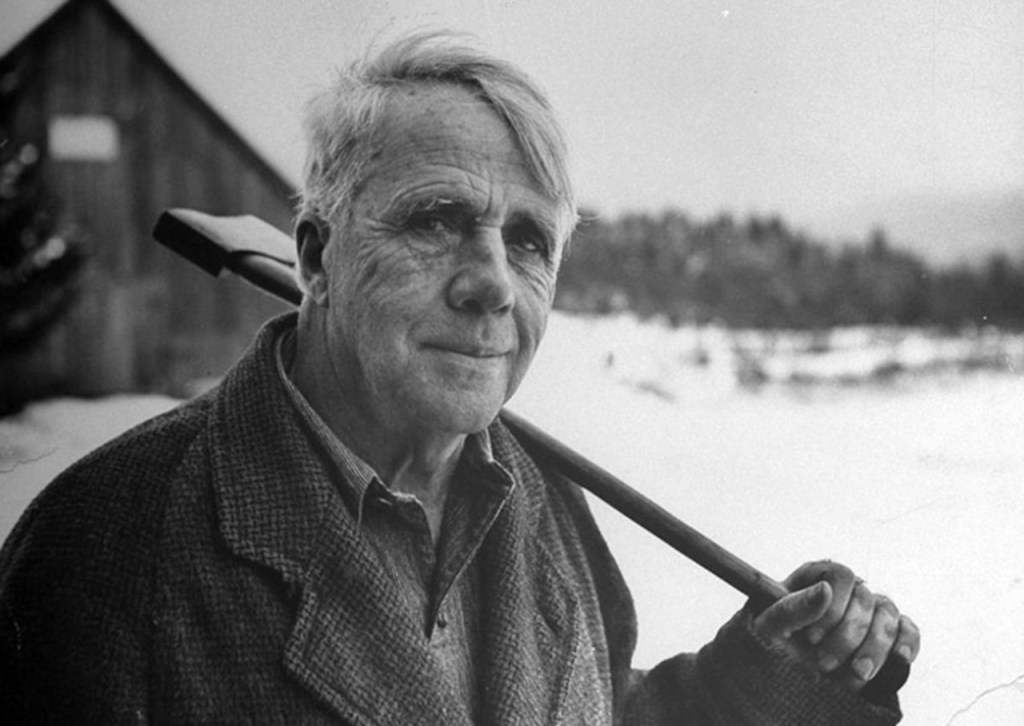
Image: Robert Frost in 1943. (Eric Schaal/The LIFE Picture Collection/Getty Images)
Robert Frost’s “Birches”
RobertFrost’s “Birches” is one of his most famous poems. It features a speaker looking back on a boyhood experience that he cherishes and would like to do again. Unfortunately, this “tricky poem” has suffered ludicrous readings that insert onanism into its innocent nostalgia.
Introduction and Text of “Birches”
The speaker in Robert Frost’s “Birches” is musing on a boyhood activity that he enjoyed. As a “swinger of birches,” he rode trees and felt the same euphoria that children feel who experience carnival rides such as ferris wheels or tilt-a-whirls.
The speaker also gives a rather thorough description of birch trees after an ice-storm. In addition, he makes a remarkable statement that hints at the yogic concept of reincarnation: “I’d like to get away from earth awhile / And then come back to it and begin over.” However, after making that striking remark, he backtracks perhaps thinking such a foolish thought might disqualify him from rational thought.
That remark however demonstrates that as human beings our deepest desires correspond to truth in ways that our culture in the Western world has plastered over through centuries of materialistic emphasis on the physical level of existence. The soul knows the truth and once in a blue moon a poet will stumble across it, even if he does not have the ability to fully recognize it.
Birches
When I see birches bend to left and right Across the lines of straighter darker trees, I like to think some boy’s been swinging them. But swinging doesn’t bend them down to stay As ice-storms do. Often you must have seen them Loaded with ice a sunny winter morning After a rain. They click upon themselves As the breeze rises, and turn many-colored As the stir cracks and crazes their enamel. Soon the sun’s warmth makes them shed crystal shells Shattering and avalanching on the snow-crust— Such heaps of broken glass to sweep away You’d think the inner dome of heaven had fallen. They are dragged to the withered bracken by the load, And they seem not to break; though once they are bowed So low for long, they never right themselves: You may see their trunks arching in the woods Years afterwards, trailing their leaves on the ground Like girls on hands and knees that throw their hair Before them over their heads to dry in the sun. But I was going to say when Truth broke in With all her matter-of-fact about the ice-storm I should prefer to have some boy bend them As he went out and in to fetch the cows— Some boy too far from town to learn baseball, Whose only play was what he found himself, Summer or winter, and could play alone. One by one he subdued his father’s trees By riding them down over and over again Until he took the stiffness out of them, And not one but hung limp, not one was left For him to conquer. He learned all there was To learn about not launching out too soon And so not carrying the tree away Clear to the ground. He always kept his poise To the top branches, climbing carefully With the same pains you use to fill a cup Up to the brim, and even above the brim. Then he flung outward, feet first, with a swish, Kicking his way down through the air to the ground. So was I once myself a swinger of birches. And so I dream of going back to be. It’s when I’m weary of considerations, And life is too much like a pathless wood Where your face burns and tickles with the cobwebs Broken across it, and one eye is weeping From a twig’s having lashed across it open. So was I once myself a swinger of birches. And so I dream of going back to be. It’s when I’m weary of considerations, And life is too much like a pathless wood Where your face burns and tickles with the cobwebs Broken across it, and one eye is weeping From a twig’s having lashed across it open. I’d like to get away from earth awhile And then come back to it and begin over. May no fate willfully misunderstand me And half grant what I wish and snatch me away Not to return. Earth’s the right place for love: I don’t know where it’s likely to go better. I’d like to go by climbing a birch tree, And climb black branches up a snow-white trunk Toward heaven, till the tree could bear no more, But dipped its top and set me down again. That would be good both going and coming back. One could do worse than be a swinger of birches.
Reading
Commentary on “Birches”
Robert Frost’s “Birches” is one of the poet’s most famous and widely anthologized poems. And similar to his famous poem “The Road Not Taken,” “Birches” is also a very tricky poem, especially for certain onanistic mindsets.
First Movement: A View of Arching Birch Trees
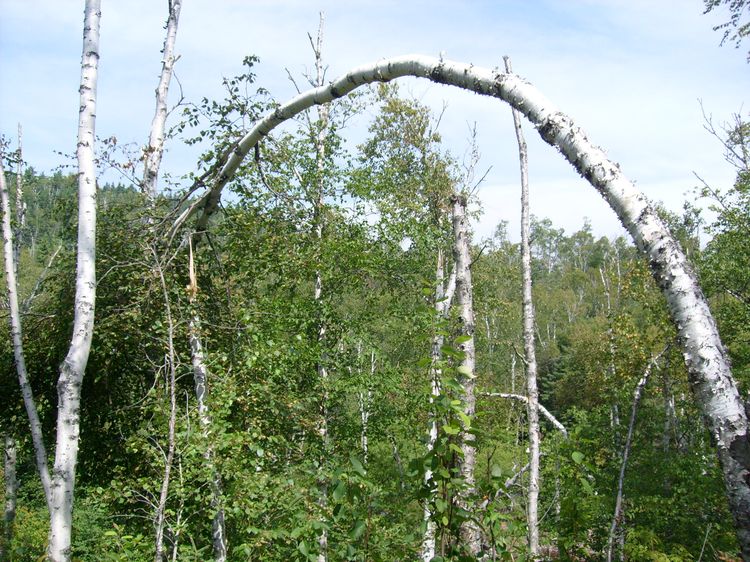
When I see birches bend to left and right Across the lines of straighter darker trees, I like to think some boy’s been swinging them. But swinging doesn’t bend them down to stay As ice-storms do. Often you must have seen them Loaded with ice a sunny winter morning After a rain. They click upon themselves As the breeze rises, and turn many-colored As the stir cracks and crazes their enamel.
The speaker begins by painting a scene wherein birch trees are arching either “left or right” and contrasting their stance with “straighter darker tree.” He asserts his wish that some young lad has been riding those trees to bend them that way.
Then the speaker explains that some boy swinging on those trees, however, would not bend them permanently “[a]s ice-storms do.” After an ice-storm they become heavy with the ice that begins making clicking sounds. In the sunlight, they “turn many-colored” and they move until the motion “cracks and crazes their enamel.”
Second Movement: Ice Sliding off Trees
Soon the sun’s warmth makes them shed crystal shells Shattering and avalanching on the snow-crust— Such heaps of broken glass to sweep away You’d think the inner dome of heaven had fallen. They are dragged to the withered bracken by the load, And they seem not to break; though once they are bowed So low for long, they never right themselves: You may see their trunks arching in the woods Years afterwards, trailing their leaves on the ground Like girls on hands and knees that throw their hair Before them over their heads to dry in the sun.
The sun then causes the crazy ice to slide off the trees as it “shatter[s] and avalanch[es]” on to the snow. Having fallen from the trees, the ice looks like big piles of glass, and the wind comes along and brushes the piles into the ferns growing along the road.
The ice has caused the trees to remain bent for years as they continue to “trail their leaves on the ground.” Seeing the arched birches puts the speaker in mind of girls tossing their hair “over the heads to dry in the sun.”
Third Movement: Off on a Tangent
Before them over their heads to dry in the sun. But I was going to say when Truth broke in With all her matter-of-fact about the ice-storm I should prefer to have some boy bend them As he went out and in to fetch the cows— Some boy too far from town to learn baseball, Whose only play was what he found himself, Summer or winter, and could play alone. One by one he subdued his father’s trees By riding them down over and over again Until he took the stiffness out of them, And not one but hung limp, not one was left For him to conquer. He learned all there was To learn about not launching out too soon And so not carrying the tree away Clear to the ground. He always kept his poise To the top branches, climbing carefully With the same pains you use to fill a cup Up to the brim, and even above the brim. Then he flung outward, feet first, with a swish, Kicking his way down through the air to the ground.
At this point, the speaker realizes that he has gone off on a tangent with his description of how birches get bent by ice-storms. His real purpose he wants the reader/listener to know lies in another direction. That the speaker labels his aside about the ice-storm bending the birch tree “Truth” is somewhat bizarre. While his colorful description of the trees might be a true one, it hardly qualifies as “truth” and with a capital “T” no less.
“Truth” involves issues that relate to eternal verities, especially of a metaphysical or spiritual nature—not how ice-storms bend birch trees or any purely physical detail or activity. The speaker’s central wish in this discourse is to reminisce about this own experience of what he calls riding trees as a “swinger of birches.” Thus he describes the kind of boy who would have engaged in such an activity.
The boy lives so far from other people and neighbors that he must make his own entertainment; he is a farm boy whose time is primarily taken up farm work and likely some homework for school. He has little time, money, inclination for much of a social life, such as playing baseball or attending other sports games.
Of course, he lives far from the nearest town. The boy is inventive, however, and discovers that swinging on birch trees is a fun activity that offers him entertainment as well as the acquisition of a skill. He had to learn to climb the tree to the exact point where he can then “launch” his ride.
The boy has to take note of the point and time to swing out so as not to bend the tree all the way to ground. After attaining just the right position on the tree and beginning the swing downward, he can then let go of the tree and fling himself “outward, feet first.” And “with a swish,” he can begin kicking his feet as he soars through the air and lands on the ground.
Fourth Movement: The Speaker as a Boy
So was I once myself a swinger of birches. And so I dream of going back to be. It’s when I’m weary of considerations, And life is too much like a pathless wood Where your face burns and tickles with the cobwebs Broken across it, and one eye is weeping From a twig’s having lashed across it open. So was I once myself a swinger of birches. And so I dream of going back to be. It’s when I’m weary of considerations, And life is too much like a pathless wood Where your face burns and tickles with the cobwebs Broken across it, and one eye is weeping From a twig’s having lashed across it open.
Now the speaker reveals that he himself once engaged in the pastime of swinging on birches. That is how he knows so much about the difference it makes of a boy swinging on the trees and ice-storms for the arch of the trees. And also that he was once a “swinger of birches” explains how he knows the details of just how some boy would negotiate the trees as he swung on them.
The speaker then reveals that he would like to revisit that birch-swinging activity. Especially when he is tired of modern-day life, running the rat-race, facing all that the adult male has to contend with in the workday world, he day-dreams about this carefree days of swinging on birch trees.
Fifth Movement: Getting off the Ground
I’d like to get away from earth awhile And then come back to it and begin over. May no fate willfully misunderstand me And half grant what I wish and snatch me away Not to return. Earth’s the right place for love: I don’t know where it’s likely to go better. I’d like to go by climbing a birch tree, And climb black branches up a snow-white trunk Toward heaven, till the tree could bear no more, But dipped its top and set me down again. That would be good both going and coming back. One could do worse than be a swinger of birches.
The speaker then asserts his wish to leave earth and come back again. Likely this speaker uses the get-away-from-earth notion to refer to the climbing of the birch tree, an act that would literally get him up off the ground away from earth. But he quickly asks that “no fate willfully misunderstand” him and snatch him away from the earth through death—he “knows” that such a snatch would not allow him to return.
The speaker then philosophizes that earth is “the right place for love” because he has no idea that there is any other place it could “go better.” So now he clarifies that he simply would like to climb back up a birch tree and swing out as he did when a boy: that way he would leave earth for the top of the tree and then return to earth after riding it down and swinging out from the tree. Finally, he offers a summing up of the whole experience that being swinger of birches—well, “one could do worse.”
Robert Frost claimed that his poem, “The Road Not Taken,” was a very tricky poem. He was correct, but other poems written by Frost have proved to be tricky as well. This poem is clearly and unequivocally a nostalgic piece by a speaker looking back at a boyhood pastimes that he cherishes. Some readers have fashioned an interpretation of masturbatory activity from this poem.
Robert Frost’s second most widely known poem “Birches” has suffered an faulty interpretation that equals the inaccurate call-to-nonconformity so often foisted onto “The Road Not Taken.” At times when readers misinterpret poems, they demonstrate more about themselves than they do about the poem. They are guilty of “reading into a poem” that which is not there on the page but is, in fact, in their own minds.
Readers Tricked by “Birches”
Robert Frost claimed that his poem “The Road Not Taken” was a tricky poem, but he must have known that any one of his poems was likely to trick the over-interpreter or the immature, self-involved reader. The following lines from Robert Frost’s “Birches” have been interpreted as referring to a young boy learning the pleasures of self-gratification:
One by one he subdued his father’s trees By riding them down over and over again Until he took the stiffness out of them, And not one but hung limp, not one was left For him to conquer. He learned all there was To learn about not launching out too soon
About those lines, Elizabeth Gregory, who used to post on the now defunct site Suite101, once claimed: “The lexical choices used to describe the boy’s activities are unmistakably sexual and indicate that he is discovering more than a love of nature.”
Indeed, one could accurately interpret that the boy is discovering something “more than the love of nature,” but what he is discovering (or has discovered actually since the poem is one of nostalgic looking back) is the spiritual pull of the soul upward toward heaven, not the downward sinking of the mind into sexual dalliance.
In the Mind of the Beholder, Not on the Page
Gregory’s interpretation of sexuality from these lines simply shows the interpretive fallacy of “reading into” a poem that which is not there, and that reader’s proposition that “the boy’s activities are unmistakably sexual” exhausts reason or even common sense.
The “lexical choices” that have tricked this reader are, no doubt, the terms “riding,” “stiffness,” “hung limp,” and “launching out too soon.” Thus that reader believes that Robert Frost wants his audience to envision a tall birch tree as a metaphor for a penis: at first the “tree (male member)” is “stiff (ready for employment),” and after the boy “rides them (has his way with them),” they hang “limp (are satiated).”
And from riding the birches, the boy learns to inhibit “launching out too soon (premature release).” It should be obvious that this is a ludicrous interpretation that borders on the obscene.
But because all of these terms refer quite specifically to the trees, not to the male genitalia or sexual activity, and because there is nothing else in the poem to make the reader understand them to be metaphorical, the thinker who applies a sexual interpretation is quite simply guilty of reading into the poem that which is not in the poem but quite obviously is in the thinker’s mind.
Some beginning readers of poems believe that a poem always has to mean something other than what is stated. They mistakenly think that nothing in a poem can be taken literally, but everything must be a metaphor, symbol, or image that stands in place of something else. And they often strain credulity grasping at the unutterably false notion of a “hidden meaning” behind the poem.
That Unfortunate Reader Not Alone
Gregory is not the only uncritical thinker to be tricked by Frost’s “Birches.” Distinguished critic and professor emeritus of Brown University, George Monteiro, once scribbled: “To what sort of boyhood pleasure would the adult poet like to return? Quite simply; it is the pleasure of onanism.” Balderdash! The adult male remains completely capable of self-gratification; he need not engage boyhood memories to commit that act.
One is coaxed to advise Professor Monteiro—and all of those who fantasize self-gratification in “Birches”—to keep their minds above their waists while engaging in literary criticism and commentary.
Image: Emily Dickinson – Amherst College – Daguerrotype of the poet at age 17, circa 1847 – likely the only authentic, extant likeness of the poet
Emily Dickinson’s “A Bird came down the Walk”
Emily Dickinson’s “A Bird came down the Walk” using clever plays on words offers a keen observation, reminding listeners and readers of images which they can likely recognize.
Introduction with Text of “A Bird came down the Walk”
Emily Dickinson’s “A Bird came down the Walk” is one of the poet’s many fun poems loaded with clever word plays—a technique that creates a drama based on keen observation.
The little drama functions to remind readers and listeners of images stored in memory and scenes that they have also experienced in their lifetimes. In other words, the little fun poem is performing the primary function of any genuine poem. This Dickinson poem (#328 in Thomas H. Johnson’s Complete Poems) is one of the poet’s most anthologized poems.
The poem displays in five quatrains, employing a loose rime scheme in which the second and fourth lines sound out in either perfect (saw-raw) or slant (around-Head) rimes. Thomas H. Johnson’s Complete Poems offers the version that most closely represents the Dickinson manuscript, in which the line is “That hurried all around.”
Some editors have tried to improve or correct the poet’s rime scheme by changing “around” to “abroad.” The notion is that “abroad” is a better rime with “head” than “around.” But, as is nearly always the case, the poet’s subtle meanings are lost with these unfortunate editorial “corrections.”
For example, “abroad” suggests a much farther distance than “around.” The bird simply moved its head in such a way as to glimpse its immediate surroundings. The bird did not attempt to look searching into areas as far from it as in another country, as the term “abroad” suggests.
A Bird came down the Walk
A Bird came down the Walk – He did not know I saw – He bit an Angleworm in halves And ate the fellow, raw,
And then he drank a Dew From a convenient Grass – And then hopped sidewise to the Wall To let a Beetle pass –
He glanced with rapid eyes That hurried all around – They looked like frightened Beads, I thought – He stirred his Velvet Head
Like one in danger, Cautious, I offered him a Crumb And he unrolled his feathers And rowed him softer home –
Than Oars divide the Ocean, Too silver for a seam – Or Butterflies, off Banks of Noon Leap, plashless as they swim.
Reading
Commentary on “A Bird came down the Walk”
Emily Dickinson’s poem “A Bird came down the Walk” is one of the poet’s many fun poems filled with entertaining plays on words. The little drama originates from the poet’s keen observation, and it functions as do all genuine poems to engage the reader’s own lived experience.
First Quatrain: Human Eyes Observe a Bird
A Bird came down the Walk – He did not know I saw – He bit an Angleworm in halves And ate the fellow, raw,
In the first quatrain, the speaker states simply that “A Bird came down the Walk.” Then she reports what happened next after assuring her audience that the bird remained unaware that it was being closely observed by a pair of inquisitive human eyes.
The bird grasps a worm, clips the worm in two pieces, and then swallows the unlucky creature. The bird does not bother to cook the worm—just gobbles it up “raw.” Dickinson seems to enjoy inserting some fun into her poems, and this one put on displays her sense of hilarity.
Second Quatrain: Clever and Playful Use of Terms
And then he drank a Dew From a convenient Grass – And then hopped sidewise to the Wall To let a Beetle pass –
The speaker then continues to report to her audience what she sees next: the bird sips some water from a blade of grass and then jumps out of the way so a beetle could crawl by. The poet must have enjoyed the cleverness of saying that the bird “drank a Dew / From a convenient Grass.”
The term “grass” clearly will remind the reader of the term “glass” from which the human beings are accustomed to drinking. While having the bird take a sip of the dew off a piece of grass is perfectly natural, it is equally convenient that the words so seemingly accidentally align with human experience.
After imbibing his sip of dew, the polite avian steps aside allowing another creature of nature to continue on with his journey. The speaker is portraying little acts of civility a she describes the antics of nature which she has so keenly observed.
Third Quatrain: Fidgeting, Frightened Eyes
He glanced with rapid eyes That hurried all around – They looked like frightened Beads, I thought – He stirred his Velvet Head
The speaker then reports the details regarding the eyes of the bird. This report seems to suggest the speaker was quite close to the bird. She was able to detect that his eyes moved quickly as they glimpsed “all around.” She also noticed that they resembled “frightened Beads.”
The absurdity of beads having the sensibility to become frightened simply strikes the consciousness as an appropriate use of exaggeration. No one would be confused and think that the speaker actually believes beads can experience emotion—especially since the speaker employs a simile and then inserts the claim “I thought.”
Also, it is likely that somewhere in the reader’s memory is the same sight—having seen a bird’s rapid eye movement. Thus, in this poem, the poet’s dramatic re-creation gives the reader back that image stored in memory. The observation, the image, the memory, and the experience all coming to support the fact that the claim is absolutely accurate.
It is, in fact, a perfectly accurate observation: those little black avian eyes “looked like frightened Beads.” And then the bird’s head begins to move: “He stirred his Velvet Head.”
Fourth Quatrain: Fear of Feeding
Like one in danger, Cautious, I offered him a Crumb And he unrolled his feathers And rowed him softer home –
The speaker understands exactly why the bird seemed suddenly to experience frightened eyes. And the bird begins to move his head because he has become fearful that the speaker has approached so close to the bird—close enough to attempt to bestow on him a morsel of food. The speaker says she offered him “a Crumb.”
Immediately after she offers him a bit of food, he does not stick around to accept that crumb—he flies off. The speaker then dramatizes that avian exit: “he unrolled his feathers / And rowed him softer home.”
Fifth Quatrain: Seamless Rowing
Than Oars divide the Ocean, Too silver for a seam – Or Butterflies, off Banks of Noon Leap, plashless as they swim.
In the final quatrain, the speaker fashions her vitally important re-creation of the velvety smoothness of the bird’s flight. At the end of the fourth quatrain, the speaker had begun a comparison, stating that “he rowed him softer home.
She then continues and concludes that comparison in the first line of the final quatrain with “Than oars divide the Ocean.” The bird’s flight through the air remains invisible, as one does not see the air parting as the bird’s wings cut through it.
Thus, the bird flight is much softer in sight and sound than when one rows a boat through water using oars. The bird’s “rowing” was “Too silver for a seam.” And not only was it softer and seamless compared to rowing a boat on water, the bird’s flight was even smoother than the flight of butterflies jumping into the rivers of “Noon” swimming and splashing about.
The line “off Banks of Noon” likely encouraged another smile of satisfaction to poet’s face as she swam around in her own drama of cleverness. After all, she had created those immortal images that will reawaken the dormant memories in readers and listeners years and years hence.
Image: Emily Dickinson – Amherst College – This daguerrotype circa 1847 at age 17 is likely the only authentic, extant image of the poet.
Emily Dickinson’s “It did not surprise me”
In Emily Dickinson’s “It did not surprise me,” the speaker has created a bird metaphor as she begins to muse on the unlikely event that she may lose her intuitive ability to perceive beyond sense awareness.
Introduction with Text of “It did not surprise me”
With a similar motivational purpose of her riddle-poem “I have a Bird in spring,” Emily Dickinson’s speaker in “It did not surprise me” employs a bird metaphor to contemplate the notion that her special intuitive ability to perceive events, ideas, and entities beyond sense awareness might abandon her.
The bird metaphor remains a useful poetic device for Emily Dickinson‘s speakers as they bestow flight on their ability to create poetic dramas. Also, similar to her riddle-poem “I have a Bird in spring” in this little drama, the speaker is unveiling the metaphorical bird as a mystical muse, as the speaker ruminates on the idea that if that little birdling were to fly away from her, she would become heartbroken.
However, unlike the riddle aspect in “I have a Bird in spring,” the poet allows her speaker to report first as if she is merely describing a literal bird. The speaker then moves into a questioning format which shines a light on the possibility that her muse might just up and fly off as any real bird might do.
The speaker is obliged, however, to leave the issue without answering it, because she will keep that question as long as she continues in her mission of poetry creation. Ultimately, no creative artist can ever know in advance, if or when inspiration will vanish and possibly never return.
Despite temporary flights into the clairvoyance of certain noumena, as long as the poet remains earth bound, she remains dependent to a certain extent on ordinary sense awareness.
It did not surprise me
It did not surprise me – So I said – or thought – She will stir her pinions And the nest forgot,
Traverse broader forests – Build in gayer boughs, Breathe in Ear more modern God’s old fashioned vows –
This was but a Birdling – What and if it be One within my bosom Had departed me?
This was but a story – What and if indeed There were just such coffin In the heart instead?
Reading of “It did not surprise me”
Commentary on “It did not surprise me”
Dickinson’s speaker metaphorically likens her muse—which she knows is bound to her mystical insight—to a bird, as she contemplates the possibility of losing the blessing provided by her innate, God-given talent and mystical ability.
First Stanza: A Thought Awakening
It did not surprise me – So I said – or thought – She will stir her pinions And the nest forgot,
The speaker begins her soliloquy by admitting that her lack of “surprise” at some event has been prompted by the thought of a bird stirring and flying off from its nest. Between her opening statement and the bird’s first movement, the speaker asserts that upon realizing her lack of surprise, she spoke out but then changed her claim to the fact that she merely thought about the coming event without actually giving it voice.
The final two lines of the stanza express the possibility of an activity as she states that this particular bird will start fluttering its wings, readying itself for flight and then fly off from its nest. Such an avian forsaking its nest will then likely not even recall that it had ever stayed there.
That status is simply the essential nature of natural creatures, as well as specific metaphorical birds that may be likened to the muse. If this style of muse abandons its target permanently, it will likely not recall that it had ever inspired any such soul.
Interestingly, Dickinson has her speaker employ the past tense “forgot” but clearly the actual meaning is present tense “forget.” She possibly employed the past tense because it stands in as a closer rime to “thought.”
However, a different interpretation of the meaning may call for the term “forgot” to be understood as the shortened form of the past participle, as in the nest will be “forgotten.” Through her widespread employment of minimalism and ellipsis, the poet has her speaker leave out “nest will be,” requiring the phrase to be understood and, therefore, supplied by the reader’s mind.
Second Stanza: Ranging to New Territories
Traverse broader forests – Build in gayer boughs, Breathe in Ear more modern God’s old fashioned vows –
After rousing its pinions and flying from its nest, this bird will roam in new territories or through “broader forests.” It may reconstruct a new nest in a place deemed happier for its circumstances, that is, “gayer boughs.” The bird will listen to fresh sounds, as it enjoys the many blessings of its Divine Creator, Who has promised to guard and guide all of His creatures.
At this point, the bird has taken on only a few metaphorical qualities. The message could thus be that of merely dramatizing what any young bird might do, after awakening to the marvelous reality of possessing the delicious ability to fly and range wide from its original location.
Third Stanza: Bird in the Heart
This was but a Birdling – What and if it be One within my bosom Had departed me?
The speaker now admits that the little flying creature she has been describing was, in actuality, a simple little bird, or “Birdling.” But then she changes her focus to the “One” that lives in her heart, asking the basic question—what if my little bird-muse leaves me?
In her poem “I have a Bird in spring,” the poet also had her speaker describe her mystical muse as a bird. That poem also plays out as one of her numerous riddle-poems, as she seems to be describing some impossible entity that can fly from her but then return to her and bring her gifts from beyond the sea.
That special metaphorical bird has the power to calm her in times of stress. Similar to “I have a Bird in spring,” which is one of her most profound poems, this one, “It did not surprise me,” remains on the exact same consistent plane of mystical perception.
Unquestionably, the natural creature known as a “bird” as a metaphorical vehicle for the soul (muse or mystically creative spirit) remains quite appropriate, as poet Paul Laurence Dunbar has also demonstrated in his classic masterpiece “Sympathy.”
Fourth Stanza: A Intriguing Inquiry
This was but a story – What and if indeed There were just such coffin In the heart instead?
The speaker offers another admission that up to this point she has been merely speculating about her bird/muse flying off from its nest in her heart/mind/soul. She crafts another inquiry, repeating the curious phrase “[w]hat and if” before her question.
This poignant question employs the term “coffin” indicating the drastic and deadly situation that would exist in her mind/heart/soul, if her bird/muse did actually fly off from her to explore more extensive forests and build nests on more joyful boughs. The speaker affirms her belief that such a loss to her heart and mind would materialize that “coffin,” if such an event ever transpired.