Rabindranath Tagore’s “The Last Bargain” focuses on what seems to be an quandary: how is it that a child’s offering of “nothing” to a seeker becomes the “last bargain” as well as the best bargain?
Introduction and Text of “The Last Bargain”
The human mind/hear/soul engages in the spiritual search in order to gain freedom and bliss. Much sorrow and pain afflict those who focus solely on the material level of existence.
As the speaker in Rabindranath Tagore’s “The Last Bargain” searches for a job, he is, in fact, demonstrating the difference between focusing on the material level of being and focusing on the spiritual level.
The Last Bargain
“Come and hire me,” I cried, while in the morning I was walking on the stone-paved road. Sword in hand, the King came in his chariot. He held my hand and said, “I will hire you with my power.” But his power counted for nought, and he went away in his chariot.
In the heat of the midday the houses stood with shut doors. I wandered along the crooked lane. An old man came out with his bag of gold. He pondered and said, “I will hire you with my money.” He weighed his coins one by one, but I turned away.
It was evening. The garden hedge was all aflower. The fair maid came out and said, “I will hire you with a smile.” Her smile paled and melted into tears, and she went back alone into the dark.
The sun glistened on the sand, and the sea waves broke waywardly. A child sat playing with shells. He raised his head and seemed to know me, and said, “I hire you with nothing.” From thenceforward that bargain struck in child’s play made me a free man.
Commentary on “The Last Bargain”
Rabindranath Tagore’s “The Last Bargain” presents an enigma: how can it be that a child offering nothing can be the bargain that makes a “free man” of the seeker?
First Movement: Seeking Employment
“Come and hire me,” I cried, while in the morning I was walking on the stone-paved road. Sword in hand, the King came in his chariot. He held my hand and said, “I will hire you with my power.” But his power counted for nought, and he went away in his chariot.
The opening movement taking place in the morning finds the speaker apparently seeking employment; thus he announces, “Come and hire me.” A king then comes on the scene, offering the individual employment through his “power.”
However, the job seeker determines that the king’s power held very little value. The king then moves away in his “chariot.” Then the speaker continues to search. Now, the reader is likely to suspect that this speaker is not seeking a job on the material, planet Earth, physical sense.
Second Movement: Continuing the Search
In the heat of the midday the houses stood with shut doors. I wandered along the crooked lane. An old man came out with his bag of gold. He pondered and said, “I will hire you with my money.” He weighed his coins one by one, but I turned away.
The speaker keeps up his search, and the time now is “midday.” He takes notice that the doors to all of the houses are closed. All of a sudden, an old man comes on the scene; he is carrying a “bag of gold.” The old man then inform the seeker that he will offer him a job “with [his] money.”
The old man counts out his coins piece by piece, which demonstrates his attachment to money—a physical level necessity and reality. However, that display of physical attachment annoys this spiritual seeker, who then turns away in disgust.
The speaker remains unimpressed by the power of a king, and he is not favorable to an old man’s “gold.” The reader can now be assured that the speaker is not seeking an earthly job and thus not seeking worldly goods; instead, he is searching for the spiritual love that comes only from God. Worldly wealth and power hold no importance for him.
Third Movement: Experiencing a Change
It was evening. The garden hedge was all aflower. The fair maid came out and said, “I will hire you with a smile.” Her smile paled and melted into tears, and she went back alone into the dark.
However, the seeker continues on well into evening, when he sees, a “garden hedge [ ] all aflower.” Then he encounters a “fair maid” who says, “I will hire you with a smile.” But he inevitably experiences the transformation that comes to the aged human being as the smile “paled and melted into tears.” Thus rejected, the maiden “went back alone into the dark.”
Fourth Movement: The Best Bargain
The sun glistened on the sand, and the sea waves broke waywardly. A child sat playing with shells. He raised his head and seemed to know me, and said, “I hire you with nothing.” From thenceforward that bargain struck in child’s play made me a free man.
In the final movement, the speaker, as he is walking along the ocean’s shore, watching the turbulent waves, and meeting a child who is playing on the shore, is afforded his final bargain: the child affirms, “I hire you with nothing.” This final bargain thus results in a situation that ultimately becomes the best bargain.
The best bargain is the one that liberates the seeker from searching for satisfaction from earthly things. He, then instead, may focus his attention on his own soul, where the real “job” of seeking freedom, liberation, and bliss exist.
It is the quiet Spirit—the seeming nothingness contrasting with materiality, the space transcending time and matter—that turns out to be the genuine, true employer. Working for the Celestial, Divine Employer (God) affords the laborer the true freedom, soul realization, and bliss—none of which can achieved by earthly power, gold, and physical affection.
Rabindranath Tagore’s Gitanjali #48: “The morning sea of silence… “
Rabindranath Tagore’s poem elucidating a metaphorical and metaphysical journey is number 48 in his most noted collection titled Gitanjali. The poet received the Nobel Prize for Literature in 1913, specifically for that collection.
Introduction with Text from Gitanjali #48: “The Morning Sea of Silence”
Rabindranath Tagore, Nobel Laureate for Literature in 1013, translated his collection of poems, Gitanjali, from his original Bengali into English. He numbered each poem and rendered them as prose-poems, and they remain poetry of the highest order.
Readers may encounter Gitanjali #48 wide-spread across the internet titled “The Journey” playing out in eight traditional poetry stanzas. Tagore’s #48 displays in only six verse paragraphs (versagraphs), but those who converted the piece have separated the fourth versagraph into three separate units.
Tagore’s Gitanjali #48 metaphorically elucidates the spiritual journey of the speaker, even as at the outset, he and his fellow trekkers seem to be setting out on an ordinary hike through the landscape of beauty with flowers and birdsong. What happens to the speaker becomes truly astounding and inspiring, as he comes to understand the true nature of the idea of a spiritual journey.
In this poem, the term journey serves as an extended metaphor for meditation. The speaker takes his meditation seat and begins his practice in order to experience union with the Divine Belovèd (God). The speaker employs use of the extended metaphor to reveal dramatically his series of emotions as he continues his metaphorical journey.
Even though the source for the drama could credibly have remained a literal hike through the countryside on the lovely morning, the speaker of the poem remains focused on his inner spiritual journey to unite his soul with his Creator.
Gitanjali #48: “The Morning Sea of Silence”
The morning sea of silence broke into ripples of bird songs; and the flowers were all merry by the roadside; and the wealth of gold was scattered through the rift of the clouds while we busily went on our way and paid no heed.
We sang no glad songs nor played; we went not to the village for barter; we spoke not a word nor smiled; we lingered not on the way. We quickened our pace more and more as the time sped by.
The sun rose to the mid sky and doves cooed in the shade. Withered leaves danced and whirled in the hot air of noon. The shepherd boy drowsed and dreamed in the shadow of the banyan tree, and I laid myself down by the water and stretched my tired limbs on the grass.
My companions laughed at me in scorn; they held their heads high and hurried on; they never looked back nor rested; they vanished in the distant blue haze. They crossed many meadows and hills, and passed through strange, far-away countries. All honour to you, heroic host of the interminable path! Mockery and reproach pricked me to rise, but found no response in me. I gave myself up for lost in the depth of a glad humiliation in the shadow of a dim delight.
The repose of the sun-embroidered green gloom slowly spread over my heart. I forgot for what I had travelled, and I surrendered my mind without struggle to the maze of shadows and songs.
At last, when I woke from my slumber and opened my eyes, I saw thee standing by me, flooding my sleep with thy smile. How I had feared that the path was long and wearisome, and the struggle to reach thee was hard!
Reading of Gitanjali #48: “The Morning Sea of Silence”
Commentary on Gitanjali #48: “The Morning Sea of Silence”
The speaker engages a truly astounding spiritual event, placing his experience in a metaphysical setting, and metaphorically elucidating that experience as a simple hike across the landscape.
First Versagraph: The Welcoming Morning Landscape
The morning sea of silence broke into ripples of bird songs; and the flowers were all merry by the roadside; and the wealth of gold was scattered through the rift of the clouds while we busily went on our way and paid no heed.
In the first versagraph, the speaker begins by describing the beauty of the morning landscape that surrounds him and his fellow hikers as they set out on their walking excursion.
The first line offers an masterfully crafted metaphor: the early morning “silence” is likened to the waves of an ocean that break into “ripples of bird songs.” While the birds are singing, the flowers by the wayside appear to be “all merry.” The sky is spread out into a golden glow which is “scattered through the rift of the clouds.”
The speaker then states that he and his hiking buddies are in a hurry to get on with their trek, and they therefore take no notice of, and therefore do not cherish, the beauty that has already been bestowed upon them.
Second Versagraph:: Deadly Solemnity
We sang no glad songs nor played; we went not to the village for barter; we spoke not a word nor smiled; we lingered not on the way. We quickened our pace more and more as the time sped by.
The speaker then asserts that he and his fellow trekkers remain quite serious in their coming travel extravaganza; thus, they do not stop to play or sing happy songs. They did not even engage in cheerful banter with one another, nor do they stop in the village to make any purchases.
They remain so deadly solemn that not only do they not even bother to speak, but they also do not deign to smile. They refuse to linger anywhere. They remain in such a great hurry that they continue to speed by faster and faster as time wore on.
Third Versagraph: Taking Needed Rest
The sun rose to the mid sky and doves cooed in the shade. Withered leaves danced and whirled in the hot air of noon. The shepherd boy drowsed and dreamed in the shadow of the banyan tree, and I laid myself down by the water and stretched my tired limbs on the grass.
By noon, the speaker has become distracted by the position of the sun, noting that doves are making their cooing sounds in the shade of the trees. He then takes notice that a shepherd boy is resting in the shade under a tree.
While the sun is so hot and with the doves and shepherd boy enjoying a relief from action, the speaker decides to stop his own active walk. Thus, he lies down upon the grass by the water and stretches out his tired body to enjoy a respite from the strenuous task of hiking.
Fourth Versagraph: Ridicule for Taking a Rest
My companions laughed at me in scorn; they held their heads high and hurried on; they never looked back nor rested; they vanished in the distant blue haze. They crossed many meadows and hills, and passed through strange, far-away countries. All honour to you, heroic host of the interminable path! Mockery and reproach pricked me to rise, but found no response in me. I gave myself up for lost in the depth of a glad humiliation in the shadow of a dim delight.
The speaker’s walking buddies, however, chide him for wishing to take a break and rest. So, they continue on with their walk. As they continue, they strike supercilious poses with their heads in the air. They take no second notice of the speaker, as they disappear into “distant blue haze.”
Nevertheless, the speaker remains in his resting position with the determination to enjoy his leisurely rest, even as the others rapidly continue on with their swift strides. The speaker reports that his fellow hikers are pressing on as they continue to trek through the “meadows and hills.” They show that they are not as lazy as he is. The speaker’s fellows are continuing to push “through strange, far-away countries.”
He gives them credit for their adventuresome nature, and he confesses that he has experienced some guilt for remaining in leisure and not accompanying them, but he just could not urge himself on to continue this particular walking excursion.
The speaker also confesses that he has ambiguous feelings: on the one hand, he feels “lost” not remaining with the others, but on the other hand, he experiences a “glad humiliation,” feeling that he must be reclining “in the shadow of a dim delight.”
Fifth Versagraph: Rethinking the Reason for the Hike
The repose of the sun-embroidered green gloom slowly spread over my heart. I forgot for what I had travelled, and I surrendered my mind without struggle to the maze of shadows and songs.
As the speaker goes on lounging about, he takes notice that the sunset is “spread[ing] over his heart”—an act that unveils for a second time his emotions fraught with ambiguity. Such gloom is “sun-embroidered,” reminiscent of the old saw, “every cloud has a silver lining.”
The dawdling speaker then admits that he can no longer remember why he originally decided to set out on this hike. Thus, he just lets his mental body go, no longer struggling with his true urgings any more. He allows his heart and mind to continue musing through “the maze of shadows and songs.”
Sixth Versagraph: Nearing the Door-Heart of the Divine Creator
At last, when I woke from my slumber and opened my eyes, I saw thee standing by me, flooding my sleep with thy smile. How I had feared that the path was long and wearisome, and the struggle to reach thee was hard!
Finally, the speaker wakes up from his ambiguous torpor; he then realizes that he has discovered what he was searching for. He had surmised that walking such a spiritual path was out of his reach, as it was considered to be such an arduous task.
But after his discovery, he is able to realize that all he had to do was permit his inner self to be guided to the door-heart of the Divine Belovèd. All lesser journeys, including those on the physical plane, become irrelevant as one becomes ensconced in that sacred environment, near the door of the DivineCreator-Father.
William Butler Yeats possessed a lifelong dedication to the cultural and political rebirth of Ireland. He experienced life as a poet, playwright, and senator as he lived during turbulent shifts in Irish politics. He had a lifelong unquenchable thirst for artistic and spiritual truth.
William Butler Yeats remains one of the most influential literary figures of the modern era. His canon, which includes examples of his interest in Eastern philosophy, Irish folklore, and the vicissitudes of life, eventually resulted in the production of various literary forms such as poetry, drama, and essays [1].
Early Life and Education
Born on June 13, 1865, in Sandymount, County Dublin, William Butler Yeats was raised in a household that placed a high value on intellectual curiosity bolstered by cultural heritage.
His father, John Butler Yeats, was a skilled portrait painter, and his mother, Susan Pollexfen, created an environment steeped in Irish history and folklore. His early exposure to art, literature, and the stories of ancient Ireland instilled in Yeats a deep appreciation for myth and legend that would later become central themes in his work.
As a young man, Yeats attended the Metropolitan School of Art in Dublin, where he developed keen observational skills and his ability to capture what he saw into dramatic literary form such as poetry and plays.
His early attempts to write poetry were heavily influenced by Romanticism, and he found inspiration in the rich treasure house of Irish mythology and the natural world. These early experiences laid the groundwork for a lifelong exploration of the interplay between the tangible and the transcendent [2].
The Celtic Revival
In the 1880s and 1890s, Yeats became as a principal figure in the Celtic Revival—a cultural movement, aimed at reclaiming Ireland’s heritage from centuries of British domination.
Along with contemporaries such as Lady Gregory and Edward Martyn, Yeats sought to regain Irish identity through renewed interest and influence of its ancient myths and folklore. Yeats’ first poetry collections, including The Wanderings of Oisin and Other Poems (1889), offered a vision of Ireland as a land of fantastic beauty and heroic legend.
Yeats’ involvement in the Irish literary revival was not merely rhetorical and philosophical; he assisted in the founding of the National Literary Society and became a driving force behind the establishment of the Abbey Theatre, which became the center stage for modern Irish drama.
Through the Abbey Theatre, Yeats teamed up with playwrights and dramatists to stage works, combining Irish mythology with contemporary social and political issues; thus he became responsible for creating a distinctly Irish voice in the performing arts [3].
Changing Style and Interest in the Mysticism
As Yeats’ career progressed, his creative writings faced an important transformation. As he moved away from his early Romanticism, he took up themes of aging, disillusionment, and the search for spiritual meaning. This shift was influenced by his increasing interest in Eastern Philosophy and mystical traditions.
Yeats’ lifelong engagement with esoteric philosophy—ranging from Theosophy to the study of Eastern Philosophy—found expression in poems such as “The Second Coming” (1919) and “The Indian upon God” (1927). These works reflect a mind grappling with the decline of traditional values and the potential for rebirth through art and myth.
Yeats’ fascination with mysticism was not a mere intellectual exercise; it became deeply personal. He was a member of the Hermetic Order of the Golden Dawn, an organization dedicated to the study and practice of magical rituals and mysticism.
This involvement influenced his poems with symbolic imagery and complex mythological references that continue to captivate readers. The cyclical view of history that Yeats espoused—wherein civilizations rise, decay, and ultimately transform—became a recurring theme of his later work.
Unfortunately, Yeats’ study of Eastern Philosophy/Religion at times led him astray. Some of his works demonstrated that he failed to understand [4] the most important aspects of the concepts that he tried to portray in his poems.
While his poem “The Indian upon God” accurately reflects Eastern tenets, his “The Second Coming” and “Lapis Lazuli” go far astray. The bulk of his understanding of Eastern philosophical and religious concepts may be described no less than by the term assigned by T. S. Eliot “romantic misunderstanding.”
Politics and the Poet in Society
The early twentieth century was a period of political upheaval in Ireland, and Yeats became increasingly involved with the nationalist movement. Even though he never fully aligned himself with any particular political party, his writings and public statements often reflected a profound concern for the fate of his country. His poetry became the main medium through which he expressed hope but also anxiety about the future of his country.
Poems such as “Easter 1916” suggest that whatever happens no one can deny that those rebels will have died for their dreams. This speaker still cannot completely commit to those dreams. All he can admit is that everything has changed and “A terrible beauty is born.”
The Yeatsian musing of drama ultimately finds only that things have changed. The speaker cannot say if they have changed for better for worse. He and his generation will have to wait to see how that “terrible beauty” matures. However, this duality—of destruction and creation—reflects the eternal cycles that he so frequently explored in his verse.
Beyond his poetry, Yeats contributed directly to the political life of his nation. He served from 1922-1928 in the senate of the newly formed Irish Free State [5]. Although he was often seen as an outsider by both traditional nationalists and modernists, Yeats’ presence in the Senate suggested a belief in the vital role that artists and intellectuals play in shaping public discourse and guiding cultural evolution.
Yeats’ personal life was distressed by a long, unrequited love for Maud Gonne [6], an Irish revolutionary and actress. His feelings for Gonne inspired many of his poems, imbuing them with themes of love, loss, and longing. Gonne’s rejection of his marriage proposals did not deter Yeats from writing some of his most passionate poetry, where she often appears as a muse or an ideal.
Later in life, Yeats married Georgie Hyde-Lees, who not only became his companion but also a collaborator in his mystical explorations. They had two children, Anne and Michael, and their family life was documented in some of Yeats’ more personal poems, such as “A Prayer for My Daughter” and “The Circus Animals’ Desertion.”
The Alignment of Myth and Modernity
A central aspect of Yeats’ enduring appeal is his ability to weave together disparate strands of experience—myth and modernity, beauty and decay, hope and despair—into a coherent vision of the human condition. His poetry often reads as if it were both a dream and a prophecy, a blend of personal reflection and universal truth.
For instance, in “Sailing to Byzantium,” Yeats contrasts the ephemeral nature of the physical world with the possibility of spiritual transcendence [7]. The poem’s vivid imagery and rhythmic cadence invite readers to contemplate the eternal in the midst of the temporal, a duality that lies at the heart of Yeats’ artistic endeavor.
Yeats’ engagement with myth was not limited to the realm of poetry; it also informed his political and cultural projects. By reviving ancient Irish legends and traditions, he sought to restore a sense of identity and continuity to a country grappling with the forces of modernity and colonialism. His poem “The Fisherman” offers an example of this engagement.
His work with the Abbey Theatre was driven by the conviction that drama rooted in myth could foster a national spirit and provide a counterpoint to the homogenizing effects of globalization. In this way, Yeats not only redefined the poetic landscape but also contributed to a broader cultural renaissance in Ireland.
An Enduring Influence on Literature and Beyond
The influence of William Butler Yeats extends far beyond the confines of his own time. His exploration of spiritual and metaphysical themes paved the way for subsequent generations of poets and writers who sought to reconcile the material and the mystical. In the decades following his death, critics and scholars have revisited his work, probing its layers of symbolism and historical context to uncover new meanings and insights.
Contemporary literary critics often highlight the innovative structure and language of Yeats’ later poetry, noting how his use of recurring symbols and motifs creates a dense network of associations that invites endless interpretation.
His ability to encapsulate the complexities of Irish identity, the ravages of time, and the interplay between art and life continues to resonate in today’s discussions of literature and culture.
Moreover, Yeats’ political engagement and his belief in the transformative power of art have inspired not only writers but also activists and cultural leaders who view the arts as a vital force for social change [8].
That political engagement, however, begs for a caveat. As postmodernism crept ever nearer the hearts of the contemporary artists, the loss of skill and lack of interest in truth began to blight both poetry and criticism. That postmodern mind-set has little hope of heralding and power to transform society for the better.
Yeats’ Legacy
William Butler Yeats’ life and work remain a testament to the power of art to illuminate the deepest mysteries of existence. From his early days steeped in Irish folklore to his later explorations of mystical symbolism and political transformation, he navigated the tumultuous currents of change with a keen and reflective mind. His ability to articulate the paradoxes of beauty and decay, hope and despair, has left an indelible mark on the world of literature.
Yeats’ legacy is a reminder that art is not merely a reflection of life but also can serve as an agent of transformation, when steeped in desire for truth. His vision of history as a series of cyclic renewals, his embrace of the occult and the mythical, and his commitment to cultural and political renewal have all contributed to a body of work that continues to inspire and challenge readers. In celebrating Yeats, one celebrates the eternal quest for meaning—a quest that, like his poetry, transcends time and place.
Through his poetic innovations and his fervent commitment to the rebirth of Irish culture, William Butler Yeats carved out a unique space in the annals of literary history. His words continue to echo in classrooms, theaters, and the hearts of those who dare to dream beyond the confines of the everyday routine.
Death
In his later years, Yeats’ poetry grew increasingly reflective and introspective. The themes of mortality, the nature of artistic creation, and the inexorable passage of time became ever more emphasized.
Works such as The Tower (1928) and The Winding Stair and Other Poems (1933) reveal a man deeply aware of his own aging and the inevitable approach of death. Yet, even as he grappled with the transient nature of human life, he remained committed to the idea that art could capture eternal truths.
Despite experiencing poor health, Yeats continued to write and speak out on matters of art, politics, and philosophy until his final days. On the French Riviera, he spent his last months in quiet musing, as he sought solace and reflection away from the public eye.
On January 28, 1939, in Menton, France, [9] William Butler Yeats passed away peacefully . The world mourned not just the passing of a literary giant, but also the departure of a visionary who had continually challenged and enriched the cultural landscape of Ireland and beyond.
One of the most profound memorial poems to Yeats is W. H. Auden’s “In Memory of W. B. Yeats.” The following excerpt contains some of the poem’s most memorable lines, for example, “Mad Ireland hurt you into poetry”:
You were silly like us; your gift survived it all: The parish of rich women, physical decay, Yourself. Mad Ireland hurt you into poetry. Now Ireland has her madness and her weather still, For poetry makes nothing happen: it survives In the valley of its making where executives Would never want to tamper, flows on south From ranches of isolation and the busy griefs, Raw towns that we believe and die in; it survives, A way of happening, a mouth.
Sources
[1] Richard Ellmann. Yeats. New York. Oxford University Press, 1989.
[2] Mark Fryer. The Life of W.B. Yeats: A Critical Biography. London. Bloomsbury Academic. 2001.
[3] A. Norman Jeffares. The Cambridge Companion to W.B. Yeats. Cambridge University Press, 2006.
“The Indian upon God” This poem is displayed in ten riming couplets. The theme of the poem dramatizes the biblical concept that God made man in His own image.
“The Fisherman” In “The Fisherman,” Yeats has created a speaker who is voicing a call for genuine art for the common folk, an art that dramatizes the beauty and truth inherent in all great art.
“The Second Coming” One of the most overrated and misunderstood works of the Western literary canon.
“Sailing to Byzantium” This poem is a profound meditation on aging, art, and the quest for spiritual transcendence, despite his failure to clearly grasp the Eastern religious/philosophical concepts he strived to portray.
“Leda and the Swan” Focuses on the ancient Greek myth, wherein the woman, Leda, wife of Tyndareus, was impregnated by the god Zeus in disguise as a swan. Yeats’ speaker is musing regarding the nature of such an act and how it might have impacted Leda’s mental capacities afterward.
“Among School Children” One of Yeats’ most anthologized poems, this poem features numerous allusions to ancient Greek mythology and philosophy. Yeats was always a thinker, even if not always a clear thinking one.
“Lapis Lazuli” In this poem, William Butler Yeats has his speaker explore the issue of peace and tranquility despite a chaotic environment.
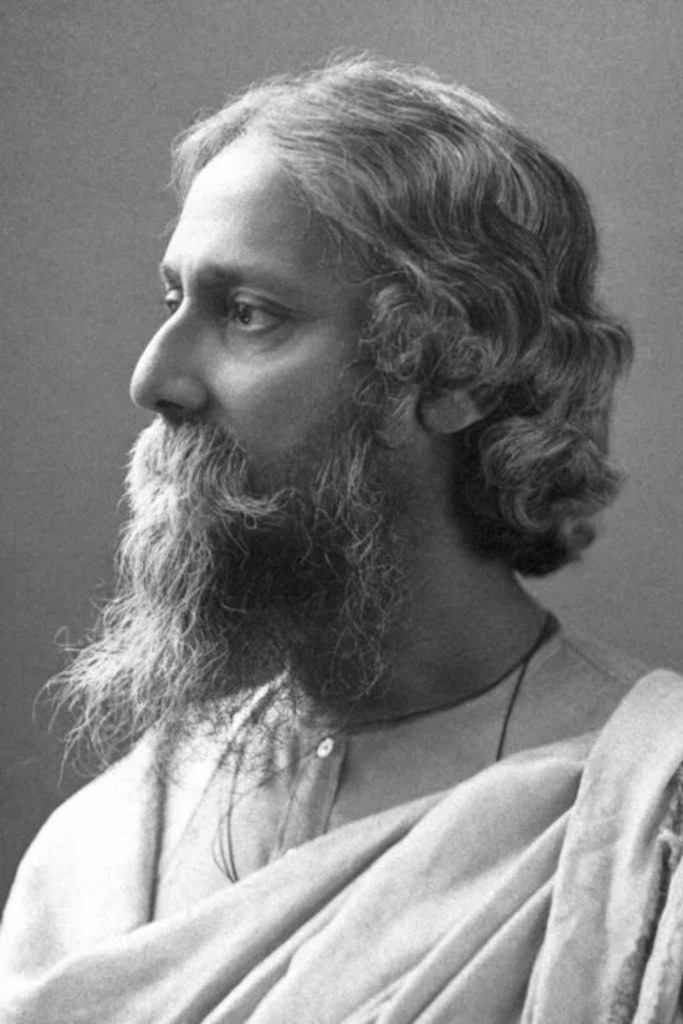
In 1913, Rabindranath Tagore, Indian Nobel Laureate, won the literature prize for his prose translations of Gitanjali, Bengali for “song offerings.” A true Renaissance man, he served as a poet, social reformer, and founder of a school.
Early Life and Education
Rabindranath Tagore, (in Bengali, Rabīndranāth Ṭhākur), was born May 7, 1861, Calcutta, India, to the religious reformer Debendranath Tagore (1817–1905) and Sarada Devi (1830–1875). Sarada gave birth to fifteen children with Debendranath Tagore [1].
Rabindranath was the youngest of the children and was raised primarily by his oldest sister and servants. His mother fell ill after giving birth to her last child, and she died when Rabindranath was only fourteen years of age.
Tagore came to disdain formal education. He was first enrolled in public education at the Oriental Seminary School in Calcutta. At only seven years of age, he dropped out of school after attending for one month. Students at the school were punished by being beaten with sticks.
After enrolling in the school of Saint Xavier in 1876, he managed to attend for six months but then again left the institution. However, he did retain some pleasant memories of his attendance at Saint Xavier and in 1927, he gifted the school with a statue of Jesus Christ from his personal collection.
Saint Xavier values its relationship with Tagore, despite its brevity, and commemorates his birthday anniversary, even holding their ceremony during the pandemic in 2021:
The principal of the college, Father Dominic Savio, said: “We have decided to remember him on his birthday not only for paying tribute to a true Xaverian, who preached universal humanism but also to get inspiration from his writings, preaching and philosophy, particularly at this trying time”.[2]
Tagore was richly homeschooled by his many accomplished siblings; his brother Hemendranath trained his younger brother in physical culture, having “Rabi” swim in the Ganges and hike through the surrounding hills.
Rabindranath also practiced gymnastics, wresting, and judo, under the watchful eye of his older brother. With other siblings, Tagore studied history, geography, drawing, anatomy, mathematics. Most importantly for his future writing career, he studied Sanskrit and English literature.
Tagore’s contempt for formal schooling was on display when he enrolled in Presidency College but then spent only one day at the school. His philosophy of teaching held that appropriate teaching included fueling curiosity not merely explaining situations.
Founding His Own School
Ironically, Tagore’s later interest in education led him to the founding of his own school in 1901 at Santiniketan (“Peaceful Abode”) in the bucolic countryside in West Bengal. His school was established as an experimental educational institution, which would blend the best features of Eastern and Western traditions in education.
Tagore relocated from Calcutta to reside permanently at his school. In 1921, it became officially known as Visva-Bharati University, an important learning institution still flourishing today. The following is from the school’s mission statement:
The principal of the college, Father Dominic Savio, said: “We have decided to remember him on his birthday not only for paying tribute to a true Xaverian, who preached universal humanism but also to get inspiration from his writings, preaching and philosophy, particularly at this trying time”.[2]
To bring into more intimate relation with one another, through patient study and research, the different cultures of the East on the basis of their underlying unity.
To approach the West from the standpoint of such a unity of the life and thought of Asia.
To seek to realize in a common fellowship of study the meeting of the East and the West, and thus ultimately to strengthen the fundamental conditions of world peace through the establishment of free communication of ideas between the two hemispheres. [3]
Tagore’s keen perception and deep understanding of the areas in which public education had become hopelessly corrupt prompted him to create a learning environment in which his vision of holistic learning could become a reality while continuing to grow and flourish.
The English painter and art critic William Rothenstein [4] became deeply interested in the philosophy and writings of Rabindranath Tagore. The painter especially was attracted to Tagore’s prose poems from Gitanjali, Bengali for “song offerings.” The beauty and charm of these poems compelled Rothenstein to suggest to Tagore that he translate them into English so people in the West could appreciate them.
Tagore, following Rothenstein’s advice, translated his song offerings in Gitanjali into English prose renderings. In 1913, Rabindranath Tagore was awarded the Nobel Prize for literature primarily for this volume of poems. Also in 1913, the publishing house Macmillan brought out the hardcover copy of Tagore’s prose translations of Gitanjali.
William Butler Yeats, the greatest Irish poet, also a Nobel Laureate (1923), penned the introduction to Gitanjali. Yeats reports that this volume of poems “stirred [his] blood as nothing has for years.” About Indian culture in general, Yeats opines, “The work of a supreme culture, they yet appear as much the growth of the common soil as the grass and the rushes.”
Yeats’ interest and perusal of Eastern philosophy intensified, and he was particularly moved by Tagore’s spiritual writing. Yeats avers that Tagore’s tradition was one wherein
poetry and religion are the same thing and that it has passed through the centuries, gathering from learned and unlearned metaphor and emotion, and carried back again to the multitude the thought of the scholar and of the noble. [5]
Yeats later composed many poems based on Eastern concepts, although their subtleties at times evaded him [6]. Nevertheless, Yeats deserves credit for advancing the West’s attention and interest in the spiritual essence of those concepts. Yeats further asserts in his introductory piece to Gitanjali,
If our life was not a continual warfare, we would not have taste, we would not know what is good, we would not find hearers and readers. Four-fifths of our energy is spent in this quarrel with bad taste, whether in our own minds or in the minds of others.
Yeats’ decidedly severe appraisal of Western culture quite accurately reflects the mood of his era: the Irish poet’s birth and death dates (1861-1939) sandwiches his life between two bloody Western wars, the American Civil War (1861–1965) and World War II (1939–1945).
Yeats also accurately speaks to Tagore’s achievement as he reports that Tagore’s songs “are not only respected and admired by scholars, but also they are sung in the fields by peasants.” The Irish poet would have been astonished and delighted if his own poetic efforts had been accepted by such a wide spectrum of the populace.
In Yeats’ poem, “The Fisherman,” he creates a speaker who is asserting the need for such an organic, pastoral style of poetry. He is calling for a poetry that will be meaningful for the common folk.
Yeats reveals his contempt for charlatans, while encouraging an ideal that he feels must guide culture and art. Yeats encouraged a style of art that he felt most closely appealed to the culture of the Irish. Thus, the Irish poet comprehended the beauty and simplicity native to the concept of a poetry for the common folk.
The following prose-poem rendering #7 is representative of the Gitanjali’s form and content:
My song has put off her adornments. She has no pride of dress and decoration. Ornaments would mar our union. They would come between thee and me. Their jingling would drown thy whispers.
My poet’s vanity dies in shame before thy sight. O Master Poet, I have sat down at thy feet. Only let me make my life simple and straight like a flute of reed for thee to fill with music.
This poem unveils a charm that remains humble: it is, in fact, a prayer to soften the poet’s heart to his Belovèd Master Poet (God), without unnecessary words and gestures. A poet steeped in vanity produces only ego-centered poetry, but this guileless poet/devotee seeks only to be open to the simple humbleness of truth that only the Heavenly Father-Creator can bestow upon his soul.
As the Irish poet William Butler Yeats has averred, these songs emerge from a culture in which art and religion have become synonymous. Thus, it comes as no surprise that the offerer of these humble songs is speaking directly to the Divine Belovèd (God) in song after song, and song rendering #7 remains a perfect example.
In the last line of song #7 is a subtle allusion [7] to Bhagavan Krishna. The great yogi/poet Paramahansa Yogananda elucidates the meaning:
Krishna is shown in Hindu art with a flute; on it he plays the enrapturing song that recalls to their true home the human souls wandering in delusion.
Tagore’s employment of religious themes remains a subtle yet integral part of his works. He seldom engages in overtly polemical exposition, only a natural, organic art that inspires even as it educates and entertains.
Renaissance Man
Rabindranath Tagore became an accomplished writer of poetry, essays, plays, and novels. And despite his early disagreeable relationship with schooling, he is also noted for becoming an educator and founder of Visva-Bharati University in Santiniketan, West Bengal, India.
Tagore’ many accomplishments renders him a perfect example of a Renaissance man, who is skilled in many fields of endeavor, including spiritual poetry. Despite being a world traveler, Rabindranath Tagore lived most of his life in the same house in which he was born. On August 7, 1941, he died in that same house, three months after his 80thbirthday.
Rabindranath Tagore’s Gitanjali #48: “The morning sea of silence…” Rabindranath Tagore’s poem elucidating a metaphorical and metaphysical journey is number 48 in his most noted collection titledGitanjali. The poet received the Nobel Prize for Literature in 1913, specifically for that collection.
Rabindranath Tagore’s “Light the Lamp of Thy Love” Rabindranath Tagore’s poem “Light the Lamp of Thy Love” is a devotional lyric that expresses the speaker’s longing for self-realization. Through colorful imagery, the poem explores themes of transformation, redemption, and the transcendence of human limitation through spiritual awakening.
Rabindranath Tagore’s “The Last Bargain” Rabindranath Tagore’s “The Last Bargain” focuses on what seems to be an quandary: how is it that a child’s offering of “nothing” to a seeker becomes the “last bargain” as well as the best bargain?

 Linda's Literary Home