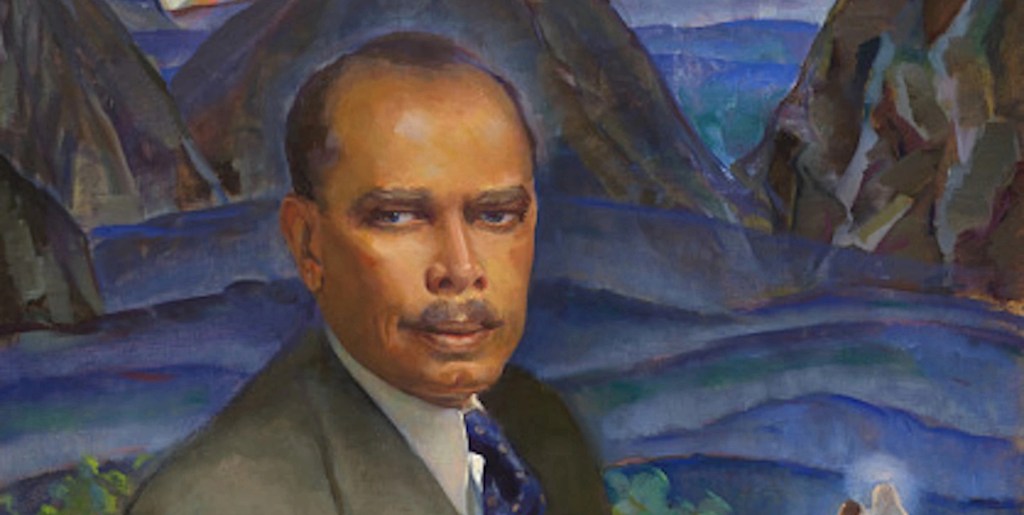
James Weldon Johnson’s “My City”
Jacksonville, Florida, native James Weldon Johnson composed his tribute to his adopted New York City in a surprising Petrarchan sonnet. He reveals the features of city life that he came to love and appreciate and that he will sorely miss after he dies.
Introduction with Text of “My City”
James Weldon Johnson’s “My City” is a Petrarchan or Italian sonnet, with the traditional rime scheme: in the octave ABBACDDC and in the sestet DEDEGG. The poem features unexpected claims that diverge radically from what readers have come to anticipate in a poem offering a personal, heartfelt tribute.
Although Johnson was born in Jacksonville, Florida, he lived a portion of his life in New York City, and as this poem attests, he came to love his adopted city.
He appreciated even the aspects of city life that many find challenging, for example, the crowd of people throning the streets day and night.
He even appreciated the opportunity to experience the slums that the Manhattan borough had to offer. That his speaker is accounting for what he will miss most by dying, he is offering a unique type of tribute to the city the he came to love and appreciate.
My City
When I come down to sleep death’s endless night,
The threshold of the unknown dark to cross,
What to me then will be the keenest loss,
When this bright world blurs on my fading sight?
Will it be that no more I shall see the trees
Or smell the flowers or hear the singing birds
Or watch the flashing streams or patient herds?
No, I am sure it will be none of these.
But, ah! Manhattan’s sights and sounds, her smells,
Her crowds, her throbbing force, the thrill that comes
From being of her a part, her subtle spells,
Her shining towers, her avenues, her slums—
O God! the stark, unutterable pity,
To be dead, and never again behold my city!
Commentary on “My City”
Poet James Weldon Johnson was a native of Jacksonville, Florida, but this poem offers a tribute to his adopted city, New York City.
Octave: What Will Be His Greatest Loss?
When I come down to sleep death’s endless night,
The threshold of the unknown dark to cross,
What to me then will be the keenest loss,
When this bright world blurs on my fading sight?
Will it be that no more I shall see the trees
Or smell the flowers or hear the singing birds
Or watch the flashing streams or patient herds?
No, I am sure it will be none of these.
To begin his tribute to New York City, the speaker poses two questions in the octave: the first question seeks the answer to what he will consider his greatest loss as he experiences death; the second question merely offers a suggestion as to what his great loss might entail.
The speaker asks his first question, posing it poetically: he seeks to ascertain and express what he will feel his greatest loss to be after he has died, leaving “this bright world” but a fading memory in his mind’s eye.
He places on display his abiding love for this world by calling it “this bright world.” By thus labeling the world “bright,” the speaker makes clear that he has a high regard for God’s creation, which he will regret leaving.
He then dramatically and richly portrays death, labeling that state metaphorically “sleep” and giving it the property of “endless night.” He further labels the crossing over from life to death as as “threshold of the unknown dark.”
With the second question, he asks if he might mourn the fact that he no longer has the ability to “see trees,” nor does he possess the capability of “smell[ing] the flowers.”
He continues musing on the possibilities of his greatest losses and avers that the inability to listen to birds singing would also cause him great pain, which might be his greatest loss.
The speaker then adds two further possibilities: “watch[ing] the flashing streams” or unhurriedly observing the “patient herds.” The reader will take note that all of these many possible losses stem from the things of nature, ordinarily observed in a bucolic setting.
Recalling that the title of the poem is “My City,” the reader will not be shocked that the speaker then answers his own question asserting that he is quite certain he will not consider any of these losses his greatest.
Although leaving them will be painful, because he does enjoy all of those natural gifts from God, he know that none of them cause him as much sorrow as some other loss, yet to be named.
Sestet: Losing the Sights, Sound, Smells of His City
But, ah! Manhattan’s sights and sounds, her smells,
Her crowds, her throbbing force, the thrill that comes
From being of her a part, her subtle spells,
Her shining towers, her avenues, her slums—
O God! the stark, unutterable pity,
To be dead, and never again behold my city!
In the sestet, the speaker pronounces with an emphatic, fervent anguish that it is “Manhattan” that he will most long for, after death has taken him from this world.
The speaker then enumerates the features that entice him and engender in him his deep love for his city: he remains spellbound and holds deep affection the sights, sounds, and smells of “Manhattan,” which is the most densely populated borough of New York City.
Thus, he adores all those crowds of people streaming through the streets of that borough. In addition to all of these Manhattan things, the speaker will also experience the forfeiture of continuing to experience the “shining towers,” the avenues and even the slums.
Although some of the items in this catalogue are not especially beautiful nor are they particularly inspiring, specifically to those engrossed in a rustic setting, this speaker possesses an abiding love for those things. He is, therefore, dreading the fact that death will dispossess him of the continued pleasure they have so long afforded him.
In the speaker’s final outcry, as he verbalizes his mourning, his readers/listeners will understand the melancholy dramatized in his voice. He cries out to his Beloved Lord that it will be such a damnable shame that after he shuffles off the mortal coil, he will never again be able to see his beloved city.
 Linda's Literary Home