Linda's Literary Home

Tag: politics

  • Ben Okri’s Poem “Obama”

    Image:  Ben Okri

    Ben Okri’s Poem “Obama”

    A no-achievement president confounds the ability of a poet, who tries to celebrate the outgoing leader but can find no achievements to celebrate.

    Introduction with Text of Ben Okri’s “Obama” 

    On Thursday, January 19, 2017, one day before the inauguration of Donald Trump as the 45th president of the United States of America, the U.S.A. edition of The Guardian published Ben Okri’s poem [1] simply titled “Obama,” about which the publication claimed, “With Donald Trump about to enter the White House, a poet celebrates the achievements of the outgoing president.”

    One will peruse Okri’s poem in vain looking of any achievements that might be associated with President #44.  One will also peruse this poem in vain looking for any “celebration.”  The poem offers four musings of a philosophical nature, each handled in each of the four movements that structure the piece:  

    1. “Sometimes the world is not changed / Till the right person appears who can / Change it.”
    2. “For it is our thoughts that make / Our world.”
    3. “Being a black president is not a magic wand / That will make all black problems disappear.”
    4. “And so what Obama did and did not do is neither / Here nor there, in the great measure of things.”

    Each musing remains a vague utterance, especially in relationship to its avowed subject.  The promise of celebrating achievements becomes a dumbfounded leitmotiv that like the Obama presidency fails to deliver anything substantial.

    Toward the end of the piece, the speaker even seems to have become aware that he had not, in fact, offered anything concrete regarding the achievements of this president.  Thus, he rehashes an old lie that people wanted this president to fail so they could support their racism.  

    For any opposition to a black president has to be racist! 

    The opposition cannot be opposing a black president because they do not agree with his policies; that opposition must be the result of the “race-hate, twin deity of America,” despite the blaring fact that that race-hateful America elected this black man to their highest office twice.

    Okri usually provides level-headed, balanced thinking on most issues, even the race issue.  He knows the difference between achievement and lack thereof; thus, in this poem, he has his speaker spouting philosophical stances and then only implying that they apply to Barack Obama. 

    Okri, the thinking man, knows that Barack Obama is the epitome of an “empty-suit.”  Obama can lay no claim to achievements accept negative ones.  This poem might even be considered one of those that “damn with faint praise” [2].

    Obama

    Sometimes the world is not changed
    Till the right person appears who can
    Change it. But the right person is also
    In a way the right time. For the time
    And the person have to work
    The secret alchemy together.
    But to change the world is more than
    Changing its laws. Sometimes it is just
    Being a new possibility, a portal
    Through which new fire can enter
    This world of foolishness and error.
    They change the world best who
    Change the way people think.

    For it is our thoughts that make
    Our world. Some think it is our deeds;
    But deeds are the children of thought.
    The thought-changers are the game-changers,
    Are the life-changers.
    We think that achievements are symbols.
    But symbols are not symbols.
    Obama is not a mere symbol.
    Sometimes even a symbol is a sign
    That we are not dreaming potently
    Enough. A sign that the world is the home
    Of possibility. A sign that our chains
    Are unreal. That we are freer than we
    Know, that we are more powerful than
    We dare to think. If he is a symbol at all,
    Then he is a symbol of our possible liberation.
    A symbol also that power in this world
    Cannot do everything. Even Moses could
    Not set his people free. They too had to
    Wander in the wilderness. They too turned
    Against their leaders and their God
    And had to overcome much in their
    Make up and their history to arrive
    At the vision their prophets had long before.

    Being a black president is not a magic wand
    That will make all black problems disappear.
    Leaders cannot undo all the evils that
    Structural evils make natural in the life
    Of a people. Not just leadership, but
    Structures must change. Structures of thought
    Structures of dreams structures of injustice
    Structures that keep a people imprisoned
    To the stones and the dust and the ash
    And the dirt and the dry earth and the dead
    Roads. Always we look to our leaders
    To change what we ourselves must change
    With the force of our voices and the force
    Of our souls and the strength of our dreams
    And the clarity of our visions and the strong
    Work of our hands. Too often we get fixated
    On symbols. We think fame ought to promote
    Our cause, that presidents ought to change our
    Destinies, that more black faces on television
    Would somehow make life easier and more just
    For our people. But symbols ought to only be
    A sign to us that the power is in our hands.
    Mandela ought to be a sign to us that we cannot
    Be kept down, that we are self-liberating.
    And Obama ought to be a sign to us that
    There is no destiny in colour. There is only
    Destiny in our will and our dreams and the storms
    Our “noes” can unleash and the wonder our “yesses”
    Can create. But we have to do the work ourselves
    To change the structures so that we can be free.
    Freedom is not colour; freedom is thought; it is an
    Attitude, a power of spirit, a constant self-definition.

    And so what Obama did and did not do is neither
    Here nor there, in the great measure of things.
    History knows what he did, against the odds.
    History knows what he could not do. Not that
    His hands were tied, but that those who resent
    The liberation of one who ought not to be liberated
    Blocked those doors and those roads and whipped
    Up those sleeping and not so sleeping demons
    Of race-hate, twin deity of America. And they turned
    His yes into a no just so they could say they told us so,
    Told us that colour makes ineffectuality, that colour
    Makes destiny. They wanted him to fail so they could
    Prove their case. Can’t you see it? But that’s what
    Heroes do: they come through in spite of all that blockage,
    All those obstacles thrown in the path of the self-liberated.
    That way the symbol would be tainted and would fail
    To be a beacon and a sign that it is possible
    To be black and to be great.

    Commentary on Ben Okri’s  “Obama”

    Ben Okri is a fine poet and thinker.  His unfortunate choice of subject matter for this piece, however, leads his speaker down a rocky path to nowhere.

    First Movement:  “Change”?  But Where is the “Hope”?

    The speaker of Okri’s “Obama” has a mighty task before him:  he must transform a sow’s ear into a silk purse.  And of course, that cannot be done.  But the speaker tries, beginning with some wide brush strokes that attempt to sound profound:  only the right person appearing at the right time can change with world.  

    Changing laws is not sufficient to change the world, so sometimes it is only a “new possibility” which functions like a new door “through with a new fire can enter.”  

    The speaker is, of course, implying that his subject, Obama, is that “portal” through which a new fire has entered.  Readers will note that the speaker is only implying such; he does not make any direct statement about Obama actually being that new door or new fire.

    The election of 2016, after eight years of this implied new fire that has supposedly changed the way people think, proved that American citizens were indeed thinking differently.

    They had grown tired of stagnant economic growth, the destruction of their health care system, the rampant lawlessness of illegal immigrants, the war on law enforcement officers fueled by that “hope and change” spouting candidate, the ironically deteriorated race relations, and the installation of a petty dictatorship fueled by political correctness.  

    This beckon of hope and change had promised to fundamentally change [3] the United States of America, and his policies indeed had put the country on a path to an authoritarian state from which the Founders had guarded the country through the U. S. Constitution.  Obama proceeded to flout that document as he ruled by executive order, circumventing the congress.

    Indeed, after those abominable, disastrous eight years, people’s minds had changed, and they wanted no more of those socialistic policies that were driving the country to the status of a Banana Republic.

    The speaker, of course, will never refer to any of the negative accomplishments of his subject, but also he will never refer to any positive accomplishment because there simply are none.  Thus, no achievement is mentioned in the opening movement.

    Five days away:  

    Second Movement:  Symbols, Signs, Still No Achievements

    The speaker then continues with the mere philosophizing, offering some useful ideas that have nothing to do with his subject.  He asserts the importance of thought, how thought is the mother of deeds.  He then begins an equivocating series of lines that indeed fit quite well with the shallow, misdirection of the subject about which he tries to offer a celebration.

    The speaker makes a bizarre, false claim, “We think that achievements are symbols.”  We do not think any such thing; we think that achievements are important, useful accomplishments.

    A presidential achievement represents some act which the leader has encouraged that results in better lives for citizens. 

    Americans had high hopes [4] that the very least this black president could achieve would be the continued improvement of race relations.  Those hopes were dashed as this president from his bully pulpit denigrated whole segments of society—the religious, the patriotic, and especially the members of law enforcement [5].  

    Obama damaged the reputation of the entire nation as he traveled on foreign soil, apologizing for American behavior [6] that had actually assisted those nations in their times of distress.  

    The speaker then ludicrously states, “symbols are not symbols,” which he follows with “Obama is not a mere symbol.”  

    In a kind of syllogistic attempt to define a symbol, the speaker admits the truth that Obama actually had no achievements. If achievements are symbols, and Obama is not a “mere” symbol, then we hold the notion that Obama does not equal achievements, except for whatever the word “mere” might add to the equation.

    But the speaker then turns from symbols to signs. Signs can show us whether we are dreaming correctly or not.  Signs can show us that we are more free than we know.  But if Obama is any kind of  symbol, he symbolizes “our possible liberation.”  

    But he is also a symbol that “power in this world / Cannot do everything.”  He then turns to Moses’ inability to liberate his people.

    The sheer inappropriateness of likening the lead-from-behind, atheistic Obama to the great historical, religious figure Moses boggles the mind.  The speaker then makes an astoundingly arrogant inference that Americans turning against Obama equates to Moses’ people turning against him “and their God.”  

    Americans turning against leader Obama means they will have to “wander in the wilderness” until they at last come to their senses and return to the “vision of their prophets.”

    The speaker again has offered only musings about symbols, signs, power, lack of power, dreams, and misdirection, but he offers nothing that Obama has done that could be called an achievement.

    Third Movement:  Color Is not Destiny

    This movement offers a marvelous summation of truths, which essentially places all leaders in their proper places.  Leaders can serve only as symbols or signs to remind citizens that only the people themselves have the power to change the structures of society that limit individuals.  

    Black presidents possess no “magic wand” with which to make all “black problems disappear.”  Even Nelson Mandela should serve only as a sign that we are all “self-liberating.”

    The speaker rightly laments that we tend to look to our leaders to perform for us the very acts that we must perform for ourselves.  Our leaders cannot guarantee our inner freedom, only we can do that. 

    He asserts that Obama must remain only a sign that there is “no destiny in colour.”  Our destiny is in our own will and in our own dreams. 

    The speaker correctly asserts, “Freedom is not colour; freedom is thought; it is an / Attitude, a power of spirit, a constant self-definition.”

    Sadly, Obama has never demonstrated that he understands the position taken in Okri’s third movement.  Obama is so steeped in political correctness and radical collectivism that he always denigrates the stereotypical white privileged over the stereotypical groups of race, gender, nationality, and religion.  

    Obama’s warped, highly partisan stance would never accept the statements about freedom as described by Okri.  Obama believes that only the state can grant freedom to the proper constituencies as it punishes others.  Okri’s analysis runs counter to the Obama worldview [7].

    Thus, again, in its third movement, this poem that claims to be a celebration of the presidential achievements of the 44th president offers only philosophical musings, and although some of those musings state an accurate position, there still remains no positive achievement that can attach to Obama.

    Fourth Movement:  Obama, Neither Here nor There 

    With complete accuracy once again, Okri’s speaker states baldly, “And so what Obama did and did not do is neither / Here nor there, in the great measure of things.”  Certainly, one who looks for positive achievements will find the blandness of this statement on the mark.  The speaker then adds that history will record what Obama did and also what he was unable to do.

    Then the narrative goes totally off the rails.  American racists, those “racists” who had elected this black president twice, threw up road blocks that limited this president’s accomplishments.  

    They wanted him to fail because being black he had no right to succeed.  The speaker implies that those American racists thought that this black president did not deserve liberation, meaning they thought he should be a slave—a ludicrous, utterly false claim. 

    The speaker then concludes with a weak implication that Obama is a hero, who demonstrated that it is possible to be “black and to be great”:  

    They wanted him to fail so they could
    Prove their case. Can’t you see it? But that’s what
    Heroes do: they come through in spite of all that blockage,
    All those obstacles thrown in the path of the self-liberated.
    That way the symbol would be tainted and would fail
    To be a beacon and a sign that it is possible
    To be black and to be great.

    The problem with this part of the narrative again is, on the one hand, that it is only an implication, not a positive statement making the claim that Obama was, in fact, a hero; on the other hand, it is obvious why the speaker would only imply these positive qualities to Obama:  the man is not a hero; indeed, he is a fraud [8].  

    Fraudulent Claims of Literary Prowess

    There is a certain bit of irony in having a poem attempt to celebrate the achievements of a colossal fraud [9].  Nowhere is the evidence of Obama’s characteristic as a fraud more evident than in his claims to have written his two books, Dreams from My Father, and The Audacity of Hope

    Jack Cashill’s “Who Wrote Dreams from My Father?” [10] offers convincing evidence that Barack Obama could not have written the books he claims to have authored.  And Cashill continues his analysis of Obama’s writing skills in “Who Wrote Audacity of Hope?” [11].

    Writing in the Illinois Review, Mark Rhoads [12] poses the same question regarding the Obama works.  Even Obama’s presidential library [13] will offer no evidence that the president possessed any literary skills.

    Clearly, Okri’s poem provides a mélange of attitudes toward its subject.  On the one hand, it wants to praise the outgoing president, but on the other, it simply can find nothing with which to do so. 

    That the poem concludes with a bald-face lie is unfortunate, but understandable.  Still, it cannot hide the truth:  that Barack Obama offered it no achievements, which it could celebrate; at best, only phony ones [14].

    Sources

    [1]  Ben Okri.  “Barack Obama: a celebration in verse.”  The Guardian.  January 19, 2017.

    [2] Alexander Pope.  Rape of the Lock and Other Poems.  Project Gutenberg.  October 18, 2003.

    [3]  Barack Obama. “We Are 5 Days From Fundamentally Transforming America.” YouTube.  Feb 2, 2012.

    [4] Jeffrey M. Jones. “In U.S., Obama Effect on Racial Matters Falls Short of Hopes.” Gallup. August 11, 2016.

    [5]  Ben Smith. “Obama on small-town Pa.: Clinging to religion, guns, xenophobia.”  Politico.  April 11, 2008.

    [6]   Nile Gardiner and Morgan Lorraine Roach.  “Barack Obama’s Top 10 Apologies: How the President Has Humiliated a Superpower.”  The Heritage Foundation.  June 2, 2009.

    [7]  Andrew Miller.  “Unriddling the Radical Worldview of President Obama.”  The Trumpet. January 2016.

    [8]  Andrew McCarthy.  “Obama’s Massive Fraud.”  National Review Online.  November 9, 2013.

    [9]  Jack Cashill.  “‘Roots,’ ‘Dreams,’ and the Unequal Punishment of Fraud.”  The American Spectator.  December 26, 2021.

    [10]   – – – . “Who Wrote Dreams From My Father?American Thinker.  October 9, 2008.

    [11]  – – – .  “The Question the Times Should Have Asked ‘Writer’ Barack Obama.”  The American Spectator.  January 25, 2017.

    [12]  Mark Rhoads.  “Did Obama Write ‘Dreams from My Father or ‘Audacity of Hope’?”  Illinois Review. October 16, 2008.

    [13] Lolly Bowean.  “Without archives on site, how will Obama Center benefit area students, scholars?”  Chicago Tribune. October 8, 2017.

    [14]  Jennifer Rubin.  “Obama’s phony accomplishments leave us worse off.”  Washington Post.  Feb. 12, 2016.

    🕉

    You are welcome to join me on the following social media:
    TruthSocial,Locals,Gettr,X,Bluesky,Facebook,Pinterest 

    🕉

    Share
  • W. H. Auden’s “Doggerel by a Senior Citizen”

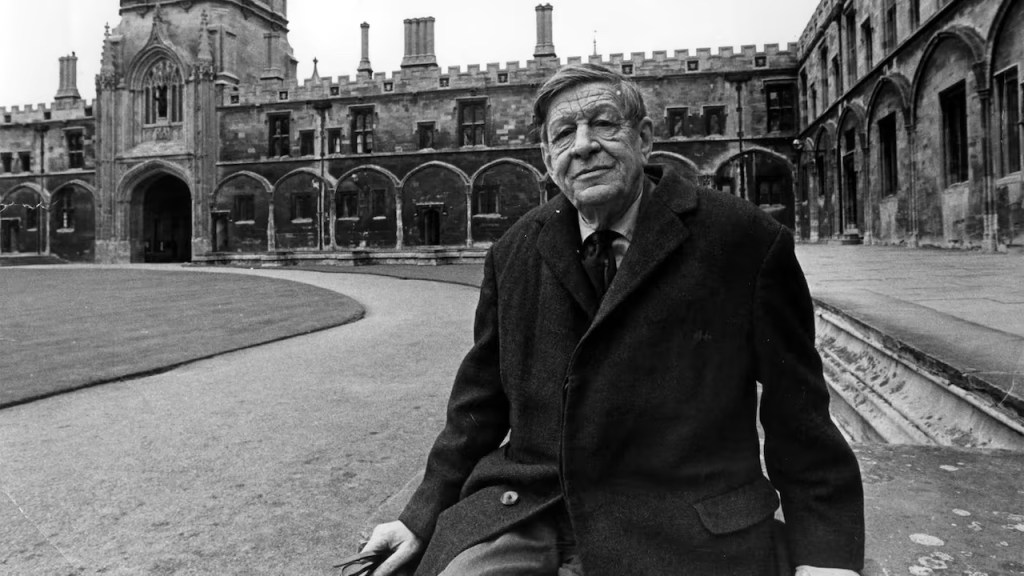
    Image: WH Auden in the Tom Quadrangle at Christ Church College, Oxford © Camera Pres 

    W. H. Auden’s “Doggerel by a Senior Citizen”

    The speaker in Auden’s “Doggerel by a Senior Citizen” is a man of certain age, warning listeners that what he is about to spew is doggerel.  But the claim is made in ironic jest; what the “doggerelist” is about to spew is the bitter truth, or at least in his humble opinion, about societal progress.

    Introduction with Text from “Doggerel by a Senior Citizen”

    By ironically jesting that his utterance will be only a bit of doggerel, the speaker in W. H. Auden’s “Doggerel by a Senior Citizen” lightens any blame he may receive, or any pushback against his views.    The views and the biting criticism remain perfectly in line with the poet’s views as expressed in his utterly serious works, such as “The Unknown Citizen.”

    Doggerel by a Senior Citizen

    Our earth in 1969
    Is not the planet I call mine,
    The world, I mean, that gives me strength
    To hold off chaos at arm’s length.

    My Eden landscapes and their climes
    Are constructs from Edwardian times,
    When bath-rooms took up lots of space,
    And, before eating, one said Grace.

    The automobile, the aeroplane,
    Are useful gadgets, but profane:
    The enginry of which I dream
    Is moved by water or by steam.

    Reason requires that I approve
    The light-bulb which I cannot love:
    To me more reverence-commanding
    A fish-tail burner on the landing.

    My family ghosts I fought and routed,
    Their values, though, I never doubted:
    I thought the Protestant Work-Ethic
    Both practical and sympathetic.

    When couples played or sang duets,
    It was immoral to have debts:
    I shall continue till I die
    To pay in cash for what I buy.

    The Book of Common Prayer we knew
    Was that of 1662:
    Though with-it sermons may be well,
    Liturgical reforms are hell.

    Sex was of course — it always is —
    The most enticing of mysteries,
    But news-stands did not then supply
    Manichean pornography.

    Then Speech was mannerly, an Art,
    Like learning not to belch or fart:
    I cannot settle which is worse,
    The Anti-Novel or Free Verse.

    Nor are those Ph.D’s my kith,
    Who dig the symbol and the myth:
    I count myself a man of letters
    Who writes, or hopes to, for his betters.

    Dare any call Permissiveness
    An educational success?
    Saner those class-rooms which I sat in,
    Compelled to study Greek and Latin.

    Though I suspect the term is crap,
    There is a Generation Gap,
    Who is to blame? Those, old or young,
    Who will not learn their Mother-Tongue.

    But Love, at least, is not a state
    Either en vogue or out-of-date,
    And I’ve true friends, I will allow,
    To talk and eat with here and now.

    Me alienated? Bosh! It’s just
    As a sworn citizen who must
    Skirmish with it that I feel
    Most at home with what is Real.

    Commentary on “Doggerel by a Senior Citizen”

    Claiming to be offering a piece of doggerel, this speaker/senior-citizen offers his personal evaluation about what things are like in the year 1969.

    First Movement:   A Different Planet from Yesteryear

    Our earth in 1969
    Is not the planet I call mine,
    The world, I mean, that gives me strength
    To hold off chaos at arm’s length.

    My Eden landscapes and their climes
    Are constructs from Edwardian times,
    When bath-rooms took up lots of space,
    And, before eating, one said Grace.

    The speaker begins by alerting his listeners that he is reporting from the year 1969, and he then makes clear through a bit of exaggeration that the earth no longer represents the same “planet” upon which he had formerly existed.   This new “earth” “planet” “world” has become a place of mayhem, and the disorder is so bad that he has difficulty keeping it at bay or out of his own life.

    The speaker suggests that his own preference is for the Edwardian age [1], a period of prosperity and especially important in the areas of fashion and art.  The speaker hints that religion was still a central feature in the family, as they said “Grace” before dining.

    The speaker makes it clear that for him those times were “[his] Eden”—likely he does mean prelapsarian Eden [2]. He employs the rest of his discourse to show how the times in which he is now living can be considered quite postlapsarian [3]

    Second Movement:  Nostalgia Outsmarts Novelty

    The automobile, the aeroplane,
    Are useful gadgets, but profane:
    The enginry of which I dream
    Is moved by water or by steam.

    Reason requires that I approve
    The light-bulb which I cannot love:
    To me more reverence-commanding
    A fish-tail burner on the landing.

    The speaker refers to the common inventions of the day, calling the mode of travel by car and plane “useful” but “profane.”  He still longs for the steam engine  and old-timey wind sailing.

    Although he feels that he is likely required to accept used of the “light-bulb,” he cannot bring himself to “love” the object.  He prefers the gaslight resembling a fish tail, which resulted from two gas jets spewing through two holes that fanned out and formed the fish tail shaped flame.  Nostalgia often overcomes efficacy when it comes to every-day useful appliances.

    Third Movement:  From the Work Ethic to Debt Accumulation

    My family ghosts I fought and routed,
    Their values, though, I never doubted:
    I thought the Protestant Work-Ethic
    Both practical and sympathetic.

    When couples played or sang duets,
    It was immoral to have debts:
    I shall continue till I die
    To pay in cash for what I buy.

    The speaker has overcome the idiosyncrasies of family life, coming to love those whom he had earlier found unpleasant; he has, however, always accepted the basic moral rectitude of those family members.  They adhered to the “Protestant Work-Ethic,” which the speaker has always deemed practical and proper.

    Back during the time when party entertainment often consisted of “couples [playing or singing] duets,” the society deemed acquiring debt an immoral act.  The speaker assures his listener that to his dying day he will continue to accept that societal feature and continue to pay “in cash for what I buy.”

    Fourth Movement:  The Weakness of Liturgical Reforms

    The Book of Common Prayer we knew
    Was that of 1662:
    Though with-it sermons may be well,
    Liturgical reforms are hell.

    Sex was of course — it always is —
    The most enticing of mysteries,
    But news-stands did not then supply
    Manichean pornography.

    The speaker remembers that before certain religious reforms a “Book of Common Prayer” held sway, and it dated all the way back to 1662, during the era of the Restoration of King Charles II [4].

    Religious reformation always comes about through controversy.  Those who have become accustomed to certain practices of worship distain any change and thus argue against “liturgical reforms” [5].  This speaker has already placed his likely position on such reforms; he naturally comes down solidly on the side against them, labeling such actions “hell.”

    The speaker then cites “sex,” which is always engulfed in “mysteries,” as an example of one phase of life that has suffered because of “liturgical reforms”:  the obnoxious duality of “Manichean pornography” now sits on “news-stands,” whereas in the more modest past, such sights would not have been tolerated.

    Fifth Movement:  The Problem with Language Study

    Then Speech was mannerly, an Art,
    Like learning not to belch or fart:
    I cannot settle which is worse,
    The Anti-Novel or Free Verse.

    Nor are those Ph.D’s my kith,
    Who dig the symbol and the myth:
    I count myself a man of letters
    Who writes, or hopes to, for his betters.

    The speaker now tackles “Speech,” the art of the word, the use of letters that creates literary art.  But first he delves into the vulgar act of belching or farting, which along with the “mannerly” use of language, would not be acceptable.  Children would then learn to avoid the grossness involved in such human effusions.

    The speaker says he has not decided which art form is more vile: “the Anti-Novel” or “Free Verse.”  The proliferation of those holding doctoral degrees, particularly the Ph.D., does not impress this speaker; he finds this who revel in “myth” and “symbol” hold little interest for him.

    He contrasts himself with those book-learned fellows: he assures his listeners that he himself is “a man of letters.”  But instead of trying to appeal to the vulgar, profane masses, he strives to compose for “his betters.”  He remains a bit humble in his claim by inserting “or hopes to.”

    Sixth Movement:  Lack of Discipline

    Dare any call Permissiveness
    An educational success?
    Saner those class-rooms which I sat in,
    Compelled to study Greek and Latin.

    Though I suspect the term is crap,
    There is a Generation Gap,
    Who is to blame? Those, old or young,
    Who will not learn their Mother-Tongue.

    The speaker then refers to permissiveness as the bane of success in education.  He finds the old-fashioned disciplines focusing on learning “Greek and Latin” to be a much “saner” focus for the classroom.  He was such a student and now feels he has benefited for the rigor of such study of language.

    Mentioning the buzz-phrase of the late sixties “Generation Gap,” he says its likely a worthless expression, even though he does detect that such a thing exists.  But he wonders who is to blame for it? Is the the “old or young”?  But then he answers his question by asserting that both are to blame, that is, those who refuse to learn “their Mother-Tongue.”

    Seventh Movement:  Love and Reality

    But Love, at least, is not a state
    Either en vogue or out-of-date,
    And I’ve true friends, I will allow,
    To talk and eat with here and now.

    Me alienated? Bosh! It’s just
    As a sworn citizen who must
    Skirmish with it that I feel
    Most at home with what is Real.

    The speaker concludes with some uplifting thoughts:  love, for example, never goes out of style, and he retains good friends with whom he can pleasantly dine and converse.

    He seems to reject the notion that he might feel “alienated,” but he does suggest that the loosening of societal mores causes him to “skirmish” with it all.  He insists that he feels most comfortable with “what is Real.”  He does not equivocate with what he thinks that reality entails; he has just laid it all out in his piece of “doggerel.”

    Sources

    [1]  Curators.  “Edwardian Era Facts: Daily Life Of People, Society.” Victorian Era.  Accessed November 26, 2023.

    [2]  Curators.  “prelapsarian.”  vDict.pro. Accessed November 26, 2023.

    [3]  Curators. “postlapsarian.”  Merriam-Webster.  Accessed November 26, 2023.

    [4]  History.com Editors.  “The English Restoration begins.”  History. May 21, 2020.

    [5]  Helen Hull Hitchcock.  “Why the Liturgical Reform? or, ‘What if we just say no to any liturgical change?’Adoremus. November 11, 2020.

  • William Butler Yeats’ “The Second Coming”

    Image: William Butler Yeats – Howard Coster – National Portrait Galley, London

    William Butler Yeats’ “The Second Coming”

    William Butler Yeats’ “The Second Coming” remains one of the most widely misunderstood poems of the 20th century. Many scholars and critics have failed to criticize the exaggeration in the first stanza and the absurd metaphor in the second stanza, which render a potentially fine poem a critical failure.

    Introduction with Text of “The Second Coming”

    Poems, in order to communicate, must be as logical as the purpose and content require. For example, if the poet wishes to comment on or criticize an issue, he must adhere to physical facts in his poetic drama. If the poet wishes to emote, equivocate, or demonstrate the chaotic nature of his cosmic thinking, he may legitimately do so without much seeming sense.

    For example, Robert Bly’s lines—”Sometimes a man walks by a pond, and a hand / Reaches out and pulls him in” / / “The pond was lonely, or needed / Calcium, bones would do,”—are ludicrous [1] on every level.   Even if one explicates the speaker’s personifying the pond, the lines remain absurd, at least in part because if a person needs calcium, grabbing the bones of another human being will not take care of that deficiency. 

    The absurdity of a lake needing “calcium” should be abundantly clear on its face.  Nevertheless, the image of the lake grabbing a man may ultimately be accepted as the funny nonsense that it is.   William Butler Yeats’ “The Second Coming” cannot be dismissed so easily; while the Yeats poem does not depict the universe as totally chaotic, it does bemoan that fact that events seem to be leading society to armageddon.

    The absurdity surrounding the metaphor of the “rough beast” in the Yeats poem renders the musing on world events without practical substance.

    The Second Coming

    Turning and turning in the widening gyre   
    The falcon cannot hear the falconer;
    Things fall apart; the centre cannot hold;
    Mere anarchy is loosed upon the world,
    The blood-dimmed tide is loosed, and everywhere   
    The ceremony of innocence is drowned;
    The best lack all conviction, while the worst   
    Are full of passionate intensity. 

    Surely some revelation is at hand;
    Surely the Second Coming is at hand.   
    The Second Coming! Hardly are those words out  
    When a vast image out of Spiritus Mundi
    Troubles my sight: somewhere in sands of the desert   
    A shape with lion body and the head of a man,   
    A gaze blank and pitiless as the sun,   
    Is moving its slow thighs, while all about it   
    Reel shadows of the indignant desert birds.   
    The darkness drops again; but now I know   
    That twenty centuries of stony sleep
    Were vexed to nightmare by a rocking cradle,  
    And what rough beast, its hour come round at last,   
    Slouches towards Bethlehem to be born? 

    Commentary on “The Second Coming”

    William Butler Yeats’ “The Second Coming” remains one of the most widely anthologized poems in world literature.  Yet its hyperbole in the first stanza and ludicrous “rough beast” metaphor in the second stanza result in a blur of unworkable speculation.

    First Stanza: Sorrowful over Chaos

    Turning and turning in the widening gyre   
    The falcon cannot hear the falconer;
    Things fall apart; the centre cannot hold;
    Mere anarchy is loosed upon the world,
    The blood-dimmed tide is loosed, and everywhere   
    The ceremony of innocence is drowned;
    The best lack all conviction, while the worst   
    Are full of passionate intensity. 

    The speaker is sorrowing over the chaos of world events that have left in their wake many dead people.  Clashes of groups of ideologues have wreaked havoc, and much blood shed has smeared the tranquil lives of innocent people who wish to live quiet, productive lives. 

    The speaker likens the seemingly out of control situation of society to a falconer losing control of the falcon as he attempts to tame it.   Everyday life has become chaotic as corrupt governments have spurred revolutions.  Lack of respect for leadership has left a vacuum which is filled with force and violence.

    The overstated claim that “The best lack all conviction, while the worst / Are full of passionate intensity” should have alerted the poet that he needed to rinse out the generic hyperbole in favor of more accuracy on the world stage.  

    Such a blanket, unqualified statement, especially in a poem, lacks the ring of truth:  it simply cannot be true that the “best lack all conviction.”  Surely, some the best still retain some level of conviction, or else improvement could never be expected.  

    It also cannot be true that all the worst are passionate; some of the worst are likely not passionate at all but remain sycophantic, indifferent followers.  Any reader should be wary of such all-inclusive, absolutist statements in both prose and poetry.  

    Anytime a writer subsumes an entirety with the terms “all,” “none,” “everything,” “everyone,” “always,” or “never,” the reader should question the statement for its accuracy.  All too often such terms are signals for stereotypes, which produce the same inaccuracy as groupthink.

    Second Stanza: What Revelation?

    Surely some revelation is at hand;
    Surely the Second Coming is at hand.   
    The Second Coming! Hardly are those words out  
    When a vast image out of Spiritus Mundi
    Troubles my sight: somewhere in sands of the desert   
    A shape with lion body and the head of a man,   
    A gaze blank and pitiless as the sun,   
    Is moving its slow thighs, while all about it   
    Reel shadows of the indignant desert birds.   
    The darkness drops again; but now I know   
    That twenty centuries of stony sleep
    Were vexed to nightmare by a rocking cradle,  
    And what rough beast, its hour come round at last,   
    Slouches towards Bethlehem to be born? 

    The idea of “some revelation” leads the speaker to the mythological second coming of Christ.  So he speculates on what a second coming might entail.  However, instead of “Christ,” the speaker conjures the notion that an Egyptian-Sphinx-like character with ill-intent might arrive instead.  

    Therefore, in place of a second coming of godliness and virtue, as is the purpose of the original second coming, the speaker wonders:  what if the actual second coming will be more like an Anti-Christ?  What if all this chaos of bloodshed and disarray has been brought on by the opposite of Christian virtue?

    Postmodern Absurdity and the “Rough Beast”

    The “rough beast” in Yeats’ “The Second Coming” is an aberration of imagination, not a viable symbol for what Yeats’ speaker thought he was achieving in his critique of culture. If, as the postmodernists contend, there is no order [2] in the universe and nothing really makes any sense anyway, then it becomes perfectly fine to write nonsense. 

    Because this poet is a contemporary of modernism but not postmodernism [3], William Butler Yeats’ poetry and poetics do not quite devolve to the level of postmodern angst that blankets everything with the nonsensical.  Yet, his manifesto titled A Vision is, undoubtedly, one of the contributing factors to that line of meretricious ideology. 

    Hazarding a Guess Can Be Hazardous

    The first stanza of Yeats’ “The Second Coming” begins by metaphorically comparing a falconer losing control of the falcon to nations and governments losing control because of the current world disorder, in which “[t]hings fall apart; the centre cannot hold.” 

    Political factions employ these lines against their opposition during the time in which their opposition is in power, as they spew forth praise for their own order that somehow magically appears with their taking the seat of power.

    The poem has been co-opted by the political class so often that Dorian Lynskey, overviewing the poem in his essay, “‘Things fall apart’: the Apocalyptic Appeal of WB Yeats’s The Second Coming,” writes, “There was apparently no geopolitical drama to which it could not be applied” [4].

    The second stanza dramatizes the speaker’s musing about a revelation that has popped into his head, and he likens that revelation to the second coming of Christ; however, this time the coming, he speculates, may be something much different.  

    The speaker does not know what the second coming will herald, but he does not mind hazarding a dramatic guess about the possibility.   Thus, he guesses that the entity of a new “second coming” would likely be something that resembles the Egyptian sphinx; it would not be the return of the Christ with the return of virtue but perhaps its opposite—vice. 

    The speaker concludes his guess with an allusion to the birth of such an entity as he likens the Blessed Virgin Mother to the “rough beast.”   The Blessèd Virgin Mother, as a newfangled, postmodern creature, will be “slouching toward Bethlehem” because that is the location to which the first coming came.  

    The allusion to “Bethlehem” functions solely as a vague juxtaposition to the phrase “second coming” in hopes that the reader will make the connection that the first coming and the second coming may have something in common.  The speaker speculates that at this very moment wherein the speaker is doing his speculation some “rough beast” might be pregnant with the creature of the “second coming.” 

    And as the time arrives for the creature to be born, the rough beast will go “slouching” towards its lair to give birth to this “second coming” creature: “its hour come round at last” refers to the rough beast being in labor. 

    The Flaw of Yeats’ “The Second Coming” 

    The speaker then poses the nonsensical question: “And what rough beast, its hour come round at last, / Slouches towards Bethlehem to be born?”   In order to make the case that the speaker wishes to make, these last two lines should be restructured in one of two ways: 

    And what rough beast, its hour come round at last,
    Slouches towards Bethlehem to give birth? 

     or

    And what rough beast’s babe, its time come at last,
    Is in transport to Bethlehem to be born?

    An unborn being cannot “slouch” toward a destination.  The pregnant mother of the unborn being can “slouch” toward a destination.   But the speaker is not contemplating the nature of the rough beast’s mother; he is contemplating the nature of the rough beast itself.  

    The speaker does not suggest that the literal Sphinx will travel to Bethlehem. He is merely implying that a Sphinx-like creature might resemble the creature of the second coming.  Once an individual has discounted the return of Jesus the Christ as a literal or even spiritual fact, one might offer personal speculation about just what a second coming would look like. 

    It is doubtful that anyone would argue that the poem is dramatizing a literal birth, rather than a spiritual or metaphorical one.    It is also unreasonable to argue that the speaker of this poem—or Yeats for that matter—thought that the second coming actually referred to the Sphinx.   A ridiculous image develops from the fabrication of the Sphinx moving toward Bethlehem. Yeats was more prudent than that. 

    Exaggerated Importance of Poem

    William Butler Yeats composed a manifesto to display his worldview and poetics titled A Vision, in which he set down certain tenets of his thoughts on poetry, creativity, and world history.   Although seemingly taken quite seriously by some Yeatsian scholars, A Vision is of little value in understanding either meaning in poetry or the meaning of the world, particularly in terms of historical events.  

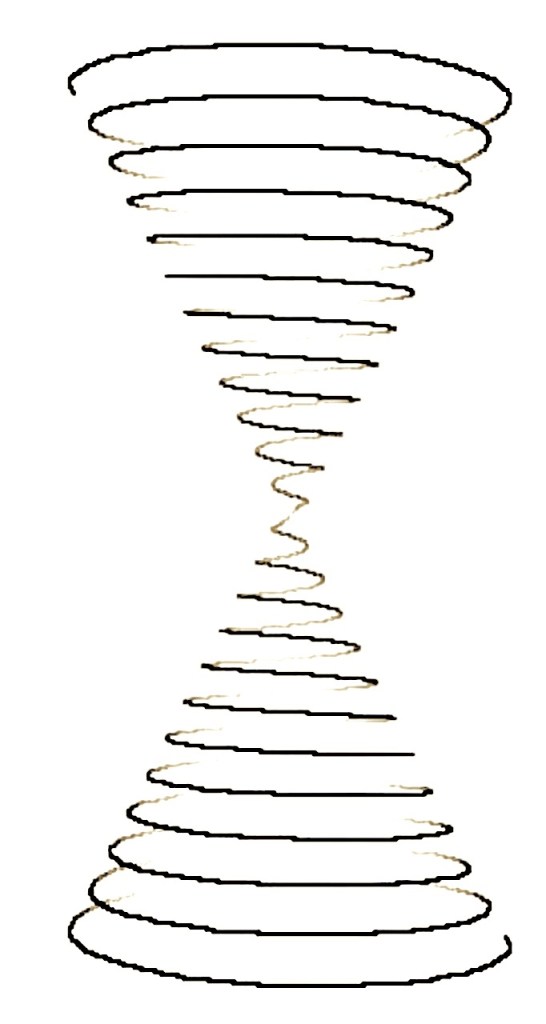
    An important example of Yeats’ misunderstanding of world cycles is his explanation of the cyclical nature of history, exemplified with what he called “gyres” (pronounced with a hard “g.”)  Two particular points in the Yeatsian explanation demonstrate the fallacy of his thinking:

    1. In his diagram, Yeats set the position of the gyres inaccurately; they should not be intersecting but instead one should rest  one on top of the other:  cycles shrink and enlarge in scope; they do not overlap, as they would have to do if the Yeatsian model were accurate. 

    Image :  Gyres – Inaccurate Configuration from A Vision

    Image:  Gyres –  Accurate Configuration

    2.  In the traditional Second Coming, Christ is figured to come again but as an adult, not as in infant as is implied in Yeats’ poem “The Second Coming.”

    Of great significance in Yeats’ poem is the “rough beast,” apparently the Anti-Christ, who has not been born yet.  And most problematic is that the rough beast is “slouch[ing] towards Bethlehem to be born.”  The question is, how can such a creature be slouching if it has not yet been born?  There is no indication the speaker wishes to attribute this second coming fiasco to the mother of the rough beast.

    This illogical event is never mentioned by critics who seem to accept the slouching as a possible occurrence.  On this score, it seems critics and scholars have lent the poem an unusually wide and encompassing poetic license.

    The Accurate Meaning of the Second Coming

    Paramahansa Yogananda has explained in depth the original, spiritual meaning of the phrase “the second coming”[5] which does not signify the literal coming again of Jesus the Christ, but the spiritual awakening of each individual soul to its Divine Nature through the Christ Consciousness.  

    Paramahansa Yogananda summarizes his two volume work The Second Coming of Christ: The Resurrection of the Christ Within You:

    In titling this work The Second Coming of Christ, I am not referring to a literal return of Jesus to earth . . . 

    A thousand Christs sent to earth would not redeem its people unless they themselves become Christlike by purifying and expanding their individual consciousness to receive therein the second coming of the Christ Consciousness, as was manifested in Jesus . . . 

    Contact with this Consciousness, experienced in the ever new joy of meditation, will be the real second coming of Christ—and it will take place right in the devotee’s own consciousness. (my emphasis added)

    Interestingly, knowledge of the meaning of that phrase “the second coming” as explained by Paramahansa Yogananda renders unnecessary the musings of Yeats’ poem “The Second Coming”and most other speculation about the subject. Still, the poem as an artifact of 20th century thinking remains an important object for study. 

    Sources

    [1]  Linda Sue Grimes.  “Robert Bly’s ‘The Cat in the Kitchen’ and ‘Driving to Town Late to Mail a Letter’.”  Linda’s Literary Home. December 24, 2025. 

    [2]  David Solway.  “The Origins of Postmodernitis.”  PJ Media.  March 25, 2011.  

    [3]  Linda Sue Grimes. “Poetry and Politics under the Influence of Postmodernism.” Linda’s Literary Home.  Accessed December 3, 2025.

    [4]  Dorian Lynsey. “‘Things fall apart’: the Apocalyptic Appeal of WB Yeats’s The Second Coming.” The Guardian.  May 30, 2020.

    [5]  Editors. “The Truth Hidden in the GospelsSelf-Realization Fellowship. Accessed October 27, 2023.