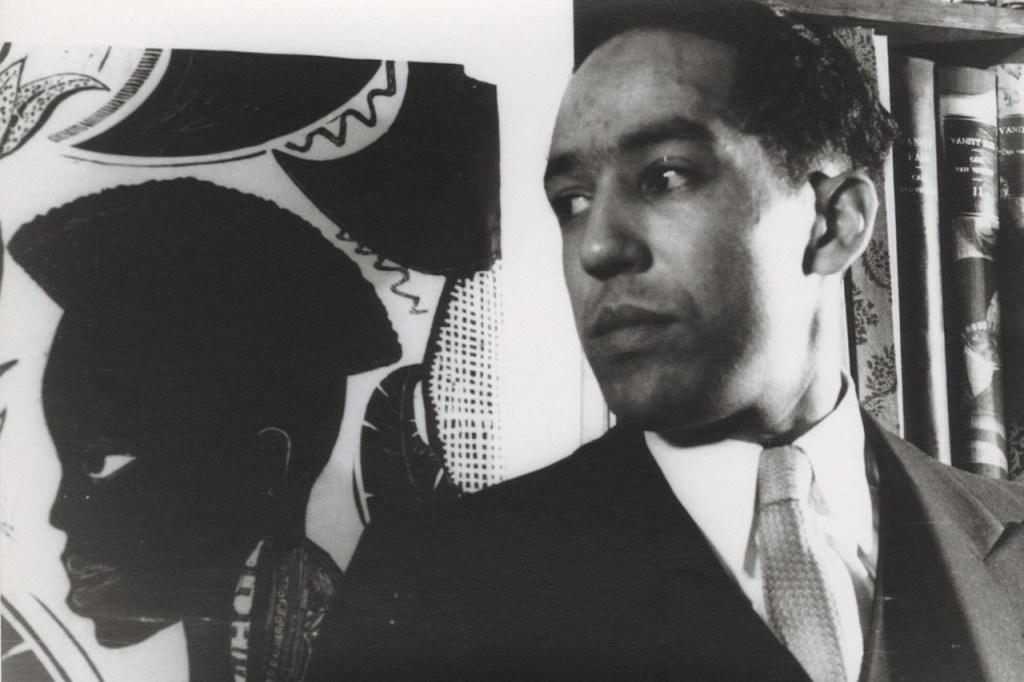
Langston Hughes’ “Theme for English B”
Langston Hughes’ “Theme for English B” dramatizes the brainstorming session of a speaker who is a non-traditional college student. He has been given the assignment to write a paper about himself that is true. He muses on how to go about producing a page that the instructor will understand.
Note on Usage: “Negro,” “Colored,” and “Black”: Before the late 1980s in the United States, the terms “Negro,” “colored,” and “black” were accepted widely in American English parlance. While the term “Negro” had started to lose its popularity in the 1960s, it wasn’t until 1988 that the Reverend Jesse Jackson began insisting that Americans adopt the phrase “African American.” The earlier, more accurate terms were the custom at the time that Langston Hughes was writing.
Introduction with Text of “Theme for English B”
The speaker is a non-traditional, older student in a college English class who has been given the assignment to write a paper that “come[s] out of you.” The instructor has insisted that the paper will be “true” if the student simply writes from his own heart, mind, and experience, but the speaker remains a bit skeptical of that claim, thinking that maybe he is unsure that it is “that simple.
Theme for English B
The instructor said,
Go home and write
a page tonight.
And let that page come out of you—
Then, it will be true.
I wonder if it’s that simple?
I am twenty-two, colored, born in Winston-Salem.
I went to school there, then Durham, then here
to this college on the hill above Harlem.
I am the only colored student in my class.
The steps from the hill lead down into Harlem,
through a park, then I cross St. Nicholas,
Eighth Avenue, Seventh, and I come to the Y,
the Harlem Branch Y, where I take the elevator
up to my room, sit down, and write this page:
It’s not easy to know what is true for you or me
at twenty-two, my age. But I guess I’m what
I feel and see and hear, Harlem, I hear you:
hear you, hear me—we two—you, me, talk on this page.
(I hear New York, too.) Me—who?
Well, I like to eat, sleep, drink, and be in love.
I like to work, read, learn, and understand life.
I like a pipe for a Christmas present,
or records—Bessie, bop, or Bach.
I guess being colored doesn’t make me not like
the same things other folks like who are other races.
So will my page be colored that I write?
Being me, it will not be white.
But it will be
a part of you, instructor.
You are white—
yet a part of me, as I am a part of you.
That’s American.
Sometimes perhaps you don’t want to be a part of me.
Nor do I often want to be a part of you.
But we are, that’s true!
As I learn from you,
I guess you learn from me—
although you’re older—and white—
and somewhat more free.
This is my page for English B.
Reading of “Theme for English B”
Commentary on “Theme for English B”
In Langston Hughes’ “Theme for English B,” the speaker is musing on how to write a college essay about himself, after receiving the instructor’s assignment in his English class. The issue of race intrudes on the speaker’s thoughts, and he offers his experienced observation about the supposed differences between the races.
First Movement: Not a Simple Assignment
The instructor said,
Go home and write
a page tonight.
And let that page come out of you—
Then, it will be true.
I wonder if it’s that simple?
I am twenty-two, colored, born in Winston-Salem.
I went to school there, then Durham, then here
to this college on the hill above Harlem.
I am the only colored student in my class.
The speaker begins his musing by brainstorming, listing the reasons that the assignment may not be so simple as the instructor has made it sound. The student/speaker is only “twenty-two,” but he is older than most of the other students in his class.
He was born in Winston-Salem, North Carolina, where he attended school until he moved to New York. The speaker is now attending college in Harlem. He is the only “colored” student in the class. Despite the fact that the majority of the population of Harlem was African American, it was still a time when few of them attended college.
Second Movement: A Brainstorming Tactic
The steps from the hill lead down into Harlem,
through a park, then I cross St. Nicholas,
Eighth Avenue, Seventh, and I come to the Y,
the Harlem Branch Y, where I take the elevator
up to my room, sit down, and write this page:
As the speaker begins to write, he traces the route that he takes from the college to his apartment. This step in his composition process seems to be a delaying tactic—a brainstorming activity just to get started thinking on the issue. He no doubt intuits that during the process of writing one thing leads to another, and he is thereby likely hoping that the trivial will lead to the profound.
Third Movement: Musing on What Is True
It’s not easy to know what is true for you or me
at twenty-two, my age. But I guess I’m what
I feel and see and hear, Harlem, I hear you:
hear you, hear me—we two—you, me, talk on this page.
(I hear New York, too.) Me—who?
Well, I like to eat, sleep, drink, and be in love.
I like to work, read, learn, and understand life.
I like a pipe for a Christmas present,
or records—Bessie, bop, or Bach.
The speaker then turns his attention to what might be “true” for himself and what might be “true” for a white instructor. It crosses his mind that the differences between them might be too great for the instructor to understand and appreciate a “colored” student’s experience.
Nevertheless, the speaker begins to examine what he feels is genuine for himself. He then guesses that what he sees helps make him what he is—a brilliant recovery from what might have sounded only like stalling in the brainstorming session that began his composition.
By tracing the route he takes to school, he has opened up the possibilities for what he sees and hears. What he sees and hears is Harlem as he somewhat awkwardly spills out his thinking. He hears himself, he hears his instructor, and now he has to “talk on this page” to this instructor. He hears “New York,” but then he circles back to himself with a question, implying a query into who he actually is.
The answer to his question is important because the assignment, after all, is to produce a piece of writing that tells the instructor who the student is, what he hopes for, and what is in his heart and mind. The instructor has intimated that if the student writer will search his own heart and mind, he will then write what is “true,” that is, what is genuine and accurate without obfuscation and guile. The speaker then moves on to catalogue what he likes: sleeping, eating, drinking, and being in love.
Furthermore, the speaker enjoys such activities as working, reading, learning, and he likes to “understand life”—all fine qualities that would likely impress a university instructor. He also likes to receive “a pipe for a Christmas present.”
Finally, the speaker lists other items that he enjoys getting such as records for Christmas because he enjoys listening to music. His taste in music turns out to be rather eclectic from “Bessie, bop, or Bach.” He must be simply gleeful that his music preferences create an interesting sounding alliterative series of names.
Fourth Movement: Communication between Black and White
I guess being colored doesn’t make me not like
the same things other folks like who are other races.
So will my page be colored that I write?
The opening two lines of this movement present the observation that this young man has tentatively made in his life, so he frames that observation as a “guess”—he surmises that race does not dictate what an individual “likes.”
Still as a young man, the speaker continues to wonder if how he feels and what he says will register with his white instructor. He, therefore, wonders if what he writes will be “colored.”
The speaker is contemplating what he believes is genuine for himself as the instructor has suggested, but he remains unsure that he can be understood by a white instructor if his words reveal him as “colored.”
Fifth Movement: Racial Boundaries
Being me, it will not be white.
But it will be
a part of you, instructor.
You are white—
yet a part of me, as I am a part of you.
That’s American.
Sometimes perhaps you don’t want to be a part of me.
Nor do I often want to be a part of you.
But we are, that’s true!
As I learn from you,
I guess you learn from me—
although you’re older—and white—
and somewhat more free.
This is my page for English B.
The speaker then insists that what he writes will “not be white.” Yet it must still be part of the instructor. Although he is black and the instructor is white, they are surely still part of each other because “That’s American.”
Yet the speaker does remain aware that often whites do not want to be part of blacks, and he is also aware that the reverse is equally true. Despite those racial boundaries of separation, the speaker believes that they are still part of each other, whether they accept it or not.
Finally, the speaker concludes with a very significant discernment: the black student learns from the white instructor, and the white instructor can also learn from the black student, even if the instructor is older, white, and “somewhat more free” than the black student.
The speaker concludes by offering the explicit statement, “This is my page for English B.” He seems to feel that he has likely exhausted his exploration for the true, genuine, and accurate for this English assignment.
The Speaker of the Poem
Lest readers are tempted to take this poem as autobiography, a perusal of Hughes’ autobiographical work, The Big Sea, should disabuse them of that error. In that first autobiography (his second was I Wonder as I Wander), the poet describes his college days at Lincoln University, located in “the rolling hills of Pennsylvania,” not “on the hill above Harlem.”
Hughes does not broach any subject as mundane as an English class assignment as he describes his rough and tumble days at Lincoln. Also, Hughes was born in Joplin, Missouri, not “Winston-Salem.”
It is useful to remember that poets seldom write autobiographical details; they often create characters, as playwrights do. Hughes does take the opportunity in this piece to make a statement about race relations, a topic that he explored his whole life. But the speaker of a poem and the poet are often not the same, and to understand and appreciate the poem that fact must be kept in mind.
Controversy over the Phrase “African American”
The controversy surrounding the appellation, “African American,” reached an important pinnacle after Teresa Heinz Kerry, Caucasian wife of the 2004 presidential candidate and former senator John Kerry, identified herself as “African American.”
Teresa Heinz was born and raised in Mozambique, which is a country in Africa. Having been a resident of the USA since 1963, she qualifies most assuredly as an “African American.” The fact that she is white demonstrates the inaccuracy that Rev. Jackson foisted upon the black population of the United States of America, as he attempted to euphemize terms that need no euphemism.
Sources
- Megan Gannon.”Race Is a Social Construct, Scientists Argue.” Scientific American. February 5, 2016.
- Editors.”Don’t Call Me African-American.” NewAfrican. September 5, 2012.
- Milton W. Hinton Jr. “The case against ‘African American’ to describe U.S. Black people.” NJ.com. January 26, 2020.
- James Joyner. “Teresa Heinz Kerry: African American.” Outside the Beltway. August 12, 2004.
- Editors. “Teresa Heinz Biography.” The Famous People. Accessed February 8, 2021.
Video: Dramatic Interpretation of “Theme for English B”
 Linda's Literary Home