Emily Dickinson’s “I keep my pledge”
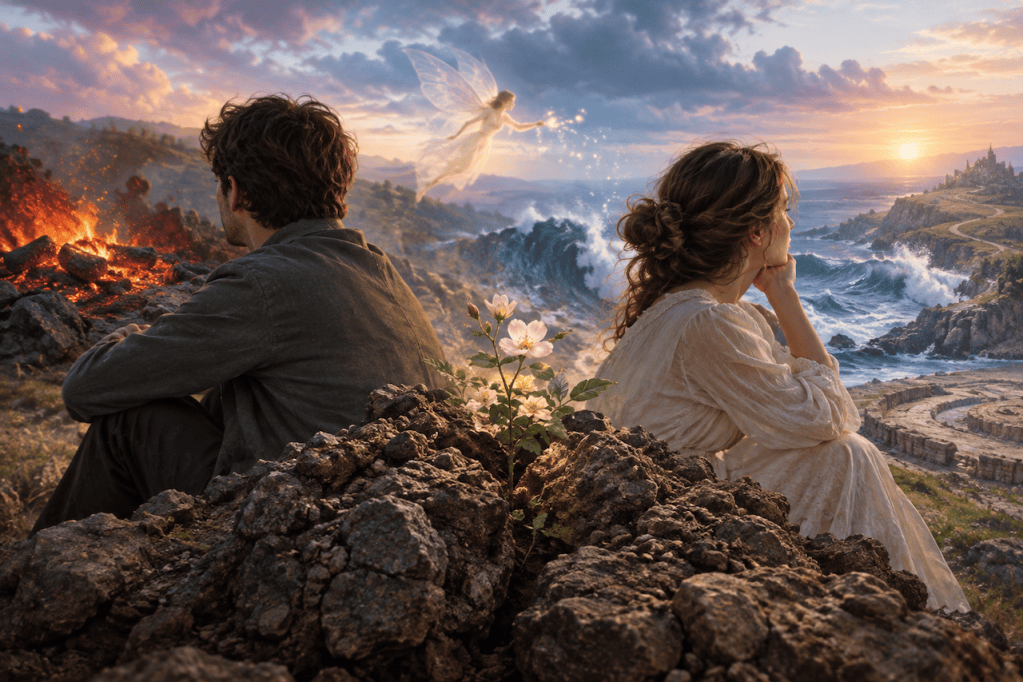
Emily Dickinson’s “I keep my pledge” dramatizes the speaker’s quiet certainty that life continues beyond death and returns again through the spirituality of nature’s eternal rhythms.
Introduction and Text of “I keep my pledge”
Emily Dickinson’s “I keep my pledge” offers a compact but profound musing on immortality, reincarnation, and the soul’s fidelity to divine law. The speaker fashions a little lyrical drama in which nature becomes witness to a sacred vow that transcends earthly death.
The poem’s short lines and compressed images intensify the mystical atmosphere as the speaker aligns herself with flowers, bees, and birds to affirm her continuing existence. As in many Dickinson poems, earthly imagery gestures toward a metaphysical reality beyond human sensory perception.
I keep my pledge
I keep my pledge.
I was not called –
Death did not notice me.
I bring my Rose.
I plight again,
By every sainted Bee –
By Daisy called from hillside –
By Bobolink from lane
Blossom and I –
Her oath, and mine –
Will surely come again.
Commentary on “I keep my pledge”
The speaker quietly celebrates the immortality of the soul and its inevitable return through metaphorical employment of nature’s recurring cycles.
First Movement: Making a Vow
I keep my pledge.
I was not called –
Death did not notice me.
The speaker begins with a declaration of fidelity, insisting that she has remained true to a sacred promise. The claim “I keep my pledge” carries spiritual force because it implies an agreement extending beyond one earthly lifetime.
The speaker’s assertion that “Death did not notice me” diminishes death’s supposed authority and portrays the soul as untouched by the loss of the physical encasement.
The speaker’s attitude recalls Paramahansa Yogananda’s teaching that “This body has come, and it will vanish; but the soul essence within it will never cease to exist.”
Dickinson’s speaker similarly refuses to grant death ultimate reality, treating it almost as a distracted figure unable to perceive the immortal essence moving silently beyond material limitation.
Earlier commentaries on Dickinson’s poetry have often noted that her speakers transform ordinary experience into metaphysical revelation. Here again, the speaker presents death not as annihilation but merely as an interruption in outward form.
Her confidence resembles the assurance found in “There is another sky,” where the created spiritual world remains untouched by decay and change.
Second Movement: Instruments of Faith
I bring my Rose.
I plight again,
The speaker next introduces the “Rose,” a traditional emblem of spiritual beauty and eternal affection. She does not merely observe the flower; she “bring[s]” it, suggesting active participation in the ongoing renewal of life. The rose becomes an offering carried from one incarnation into another.
The affirmation “I plight again” deepens the sense of recurring vows. To “plight” means to pledge or bind oneself faithfully, and the addition of “again” hints strongly at reincarnation. The soul continues renewing its sacred commitments across repeated cycles of existence.
Paramahansa Yogananda frequently taught that the soul evolves “through many forms” until it realizes its unity with Spirit. The speaker’s language harmonizes with that spiritual concept, as though she recognizes herself participating in a divine continuity extending far beyond one mortal appearance.
The rose also resembles the unfading flowers in “There is another sky,” where beauty remains untouched by frost or deterioration. Dickinson’s speakers repeatedly imagine blossoms as symbols of permanent spiritual reality rather than temporary earthly decoration. The flower’s endurance reflects the soul’s endurance.
Third Movement: By Nature’s People
By every sainted Bee –
By Daisy called from hillside –
By Bobolink from lane
The speaker now invokes nature itself as witness to her vow. The “sainted Bee,” the daisy, and the bobolink all function as living participants in a sacred universe governed by continuity and renewal. The adjective “sainted” elevates the bee from ordinary insect to spiritual messenger.
The bee traditionally symbolizes industry and immortality because it continually moves among flowers carrying life-giving pollen. The daisy rising from the hillside represents innocence and recurring seasonal rebirth, while the bobolink’s song fills the landscape with joyful vitality. Together, these natural images create a chorus affirming life’s perpetual return.
Dickinson’s speakers often treat nature not as separate from humanity but as intimately allied with the soul’s destiny. In earlier Dickinson commentaries, nature frequently appears as a symbolic language through which eternity reveals itself. Here, every creature becomes testimony against death’s supposed permanence.
Paramahansa Yogananda taught that divine consciousness pervades flowers, birds, and all living forms, declaring, “I am dreaming in the flowers, and I am singing in the birds.” The speaker’s imagery reflects that same intuition of unity between the human soul and the living world surrounding it.
Fourth Movement: Reincarnation and Karma
Blossom and I –
Her oath, and mine –
Will surely come again.
In the final movement, the speaker joins herself directly to the “Blossom,” linking human destiny with nature’s recurring cycles. The flower and the speaker share one “oath,” implying that both participate in the same divine law of return and renewal. Spring follows winter just as the soul follows death with rebirth.
The certainty of “Will surely come again” removes all doubt regarding continuation after physical departure. The speaker utters the line not as speculation but as spiritual knowledge. Her confidence transforms the brief lyric into a powerful affirmation of immortality.
Paramahansa Yogananda explained that the soul repeatedly returns through reincarnation until it fully realizes its eternal nature. Dickinson’s speaker expresses a remarkably similar vision, perceiving existence as cyclical rather than terminal.
As in “There is another sky,” the speaker ultimately creates a realm where permanence triumphs over decay. Flowers bloom again, birds sing again, and the soul itself “surely” returns. The little lyric therefore becomes both vow and revelation, affirming the eternal continuity of divine life.