William Butler Yeats’ “Sailing to Byzantium” is a profound meditation on aging, art, and the quest for spiritual transcendence, despite his failure to clearly grasp the Eastern religious/philosophical concepts he strived to portray.
Introduction and Excerpt from “Sailing to Byzantium”
William Butler Yeats’ “Sailing to Byzantium” is a profound meditation on aging, art, and the quest for spiritual transcendence. However, despite Yeats’ deep engagement with Eastern religion and philosophy, his interpretation and application of these concepts in his poetry often reveal a “Romantic misunderstanding,” as T.S. Eliot astutely observed.
This misunderstanding is clearly evident in “Sailing to Byzantium,” especially in its fourth stanza, where Yeats’ vision of eternal existence through art diverges significantly from Eastern religious/philosophical principles.
Yeats wrote “Sailing to Byzantium” in 1926, at the age of 61, as a reflection on the aging process and the spiritual journey required to maintain vitality in the face of physical decline.
Sailing to Byzantium
That is no country for old men. The young In one another’s arms, birds in the trees —Those dying generations—at their song, The salmon-falls, the mackerel-crowded seas, Fish, flesh, or fowl, commend all summer long Whatever is begotten, born, and dies. Caught in that sensual music all neglect Monuments of unageing intellect.
An aged man is but a paltry thing, A tattered coat upon a stick, unless Soul clap its hands and sing, and louder sing For every tatter in its mortal dress, Nor is there singing school but studying Monuments of its own magnificence; And therefore I have sailed the seas and come To the holy city of Byzantium.
O sages standing in God’s holy fire As in the gold mosaic of a wall, Come from the holy fire, perne in a gyre, And be the singing-masters of my soul. Consume my heart away; sick with desire And fastened to a dying animal It knows not what it is; and gather me Into the artifice of eternity.
Once out of nature I shall never take My bodily form from any natural thing, But such a form as Grecian goldsmiths make Of hammered gold and gold enamelling To keep a drowsy Emperor awake; Or set upon a golden bough to sing To lords and ladies of Byzantium Of what is past, or passing, or to come.
Commentary on “Sailing to Byzantium”
The poem “Sailing to Byzantium” uses a journey to Byzantium (Constantinople now Istanbul,) as a metaphor for a spiritual quest, with the speaker seeking to transcend the limitations of the mortal body and achieve a form of immortality through art.
First Stanza: Contrasting Vividly
That is no country for old men. The young In one another’s arms, birds in the trees —Those dying generations—at their song, The salmon-falls, the mackerel-crowded seas, Fish, flesh, or fowl, commend all summer long Whatever is begotten, born, and dies. Caught in that sensual music all neglect Monuments of unageing intellect.
The opening stanza of “Sailing to Byzantium” presents a vivid contrast between the vitality of youth and the poet’s sense of alienation from the natural world as he ages. Yeats paints a picture of a country teeming with life, where “The young / In one another’s arms, birds in the trees” and “the mackerel-crowded seas” represent the cyclical nature of life and death.
The phrase “Those dying generations” underscores the transient nature of all living things, a concept that aligns with Eastern philosophy’s emphasis on impermanence. However, Yeats’ reaction to this natural cycle reveals a departure from Eastern thought.
While Buddhism and Hinduism often advocate for acceptance of life’s impermanence, Yeats expresses a desire to escape it. His assertion that “all neglect / Monuments of unageing intellect” suggests a privileging of human intellect and art over the natural world, a distinctly Western perspective that contradicts the Eastern emphasis on harmony with nature.
Second Stanza: Aging and the Quest for Renewal
An aged man is but a paltry thing, A tattered coat upon a stick, unless Soul clap its hands and sing, and louder sing For every tatter in its mortal dress, Nor is there singing school but studying Monuments of its own magnificence; And therefore I have sailed the seas and come To the holy city of Byzantium.
In the second stanza, Yeats further develops the theme of aging and the quest for spiritual renewal. The image of an aged man as “a paltry thing, / A tattered coat upon a stick” vividly conveys the physical deterioration that comes with age. However, Yeats proposes that this decline can be transcended if the soul can “clap its hands and sing, and louder sing / For every tatter in its mortal dress.”
This concept of the soul triumphing over bodily decay echoes certain Eastern philosophical ideas, particularly the Hindu concept of the soul, which is the eternal self, transcending the physical body.
However, Yeats’ emphasis on the soul’s need to “sing” and study “Monuments of its own magnificence” reveals a more Western, ego-centric approach to spiritual transcendence. In contrast, many Eastern philosophies advocate for the dissolution of the ego and the realization of the soul’s unity with the Divine Reality.
Third Stanza: The Concept of Transformation
O sages standing in God’s holy fire As in the gold mosaic of a wall, Come from the holy fire, perne in a gyre, And be the singing-masters of my soul. Consume my heart away; sick with desire And fastened to a dying animal It knows not what it is; and gather me Into the artifice of eternity.
The third stanza introduces the “sages standing in God’s holy fire,” whom the speaker implores to be the “singing-masters of my soul.” This imagery draws on both Western and Eastern concepts, blending Christian imagery of holy fire with the Eastern idea of spiritual masters or gurus. The speaker’s desire to have his heart consumed away and to be gathered into “the artifice of eternity” reflects a yearning for spiritual transformation.
However, Yeats’ conception of this transformation as an “artifice” created by sages diverges from Eastern philosophical traditions. In many Eastern spiritual practices, enlightenment or liberation is seen not as an artificial state created by external forces, but as the realization of one’s true nature, of uniting the individual soul with the Oversoul, or God. Yeats’ portrayal suggests a more Western, interventionist approach to spiritual transformation.
Fourth Stanza: Romantic Misunderstanding
Once out of nature I shall never take My bodily form from any natural thing, But such a form as Grecian goldsmiths make Of hammered gold and gold enamelling To keep a drowsy Emperor awake; Or set upon a golden bough to sing To lords and ladies of Byzantium Of what is past, or passing, or to come.
The final stanza of “Sailing to Byzantium” most clearly demonstrates Yeats’ “Romantic misunderstanding” of Eastern philosophy. Here, the speaker envisions his eternal form not as a dissolution into God-consciousness (self-realization), as many Eastern traditions insist, but as a golden artifact created by “Grecian goldsmiths.” This vision of immortality through art is fundamentally at odds with Eastern concepts of liberation from the cycle of birth and death.
Yeats’ desire to take a form “Of hammered gold and gold enamelling” to entertain “lords and ladies of Byzantium” reveals a distinctly Western preoccupation with individual identity and artistic legacy. This contrasts sharply with Eastern religious/philosophical concepts such as the Buddhist non-self upon entering nirvana or the Hindu idea of samadhi or liberation from cycles of death and rebirth.
Furthermore, the speaker’s intention to “sing / To lords and ladies of Byzantium / Of what is past, or passing, or to come” suggests a linear view of time that is more aligned with Western thought than with the cyclical time concepts expounded in Eastern religion/philosophy.
While “Sailing to Byzantium” is undoubtedly a masterpiece of poetic craft, it also reveals the limitations of Yeats’ understanding and application of Eastern philosophical concepts.
His vision of spiritual transcendence, particularly as expressed in the fourth stanza, remains rooted in Western ideas of individual immortality and artistic legacy, rather than the Eastern concepts of ego dissolution and unity with the Divine Creator.
This “Romantic misunderstanding” of Eastern philosophy, as Eliot termed it, is indeed on full display in this poem, showcasing both the brilliance of Yeats’ poetic vision and the cultural limitations that shaped his interpretation of Eastern thought.
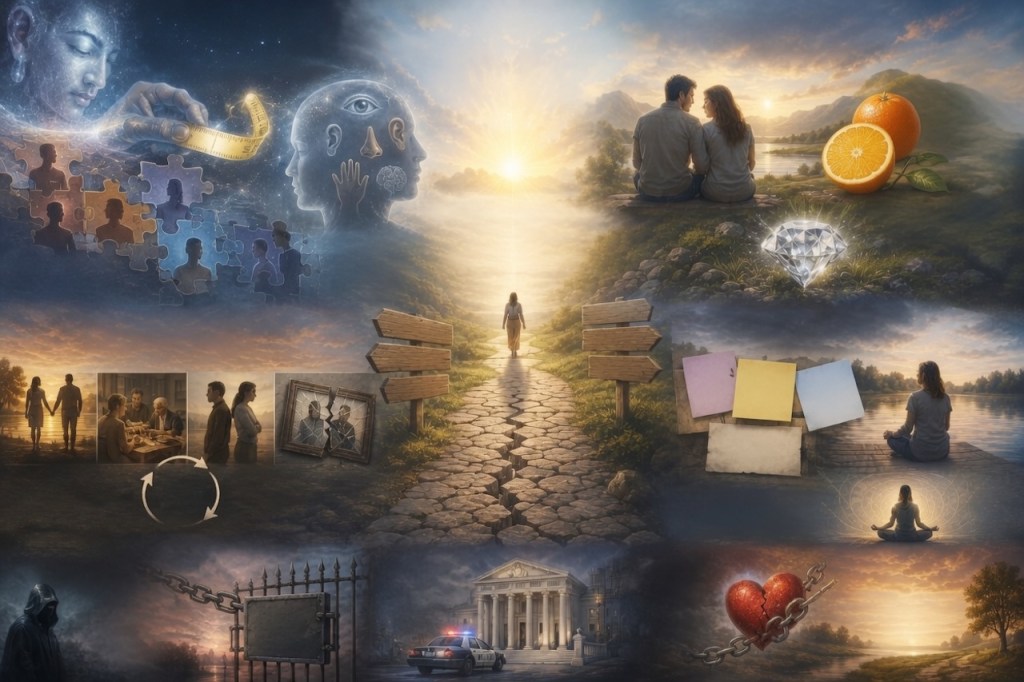
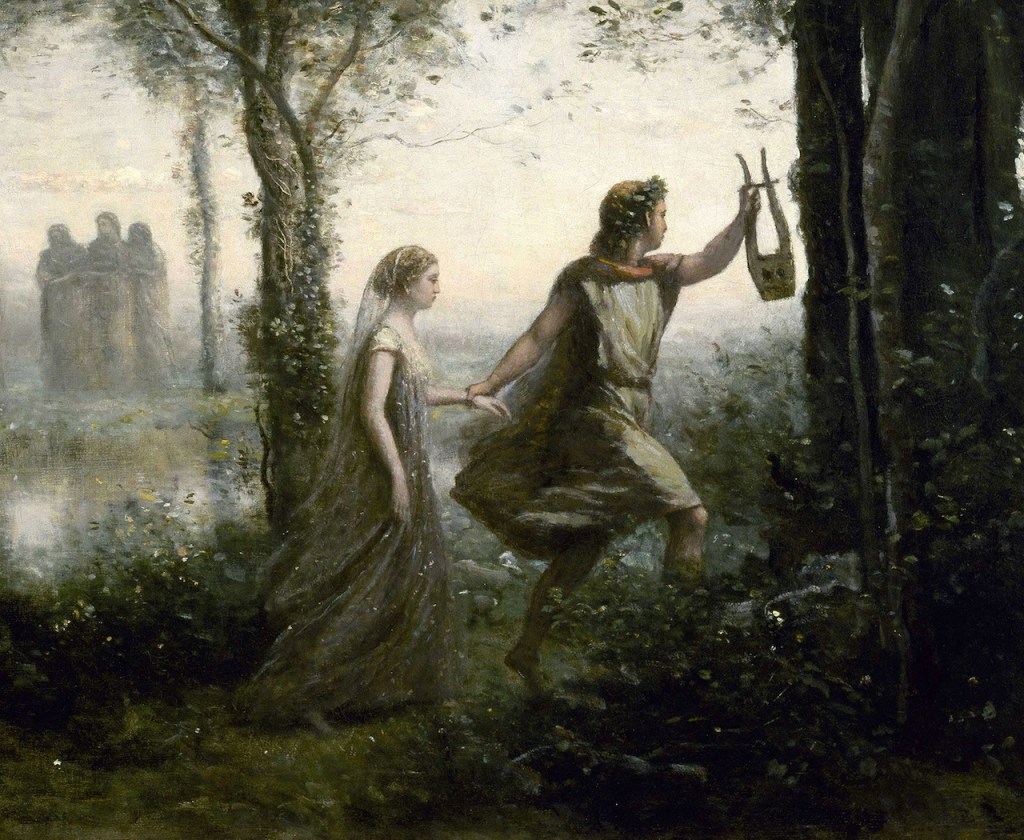
Image created by ChatGPT/Grok inspired by the poem
The Reality of Human Differences
We live in a world where no two people are exactly alike. Human beings possess differing interests, ideas, and intentions, a fact that makes relationships inherently difficult. When you look at how distinct we all are on the inside, it is no wonder that it is so rare for any one human being to develop a peaceful and purposeful relationship with another.
The Root of the Difficulty
This struggle for human beings to get along is built right into the fabric of creation. As the unmanifested Spirit, God is pure Bliss, but to create the world, He utilized a cosmic deception called maya—the grand magical measurer [1]. Paramahansa Yogananda explains this cosmic setup [2]:
Spirit overspread and permeated Its creative desire with cosmic delusion, a grand magical measurer described in Hindu scriptures as maya (from the Sanskrit root ma, “to measure”). Delusion divides, measures out, the Undefined Infinite into finite forms and forces.
Delusion divides the Undefined Infinite into finite forms. Because of this division, we all navigate existence with avidya, or individual illusion, which makes us feel completely separate from everyone else. Trapped in individual egos, our human condition unfolds through a multiplicity of perspectives.
Most of our trouble comes from the fact that we look at life through our five senses and limited human minds, yet the senses are unreliable, catching only what happens on the changing, physical level.
When the Infinite is chopped up into billions of separate human beings—each shaped by unique experiences, temperaments, and aspirations—individual persons develop their own unique set of desires and motives. With so many different minds running around, it is a mathematical certainty that our intentions will eventually clash.
The Myth of Effortless Harmony
These divergences extend beyond mere preferences into our core intentions—the silent drivers of daily choices and long-term paths. Relationships, by their nature, require constant negotiation between these distinct inner worlds.
The family unit, often idealized as a sanctuary of unconditional unity, frequently illustrates this
challenge most acutely. Siblings raised in the same household may develop opposing worldviews, while parents and children encounter generational shifts in values that widen the gap between expectation and reality.
Similarly, the marital bond confronts the daily reality of two separate consciousnesses attempting to merge trajectories, and friendships dissolve when evolving intentions pull individuals in irreconcilable directions.
Because we are wrapped up in personal illusions, finding true harmony with another person is incredibly rare. To achieve a peaceful and purposeful relationship, two people must quiet their egos enough to see past their own selfishness.
The inner world of another person—their hurts, thoughts, and true intentions—is entirely ineffable. It resembles the experience of tasting an orange: on the material plane, you can try to describe the taste to someone, but they will never truly know it until they taste it themselves. We can never perfectly climb inside someone else’s mind.
Dr. David Frawley notes that to find true harmony, we must look deeper [3]:
We can discover that Divine face and presence of consciousness everywhere, but for this to occur, we must first discover it within our own hearts and in the hearts of all beings. Most people have not found that presence within themselves yet, so they remain stuck in the outer shell of the ego. And where there is ego, there is friction.
Redefining Relationship Fractures
With human nature structured this way, we should not be shocked when things fall apart. Fractured family relationships, broken marriages, and ended friendships are natural phenomena in a dualistic universe.
In a material world defined by constant change and division, things come together and things fall apart. Just as creation itself goes through cycles of manifestation and dissolution [4], human relationships go through cycles too. When the underlying reasons that brought two people together expire, the relationship naturally dissolves.
Society loves to play the blame game, immediately searching for a villain when a relationship fails. Much suffering arises from the imposition of these unrealistic ideals—the belief that true love conquers all differences effortlessly, or that familial duty demands perpetual agreement. When reality falls short, individuals internalize failure or assign fault.
Assigning bitter blame is usually a mistake. It assumes that everyday human beings have the spiritual power to override the laws of maya at will. Until a person learns to completely quiet the body and the mind so the soul can take over, they will be pushed and pulled by their changing ideas and desires.
Broken marriages often reflect the honest recognition that continued union would stifle the authentic development of one or both partners; ended friendships signify the natural completion of a shared chapter rather than betrayal.
Removing Blame and Accepting Reality
If we want to have peace of mind, we must accept reality without holding onto resentment. I am Linda Sue Grimes, and as I have mentioned before, I have many aspects and nicknames—Sissy to my sister, Grammy to my grandkids, and Nubbies to my husband. Those roles are a part of my life, but they are not the eternal soul. Human relationships are temporary arrangements on the physical plane.
By recognizing relationships as dynamic interactions between distinct souls rather than proofs of personal merit, we cultivate compassion and remove blame. When a relationship ends, it is not always because someone is an evil person, but simply because the temporary alignment of their interests has come to a natural end. Accepting this truth softens the blow for postmodern minds constantly hurt by broken hearts.
When two people do manage to bridge that massive gap and create a beautiful bond, it stands as a genuine, transcendent blessing. Such connections require conscious cultivation: patience to listen beyond surface disagreement, humility to release the need for complete agreement, and wisdom to honor the other’s path even when it diverges.
This understanding aligns with broader spiritual insight. The difficulties of human connection invite the development of virtues—forgiveness, adaptability, and non-attachment—that facilitate progress on the spiritual path.
Ultimately, the human journey involves balancing the longing for connection with the reality of separateness. When intentions can harmonize sufficiently to allow mutual flourishing, something sacred occurs. When they cannot, releasing the bond with understanding preserves dignity and opens space for new possibilities.
An Important Caveat
However, a crucial distinction must be made: relinquishing blame and judgment of others does not mean we suffer fools and criminals. It must be acknowledged that evil does exist in this world of maya delusion, and evil individuals do try to victimize the innocent.
The understanding that human intentions diverge because of individual illusion is a philosophical tool for personal peace, not an excuse for passivity or a license for others to do harm.
Criminals must still be prosecuted to the full extent of the law. Society requires structure and protection from those whose delusions manifest as destructive violence or fraud. Furthermore, evil acts that may not be punishable by civil law still require banishment from one’s life.
Boundaries are essential; recognizing that an individual is acting out of ignorance or avidya does not mean you must allow them to remain a toxic presence in your domestic or social circle.
It is simply that crimes against us can be forgiven by us even if they are not forgiven by the legal system. The legal system must punish the act to preserve order on the material plane, but the individual victim can choose to release the burning resentment within their own heart.
Forgiveness is a spiritual function of the soul that frees the victim from the karmic tie of hatred, allowing them to move forward in quietude, even as the law takes its necessary course.
Sources
[1] Paramahansa Yogananda. “Maya.” Self-Realization Fellowship. Accessed June 22, 2026. [2] Editors. “Law of Maya.” Paramahansa Yogananda: The Royal Path of Yoga. Accessed June 22, 2026. [3] David Frawley. “Is Hinduism a Monotheistic Religion?” American Institute of Vedic Studies. August 27, 2014. [4] Swami Sri Yukteswar. The Holy Science. Internet Archive. Originally published by Self-Realization Fellowship.
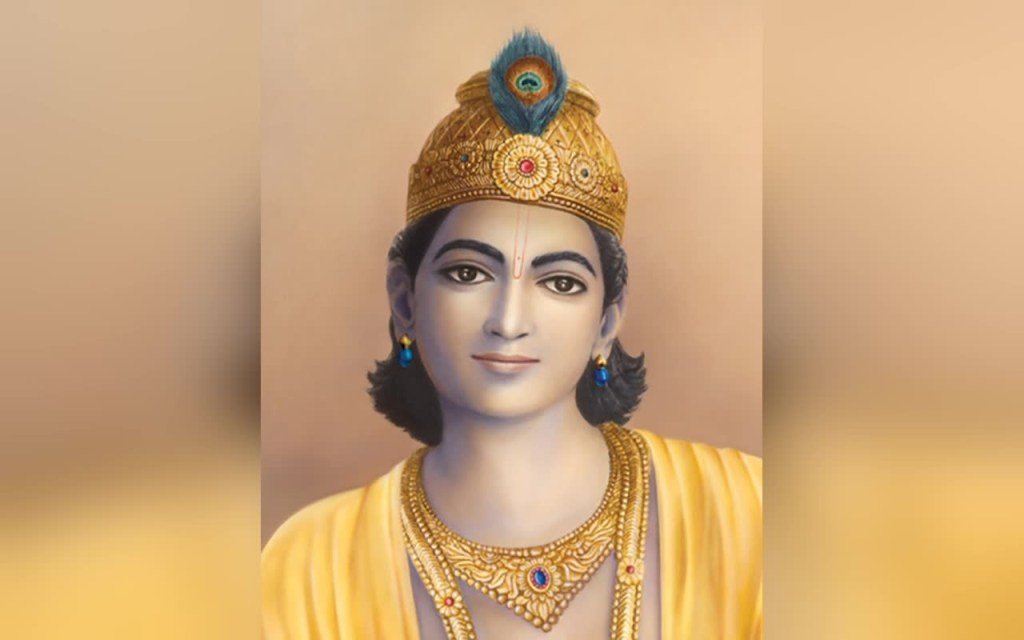
Paramahansa Yogananda’s “My Krishna Is Blue” reveals the chanter’s yearning for union with Krishna consciousness. He is envisioning a state beyond ordinary awareness, where the soul rises to the highest level of divine realization—self-realization.
Introduction and Text of “My Krishna Is Blue”
Paramahansa Yogananda’s “My Krishna Is Blue” is a devotional chant consisting of three movements. Through chant repetition and simplicity, the chanter dramatizes his profound love for Krishna and his longing to dwell perpetually in the Divine Presence.
The chant progresses from recognition to aspiration and finally to spiritual identification. The chanter first notices a correspondence between Krishna and the blue tamal tree, then expresses a desire to ascend to its highest branch, and finally longs to die where Krishna sat.
On the literal level, the chanter appears to be praising a tree associated with Krishna. On the mystical level, however, the imagery points beyond physical nature toward the soul’s desire to attain the exalted consciousness embodied by Krishna.
My Krishna Is Blue
My Krishna is blue; the tamal tree is blue. My Krishna is blue; The tamal tree is blue. So I do love thee, tamal tree! So I do love thee, my tamal tree!
And when I die, O Mother! Do put me high On a branch of the tamal tree, On a branch of the tamal tree.
Where Krishna sat, there I would die, Where Krishna sat, there I would die, On a branch of the tamal tree, On a branch of the tamal tree.
Commentary on “My Krishna Is Blue”
Paramahansa Yogananda’s “My Krishna Is Blue” reveals the soul’s devotion to the Divine Beloved. The chanter’s simple chant also expresses a profound spiritual aspiration toward God-union.
First Movement: “My Krishna is blue”
My Krishna is blue; the tamal tree is blue. My Krishna is blue; The tamal tree is blue. So I do love thee, tamal tree! So I do love thee, my tamal tree!
The chanter begins by establishing an identity between Krishna and the tamal tree. Both are described as blue, and that shared quality causes the chanter to regard the tree with affection and reverence.
The repetition carries the force of devotional musing rather than ordinary description. The chanter seems to be dwelling lovingly upon a spiritual correspondence that links the visible object with the Divine Reality symbolized by Krishna.
Because Krishna and the tamal tree share the same color, the tree becomes more than a botanical object. It functions as an emblem of Krishna consciousness and therefore deserves the chanter’s devotion.
The declaration—“So I do love thee, tamal tree!”—reveals that the chanter’s love for the tree derives from its association with Krishna. The affection is not directed toward matter but toward the divine presence reflected through matter.
The repeated address, “my tamal tree,” adds intimacy to the relationship. The chanter regards the tree as a sacred possession because it serves as a reminder of the beloved Lord.
Paramahansa Yogananda frequently emphasizes perceiving God’s presence throughout creation. Paramahansa Yogananda explains that divine consciousness may be perceived behind all forms, and the chanter’s vision reflects that spiritual perception.
On my literary website Linda’s Literary Home, I have discussed how poets often employ physical imagery to suggest metaphysical realities. The chanter similarly employs the visible tamal tree as a symbol pointing toward an invisible spiritual state.
The stanza therefore moves beyond literal description. Through the repeated equation of Krishna and the blue tamal tree, the chanter transforms a natural image into a symbol of divine consciousness.
Second Movement: “And when I die, O Mother!”
And when I die, O Mother! Do put me high On a branch of the tamal tree, On a branch of the tamal tree.
The second stanza shifts from recognition to aspiration. Having established the sacred significance of the tamal tree, the chanter now expresses a fervent desire regarding his own destiny.
The address to “Mother” adds emotional intensity, referring to the Divine Mother. The invocation conveys humility and dependence before a higher power. At first glance, the request appears unusual. The chanter asks to be placed “high” upon a branch of the tamal tree rather than buried or laid to rest in some conventional manner.
The word “high” becomes the stanza’s crucial term. The chanter does not merely seek proximity to the tree; he desires elevation within it. Such elevation suggests ascent rather than location. The imagery points toward a higher level of consciousness rather than a merely physical position.
The branch functions as a metaphorical rather than literal destination. To imagine a devotee sincerely wishing to have his body suspended in a tree would diminish the spiritual seriousness of the chant. Instead, the high branch symbolizes the summit of awareness. The chanter longs to rise to the highest attainable state of realization.
Paramahansa Yogananda repeatedly teaches that human consciousness may ascend from body-awareness to soul-awareness through spiritual discipline. The chanter’s longing for the highest branch harmonizes with that teaching of spiritual ascent.
On my literary website Linda’s Literary Home, I have often observed that poetry rarely states its deepest meanings directly. Through symbol and suggestion, poets allow intuition to perceive realities that ordinary language cannot adequately express. Thus the high branch becomes an image of supreme spiritual attainment. The chanter prays not for physical elevation but for the soul’s ascent into divine consciousness.
Third Movement: “Where Krishna sat, there I would die”
Where Krishna sat, there I would die, Where Krishna sat, there I would die, On a branch of the tamal tree, On a branch of the tamal tree.
The final stanza reveals the chanter’s ultimate desire. He wishes to die precisely where Krishna sat. The statement deepens the symbolic significance of the branch. It is not merely high; it is the place occupied by Krishna. If Krishna represents perfected divine consciousness, then the branch symbolizes the level of realization attained by that consciousness. The chanter longs to occupy the same spiritual station.
The repeated line intensifies the devotional yearning. The chanter does not seek worldly rewards, intellectual accomplishment, or heavenly pleasures. Instead, he desires complete identification with Krishna. The aspiration is one of union rather than admiration from a distance.
The word “die” also carries spiritual significance. Mystical literature frequently employs death as a symbol for the dissolution of ego-consciousness.The chanter therefore longs for the extinction of the limited self in the very state inhabited by Krishna. Such a death would not signify annihilation but fulfillment.
Paramahansa Yogananda teaches that the soul’s highest goal is realization of its unity with Spirit. The chanter’s desire to die where Krishna sat reflects precisely such a yearning for God-union. The repeated return to the tamal tree completes the chant’s symbolic design. What began as a blue tree associated with Krishna culminates as a metaphor for the highest spiritual center.
The chant’s simplicity is permeated with remarkable depth. Through the image of a blue tamal tree and its highest branch, the chanter dramatizes the soul’s longing to rise into Krishna consciousness and experience the liberating realization of divine union.
Image: Emily Dickinson – Amherst College – Daguerrotype of the poet at age 17, circa 1847 – likely the only authentic, extant likeness of the poet
Emily Dickinson’s “Color – Caste – Denomination”
Emily Dickinson’s speaker in “Color – Caste – Denomination” is demonstrating a profound truth about the flaws in human classifications that still today lead to ill-will and even violence toward members of different racial, social class, and religion groups.
Human Classifications: Two Views
Emily Dickinson’s “Color – Caste – Denomination” and Arna Bontemps’ “God Give to Men” take as their theme the issue of the classifications that humanity has through the centuries imposed upon itself.
While there are many ways that human beings identity themselves, three common ones are race, class (social status), and religion; thus, Dickinson has labeled the classes “color” (race), “caste” (class, social status), and “denomination” (religion).
Arna Bontemps in his race conscious piece “God Give to Men” has concentrated primarily on the classification of color (race). He refers to the skin color for two of the classes—”yellow” and “black”—but then uses the eye color “blue” for the third class. The poets Emily Dickinson and Arna Bontemps have handled the issue of human classification in two quite disparate ways:
(1) Dickinson’s drama serves to unite all human classes, as her speaker insists that each human being is a soul without any of the outward classifications with which humanity has burdened itself.
(2) Bontemps’ speaker remains squarely focused on the issues that he finds repugnant or venal in each color class, not his own. As his speaker asks God to give certain gifts to men, he reveals his animosity toward two of his designated classes. The third class receives rather short shrift in an ironic attempt at humility.
Dickinson’s ultimate truth is based on the individuality of each human being, while Bontemps relies heavily on racial stereotypes [1], which serve only to divide, not unify, for not all members of any so-called classification represent the concocted stereotype that attempts to define and describe that classification.
Text of Emily Dickinson’s “Color – Caste – Denomination”
The speaker in Emily Dickinson’s “Color – Caste – Denomination” demonstrates a profound understanding regarding the futility of human classifications [2] based on race, class, religion, and sex.
The theme of the Dickinson poem is likely influenced by Galatians 3: 28: “There is neither Jew nor Greek, there is neither bond nor free, there is neither male nor female: for ye are all one in Christ Jesus” [3].
Color – Caste – Denomination
Color – Caste – Denomination – These – are Time’s Affair – Death’s diviner Classifying Does not know they are –
As in sleep – all Hue forgotten – Tenets – put behind – Death’s large – Democratic fingers Rub away the Brand –
If Circassian – He is careless – If He put away Chrysalis of Blonde – or Umber – Equal Butterfly –
They emerge from His Obscuring – What Death – knows so well – Our minuter intuitions – Deem unplausible –
To view Emily Dickinson’s hand-written copy of this poem, please visit the Emily Dickinson Archive.
Commentary on Dickinson’s “Color – Caste – Denomination”
The speaker in Emily Dickinson’s “Color – Caste – Denomination” is demonstrating the futility of humanity’s self-classification that is still today widely and tragically misconstrued and continues to lead to unfortunate struggles and misunderstandings among the peoples of the world.
First Stanza: The Delusion of Classification
Color – Caste – Denomination – These – are Time’s Affair – Death’s diviner Classifying Does not know they are –
The perspicacious speaker begins with an audacious claim: the human soul possesses no ordinary identities associated with race, class (social status), or religion. By extension, one would realize that if those common classes are null, so is the classification by sex and/or sexual orientation.
This speaker perceives that those classifications are merely delusional imaginings, resulting from the mayic realm [4] of the operative pairs of opposites which have their being under time’s sway: “These – are Time’s Affair.”
The fact that these classifications vanish after death demonstrates that they are merely delusive tools, useful only, if useful at all, to the material level of existence. The soul is “Death’s diviner Classifying,” and Death cannot classify the living. When Death attempts to classify the soul, it finds that the soul’s purity lacks those limiting qualities that humanity assigns itself.
Second Stanza: A Dreamer’s Awareness
As in sleep – all Hue forgotten – Tenets – put behind – Death’s large – Democratic fingers Rub away the Brand –
The speaker, desiring to further clarify her claim, then compares “death” to “sleep”—in sleep, the human being forgets his/her race, class, religion, and sex. These “tenets” are abandoned, and the sleeper, if she dreams, may dream herself a different race, class, religion, or sex, but as long as she dreams those classes will seem to be reality.
Sleep, like Death, has “large – Democratic fingers” which are capable of erasing the marks of human classifications that circumscribe the individual in ordinary, waking consciousness. The dreamer understands her images and relates to them exactly as she does while awake.
Third Stanza: The Unclassifiable Soul
If Circassian – He is careless – If He put away Chrysalis of Blonde – or Umber – Equal Butterfly –
The Circassians [5] comprised a civilization in Diaspora, routed by the Russians and then by the Ottoman Empire. Their classifications would be tenuous at best; thus, their ability to classify themselves would be quite difficult, as many other civilizations have experienced. Peoples who live in contiguity to conquering peoples have found it difficult to maintain a unified identity; such has also been the lot of the Jewish people [6].
But even the “Circassian” who attempts to identity her classification would find that like a butterfly, whether it be “Blonde – or Umber,” she would still remain “Equal Butterfly.” The speaker is suggesting that the usefulness of names on the material plane can never taint the soul. The soul remains perfectly unclassifiable by mayic limitations.
This speaker finds solace in this awareness as do most objective, fair-minded thinkers, but in 21st century America, those who are financially and emotionally invested in the victimhood concocted through identity politics [7] find such an idea abhorrent, as it leaves them without a favorite issue to exploit for political gain [8].
Fourth Stanza: Delusive Limitations of Race, Class, Religion, and Gender
They emerge from His Obscuring – What Death – knows so well – Our minuter intuitions – Deem unplausible –
The speaker ultimately is averring through suggestion that each human soul is not “obscured” by any attempt to classify it by the delusive limitations of race, class, religion, or sex. Death knows this, the speaker again emphasizes. Even the tiniest inference that the human mind makes regarding that futile act of classifying will remain “unplausible.”
William Butler Yeats’ “Sailing to Byzantium” is a profound meditation on aging, art, and the quest for spiritual transcendence, despite his failure to clearly grasp the Eastern religious/philosophical concepts he strived to portray.
Introduction and Excerpt from “Sailing to Byzantium”
William Butler Yeats’ “Sailing to Byzantium” is a profound meditation on aging, art, and the quest for spiritual transcendence. However, despite Yeats’ deep engagement with Eastern religion and philosophy, his interpretation and application of these concepts in his poetry often reveal a “Romantic misunderstanding,” as T.S. Eliot astutely observed.
This misunderstanding is clearly evident in “Sailing to Byzantium,” especially in its fourth stanza, where Yeats’ vision of eternal existence through art diverges significantly from Eastern religious/philosophical principles.
Yeats wrote “Sailing to Byzantium” in 1926, at the age of 61, as a reflection on the aging process and the spiritual journey required to maintain vitality in the face of physical decline.
Sailing to Byzantium
That is no country for old men. The young In one another’s arms, birds in the trees —Those dying generations—at their song, The salmon-falls, the mackerel-crowded seas, Fish, flesh, or fowl, commend all summer long Whatever is begotten, born, and dies. Caught in that sensual music all neglect Monuments of unageing intellect.
An aged man is but a paltry thing, A tattered coat upon a stick, unless Soul clap its hands and sing, and louder sing For every tatter in its mortal dress, Nor is there singing school but studying Monuments of its own magnificence; And therefore I have sailed the seas and come To the holy city of Byzantium.
O sages standing in God’s holy fire As in the gold mosaic of a wall, Come from the holy fire, perne in a gyre, And be the singing-masters of my soul. Consume my heart away; sick with desire And fastened to a dying animal It knows not what it is; and gather me Into the artifice of eternity.
Once out of nature I shall never take My bodily form from any natural thing, But such a form as Grecian goldsmiths make Of hammered gold and gold enamelling To keep a drowsy Emperor awake; Or set upon a golden bough to sing To lords and ladies of Byzantium Of what is past, or passing, or to come.
Commentary on “Sailing to Byzantium”
The poem “Sailing to Byzantium” uses a journey to Byzantium (Constantinople now Istanbul,) as a metaphor for a spiritual quest, with the speaker seeking to transcend the limitations of the mortal body and achieve a form of immortality through art.
First Stanza: Contrasting Vividly
That is no country for old men. The young In one another’s arms, birds in the trees —Those dying generations—at their song, The salmon-falls, the mackerel-crowded seas, Fish, flesh, or fowl, commend all summer long Whatever is begotten, born, and dies. Caught in that sensual music all neglect Monuments of unageing intellect.
The opening stanza of “Sailing to Byzantium” presents a vivid contrast between the vitality of youth and the poet’s sense of alienation from the natural world as he ages. Yeats paints a picture of a country teeming with life, where “The young / In one another’s arms, birds in the trees” and “the mackerel-crowded seas” represent the cyclical nature of life and death.
The phrase “Those dying generations” underscores the transient nature of all living things, a concept that aligns with Eastern philosophy’s emphasis on impermanence. However, Yeats’ reaction to this natural cycle reveals a departure from Eastern thought.
While Buddhism and Hinduism often advocate for acceptance of life’s impermanence, Yeats expresses a desire to escape it. His assertion that “all neglect / Monuments of unageing intellect” suggests a privileging of human intellect and art over the natural world, a distinctly Western perspective that contradicts the Eastern emphasis on harmony with nature.
Second Stanza: Aging and the Quest for Renewal
An aged man is but a paltry thing, A tattered coat upon a stick, unless Soul clap its hands and sing, and louder sing For every tatter in its mortal dress, Nor is there singing school but studying Monuments of its own magnificence; And therefore I have sailed the seas and come To the holy city of Byzantium.
In the second stanza, Yeats further develops the theme of aging and the quest for spiritual renewal. The image of an aged man as “a paltry thing, / A tattered coat upon a stick” vividly conveys the physical deterioration that comes with age. However, Yeats proposes that this decline can be transcended if the soul can “clap its hands and sing, and louder sing / For every tatter in its mortal dress.”
This concept of the soul triumphing over bodily decay echoes certain Eastern philosophical ideas, particularly the Hindu concept of the soul, which is the eternal self, transcending the physical body.
However, Yeats’ emphasis on the soul’s need to “sing” and study “Monuments of its own magnificence” reveals a more Western, ego-centric approach to spiritual transcendence. In contrast, many Eastern philosophies advocate for the dissolution of the ego and the realization of the soul’s unity with the Divine Reality.
Third Stanza: The Concept of Transformation
O sages standing in God’s holy fire As in the gold mosaic of a wall, Come from the holy fire, perne in a gyre, And be the singing-masters of my soul. Consume my heart away; sick with desire And fastened to a dying animal It knows not what it is; and gather me Into the artifice of eternity.
The third stanza introduces the “sages standing in God’s holy fire,” whom the speaker implores to be the “singing-masters of my soul.” This imagery draws on both Western and Eastern concepts, blending Christian imagery of holy fire with the Eastern idea of spiritual masters or gurus. The speaker’s desire to have his heart consumed away and to be gathered into “the artifice of eternity” reflects a yearning for spiritual transformation.
However, Yeats’ conception of this transformation as an “artifice” created by sages diverges from Eastern philosophical traditions. In many Eastern spiritual practices, enlightenment or liberation is seen not as an artificial state created by external forces, but as the realization of one’s true nature, of uniting the individual soul with the Oversoul, or God. Yeats’ portrayal suggests a more Western, interventionist approach to spiritual transformation.
Fourth Stanza: Romantic Misunderstanding
Once out of nature I shall never take My bodily form from any natural thing, But such a form as Grecian goldsmiths make Of hammered gold and gold enamelling To keep a drowsy Emperor awake; Or set upon a golden bough to sing To lords and ladies of Byzantium Of what is past, or passing, or to come.
The final stanza of “Sailing to Byzantium” most clearly demonstrates Yeats’ “Romantic misunderstanding” of Eastern philosophy. Here, the speaker envisions his eternal form not as a dissolution into God-consciousness (self-realization), as many Eastern traditions insist, but as a golden artifact created by “Grecian goldsmiths.” This vision of immortality through art is fundamentally at odds with Eastern concepts of liberation from the cycle of birth and death.
Yeats’ desire to take a form “Of hammered gold and gold enamelling” to entertain “lords and ladies of Byzantium” reveals a distinctly Western preoccupation with individual identity and artistic legacy. This contrasts sharply with Eastern religious/philosophical concepts such as the Buddhist non-self upon entering nirvana or the Hindu idea of samadhi or liberation from cycles of death and rebirth.
Furthermore, the speaker’s intention to “sing / To lords and ladies of Byzantium / Of what is past, or passing, or to come” suggests a linear view of time that is more aligned with Western thought than with the cyclical time concepts expounded in Eastern religion/philosophy.
While “Sailing to Byzantium” is undoubtedly a masterpiece of poetic craft, it also reveals the limitations of Yeats’ understanding and application of Eastern philosophical concepts.
His vision of spiritual transcendence, particularly as expressed in the fourth stanza, remains rooted in Western ideas of individual immortality and artistic legacy, rather than the Eastern concepts of ego dissolution and unity with the Divine Creator.
This “Romantic misunderstanding” of Eastern philosophy, as Eliot termed it, is indeed on full display in this poem, showcasing both the brilliance of Yeats’ poetic vision and the cultural limitations that shaped his interpretation of Eastern thought.
Commentaries on Paramahansa Yogananda’s Songs of the Soul
Each time my father, mother, friends Do loudly claim they did me tend, I wake from sleep to sweetly hear That Thou alone didst help me here. —from Paramahansa Yogananda’s “One Friend”
for Ron Grimes, my soul mate with whom I travel the spiritual path
This collection of personal commentaries is a companion to the book of spiritual poems, Songs of the Soul, written by Paramahansa Yogananda, the “Father of Yoga in the West.” While these commentaries offer elucidation of each poem, they cannot offer the beauty and majesty experienced by reading the poems themselves.
I have included only an excerpt from each poem preceding each commentary. I, therefore, humbly suggest that you acquire a copy of the great guru’s poems to experience them for yourself, along with my commentaries.
Paramahansa Yogananda’s Songs of the Soul is available at the Self-Realization Fellowship bookstore, Amazon, Barnes & Noble, and other online outlets, as well as in bookstores everywhere.
These commentaries are my personal responses to the poems in Paramahansa Yogananda’s Songs of the Soul. If they assist any reader in understanding the poetic language on a deeper level, then that is a bonus, for my only purpose is to offer my own personal, humble reading.
Brief Publishing History of Songs of the Soul
The first version of Paramahansa Yogananda’s Songs of the Soul appeared in 1923. He continued to revise the poems during the 1920s and 1930s, and the definitive revision that was authorized by the great guru was published in 1983, featuring many restored lines that had been excised from the first publication of the text.
The 1923 version of the collection of poems appears online at Internet Archive. For my commentaries, I rely on the printed text of the 1983 version; the current printing year for that version is 2014.The 1983 printing offers the final approved versions of these poems.
Special Purpose of the Poems in Songs of the Soul
The poems in Songs of the Soul come to the world not as mere literary pieces that elucidate and share common human experiences as most ordinary successful poems do, but these mystical poems also serve as inspirational guidance to enhance the study of the yoga techniques disseminated by the great guru, Paramahansa Yogananda.
He came to the West, specifically to Boston, Massachusetts, in the United States of America, to share his deep knowledge of yoga through techniques that lead the mind to conscious awareness of God, a phenomenon that he called “self-realization.”
The great guru published a series of lessons that contain the essence of his teaching as well as practical techniques of Kriya Yoga. His organization, Self-Realization Fellowship, has continued to publish collections of his talks in both print and audio format that he gave nationwide during the 1920s, 1930s, 1940s, and 1950s.
In addition to Songs of the Soul, the great guru/poet offers mystical poetic expressions in two other publications, Whispers from Eternity and Metaphysical Meditations, both of which serve in the same capacity that Songs of the Soul does, to assist the spiritual aspirant on the journey along the spiritual path.
This section features the commentaries, one for each of the 101 poems in Songs of the Soul. Each commentary is preceded by a brief introduction and excerpt from the poem. Here I am offering the first commentaries, each with an excerpt from the poem.
1. “Consecration”
In the opening poem, titled “Consecration,” the speaker humbly offers his works to his Creator. He offers the love from his soul to the One Who gives him his life and his creative ability, as he dedicates his poems to the Divine Reality or God.
Introduction and Excerpt from “Consecration”
Paramahansa Yogananda, the great guru/poet and founder of Self-Realization Fellowship, known as the “Father of Yoga in the West,” dedicates his book of mystical poems, Songs of the Soul, to his earthly father and consecrates it by offering it to his Heavenly Father (God—the Divine Creator). In dedicating his collection to his earthly father, the great guru writes,
Dedicated to my earthly father, who has helped me in all my spiritual work in India and America
The first poem appearing in the great yogi-poet’s book of spiritual poems is an American (innovative) sonnet, featuring two sestets and a couplet with the rime scheme AABBCC DDEFGGHH.
The first sestet is composed of three rimed couplets; the second sestet features two rimed couplets and one unrimed couplet that occupies the middle of the sestet.
This innovative form of the sonnet is perfectly fitted to the subject matter and purpose of the Indian yogi, who has come to America to minister to the waiting souls, yearning for the benefits of the ancient yogic techniques in which the great guru will instruct them.
The ancient Hindu yogic concepts offer assistance to Westerners in understanding their own spiritual traditions, including the dominant Christianity of which many are already devotees.
Excerpt from “Consecration”
At Thy feet I come to shower All my full heart’s rhyming* flower: Of Thy breath born, By Thy love grown, Through my lonely seeking found, By hands Thou gavest plucked and bound . . .
*The spelling, “rhyme,” was introduced into English by Dr. Samuel Johnson through an etymological error. As most editors require the Johnson-altered spelling of this poetic device, the text of Songs of the Soul also adheres to that requirement featuring the spelling, “rhyming.” However, when I employ that term in my commentaries, I use the original spelling, “rime.”
Commentary
These spiritual poems begin with their consecration, a special dedication that offers them not only to the world but to God, the Ultimate Reality and Cosmic Father, Mother, Friend, Creator of all that is created.
First Sestet: Dedication of Poetic Effort
The speaker proclaims that he has come to allow his power of poetry to fall at the feet of his Divine Belovèd Creator. He then avers that the poems as well as the poet himself are from God Himself.
The Divine Belovèd has breathed life into the poems that have grown out of the speaker’s love for the Divine. The speaker has suffered great loneliness in his life before uniting with his Divine Belovèd.
The spiritually striving speaker, however, has earnestly searched for and worked to strengthen his ability to unite with the Divine Creator, and he has been successful in attaining that great blessing.
The speaker/devotee is now offering that success to his Divine Friend because he knows that God is the ultimate reason for his capabilities to accomplish all of his worthwhile goals. As he feels, works, and creates as a devotee, he gives all to God, without Whom nothing that is would ever be.
Second Sestet: Poems for the Divine
In the second sestet, the speaker asserts that he has composed these poems for the Belovèd Creator. The collection of inspirational poetic works placed in these pages contains the essence of the guru-poet’s life and accomplishments made possible by the Supreme Spirit.
The writer asserts that from his life he has chosen the most pertinent events and experiences which will illuminate and inform the purpose of these poems.
The speaker is metaphorically spreading wide the petals of his soul-flowers to allow “their humble perfume” to waft generously.
He is offering these works not merely as personal effusions of shared experience for the purpose of entertainment or self-expression but for the upliftment and soul guidance of others, especially for his own devoted followers.
His intended audience remains the followers of his teachings, for he knows they will continue to require his guidance as they advance on their spiritual paths.
The Couplet: Humbly Returning a Gift
The speaker then with prayer-folded hands addresses the Divine directly, averring that he is in reality only returning to his Divine Belovèd that which already belongs to that Belovèd. He knows that as a writer he is only the instrument that the Great Poet has used to create these poems.
As the humble writer, he takes no credit for his works but gives it all to the Prime Creator. This humble poet/speaker then gives a stern command to his Heavenly Father, “Receive!”
As a spark of the Divine Father himself, this mystically advanced speaker/poet discerns that he has the familial right to command his Great Father Poet to accept the gift that the devotee has created through the assistance of the Divine Poet.
2. “The Garden of the New Year”
In “The Garden of the New Year,” the speaker celebrates the prospect of looking forward with enthusiastic preparation to live “life ideally!”
Introduction and Excerpt from “The Garden of the New Year”
The ancient tradition of creating New Year’s resolutions has situated itself in much of Western culture, as well as Eastern culture. As a matter of fact, world culture participates in this subtle ritual either directly or indirectly. This tradition demonstrates that hope is ever present in the human heart.
Humanity is always searching for a better way, a better life that offers prosperity, peace, and solace. Although every human heart craves those comforts, each culture has fashioned its own way of achieving them. And by extension, each individual mind and heart follows its own way through life’s vicissitudes.
The second poem is titled “The Garden of the New Year.” This poem dramatizes the theme of welcoming the New Year, using the metaphor of the garden where the devotee is instructed to pull out “weeds of old worries” and plant “only seeds of joys and achievements.”
The pulling out of weeds from the garden of life is a perfect metaphor for the concept of a New Year’s resolution. We make those resolutions for improvement and to improve we often find that we must eliminate certain behaviors in order to instill better ones.
The poem features five unrimed versagraphs*, of which the final two are excerpted.
Excerpt from “The Garden of the New Year”
. . . The New Year whispers: “Awaken your habit-dulled spirit To zestful new effort. Rest not till th’ eternal freedom is won And ever-pursuing karma outwitted!”
With joy-enlivened, unendingly united mind Let us all dance forward, hand in hand, To reach the Halcyon Home Whence we shall wander no more . . .
*The term, “versagraph,” is a conflation of “verse paragraph,” the traditional unit of lines for free verse poetry. I coined the term for use in my poem commentaries.
Commentary
This poem is celebrating living life “ideally,” through changing behavior that has limited that ability in the past.
First Versagraph: Out with the Old and in with the New
The speaker is addressing his listeners/readers as he asserts that the old year has left us, while the New Year is arriving. The old year did spread its “sorrow and laughter,” yet the New Year holds promises of brighter encouragement and hope.
The New Year’s “song-voice” offers grace to the senses, while commanding, “Refashion life ideally!”
This notion is universally played out as many people fashion New Year’s resolutions, hoping to improve their lives in the coming year. Because most people are always seeking to improve their situations, they determine how to do so and resolve that they will follow a new path that will lead to a better place.
Second Versagraph: Abandoning the Weed to Plant New Seeds
In the second versagraph, the speaker employs the garden metaphor to liken the old problematic ways to weeds that must be plucked out so that the new ways can be planted and grow.
The speaker instructs the metaphoric gardener to pull out the weeds of “old worries” and in their place plant “seeds of joys and achievements.” Instead of allowing the weeds of doubt and wrong actions to continue growing, the spiritual gardener must plant seeds of “good actions and thoughts, all noble desires.”
Third Versagraph: The Garden Metaphor
Continuing the garden metaphor, the speaker advises the spiritual aspirant to “sow in the fresh soil of each new day / Those valiant seeds.” After having sown those worthy seeds, the spiritual gardener must “water and tend them.”
The perfect metaphor for one’s life is the garden with its life-giving entities as well as its weeds. As one tends a garden, one must tend one’s life as well to make them both the best environment for life to thrive. By careful attention to the worthy, good seeds of attitudes and habits, the devotee’s life will become “fragrant / With rare flowering qualities.”
Fourth Versagraph: New Year as Spiritual Guide
The speaker then personifies the New Year as a spiritual guide who gives sage advice through whispers, admonishing the devotees to employ real effort to wake up their sleeping spirit that has become “habit-dulled.” This new spiritual guide advises the spiritual aspirant to continue struggling until their “eternal freedom” is gained.
The spiritual searchers must work, revise their lives, and continue their study until they have “outwitted” karma, the result of cause and effect that has kept them earth-bound and restless for aeons.
The beckoning New Year always promises a new chance to change old ways. But the seekers must do their part. They must cling to their spiritual path, and as soon as they veer off, they must return again and again until they have reached their goal.
Fifth Versagraph: A Benediction of Encouragement
The speaker then offers a benediction of encouragement, giving the uplifting nudge to all those spiritual aspirants who wish to improve their lives, especially their ability to follow their spiritual paths. The speaker invites all devotees to “dance forward” together “With joy-enlivened, unendingly united mind.”
The speaker reminds his listeners that their goal is to unite their souls with their Divine Beloved Who awaits them in their “Halcyon Home.” And once they achieve that Union, they will need no long venture out into the uncertainty and dangers as they exist on the physical plane.
The New Year always holds the promise, but the spiritual aspirant must do the heavy lifting to achieve the lofty goal of self-realization.
3. “My Soul Is Marching On”
This amazing poem, “My Soul Is Marching On,” offers a refrain which devotees can chant and feel uplifted in times of lagging interest and seeming spiritual dryness.
Introduction and Excerpt from “My Soul Is Marching On”
The poem, “My Soul Is Marching On,” offers five stanzas, each with the refrain, “But still my soul is marching on!” The poem demonstrates the soul’s power in contrast with the weaker powers of entities from nature. For example, as strong as the light of the sun may be, it vanishes at night, and will eventually be extinguished altogether in the long, long run of aeons of time.
Unlike those seemingly forceful, yet ultimately, much weaker physical, natural creatures, the soul of each individual human being remains a strong, vital, eternal, immortal force that will keep marching on throughout all time—throughout all of Eternity.
Devotees who have chosen the path toward self-realization may sometimes feel discouraged as they tread the path, feeling that they do not seem to be making any progress. But Paramahansa Yogananda’s poetic power comes to rescue them, giving in his poem a marvelous repeated line that the devotee can keep in mind and repeat when those pesky times of discouragement float across the mind.
Included here are the epigram and first two stanza of the poem, “My Soul Is Marching On.”
Excerpt from “My Soul Is Marching On”
Never be discouraged by this motion picture of life. Salvation is for all. Just remember that no matter what happens to you, still your soul is marching on. No matter where you go, your wandering footsteps will lead you back to God. There is no other way to go.
The shining stars are sunk in darkness deep, The weary sun is dead at night, The moon’s soft smile doth fade anon; But still my soul is marching on!
The grinding wheel of time hath crushed Full many a life of moon and star, And many a brightly smiling morn; But still my soul is marching on! . . .
Commentary
Before beginning his encouraging drama of renewal, Paramahansa Yogananda offers an epigram that prefaces the poem by stating forthrightly its intended purpose. In case the reader may fail to grasp the drama of the poetic performance, the epigram will leave no one in doubt.
The Epigram: A Balm to the Marching Soul
The great guru avers that there is no other reality but the soul’s forward march. Despite all circumstance to the contrary, the soul will, in fact, continue its march.
The devotee simply has to come to realize that fact that all “wandering footsteps” return to their home in the Divine. The guru then states unequivocally, “There is no other way to go.”
This amazing, inspiring statement culminates in the refrain that allows the devotee to take into mind a chant for upliftment anytime, anywhere it is needed.
First Stanza: The Soul Marches on in Darkness
The speaker begins by asserting that the bright bodies of the stars, sun, and moon are often hidden. The stars seem to sink into the black backdrop of the sky, or even remain hidden by day, as if never to be seen again, yet other times, they are completely invisible.
The largest dominant star of all—the sun—also seems to completely vanish from the sight of world-weary inhabitants of planet Earth. The sun seems to be “weary” as it has crossed the diurnal sky and then sinks out of sight.
The moon whose glow remains less bright compared to the sun, nevertheless, also fades out of sight. All of these bright orbs of such tremendous magnitude glow and fade, for they are mere physical beings.
The speaker then adds his marvelous, encouraging claim that becomes his refrain—”But still my soul is marching on!” The speaker will continue repeating this vital assertion as he dramatizes his poem to encourage and uplift devotees whose spirits may from time-to-time lag.
This refrain will then ring in their souls and urge them to keep marching because their souls are already continuing that march.
Second Stanza: Nothing Physical Can Halt the Spiritual
The speaker then reports that time has already smashed moons and stars and obliterated them from existence. Many cycles of creation and recreation have come and gone from the annals of eternity.
That eventuality remains the nature of physical creation: it emerges from the depths of the body of the Divine Creator and then later is taken back into that Divine Body, disappearing as if they had never been.
But regardless of what happens on the physical level, the soul remains an existing Entity throughout Eternity. The soul of each individual continues its journey. It makes no difference on which planet it may appear; it may continue from planet to planet, if necessary, as it marches back to its Creator.
That soul will continue its march to the Divine, despite all cosmic activity. Nothing can prevent the soul’s forward march, nothing can stop the marching soul, and nothing can hinder that march. The refrain shall again and again ring in the mind of the devotee who has begun this march to self-realization.
Third Stanza: The Evanescence of Nature
The speaker then reports on other natural phenomena. Marvelous, beautiful flowers have offered their colorful blooms to the eyes of humankind, but then they invariably fade and shrivel up to nothingness. The evanescence of beauty remains a conundrum for the mind of humankind.
Like the beauty yielding flowers, the gigantic trees offer their “bounty” for only a while, and then they too sink into nothingness. The naturally appearing entities that feed the human mind as well as the human body all mysteriously come under ” time’s scythe,” appearing and disappearing again and again.
But the soul again remains in contrast to these wonderful natural entities. The soul continues its eternal march, unlike the outer physical realities of flowers and trees.
The human soul will continue its march, as will the invisible souls of those seemingly vanishing nature’s living beings. The refrain must take hold in the mind of the devotee, who in times of lagging interest and self-doubt will chant its truth and become re-invigorated.
Fourth Stanza: As Physical Life Fades, The Soul Continues Unabated
All of the great emissaries sent by the Divine Creator continue to speed by. Vast swaths of time also speed by as creation seems to remain on a collision course with ultimate disaster.
The human being must remain in a perpetually vigilant state of mind just to remain alive in this dangerous and pestilent-filled world. Even human against human remains a continued concern as “man’s inhumanity to man” prevails in very age in every nation of planet Earth.
But the speaker is not only referring to the small planet at a short period of time; he is speaking cosmically of the entire history of all Creation. He is averring that being born a human being at any time in history brings that individual soul into the same arena of struggle.
As each human being lets fling his arrows in battle, the individual finds that all of his “arrows” have been used up. He finds his life ebbing away.
But again, while the physical body remains the battle ground of trials and tribulations, the soul is unaffected. It will continue on its path back to its Divine Haven, where it will no longer need those arrows. The devotee will continue to chant this truth again and again to spark his march to greater heights.
Fifth Stanza: The Refrain Must Remain
The speaker has observed that his fight with nature has been a fierce one. Failures have blocked his way. He has experienced the ravages of death’s destruction. He has had to face obstructions blocking “his path.”
All of nature has conspired to “block [his] path.” Nature has always been a challenging force, but the human being who has determined to overcome the ravages of nature will find that his “fight” is stronger than that of nature, despite the fact that nature remains a “jealous” power.
The soul continues to march to its home in God, where it will never again have to face the fading of beautiful light, the vanishing of colorful flowers, the failures that obstruct and slow one’s pace.
The soul will continue to march, to study, to practice, to meditate, and to pray until it at last experiences success, until it as last finds itself totally awake in the arms of the Blessed Divine Over-Soul, from which it has come. The devotee will continue to hear that amazingly uplifting line and continue to know that his/her “soul is marching on!”
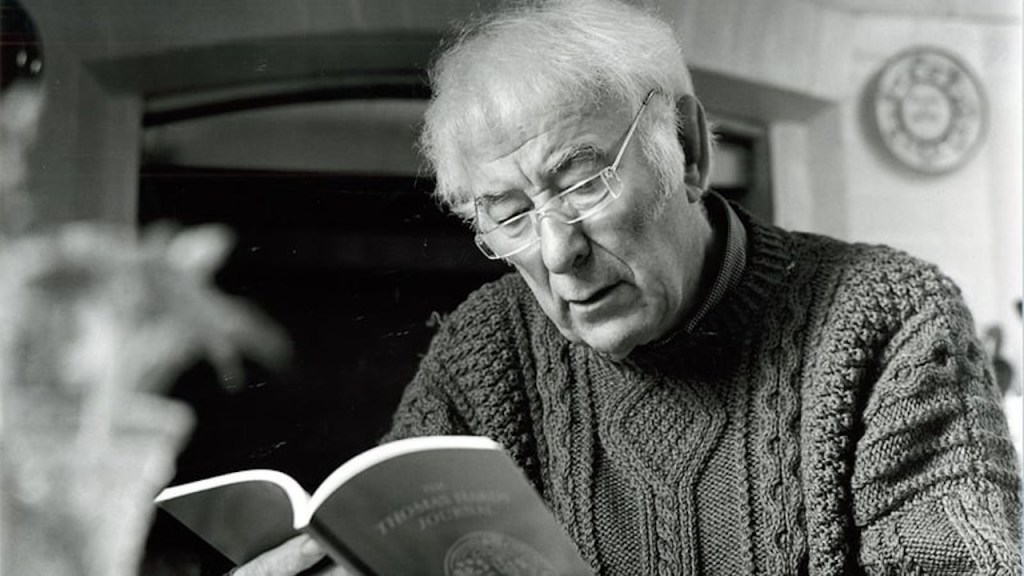
Seamus Heaney’s “Whatever You Say, Say Nothing” is displayed in four parts. The piece dramatizes a rough-style free verse with an irregularly paced rime scheme. The speaker is describing the events surrounding the command for political operatives to be extremely careful with what they say.
Introduction and Text of “Whatever You Say, Say Nothing”
The title, “Whatever You Say, Say Nothing,” originates with the secretive activity of Northern Ireland’s rebel paramilitary that admonished its members with this demand.
Its purpose was to advise members to be extremely careful with what they say. If they speak to “civilians” at all, they should make their talk so small that it would reveal nothing about their activity.
Whatever You Say, Say Nothing
I
I’m writing just after an encounter With an English journalist in search of ‘views On the Irish thing’. I’m back in winter Quarters where bad news is no longer news, Where media-men and stringers sniff and point, Where zoom lenses, recorders and coiled leads Litter the hotels. The times are out of joint But I incline as much to rosary beads As to the jottings and analyses Of politicians and newspapermen Who’ve scribbled down the long campaign from gas And protest to gelignite and Sten, Who proved upon their pulses ‘escalate’, ‘Backlash’ and ‘crack down’, ‘the provisional wing’, ‘Polarization’ and ‘long-standing hate’. Yet I live here, I live here too, I sing, Expertly civil-tongued with civil neighbours On the high wires of first wireless reports, Sucking the fake taste, the stony flavours Of those sanctioned, old, elaborate retorts: ‘Oh, it’s disgraceful, surely, I agree.’ ‘Where’s it going to end?’ ‘It’s getting worse.’ ‘They’re murderers.’ ‘Internment, understandably …’ The ‘voice of sanity’ is getting hoarse.
II
Men die at hand. In blasted street and home The gelignite’s a common sound effect: As the man said when Celtic won, ‘The Pope of Rome’s a happy man this night.’ His flock suspect
In their deepest heart of hearts the heretic Has come at last to heel and to the stake. We tremble near the flames but want no truck With the actual firing. We’re on the make
As ever. Long sucking the hind tit Cold as a witch’s and as hard to swallow Still leaves us fork-tongued on the border bit: The liberal papist note sounds hollow
When amplified and mixed in with the bangs That shake all hearts and windows day and night. (It’s tempting here to rhyme on ‘labour pangs’ And diagnose a rebirth in our plight
But that would be to ignore other symptoms. Last night you didn’t need a stethoscope To hear the eructation of Orange drums Allergic equally to Pearse and Pope.)
On all sides ‘little platoons’ are mustering- The phrase is Cruise O’Brien’s via that great Backlash, Burke-while I sit here with a pestering Drouth for words at once both gaff and bait
To lure the tribal shoals to epigram And order. I believe any of us Could draw the line through bigotry and sham Given the right line, aere perennius.
III
“Religion’s never mentioned here”, of course. “You know them by their eyes,” and hold your tongue. “One side’s as bad as the other,” never worse. Christ, it’s near time that some small leak was sprung In the great dykes the Dutchman made To dam the dangerous tide that followed Seamus. Yet for all this art and sedentary trade I am incapable. The famous Northern reticence, the tight gag of place And times: yes, yes. Of the “wee six” I sing Where to be saved you only must save face And whatever you say, you say nothing. Smoke-signals are loud-mouthed compared with us: Manoeuvrings to find out name and school, Subtle discrimination by addresses With hardly an exception to the rule That Norman, Ken and Sidney signalled Prod And Seamus (call me Sean) was sure-fire Pape. O land of password, handgrip, wink and nod, Of open minds as open as a trap, Where tongues lie coiled, as under flames lie wicks, Where half of us, as in a wooden horse Were cabin’d and confined like wily Greeks, Besieged within the siege, whispering morse.
IV
This morning from a dewy motorway I saw the new camp for the internees: A bomb had left a crater of fresh clay In the roadside, and over in the trees Machine-gun posts defined a real stockade. There was that white mist you get on a low ground And it was déjà-vu, some film made Of Stalag 17, a bad dream with no sound. Is there a life before death? That’s chalked up In Ballymurphy. Competence with pain, Coherent miseries, a bite and sup, We hug our little destiny again.
Commentary on “Whatever You Say, Say Nothing”
The poem, “Whatever You Say, Say Nothing,” is displayed in four parts. The piece dramatizes a rough-style free verse with an irregularly paced rime scheme.
First Part: Harassed by Reporters
I’m writing just after an encounter With an English journalist in search of ‘views On the Irish thing’. I’m back in winter Quarters where bad news is no longer news, Where media-men and stringers sniff and point, Where zoom lenses, recorders and coiled leads Litter the hotels. The times are out of joint But I incline as much to rosary beads As to the jottings and analyses Of politicians and newspapermen Who’ve scribbled down the long campaign from gas And protest to gelignite and Sten, Who proved upon their pulses ‘escalate’, ‘Backlash’ and ‘crack down’, ‘the provisional wing’, ‘Polarization’ and ‘long-standing hate’. Yet I live here, I live here too, I sing, Expertly civil-tongued with civil neighbours On the high wires of first wireless reports, Sucking the fake taste, the stony flavours Of those sanctioned, old, elaborate retorts: ‘Oh, it’s disgraceful, surely, I agree.’ ‘Where’s it going to end?’ ‘It’s getting worse.’ ‘They’re murderers.’ ‘Internment, understandably …’ The ‘voice of sanity’ is getting hoarse.
In Part I, the speaker reports that he is being harassed by reporters. They seek information about how the Irish feel about their situation. The intrusive reporters shove cameras and microphones into the faces of the locals. They “litter” the localities and disturb the peace.
The speaker then describes the chaos of the political situation. He claims that he leans more toward religion than politics, but because he is also a citizen he has to pay some attention to current events.
The speaker portrays the situation as fractious and obstreperous. As the citizens discuss the chaos, each has his own opinion. But this speaker/observer notes that certain phrases keep popping up as the folks wonder how all the fighting and back-biting will end. They all agree that the situation is disagreeable even full of disgrace.
The speaker even hears his neighbors complaining and keening cries about murderers. They seem to have no recourse to keep themselves safe. There seems to be no one around them who possesses a healthy attitude.
The speaker’s attitude runs the gamut from amusement to sheer philosophical angst as he looks on the chaos. He becomes Yeastian at times as he marvels, condemns, and pontificates.
Second Part: After Centuries of War Zone Living
Men die at hand. In blasted street and home The gelignite’s a common sound effect: As the man said when Celtic won, ‘The Pope of Rome’s a happy man this night.’ His flock suspect
In their deepest heart of hearts the heretic Has come at last to heel and to the stake. We tremble near the flames but want no truck With the actual firing. We’re on the make
As ever. Long sucking the hind tit Cold as a witch’s and as hard to swallow Still leaves us fork-tongued on the border bit: The liberal papist note sounds hollow
When amplified and mixed in with the bangs That shake all hearts and windows day and night. (It’s tempting here to rhyme on ‘labour pangs’ And diagnose a rebirth in our plight
But that would be to ignore other symptoms. Last night you didn’t need a stethoscope To hear the eructation of Orange drums Allergic equally to Pearse and Pope.)
On all sides ‘little platoons’ are mustering- The phrase is Cruise O’Brien’s via that great Backlash, Burke-while I sit here with a pestering Drouth for words at once both gaff and bait
To lure the tribal shoals to epigram And order. I believe any of us Could draw the line through bigotry and sham Given the right line, aere perennius.
The speaker is, however, also capable of spouting the same jeremiads that the Irish have spouted for centuries of residing in a war zone. Understandably, they have become hardened and discouraged seeing people dying around them as homes are bombed and streets are littered with fire power and debris.
The speaker claims that a common sound is the explosion of “gelignite.” He seems fascinated by the term “gelignite,” which he continues to spread liberally throughout his passages.
The speaker is also, however, dramatizing the socialist nature of the crowd and manages to fling off a worked-over cliché: “cold as a witch’s tit” becomes “hind tit / Cold as a witch’s”—his colorful way of dramatizing the angst.
The speaker’s colorful portrayals lurch the poem forward, even if the politics gives it a decided lag, as he confounds the papal intrusion with emptiness. The continued explosions, however, rip the night and rattle the people’s minds and hearts as well as the windows of their houses.
Of course, the reader is aware that eventual outcomes depend totally upon which side one is shouting for. The speaker philosophizes that all the citizens could find the correct solution given enough time and space.
They would likely be better at cutting through the bigotry and fake political posturing than those seeking personal gain at the expense of others. Enough time and anything could be accomplished, the speaker wants to suggest.
Third Part: The Resistance vs Authority
“Religion’s never mentioned here”, of course. “You know them by their eyes,” and hold your tongue. “One side’s as bad as the other,” never worse. Christ, it’s near time that some small leak was sprung In the great dykes the Dutchman made To dam the dangerous tide that followed Seamus. Yet for all this art and sedentary trade I am incapable. The famous Northern reticence, the tight gag of place And times: yes, yes. Of the “wee six” I sing Where to be saved you only must save face And whatever you say, you say nothing. Smoke-signals are loud-mouthed compared with us: Manoeuvrings to find out name and school, Subtle discrimination by addresses With hardly an exception to the rule That Norman, Ken and Sidney signalled Prod And Seamus (call me Sean) was sure-fire Pape. O land of password, handgrip, wink and nod, Of open minds as open as a trap, Where tongues lie coiled, as under flames lie wicks, Where half of us, as in a wooden horse Were cabin’d and confined like wily Greeks, Besieged within the siege, whispering morse.
In Part III, the poem’s title appears, warning that the members of the resistance should take great care not to tip their hand. If they speak to anyone, they must keep their conversation as neutral as possible.
They must be quiet, so quiet that a smoke-signal would sound louder. They must keep their talk to a level of mum. They must not reveal their plans to anyone lest some authority figure get hold of them.
Fourth Part: Is There Life Before Death?
This morning from a dewy motorway I saw the new camp for the internees: A bomb had left a crater of fresh clay In the roadside, and over in the trees Machine-gun posts defined a real stockade. There was that white mist you get on a low ground And it was déjà-vu, some film made Of Stalag 17, a bad dream with no sound. Is there a life before death? That’s chalked up In Ballymurphy. Competence with pain, Coherent miseries, a bite and sup, We hug our little destiny again.
In the final part, the speaker describes what he has seen. He saw a crater in the middle of an internee camp. The bomb has carved out the crater and the fresh clay has been spewed all over the trees and the road.
The speaker then sums up his report with a statement filled with questions. He wonders if there is life before death. He also questions the notions of pain and competence. It seems that life is filled with contradictions, that misery can be coherent stands in his mind as a blind trust.
If they are to enjoy their dinner, they must grasp their own destiny repeatedly as they wait for each bit of knowledge that will eventually lead them out of chaos.
Reading: Seamus Heaney reading Part 3 of his poem:
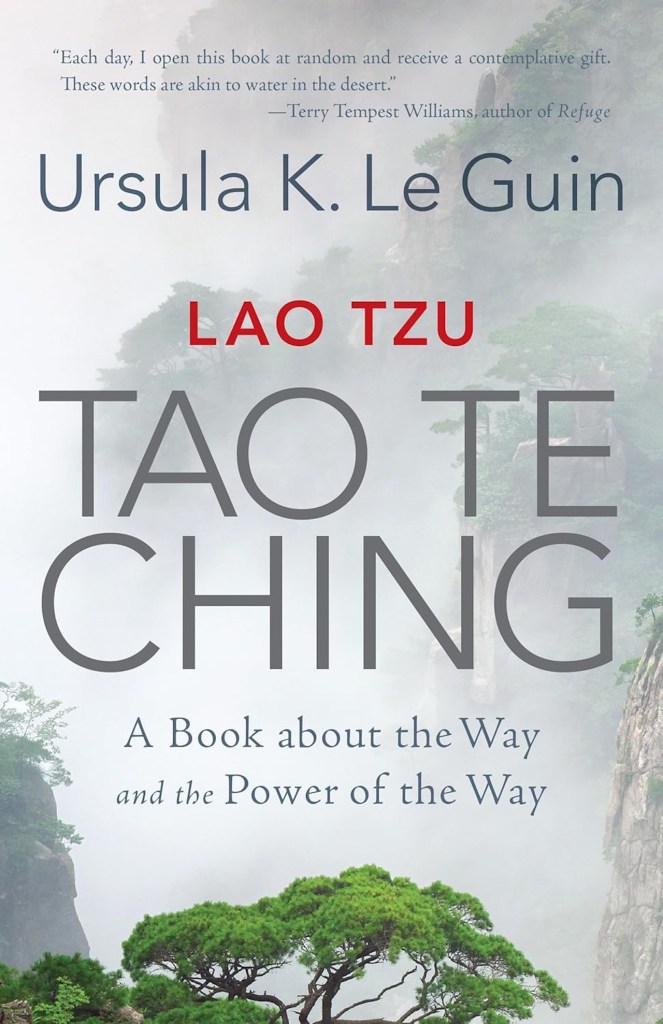
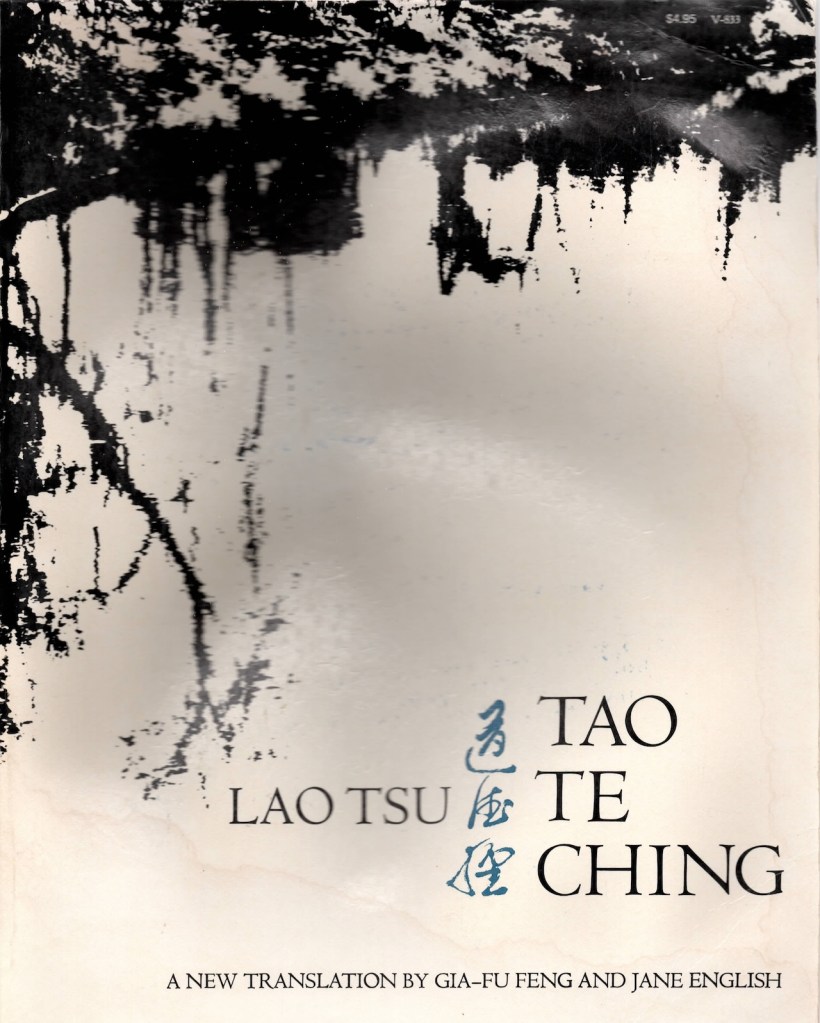
Addressing a portion of the errors that have been foisted on the literary world by Ursula K. Le Guin’s faulty “translation” of the sacred text Lao Tsu’s Tao Te Ching, this essay seeks to redirect the narrative driving that spiritual classic.
Introduction: Translation vs Rendition/Version
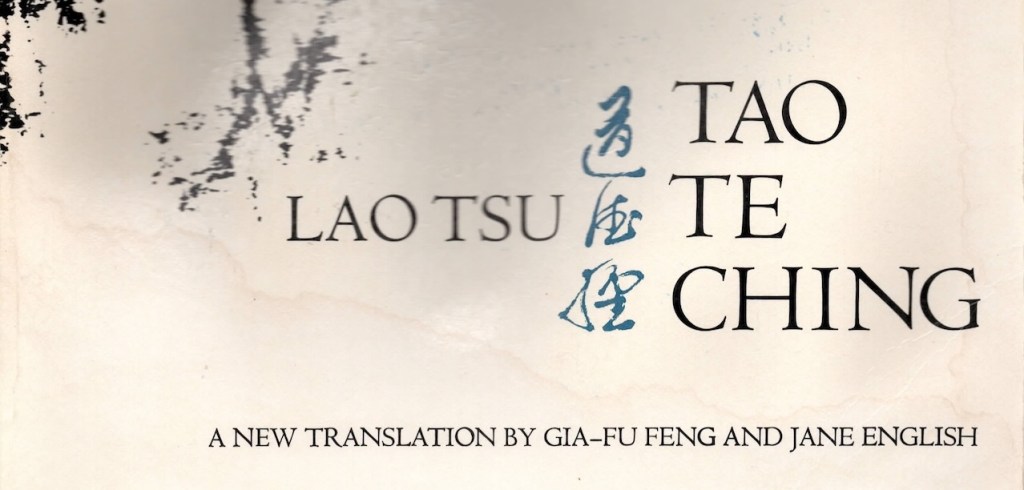
This essay contrasts a translation of Lao Tsu’s Tao Te Ching by Gia-Fu Feng and Jane English to a rendering by Ursula K. Le Guin. Feng actually translated the text from the original Chinese, while Le Guin simply rewrote and reinterpreted from genuine translations of the text, including the Feng/English translation. In order words, Le Guin pulled a stunt akin to poetaster Robert Bly’s notion of translation.
To be fair to Le Guin, however, it must be noted that she does not claim to have “translated” Lao Tsu’s work; she merely wrote her own interpretations and reactions based on the translations of others. She refers to the effort as a “rendering” or a “version”—not a translation.
In her study and revising of the sacred text, Le Guin appears to be working out her own path of spirituality, which means that the work should have remained private and never been released on the public. Poets and writers who become widely famous—as have Le Guin and Robert Bly—often become so enamored with their own output that they seem to think that anything they write must be worthy of widespread distribution—not to mention the possibility of added revenue from sales.
The personal rendering of sacred texts may become hazardous, when the poet does not truly understand the spirit that originally motivated the work. The result in T. S. Eliot’s “romantic misunderstanding” becomes all too evident. Unfortunately, reviewers, publishers, and promoters have labeled Le Guin’s work a translation, and such labeling is grossly misleading. In her section on Sources, Le Guin lists several translations of the work that she studied; among them are translations by Paul Caru, Arthur Waley, Robert G. Hendricks, and several others.
She also mentions Gia-Fu Feng and Jane English with the comment: “First published in 1972. I have the Vintage edition of 1989. Arising from a sympathetic and informed understanding, this is literarily the most satisfying and recent translation, I have found terse, clear, and simple.”
It is this last one with which I am concerned in this essay. And because Le Guin has called the Feng/English the “most satisfying,” I wonder why she would have even taken it upon herself to engage with a text that others would mistakenly reckon to be a new translation.
And the unfortunate consequence is that those relying on the Le Guin “translation” of the Tao Te Ching as a reference for supporting their arguments will find that their claims do not age well. The inaccuracies foisted on the literary world by faulty translations cheapens the very engagement that literary scholars love and work hard to keep genuine. It is with the purpose of correction that I offer this essay.
Note: While the original text of Tao Te Ching is comprised of 81 chapters and Le Guin’s content focuses on all 81, I have excised a mere dozen or so of them for this essay. I plan to engage a larger study to include all of the chapters in future.
What follows is not a general complaint about poetic freedom, but a critique of specific departures from Lao Tsu’s meaning—departures that, when repeated throughout the work, amount to a systematic softening and psychologizing of Taoist metaphysics. In each case, I cite the Feng/English translation alongside Le Guin’s rendering and explain why the former preserves Lao Tsu’s intent while the latter obscures or distorts it.
1. Chapter 1: Ontology Reduced to Epistemology
Feng/English:
“The Tao that can be told is not the eternal Tao. The name that can be named is not the eternal Name.”
Here Lao Tsu asserts the ontological priority of the Tao over language and conceptualization. Telling and naming are functions of the human mind, and the human mind cannot conceive of the Ultimate Reality, the Tao, or God. Only the soul can perceive, unite with, and therefore understand the Tao (Ultimate Reality, Divine Belovéd, Divine Mother, or God).
Note that the term “Tao” is capitalized in the Feng/English work, while Le Guin lowercases it. Le Guin’s lower-casing possibly results from the mistaken notion that Eastern religions, especially Buddhism, which was heavily influenced by Taoism, is an atheistic (Godless) religion.
Le Guin:
“The tao that can be told is not the eternal Tao. The name that can be named is not the eternal name.”
While the wording remains the same, except for lowercasing, Le Guin’s framing elsewhere in her text interprets the passage primarily as a comment on human linguistic limitation, rather than as a declaration about the structure of reality itself. Taoist philosophy as well as most Eastern religious philosophy is entirely judgment/evaluation free: these texts describe reality; they do not judge/evaluate the pairs of opposites. Western interpretation of Eastern texts across the board go astray by adding judgment/evaluation.
2. Chapter 2: Mutual Arising vs. Moral Psychology
Feng/English:
“When people see some things as beautiful, other things become ugly.”
This expresses the Taoist principle of mutual arising (相生). It engages the basic principle of maya delusion that exists through the pairs of opposites: beautiful vs ugly, good vs evil, up vs down, etc.
Le Guin:
“Everybody on earth knowing that beauty is beautiful makes ugliness.”
Le Guin’s phrasing shifts structural polarity (pairs of opposites) into psychological causation. Instead of merely expressing the fact that the pairs of opposites exist in relation to each other, this shift adds the notion that the human mind causes the contrast, and that notion is simply false, because those contrasts exist without the human mind interpreting them. Le Guin’s phrasing implies that if only we did not deem something beautiful, we would not then see ugliness. The error of that implication should be self-evident.
3. Chapter 11: Emptiness as Enabling Force
Feng/English:
“We shape clay into a pot, but it is the emptiness inside that holds whatever we want.”
Le Guin:
“…the emptiness inside that makes it useful.”
Potentiality becomes utility—again the hint of judgment mars the usefulness of this rendering. While the Feng/English simply states a fact, the Le Guin adds the human value judgment of usefulness.
4. Chapter 17: Wu Wei and Governance
Feng/English:
“When the Master governs, the people are hardly aware that he exists.”
Le Guin:
“The best rulers are those the people don’t notice.”
Governance becomes political minimalism rather than cosmic alignment.
5. Chapter 22: Ontological Paradox Flattened
Feng/English:
“Yield and overcome; Bend and be straight.”
Le Guin:
“Yielding is completion.
Bending is becoming straight.”
Paradox is psychologized.
6. Chapter 25: Cosmogony Softened
Feng/English:
“There was something formless and perfect before the universe was born.”
Le Guin:
“There is something unformed yet complete that existed before heaven and earth.”
Metaphysical priority is rendered poetic.
7. Chapter 32: The Uncarved Block and Cosmic Authority
Feng/English:
“The Tao is forever nameless. Though the uncarved block is small, no one in the world dare claim it. If kings and lords could harness it, the ten thousand things would naturally obey. Heaven and earth would unite…”
Le Guin:
“The way is forever nameless. Though the uncarved block is small, no one in the world dares make it a servant…”
Metaphysical taboo becomes ethical restraint.
8. Chapter 37: Wu Wei as Koan
Feng/English:
“The Tao never does anything, yet through it all things are done.”
Le Guin:
“The Tao does nothing, yet nothing is left undone.”
Causality becomes aphorism.
9. Chapter 42: Violence as Ontological Failure
Feng/English:
“The violent perish by their own violence. This is the root of my teaching.”
Le Guin:
“What others teach, I teach also: the violent die a violent death. This will be the root of my teaching.”
Cosmic law becomes moral maxim.
10. Chapter 48: Subtraction vs. Self-Improvement
Feng/English:
“In the pursuit of learning, every day something is acquired. In the pursuit of Tao, every day something is dropped.”
Le Guin:
“Learning adds. The Way subtracts.”
Radical existential negation becomes slogan.
11. Chapter 57: Governance and Natural Order
Feng/English:
“The more prohibitions you have, the less virtuous people will be.”
Le Guin:
“The more laws you make, the more criminals there will be.”
Taoist naturalism is reframed as modern political critique.
12. Chapter 74: Human vs Divine Justice
Feng/English:
If men are not afraid to die, It is of no avail to threaten them with death.
If men live in constant fear of dying, And if breaking the law means that a man will be killed, Who will dare to break the law?
There is always an official executioner. If you try to take his place, It is like trying to be a master carpenter and cutting wood. If you try to cut wood like a master carpenter, you will only hurt your hand.
The Feng/English version accurately captures the chapter’s critique of harsh governance and the death penalty. It directly addresses rulers who rely on threats of execution to control the people, pointing out the futility when people lose their fear of death (often due to oppressive conditions).
The “official executioner” refers to the natural order or Tao itself—the impartial force that metes out consequences. Attempting to usurp this role through arbitrary human killings is presumptuous and self-destructive, like an amateur wielding a master carpenter’s tools. This rendering stays close to the original Chinese text’s structure and intent, emphasizing non-interference and the dangers of overreaching authority.
Le Guin:
When normal, decent people don’t fear death, how can you use death to frighten them? Even when they have a normal fear of death, who of us dare take and kill the one who doesn’t? When people are normal and decent and death-fearing, there’s always an executioner. To take the place of that executioner is to take the place of the great carpenter. People who cut the great carpenter’s wood seldom get off with their hands unhurt.
Le Guin’s version introduces interpretive additions that distort the original meaning. Phrases like “normal, decent people” and repeated emphasis on “normal” behavior inject a moralistic, humanistic judgment absent from the Chinese text, which speaks generally of “the people” without qualifiers of decency or normality. This shifts the focus from a political warning against tyrannical rule to a psychological or ethical observation about consistent human behavior.
The hypothetical “who of us dare take and kill the one who doesn’t?” implies no one would dare execute even the fearless, softening the critique of capital punishment and missing the irony in the original’s rhetorical question about lawbreakers (“who would dare?”).
While poetic, these liberties dilute the chapter’s core Taoist message: rulers should not play executioner, as death is the province of the Tao (“great carpenter” or divine master who “hews” life), and human interference invites harm. The Feng/English stays truer to this anti-authoritarian essence without the added layers.
Image c: Le Guin’s Book Cover
Why Accuracy Matters
Le Guin’s Tao Te Ching is a graceful literary artifact. It is often insightful, occasionally beautiful, and sometimes moving. But it is not Lao Tsu—which she spells “Lao Tzu.” By filtering Taoism through modern psychology, ethical sentiment, and literary minimalism, Le Guin consistently narrows a cosmological text into a personal one. Feng and English, by contrast, preserve the exotic, impersonality, and metaphysical rigor of the original.
This distinction matters. Sacred texts are not raw material for aesthetic rearrangement without consequence. When a “version” is mistaken for a translation, the philosophical lineage is compromised, and later arguments built upon it rest on unstable ground. It is precisely to prevent such erosion that this essay insists on correction—not to diminish Le Guin’s literary talent, but to restore Lao Tsu’s voice where it has been inadvertently overwritten.
The Damage Done by Overwriting
Le Guin’s Tao Te Ching is often defended on the grounds that it is not a translation at all, but a “version,” a “rendering,” a personal engagement with the text. That defense, however, does not mitigate the damage done when such a rendering is repeatedly received and cited as Lao Tsu. The harm lies not in poetic interpretation per se, but in philosophical overwriting—the replacement of a coherent metaphysical system with a modern ethical sensibility that only partially overlaps with it.
Because Lao Tsu views human perceptual reality as a yin/yang play of dualities within a wholeness of Being, he does not present good and bad as moral preferences or psychological dispositions. They are structural features of manifested reality. Likewise, Lao Tsu distinguishes between a true, creative form of power—one aligned with the Tao—and a false, destructive form, arising from coercion, force, and egocentric assertion. This distinction is not ethical window dressing; it is central to Taoist ontology.
In the Feng/English translation, this structure remains intact. Power is impersonal, prior, and generative; its counterfeit is self-assertive and ultimately self-defeating. Violence fails not because it is morally frowned upon, but because it violates the grain of reality itself.
Le Guin, however, repeatedly recasts this ontological distinction in affective and evaluative language. Where Lao Tsu speaks of alignment and misalignment with the Tao, Le Guin substitutes terms such as “mysterious,” “great,” and “true” for what might be called real power, and “care” as its preferred human expression. Opposed to this is not ontological distortion, but what reads as a lesser, egocentric abuse of power—a psychological or ethical failing rather than a metaphysical one. This shift is subtle, but its consequences are profound.
Taoist power is not something one chooses to wield kindly; it is something that operates whether one believes in it or not. By recasting power as a matter of care versus abuse, Le Guin relocates Taoism from the realm of cosmology into that of moral psychology. The Tao becomes something one believes in, rather than something one must align with.
This same kind of misunderstanding is observable in Christianity, when religionists insist that one must believe in Jesus as God, instead of as a son (child) of God, who was aligned with God in ways that the bulk of humanity has forgotten, the fall of Adam and Eve being the mythological depiction of that fall. Jesus took on some of the karma of erring humanity, but individual karma still applies to each human being born of woman into this world of maya.
The impact of inaccuracies results in the damage done by overwriting. The text is no longer strong enough. Its impersonality is softened; its rigor is humanized; its metaphysical claims are domesticated into ethical preferences. What remains is graceful, humane, and accessible—but it is no longer Lao Tsu’s Tao Te Ching.
When such a version is mistaken for a translation, the consequences extend beyond literary taste. Scholars, students, and readers build arguments upon it, unaware that the philosophical ground has shifted beneath their feet. Over time, the Tao itself is subtly redefined—not by debate or refutation, but by replacement.
It is precisely to prevent such erosion that this essay insists on correction. Not to deny Ursula K. Le Guin her considerable literary gifts, but to insist that a sacred philosophical text must be allowed to remain what it is, even when it resists modern sensibilities. Lao Tsu does not need to be improved, clarified, or made more caring. He needs to be heard.
William Butler Yeats’ reputation stands him as one of the towering figures of twentieth-century poetry, a master whose lyrical skill and evocative imagery earned him the Nobel Prize in Literature in 1923.
William Butler Yeats: A World-Class Poet
Many of William Butler Yeats’ poems, including “The Second Coming” and “Sailing to Byzantium,” reveal a profound sensitivity to the human condition, blending Irish myth with modern innovation.
Yet, beneath his celebrated poetry lies a less triumphant endeavor: A Vision, a sprawling metaphysical treatise first published in 1925 and revised in 1937. In A Vision, Yeats attempts to create a comprehensive system—a poetic ethic—that would unify history, personality, and art under a single rubric.
Despite Yeats’ stature as a world-class poet, A Vision represents a resounding failure. Far from establishing a coherent ethic, the work emerges as a cacophony of misguided notions, revealing Yeats’ superficial and often erroneous grasp of the Eastern religious traditions he claimed to have deeply studied.
Yeatsean Audacity
Yeats’ ambition in A Vision may be understood as the epitome of audacity. Supposedly inspired by automatic writing sessions with his wife, Georgie Hyde-Lees, beginning in 1917, the poet believed he had received revelations from spiritual “instructors” that offered a key to understanding human creativity as well as history.
The result was a system based on a cyclical theory of history, symbolized by interlocking gyres—conical spirals that represent the rise and fall of civilizations over 2,000-year periods. (For a discussion regarding the error of the gyres, please see “William Butler Yeats’ ‘The Second Coming’.”)
Yeats divided human personalities into 28 phases of the moon, each corresponding to a specific type, and posited that art, history, and the soul were governed by these cosmic rhythms. His goal was not merely philosophical; he aimed to craft a poetic ethic, a lens through which his poetry could be both generated and then interpreted.
This ambition, however, was challenged by Yeats’ intellectual limitations. While his poetic genius thrived on intuition and ambiguity,the success of a work such as A Vision demanded precision and coherence—qualities it sorely lacks.
Scholars such as Richard Ellmann have noted that Yeats himself admitted to the work’s thinness and opacity, famously remarking in a letter to Ethel Mannin that he wrote it “to keep myself from going mad” [1]. The treatise’s reliance on occult sources, including theosophy and Rosicrucianism, already situates it on shaky ground, but its most glaring and distressing failure lies in Yeats’ mishandling of Eastern religious concepts, which he claimed as foundational influences.
An Eastern Mirage: Yeats’ “Romantic Misunderstanding”
T. S. Eliot labeled Western misunderstanding of Eastern philosophy and religious concepts “Romantic misunderstanding.” He could have been pointing directly to Yeats in this evaluation.
Yeats’ engagement with Eastern religion was not a passing fancy. He was introduced to Hindu philosophy through his association with the Theosophical Society and his friendship with figures such as Sri Mohini Chatterjee, an Indian philosopher whom Yeats met in 1885. Yeats’ fascination deepened with readings of the Upanishads and the Bhagavad Gita, texts he revisited throughout his life.
In A Vision, Yeats explicitly invokes these traditions, particularly in his concepts of reincarnation, the eternal self, and the interplay of the pairs of opposites—ideas he aligns with his gyres and lunar phases. Yet, a closer examination reveals that Yeats’ interpretations are not only idiosyncratic but fundamentally at odds with the traditions he sought to integrate.
Take, for instance, Yeats’ treatment of reincarnation. In Hindu and Buddhist frameworks, reincarnation (samsara) is a process governed by karma, the moral law of cause and effect, aimed at liberation (samadhi in Hinduism, nirvana in Buddhism, salvation in Christianity).
The Brihadaranyaka Upanishad, a key text Yeats references, describes the soul’s journey as a quest for union with Brahman, the universal consciousness or God (as that concept is understood in Western culture) [2].
Yeats, however, reimagines reincarnation as a mechanistic cycle tied to his gyres, devoid of moral progression or spiritual liberation. This watering down of the concept of reincarnation obliterates its deep, spiritual purpose in the lives of humanity.
His 28 phases of the moon assign fixed personality types—such as the “Hunchback” or the “Saint”—with no clear path to transcendence, reducing a dynamic process to a deterministic wheel.
Again, Yeats misunderstanding results in a fatal flaw that limits the Eastern concepts to mere thought experiments, not profound truths that guide individuals on spiritual paths to a definite goal.
Scholar Harold Bloom observes Yeats’ limited awareness of Eastern religious concepts by suggesting that the poet’s understanding of reincarnation amounts to little more than a parody; in Yeats system the soul is trapped rather than liberated [3].
Similarly, Yeats’ appropriation of the Bhagavad Gita’s concept of dharma (duty) is distorted beyond recognition. In the Gita, Krishna advises Arjuna to act according to his rôle as a warrior, emphasizing selfless action within a cosmic order [4]. Yeats, however, interprets dharma as a fatalistic submission to historical forces, as seen in his analysis of civilizations’ rise and fall.
His gyres suggest that human agency is illusory, a stark departure from the Gita’s call to active participation in one’s destiny. This misreading reflects not a deep study but a superficial cherry-picking of Eastern ideas to bolster his preconceived system.
A Cacophony of Contradictions
The intellectual incoherence of A Vision extends beyond its Eastern distortions to its internal structure. Yeats’ gyres, meant to symbolize the dialectical interplay of opposites (primary and antithetical tinctures, in his terminology), collapse under scrutiny.
He asserts that history oscillates between unity and multiplicity, yet his examples—such as the fall of Troy or the rise of Christianity—are cherry-picked and lack rigorous historical grounding. Scholar Northrop Frye critiques this approach, arguing that the poet’s historical cycles are poetic fictions masquerading as metaphysics, unsupported by evidence or logic [5].
The treatise’s reliance on vague assertions—for example the suggestion that the end of an age, which always receives the revelation of the character of the next age, is represented by the coming of one gyre to its place of greatest expansion [6]. Such bland unexplained statements further muddy the work’s claims.
Moreover, the 28 lunar phases, intended as a typology of human character, devolve into arbitrary categorization. Yeats assigns historical figures like Shelley (Phase 17) and Napoleon (Phase 20) to these phases, but the criteria are inconsistent and subjective.
The system’s complexity overwhelms its usefulness, leaving readers with a tangled, labyrinthine taxonomy rather than a meaningful ethic. As critic T.R. Henn has avered that the work is less a philosophy than a privately concocted mythology, a wobbly scaffolding for Yeats’ imagination that collapses under its own weight [7].
The Poetic Ethic That Never Materialized
Yeats’ stated intention in formulating his treatise was to establish a poetic ethic, a poetic framework that would elevate his art and serve as a guide those who consume his art. Yet, A Vision fails to come together as either a practical guide or a philosophical statement.
Unlike Dante’s Divine Comedy, which integrates a clear Christian cosmology into its poetry, or Rabindranath Tagore’s works that reveal the Eastern concepts as they are meant to be understood through a poetry that resonates with appropriate imagery as it reveals those concepts, A Vision remains detached from Yeats’ best poetry; its unhinged rhetoric is a like a raft let loose to the wind.
Poems such as “The Second Coming” draw loosely on its imagery—for example, the “widening gyre”—but their power lies in their ambiguity, not in the treatise’s labored explanations. Scholar Helen Vendler has suggested that Yeats’ great poems transcend A Vision, and that they succeed despite it, not because of it [8].
This disconnect underscores the work’s failure as an ethic. An ethic, poetic or otherwise, requires clarity and applicability—qualities A Vision sorely lacks. Its esoteric jargon and convoluted diagrams (the gyres, the wheel, the unicorn) alienate rather than enlighten, rendering it inaccessible.
Even the most devoted Yeatsean acolytes have struggled to reveal any logic or utility in the work. Yeats’ Eastern borrowings, far from lending depth, expose his misunderstanding of traditions that emphasize simplicity and direct experience over intellectual abstraction.
The Zen Buddhist principle of direct insight, for instance, stands in stark contrast to Yeats’ overwrought theorizing, highlighting the huge gulf between his system and the philosophies he seemingly admired.
A Poet’s Folly
William Butler Yeats’ legacy as a poet is unassailable; his poetry remains a testimony to his genius. Yet, A Vision reveals the limits of that genius when applied to systematic thought.
Sadly, intended as a poetic ethic, the work instead emerges as a cacophony of wrong-headed ideas, its Eastern influences warped by misinterpretation and its structure undone by contradiction.
Yeats’ deep study of Hindu and Buddhist concepts, so proudly proclaimed, proves shallow in execution, a veneer of exoticism atop a fundamentally Western occult framework.
The treatise stands not as a triumph but as a cautionary tale: even a world-class poet can falter when straying too far from his craft. In the end, A Vision is less a vision than a mirage—a grand but misguided attempt to impose order on a world that resists such human intervention on a grand scale.
Misreading the Orpheus and Eurydice Myth: Feminist Ideology and the Corruption of Mythic Meaning
Misunderstanding myth is a widespread phenomenon: the very definition of the term “myth” is trivialized in modern parlance, as anything from an error to a lie is often called a myth. The term myth refers to stories with universal, spiritual appeal to the heart, mind, and soul of humankind.
The current motivation to “correct” the past has become one of the more persistent urges in contemporary literary studies. This tendency is visible in the modern attempts to rewrite classical myth, from which ancient figures are called forth, not to unveil perennial truth but to recite the slogans of contemporary feminist ideology.
The myth of Orpheus and Eurydice has suffered significantly from this modernizing impulse in the hands of Margaret Atwood and Carol Ann Duffy. The myth’s spiritual drama—the soul’s yearning for transcendence and the unfortunate failure of faith—has been “corrected” by turning it into a patriarchal battle between man and woman.
Atwood and Duffy
In Atwood’s “Eurydice,” from Interlunar (1984), and Duffy’s “Eurydice,” from The World’s Wife (1999), Eurydice has become a cynical voice for liberation, mocking Orpheus as the stereotype of the egotistical male artist. Duffy’s Eurydice calls the musician/poet “Big O” and accuses him of valuing his own legend above his loved one’s life.
Both Atwood and Duffy applaud Eurydice for slipping through her husband’s grasp as he looks back, disobeying his only command. This understandable failure of Orpheus, which is tragic, is converted into emancipation of his spouse by the simple wave of the feminist wand, levied against the patriarchy.
Yet this politically inspired moral conversion relies upon an act of historical and spiritual blindness. The myth of Orpheus is grounded in the sacred lore, explicating the imagination of antiquity, not to the ideological preoccupations of the current modern social climate.
In its original telling, preserved most completely in Virgil’s Georgics and Ovid’s Metamorphoses, the mythic narrative of Orpheus and Eurydice is not about the sexes but about the soul.
Orpheus remains the quintessential musician/poet; his music/lyrics seeks to restore harmony between life and death as well as between the physical body and the soul. His foray into the Underworld represents the artist’s very vocation: to recover the lost beauty of the world through creative song.
Disobeying a Spiritual Command
The spiritual command not to glance back symbolizes the command of faith: trust in that which cannot be seen with the human eye. His failure as he looks back is not an claim to dominance but the revelation of human weakness facing the enigma of divine perfection. Eurydice’s vanishing does not symbolize an act of resistance; it reveals the soul’s return to the mystery, from which it had only briefly materialized.
The readings of Atwood and Duffy convert the mythic dimension from human emotional truth into the psychology of victimhood. Their Orpheus is not a mystic but a narcissist; their Eurydice is no symbol of the soul but a sarcastic wife in a contemporary petty quarrel. By revising the myth’s value, they turn the story into social allegory and thereby trivialize what they intend to redeem.
They remake the Underworld into a metaphor for patriarchy, and the danger associated with divine disobedience transforms into a parable of female self-assertion. The result remains not only tone-deaf but spiritually hollow. They have thus allowed their gesture of contemporary moralism to masquerade as mythic revision.
Readers can easily understand the appeal for such ministrations. Contemporary literary culture has come to measures significance by the degree of subversion it can produce. To “provide Eurydice a voice” is to score a moral victory for the supposedly oppressed silences of women in the past.
Yet mythic silence is not oppression; it is reverence. Eurydice’s quietness is the silence of mythic spiritual mystery, not the muteness of oppressive victimhood. To convert sacred stillness to irony is to replace contemplation with complaint.
The ancient poets comprehended well the aspects of life and creativity that their modern revisers ignore. Myth does not express itself with grievance language; instead it speaks in the language of the soul. As Orpheus sings, he does not merely effuse emotion; he reorders cosmic energy.
Orpheus’ songs are capable of charming the stones and the trees, not because they answer grievances, but because they call forth balance and harmony between the human and the divine—as does all art, rightly framed.
A Universal Tragedy
The tragedy of Orpheus’ looking back remains universal, not personal. Every human heart and mind, aspiring to attain perfection—self-realization—is required to face the same frailty of faith. Because of this universal mandate, Orpheus’ failure is our own failure: in our fallen state, we cannot help but glance back to what we love, even as love commands us to trust the unseen.
By the empty social moralizing of the myth and sifting it through modern political ideology, poets including Atwood and Duffy abandon the myth’s sacred resonance to the insipid, spiritually dry idiom of politics. They mischaracterize the myth’s silent universality as erasure and mistake its reverence for oppression.
The irony becomes blatantly clear that their “liberated” Eurydice is not free; she remains bound within the suffocating psychology of the age. Her fake, modern voice, though loud with wit, cannot move beyond self-assertion. She may have been granted parole from Hades, but she now finds herself imprisoned in ideology.
The Myth’s Endurance
Thankfully, what endures, however, is not the Atwoodian-Duffian parody of the myth but the myth itself. The songs of Orpheus continue to waft across the centuries because they sing to the immutable condition of the human soul, which longs for what it has lost and suffers as it fails to secure it.
The modern motivation to correct such myths by turning them into moral parables cannot extinguish the ancient fire of their importance. Such trivialization does remind us how some thinkers, influenced by the contemporary postmodernism of radical feminist ideology, only dimly glimpse that light.
Works Cited
Margaret Atwood. “Eurydice.” Interlunar. Oxford University Press, 1984. Carol Ann Duffy. “Eurydice.” The World’s Wife. Picador, 1999. Ovid. Metamorphoses. Translated by A. D. Melville. Oxford University Press, 1986. Virgil. Georgics. Translated by Peter Fallon. Oxford University Press, 2006.