Linda's Literary Home

Tag: reviews

  • Emily Dickinson’s “I had a guinea golden”

    Image: Emily Dickinson – Amherst College – Daguerrotype of the poet at age 17, circa 1847 – likely the only authentic, extant likeness of the poet

    The speaker in Emily Dickinson’s “I had a guinea golden” is expressing melancholy at the loss of a friend, whom she describes metaphorically in terms of three dear objects: a guinea, a robin, and a star.

    Introduction with Text of “I had a guinea golden”

    This fascinating Emily Dickinson poem of loss offers quite a tricky subversion of thought.  The first three stanzas seem to explain the loss of three separate loved ones. 
    Then the final stanza packs a wallop unloading on only one “missing friend,” who has caused the speaker to create this “mournful ditty” with tears in her eyes.

    This poem demonstrates the depth of Dickinson’s education as she employs metaphors of the British coinage system and allusions to Greek mythology, which has been further employed by the science of astronomy to name stars. 

    Not only did Dickinson study widely in many subject areas, she possessed the ability to employ her learning in creative ways to fashion those beautiful flowers, allowing them to grow in her garden of verse.

    I had a guinea golden

    I had a guinea golden –
    I lost it in the sand –
    And tho’ the sum was simple
    And pounds were in the land –
    Still, had it such a value
    Unto my frugal eye –
    That when I could not find it –
    I sat me down to sigh.

    I had a crimson Robin –
    Who sang full many a day
    But when the woods were painted,
    He, too, did fly away –
    Time brought me other Robins –
    Their ballads were the same –
    Still, for my missing Troubador
    I kept the “house at hame.”

    I had a star in heaven –
    One “Pleiad” was its name –
    And when I was not heeding,
    It wandered from the same.
    And tho’ the skies are crowded –
    And all the night ashine –
    I do not care about it –
    Since none of them are mine.

    My story has a moral –
    I have a missing friend –
    “Pleiad” its name, and Robin,
    And guinea in the sand.
    And when this mournful ditty
    Accompanied with tear –
    Shall meet the eye of traitor
    In country far from here –
    Grant that repentance solemn
    May seize upon his mind –
    And he no consolation
    Beneath the sun may find.

    Reading 

    Commentary on “I had a guinea golden”

    Each stanza builds to a magnificent crescendo of outrage that allows the speaker to lavish affection as well as harsh rebuke to the one leaving her in a state of melancholy.

    First Stanza:  The Value of Small Things

    I had a guinea golden –
    I lost it in the sand –
    And tho’ the sum was simple
    And pounds were in the land –
    Still, had it such a value
    Unto my frugal eye –
    That when I could not find it –
    I sat me down to sigh.

    The speaker begins by referring to the coin “guinea,” which was a British coin manufactured with the gold from the African nation of Guinea.  The coin was worth 21 shillings and ceased circulating in 1813.   The speaker maintains the British monetary metaphor by referring also to “pounds” in the fourth line of the poem.

    Metaphorically, the speaker is calling her lost friend a “golden” coin, which she lost “in the sand.”  She then admits that it was a small loss for much more valuable moneys—”pounds”—were all about her.   Nevertheless, to her, because of her frugality, the value of the small coin was huge, and because it was lost to her, she just “sat down to sigh.”

    Second Stanza:  Missing the Music

    I had a crimson Robin –
    Who sang full many a day
    But when the woods were painted,
    He, too, did fly away –
    Time brought me other Robins –
    Their ballads were the same –
    Still, for my missing Troubador
    I kept the “house at hame.”

    The speaker then employs the metaphor of “crimson Robin.”  This time she is likening her friend to the singing robin who “sang full many a day.”  But when the autumn of the year came around, she loses this friend also.

    Just as other moneys were abounding after the loss of a simple guinea, other robins presented themselves to the speaker after she lost her robin.  But even though they sang the same songs as her lost robin, it just was not the same for the speaker.   She continues to mourn the loss of her robin; thus she kept herself harnessed to her house, likely in case her own robin should show up again.

    Third Stanza:  The Mythology of Science

    I had a star in heaven –
    One “Pleiad” was its name –
    And when I was not heeding,
    It wandered from the same.
    And tho’ the skies are crowded –
    And all the night ashine –
    I do not care about it –
    Since none of them are mine.

    The speaker then finds herself once again mourning the loss of a loved one.  This one she labels “Pleiad.”  Pleiad is an allusion to Greek mythology but also a reference to astronomy.  

    In Greek mythology, the seven daughters of Atlas went into hiding up in the sky among the stars to escape being pursued by Orion.  One the seven seems to disappear perhaps out of shame or grief.  

    In the science of astronomy, the constellation known as Taurus features a group of seven stars, but oddly enough only six can be seen, resulting in the same “Lost Pleiad” as exists in the Greek myth.

    Dickinson, who studied widely the subjects of mythology, history, and science thus alludes to the myth of the “Lost Pleiad” to again elucidate the nature of her third lost beloved.   She has now experienced the loss of money, a bird, and now a star–each more precious than the last.

    The speaker loses the star as she was being heedless–not paying attention.  In her negligent state, her star wanders away from her.  Again, although the sky is full of other stars, they just don’t measure up because “none of them are mine.”

    Fourth Stanza:  Admonishing a Traitor

    My story has a moral –
    I have a missing friend –
    “Pleiad” its name, and Robin,
    And guinea in the sand.
    And when this mournful ditty
    Accompanied with tear –
    Shall meet the eye of traitor
    In country far from here –
    Grant that repentance solemn
    May seize upon his mind –
    And he no consolation
    Beneath the sun may find.

    While wildly famous for her riddles, Dickinson often breaks the riddle’s force by actually naming the object described.  In the final stanza, she blatantly confesses that her little story “has a moral.”  She then blurts out, “I have a missing friend.”  

    It is now that the reader understands the loss is not three different loved ones, but only one.  She has thus been describing that “missing friend” using three different metaphoric images.

    Now, however, she has a message for this friend whose description has revealed multiple times how much she misses the friend and laments the loss.   After again rather baldly admitting her sorrow told in “this mournful ditty” and even “[a]ccompanied with tear,” she refers to that missing friend as a “traitor.”

    If this friend who has betrayed her happens to see this “mournful ditty,” she hopes that it will grab that individual’s mind so that the person will experience “repentance solemn.”  Furthermore, she wishes that the friend be unable to find any solace for the individual’s contrition no matter where that friend goes.

  • Original Song:  “These Letters” with Prose Commentary

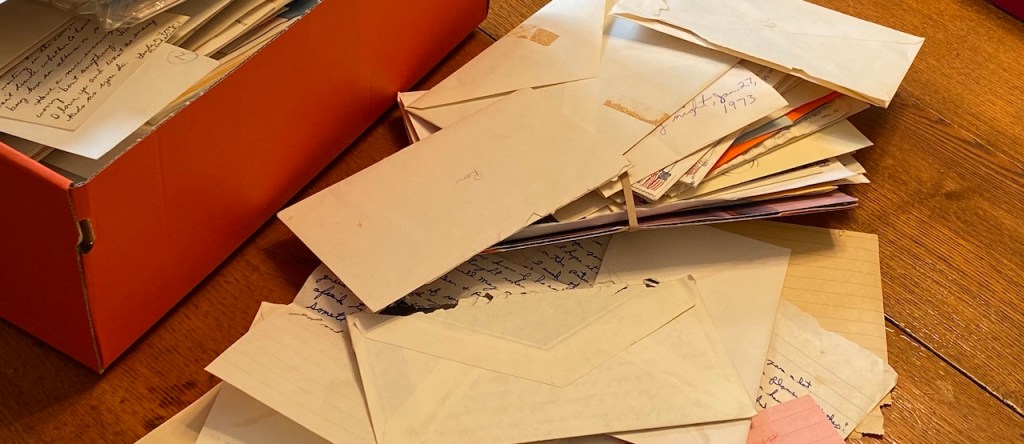
    Image:  Letters  – Photo by Ron W. G.

    Original Song:  “These Letters” with Prose Commentary

    My original song “These Letters” is a rather uncategorizable love song:  it does not exactly fit into the lost love category, nor does it fit into the romantic, idealism of most love songs.

    Introduction and Lyric of “These Letters”

    The singer and the individual addressed in the song have apparently had a friendly, loving relationship in the past—even likely lived together experiencing the life that the singer suggests with images in the song.  However, the addressee at the time of the song remains at some distance from the singer.   The fact that they have been exchanging letters reveals that a spacial distance exists between the two parties.

    The singer does not reveal the reason for the two being apart, but the fact that she hopes the addressee will return to her leaves open the question for the addressee’s departure and even whether the addressee will ever return.  The singer expresses the wish and hope that the addressee will return, and by that expression of that wish/hope, she is implying that the addressee many not ever return.

    Interestingly, the mention of being “far apart” is not clear that the singer is referring only to distance in miles, but it is obvious that a spacial distance exists because of the very title of the song.  The song cannot be considered a “lost love” song because the singer expresses her love for the distant individual and that she hopes the addressee will return to her.  Whether the two reunite remains a mystery because the theme of the song is simply that letters are not sufficient to maintain a close relationship.

    These Letters

    First Verse

    Here I sit with knitting needles
    Winter drawing near.
    Mind on fire with old desire
    Wishing you were here.
    So I’ll make this sweater
    To send to you
    With the love that’s in my heart
    And I’ll tell you that I long for you
    ‘Cause we’re so far apart.

    Second Verse

    The wine in the cellar gets better and better.
    I wish you could taste some with me.
    I try not to show
    The young plants as they grow
    How empty and sad I can be.
    The tomato vines hung so full this year
    I wish you had been here to see.
    I’ll send you some pictures and strawberry jam
    And my hopes that you’ll come back to me.

    Chorus

    These letters can’t take your place, my Love.
    I hope that you come back to me.
    No, these letters can’t take your place, my Love.
    I hope that you come back to me.

    Commentary on “These Letters”

    Because the title of the song is “These Letters,” the singer is placing great emphasis on that form of writing.  But she is letting the recipient of her letters know that she finds such correspondence insufficient to maintain their relationship.  While letters cannot take the place of the missing individual, she singer adds her hope their the addressee will return to their her and their life together.

    First Verse:   A Distant Relationship

    Here I sit with knitting needles
    Winter drawing near.
    Mind on fire with old desire
    Wishing you were here.
    So I’ll make this sweater
    To send to you
    With the love that’s in my heart
    And I’ll tell you that I long for you
    ‘Cause we’re so far apart.

    The singer begins by noting where she is and suggesting what she is doing:  she is sitting somewhere, likely in her home, with a pair of “knitting needles.”   She then alerts the addressee and her listeners to the fact that the winter season is coming soon.

    The fact that the coldest season is nearly upon her prompts her to reveal the reason for her sitting with knitting needles:  she is knitting a sweater for the individual, whom she is addressing in the song.  She then tells the individual that she is sending the sweater to him/her.  She adds the unexpected element that she will also be sending love the person.  

    Love resides in her heart for the person she is addressing, and she wishes they were not “so far apart.”  She reports that she will tell the individual that she “long[s] for [the individual]” because of the vast separation.

    Second Verse:  Hopes for Return

    The wine in the cellar gets better and better.
    I wish you could taste some with me.
    I try not to show
    The young plants as they grow
    How empty and sad I can be.
    The tomato vines hung so full this year
    I wish you had been here to see.
    I’ll send you some pictures and strawberry jam
    And my hopes that you’ll come back to me.

    The singer then reveals that she and the individual whom she is addressing have made wine together.  Their wine gets “better and better” as it rests in the cellar.   This set of imagery “wine” and “cellar” implies that the singer and the individual reside in the country, in a bucolic setting as opposed to city living, where cellars are not common, nor is wine-making.

    More evidence for the country living is that the singer next mentions the growing of the grapes for the wine, which likely represent other plants that the singer and her friend have formerly grown together.

    Now that she and the individual have distance between them, she singer is “empty and sad,” but as the cultivates the garden, she attempts to put on a happier face for the sake of the plants, as plants can be sensitive to the mood of their caretaker.

    She then tells her friend that the tomato harvest was especially good this year.  And again she expresses the wish that her friend had been there to experience those full-hanging tomato vines.  The singer then alerts her friend that she will send the individual pictures—likely images of those garden plants, particularly the tomatoes that grew so abundantly.  

    In addition to the pictures, she will send “strawberry jam”—another indication that the singer lives out in the country where she has the space to grow strawberries.  And again, this singer expresses “hopes”—this time, somewhat more than a mere “wish”—that the individual will return to the singer.

    Chorus:  What Letters Cannot Do

    These letters can’t take your place, my Love.
    I hope that you come back to me.
    No, these letters can’t take your place, my Love.
    I hope that you come back to me.

    The chorus which is offered only twice expresses the fact that the two individuals have been exchanging letters.   The singer makes her feelings known that letters are not sufficient to maintain the loving relationship that the two had earlier experienced.

    The chorus itself even repeats the fact that the letters are not enough.  The singer remains hopeful that the now distant former friend and likely housemate will return to her and their life together.

  • Original Song:  “Where You Are”  with Prose Commentary

    Image: Pacific Ocean – August 2015 – Self-Realization Fellowship Meditation Gardens – Encinitas CA – Photo by Ron W. G.

    Original Song:  “Where You Are”  with Prose Commentary

    This song Where You Are” is one of my original compositions. The video accompanying it was created by landscape artist/photographer Ron Grimes.

    Introduction and Text of “Where You Are”

    My original song “Where You Are”is based on a simple premise: the singer is addressing her Divine Belovèd (God), asserting to the Belovèd the desire to be where the Ultimate Loved One is.

    Each verse features rhetorical questions and musings upon the actual location of the Divine Creator.  Because the Creator/Father of all creation is both within creation and outside of creation, the answer to all of the rhetorical questions is, naturally, yes.

    Nevertheless, being where the Divine Belovèd is cannot be the same situation as being where a human friend or beloved is.   Because it seems that God is playing hide and seek with his children, the singer asserts that her soul “soul tugs at the veil hiding You from me.”

    Where You Are

    First Verse

    Are You standing on top of a mountain?
    Are You sitting beside the vast grave sea?
    How can I ever approach You?
    Will You ever just come to me?

    Second Verse

    Are You speaking to me through my loved ones?
    Are You quietly whispering through the silver stars?
    Are You waiting to hear what my songs will sing?
    Do You listen to the rapid beat of my heart?

    Third Verse  

    If I offer You all in my stillness—
    If I silently listen to the hum in my mind—
    If I patiently fast from all my senses—
    Will You break Your vow of silence and just come to me!

    Chorus 

    Where You are is where I long to be.
    I cannot understand where else I could seek.
    My soul tugs at the veil hiding You from me.
    Where You are is where I long to be.

    Video: Linda Sue Grimes performing “Where You Are”  

    SoundCloud:  Linda Sue Grimes performing “Where You Are” 

    Commentary on “Where You Are”

    After much questioning, contemplating, and ultimately meditating, the devotee will find that the soul will remove the veil hiding it from the Over-Soul—the soul’s Creator, the Divine Belovèd, or any of the preferred name for the Ineffable (God).

    First Verse:  “Are You standing on top of a mountain?”

    Are You standing on top of a mountain?
    Are You sitting beside the vast grave sea?
    How can I ever approach You?
    Will You ever just come to me?

    The singer opens with four rhetorical questions to the Divine Reality.  The first two questions reveal earthly locations that are considered sanctuaries of sacredness, holiness, or just ordinary vacation escapes:  mountain tops and sea sides. 

    The next two questions reveal that the devotee is still walking the sacred, devotional path to soul-realization (also known as self-realization or God-realization).  

    Before final liberation, the devotee experiences the separation from her Goal to be a heavy burden.  That burden causes her to wonder if she, in fact, will ever be able to unite with the Creator/Father.

    In her melancholy and sorrowful mourning because of the seeming distance, the devotee often wonders if the Lord will ever appear to her and make her know that she is His own child.   Will she ever be able to attain the Sacred Goal of self-realization and experience unity with her Belovèd Divine Creator?

    Second Verse:  “Are You speaking to me through my loved ones?”

    Are You speaking to me through my loved ones?
    Are You quietly whispering through the silver stars?
    Are You waiting to hear what my songs will sing?
    Do You listen to the rapid beat of my heart?

    In the second verse, the singer/devotee continues with rhetorical questions.  Intuiting the answer yet not knowing the fullness of each answer, she inquires of the Divine Belovèd if He is communicating with her through her family and friends.

    The singer likely is aware that God is speaking to her through everyone she knows and meets.  But without that last step in the process of enlightenment, she does not know exactly what is being said or exactly what all that conversation might ultimately mean to her.

    Thus, she also wonders if the One Who fashioned the “silver stars” may be signaling to her through those heavenly entities.  Again, she likely knows it to be a fact, but that separation continues to prompt questions.  

    The singer wonders if Divine Mother anticipates what she sings in her songs.  She wonders if her musical worship is reaching its intended Goal.

    The singer/devotee often becomes anxious with a rapid heart beat, knowing that that heart beat needs to become calm to achieve stillness.  She therefore wonders if the Creator Divine cares to listen to that rapid heart beat.  And she wonders if the Ultimate Physician will perform some medical heavenly magic to help her still her rapid heart.

    Third Verse:  “If I offer You all in my stillness”

    If I offer You all in my stillness—
    If I silently listen to the hum in my mind—
    If I patiently fast from all my senses—
    Will You break Your vow of silence and just come to me!

    The singer/devotee’s questioning becomes even more intense in the lyric of the final verse.    She has shown that she knows that she must still the rapid beat of her heart, but she also must still all of her senses as she offers her every atom to the Divine Essence.

    The devotee/singer shows awareness that she must listen the divine hum of the cosmic motor, the sacred AUM (Om) sound that upholds all of creation.  She knows that she must remove her attention from worldly things and events and place that attention upon the locus beyond the senses, where the soul resides.

    The singer/devotee remains certain that after she is able to accomplish all that is implied in her questions and musings, the Divine Belovèd Presence will, in fact, “break [that] vow of silence and [ ] come to [her].”

    Chorus:  “Where You are is where I long to be”

    Where You are is where I long to be.
    I cannot understand where else I could seek.
    My soul tugs at the veil hiding You from me.
    Where You are is where I long to be.

    The chorus, instead of offering mere rhetorical questions and musings, makes an affirmative statement:  the singer asserts that she wants to be where her Divine Beloved is.   She reveals her intuition that she cannot find love, peace, fulfillment on the physical, earthly plane.

    The singer/devotee insists that her soul is attempting to rend the cloth of separation from the Divine, as it “tugs at the veil” that keeps her from uniting with the Creator Belovèd. 

    The final line emphasizes as it repeats the important desire: “Where You are is where I long to be.”  The importance of the chorus is demonstrated by its repetition after every verse.

  • Original Song:  “The Paper Mill Bridge Song” with Prose Commentary

    Image:  Old Paper Mill Bridge, Brookville, Indiana – Built 1914 – Brookville Library Collections

    Original Song:  “The Paper Mill Bridge Song” with Prose Commentary

    My original song “The Paper Mill Bridge Song” was inspired by the beautiful Whitewater River in Indiana and its relationship to the beautiful relationship I have enjoyed for over half a century with my wonderful husband, native of the little town of Brookville, Indiana.

    Introduction and Excerpt from “The Paper Mill Bridge Song”

    My husband, landscape artist Ron Grimes, created the video featured in this article to accompany my original song “The Paper Mill Bridge Song.”  He wrote the following introduction to the piece and placed his video on YouTube:

    A celebration of life and love as witnessed by the Paper Mill Bridge over the Whitewater River in Brookville, Indiana.

    September 10th, 2022. Linda and I walked to the middle of the new Papermill Bridge. I wanted to capture some scenes for this video. As soon as I started videoing, this Canada Goose flew right over us and honked as it if it were saying, “I want to be in your video.” It was a gift.

    Innovative Chorus

    The song undergoes an unusual arrangement; instead of an ordinary chorus, it features an middle octave which behaves as a second octave and chorus that gets repeated at a the end of the song.

    The Paper Mill Bridge Song

    Here’s where people paddle canoes
    Down the Whitewater River.
    I stand here on Paper Mill Bridge.
    Watch the water and remember
    The day we walked along the bank,
    Sand so warm to my feet.
    We talked about cattails, rocks, and stars
    And the moss that grows on old trees.

    These are the things that fill my day,
    Things we’ve done together.
    Sunshine streaming down through the leaves,
    A storm in the clouds or snow in the fields.
    River water runs through my veins.
    The stars light up my eyes.
    Love for you turns in my heart
    Like the sun burns through the sky.


    Through the years my heart has filled
    With love for this old river.
    I stand here on Paper Mill Bridge.
    Watch the water and remember
    The day we paddled down the stream,
    A cool breeze on my shoulders.
    The sun shone bright over Paper Mill Bridge
    And I knew I’d love you forever.

    These are the things that fill my day,
    Things we’ve done together.
    Sunshine streaming down through the leaves,
    A storm in the clouds or snow in the fields.
    River water runs through my veins.
    The stars light up my eyes.
    Love for you turns in my heart
    Like the sun burns through the sky.

    © LINDA SUE GRIMES 2004

    Prose Commentary on “The Paper Mill Bridge Song”

    My original song—”The Paper Mill Bridge Song”—focuses on one relationship that progresses from good friends to life partner.  In the opening verse, the friends experience a quiet walk and talk along the river.  In the final verse, the life relationship is solidified.

    First Octave/Verse:  The View from the Bridge

    Here’s where people paddle canoes
    Down the Whitewater River.
    I stand here on Paper Mill Bridge.
    Watch the water and remember
    The day we walked along the bank,
    Sand so warm to my feet.
    We talked about cattails, rocks, and stars
    And the moss that grows on old trees

    The singing narrator is standing on a bridge, which turns out to be the subject of the song, the Paper Mill Bridge.  She begins to report on the activities that are locally common to that bridge.  The bridge spans the Whitewater River—a river in mideastern to southern Indiana—and from its perch one can from time to time see canoers paddling their barks down the river.

    The narrator then focuses on a memory that is important to her regarding her hike along the riverbank with a friend.  During that pleasant stroll, the two friends casually conversed about river-related entities such as water reeds that look like “cattails” and other features of nature such a “rocks and stars.”

    The narrator recalls that her feet enjoyed the luxury of the warm sand.  They also held forth about the fact that moss grows on old trees—likely that the moss grows mostly on the north side of those arbolian creatures.

    Second Octave/Chorus:  Recurring Images

    These are the things that fill my day,
    Things we’ve done together.
    Sunshine streaming down through the leaves,
    A storm in the clouds or snow in the fields.
    River water runs through my veins.
    The stars light up my eyes.
    Love for you turns in my heart
    Like the sun burns through the sky.

    The chorus has an usual placement, standing the middle of the song and containing an equal number of line as each verse, instead of following each verse with fewer lines.  Essentially the piece offers three separate octaves, even as the middle octave performs as a chorus.

    In this innovative chorus, the narrator has placed a heavy emphasis.  While she has offered some concrete details in the opening verse-octave, in the chorus-octave she is stating a general take on what she may likely be thinking about during this particular time period in her life.

    She thus has been focusing mentally on things that she and her friend have enjoyed together.  But then she adds two images in the first quatrain of the chorus-octave that allow her thoughts to show their natural influences as she experiences weather conditions—specially the warmth of spring and summer and the cold of fall and winter.

    The second quatrain of the chorus-octave becomes even more generalized: she is a creature of the river, so closely attuned to river culture that it seems that the very waters of the river flow “through [her] veins.”

    The narrators suggests that her happiness is enhanced as if by starlight.  She then asserts that she loves her friend with the same intensity that causes the “sun” to burn “through the sky.”  The hyperbole serves to suggest the strong emotion that this narrator feels for her friend, their relationship, and the natural features that they have experienced together.

    Third Octave/Verse:  The Passage of Time

    Through the years my heart has filled
    With love for this old river.
    I stand here on Paper Mill Bridge.
    Watch the water and remember
    The day we paddled down the stream,
    A cool breeze on my shoulders.
    The sun shone bright over Paper Mill Bridge
    And I knew I’d love you forever.

    The third octave/verse again focuses on the narrators thoughts about her friend, and now it becomes apparent that they are indeed life partners.  But first she places that river into her affections; she has come to love the river, and again, she is standing on the same bridge with pleasant memories coming to the fore.

    This time she remembers that like the other folks one might see canoeing down the Whitewater River, she and her partner did such paddling.  That day she recalls that she felt a breeze on the skin; it was a “cool breeze”—indicating that it was likely early to mid-spring.

    However, she then asserts that over that bridge the sun was beaming down in bright rays.  And suddenly, her heart told her then as it is telling her now that she would continue to hold her partner in her heart “forever.”  

    Second Octave/Chorus:  Recurring Images Again

    These are the things that fill my day,
    Things we’ve done together.
    Sunshine streaming down through the leaves,
    A storm in the clouds or snow in the fields.
    River water runs through my veins.
    The stars light up my eyes.
    Love for you turns in my heart
    Like the sun burns through the sky.

    The purpose of the repetition remains the exact same purpose that is held for all choruses in songs: to emphasize the sentiment expressed in the verses and perhaps add an extra image or two. 

    Linda Sue on the new Paper Mill Bridge – Constructed 1977Photo by Ron W. G.

  • Sterling A. Brown’s “Southern Cop”

    Image:  Sterling A. Brown  Academy of American Poets

    Sterling A. Brown’s “Southern Cop”

    This commentary on Sterling A. Brown’s “Southern Cop” offers an alternative reading to the sycophantic interpretation given by postmodernists who subscribe to the prevailing ideology of victimhood.  The curse of identity politics soft censors such stances; thus they remain rare.

    Introduction with Text of “Southern Cop”

    While the speaker in Sterling Brown’s “Southern Cop” seems to be exposing and rebuking racism, he actually engages in racism himself. This widely anthologized poem features the following scene: A rookie cop named Ty Kendricks has shot a man who was running out of an alley. 

    The poem does not report the reason that the man was running nor the reason that the police officer happened to be at the scene.  However, the report clearly states that the man’s reason for running was not because of any guilt on his part. It is useful to keep in mind that the caveat stating that one is innocent until proven guilty applies to all citizens—even those who are running.

    The speaker of the poem purports to represent the outraged citizenry, whose emotional reaction is so powerful that the speaker must turn to verbal irony in order to convey that outrage. The outraged speaker assumes that his audience is as offended as he is and thus will agree with his statements on all levels. 

    But the speaker also assumes that a racist audience will take him literally, even though brushing away the irony would demonstrate the utter bankruptcy of his intentionally ludicrous exhortations. The ideas that because Ty Kendricks was a rookie in the process of proving himself and that the citizenry should decorate him for shooting an innocent man cannot be taken literally.

    The ideas of proving manhood and decorating a cop for shooting an innocent man are clearly absurd. The ideas are absolutely preposterous, yet the speaker does not suggest the course of action society should take in dealing with Ty Kendricks, the rookie cop, who likely made a mistake, without consideration of the race of the victim. 

    What does this rookie cop deserve? Who is to decide? An angry, disorderly mob? The speaker’s emotion becomes magnified with each stanza from the first line of the first stanza that would appear not to be ironic at all but quite literal to the first line of the last stanza that is undoubtedly filled with irony. 

    About half-way through the poem the irony becomes obvious. And the speaker then sets center stage his ironic barbs in his effusion.

    Southern Cop

    Let us forgive Ty Kendricks.
    The place was Darktown. He was young.
    His nerves were jittery. The day was hot.
    The Negro ran out of the alley.
    And so Ty shot.

    Let us understand Ty Kendricks.
    The Negro must have been dangerous.
    Because he ran;
    And here was a rookie with a chance
    To prove himself a man.

    Let us condone Ty Kendricks
    If we cannot decorate.
    When he found what the Negro was running for,
    It was too late;
    And all we can say for the Negro is
    It was unfortunate.

    Let us pity Ty Kendricks.
    He has been through enough,
    Standing there, his big gun smoking,
    Rabbit-scared, alone,
    Having to hear the wenches wail
    And the dying Negro moan.

    Commentary on “Southern Cop”

    This irony-filled drama portrays a bundle of rage and racism. The attitude of the speaker weighs in at least as heavily as the actual event that the speaker is decrying.

    Stanza 1:  Forgiveness Is Good

    Let us forgive Ty Kendricks.
    The place was Darktown. He was young.
    His nerves were jittery. The day was hot.
    The Negro ran out of the alley.
    And so Ty shot

    The first stanza opens with the speaker seemingly quite controlled as he suggests that he and his milieu “forgive” the young cop named Ty Kendricks. The invocation of the Christian value of forgiveness offers no clue that the speaker would not, in fact, forgive this rookie cop. Of course, the biblical injunction demands that  trespassers be forgiven.

    However, in this particular scenario, what is the speaker suggesting be forgiven? He is urging forgiveness of Ty Kendricks the rookie cop who shot an man because he was running out of an alley.  The speaker does not reveal the reason that the man was running, nor what caused the cop to shoot; the speaker is simply asking that the rookie be forgiven. 

    Stanza 2:  Understanding Is Also a Good Thing

    Let us understand Ty Kendricks.
    The Negro must have been dangerous.
    Because he ran;
    And here was a rookie with a chance
    To prove himself a man.

    Next, the speaker asks that he and his listeners “understand” the rookie cop. Of course, they should try to understand both the perpetrators of crime and the enforcers of law. Otherwise, justice cannot prevail without understanding. 

    But then the speakers’s audience is apprised of what they are being commanded to forgive and to understand: the man was surely dangerous/guilty because he was running.  Not only that, the rookie Ty Kendricks now has the opportunity to show himself to be a man.

    Because running does not equal guilt, and the notion of proving manhood by shooting someone is ludicrous, it now becomes clear that the speaker is engaging in verbal irony to portray his true message.  This speaker does not, in fact, want his audience to forgive nor understand Ty Kendricks, the rookie cop.

    What does the speaker hope to accomplish with his use of irony? He intends to brand Ty Kendricks a racist and elicit sympathy for the man shot by this cop. Of course, the man who was shot deserves sympathy, but the speaker offers no evidence that Ty Kendricks was a racist cop.  

    That fact that Kendricks shot a man running out of an ally does not equal racism, despite the fact that the running man was black. All things being equal, Ty Kendricks would likely have shot any man of any race in this situation.

    Stanza 3:  Condoning the Killing of an Innocent Man

    Let us condone Ty Kendricks
    If we cannot decorate.
    When he found what the Negro was running for,
    It was too late;
    And all we can say for the Negro is
    It was unfortunate.

    Condoning this apparently despicable act of a rookie cop shooting an innocent victim becomes a near surreal request.  But because the speaker is engaging in irony, he does not intend his listeners to “condone” but instead to “condemn” the rookie cop.

    The cop’s reaction of shooting the running man became just another “unfortunate” event by the time the cop learned the reason for the running.  But what is the efficacy of forgiving, condoning, and decorating a cop for a bad shoot? 

    The ironic use of the terms means that the speaker is in reality suggesting that his listeners continue to hold a grudge and to condemn cops, even those who might have mistakenly shot someone. The intensity of this verbal irony may possibly encourage speculation that the speaker is even attempting to instigate rioting, burning buildings, and killing other cops.

    Stanza 4:  Pity for All Involved

    Let us pity Ty Kendricks.
    He has been through enough,
    Standing there, his big gun smoking,
    Rabbit-scared, alone,
    Having to hear the wenches wail
    And the dying Negro moan.

    Finally, the speaker appears to return to some semblance of humanity, asking that he and his listeners “pity” this poor rookie cop.  Of course, the cop deserves pity. Or more accurately, he deserves sympathy and support. Taking the life of a fellow human being causes emotional damage—even to the most well-adjusted veteran law enforcement officer.

    And taking a human life constitutes a serious, deeply spiritual offense against Creation and the Creator, even though that Creator has arranged Creation to require such an offense at times. Even man’s law allows for self-defense.

    But notice that the speaker is still in his own racist venue, as he applies his final acerbic barb of irony: he does not, in fact, want his audience to pity that rookie cop. Instead, he wants his readers to pity only the family of the deceased man: they stood there crying and moaning the loss of their loved one. 

    The speaker asks us to pity the rookie only because that rookie has to listen to that crying and moaning.  By stating ironically that the pity should apply to Ty Kendricks and contrasting his situation with that of the deceased man and his family, the speaker is implying that any loss suffered by the cop remains negligible.

    But suffering cannot be compared and contrasted especially in such a callous way. There is no way of calculating and weighing the suffering on either side: it’s a lose-lose situation.

    Ultimately, there is no pity for Kendricks from this speaker and his ilk—only a hollow attempt to portray the cop as a criminal, not simply a human being who has made a mistake.

    The Issue of Racism in the Poem

    A cursory reading of Sterling A. Brown’s “Southern Cop” may result in the assumption of the stereotypical view that cops shoot young black men because they are black.  An example of such a reading includes the following:

    Sterling A. Brown’s poem “Southern Cop” published in 1936 is an extremely powerful piece of poetry in American history because it cuts at the heart of racism in America. Unfortunately, many of the points Brown makes are still relevant today. In fact, this poem could have been written after any number of recent events, Ferguson perhaps being the most well known, and it would be as pertenant (sic) as ever. [1]

    The claim that this poem parallels the situation in “Ferguson” is patently false.  The shooting in the poem “Southern Cop” and the shooting in Ferguson have nothing in common.  In the “Ferguson” shooting, the race of the cop who shot and the race of the victim are known.  In “Southern Cop,” the race of the cop can only be assumed—and then only prejudicially.

    The “Hands up, don’t shoot!” claim, following the shooting of black teenager Michael Brown by white cop Darren Wilson in Ferguson, Missouri, in August 2014, has been debunked repeatedly; yet its basic impetus has refused to be abated [2] [3] [4] [5].   In fact, the only racism discoverable in the poem”Southern Cop” comes from the speaker, who identifies the victim as a “Negro” but does not ever mention the race of the cop who shot the “Negro.”  

    Because the stereotype of white racist cops, especially southern cops, is so ingrained in the culture, the speaker feels no need to identify the race of Ty Kendricks, who could as likely have been of any race. But because of the assumption that the cop is white, the speaker demonstrates his own racism by his utter contempt; he is deliberately attempting to pit the race of the shooting victim against the race of the shooter. 

    The speaker demonstrates sympathy only for the “Negro” while he attempts to promote hatred and contempt for the cop. 

    Sources

    [1]  WESSWIDEREK.  “Southern Cop.” ENGL 213: Modernist Lit & Culture.  November 14, 2016.

    [2]  Noah Rothman.  “‘Hands up, Don’t Shoot’: The Myth That Refuses to Fade.”  Hotair.  December 03, 2014.

    [3]  Andrew C. Mccarthy. “Progressive Mythography.”  National Review.  November 29, 2014.

    [4]  Nick Gass.  “‘Hands up, Don’t Shoot’ Ranked One of Biggest ‘Pinocchios’ of 2015.”  Politico.  December 14, 2015.

    [5]  William A. Jacobson.  “Reminder: “Hands up, Don’t Shoot” Is a Fabricated Narrative from the Michael Brown Case.”    LI: Legal Insurrection.  June 4, 2020.

    Note on Usage

    Before the late 1980s in the United States, the terms “Negro,” “colored,” and “black” were accepted widely in American English parlance. 

    While the term “Negro” had started to lose it popularity in the 1960s, it wasn’t until 1988 that the Reverend Jesse Jackson began insisting that Americans adopt the phrase “African American.”  The earlier more accurate terms were the custom at the time that Sterling A. Brown was writing.

    Suggestion for Students Writing Papers on Sterling A. Brown’s “Southern Cop” and Other Sensitive Issues

    The following advice applies to students attending most American colleges and universities.  Exceptions are Hillsdale College and a few others, where the First Amendment and other constitutional protections are still operative.

    The current prevailing societal emphasis on identity and the politics of racial victimhood insures that my critical stance in this commentary is deemed unacceptable and will be at least soft censored, if not completely canceled.

    So if you take such a stance in your classes, you are likely to be graded down or even censored—at best.  At worst, you may be labeled racist, even expelled.   

    Therefore, please consider your options when writing on sensitive subjects like this one.  Know your professors’ biases and use caution in crossing them.

    However, the best outcome is that you are in position to take legal action against those professors who violate your constitutional rights. With such endeavors, I wish you all the best success.

  • Original Songs

    Image: Linda Sue Grimes – Selfie

    Welcome to My Original Songs

    As a life-long creative writer, I have dabbled in many forms: poems, songs, short stories, flash fiction, memoir, and essays that focus on a variety of topics including history and politics, and philosophical issues.  I also create vegetarian/vegan recipes.

    This page is dedicated to providing links to a sampling of my songs; to sample some of my poems, please visit my “Original Poems.”   Other works are forthcoming.

    Thank you for visiting my literary home!  

    Questions, comments, and suggestions offered in good faith are always welcome.

    Original Songs on SoundCloud

    All written and performed by Linda Sue Grimes

    1. Twixt Good and Evil
    2. When Morning Looms
    3. Blue Haired Girl
    4. Sing through Me as I Worship at Thy Sea
    5. Where You Are
    6. Lyn’s Song
    7. River of Time – w/The Yamaha Band
    8. Ron’s Song
    9. Astral Mother
    10. Where You Are Dear – Keyboard
    11. Where You Are Dear – Guitar
    12. Pretty Little Woman
    13. Without the Waves
    14. River Spirit

    Original Songs  

    Videos on YouTube created by Ron Grimes

    1. Paper Mill Bridge Song
    2. Where You Are
    3. Lyn’s Song
    4. Haunted House
    5. Old Forgotten Love
    6. Slipped Away
    7. Down the Road
    8. I Know how the Lord Feels about Me
    9. When Tears Always Flow
    10. I Walk with You
    11. Songs That You Sing
    12. Dreaming of You Again – lyric by Ron Grimes & Linda Sue Grimes

    Videos on YouTube created by Carlene Craig

    1. River of Time – w/guitar
    2. My Girl Darian – written by Carlene Craig, set to music & performed by Linda Sue Grimes

    Original Song with Commentaries

    1. “Dreaming of You Again” with Prose Commentary
    2. “Against” with Prose Commentary
    3. The Paper Mill Bridge Song” and Prose Commentary
    4. “Where You Are” with Prose Commentary
    5. “River of Time” with Prose Commentary
    6. “When Morning Looms” with Prose Commentary
    7. “These Letters” with Prose Commentary
    8. “Astral Mother” and Prose Commentary
    9. “I Wonder if You Ever Think of Me” and Prose Commentary
    10. “River Spirit” and Prose Commentary
    11. “Twixt Good and Evil” and Prose Commentary