Linda's Literary Home

Tag: riddle poem

  • Emily Dickinson’s “She slept beneath a tree” and “It’s all I have to bring today”

    Image: Emily Dickinson – Amherst College – Daguerrotype of the poet at age 17, circa 1847 – likely the only authentic, extant likeness of the poet

    Emily Dickinson’s “She slept beneath a tree” and “It’s all I have to bring today”

    These two Dickinson poems seem to grow out of a singular event on a certain day, likely in early spring, when nature is waking up bringing its flowered and bird-song beauty to the eyes and ears.  No one is better prepared to report on that beauty than Emily Dickinson.

    Introduction and Text of  “She slept beneath a tree” and “It’s all I have to bring today”

    The first installment of this mini-series, “She slept beneath a tree,” offers up one of those famous Dickinson riddles.  She only describes her subject but never names it, leaving that up to her readers to guess.  

    The second installment, “It’s all I have to bring today,” sounds almost as if she is offering a continuation of the first offering.  One can imagine that the “it” in the first line refers to the subject of the “She slept beneath a tree.”   It offers an interesting contrast to read the second in tandem with the first as opposed to reading it as standing alone.  

    Thomas H. Johnson returned Emily Dickinson’s poems to a closer facsimile of their original.  Other editors of Dickinson had given her poems titles and regularized her idiosyncratic style, such as the liberal spray of dashes, capitalizations, and many other grammatical ellipses.

    In an earlier edition of the Dickinson poems, “She slept beneath a tree” was given the title “The Tulip.”  Dickinson would not have approved of this titling, because the poem is one of her obvious riddles, which leaves the subject of the poem up to the reader to suss out.  

    The reading of the poem in the video below uses the mistitled version of the poem; still the sense of the piece can be appreciated by the reading, even though the printed form of the poem varies from the Johnson version, which offers Emily’s original and intended style.

    She slept beneath a tree  

    She slept beneath a tree –
    Remembered but by me.
    I touched her Cradle mute –
    She recognized the foot –
    Put on her carmine suit
    And see!

    Reading of “She slept beneath a tree” 

    It’s all I have to bring today

    It’s all I have to bring today –
    This, and my heart beside –
    This, and my heart, and all the fields –
    And all the meadows wide –
    Be sure you count – should I forget
    Some one the sum could tell –
    This, and my heart, and all the Bees
    Which in the Clover dwell.

    Reading of “It’s all I have to bring today”  

    Commentary on  “She slept beneath a tree”

    This riddle poem “She slept beneath a tree” remains mysteriously vague, as the speaker plays with the reader’s sensibilities.  While the subject of the riddle might be interesting, more important is the effect that child of nature has on the speaker.

    First Movement:   A Riddle

    She slept beneath a tree –
    Remembered but by me.
    I touched her Cradle mute –

    The speaker reports that the subject of her riddle had been sleeping at the foot of tree.  No one had remembered or taken note of the subject except for the speaker, who visits the subject and “touched her Cradle.”  The cradle was mute or perhaps it was the speaker who remained mute.  By allowing the ambiguity, the speaker amplifies the impact of the riddle.

    Second Movement:  Remarkable Claim

    She recognized the foot –
    Put on her carmine suit
    And see!

    The speaker then makes a remarkable claim, reporting that her subject was aware of the speaker’s identity because of the sound of her football.  The speaker is now playing with her readers, telling them that she, in fact, is the one who was able to remember and spot the subject.

    Even more remarkable and cagey of the speaker is that after the subject of her discourse recognizes the speaker, the subject dresses herself out in a “carmine suit.”  The dark red coloring of the subject might offer a clue to her identity, but it might also obfuscate that identify.

    The speaker then excitedly cries, “And see!”  She is pointing to the subject, telling her companion, who may be real or imagined, to observe the fascinating, unusual color of the subject.  

    The speaker makes little known about the subject itself; her description seems to cover more than uncover, yet it reveals much about the speaker, who has demonstrated her joy, even glee, at the opportunity to discover and visit this nature’s child who sleeps beneath a tree and then turns red at the mere presence of the speaker’s aura.

    So who is this child of nature sleeping beneath and tree?  The speaker does not name the subject of this riddle poem, because she wants her audience to participate in wonder and amazement as they try to suss out exactly who that entity is.

    Reading of “It’s all I have to bring today”  

    Commentary on “It’s all I have to bring today”

    The poem begins in humble recognition of a humble offering but then expands to include all the speaker’s circumference.

    First Movement:  A Blooming Statement

    It’s all I have to bring today –
    This, and my heart beside –
    This, and my heart, and all the fields –
    And all the meadows wide –

    The speaker begins small with a statement that sounds quite limiting.  She apparently is porting something and says that’s all she has brought today.  But she seems immediately to contradict that limiting statement by opening up to a whole wide world of other things she is bringing.

    In addition to the object she has brought, she is also bringing “her heart,” “all the fields,” as well as “all the meadows.”  Her statement seems to fan out like one of those Japanese folding fans that folds up and then spreads out for use in moving the air about one’s face.

    Second Movement:  Reckoning God

    Be sure you count – should I forget
    Some one the sum could tell –
    This, and my heart, and all the Bees
    Which in the Clover dwell.

    To her audience, the speaker then commands that they also include God, that is, “some one the sum could tell.”  Only God is able to reckon all the creation that the speaker has chosen to allude to in her expanding report.

    The speaker then reiterates that she is bringing “this” along with her heart and then expands further by including “all the Bees” that live in the clover.  She has gone from bringing only a seeming token to bringing all that her eyes can detect or all that he mind can discern.  

    This humble speaker is simply offering all that she is, all that she sees, and all that she knows to the Blessèd Creator, Who has fashioned all of this magnificent nature that she adores with her heart, mind, and soul.

    Taken Together: An Alternative View

    Looking at each installment of this mini-series individually returns a commingling of two slightly differing views as described in the commentaries above.  But a slightly different view may be taken by using a small adjustment.

    If one interprets the “it” in the second part of the series as referring to the subject of the first installment, then the speaker seems to have plucked the tulip and is now offering it at her altar for her meditation and prayer.

    Actually, everything else remains the same; her humble offering to God has caused her mind to expand from simple awareness of the tulip to acknowledgment of all God’s creation–including her heart, the fields, the meadows, and, of course, all the bees in the clover.
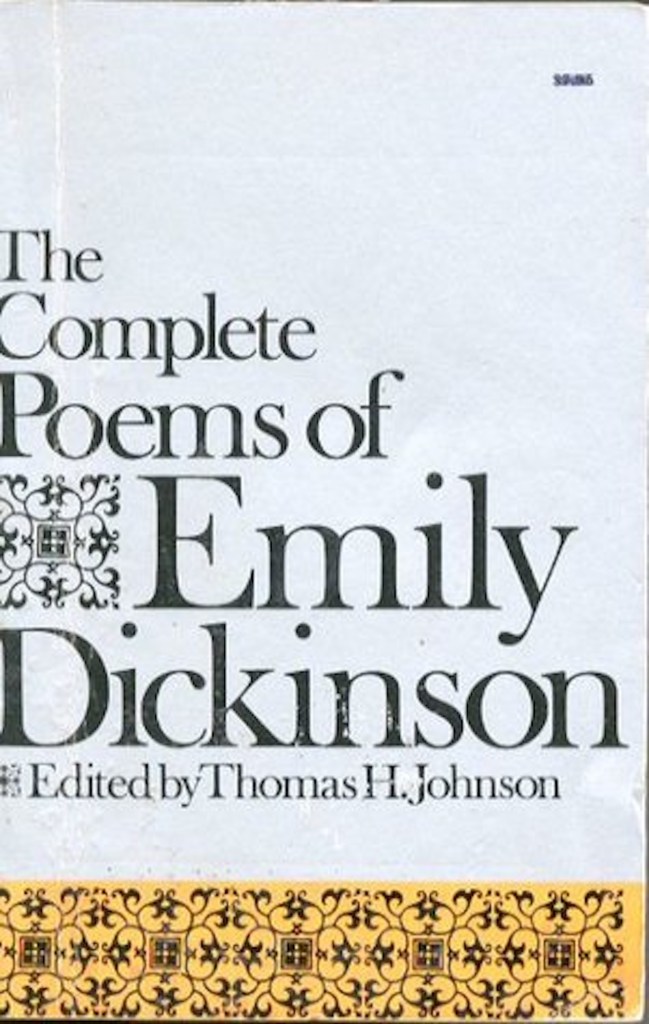
    Thomas H. Johnson's The Complete Poems of Emily Dickinson - The text of Dickinson poems that i use for my commentaries on her poems
    Image: Thomas H. Johnson’s The Complete Poems of Emily Dickinson

  • Emily Dickinson’s “The morns are meeker than they were”

    Image: Emily Dickinson – Amherst College – Daguerrotype of the poet at age 17, circa 1847 – likely the only authentic, extant likeness of the poet

    Emily Dickinson’s “The morns are meeker than they were”

    Emily Dickinson’s “The morns are meeker than they were” is one of the poet’s riddle poems; it is focusing on the phenomenon of how mornings change with the season.

    Introduction with Text of  “The morns are meeker than they were”

    Emily Dickinson’s speaker in “The morns are meeker than they were” is observing the natural features surrounding her.  She has begun to detect a transformation in how morning is now behaving.

    She then remarks about the behavior of the trees and eventually focuses a comment on the “field.” Finally, she reveals how all these alterations will influence her own behavior.

    This poem presents itself as one of Emily Dickinson’s riddles, in which she describes the subject but does not name it;  thus she allows her audience to figure out the answer to the riddle.

    The morns are meeker than they were –

    The morns are meeker than they were –
    The nuts are getting brown –
    The berry’s cheek is plumper –
    The Rose is out of town.

    The Maple wears a gayer scarf –
    The field a scarlet gown –
    Lest I should be old fashioned
    I’ll put a trinket on.

    Reading of “The morns are meeker than they were” 

    Commentary on “The morns are meeker than they were”

    Mornings change with the season.

    First Stanza:  The Rose Has Flown

    The morns are meeker than they were –
    The nuts are getting brown –
    The berry’s cheek is plumper –
    The Rose is out of town.

    The  speaker observes that mornings have become more sedate and quiet than they had been.  At this point, readers/listeners have no idea why the behavior of morning should have become “meeker.”

    The second line, however, begins to open up the answer to a riddle, as she begins to drop hints about her subject.   She describes the browning of the nuts, and the plumping of the “cheek” of the berry.

    And by the final line, which reports that the roses have gone away, no longer decorating the summer day, the reader can be sure that the speaker is describing the onset of the autumn season, a season Dickinson loved and found unusually inspiring for her poetic musings.

    Second Stanza:  A Trinket for the New Fashion

    The Maple wears a gayer scarf –
    The field a scarlet gown –
    Lest I should be old fashioned
    I’ll put a trinket on.

    The speaker now offers further clues about her subject.  Maple trees are now decked out in leaves that look more varied and that seem more merry than the simple summer green they had hitherto adorned.  Even the meadow now dons a colorful dress. Replacing its summer green attire is a bold “scarlet gown.”

    After reporting on all the changes the speaker has observed in the behavior of morning, the coloring of the nuts, the fattening of the berries, the absence of the roses, the maple leaves turning all colorful.

    And the meadow is sporting a bright red dress. The speaker now announces that she will begin wearing some “trinket,” in order to keep up with all the modern day apparel.  

    She does not want to be caught dressed for summer and appear “old fashioned” among the newly minted, colorful styles being sported by the beings that constitute her “society” of creatures during this new and exciting season.

  • Emily Dickinson’s “There is a word”

    Image: Emily Dickinson – Amherst College – Daguerrotype of the poet at age 17, circa 1847 – likely the only authentic, extant likeness of the poet

    Emily Dickinson’s “There is a word”

    Emily Dickinson’s “There is a word” features one of the poet’s many poems that may qualify as riddles.  She keeps the reader guessing until the end when she finally reveals the “word” that “bears a sword.”

    Introduction and Text of “There is a word”

    Many of Emily Dickinson’s riddle poems never mention the word or thing her speaker is describing.  Examples of two of those mentionless riddles are, “It sifts from Leaden Sieves,” and “I like to see it lap the Miles.”  

    While Dickinson’s “There is a word” does begin as a riddle, it only remains so until the final line, in which the speaker does reveal what word it is that she is finding so troublesome.

    There is a word

    There is a word
    Which bears a sword
    Can pierce an armed man –
    It hurls its barbed syllables
    And is mute again –
    But where it fell
    The saved will tell
    On patriotic day,
    Some epauletted Brother
    Gave his breath away.

    Wherever runs the breathless sun –
    Wherever roams the day –
    There is its noiseless onset –
    There is its victory!
    Behold the keenest marksman!
    The most accomplished shot!
    Time’s sublimest target
    Is a soul “forgot!”

    Commentary on “There is a word”

    This poem is one of the poet’s many poems that may qualify as a  riddle.  She keeps her audience guessing about the word she is describing until the end when she finally reveals the “word” that “bears a sword.”

    First Movement:  The Riddle Begins

    There is a word
    Which bears a sword
    Can pierce an armed man –
    It hurls its barbed syllables
    And is mute again –

    The speaker begins with what seems to be a riddle by asserting that a certain word exists that carries “a sword.”  This word must be very sharp indeed because it can “pierce an armed man.”  This sharp word has “barbed syllables,” and after it “hurls” those sharp syllables, it returns to silence.

    The first movement then has set up a scenario in which a certain “word” is dramatized with the unsavory characteristic of a weapon.  This claim might offer a contradiction to the little ditty that goes, “Sticks and stones may break my bones, but words can never hurt me.”  

    The “sticks and stone” claim used to be offered to children to assist them in dealing with a bully.  It was meant to deflect the child’s mind from taking the bullying as a personal affront.  

    If someone breaks your bones with a weapon, you have little recourse but to allow time to heal your broken bones.  If someone hurls painful rhetoric at you, you have the option of not keeping your mind focused on that rhetoric and thus, you are not hurt.

    However, there is a school of thought that has always found the “sticks and stones” advice wanting, claiming that words can definitely hurt one.  And of course, both schools of thought have their merits.  

    A sharp, weaponized “word” hurled even at an “armed man” can pierce the psyche and render untold damage, if the victim finds it difficult to place her mind on other things.

    Second  Movement:  A Metaphorical Weapon

    But where it fell
    The saved will tell
    On patriotic day,
    Some epauletted Brother
    Gave his breath away.

    In the second movement, the speaker metaphorically likens a fallen victim of some weaponized word to a martyr to the cause of patriotism.  Like an “epauletted Brother” who fights to protect the citizens of his nation, who willingly gives “his breath away,” the victim of this sharp word will be praised by those the brother saved.

    This speaker is demonstrating that she is referring to words that hurt the psyche, not necessarily the bones or the flesh.  But in order to dramatize the scenario, she metaphorically paints the images in military terms, which she continues through the remaining two movements.

    Third  Movement:  An Astounding Notion

    Wherever runs the breathless sun –
    Wherever roams the day –
    There is its noiseless onset –
    There is its victory!

    That the sun may be considered “breathless” is an astounding notion.  But that notion along with the roaming of the day places the entire scene beyond the physical level of being.  The “noiseless onset” is the space wherein that weaponized word has failed to penetrate.

    Had that failure of penetration continued, there would have been a great “victory.”  But that victory does not materialize.  It cannot as it is placed in an impossible location where the sun runs breathless and where the day may be understood to have the ability to “roam.”

    Without breath, the human being cannot utter any word, weaponized or not.  And that silent space of time remains a blessed opposition to the battleground where pain and suffering occur.  

    Beyond that battleground, that is, beyond the physical level of existence, those who have achieved the status of “breathless sun” will achieve their victory over those weaponized words.

    Fourth  Movement:  Again, the Military Metaphor

    Behold the keenest marksman!
    The most accomplished shot!
    Time’s sublimest target
    Is a soul “forgot!”

    Again, employing the military metaphor, the speaker commands her listener/reader to observe and consider the “keenest marksman,” who has accomplished the highest level of shooting ability. 

    Finally, the speaker reveals that word that she finds to be the one that “bears a sword.”  That word is the simple word “forgot.”  But she has framed that word by claiming it is “Time’s sublimest target” which is, “a soul” “forgot!”

    The exclamation point following the word “forgot” is vital to the total meaning of the poem.  By placing that punctuation mark outside the quotation marks, the emphasis on the word is removed.

    The ambiguity of the following two-line sentence continues to keep the poem a riddle:

    Time’s sublimest target
    Is a soul “forgot!”

    That sentence can be understood two ways:

    1. The most difficult thing for any human being is that her mind has forgotten that she is a soul.
    2. The hardest thing for a person to hear is that she has been forgotten by someone else.

    Interestingly, the ambiguity of those final two lines, that is, the two alternate interpretations give the poem its depth of meaning.  The result of anything that has been  “forgot” remains a disfiguring absence to any human being—physically, mentally, or spiritually.

    When the two instances of forgetting are bound up into one painful event, even the “armed man” who has been shot by the “keenest marksman” will fall victim and suffer from the barbed syllables hurled at him.

  • Emily Dickinson’s “It did not surprise me”

    Image: Emily Dickinson – Amherst College – This daguerrotype circa 1847 at age 17 is likely the only authentic, extant image of the poet.

    Emily Dickinson’s “It did not surprise me”

    In Emily Dickinson’s “It did not surprise me,” the speaker has created a bird metaphor as she begins to muse on the unlikely event that she may lose her intuitive ability to perceive beyond sense awareness.

    Introduction with Text of “It did not surprise me”

    With a similar motivational purpose of her riddle-poem “I have a Bird in spring,” Emily Dickinson’s speaker in “It did not surprise me” employs a bird metaphor to contemplate the notion that her special intuitive ability to perceive events, ideas, and entities beyond sense awareness might abandon her.

    The bird metaphor remains a useful poetic device for Emily Dickinson‘s speakers as they bestow flight on their ability to create poetic dramas. Also, similar to her riddle-poem “I have a Bird in spring” in this little drama, the speaker is unveiling the metaphorical bird as a mystical muse, as the speaker ruminates on the idea that if that little birdling were to fly away from her, she would become heartbroken.

    However, unlike the riddle aspect in “I have a Bird in spring,” the poet allows her speaker to report first as if she is merely describing a literal bird. The speaker then moves into a questioning format which shines a light on the possibility that her muse might just up and fly off as any real bird might do.

    The speaker is obliged, however, to leave the issue without answering it, because she will keep that question as long as she continues in her mission of poetry creation. Ultimately, no creative artist can ever know in advance, if or when inspiration will vanish and possibly never return.

    Despite temporary flights into the clairvoyance of certain noumena, as long as the poet remains earth bound, she remains dependent to a certain extent on ordinary sense awareness.

    It did not surprise me

    It did not surprise me –
    So I said – or thought –
    She will stir her pinions
    And the nest forgot,

    Traverse broader forests –
    Build in gayer boughs,
    Breathe in Ear more modern
    God’s old fashioned vows – 

    This was but a Birdling –
    What and if it be
    One within my bosom
    Had departed me?

    This was but a story –
    What and if indeed
    There were just such coffin
    In the heart instead?

    Reading of “It did not surprise me”  

    Commentary on “It did not surprise me”

    Dickinson’s speaker metaphorically likens her muse—which she knows is bound to her mystical insight—to a bird, as she contemplates the possibility of losing the blessing provided by her innate, God-given talent and mystical ability.

    First Stanza:  A Thought Awakening

    It did not surprise me –
    So I said  –  or thought –
    She will stir her pinions
    And the nest forgot,

    The speaker begins her soliloquy by admitting that her lack of “surprise” at some event has been prompted by the thought of a bird stirring and flying off from its nest.  Between her opening statement and the bird’s first movement, the speaker asserts that upon realizing her lack of surprise, she spoke out but then changed her claim to the fact that she merely thought about the coming event without actually giving it voice.

    The final two lines of the stanza express the possibility of an activity as she states that this particular bird will start fluttering its wings, readying itself for flight and then fly off from its nest.  Such an avian forsaking its nest will then likely not even recall that it had ever stayed there.

    That status is simply the essential nature of natural creatures, as well as specific metaphorical birds that may be likened to the muse.  If this style of muse abandons its target permanently, it will likely not recall that it had ever inspired any such soul.

    Interestingly, Dickinson has her speaker employ the past tense “forgot” but clearly the actual meaning is present tense “forget.”  She possibly employed the past tense because it stands in as a closer rime to “thought.”  

    However, a different interpretation of the meaning may call for the term “forgot” to be understood as the shortened form of the past participle, as in the nest will be “forgotten.”  Through her widespread employment of minimalism and ellipsis, the poet has her speaker leave out “nest will be,” requiring the phrase to be understood and, therefore, supplied by the reader’s mind.

    Second Stanza:  Ranging to New Territories

    Traverse broader forests –
    Build in gayer boughs,
    Breathe in Ear more modern
    God’s old fashioned vows –

    After rousing its pinions and flying from its nest, this bird will roam in new territories or through “broader forests.”  It may reconstruct a new nest in a place deemed happier for its circumstances, that is, “gayer boughs.”  The bird will listen to fresh sounds, as it enjoys the many blessings of its Divine Creator, Who has promised to guard and guide all of His creatures.

    At this point, the bird has taken on only a few metaphorical qualities.  The message could thus be that of merely dramatizing what any young bird might do, after awakening to the marvelous reality of possessing the delicious ability to fly and range wide from its original location.

    Third Stanza:  Bird in the Heart

    This was but a Birdling –
    What and if it be
    One within my bosom
    Had departed me?

    The speaker now admits that the little flying creature she has been describing was, in actuality, a simple little bird, or “Birdling.”  But then she changes her focus to the “One” that lives in her heart, asking the basic question—what if my little bird-muse leaves me?

    In her poem “I have a Bird in spring,” the poet also had her speaker describe her mystical muse as a bird.   That poem also plays out as one of her numerous riddle-poems, as she seems to be describing some impossible entity that can fly from her but then return to her and  bring her gifts from beyond the sea.  

    That special metaphorical bird has the power to calm her in times of stress.  Similar to “I have a Bird in spring,” which is one of her most profound poems, this one, “It did not surprise me,” remains on the exact same consistent plane of mystical perception.  

    Unquestionably, the natural creature known as a “bird” as a metaphorical vehicle for the soul (muse or mystically creative spirit) remains quite appropriate, as poet Paul Laurence Dunbar has also demonstrated in his classic masterpiece “Sympathy.”

    Fourth Stanza:  A Intriguing Inquiry

    This was but a story –
    What and if indeed
    There were just such coffin
    In the heart instead?

    The speaker offers another admission that up to this point she has been merely speculating about her bird/muse flying off from its nest in her heart/mind/soul.  She crafts another inquiry, repeating the curious phrase “[w]hat and if” before her question.

    This poignant question employs the term “coffin” indicating the drastic and deadly situation that would exist in her mind/heart/soul, if her bird/muse did actually fly off from her to explore more extensive forests and build nests on more joyful boughs.  The speaker affirms her belief that such a loss to her heart and mind would materialize that “coffin,” if such an event ever transpired.

    🕉

    You are welcome to join me on the following social media:
    TruthSocial, Locals, Gettr, X, Bluesky, Facebook, Pinterest 

    🕉

    Share