Elizabeth Barrett Browning’s Sonnet 38 “First time he kissed me, he but only kissed”
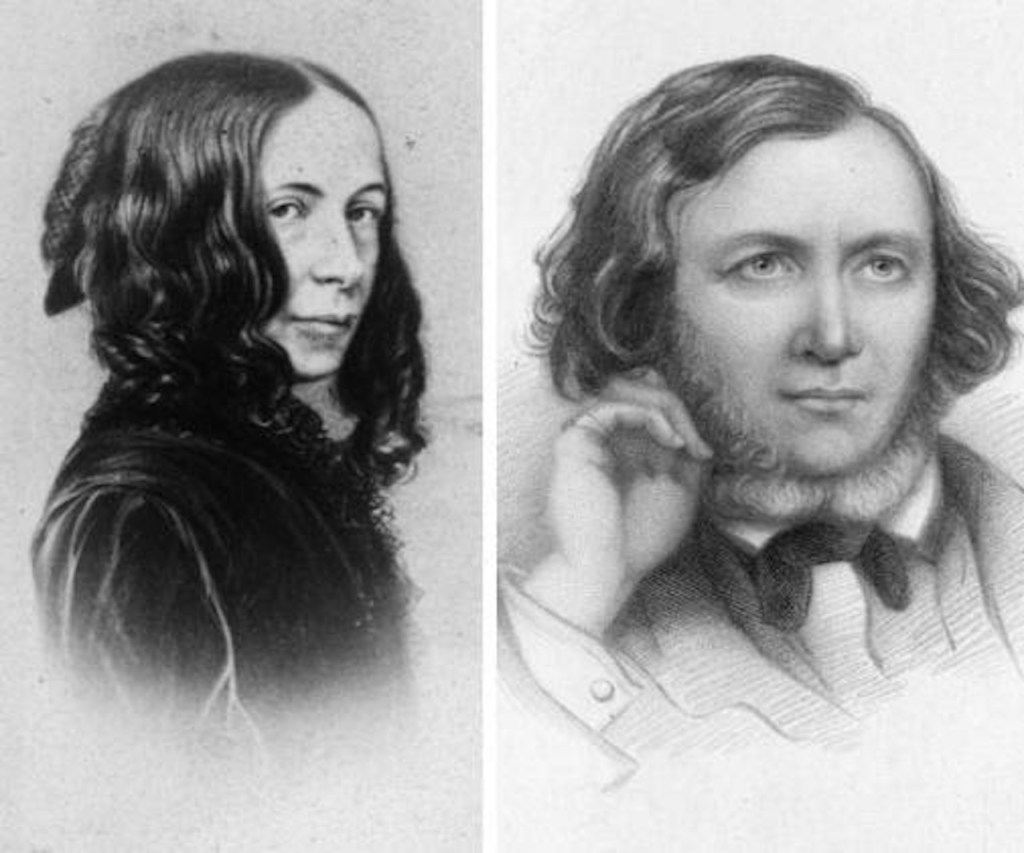
Elizabeth Barrett Browning’s sonnet 38 “First time he kissed me, he but only kissed” dramatizes the speaker’s elated feelings after the first three kisses shared with her belovèd: the first was on her hand with which she writes, the second was on her forehead, and third on her lips.
Introduction and Text of Sonnet 38 “First time he kissed me, he but only kissed”
In Elizabeth Barrett Browning’s sonnet 38 “First time he kissed me, he but only kissed, ” the speaker demonstrates that the love relationship with her suitor has continued to grow stronger even as she has continued to have serious doubts about it.
Readers likely have begun to wonder if this speaker will ever surrender to this desire and accept the fact that her suitor is actually offering her the love she so desperately wants to accept. In this sonnet, the speaker hints that she is ready to surrender to the love that she doubted even as it has grown stronger.
Sonnet 38 “First time he kissed me, he but only kissed”
First time he kissed me, he but only kissed The fingers of this hand wherewith I write; And ever since, it grew more clean and white, Slow to world-greetings, quick with its “Oh, list,” When the angels speak. A ring of amethyst I could not wear here, plainer to my sight, Than that first kiss. The second passed in height The first, and sought the forehead, and half missed, Half falling on the hair. O beyond meed! That was the chrism of love, which love’s own crown, With sanctifying sweetness, did precede. The third upon my lips was folded down In perfect, purple state; since when, indeed, I have been proud and said, “My love, my own.”
Commentary on Sonnet 38 “First time he kissed me, he but only kissed”
Even as their love relationship grows stronger, there still remains a tinge of doubt that the speaker will ever completely surrender to that love.But it remains clear that she is striving sincerely to accept that the relationship is genuine and will endure.
First Quatrain: Kissing the Hand
First time he kissed me, he but only kissed The fingers of this hand wherewith I write; And ever since, it grew more clean and white, Slow to world-greetings, quick with its “Oh, list,”
The speaker’s belovèd first kissed her on her writing hand. After this first kiss, she has noticed a remarkable transition of that hand: it appears cleaner and lighter. That hand has grown “slow to world-greetings,” but “quick” to caution her to listen to the angels when they speak.
In a stroke of technical brilliance, the speaker/poet again uses the device of breaking the line between “Oh, list,” and “When angels speak,” over the two quatrains. This improvised special emphasis gives the same sense as an extended sigh with the facial expression of one seeing some magical being.
Second Quatrain: The Honored Kiss
When the angels speak. A ring of amethyst I could not wear here, plainer to my sight, Than that first kiss. The second passed in height The first, and sought the forehead, and half missed,
The speaker’s hand could not be more real and have any better decoration, such as “a ring of amethyst,” than it does now that her belovèd has honored it with his kiss. The enchanted speaker then scurries on to report about the second kiss, which sounds rather comical: the second kiss was aimed at her forehead, but “half-missed” and lands half in her hair and half on the flesh.
First Tercet: Ecstatic Joy
Half falling on the hair. O beyond meed! That was the chrism of love, which love’s own crown, With sanctifying sweetness, did precede.
Despite the comical half-hair/half-forehead miss, the speaker is carried away in an ecstatic joy, “O beyond meed!” The clever speaker puns on the word “meed” to include the meaning of “reward” as well as the famously intoxicating beverage mead. The speaker has become drunk with the delight of this new level of intimacy.
This kiss is “the chrism of love”; she is baptized in the love of her belovèd suitor. This kiss is also “love’s own crown”; again, similar to the “meed” pun, the speaker exploits the double meaning of the term “crown,” as the headdress of a king or simply the crown of the head. The “sanctifying sweetness” of this kiss has preceded and grown out of the love that now is so sweet and electrifying.
Second Tercet: A Royal Kiss
The third upon my lips was folded down In perfect, purple state; since when, indeed, I have been proud and said, “My love, my own.”
Finally, the third kiss “folded down” “upon [her] lips.” And it was perfect. It possessed her in a “purple state.” This royal kiss elevated her mind to pure royalty. She thus returns again to referring to her belovèd in royal terms as she had done in earlier sonnets.
So since that series of kisses, especially that third royal embrace, the speaker has “been proud and said, ‘My love, my own.’” This reluctant speaker is finally accepting her belovèd as the love of her life and allows herself the luxury of placing her newly awakened faith in his love.
The Graveyard Whistler has found a new story with a complex of irony. He is rethinking his profession as literary sleuth. Captivated by the stories he finds, he remains conflicted about continuing with literature. Maybe he will give up and become a lawyer.
Fiction Alert! This story is fiction. It does not depict any real person or actual event.
Graveyard Whistler Offers Some Explanatory Remarks
Hey, hey! It’s been a while since I’ve posted.
The one titled “Literary History and the Art of Irony” brought me a ton of complaints from all the brothers and sisters who enjoy a beautiful, harmonious relationship and deeply resent that I would reveal a set of siblings who scratched at each other like cats in a clothes dryer.
My response was to delete that post, even though the subject was irony, the sibs just provided the example. But hey, I’m not in the business of alienating readers, so I just let it go. The experience did give me some food for thought.
So as I rethink my journey into the literary life, I am finding it discouraging that so many people can’t tell the difference between biography and fiction. What I mean is, a writer creating fiction does not always reveal only what is in his heart and mind: that’s why it’s called “fiction.”
The writer of fiction makes up stuff. If a writer were limited to writing only what he felt and thought, there would be no murder mysteries because only murderers have the knowledge of what it feels like to kill and what thoughts are engendered by that deplorable act.
So as I think though my dilemma, I take comfort in knowing that I will probably never become a creative writer: I write no poetry, no short stories, no plays, no novels. I just write about what poets, fiction writers, playwrights, and novelist have already written.
As I have said, I am especially interested in irony as a literary form and that’s why I wrote about the dysfunctional sibling relationship because the piece I had found had dealt with irony.
The following piece that I found, not on the Internet, but in an ancient, dusty tome at the New Chesterfield Library in Cabot Cove, Maine, features a wacky sea captain and her crew of the Blarney Barnacle, a strange seafaring vessel that ranged up and down the East coast from Maine to Georgia, sometime after the Civil War in the 1870s.
It’s a long and complicated tale but I have excerpted a spot that I found particularly interesting. It was quite a hassle having to type out text, made me very appreciative of the “cut and paste” function on modern word processors.
Without further ado, I present the story to you warts and all—meaning I have not corrected spelling or grammar errors unless they interfered too much with meaning.
The Irony of the Bones
The seas was strictly calm the night that Elizabeth Wayneright ran off from her blackhearted husband.
She hid under the technical tarp on the starboard side and was not detected until we’s way down the coast nearing on Massachusetts.
Cap’n Jane Pickwick, who as you now know, ran a tight ship-shape shippe—actually we wasn’t a shippe, we more a oversize tub but big enough to hold a crew of 9 and sometimes we’d take on passengers who need to travel down the coast.
We started out as usual, Capt. Janey, as we with affection called her, making her rounds, and her first mate, Lt. Maxine Stauttlemeyer, was checking out supplies then ran around the tub, as we with affection called our shippe. Everything in order we start her moving on down the coast.
We’s almost to Massachusetts Bay when a storm busted through, starting to bluster us about something awful. It wasn’t near so bad as it sounded, we’s all used to it and knew we’d be through it in an hour. But the stowaway, Elizabeth Wayneright musta thought we’s headed to perdition.
She came busting out flailing her arms around screaming and yelling, “Oh, God! Oh, God! We’re going to die! We’re going to die! What have I done? What have I done?”
First mate Maxy, as we with affection called her, arrived on the scene, grabbed Lizzy, as we later came to call her with affection, and got her settled own.
She brought Lizzy to Capt. Janey who asked Lizzy all manner of interrogatories, maybe taking hours on into the night.
Capt. put Lizzy in a cabin that had a cot, gave her some tea, and told her that breakfast was at 600 hours. We can only guess if Lizzy slept but next morning as we’s sailing the tub around Mass Bay, we stopped, spread out breakfast and then Lizzy told us her story.
Elizabeth Wayneright was a wife and mother, citizen from a little fishing village about a mile north of Cabot Cove, Maine. She wrote stories for newspapers and magazines. She wrote stuff she just made up, not news reports or journalist-like stuff.
She said she was doing pretty good, making a few extra bucks to help out the family. She had a husband who worked as a lumberjack and blacksmith, depending on what was busy at any given time.
They had one son, who was now grown, married, and living in Augusta, where he did some copyediting work for the state.
She said she worked as a waitress in the local pub while her son was growing up, and that’s how she got the idea to write made-up stories, listening to and talking to all the different types of folk who’d blow into town.
She said she’d been writing her stories for about ten years, sending them off to as far away as California. Said her stories had been published in the same magazine that published biggies like Samuel Clemens, aka Mark Twain.
We’s all really impressed, we hadn’t heard of her, but we did know the man Samuel Clemens, aka Mark Twain.
Going on with her story, she said everything was fine, her money helped so that when her husband couldn’t get enough work, they didn’t ever have to fall into debt or go begging on the streets. Then during a long stretch of workless days, her husband started rifling through the stories she had written.
At first, she was glad to see that he was taking an interest, something he had never done before. She felt a little concerned however because he’d read and then the rest of day not say anything. Then he’d read some more and seemed to get kind of mean toward her.
This went on for a week or so, and then he came busting into their bedroom where she sat writing, and he was shaking a magazine at her, and began to call her all sort of bad woman names, like bitch, whore, trollop.
She asked him what he’s taking about and he said it was all there in black and white. She hated him, she had bedded every stranger who came into town, and now she was planning to kill him. It was all there in black and white, he kept saying.
She tried to explain to him that those were stories she made up, she said she got ideas for those stories from listening to folks who frequented the pub where she used to waitress.
She told him she never wrote any stories about him, herself or anyone else she knew. They were all just fiction, stories she had made up.
He was having none of it. He stated ripping the pages out of the magazine, and throwing them at her. She tried again to reason with him, but again he had the goods on her it was all there in black and white.
He kept this rant up for several days, and then one night as Lizzy was cooking supper, he blasted though the door into the kitchen brandishing a knife. Whore! Trollop! What you think of this. I’ll teach you to make a fool out of Roger Blassing Wayneright.
He struck at her, leaving deep wound in her left arm. Lizzy held up her arm and sure enough a deep wound she said she wrapped up and then packed a little bag, and while Roger was sacked out after supper, she ran from their home and here she was.
We all sat, amazed, by this tale this poor woman was telling. We all said we’d think of how we could help her. She said she knew this tub went down the coast but didn’t know how far.
We told her it goes down to Savannah, Georgia. She asked if she could stay with us until then. We said we’s glad to help anyway we could.
After pulling the tub into Savannah, Lizzy clutching her little bag left the shippe, and we never heard from her again. We kept on sailing the Blarney Barnacle up and down the coast.
Then about thirty years after we’d encountered Lizzy, we all stepped out of our tub near Cabot Cove and went into the little diner where we planned to get a much needed, nearly home-cooked meal.
The place was buzzing with a strange report that was spreading through the little village. Near the old Wayneright place, some pigs has had been plugging into the dirt and unearthed a bunch of bones.
The local sheriff had sent the bones off to the capital for testing. But what grabbed us was the rumors that was buzzing about.
Some people was saying those bones was Roger Blassing Wayneright and that Elizabeth Wayneright had murdered her husband about three decade ago. They was sure it was her that done the nasty deed because one night she went missing and soon after it was discovered that Roger was also missing.
But then other folks saw it different, they said it was Elizabeth’s bones and that Roger had done his wife in. Both stories were floating around and we couldn’t tell which side was right, except for the fact that we’d carried Elizabeth Wayneright down to Savannah. We heard her story, but maybe she left out somethin’?
We had a meetin’ on the tub and tossed around the notion of telling the local authorities about seeing Elizabeth all those years ago. We voted that we should tell and so next day, we fetched ourselves to the sheriff’s office and laid out our tale.
He shocked us though and said that Elizabeth Wayneright had come back to Cabot Cove and she and Roger had patched things up and had been living pretty much a quiet life for at least the past twenty years or so.
So we asked him why the two sides of a story about those bones: some thinking Lizzy killed Roger, and some thinking Roger killed Lizzy. He said, that’s just what people in that town do. There was a third group of folks who knew that both Waynerights had moved to Augusta to be near their grandchildren.
A friend of Elizabeth, fellow writer lady of Cabot Cove who wrote under the name of Janice Baines Longstreet had kept that third group in the know about Elizabeth. So the sheriff could say for sure that those bones belonged to neither Wayneright. And to cap it off, he had funeral notices for both Roger and Elizabeth from when they lived and then died in Augusta.
We asked him why there could be three different version of the Wayneright story floating around this little village when at least two upstanding citizens knew the real skinny.
He just said, people gonna believe what they wanna believe. Don’t matter who says what. Once they choose up a side they just won’t see the other side, no matter the evidence.
Capt. Janey then put out the question we’s all wondering about. How did Elizabeth ever convince her husband that her stories were just stuff she made u? He cut her arm thinking she was going to kill him because of her stories.
The sheriff said that writer lady had a book that tried to answer that question. But he said he thought because it was a novel, it might have fudged the details a bit.
What he knew was that Elizabeth came back because she wanted to keep writing her stories and making money.
Roger had been down on his luck for quite a while, and had to depend on their son to even keep their home, and so when Elizabeth showed up, he knew he’d either have to accept her and her money or eventually sink to the poor house.
He knew their son who had a growing family couldn’t continue to support him. The sheriff said, it’s simple, money talks, and Roger finally accepted the fact that if stories about adultery and murder could make money that was better then no money.
We left again down the coast before the report about the bones came back, but we knew that once it did, no matter what the report said, those two sides would continue their rumors, and the third side, the one that knew the truth would just be so much whistling in the wind.
Graveyard Whistler’s Final Remark on Dramatic/Situational Irony
I asked a friend of mine to proofread this piece and he asked me what is ironic about the bones. Well, at first the reader thinks they must be Roger’s because they know Elizabeth had traveled with the Barnacle crew after running away from him.
Then it shifts to the possibility it could be Elizabeth’s because they learn that she went back to Roger.
But then they finally know that the bones are not Roger or Elizabeth, and they never find whose they are.
It’s a complex of dramatic and situational irony instead of simple verbal irony because the irony is based on situation not just words and the audience does become aware of information that the people in the story will never know.
Fiction Alert! This story is fiction. It does not depict any real person or actual event.
Introducing Sharm Wilson
What will happen to Sharm? Is she doomed? Where is she going, walking these dark hallways?
In this bizarre tale, Sharm Wilson takes you on a bizarre journey, a slice of her life. She speaks her mind but seems to be trying to tell it like it is. Her off-the-wall language about her off-the-wall experience fosters the questions: What will happen to Sharm? Is she doomed? Where is she going, walking these dark hallways?
The story, like most pieces of fiction that writers write, stems from an incident in my own life, but it is greatly—and I emphasize “greatly”—embellished. And I am eternally grateful for that. Now just read the story and see what I mean!
Walking down Dark Hallways
Sharm was sleepwalking again. Oh, forget about it, I’m Sharm, and I’m not going to pretend again. I’m going to tell this story as myself. So if you don’t like it, that’s ok by me. Just don’t read it.
But ask yourself this, would a fakity fake bother to write all those words without some meaning. Hecky darn, don’t we all yearn for meaning? I just want to tell a little story here: so read or don’t. It’s totally up to you. I’ll try to keep it as clean as possible. I never intended for this to happen, but it did, and I wish so much that I could go back and make all the bad stuff go away, but then who don’t? Right?
At the Y
I was walking to my room at the Y, down the dark hallway. I shoved my key into the lock, opened the door, and went inside. I was so tired after a full day’s work at the salmon factory. (Oh please don’t expect me to tell you which salmon factory. If they knew that someone like me had been working there, they would probably arrest me.)
Anyway, I sat down on my bed and began to think about what I should do the rest of the evening. I decided to light up a joint to get me all relaxed. I knew pot was not allowed in this fine establishment, so I also lit an incense and a tobacco ciggy and went on with my tokes. Just as I was getting a good buzz, a knock comes at the door.
I moved the incense closer to the door, picked up my tobacco ciggy, tried to look as straight—meaning non-stoned—as I could, and then opened the door.
“Hello, Ms Wilson,” a matronly looking gal addressed me. “How are you this evening?”
“I’m ok,” I managed to spout out and then she laid it on me. “There have been complaints from other residents. Are you smoking marijuana in your room?” Feeling a little strained, I took a big puff off the ciggy and then announced, “Oh, no! I’m just smoking my regular Marlboros. I burn incense when I smoke because I like the smell of sandalwood better than tobacco. Is that a problem, ma’am?”
“Oh, no! You’re allowed to smoke in your room, for now. After September, I’m afraid even smoking cigarettes will not be allowed. So you might want to find a new residence, if you continue to smoke after September,” she explained, all the while seeming to buy that I was only smoking tobacco and not wacky tobacky.
“Well, thanks for letting me know. You know, I’ve been meaning to quit anyway. So maybe this is just another reason to do that.” She gave me a knowing look, an understanding look, and left.
It wasn’t five minutes later that another knock came at my door, and it was the cops, who pushed their way inside, found the four pounds of pot, and arrested me for drug dealing.
Tarnation, I had never dealt in drugs. Sometimes I had a lot of pot for personal use. They could never prove that I was a dealer so they had to let me go. But by that time, I had no job, no place to live, and so here I was walking down another dark hallway to another room in a dump called the Cozy Inn.
But I considered myself lucky. I had my freedom. I had the opportunity to look for work. And so when I found a job at the Cozy Dinner, I decided to turn over a new leaf, keep on the straight and narrow (I know that’s a cliché), and keep out of trouble.
Then Bruce came along. He was kind of cute, seemed to have lots of dough, and he started telling me stories about Vietnam. One time he and couple of buddies were captured and taken to a place where they were interrogated.
He thought they were going to become POWs, but that night he and the other two guys decided to break out of the little hut they are held in. They succeeded, made it back to their unit, and lived happily every after—they lived to be discharged from the Army with all their body parts in tact.
One night Bruce and I had just made out in the back seat of his station wagon down on River Road. He was a great lover—oh the stories I could make up, I mean tell, about his loving making! But then as we were getting our clothes back on, a big bang came down hard on the top of the car.
“Get out of there! You creeps! Step out of the vehicle!” a voice rang out loud and stern.
We could see the shape of a very large man, banging on the top of the vehicle, while he seemed to be encircling it, running fast.
Bruce opened the back hatch and yelled, “What the hell do you want? Who are you?”
The man suddenly was upon Bruce beating him with a huge flashlight. He kept beating and beating until Bruce lay a crumbled mass of flesh and bone, unrecognizable. Then the man spotted me.
He grabbed me like I was a sack of flour and headed for his own vehicle, where he dumped me inside on the passenger side and then entered the driver’s side.
I was so scared. I knew this was it. The day I would leave this world. The day I would be killed like an insect. I was shaking but suddenly I became very calm because I knew nothing mattered anymore. I was dead. And nothing mattered anymore.
What happened next is nothing short of bizarre, miraculous, out of this world,—oh crap, you decide!
Along Came Gerrod
“My name is Gerrod Slater,” Bruce’s killer started telling me about himself. “I’ve been looking for that sum-bitch for thirteen years. He killed my mother and sister while my father was serving in Vietnam. His name is not Bruce Slater; his name is Anton Norman. He would have killed you too, I’m damned sure of it.”
“How do you know all this?” I asked this new acquaintance.
“Like I said, I’ve been on his trail for 13 long, goddam years. I need to thank you for slowing him down. When he started making the moves on you, he kind of slipped. He stayed in the town a little too long. And I was able to follow him, check out his history, and then when I saw him on you pretty regular, I was able to catch him.”
Gerrod started his car and peeled out, leaving Bruce/Anton, leaving the night behind. The last night I would spend with Bruce. My mind was a chaos of images: but maybe I won’t die, but what do I do next?
Gerrod drove for several miles and then asked me, “Where do you want to go?”
“Oh, I’m staying at the Cozy Inn, next to the Cozy Dinner, where I work,” I said.
“Yeah, I knew where you worked, wasn’t sure where you stayed, though, but I know Anton lives in Darrtown with his wife and three kids. Wait, did I say, lives — I mean lived,” chuckled Gerrod.
“What are you going to do? How do you plan to get away with murdering Bruce?” I asked Gerrod.
“Well, you know, I hadn’t planned that far,” he said. “My only plan for the past 13 years has been to catch him and kill him. I guess all that planning took up my mind and I have no clue what to do next.”
“Won’t the cops be coming for you?” I asked. “If they come for me, what do you want me to tell them?”
“Look,” he said, giving a look that scared the crap out of me, “I don’t care what you tell anybody. I don’t care if the cops come for me. That’s just another story, another day. You get it. I reached a goal tonight that nobody can ever take away. Look, I’m free. You see, I could kill you too, and by all rights, I should, you are the only person on the planet who can put me at the scene of that scumbag’s death.”
I Ain’t No Rat
“Oh, yes, I see your point,” I said, as I started to exist the car. “I see I’ve asked too many questions. I hope you have a good life, whatever happens. Glad I could help you catch Bruce. Good-bye,” I said as I started to leave.
“Hey, wait!” Oh, God, he’s finally come to his senses, he’s going to kill me too.
“What?” I asked.
“Look, you seem like a nice young lady. Don’t go messing with the likes of Anton Norman again. You got your whole life ahead of you. Make something out of yourself,” advice from a guy who just slaughtered a fellow human being; still it made of lot of sense.
And Now?
That all happened five or so years ago. What have I done since? I’ve made up my mind to do as little as possible. All I really want is to live a life that doesn’t have my heart in my throat from time to time. Can you dig it?
I didn’t rat Gerrod out. Why should I? Just more crap that I’d have to suffer. I want to be as far away from law enforcement as possible, unless I’m being assaulted, robbed, or something.
But then that’s why I keep a very low profile now—just try to keep my waitress job and small apartment maintained. Took Gerrod’s advice about getting too close to handsome strangers.
Haven’t found the perfect answer though, and if you have a suggestion, I’d like to hear it.
Fiction Alert! This story is fiction. It does not depict any real person or actual event.
Tipi for the Twenty-First Century
Lucinda Robertson returns to school to complete a master’s degree. She encounters a fellow student who seemed so interesting and sensually attractive but turns out to be full of a bizarre kind of deceit.
I think I should explain here, that the flesh represents ignorance and, thus, as we dance and break the thong loose, it is as if we were being freed from the bonds of the flesh. —Black Elk, “Wiwanyag Wachipi: The Sun Dance,” The Sacred Pipe: Black Elk’s Account of the SevenRites ofthe Oglala Sioux
After fifteen years, three children, a failed marriage, and five years of moping around a tiny apartment on the south side of Muncie, I decided to return to school at Ball State University to finish my master’s degree in architecture.
I needed only six graduate credits, but my advisor suggested I take some undergraduate courses in English composition and math. He also advised me to audit some architecture courses, claiming that a lot of new material had been added to the curriculum, since I had studied here twenty years ago.
So as advised, I enrolled in English Composition 111. During the first meeting the professor put us in groups of four or five students. Our assignment was to interview each other and write a short essay based on the interview. I was grouped with two freshmen and a senior. The senior began the conversation.
“I guess the first thing is to find out each other’s names. I’m Sled Wheat.” He turned to me, and in his leadership tone asked, “What’s your name, ma’am?”
“I’m Lucinda Robertson. And I know I’m the oldest student in the room, but you don’t have to call me ‘ma’am’, do you?” I responded.
“Oh, I’m sorry; I didn’t mean to make you feel uncomfortable. There are a number of non-traditional students on campus now, and I’ve met many of them in my classes, but I didn’t even think you were a non-traditional, you look so young,” he schmoozed.
“Well, thank you, I think . . . I mean, well, are you a non-traditional?” I queried.
“Oh, no, that is, not in the ordinary meaning of the term. I’m somewhat non-traditional in that I’m a year younger than most seniors,” he said.
After the girls had introduced themselves, we paired off and began the interviewing. Sled Wheat was my partner, and he soon got into fairly personal matters.
“Do you think your ex-husband missed you that much and moped around those five years?” he inquired.
“I doubt it, since he was the one who left. I do have to admit I was lucky he helped me financially. My job at the bookstore couldn’t support me and our three children. But then Harold wasn’t stingy with money, just his love. And I wanted his love, not just his money. I’m sorry I babbled on about that. That can’t interest you. I always get down in the dumps when I talk about love. Let’s talk about our majors. What’s yours?” I replied.
“Psychology with a minor in classical studies,” he said.
“That sounds deep. And like a lot of work. Do you graduate this year?” I asked.
“Actually, I finish all my course work this quarter. But I’m hanging around for winter and spring to catch up on some courses I wanted to take but never had time for. How did you ever get into architecture?” he continued.
“I just always design stuff, kind of, in my head—mostly buildings, and usually buildings that look like tipis—and then I draw them as close as I can to my vision. My art teacher in high school was impressed with my drawings and suggested architecture as a major in college. I’ve always felt that was the right choice, even though I didn’t finish my master’s. I only have about 6 hours to finish. I didn’t expect to have to take undergraduate courses in English and math, but it’s kind of fun being in classes with all these young students,” I explained.
“Are you seeing anyone special right now?” he asked.
“You mean dating-seeing, like a boyfriend?”
“Well, yeah.”
“No, I haven’t had any relationships since Harold—well, one, but it didn’t go anywhere. I don’t know—I guess I’ve been hurt too much. I know that must sound sappy and like I’m sorry for myself, but in high school I got my heart broken really bad; I had a steady, Ed Jackson. He’s part Oglala Sioux, like me, and we studied our heritage together, we read everything we could find about our Lakota people; after we graduated we spent the summer on the Pine Ridge Reservation in South Dakota; we both have relatives there. He wanted to take part in the Sun Dance, but for some reason they wouldn’t let him, but we did participate in some other religious rituals. Anyway, I thought he loved me as much as I loved him, but then he dumps me and starts going with Kate Sooner. Kate had a reputation . . . you know, like she was kinda loose. I’d hear guys sniggering about her, saying stuff like, ‘see Sooner for a nooner’ and ‘I’d rather Sooner than later’ or something like that. Anyway, I freaked out, when Ed dumped me for her. I didn’t trust any guys for a long time. And by the time I met Harold, I had avoided relationships until I made it almost impossible for Harold to begin one with me. I think I must have something in my nature that makes men have difficulty committing to me permanently,” I explained, likely imparting too much information.
“Well, it’s probably not you. It must be them. Harold was probably intimidated by your strength, and Ed, well, if you were both in high school, you could probably blame that on youth. It seems that women are usually more stable earlier than men in relationships. That’s true I believe, and they disconcern [He actually used that “word” a lot. Later I found out it wasn’t really a word. I should have told him, I guess. Oh, well, surely someone in graduate school would set him straight.] the compatibility of psychological and physical make up which is highly ambiguous at best. But that provides the motive for devising a philosophical code of life. What do you feel is your own personal code of life?” he rambled on.
“I just want to live and let live,” I, becoming a bit uncomfortable, replied.
“Yeah, but that’s not always possible. You can’t always find that you can disconcern every detail of your existence. You have to take a stance, like with your son. Why don’t you suggest to him that he get his own apartment or live on campus in a dorm? That way your daughters couldn’t hassle you all the time about coddling him,” he now was becoming my advisor.
“But I don’t want him to do that. He has no money, no job. He’s just a freshman. If it weren’t for his scholarship, he wouldn’t be in school at all, and his scholarship only pays tuition. You said yourself that you still live at home with your parents, and look at you, you’re 21. My son has plenty pressure on him just being a student. You know that. And I don’t coddle him. He does a lot for me—he helps clean the apartment, and he usually does the grocery shopping. The girls are just too eager to be mothers. They’re practicing by bossing me around. Besides, what’s this got to do with a life code?” I was becoming a bit annoyed.
“It shows what your life code is. You are obviously over-influenced a great deal by your son—well, your children. Here you are at school primarily to upgrade your employment in order so you can buy a house because your daughters want a nice place to bring their children—children that they don’t even have as of yet. And your son does a little cleaning and grocery shopping for you, and you think that’s enough to warrant your still supporting him,” he pontificated again.
“Don’t your parents support you—didn’t you say you still live at home?” His impertinence was becoming annoying.
“I do, but I do have a job that covers the expenses for my recreational activities. I think there is a significant difference in the dynamic of my situation,” he rebutted.
“Well, I think I have enough to write my essay now. Thanks for the information,” I said, trying not to sound as disgusted as I really was.
Annoyed by this young man’s arrogance, I took my notes, turned away to begin writing. Sled turned his attention to the two freshmen girls in our group and talked with them the rest of the time. After about twenty minutes, the professor ended interview time and instructed us write our essays.
Since I had already been writing for that twenty minutes, I decided to revise what I had. As I read through my paper, I realized that the tone was bitter. I decided that I should not judge this Sled Wheat so harshly; after all, I hardly knew him.
So I filtered out the bitterness as much as I could. I could tell my writing needed some fine tuning. I decided it was a good thing I was taking a composition course.
By the end of the class period, I felt tense and tired; it had been a long day, and I couldn’t wait to get home to relax. Out in the parking lot, as I was unlocking my car, I heard a voice call out, “Lucinda.” I looked around, not many people have that name, and the voice sounded vaguely familiar.
“I wanted to tell you I enjoyed talking with you, and well, if you don’t have to get home right away, maybe we could continue our conversation; how about walking over to the Dug-Out, have come Cokes or something?” I will never know why I said yes to this suggestion.
We went for Cokes. And every Tuesday and Thursday night after class Sled suggested we continue our conversation. Usually we’d walk to the Student Center, or we’d go to the Dill Street Bar and Grill. We found we had a lot in common.
He told me that his mother’s father was part Hopi, and he had started studying the Hopi religion. He believed that the Native American religions were more natural and compatible with human life than the religion of preachers like Billy Graham.
I told him that I had been scared silly listening to preachers who promised sinners hell-fire and damnation. I could never figure out if I was a sinner or not. So I had just stopped listening to anything religious until I had started researching my Lakota background. We liked Mexican food—the hotter the better.
Sled had broken up with his girlfriend recently, and he, therefore, felt he understood how I felt about my marriage break up. He seemed so mature and intelligent and at the same time awkward and naive, and I think that combination of qualities endeared him to me.
I began to enjoy these conversations and looked forward to them, and when he didn’t appear in class one Tuesday night, I was disappointed and worried. But at Thursday’s class he told me he had to take his mother to the airport; her sister in Arizona had suddenly fallen ill.
He usually insisted on driving his mother places, because he didn’t trust his father’s driving. But he said he had really missed talking with me Tuesday night and asked if I was busy Saturday. He invited me to take a drive with him to Brookville Lake where his parents own a cabin.
The lake was beautiful. The cabin was more like a mansion than a cabin, I thought. Sled pulled out two beers from the refrigerator and said, “Let’s go sit on the deck. We can watch the boats. And maybe see some fish jump up out of the water.”
“So you and your family spend a lot of time here?” I asked.
“Mom and Dad come down almost every weekend. I come when I can. Especially when I think Dad isn’t really up to that long drive. I do worry about them driving. It’s certainly an irrational primal fear. I know Dad is healthy enough and a capable driver, but I almost lost my mother once in a car accident, and that latent fear motivates me to try to protect her,” the little psychiatrist offered his self-analysis.
“You care a great deal about your mother, don’t you? I admire that in a son. Daniel and I are close, but he doesn’t worry about me, which is good, because I couldn’t stand the thought of my child trying to protect me. I hated it when my parents tried to protect me,” I said.
“Well, my mother is the most important person in my life. Everything I do I try to think about the effect it could bring to bear on her. Of course, I don’t live the life of a celibate monk, and she knows it, but I do try to consider everything carefully. That’s part of my code of life.” Sled stopped talking and took a long drink of beer.
I stood up, walked to the railing of the deck, took a sip of my beer, and looked out over the lake. A warm breeze flustered the water into tiny ripples, and I enjoyed the feel of it on my face. I hadn’t been out of Muncie for several months, and this was turning out to be the most pleasant trip I had had in many years.
I took a deep breath, and felt Sled standing close behind me. He leaned against me, put his hands on my arms, and rubbed up and down. I leaned back against him. I felt nervous. All the time we had spent together was time spent talking. Now we were touching.
Sled lifted my hair and kissed my neck. I moved against him. He moved up to my face, and he took my mouth with his. Our tongues searched each other for a long moment.
“I’ve wanted to do that for a long time now. I hope you don’t mind too much,” he said.
“No, I don’t mind at all.” I wanted to be composed and cool, but inside I was trembling, and as I looked into his deep blue eyes, I fell in love. Some little voice kept taunting me, “you foolish woman, you foolish woman”—like a chant, but I ignored it; I ignored it because it was so warm and wet, swimming in those eyes.
“I want to make love to you, but I guess I’ve been a little bit afraid that you’d reject me, and that would crush my masculine ego. But I don’t want you to feel pressured. You know? Like I got you down here to trap you? I’d still enjoy being with you even if you don’t want sex with me. I wanted you to know that. I think about you a lot when we are apart, and I do really care about you,” he confessed, and I was captivated.
“Thank you for saying that. It makes me feel better. I think one of the worst things a woman can feel is that a man is interested in her only for sex. It’s not that we don’t want a man to be interested in the sex; it’s just that when sex is the only thing, it destroys even the sex. I’m babbling, I must sound idiotic—does that make sense?” I was becoming flustered.
“Perfect sense and I’d say men feel that way too. And I would assert that sex is only good between really good friends, and we have become the best of friends, wouldn’t you say so?” he inquired.
“Oh, yes, I would definitely say so,” I brazenly lied.
Then Sled leaned in close to me again. I felt his body against mine. I felt his hair, let it stream through my fingers. We kissed again, a long kiss, soft and sweet and warm; then he led me to the giant bed in the master bedroom.
“Oh mother, oh God, oh mother, oh sweet Jesus!” Abruptly, he pulled out, stood over me, just stood for a moment, dripping cum on my belly; he rubbed his eyes and looked at me as if he was seeing me for the first time, and said in a strange tone, “That was a real trip, lady.” And he went to the refrigerator and brought us two beers.
Sunday I worked on my architecture project. The assignment was to design a living space for the twenty-first century. I got out my old designs to search for ideas.
I had come to the conclusion that the only real way to move into the twenty-first century and be environmentally correct was to look back to the American Indian way of living and incorporate some of the features of the tipi.
I hoped it wasn’t racial pride that led me to believe that, and when I read about the feasibility of many Native American customs in my textbook, I felt I must be right.
So as I thought about the project, I knew I would have to do something with the idea of a tipi as living space.
I had thought a lot about Sled’s idea about a “code of life,” and I figured that mine was to love and be of service to those I love. I had long thought that the isolated nuclear family caused tension and stress that could be alleviated with an extended family concept.
Not only could children remain part of the family unit, but others could be brought in to form a family of friends who love one another.
It seemed to me that with such a change in attitude there would be no homeless, no abused children. Vast communities of loving extended families would cover the globe, and peace would finally arrive on earth.
What an idealist! Or was I just naive? No matter. I liked the idea. I guess my ideas were just throw-backs to the sixties, but after all I was influenced by hippies and civil rights activists.
It occurred to me as I worked on my “tipi for the 21st century” that maybe I could conduct an experiment to test my idealism; maybe Sled could be part of it.
My tipi project included a main building, with surrounding compartments, and each compartment as well as the main central building would have a central area that contained a huge fireplace ventilating upward like a tipi opening; the fireplace would serve as a gathering place for all the family members.
It would also serve as the place to cook meals as well as to keep each compartment warm. I wasn’t yet sure about other details such as sleeping arrangements and building materials; I had to research that. But by Sunday night I was truly excited with my ideas and plans, and I couldn’t wait to tell Sled about them and get his ideas.
I arrived at class a little early on Tuesday hoping to talk to Sled before class. I had tried to call him a couple of times Monday, but I never found him home. So I was doubly excited and terribly eager to see him.
But class had started by the time he arrived, so I couldn’t talk to him. When class finally ended, I got up and looked around, but Sled had left. He hadn’t even waited to speak to me at all. I was shocked, so I ran out to see if I could catch him. He had vanished. Wednesday I tried calling and could never find him home.
By Thursday I had begun to panic. I could not understand why he would deliberately avoid me. What had I done? I thought we were friends, lovers; what was going on? Instead of going into class, I waited at the door for Sled. He arrived ten minutes late.
“Sled, can we talk?” I said.
“Oh, hi, how’s it going?” he replied listlessly.
“Well, I’m a little confused. I haven’t heard from you. You bolted from the classroom Tuesday before I could even say hi. Is something wrong?” I asked.
“No, nothing. I’ve been pretty busy, but nothing’s wrong,” he said.
“I have some things to tell you about my tipi project. Remember? I told you a little about it on the way to Brookville Lake,” I said.
“Oh, yeah. I’d love to hear it, but I really have to run. I don’t have time right now. Maybe next week. It was nice talking to you. Really gotta run,” he said, bolting from me, again leaving me confused.
And that’s what he did. And that’s what he did every class night. He arrived late to class and ran as soon as class was over. I felt so confused. Just totally baffled. Everything he had said to me since that first night he asked me to go for Cokes had indicated to me that we were close friends. We had shared so many details of our lives.
I thought he was a fascinating individual, full of spirit and courage. And I thought he felt the same way about me. Once in a while the nasty thought occurred to me that all this young man had wanted was a sexual encounter with me, and every time I thought that I dismissed it as a silly idea.
That just didn’t make any sense. Why would a young man pursue a woman twice his age only for a sexual encounter? I reasoned that our relationship had to be based on more than sex; it had to include friendship—hadn’t he said so?—and I wanted his friendship back. I thought that if he would just tell me what I had done wrong, I could make amends and we could continue.
So I kept calling and finally reached him the day before our last Thursday class meeting; I asked him if we could just talk for a few minutes. He said he would have some time right after class on Thursday. So after class we went for coffee at the Student Center.
“Sled, I really miss you. I know you’ve been busy, but I feel like I’ve done something wrong. And I wish you’d tell me what it is, so I can fix it. I thought we were good friends, and even good lovers, I just don’t understand what’s happened.” I didn’t want to do it, but I started to cry. I tried to catch the tears before they ran down my cheeks.
“It’s not you. It’s . . . well, it’s something I realized about our relationship and quite frankly it made me sick. And it’s really me as much as it is you. I think it affects us both. But I am willing to accept my part of the perversity,” he began his confession.
“Perversity? What do you mean? Do you think there is something perverse about our relationship?” I responded, incredulous.
“Well, I’ve thought about it a lot, and I realize now exactly what our attraction was. At first I tried to disconcern myself to it but now I am facing it . . . it’s Oedipal. You see, you love your son a great deal and feel very close to him, and I love my mother and feel extraordinarily close to her. So it’s your latent sexual attraction to your son that attracts you to me, and the same for me.”
“You mean . . . you would like . . . to have sex with your mother? And so you think . . . having sex with me has something to do with that?” totally incredulous, I stammered.
“And the same for you, even though you try to disconcern yourself to it, you have a latent . . .” Before he could finish, I stood up, and for a long moment, I gazed at his beautiful, deceptive face. Then stunned and amazed, I turned and walked away.




 Linda's Literary Home
