Linda's Literary Home

Tag: Ron Grimes

  • Original Song:  “Where You Are”  with Prose Commentary

    Image: Pacific Ocean – August 2015 – Self-Realization Fellowship Meditation Gardens – Encinitas CA – Photo by Ron W. G.

    Original Song:  “Where You Are”  with Prose Commentary

    This song Where You Are” is one of my original compositions. The video accompanying it was created by landscape artist/photographer Ron Grimes.

    Introduction and Text of “Where You Are”

    My original song “Where You Are”is based on a simple premise: the singer is addressing her Divine Belovèd (God), asserting to the Belovèd the desire to be where the Ultimate Loved One is.

    Each verse features rhetorical questions and musings upon the actual location of the Divine Creator.  Because the Creator/Father of all creation is both within creation and outside of creation, the answer to all of the rhetorical questions is, naturally, yes.

    Nevertheless, being where the Divine Belovèd is cannot be the same situation as being where a human friend or beloved is.   Because it seems that God is playing hide and seek with his children, the singer asserts that her soul “soul tugs at the veil hiding You from me.”

    Where You Are

    First Verse

    Are You standing on top of a mountain?
    Are You sitting beside the vast grave sea?
    How can I ever approach You?
    Will You ever just come to me?

    Second Verse

    Are You speaking to me through my loved ones?
    Are You quietly whispering through the silver stars?
    Are You waiting to hear what my songs will sing?
    Do You listen to the rapid beat of my heart?

    Third Verse  

    If I offer You all in my stillness—
    If I silently listen to the hum in my mind—
    If I patiently fast from all my senses—
    Will You break Your vow of silence and just come to me!

    Chorus 

    Where You are is where I long to be.
    I cannot understand where else I could seek.
    My soul tugs at the veil hiding You from me.
    Where You are is where I long to be.

    Video: Linda Sue Grimes performing “Where You Are”  

    SoundCloud:  Linda Sue Grimes performing “Where You Are” 

    Commentary on “Where You Are”

    After much questioning, contemplating, and ultimately meditating, the devotee will find that the soul will remove the veil hiding it from the Over-Soul—the soul’s Creator, the Divine Belovèd, or any of the preferred name for the Ineffable (God).

    First Verse:  “Are You standing on top of a mountain?”

    Are You standing on top of a mountain?
    Are You sitting beside the vast grave sea?
    How can I ever approach You?
    Will You ever just come to me?

    The singer opens with four rhetorical questions to the Divine Reality.  The first two questions reveal earthly locations that are considered sanctuaries of sacredness, holiness, or just ordinary vacation escapes:  mountain tops and sea sides. 

    The next two questions reveal that the devotee is still walking the sacred, devotional path to soul-realization (also known as self-realization or God-realization).  

    Before final liberation, the devotee experiences the separation from her Goal to be a heavy burden.  That burden causes her to wonder if she, in fact, will ever be able to unite with the Creator/Father.

    In her melancholy and sorrowful mourning because of the seeming distance, the devotee often wonders if the Lord will ever appear to her and make her know that she is His own child.   Will she ever be able to attain the Sacred Goal of self-realization and experience unity with her Belovèd Divine Creator?

    Second Verse:  “Are You speaking to me through my loved ones?”

    Are You speaking to me through my loved ones?
    Are You quietly whispering through the silver stars?
    Are You waiting to hear what my songs will sing?
    Do You listen to the rapid beat of my heart?

    In the second verse, the singer/devotee continues with rhetorical questions.  Intuiting the answer yet not knowing the fullness of each answer, she inquires of the Divine Belovèd if He is communicating with her through her family and friends.

    The singer likely is aware that God is speaking to her through everyone she knows and meets.  But without that last step in the process of enlightenment, she does not know exactly what is being said or exactly what all that conversation might ultimately mean to her.

    Thus, she also wonders if the One Who fashioned the “silver stars” may be signaling to her through those heavenly entities.  Again, she likely knows it to be a fact, but that separation continues to prompt questions.  

    The singer wonders if Divine Mother anticipates what she sings in her songs.  She wonders if her musical worship is reaching its intended Goal.

    The singer/devotee often becomes anxious with a rapid heart beat, knowing that that heart beat needs to become calm to achieve stillness.  She therefore wonders if the Creator Divine cares to listen to that rapid heart beat.  And she wonders if the Ultimate Physician will perform some medical heavenly magic to help her still her rapid heart.

    Third Verse:  “If I offer You all in my stillness”

    If I offer You all in my stillness—
    If I silently listen to the hum in my mind—
    If I patiently fast from all my senses—
    Will You break Your vow of silence and just come to me!

    The singer/devotee’s questioning becomes even more intense in the lyric of the final verse.    She has shown that she knows that she must still the rapid beat of her heart, but she also must still all of her senses as she offers her every atom to the Divine Essence.

    The devotee/singer shows awareness that she must listen the divine hum of the cosmic motor, the sacred AUM (Om) sound that upholds all of creation.  She knows that she must remove her attention from worldly things and events and place that attention upon the locus beyond the senses, where the soul resides.

    The singer/devotee remains certain that after she is able to accomplish all that is implied in her questions and musings, the Divine Belovèd Presence will, in fact, “break [that] vow of silence and [ ] come to [her].”

    Chorus:  “Where You are is where I long to be”

    Where You are is where I long to be.
    I cannot understand where else I could seek.
    My soul tugs at the veil hiding You from me.
    Where You are is where I long to be.

    The chorus, instead of offering mere rhetorical questions and musings, makes an affirmative statement:  the singer asserts that she wants to be where her Divine Beloved is.   She reveals her intuition that she cannot find love, peace, fulfillment on the physical, earthly plane.

    The singer/devotee insists that her soul is attempting to rend the cloth of separation from the Divine, as it “tugs at the veil” that keeps her from uniting with the Creator Belovèd. 

    The final line emphasizes as it repeats the important desire: “Where You are is where I long to be.”  The importance of the chorus is demonstrated by its repetition after every verse.

  • Original Song:  “The Paper Mill Bridge Song” with Prose Commentary

    Image:  Old Paper Mill Bridge, Brookville, Indiana – Built 1914 – Brookville Library Collections

    Original Song:  “The Paper Mill Bridge Song” with Prose Commentary

    My original song “The Paper Mill Bridge Song” was inspired by the beautiful Whitewater River in Indiana and its relationship to the beautiful relationship I have enjoyed for over half a century with my wonderful husband, native of the little town of Brookville, Indiana.

    Introduction and Excerpt from “The Paper Mill Bridge Song”

    My husband, landscape artist Ron Grimes, created the video featured in this article to accompany my original song “The Paper Mill Bridge Song.”  He wrote the following introduction to the piece and placed his video on YouTube:

    A celebration of life and love as witnessed by the Paper Mill Bridge over the Whitewater River in Brookville, Indiana.

    September 10th, 2022. Linda and I walked to the middle of the new Papermill Bridge. I wanted to capture some scenes for this video. As soon as I started videoing, this Canada Goose flew right over us and honked as it if it were saying, “I want to be in your video.” It was a gift.

    Innovative Chorus

    The song undergoes an unusual arrangement; instead of an ordinary chorus, it features an middle octave which behaves as a second octave and chorus that gets repeated at a the end of the song.

    The Paper Mill Bridge Song

    Here’s where people paddle canoes
    Down the Whitewater River.
    I stand here on Paper Mill Bridge.
    Watch the water and remember
    The day we walked along the bank,
    Sand so warm to my feet.
    We talked about cattails, rocks, and stars
    And the moss that grows on old trees.

    These are the things that fill my day,
    Things we’ve done together.
    Sunshine streaming down through the leaves,
    A storm in the clouds or snow in the fields.
    River water runs through my veins.
    The stars light up my eyes.
    Love for you turns in my heart
    Like the sun burns through the sky.


    Through the years my heart has filled
    With love for this old river.
    I stand here on Paper Mill Bridge.
    Watch the water and remember
    The day we paddled down the stream,
    A cool breeze on my shoulders.
    The sun shone bright over Paper Mill Bridge
    And I knew I’d love you forever.

    These are the things that fill my day,
    Things we’ve done together.
    Sunshine streaming down through the leaves,
    A storm in the clouds or snow in the fields.
    River water runs through my veins.
    The stars light up my eyes.
    Love for you turns in my heart
    Like the sun burns through the sky.

    © LINDA SUE GRIMES 2004

    Prose Commentary on “The Paper Mill Bridge Song”

    My original song—”The Paper Mill Bridge Song”—focuses on one relationship that progresses from good friends to life partner.  In the opening verse, the friends experience a quiet walk and talk along the river.  In the final verse, the life relationship is solidified.

    First Octave/Verse:  The View from the Bridge

    Here’s where people paddle canoes
    Down the Whitewater River.
    I stand here on Paper Mill Bridge.
    Watch the water and remember
    The day we walked along the bank,
    Sand so warm to my feet.
    We talked about cattails, rocks, and stars
    And the moss that grows on old trees

    The singing narrator is standing on a bridge, which turns out to be the subject of the song, the Paper Mill Bridge.  She begins to report on the activities that are locally common to that bridge.  The bridge spans the Whitewater River—a river in mideastern to southern Indiana—and from its perch one can from time to time see canoers paddling their barks down the river.

    The narrator then focuses on a memory that is important to her regarding her hike along the riverbank with a friend.  During that pleasant stroll, the two friends casually conversed about river-related entities such as water reeds that look like “cattails” and other features of nature such a “rocks and stars.”

    The narrator recalls that her feet enjoyed the luxury of the warm sand.  They also held forth about the fact that moss grows on old trees—likely that the moss grows mostly on the north side of those arbolian creatures.

    Second Octave/Chorus:  Recurring Images

    These are the things that fill my day,
    Things we’ve done together.
    Sunshine streaming down through the leaves,
    A storm in the clouds or snow in the fields.
    River water runs through my veins.
    The stars light up my eyes.
    Love for you turns in my heart
    Like the sun burns through the sky.

    The chorus has an usual placement, standing the middle of the song and containing an equal number of line as each verse, instead of following each verse with fewer lines.  Essentially the piece offers three separate octaves, even as the middle octave performs as a chorus.

    In this innovative chorus, the narrator has placed a heavy emphasis.  While she has offered some concrete details in the opening verse-octave, in the chorus-octave she is stating a general take on what she may likely be thinking about during this particular time period in her life.

    She thus has been focusing mentally on things that she and her friend have enjoyed together.  But then she adds two images in the first quatrain of the chorus-octave that allow her thoughts to show their natural influences as she experiences weather conditions—specially the warmth of spring and summer and the cold of fall and winter.

    The second quatrain of the chorus-octave becomes even more generalized: she is a creature of the river, so closely attuned to river culture that it seems that the very waters of the river flow “through [her] veins.”

    The narrators suggests that her happiness is enhanced as if by starlight.  She then asserts that she loves her friend with the same intensity that causes the “sun” to burn “through the sky.”  The hyperbole serves to suggest the strong emotion that this narrator feels for her friend, their relationship, and the natural features that they have experienced together.

    Third Octave/Verse:  The Passage of Time

    Through the years my heart has filled
    With love for this old river.
    I stand here on Paper Mill Bridge.
    Watch the water and remember
    The day we paddled down the stream,
    A cool breeze on my shoulders.
    The sun shone bright over Paper Mill Bridge
    And I knew I’d love you forever.

    The third octave/verse again focuses on the narrators thoughts about her friend, and now it becomes apparent that they are indeed life partners.  But first she places that river into her affections; she has come to love the river, and again, she is standing on the same bridge with pleasant memories coming to the fore.

    This time she remembers that like the other folks one might see canoeing down the Whitewater River, she and her partner did such paddling.  That day she recalls that she felt a breeze on the skin; it was a “cool breeze”—indicating that it was likely early to mid-spring.

    However, she then asserts that over that bridge the sun was beaming down in bright rays.  And suddenly, her heart told her then as it is telling her now that she would continue to hold her partner in her heart “forever.”  

    Second Octave/Chorus:  Recurring Images Again

    These are the things that fill my day,
    Things we’ve done together.
    Sunshine streaming down through the leaves,
    A storm in the clouds or snow in the fields.
    River water runs through my veins.
    The stars light up my eyes.
    Love for you turns in my heart
    Like the sun burns through the sky.

    The purpose of the repetition remains the exact same purpose that is held for all choruses in songs: to emphasize the sentiment expressed in the verses and perhaps add an extra image or two. 

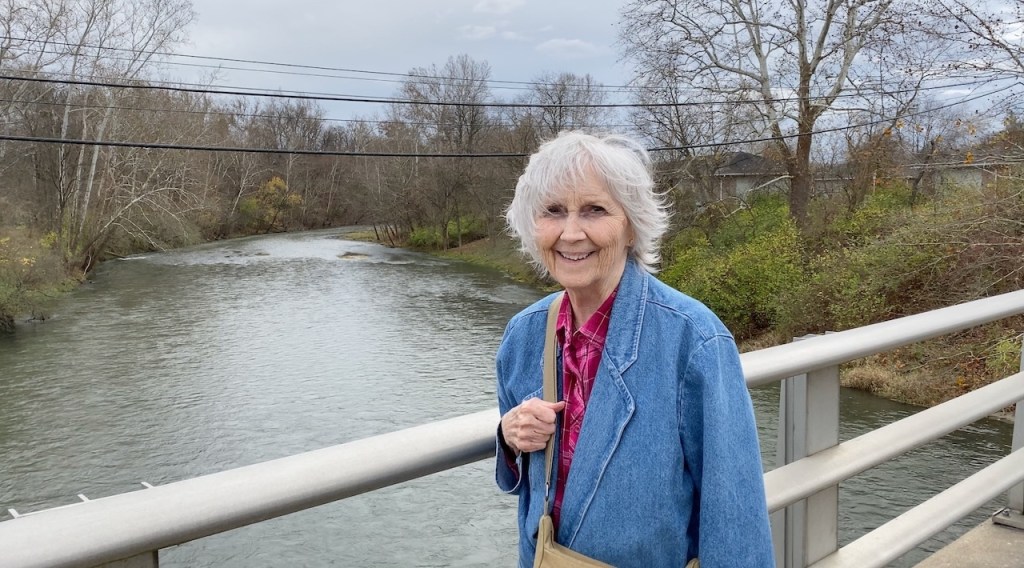
    Linda Sue on the new Paper Mill Bridge – Constructed 1977Photo by Ron W. G.