Linda's Literary Home

Tag: short literary fiction

  • Original Short Story: “Sylvia’s Sister Mule”

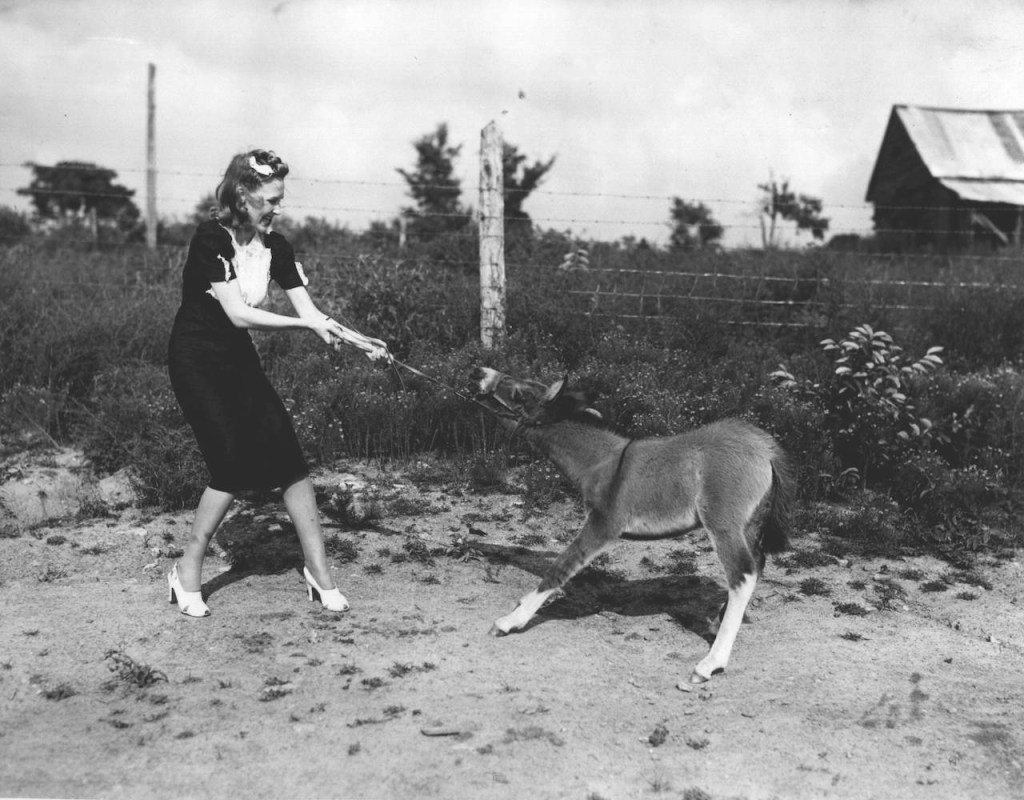
    Image 1:  Lucille Keith tugging at a three-month old, 40 lb. stubborn midget mule, owned by Lex Watson of Columbia, Tennessee

    Saint Francis of Assisi referred to his physical body as “brother donkey”: the physical body is stubborn often failing to heed the commands of the soul.  Sylvia Branch had a body image problem which was likely the least of her issues—then a strange book arrived at the bookstore where she worked. 

    You Terrible, Plathian Fish

    Each morning it is her face that replaces the darkness.
    In me she has drowned a young girl, and in me an old woman
    Rises toward her day after day, like a terrible fish.   
    Sylvia Plath’s “Mirror

    Sylvia Branch washed her face, looked up at the mirror, as was her custom every morning, and noted, “Yes, there you are, you terrible Plathian fish, rising and rising.” Next, she dressed, had her breakfast and ventured forth to work.

    “Hey, Suzette, any new arrivals?” Sylvia asked her boss and owner as she removed her gloves, coat and scarf, preparing for her day at Ye Old Book Shack, where she had spent the last ten years of her life. 

    After leaving graduate school at Ball State University, where she had attempted to acquire a PhD in English, Sylvia found herself adrift.

    But then she became securely anchored in acquiring and selling used books to the other college students who frequented the local bookstores looking for the best deal on the material that would eventually lead to their own BAs, MAs, and PhDs from the fastidious English Department.

    “Oh, yes, today was quite a haul!” responded Suzette, with her usual spiritedness when at least seven students had dropped off books that Suzette could acquire for less than a dollar, or three at the most, a piece. “You’ll be inspired to find that there is an edition of Yeats’ poetry. You’ll have to tell me how valuable it is. “Can we sell it for five or six dollars?” 

    Suzette relied on Sylvia’s expertise in poetry, especially Yeats, for determining how useful the books might be for the illustrious students who sat for the equally illustrious classes at Ball State. 

    This scene played out every day at the bookstore. Sylvia determined the price they could ask for poetry books, in addition to shelving books and running the cash register.

    But Sylvia was on an adventure and she knew it. 

    During her lunch period, which had increased from a mere 20 minutes to a whole hour, thanks to the recent employment of a second and third cashier and bookshelver, Sylvia with her ten years seniority, not to mention her friendship with Suzette, now was afforded a whole hour for lunch. 

    In fact, she was free to expand or shrink that hour in either direction she found fit. So if she felt she wanted to go back to work after only half an hour, she could, and sometimes two hours of lunch leisure would work out quite nicely.

    On an especially inauspicious day, Sylvia was looking through a “haul” of books supplied by the university students and found one that looked totally out of place. It had a picture of a long haired man with piercing eyes. The book was orange and the publisher was Self-Realization Fellowship. 

    This Self-Realization Fellowship was founded in 1920 in Los Angeles. At first Sylvia’s inclination was to toss the book as a self-published piece with no hope of resale. 

    But for some vague strange reason, she decided to place it in the spirituality section and price it at three dollars—the lowest price of books deemed unsalable. Sylvia then returned to her work for the day.

    The next day, Sylvia, out of a strange unexplainable curiosity went looking for the book. It was still there. 

    Also unexplainably, she looked for that book for the next month. It was always there, predictably and assuring Sylvia of her first impression that the book was unsalable. What Sylvia could not understand was why she cared. 

    Hundreds of books sat on the shelves of Ye Old Book Shack never selling. And Sylvia never checked on any of them, even the Yeats books that sat longer then expected.

    But for some vague reason, day after day, she was drawn to check to see if Autobiography of a Yogi by Paramahansa Yogananda had sold. The title of the book and its author’s name had become almost a mantra in her brain. 

    So Sylvia found herself repeating the title and its author’s name, between working with other books. 

    And like clockwork, every morning as she trotted into the spirituality section, she would be chanting, “So, Autobiography of a Yogi by Paramahansa Yogananda, have you sold yet?” 

    And invariably it was there. And Sylvia found a strange sense of relief always finding it there.  

    Then one day the unthinkable happened. Happily chanting, “Autobiography of a Yogi by Paramahansa Yogananda,” Sylvia bursts into the spirituality section to assure herself of the non-salability of the book and discovers to her horror that it is not there. 
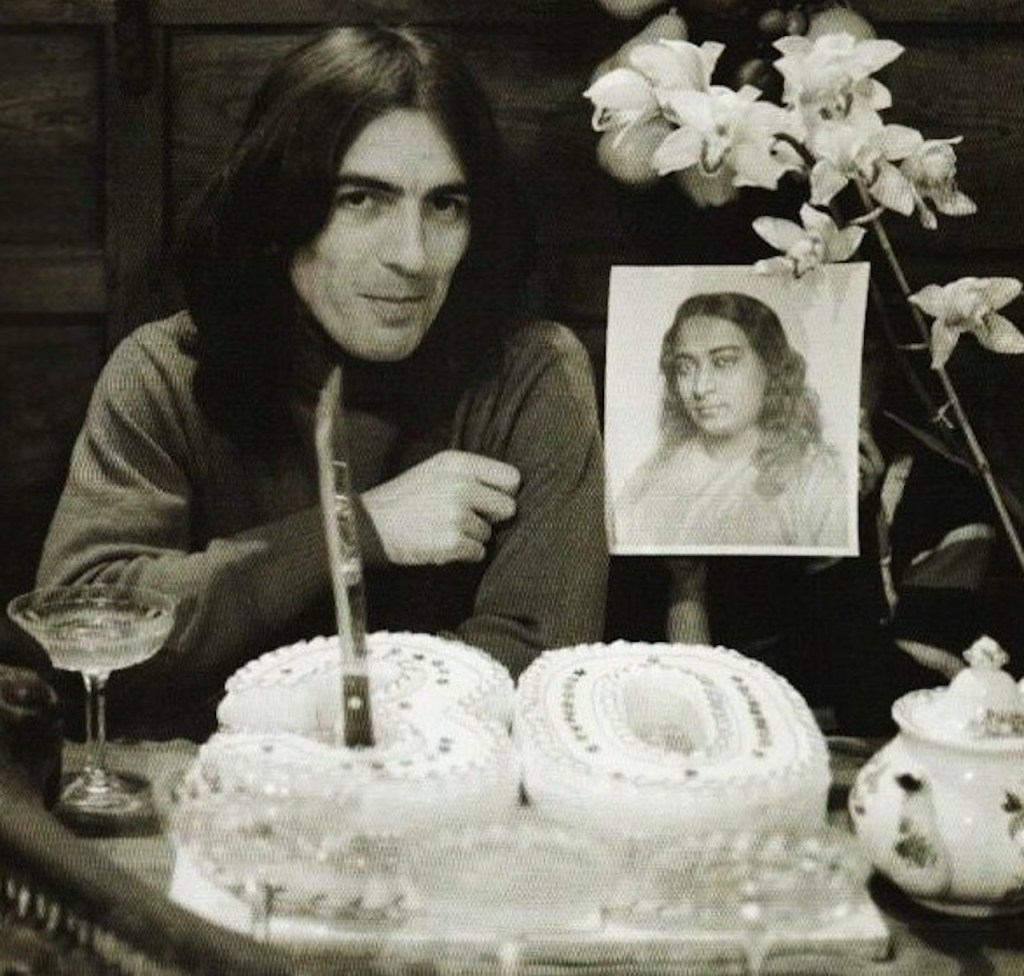
    Image 2:   George Harrison celebrating his 30th birthday, with photo of Paramahansa Yogananda

    Where Is Autobiography of a Yogi by Paramahansa Yogananda?

    “I looked at the cover and Yogananda just zapped me with his eyes, and that was it–it was all over!”  George Harrison

    “Suzette! Where is Autobiography of a Yogi by Paramahansa Yogananda?” Sylvia seemed flustered as she queried her boss about her loss.

    “What are you talking about?” Suzette asked.

    “That orange book with the cleared-eye master on the cover, in the spirituality section! What happened to it? Did you sell it? It’s been there for at least a month. I didn’t think it was possible to sell a book like that here! What’s going on?” 

    Sylvia seemed to be losing her composure, and Suzette was shocked that Sylvia would care so much about a book not poetry or English literature.

    “I don’t know, Sylvia. I didn’t see any book by that name, but let me look at the book log.” Suzette found that Nancy Forman has sold that book last night just before closing.

    All that day, Sylvia seemed off her stride. 

    Between books, as she chanted the name of the lost book in her mind, she realized that she would no longer be seeing it standing there loyally every morning as she lovingly approached it chanting, “Autobiography of a Yogi by Paramahansa Yogananda.” 

    After three days of missing that book that had become her morning inspiration by just standing there on the shelf, Sylvia decides she had to have that book. 

    Then after three nights of dreaming about the book, she decided to search out a copy for herself. She found it at Amazon on line and purchased her own copy.

    When the book finally arrived after what seemed a century, Sylvia asked Suzette if she could take two weeks off. 

    She told Suzette that she needed to do some thinking about whether to return to graduate school; she needed some time to make up her mind. Suzette agreed, and Sylvia was free to read her cherished book without interruption.

    After the two weeks of immersion in the book, Sylvia returned to work with what can be described only as a whole new world view. 

    Her failed marriage, her inability to finish graduate degrees, her total lack of self-confidence, and nagging negative body image had shrunk in importance. She had something that was quite new to her; she had faith.

    From that strange, orange book that stood on the shelf for a month without interest to anyone but Sylvia, Sylvia learned that she was responsible for everything that had happened to her. Her husband, who had mercilessly beaten her physically and mentally, had done so because the experience taught her a lesson. 

    Strange but alluring thoughts kept running through Sylvia’s mind as she tried to continue conducting her life, doing her job, and trying to plan for the future.

    Every lousy experience she had formerly suffered had pointed her toward this book. This amazing book that taught her to understand that life is a play and human beings are only players here to play roles. 

    A great Divine Spirit has concocted this playhouse for entertainment, and thus it is necessary to have good guys and bad guys to fight it out. Does that make Divine Reality evil? Hardly. That Great Spirit created the evil as well as the good. 

    The point is that each individual has the responsibility as well as the opportunity of making his/her own heaven: that is, finding that Ultimate Reality through uniting his/her own soul with It. 

    That Divine Reality (God) is like the ocean and His human children are like the waves of the ocean.  Sylvia was astonished that the twin concepts of reincarnation and karma rendered what seemed unfair in human affairs quite “fair” indeed.

    Sylvia’s Musing

    Sylvia’s birthday was approaching. January 1, the first day of the year. Suzette planned an elaborate dinner for Sylvia’s fortieth birthday and her 10th year at Ye Old Book Shack. 

    Suzette planned to hold the dinner on the Ball State campus in the ballroom of the Pittenger Student Center.  Sylvia had been musing what to do with the rest of her life. 

    At forty, she had finally found a spirituality that she could follow, that answered many of her questions about life, and that even offered lessons with techniques for meditation and prayer.

    This new set of thoughts and tenets was slowly but surely leading Sylvia to a calm place within herself where she knew she could live.

    But still the physical world is real—even if a delusion—and has to be dealt with. Sylvia decided that, indeed, she should return to graduate school and finish her PhD. 

    Still she was quite comfortable in her job at the bookstore, but through an arrangement with Suzette, she realized that she could do both—work at the bookstore, while pursuing her PhD in English literature.

    Still the most important part of Sylvia’s life whirled around her lessons from Self-Realization Fellowship. Learning about reincarnation and karma gave Sylvia a freedom she didn’t know was possible. 

    Blaming others for her own predicament had become a staple in her life in the form of a heavy burden.  

    After all, if someone else is to blame for your problems, there is little you can do to change the other person; however, if you alone are responsible for your situation, you are free to change it.  

    These thoughts freed Sylvia from victim status to potential victor, and she breathed easier for that knowledge.

    Sister Mule

    Saint Francis of Assisi used to call his body brother donkey because the body is very stubborn but also to distinguish the physical body from the soul.

    Sylvia had always hated her body.  She chafed when people would make jokes about her looking like a skeleton. 

    So many of her friends had complained about their inability to lose weight, but Sylvia had the opposite problem; no matter what she ate, she could not seem to put on enough flesh.  

    She had begun to wear two or three layers of clothing to try to hide her physical sparseness.

    Now, through the SRF lessons and the wise words of her Guru Paramahansa Yogananda she finally realized that the physical body is just vehicle for the soul.  Ceasing to obsess about her physical appearance, Sylvia could concentrate on higher endeavors.

    Besides, Saint Francis had called his own body, “Brother Donkey.” Sylvia decided that she would call her body, “Sister Mule.” The body is stubborn; it likes to have its own way. Like a mule, it will not budge if it chooses not to budge. 

    She decided that no matter how thin she had to be, it was only the body, “Sister Mule,” who was thin; her soul was wider as the sky and deeper than any ocean.  

    She knew that way of looking at her thin body gave freedom from striving to increase her body flesh.  Instead she would seek her immortal, eternal, vast soul.

    Sylvia settled into the routine of grad school and work and after two years found herself a newly minted PhD in English.  Now, what do do with such an illustrious degree.  

    Suzette encouraged Sylvia to apply for tenure track teaching positions at colleges near and far, but Sylvia balked at the idea of teaching.

    “You might like it, Sylvia. Think of it, talking about poetry and literature all day, everyday with students, and helping them understand literary concepts,” persuaded Suzette.  “Not that I want to lose you, but you’re a PhD now, and surely you’d like to make more money.”

    “I’m just not sure.  I’ve never done any teaching.  I’ve never even served as a grad assistant or doctoral fellow.  I still worked here while I got my degree.  And I’m not sure I want to move away from Muncie and my friends here,” said Sylvia.

    “I have an idea.  Why don’t you just apply to teach a couple of classes at Ball State just to see if you’d like it;  they always need people to teach their comp courses, and you could do that easily,” suggested Suzette.

    “Ummm,  I guess I could give it try, and I could still work here probably, just teach a couple of night courses,” responded Sylvia.

    Epiphany

    “Seeds of past karma cannot germinate if they are roasted in the fires of divine wisdom.” ―Paramahansa Yogananda, Autobiography of a Yogi

    Two years later, after her teaching experiment, Sylvia had another epiphany.  The teaching experience had shown Sylvia that she was right:  she did not want to spend her life in that profession.  

    Suzette then tried to persuade Sylvia that she really needed a real, tenure line job that would require more of her.  Sylvia was doubtful.  She cried.  She prayed.  She meditated.  And then decided to attend a Self-Realization Fellowship World Convocation.

    Ever since she joined SRF as a student member, she had been receiving announcements about the yearly convocation the organization held in Los Angeles.  She had never thought of attending until now.  She needed something in her life, but she didn’t know what it was.  

    She kept kicking Sister Mule for being such a stubborn vessel, and Sister Mule of the mind that seemed to be keeping her in chaos.  She studied her SRF lessons, she meditated regularly, but she felt that something was missing.  Maybe convocation could help her.

    At convocation, Sylvia met with a nun to discuss her situation.  The nun exhibited such an aura of peace.  Sylvia decided she wanted that more than anything she had ever wanted, so she decided to apply to become a nun of the SRF order.

    Suzette’s Question

    “If you don’t invite God to be your summer Guest, He won’t come in the winter of your life.” ―Paramahansa Yogananda, Autobiography of a Yogi

    After five years of living and serving as a nun at SRF’s Encinitas ashram, Sylvia makes a trip back to Muncie to visit friends and attend a reunion of Ye Old Book Shack workers. 

    Her friends were astonished that Sylvia looked years younger, more robust, and decidedly calmer than they had ever seen her.  Sylvia was not shy in explaining her outer and inn glow.

    “Suzette, from the moment I applied to the moment took my first vows, I have never looked back,” Sylvia explained to Suzette.  “I love every minute of every day.  I know I am heading in the right direction.  I never felt that way doing anything else I’ve ever done in my life.”

    “I’m just so happy for you, Sylvia,” replied Suzette.  “Maybe I should read that book?”

    Image 3:  Self-Realization Fellowship  Autobiography of a Yogi  

    🕉

    You are welcome to join me on the following social media:
    TruthSocial, Locals, Gettr, X, Bluesky, Facebook 

    Share

  • Original Short Story: “The Thin Woman”

    Image:  The Big Pond 

    The Thin Woman

    Lenore’s most dreaded chore was picking up pop bottles. She had to tote a heavy pop crate while collecting the pop bottles from around the ponds. She trembled in fear while negotiating the sloping side of the pond because she could not swim . . .

    Lenore Ellen Thompson spent her childhood at end of a long dirt road, where her family owned and operated pay fishing lakes—Thompson’s Ponds, later renamed Heavenly Lakes. The fellows who came fishing would get mighty thirsty, so the Thompson’s sold soda pop and other snacks in their concession stand that they nicknamed “The Shanty.” 

    Back then in the late 1950s and early 1960s, the pop was sold in 12 ounce returnable bottles, but the fishers would not bring back their bottles to “The Shanty.” Instead they simply threw them on the ground around the ponds, and Lenore would have to go out and gather them up, so they could return them to the Pop Man, who came every Saturday to deliver fresh bottles of pop from his big pop truck.

    To gather up the pop bottles, Lenore would carry a pop crate that held about 20 or so bottles. She was always fearful when negotiating the sloping side of the ponds because she could not swim, and her inability to swim accounted for the reason that she feared picking up bottles on the sloping sides of the lakes. Sometimes she would pick them up around the level sides and just not bother with the sloping side.

    But when she did that, her father would tell her she was lazy for not finishing her task, so to avoid being upbraided by her father, she determined to finish her task regardless of her safety. After a weekend of fairly heavy business, the Monday, June 17, 1957, at approximately 9 a.m., Lenore was hauling the pop crate along the sloping side of the Big Pond, as the family referred to the bigger pond back then.  The other one was the Little Pond, naturally. 

    It had rained the night before and the ground was slippery with mud. There was only one person fishing in the lake, a very thin woman who was casting her line out and reeling in and casting out and reeling in, more as if she were practicing than fishing. As Lenore stepped down and reached out to retrieve a bottle from near the edge of the water, she slipped and went tumbling into the water.  The pop crate tumbled in after her hitting her on the leg. She panicked, she could not feel the bottom of the lake under her feet, so she panicked some more. 

    Suddenly, her lungs felt as though they were going to burst. All at once, she realized that she was breathing under water, and she was shocked! She wondered how she would tell her mom and dad that she could breathe under water.

    A Bizarre Thing Happened

    But then a most bizarre thing happened. She lunged up out of the water, hovered over it, and then looked around for what to do next.  She saw the woman, who was sitting in an odd position, cross-legged, on the hard ground, not moving, just staring off into space. It seemed that Lenore saw the woman open her brain and ask Lenore to enter it. 

    She did what the thin woman requested, and then after what must have been only seconds, Lenore realized that she no longer had the body of an eleven-year-old, but that of a woman who must have been in her thirties. Lenore got up and walked into a clump of trees up the sloping side of the pond. She sat down to decide what to do. She closed her eyes and began to pray.  

    Although she had never really prayed before, she couldn’t think of anything else to do, so she prayed for God or Someone or Something to tell her what to do. She knew she could not live as this woman—Lenore was still only eleven-years-old. What could she do? Lenore was guided to think hard about what she used to look like, and so she did that thinking for several minutes as hard as she could. Slowly, she could feel her body changing. She looked down at the hands; they were her hands. 

    The legs were her legs, and the arms her arms. She wondered if the face was her face, so she went down to the water’s edge and looked in and saw that, indeed, it was the face of eleven-year-old Lenore Ellen Thompson. 

    And she saw something that stunned her more than she had ever been stunned before: she saw her former body in the water.  She was starting to panic again—this time not because of not being able to swim, because she knew that if she fell into the water now, she would be able to swim.

    What if They Find the Body?

    Lenore tried to figure what she would do when people find that body. Everybody knows that she is not twins. She searched for a long tree branch and shoved the body deeper into the water.  Luckily, it finally disappeared so no one could see it from the bank, and she reasoned that because she was very much alive, no one would ever bother to look.  She sat for a few moments trying to calm herself and figure what to do next. 

    She had been gone for what seemed a long time, and she knew her mother would begin to worry if she didn’t get back to the house soon. Then it hit her that she had that woman’s clothes on. They were so tight that she could barely breathe. 

    The woman, whose body she now inhabited, had been a very thin woman, and Lenore was a rather chubby girl. And she realized that her mother would know that those clothes were not Lenore’s shorts and top.  She had to get into the house without her mother seeing her and get some of her own clothes.

    So she sneaked up the hillside and waited until her mother came outside. Fortunately, her mother came out and went to the garden to pull weeds.  Lenore ran as fast as she could, bounded into the house, changed her clothes, bundled up the thin woman’s clothes and then started to panic again. 

    What could she do with those clothes? Her mother would know that these were not hers. She looked out the window and saw that her mother had moved to the very far end of the garden, and thus could not see Lenore if she went outside. 

    Lenore thought at first that she could burn the clothes in a trash barrel drum that they were using to burn trash. But then she would have to account for the fire. The trash barrel was just a few yards away from their outdoor john, (they still had no indoor plumbing back then), and she got the idea to just toss them in the john, and that’s what she did. 

    It didn’t occur to her that anyone would look down into the excrement hard enough to recognize a pair of shorts and a blouse.  But later that night, her father started complaining about the fishermen using their private toilet. He said somebody had put some clothes down in it. That’s all though.  He and Lenore’s mother just thought that some fisherman had tossed those clothes down there. Luck was on Lenore’s side again.

    Who Was That Woman?

    Things settled down for Lenore Ellen Thompson over the next few days, months, years—at times, she wondered if that body would ever be discovered. But what bothered her most was, who was that woman who gave up her body for Lenore?  Every time Lenore would hear of a woman missing, she wondered if it were that thin woman until she’d find out some fact that made it impossible.

    For example, a woman in Eaton, Ohio, went missing, but they found her body later in Dayton in a hotel room, where she had committed suicide. Over the years, this fear finally faded. After earning her culinary certificate in Cooking Arts at the Culinary Institute in Rhode Island, Lenore married the chef Christopher Evanston.

    They worked together in vegetarian restaurants in Chicago, Miami, and finally Encinitas, where they settled down to raise their two sons, Eliot and William. In her early thirties, Lenore encountered the teachings of Vedanta from which she learned some astounding concepts which gave her great comfort—like reincarnation and karma and how each human being is responsible for his/her own salvation. 

    According to those teachings, if we have led a life that has caused us great pain, we can change it, and follow a pathway that leads us to happiness in the future. And the heart of these teaching is meditation, which calms the body and mind, allowing the soul to find itself.

    Discovering that each human body has a soul was a defining moment in the life of Lenore Ellen Thompson because she could now understand that it was her soul that left that body that day and entered the body of the thin woman.  Who was the thin woman? Lenore still did not know.

    But she thought that the woman was just an astral being used by the Divine Creator to allow Lenore to continue to live out her life. Also what the woman did for Lenore give her an experience base that would allow her to identify with the teachings of Vedanta—no one else in her family ever had such an experience base. 

    No one ever turned up missing who fit the thin woman’s description. And no one had bought a ticket to fish that morning that Lenore drowned while picking up pop bottles. No one saw the thin woman except Lenore.

    Strange Teachings

    Vedanta explains that vagrant souls exist and try to enter bodies of people who allow their minds to remain blank. At some point during Lenore’s death state, she became something like a vagrant soul. And the thin woman was waiting for Lenore to take over her body. Lenore comforted herself knowing that the thin woman invited her to do that; Lenore did not merely abscond with the woman’s physical encasement. 

    Lenore didn’t even know how she did it. It was as if forces were moving her and connecting her without much of her awareness. Lenore was guided to place her attention between her eyes and let the forces do the rest. Vedanta also explains that intense prayer can change the physical body. And at the time of her death and entry into that woman’s body, Lenore prayed with an intensity that she had never before or after experienced.

    The Thin Woman Revisits

    Despite her bizarre drowning death and rebirth, Lenore lived a fairly ordinary life. She was content in her marriage, motherhood, and loved working with her husband cooking in vegetarian restaurants.  Both sons entered monastic life in the ashrams of Paramahansa Yogananda, and Lenore whole-heartedly approved of her sons’ life choices.

    Lenore’s soul left its body with finality June 17, 2057, at 9:00 a.m.—exactly one hundred years after the bizarre drowning. Both sons were at her side as she slipped out of her physical encasement. Her belovèd husband had passed only days before. As she was entering the astral realm, Lenore was permitted a brief visitation with her belovèd husband and with several friends from her meditation group. 

    Then she saw a brilliant light that slowly formed itself into the image of the thin woman, who had offered Lenore her body that day by the Big Pond. The thin woman then welcomed Lenore’s soul to the astral world, where she continues on her journey back to the Infinite.

  • Original Short Story: “Krystal’s Dark Nights”

    Image: Gifyu Scary Nightmares

    Krystal’s Dark Nights

    The nightmares had started attacking Krystal Dickson again, robbing her of sleep, rendering her so listless, so confused that she had mislaid the files for the divorce proceedings of an important client.

    My short story, “Krystal’s Dark Nights,” is based loosely on my original poem, “A Terrible Fish.”

    A Terrible Fish

    “In me she has drowned a young girl, and in me an old woman
    Rises toward her day after day, like a terrible fish.”
    —Sylvia Plath’s “Mirror

    The nightmare repeats itself:
    A daughter clamped tight to each foot
    Pulling her down under
    The brute waters of the dark, deep lake —
    She gasps — imagines she’s drowning
    While her husband watching on the levy
    Wrings his hands, faints in the heavy fog.
    A terrible fish looms under her nose;
    She smells blood dripping
    From a dozen hooks dangling
    From his mouth.
    His eyeballs slide out easy
    As the drawer of a cash register.
    Each eye-socket a window
    To her own soul — $ bills
    With little jackpots on them
    Jump up and dance like clowns
    Poking out their tongues,
    Flapping campaign signs
    With hammers, sickles, swastikas —
    She believes – ¡Sí se puede!
    Morning shivers her awake again,
    Stumbling to the bathroom
    Where the mirror flashes
    In her face that same terrible fish
    That has been catching her dreams
    And throwing them back
    As she chases each $,
    Never quite able to grasp enough.

    Krystal’s Dark Nights

    We are the ones we’ve been waiting for. . .” – Barack Hussein Obama II

    The nightmares had started attacking Krystal Dickson again, robbing her of sleep, rendering her so listless, so scatter-brained that she had mislaid the files for the divorce proceedings of an important client. Now she had to call that client and ask her to reschedule an appointment to recapture the information. Her associates in the firm of Stegall, Porter, Marsch, Rictoff, and Davis, the most prominent law firm in Richmond, Indiana, were like family to Krystal so they once again cut the blundering legal eagle some slack, as she so often seemed distracted.   

    Everyone surmised that Krystal was out her element as a lawyer, but they felt sorry for her, and once in a blue moon Krystal actually pulled her weight for a few months, and more importantly Krystal provided the face of diversity. Krystal couldn’t count the times she feared she would lose her job, yet every pay check seemed to evaporate before she could register that she actually was paid.

    Krystal’s husband, Dr. Jamal Kreedmont, had nightmares of his own. His own heart was failing, but he somehow managed to keep his practice a float. Kreedmont had given up on his family business, The Wilderness Trail Campground, just south of town in favor of doctoring; although he still lived on the land in the sprawling old ranch-style house he grew up in, kept his five ponds well manicured and stocked with fish, his loss of income from the campground caused Krystal to fret over losing those dollars. And Krystal made sure Jamal knew how she felt about losing dollars. 

    Many times Krystal and her sister Bethany would gang up on the good doctor, castigating him for not making the most of his property.  But Jamal would remind Bethany that perhaps if she had stayed in Indiana instead of traipsing off to Florida with Jamal’s brother Florence, they could have kept the business running. Jamal would trust only family to run his business, and since both of his brothers and three sisters had left the state, he closed it instead of trying to manage employees. 

    Jamal never worried about money; Krystal was the center of his life, and it did pang him that she was so insecure about their financial situation. He promised her repeatedly that he would always take care of her, and she would never have to suffer.

    Shasta and Keishlan, the couple’s two daughters, dropped out of high school to pursue a career in early retirement, fleshed out with adventures in crime. Despite their job hopping, the girls were perennially broke and ended up living in a make-shift, loft apartment above the barn, a cornfield away from their parents’ house. They were bleeding the parents dry in daily hundred $ increments.  Jamal and Krystal had enjoyed stellar reputations in town until Shasta and Keishlan started their reign of terror: shop-lifting, brawling in restaurants, bullying fire fighters, wrecking a car they had stolen for a joy ride and then assaulting the police officers who rescued them from the burning vehicle; then one night they were caught sexually gratifying each other in a restroom in Glen Miller Park. At ages 28 and 30, the Dickson girls—they both were assigned their mother’s last name—had trashed their own reputations and nearly ruined that of their parents.

    Lucky for the lawyer and doctor, most people were aware that sometimes kids just don’t reflect the values of their parents and would sympathize when someone would say to Krystal, “I overheard your daughters the other day, trying to open a saving account at the Second National Bank; they said they were from Canada and apparently had some Canadian IDs.” To which Krystal would apologize profusely, explain a bit about her plight, thus gaining the empathy and sympathy of another Richmondite. Continually, the behavior of those girls caused a lot of grief for Krystal and Jamal.  

    Krystal experienced nightmares, and Jamal developed a heart condition.  But things hummed along for a few years, and then Shasta and Keishlan started hatching a plan: they reasoned that if they could get that 350 acres of land on which the former Wilderness Trail Campground once flourished, they could sell it and live big time. They knew that the property would go to their mom if their dad died first. They also knew that it was likely he would die first, being twenty years older and suffering a heart condition. They also knew that they could manipulate Krystal and ultimately get anything they wanted from her. So the first part of the plan: Dad has to go.

    The Dickson girls knew that their dad was crazy about their mom, so they reasoned the best way to kill off Dad is to stick it to Mom somehow. They put their heads together and came up with love letters written to Mom from one of her associates at the law firm. They told Dad that they had something to talk to him about, and they showed him the letters. He read them and knew immediately that the girls had written them. He said to them, “You two must be the sickest, dumbest creatures to ever live,” then turned and walked away.  “Goddam him!” they screeched and proceeded to plan B. 

    They would hire Ziggy, a druggy friend who would do anything for a brick or two of crack, to break into the house, hold Mom at gunpoint and then pistol whip Dad. Dad’s bum ticker would do the rest.  So the plan went down, but Pop didn’t. Krystal and Jamal huddled closer than ever, started revealing old secrets to each other in order to cleanse their souls, so they could fuse even closer. They realized while staring down the barrel of Ziggy’s gun and his crack-crazed buddy Toody, that life is precarious, better cling to the good and true while you can.

    Then Krystal admitted that she had been “seeing” Mel Frenchman, a lawyer who practiced in Washington, D. C. She would “see” him only two or three times a year when she had a conference in the capital to learn about all the new regulations affecting law firms. Jamal stood opened mouthed for a long moment; his blood began to boil, he remembered the “love letters” he accused his daughters of writing—no, he still knew they had written them; they weren’t intelligent enough to have suspected Krystal’s real “affair.”  In an instant, all the closeness, all the love Jamal had nourished in his heart for Krystal turned to a bitter bile of hatred. He grabbed his 15 pound bowling trophy, raised it high and came down hard on Krystal’s head; she fell dead—her back had been turned to Jamal; thus she did not know what hit her.

    Stuttering, jabbering, wildly flinging his arms about, Jamal finally calmed enough to ask himself, what do I do now? Well, the only thing possible: bury the body. He dragged the corpse out beyond his vegetable garden into the middle of his big cornfield, retrieved a shovel from the shed and dug as deep as he could. 

    After shoving Krystal’s lifeless form into the hole, he began to refill it.  Now all is good, he kept thinking: yes, he had fixed it. He would simply tell whoever might ask that Krystal had run away. Sure, she couldn’t take living with those two black holes of daughters, so she just ran away. But on his way back to the shed carrying the shovel, Jamal keeled over and died.

    Now lest gentle reader think those black holes had finally triumphed, not so fast.  When Dr. Kreedmont didn’t show up for work, his office assistant sent the authorities out to his estate. Of course, they figured out in record time what had gone down. And after proper funerals, the Dickson girls seemed to be in the catbird seat, until the wills were read.  With Krystal preceding him in death, Jamal’s property went to a large recreational corporation that promptly evicted the Dickson girls. 

    After several failed attempts to sue, they gave up. Last anyone around Richmond ever saw of them, they were hitchhiking to San Francisco.   But a newspaper report in Wyoming might have offered the last bit of information on the whereabouts of the girls: the headline read, “Two Nude Female Bodies Found Near Jackson Hole.” The report read in part: “Gunshot wounds to the back of each head seem to suggest an execution style killing. Thus far the bodies remain unidentified.”  Maybe it was Shasta and Keishlan, or maybe not. As some wise philosopher has said, karma is a bitch. So whatever they deserve . . . .

  • Original Short Literary Fiction

    Image: Lit Fic

    This page offers a list of links to my original short fiction.

    Thank you for visiting my literary home.  Questions, comments, and suggestions are always welcome, if offered in good faith.

    Original Short Literary Fiction

    Various and Sundry Tales

    1. Krystal’s Dark Nights
    2. The Sylvin Sprite
    3. The Thin Woman
    4. Sylvia’s Sister Mule
    5. Which Hand?
    6. Me & Iris
    7. Merry’s Prom Night
    8. Lady Susanne of Frawling Manor
    9. Tipi for the Twenty-First Century
    10. Walking down Dark Hallways
    11. Betty Sue’s Boutique
    12. Dedalus
    13. Falling Grace
    14. Joyce Ann

    Graveyard Whistler Series

    1. Life Sketch of Belmonte Segwic aka Graveyard Whistler
    2. Graveyard Whistler Finds Stone Gulch Literary Forum
    3. Graveyard Whistler’s New Find, “The Irony of the Bones”
    4. Graveyard Whistler Features Stoney’s One Act Play
    5. Graveyard Whistler on “The Lucy Light Letters”
    6. Graveyard Whistler’s First Flash Fiction Find” (1)
    7. Graveyard Whistler’s Second Flash Fiction Find” (2) 
    8. Graveyard Whistler Presents Verönique Flüres’ “A Political Intrigue”
    9. Graveyard Whistler’s Political Poem Find,”Liberal Mud with Commentary”
    10. Graveyard Whistler’s Career Update and Third Flash Fiction Find (3)
    11. Graveyard Whistler’s Fourth Flash Fiction Find (4)