
Linda's Literary Home

Tag: Sonnets from the Portuguese

  • Elizabeth Barrett Browning’s Sonnet 36 “When we met first and loved, I did not build”

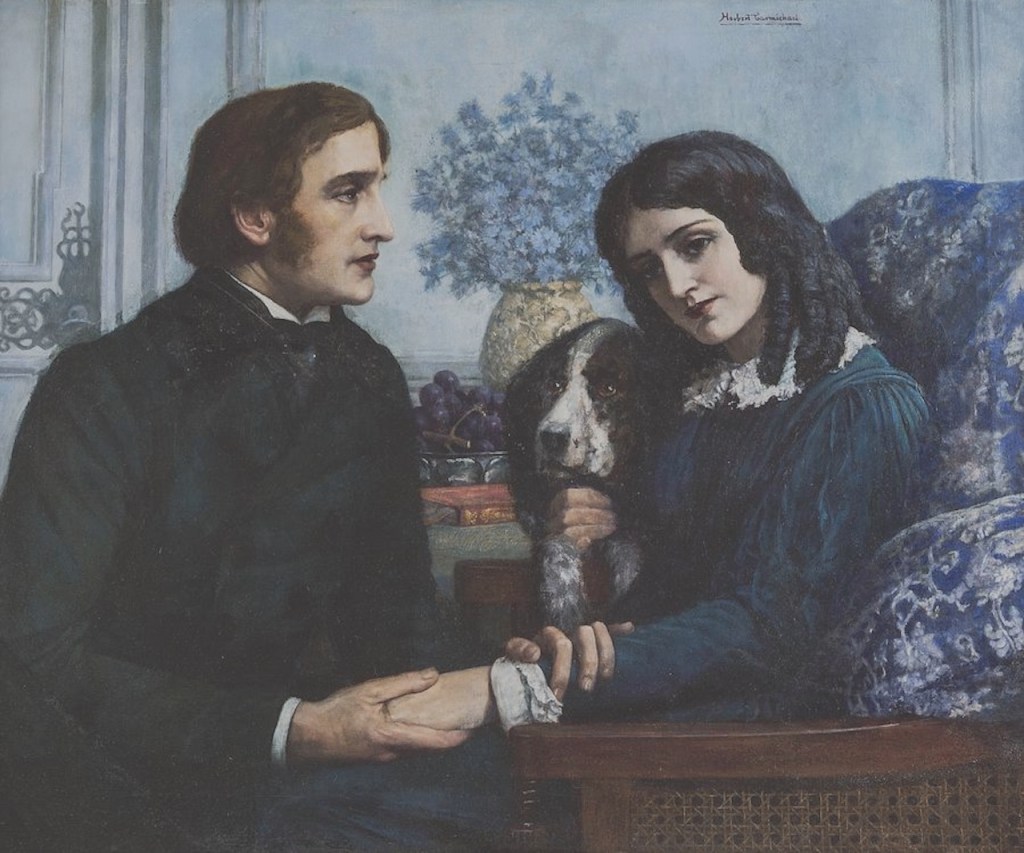
    Image: Elizabeth Barrett Browning and Robert Browning – 1852. Portraits painted by Thomas Buchanan Read

    Elizabeth Barrett Browning’s Sonnet 36 “When we met first and loved, I did not build”

    In sonnet 36 “When we met first and loved,” the speaker reveals her inability to fully accept the love relationship that is growing with her belovèd suitor.  She is constantly trying to prevent her heart from being broken, in case the relationship fails to reach it full potential.

    Introduction and Text of Sonnet 36 “When we met first and loved, I did not build”

    Elizabeth Barrett Browning’s sonnet 36 “When we met first and loved, I did not build”  from Sonnets from the Portuguese reveals the speaker’s apprehension that the first moments of a new love might prove to be illusive; thus, she refuses to believe unwaveringly in the possibility that love had arrived.

    This speaker always remains aware that she must protect her heart from disaster.  And at this point in their relationship, she knows that she could suffer a terrible broken heart if the relationship fails to flourish.

    Sonnet 36 “When we met first and loved, I did not build”

    When we met first and loved, I did not build
    Upon the event with marble. Could it mean
    To last, a love set pendulous between
    Sorrow and sorrow? Nay, I rather thrilled,
    Distrusting every light that seemed to gild
    The onward path, and feared to overlean
    A finger even. And, though I have grown serene
    And strong since then, I think that God has willed
    A still renewable fear … O love, O troth …
    Lest these enclaspèd hands should never hold,
    This mutual kiss drop down between us both
    As an unowned thing, once the lips being cold.
    And Love, be false! if he, to keep one oath,
    Must lose one joy, by his life’s star foretold.

    Commentary on Sonnet 36 “When we met first and loved, I did not build”

    The speaker again is demonstrating her inability to fully accept the love relationship that is growing with her belovèd suitor.  The speaker must protect her poor heart, which could so easily be shattered if the love relationship should end.

    First Quatrain:  Love between Sorrow

    When we met first and loved, I did not build
    Upon the event with marble. Could it mean
    To last, a love set pendulous between
    Sorrow and sorrow? Nay, I rather thrilled,

    The speaker says that when she and her belovèd first met and love began to flower, she did not readily accept that the feelings were genuine; she refused to imagine that such a relationship could become solid.  She must continue to guard her heart by holding in abeyance only the possibility of a lasting love relationship.

    She questions whether love could endure for her because of the many sorrows she has experienced.  She, instead, continued to think of only the potential of love, existing between one sorrow after the next sorrow.  She felt more confident that sorrow would remain in the offing than that love would come to rescue her out of her melancholy.

    The reader is by now quite familiar with the sadness, pain, and grief this speaker has suffered in her life and that she continues to suffer these maladies.   For this melancholy speaker to accept the balm of love remains very difficult. Her doubts and fears continue to remain more real to her than these new, most cherished feelings of love and affection.

    Second Quatrain:   Continuing Fear

    Distrusting every light that seemed to gild
    The onward path, and feared to overlean
    A finger even. And, though I have grown serene
    And strong since then, I think that God has willed

    Answering her own question in the negative, the speaker asserts that she preferred to remain skeptical of the hints that seemed to suggest a progression toward the loving relationship.   

    The speaker’s fears continue to prompt her  to hold back her heart because she continued to remains afraid that if she gave way at even a “finger[’s]” length, she would regret the loss so much that she would suffer even more than she already had done.

    Quite uncharacteristically, the speaker admits that since that early time at the very beginning of this love relationship, she has, indeed, “grown serene / And strong.”   Such an admission is difficult for the  personality of this troubled speaker, but she does remain aware that she must somehow come to terms with her evolving growth.

    First Tercet:   Skepticism for Protection

    A still renewable fear … O love, O troth …
    Lest these enclaspèd hands should never hold,
    This mutual kiss drop down between us both

    Still, even though this wary speaker is cognizant of her growth in terms of serenity and strength, she believes that God has instilled in her the ability to remain somewhat skeptical in order to protect herself from certain torture at having been wrong about the relationship.

    This speaker knows that if, “these enclaspèd hands should never hold,” she would be devastated if she had not protected her heart by retaining those doubts.   If the “mutual kiss” should “drop between us both,” this ever-thinking speaker is sure her life would be filled with even more grief and sorrow.

    Second Tercet:  Wrenching Feeling

    As an unowned thing, once the lips being cold.
    And Love, be false! if he, to keep one oath,
    Must lose one joy, by his life’s star foretold.

    The speaker then spreads across the border of the tercets the wrenching feeling that her words are causing her.   This melancholy speaker feels that she must give utterance to these thoughts, but she knows that they will cause pain, even to her belovèd. But if, “Love, be false,” then she simply must acknowledge that possibility for both their sakes.

    The speaker anticipates the likelihood that she might have to “lose one joy” which may already be written in her stars, and not knowing which joy that might be, she must remain watchful that it might be the very love she is striving so mightily to protect.

  • Elizabeth Barrett Browning’s Sonnet 34 “With the same heart, I said, I’ll answer thee”

    Image: Elizabeth Barrett Browning – Baylor University

    Elizabeth Barrett Browning’s Sonnet 34 “With the same heart, I said, I’ll answer thee”

    Returning to the melancholy character in sonnet 34 “With the same heart, I said, I’ll answer thee,” as she has so often maintained, the speaker contrasts her light-hearted childhood’s response with her serious maturity.

    Introduction and Text of Sonnet 34 “With the same heart, I said, I’ll answer thee”

    The character speaking in Barrett Browning’s Sonnet 34 “With the same heart, I said, I’ll answer thee” from Sonnets from the Portuguese has returned to her melancholy attitude.  Now she is contrasting her happy, carefree childhood years to her very stern and serious life as a mature adult.

    The speaker however is addressing her belovèd, imploring him to consider how important he is to her.  As earnest, obedient, and steadfast as she was as a child, now her constancy with her belovèd is even more in evidence.    The speaker continues to build her case for deserving the love of such an accomplished man, whom she considers to be much above her own station in life.  

    Sonnet 34 “With the same heart, I said, I’ll answer thee”

    With the same heart, I said, I’ll answer thee
    As those, when thou shalt call me by my name—
    Lo, the vain promise! is the same, the same,
    Perplexed and ruffled by life’s strategy?
    When called before, I told how hastily
    I dropped my flowers or brake off from a game,
    To run and answer with the smile that came
    At play last moment, and went on with me
    Through my obedience. When I answer now,
    I drop a grave thought, break from solitude;
    Yet still my heart goes to thee—ponder how—
    Not as to a single good, but all my good!
    Lay thy hand on it, best one, and allow
    That no child’s foot could run fast as this blood.

    Commentary on Sonnet 34 “With the same heart, I said, I’ll answer thee”

    Returning to the melancholy character she has so often maintained, the speaker contrasts her light-hearted childhood’s response with her serious maturity.

    First Quatrain:  The Necessity of Consistency

    With the same heart, I said, I’ll answer thee
    As those, when thou shalt call me by my name—
    Lo, the vain promise! is the same, the same,
    Perplexed and ruffled by life’s strategy?

    The pensive speaker professes a need to be consistent; thus, she repeats the word “same” three times in three lines.  She is of the “same heart” as she was earlier in her lifetime.  She is called by “[her] name.  But she is unsure about “life’s strategy.”  She is even “perplexed and ruffled” by it.

    The speaker hopes to convince herself that love has merely continued to flow into around her life.  She also demands from her new love relationship a constant heart as she lovingly and gently makes demands on her belovèd.

    Second Quatrain:  The Obedient One

    When called before, I told how hastily
    I dropped my flowers or brake off from a game,
    To run and answer with the smile that came
    At play last moment, and went on with me

    Earlier in her lifetime, the melancholy speaker had played the obedient one, coming when called, dropping her “flowers” or leaving off her “game.”   She ran to answer and even “with a smile” she appeared. Such behavior continued because of her dedication to obedience.

    The speaker needs to be always consistent in her emotional responses.  The static melancholy that she has experienced has programmed her to need a steady environment, even if she must create it from fragments of memory and emotional responses from the past.

    First Tercet:  Adult Life Different Details

    Through my obedience. When I answer now,
    I drop a grave thought, break from solitude;
    Yet still my heart goes to thee—ponder how—

    Now the specific details of life are a bit different.  Instead of games and flowers, she answers from the position of having dropped “a grave thought” or a “break from solitude.”  But her heart goes now always to the belovèd.  She spills out a command before venturing on, telling her beloved to “ponder how . . . .” 

    Even though the details of her adult life are different, her emotional responses are essentially the same.  Her same heart-responses continue to guide her.  Her new love relationship has become even more important to her than any relationship before.

    Second Tercet:  From Childhood to Adulthood

    Not as to a single good, but all my good!
    Lay thy hand on it, best one, and allow
    That no child’s foot could run fast as this blood.

    The speaker then concludes that the good her beloved has done her is not one in one single area but in “all my good!”  She asks her beloved to understand that as fleet foot as she was at obedience as child, she is much faster at running to her belovèd than she could have ever been in her earlier life.  

    The speaker’s blood now runs faster and with more passion than ever her foot did as a child.  As important to her as were her earlier loves, her new belovèd has become even more vital to her life.

    The speaker’s melancholy seems to be desperate for her lover to grasp his importance to her.  Thus, she continues to compare and contrast her life’s environments from childhood to maturity.

    Image: Elizabeth Barrett Browning and Robert Browning – 1852. Portraits painted by Thomas Buchanan Read
  • Elizabeth Barrett Browning’s Sonnet 20 “Beloved, my Beloved, when I think”

    Image:  Robert Browning visits Elizabeth Barrett at 50 Wimpole Street painting by Celestial Images

    Elizabeth Barrett Browning’s Sonnet 20 “Beloved, my Beloved, when I think”

    Sonnet 20 “Beloved, my Beloved, when I think” from Sonnets from the Portuguese finds the speaker in a pensive mood, dramatizing her awe at the difference a year has made in her life.

    Introduction with Text of Sonnet 20 “Beloved, my Beloved, when I think”

    The speaker in Elizabeth Barrett Browning’s sonnet 20 “Beloved, my Beloved, when I think” from Sonnets from the Portuguese remembers that just year ago she would not have been able to imagine that a love relationship with someone so important as her belovèd would break the chains of sorrow with which she has been bound for many years.

    This sonnet finds the speaker in a pensive mood, dramatizing her awe at the difference a year has made in her life.  The speaker is gaining confidence in her ability to attract and return the kind of love that she has yearned for but heretofore considered herself unworthy of possessing. 

    Sonnet 20 “Beloved, my Beloved, when I think”

    Beloved, my Beloved, when I think
    That thou wast in the world a year ago,
    What time I sate alone here in the snow
    And saw no footprint, heard the silence sink
    No moment at thy voice … but, link by link,
    Went counting all my chains, as if that so
    They never could fall off at any blow
    Struck by thy possible hand … why, thus I drink
    Of life’s great cup of wonder! Wonderful,
    Never to feel thee thrill the day or night
    With personal act or speech,—nor ever cull
    Some prescience of thee with the blossoms white
    Thou sawest growing! Atheists are as dull,
    Who cannot guess God’s presence out of sight.

    Commentary on Sonnet 20 “Beloved, my Beloved, when I think”

    Sonnet 20 “Beloved, my Beloved, when I think” finds the speaker in a pensive mood, dramatizing her awe at the difference a year has made in her life.

    First Quatrain:  The Difference a Year Makes

    Beloved, my Beloved, when I think
    That thou wast in the world a year ago,
    What time I sate alone here in the snow
    And saw no footprint, heard the silence sink 

    The speaker is reminiscing about her feelings “a year ago” before she had met her belovèd. She sat watching the snow that remained without his “footprint.” The silence surrounding her lingered without her hearing his voice. The speaker is structuring her remarks in when/then clauses; she will be saying, “when” this was true, “then” something else was true.

    In the first quatrain, she is thus beginning her clause with “when I think” and what she is thinking about is the time before her belovèd and she had met. She continues the “when” clause until the last line of the second quatrain.

    Second Quatrain:  Never to be Broken Chains

    No moment at thy voice … but, link by link,
    Went counting all my chains, as if that so
    They never could fall off at any blow
    Struck by thy possible hand … why, thus I drink 

    Continuing to recount what she did and how she felt before her ne love came into her life, she reminds her audience that she was bound by “all my chains” which she “went counting” and believing would never be broken.  The speaker makes it clear that her belovèd has, in fact, been responsible for breaking those chains of pain and sorrow that kept her bound and weeping.

    The speaker then moves into the “then” construction, averring that the arrival of her belovèd is, indeed, the reason that she can now look on the world as a place “of wonder.”  At this point, she is simply experiencing the awe of wonder that she should be so fortunate to have her belovèd strike those metaphorical blows against the chains of sorrow that kept her in misery.

    First Tercet:  Near Incredulous

    Of life’s great cup of wonder! Wonderful,
    Never to feel thee thrill the day or night
    With personal act or speech,—nor ever cull 

    The speaker then expounds on what she had not been able to foretell as she remained unable to experience the joy and thrill of living that her belovèd has now afforded her through his acts of kindness and his verbal expressions of affection.  The speaker is nearly incredulous that she could have remained without the love that has become so important to her.

    Second Tercet:  Dull as Atheists

    Some prescience of thee with the blossoms white
    Thou sawest growing! Atheists are as dull,
    Who cannot guess God’s presence out of sight.

    The speaker adds another part of her astonishing “wonder”: that she was not able to sense that such a being might actually be living and amenable to having a relationship with her.  She feels that she should have had some inkling of awareness that such might be the case.

    She sees now that she was “as dull” as “atheists,” those unimaginative souls, “who cannot guess God’s presence out of sight.”   The speaker’s belovèd is such a marvelous work of nature that she imbues him with a certain divine stature, and she considers herself somewhat “dull” for not being about to guess that such a one existed. 

    As atheists are unable to surmise of Supreme Intelligence guiding the ordered cosmos, she was incapable of imagining that one such as her belovèd would come along and free her from her self-induced coma of sadness.