Linda's Literary Home

Tag: soul

  • Emily Dickinson’s “The Soul selects her own Society”

    Image: Emily Dickinson – Amherst College – Daguerrotype of the poet at age 17, circa 1847 – likely the only authentic, extant likeness of the poet

    Emily Dickinson’s “The Soul selects her own Society”

    Emily Dickinson’s “The Soul selects her own Society” portrays the nature of individual self-sufficiency, spiritual power, and the deliberate choice of isolation over social engagement.  The result is a positive statement that the strength of the soul remains ascendent, despite a world of chaos.

    Introduction and Text of “The Soul selects her own Society”

    In only three innovative quatrains, Emily Dickinson’s poem, “The Soul selects her own Society,” reveals the power of the soul’s skill in selecting its companions and rejecting external influences.  

    This profound theme is one of many that similarly focus on issues of individuality in Dickinson’s 1775 span of poems. The poet grappled with questions of personal autonomy and the inner life by creating speakers who address those inquiries in unique, strong voices.

    Emily Dickinson’s themes, poetic techniques, as well as the cultural and philosophical contexts that inform her poems all lend heft to the notion that the poet remained steadfast in her determination to live deliberately and independently.

    The claims that Dickinson’s speaker makes about the soul’s choices illuminate this poem’s celebration of individuality, and those claims offer a subtle critique of societal pressures. This important theme can be found in a number of Dickinson’s poems. The poet continued to create speakers who share her love of privacy.

    The Soul selects her own Society –

    The Soul selects her own Society –
    Then – shuts the Door –
    To her divine Majority –
    Present no more –

    Unmoved – she notes the Chariots – pausing –
    At her low Gate –
    Unmoved – an Emperor be kneeling
    Upon her Mat –

    I’ve known her – from an ample nation –
    Choose One –
    Then – close the Valves of her attention –
    Like Stone –

    Commentary on “The Soul selects her own Society”

    Emily Dickinson’s “The Soul selects her own Society” stands as the emblematic poem for not only the poet’s entire oeuvre but also for her life choice of isolation as well.  She continued to create speakers, whose voices remain strong and unique.  Her elliptical, minimalist expressions demonstrate an economy of language use seldom experienced to such a high degree.

    First Stanza: The Soul’s Decision

    The Soul selects her own Society –
    Then – shuts the Door –
    To her divine Majority –
    Present no more –

    The first stanza establishes the soul’s autonomy and power as the target of the poem. Dickinson’s speaker is personifying the soul as a feminine being, a choice that comports with her frequent portrayal of the self as an introspective consciousness. 

    The verb “selects” remains essential in distinguishing a deliberate act of choice. Unlike passive acceptance or arbitrary selection, the soul’s decision to choose its “Society” reflects a profound exercise of individual agency and strength. 

    The capitalization of “Soul” and “Society” ennobles these terms, attesting to spiritual and metaphysical power.  “Society” indicates a selected group of companions that the soul deems worthy of its attention.

    The second line, “Then – shuts the Door,” introduces an intense metaphor of exclusion. The act of shutting the door symbolizes the rejection of all that lies outside the soul’s chosen circle. 

    This exclusionary image invokes both physical and psychological barriers, making clear that the soul’s decision is not merely a preference but instead remains a absolute act of isolation. 

    The door, a boundary between the inner and outer worlds, becomes an instrument of both inclusion and exclusion, emphasizing the soul’s desire for control over its environment.

    The phrase “divine Majority” in the third line refers to a spiritual unity, such as a divine assembly representing the will of a Higher Power, and the soul accepts that “Majority” and its divinity as evidence of its own affirmative judgment. 

    The “divine Majority” also includes tangentially certain members of the broader societal collective–family and friends–on the earth plane, implying that the soul dismisses the opinions or expectations of the masses but accepts willingly and graciously all those who understand and respect the choices of the speaker.   

    The adjective “divine” imbues this majority with a sacred quality that it must possess, if the speaker is to sanction it.  The final line, “Present no more,” reinforces the irrevocability of this decision. The soul’s chosen society is now its sole focus, and all others are rendered absent, both physically and metaphysically.

    Interestingly, the word “present” can be interpreted as either an adjective or a verb, but either interpretation results in the same meaning of the phrase in this context.  As a verb, it is a command, “Offer no more suggestions for my perusal.”   As an adjective, the speaker is making the simple statement that other than her chosen “divine Majority,” no further admittance is allowed; her group remains complete.

    Dickinson’s use of her liberal spray of dashes throughout the stanza creates a spacing  rhythm, mirroring the deliberate and measured nature of the soul’s actions. These pauses invite readers or listeners to linger on each phrase, reflecting the weight of the soul’s choices. 

    The stanza’s brevity and syntactic compression further enhance its impact, distilling complex ideas into a few carefully chosen words. By framing the soul’s selection as both an act of inclusion and exclusion, the speaker has set the stage for the poem’s expression of individualism and its consequences.

    Second Stanza: Resisting External Influence

    Unmoved – she notes the Chariots – pausing –
    At her low Gate –
    Unmoved – an Emperor be kneeling
    Upon her Mat –

    The second stanza shifts its focus from it affirmative declaration to the soul’s unwavering stance in the face of external temptations, reinforcing the theme of absolute individual sovereignty. 

    The repetition of “Unmoved” at the beginning of the first and third lines serves as a rhetorical anchor, emphasizing the soul’s emotional detachment and unchanging resolve. 

    This word choice suggests not only indifference but also a deliberate refusal to be swayed by external grandeur or authority. The soul’s ability to remain “unmoved” underscores its inner strength, positioning it as a self-sustaining entity invulnerable to worldly, earthly allure.

    The imagery of “Chariots – pausing – / At her low Gate” heralds a scene of pomp and power, seeking entry. Chariots, often associated with military might or royal processions, symbolize societal prestige and influence. 

    This chariots pausing at the soul’s “low Gate” creates a striking contrast between the grandeur of the material world-at-large and the humility of the soul’s inner mystical domain. 

    The adjective “low” suggests simplicity and humility—qualities that perfectly align with Dickinson’s speakers’ recurring portrayal of the self as unpretentious yet profoundly self-aware.  The gate, like the door in the first stanza, functions as a boundary, reinforcing the soul’s control over who may enter its realm.

    The second image of “an Emperor be kneeling / Upon her Mat” magnifies this contrast. The emperor, a figure of supreme authority, is portrayed in a position of supplication—”kneeling” on the soul’s humble mat. 

    This inversion of power dynamics is astonishing: the soul—humble, modest, and tranquil—commands the respect of even the most powerful figures.  The mat, a simple household item, further emphasizes  the soul’s unassuming nature, yet its presence in this context elevates it to a symbol of the soul’s complete sovereignty. 

    The emperor’s kneeling suggests not only deference but also a recognition of the soul’s authority, which transcends all worldly hierarchies. Dickinson’s traditional, abundant splash of dashes in this stanza furthers the pauses, mirroring the soul’s contemplative resistance. Each dash invites the reader to pause and consider the significance of the soul’s indifference to such potent symbols of power. 

    The stanza’s structure, with its parallel clauses beginning with “Unmoved,” reinforces the soul’s consistency and resolve. By juxtaposing the soul’s simplicity with the grandeur of chariots and emperors, the speaker celebrates the power of inner conviction over external splendor, a theme that resonates with the Dickinsonian broader critique of societal conformity.

    Third Stanza: The Final Choice

    I’ve known her – from an ample nation –
    Choose One –
    Then – close the Valves of her attention –
    Like Stone –

    The third stanza shifts to a personal perspective, as the speaker reveals intimate knowledge of the soul’s behavior with the phrase “I’ve known her.” This shift to the first person opens up her deep familiarity, confirming the speaker’s own experience as one who often chooses solitude over societal engagement. 

    The phrase “from an ample nation” implies a vast array of potential companions, whether individuals, ideas, or influences. The word “ample” denotes abundance, yet the soul’s choice is singular and exclusive, as it selects only “One.”  This act of choosing remains both deliberate as well as reductive, narrowing the soul’s focus to a single entity or ideal.

    The metaphor of closing “the Valves of her attention” is particularly salient. The term “Valves” introduces a mechanical image, indicating a controlled and deliberate mechanism for regulating attention.  Unlike the organic imagery of doors or gates, valves imply precision and finality, as if the soul is sealing off its consciousness with mechanical efficacy. 

    The simile, “Like Stone,” further emphasizes this irrevocability, vouchsafing an unyielding, determined state. Stone is nearly immutable and enduring, indicating that the soul’s decision is permanent and secure against change.  This image also carries a sense of weight and stillness, contrasting with the dynamic imagery of chariots and emperors in the previous stanza.

    The stanza’s brevity enhances its impact, as each line dramatically builds toward the final, evocative image of stone. The dashes keep their rhythm punctuating the lines, creating the important pauses that reflect the gravity of the soul’s withdrawal. 

    By framing the soul’s choice as selective—inclusive as well as exclusive—the speaker emphasizes the result of such individual autonomy: the soul expresses its sovereignty, and the less important connection with the broader world is exposed and laid to rest. 

    A Resolute Act of Agency

    Emily Dickinson’s “The Soul selects her own Society” is a masterful exploration of individuality, autonomy, and the consequences of deliberate isolation. Through its three quatrains, the poem traces the soul’s journey from selection to rejection to final withdrawal, each stage completed by a resolute act of agency. 

    The first stanza establishes the soul’s sovereignty through its careful selection of companions, while the second illustrates its resistance to external temptations, and the third underscores the finality of its withdrawal. 

    Dickinson’s use of vivid imagery–doors, gates, chariots, emperors, valves, and stone–creates a rich tapestry of meaning, inviting readers to contemplate the power and cost of personal choice.  The poem’s formal elements, including its concise structure, halting rhythm, and strategic use of dashes, enhance its thematic depth. 

    The dashes, in particular, serve as a stylistic hallmark, creating pauses that mirror the soul’s contemplative resolve and invite readers to engage with the text on a deeper level.

    The capitalization of key terms, such as “Soul,” “Society,” and “Majority,” imbues them with metaphysical significance, elevating the poem’s exploration of individuality to a universal plane.

    Contextually, the poem reflects Dickinson’s own life as a poet who chose solitude over societal engagement. Living in Amherst, Massachusetts, Dickinson maintained a reclusive lifestyle, corresponding with a select few while withdrawing from public life.  This personal context informs the poem’s celebration of inner conviction, as well as its acknowledgment of the isolation that such conviction entails. 

    Philosophically, the poem aligns with transcendentalist ideas of self-reliance, as espoused by contemporaries like Ralph Waldo Emerson, though Dickinson’s perspective is more introspective and less optimistic about the individual’s connection to the broader world.

    Ultimately, “The Soul selects her own Society” is a testament to Dickinson’s ability to distill complex ideas into concise, evocative verse. The poem invites readers to reflect on the nature of choice, the value of autonomy, and the delicate balance between connection and solitude. 

    By portraying the soul as a sovereign entity capable of shaping its own destiny, Dickinson’s speaker has affirmed the power of individuality while acknowledging the profound solitude that accompanies such freedom.
  • Langston Hughes’ “The Negro Speaks of Rivers”

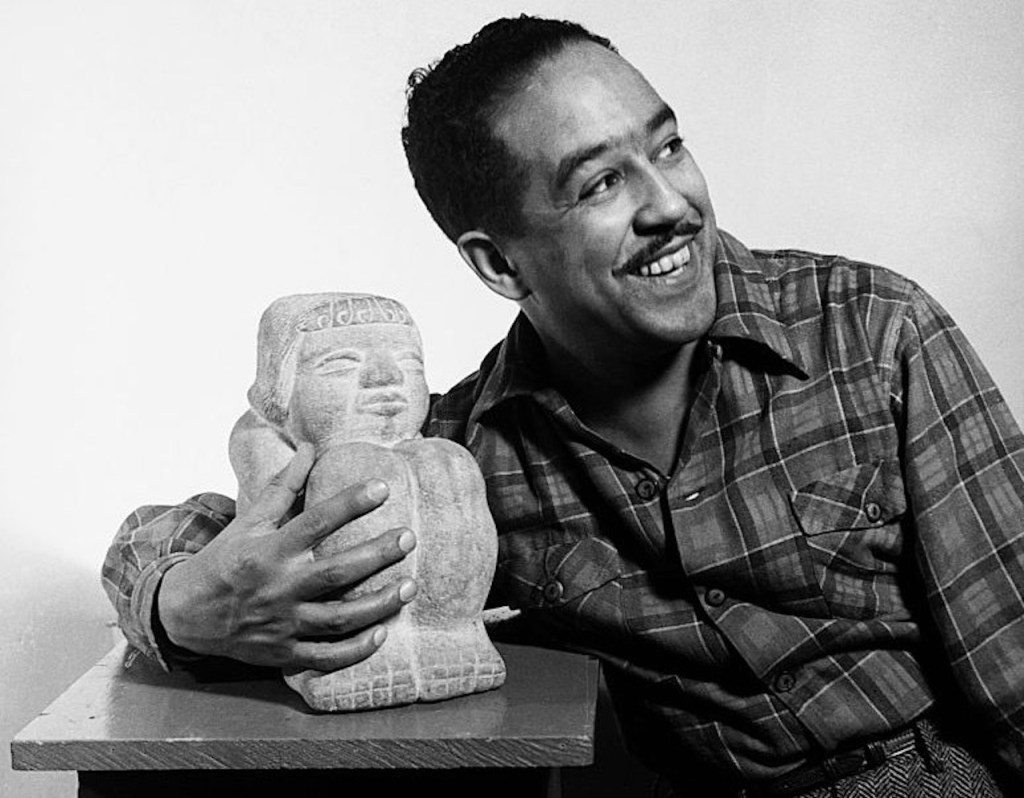
    Image:  Langston Hughes.  Library of Congress. Photographer Gordon Parks 

    Langston Hughes’ “The Negro Speaks of Rivers”

    Langston Hughes’ speaker in “The Negro Speaks of Rivers” displays his message in five versagraphic movements, thematically exploring his soul experience with a “cosmic voice,” which includes and unites all of humanity.

    Introduction and Text of “The Negro Speaks of Rivers”

    Langston Hughes’ speaker in “The Negro Speaks of Rivers” displays his message with a “cosmic voice,” which includes and unites all of humanity.  The poem plays out in five versagraphic movements, focusing on the theme of soul exploration.

    The Cosmic Voice in Poetry

    Writers, especially poets, often employ the “cosmic voice” in order to provide a deep and wide view of historical events and vast swaths of space.  A device called the omniscient speaker is often used in fiction; that voice is similar to the cosmic voice but much more limited.

    Time and space may stretch or contract as needed as the cosmic seer narrates what he experiences.  The “cosmic voice” may come to a poet through a vivid imagination; however, it transcends the imagination as a truth teller.   Only a few poets have been blessed with such a voice; examples are Emily Dickinson, Rabindranath Tagore, Paramahansa Yogananda, and to a limited degree Walt Whitman.

    The cosmic voice imparts truth through deep intuition.  The soul of the speaker employing the cosmic voice is, even if only temporarily as is the case with Langston Hughes, becomes aware of its vast and profound knowledge.  The cosmic voice speaks from a place far beyond ordinary sense awareness.  

    Individuals who comprehend the cosmic voice are bequeathed a consciousness far beyond their own sense awareness and thus comprehend the unity of all created things.  Those individuals are heralded into the realm of the Cosmic Creator and often remain transformed beings for having experienced that Sacred Locus.

    Langston Hughes and the Cosmic Voice

    The voice employed in “The Negro Speaks of Rivers” is not a whining, complaining one so often heard in the protest voices of activists; instead Hughes is employing the cosmic voice—the voice of the soul that knows itself to be a divine entity.  That voice speaks with inherent authority; it reports its intuitions so that others might hear and regain their own experiences through its guidance.

    Langston Hughes’ speaker in “The Negro Speaks of Rivers” imparts his discourse in five versagraphic movements.  His theme explores with the cosmic voice that unites all of humanity.  

    The vital lines that serve as a refrain—”I’ve known rivers” and “My soul has grown deep like the rivers”—work like a chant, instilling in the listener the truth that the speaker wishes to impart.  That Langston Hughes was able to employ a cosmic voice in a poem at age seventeen is quite remarkable.  

    Although some of his later work, even as much of it remained important and very entertaining, descended into the banal and at times even slipshod, no one can deny his marvelous accomplishment with this early poem in which he speaks as a master craftsman.

    The Negro Speaks of Rivers 

    I’ve known rivers:
    I’ve known rivers ancient as the world and older than the flow
    of human blood in human veins.

    My soul has grown deep like the rivers.

    I bathed in the Euphrates when dawns were young.
    I built my hut near the Congo and it lulled me to sleep.
    I looked upon the Nile and raised the pyramids above it.
    I heard the singing of the Mississippi when Abe Lincoln
         went down to New Orleans, and I’ve seen its muddy
         bosom turn all golden in the sunset.

    I’ve known rivers:
    Ancient, dusky rivers.

    My soul has grown deep like the rivers.

    Reading:   Langston Hughes reads his poem “The Negro Speaks of Rivers”

    Commentary on “The Negro Speaks of Rivers”

    Langston Hughes’ speaker in “The Negro Speaks of Rivers” stands as high testimony to the poet’s ability to craft genuine, heartfelt poetry.  To have composed such a profound piece of art at such an early age bespeaks a literary marvel.

    First Movement:  The River as a Symbol

    I’ve known rivers:
    I’ve known rivers ancient as the world and older than the flow
    of human blood in human veins.

    The poem opens with the speaker remarking rather nonchalantly that he has experienced the natural phenomenon known as “rivers.”  He has no doubt observed rivers flowing in their channels, and he has become aware that rivers flow through the earth as blood flows through the veins of human beings.  

    Both flowing rivers and flowing blood must be ancient, but the speaker intuits that the flow of the rivers surely predates that of the appearance of the human being upon the planet. The river image becomes a symbol linking all of humanity from the pre-historic era to the present day.   

    As the “river” has served to carry the physical encasements (bodies) and mental bodies over the rough terrain of land and rocks, the symbolic river carries the soul on its Divine journey.   Readers and listeners will easily intuit the significance of the speaker’s focus as it ranges far beyond the boundaries of the physical, material universe.

    Second Movement:  Intuitive Awareness

    My soul has grown deep like the rivers.

    This line indicates that the speaker has become aware that through his own soul he can intuit historical events, places, and people, who have existed from the beginning to time.  The line becomes a refrain and will be encountered again in the poem because of its great importance.  

    It becomes quite obvious that the speaker would not have been able to know literally the rivers of antiquity that he claims to “know.”  However, through his soul, or mystical awareness, he can.  Thus, he again employs the cosmic, thus mystical, voice to fashion his assertion.

    Third Movement: Historical Unity

    I bathed in the Euphrates when dawns were young.
    I built my hut near the Congo and it lulled me to sleep.
    I looked upon the Nile and raised the pyramids above it.
    I heard the singing of the Mississippi when Abe Lincoln
         went down to New Orleans, and I’ve seen its muddy
         bosom turn all golden in the sunset.

    The speaker claims that he “bathed in the Euphrates” at the dawning of Western civilization.  From the Euphrates to the Mississippi Rivers, the speaker offers a huge expansion of time and place.  

    In biblical times to present time, he lays claim to knowledge, again impossible except for soul consciousness. Awareness through the soul is unlimited, unlike the limitations of body and mind.  The speaker could not have experienced the Euphrates when “dawns were young.”  

    But the cosmic voice of the speaker can place itself at any point along the time line of civilization or cosmic creation. In claiming to have built his “hut near the Congo,” the speaker continues his cosmic, mystically inspired journey.  He “looked upon the Nile”  and “raised the pyramids” only as a cosmic-voiced speaker.

    People of all times and climes have been influenced by the river experience.  The speaker can thus unite all races, nationalities, creeds, and religions in his gathering of historic experiences within which all those peoples have lived.   And he accomplishes this feat through employment of the symbolic force of the “river.” 

    Emphasizing the American experience, the speaker claims to have “heard the singing of the Mississippi when Abe Lincoln / went / down to New Orleans . . . .”   The allusion to President Abraham Lincoln reminds the reader of the process of slave emancipation.

    As with all the rivers mentioned, the Mississippi River, an American river, stands as a symbol of the blood of the human race—not naturally segregated into color and national categories. The American Mississippi River, as the earlier mention of rivers has done, symbolizes the human blood of the human race—the only race that scientifically exists.

    Fourth Movement:  A Soul Chant

    I’ve known rivers:
    Ancient, dusky rivers.

    Because of the importance of the “river” as a symbol, the speaker repeats the line, “I’ve known rivers.”  Like the line, “My soul has grown deep like the rivers,” this one also  serves as a refrain.   If the speaker had chanted the line many more times, the poem’s delightful charm would have even been enhanced—that line is that crucial!

    The soul, the river, the depth of the soul and the river—all force history to yield a mighty blessing on those who have “known rivers,”  and whose souls have grown deep like those rivers. 

    Thus the speaker offers a brief description of how those river appear:  they are extremely old, and they are mystically dark, a measure that alludes to the dark-skinned race with graceful precision, even as it holds all races as having experienced the nature of the mystic river.

    Fifth Movement: Life Force and the Symbol of the River

    My soul has grown deep like the rivers.

    The speaker’s soul has grown profoundly deep like the rivers and along with the rivers.  Civilizations have grown up and grown deep along rivers all over Planet Earth. The soul that possesses the body is the life force informing and maintaining that body. 

    Likewise, rivers streaming through the earth give life force to civilizations and also assist in maintaining those civilization with the products and supplies that river travel has allowed over the centuries.

    The speaker is taking his own identity from the energetic force of the soul and the river force of the earth.  The children of the Divine Creative Reality (God) all spring forth from a common ancestry, a symbolic set of original parents.   It has always been rivers that link all of those ancestors as the blood in their veins links them into one family—the Human Race.

    The cosmic voice of a young poet—who happened possess the darker hue of skin along the color spectrum—has rendered a statement that could enlighten and reconnect all peoples if only they could listen with their own cosmic awareness.  

    At the soul level, all human beings remain eternally linked as children of the Great Divine River King (God). That River God flows in the blood of His offspring. And that same River God flows in the rivers of the planet on which they find themselves too often segregated by ignorance of their own common being as sparks of the Divine.

    Instead of identifying with the perishable body and changeable mind that too often rule, the simple act of identifying with their own cosmic nature would allow individuals to experience the cosmic voice of their own soul. The simple poet named Langston Hughes has offered a useful template for viewing the world through a cosmic lens in his nearly perfect poem.

    🕉

    You are welcome to join me on the following social media:
    TruthSocial, Locals, Gettr, X, Bluesky, Facebook, Pinterest 

    🕉

    Share

  • Rabindranath Tagore’s “Light the Lamp of Thy Love”

    Image: Rabindranath Tagore – Portrait by William Rothenstein

    Rabindranath Tagore’s “Light the Lamp of Thy Love”

    Rabindranath Tagore’s poem “Light the Lamp of Thy Love” is a devotional lyric that expresses the speaker’s longing for self-realization. Through colorful imagery, the poem explores themes of transformation, redemption, and the transcendence of human limitation through spiritual awakening.

    Introduction and Text of “Light the Lamp of Thy Love”

    Rabindranath Tagore, a Nobel laureate poet and philosopher, often infused his works with spiritual depth and mysticism. His lyric “Light the Lamp of Thy Love” offers a prayerful plea for divine intervention, as the speaker implores a higher power to dispel darkness and replace it with enlightenment. 

    The poem’s structure follows a gathering movement from supplication to transformation, resulting in the profound realization of divine presence, also known as self-realization or God-union. Tagore employs vivid metaphors—lamps, light, and gold—to symbolize the process of spiritual purification. 

    The repetition of phrases reinforces the urgency of the speaker’s plea, while the invocation of touch underscores the immediacy of divine grace. The poem’s universal theme of seeking enlightenment resonates beyond religious confines, making it a poignant reflection on the human soul’s yearning for transcendence.

    Paramahansa Yogananda refashioned this poem into a chant that is performed at SRF meditation gatherings and ceremonies.  Immediately below the poem, there is a video of the SRF monks chanting the piece at one of SRF’s World Convocations.

    Light the Lamp of Thy Love

    In my house, with Thine own hands,
    Light the lamp of Thy love!
    Thy transmuting lamp entrancing,
    Wondrous are its rays.
    Change my darkness to Thy light, Lord!
    Change my darkness to Thy light.
    And my evil into good.
    Touch me but once and I will change,
    All my clay into Thy gold
    All the sense lamps that I did light
    Sooted into worries
    Sitting at the door of my soul,
    Light Thy resurrecting lamp!

    Commentary on “Light the Lamp of Thy Love”

    Rabindranath Tagore’s poem “Light the Lamp of Thy Love” serves a prayer for divine illumination or God-union (also known as self-realization), reflecting an intense spiritual longing. The speaker acknowledges human frailty and desires transformation through divine grace. Each movement of the poem builds upon the preceding one, deepening the speaker’s surrender to the divine will.

    First Movement: Invocation of Divine Light

    In my house, with Thine own hands,
    Light the lamp of Thy love!

    The speaker begins with a direct appeal to the divine, requesting illumination within his own “house,” a metaphor for the soul. The imagery of the divine hand lighting the lamp suggests an intimate and personal act of grace. 

    This scenario establishes the poem’s central theme of spiritual awakening as a force intervening in the speaker’s internal world. The use of the imperative conveys urgency as well as personal familiarity, emphasizing human dependency on divine intervention for enlightenment.  This evocative opening sets the tone for the poem’s progression from entreaty to transformation.

    Second Movement: Transformation through Divine Light

    Thy transmuting lamp entrancing,
    Wondrous are its rays.
    Change my darkness to Thy light, Lord!
    Change my darkness to Thy light.
    And my evil into good.

    In the second movement, the speaker acknowledges the power of divine enlightenment, describing it as “entrancing” and “wondrous.” The repetition of “Change my darkness to Thy light” underscores the urgency and necessity of divine transformation. Darkness symbolizes ignorance, sin, and suffering, while light represents wisdom, virtue, and divine grace. 

    The explicit plea to change evil into good reflects Tagore’s vision of spiritual evolution, wherein the divine presence purges human flaws.   This movement portrays transformation as both passive and active—the speaker submits to divine will while the divine force actively reshapes his essence. The imagery of light as a catalyst for moral and spiritual purification aligns with Tagore’s broader philosophical themes of unity between the self and the divine.

    Third Movement: Spiritual Alchemy

    Touch me but once and I will change,
    All my clay into Thy gold

    The speaker then expresses absolute faith in divine transformation, emphasizing the power of a single divine touch. The contrast between “clay” and “gold” serves as a metaphor for spiritual alchemy—earthly, flawed existence is refined into something pure and incorruptible. 

    This suggestion reflects the Upanishadic tenet that the soul has potential to merge with the divine.   The phrase “but once” highlights the immediacy and sufficiency of divine intervention, reinforcing the idea that enlightenment is not a gradual process but an instantaneous, transcendent experience, after conditions become aligned.

    Fourth Movement: Renunciation of Material Attachments

    All the sense lamps that I did light
    Sooted into worries
    Sitting at the door of my soul,
    Light Thy resurrecting lamp!

    In this final movement, the speaker reflects on past attempts to find light through worldly means, represented by “sense lamps.” These artificial lights, linked to sensory experiences, have only resulted in “worries,” suggesting that material pursuits lead to disillusionment. 

    The speaker, becoming aware that the Divine Reality is “sitting at the door of my soul,” finds himself in a precarious position, awaiting true illumination. The plea for the “resurrecting lamp” signifies the desire for rebirth through divine grace. 

    This conclusion emphasizes the contrast between self-induced, transient sources of light and the enduring illumination provided by the Divine. Tagore’s imagery addresses surrender and renewal, resulting in the speaker’s complete reliance on divine intervention for enlightenment.

    A Philosophy of Divine Love

    “Light the Lamp of Thy Love” encapsulates Tagore’s philosophy of divine love as the ultimate source of transformation. The poem progresses from invocation to surrender, illustrating the speaker’s deepening spiritual realization.   Tagore employs symbolic imagery—light, lamps, gold—to depict the process of transcendence, wherein the divine presence eradicates darkness and imparts purity. 

    The repetition of phrases reinforces the speaker’s desperation for enlightenment, while the shift from self-lit lamps to the resurrecting lamp signifies the futility of worldly pursuits in comparison to divine grace. 

    The interplay between passivity and divine action suggests that while human effort is insufficient for true transformation, surrender to divine will results in ultimate fulfillment.

    Tagore’s devotional lyric aligns with the Bhakti tradition, where longing for divine presence is central. However, its universal message extends beyond religious boundaries, addressing the fundamental human desire for meaning, clarity, and redemption.  The poem’s cyclical structure, resulting in divine illumination, parallels the spiritual journey from ignorance to wisdom. 

    By portraying the speaker’s progression from a seeker to one awaiting divine grace, Tagore underscores the idea that true enlightenment is not self-generated but received through divine compassion.  Ultimately, “Light the Lamp of Thy Love” serves as a meditation on the transformative power of divine love and its ability to guide the human soul toward transcendence.

    Image: Rabindranath Tagore – Portrait by Unknown Artist

  • A Musing on Overcoming Fear

    Image:  Created by Grok

    A Musing on Overcoming Fear

    Five Major Sources That Elicit in Me Fear of Pain

    Most important to remember:  fear “. . . attracts the very thing you fear.”

    Paramahansa Yogananda:  “Whatever it is that you fear, take your mind away from it and leave it to God. Have faith in Him. Much suffering is due simply to worry. Why suffer now when the malady has not yet come? Since most of our ills come through fear, if you give up fear you will be free at once. The healing will be instant. Every night, before you sleep, affirm: “The Heavenly Father is with me; I am protected.” Mentally surround yourself with Spirit….You will feel His wonderful protection.”

    Paramahansa Yogananda:  “Trust in God and destroy fear, which paralyzes all efforts to succeed and attracts the very thing you fear.”

    1. Status in Astral World: because of failure to attain goal
    2. Losing Ron
    3. Gaining weight: not losing to desired goal
    4. Not being able to quit coffee
    5. Accidents, diseases, old age losing ability to function and pain in general

    Overcoming Fear of Pain for Each Source

    1. Status in Astral World: because of failure to attain samadhi:

    I don’t remember being born in this incarnation.  So I don’t remember what it was like when I was last in the Astral World.  Leave it to God and Guru: “Leave a few mysteries to explore in Eternity,” says Sri Yukteswar in Paramahansa Yogananda’s Autobiography of a Yogi

    2.  Losing Ron: One day at a time.  With guidance from God and Guru.  We are not given more than we can deal with.  Guruji says:  “You should be prepared to deal with all problems of health, mind, and soul by common sense methods and faith in God, knowing that in life or death your soul remains unconquered.”  I am more likely to shuffle off first, but if I do not, I know I would do what I had to do . . . still . . . ?!

    3.  Gaining weight or not losing to desired goal:  From SRF talk, Brother Anantananda:  “Fear disrupts our natural inner harmony, causing physical, mental, and spiritual disturbances. But as we learn to live more in the calm interior silence of the soul, we discover an inner sanctuary where worries and fears cannot intrude — and where we are ever safe and secure in our oneness with the Divine.” 

    4.  Not being able to quit coffee: Remember the little drunk devotee in the lesson “The Bad Man Who Was Preferred By God.”

    5.  Accidents, diseases, and pain in general:  “Daily devotional contact with the Eternal Source of security and resilience is the way to train ourselves to a constant, lived affirmation of our souls’ power to ‘stand unshaken amidst the crash of breaking worlds’.”  —A New Year’s Message From Brother Chidananda 2022

    Whenever a stray fear pops up such as fear of losing physical and cognitive ability—just let it go just like the others, give it God and Guruji.  They are in control, not me.   

    Most important to remember:  

    fear “. . . attracts the very thing you fear.”

    And then there are regrets: 

    Biggest regret:  that I have not been able to to influence my family to study and follow the spiritual teachings of Paramahansa Yogananda.  I must not be a good enough example for them to follow or even wonder about.  

    Answer:  I cannot control the karma of others.  I must take care of my own soul.  The others belong to God.  God is guiding them as He sees fit.  Again, let it go and leave it to God and Gurus.