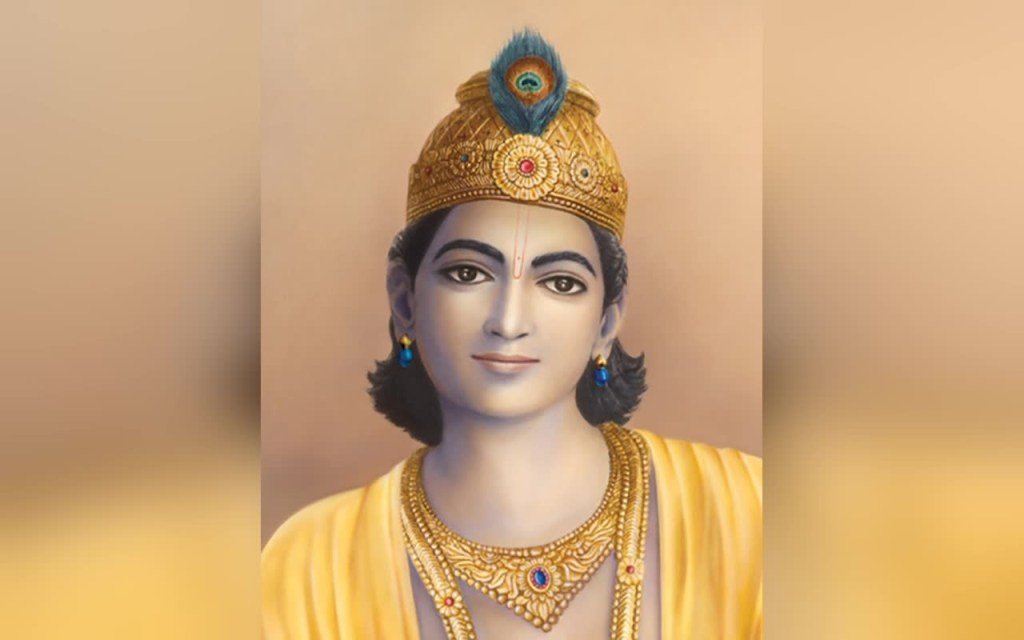
Paramahansa Yogananda’s “My Krishna Is Blue”
Paramahansa Yogananda’s “My Krishna Is Blue” reveals the chanter’s yearning for union with Krishna consciousness. He is envisioning a state beyond ordinary awareness, where the soul rises to the highest level of divine realization—self-realization.
Introduction and Text of “My Krishna Is Blue”
Paramahansa Yogananda’s “My Krishna Is Blue” is a devotional chant consisting of three movements. Through chant repetition and simplicity, the chanter dramatizes his profound love for Krishna and his longing to dwell perpetually in the Divine Presence.
The chant progresses from recognition to aspiration and finally to spiritual identification. The chanter first notices a correspondence between Krishna and the blue tamal tree, then expresses a desire to ascend to its highest branch, and finally longs to die where Krishna sat.
On the literal level, the chanter appears to be praising a tree associated with Krishna. On the mystical level, however, the imagery points beyond physical nature toward the soul’s desire to attain the exalted consciousness embodied by Krishna.
My Krishna Is Blue
My Krishna is blue;
the tamal tree is blue.
My Krishna is blue;
The tamal tree is blue.
So I do love thee, tamal tree!
So I do love thee, my tamal tree!
And when I die, O Mother!
Do put me high
On a branch of the tamal tree,
On a branch of the tamal tree.
Where Krishna sat, there I would die,
Where Krishna sat, there I would die,
On a branch of the tamal tree,
On a branch of the tamal tree.
Commentary on “My Krishna Is Blue”
Paramahansa Yogananda’s “My Krishna Is Blue” reveals the soul’s devotion to the Divine Beloved. The chanter’s simple chant also expresses a profound spiritual aspiration toward God-union.
First Movement: “My Krishna is blue”
My Krishna is blue;
the tamal tree is blue.
My Krishna is blue;
The tamal tree is blue.
So I do love thee, tamal tree!
So I do love thee, my tamal tree!
The chanter begins by establishing an identity between Krishna and the tamal tree. Both are described as blue, and that shared quality causes the chanter to regard the tree with affection and reverence.
The repetition carries the force of devotional musing rather than ordinary description. The chanter seems to be dwelling lovingly upon a spiritual correspondence that links the visible object with the Divine Reality symbolized by Krishna.
Because Krishna and the tamal tree share the same color, the tree becomes more than a botanical object. It functions as an emblem of Krishna consciousness and therefore deserves the chanter’s devotion.
The declaration—“So I do love thee, tamal tree!”—reveals that the chanter’s love for the tree derives from its association with Krishna. The affection is not directed toward matter but toward the divine presence reflected through matter.
The repeated address, “my tamal tree,” adds intimacy to the relationship. The chanter regards the tree as a sacred possession because it serves as a reminder of the beloved Lord.
Paramahansa Yogananda frequently emphasizes perceiving God’s presence throughout creation. Paramahansa Yogananda explains that divine consciousness may be perceived behind all forms, and the chanter’s vision reflects that spiritual perception.
On my literary website Linda’s Literary Home, I have discussed how poets often employ physical imagery to suggest metaphysical realities. The chanter similarly employs the visible tamal tree as a symbol pointing toward an invisible spiritual state.
The stanza therefore moves beyond literal description. Through the repeated equation of Krishna and the blue tamal tree, the chanter transforms a natural image into a symbol of divine consciousness.
Second Movement: “And when I die, O Mother!”
And when I die, O Mother!
Do put me high
On a branch of the tamal tree,
On a branch of the tamal tree.
The second stanza shifts from recognition to aspiration. Having established the sacred significance of the tamal tree, the chanter now expresses a fervent desire regarding his own destiny.
The address to “Mother” adds emotional intensity, referring to the Divine Mother. The invocation conveys humility and dependence before a higher power. At first glance, the request appears unusual. The chanter asks to be placed “high” upon a branch of the tamal tree rather than buried or laid to rest in some conventional manner.
The word “high” becomes the stanza’s crucial term. The chanter does not merely seek proximity to the tree; he desires elevation within it. Such elevation suggests ascent rather than location. The imagery points toward a higher level of consciousness rather than a merely physical position.
The branch functions as a metaphorical rather than literal destination. To imagine a devotee sincerely wishing to have his body suspended in a tree would diminish the spiritual seriousness of the chant. Instead, the high branch symbolizes the summit of awareness. The chanter longs to rise to the highest attainable state of realization.
Paramahansa Yogananda repeatedly teaches that human consciousness may ascend from body-awareness to soul-awareness through spiritual discipline. The chanter’s longing for the highest branch harmonizes with that teaching of spiritual ascent.
On my literary website Linda’s Literary Home, I have often observed that poetry rarely states its deepest meanings directly. Through symbol and suggestion, poets allow intuition to perceive realities that ordinary language cannot adequately express. Thus the high branch becomes an image of supreme spiritual attainment. The chanter prays not for physical elevation but for the soul’s ascent into divine consciousness.
Third Movement: “Where Krishna sat, there I would die”
Where Krishna sat, there I would die,
Where Krishna sat, there I would die,
On a branch of the tamal tree,
On a branch of the tamal tree.
The final stanza reveals the chanter’s ultimate desire. He wishes to die precisely where Krishna sat. The statement deepens the symbolic significance of the branch. It is not merely high; it is the place occupied by Krishna. If Krishna represents perfected divine consciousness, then the branch symbolizes the level of realization attained by that consciousness. The chanter longs to occupy the same spiritual station.
The repeated line intensifies the devotional yearning. The chanter does not seek worldly rewards, intellectual accomplishment, or heavenly pleasures. Instead, he desires complete identification with Krishna. The aspiration is one of union rather than admiration from a distance.
The word “die” also carries spiritual significance. Mystical literature frequently employs death as a symbol for the dissolution of ego-consciousness.The chanter therefore longs for the extinction of the limited self in the very state inhabited by Krishna. Such a death would not signify annihilation but fulfillment.
Paramahansa Yogananda teaches that the soul’s highest goal is realization of its unity with Spirit. The chanter’s desire to die where Krishna sat reflects precisely such a yearning for God-union. The repeated return to the tamal tree completes the chant’s symbolic design. What began as a blue tree associated with Krishna culminates as a metaphor for the highest spiritual center.
The chant’s simplicity is permeated with remarkable depth. Through the image of a blue tamal tree and its highest branch, the chanter dramatizes the soul’s longing to rise into Krishna consciousness and experience the liberating realization of divine union.
 Linda's Literary Home