Linda's Literary Home

Tag: spirituality

  • The Reality of Human Differences

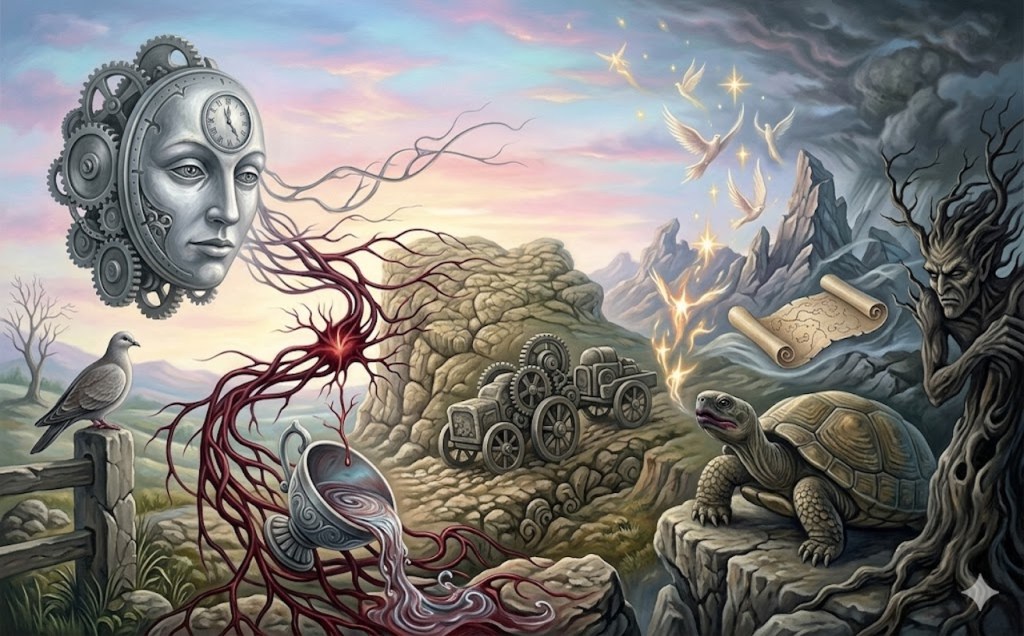
    Image created by ChatGPT/Grok inspired by the poem
    Image created by ChatGPT/Grok inspired by the poem

    The Reality of Human Differences

    We live in a world where no two people are exactly alike. Human beings possess differing interests, ideas, and intentions, a fact that makes relationships inherently difficult. When you look at how distinct we all are on the inside, it is no wonder that it is so rare for any one human being to develop a peaceful and purposeful relationship with another.

    The Root of the Difficulty

    This struggle for human beings to get along is built right into the fabric of creation. As the unmanifested Spirit, God is pure Bliss, but to create the world, He utilized a cosmic deception called maya—the grand magical measurer [1]. Paramahansa Yogananda explains this cosmic setup [2]:

    Spirit overspread and permeated Its creative desire with cosmic delusion, a grand magical measurer described in Hindu scriptures as maya (from the Sanskrit root ma, “to measure”). Delusion divides, measures out, the Undefined Infinite into finite forms and forces.

    Delusion divides the Undefined Infinite into finite forms. Because of this division, we all navigate existence with avidya, or individual illusion, which makes us feel completely separate from everyone else. Trapped in individual egos, our human condition unfolds through a multiplicity of perspectives.

    Most of our trouble comes from the fact that we look at life through our five senses and limited human minds, yet the senses are unreliable, catching only what happens on the changing, physical level. 

    When the Infinite is chopped up into billions of separate human beings—each shaped by unique experiences, temperaments, and aspirations—individual persons develop their own unique set of desires and motives. With so many different minds running around, it is a mathematical certainty that our intentions will eventually clash.

    The Myth of Effortless Harmony

    These divergences extend beyond mere preferences into our core intentions—the silent drivers of daily choices and long-term paths. Relationships, by their nature, require constant negotiation between these distinct inner worlds.

    The family unit, often idealized as a sanctuary of unconditional unity, frequently illustrates this 

    challenge most acutely. Siblings raised in the same household may develop opposing worldviews, while parents and children encounter generational shifts in values that widen the gap between expectation and reality. 

    Similarly, the marital bond confronts the daily reality of two separate consciousnesses attempting to merge trajectories, and friendships dissolve when evolving intentions pull individuals in irreconcilable directions.

    Because we are wrapped up in personal illusions, finding true harmony with another person is incredibly rare. To achieve a peaceful and purposeful relationship, two people must quiet their egos enough to see past their own selfishness. 

    The inner world of another person—their hurts, thoughts, and true intentions—is entirely ineffable. It resembles the experience of tasting an orange: on the material plane, you can try to describe the taste to someone, but they will never truly know it until they taste it themselves. We can never perfectly climb inside someone else’s mind.

    Dr. David Frawley notes that to find true harmony, we must look deeper [3]:

    We can discover that Divine face and presence of consciousness everywhere, but for this to occur, we must first discover it within our own hearts and in the hearts of all beings.  Most people have not found that presence within themselves yet, so they remain stuck in the outer shell of the ego. And where there is ego, there is friction.

    Redefining Relationship Fractures

    With human nature structured this way, we should not be shocked when things fall apart. Fractured family relationships, broken marriages, and ended friendships are natural phenomena in a dualistic universe. 

    In a material world defined by constant change and division, things come together and things fall apart. Just as creation itself goes through cycles of manifestation and dissolution [4], human relationships go through cycles too. When the underlying reasons that brought two people together expire, the relationship naturally dissolves.

    Society loves to play the blame game, immediately searching for a villain when a relationship fails. Much suffering arises from the imposition of these unrealistic ideals—the belief that true love conquers all differences effortlessly, or that familial duty demands perpetual agreement. When reality falls short, individuals internalize failure or assign fault.

    Assigning bitter blame is usually a mistake. It assumes that everyday human beings have the spiritual power to override the laws of maya at will. Until a person learns to completely quiet the body and the mind so the soul can take over, they will be pushed and pulled by their changing ideas and desires. 

    Broken marriages often reflect the honest recognition that continued union would stifle the authentic development of one or both partners; ended friendships signify the natural completion of a shared chapter rather than betrayal.

    Removing Blame and Accepting Reality

    If we want to have peace of mind, we must accept reality without holding onto resentment. I am Linda Sue Grimes, and as I have mentioned before, I have many aspects and nicknames—Sissy to my sister, Grammy to my grandkids, and Nubbies to my husband. Those roles are a part of my life, but they are not the eternal soul. Human relationships are temporary arrangements on the physical plane.

    By recognizing relationships as dynamic interactions between distinct souls rather than proofs of personal merit, we cultivate compassion and remove blame. When a relationship ends, it is not always because someone is an evil person, but simply because the temporary alignment of their interests has come to a natural end. Accepting this truth softens the blow for postmodern minds constantly hurt by broken hearts.

    When two people do manage to bridge that massive gap and create a beautiful bond, it stands as a genuine, transcendent blessing.  Such connections require conscious cultivation: patience to listen beyond surface disagreement, humility to release the need for complete agreement, and wisdom to honor the other’s path even when it diverges. 

    This understanding aligns with broader spiritual insight. The difficulties of human connection invite the development of virtues—forgiveness, adaptability, and non-attachment—that facilitate progress on the spiritual path.

    Ultimately, the human journey involves balancing the longing for connection with the reality of separateness. When intentions can harmonize sufficiently to allow mutual flourishing, something sacred occurs. When they cannot, releasing the bond with understanding preserves dignity and opens space for new possibilities.

    An Important Caveat

    However, a crucial distinction must be made: relinquishing blame and judgment of others does not mean we suffer fools and criminals. It must be acknowledged that evil does exist in this world of maya delusion, and evil individuals do try to victimize the innocent. 

    The understanding that human intentions diverge because of individual illusion is a philosophical tool for personal peace, not an excuse for passivity or a license for others to do harm.

    Criminals must still be prosecuted to the full extent of the law. Society requires structure and protection from those whose delusions manifest as destructive violence or fraud. Furthermore, evil acts that may not be punishable by civil law still require banishment from one’s life. 

    Boundaries are essential; recognizing that an individual is acting out of ignorance or avidya does not mean you must allow them to remain a toxic presence in your domestic or social circle.

    It is simply that crimes against us can be forgiven by us even if they are not forgiven by the legal system. The legal system must punish the act to preserve order on the material plane, but the individual victim can choose to release the burning resentment within their own heart. 

    Forgiveness is a spiritual function of the soul that frees the victim from the karmic tie of hatred, allowing them to move forward in quietude, even as the law takes its necessary course.

    Sources

    [1] Paramahansa Yogananda.  “Maya.”  Self-Realization Fellowship.  Accessed June 22, 2026.
    [2] Editors. “Law of Maya.” Paramahansa Yogananda: The Royal Path of Yoga. Accessed June 22, 2026.
    [3] David Frawley. “Is Hinduism a Monotheistic Religion?American Institute of Vedic Studies. August 27, 2014.
    [4] Swami Sri Yukteswar. The Holy Science. Internet Archive.  Originally published by Self-Realization Fellowship.

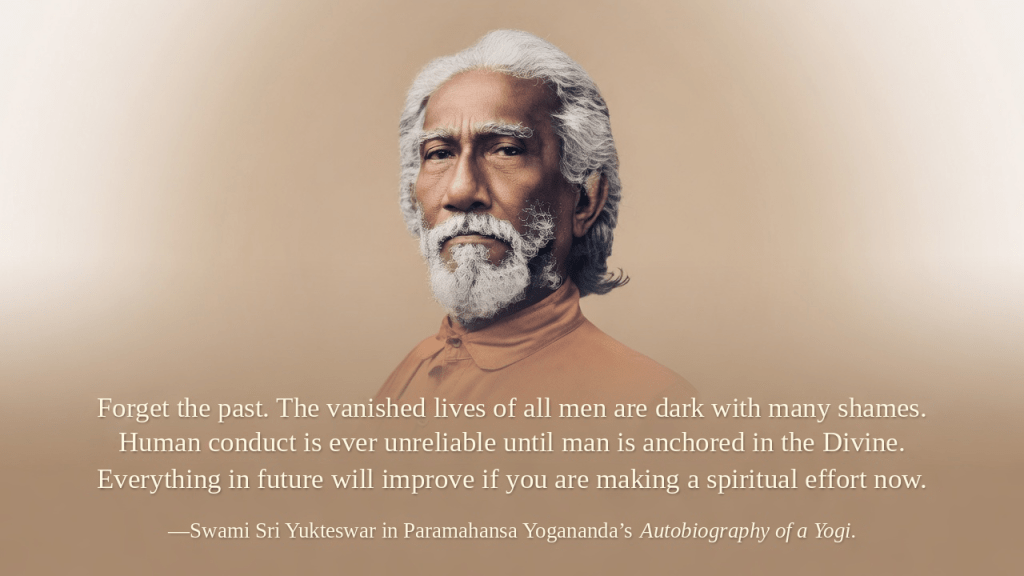
    Sri Yukteswar and “Forget the Past” quotation
  • Time’s Hands

    Image created by Gemini inspired by the poem
    Image created by Gemini inspired by the poem

    Time’s Hands

    Time’s hands unveil as morning’s glow fades,
    A silver face like pewter forward parades.
    In silence, like the dove on fence post still,
    The pewter visage moves with quiet will.

    The mind holds desires in a brimming cup,
    No calming stone of regret to lift up.
    As blood flushes cheeks in meandering flow,
    A vein in the brain bursts, letting life go.

    Skin stays unchanged through centuries long,
    Where invented wheels roll, heavy and strong.
    Unswayed by mourners’ destiny so grim,
    An endless route of minds, intruding, skims.

    The turtle’s dark lips part in silent speech,
    Each soul burns star-like, beyond earthly reach.
    Over rocks of intrigue and fury they soar,
    As mapping songs on breezes gently pour.

    Stone wise, the world remains a place so hard,
    Brute gales and pestilence, hidden, stand guard.
    Tempting the margins with blasts of sin’s might,
    The devil plays judge, spinning games of spite.

  • Paramahansa Yogananda’s “My Krishna Is Blue”

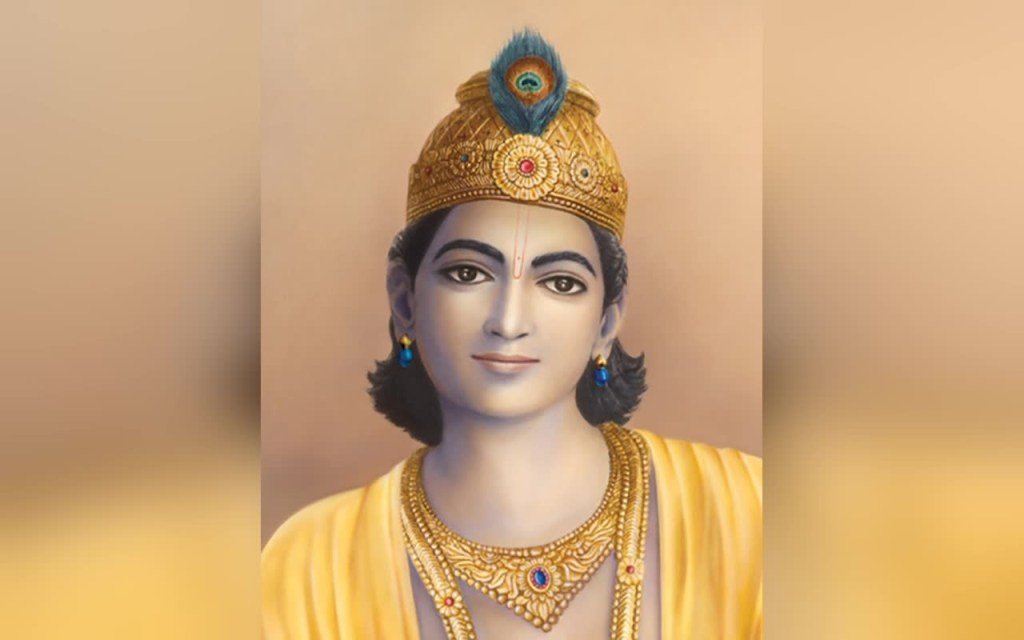
    Image:  Bhagavan Krishna Self-Realization Fellowship https://bookstore.yogananda-srf.org/product/bhagavan-krishna-altar-photo-color/
    Image: Bhagavan Krishna – Self-Realization Fellowship

    Paramahansa Yogananda’s “My Krishna Is Blue”

    Paramahansa Yogananda’s “My Krishna Is Blue” reveals the chanter’s yearning for union with Krishna consciousness. He is envisioning a state beyond ordinary awareness, where the soul rises to the highest level of divine realization—self-realization.

    Introduction and Text of “My Krishna Is Blue”

    Paramahansa Yogananda’s “My Krishna Is Blue” is a devotional chant consisting of three movements. Through chant repetition and simplicity, the chanter dramatizes his profound love for Krishna and his longing to dwell perpetually in the Divine Presence.

    The chant progresses from recognition to aspiration and finally to spiritual identification. The chanter first notices a correspondence between Krishna and the blue tamal tree, then expresses a desire to ascend to its highest branch, and finally longs to die where Krishna sat.

    On the literal level, the chanter appears to be praising a tree associated with Krishna. On the mystical level, however, the imagery points beyond physical nature toward the soul’s desire to attain the exalted consciousness embodied by Krishna.

    My Krishna Is Blue

    My Krishna is blue;
    the tamal tree is blue.
    My Krishna is blue;
    The tamal tree is blue.
    So I do love thee, tamal tree!
    So I do love thee, my tamal tree!

    And when I die, O Mother!
    Do put me high
    On a branch of the tamal tree,
    On a branch of the tamal tree.

    Where Krishna sat, there I would die,
    Where Krishna sat, there I would die,
    On a branch of the tamal tree,
    On a branch of the tamal tree.

    Commentary on “My Krishna Is Blue”

    Paramahansa Yogananda’s “My Krishna Is Blue” reveals the soul’s devotion to the Divine Beloved. The chanter’s simple chant also expresses a profound spiritual aspiration toward God-union.

    First Movement:  “My Krishna is blue”

    My Krishna is blue;
    the tamal tree is blue.
    My Krishna is blue;
    The tamal tree is blue.
    So I do love thee, tamal tree!
    So I do love thee, my tamal tree!

    The chanter begins by establishing an identity between Krishna and the tamal tree. Both are described as blue, and that shared quality causes the chanter to regard the tree with affection and reverence.

    The repetition carries the force of devotional musing rather than ordinary description. The chanter seems to be dwelling lovingly upon a spiritual correspondence that links the visible object with the Divine Reality symbolized by Krishna.

    Because Krishna and the tamal tree share the same color, the tree becomes more than a botanical object. It functions as an emblem of Krishna consciousness and therefore deserves the chanter’s devotion.

    The declaration—“So I do love thee, tamal tree!”—reveals that the chanter’s love for the tree derives from its association with Krishna. The affection is not directed toward matter but toward the divine presence reflected through matter.

    The repeated address, “my tamal tree,” adds intimacy to the relationship. The chanter regards the tree as a sacred possession because it serves as a reminder of the beloved Lord.

    Paramahansa Yogananda frequently emphasizes perceiving God’s presence throughout creation. Paramahansa Yogananda explains that divine consciousness may be perceived behind all forms, and the chanter’s vision reflects that spiritual perception.

    On my literary website Linda’s Literary Home, I have discussed how poets often employ physical imagery to suggest metaphysical realities. The chanter similarly employs the visible tamal tree as a symbol pointing toward an invisible spiritual state.

    The stanza therefore moves beyond literal description. Through the repeated equation of Krishna and the blue tamal tree, the chanter transforms a natural image into a symbol of divine consciousness.

    Second Movement: “And when I die, O Mother!”

    And when I die, O Mother!
    Do put me high
    On a branch of the tamal tree,
    On a branch of the tamal tree.

    The second stanza shifts from recognition to aspiration. Having established the sacred significance of the tamal tree, the chanter now expresses a fervent desire regarding his own destiny.

    The address to “Mother” adds emotional intensity, referring to the Divine Mother. The invocation conveys humility and dependence before a higher power. At first glance, the request appears unusual. The chanter asks to be placed “high” upon a branch of the tamal tree rather than buried or laid to rest in some conventional manner.

    The word “high” becomes the stanza’s crucial term. The chanter does not merely seek proximity to the tree; he desires elevation within it.  Such elevation suggests ascent rather than location.  The imagery points toward a higher level of consciousness rather than a merely physical position.

    The branch functions as a metaphorical rather than literal destination.  To imagine a devotee sincerely wishing to have his body suspended in a tree would diminish the spiritual seriousness of the chant. Instead, the high branch symbolizes the summit of awareness. The chanter longs to rise to the highest attainable state of realization.

    Paramahansa Yogananda repeatedly teaches that human consciousness may ascend from body-awareness to soul-awareness through spiritual discipline. The chanter’s longing for the highest branch harmonizes with that teaching of spiritual ascent.

    On my literary website Linda’s Literary Home, I have often observed that poetry rarely states its deepest meanings directly.  Through symbol and suggestion, poets allow intuition to perceive realities that ordinary language cannot adequately express.  Thus the high branch becomes an image of supreme spiritual attainment.  The chanter prays not for physical elevation but for the soul’s ascent into divine consciousness.

    Third Movement: “Where Krishna sat, there I would die”

    Where Krishna sat, there I would die,
    Where Krishna sat, there I would die,
    On a branch of the tamal tree,
    On a branch of the tamal tree.

    The final stanza reveals the chanter’s ultimate desire. He wishes to die precisely where Krishna sat.  The statement deepens the symbolic significance of the branch. It is not merely high; it is the place occupied by Krishna.  If Krishna represents perfected divine consciousness, then the branch symbolizes the level of realization attained by that consciousness. The chanter longs to occupy the same spiritual station.

    The repeated line intensifies the devotional yearning. The chanter does not seek worldly rewards, intellectual accomplishment, or heavenly pleasures.  Instead, he desires complete identification with Krishna. The aspiration is one of union rather than admiration from a distance.

    The word “die” also carries spiritual significance. Mystical literature frequently employs death as a symbol for the dissolution of ego-consciousness.The chanter therefore longs for the extinction of the limited self in the very state inhabited by Krishna. Such a death would not signify annihilation but fulfillment.

    Paramahansa Yogananda teaches that the soul’s highest goal is realization of its unity with Spirit. The chanter’s desire to die where Krishna sat reflects precisely such a yearning for God-union.  The repeated return to the tamal tree completes the chant’s symbolic design. What began as a blue tree associated with Krishna culminates as a metaphor for the highest spiritual center.

    The chant’s simplicity is permeated with remarkable depth. Through the image of a blue tamal tree and its highest branch, the chanter dramatizes the soul’s longing to rise into Krishna consciousness and experience the liberating realization of divine union.

  • Emily Dickinson’s “The Soul’s distinct connection”

    Image: Emily Dickinson - Amherst College - Daguerrotype of the poet at age 17, circa 1847 - likely the only authentic, extant likeness of the poet
    Image: Emily Dickinson – Amherst College – Daguerrotype of the poet at age 17, circa 1847 – likely the only authentic, extant likeness of the poet

    Emily Dickinson’s “The Soul’s distinct connection”

    The speaker in Emily Dickinson’s “The Soul’s distinct connection” reveals that immortality is suddenly disclosed through shock and danger experiences.

    Introduction and Text of “The Soul’s distinct connection”

    The speaker presents “The Soul’s distinct connection” as a compressed American-Innovative lyric exploring spiritual perception. Its short lines and slant rimes create a sudden movement from idea to visionary image. The speaker suggests immortality is not gradual knowledge but a flash of direct awareness.

    The speaker frames immortality as something revealed through sudden crisis rather than gradual understanding. The structure anticipates a metaphysical shock that disrupts ordinary perception.

    The Soul’s distinct connection”

    The Soul’s distinct connection
    With immortality
    Is best disclosed by Danger
    Or quick Calamity –

    As Lightning on a Landscape
    Exhibits Sheets of Place –
    Not yet suspected – but for Flash –
    And Click – and Suddenness.

    Commentary on “The Soul’s distinct connection”

    The speaker frames immortality as something revealed through sudden crisis rather than gradual understanding. The structure anticipates a metaphysical shock that disrupts ordinary perception.  Her vision aligns with Paramahansa Yogananda’s teaching that immortality is perceived through sudden inner awakening beyond ordinary awareness.

    First Stanza: The Soul and Immortality

    The Soul’s distinct connection
    With immortality
    Is best disclosed by Danger
    Or quick Calamity –

    In the first stanza, the speaker defines a direct relationship between the soul and immortality, presenting the connection as inherent rather than acquired, embedded within the very structure of consciousness itself. This connection is not continuously visible in ordinary perception, but it becomes evident when danger or sudden calamity interrupts the expected flow of life and thought. 

    Paramahansa Yogananda explains that the soul perceives immortality most clearly when the mind is startled into higher awareness beyond sensory routine, allowing intuitive consciousness to rise above temporal limitation enabling perception of immortality as immediate experience rather than abstract belief grounded in time-bound reasoning.

    In the phrase “Danger / Or quick Calamity,” the speaker emphasizes the disruptive force required to awaken spiritual perception, suggesting that only extreme interruption can break habitual mental patterns. 

    On my literary website Linda’s Literary Home, I have discussed the fact that Dickinson often uses shock imagery to reveal hidden spiritual states, where disruption becomes a gateway to deeper awareness of the soul. 

    Here the speaker suggests that spiritual awareness emerges when normal continuity is broken, forcing consciousness into a heightened state of perception that resembles awakening from illusion aligning consciousness with a sudden intuitive shift beyond habitual cognition.

    Second Stanza: Soul Suddenness

    As Lightning on a Landscape
    Exhibits Sheets of Place –
    Not yet suspected – but for Flash –
    And Click – and Suddenness.

    In the second stanza, the speaker uses lightning as the central image to describe how spiritual perception suddenly reveals the hidden structure of reality, revealing perception as a sudden cognitive rupture rather than a gradual interpretive process unfolding in time. 

    This revelation is not gradual but instantaneous, exposing “Sheets of Place” across the landscape of experience implying hidden dimensionality within ordinary perception itself. 

    Paramahansa Yogananda explains that divine insight often arrives like a flash of lightning, dissolving mental obscurity and awakening superconscious awareness where consciousness transcends linear reasoning and enters intuitive cognition.

    The speaker suggests that reality is composed of layers that are normally invisible, only becoming apparent when perception is abruptly illuminated suggesting that ordinary awareness conceals deeper structures until disrupted by sudden insight. 

    On my literary website Linda’s Literary Home, I have noted that Dickinson compresses vast metaphysical ideas into brief, electric imagery that mimics sudden spiritual awakening where brevity intensifies metaphysical meaning through concentrated symbolic expression that emphasizes non-linear cognition characteristic of mystical experience. 

    This structure mirrors mystical experience, where understanding arrives all at once rather than through linear reasoning reinforcing the immediacy of perception as a sudden cognitive awakening beyond temporal sequence, dissolving fragmentation into unified awareness that transcends sensory division aligning sensory faculties into a single integrated perception of truth.

    The imagery of flash and click emphasizes immediacy, suggesting a sudden recognition of truth that cannot be delayed or extended over time emphasizing that spiritual understanding arrives as a decisive moment rather than gradual accumulation. 

    Paramahansa Yogananda explains that when consciousness rises above sensory limitation, truth is perceived as a single unified moment of clarity marking transformation from illusion to awakened recognition within consciousness. 

    The speaker frames this experience as both visual and auditory, merging perception into one unified spiritual event where poetic compression mirrors expanded metaphysical insight through condensed language.

  • Emily Dickinson’s “The Soul that hath a Guest”

    Image: Emily Dickinson - Amherst College - Daguerrotype of the poet at age 17, circa 1847 - likely the only authentic, extant likeness of the poet
    Image: Emily Dickinson – Amherst College – Daguerrotype of the poet at age 17, circa 1847 – likely the only authentic, extant likeness of the poet

    Emily Dickinson’s “The Soul that hath a Guest”

    Emily Dickinson’s “The Soul that hath a Guest” dramatizes the soul’s complete fulfillment after welcoming the Divine Presence within consciousness.

    Introduction and Text of “The Soul that hath a Guest”

    Emily Dickinson’s “The Soul that hath a Guest” features a speaker contemplating the disposition of a soul that has become inwardly united with the Divine Reality. The compressed little lyric contains only two quatrain stanzas, yet the speaker manages to suggest an entire metaphysical philosophy regarding the soul’s preference for spiritual companionship over worldly diversion.

    The poem advances through two balanced, harmonious movements. The first quatrain establishes the soul’s contentment in remaining inwardly absorbed because of the “Diviner Crowd” dwelling within. The second quatrain stanza reveals that spiritual courtesy itself forbids abandoning one’s inward sanctuary while entertaining “The Emperor of Men.”

    This Dickinsonian drama recalls the teachings of the “Father of Yoga in the West” Paramahansa Yogananda, who often taught that communion with the Divine becomes so absorbing that worldly restlessness naturally diminishes. Dickinson’s speaker reveals the same intuition regarding the soul’s preference for inner bliss over outward entertainment.

    The Soul that hath a Guest

    The Soul that hath a Guest 

    Doth seldom go abroad –
    Diviner Crowd at Home –
    Obliterate the need –

    And Courtesy forbid
    A Host’s departure when
    Upon Himself be visiting
    The Emperor of Men –

    Commentary on “The Soul that hath a Guest”

    Emily Dickinson’s “The Soul that hath a Guest” portrays the soul’s inward fulfillment after receiving the companionship of the Divine Belovèd.

    First Stanza: God and Solitude

    The Soul that hath a Guest
    Doth seldom go abroad –
    Diviner Crowd at Home –
    Obliterate the need –

    The speaker begins with the remarkable assertion that the soul possessing “a Guest” no longer feels compelled to “go abroad.” The term “abroad” suggests worldly involvement, social distraction, and outward seeking among transient pleasures that can never permanently satisfy the human heart. The soul’s newfound inward richness renders external wandering increasingly unnecessary.

    The identity of the “Guest” gradually emerges through implication rather than direct declaration. Dickinson’s speakers often employ riddling language that hints rather than explains.

    And here the speaker permits the reader to infer that the “Guest” is none other than God or Divine Consciousness Itself. The presence of the “Diviner Crowd at Home” confirms that the soul has become inhabited by spiritual reality greater than ordinary earthly companionship.

    The phrase “Diviner Crowd” possesses a curious and mystical resonance because the speaker refers to a singular “Guest” but then transforms that singularity into a “Crowd.” Such language suggests the infinite qualities of Spirit that accompany divine communion: peace, joy, wisdom, harmony, and intuitive understanding. One divine Presence contains more richness than the multitude of worldly associations.

    The speaker then explains that the “Diviner Crowd” can “Obliterate the need.” The verb “obliterate” demonstrates the completeness of spiritual fulfillment because the soul no longer merely suppresses worldly cravings; instead, those cravings dissolve altogether in the greater attraction of divine companionship.

    The speaker understands that spiritual realization does not operate through deprivation but through replacement of lesser satisfactions with greater bliss.  Paramahansa Yogananda frequently emphasized that the soul’s true happiness arises from inward communion with God rather than dependence upon external entertainments. 

    Paramahansa Yogananda teaches, “When you know God as peace within, you will realize Him as peace existing in the universal harmony of all things without.” Dickinson’s speaker reveals that same calm inward certainty resulting from spiritual companionship.

    The speaker’s little drama also focuses on the same theme that Dickinson explores often because of her fascination with the soul’s hidden life.   Her speakers repeatedly suggest that external society pales beside the soul’s own immense inward kingdom. This speaker likewise demonstrates that once the soul discovers the Divine Reality, ordinary worldly movement loses much of its fascination.

    Second Stanza:  God and Hospitality

    And Courtesy forbid
    A Host’s departure when
    Upon Himself be visiting
    The Emperor of Men –

    The second stanza deepens the speaker’s conceit by employing the metaphor of hospitality. The soul now becomes a “Host,” while the divine Presence remains the honored “Guest.” Because the soul is entertaining such exalted company, ordinary “Courtesy” itself forbids departure from the inward sanctuary.

    The speaker’s use of “Courtesy” lends a delicate social elegance to the spiritual circumstance. Even in worldly etiquette, a gracious host would never abandon an honored visitor. Thus, the soul absorbed in divine awareness naturally remains inwardly attentive because no earthly obligation could surpass the importance of entertaining “The Emperor of Men.”

    The final phrase majestically identifies the Guest’s true stature. The “Emperor of Men” clearly symbolizes God as sovereign over all humanity and creation itself. The speaker therefore implies that once divine consciousness enters the soul’s awareness, all lesser attractions become secondary beside the majesty of that Presence.

    Dickinson’s speaker carefully avoids theological dogma while still conveying unmistakable spiritual intimacy. The poem remains experiential rather than doctrinal because the speaker focuses not upon religious systems but upon the soul’s transformed condition after inwardly realizing divine companionship. Such subtlety allows the poem to retain both mystical suggestiveness and artistic restraint.

    Paramahansa Yogananda similarly taught that the soul discovers its deepest fulfillment through interior communion with God. Paramahansa Yogananda explains, “The more you appreciate the divine image in everyone, the more you are alive with God’s consciousness.” 

    Dickinson’s speaker reveals a consciousness already so absorbed in the divine realm that outward movement appears unnecessary in comparison to the bliss of inward companionship.

    The speaker’s reverent inwardness also recalls Paramahansa Yogananda’s frequent emphasis on stillness and soul awareness. Divine realization requires inward receptivity, not ceaseless outward motion. Dickinson’s speaker therefore dramatizes the soul quietly remaining at home because the greatest conceivable Guest already dwells within.

  • Emily Dickinson’s “The Soul’s Superior instants” 

    Image: Emily Dickinson - Amherst College - Daguerrotype of the poet at age 17, circa 1847 - likely the only authentic, extant likeness of the poet
    Image: Emily Dickinson – Amherst College – Daguerrotype of the poet at age 17, circa 1847 – likely the only authentic, extant likeness of the poet

    Emily Dickinson’s “The Soul’s Superior instants” 

    Emily Dickinson’s “The Soul’s Superior instants” dramatizes the soul’s ascent beyond worldly consciousness into the sublime perception of immortality.

    Introduction and Text of “The Soul’s Superior instants”

    Emily Dickinson’s “The Soul’s Superior instants” offers one of the speaker’s most concentrated musings on the nature of mystical awareness. The little drama portrays those elevated moments when the soul withdraws from earthly distraction and experiences its eternal connection to God, its Maker.

    The poem plays out in four quatrains, each deepening the speaker’s movement away from mortal limitation and toward spiritual omnipotence—a progression often encountered in Dickinsonian poetry. 

    As in many Dickinson poems, the speaker presents the soul as a being capable of transcending ordinary consciousness and entering a realm where immortality becomes not merely a theological notion but an intuitive certainty. 

    The great spiritual leader known as “the Father of Yoga in the West”Paramahansa Yogananda taught that “the soul is the true and immortal nature of man,” a realization perceived only with direct interior awareness. 

    The Soul’s Superior instants

    The Soul’s Superior instants
    Occur to Her – alone –
    When friend – and Earth’s occasion
    Have infinite withdrawn –

    Or She – Herself – ascended
    To too remote a Height
    For lower Recognition
    Than Her Omnipotent –

    This Mortal Abolition
    Is seldom – but as fair
    As Apparition – subject
    To Autocratic Air –

    Eternity’s disclosure
    To favorites – a few –
    Of the Colossal substance
    Of Immortality

    Commentary on “The Soul’s Superior instants”

    Emily Dickinson’s speaker depicts the soul’s temporary liberation from earthly consciousness into direct communion with Eternal Reality.

    First Stanza: The Ascendant Soul

    The Soul’s Superior instants
    Occur to Her – alone –
    When friend – and Earth’s occasion
    Have infinite withdrawn –

    The speaker opens by asserting that the soul’s “Superior instants” occur in solitude, after “friend” and “Earth’s occasion” have withdrawn into infinity. Earthly duties, social obligations, and even cherished companionship must recede before the soul can recognize its own higher reality. The speaker implies that spiritual revelation demands a stillness unavailable amid worldly distraction.

    The phrase “Earth’s occasion” suggests the temporary and often noisy events associated with physical existence. Dickinson’s speaker frequently distinguishes between the fleeting nature of earthly concerns and the permanence of spiritual truth, and here she dramatizes that distinction with unusual compression. The withdrawal of earthly circumstance does not signal loneliness but liberation into a deeper awareness.

    Paramahansa Yogananda repeatedly emphasized that the soul realizes its divine identity only after consciousness turns inward through meditation and silence. He explained that “when you close your eyes in meditation, you see the vastness of your consciousness—you see that you are in the center of eternity.” 

    The speaker’s solitude resembles that inward withdrawal in which the soul ceases identifying with outward activity and begins perceiving its immortal nature. It can do this only after transcending earthly noise and activity.

    The speaker’s insistence on aloneness also recalls the mystical isolation often dramatized throughout Dickinson’s poetry. Her speakers frequently inhabit a realm inaccessible to ordinary social understanding because spiritual intuition exceeds common perception. 

    As  I have elucidated in a number of commentaries on  Dickinson poems at Linda’s House of Letters, Dickinson often observes and professes mystical tendencies as the poet’s speakers often privilege inward revelation above public validation.

    Second Stanza: The Aboveness

    Or She – Herself – ascended
    To too remote a Height
    For lower Recognition
    Than Her Omnipotent –

    The second stanza shifts from withdrawal to ascension, as the speaker describes the soul rising to “too remote a Height” for ordinary recognition. The soul’s elevation places it beyond the comprehension of lower consciousness, and thus only the “Omnipotent” can fully recognize it. The movement dramatizes an ascent from finite awareness into divine perception.

    The phrase “too remote a Height” conveys not distance in a physical sense but transcendence beyond material categories. Dickinson’s speaker repeatedly portrays spiritual experience as inaccessible to those confined solely to sensory knowledge. The soul, once elevated, exists in a realm where earthly standards lose authority.

    The speaker’s use of “Omnipotent” implies direct relation between the soul and divine consciousness. Paramahansa Yogananda taught that the soul originates in Spirit and must eventually “climb back up the ladder of consciousness to Spirit.” The stanza enacts precisely such a climb, depicting the soul’s temporary escape from mortal identity into its higher inheritance.

    Dickinson’s mystical imagination frequently renders heaven not as a distant locality but as an altered state of perception. The soul’s ascension therefore becomes an inward enlargement of consciousness rather than a physical departure from the world. Paramahansa Yogananda similarly affirmed that “the highest wisdom is Self-realization—knowing the Self, the soul, as eternally inseparable from God.” 

    The speaker’s elevated soul can no longer accept “lower Recognition,” because ordinary human judgment cannot evaluate transcendent awareness. The soul’s superior instant grants knowledge that exceeds intellectual explanation. Such moments remain rare for the unself-realized because they require the temporary suspension of mortal consciousness itself.

    Third Stanza: Death’s Removal

    This Mortal Abolition
    Is seldom – but as fair
    As Apparition – subject
    To Autocratic Air –

    The speaker now characterizes the soul’s elevation as “This Mortal Abolition,” suggesting a temporary removal of mortal limitation. The word “Abolition” indicates not physical death but the suspension of ordinary worldly consciousness. Such experiences occur “seldom,” yet they possess extraordinary beauty and authority.

    The comparison to “Apparition” lends the experience an ethereal and supernatural quality. The soul’s superior instant appears almost ghostlike because it transcends material certainty and sensory verification. Dickinson’s speaker often portrays spiritual realities as elusive presences glimpsed briefly through intuition.

    The “Autocratic Air” suggests sovereign spiritual authority. During these superior instants, the soul recognizes a reality beyond earthly systems and conventions. The elevated consciousness assumes command over fear, limitation, and mortal uncertainty.

    Paramahansa Yogananda frequently taught that human beings mistakenly identify themselves with temporary bodily existence rather than immortal soul-consciousness. He declared, “You are immortal; your trials are mortal.” Dickinson’s speaker dramatizes precisely such a release from mortal confinement, presenting the soul’s revelation as both rare and magnificent.

    The stanza’s imagery also evokes the delicate boundary between life and death that Dickinson explored throughout her poetry. Yet the speaker does not fear this “Mortal Abolition”; instead, she portrays it as beautiful and liberating. The experience resembles a mystical foretaste of immortality rather than annihilation.

    Fourth Stanza: The Vastness of Immortality

    Eternity’s disclosure
    To favorites – a few –
    Of the Colossal substance
    Of Immortality

    The final stanza reveals the culmination of the soul’s superior instant: “Eternity’s disclosure.” The speaker suggests that only “favorites – a few” receive such revelation, emphasizing the rarity of profound mystical experience to humanity in general. The disclosure grants direct intuition of immortality’s “Colossal substance.”

    The phrase “Colossal substance” conveys overwhelming spiritual magnitude. Immortality is not presented as abstraction or doctrine but as a living reality, immense beyond comprehension. Dickinson’s speaker attempts to compress infinity itself into poetic language.

    Paramahansa Yogananda taught that beneath human limitation exists an eternal identity untouched by death or suffering. He affirmed, “The ocean of Spirit has become the little bubble of my soul,” while insisting that the soul remains inseparable from divine consciousness. Dickinson’s speaker arrives at a similar realization through intuitive vision.

    The poem closes without returning fully to earthly awareness, allowing the final word, “Immortality,” to resonate with solemn grandeur. The speaker leaves readers suspended before the vastness of eternal existence itself. Dickinson’s speaker thus transforms a brief mystical instant into a revelation of the soul’s infinite destiny.

  • Emily Dickinson’s “He touched me, so I live to know” 

    Image: Emily Dickinson – Amherst College – Daguerrotype of the poet at age 17, circa 1847 – likely the only authentic, extant likeness of the poet

    Emily Dickinson’s “He touched me, so I live to know” 

    Emily Dickinson’s “He touched me, so I live to know” dramatizes an experience in mystical union with the Divine Reality. Often interpreted and examined as madness, Dickinson’s mystical proclivities more easily and thoroughly explain her elliptical writings.

    Introduction with Text of “He touched me, so I live to know”

    Emily Dickinson’s many experiences in mystical union [1] with the Divine Spiritual Reality reveal that the poet was working from an extraordinary state of awareness.   Often interpreted and examined as madness or extreme idiosyncrasy, Dickinson’s mystical proclivities more easily and thoroughly explain her elliptical writings than total reliance on the physical and mental levels of being.

    While Dickinson must be perceived primarily as an accomplished poet and not an avatar of perfect knowledge, her mystical proclivities are difficult to deny.  For example, superficial observers of this poem are wont to report that the speaker is describing her happy experience of engaging in a physical tryst with a lover. 

    But the “lover” trope is often used by those who experience the mystical union with the Divine, for example, Saint Terese of Ávila’s ecstasy is metaphorically expressed as similar to “erotic intensity  [2].

    Instead of physical bodies uniting, however, the mystical experience is the uniting of the individual soul and the Divine Creator or God. Because the physical union offers intense pleasure, it makes a useful metaphor for the even more intense pleasure experienced during mystical union.  

    While understanding the union metaphorically is perfectly acceptable and logical, it is absurd to misunderstand and think those two very different experiences are identical.  It is helpful to remember that a metaphor is useful in that it likens two very different entities.

    The purpose of the physical, sexual union exists for procreation, that is, the continuation of the generations of humanity, while the mystical union remains the true goal of each human soul.  

    Paramahansa Yogananda and the avatars all of faiths have taught that the true purpose of life  [3] is to find and unite the individual soul with the Over-Soul, Divine Reality, or God.

    As the spiritual scientist, Sant Rajinder Singh Ji Maharaj, has elucidated [4], “It is important to recognize that this human existence has a purpose, that we are here to grow spiritually, to know God, and to merge back in God.”

    He touched me, so I live to know

    He touched me, so I live to know
    That such a day, permitted so,
    I groped upon his breast –
    It was a boundless place to me
    And silenced, as the awful sea
    Puts minor streams to rest.

    And now, I’m different from before,
    As if I breathed superior air –
    Or brushed a Royal Gown –
    My feet, too, that had wandered so –
    My Gypsy face – transfigured now –
    To tenderer Renown –

    Into this Port, if I might come,
    Rebecca, to Jerusalem,
    Would not so ravished turn –
    Nor Persian, baffled at her shrine
    Lift such a sign
    To her imperial Sun.

    Reading 

    Commentary on “He touched me, so I live to know”

    The speaker is describing the mystical experience that has transfigured her mind, her heart, even her entire life.   Likely, this poem was the poet’s first attempt to delve into that particular theme that had such a profound influence on her ability to compose poetry.

    First Stanza:  The Visitation

    He touched me, so I live to know
    That such a day, permitted so,
    I groped upon his breast –
    It was a boundless place to me
    And silenced, as the awful sea
    Puts minor streams to rest.

    The speaker begins by announcing that she has been visited by the Divine Reality.  Her union with the Mystical Creative Force caused her to feel that her living is now more intense and vital than it had ever been before this momentous realization.

    The speaker now is aware that such a soul-realizing event can actually happen to mere mortals.  The reality of His presence makes her feel that during this visitation she was “groping” upon an enormous entity.   Her consciousness has become unbounded by her heretofore mental and physicals encasements.

    Because God’s body remains inside and outside of creation, that Entity in human terms is a vast area of space and matter, and as the individual human soul unites with that Entity it experiences the enormity of that Form.

    The speaker then likens the experience to a “minor stream” such as a river that flows into the ocean.   Paramahansa Yogananda likens the little human body to a “bubble” and the God to the ocean, and in his chant he commands the Divine Reality:  “I am the bubble, make me the sea”  [5].

    The speaker in Dickinson’s “He touched me, so I live to know” is experiencing a time that God had made her the sea; she was a tiny bubble, and for a time, she experienced being the sea.

    Second Stanza:  The Transformation

    And now, I’m different from before,
    As if I breathed superior air –
    Or brushed a Royal Gown –
    My feet, too, that had wandered so –
    My Gypsy face – transfigured now –
    To tenderer Renown –

    After her mystical experience, the speaker now realizes that she is “different”; she has been transformed and feels that now even her breathing has been clarified and elevated.  She also likens her new awareness to touching a “Royal Gown.”  

    The speaker is describing an event that, in fact, cannot be translated into language; thus, she must metaphorically compare the ineffable to physical things and experiences that come closest to expressing her experience. 

    She then reports that her feet now seem more firmly planted, as before they had remained roaming in delusion.  Her face also has been transformed from a roaming, inquisitive face of to something kind, pleasant, and staid.

    Third Stanza:  The Reality of Permanence

    Into this Port, if I might come,
    Rebecca, to Jerusalem,
    Would not so ravished turn –
    Nor Persian, baffled at her shrine
    Lift such a sign
    To her imperial Sun.

    The speaker then contrasts her journey along with its destination to the biblical character, Rebekah, who traveled to the home of Isaac to become his wife, and to some nameless “Persian” whose prayerful pleadings remained somewhat superficial.

    Instead of such worldly experiences, this speaker insists that she has become aware of the permanence bestowed by this amazing event that has captured her. Her port, if she understands if correctly, leads to the immortality upon which she has long mused and upon which she strongly insists is a reality.  

    Her mystical experience has now confirmed for her that the Afterlife is real and that she has visited and now knows in her soul that the Creator of the Cosmos is directing and guarding her. 

    Sources

    [1] Virginia L. Paddock.  Madness as Metaphor: A Study of Mysticism in the Life and Art of Emily Dickinson. 1991. Ball State University. Ph.D. Dissertation. Cardinal Scholar.

    [2] Editors.  “The Ecstasy of Saint Teresa.” The Archive for Research in Archetypal Symbolism.  Accessed March 21, 2023.

    [3] Paramahansa Yogananda.  “The purpose of Life.”  Self-Realization Fellowship.  Accessed March 21, 2023.

    [4] Sant Rajinder Singh Ji Maharaj.  “What is the purpose of this life?.” Science of Spirituality.  Accessed March 21, 2023.

    [5]  Nuns of Self-Realization Fellowship.  Chanting: “I am the bubble, make me the sea.” YouTube.  Accessed March 21, 2023.

    🕉

    You are welcome to join me on the following social media:
    TruthSocial, Locals, Gettr, X, Bluesky, Facebook, Pinterest 

    🕉

    Share

  • William Butler Yeats’ “Sailing to Byzantium”

    Image:  William Butler Yeats

    William Butler Yeats’ “Sailing to Byzantium”

    William Butler Yeats’ “Sailing to Byzantium” is a profound meditation on aging, art, and the quest for spiritual transcendence, despite his failure to clearly grasp the Eastern religious/philosophical concepts he strived to portray.

    Introduction and Excerpt from “Sailing to Byzantium”

    William Butler Yeats’ “Sailing to Byzantium” is a profound meditation on aging, art, and the quest for spiritual transcendence. However, despite Yeats’ deep engagement with Eastern religion and philosophy, his interpretation and application of these concepts in his poetry often reveal a “Romantic misunderstanding,” as T.S. Eliot astutely observed. 

    This misunderstanding is clearly evident in “Sailing to Byzantium,” especially in its fourth stanza, where Yeats’ vision of eternal existence through art diverges significantly from Eastern religious/philosophical principles.

    Yeats wrote “Sailing to Byzantium” in 1926, at the age of 61,  as a reflection on the aging process and the spiritual journey required to maintain vitality in the face of physical decline. 

    Sailing to Byzantium

    That is no country for old men. The young
    In one another’s arms, birds in the trees
    —Those dying generations—at their song,
    The salmon-falls, the mackerel-crowded seas,
    Fish, flesh, or fowl, commend all summer long
    Whatever is begotten, born, and dies.
    Caught in that sensual music all neglect
    Monuments of unageing intellect.

    An aged man is but a paltry thing,
    A tattered coat upon a stick, unless
    Soul clap its hands and sing, and louder sing
    For every tatter in its mortal dress,
    Nor is there singing school but studying
    Monuments of its own magnificence;
    And therefore I have sailed the seas and come
    To the holy city of Byzantium.

    O sages standing in God’s holy fire
    As in the gold mosaic of a wall,
    Come from the holy fire, perne in a gyre,
    And be the singing-masters of my soul.
    Consume my heart away; sick with desire
    And fastened to a dying animal
    It knows not what it is; and gather me
    Into the artifice of eternity.

    Once out of nature I shall never take
    My bodily form from any natural thing,
    But such a form as Grecian goldsmiths make
    Of hammered gold and gold enamelling
    To keep a drowsy Emperor awake;
    Or set upon a golden bough to sing
    To lords and ladies of Byzantium
    Of what is past, or passing, or to come.

    Commentary on “Sailing to Byzantium”

    The poem “Sailing to Byzantium” uses a journey to Byzantium (Constantinople now Istanbul,) as a metaphor for a spiritual quest, with the speaker seeking to transcend the limitations of the mortal body and achieve a form of immortality through art.

    First Stanza:  Contrasting Vividly

    That is no country for old men. The young
    In one another’s arms, birds in the trees
    —Those dying generations—at their song,
    The salmon-falls, the mackerel-crowded seas,
    Fish, flesh, or fowl, commend all summer long
    Whatever is begotten, born, and dies.
    Caught in that sensual music all neglect
    Monuments of unageing intellect.

    The opening stanza of “Sailing to Byzantium” presents a vivid contrast between the vitality of youth and the poet’s sense of alienation from the natural world as he ages. Yeats paints a picture of a country teeming with life, where “The young / In one another’s arms, birds in the trees” and “the mackerel-crowded seas” represent the cyclical nature of life and death. 

    The phrase “Those dying generations” underscores the transient nature of all living things, a concept that aligns with Eastern philosophy’s emphasis on impermanence.  However, Yeats’ reaction to this natural cycle reveals a departure from Eastern thought. 

    While Buddhism and Hinduism often advocate for acceptance of life’s impermanence, Yeats expresses a desire to escape it. His assertion that “all neglect / Monuments of unageing intellect” suggests a privileging of human intellect and art over the natural world, a distinctly Western perspective that contradicts the Eastern emphasis on harmony with nature.

    Second Stanza:  Aging and the Quest for Renewal

    An aged man is but a paltry thing,
    A tattered coat upon a stick, unless
    Soul clap its hands and sing, and louder sing
    For every tatter in its mortal dress,
    Nor is there singing school but studying
    Monuments of its own magnificence;
    And therefore I have sailed the seas and come
    To the holy city of Byzantium.

    In the second stanza, Yeats further develops the theme of aging and the quest for spiritual renewal. The image of an aged man as “a paltry thing, / A tattered coat upon a stick” vividly conveys the physical deterioration that comes with age. However, Yeats proposes that this decline can be transcended if the soul can “clap its hands and sing, and louder sing / For every tatter in its mortal dress.”

    This concept of the soul triumphing over bodily decay echoes certain Eastern philosophical ideas, particularly the Hindu concept of the soul, which is the eternal self, transcending the physical body. 

    However, Yeats’ emphasis on the soul’s need to “sing” and study “Monuments of its own magnificence” reveals a more Western, ego-centric approach to spiritual transcendence. In contrast, many Eastern philosophies advocate for the dissolution of the ego and the realization of the soul’s unity with the Divine Reality.

    Third Stanza:  The Concept of Transformation 

    O sages standing in God’s holy fire
    As in the gold mosaic of a wall,
    Come from the holy fire, perne in a gyre,
    And be the singing-masters of my soul.
    Consume my heart away; sick with desire
    And fastened to a dying animal
    It knows not what it is; and gather me
    Into the artifice of eternity.

    The third stanza introduces the “sages standing in God’s holy fire,” whom the speaker implores to be the “singing-masters of my soul.”  This imagery draws on both Western and Eastern concepts, blending Christian imagery of holy fire with the Eastern idea of spiritual masters or gurus. The speaker’s desire to have his heart consumed away and to be gathered into “the artifice of eternity” reflects a yearning for spiritual transformation.

    However, Yeats’ conception of this transformation as an “artifice” created by sages diverges from Eastern philosophical traditions.  In many Eastern spiritual practices, enlightenment or liberation is seen not as an artificial state created by external forces, but as the realization of one’s true nature, of uniting the individual soul with the Oversoul, or God.  Yeats’ portrayal suggests a more Western, interventionist approach to spiritual transformation.

    Fourth Stanza: Romantic Misunderstanding

    Once out of nature I shall never take
    My bodily form from any natural thing,
    But such a form as Grecian goldsmiths make
    Of hammered gold and gold enamelling
    To keep a drowsy Emperor awake;
    Or set upon a golden bough to sing
    To lords and ladies of Byzantium
    Of what is past, or passing, or to come.

    The final stanza of “Sailing to Byzantium” most clearly demonstrates Yeats’ “Romantic misunderstanding” of Eastern philosophy. Here, the speaker envisions his eternal form not as a dissolution into God-consciousness (self-realization), as many Eastern traditions insist, but as a golden artifact created by “Grecian goldsmiths.”  This vision of immortality through art is fundamentally at odds with Eastern concepts of liberation from the cycle of birth and death.

    Yeats’ desire to take a form “Of hammered gold and gold enamelling” to entertain “lords and ladies of Byzantium” reveals a distinctly Western preoccupation with individual identity and artistic legacy. This contrasts sharply with Eastern religious/philosophical concepts such as the Buddhist non-self upon entering nirvana or the Hindu idea of samadhi or liberation from cycles of death and rebirth.

    Furthermore, the speaker’s intention to “sing / To lords and ladies of Byzantium / Of what is past, or passing, or to come” suggests a linear view of time that is more aligned with Western thought than with the cyclical time concepts expounded in Eastern religion/philosophy.

    While “Sailing to Byzantium” is undoubtedly a masterpiece of poetic craft, it also reveals the limitations of Yeats’ understanding and application of Eastern philosophical concepts. 

    His vision of spiritual transcendence, particularly as expressed in the fourth stanza, remains rooted in Western ideas of individual immortality and artistic legacy, rather than the Eastern concepts of ego dissolution and unity with the Divine Creator. 

    This “Romantic misunderstanding” of Eastern philosophy, as Eliot termed it, is indeed on full display in this poem, showcasing both the brilliance of Yeats’ poetic vision and the cultural limitations that shaped his interpretation of Eastern thought.

    🕉

    You are welcome to join me on the following social media:
    TruthSocial, Locals, Gettr, X, Bluesky, Facebook, Pinterest 

    🕉

    Share

  • Langston Hughes’ “The Negro Speaks of Rivers”

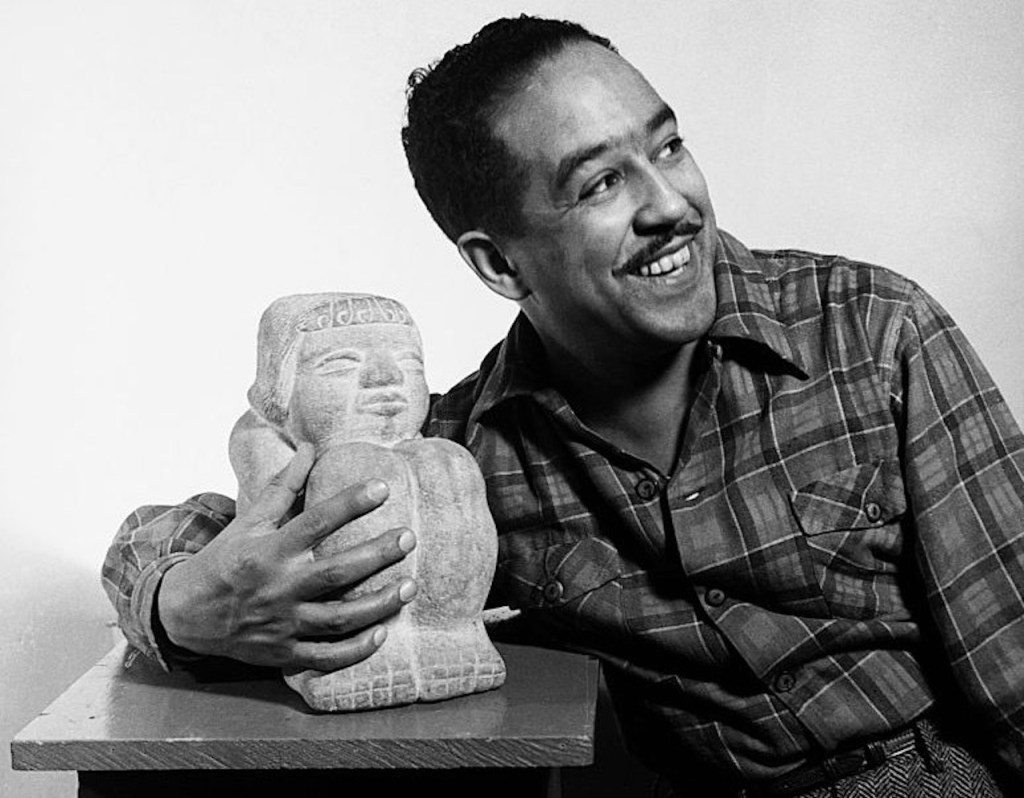
    Image:  Langston Hughes.  Library of Congress. Photographer Gordon Parks 

    Langston Hughes’ “The Negro Speaks of Rivers”

    Langston Hughes’ speaker in “The Negro Speaks of Rivers” displays his message in five versagraphic movements, thematically exploring his soul experience with a “cosmic voice,” which includes and unites all of humanity.

    Introduction and Text of “The Negro Speaks of Rivers”

    Langston Hughes’ speaker in “The Negro Speaks of Rivers” displays his message with a “cosmic voice,” which includes and unites all of humanity.  The poem plays out in five versagraphic movements, focusing on the theme of soul exploration.

    The Cosmic Voice in Poetry

    Writers, especially poets, often employ the “cosmic voice” in order to provide a deep and wide view of historical events and vast swaths of space.  A device called the omniscient speaker is often used in fiction; that voice is similar to the cosmic voice but much more limited.

    Time and space may stretch or contract as needed as the cosmic seer narrates what he experiences.  The “cosmic voice” may come to a poet through a vivid imagination; however, it transcends the imagination as a truth teller.   Only a few poets have been blessed with such a voice; examples are Emily Dickinson, Rabindranath Tagore, Paramahansa Yogananda, and to a limited degree Walt Whitman.

    The cosmic voice imparts truth through deep intuition.  The soul of the speaker employing the cosmic voice is, even if only temporarily as is the case with Langston Hughes, becomes aware of its vast and profound knowledge.  The cosmic voice speaks from a place far beyond ordinary sense awareness.  

    Individuals who comprehend the cosmic voice are bequeathed a consciousness far beyond their own sense awareness and thus comprehend the unity of all created things.  Those individuals are heralded into the realm of the Cosmic Creator and often remain transformed beings for having experienced that Sacred Locus.

    Langston Hughes and the Cosmic Voice

    The voice employed in “The Negro Speaks of Rivers” is not a whining, complaining one so often heard in the protest voices of activists; instead Hughes is employing the cosmic voice—the voice of the soul that knows itself to be a divine entity.  That voice speaks with inherent authority; it reports its intuitions so that others might hear and regain their own experiences through its guidance.

    Langston Hughes’ speaker in “The Negro Speaks of Rivers” imparts his discourse in five versagraphic movements.  His theme explores with the cosmic voice that unites all of humanity.  

    The vital lines that serve as a refrain—”I’ve known rivers” and “My soul has grown deep like the rivers”—work like a chant, instilling in the listener the truth that the speaker wishes to impart.  That Langston Hughes was able to employ a cosmic voice in a poem at age seventeen is quite remarkable.  

    Although some of his later work, even as much of it remained important and very entertaining, descended into the banal and at times even slipshod, no one can deny his marvelous accomplishment with this early poem in which he speaks as a master craftsman.

    The Negro Speaks of Rivers 

    I’ve known rivers:
    I’ve known rivers ancient as the world and older than the flow
    of human blood in human veins.

    My soul has grown deep like the rivers.

    I bathed in the Euphrates when dawns were young.
    I built my hut near the Congo and it lulled me to sleep.
    I looked upon the Nile and raised the pyramids above it.
    I heard the singing of the Mississippi when Abe Lincoln
         went down to New Orleans, and I’ve seen its muddy
         bosom turn all golden in the sunset.

    I’ve known rivers:
    Ancient, dusky rivers.

    My soul has grown deep like the rivers.

    Reading:   Langston Hughes reads his poem “The Negro Speaks of Rivers”

    Commentary on “The Negro Speaks of Rivers”

    Langston Hughes’ speaker in “The Negro Speaks of Rivers” stands as high testimony to the poet’s ability to craft genuine, heartfelt poetry.  To have composed such a profound piece of art at such an early age bespeaks a literary marvel.

    First Movement:  The River as a Symbol

    I’ve known rivers:
    I’ve known rivers ancient as the world and older than the flow
    of human blood in human veins.

    The poem opens with the speaker remarking rather nonchalantly that he has experienced the natural phenomenon known as “rivers.”  He has no doubt observed rivers flowing in their channels, and he has become aware that rivers flow through the earth as blood flows through the veins of human beings.  

    Both flowing rivers and flowing blood must be ancient, but the speaker intuits that the flow of the rivers surely predates that of the appearance of the human being upon the planet. The river image becomes a symbol linking all of humanity from the pre-historic era to the present day.   

    As the “river” has served to carry the physical encasements (bodies) and mental bodies over the rough terrain of land and rocks, the symbolic river carries the soul on its Divine journey.   Readers and listeners will easily intuit the significance of the speaker’s focus as it ranges far beyond the boundaries of the physical, material universe.

    Second Movement:  Intuitive Awareness

    My soul has grown deep like the rivers.

    This line indicates that the speaker has become aware that through his own soul he can intuit historical events, places, and people, who have existed from the beginning to time.  The line becomes a refrain and will be encountered again in the poem because of its great importance.  

    It becomes quite obvious that the speaker would not have been able to know literally the rivers of antiquity that he claims to “know.”  However, through his soul, or mystical awareness, he can.  Thus, he again employs the cosmic, thus mystical, voice to fashion his assertion.

    Third Movement: Historical Unity

    I bathed in the Euphrates when dawns were young.
    I built my hut near the Congo and it lulled me to sleep.
    I looked upon the Nile and raised the pyramids above it.
    I heard the singing of the Mississippi when Abe Lincoln
         went down to New Orleans, and I’ve seen its muddy
         bosom turn all golden in the sunset.

    The speaker claims that he “bathed in the Euphrates” at the dawning of Western civilization.  From the Euphrates to the Mississippi Rivers, the speaker offers a huge expansion of time and place.  

    In biblical times to present time, he lays claim to knowledge, again impossible except for soul consciousness. Awareness through the soul is unlimited, unlike the limitations of body and mind.  The speaker could not have experienced the Euphrates when “dawns were young.”  

    But the cosmic voice of the speaker can place itself at any point along the time line of civilization or cosmic creation. In claiming to have built his “hut near the Congo,” the speaker continues his cosmic, mystically inspired journey.  He “looked upon the Nile”  and “raised the pyramids” only as a cosmic-voiced speaker.

    People of all times and climes have been influenced by the river experience.  The speaker can thus unite all races, nationalities, creeds, and religions in his gathering of historic experiences within which all those peoples have lived.   And he accomplishes this feat through employment of the symbolic force of the “river.” 

    Emphasizing the American experience, the speaker claims to have “heard the singing of the Mississippi when Abe Lincoln / went / down to New Orleans . . . .”   The allusion to President Abraham Lincoln reminds the reader of the process of slave emancipation.

    As with all the rivers mentioned, the Mississippi River, an American river, stands as a symbol of the blood of the human race—not naturally segregated into color and national categories. The American Mississippi River, as the earlier mention of rivers has done, symbolizes the human blood of the human race—the only race that scientifically exists.

    Fourth Movement:  A Soul Chant

    I’ve known rivers:
    Ancient, dusky rivers.

    Because of the importance of the “river” as a symbol, the speaker repeats the line, “I’ve known rivers.”  Like the line, “My soul has grown deep like the rivers,” this one also  serves as a refrain.   If the speaker had chanted the line many more times, the poem’s delightful charm would have even been enhanced—that line is that crucial!

    The soul, the river, the depth of the soul and the river—all force history to yield a mighty blessing on those who have “known rivers,”  and whose souls have grown deep like those rivers. 

    Thus the speaker offers a brief description of how those river appear:  they are extremely old, and they are mystically dark, a measure that alludes to the dark-skinned race with graceful precision, even as it holds all races as having experienced the nature of the mystic river.

    Fifth Movement: Life Force and the Symbol of the River

    My soul has grown deep like the rivers.

    The speaker’s soul has grown profoundly deep like the rivers and along with the rivers.  Civilizations have grown up and grown deep along rivers all over Planet Earth. The soul that possesses the body is the life force informing and maintaining that body. 

    Likewise, rivers streaming through the earth give life force to civilizations and also assist in maintaining those civilization with the products and supplies that river travel has allowed over the centuries.

    The speaker is taking his own identity from the energetic force of the soul and the river force of the earth.  The children of the Divine Creative Reality (God) all spring forth from a common ancestry, a symbolic set of original parents.   It has always been rivers that link all of those ancestors as the blood in their veins links them into one family—the Human Race.

    The cosmic voice of a young poet—who happened possess the darker hue of skin along the color spectrum—has rendered a statement that could enlighten and reconnect all peoples if only they could listen with their own cosmic awareness.  

    At the soul level, all human beings remain eternally linked as children of the Great Divine River King (God). That River God flows in the blood of His offspring. And that same River God flows in the rivers of the planet on which they find themselves too often segregated by ignorance of their own common being as sparks of the Divine.

    Instead of identifying with the perishable body and changeable mind that too often rule, the simple act of identifying with their own cosmic nature would allow individuals to experience the cosmic voice of their own soul. The simple poet named Langston Hughes has offered a useful template for viewing the world through a cosmic lens in his nearly perfect poem.

    🕉

    You are welcome to join me on the following social media:
    TruthSocial, Locals, Gettr, X, Bluesky, Facebook, Pinterest 

    🕉

    Share

  • Rabindranath Tagore’s “Light the Lamp of Thy Love”

    Image: Rabindranath Tagore – Portrait by William Rothenstein

    Rabindranath Tagore’s “Light the Lamp of Thy Love”

    Rabindranath Tagore’s poem “Light the Lamp of Thy Love” is a devotional lyric that expresses the speaker’s longing for self-realization. Through colorful imagery, the poem explores themes of transformation, redemption, and the transcendence of human limitation through spiritual awakening.

    Introduction and Text of “Light the Lamp of Thy Love”

    Rabindranath Tagore, a Nobel laureate poet and philosopher, often infused his works with spiritual depth and mysticism. His lyric “Light the Lamp of Thy Love” offers a prayerful plea for divine intervention, as the speaker implores a higher power to dispel darkness and replace it with enlightenment. 

    The poem’s structure follows a gathering movement from supplication to transformation, resulting in the profound realization of divine presence, also known as self-realization or God-union. Tagore employs vivid metaphors—lamps, light, and gold—to symbolize the process of spiritual purification. 

    The repetition of phrases reinforces the urgency of the speaker’s plea, while the invocation of touch underscores the immediacy of divine grace. The poem’s universal theme of seeking enlightenment resonates beyond religious confines, making it a poignant reflection on the human soul’s yearning for transcendence.

    Paramahansa Yogananda refashioned this poem into a chant that is performed at SRF meditation gatherings and ceremonies.  Immediately below the poem, there is a video of the SRF monks chanting the piece at one of SRF’s World Convocations.

    Light the Lamp of Thy Love

    In my house, with Thine own hands,
    Light the lamp of Thy love!
    Thy transmuting lamp entrancing,
    Wondrous are its rays.
    Change my darkness to Thy light, Lord!
    Change my darkness to Thy light.
    And my evil into good.
    Touch me but once and I will change,
    All my clay into Thy gold
    All the sense lamps that I did light
    Sooted into worries
    Sitting at the door of my soul,
    Light Thy resurrecting lamp!

    Commentary on “Light the Lamp of Thy Love”

    Rabindranath Tagore’s poem “Light the Lamp of Thy Love” serves a prayer for divine illumination or God-union (also known as self-realization), reflecting an intense spiritual longing. The speaker acknowledges human frailty and desires transformation through divine grace. Each movement of the poem builds upon the preceding one, deepening the speaker’s surrender to the divine will.

    First Movement: Invocation of Divine Light

    In my house, with Thine own hands,
    Light the lamp of Thy love!

    The speaker begins with a direct appeal to the divine, requesting illumination within his own “house,” a metaphor for the soul. The imagery of the divine hand lighting the lamp suggests an intimate and personal act of grace. 

    This scenario establishes the poem’s central theme of spiritual awakening as a force intervening in the speaker’s internal world. The use of the imperative conveys urgency as well as personal familiarity, emphasizing human dependency on divine intervention for enlightenment.  This evocative opening sets the tone for the poem’s progression from entreaty to transformation.

    Second Movement: Transformation through Divine Light

    Thy transmuting lamp entrancing,
    Wondrous are its rays.
    Change my darkness to Thy light, Lord!
    Change my darkness to Thy light.
    And my evil into good.

    In the second movement, the speaker acknowledges the power of divine enlightenment, describing it as “entrancing” and “wondrous.” The repetition of “Change my darkness to Thy light” underscores the urgency and necessity of divine transformation. Darkness symbolizes ignorance, sin, and suffering, while light represents wisdom, virtue, and divine grace. 

    The explicit plea to change evil into good reflects Tagore’s vision of spiritual evolution, wherein the divine presence purges human flaws.   This movement portrays transformation as both passive and active—the speaker submits to divine will while the divine force actively reshapes his essence. The imagery of light as a catalyst for moral and spiritual purification aligns with Tagore’s broader philosophical themes of unity between the self and the divine.

    Third Movement: Spiritual Alchemy

    Touch me but once and I will change,
    All my clay into Thy gold

    The speaker then expresses absolute faith in divine transformation, emphasizing the power of a single divine touch. The contrast between “clay” and “gold” serves as a metaphor for spiritual alchemy—earthly, flawed existence is refined into something pure and incorruptible. 

    This suggestion reflects the Upanishadic tenet that the soul has potential to merge with the divine.   The phrase “but once” highlights the immediacy and sufficiency of divine intervention, reinforcing the idea that enlightenment is not a gradual process but an instantaneous, transcendent experience, after conditions become aligned.

    Fourth Movement: Renunciation of Material Attachments

    All the sense lamps that I did light
    Sooted into worries
    Sitting at the door of my soul,
    Light Thy resurrecting lamp!

    In this final movement, the speaker reflects on past attempts to find light through worldly means, represented by “sense lamps.” These artificial lights, linked to sensory experiences, have only resulted in “worries,” suggesting that material pursuits lead to disillusionment. 

    The speaker, becoming aware that the Divine Reality is “sitting at the door of my soul,” finds himself in a precarious position, awaiting true illumination. The plea for the “resurrecting lamp” signifies the desire for rebirth through divine grace. 

    This conclusion emphasizes the contrast between self-induced, transient sources of light and the enduring illumination provided by the Divine. Tagore’s imagery addresses surrender and renewal, resulting in the speaker’s complete reliance on divine intervention for enlightenment.

    A Philosophy of Divine Love

    “Light the Lamp of Thy Love” encapsulates Tagore’s philosophy of divine love as the ultimate source of transformation. The poem progresses from invocation to surrender, illustrating the speaker’s deepening spiritual realization.   Tagore employs symbolic imagery—light, lamps, gold—to depict the process of transcendence, wherein the divine presence eradicates darkness and imparts purity. 

    The repetition of phrases reinforces the speaker’s desperation for enlightenment, while the shift from self-lit lamps to the resurrecting lamp signifies the futility of worldly pursuits in comparison to divine grace. 

    The interplay between passivity and divine action suggests that while human effort is insufficient for true transformation, surrender to divine will results in ultimate fulfillment.

    Tagore’s devotional lyric aligns with the Bhakti tradition, where longing for divine presence is central. However, its universal message extends beyond religious boundaries, addressing the fundamental human desire for meaning, clarity, and redemption.  The poem’s cyclical structure, resulting in divine illumination, parallels the spiritual journey from ignorance to wisdom. 

    By portraying the speaker’s progression from a seeker to one awaiting divine grace, Tagore underscores the idea that true enlightenment is not self-generated but received through divine compassion.  Ultimately, “Light the Lamp of Thy Love” serves as a meditation on the transformative power of divine love and its ability to guide the human soul toward transcendence.

    Image: Rabindranath Tagore – Portrait by Unknown Artist