Linda's Literary Home

Tag: time

  • Emily Dickinson’s “To venerate the simple days”

    Image: Emily Dickinson - Amherst College - Daguerrotype of the poet at age 17, circa 1847 - likely the only authentic, extant likeness of the poet
    Image: Emily Dickinson – Amherst College – Daguerrotype of the poet at age 17, circa 1847 – likely the only authentic, extant likeness of the poet

    Emily Dickinson’s “To venerate the simple days”

    Emily Dickinson’s “To venerate the simple days” demonstrates the speaker’s contemplative musing on time, honoring ordinary moments, and framing human physical death as merely a minor threshold.

    Introduction and Text of “To venerate the simple days”

    Emily Dickinson’s “To venerate the simple days” offers a concise reflection on the fleeting nature of earthly existence. In my earlier essays on Dickinsonian poems, I have discussed the speaker’s habit of privileging inner evidence over public display. The speaker calls for a quiet reverence toward ordinary time.

    The poem consists of a single six-line stanza utilizing short lines, delicate cadence, and slant rime. Through this brief structure, the speaker reminds humanity that mortal life passes swiftly; yet, physical death remains a minor event when viewed through the enduring, timeless perspective of spiritual reality and soul consciousness.

    To venerate the simple days

    To venerate the simple days
    Which lead the seasons by,
    Needs but to remember
    That from you or I,
    They may take the trifle
    Termed mortality!

    Commentary on “To venerate the simple days”

    Emily Dickinson’s “To venerate the simple days” presents a profound observation on honoring daily life while maintaining a detached perspective toward physical departure.

    First Movement: “To venerate the simple days”

    To venerate the simple days
    Which lead the seasons by,

    The speaker opens by encouraging readers to honor the unassuming, ordinary moments of daily existence. These moments quietly guide the passing seasons forward.  Rather than seeking grand public displays or dramatic events, the speaker suggests that profound spiritual value resides within unassuming routine.  

    In my earlier essays on Dickinsonian poems, I have discussed the speaker’s habit of finding sacred truth within common natural occurrences.  These daily routines shape human experience as seasons march steadily onward.

    Every passing moment carries quiet dignity.  Honoring each humble day allows the mind to achieve inner calm and spiritual perspective. Daily life provides the setting for spiritual growth.

    Paramahansa Yogananda explains in his teachings that living with conscious awareness transforms ordinary daily activities into avenues for divine perception.  By recognizing the sanctity inherent in simple routines, one cultivates a deep reverence for life. The speaker urges an appreciation for time itself.

    Second Movement: “Needs but to remember”

    Needs but to remember
    That from you or I,
    They may take the trifle
    Termed mortality!

    The speaker provides the motivation for this daily reverence, noting that remembering life’s brevity restores proper perspective. Time eventually eclipses physical existence.

    Yet, the speaker boldly labels human physical death as merely a “trifle,” reducing its perceived terror to an insignificant detail.

    In my earlier essays on Dickinsonian poems, I have discussed the speaker’s habit of viewing physical mortality as an illusory boundary rather than an ultimate end.  The departure from the physical body does not touch the essential nature of the enduring soul. Eternity transcends temporal limits.

    Paramahansa Yogananda explains that physical death is merely a transition, as the indestructible soul remains entirely untouched by the body’s dissolution.  By viewing mortality as a mere trifle, the speaker inspires freedom from fear. Understanding this truth allows one to cherish each simple day fully.
  • The Crown of Spirit

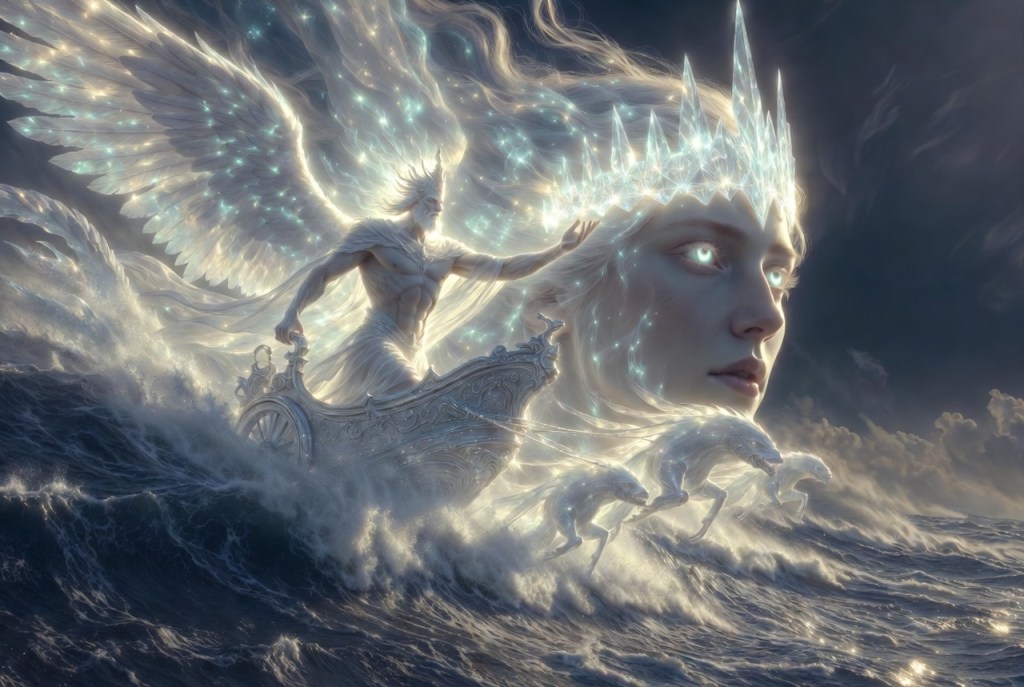
    Image created by Grok inspired by the poem
    Image created by Grok inspired by the poem

    The Crown of Spirit

    He wove her name by fate,
    Thunder stirred her blood:
    She would ride to him yet
    But her hand was stilled.

    Her gaze drove back mist
    From hours of waiting,
    Drawn by his unspoken promise—
    A whisper of a dream, a storm.

    Winter would teach the rite
    That cobbles the boot of memory.
    A soul in silence will grow wings,
    And the heart will forge arrows.

    You have shattered my night into silver
    With the crown of spirit that You
    Planted on my brow along with murmurs
    From every ancient vow.

    You have thundered on chariots of foam,
    Rising from the froth of the ocean,
    Sweeping past the ruins of time
    Twined in the gardens of the abyss.

    You have awakened my legend,
    My sleeping name, through the roaring
    Of Your every hidden trumpet
    Sounding from caves of endless birth.

    O Ancient King, deliver me to the crown
    Of Your Spirit where breath and blaze
    Quicken the bones sleeping in the vault
    Of a planet cradled in riddle and roar.

  • My Time I Must Keep 

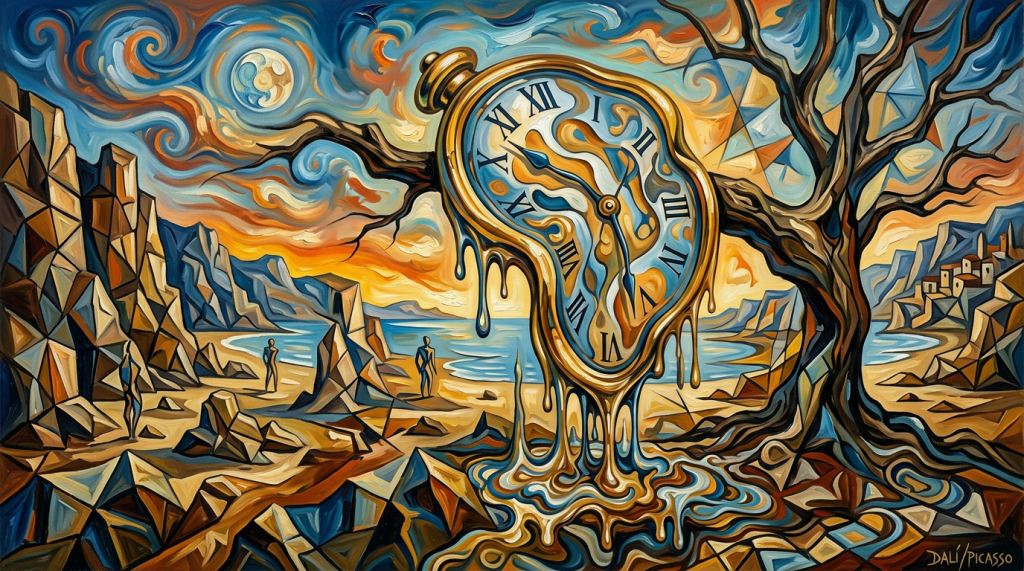
    Melting clock with Roman numerals hanging from tree branch in surreal landscape
    Image created by AI on WordPress

    My Time I Must Keep 

    Their self-worth, a dwarf star in vast cosmic seas,
    From my wild scrawls, they harvest bitter bees,
    Extracting venom from my placid inky streams,
    Convinced their downfall in my verses gleams.

    Their love, they vow, burns like a supernova—
    Yet longs for me to shed my true persona,
    To mirror their minds’ chosen design,
    To think and speak in perfect paradigm.

    I’ll sail on through this strange lexical sea—
    Casting wishes: peace, love, harmony’s key,
    As they trawl depths for words that sting and burn,
    Imagining each catch proves how I spurn.

    Why they crave my scorn, an enigma deep,
    I ponder no more—my time I must keep . . .

  • Original Song: “River of Time” with Commentary

    Image: Whitewater River, Richmond IN  

    Original Song: “River of Time” with Commentary

    My original song “River of Time” is a hymn to my Divine Belovèd, featuring a chorus that functions as a chant.

    Introduction with Text of Lyric “River of Time”

    Because music was my first love that I remember from the earliest age, I have always been attracted by the sounds from inspiring music.  

    I began writing songs seriously around age 32, and I especially enjoy and appreciate my songs that turn into hymns to the Divine Belovèd.  “River of Time” is such a hymn.  

    I am strongly influenced by the Cosmic Chants of my guru (spiritual leader) Paramahansa Yogananda.  Many of my original hymns have a chant-like element—a repetition that takes the minds within or bespeaks some spiritual truth for mental awareness.

    River of Time

    A hymn to my Divine Belovèd

    Verse
    Waiting by the river of time—
    My beloved keeps His rime
    In the sunlight that sings in stars
    The moon will wax in tune

    Verse
    Flowing with the river of time—
    Do you feel the rhythm that glides
    As you sing each lingering verse?
    Your soul will chant in bliss

    Verse
    Once beyond the river of time—
    Where you seek your ultimate rime,
    Where you need to battle no more
    You’ve reached that heavenly shore

    Chorus
    Every moment is light infused  
    Behind the darkness of closed eyes
    Seek no more for all is here
    Nothing more to do or fear

    Video by Carlene Craig

    Commentary on “River of Time”

    The singer/seeker/devotee in this hymn does not directly address her Heavenly Father-God.  She suggests the target of her report in subtle ways by essentially addresses her own self or soul. She sings to remind herself of her goal of soul- or self-realization, unity with the Divine Belovèd.

    First Verse:  Existence on the Physical Plane

    Waiting by the river of time—
    My beloved keeps His rime
    In the sunlight that sings in stars
    The moon will wax in tune

    The singer/devotee exists along a continuum that the human mind and heart often liken metaphorically to a river—a “river of time.”  Time seems to flow, meander, going somewhere.

    Intuition tells the human mind and heart that the soul is moving as on a flowing body of water to somewhere that must be wonderful.

    The beloved who is causing this river to flow displays his wares in light—sunlight and moonlight.  Science tells humanity that sunlight is reflected in the stars, and the moon also reflects that important, life-sustaining orb.

    The singer/devotee implies that her beloved is a poetic artist because he keeps “His rime” visible in the light of the sun and the moon.

    Second Verse:  The Rhythm of Soul Bliss

    Flowing with the river of time—
    Do you feel the rhythm that glides
    As you sing each lingering verse?
    Your soul will chant in bliss

    The singer then states that her soul is, in fact, moving down this metaphorical river.  She poses a rhetorical question of her self to ascertain if she is really sensing the rhythmic sway of the music of her verses.

    As she sings, she has become aware of her soul flowing into its natural state of “bliss.”  The verses that linger in the heart and mind bestow on her a marvelous state of awareness and joy.

    Third Verse:  Transcending Physical Existence

    Once beyond the river of time—
    Where you seek your ultimate rime,
    Where you need to battle no more
    You’ve reached that heavenly shore

    The singer then begins to speculate about the existence to be experienced after transcending the physical level of existence, metaphorically named the “river of time.”  

    Beyond that locus is where the ultimate poetry and music hold sway, where humanity no longer is required to struggle with life’s vicissitudes, trails, and tribulations.  Once the soul has become self-realized, it knows only divine joy and love.

    Chorus:  Moving into the Joy of the Light

    Every moment is light infused  
    Behind the darkness of closed eyes
    Seek no more for all is here
    Nothing more to do or fear

    The singer’s repeated, chant-like chorus is an affirmative statement about what goes on after she closes her eyes to the physical level of existence.

    She need not continue searching for she has arrived at the Goal of life. United with the Divine Belovèd, there is nothing that she will ever have to fear.

    Video:  Whitewater River-Tim Bowman-East Fork of the Whitewater River-near Brownsville IN