Linda's Literary Home

Tag: tradition

  • Stephen Vincent Benét’s “The Ballad of William Sycamore”

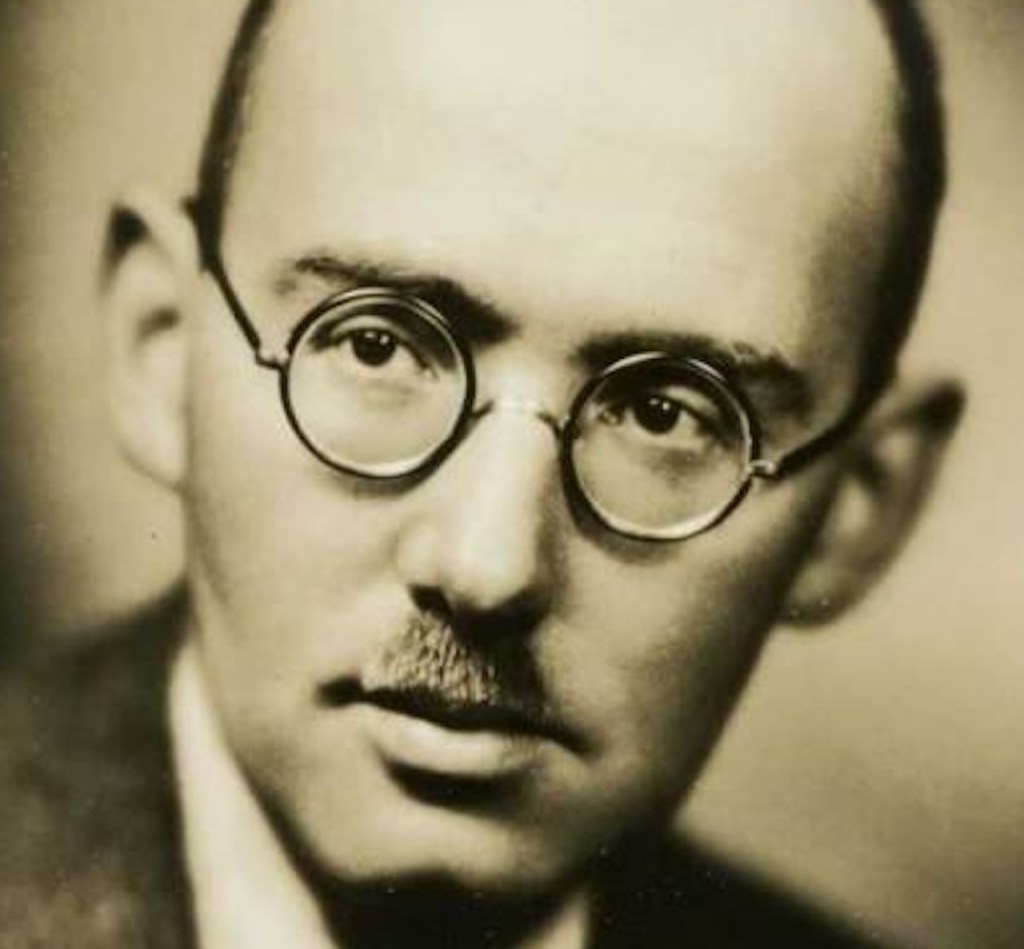
    Image:  Stephen Vincent Benét

    Stephen Vincent Benét’s “The Ballad of William Sycamore”

    Not strictly a cowboy poem, Benét’s ballad, however, offers the mind-set of an individual close to the land, preferring the rural life to the urban.

    Introduction and Text of “The Ballad of William Sycamore”

    Stephen Vincent Benét’s “The Ballad of William Sycamore” features 19 rimed, stanzas of traditional ballad form. The subject is the rustic life of William Sycamore, narrated by Sycamore himself from just before his birth to after his death.

    The Ballad of William Sycamore

    My father, he was a mountaineer,
    His fist was a knotty hammer;
    He was quick on his feet as a running deer,
    And he spoke with a Yankee stammer.

    My mother, she was merry and brave,
    And so she came to her labor,
    With a tall green fir for her doctor grave
    And a stream for her comforting neighbor.

    And some are wrapped in the linen fine,
    And some like a godling’s scion;
    But I was cradled on twigs of pine
    In the skin of a mountain lion.

    And some remember a white, starched lap
    And a ewer with silver handles;
    But I remember a coonskin cap
    And the smell of bayberry candles.

    The cabin logs, with the bark still rough,
    And my mother who laughed at trifles,
    And the tall, lank visitors, brown as snuff,
    With their long, straight squirrel-rifles.

    I can hear them dance, like a foggy song,
    Through the deepest one of my slumbers,
    The fiddle squeaking the boots along
    And my father calling the numbers.

    The quick feet shaking the puncheon-floor,
    And the fiddle squealing and squealing,
    Till the dried herbs rattled above the door
    And the dust went up to the ceiling.

    There are children lucky from dawn till dusk,
    But never a child so lucky!
    For I cut my teeth on “Money Musk”
    In the Bloody Ground of Kentucky!

    When I grew as tall as the Indian corn,
    My father had little to lend me,
    But he gave me his great, old powder-horn
    And his woodsman’s skill to befriend me.

    With a leather shirt to cover my back,
    And a redskin nose to unravel
    Each forest sign, I carried my pack
    As far as a scout could travel.

    Till I lost my boyhood and found my wife,
    A girl like a Salem clipper!
    A woman straight as a hunting-knife
    With eyes as bright as the Dipper!

    We cleared our camp where the buffalo feed,
    Unheard-of streams were our flagons;
    And I sowed my sons like the apple-seed
    On the trail of the Western wagons.

    They were right, tight boys, never sulky or slow,
    A fruitful, a goodly muster.
    The eldest died at the Alamo.
    The youngest fell with Custer.

    The letter that told it burned my hand.
    Yet we smiled and said, “So be it!”
    But I could not live when they fenced the land,
    For it broke my heart to see it.

    I saddled a red, unbroken colt
    And rode him into the day there;
    And he threw me down like a thunderbolt
    And rolled on me as I lay there.

    The hunter’s whistle hummed in my ear
    As the city-men tried to move me,
    And I died in my boots like a pioneer
    With the whole wide sky above me.

    Now I lie in the heart of the fat, black soil,
    Like the seed of the prairie-thistle;
    It has washed my bones with honey and oil
    And picked them clean as a whistle.

    And my youth returns, like the rains of Spring,
    And my sons, like the wild-geese flying;
    And I lie and hear the meadow-lark sing
    And have much content in my dying.

    Go play with the towns you have built of blocks,
    The towns where you would have bound me!
    I sleep in my earth like a tired fox,
    And my buffalo have found me.

    Reading: 

    Commentary on “The Ballad of William Sycamore”

    Speaking from two unlikely locales, William Sycamore narrates a fascinating tale of a fanciful life.

    First Movement: Rough and Tumble Parents

    The speaker describes his parents as scrappy, rough survivors. His mountaineer father had fists that resembled hammers; he ran as fast as a deer, and had a Yankee accent.  His mother was merry and brave and also quite a tough woman, giving birth to the narrator under a tall green fir with no one to help her but “a stream for her comforting neighbor.”

    While some folks can boast of clean linen fine to swaddle them, Sycamores cradle was a pile of pine twigs and he was wrapped in the skin of a mountain lion. Instead of “a starched lap / And a ewer with silver handles,” he recalls “a coonskin cap / And the smell of bayberry candles.”

    Thus, Sycamore has set the scene of his nativity as rustic and rural, no modern conveniences to spoil him. He idealizes those attributes as he sees them making him strong and capable of surviving in a dangerous world.

    Second Movement: Fun in the Cabin

    Sycamore describes the cabin in which he grew up by focusing on the fun he saw the adults have when they played music and danced. Their visitors were tall, lank, “brown as snuff,” and they brought their long, straight squirrel rifles with them.

    He focuses on the fiddle squealing and the dancing to a foggy song. The raucous partying was so intense that it rattled the herbs hanging over the door and caused a great cloud of dust to rise to the ceiling. He considers himself a lucky child to have experienced such, as well as being able to “cut [his] teeth on ‘Money Musk’ / In the Bloody Ground of Kentucky!”

    Third Movement:  Tall as Indian Corn

    The speaker reports that he grew as tall as the Indian corn, and while his father had little to offer him in things, his father did give him a woodsman skill, which he found helpful. With his homespun gear, a leather shirt on his back, he was able to navigate the woodlands like a profession scout.

    Fourth Movement: A Sturdy Wife

    Reaching adulthood, Sycamore married a sturdy woman, whom he describes as “straight as a hunting-knife / With eyes as bright as the Dipper!” The couple built their home where the buffalo feed, where the streams had no names. They raised sons who were “right, tight boys, never sulky or slow.” 

    The oldest son died at the Alamo, and the youngest died with Custer. While the letters delivering the news of their fallen sons “burned [his] hand,” the grieving parents stoically said, “so be it!” and push ahead with their lives.  What finally broke the speaker’s heart, however, was the fencing of his land, referring the government parceling land to individual owners.

    Fifth Movement:  Gutsy, Self-Reliance

    The speaker still shows his gutsy, self-reliance in his breaking of a colt that bucked him off and rolled over him.  After he recovered, however, he continues to hunt, and while the “city-men tried to move [him],” he refused to be influenced by any city ways. He died “in [his] boots like a pioneer /  With the whole wide sky above [him].”

    Sixth Movement:  Speaking from Beyond

    Speaking from beyond the grave somewhat like a Spoon River resident, only with more verve and no regret, William Sycamore describes his astral environment as a fairly heavenly place.

    He is young again, reminding him of spring rain that returns every year, and his sons are free souls reminding him of wild geese in flight.  He hears the meadow-lark, and he avers that he is very contented in his after-life state.

    Sycamore disdained the city, as most rustics do, so he uses his final stanza to get in one last dig: “Go play with the town you have built of blocks.” He then insists that he would never be bound by a town, but instead he sleeps “in my earth like a tired fox, / And my buffalo have found me.”  In his peaceful, afterlife existence, William Sycamore differs greatly from the typical Spoon River reporter.
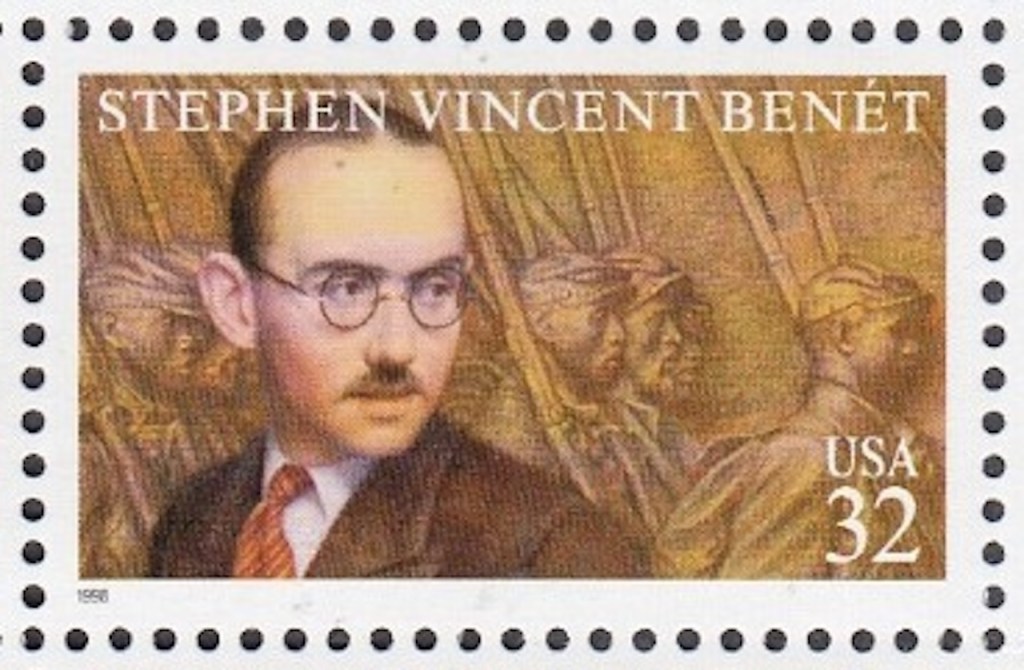
    image: Stephen Vincent Benét – Commemorative Stamp 

    Brief Life Sketch of Stephen Vincent Benét

    The works of Stephen Vincent Benét (1898–1943) [1] have influenced many other writers.  Cowboy poet Joel Nelson claims that “The Ballad of William Sycamore” made him fall in love with poetry.  Dee Brown’s title Bury my Heart at Wounded Knee comes directly from the final line of Benét’s poem titled “American Names” [2].

    The book-length poem, John Brown’s Body, won him his first Pulitzer Prize in 1929 and remains the poet’s most famous work. Benét first published “The Ballad of William Sycamore” in the New Republic in 1922.    Benét’s literary talent extended to other forms, including short fiction and novels.  He also excelled in writing screenplays, librettos, an even radio broadcasts.

    Born July 22, 1898, in Bethlehem, Pennsylvania [3] Benét graduated from Yale University in 1919 where instead of a typical thesis, he substituted his third collection of poems.  His father was a military man who appreciated literary studies.  His brother William and his sister Laura both became writers as well.

    Benét’s first novel The Beginning of Wisdom was published in 1921, after which he relocated to France to study at the Sorbonne.  He married the writer Rosemary Carr, and they returned to the USA in 1923, where his writing career blossomed.

    The writer won the O. Henry Story Prize and a Roosevelt Medal, in addition to a second Pulitzer Prize, which was awarded posthumously in 1944 for Western Star.  Just a week before spring of 1943, Benét succumbed to a heart attack in New York City; he was four month shy of his 45th birthday.

    Sources

    [1]  Editors.  “Stephen Vincent Benét.”  Academy of American Poets. Accessed January 13, 2026.

    [2] Darla Sue Dollman.  “Buy My Heart at Wounded Knee and Stephen Vincent Benét.” Wild West History.  October 4, 2013.

    [3] Editors.  “Stephen Vincent Benét.”  Poetry Foundation.  Accessed January 13, 2026.
  • Brad McClain’s “Cowboy Christmas”

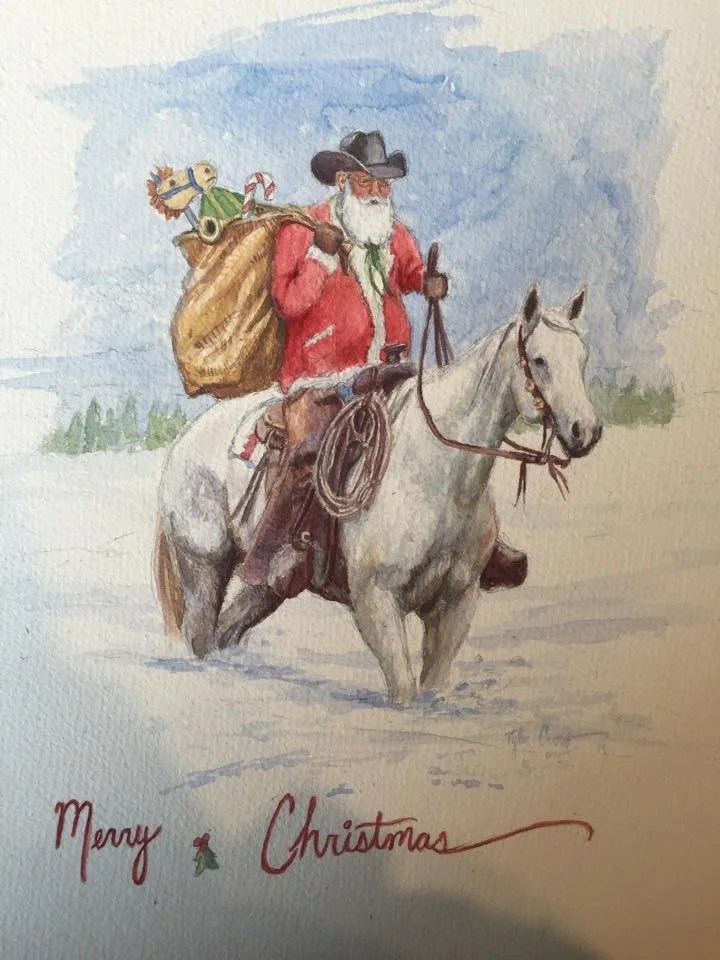
    Image: Merry Christmas  – Art by Tyler Crow, used by permission

    From an internet site dedicated to his Christian faith and affinity for cowboy culture God’s Horseback Gospel, Brad McClain’s “Cowboy Christmas” celebrates the congeniality of friends gathering to observe the Christmas season.  It offers the traditional energy and fun-loving atmosphere of most cowboy Christmas poetry.

    The two prose pieces following the poem further extend the faithful worship included in Mr. McClain’s purpose for creating his webpage—to glorify God and introduce others to a kind of spiritual awakening that they may not have known existed.

    Brad McClain’s “Cowboy Christmas”

    A countrified tradition,
    Was part of yester-year,
    When the cowboys’ main ambition,
    Was to spread some Christmas cheer.

    The ranch folk friend and families,
    Would come from far and wide,
    Trottin’ through the winter breeze,
    On Christmas Eve they’d ride.

    For food and fun and merriment,
    Twin fiddles filled the air,
    And everyone’s so glad they went,
    And goodwill everywhere.

    Kids a’chasin’ kids around,
    Oldsters smile and wave,
    All the festive sights and sounds,
    And a cowboy gettin’ brave,

    Enough to ask that gal to dance,
    And of course she says she will,
    He never thought he had a chance,
    And if a look could kill,

    Her Daddy watches carefully,
    He remembers to that age,
    Her mama takes it prayerfully,
    It helps her fear assuage.

    But nothin’ like a Christmas waltz,
    And nothin’ like young love,
    And nobody is findin’ faults,
    And lots to be proud of.

    And when the egg nog’s mostly gone,
    And the kids are ‘bout asleep,
    The hugs and handshakes linger long,
    And the night is gettin’ deep,

    And then all head for hearth and home,
    They jingle all the way,
    Snow drifts ‘cross the sandy loam,
    And soon comes Christmas Day.

    The evening wanes, kids tucked in bed,
    Gifts set beneath the tree,
    Stockings filled all green and red,
    A prayer for you and me.

    The Cowboy Christmas, all are blessed,
    Praise for the Savior’s birth,
    God gave to each His gracious rest,
    Good will and peace on earth.

    “Praise the Lord, the God of Israel, because He has visited and redeemed His people.  He has sent us a mighty Savior from the royal line of His servant David.” (Luke 1:68-69, NLT)

    Christmas is a festival of praise.  All the fun, food, music, lights and fellowship are because God has given us His greatest give- the Savior!  God has always been the One who saves, but now the ultimate salvation has entered the world and for one reason- to save that which is lost.  How sad that some of those who need it the most seem to feel it the least.  And how wonderful it is when someone discovers the love that meets them exactly where they are in order to take them where they have always should have been!  The devil lies when he claims to have the best party.  Jesus is the Lord of the dance and it’s time we put aside our fickleness and followed Him.  Christmas is a good time to get the party started!

  • S. Omar Barker’s “Three Wise Men”

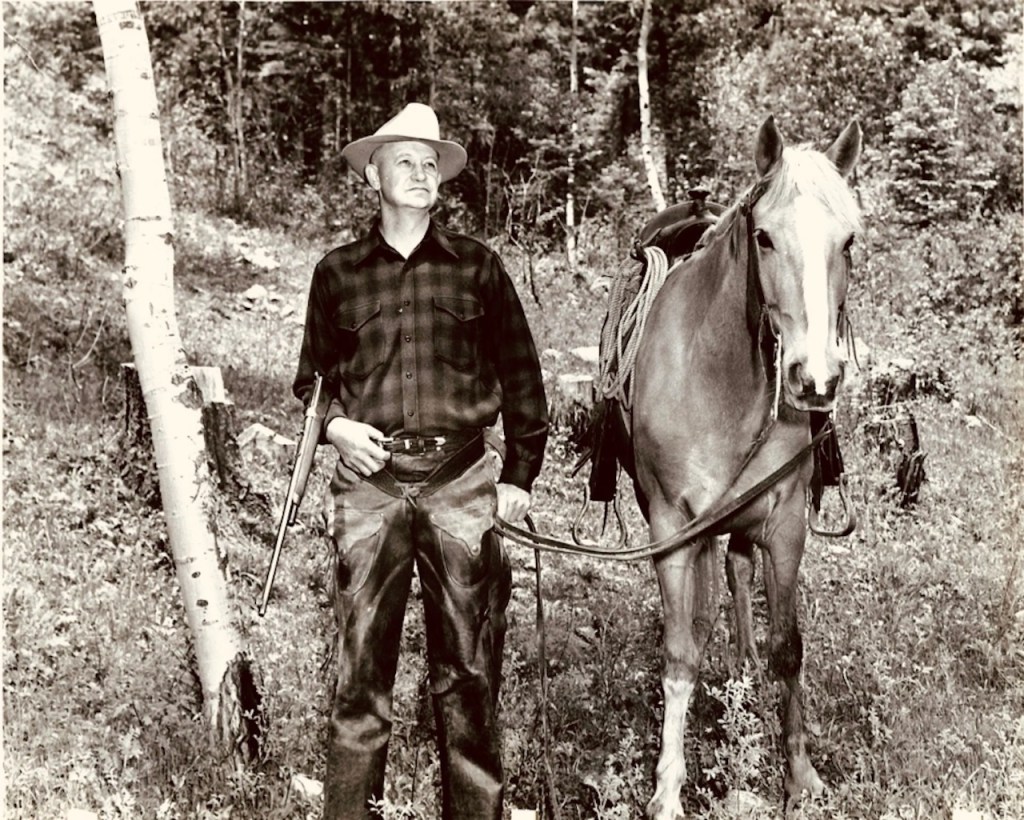
    Image: S. Omar Barker with Horse The Estate of S. Omar Barker

    S. Omar Barker’s “Three Wise Men”

    S. Omar Barker’s Christmas poem dramatizes a tale about three lonesome cowboys camped far out on the prairie.  Because they are so far from home, they hanker to be celebrating Christmas in the tradition way.

    Introduction with Text of “Three Wise Men”

    S. Omar Barker’s “Three Wise Men” narrates a story of the Magi in an American Southwest setting with cowboys performing the roles of the three wise men.  The story, of course, seeks to parallel that of the story of the first Christmas.

    Barker’s poem dramatizes a tale about three lonesome cowboys camped far out on the prairie.  Because they are so far from home, they hanker after a celebration of Christmas in the good old-fashioned, traditional way.  The story features the cowboy dialect and plays out in riming couplets. 

    Three Wise Men

    Back in the days when cattle range was prairies wide and lone,
    Three Bar Z hands was winter-camped upon the Cimarrón.
    Their callin’ names was Booger Bill and Pinto Pete and Tug,
    And though their little dugout camp was plenty warm and snug,
    They got plumb discontented, for with Christmas drawin’ near,
    They couldn’t see no prospects of no kind of Christmas cheer.

    Pete spoke about the bailes he’d be missin’ up at Taos.
    Tug said he’d give his gizzard just to see a human house
    Alight with Christmas candles; and ol’ Booger Bill avowed
    He’s shoot the next galoot who spoke of Christmas cheer out loud.
    They sure did have the lonesomes, but the the first of Christmas week,
    A wagonload of immigrants made camp off down the creek.

    They’d come out from Missouri and was headin’ farther west,
    But had to stop a little while and give their team a rest.
    They seemed to be pore nester folks, with maybe six or eight
    As hungry lookin’, barefoot kids as ever licked a plate.
    “We’ve just got beans to offer you,” the wagon woman smiled,
    “But if you boys will join us, I will have a big pot b’iled
    On Christmas day for dinner, and we’ll do the best we kin
    To make it seem like Christmas time, although our plates are tin!”

    Them cowboys sort of stammered, but they promised her they’d come,
    Then loped back to their dugout camp, and things begun to hum.
    They whittled with their pocketknives, they sewed with rawhide threads,
    They hammered and they braided and they raveled rope to shreds.
    They butchered out a yearlin’, and they baked a big ol’ roast.
    They scratched their heads to figger out what kids would like the most,
    Till when they went on Christmas day to share the nesters’ chuck,
    They had a packhorse loaded with their homemade Christmas truck:

    Bandanna dolls for little gals, with raveled rope for hair;
    Some whittled wooden guns for boys, and for each kind a pair
    Of rough-made rawhide moccasins.  You should have seen the look
    Upon that nester woman’s face when from their pack they took
    A batch of pies plumb full of prunes, some taffy made of lick,
    And a pan of sourdough biscuits right around four inches thick.

    That ain’t the total tally, but it sort of gives a view
    Of what three lonesome cowboys figgered out to try and do
    To cure the Christmas lonesomes on the Cimarrón, amid
    The wild coyotes and cattle–and they found it sure ‘nough did.

    Reading 

    Commentary on “Three Wise Men”

    Barker’s Christmas poem dramatizes a tale about three lonesome cowboys camped far out on the prairie. Because they are so far from home, they hanker to be celebrating Christmas in the tradition way.

    First Stanza: No Christmas Cheer This Year

    Back in the days when cattle range was prairies wide and lone,
    Three Bar Z hands was winter-camped upon the Cimarrón.
    Their callin’ names was Booger Bill and Pinto Pete and Tug,
    And though their little dugout camp was plenty warm and snug,
    They got plumb discontented, for with Christmas drawin’ near,
    They couldn’t see no prospects of no kind of Christmas cheer.

    The narrator begins by reporting that three cowhands from the Bar Z ranch are winter-camped upon the Cimarrn. Their names, that is, their nicknames are Booger Bill, Pinto Pete, and Tug.

    Even though their dugout camp was comfortable enough, the trio started to lament that they could see “no prospects of no kind of Christmas cheer.” With Christmas nearing, they were becoming melancholy about being so far from civilization and home.

    Second Stanza:  Three Cowpokes Deep in Christmas Blues

    Pete spoke about the bailes he’d be missin’ up at Taos.
    Tug said he’d give his gizzard just to see a human house
    Alight with Christmas candles; and ol’ Booger Bill avowed
    He’s shoot the next galoot who spoke of Christmas cheer out loud.
    They sure did have the lonesomes, but the the first of Christmas week,
    A wagonload of immigrants made camp off down the creek.

    Pete complained that he would miss out on the dances (bailes) up at Taos. Tug missed seeing a human house, saying colorfully, he’d give his gizzard just to see just one. Bill was so morose that he threatened “to shoot the next galoot who spoke of Christmas cheer out loud.”

    All three cowpokes were deep in the Christmas blues, missing civilization all decked out in Christmas attire and the social events that accompany the season. Then a wagonload of travelers made camp off down the creek.

    Third Stanza:   Folks Moving West

    They’d come out from Missouri and was headin’ farther west,But had to stop a little while and give their team a rest.
    They seemed to be pore nester folks, with maybe six or eight
    As hungry lookin’, barefoot kids as ever licked a plate.
    “We’ve just got beans to offer you,” the wagon woman smiled,
    “But if you boys will join us, I will have a big pot b’iled
    On Christmas day for dinner, and we’ll do the best we kin
    To make it seem like Christmas time, although our plates are tin!”

    This load of immigrants is traveling from Missouri and “headin farther west.” They had to stop to let their animals revive themselves before pressing on. These travelers are very poor with “hungry lookin, barefoot kids.” There must have been six or eight people in the party “all pore nester folks.”

    The woman of the group smiled pleasantly and invited the cowboy trio to join them for Christmas. Even though they have only beans to offer them, she promises to make it seem like Christmas time despite their impoverished lot and their plates being tin.

    Fourth Stanza:  Homemade Christmas Stuff

    Them cowboys sort of stammered, but they promised her they’d come,
    Then loped back to their dugout camp, and things begun to hum.
    They whittled with their pocketknives, they sewed with rawhide threads,
    They hammered and they braided and they raveled rope to shreds.
    They butchered out a yearlin’, and they baked a big ol’ roast.
    They scratched their heads to figger out what kids would like the most,
    Till when they went on Christmas day to share the nesters’ chuck,
    They had a packhorse loaded with their homemade Christmas truck:

    The cowboys feel somewhat dubious at first but promise to return on Christmas. Then after the three have returned to their camp, they begin creating all sorts of gifts for the travelers with whom they would celebrate Christmas.

    They whittled with pocketknives, they sewed with rawhide threads making toys for the children. They hammered and they braided to make dolls for the girls. They whittled toy guns for the boys. They butchered a yearling and made a roast to take to the party. When Christmas day arrived, they loaded up their packhorse and headed off to the celebration.

    Fifth Stanza: Wise Men Bearing Gifts

    Bandanna dolls for little gals, with raveled rope for hair;
    Some whittled wooden guns for boys, and for each kind a pair
    Of rough-made rawhide moccasins.  You should have seen the look
    Upon that nester woman’s face when from their pack they took
    A batch of pies plumb full of prunes, some taffy made of lick,
    And a pan of sourdough biscuits right around four inches thick.

    The wise men came bearing gifts for the children including rawhide moccasins. The wagon woman looked astonished as they produced from the packhorse a batch of pies “plumb full of prunes, taffy, and sourdough biscuits.”

    Sixth Stanza: Cure for the Christmas Blues

    That ain’t the total tally, but it sort of gives a view
    Of what three lonesome cowboys figgered out to try and do
    To cure the Christmas lonesomes on the Cimarrón, amid
    The wild coyotes and cattle–and they found it sure ‘nough did.

    The narrator makes it clear that those wise men also brought many other items that helped the little traveling party and the lonely cowboys celebrate Christmas. The Christmas blues was “cure[d],” and among the wild coyotes and cattle, the little group of wise cowboys resurrected the spirit of Christmas with their big hearts and generous giving.