Frosty Fantasy
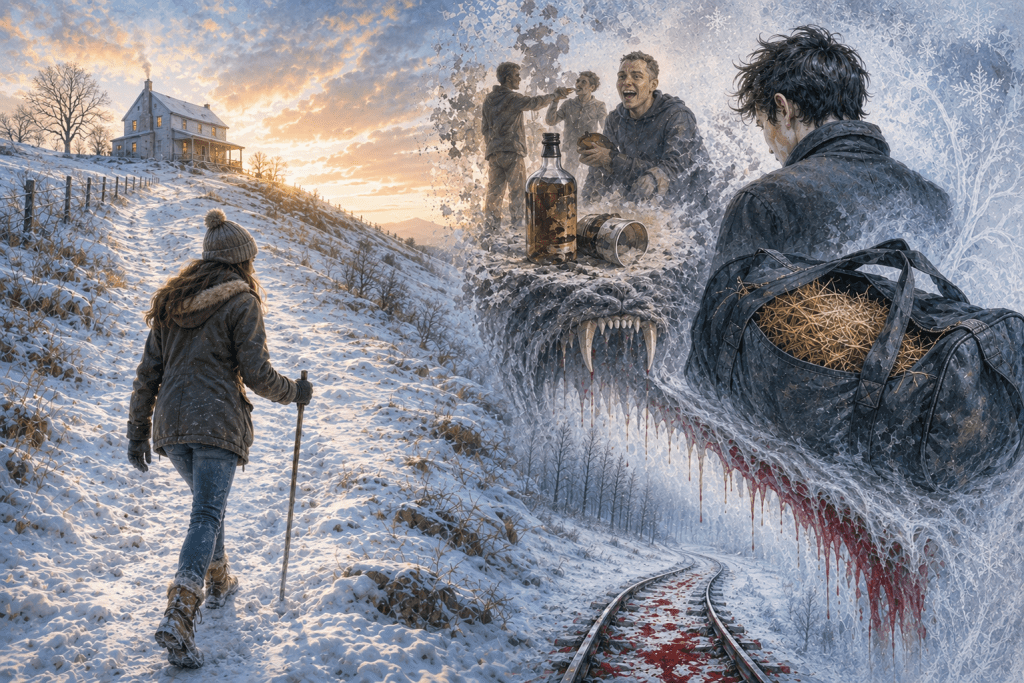
The hill gives my legs an excuse to bend
And my arms a chance to steady their trembling
But my back holds firm as I negotiate each step.
What were they thinking, my parents, who
Built their home so far from town?
I never wished for more than heaven.
You, however, who grew up far from the midland,
Kept your heart in a duffle bag, stuffed with straw.
Sure, I’m only guessing, but you gave me the material:
Sick laughter, sour smells clinging to your clothes,
Boasting pride breaking your potential
Which was poetry itself, sometimes sublime.
But you allowed your fangs of frosty fantasy
To make a bloody truant of your future.
Commentarian Hat Image
A Prose Commentary on My Original Poem “Frosty Fantasy”
In my poem “Frosty Fantasy,” I have created a speaker who reflects upon the divergent paths of two lives: one rooted in place, discipline, and spiritual aspiration, the other undermined by self-deception and squandered promise.
The poem unfolds as a personal address, but beneath its conversational surface lies a musing on character, destiny, and the consequences of embracing illusion over authentic growth.
The title itself is deliberately ironic. Fantasy ordinarily suggests imagination, creativity, and possibility. Yet the fantasy explored here is “frosty”—cold, sterile, and ultimately destructive. Rather than nurturing the future, it freezes it.
The poem’s emotional movement progresses from the speaker’s own grounded perspective toward an examination of another individual whose considerable gifts have been compromised by pride and self-delusion.
Underlying the poem is the conviction that talent alone cannot sustain a meaningful life. Potential must be guided by self-knowledge, humility, and higher aspiration. Without such guidance, even genuine brilliance may become an instrument of self-sabotage.
First Stanza: The Discipline of Ascent
The hill gives my legs an excuse to bend
And my arms a chance to steady their trembling
But my back holds firm as I negotiate each step.
What were they thinking, my parents, who
Built their home so far from town?
I never wished for more than heaven.
In the opening stanza, my speaker begins with a physical ascent up a hill. The hill is not merely geographical; it serves as a metaphor for the challenges inherent in human life. Each part of the body participates in the effort. The legs bend, the arms steady themselves, and the back remains firm. This catalog of bodily responses emphasizes perseverance and balance.
The speaker then turns briefly toward the parents who built their home “so far from town.” The question, “What were they thinking?” introduces a touch of humor and mild complaint, but the complaint quickly dissolves into a larger perspective. The concluding line, “I never wished for more than heaven,” transforms what might have remained an ordinary recollection into a spiritual declaration.
The speaker suggests that physical distance from worldly activity may have fostered a deeper orientation toward transcendent values. The ascent of the hill thus becomes inseparable from the ascent of consciousness.
Second Stanza: A Portrait of Displacement
You, however, who grew up far from the midland,
Kept your heart in a duffle bag, stuffed with straw.
Sure, I’m only guessing, but you gave me the material.
Sick laughter, sour smells clinging to your clothes,
Boasting pride breaking your potential
Which was poetry itself, sometimes sublime.
The second stanza shifts attention toward the person being addressed. Unlike the speaker, this individual is portrayed as fundamentally unsettled. The image of keeping one’s heart “in a duffle bag, stuffed with straw” suggests emotional impermanence and spiritual emptiness.
A duffle bag is designed for movement and transience; it has no permanence or rootedness. The straw further implies something artificial, a substitute for genuine substance. The heart has become portable but hollow.
The speaker acknowledges uncertainty with the phrase “Sure, I’m only guessing,” yet immediately asserts that the evidence for such speculation has been provided by the subject himself. This rhetorical maneuver allows the speaker to maintain both humility and authority.
The subsequent images become increasingly severe. “Sick laughter” and “sour smells” create an atmosphere of moral and psychological decay. These sensory details suggest that inner disorder eventually manifests outwardly. The speaker is less concerned with literal odors or sounds than with the lingering effects of a troubled character.
The latter portion of the second stanza introduces the poem’s central sorrow. The addressed individual possesses remarkable potential. The speaker observes that his potential “was poetry itself, sometimes sublime.”
This line is intentionally generous. The poem does not depict an ordinary failure but the squandering of exceptional gifts. The word “sublime” elevates the subject’s capacities beyond mere competence into the realm of genuine artistic and spiritual possibility.
Yet this praise is immediately juxtaposed against “Boasting pride.” The contrast is crucial. The obstacle is not lack of talent but an inflated sense of self. Pride becomes the force that fractures the connection between potential and fulfillment. The speaker therefore presents a familiar but painful truth: greatness is often destroyed not by external enemies but by internal weaknesses.
Third Stanza: The Tyranny and Tragedy of Illusion
But you allowed your fangs of frosty fantasy
To make a bloody truant of your future.
The final stanza—which is only an unrimed couplet—condenses the poem’s judgment into a single powerful image. The “fangs of frosty fantasy” transform fantasy from a harmless indulgence into a predatory force. Fangs suggest aggression, danger, and injury.
The fantasy has become something that bites and wounds. The adjective “frosty” reinforces the image of emotional coldness and spiritual paralysis. Rather than inspiring growth, these fantasies freeze the individual within a false vision of himself.
The phrase “make a bloody truant of your future” is deliberately startling. A truant abandons responsibility and neglects obligation. Here the future itself becomes the truant, absent because the subject’s choices have driven it away.
The image suggests that the future was once available but has been injured and expelled through self-defeating behavior. What might have become a life of accomplishment and creative fulfillment has instead been sacrificed to illusion. The poem ends without reconciliation because the speaker wishes to leave the consequences visible and unresolved. The loss itself becomes the final lesson.
An Afterthought
In “Frosty Fantasy,” the speaker examines the painful distance between promise and fulfillment. The poem contrasts two modes of living: one grounded in perseverance, aspiration, and rootedness, the other consumed by pride, instability, and self-deception.
The speaker’s judgment is severe but not entirely condemnatory. Embedded within the criticism is an acknowledgment that the addressed individual possessed genuine gifts, perhaps even extraordinary ones. This recognition makes the loss more poignant, not less. In fact, that loss may be designated a tragedy in the original usage of the term.
Ultimately, the poem suggests that imagination detached from truth becomes fantasy, and fantasy detached from discipline becomes destructive. The speaker portrays a life in which illusion gradually eclipses possibility, leaving behind not the fulfillment of potential but the lingering shadow of what might have been.

