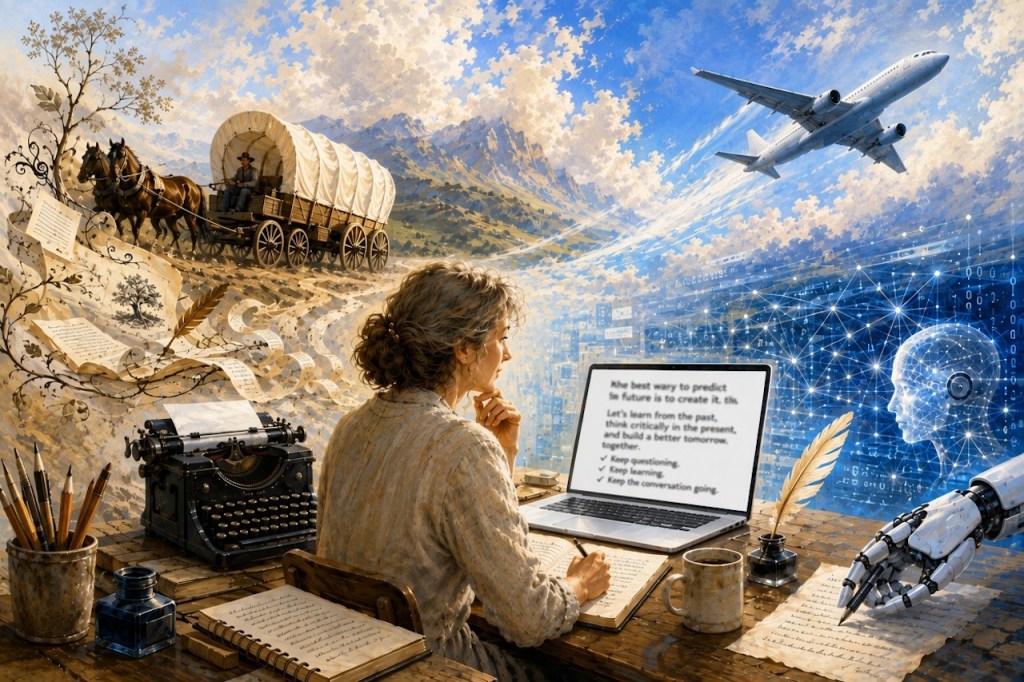
AI and I: Tools, Fools, and Luddites
I am a writer—primarily a poet, songwriter, and essayist—and I feel an obligation to render the written word as honestly as I am able. For more than six decades, I have lived with words: reading them, studying them, arranging them, revising them, and trying to discover through them what I really think and feel.
From Conestoga to Airplane
The physical means by which I write have changed dramatically over those decades—from pencils and ink pens, to typewriters, to computers with word-processing systems. Now I have another tool available to me: artificial intelligence (AI). It is, in a sense, the leap from the horse-drawn conestoga to the jet-propelled airplane.
That leap raises an obvious question for a writer: if I use AI to help me compose, am I still the writer? My answer is yes—but only if I remain responsible for the writing.
AI can now produce remarkably competent poems, songs, essays, summaries, and arguments, organizing information almost instantly in prose that sometimes sounds more polished than an experienced human writer.
However, AI’s capabilities invite both enthusiasm and suspicion. Some see it as a marvelous new instrument; others as a threat to human creativity; still others reject it outright. I regard it simply as a tool, as I once regarded the pencil, the typewriter, and the word processor.
A Writer’s Responsibility
Because AI is now so competent at producing written material, readers may wonder whether a writer simply hands the work to a machine and steps aside. I do not. I remain responsible for every text that appears under my name.
When I moved from typewriter to word processor, it never occurred to me that I owed anyone an explanation for use of that technology. A typewriter did not write my essay; a word processor did not write my poem.
These instruments simply let me put thoughts into a form that could be preserved, revised, and shared. AI is different because the machine itself can generate language—which is exactly why anxiety about authorship is understandable. But what genuine writer would take a machine’s output, unexamined, and call it his or her own?
Here is what I actually do. I give an AI system—Grok, ChatGPT, Gemini, Claude, Perplexity—a list of requirements, along with a sample of my own writing, instruct it to work in my tone and voice to produce a preliminary draft. Then my real work begins.
(Following this essay, I have supplied an Appendix with a list of requirements that I give AI to generate my first draft of a commentary on a poem, Emily Dickinson’s and others’. For each new poem, I simply change out the title and other pertinent details.)
After my AI buddy generates the draft, I go through it word by word: checking facts, cutting overreach, replacing words that do not sound like me, reordering paragraphs, adding what only my own experience could supply, sharpening arguments, softening claims the evidence does not support.
Above all, I listen for my own voice—and because AI is trained toward an establishment sensibility that I do not always share, I frequently rewrite passages simply to register my own skepticism or disagreement. AI generates a rough draft; I polish it, exactly as I once polished my own first drafts. That distinction is everything.
Although I supply a sample of my original writing, AI is not always capable of reflecting my tone, style, and voice, which gives me plenty of work to do to make sure the piece sounds like me.
From Pencil to AI
A pencil does not think. Neither does a typewriter, nor a word processor in any human sense—yet each changed a writer’s relationship to composition. Revision meant erasing with a pencil, retyping with a typewriter, and became dramatically easier with a word processor. No one ever concluded that the typewriter or word processor had become the author.
AI is a more significant leap because it has the ability to generate language in sentences. But the fundamental question does not change: who is directing the tool, and who answers for the result? For me, the answer is abundantly clear: I do.
The practical advantage is real. The rough draft—research, brainstorming, deciding what belongs, finding a way into the subject—is usually the most time-consuming stage in composition, and much of it follows patterns AI can help accelerate.
But writing is more than organization. The decisive creative work happens in revision, when an unexpected association leads somewhere better, or a sentence reveals something I had not consciously understood when I began. AI can supply form. The writer has to shape the content so form and content align. That is where authorship lives.
The AI-Detector Problem
I first encountered the charge of posting an AI-generated text while writing for the now-defunct HubPages. The article in question, which after the accusation, I revised multiple times but never satisfying the editors, now resides on my personal literary website: “Ella Wheeler Wilcox’s ‘The Queen’s Last Ride’.” The experience was instructive.
Since then, I have submitted many older essays—works written years before I ever heard of ChatGPT or similar systems—to AI detectors. The results have been astonishingly inconsistent. Some detectors have claimed that texts written entirely by me were partly or even overwhelmingly AI-generated. Scores have ranged from very low percentages to extraordinarily high ones.
One detector explained its verdict by pointing to nearly perfect grammar and clear organization. I could hardly object to those as descriptions of my writing; they represent what sixty years of practice, two master’s degrees, a PhD, and three publications in The Explicator ought to produce. It turns out this inconsistency is not just my experience—it is well documented.
A comparison of sixteen commercial AI-text detectors found meaningful differences in accuracy, decisiveness, and false-positive rates between tools evaluating the same essays [1]. OpenAI’s own classifier, before it was shut down for unreliability, mislabeled human-written text as AI-generated roughly 9 percent of the time [2].
Independent 2025–2026 testing has found some detectors holding false-positive rates near or below 1 percent on longer passages, while open-source and free tools have flagged anywhere from 30 to 69 percent of genuinely human writing [3].
The bias runs deeper for some writers than others: research on non-native English essays has found false-positive rates as high as 61 percent, apparently because detectors read simpler, more standardized sentence structure as “machine-like” [4][5].
Formal, technically precise, or highly organized human prose—medical writing, legal writing, and, I would add, a lifetime of disciplined essay writing—triggers false positives at elevated rates for the very same reason.
None of this means detection is worthless. It means a percentage is not a witness. A score cannot know who sat at the desk, who revised a poem twenty times, or who spent three hours on a single paragraph because one word carried a precise shade of meaning. The machine sees the text. The writer lived the life behind it.
The Difference Between Generating and Creating
This distinction matters most in poetry. A poem is not merely a string of grammatically acceptable sentences; it depends on memory, emotional association, rhythm, silence, irony, and an individual response to lived experience. AI can imitate poetic language extraordinarily well—rime, meter, metaphor, imagery, even the surface style of a particular poet. But imitation is not experience.
When I write about something that has affected me, it exists inside a history that belongs to me alone: memories, beliefs, relationships, disappointments, and discoveries accumulate over a lifetime.
My own literary site Linda’s Literary Home reflects that web of connection—poems and songs alongside literary studies and a room devoted to my spiritual life and the teachings of Paramahansa Yogananda, “Father of Yoga in the West.” AI can help me articulate those connections. It cannot possess them for me.
How I Maintain Control
I treat AI as a tool. I supply the requirements, the subject, the sample of my own writing, the purpose; I decide what needs evidence, evaluate every suggestion, and make the final call—which means I can never say “the AI wrote it” when something is wrong. If a text is published under my name, it is mine: the errors, the foolishness, and the insight alike.
The comparison I keep returning to is the calculator and the mathematician. A calculator performs an operation faster than a human can, but it does not decide which problem is worth solving or what the answer means. AI can manipulate language rapidly. The writer still has to decide what deserves to be said.
The Tool, the Fool, and the Luddite
Three stances are possible regarding a technological advancement such as AI: the fool hands the whole task to the machine and claims the result as entirely original, mistaking convenience for creativity. The Luddite rejects the tool altogether, mistaking resistance for the preservation of human creativity. The sensible writer takes a third position: AI as a tool—useful, powerful, limited, and subordinate.
That state of affairs does not mean accepting whatever it produces; the more powerful the tool, the more judgment its use demands. A chainsaw is useful, but no one hands it to a child and walks away. A camera does not make someone a photographer, nor a grand piano concert pianist. AI does not make someone a writer. The human being remains responsible for knowing what he or she wants to say.
Calmly Active and Actively Calm
Paramahansa Yogananda taught the principle of being “calmly active and actively calm”—staying centered in inner stillness while living dynamically and purposefully in the world [6]. I find that principle exactly suited to working with AI.
The writer should be active: directing the process, questioning, revising, deciding. But the writer should also be calm—no need to fear a new technology, and no need to worship it either. The screen is outward. The AI system is outward. The intention behind the words is inward, and that is what matters.
In my essays on Emily Dickinson poems, I have written about her speakers’ habit of placing inner evidential integrity above public display. The same idea applies here. My obligation is not to satisfy a detector or perform “humanness” for an algorithm. It is to tell the truth as honestly as I am able. Outer methods change; inner responsibility does not.
I Remain the Writer
I have no wish to return to a world where the only legitimate instrument is a pencil, pen, or typewriter; I have lived through too many technological revolutions to think creative integrity depends on refusing new tools. The question was never whether to use AI, only how.
If I tell a system to write an essay, accept whatever comes back, verify nothing, and sign my name—I have surrendered authorship. But if I bring my subject, my experience, my research, my questions, and my decades of practice to the process, and use AI to help organize, draft, question, or polish—the technology is serving me as the writer. That is how I use it.
I do not expect AI to replace the writer any more than I expect my word processor to do such. I expect it to help me do what I have wanted to do for sixty years: put words together in the best way I can. The tools have changed; the writer has not.
I am still the one who decides what I believe, chooses the subject, determines what matters, and asks of every sentence, “Is that really what I mean?” AI may supply a draft, a structure, even an unexpected phrase. But it does not have my memories, my relationships, my spiritual journey, or my responsibility to the reader.
Those features remain mine—and as long as I stay awake, attentive, and responsible for every word that bears my name, I see no contradiction between embracing the tool and keeping the writer’s oldest obligation: to seek, as honestly as possible, the right words for what is true.
Sources
[1] William H. Walters. “The Effectiveness of Software Designed to Detect AI-Generated Writing: A Comparison of 16 AI Text Detectors.” Open Information Science, vol. 7, no. 1, 2023.
[2] Panagiotis Tsigaris, et al. ”AI Detecting AI in Academic Writing: Why Most AI Detector Findings Are False.” ScienceDirect, 2026.
[3] Nirmal Thacker. ”AI Detector False Positive Rates Compared (2026).” GradPilot. May 19, 2026 · Updated Aug 2, 2026
[4] Jon-Philippe K. Hyatt, et al. “Using Aggregated AI Detector Outcomes to Eliminate False Positives in STEM-Student Writing.” Advances in Physiology Education, vol. 49, no. 2, 2025, pp. 486–495. March 19, 2025.
[5] Ashley Segal. ”Understanding False Positives in AI Detection: A Comprehensive Guide for Educators and Content Creators.” Proofademic. Updated August 18, 2026.
[6] Editors. “A Toolkit for Experiencing Peace Today.” Self-Realization Fellowship. August 31, 2023.
Appendix
Compose an essay commentary on Emily Dickinson’s “Some Rainbow – coming from the Fair!” adhering to the following list of requirements for the essay:
- Place the following Title: Emily Dickinson’s “Some Rainbow – coming from the Fair!”
- To establish style and tone, use the sample of my writing on Emily Dickinson’s “There is another sky” which follows this set of instructions. VERY IMPORTANT THAT YOU FOLLOW THIS INSTRUCTION.
- Be sure to place the entire text of the poem in the introduction and the stanzas (or movements) in the commentary sections.
- Do not report on the type of poem, its rhythmic meter, or its rime scheme.
- Do not italicize the text of the poem in either the introduction or the commentary.
- Do not use Wikipedia or any left-leaning political, or other unreliable sources.
- Do not announce what the commentary or paragraph is going to do; for example “This commentary will explain the poem’s structure . . . ”; just do it.
- Always refer the poet as “the speaker,” not by the poet’s name.
- Keep all headings EXACTLY as presented: Introduction and Text of “Some Rainbow – coming from the Fair!” and Commentary on “Some Rainbow – coming from the Fair!”
- Where possible use a quotation showing a concept from the teachings of Paramahansa Yogananda, with a link to the source on the site at https://yogananda.org. You can also find many of Paramahansa Yogananda’s writings on Internet Archive https://archive.org/ Always use his full title and name Paramahansa Yogananda when mentioning the great Guru.
- Use only official Self-Realization Fellowship / Yogananda.org sources for quotations or teachings attributed to Paramahansa Yogananda. Do not use Ananda, Wikiquote, AZQuotes, Goodreads, or other secondary quotation websites.
- When alluding to a Paramahansa Yogananda quoted concept, always use present tense: Paramahansa Yogananda explains; not Paramahansa Yogananda explained.
- Also where possible, offer a quotation showing a concept from my earlier commentaries on Dickinson’s poems from my literary website Linda’s Literary Home, at https://lindas-literary-home.com/2026/02/05/life-sketch-of-emily-dickinson/ . When referring to a quoted concept from my literary website, use the following introduction, “In myearlier essays on Dickinsonian poems, I have discussed . . . .”
- Instead of this construction —“In my earlier essays on Dickinsonian poems, I have discussed how the speaker privileges inner evidence over public display” —use this one, for example, “In my earlier essays on Dickinsonian poems, I have discussed the speaker’s habit of privileging inner evidence over public display.” That is, eliminate the awkward use of “how,” by focusing on the specific subject.
- Instead of the term “meditation” for contemplation on literary things, use the phrase “contemplative musing.”
- Limit each paragraph to 50 words.
- Always spell “rhyme” using the original, more accurate spelling “rime.”
- Please do not give me a lot text explaining what you are going to do; just do it. If you cannot follow these instructions exactly, let me know and I’ll find another program that can. Thank you! Now begin!
EMPLOY THE EXACT STYLE AND TONE ESTABLISHED IN THIS SAMPLE OF MY WRITING:
Emily Dickinson’s “There is another sky”
Emily Dickinson’s “There is another sky” reveals the speaker’s confidence in her creation of a world of beauty that will exist in perpetuity. She is envisioning a world beyond the physical level of existence, where permanence prevails in things of beauty.
Introduction with Text of “There is another sky”
In Emily Dickinson’s “There is another sky,” the speaker of the poem is previewing her intention to establish a world where the pairs of opposites do not obstruct the lives of the inhabitants.
Such beloved features and qualities of life, such as beauty, peace, harmony, balance, and love will hold sway uninterrupted by pesky things like change and disfigurement in her newly created “garden.” On a second note, she is also inviting her brother to enter her new garden that exists under a different sky so that he too may enjoy the divinely fragranced atmosphere of her new creation.
On the literal level, the poet is creating a speaker who is announcing her audacious plan to create a brand new world with her poetry. It will be such a special place so other-worldly that nothing unpleasant that exists in earthly reality will exist there.
Because everything she creates will be based on her imagination and intuition, she can fashion her “garden” to grow anything she finds feasible. That she anticipates no arrival of “frost,’ she can guarantee that flowers will not “fade.” Also leaves will be able to remain “ever green.”
Posing as a invitation, Dickinson’s little drama serves as a clever ruse to persuade her brother to come and experience her poetry. By promising him a whole new, different world, she no doubt hopes he will be more likely to take her up on her offer.
There is another sky
There is another sky,
Ever serene and fair,
And there is another sunshine,
Though it be darkness there;
Never mind faded forests, Austin,
Never mind silent fields –
Here is a little forest,
Whose leaf is ever green;
Here is a brighter garden,
Where not a frost has been;
In its unfading flowers
I hear the bright bee hum:
Prithee, my brother,
Into my garden come!
Reading of “There is another sky”
Commentary on “There is another sky”
Emily Dickinson’s “There is another sky” reveals an attitude dramatized in the Shakespeare sonnets: the poet’s confidence in her creation of a world of beauty that will last forever.
The poem is a literal invitation from the poet to her brother Austin to read her poetry, where she is erecting a new place to exist, a beautiful garden free of the decay that literal gardens must undergo.
First Quatrain: Physical Sky vs Metaphysical Sky
There is another sky,
Ever serene and fair,
And there is another sunshine,
Though it be darkness there;
In the first quatrain, the speaker begins by alerting readers that in addition to the “sky” and “sunshine” that already experience on the earthly level, there exist a different sky and a different sunshine.
The other sky about which the speaker is declaiming is always “serene and fair. Thus, no thunder storms or dark clouds intrude into this new sky’s space. The beauty and calmness of a clear blue sky offer an inviting and intriguing possibility.
The speaker then announces the existence of “another sunshine.” But this sunshine seems to have the magic and delicious power to shining even through the darkness. This claim is the first flag that the speaker will be referring to a mystical or metaphysical place that only the soul can perceive.
Behind the darkness of closed eyes, the only “sunshine” or light that can be seen is that of the spiritual eye. Although the speaker cannot guarantee that her entire audience will be able to see such “sunshine,” she is sure that on a mental level they can imagine such a heavenly place.
Second Quatrain: No Fading in the Metaphysical Universe
Never mind faded forests, Austin,
Never mind silent fields –
Here is a little forest,
Whose leaf is ever green;
The speaker then directly addresses someone, admonishing him to pay no attention to “faded forests.” She then the addresses the individual by name, “Austin. ” Austin is the name of Dickinson’s brother. She then admonishes Austin to ignore the “silent fields.”
The reason that Austin should ignore those faded forests and silent fields is that in this place to which she is inviting him, the “little forest” presents leaves that remain perpetually green. And the fields will remain perpetually filled with fruitful crops, never having to lie fallow.
While dropping hints throughout, he speaker remains illusive regarding the whereabouts of this place where the sky, the sun, forests and fields, and leaves all behave differently from that of the physical universe that humanity must experience on the earthly plane.
Sestet: Invitation to the Metaphysical Garden
Here is a brighter garden,
Where not a frost has been;
In its unfading flowers
I hear the bright bee hum:
Prithee, my brother,
Into my garden come!
The speaker now offers some further description of this new place with a new sky and new sun; she then states that that place is “a brighter garden.” As earthly gardens are bright, mystical or metaphysical gardens remain even brighter.
In the metaphysical garden, there is never a fear of “frost” that kills earthly plants with its sting. Flowers will not fade because of frost or from simply aging. The magic of her garden will guarantee that the beauty of the flowers will bloom forth in perpetuity.
Because of the ability of the flowers to remain “unfading,” bees will always be able to partake of their nectar any time they choose. Thus, the speaker avers that she can “hear the bright bee hum.”
The bright bee is, no doubt, brighter than the ordinary, earthly, literal bee. And because of the permanence of her newly created metaphysical garden, she can listen to the pleasant hum any time she wishes.
In the final couplet, the speaker sets forth the clear invitation to her brother, virtually begging him to come into her garden. She employs the archaic expression “[p]rithee” (conflation of “pray thee”) to emphasize her desire that he take her up on her offer to visit her “garden.”
On the literal level, the poet has created a speaker who extends an invitation to the poet’s brother to read her poems. She has offered an alluring set of reasons to try to capture the brother’s imagination and interest.
And to her other readers, the poet has created a speaker to extend that same invitation, as she hopes the notion of a new, permanent, created world will capture their imaginations also.
Dickinson Riddles
Emily Dickinson’s American-Innovative sonnet “There is another sky” is one of the poet’s many riddles. Her speaker never states directly that the garden is her poetry, but still, she is inviting her brother in to read her poems.
The speaker continues to imply throughout the sonnet that she has constructed a whole new world, where things can live unmolested by the irritants that exist on the physical plane of life. The sky can remain “serene and fair”–no storms, tornadoes, hurricanes, heavy rainstorms that frighten and damage.
And the sunshine can present itself even through the darkness. Forests never fade and die out, and the fields remain always bursting with life; they never lie fallow or turn to dust as on the real, earthy plane–that literal world.
The trees can enjoy wearing green leaves and never have to drop them after they turn all brown or rusty. The speaker is privy to all these utopian-sounding acts because she has created it.
And like the master writer of the Shakespeare sonnets, Dickinson’s speaker knows that she has fashioned out of crude, earthly nature an art that will provide pleasure in perpetuity to the minds and hearts of those who have the ability to imagine and intuit along with her.
This speaker further demonstrates a certain level of cheek and courage by inviting her own brother into her creation. While she no doubt quietly wonders if he will be as impressed as she is, she shows a certain level of confidence by offering such an invitation.
Emily Dickinson’s “Some Rainbow – coming from the Fair!”
Introductory summary about 20 words in complete sentences
Introduction and Text of “Some Rainbow – coming from the Fair!”
approximately 100 words
Some Rainbow – coming from the Fair!
Some Rainbow – coming from the Fair!
Some Vision of the World Cashmere –
I confidently see!
Or else a Peacock’s purple Train
Feather by feather – on the plain
Fritters itself away!
The dreamy Butterflies bestir!
Lethargic pools resume the whir
Of last year’s sundered tune!
From some old Fortress on the sun
Baronial Bees – march – one by one –
In murmuring platoon!
The Robins stand as thick today
As flakes of snow stood yesterday –
On fence – and Roof – and Twig!
The Orchis binds her feather on
For her old lover – Don the Sun!
Revisiting the Bog!
Without Commander! Countless! Still!
The Regiments of Wood and Hill
In bright detachment stand!
Behold! Whose Multitudes are these?
The children of whose turbaned seas –
Or what Circassian Land?
Commentary on “Some Rainbow – coming from the Fair!”
approximately 20 words in complete sentences
First Stanza: “Some Rainbow – coming from the Fair!”
Some Rainbow – coming from the Fair!
Some Vision of the World Cashmere –
I confidently see!
Or else a Peacock’s purple Train
Feather by feather – on the plain
Fritters itself away!
approximately 250 words
Second Stanza: “The dreamy Butterflies bestir!”
The dreamy Butterflies bestir!
Lethargic pools resume the whir
Of last year’s sundered tune!
From some old Fortress on the sun
Baronial Bees – march – one by one –
In murmuring platoon!
approximately 250 words
Third Stanza: “The Robins stand as thick today”
The Robins stand as thick today
As flakes of snow stood yesterday –
On fence – and Roof – and Twig!
The Orchis binds her feather on
For her old lover – Don the Sun!
Revisiting the Bog!
approximately 250 words
Fourth Stanza: “Without Commander! Countless! Still!”
Without Commander! Countless! Still!
The Regiments of Wood and Hill
In bright detachment stand!
Behold! Whose Multitudes are these?
The children of whose turbaned seas –
Or what Circassian Land?
approximately 250 words

