Linda's Literary Home

Tag: Whitewater River in Indiana

  • Original Song:  “River Spirit” and Prose Commentary

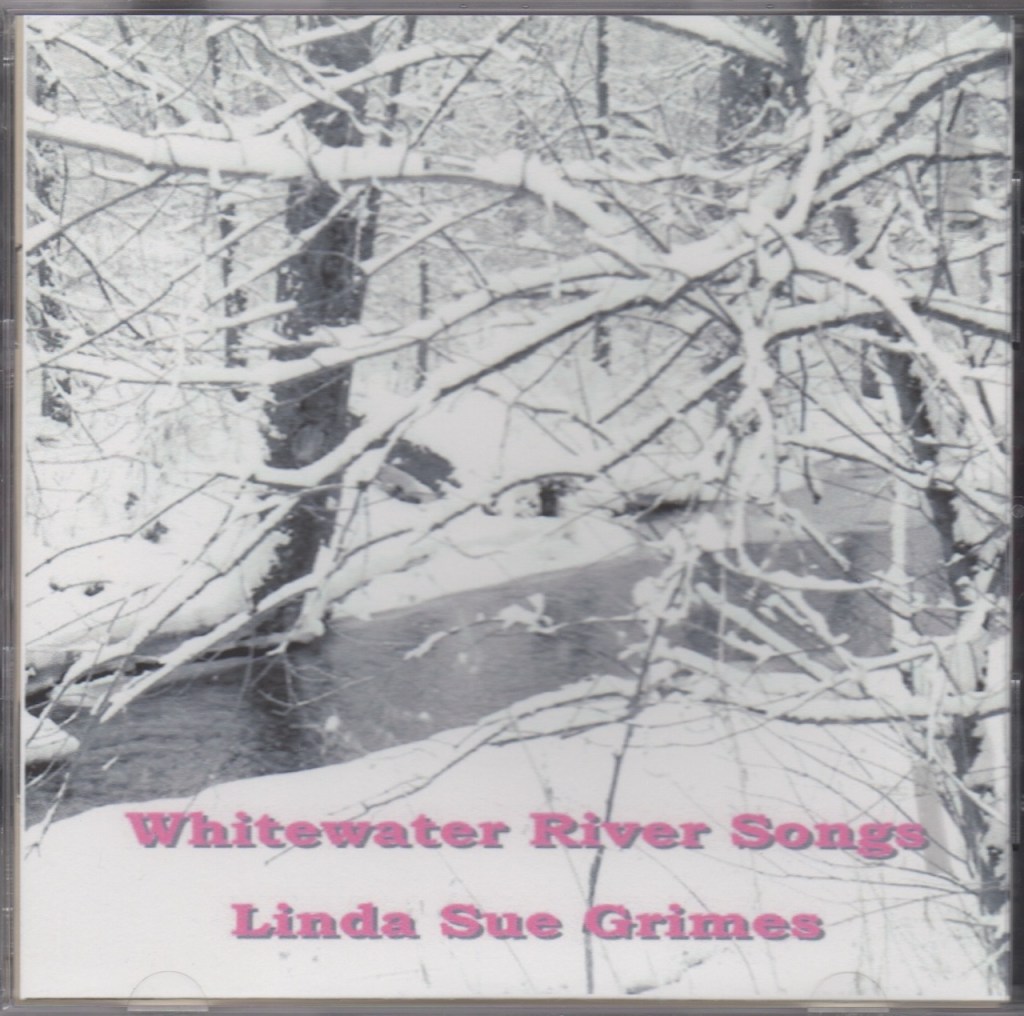
    Image: “Whitewater River Songs – Album Cover” Photo by Ron W. G.

    Original Song:  “River Spirit” and Prose Commentary

    I wrote “River Spirit” circa 1980 then made a homemade recording of it around 20 around 2004.  In 2023, my husband Ron—whom I call “My Sweet Ron”—created the video featuring his own photos and videos selections along with the song.  

    Introduction to and Lyric of “River Spirit”

    The lyric of “River Spirit” plays out in four stanzas of tercets, with one couplet appearing as the second stanza.  It sports no traditional rime-scheme but does offer one set of perfect rime in “hand/sand” in the second and third lines.  Other slant—or more accurately ghost rimes—appear in “water/before” in the couplet.

    Ghost rimes also make an appearance with “bed/edge” and “changes/images.”  The time frame begins in spring, as the singer begins to report what she sees along the river after the cold hard season of winter has given way to the warmth of spring.

    The theme of the song is the mystery the singer feels at seeing that the landscape along the river has been radically transformed from what she had observed during the summer before this transforming winter had its sway.  The singer poses questions about how the trees got uprooted and the path along the river has shifted, as even the stones are taking on new patterns.

    The singer then announces what she had thought to be the agent of the transformations; however, she is ultimately revealing—in the title—that what she “guessed” back in the day, she now knows to be the work of the Divine Reality, the “River Spirit”—or God (see “Names for the Ineffable God”).

    (Please note:  Dr. Samuel Johnson introduced the form “rhyme” into English in the 18th century, mistakenly thinking that the term was a Greek derivative of “rythmos.”  Thus “rhyme” is an etymological error. For my explanation for using only the original form “rime,” please see “Rime vs Rhyme: Dr. Samuel Johnson’s Error.”)

    River Spirit

    Every spring along the Whitewater River
    I saw that some mysterious hand
    Had rearranged the rocks and sand.

    The path I followed the summer before
    Was slipping off into the water.
    I could not figure out whose force
    Could drive that water among the reeds
    & shift the river in its bed

    Whose muscles uprooted those trees?
    Whose fingers patterned those stones
    Along the edge?  

    I guessed only that the spring thaw
    Conjured up the changes
    In those sleeping river images.

    Commentary on “River Spirit”

    The time frame is spring, as the singer begins to muse on what she observes along the river after the cold, hard season of winter has given way to the warmth of spring.  Her earlier guess about that riverbank rearrangement has now become an article of faith, and she proclaims in the title the answer to her earlier inquiry.

    First Movement:  The Hand of Mystery

    Every spring along the Whitewater River
    I saw that some mysterious hand
    Had rearranged the rocks and sand.

    The singing narrator launches right into her story by making the claim that she observed a change in the pattern of stones and sand along the river’s edge, and she make this observation “every spring.”  She had thus a recollection of having experiences these changes many times.

    She colorfully attributes those rearrangements to “some mysterious hand.”  At this point, it may sound a bit odd that a river walker would think a hand had been involved in what went on along the riverbank in her absence.

    Second Movement:  River Features Shifting

    The path I followed the summer before
    Was slipping off into the water.

    After setting the stage for mystery and rearrangement of river features, the singer offers a very specific change.  She had walk along a path during the preceding summer, and now that path simply veered off into the river water.  Such a change would likely be quite jarring for the hiker, who would necessarily be obliged to alter her walking pattern.

    Third Movement:  Puzzling over the Changes 

    I could not figure out whose force
    Could drive that water among the reeds
    & shift the river in its bed

    The singer now inserts her puzzlement.  She becomes curious as to how such changes could have occurred.  She sees that the river has now shifted its course, plunging into the reeds along the bank.

    The mere fact of the river shifting “in its bed” seems Herculean in prospect.  The river is such a large body of moving water that the notion of it shifting surely requires a force that strikes the singer an unimaginable at this point.

    Fourth Movement:  Who Made Those Changes?

    Whose muscles uprooted those trees?
    Whose fingers patterned those stones
    Along the edge?  

    The singer then again adds more specificity to her inquiry.  She sees that trees have been “uprooted,” and she observes that the stones along the river’s edge have been rearranged in a different pattern from the summer before.

    Again, she colorfully attributes those “changes” to a seemingly human agency of “muscles” and “fingers.”  But behind those specific agents must lie some metaphysical force that at this point the singer cannot name, cannot even offer a guess about.

    Fifth Movement:  Guessing at the Conjuring

    I guessed only that the spring thaw
    Conjured up the changes
    In those sleeping river images.

    Now the singer offers what she thought to be an answer to her inquiry: Well, it was likely that not any hands, muscles, or fingers enforced all of these changes; it was simply the process of thawing out from the ice during the warming movements brought on by spring.

    Sure, that’s it: the spring movements of thawing influenced those inert river features to alter themselves into differing patterns from the summer before.  What else could it be?  But the singer is understating what she really believes now.  She “guessed” about the “spring thaw”—but that was then, this is now.

    Thus the singer through anthropomorphic images of hands, muscles, fingers has proclaimed that a humanlike power has, in fact, mades these changes.  Not an actual human being on its own however.  But some power that retains in its Being the image of the human form, power,  and ingenuity.

    Simply, the title of the lyric has already stated what the singer pretends to guess about as she unfurls the song:  God (as the “River Spirit”) has performed His magic on these “sleeping river images.” God has “conjured up” those alterations in those river images as they moved from a frozen, winter sleep to vital spring time awakening.

  • Original Song:  “The Paper Mill Bridge Song” with Prose Commentary

    Image:  Old Paper Mill Bridge, Brookville, Indiana – Built 1914 – Brookville Library Collections

    Original Song:  “The Paper Mill Bridge Song” with Prose Commentary

    My original song “The Paper Mill Bridge Song” was inspired by the beautiful Whitewater River in Indiana and its relationship to the beautiful relationship I have enjoyed for over half a century with my wonderful husband, native of the little town of Brookville, Indiana.

    Introduction and Excerpt from “The Paper Mill Bridge Song”

    My husband, landscape artist Ron Grimes, created the video featured in this article to accompany my original song “The Paper Mill Bridge Song.”  He wrote the following introduction to the piece and placed his video on YouTube:

    A celebration of life and love as witnessed by the Paper Mill Bridge over the Whitewater River in Brookville, Indiana.

    September 10th, 2022. Linda and I walked to the middle of the new Papermill Bridge. I wanted to capture some scenes for this video. As soon as I started videoing, this Canada Goose flew right over us and honked as it if it were saying, “I want to be in your video.” It was a gift.

    Innovative Chorus

    The song undergoes an unusual arrangement; instead of an ordinary chorus, it features an middle octave which behaves as a second octave and chorus that gets repeated at a the end of the song.

    The Paper Mill Bridge Song

    Here’s where people paddle canoes
    Down the Whitewater River.
    I stand here on Paper Mill Bridge.
    Watch the water and remember
    The day we walked along the bank,
    Sand so warm to my feet.
    We talked about cattails, rocks, and stars
    And the moss that grows on old trees.

    These are the things that fill my day,
    Things we’ve done together.
    Sunshine streaming down through the leaves,
    A storm in the clouds or snow in the fields.
    River water runs through my veins.
    The stars light up my eyes.
    Love for you turns in my heart
    Like the sun burns through the sky.


    Through the years my heart has filled
    With love for this old river.
    I stand here on Paper Mill Bridge.
    Watch the water and remember
    The day we paddled down the stream,
    A cool breeze on my shoulders.
    The sun shone bright over Paper Mill Bridge
    And I knew I’d love you forever.

    These are the things that fill my day,
    Things we’ve done together.
    Sunshine streaming down through the leaves,
    A storm in the clouds or snow in the fields.
    River water runs through my veins.
    The stars light up my eyes.
    Love for you turns in my heart
    Like the sun burns through the sky.

    © LINDA SUE GRIMES 2004

    Prose Commentary on “The Paper Mill Bridge Song”

    My original song—”The Paper Mill Bridge Song”—focuses on one relationship that progresses from good friends to life partner.  In the opening verse, the friends experience a quiet walk and talk along the river.  In the final verse, the life relationship is solidified.

    First Octave/Verse:  The View from the Bridge

    Here’s where people paddle canoes
    Down the Whitewater River.
    I stand here on Paper Mill Bridge.
    Watch the water and remember
    The day we walked along the bank,
    Sand so warm to my feet.
    We talked about cattails, rocks, and stars
    And the moss that grows on old trees

    The singing narrator is standing on a bridge, which turns out to be the subject of the song, the Paper Mill Bridge.  She begins to report on the activities that are locally common to that bridge.  The bridge spans the Whitewater River—a river in mideastern to southern Indiana—and from its perch one can from time to time see canoers paddling their barks down the river.

    The narrator then focuses on a memory that is important to her regarding her hike along the riverbank with a friend.  During that pleasant stroll, the two friends casually conversed about river-related entities such as water reeds that look like “cattails” and other features of nature such a “rocks and stars.”

    The narrator recalls that her feet enjoyed the luxury of the warm sand.  They also held forth about the fact that moss grows on old trees—likely that the moss grows mostly on the north side of those arbolian creatures.

    Second Octave/Chorus:  Recurring Images

    These are the things that fill my day,
    Things we’ve done together.
    Sunshine streaming down through the leaves,
    A storm in the clouds or snow in the fields.
    River water runs through my veins.
    The stars light up my eyes.
    Love for you turns in my heart
    Like the sun burns through the sky.

    The chorus has an usual placement, standing the middle of the song and containing an equal number of line as each verse, instead of following each verse with fewer lines.  Essentially the piece offers three separate octaves, even as the middle octave performs as a chorus.

    In this innovative chorus, the narrator has placed a heavy emphasis.  While she has offered some concrete details in the opening verse-octave, in the chorus-octave she is stating a general take on what she may likely be thinking about during this particular time period in her life.

    She thus has been focusing mentally on things that she and her friend have enjoyed together.  But then she adds two images in the first quatrain of the chorus-octave that allow her thoughts to show their natural influences as she experiences weather conditions—specially the warmth of spring and summer and the cold of fall and winter.

    The second quatrain of the chorus-octave becomes even more generalized: she is a creature of the river, so closely attuned to river culture that it seems that the very waters of the river flow “through [her] veins.”

    The narrators suggests that her happiness is enhanced as if by starlight.  She then asserts that she loves her friend with the same intensity that causes the “sun” to burn “through the sky.”  The hyperbole serves to suggest the strong emotion that this narrator feels for her friend, their relationship, and the natural features that they have experienced together.

    Third Octave/Verse:  The Passage of Time

    Through the years my heart has filled
    With love for this old river.
    I stand here on Paper Mill Bridge.
    Watch the water and remember
    The day we paddled down the stream,
    A cool breeze on my shoulders.
    The sun shone bright over Paper Mill Bridge
    And I knew I’d love you forever.

    The third octave/verse again focuses on the narrators thoughts about her friend, and now it becomes apparent that they are indeed life partners.  But first she places that river into her affections; she has come to love the river, and again, she is standing on the same bridge with pleasant memories coming to the fore.

    This time she remembers that like the other folks one might see canoeing down the Whitewater River, she and her partner did such paddling.  That day she recalls that she felt a breeze on the skin; it was a “cool breeze”—indicating that it was likely early to mid-spring.

    However, she then asserts that over that bridge the sun was beaming down in bright rays.  And suddenly, her heart told her then as it is telling her now that she would continue to hold her partner in her heart “forever.”  

    Second Octave/Chorus:  Recurring Images Again

    These are the things that fill my day,
    Things we’ve done together.
    Sunshine streaming down through the leaves,
    A storm in the clouds or snow in the fields.
    River water runs through my veins.
    The stars light up my eyes.
    Love for you turns in my heart
    Like the sun burns through the sky.

    The purpose of the repetition remains the exact same purpose that is held for all choruses in songs: to emphasize the sentiment expressed in the verses and perhaps add an extra image or two. 

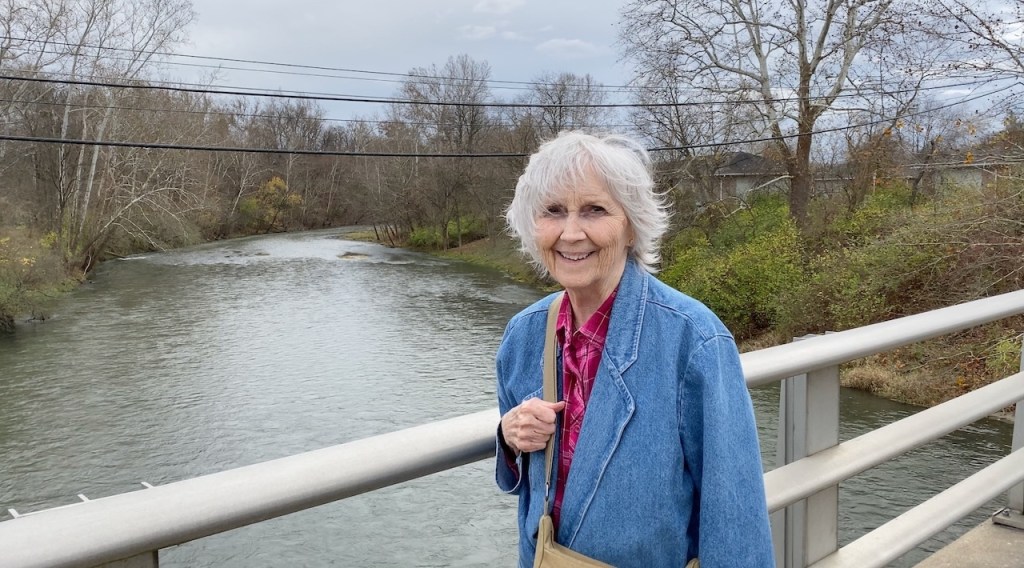
    Linda Sue on the new Paper Mill Bridge – Constructed 1977Photo by Ron W. G.