Linda's Literary Home

Tag: William Shakespeare

  • A Few Curiosities Regarding Edward de Vereand the Writer Who Called Himself Shake-speare

    A Few Curiosities Regarding Edward de Vere
    and the Writer Who Called Himself Shake-speare

    by Mark Alexander and Prof. Daniel Wright

    Unlike William of Stratford—born to illiterate parents in a virtually bookless market town in provincial Warwickshire—Edward de Vere was born to a mother of prominent literary associations (Margaret Golding) and a father who kept an acting company (the Earl of Oxford’s Men) that his son inherited; Edward de Vere’s father also was one of the early nobleman patrons of the theatre and a patron to John Bale, one of the early writers of the history play, the genre with which the writer known as Shakespeare is widely regarded to have begun his own playwriting career.

    The Shakespearean sonnet (also known as the English sonnet) was not original with Shakespeare (merely popularized by him). The Shakespearean sonnet actually was invented by Edward de Vere’s paternal uncle—Henry Howard, the 5th earl of Surrey.

    Scholars regard Arthur Golding’s translation of Ovid’s Metamorphoses as a leading influence on Shakespeare, second only to the Bible. Arthur Golding was Edward de Vere’s maternal uncle, and Edward, when a teen, lived with him. Golding, in a dedication of one of his works to the young Edward de Vere, saluted his nephew’s interest in and command of history.

    The Geneva Bible, widely recognised by scholars as Shakespeare’s Bible, was the edition of the Scriptures owned by Edward de Vere, and his personal copy (now in the possession of the Folger Shakespeare Library) contains notations and marginalia that bear striking correspondence to passages, themes and image clusters that appear in the works of the writer who called himself Shakespeare. William of Stratford, to the best of our knowledge, not only owned no Protestant Bible but, as many Stratfordian adherents attest, was, in personal conviction, a deeply-committed, radical Roman Catholic who went so far as to purchase the notorious Blackfriars Gatehouse in 1613 – a den of Catholic conspiracy and sedition – a purchase that is utterly unaccountable and laughably ridiculous if the buyer were the demonstrably Anglican playwright, Shakespeare.

    Shakespeare’s history plays rewrite the histories of the earls of Oxford—even in incidental ways that are inconsequential to the plays’ substance—in order to bestow a uniformly shining and patriotic legacy on the de Veres.

    The writer who called himself Shakespeare was multi-lingual. He had access to a massive, rarefied library, the works of which (many yet untranslated into English in Shakespeare’s era) saturate the poems and plays of Shakespeare. Oxford lived, and was tutored, in Cecil House, the household with not only the best library in England but one of the finest libraries in Europe. There is no evidence, however, that William of Stratford ever owned—let alone read—so much as a single essay or book; indeed, not only do we have no correspondence from William of Stratford to his supposed colleagues—we have no record of any correspondence from him to anyone. No writer of the Elizabethan age ever wrote or even hinted that William of Stratford was a poet or a playwright. No one ever dedicated anything to him. Astonishingly, Phillip Henslowe, the great diarist of the Elizabethan theatre, makes no mention of even knowing the man.

    Shakespeare’s intimate knowledge of politics and law has always impressed but bewildered scholars, particularly as Will Shakspere of Stratford is not known ever to have attended so much as a single day of school.  Astonishingly, no tutor or pedagogue of the era ever left any record that he taught William of Stratford or recorded that he knew him to be anyone else’s student. Unlike Kit Marlowe, no one offered Will Shakspere any scholarly aid or assistance in furthering his education. Edward de Vere, however, was praised by scholars for the breadth of his learning.  He received tutelage from some of the finest minds in Europe—most notably, Sir Thomas Smith; he was awarded degrees from Cambridge and Oxford Universities and enrolled at Gray’s Inn to study law. He served on the Privy Council during the reign of King James. One writer of a book on Renaissance politics has said that Shakespeare is the age’s best tutor on the inside workings of political power. Accordingly, and perhaps unsurprisingly, the man to whom Oxford’s care and education was entrusted was England’s chief politician and statesman, William Cecil, and Oxford, following his father’s death, was raised in Cecil House—arguably the most political house in England. Oxford’s tutors, moreover, were experienced as well as learned men; Smith, for example, was Regius Professor of Civil Law at Cambridge University, twice Ambassador to France, and later, Principal Secretary.

    Edward de Vere owned the lease to the Blackfriars’ Theatre, was an acknowledged poet and playwright himself, was a patron to players and was a playhouse producer. He provided dramatic entertainment for the court at Whitehall. According to the writer of The Arte of English Poesie (1589), he was known, however, as a courtier who did not reveal the authorship of the works he wrote.

    Scholars regard John Lyly and Anthony Munday as writers who exerted prominent influence on Shakespeare. Both, interestingly enough, were employed by Edward de Vere. Anthony Munday was Oxford’s secretary and an actor in Oxford’s Men; the playwright, John Lyly, was also a private secretary to Oxford, and he and Oxford co-produced plays. No evidence has ever been uncovered to establish that Lyly and Munday even knew Will Shakspere of Stratford-Upon-Avon.

    George Baker’s medical book, The Newe Jewell of Health (1576) is widely acknowledged as a book that was a key influence on Shakespeare. George Baker was the household physician of Edward de Vere, and Baker’s medical book that Shakespeare used was dedicated to the Countess of Oxford. Stephen Booth is one prominent orthodox scholar who, in his study of the Sonnets, points to the importance of Baker’s book to Shakespeare, but he excludes any mention of Baker’s connection to Oxford or Baker’s dedication of his book to Oxford’s wife, Anne.

    Scholars long have noted that Baldesar Castiglione’s The Courtier was an influence on the writer who created Hamlet. When he was 21, Oxford wrote a Latin preface to Clerke’s translation of The Courtier.  

    Scholars note that Cardan’s Comforte was an influence on the writer who created Hamlet. The English translation of this book was dedicated to Oxford; Oxford himself commanded that this work be translated and published.

    We know from Thomas Nashe’s preface to Greene’s Menaphon that Hamlet was in performance as early as 1589. Some orthodox scholars, however, believe that William of Stratford had barely settled in London by that time. This still does not deter some Stratfordians from arguing that in the space of perhaps less than a year, Stratford Will, after or while working as an ostler, and without any known literary background, education, apprenticeship or theatrical experience, launched his dramatic career by writing and staging what today is broadly regarded as perhaps the greatest play ever written. Other Stratfordians choose to sail past Scylla rather than navigate this Charybdis by imaginatively suggesting that the Hamlet to which Nashe referred must have been—had to have been!—a play called Hamlet that someone else wrote; this Hamlet, they propose, Stratford Will later stole, adapted and made his own.

    Many traditional scholars, for almost 100 years, have acknowledged that Polonius (originally named Corambis) from Hamlet is based on Oxford’s guardian and father-in-law—the Queen’s chief minister of State, William Cecil, Lord Burghley—whose family motto, cor unam via una (one heart, one way) is parodied in the earliest version of Hamlet (Corambis effectively means “double-hearted” or “two-faced”). Burghley’s daughter, Anne, the wife of Edward de Vere, they have argued, was the basis for Ophelia, Polonius’s daughter. There is no evidence that the commoner, William of Stratford, even knew Lord Burghley or his daughter, the Countess of Oxford.

    Scientists have observed that Shakespeare’s record of astronomical knowledge acquired during the Elizabethan Age (such as the discovery of Mars’ retrograde orbit) and the record of major celestial events (such as the supernova of 1572) cease with the occurrence of astronomical events and discoveries that had been made by mid-1604. William of Stratford, however, lived until 23 April 1616—long enough, if he were Shakespeare, to continue to record in the Shakespeare plays the discovery of sunspots, the invention of the telescope, the discovery of Jupiter’s moons, and other significant celestial phenomena and developments in astronomical science that occurred between 1604 and 1616. But the Shakespeare plays, while abundantly referential to such discoveries prior to 1604, are silent on those astronomical discoveries and celestial phenomena that were made or observed between 1604 and 1616. Edward de Vere died on 24 June 1604.

    Shakespeare’s intimate knowledge of Italy has perplexed scholars, especially as William of Stratford never traveled farther from Stratford-Upon-Avon than London. Oxford’s travels, however, took him to practically all of the locations in Shakespeare’s Italian plays, including Milan, Padua, Verona, Venice (where he built a home), Mantua, Sicily and a host of other Italian cities and sites. The orthodox Italian scholar, Professor Ernesto Grillo, accordingly, has declared that Shakespeare’s familiarity with his native land indicates that Shakespeare had to have traveled extensively in Italy; as he writes: “When we consider that in the north of Italy he [Shakespeare] reveals a more profound knowledge of Milan, Bergamo, Verona, Mantua, Padua and Venice, the very limitation of the poet’s notion of geography proves that he derived his information from an actual journey through Italy and not from books.”

    When Oxford was in Venice, he borrowed 500 crowns from a man named Baptista Nigrone. When in Padua, he borrowed more money from a man named Pasquino Spinola. In Shakespeare’s Taming of the Shrew, Kate’s father is described as a man “rich in crowns.” Where does this character in Shakespeare’s play live? Padua. What is his name? Baptista Minola—a conflation of Baptista Nigrone and Pasquino Spinola.

    In May 1573, in a letter to William Cecil, two of Oxford’s former employees accused three of Oxford’s friends of attacking them on “the highway from Gravesend to Rochester.” In Shakespeare’s 1 Henry IV, Falstaff and three roguish friends of Prince Hal also waylay unwary travelers—on the highway from Gravesend to Rochester.

    Such singular events in the plays as the Gad’s Hill robbery in 1 Henry IV, the attack on and release of Hamlet by pirates at sea, and the bed trick of All’s Well That Ends Well—any one of which would constitute a highly unusual event in any man’s experience—are all documented events in Oxford’s life.

    The three dedicatees of Shakespeare’s works (the earls of Southampton, Montgomery and Pembroke) were each proposed as husbands for the three daughters of Edward de Vere. (Venus and Adonis and The Rape of Lucrece were dedicated to Southampton and the First Folio of Shakespeare’s plays was dedicated to Montgomery and Pembroke.) Southampton declined the hand of Elizabeth Vere to marry Elizabeth Vernon (Elizabeth Vere later married William Stanley, the 6th earl of Derby, himself a man of the theatre); Montgomery married Oxford’s daughter, Susan, in 1604; and Bridget Vere, proposed by her prospective father-in-law, the earl of Pembroke, as a bride for his son, married Lord Norris after her father’s death. There is no record, anywhere, that any of these powerful aristocrats, exclusively connected with the works of Shakespeare, even knew Will Shakspere. (Needless to say, none of them proposed to or married any of his daughters!)

    Following the death of his father, the 18th earl of Oxford, Henry de Vere, participated in the formation of a Protestant resistance to a proposed English alliance with Catholic Spain. Who were Henry de Vere’s leading compatriots in this resistance? The earls of Southampton, Montgomery and Pembroke—the three dedicatees of the poems and plays of Shakespeare.

    The writer who called himself Shakespeare possessed the largest published vocabulary of any writer who has ever lived. Like many other orthodox scholars, Edward T. Oakes, in “Shakespeare’s Millennium,” recognizes Shakespeare’s unique achievement as a wordsmith; he notes that “one-twelfth of the words in the Shakespeare canon make their appearance, at least in print, for the first time in English,” and he acknowledges that “most of [these] must have been of his coinage.” Oakes also records that “nearly half of Shakespeare’s words were what scholars call hapax legomena, that is, words that Shakespeare used only once.” Even allowing William of Stratford the benefit of an elementary schooling that there is no evidence he received, Oakes himself declares “[t]he idea that the greatest playwright of the human race could have poured forth such a cornucopia of genius with only the benefit of a grammar school education does seem to stretch stupefaction past the point of credulity.”

    Researchers have discovered that words frequently credited by the Oxford English Dictionary and other sources as having had their first usage in Shakespeare actually have shown up earlier in Edward de Vere’s personal letters.

    “I am that I am” is peculiar to Shakespeare as an appropriation from Scripture (Exodus 3: 14)—but it shows up, in the same form, in a letter from Edward de Vere to Lord Burghley. (See Sonnet 121 and Hank Whittemore’s Shakepseare Blog)

    In 1589, in order to raise much-needed funds, Edward de Vere hurriedly sold his London residence, Fisher’s Folly, to William Cornwallis who, with his young daughter, Anne, took up residence in the earl’s former home. In 1852, Shakespeare biographer J. O. Halliwell-Phillips discovered Anne Cornwallis’s copybook from her days at Fisher’s Folly in which she had transcribed verses from Edward de Vere, presumably from manuscripts left behind when the residence changed hands. Interestingly, however, Halliwell-Phillips observed that Anne’s copybook included not only then-unpublished poetry by Edward de Vere but two unpublished sonnets that later would be attributed to Shakespeare. Anne’s copybook, moreover, included another poem scholars later would attribute to Shakespeare that was printed by William Jaggard in 1599 in his miscellanies of Elizabethan poetry, The Passionate Pilgrim. Halliwell-Phillips estimated that Anne Cornwallis made her transcriptions of these then-unpublished verses in 1590, the year after she and her father took up residence at Fisher’s Folly. Of course, how Anne Cornwallis, in 1590, would have acquired unpublished poems by Shakespeare in the former home of Edward de Vere no one in orthodox circles ever has been able to persuasively explain.

    On 22 July 1598, the Stationers’ Register records: “Entred for his copie under the handes of bothe the wardens, a booke of the Merchaunt of Venyce or otherwise called the Iewe of Venice. / Provided that yt bee not printed by the said Iames Robertes [the printer who presented the work for registration]; or anye other whatsoever without lycence first had from the Right honorable the lord Chamberlen.” As (1) no such license was ever extended by the Stationers’ Office to anyone other than an author of a registered work, and as (2) no Lord Chamberlain of the Royal Household ever licensed (or possessed the authority to license) the publication of another’s work, and as (3) numerous examples exist of Oxford and others referencing Oxford as Lord Chamberlain (rather than Lord Great Chamberlain— the title that formally distinguished him from the Lord Chamberlain of the Royal Household), one can reach no other conclusion than that the Stationers’ Register entry of 22 July 1598 indicates Oxford to be the author of The Merchant of Venice and, accordingly, the only person with the legal authority to oversee and authorise its publication.  The attendant conclusion, based on all the evidence, is unmistakable: if Oxford is the author of The Merchant of Venice, Oxford is Shakespeare.

    Henry Peacham, in The Compleat Gentleman [1622], praised Oxford above all other writers among the Golden Age writers during the reign of Queen Elizabeth — and his list makes no mention of any William Shakespeare.

    Oxford received the kinds of literary accolades worthy of (and that one would expect would go to) Shakespeare. William of Stratford, however, never had anything dedicated to him, from anyone, in the whole of his life. Yet, despite the accolades accorded Oxford by his contemporaries, no traditional scholar has yet identified what plays of the era that were so highly praised of Oxford might be Oxford’s; if his works are not those of the great Elizabethan spear-shaker, where are they? Is it credible to assert that every single one of his plays was lost?

    Gabriel Harvey saluted (in English translation from the Latin) the 17th Earl of Oxford in Gratulationes Valdinenses, libri quatuor (1578): “English poetical measures have been sung thee long enough. Let that Courtly Epistle—more polished even than the writings of Castiglione himself—witness how greatly thou dost excel in letters. I have seen many Latin verses of thine, yea, even more English verses are extant; thou hast drunk deep draughts not only of the Muses of France and Italy, but hast learned the manners of many men, and the arts of foreign countries . . . . Thine eyes flash fire, thy countenance shakes a spear . . . .”

    William Webbe, in A Discourse on English Poetry (1586) wrote: “I may not omit the deserved commendations of many honourable and noble Lords and Gentlemen in Her Majesty’s Court, which, in the rare devices of poetry, have been and yet are most skilful; among whom the right honourable Earl of Oxford may challenge to himself the title of most excellent among the rest.”

    George Puttenham, in The Arte of English Poesie (1589) wrote: “And in Her Majesty’s time that now are have sprung up another crew of Courtly makers, Noblemen and Gentlemen of Her Majesty’s own servants, who have written excellently well as it would appear if their doings could be found out and made public with the rest, of which number is first the noble gentleman Edward Earl of Oxford.”

    John Marston, in Scourge of Villanie (1598) hailed a great, unacknowledged writer with a “silent name” bounded by “one letter” who one day would achieve the recognition he was due when pretenders to his greatness would be exposed: “Far fly thy fame, / Most, most of me beloved, whose silent name [Edward de Vere?] / One letter [e?] bounds . . . . [T]hy unvalu’d worth / Shall mount fair place when Apes are turned forth.”

    Francis Meres, in Palladis Tamia (1598) declared of the era’s playwrights: “The best for comedy amongst us be Edward Earl of Oxford.”

    Edmund Spenser, in his dedication to Oxford in Fairie Queene (1590) wrote of Edward de Vere’s favour with the nation’s literary elite: “And also for the love, which thou doest beare / To th’ Heliconian ymps, and they to thee, / They unto thee, and thou to them most deare….”

    John Soowthern, in Pandora (1584) wrote: “De Vere, that hath given him in part: / The love, the war, honour and art, / And with them an eternal fame. / Among our well-renowned men, / De Vere merits a silver pen / Eternally to write his honour. / A man so honoured as thee, / And both of the Muses and me.”

    In The Revenge of Bussy d’Ambois, George Chapman recalled: “I over-tooke, coming from Italie / a great and famous Earle / Of England . . . / He was beside of spirit passing great, / Valiant, and learn’d, and liberall as the Sunne, / Spoke and writ sweetly, or of learned subjects, / Or of the discipline of publike weals; / And ’twas the Earle of Oxford . . . .”

    When Shake-speares Sonnets were published in 1609, the work’s dedication (composed, unlike Shakespear’s earlier dedications, not by the poet but by the poems’ editor, Thomas Thorpe) memorialized the writer as “our ever-living poet”—an acclamation not used for a living person and a clear indication, thereby, that Shakespeare was dead. In 1609, Edward de Vere was dead; Stratford Will lived until 1616.

    When Shakespeare “went public” in 1593, he connected his name, irrevocably and exclusively, to Henry Wriothesley, the 3rd earl of Southampton. Southampton, like Oxford, was one of the great peers of England and he, like Oxford, was one of the royal wards who had been raised and educated by Lord Burghley in Cecil House. Southampton also was actively encouraged by Burghley, at age 17, to marry Elizabeth Vere, Oxford’s eldest daughter, and many scholars are convinced that the first 17 “marriage sonnets” of Shakespeare were composed by the great poet in 1590 as an inducement for Southampton to marry Elizabeth Vere. But who is the more likely poet to have undertaken that charge? A yet-unpublished provincial from Warwickshire — or Edward de Vere, the acclaimed poet who himself had married Burghley’s only daughter in 1571?

    The Sonnets were not the only works of Shakespeare to appear with an enigmatic prefatory note in 1609. When Troilus and Cressida was published in 1609 (the first publication of a new Shakespeare play since 1604, the year Edward de Vere died), a cryptic preface on the title page of the play (suppressed when Shakespeare’s plays were published in folio in 1623), enigmatically declared that the play was from “A never writer to an ever reader” (an E. Vere writer to an E. Vere reader?). The preface declared, as well, that the manuscript had not come to the printer from the playwright; rather, the unnamed writer of the preface invites the reader of the play to “thanke fortune for the scape it hath made” from a group which the writer of the preface refers to as “the grand possessors.”

    As Prince Charles, the Prince of Wales, has expressed his astonishment at Shakespeare’s ability to know the intimate character of royalty: “When I re-read [Henry V] nearly twenty years after performing it at school, I found myself wondering in amazement at Shakespeare’s insight into the mind of someone born into this kind of position.”

    Mark Alexander and Prof. Daniel Wright

  • William Shakespeare: “O, how that name befits my composition”

    by Professor Daniel Wright, Ph.D.
    Director, The Shakespeare Authorship Research Centre

    In the early 1780s, the Reverend Dr James Wilmot, a friend of Dr. Samuel Johnson and rector of a small parish church near Stratford-Upon-Avon, went searching for the legacy of England’s greatest literary prodigy, an artist of unrivaled achievement whose poetry and drama were renowned but about whose person very little was known. Dr Wilmot searched for years in the poet’s environs for information of any kind that might illuminate this prominent man (arguably the most celebrated resident in the history of Cotswolds England). He wished to learn what was known of this man as a writer, dramatist and poet by his family, neighbors, peers and other friends and acquaintances. For four years, he searched diligently for letters to or from the man; he sought records and anecdotes about his personal life in diaries and family histories; he combed the region for books and other artifacts. To his consternation, he found absolutely nothing that linked Tradition’s candidate to the writing of those incomparable works that had appeared in England two centuries earlier under the name of “William Shakespeare.”

    What Dr Wilmot found, instead, was the record of the son of a simple, untutored merchant, baptized Gulielmus Shakspere, who apparently began life as a butcher’s apprentice and later excelled in various business ventures, but who otherwise had lived a fairly non-descript life. He discovered, in short, a rather ordinary man who had no connection to the literary world and who, at the conclusion of an ostensibly uneventful life, was buried without ceremony in a grave that didn’t even identify its occupant by name. His findings stunned him into dazed silence about the matter, and he confided nothing of his discovery for years.

    Dr Wilmot eventually confessed to a friend that despite his arduous labors in Warwickshire, he had unearthed nothing in his expeditions to connect Will Shakspere of Stratford-Upon-Avon to the works of the Elizabethan dramatic giant that Ben Jonson had apostrophized as a “Starre of Poets” and the “Soule of the Age.” Serious doubts about the authorship of the Shakespeare canon followed hard thereon—doubts that continue to bewilder and puzzle readers of Shakespeare. However, the collapse of all the quixotic campaigns of the past two centuries that have attempted to establish the man from Stratford as the author of the plays (or even corroborate his reputation as a writer!) are now leading many scholars to conclude that would-be discoverers of Shakespeare repeatedly fail, not due to their lack of zeal or skill, but because, like good Dr Wilmot, they are seeking a writer where no writer (or, more accurately, another writer) exists.

    In contrast to the defenders of orthodox myths about Stratford Will, skeptics propose that the Shake-speare poems and plays were not the throwaway work of a butcher-turned-poet-and-playwright who, in his first foray into poetic and dramatic composition, produced such works as Venus and Adonis, The Rape of Lucrece and Loves Labour’s Lost. They argue, instead, that these works are the mature achievements of a worldly and urbane litterateur, a dexterous and experienced writer endowed with vast linguistic ability and an extraordinarily particularized knowledge of many arcane and specialized studies, an erudite, well-traveled, multi-lingual man of prior achievement who could not tell the world his name.

    One might well ask, therefore, if the writer who called himself Shakespeare were this versatile and formidable talent, why would he disguise himself and evade recognition? What possible reasons could he have had to cloak himself in obscurity? Such questions can be answered by considering the conventions that governed writing and publication in Elizabethan England.

    The invention of the printing press terrified absolutist regimes such as the Tudors. It created unprecedented opportunities for writers to stir up partisan constituencies and create audiences for new ideas. The capacity to anonymously publish pamphlets, books, plays, essays, tracts and other texts limited the ability of authorities to silence individuals for disseminating seditious ideas or advancing unflattering satires that exposed the government’s incompetence or corruption. Because this revolutionary technology threatened to place writers beyond the effective control of the State, it led the English government to establish various civil and ecclesiastical licensing measures and censorial offices to regulate and control the press with the goal of stifling the flow of disapproved ideas. Therefore, by the last half of the sixteenth century, although the ability to communicate had been extended, the freedom to say what one would without penalty had not. Unlicensed presses were destroyed; pamphlets were seized; writers were imprisoned; theatres were closed.

    A writer who sought protection from discovery and persecution needed to dissemble. For playwrights, this was especially urgent, particularly as the public theatre (already much mistrusted and often suppressed by authorities for its alleged traffic in corrupt matter) was exiled in Shakespeare’s day to the darker districts of London (such as Southwark) where the theatre’s supposed viciousness could be restricted to people who commonly were regarded as derelicts and scoundrels. Writers of public entertainments and / or their families were likely to be impugned, therefore, by such disreputable associations if they were discovered; many had personal reputations to protect. Writers who disdained anonymity, moreover, often faced frightful consequences for their daring in sallying forth to publish under their own names. Many were hauled before the Privy Council for interrogation (as was Samuel Daniel for Philotas); others were imprisoned (as were Ben Jonson and George Chapman for Eastward Ho! and Sir John Hayward for his Life of Henry IV); others were savagely mutilated (as were John Stubbs, Alexander Leighton and William Prynne); some may even have been assassinated (as perhaps was Christopher Marlowe).

    Many playwrights, accordingly, published anonymously, shielding themselves and—perhaps more importantly—their families from bad repute and persecution. The consequence of this is that we, today, still do not know the origins of many dramatic works that appeared in the age of Shakespeare. In fact, as Professor Gerald Eades Bentley of Princeton tells us, “the large majority of all English plays before the reign of Elizabeth are anonymous, and even from 1558 to 1590 the authors of most plays are unknown.” The unattributable nature of these works illuminates the problem confounding scholars’ attempts to resolve the Shakespeare authorship controversy, for, unbeknownst to most people, the playwriting career of the writer who called himself Shakespeare also was maintained in secrecy. Even when the plays of Shakespeare were published (and publication almost always followed many years of performance), they were published without attribution. In fact, for seven years after the Shakespeare plays began to be printed, they were published without any name affixed to them at all. Not until the end of the sixteenth century (well into the Shakespeare playwright’s career) did any plays begin to appear in print under the name of “William Shakespeare.” Even then, several of them (such as The London Prodigall and A Yorkshire Tragedy) were clearly misidentified by the publishers. One might wonder if even the publishers of his works knew who he was!

    If, as Oxfordians maintain, the writer behind the Shakespeare pseudonym was Edward de Vere, as the 17th Earl of Oxford and Lord Great Chamberlain of England, he would have been constrained by more than ordinary apprehensions about publishing his poems and plays. Convention discouraged nobility from publishing any works—especially plays—they composed; to have indugled in such act an act outside of one’s station would have been regarded within court culture as infra dignitatem—a slur on the code of nobility itself; a nobleman’s reputation, after all, was to be won by sword and shield, not achieved by pen and ink in the midst of the roguish antics and rough-and-tumble recreations of the common herd at public theatres. Accordingly, several high-born poets’ works, such as those of Sir Philip Sidney and Robert Devereaux, 2nd Earl of Essex, were never published under their authors’ names during their lifetimes. If Oxford was the poet-playwright Shakespeare, he would have been prompted to shield his name from discovery (apart from other legitimate considerations) because Court practice and precedent urged it; the Lord Great Chamberlain of England and the son-in-law of the Lord Treasurer and chief minister of the Crown simply could not be known as a writer for the public stage.

    Oxford, therefore, probably masked his identity from the larger public because he was compelled by his family and the Crown to do so. A writer for the public stage could ill afford to be linked to the Court. If he were to become publically known as a courtier poet and playwright, his poems and plays might be interpreted as government-financed propaganda or—perhaps more ominously—satirical commentary on the life, mores and personages of the Court, and no courtier, after all, was more prominent than Oxford’s own father-in-law: the great Lord Treasurer, spymaster and chief counselor to the Queen, William Cecil, Lord Burghley, to whom Oxford was personally as well as politically beholden (Burghley, as Master of the Court of Wards, had overseen and provided for Oxford’s youth in his own household before Oxford became his son-in-law).

    Therefore, by adopting the pseudonym of William Shakespeare, Edward de Vere provided himself, his family and the Crown with the means of preventing the public from looking to the Court in search of the Shakespeare playwright. His use of the nom de plume, Shakespeare, likely would have been known among only a few intimates, fellow courtier poets, principals of the Lord Chamberlain’s Men and the Crown’s chief officers. Indeed, that the “secret” was something of an open one, particularly in certain literary circles, seems confirmed by Oxford’s receipt of a continuing stream of dedications and acclaim by his contemporaries, over many years—although, curiously, he is purported by most Traditionalists to have published nothing under his own name after 1576. By contrast, no one ever dedicated a single literary work to anyone named William Shakespeare in that writer’s supposed lifetime, the merchant from Stratford never spelled his name as “Shakespeare,” and he never is identified by anyone during the whole of his life as the Shakespeare poet-playwright.

    But why “Shakespeare”? Why would Edward de Vere adopt that name as his playwriting name? There is no mystery here. Like that of Martin Marprelate, the well-known sobriquet of a Puritan dissident (still unknown to us) in the late 1580s, Shakespeare was a pseudonym that addressed the chief realm of the writer’s attention; in Marprelate’s case, his focal point was the prelacy of the Anglican Church; in Shakespeare’s case, it was the theatre.

    “William Shakespeare” is a name that might have been adopted by almost any writer who wished to conceal from the public his title, office or his baptismal name but who yet wished to assert his identity as a playwright. After all, Pallas Athena, the mythological patron goddess of Athens (the ancient home of the theatre) wore a helmet, crowned by a Sphinx, that, when its visor was drawn, made her invisible. In her hand she carried a great spear. For a writer to be such a “spear-shaker” could therefore suggest that he was a writer of plays—an invisible writer of plays. That Oxford should have resorted to this pseudonym makes eminent sense, for he also was known as a champion battler in the lists—a spear-shaker of military renown. Similarly, Oxford’s occasional hyphenated spelling of his poet-playwright name may also have been adopted to allude, with a more obvious wink and a nudge, to the author’s role as a warrior with a pen as his spear. The possible suggestiveness of the name “Will-i-am Shake-speare” (“I will be [a] spear-shaker”) as one whose words are intended to disturb the complacent takes on additional significance when we read Ben Jonson’s knowing commemoration of Shakespeare in the First Folio: “He seems to shake a lance / As brandish’t at the eyes of ignorance.”

    Writers always have taken terrible risks by writing “offensive” works. Ovid so offended Caesar Augustus’ puritanical sensibilities by his erotic verse that he suffered the indignity of life-long exile from the empire. Dante, too, was exiled from his beloved Florence. When the brilliant British novelist, Matthew Gregory Lewis, owned up to his authorship of the Gothic novel, The Monk, he faced savage rebuke from ossified old Tories like Samuel Taylor Coleridge and risked charges of blasphemy being leveled against him in Parliament. Voltaire (the pseudonym of François-Marie Arouet) was imprisoned and subsequently exiled. Emile Zola was driven from France following his publication of J’accuse. Jean-Baptiste Pocquelin concealed himself, and protected his family, behind the name of Molière. Women, in particular, have invoked pseudonyms merely to get into print. Consider Mary Ann Evans (George Eliot) and the Brontë sisters (who published under the names of Currer, Ellis and Acton Bell); Jane Austen wrote anonymously (her name was attached to her work only after her death). Oscar Wilde, while in exile, wrote as Sebastian Melmoth (the martyred wanderer). The sobriquet “O. Henry” shielded William Sidney Porter’s family from association with Porter’s personal disgrace following his conviction and imprisonment for embezzlement. In the 1950s, America’s Hollywood Ten resorted to a host of pseudonyms and front men to try to get around the barriers to work that were established by the McCarthy-era blacklists. Daniel Defoe concealed himself behind more than twenty pseudonyms. In retrospect, Salman Rushdie probably wishes that he had chosen to hide behind at least one…!

    English nobility who have employed pseudonyms since Elizabethan days include King George III, who published as Ralph Robinson. Lord Tennyson sometimes published his poetry under the name of Merlin. Lord Hardinge of Penshurst published crime fiction in the 1940s as George Milner. Edward de Vere might be comforted to know that the tradition of adopting a disguise when venturing into publication continues even today among England’s peers. In any event, that the chief courtier poet-playwright of Elizabethan England, son-in-law of the Lord Treasurer and cousin to the Queen should have chosen the devices of anonymity and pseudonymity to assure himself freedom of expression in his repressive, suspicious and censorious culture should hardly be surprising. That such an accomplished writer is likely to be the poet-dramatist we know by the name of Shakespeare—as opposed to an unlettered merchant from Warwickshire whose own offspring were illiterate—is even less so.

    Professor Daniel Wright, Ph.D.
    Director, The Shakespeare Authorship Research Centre

  • The Shakespeare Authorship Controversy: The Case Summarily Stated

    The Shakespeare Authorship Controversy: The Case Summarily Stated

    by Professor Daniel L. Wright
    Director, The Shakespeare Authorship Research Centre

    Who wrote the works of Shakespeare? Tradition reports that the author was a tradesman from provincial Warwickshire who was baptized Gulielmus Shakspere, a man who, to the best of our knowledge, never had a day’s schooling, and yet we are told – and are expected to believe – that, in his twenties, this man began to publish (having written nothing before in the whole of his life!) the most erudite works of literature the world has ever seen. We are told by traditionalists that this man (who literally could not spell his own name the same way twice) wrote poems and plays that are dense in their reliance on the literature of classical antiquity as well as Continental verse and narrative which had not even been translated into English in Shakespeare’s day. We are told that this man, who never owned so much as a single book, wrote, without any education or apprenticeship in the literary and dramatic arts, poems and plays that invoke the legends of hundreds of figures from Greek and Roman mythology – poems and plays that demonstrate the writer’s easy familiarity with and competence in Latin, Greek, Italian and French – poems and plays demonstrative of a linguistic facility so agile and confident that he sometimes would compose (as in scenes such as Henry the Fifth III. iv) in languages other than English.

    When, where and from whom did this man who never traveled farther than London from his hometown, and who reputedly spent the years prior to his early marriage in apprenticeship to a butcher, supposedly learn all of this? In what educational domain did he acquire the ability to become the rarest of men: the chief wordsmith of the English language – a linguistic creator whose fecundity humbles Milton and overrides the Bible? How was it that he appeared in London, suddenly and with no preparation – like a genie from a lamp – an urbane, cultivated, accomplished, knowledgeable and unrivaled poet; a masterful practitioner of rhetoric; a scholar of his own and other nations’ literatures, histories, customs, painting and sculpture; a man intimately versed in the character of many ages’ political and religious disputes – both foreign and domestic? Where did he study astronomy, read Copernicus, become capable in the field of medicine, and demonstrate remarkable competence in and familiarity with English case law as well as Continental civil law? Where did he learn the arcane jargon of aristocratic sport and military command if all he did for the first half of his life was chop meat in a provincial and virtually bookless burg of perhaps forty families’ size (none of which families, incidentally, although they knew him well, ever acknowledged their townsman as a poet, playwright or even a writer)?

    Can anyone truly think the scenario likely? Is this – a process that defies everything we know about the development of literary creativity and skill – a credible explanation of how Shakespeare attained the highest achievements in literary art? Are we seriously to believe that a man of no education, who wrote no letters (nor received any from anyone [they must have known he couldn’t read]), who wrote absolutely nothing – not so much as a mundane shopping list (and who, though wealthy, owned no books even at the end of his life) – who had no journeyman experience in the literary arts, no apprenticeship or tutelage in the classics, no foundation in music, law, statecraft, theology, aristocratic sport or courtly custom – would sit down at a desk in his mid-twenties and, in his first foray into writing, compose the works of Shakespeare? Would such a man – the world’s greatest wordsmith and lover of language – not have taught his own family to read and write rather than leave them gaping illiterates? Would the only literate member of his extended family (his son-in-law) praise, in print, fellow Warwickshire poet Michael Drayton but never write a line acknowledging that his own father-in-law was England’s most accomplished poet-dramatist (or even a writer)? Would this Shakespeare not have been feted and received tributes like his peers-rather than fail in his own lifetime to be acknowledged as a poet or playwright by anyone in letters, memorandae, dedications or diary entries?

    If the writer who called himself Shakespeare were this rustic from Stratford-Upon-Avon, he is the most improbable person ever to have lived, and his story is the most implausible tale in history – one that, as Concordia University professors of psychological and educational theory Drs Kevin Simpson and Steven Steffens have demonstrated, utterly defies rational explanation and overthrows everything that learning theorists and psychologists of cognitive development know about how creative talents are cultivated and mature.

    How likely, therefore, is it that this man from Stratford-Upon-Avon – this man who, in his own day, no literary figure (not even Phillip Henslowe, the age’s chief diarist of the theatre) acknowledged as so much as an acquaintance – was the author of the works that bear the name of William Shakespeare? More scholars, each year, swell the ranks of those of us who say that whoever Shakespeare was, he was not this pedestrian merchant from Warwickshire for which there is no evidence of any kind of literary career – let alone any evidence for his being, in A.L. Rowse’s words, “the best-known dramatist” of the age.

    But if Shakespeare were not this man from Stratford-Upon-Avon, who was he? I would propose that the most probable candidate is Edward de Vere, the Lord Great Chamberlain of England and the 17th earl of Oxford – a brilliant poet and playwright who also was a favourite of the Queen as well as her ward and the son-in-law of her chief minister of state, William Cecil, the first Baron Burghley, Lord Treasurer of England.

    Unlike the butcher from Stratford, Edward de Vere was nurtured in the arts of poetry and stagecraft from his youth. Steeped in the art of the theatre, Edward and his father were the patrons of one of England’s earliest acting companies that performed under aristocratic patronage. Following his father’s death, the Queen directed that Edward be raised in the home of the man who owned the largest library in England. He was tutored by England’s finest scholars – men such as Lawrence Nowell (owner of the world’s only copy of the Beowulf manuscript) and Sir Thomas Smith (Regius Professor of Civil Law at Cambridge University and Ambassador to France); he was multi-lingual, a fluent speaker and writer of Latin, Italian and French. He traveled extensively on the European Continent (and to almost [and perhaps] all the Italian sites recorded in the Shakespeare plays – sojourns that, as Richard Roe has meticulously demonstrated in his book, The Shakespeare Guide to Italy: Retracing the Bard’s Unknown Travels, the Shakespeare writer had to have undertaken); he owned a house in Venice; John Lyly, the playwright, was his personal secretary (as was the dramatist, Anthony Munday). He received degrees from both Oxford University and Cambridge University before he was 17 years old. To study law, he matriculated at Gray’s Inn – one of the revered Inns of Court – and the Inn, incidentally, that was one of the principal sites of theatrical performance in late sixteenth-century London. He created lavish entertainment for the Queen and her Court, was a patron of writers

    and playwrights, and he held the lease to the Blackfriars Theatre, the principal private theatre in London. He was an acclaimed writer, poet and playwright in his own lifetime; indeed, he was recognized as the foremost writer of his age by Henry Peacham, declared the “most excellent” of all Elizabethan court poets by William Webbe and acknowledged by George Puttenham as the best of those Elizabethan writers who, as Puttenham revealed in The Arte of English Poesie, were publishing without appending their own names to their works.

    Oxford also received a host of literary dedications that distinguished him as pre-eminent among writers of the Elizabethan Age; Angel Day, for example, hailed him as a writer “sacred to the Muses”; Edmund Spenser praised him in The Fairie Queene, and John Brooke congratulated Cambridge University for its special recognition and commendation of Oxford’s “rare learning.” By contrast, to the man who supposedly brought the Renaissance to England – butcher-turned- poet and playwright Will Shakspere of Stratford-Upon-Avon – no one in his own lifetime ever dedicated a thing. Moreover, when Stratford Will died, he was buried in a grave that did not even bear his name but chewed out, instead, some doggerel curse against anyone who would disturb his corpse. His passing was not marked with any of the mourning and ceremony that attended the passing of far less notable (and now all-but-forgotten) writers of the day. Despite possessing wealth that, as Stratfordian Professor Stanley Wells has noted, made him the equivalent of a modern millionaire, he created no fellowships and (unlike the actor, Edward Alleyn, who founded Dulwich College), he endowed no colleges or universities (let alone the grammar school that stood directly across the street from his home); he founded no libraries nor supplied them; he patronized no scholars or writers, nor did he fund any legacies in arts or letters.

    The case for Edward de Vere as the pseudonymous author of the Shakespeare canon, of course, is one that requires more than a few summary statements for an adequate presentation. Massive and detailed scholarly investigations by some of America’s, Britain’s and Europe’s best scholars are available for study by those who may wish to join their efforts with others in order to help us attain a definitive resolution to the Shakespeare Authorship Question and impart to the true author of the works of Shakespeare the long-neglected distinction that is his due. To the pursuit of this end, an international convocation of scholars gathers each year to explore and share the latest research on the Authorship Question at Concordia University’s Shakespeare Authorship Studies Conference – an annual assembly, convened by the university’s Shakespeare Authorship Research Centre, to which all who are interested in seeing the Shakespeare Authorship Question debated, studied and resolved are invited.

    Professor Daniel Wright
    Director, The Shakespeare Authorship Research Centre

  • The “Shakespeare” Writer

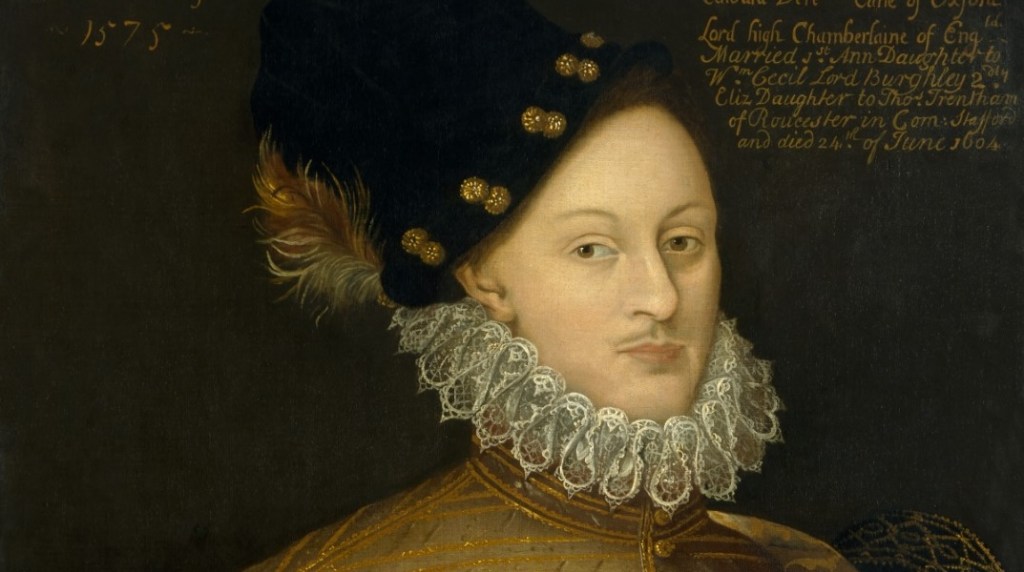
    Image – Edward de Vere, 17th Earl of Oxford

    Continued research seems to be confirming the claim by the Oxfordians that Edward de Vere, 17th Earl of Oxford—not Gulielmus Shakspere of Stratford-upon-Avon as insisted by the Stratfordians—wrote the canon of plays and poems left by the pseudonymous “William Shakespeare.”

    Who Is the Authentic “Shakespeare” Writer”?

    The mystery regarding the true identity of the writer traditionally known as “William Shakespeare” actually began in Elizabethan England, during the period in which most of the likely candidates for the position lived and wrote. 

    The controversy [1] has continued, and today there are two main groups that argue the point: the Oxfordians contend that the most likely writer of the Shakespeare canon is Edward de Vere, 17th Earl of Oxford.   Arguing the other side are the Stratfordians, who maintain that Gulielmus Shakspere of Stratford-upon-Avon, the traditionally held choice, remains the actual writer.

    The first biographical work on “William Shakespeare” appeared in 1769.   It focuses on Gulielmus Shakspere, the man from Stratford-upon-Avon in Warwickshire, traditionally hailed as the Shakespeare writer.  

    That same year, Herbert Lawrence in his work titled, The Life and Adventures of Common Sense, suggests the idea that “William Shakespeare” was likely the nom de plume of some other writer but not the Stratford man. 

    In 1780 a clergyman/scholar in Warwickshire, James Wilmot, examined records near and surrounding Stratford-upon-Avon, searching for data on William Shakespeare and the Shakespeare works.  Wilmot found nothing about the writer or his works.

    After Wilmot lacked success in locating any information leading to the identity of the Stratford man as the Shakespeare writer, he floated the notion that Francis Bacon using “William Shakespeare” nom de plume had written those plays and sonnets.  Wilmot, to the detriment of historical literary research, mandated that all of his research materials be burned upon his death.

    In 1857, Delia Bacon, an American short story writer and Shakespeare enthusiast, offered the suggestion that perhaps a committee and not just one individual had composed the Shakespeare canon.  For her suggested committee, Delia Bacon chose Edmund Spencer, Sir Walter Ralegh, and Edward de Vere; she placed Francis Bacon in the committee as its chairman.

    Since those early suggestions that an individual other than the Stratford man wrote the Shakespeare canon, the controversy has raged on.   Currently, the Oxfordians, who continue to gather evidence for Edward de Vere, 17th Earl of Oxford, as the Shakespeare writer are putting forth the strongest, most convincing argument.

    Literary scholars and critics are increasingly coming to the conclusion that the man from Stratford, Gulielmus Shakspere, widely held as the traditional Shakespeare, is the least qualified candidate for playing that authorial rôle.  From that conclusion emerges the likelihood that Edward de Vere, 17th Earl of Oxford, is the best candidate for consideration as the Shakespeare writer. 

    Walt Whitman, one of America’s greatest poets, agrees with the Oxfordians, who argue that the 17th Earl of Oxford is the actual author of the works published under the nom de plume, “William Shakespeare”: 

    Conceiv’d out of the fullest heat and pulse of European feudalism — personifying in unparalleled ways the medieval aristocracy, its towering spirit of ruthless and gigantic caste, with its own peculiar air and arrogance (no mere imitation) — only one of the “wolfish earls” so plenteous in the plays themselves, or some born descendant and knower, might seem to be the true author of those amazing works — works in some respects greater than anything else in recorded literature.  [2]

    From other respected writers such as Henry James and Ralph Waldo Emerson to actors such as Charlie Chaplin and Sir Derek Jacobi to supreme court justices such as Harry A. Blackmun and John Paul Stevens, famous individuals have expressed doubt about the tradition identification of the Shakespeare writer [3].

    Why the Oxfordians Are Likely Correct

    A study of the background of each man—Gulielmus Shakspere of Stratford-upon-Avon and Edward de Vere, 17th Earl of Oxford—reveals evidence that  suggests that only Oxford possessed the ability to have produced the complex, historically based, geographically accurate  works of the Shakespeare writer.

    Gulielmus Shakspere—”Stratford”—was semi-literate; his parents, his wife, and his children were all semi-literate.  He likely remained uneducated beyond age 14.  No records have been found that demonstrate that he wrote anything more complex than a list of beneficiaries in his last will and testament.

    But if the Stratfordians are correct, this semi-literate individual who traveled no farther than to London (if that far) and left no early writings just suddenly commenced the composition of complex historical dramas and perfectly modulated sonnets during the time period Shakespeare scholars call “Shakespeare’s Lost Years.” 

    In contrast, Edward de Vere—”Oxford”—had received a first class education, had traveled widely throughout the world, and had actually been known to be a writer of plays and poetry.

    It remains as unlikely that the man Gulielmus Shakspere could have composed any of the works attributed to “William Shakespeare,” as he could have invented the horseless carriage or discovered the Pacific Ocean.  

    Life Sketch of Gulielmus Shakspere:  Birth Date in Doubt

    The biographical documents of “William Shakespeare” are virtually blank pages, upon which scholars, critics, and enthusiasts have written versions of a life, for example, no record exists of the birth date of “William Shakespeare,” even under the name Gulielmus Shakspere.  Biographers, therefore, can only speculate [4]:

    William Shakespeare was born in Stratford-upon-Avon, England, in April 1564. The exact date of his birth is not recorded, but it is most often celebrated around the world on 23 April. . . . Shakespeare also died on 23 April; in 1616, when he was 52 years of age.

    And the speculation continues; the following represents a further example that is typical of any attempt to state when “William Shakespeare” was born:

    No birth records exist, but an old church record indicates that a William Shakespeare was baptized at Holy Trinity Church in Stratford-upon-Avon on April 26, 1564. 

    From this, it is believed he was born on or near April 23, 1564, and this is the date scholars acknowledge as Shakespeare’s birthday. [5]

    As would-be biographers speculate about the birth date and other details regarding the Shakespeare writer, they employ the nom de plume “William Shakespeare” instead of Gulielmus Shakspere, the name that appears on the man’s baptismal record.

    Remaining a nebulous figure, “William Shakespeare” as Gulielmus Shakspere has no actual day of birth.  His speculated birth date is April 23, 1564, as is his death date, April 23, 1616.    The fabulous coincidence of any man dying on his unknown birth date further suggests the vulnerability of the claim that Stratford is the actual Shakespeare writer.

    The Education of “William Shakespeare”

    While uncertainty abounds regarding the birth date of “William Shakespeare,” equal uncertainty persists regarding his education.  Again, no records [6] have been found to designate the level of education to which Stratford might have risen.

    Supposition and guess-work suggest that Stratford might have attended King Edward VI Grammar School between the ages of seven and fourteen.  After age fourteen, his formal education was finished.  However, speculation regarding Stratford’s education has been offered as actual biographical history: 

    Stratford enjoyed a grammar school of good quality, and the education there was free, the schoolmaster’s salary being paid by the borough. 

    No lists of the pupils who were at the school in the 16th century have survived, but it would be absurd to suppose the bailiff of the town did not send his son there. 

    The boy’s education would consist mostly of Latin studies—learning to read, write, and speak the language fairly well and studying some of the Classical historians, moralists, and poets. 

    Shakespeare did not go on to the university, and indeed it is unlikely that the scholarly round of logic, rhetoric, and other studies then followed there would have interested him. (my emphasis on “no lists of the pupils”) [7]

    It may seem absurd to deem that the Shakespearean father would not have insisted that his son attend an illustrious grammar school funded by the state.  In such a school,  the boy would have been immersed in Latin studies and the classics.  However, such deeming does not record that boy’s name in documents that reveal that he did actually attend such an illustrious grammar school.

    Also, if the son of the town’s bailiff had received such an excellent education and was taught to read and write Latin, which he did “fairly well,” one has to remain perplexed that Gulielmus Shakspere remained unable to write his own name and spell it consistently throughout his lifetime (see below “The Spelling of the Stratford’s Name”).

    The Importance of Education

    Although no documentation exists to validate the education of Stratford and only speculations are extant that he attended King Edward VI Grammar School in Stratford-upon-Avon, the educational record [8] for Edward de Vere is extensive.  

    Edward de Vere became a ward of the Crown and was educated by the Royal Court of Wards.  He attended Queen’s College, Cambridge, and later underwent training at Gray’s Inn in the study of law. 

    De Vere was early on considered a wunderkind; his mentor and tutor Laurence Nowell asserted in 1563, as de Vere turned 13 years old,  that his “work for the Earl of Oxford cannot be much longer required.”    By the next year, at age 14, de Vere had been awarded a Cambridge degree. In 1566, at age 16, he earned a master of arts degree from the universities of Oxford and Cambridge.

    Stratfordians like to emphasize the fact that genius can overcome station in life, but such is true only to a point.  The late Shakespeare scholar Daniel Wright [9] has elucidated the issue of education vs natural genius:

    A writer’s genius can elevate his or her poetry or prose beyond the mundane (indeed, in Shakespeare’s case, it endows his achievement with a magnificence that is almost transcendent in its resplendence), but it cannot of itself impart to any writer—not even to Shakespeare—a knowledge of particular facts. 

    Genius may animate the hand, but it does not do that which is not its office—it does not, for it cannot, supply the material with which the hand performs its work. Some things even a genius simply must be taught.

    The issue of education presents one of the best supports for the fact that Stratford would not have had knowledge of the facts needed to have written the Shakespeare canon.  Professor Wright has pointed out that “knowledge of particular facts” cannot come without the input of experience to the mind, even to a genius. 

    No evidence exists that Stratford had traveled even to London—only 100 miles from Stratford-upon-Avon—much less that he could have traveled a great deal in Italy.  Such a set of facts is necessary for the writer, who wrote the plays, to have experienced.   Despite natural talent and genius, an intimate knowledge of the Italian landscape cannot simply appear within the mind of said genius.

    “The Lost Years”

    The concept of “Lost years” in the lives of any biographical target provides a delicious opportunity to the biographer, who then has the opportunity to fill in those lost years.    Because “there is no documentary evidence of his life during this period of time,” suitable scenarios may be invented that have little or no relationship to real events.  Thus the would-be biographer is allowed to opine as he wishes, such as the following: 

    ‘The Lost Years’ refers to the period of Shakespeare’s life between the baptism of his twins, Hamnet and Judith in 1585 and his apparent arrival on the London theatre scene in 1592.

    We do not know when or why William Shakespeare left Stratford-upon-Avon for London, or what he was doing before becoming a professional actor and dramatist in the capital. There are various traditions and stories about the so-called ‘lost years’. 

    There is no documentary evidence of his life during this period of time.  A type of mythology has developed around these mysterious years, and many people have their favourite version of the story. (my emphasis added)  [10]

    These speculating Shakespearean biographers not only do not know “when or why” Stratford left Stratford-upon-Avon for London, but they also do not even know that he actually did make that trip to London.   That Stratford became “a professional actor and dramatist in the capital” remain likely one part of the confusion that has fused aspects from the lives of Stratford and Oxford.

    Further Evidence Oxford Is the Real “Shakespeare”

    In addition to the issue of the vast differences between the Stratford man and the Oxford earl in education, further issues advocate that Oxford continues to remain the better candidate for the real “Shakespeare” than Stratford.

    The Spelling of the Stratford’s Name

    The many variations in the spelling of the name “Shakspere” offer further evidence for the claim the Stratford could not have authored the Shakespeare canon.  Stratford could barely write his own name, much less a complex literary canon.  Stratford’s signature [11] varied, as he affixed his name with six different spellings in four legal documents:  

    1. deposition of the lawsuit, Bellott v Mountjoy (1612) 
    2. deed for a house sold in Blackfriars, London (1613)
    3. the mortgage document for a house acquired in Blackfriars (1613)
    4. a 3-page Last Will and Testament (1616), which he signed at the bottom of each page.

    Interestingly, none of the Stratford man’s many variations on the spelling of his name includes the spelling “Shakespeare” (12).

    Thomas Regnier on “Our Ever-Living Poet”

    Thomas Regnier, Shakespeare scholar and prominent Oxfordian, delineates the top “18 Reasons Why Edward de Vere, Earl of Oxford, Was “Shakespeare.”   Regnier’s Reason 18 clarifies the use of the phrase, “Our ever-living poet,” thus demonstrating that it refers to Oxford instead of Stratford:

    Shakespeare’s Sonnets were first published in 1609. There are indications on the dedication page that the author was no longer living at that time. 

    First, the dedication is signed by the publisher, Thomas Thorpe, not by the author, suggesting that the author was not alive to write the dedication. 

    More significantly, the dedication refers to the author as “ever-living.” This is a phrase that was used metaphorically to refer to a person who was no longer alive, but who would live on through his works in our minds and hearts. 

    The Earl of Oxford was no longer living in 1609, while the man from Stratford, who is usually credited with writing the works of Shakespeare, would live on for another seven years. Stratfordian scholars have never been able to explain why the phrase “ever-living” would have been applied to a living person.  [13]

    The controversy at the heart of the Stratford vs Oxford debate will likely continue because of the simple nature of the past, which perpetually remains in a kind of fog.   An unfortunate encumbrance that may interfere with the legitimacy of the debate to ultimately find the truth is that it might come to depend on which side affords the debaters greater financial and prestigious awards.  

    Questions that could use an airing are:  Do university grants go more often to those researchers who contend that Stratford is the real “William Shakespeare”?  Does Oxfordianism label one a royalist and an elitist while Stratfordianism offers the veneer of humbleness and dedication to the “little man”?

    The Stigma Attached to Oxfordianism

    The Stratfordians have in the past attached a stigma to the Oxfordians, for example, in 1920, J. Thomas Looney identified Oxford as the Shakespeare writer and offering the claim that “William Shakespeare” was a  pseudonym (pen name or nom de plume.)   While Looney’s name is pronounced with a long ō, stigmatizing Stratfordians engaging in the rhetorical fallacy called name-calling revels in calling Looney “loony” (14).

    Also if one entertains any lingering doubt that the Stratfordians have an equal argument to wield against the Oxfordians, one might want to have a look at the comments offered on amazon.com after Looney’s book, “Shakespeare” Identified,” a centenary edition edited by James Warren.  

    John Crowe Ransom’s New Criticism movement of the middle 20th century placed emphasis on the text above biography of the writer:  

    The central issue that new critical thought brought to literary studies is the emphasis on the text itself, rather than on the biography of the writer or the historical and societal circumstances in which the writer composed. While these issues may be considered overall, the first consideration must be the text itself. [15]

    Nevertheless, each scholar, critic, commentarian, or reader has to decided for himself which of the known facts are important and in which direction they point.  It is also important to remember that biography is only one portion of the information needed to understand and appreciate any work of literary art.

    My Personal View of the Shakespeare Controversy

    I have written commentaries on the 154 sonnets in the Shakespeare canon, and I have posted them on this site; thus I feel it necessary to make known my thoughts on the controversy and how they likely impact issues that I focus on in my sonnet commentaries.

    After studying the research of Oxfordians such as the late Professor Daniel Wright, Thomas Regnier, and many others, as well as the many who remain traditional Stratford supporters, I conclude that the Oxfordians have the far better argument, and the evidence is clear that the Shakespeare writer is most likely, if not in fact, Edward de Vere, 17th Earl of Oxford.

    I agree that the name “William Shakespeare” is most likely the pen name (nom de plume) of the Earl of Oxford.  I find no reason that Gulielmus Shakspere should have adopted a pen name, when as it has been fairly established the he seldom put pen to paper.

    Edward de Vere, as a ranking nobleman, needed to hide his association with the lower classes who engaged in writing and putting on plays.  Thus he did have the need for employing the use of a nom de plume, especially as he began to publish.  It is quiet easy to see that de Vere’s choice of a pen name “William Shakespeare” could be confused with the Stratford man’s name “Gulielmus Shakspere.”

    Because I find most compelling that argument that “William Shakespeare” is the nom de plume of Edward de Vere, 17th Earl of Oxford, I choose to refer to the works attributed to “William Shakespeare” as the “Shakespeare works” or the “Shakespeare sonnets,” instead of  “Shakespeare’s works” or “Shakespeare’s sonnets.”

    I suggest that ownership shown by the apostrophe should be reserved for a person, not a nom de plume.  In cases such a “Mark Twain” and “Lewis Carroll,” I relent because of their proximity to our contemporary world, and their identities are not in question.  In my opinion, however, the sonnets are Edward de Vere’s sonnets, but because they are published and traditionally known as “Shakespeare” sonnets, I refer to them as such.

    Sources

    [1]  Editors. “Controversy Timeline, Part 1.” Shakespeare Authorship Roundtable.  Accessed June 6, 2021.

    [2]  Walt Whitman.  “What Lurks Behind Shakspere’s Historical Plays?November Boughs. bartleby.com: Great Books Online. Accessed December 2020.

    [3]  Editors.  “Past Doubters.”  The Shakespeare Authorship Coalition.  Accessed September 27, 2024.

    [4] Editors.  “When Was Shakespeare Born?”  Shakespeare Birthplace Trust.  Accessed December 2020.

    [5]  Editors. “William Shakespeare Biography.”  Biography.  Updated: Dec 10, 2020. Original: Apr 24, 2015.

    [6]  Editors. “The Education of William Shakespeare.” Literary Genius. Accessed December 2020.

    [7]  David Bevington. “William Shakespeare.”  Britannica. November 4, 2020.

    [8] Curators.  “Chronology of Edward de Vere.”  The de Vere Society.  Accessed December 2020.

    [9] Daniel L. Wright.  “The Education of The 17th Earl of Oxford Mirrored in the Shakespeare Canon.”  Shakespeare Oxford Fellowship. May 1, 2006

    [10]  Editors. “Shakespeares’ Lost Years.” Shakespeare Birthplace Trust.  Accessed December 2020.

    [11]  Amanda Mabillard. “Playing Fast and Loose with Shakespeare’s Name.”  shakespeare online. July 20,  2011.

    [12]  Bryan H. Wildenthal.  “Reflections on Spelling and the Authorship Question.”  Shakespeare Oxford Fellowship.  August 9, 2018.

    (13)  Thomas Regnier.  “Top 18 Reasons Why Edward de Vere, Earl of Oxford, Was “Shakespeare.” Shakespeare Oxford Fellowship. August 18, 2019.

    [14]  Eve Siebert.  “Spot the Looney.”  Skeptical Humanities.  Accessed September 27, 2024.

    [15]  Linda Sue Grimes.  “The Fugitive-Agrarian Movement in Poetry.”  Linda’s Literary Home.  Updated November 17, 2025.  

    Edward de Vere, 17th Earl of Oxford – “William Shakespeare”

    Commentaries on the Shakespeare Sonnets 1—154

    1. The Marriage Sonnets 1—17

    2. The Muse Sonnets 18—126
        Part 1:  18—73
        Part 2:  74—126

    3. The Dark Lady Sonnets 127—154