In her customary fashion, poetaster Sharon Olds offers up this deeply flawed, dishonest hit-piece, “The Victims,” which does little more for humanity than showcase a handful of stark images.
Introduction with Text of “The Victims”
According to noted poetry critic, Helen Vendler, Sharon Olds’ poetry comes across as “self- indulgent, sensationalist, and even pornographic.” And as former poet laureate Billy Collins averred: Olds is “a poet of sex and the psyche” “infamous for her subject matter alone.”
And even though Collins attempted to add some faint praise, “but her closer readers know her as a poet of constant linguistic surprise,” those linguistic surprises consisting of stark images only function to undermine her attempt to produce any genuine poetry.
Although “The Victims” is one of Olds’ least “pornographic” efforts, the piece clearly demonstrates egotistical self-indulgence and egregious sensationalism. Such writing smacks more of loose-mused regurgitation than real cogitation on genuine emotion.
This unhappy piece consists of 26 uneven lines of free verse that sit in a lump chunk on the page and suffer from the customary Oldsian haphazard line breaks.
The Victims
When Mother divorced you, we were glad. She took it and took it in silence, all those years and then kicked you out, suddenly, and her kids loved it. Then you were fired, and we grinned inside, the way people grinned when Nixon’s helicopter lifted off the South Lawn for the last time. We were tickled to think of your office taken away, your secretaries taken away, your lunches with three double bourbons, your pencils, your reams of paper. Would they take your suits back, too, those dark carcasses hung in your closet, and the black noses of your shoes with their large pores? She had taught us to take it, to hate you and take it until we pricked with her for your annihilation, Father. Now I pass the bums in doorways, the white slugs of their bodies gleaming through slits in their suits of compressed silt, the stained flippers of their hands, the underwater fire of their eyes, ships gone down with the lanterns lit, and I wonder who took it and took it from them in silence until they had given it all away and had nothing left but this.
Commentary on “The Victims”
The piece breaks into two parts: the first is a description of how the speaker and her family felt way back a few decades when she was a child, and the second part jumps to what the speaker observes and thinks as an adult.
First Movement: Hindsight Sometimes Less Than 20/20
The speaker of the poem is an adult looking back at the break up of her family roughly around the time that her mother divorced her father. The speaker is addressing the father, telling him how glad she and the family were after the mother divorced the father.
The speaker and her siblings were glad because she “took it // in silence, all those years.” What she, and perhaps they, silently endured is left up to the reader to imagine, and that omission is a major flaw that leads the poem astray.
No two divorces are alike. By leaving such an important motive to the imagination of the reader, the speaker weakens the thrust of her accusations against the father. The only hint of the father’s misdeeds is that he enjoyed three alcoholic beverages with his lunch.
Admittedly, that could present a problem, but by no means does it always do so. Some individuals can handle a few drinks better than others, and the fact that the father seemed to have functioned in his job for a considerable period of time hints that he might have been competent in his job.
On the other hand, the mother influenced her children in a grossly negative way, causing them to hate their father and wish him dead.
Apparently, the mother teaches her children to hate their father simply because he had three double bourbons for lunch or so we must assume because no other accusation is leveled against the poor man.
Maybe the father was a cruel alcoholic, who beat the mother and children, but there is no evidence to support that idea. And if that were the case, stark images of bruises and broken bones would surely have made an appearance in the little drama.
The father was fired from his job, but only after the mother kicked him out. Would he have been able to keep his job to that point in his life, if he had been an out of control, cruel drunk? Perhaps he became depressed and without purpose after being forced to leave his family and sank further into alcohol.
The gratuitous allusion to “Nixon’s helicopter,” carrying the newly resigned president from office, further inserts the nastiness of a political hit-piece, adding nothing to the drama except the suggestion that the family likely voted for Democrats.
One has to wonder if the speaker and her fellow travelers would have “grinned” so readily, if a helicopter had lifted off the South Lawn carrying Jimmy Carter or Bill Clinton.
So the reader has no evidence that the father was guilty of anything, but the mother taught the kids to hate the father and wish for his death. The mother comes across as a less sympathetic character than the father.
Second Movement: Appalling Prejudice Revealed
The speaker now begins her report on what she sees and how she thinks in her current life situation that has been tainted by her past. She begins to observe homeless men sleeping in doorways.
It becomes clear that it is those homeless men in the doorway who are reminding the speaker of her father getting kicked out of their home and getting fired from his job.
The speaker then speculates about those men about whom readers can be sure she knows absolutely nothing. She wonders about the lives of those homeless men, whom she calls “bums.”
She wonders if their families “took it” from those men the way her family supposedly took it from her father. But again, the reader remains clueless about what it is the family “took.”
What an arrogant reaction! Without one whit of evidence that these “bums” did anything to anyone, the speaker simply presumes that they are like her father, who lost it all because of what he (and now they) supposedly did.
But the reader still does not even know what the father did. They do know what the mother did; she taught her children to hate the father and wish him dead.
Stark, Colorful Images
This poem, like many of Sharon Olds’ poems, offers some colorful descriptions. The father’s business suits are rendered “dark / caresses” hanging the closet. His shoes sport “black / noses //with their large pores.”
Those homeless men are name called “bums” because they are lying “in doorways.” Their bodies are dehumanized and portrayed as “white / slugs.”
Those slugs shine “through slits” in compacted dirt, revealing their compromised hygiene after being homeless for a protracted length of time. Their hands resemble “stained / flippers,” again dehumanized.
Their eyes remind this flippant speaker, who lacks compassion for her fellow human beings, of ships that have sunken with their “lanterns lit.”
Would that all of those colorful images resided in a better place and without the lack of humanity this speaker reveals about herself. Those “linguistic surprises,” however, function only to render the speaker and the so-called victims as the actual perpetrators of despicable acts.
Although the speaker wishes to foist bad behavior onto first her father and then onto homeless men, she cannot escape the rebuttal that she has failed to indict her father and that she knows nothing about those homeless “bums.”
This ugly piece remains questionable and appears to have been created solely for the purpose of showcasing a handful of stark, colorful images.
Angela Manalang Gloria’s poem “To the Man I Married” presents an extended metaphor in which the speaker likens her love for her husband to her existential dependence on the earth.
Introduction and Text of “To the Man I Married”
This metaphor functions on both physical and spiritual levels, suggesting that her partner sustains and orients her life in a manner analogous to the natural elements necessary for survival.
To the Man I Married
I
You are my earth and all the earth implies: The gravity that ballasts me in space, The air I breathe, the land that stills my cries For food and shelter against devouring days.
You are the earth whose orbit marks my way And sets my north and south, my east and west, You are the final, elemented clay The driven heart must turn to for its rest.
If in your arms that hold me now so near I lift my keening thoughts to Helicon As trees long rooted to the earth uprear Their quickening leaves and flowers to the sun,
You who are earth, O never doubt that I Need you no less because I need the sky!
II
I cannot love you with a love That outcompares the boundless sea, For that were false, as no such love And no such ocean can ever be. But I can love you with a love As finite as the wave that dies And dying holds from crest to crest The blue of everlasting skies.
Section I
The first section of the poem adheres to the formal structure of the English (or Shakespearean) sonnet, consisting of three quatrains and a concluding couplet.
First Quatrain: The Husband as Life-Sustaining Force
You are my earth and all the earth implies: The gravity that ballasts me in space, The air I breathe, the land that stills my cries For food and shelter against devouring days.
The speaker opens with a striking declaration, asserting her husband’s indispensable role in her existence by comparing him to the earth itself. The metaphor extends through a catalogue of essential elements: gravity, air, land, and sustenance.
These earthly necessities are paralleled with emotional and material support offered by her husband, suggesting that her survival—both physical and emotional—depends as much on him as it does on the natural world.
Second Quatrain: He Provides Orientation and Final Rest
You are the earth whose orbit marks my way And sets my north and south, my east and west, You are the final, elemented clay The driven heart must turn to for its rest.
The second quatrain deepens the metaphor, portraying the husband as the source of direction and purpose in the speaker’s life. The reference to cardinal directions implies that her sense of order and orientation derives from their shared life.
The closing lines evoke mortality and rest, implying that just as the earth will eventually receive her physical body in death, her husband provides emotional and spiritual repose during life.
Third Quatrain: Acknowledging Other Affections
If in your arms that hold me now so near I lift my keening thoughts to Helicon As trees long rooted to the earth uprear Their quickening leaves and flowers to the sun,
Here, the speaker introduces a subtle shift. While affirming her deep attachment to her husband, she also acknowledges her intellectual and spiritual aspirations.
The allusion to Helicon, a mountain sacred to the Muses in Greek mythology, evokes poetic inspiration. Her longing for the transcendent does not diminish her love for her husband; rather, it coexists with it, just as rooted trees still reach toward the sun.
The Couplet: Coexistence of Earthly and Celestial Needs
You who are earth, O never doubt that I Need you no less because I need the sky!
The final couplet affirms the central thesis of the poem: the speaker’s need for transcendence (symbolized by “the sky”) does not negate her need for the grounding, stabilizing presence of her husband (symbolized by “the earth”).
Instead, both are essential, suggesting a balanced view of human experience as encompassing both the corporeal and the aspirational.
Section II
The second part of “To the Man I Married” diverges from the sonnet form and appears in two quatrains, adopting a more reflective tone. Here, the speaker qualifies the grand metaphors of the first section with a more tempered, realistic assessment of love.
First Quatrain: Rejection of Hyperbolic Metaphors
I cannot love you with a love That outcompares the boundless sea, For that were false, as no such love And no such ocean can ever be.
In this stanza, the speaker resists the temptation to describe her love through hyperbole. She dismisses the comparison to the “boundless sea” as false, recognizing the limitations of human emotion and language.
This moment of self-awareness introduces a more grounded view of romantic love.
Second Quatrain: Finite Love Reflecting the Infinite
But I can love you with a love As finite as the wave that dies And dying holds from crest to crest The blue of everlasting skies.
Although she renounces the oceanic metaphor, the speaker reintroduces the image of water through the wave. Unlike the sea, the wave is finite and mortal, yet it captures and reflects the sky’s infinity.
In this subtle turn, Gloria suggests that even within human limitations, love can embody and reflect transcendence.
William Butler Yeats’ “The Second Coming” remains one of the most widely misunderstood poems of the 20th century. Many scholars and critics have failed to criticize the exaggeration in the first stanza and the absurd metaphor in the second stanza, which render a potentially fine poem a critical failure.
Introduction with Text of “The Second Coming”
Poems, in order to communicate, must be as logical as the purpose and content require. For example, if the poet wishes to comment on or criticize an issue, he must adhere to physical facts in his poetic drama. If the poet wishes to emote, equivocate, or demonstrate the chaotic nature of his cosmic thinking, he may legitimately do so without much seeming sense.
For example, Robert Bly’s lines—”Sometimes a man walks by a pond, and a hand / Reaches out and pulls him in” / / “The pond was lonely, or needed / Calcium, bones would do,”—are ludicrous [1] on every level. Even if one explicates the speaker’s personifying the pond, the lines remain absurd, at least in part because if a person needs calcium, grabbing the bones of another human being will not take care of that deficiency.
The absurdity of a lake needing “calcium” should be abundantly clear on its face. Nevertheless, the image of the lake grabbing a man may ultimately be accepted as the funny nonsense that it is. William Butler Yeats’ “The Second Coming” cannot be dismissed so easily; while the Yeats poem does not depict the universe as totally chaotic, it does bemoan that fact that events seem to be leading society to armageddon.
The absurdity surrounding the metaphor of the “rough beast” in the Yeats poem renders the musing on world events without practical substance.
The Second Coming
Turning and turning in the widening gyre The falcon cannot hear the falconer; Things fall apart; the centre cannot hold; Mere anarchy is loosed upon the world, The blood-dimmed tide is loosed, and everywhere The ceremony of innocence is drowned; The best lack all conviction, while the worst Are full of passionate intensity.
Surely some revelation is at hand; Surely the Second Coming is at hand. The Second Coming! Hardly are those words out When a vast image out of Spiritus Mundi Troubles my sight: somewhere in sands of the desert A shape with lion body and the head of a man, A gaze blank and pitiless as the sun, Is moving its slow thighs, while all about it Reel shadows of the indignant desert birds. The darkness drops again; but now I know That twenty centuries of stony sleep Were vexed to nightmare by a rocking cradle, And what rough beast, its hour come round at last, Slouches towards Bethlehem to be born?
Commentary on “The Second Coming”
William Butler Yeats’ “The Second Coming” remains one of the most widely anthologized poems in world literature. Yet its hyperbole in the first stanza and ludicrous “rough beast” metaphor in the second stanza result in a blur of unworkable speculation.
First Stanza: Sorrowful over Chaos
Turning and turning in the widening gyre The falcon cannot hear the falconer; Things fall apart; the centre cannot hold; Mere anarchy is loosed upon the world, The blood-dimmed tide is loosed, and everywhere The ceremony of innocence is drowned; The best lack all conviction, while the worst Are full of passionate intensity.
The speaker is sorrowing over the chaos of world events that have left in their wake many dead people. Clashes of groups of ideologues have wreaked havoc, and much blood shed has smeared the tranquil lives of innocent people who wish to live quiet, productive lives.
The speaker likens the seemingly out of control situation of society to a falconer losing control of the falcon as he attempts to tame it. Everyday life has become chaotic as corrupt governments have spurred revolutions. Lack of respect for leadership has left a vacuum which is filled with force and violence.
The overstated claim that “The best lack all conviction, while the worst / Are full of passionate intensity” should have alerted the poet that he needed to rinse out the generic hyperbole in favor of more accuracy on the world stage.
Such a blanket, unqualified statement, especially in a poem, lacks the ring of truth: it simply cannot be true that the “best lack all conviction.” Surely, some the best still retain some level of conviction, or else improvement could never be expected.
It also cannot be true that all the worst are passionate; some of the worst are likely not passionate at all but remain sycophantic, indifferent followers. Any reader should be wary of such all-inclusive, absolutist statements in both prose and poetry.
Anytime a writer subsumes an entirety with the terms “all,” “none,” “everything,” “everyone,” “always,” or “never,” the reader should question the statement for its accuracy. All too often such terms are signals for stereotypes, which produce the same inaccuracy as groupthink.
Second Stanza: What Revelation?
Surely some revelation is at hand; Surely the Second Coming is at hand. The Second Coming! Hardly are those words out When a vast image out of Spiritus Mundi Troubles my sight: somewhere in sands of the desert A shape with lion body and the head of a man, A gaze blank and pitiless as the sun, Is moving its slow thighs, while all about it Reel shadows of the indignant desert birds. The darkness drops again; but now I know That twenty centuries of stony sleep Were vexed to nightmare by a rocking cradle, And what rough beast, its hour come round at last, Slouches towards Bethlehem to be born?
The idea of “some revelation” leads the speaker to the mythological second coming of Christ. So he speculates on what a second coming might entail. However, instead of “Christ,” the speaker conjures the notion that an Egyptian-Sphinx-like character with ill-intent might arrive instead.
Therefore, in place of a second coming of godliness and virtue, as is the purpose of the original second coming, the speaker wonders: what if the actual second coming will be more like an Anti-Christ? What if all this chaos of bloodshed and disarray has been brought on by the opposite of Christian virtue?
Postmodern Absurdity and the “Rough Beast”
The “rough beast” in Yeats’ “The Second Coming” is an aberration of imagination, not a viable symbol for what Yeats’ speaker thought he was achieving in his critique of culture. If, as the postmodernists contend, there is no order [2] in the universe and nothing really makes any sense anyway, then it becomes perfectly fine to write nonsense.
Because this poet is a contemporary of modernism but not postmodernism [3], William Butler Yeats’ poetry and poetics do not quite devolve to the level of postmodern angst that blankets everything with the nonsensical. Yet, his manifesto titled A Vision is, undoubtedly, one of the contributing factors to that line of meretricious ideology.
Hazarding a Guess Can Be Hazardous
The first stanza of Yeats’ “The Second Coming” begins by metaphorically comparing a falconer losing control of the falcon to nations and governments losing control because of the current world disorder, in which “[t]hings fall apart; the centre cannot hold.”
Political factions employ these lines against their opposition during the time in which their opposition is in power, as they spew forth praise for their own order that somehow magically appears with their taking the seat of power.
The poem has been co-opted by the political class so often that Dorian Lynskey, overviewing the poem in his essay, “‘Things fall apart’: the Apocalyptic Appeal of WB Yeats’s The Second Coming,” writes, “There was apparently no geopolitical drama to which it could not be applied” [4].
The second stanza dramatizes the speaker’s musing about a revelation that has popped into his head, and he likens that revelation to the second coming of Christ; however, this time the coming, he speculates, may be something much different.
The speaker does not know what the second coming will herald, but he does not mind hazarding a dramatic guess about the possibility. Thus, he guesses that the entity of a new “second coming” would likely be something that resembles the Egyptian sphinx; it would not be the return of the Christ with the return of virtue but perhaps its opposite—vice.
The speaker concludes his guess with an allusion to the birth of such an entity as he likens the Blessed Virgin Mother to the “rough beast.” The Blessèd Virgin Mother, as a newfangled, postmodern creature, will be “slouching toward Bethlehem” because that is the location to which the first coming came.
The allusion to “Bethlehem” functions solely as a vague juxtaposition to the phrase “second coming” in hopes that the reader will make the connection that the first coming and the second coming may have something in common. The speaker speculates that at this very moment wherein the speaker is doing his speculation some “rough beast” might be pregnant with the creature of the “second coming.”
And as the time arrives for the creature to be born, the rough beast will go “slouching” towards its lair to give birth to this “second coming” creature: “its hour come round at last” refers to the rough beast being in labor.
The Flaw of Yeats’ “The Second Coming”
The speaker then poses the nonsensical question: “And what rough beast, its hour come round at last, / Slouches towards Bethlehem to be born?” In order to make the case that the speaker wishes to make, these last two lines should be restructured in one of two ways:
And what rough beast, its hour come round at last, Slouches towards Bethlehem to give birth?
or
And what rough beast’s babe, its time come at last, Is in transport to Bethlehem to be born?
An unborn being cannot “slouch” toward a destination. The pregnant mother of the unborn being can “slouch” toward a destination. But the speaker is not contemplating the nature of the rough beast’s mother; he is contemplating the nature of the rough beast itself.
The speaker does not suggest that the literal Sphinx will travel to Bethlehem. He is merely implying that a Sphinx-like creature might resemble the creature of the second coming. Once an individual has discounted the return of Jesus the Christ as a literal or even spiritual fact, one might offer personal speculation about just what a second coming would look like.
It is doubtful that anyone would argue that the poem is dramatizing a literal birth, rather than a spiritual or metaphorical one. It is also unreasonable to argue that the speaker of this poem—or Yeats for that matter—thought that the second coming actually referred to the Sphinx. A ridiculous image develops from the fabrication of the Sphinx moving toward Bethlehem. Yeats was more prudent than that.
Exaggerated Importance of Poem
William Butler Yeats composed a manifesto to display his worldview and poetics titled A Vision, in which he set down certain tenets of his thoughts on poetry, creativity, and world history. Although seemingly taken quite seriously by some Yeatsian scholars, A Vision is of little value in understanding either meaning in poetry or the meaning of the world, particularly in terms of historical events.
An important example of Yeats’ misunderstanding of world cycles is his explanation of the cyclical nature of history, exemplified with what he called “gyres” (pronounced with a hard “g.”) Two particular points in the Yeatsian explanation demonstrate the fallacy of his thinking:
In his diagram, Yeats set the position of the gyres inaccurately; they should not be intersecting but instead one should rest one on top of the other: cycles shrink and enlarge in scope; they do not overlap, as they would have to do if the Yeatsian model were accurate.
Image : Gyres – Inaccurate Configuration from A Vision
Image: Gyres – Accurate Configuration
2. In the traditional Second Coming, Christ is figured to come again but as an adult, not as in infant as is implied in Yeats’ poem “The Second Coming.”
Of great significance in Yeats’ poem is the “rough beast,” apparently the Anti-Christ, who has not been born yet. And most problematic is that the rough beast is “slouch[ing] towards Bethlehem to be born.” The question is, how can such a creature be slouching if it has not yet been born? There is no indication the speaker wishes to attribute this second coming fiasco to the mother of the rough beast.
This illogical event is never mentioned by critics who seem to accept the slouching as a possible occurrence. On this score, it seems critics and scholars have lent the poem an unusually wide and encompassing poetic license.
The Accurate Meaning of the Second Coming
Paramahansa Yogananda has explained in depth the original, spiritual meaning of the phrase “the second coming”[5] which does not signify the literal coming again of Jesus the Christ, but the spiritual awakening of each individual soul to its Divine Nature through the Christ Consciousness.
Paramahansa Yogananda summarizes his two volume work The Second Coming of Christ: The Resurrection of the Christ Within You:
In titling this work The Second Coming of Christ, I am not referring to a literal return of Jesus to earth . . .
A thousand Christs sent to earth would not redeem its people unless they themselves become Christlike by purifying and expanding their individual consciousness to receive therein the second coming of the Christ Consciousness, as was manifested in Jesus . . .
Contact with this Consciousness, experienced in the ever new joy of meditation, will be the real second coming of Christ—and it will take place right in the devotee’s own consciousness. (my emphasis added)
Interestingly, knowledge of the meaning of that phrase “the second coming” as explained by Paramahansa Yogananda renders unnecessary the musings of Yeats’ poem “The Second Coming”and most other speculation about the subject. Still, the poem as an artifact of 20th century thinking remains an important object for study.
In his poem, “The Hill Maiden,” Malcolm M. Sedam has created a speaker voicing cheerful vaticination that his teenage angst-ridden protégé will one day shed her nihilism and burst into life affirming joy. The best teachers are those who can inspire as well as instruct their students. This poem represents a stellar example of that kind of inspirational educator.
Introduction and Text of “The Hill Maiden”
Malcolm M. Sedam‘s “The Hill Maiden” features a teacher dramatizing his observations about a particularly inquisitive but melancholy student. His ultimate purpose is to instill in the student the notion that she will ultimately be able to appreciate the life that she seems to disdain.
The poem plays out in three movements of unrimed stanzas. This organization allows the speaker to touch lightly on the physical reality of the subject but then move more intensely to the mental and finally the spiritual possibility of the subject’s inclinations.
Because the speaker can only infer certain facts about his student, the poem remains metaphorically and imagistically implicative instead of unequivocally literal. For example, the teacher has no exact idea what the student does at her home; thus he places her in an image of “moving among the phantom rocks of reverie.”
The teacher/speaker knows from the negativity the student has been expressing to him that she mentally resides among hardness that causes her to imagine that things are worse than they are.
Mentally she travels like a rocket through her ghostly musings until night fall when she sleeps but likely gets little rest, accounting for the nervous, brittle energy the educator perceives in his young scholar.
Likely the adolescent girl is simply suffering the turbulence of teenage angst through which most individuals of that age group must travel. But the best, most effective teachers are those who can inspire as well as instruct their students. This poem represents a stellar example of that kind of inspirational educator.
As an educator, Mr. Malcolm M. Sedam wrote poems to many of his students, always with the goal of inspiring them to high thinking and plain living. Mr. Sedam once said he felt that his function as an educator was “to kick the dirt off of his students.” By that he meant to help them see life more clearly without the fog of stereotypes, prejudice, and provincialism.
The Hill Maiden
(for Linda, over in the valley)
She is moving among the phantom Rocks of reverie hurtling through By mind bringing days into darkness Where the pull of growth rings The heart and spurs the soul
Where her wish strings questions In the mysterious night of snow Bringing a promise that only the hills can sing. Her smile waits behind a frown of swords That rend her days
In the melancholy of the deep valley Of dreams where she lives among flowers Gathering her moods that may bring peace Once the sorrow of lonely distance Has closed on hands—
The same hands that Zen-like reach To answer each knock at the door of her heart Broken to be mended by tender time. Her mind is speeding through a galaxy Of intensity where the blood rose
Will speak to her frozen will All forgiven by decree in warring winds— The nature of her plight? Without wings She will still spring into flight.
Commentary on “The Hill Maiden”
Malcolm M. Sedam’s “The Hill Maiden” features a teacher, who is also a practicing poet, dramatizing his observance of an inquisitively intelligent but extremely melancholy student.
His only purpose is to instill in the student the notion that she will ultimately be able to appreciate the life that she seems now to disdain.
First Movement: Dreaming amongst the Hills
She is moving among the phantom Rocks of reverie hurtling through By mind bringing days into darkness Where the pull of growth rings The heart and spurs the soul
Where her wish strings questions In the mysterious night of snow Bringing a promise that only the hills can sing.
The speaker begins by placing the object of his speculative musing in an image that implies sharp but dream-like rigidity. Rocks appear ghost-like through a dream-scape as they bewilder the mental musings of the young girl with whom the mature educator is engaging both as a poetry mentor as well as a teacher.
Teachers often counsel their students who seek out their advice and direction even in issues outside of the academic sphere as well as within the educational arena. Those teachers who must essentially become counselors will either direct the students to other professionals, or they will attempt to offer their own gleanings from their life experience.
The teacher in this poem demonstrates that he is the latter kind of teacher, and he has given the mind of the young student some serious analysis. Thus he not only describes her environment, but he also speculates and then foreshadows what is likely to befall the girl once she is able to erase her current adolescent fog.
Until that glowing day arrives, however, the speaker sees that the girl’s maturing process weighs heavily on her heart and soul. She is full of questions brought on by the mystery of life.
The “snow” that brings beauty as it covers the hills also brings bitter cold and slippery conditions the cause the girl to miss the music that her hill-valley home affords her.
By pointing out these images of beauty and placing them a context of mystery and difficulty, the speaker hopes to allow his charge to contemplate the possibility that life is real and offers hope to those who search its reaches with an open mind and cheerful heart.
Second Movement: Frowning Swords
Her smile waits behind a frown of swords That rend her days
In the melancholy of the deep valley Of dreams where she lives among flowers Gathering her moods that may bring peace Once the sorrow of lonely distance Has closed on hands—
The same hands that Zen-like reach To answer each knock at the door of her heart Broken to be mended by tender time.
The speaker has observed the teen’s unwillingness to show a cheerful countenance. Her bitterness “behind a frown of swords” likely often gives the mentor a shudder at the likelihood that the girl is suffering intensely.
No doubt, he believes that at this point in her life, she should be dancing merrily among “flowers” and allowing her sorrowful moods to dissolve in the “deep valley of dreams.”
But again, he returns to prognostication that once she has learned to fold her hands in wonder and listen to the love that knocks at the “door of her heart,” her melancholy will be rendered null and void as “tender time” moves her through the rough spots of her anguish.
Again, the speaker chooses beauty—”flowers gathering”—to balance the “frown.” He offers the image of the heart’s door to harmonize with the environment that will reach her with the “Zen-like” hands of mystery and the ultimate gain-of-wisdom.
Like a Zen koan, the riddle of life will remain before her as she continues to search for answers to her perplexing questions.
Third Movement: Springing into Flight
Her mind is speeding through a galaxy Of intensity where the blood rose
Will speak to her frozen will All forgiven by decree in warring winds— The nature of her plight? Without wings She will still spring into flight.
Finally, the speaker makes his most striking vaticination after asserting that his young charge has a strong mind but also a tender heart that is quick to show intense emotion.
That the “blood rose” will speak itself undeniably to the girl’s will portends that all of her negativity and nihilism will be “forgiven” as she continues to navigate through the conflicts that life bestows on all searching souls.
Then the speaker offers the question that he is likely very content to answer. The frustrating situation that befuddles the young scholar’s mind and heart has been implied by all the imagery that went before, but then what will eventually be the path chosen by and/or for the student?
She will be able to navigate through all the trials and tribulations as a bird that so easily lifts it wings to the wind and takes to the air through the abundant space of sky.
The speaker is not so naïve as to insist that such navigation will come easily, but he does remain assured that the path will open to the girl, and she will become willing to follow it. Thus the speaker can conclude affirmatively that “Without wings, she will still spring into flight.”
Offered by a beloved and well-respected mentor, such faith in a young scholar’s ability to navigate life is bound to redound in blessings, despite the pitfalls and rough spots that her life, no doubt, will place sphinx-life before her mind and heart.
“There is a price to be paid for criticizing Obama.” —Jack Cashill
Barack Obama’s “Pop”
In Barack Obama’s “Pop,” the speaker is sketching what appears to be a father-figure—likely Frank Marshall Davis—and offering a glimpse into the relationship between the two. Obama called his maternal grandfather “Gramps,” rendering it unlikely that the father-figure in this poem is Stanley Dunham.
Introduction with Text of “Pop”
The spring 1981 issue of Feast, Occidental College’s literary magazine, published two poems, “Pop” and “Underground,” by erstwhile literary prodigy Barack Obama. According to Jack Cashill, long-time researcher of Obama’s literary efforts, Obama’s writings [1] suffer from, “awkward sentence structure, inappropriate word choice, a weakness for clichés,” and “the continued failure to get verbs and nouns to agree.”
Obama’s poems suffer from similar language indignities but also include further issues relevant to poems, such a faulty line breaks, confusing mixed metaphors, and inappropriate use of surrealist images.
Although readers can forgive a 19-year old for adolescent scribblings in non-sense, especially in poems published in a college lit mag, what they cannot do is discern that this particular adolescent was showing any potential to produce a future writer.
Likely, the future, and now former, occupier of the Oval Office could have become a capable interpretive reader, and it is possible that Barack Obama would have served more admirably as an actor [2] than writer or president.
Barack Obama possesses a unique charm that could have been employed in creative ways, if he had kept his focus on the humanities and entertainment fields instead of politics and government. The Obama administration, tainted by incompetence and corruption [3], has altered the American political landscape more intensely than any other in American history.
For this misdirection, Barack Obama is less to blame than his handlers, beginning with political American terrorist Bill Ayers, continuing with political hacks David Axelrod and Valerie Jarrett.
His coterie of political advisors steered him in a direction that has enriched Obama and that coterie financially, instead of enriching society in a humanitarian field of endeavor. The former president’s piece titled “Pop” consists of one 45-line versagraph [4]. The piece’s awkward, postmodern codswallop represents much of what is despicable and destructive in most postmodern art.
Pop
Sitting in his seat, a seat broad and broken In, sprinkled with ashes, Pop switches channels, takes another Shot of Seagrams, neat, and asks What to do with me, a green young man Who fails to consider the Flim and flam of the world, since Things have been easy for me; I stare hard at his face, a stare That deflects off his brow; I’m sure he’s unaware of his Dark, watery eyes, that Glance in different directions, And his slow, unwelcome twitches, Fail to pass. I listen, nod, Listen, open, till I cling to his pale, Beige T-shirt, yelling, Yelling in his ears, that hang With heavy lobes, but he’s still telling His joke, so I ask why He’s so unhappy, to which he replies… But I don’t care anymore, cause He took too damn long, and from Under my seat, I pull out the Mirror I’ve been saving; I’m laughing, Laughing loud, the blood rushing from his face To mine, as he grows small, A spot in my brain, something That may be squeezed out, like a Watermelon seed between Two fingers. Pop takes another shot, neat, Points out the same amber Stain on his shorts that I’ve got on mine, and Makes me smell his smell, coming From me; he switches channels, recites an old poem He wrote before his mother died, Stands, shouts, and asks For a hug, as I shink, my Arms barely reaching around His thick, oily neck, and his broad back; ‘cause I see my face, framed within Pop’s black-framed glasses And know he’s laughing too.
Commentary on “Pop”
The man addressed in Obama’s “Pop” is likely Frank Marshall Davis, long thought to be Obama’s biological father [5]. Barry called his Grandfather Dunham “Gramps” [6], not “Pop.”
First Movement: Sheltered Young Man
Sitting in his seat, a seat broad and broken In, sprinkled with ashes, Pop switches channels, takes another Shot of Seagrams, neat, and asks What to do with me, a green young man Who fails to consider the Flim and flam of the world, since Things have been easy for me; I stare hard at his face, a stare That deflects off his brow; I’m sure he’s unaware of his Dark, watery eyes, that Glance in different directions, And his slow, unwelcome twitches, Fail to pass.
The speaker places his father-figure in his usual chair where the latter is watching television, enjoying his “Seagrams, neat.” The man, called Pop, begins accosting the young man by flinging at him a rhetorical question: “What to do with me?”
The speaker asserts that Pop thinks his young charge is just a “green young man / Who fails to consider the / Flim and flam of the world.”
Pop counsels the young man that the latter’s sheltered existence is responsible for the young man’s failure to recognize the “flim-flam” world. The speaker then stares at the old man, who exhibits a facial tick, while his eyes dart off “in different directions / And his slow, unwelcome twitches.”
Frank Marshall Davis Is “Pop”
While many reviewers of this poem have interpreted Pop to be Stanley Armour Dunham, the maternal grandfather who raised Obama, the former president’s hagiographer, David Maraniss, in his biography, Barack Obama: The Story, reveals that the poem “Pop” focuses on Frank Marshall Davis [7], not Stanley Armour Dunham.
And the details of the poem all point to the truth of that revelation.That Obama’s grandfather, who raised him, would be addressing such an issue with his young charge is untenable. If the boy is incapable of considering the “flim-flam” of the world, whose fault would that be? It would be the person who raised the kid.
Obama’s relationship with Frank Marshall Davis, however, provides the appropriate station for such a topic of conversation. Davis took it upon himself to help the young Obama see the world through the lens of a black man in America.
Again, if “things have been easy for” the young Barry, it has been the grandfather who made them easy; thus, for the grandfather to be accosting the boy for that supposed flaw would be absurd.
Obama’s grandfather introduced the boy to Davis for the purpose of providing Barry with the advice of an older man who had lived the life of a black man in America. The Dunhams were heavily invested in identity politics as likely members of the Communist Party, as was card carrying member, Frank Marshall Davis [8].
The grandfather was of the inclination that he could never guide a young black boy in certain areas but that Davis could. Whether that sensibility is accurate or not is the topic for another day, but the topic being discussed by the speaker of this poem precludes the poem’s addressing Obama’s white grandfather.
Faulty Line Breaks
Many of the bad line breaks [9] in the poem demonstrate the amateurish nature of the poetaster, who makes the rookie flaw of ending several lines with the definite article “the.”
About Obama’s use of line breaks, poet Ian McMillan sarcastically observes [10]: “Barack likes his line breaks, his enjambments: let’s end a line with ‘broken’ and start it with ‘in’ just because we can!”
Second Movement: Surrealistic Encounter
I listen, nod, Listen, open, till I cling to his pale, Beige T-shirt, yelling, Yelling in his ears, that hang With heavy lobes, but he’s still telling His joke, so I ask why He’s so unhappy, to which he replies… But I don’t care anymore, cause He took too damn long, and from Under my seat, I pull out the Mirror I’ve been saving; I’m laughing, Laughing loud, the blood rushing from his face To mine, as he grows small, A spot in my brain, something That may be squeezed out, like a Watermelon seed between Two fingers.
The speaker then employs a surrealistic style as he continues to describe his encounter with Pop.
The speaker listens politely, nodding occasionally, as the old man declaims, but suddenly the speaker is “cling[ing] to the old man’s “[b]eige T-shirt, yelling / Yelling in his ears.” Those ears have “heavy lobes,” and the old man is “still telling / His joke.” But the speaker then asks Pop, “why / He’s so unhappy.”
Pop starts to respond, but the speaker does not “care anymore, cause / He took too damn long.” The speaker then pulls out a mirror from under his seat.
The confusion here mounts because the speaker had just claimed he was clinging to Pop’s shirt and yelling in the old man’s ear, which would have taken the speaker out of his seat. This confusion adds to the surreal nature of the episode.
After pulling out the mirror, the speaker asserts that he is “laughing, / Laughing loud.” What he does with the mirror is never made clear. But during his outbreak of laughter, Pop “grows small” shrinking to a “spot in [the speaker’s] brain.”
That tiny spot, however, “may be squeezed out, like a / Watermelon seed between / Two fingers.” This shrunken seed image of the speaker’s pop implies a level of disrespect that is quite breathtaking as it suggests that the speaker would like to eliminate Pop from his mind.
Third Movement: Smelling the Stain
Pop takes another shot, neat, Points out the same amber Stain on his shorts that I’ve got on mine, and Makes me smell his smell, coming From me; he switches channels, recites an old poem He wrote before his mother died, Stands, shouts, and asks For a hug, as I shink, my Arms barely reaching around His thick, oily neck, and his broad back; ‘cause I see my face, framed within Pop’s black-framed glasses And know he’s laughing too.
The speaker observes that Pop “takes another shot, neat,” but he probably means that the old man took another sip; it is not likely that the father-figure is measuring out each swig with a shot glass.
With this swig, Pop “points out the same amber / Stain on his shorts that I’ve got on mine, and / Makes me smell his smell, coming / From me.” During the exchange, while clinging to Pop’s shirt, the speaker has stained Pop’s shorts.
And Pop wants the speaker to realize his blame for the stain. At least, that’s one way to interpret the smelling the stain scene.
Others have inferred a sexual reference in the “smelling” scene, but that requires too much of a stretch, that is, a reading into the text what is not there and not implied.
Pop then changes TV channels and “recites an old poem / He wrote before his mother died.” He then rises from his seat, “shouts, and asks / For a hug.”
The younger man realizes his smallness in comparison to the size of Pop: “my / Arms barely reaching around / His thick, oily neck, and his broad back.” But the speaker sees himself reflected in Pop’s “black-framed glasses.” And now Pop is “laughing too.”
The reference to a poem written before Pop’s mother died also eliminates Grandfather Dunham as “Pop.” Dunham was only eight years old, when he discovered the body of his mother who had committed suicide.
The notion that an aged man would be quoting a poem that he wrote before he was eight years old is patently absurd. Plus there is no evidence that Grandfather Dunham ever wrote any poetry, while Frank is famously known as a poet, as well as his other endeavors in political activism and pornography.
“Shink” Is Obviously a Typo and “Know” Is Likely “Now”
Much has been made of the obvious typo in the line, “For a hug, as I shink, my.” The word is obviously “shrink.” Pop had shrunk to the size of a watermelon seed a few lines earlier, and now the speaker shrinks as he realizes how much smaller he is than Pop.
It is quite possible that in the last line “know” is an additional typo, for the word “now” would be more appropriate. It would be nonsensical for the speaker to say he “knows” Pop is laughing when he is right there looking into his face. But it makes sense for him to report that during the hug Pop also begins to laugh.
Interestingly, the editors of the New York Times quietly corrected the “shink” to “shrink” when they published the poems on May 18, 2008, in an article under the title, “The Poetry of Barack Obama [11]”. The editors did not correct the obvious error “know” for “now” in the last line.
Sources
[1]Jack Kerwick. Jack Cashill’sDeconstructing Obama. American Thinker. February 25, 2011.
This commentary on Sterling A. Brown’s “Southern Cop” offers an alternative reading to the sycophantic interpretation given by postmodernists who subscribe to the prevailing ideology of victimhood. The curse of identity politics soft censors such stances; thus they remain rare.
Introduction with Text of “Southern Cop”
While the speaker in Sterling Brown’s “Southern Cop” seems to be exposing and rebuking racism, he actually engages in racism himself. This widely anthologized poem features the following scene: A rookie cop named Ty Kendricks has shot a man who was running out of an alley.
The poem does not report the reason that the man was running nor the reason that the police officer happened to be at the scene. However, the report clearly states that the man’s reason for running was not because of any guilt on his part. It is useful to keep in mind that the caveat stating that one is innocent until proven guilty applies to all citizens—even those who are running.
The speaker of the poem purports to represent the outraged citizenry, whose emotional reaction is so powerful that the speaker must turn to verbal irony in order to convey that outrage. The outraged speaker assumes that his audience is as offended as he is and thus will agree with his statements on all levels.
But the speaker also assumes that a racist audience will take him literally, even though brushing away the irony would demonstrate the utter bankruptcy of his intentionally ludicrous exhortations. The ideas that because Ty Kendricks was a rookie in the process of proving himself and that the citizenry should decorate him for shooting an innocent man cannot be taken literally.
The ideas of proving manhood and decorating a cop for shooting an innocent man are clearly absurd. The ideas are absolutely preposterous, yet the speaker does not suggest the course of action society should take in dealing with Ty Kendricks, the rookie cop, who likely made a mistake, without consideration of the race of the victim.
What does this rookie cop deserve? Who is to decide? An angry, disorderly mob? The speaker’s emotion becomes magnified with each stanza from the first line of the first stanza that would appear not to be ironic at all but quite literal to the first line of the last stanza that is undoubtedly filled with irony.
About half-way through the poem the irony becomes obvious. And the speaker then sets center stage his ironic barbs in his effusion.
Southern Cop
Let us forgive Ty Kendricks. The place was Darktown. He was young. His nerves were jittery. The day was hot. The Negro ran out of the alley. And so Ty shot.
Let us understand Ty Kendricks. The Negro must have been dangerous. Because he ran; And here was a rookie with a chance To prove himself a man.
Let us condone Ty Kendricks If we cannot decorate. When he found what the Negro was running for, It was too late; And all we can say for the Negro is It was unfortunate.
Let us pity Ty Kendricks. He has been through enough, Standing there, his big gun smoking, Rabbit-scared, alone, Having to hear the wenches wail And the dying Negro moan.
Commentary on “Southern Cop”
This irony-filled drama portrays a bundle of rage and racism. The attitude of the speaker weighs in at least as heavily as the actual event that the speaker is decrying.
Stanza 1: Forgiveness Is Good
Let us forgive Ty Kendricks. The place was Darktown. He was young. His nerves were jittery. The day was hot. The Negro ran out of the alley. And so Ty shot
The first stanza opens with the speaker seemingly quite controlled as he suggests that he and his milieu “forgive” the young cop named Ty Kendricks. The invocation of the Christian value of forgiveness offers no clue that the speaker would not, in fact, forgive this rookie cop. Of course, the biblical injunction demands that trespassers be forgiven.
However, in this particular scenario, what is the speaker suggesting be forgiven? He is urging forgiveness of Ty Kendricks the rookie cop who shot an man because he was running out of an alley. The speaker does not reveal the reason that the man was running, nor what caused the cop to shoot; the speaker is simply asking that the rookie be forgiven.
Stanza 2: Understanding Is Also a Good Thing
Let us understand Ty Kendricks. The Negro must have been dangerous. Because he ran; And here was a rookie with a chance To prove himself a man.
Next, the speaker asks that he and his listeners “understand” the rookie cop. Of course, they should try to understand both the perpetrators of crime and the enforcers of law. Otherwise, justice cannot prevail without understanding.
But then the speakers’s audience is apprised of what they are being commanded to forgive and to understand: the man was surely dangerous/guilty because he was running. Not only that, the rookie Ty Kendricks now has the opportunity to show himself to be a man.
Because running does not equal guilt, and the notion of proving manhood by shooting someone is ludicrous, it now becomes clear that the speaker is engaging in verbal irony to portray his true message. This speaker does not, in fact, want his audience to forgive nor understand Ty Kendricks, the rookie cop.
What does the speaker hope to accomplish with his use of irony? He intends to brand Ty Kendricks a racist and elicit sympathy for the man shot by this cop. Of course, the man who was shot deserves sympathy, but the speaker offers no evidence that Ty Kendricks was a racist cop.
That fact that Kendricks shot a man running out of an ally does not equal racism, despite the fact that the running man was black. All things being equal, Ty Kendricks would likely have shot any man of any race in this situation.
Stanza 3: Condoning the Killing of an Innocent Man
Let us condone Ty Kendricks If we cannot decorate. When he found what the Negro was running for, It was too late; And all we can say for the Negro is It was unfortunate.
Condoning this apparently despicable act of a rookie cop shooting an innocent victim becomes a near surreal request. But because the speaker is engaging in irony, he does not intend his listeners to “condone” but instead to “condemn” the rookie cop.
The cop’s reaction of shooting the running man became just another “unfortunate” event by the time the cop learned the reason for the running. But what is the efficacy of forgiving, condoning, and decorating a cop for a bad shoot?
The ironic use of the terms means that the speaker is in reality suggesting that his listeners continue to hold a grudge and to condemn cops, even those who might have mistakenly shot someone. The intensity of this verbal irony may possibly encourage speculation that the speaker is even attempting to instigate rioting, burning buildings, and killing other cops.
Stanza 4: Pity for All Involved
Let us pity Ty Kendricks. He has been through enough, Standing there, his big gun smoking, Rabbit-scared, alone, Having to hear the wenches wail And the dying Negro moan.
Finally, the speaker appears to return to some semblance of humanity, asking that he and his listeners “pity” this poor rookie cop. Of course, the cop deserves pity. Or more accurately, he deserves sympathy and support. Taking the life of a fellow human being causes emotional damage—even to the most well-adjusted veteran law enforcement officer.
And taking a human life constitutes a serious, deeply spiritual offense against Creation and the Creator, even though that Creator has arranged Creation to require such an offense at times. Even man’s law allows for self-defense.
But notice that the speaker is still in his own racist venue, as he applies his final acerbic barb of irony: he does not, in fact, want his audience to pity that rookie cop. Instead, he wants his readers to pity only the family of the deceased man: they stood there crying and moaning the loss of their loved one.
The speaker asks us to pity the rookie only because that rookie has to listen to that crying and moaning. By stating ironically that the pity should apply to Ty Kendricks and contrasting his situation with that of the deceased man and his family, the speaker is implying that any loss suffered by the cop remains negligible.
But suffering cannot be compared and contrasted especially in such a callous way. There is no way of calculating and weighing the suffering on either side: it’s a lose-lose situation.
Ultimately, there is no pity for Kendricks from this speaker and his ilk—only a hollow attempt to portray the cop as a criminal, not simply a human being who has made a mistake.
The Issue of Racism in the Poem
A cursory reading of Sterling A. Brown’s “Southern Cop” may result in the assumption of the stereotypical view that cops shoot young black men because they are black. An example of such a reading includes the following:
Sterling A. Brown’s poem “Southern Cop” published in 1936 is an extremely powerful piece of poetry in American history because it cuts at the heart of racism in America. Unfortunately, many of the points Brown makes are still relevant today. In fact, this poem could have been written after any number of recent events, Ferguson perhaps being the most well known, and it would be as pertenant (sic) as ever.[1]
The claim that this poem parallels the situation in “Ferguson” is patently false. The shooting in the poem “Southern Cop” and the shooting in Ferguson have nothing in common. In the “Ferguson” shooting, the race of the cop who shot and the race of the victim are known. In “Southern Cop,” the race of the cop can only be assumed—and then only prejudicially.
The “Hands up, don’t shoot!” claim, following the shooting of black teenager Michael Brown by white cop Darren Wilson in Ferguson, Missouri, in August 2014, has been debunked repeatedly; yet its basic impetus has refused to be abated [2] [3] [4] [5]. In fact, the only racism discoverable in the poem”Southern Cop” comes from the speaker, who identifies the victim as a “Negro” but does not ever mention the race of the cop who shot the “Negro.”
Because the stereotype of white racist cops, especially southern cops, is so ingrained in the culture, the speaker feels no need to identify the race of Ty Kendricks, who could as likely have been of any race. But because of the assumption that the cop is white, the speaker demonstrates his own racism by his utter contempt; he is deliberately attempting to pit the race of the shooting victim against the race of the shooter.
The speaker demonstrates sympathy only for the “Negro” while he attempts to promote hatred and contempt for the cop.
Before the late 1980s in the United States, the terms “Negro,” “colored,” and “black” were accepted widely in American English parlance.
While the term “Negro” had started to lose it popularity in the 1960s, it wasn’t until 1988 that the Reverend Jesse Jackson began insisting that Americans adopt the phrase “African American.” The earlier more accurate terms were the custom at the time that Sterling A. Brown was writing.
Suggestion for Students Writing Papers on Sterling A. Brown’s “Southern Cop” and Other Sensitive Issues
The following advice applies to students attending most American colleges and universities. Exceptions are Hillsdale College and a few others, where the First Amendment and other constitutional protections are still operative.
The current prevailing societal emphasis on identity and the politics of racial victimhood insures that my critical stance in this commentary is deemed unacceptable and will be at least soft censored, if not completely canceled.
So if you take such a stance in your classes, you are likely to be graded down or even censored—at best. At worst, you may be labeled racist, even expelled.
Therefore, please consider your options when writing on sensitive subjects like this one. Know your professors’ biases and use caution in crossing them.
However, the best outcome is that you are in position to take legal action against those professors who violate your constitutional rights. With such endeavors, I wish you all the best success.
Minimalist Gesture and the Aesthetics of Refusal: Fragmentation, Surface, and Postmodern Quietude in Contemporary Poetry
Contemporary postmodern lyric sensibility is often characterized by fragmentation, semantic restraint, and an explicit refusal of narrative or interpretive accumulation.
A small selection of poetic fragments disseminated via social media by Tom Koontz,* who self-identifies as working across literary and visual modes provides a concentrated example of this literary phenomenon.
Fragment as Method
This essay approaches these fragments as fully realized instances of an aesthetic that privileges gesture over development, surface over depth, and notation over argument. This aesthetic, furthermore, situates the poet’s fragments within a lineage of postmodern minimalism and considers their relationship to nihilism, Zen-inflected quietism, and the modernist critique of romantic transcendence.
Aligning with longstanding postmodern uses of fragmentation as a structuring principle, the literary fragment [1] has long occupied an ambiguous position in literary history, oscillating between ruin and revelation, failure and form. In contemporary postmodern practice, however, the fragment increasingly asserts itself not as a remainder of a larger work, but as a fully intentional aesthetic unit. Koontz’s recent poetic postings exemplify this orientation with notable consistency.
Rather than aspiring toward narrative coherence, cumulative argument, or sustained metaphorical development, these texts embrace separation as a guiding principle. Each fragment stands independently, neither demanding nor rewarding contextual integration. The resulting effect is not incompletion but a deliberate, self-contained minimalism: a gesture that simultaneously asserts presence and declines elaboration.
This study recognizes the Koontzean fragments as exemplars of postmodern nihilism [2] in which meaning is neither promised nor pursued, and the textual surface itself constitutes the work’s principal significance.
In this respect, the fragments offer a particularly instructive case of contemporary poetic practice, in which restraint, discontinuity, and aesthetic detachment are elevated into a formal strategy—allowing the reader to witness an intentional refusal as a measure of poetic method.
Theoretical Context: Postmodern Nihilism and Minimal Demand
The term postmodern nihilism is employed here descriptively rather than polemically. Consistent with observations on the digital constraints shaping contemporary minimalist verse [3], it denotes an aesthetic disposition in which meaning is neither interrogated nor dramatized but flagrantly bypassed. Unlike modernist negation, which often emphasizes the loss of transcendence, postmodern nihilism accepts absence as a neutral condition, notable in its undisciplined indifference, while remaining modest in conceptual ambition.
Within this framework, minimalism functions not as compression but as strategic substitution. Brevity replaces argument; spacing replaces development; tone replaces insight. The fragment becomes a site where poetic authority is implied through restraint rather than exercised through elaboration.
The Koontzean fragments align closely with this tendency. They do not strive to say more with less, but rather to say little and stop, achieving a consistency admirable in its punctiliousness, if restrained in expressive reach. The reader is not asked to excavate meaning so much as to register atmospheric effect and tonal gesture, themselves notable as formalized strategies.
Fragment One: Gestural Insistence and the Subtlety of Absence
She laughed. I was very blasé
The speaker in this fragment stages an interpersonal moment while declining to elaborate it. Laughter appears without context, motivation, or consequence, and the speaker’s response presents emotional detachment as a completed posture rather than an experience subject to inquiry.
The lexical choice is notable. The term “blasé” already denotes a condition of saturation or indifference, and its modification by “very” operates less as a conventional intensifier than as a tonal signal, reinforcing attitude rather than sharpening meaning.
The line break isolates the adjective visually, encouraging the reader to register the affective stance itself as the fragment’s primary content, independent of gradation or narrative cause.
In this respect, the fragment exemplifies a minimalist poetics in which expressive sufficiency is achieved not through semantic precision but through the confident assertion of mood.
Emotional detachment is treated as self-evident and complete, requiring no calibration or further qualification. The effect is one of cultivated neutrality—formally coherent, if deliberately inattentive to finer distinctions of degree or development.
Fragment Two: Composed Stillness and the Practice of Observational Neutrality
winter trees across the green of the hospital
Here, the fragment turns outward, presenting a static visual composition. The hospital—a site traditionally charged with narratives of illness, recovery, and mortality—is rendered primarily as a color field. Human presence remains implied but abstract.
The fragment’s restraint is central to its effect. Trees are seasonal but not symbolic; the hospital is visible but not inhabited. The image resists narrative activation, offering composed quietude, executed with consistency, if limited in interpretive scope.
By declining to specify circumstance or response, the fragment allows meaning to remain ambient and formally self-contained, exemplifying a disciplined aesthetic posture. Its steadiness is admirable in its precision, if modest in narrative ambition.
Fragment Three: Lyric Abstraction and Imagined Depth
love bathes
in a patch of sunlight
on the bottom of the sea
at the bottom of my heart
The speaker in this fragment reaches most overtly toward lyric elevation. The abstraction “love” appears without relational context, existing as a condition rather than an action. Its passivity suggests stillness rather than struggle.
The conjunction of sunlight and the sea floor produces a striking image of depth and illumination, despite the impossibility assigned the sun’s nature. Rather than functioning as a worked conceit, however, the image operates atmospherically, gesturing toward profundity without insisting on coherence.
The parallelism between “the bottom of the sea” and “the bottom of my heart” establishes a rhetorical symmetry that links external vastness and internal feeling. The connection is formal rather than experiential, allowing the two spaces to echo one another without narrative mediation.
The fragment exemplifies a postmodern lyricism that trusts abstraction and spatial metaphor to generate resonance independently of lived detail. Depth is invoked rather than developed, leaving the reader in a contemplative rather than interpretive posture.
Fragment Four: Composed Stillness and the Politics of Inaction
duck coming in— head up / butt down splash land
The speaker in this fragment introduces movement but maintains the prevailing stance of detachment. The duck’s landing is rendered through clipped phrasing and visual markers that emphasize immediacy over significance.
The slash in “head up / butt down” functions kinetically, mimicking the bird’s adjustment in descent. “Splash land” concludes the fragment with a percussive finality that registers the event without reflection.
As elsewhere, the speaker refrains from symbolic framing. The duck is not invested with metaphorical weight; the moment is not elevated into insight. The fragment records and releases the image with minimal demand on the reader.
Fragment Five: Domestic Sacrament and the Aesthetics of Shared Attention
a fiery goblet brimming with dew
we break fast in the orange light
my toast: you drinking it all in
This fragment stages a morning ritual that aspires to sacramental intimacy while remaining resolutely noncommittal. The image combines elemental excess with condensation, a paradox that gestures toward depth without clarifying its stakes. The image is evocative but static, functioning more as atmospheric garnish than as a vehicle of thought.
The act of breaking fast “in the orange light” situates the scene within a familiar lyric register of dawn-as-renewal. Yet the poem resists complication: the light is neither interrogated nor transformed. The conclusion redirects attention outward.
It thus converts the moment into an affirmation of the other’s receptivity rather than an exploration of the speaker’s consciousness. What emerges appears to be a polished vignette whose restraint reads less as discipline than as abdication. The poem knows when to stop, but not why it began.
Fragment Six: The Earnest Vessel and the Consolation of Illumination
I fashioned a bowl of my life, ardent with shadows
you filled it with fresh sunshine
Here the speaker mobilizes a container metaphor to frame the self as a crafted object, weighted with ardor and darkness. The gesture is recognizably confessional, yet its abstraction neutralizes the specificity such a posture typically demands. The bowl signifies interiority without permitting access to it.
The introduction of the second person enacts a familiar economy of redemption, wherein the self’s darkness is redeemed through an external, undefined presence. Sunshine functions as an all-purpose corrective, unburdened by complexity or cost.
The fragment’s appeal lies in its emotional legibility, but this legibility is also its limitation. By resolving tension through a single luminous substitution, the poem forecloses inquiry. What remains is a pleasing symmetry that unsettles rather than reassures, offering metaphor as pressure rather than as consolation.
Fragment Seven: Repetition as Contemplative Substitute
moonlight on the far fields
moonlight on the doorstep
This piece consists entirely of mirrored observation, invoking moonlight across two spatial coordinates. The repetition suggests stillness and attentiveness, inviting the reader into a posture of quiet perception. Yet the poem’s reliance on duplication substitutes structural echo for analytical development.
The shift from “far fields” to “the doorstep” implies a movement from distance to proximity, but the poem declines to register any corresponding change in perception or affect. Moonlight remains moonlight, uninflected by scale or intimacy.
The fragment’s economy is precise, but its restraint verges on evasive. By offering equivalence where difference might matter, the poem achieves a surface calm that resists interpretation. The result is a musing that gestures toward contemplative depth while remaining content to rest in visual symmetry alone.
Fragment Eight: Cosmic Undressing and the Poetics of Suggestion
undressing on the other side of the sun
This fragment relies almost entirely on suggestion, compressing its effect into a single, enigmatic image, which invokes intimacy, transgression, and cosmic distance in equal measure, yet declines to anchor these resonances in any discernible experience.
The line breaks orchestrate suspense, encouraging the reader to supply meaning that the poem itself withholds. The image gestures toward transcendence or erotic revelation, but its abstraction insulates it from scrutiny.
Such reticence may be read as sophistication, though it risks functioning as a refusal to think through the implications of its own metaphor. The poem’s power resides less in what it articulates than in what it leaves unsaid, a strategy that flatters the gesture while absolving it of responsibility.
Fragment Nine: Typographical Zen and the Performance of Emptiness
sitting empty
this zen
barn
holds nothing
tolls all
The speaker in this piece presents emptiness as both theme and technique, arranging sparse language into a vertical architecture that mimics negative space. The barn, emptied of contents, becomes a symbolic container for negation itself. The visual pacing reinforces the poem’s aspiration toward contemplative blankness.
The concluding turn introduces a wordplay that gestures toward metaphysical resonance. Yet the pun resolves too neatly, converting absence into aphorism rather than sustaining tension.
The fragment’s discipline is evident, but its emptiness feels carefully curated rather than arduously achieved. Zen functions here as an aesthetic posture, offering the appearance of depth through subtraction, while sparing the poem the labor of philosophical risk.
Fragment Ten: Witness without Transformation
i was watching, when the swans began to sing
This effusion hinges on an act of watching interrupted by an unexpected phenomenon: swans that sing. The surreal element promises rupture, yet the poem’s syntax and tone absorb the event without disturbance. The speaker remains a passive observer, unchanged by what he records.
The lineation slows the moment, encouraging a hushed attentiveness, but the poem declines to explore the implications of its own strangeness. Singing swans appear not as a challenge to perception but as an ornamental flourish, a borrowed emblem of wonder, even as it alludes to a long debunked phenomenon.
What distinguishes the fragment is its refusal to risk consequence. Observation is treated as sufficient poetic labor. In this way, the poem exemplifies a contemporary lyric posture in which the marvelous is noted rather than metabolized, and attention replaces insight as the terminal value.
The sophomoric lower case on the first person singular pronoun adds a pinch of spice to the otherwise bland misfortune of assigning swans a talent that they sorely lack. Again, the special provenance of this fragment proves worth its weight in gold as the piece represents the surface quietude of the postmodern mindset.
Zen Quietism and Romantic Misunderstanding
Taken together, these fragments articulate a coherent aesthetic of refusal. They do not seek to persuade, console, or illuminate. Instead, they model a mode of poetic attention that values blank stares, surface musing, and attachment to a misunderstood exotic.
This sensibility bears resemblance to Zen-inflected minimalism, though it also recalls T. S. Eliot’s critique of the “romantic misunderstanding” of Eastern philosophy: a tendency to mistake mere silence for profundity and absence for insight.
In these Koontzean fragments, such restraint rarely signals deliberate discipline; instead, it more often manifests as the default posture of an aesthetic content with superficial resonance.
Yet this resonance, too, may be understood as part of their achievement. As Azambuja has traced in the broader tradition of Zen’s impact on American poetic cosmology [4], such poems do not argue for meaning; they quietly decline it. Their consistency in this regard is glaring.
Exemplarity without Aspiration
These fragments offer a concentrated illustration of a postmodern poetic mode that trusts minimal gesture to stand as expression. Their significance lies not in what they say, but in how clearly they enact an aesthetic that asks poetry to do very little—executed with commendable consistency, even as it remains restrained in design.
They do not aspire to a collective reality, nor to logical development, and they definitely defy resolution. Instead, they remain faithful to an ethic of sufficiency, in which noticing replaces knowing and gesture substitutes for assertion—a practice that is as noteworthy in its formal fidelity, as it is limited in any muse-inspired reach.
As such, these pieces function less as individual poems than as exemplary instances of a contemporary poetic disposition [5]—one that finds confidence precisely in the decision to stop, executed with a restraint notable for its formal rigor, even as it remains circumscribed in execution, ambition, and imagination.
*Fair Use Notice: Fragments by Tom Koontz (@tomkoontz.bsky.social) reproduced under fair use for purposes of commentary, in accordance with U.S. copyright law (17 U.S.C. § 107).
The Lost Art of Poetic Persuasion and the Rise of Propaganda
The art of poetry, once central to cultural formation and moral imagination, has largely vanished from the public consciousness of the twenty-first century. Yet its techniques survive, not in poems, but in political speeches that seek to persuade, mobilize, and command allegiance. What once elevated the soul through truth now often manipulates the will through propaganda.
Historical Transcendence
Poetry historically functioned as a discourse for transcendent truth—or revealing shared characteristics and/or experience of the ineffable. That discourse was articulated through rhythm, rime, metaphor, image, and moral vision. Its purpose was not merely aesthetic but revelatory, offering insight into human nature and cosmic order.
In contrast, modern political rhetoric consistently borrows poetic devices while discarding poetry’s practical, etherial center. An important distinction between poetry and propaganda lies not in technique but in intent. Poetry aims to reveal truth through beauty of shared experience, while propaganda aims to impose belief through emotional coercion. This inversion inserts a profound cultural and political danger upon the culture.
The “cosmic voice” in poetry exemplifies the highest function of language as truth-telling. Poets such as Emily Dickinson and Rabindranath Tagore speak from a vantage point that transcends time, space, and merely personal, temporal interest by remaining true to their own felt experience. Their art invites contemplation rather than compliance.
Narrowing of Vision
By contrast, political persuasion narrows vision instead of expanding it. While employing supposedly elevated diction and often ridiculous, sweeping claims, it constricts thought to a prescribed moral frame. What appears poetic in form becomes propagandistic in function. It limits the world view to us vs them, even as it touts unreasonable and unrealistic visions of collectiveness and togetherness.
Aristotle distinguished rhetoric as the art of persuasion, separate from poetry, which he viewed as an reflected image of universal truth [1]. Modern politics collapses this distinction by weaponizing poetic techniques for rhetorical domination. The result is speech that sounds elevated but functions coercively.
The decline of poetry education has contributed to this confusion. Citizens no longer trained to discern metaphor, irony, and symbolic language become vulnerable to emotional manipulation. Without poetic literacy, propaganda passes for profundity.
Political speeches frequently invoke collective destiny, moral urgency, and historical inevitability. These elements mirror the cosmic voice but lack its grounding in transcendent truth. Instead of illuminating reality, they overwrite it.
The cosmic voice speaks from deep intuition aligned with self-evident moral law. Propaganda speaks from strategic calculation aligned with power. Though their cadences may resemble one another, their spiritual origins differ radically.
A Shared Humanity
Walt Whitman’s expansive voice celebrated the unity of the American soul without demanding ideological conformity. His poetry invited readers into shared humanity rather than partisan allegiance [2]. Modern political rhetoric reverses this impulse.
Totalitarian movements of the twentieth century demonstrated the lethal potential of propagandistic language. Adolf Hitler’s speeches, saturated with mythic imagery and rhythmic repetition, exemplify corrupted poetic form [3]. Beauty of language became an accomplice to brutality.
George Orwell warned that political language is designed “to make lies sound truthful and murder respectable” [4]. His insight underscores how poetic devices, stripped of ethical restraint, become tools of domination. Language ceases to clarify and begins to conceal.
The American founding generation understood the moral weight of language. The Federalist Papers, though persuasive, relied on reasoned argument rather than emotional spectacle [5]. Their restraint contrasts sharply with contemporary political performance.
Prioritizing Applause Lines
Modern speechwriters often prioritize applause lines over logical coherence. Repetition, chant-like phrasing, and simplified behavioral binaries replace substantive argument. These techniques mirror incantation more than deliberation.
Propaganda thrives where citizens abandon critical thinking for emotional identification. It offers belonging in exchange for obedience. Poetry, by contrast, invites solitude, reflection, and inner awakening. The cosmic voice requires humility before truth. Propaganda requires submission to narrative. One liberates the mind; the other enslaves it.
Media amplification intensifies this danger. Televised and digital platforms reward emotionally charged language over nuanced thought. Political speech increasingly resembles performance art devoid of contemplative depth. The poet speaks across centuries; the propagandist speaks to the moment. Poetry endures because it aligns with permanent truths. Propaganda expires when power shifts, leaving cultural debris.
Spiritual Realization over Persuasion
Paramahansa Yogananda’s poems and poetic prose exemplify language joined with spiritual realization rather than persuasion [6]. His words expand consciousness rather than direct behavior. Such writing resists political appropriation.
When political speech adopts cosmic imagery, it often falsifies transcendence. Appeals to “history,” “the people,” or “the future” replace genuine moral reasoning. Abstract collectives become moral/ethcial authorities. This substitution erodes individual conscience. Citizens are urged to surrender judgment to the supposed inevitability of political progress. Poetry affirms the inner reality of awareness; propaganda suppresses it.
The labeling of persuasive political language as “poetry” obscures its manipulative intent—especially when displayed in poems. Calling propaganda poetic grants it unearned authority and legitimacy.
Precision in language is therefore a civic necessity. Freedom depends on the ability to discern truth from emotional coercion. When citizens mistake propaganda for poetry, they become susceptible to ideological captivity. Liberty erodes quietly through linguistic corruption.
Absence of Classical Rhetoric and Poetry
Education in classical rhetoric and poetry once fortified citizens against demagoguery. Its absence leaves a vacuum filled by spectacle and slogan. Cultural amnesia thus becomes a political liability. The cosmic voice unites humanity by revealing shared being. Propaganda divides humanity by enforcing ideological boundaries. Poetry heals; propaganda fractures.
Political movements that rely on constant rhetorical escalation reveal their fragility. Truth does not require perpetual amplification. Only falsehood fears silence. The recovery of poetic literacy is therefore an act of resistance. Reading true poetry reawakens discernment and humility. It trains the ear to recognize authenticity.
Citizens must relearn to ask not how language makes them feel, but whether it aligns with reality. Emotional intensity is not evidence of truth. Poetry teaches this distinction; propaganda erases it.
The survival of the American republic depends on linguistic vigilance. Freedom requires citizens capable of resisting seductive falsehoods. Propaganda must be recognized, resisted, and rejected. True poetry remains a guidepost for this resistance. Its cosmic voice reminds humanity of higher order beyond power. In reclaiming poetry, citizens reclaim freedom.
Sources
[1] Aristotle. Poetics. Translated by S. H. Butcher. Project Gutenberg. Accessed January 9, 2026.
[2] Walt Whitman.Leaves of Grass. Project Gutenberg. Accessed January 9, 2026.
[3] Victor Klemperer. The Language of the Third Reich. Bloomsbury Academic. 2006. Internet Archive. Accessed January 9, 2026.
Poetry in its highest sense seeks truth, coherence, and a vision of reality that unites the temporary with the eternal, the personal and the universal.
Losing the “Cosmic Voice”
The great poets who employ something like a “cosmic voice” speak from beyond partisan quarrels and transient fashion, reminding humankind of permanent things—order, beauty, justice, and the unity of all creation [1].
My personal description of poetry has long been the following: The highest purpose of poetry is to express in deliberate, truthful, crystalline language what it feels like to experience certain aspects of human life. Thus much great poetry focuses on four subjects: truth, love, beauty, and death.
Humanity from the time of its inception (or at least since the Fall) has experienced events involving those subjects, and they have caused deep, intense feelings that the human psyche has needed to express.
The “cosmic voice” can be understood to express the universal reality of human emotion in its raw intensity through language that can be grasped and recognized—even if it must often work through paradox and other forms of literary language devices.
Such a voice does not flatter the crowd but calls it upward, inviting the soul to transcend the narrow confines of appetite and ideology. It stretches time and space, allowing the reader to glimpse a moral horizon that relativistic culture and mass entertainment all too often obscure [2].
The Decline of Poetry in Public Life
Contemporarily in the United States of America, high poetry has largely disappeared from the public square; fewer than ten percent of citizens report reading even a single poem in a given year [3]. Critics have observed that poetry has retreated into academic enclaves, where it is often politicized, trivialized, or made self-referential rather than addressed to the common culture [4].
This retreat has grave consequences because a society that no longer listens to genuine poetry loses one of its strongest checks on propaganda and ideological frenzy. When the imagination is not nourished by disciplined, truth-seeking art, it becomes vulnerable to cheaper substitutes that mimic poetic power while serving partisan ends.
Political Rhetoric as Surrogate Poetry
The vacuum left by serious poetry has been filled, in part, by political speech that borrows poetic techniques—imagery, rhythm, metaphor, antithesis—not to illuminate reality but to move “men to action or alliance,” according to Richard N. Goodwin, a prominent American speechwriter, who worked for Presidents John F. Kennedy and Lyndon B. Johnson.
Speechwriters openly acknowledge that their goal is persuasion and agenda-setting rather than patient education; language is crafted to captivate attention and stir emotion in a distracted populace.
Literary devices used by poets—alliteration, imagery, parallelism, and antimetabole—appear in many of the most memorable modern speeches [5]. John F. Kennedy’s “Ask not what your country can do for you—ask what you can do for your country” exemplifies how chiasmus and rhythm can engrave an idea on the public mind with almost incantatory force.
When Persuasion Masquerades as Propaganda
Persuasion becomes propaganda when the deliberate, systematic shaping of perception and behavior serves the hidden intent of the speaker rather than the good of the hearer [6]. Scholars of communication define propaganda as the organized attempt to manipulate cognitions and direct behavior in a way that furthers the propagandist’s aims, often by using false or misleading information [7].
In that sense, propaganda is not merely strong or forceful speech but a corruption of language itself, dressing deception in the garments of poetic beauty. Words cease to be windows onto reality and become tools for obscuring it, fostering confusion, distrust, and cynicism among citizens.
The Poetic Surface of Modern Speeches
Because political rhetoric must compete in a noisy media environment, it increasingly relies on stylistic intensifiers that resemble poetic adornment. Emotive vocabulary, simple syntax, repetitive structures, and parallel clauses are deployed to reach inattentive listeners at an affective level.
These devices can ennoble public discourse when they express honest conviction and point toward realities accessible to reason and experience. Yet they can also serve as a velvet glove over an iron fist, smoothing over contradictions in policy and concealing the true costs of political projects.
Content Emptied, Form Retained
In genuine poetry, form and content serve one another; the music of the line clarifies rather than conceals meaning. In much twenty-first-century political speech, however, poetic form—cadence, symmetry, metaphor—is preserved while substantive content is hollowed out.
As one observer notes, contemporary cultural elites often prefer verbal display to engagement with enduring truths, elevating slogans and activist catchphrases over disciplined reflection. The result is rhetoric that sounds profound while remaining vague, elevating feeling over thought and identity over principle.
Emotional Choreography and Manufactured Unity
Modern campaign speeches illustrate how poetic devices choreograph collective emotion, producing surges of hope, anger, or solidarity on command. Through repeated metaphors, rhythmic chants, and staged crescendos, speakers offer audiences a sense of unity that may have little basis in shared understanding.
This emotional unity, grounded in sentiment rather than truth, is a hallmark of propaganda. Citizens are not invited to deliberate but to feel together, often against a demonized “other” whose humanity is reduced to caricature.
Contemporary political discourse frequently illustrates this tendency through the use of historically charged labels—such as comparisons to fascism or authoritarianism—directed at political opponents, including Donald Trump.
FromMuse to Machine
Historically, poets answered to a muse—an intuition of beauty and order that could not be fully subordinated to political calculation. Even when poets engaged political themes, they did so under the constraint of truth-telling, often placing them at odds with power.
In the twenty-first century, many of the most rhetorically gifted writers work not as independent poets but as speechwriters, marketers, and narrative technicians embedded in political machinery. Their allegiance tends to lie with electoral success or ideological advance rather than the slow discipline of contemplating what is true and good.
Propaganda as Perversion of Poetic Power
Because propaganda seeks to shape perceptions, manipulate cognitions, and direct behavior, it exploits the same imaginative faculties that poetry once honored and educated. Metaphors that ought to deepen understanding are repurposed to compress complex realities into emotionally charged images—walls, storms, plagues, and saviors.
In such language, the cosmic dimension collapses into the partisan; transcendence is traded for mobilization. Citizens are urged to choose sides in a perpetual struggle rather than contemplate the unity of all created things.
The Threat to American Freedom
Propaganda threatens American freedom not only by spreading falsehoods but by corroding the capacities required for self-government: attention, memory, judgment, and trust. Sustained exposure to disinformation fosters withdrawal from civic engagement, leaving decisions to unaccountable elites.
When citizens cannot distinguish poetic truth from manipulative rhetoric, they become susceptible to messages that flatter fear or desire. In a constitutional republic dependent on informed consent, such susceptibility opens the door to soft despotism even without overt repression.
Recognizing the Poetic Techniques of Propaganda
To defend liberty, citizens must learn to recognize the poetic devices propaganda uses to bypass reason. These include metaphor and symbol that frame opponents as existential threats, rhythmic repetition that produces unthinking assent, and emotional appeals that offer catharsis without clarity. Such analysis requires not cynicism but discernment.
Restoring Poetry as Antidote
The recovery of serious poetry is not a luxury but a cultural necessity. By reintroducing citizens to art that reveres truth and beauty above ideology, poetry inoculates the imagination against counterfeit enchantments.
Poetry trains attention, demands patience, and rewards rereading—virtues that directly oppose the habits formed by soundbites, memes, and sloganeering speeches.
Citizens as Stewards of Language
If propaganda is to be defeated, citizens must see themselves as stewards rather than consumers of language. This stewardship includes rejecting rhetorical violence, refusing manipulative content, and demanding clarity and accountability from those who seek office.
The Battle for the American Mind
The struggle against propaganda is a battle for the American mind and heart, a contest over whether language will serve truth or power. When poetic energies are monopolized by political strategists, the republic stands on dangerous ground.
Redeeming Poetic Speech
The techniques of poetry have not been lost; they have been surrendered to politics, where persuasion easily slides into propaganda. If the United States is to remain free, citizens must reclaim poetry as a vehicle of truth and resist propaganda as a counterfeit poetics of power.
Ursula K. Le Guin’s November 2016 Blog Post: “The Election, Lao Tzu, a Cup of Water”
(For the full text of Le Guin’s post, readers may consult the Le Guin blog.)
Introduction: The Absurdity of the Opening Claim
Ursula K. Le Guin begins her blog entry with the shocking assertion that “Americans have voted for a politics of fear, anger, and hatred,” framing the 2016 election as a popular endorsement of negativity and thus collective moral failure rather than a legitimate political contest. This claim is absurd on multiple levels.
Le Guin reduces the motivations of over 62 million Trump voters to a monolithic emotional outburst, ignoring the many and varied reasons people cited for their choices—economic anxiety, desire for policy change on trade and immigration, distrust of establishment politics, or even optimism about shaking up the status quo.
Exit polls from the 2016 presidential election year revealed that, as the driving force, voters prioritized issues like the economy (52% said it was the most important issue) and terrorism (18%)—not the abstract qualities of “fear, anger, and hatred.”
By accusing half the electorate of being emotionally deranged, Le Guin engages in the very division she later decries, creating a false binary where one side is enlightened and the other is barbaric.
Instead of offering a balanced, informed opinion, this diatribe creates a caricature that exempts the losing side of any introspection about why its message failed to resonate. If anything, such rhetoric fuels the “fear, anger, and hatred” that it claims to oppose, by demonizing fellow citizens rather than seeking understanding.
Further Analysis of the Absurdity of the Opening Claim
Le Guin’s opening assertion—”Americans have voted for a politics of fear, anger, and hatred”—is a masterclass in the very thing she claims to oppose: divisive, enemy-making rhetoric that poisons democratic discourse.
The Logical Contradiction
Notice the immediate self-contradiction: Le Guin writes that she is “looking for a place to stand… where the behavior of those I oppose will not control my behavior,” yet her opening sentence does precisely the opposite. By characterizing roughly half the American electorate as motivated by “fear, anger, and hatred,” she has allowed her opponents’ victory to control her into making sweeping, uncharitable judgments about millions of people she has never met.
She wants to rise above and avoid “fixed enmity” while at the same time she asserts that tens of millions of her fellow citizens have voted for hatred itself. Such dishonest rhetoric does not seek amicable understanding; instead, it creates the very enemy she claims she wants to transcend and avoid.
The Mind-Reading Fallacy
How does Le Guin know what motivated Trump voters? Did she conduct psychological surveys? Interview thousands across different states and demographics? No—she simply assumes the worst possible motives for people who reached a different political conclusion than she did.
This act embodies the fundamental attribution error writ large: when some individuals agree with an action, they attribute their agreement to principle, reason, and good intentions. When they disagree, they attribute it to character flaws, base emotions, and moral deficiency.
Many Trump voters would describe their choice in terms of economic anxiety, distrust of establishment politicians, desire for change, concern about immigration policy, or opposition to Clinton specifically. Were all of these just masks for hatred? Or might people have complex, varied motivations that do not fit Le Guin’s narrative?
The Irony of Fear and Anger
Le Guin’s post itself radiates fear and anger—fear of what Trump’s presidency might bring, anger at the election outcome. Her entire piece is written in response to these emotions. Yet she has no trouble recognizing her own fear and anger as legitimate responses to perceived threats, while denying Trump voters the same interpretive charity.
Perhaps Trump voters also felt fear—of economic displacement, cultural change, or being dismissed by coastal elites. Perhaps they felt anger—at politicians who seemed not to care about their communities, at being called “deplorables,” at seeing their concerns ignored. Why are Le Guin’s fears valid while theirs are evidence of moral rot?
The Dehumanizing Assumption
To claim that millions of Americans voted “for” hatred is to deny them moral agency and complexity. It suggests they woke up on Election Day thinking, “I want to spread hate today.” Such a suggestion is absurd. People generally vote for what they perceive as good, even when they are wrong about what that good is or how to achieve it.
Le Guin has done exactly what she accuses Americans of doing: she has named an enemy (Trump voters), attributed evil motives to them (fear, anger, hatred), and declared herself on the side of righteousness. She has simplified a complex political coalition into a moral monolith worthy only of opposition, not understanding.
The Historical Amnesia
Political campaigns have always involved fear, anger, and appeals to group identity—on all sides. Obama’s 2008 campaign ran on anger at the Iraq War and the financial crisis, fear about healthcare and climate change. Bush’s 2004 campaign exploited fear of terrorism. Clinton’s 2016 campaign emphasized fear of Trump himself (remember “Love Trumps Hate”?).
Every losing side in every election could claim their opponents voted for “fear, anger, and hatred” if they wanted to be uncharitable. Such nonsense is not analysis; it is rationalization disguised as moral clarity.
The Self-Fulfilling Prophecy
Most destructively, when you tell people they voted for hatred, you make reconciliation impossible. If Trump voters are motivated by pure malice, there is no conversation to be had, no common ground to find, no way forward except total victory over irredeemable opponents.
Le Guin claims to seek a better way than war, yet her opening salvo ensures continued conflict. By attributing the worst possible motives to her political opponents, she guarantees they will never listen to her, never consider her perspective, never be persuaded by her arguments. She has preemptively ended any possibility of the bridge-building her post supposedly values.
How She Could Have Opened Her Post
An honest assessment might have been: “Americans have elected someone I deeply oppose, and I’m trying to understand why. Many Trump voters cite concerns about the economy, immigration, and political corruption. While I disagree with their analysis and fear the consequences of their choice, I must find a way to oppose these policies without demonizing my fellow citizens.”
But that would require the very humility and openness Le Guin demands from others while exempting herself. It is far easier for her to dress up contempt in the language of disappointed idealism and blame her opponents for making her angry than to actually practice the patient, water-like understanding she preaches.
Thus, the opening claim is even beyond absurd; it is the original sin that corrupts everything that follows. A contender cannot begin with “my opponents are motivated by hatred” and end with “let’s transcend division.” The post fails before it begins because Le Guin has already done precisely what she condemns: she has declared war while calling it peace.
Fundamental Weaknesses of the Post: False Dichotomies and Oversimplification
The post’s fundamental weakness lies in its rigid binary between “the way of the warrior” and “the way of water.” Le Guin suggests these are the only two paths available, ignoring the vast middle ground where most effective social change actually occurs.
Successful movements combine elements she artificially separates: the Civil Rights Movement, which she invokes favorably, involved both nonviolent resistance and strategic legal battles—literal fights in courtrooms, aggressive lobbying, and forceful rhetoric. To claim these were not forms of “fighting” requires tortured redefinition of ordinary English words.
Contradictory Treatment of Action and Reaction
Le Guin condemns “reaction” as victim mentality while praising “action,” yet her own framework collapses under scrutiny. She writes that “defending a cause without fighting… is not a reaction. It is an action.” But Standing Rock, her own example, was explicitly reactive—a reaction against pipeline construction.
There is no coherent principle here distinguishing reactive movements she approves of from reactive politics she condemns. The difference appears to be purely which side she agrees with politically.
Similarly, she claims “refusing to meet violence with violence is a powerful, positive act,” yet simultaneously insists we must “unlearn the vocabulary of war” because even metaphorical combat language shapes destructive thinking. If nonviolent resistance is truly powerful and positive action, why does it require such linguistic gymnastics to avoid appearing reactive or combative?
Historical Myopia
The post romanticizes nonviolence while ignoring inconvenient historical realities. Le Guin invokes Selma but omits that the Civil Rights Movement’s success depended partly on the implicit threat of more violent alternatives (the Black Power movement), federal enforcement power, and yes, warriors—the National Guard troops who protected the marchers. Nonviolent protest works best when backed by institutional force, a point her framework cannot accommodate.
Her dismissal of all “warrior” virtues except courage is historically illiterate. Many of history’s most effective peacemakers—from George Marshall to Dwight Eisenhower—were literal warriors who brought military discipline, strategic thinking, and organizational prowess to peace-building. The Marshall Plan was not passive water-like yielding; it was aggressive, strategic investment requiring warrior-like determination.
The Fatal Flaw in the Water Metaphor
Le Guin’s extended water metaphor ultimately fails because it proves too much. She writes that water “accepts whatever comes to it, lets itself be used and divided and defiled, yet continues to be itself.”
This situation precisely identifies the problem: water has no agency, no moral compass, no capacity for judgment. Water flows equally into irrigation ditches and sewers. It nourishes crops and spreads cholera. It carves canyons and drowns children.
The “way of water” cannot distinguish between accommodation and collaboration, between strategic retreat and cowardice, between patience and passivity. Water in a cup does not simply “give itself to thirst” through compassion—it sits there until someone drinks it.
Water does not choose to go to low places out of humility; it obeys gravity mindlessly. Attributing moral qualities to physical processes is poetic but philosophically empty—and it also smacks of the pathetic fallacy.
Despite the fact that the human body is composed of about 70% water, human beings are not water. They possess consciousness, moral reasoning, and the ability to make choices that may violate their immediate self-interest for principle.
Human beings who “accept[] contamination, accept[] foulness” while waiting to somehow remain pure are not practicing virtue—they are enabling evil through passivity. The Jews who boarded trains hoping water-like endurance would see them through were not weak for choosing that path, but they were tragically wrong about its efficacy.
The Unexamined Privilege
Le Guin’s ability to prefer the “way of water” reflects a position of significant privilege. When your house is flooded, you do not admire water’s patient persistence—you fight to save your family. When armed men threaten violence, water-like yielding means death.
The luxury of choosing nonviolent response requires either that the stakes are manageable or that others (warriors, police, soldiers) will ultimately enforce the social order protecting your protest.
A More Honest Framework
The real lesson of successful nonviolent movements is not that fighting is wrong, but that different situations require different tools. Sometimes negotiation works; sometimes litigation; sometimes protest; sometimes, yes, violence is the only response to imminent violence. Pretending otherwise is not wisdom—it is self-deception dressed in Taoist robes.
Le Guin wants courage, compassion, patience, and peace. So do most people—even the Trump supporters she disparages. But achieving these goods in a world with genuine conflicts, limited resources, and bad actors requires more than poetic metaphors and pathetic fallacies about water. It requires the very thing Le Guin rejects: strategic, sometimes aggressive, always purposeful struggle toward defined goals. Water cannot struggle. Human beings must.
The way of water is the way of erosion, not transformation. If scenario of the way of water were our model, we would accept that change comes only over geological time, grinding away opposition through mindless persistence.
But human dignity, justice, and freedom cannot wait for the river to wear down the mountain. These positive qualities require conscious, directed, forceful action—yes, at times even fighting—by people who refuse to be passive before injustice, no matter how poetically one describes their refusal.
Poem: “A Meditation”
To her rant against the November 2016 presidential election, Le Guin has appended a poem, “A Meditation,” which distills the post’s governing metaphor into lyrical form.
The verse reiterates her faith in erosion rather than confrontation, in “breath” and “tears” rather than struggle, as the means by which “the hardness of hate” is worn away. As poetry, the piece is spare and affecting; it achieves in image what the prose attempts through argument.
Yet the poem also magnifies the central weakness of the post itself. The river does not choose its course, nor does erosion discriminate between justice and injustice. By ending with a vision of moral change as a slow, impersonal process, the poem reinforces the post’s preference for endurance over agency.
In doing so, it offers consolation rather than strategy—an image of patience that is emotionally resonant but ethically incomplete when applied to human conflict, which demands not only compassion and courage, but judgment, decision, and action.



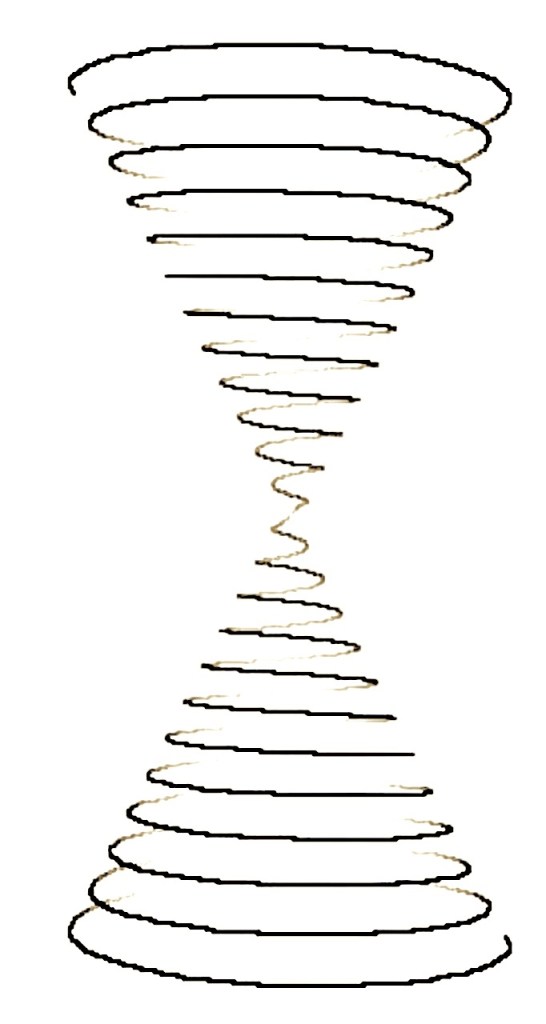



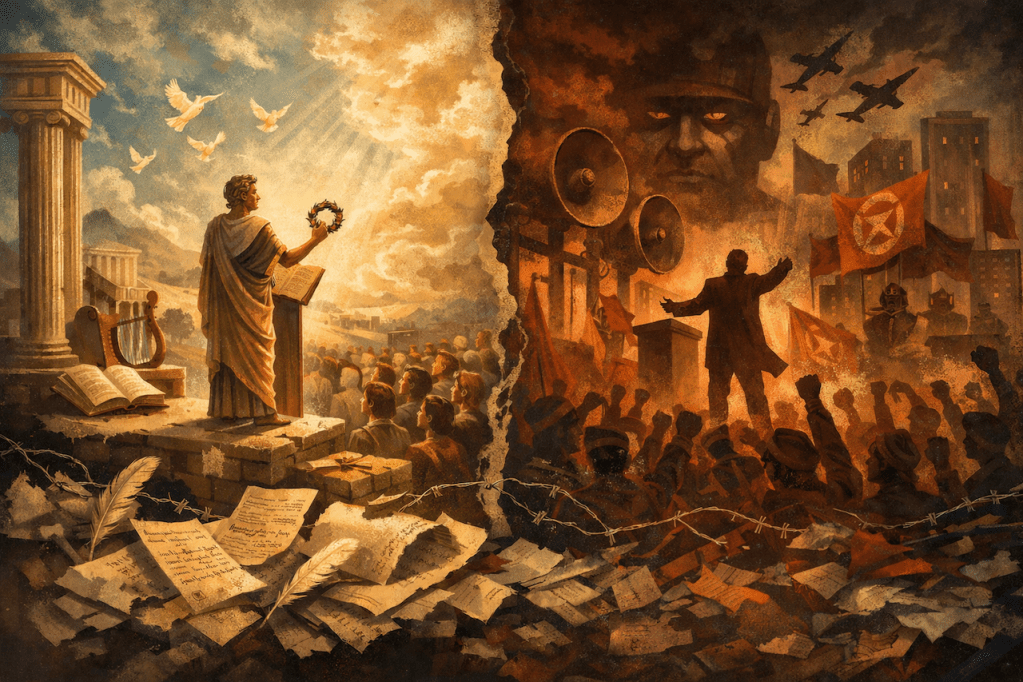


 Linda's Literary Home