Linda's Literary Home

Tag: writing

  • Langston Hughes’ “The Negro Speaks of Rivers”

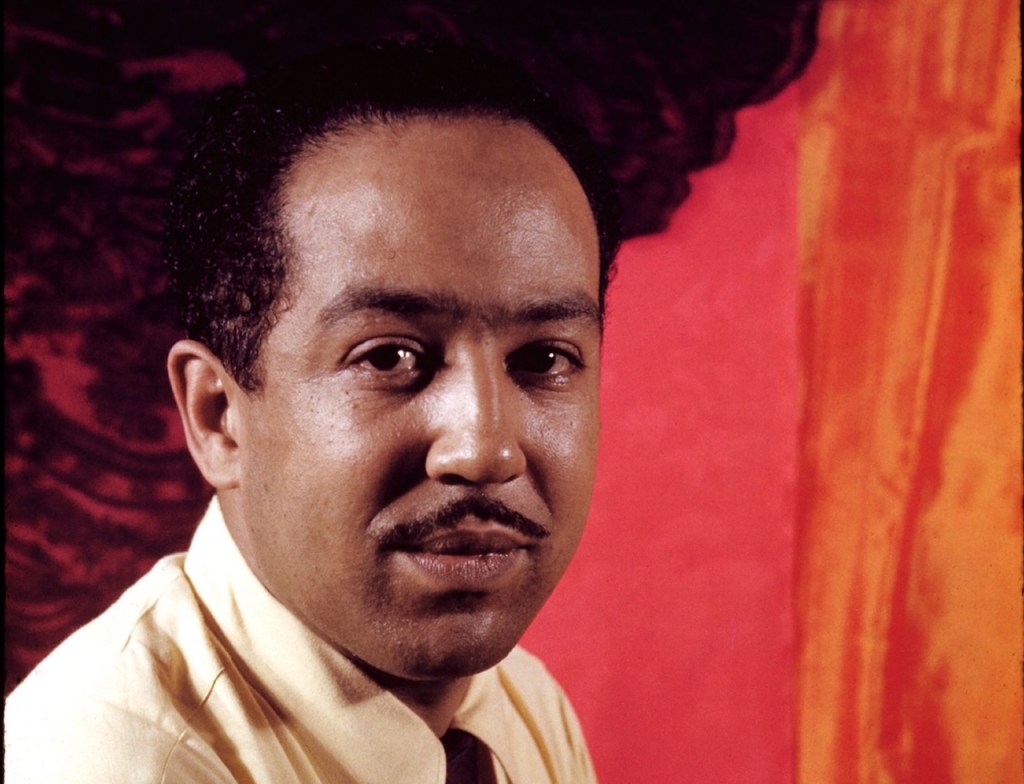
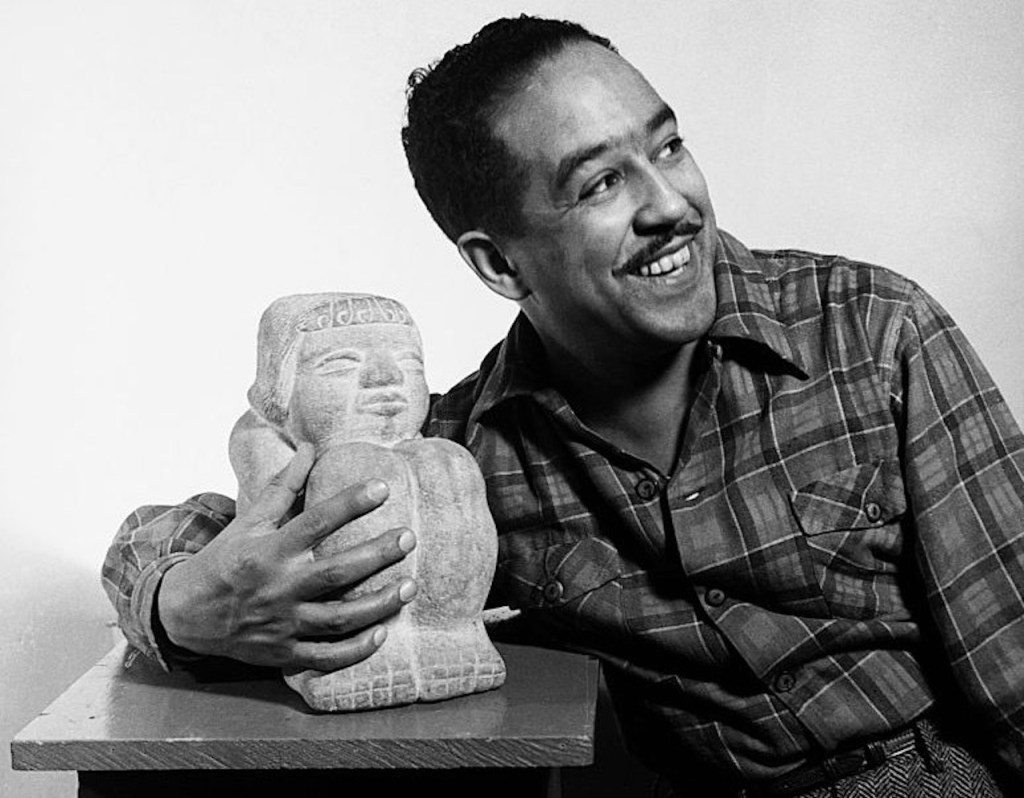
    Image:  Langston Hughes.  Library of Congress. Photographer Gordon Parks 

    Langston Hughes’ “The Negro Speaks of Rivers”

    Langston Hughes’ speaker in “The Negro Speaks of Rivers” displays his message in five versagraphic movements, thematically exploring his soul experience with a “cosmic voice,” which includes and unites all of humanity.

    Introduction and Text of “The Negro Speaks of Rivers”

    Langston Hughes’ speaker in “The Negro Speaks of Rivers” displays his message with a “cosmic voice,” which includes and unites all of humanity.  The poem plays out in five versagraphic movements, focusing on the theme of soul exploration.

    The Cosmic Voice in Poetry

    Writers, especially poets, often employ the “cosmic voice” in order to provide a deep and wide view of historical events and vast swaths of space.  A device called the omniscient speaker is often used in fiction; that voice is similar to the cosmic voice but much more limited.

    Time and space may stretch or contract as needed as the cosmic seer narrates what he experiences.  The “cosmic voice” may come to a poet through a vivid imagination; however, it transcends the imagination as a truth teller.   Only a few poets have been blessed with such a voice; examples are Emily Dickinson, Rabindranath Tagore, Paramahansa Yogananda, and to a limited degree Walt Whitman.

    The cosmic voice imparts truth through deep intuition.  The soul of the speaker employing the cosmic voice is, even if only temporarily as is the case with Langston Hughes, becomes aware of its vast and profound knowledge.  The cosmic voice speaks from a place far beyond ordinary sense awareness.  

    Individuals who comprehend the cosmic voice are bequeathed a consciousness far beyond their own sense awareness and thus comprehend the unity of all created things.  Those individuals are heralded into the realm of the Cosmic Creator and often remain transformed beings for having experienced that Sacred Locus.

    Langston Hughes and the Cosmic Voice

    The voice employed in “The Negro Speaks of Rivers” is not a whining, complaining one so often heard in the protest voices of activists; instead Hughes is employing the cosmic voice—the voice of the soul that knows itself to be a divine entity.  That voice speaks with inherent authority; it reports its intuitions so that others might hear and regain their own experiences through its guidance.

    Langston Hughes’ speaker in “The Negro Speaks of Rivers” imparts his discourse in five versagraphic movements.  His theme explores with the cosmic voice that unites all of humanity.  

    The vital lines that serve as a refrain—”I’ve known rivers” and “My soul has grown deep like the rivers”—work like a chant, instilling in the listener the truth that the speaker wishes to impart.  That Langston Hughes was able to employ a cosmic voice in a poem at age seventeen is quite remarkable.  

    Although some of his later work, even as much of it remained important and very entertaining, descended into the banal and at times even slipshod, no one can deny his marvelous accomplishment with this early poem in which he speaks as a master craftsman.

    The Negro Speaks of Rivers 

    I’ve known rivers:
    I’ve known rivers ancient as the world and older than the flow
    of human blood in human veins.

    My soul has grown deep like the rivers.

    I bathed in the Euphrates when dawns were young.
    I built my hut near the Congo and it lulled me to sleep.
    I looked upon the Nile and raised the pyramids above it.
    I heard the singing of the Mississippi when Abe Lincoln
         went down to New Orleans, and I’ve seen its muddy
         bosom turn all golden in the sunset.

    I’ve known rivers:
    Ancient, dusky rivers.

    My soul has grown deep like the rivers.

    Reading:   Langston Hughes reads his poem “The Negro Speaks of Rivers”

    Commentary on “The Negro Speaks of Rivers”

    Langston Hughes’ speaker in “The Negro Speaks of Rivers” stands as high testimony to the poet’s ability to craft genuine, heartfelt poetry.  To have composed such a profound piece of art at such an early age bespeaks a literary marvel.

    First Movement:  The River as a Symbol

    I’ve known rivers:
    I’ve known rivers ancient as the world and older than the flow
    of human blood in human veins.

    The poem opens with the speaker remarking rather nonchalantly that he has experienced the natural phenomenon known as “rivers.”  He has no doubt observed rivers flowing in their channels, and he has become aware that rivers flow through the earth as blood flows through the veins of human beings.  

    Both flowing rivers and flowing blood must be ancient, but the speaker intuits that the flow of the rivers surely predates that of the appearance of the human being upon the planet. The river image becomes a symbol linking all of humanity from the pre-historic era to the present day.   

    As the “river” has served to carry the physical encasements (bodies) and mental bodies over the rough terrain of land and rocks, the symbolic river carries the soul on its Divine journey.   Readers and listeners will easily intuit the significance of the speaker’s focus as it ranges far beyond the boundaries of the physical, material universe.

    Second Movement:  Intuitive Awareness

    My soul has grown deep like the rivers.

    This line indicates that the speaker has become aware that through his own soul he can intuit historical events, places, and people, who have existed from the beginning to time.  The line becomes a refrain and will be encountered again in the poem because of its great importance.  

    It becomes quite obvious that the speaker would not have been able to know literally the rivers of antiquity that he claims to “know.”  However, through his soul, or mystical awareness, he can.  Thus, he again employs the cosmic, thus mystical, voice to fashion his assertion.

    Third Movement: Historical Unity

    I bathed in the Euphrates when dawns were young.
    I built my hut near the Congo and it lulled me to sleep.
    I looked upon the Nile and raised the pyramids above it.
    I heard the singing of the Mississippi when Abe Lincoln
         went down to New Orleans, and I’ve seen its muddy
         bosom turn all golden in the sunset.

    The speaker claims that he “bathed in the Euphrates” at the dawning of Western civilization.  From the Euphrates to the Mississippi Rivers, the speaker offers a huge expansion of time and place.  

    In biblical times to present time, he lays claim to knowledge, again impossible except for soul consciousness. Awareness through the soul is unlimited, unlike the limitations of body and mind.  The speaker could not have experienced the Euphrates when “dawns were young.”  

    But the cosmic voice of the speaker can place itself at any point along the time line of civilization or cosmic creation. In claiming to have built his “hut near the Congo,” the speaker continues his cosmic, mystically inspired journey.  He “looked upon the Nile”  and “raised the pyramids” only as a cosmic-voiced speaker.

    People of all times and climes have been influenced by the river experience.  The speaker can thus unite all races, nationalities, creeds, and religions in his gathering of historic experiences within which all those peoples have lived.   And he accomplishes this feat through employment of the symbolic force of the “river.” 

    Emphasizing the American experience, the speaker claims to have “heard the singing of the Mississippi when Abe Lincoln / went / down to New Orleans . . . .”   The allusion to President Abraham Lincoln reminds the reader of the process of slave emancipation.

    As with all the rivers mentioned, the Mississippi River, an American river, stands as a symbol of the blood of the human race—not naturally segregated into color and national categories. The American Mississippi River, as the earlier mention of rivers has done, symbolizes the human blood of the human race—the only race that scientifically exists.

    Fourth Movement:  A Soul Chant

    I’ve known rivers:
    Ancient, dusky rivers.

    Because of the importance of the “river” as a symbol, the speaker repeats the line, “I’ve known rivers.”  Like the line, “My soul has grown deep like the rivers,” this one also  serves as a refrain.   If the speaker had chanted the line many more times, the poem’s delightful charm would have even been enhanced—that line is that crucial!

    The soul, the river, the depth of the soul and the river—all force history to yield a mighty blessing on those who have “known rivers,”  and whose souls have grown deep like those rivers. 

    Thus the speaker offers a brief description of how those river appear:  they are extremely old, and they are mystically dark, a measure that alludes to the dark-skinned race with graceful precision, even as it holds all races as having experienced the nature of the mystic river.

    Fifth Movement: Life Force and the Symbol of the River

    My soul has grown deep like the rivers.

    The speaker’s soul has grown profoundly deep like the rivers and along with the rivers.  Civilizations have grown up and grown deep along rivers all over Planet Earth. The soul that possesses the body is the life force informing and maintaining that body. 

    Likewise, rivers streaming through the earth give life force to civilizations and also assist in maintaining those civilization with the products and supplies that river travel has allowed over the centuries.

    The speaker is taking his own identity from the energetic force of the soul and the river force of the earth.  The children of the Divine Creative Reality (God) all spring forth from a common ancestry, a symbolic set of original parents.   It has always been rivers that link all of those ancestors as the blood in their veins links them into one family—the Human Race.

    The cosmic voice of a young poet—who happened possess the darker hue of skin along the color spectrum—has rendered a statement that could enlighten and reconnect all peoples if only they could listen with their own cosmic awareness.  

    At the soul level, all human beings remain eternally linked as children of the Great Divine River King (God). That River God flows in the blood of His offspring. And that same River God flows in the rivers of the planet on which they find themselves too often segregated by ignorance of their own common being as sparks of the Divine.

    Instead of identifying with the perishable body and changeable mind that too often rule, the simple act of identifying with their own cosmic nature would allow individuals to experience the cosmic voice of their own soul. The simple poet named Langston Hughes has offered a useful template for viewing the world through a cosmic lens in his nearly perfect poem.

    🕉

    You are welcome to join me on the following social media:
    TruthSocial, Locals, Gettr, X, Bluesky, Facebook, Pinterest 

    🕉

    Share
  • Rabindranath Tagore’s “The Last Bargain”

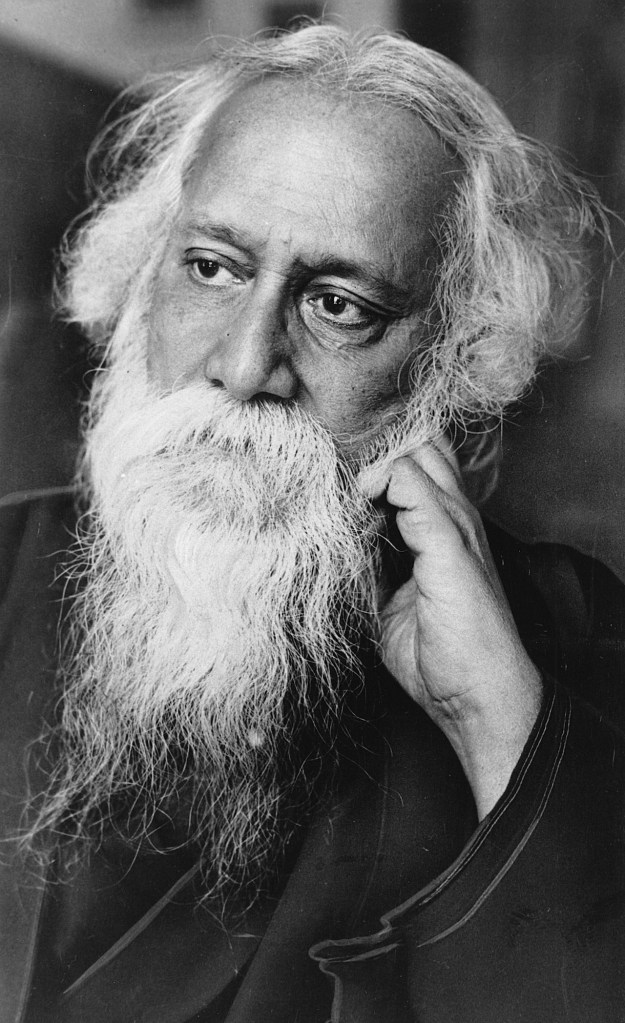
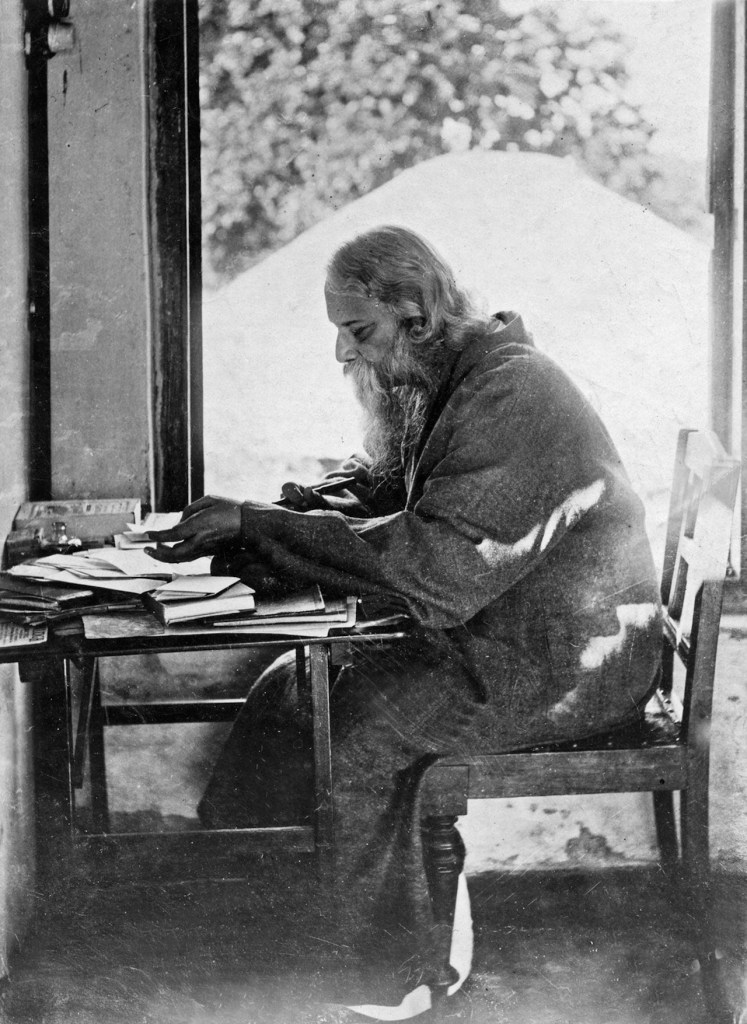
    Image:  Rabindranath Tagore  -  Britannica

    Image:  Rabindranath Tagore  – Britannica

    Rabindranath Tagore’s “The Last Bargain”

    Rabindranath Tagore’s “The Last Bargain” focuses on what seems to be an quandary:  how is it that a child’s offering of “nothing” to a seeker becomes the “last bargain” as well as the best bargain?

    Introduction and Text of “The Last Bargain”

    The human mind/hear/soul engages in the spiritual search in order to gain freedom and bliss.  Much sorrow and pain afflict those who focus solely on the material level of existence.  

    As the speaker in Rabindranath Tagore’s “The Last Bargain” searches for a job, he is, in fact, demonstrating the difference between focusing on the material level of being and focusing on the spiritual level.

    The Last Bargain

    “Come and hire me,” I cried, while in the morning I was walking on the stone-paved road.
    Sword in hand, the King came in his chariot.
    He held my hand and said, “I will hire you with my power.”
    But his power counted for nought, and he went away in his chariot.

    In the heat of the midday the houses stood with shut doors.
    I wandered along the crooked lane.
    An old man came out with his bag of gold.
    He pondered and said, “I will hire you with my money.”
    He weighed his coins one by one, but I turned away.

    It was evening. The garden hedge was all aflower.
    The fair maid came out and said, “I will hire you with a smile.”
    Her smile paled and melted into tears, and she went back alone into the dark.

    The sun glistened on the sand, and the sea waves broke waywardly.
    A child sat playing with shells.
    He raised his head and seemed to know me, and said, “I hire you with nothing.”
    From thenceforward that bargain struck in child’s play made me a free man.

    Commentary on “The Last Bargain”

    Rabindranath Tagore’s “The Last Bargain” presents an enigma:  how can it be that a child offering nothing can be the bargain that makes a “free man” of the seeker?

    First Movement:   Seeking Employment

    “Come and hire me,” I cried, while in the morning I was walking on the stone-paved road.
    Sword in hand, the King came in his chariot.
    He held my hand and said, “I will hire you with my power.”
    But his power counted for nought, and he went away in his chariot.

    The opening movement taking place in the morning finds the speaker apparently seeking employment; thus he announces, “Come and hire me.”  A king then comes on the scene, offering the individual employment through his “power.”

    However, the job seeker determines that the king’s power held very little value.  The king then moves away in his “chariot.”  Then the speaker continues to search.  Now, the reader is likely to suspect that this speaker is not seeking a job on the material, planet Earth, physical sense.

    Second Movement:  Continuing the Search

    In the heat of the midday the houses stood with shut doors.
    I wandered along the crooked lane.
    An old man came out with his bag of gold.
    He pondered and said, “I will hire you with my money.”
    He weighed his coins one by one, but I turned away.

    The speaker keeps up his search, and the time now is “midday.”  He takes notice that the doors to all of the houses are closed.  All of a sudden, an old man comes on the scene; he is carrying a “bag of gold.” The old man then inform the seeker that he will offer him a job “with [his] money.”

    The old man counts out his coins piece by piece, which demonstrates his attachment to money—a physical level necessity and reality.  However, that display of physical attachment annoys this spiritual seeker, who then turns away in disgust.

    The speaker remains unimpressed by the power of a king, and he is not favorable to an old man’s “gold.”  The reader can now be assured that the speaker is not seeking an earthly job and thus not seeking worldly goods; instead, he is searching for the spiritual love that comes only from God.  Worldly wealth and power hold no importance for him.

    Third Movement:    Experiencing a Change

    It was evening. The garden hedge was all aflower.
    The fair maid came out and said, “I will hire you with a smile.”
    Her smile paled and melted into tears, and she went back alone into the dark.

    However, the seeker continues on well into evening, when he sees, a “garden hedge [ ] all aflower.”  Then he encounters a “fair maid” who says, “I will hire you with a smile.”  But he inevitably experiences the transformation that comes to the aged human being as the smile “paled and melted into tears.”  Thus rejected, the maiden “went back alone into the dark.”

    Fourth Movement:   The Best Bargain

    The sun glistened on the sand, and the sea waves broke waywardly.
    A child sat playing with shells.
    He raised his head and seemed to know me, and said, “I hire you with nothing.”
    From thenceforward that bargain struck in child’s play made me a free man.

    In the final movement, the speaker, as he is walking along the ocean’s shore, watching the turbulent waves, and meeting a child who is playing on the shore, is afforded his final bargain: the child affirms, “I hire you with nothing.”  This final bargain thus results in a situation that ultimately becomes the best bargain.

    The best bargain is the one that liberates the seeker from searching for satisfaction from earthly things.  He, then instead, may focus his attention on his own soul, where the real “job” of seeking freedom, liberation, and bliss exist.

    It is the quiet Spirit—the seeming nothingness contrasting with materiality, the space transcending time and matter—that turns out to be the genuine, true employer.  Working for the Celestial, Divine Employer (God) affords the laborer the true freedom, soul realization, and bliss—none of which can achieved by earthly power, gold, and physical affection.

  • Rabindranath Tagore’s Gitanjali #48: “The morning sea of silence… “

    Image:  Rabindranath Tagore Wallpapers 

    Rabindranath Tagore’s Gitanjali #48: “The morning sea of silence… “

    Rabindranath Tagore’s poem elucidating a metaphorical and metaphysical journey is number 48 in his most noted collection titled Gitanjali. The poet received the Nobel Prize for Literature in 1913, specifically for that collection.

    Introduction with Text from Gitanjali #48: “The Morning Sea of Silence”

    Rabindranath Tagore, Nobel Laureate for Literature in 1013, translated his collection of poems, Gitanjali, from his original Bengali into English.  He numbered each poem and rendered them as prose-poems, and they remain poetry of the highest order.

    Readers may encounter Gitanjali #48 wide-spread across the internet titled “The Journey” playing out in eight traditional poetry stanzas.  Tagore’s #48 displays in only six verse paragraphs (versagraphs), but those who converted the piece have separated the fourth versagraph into three separate units.

    Tagore’s Gitanjali #48 metaphorically elucidates the spiritual journey of the speaker, even as at the outset, he and his fellow trekkers seem to be setting out on an ordinary hike through the landscape of beauty with flowers and birdsong.  What happens to the speaker becomes truly astounding and inspiring, as he comes to understand the true nature of the idea of a spiritual journey.

    In this poem, the term journey serves as an extended metaphor for meditation. The speaker takes his meditation seat and begins his practice in order to experience union with the Divine Belovèd (God).  The speaker employs use of the extended metaphor to reveal dramatically his series of emotions as he continues his metaphorical journey.

    Even though the source for the drama could credibly have remained a literal hike through the countryside on the lovely morning, the speaker of the poem remains focused on his inner spiritual journey to unite his soul with his Creator.

    Gitanjali #48: “The Morning Sea of Silence”

    The morning sea of silence broke into ripples of bird songs; and the flowers were all merry by the roadside; and the wealth of gold was scattered through the rift of the clouds while we busily went on our way and paid no heed.

    We sang no glad songs nor played; we went not to the village for barter; we spoke not a word nor smiled; we lingered not on the way. We quickened our pace more and more as the time sped by.

    The sun rose to the mid sky and doves cooed in the shade. Withered leaves danced and whirled in the hot air of noon. The shepherd boy drowsed and dreamed in the shadow of the banyan tree, and I laid myself down by the water and stretched my tired limbs on the grass.

    My companions laughed at me in scorn; they held their heads high and hurried on; they never looked back nor rested; they vanished in the distant blue haze. They crossed many meadows and hills, and passed through strange, far-away countries. All honour to you, heroic host of the interminable path! Mockery and reproach pricked me to rise, but found no response in me. I gave myself up for lost in the depth of a glad humiliation in the shadow of a dim delight.

    The repose of the sun-embroidered green gloom slowly spread over my heart. I forgot for what I had travelled, and I surrendered my mind without struggle to the maze of shadows and songs.

    At last, when I woke from my slumber and opened my eyes, I saw thee standing by me, flooding my sleep with thy smile. How I had feared that the path was long and wearisome, and the struggle to reach thee was hard!

    Reading of Gitanjali #48: “The Morning Sea of Silence”  

    Commentary on Gitanjali #48: “The Morning Sea of Silence”

    The speaker engages a truly astounding spiritual event, placing his experience in a metaphysical setting, and metaphorically elucidating that experience as a simple hike across the landscape.

    First Versagraph:  The Welcoming Morning Landscape

    The morning sea of silence broke into ripples of bird songs; and the flowers were all merry by the roadside; and the wealth of gold was scattered through the rift of the clouds while we busily went on our way and paid no heed.

    In the first versagraph, the speaker begins by describing the beauty of the morning landscape that surrounds him and his fellow hikers as they set out on their walking excursion. 

    The first line offers an masterfully crafted metaphor: the early morning “silence” is likened to the waves of an ocean that break into “ripples of bird songs.”  While the birds are singing, the flowers by the wayside appear to be “all merry.” The sky is spread out into a golden glow which is “scattered through the rift of the clouds.”   

    The speaker then states that he and his hiking buddies are in a hurry to get on with their trek, and they therefore take no notice of, and therefore do not cherish, the beauty that has already been bestowed upon them.

    Second Versagraph::  Deadly Solemnity

    We sang no glad songs nor played; we went not to the village for barter; we spoke not a word nor smiled; we lingered not on the way. We quickened our pace more and more as the time sped by.

    The speaker then asserts that he and his fellow trekkers remain quite serious in their coming travel extravaganza; thus, they do not stop to play or sing happy songs.  They did not even engage in cheerful banter with one another, nor do they stop in the village to make any purchases.

    They remain so deadly solemn that not only do they not even bother to speak, but they also do not deign to smile.  They refuse to linger anywhere. They remain in such a great hurry that they continue to speed by faster and faster as time wore on.

    Third Versagraph:  Taking Needed Rest

    The sun rose to the mid sky and doves cooed in the shade. Withered leaves danced and whirled in the hot air of noon. The shepherd boy drowsed and dreamed in the shadow of the banyan tree, and I laid myself down by the water and stretched my tired limbs on the grass.

    By noon, the speaker has become distracted by the position of the sun, noting that doves are making their cooing sounds in the shade of the trees.  He then takes notice that a shepherd boy is resting in the shade under a tree.  

    While the sun is so hot and with the doves and shepherd boy enjoying a relief from action, the speaker decides to stop his own active walk.  Thus, he lies down upon the grass by the water and stretches out his tired body to enjoy a respite from the strenuous task of hiking.

    Fourth Versagraph:   Ridicule for Taking a Rest

    My companions laughed at me in scorn; they held their heads high and hurried on; they never looked back nor rested; they vanished in the distant blue haze. They crossed many meadows and hills, and passed through strange, far-away countries. All honour to you, heroic host of the interminable path! Mockery and reproach pricked me to rise, but found no response in me. I gave myself up for lost in the depth of a glad humiliation in the shadow of a dim delight.

    The speaker’s walking buddies, however, chide him for wishing to take a break and rest. So, they continue on with their walk.  As they continue, they strike supercilious poses with their heads in the air.  They take no second notice of the speaker, as they disappear into “distant blue haze.”

    Nevertheless, the speaker remains in his resting position with the determination to enjoy his leisurely rest, even as the others rapidly continue on with their swift strides.  The speaker reports that his fellow hikers are pressing on as they continue to trek through the “meadows and hills.”  They show that they are not as lazy as he is.  The speaker’s fellows are continuing to push “through strange, far-away countries.” 

    He gives them credit for their adventuresome nature, and he confesses that he has experienced some guilt for remaining in leisure and not accompanying them, but he just could not urge himself on to continue this particular walking excursion. 

    The speaker also confesses that he has ambiguous feelings: on the one hand, he feels “lost” not remaining with the others, but on the other hand, he experiences a “glad humiliation,” feeling that he must be reclining “in the shadow of a dim delight.” 

    Fifth Versagraph:   Rethinking the Reason for the Hike

    The repose of the sun-embroidered green gloom slowly spread over my heart. I forgot for what I had travelled, and I surrendered my mind without struggle to the maze of shadows and songs.

    As the speaker goes on lounging about, he takes notice that the sunset is “spread[ing] over his heart”—an act that unveils for a second time his emotions fraught with ambiguity. Such gloom is “sun-embroidered,” reminiscent of the old saw, “every cloud has a silver lining.” 

    The dawdling speaker then admits that he can no longer remember why he originally decided to set out on this hike.  Thus, he just lets his mental body go, no longer struggling with his true urgings any more. He allows his heart and mind to continue musing through “the maze of shadows and songs.” 

    Sixth Versagraph:   Nearing the Door-Heart of the Divine Creator

    At last, when I woke from my slumber and opened my eyes, I saw thee standing by me, flooding my sleep with thy smile. How I had feared that the path was long and wearisome, and the struggle to reach thee was hard!

    Finally, the speaker wakes up from his ambiguous torpor; he then realizes that he has discovered what he was searching for. He had surmised that walking such a spiritual path was out of his reach, as it was considered to be such an arduous task.

    But after his discovery, he is able to realize that all he had to do was permit his inner self to be guided to the door-heart of the Divine Belovèd.  All lesser journeys, including those on the physical plane, become irrelevant as one becomes ensconced in that sacred environment, near the door of the DivineCreator-Father. 

    Video of Rabindranath Tagore 

  • Langston Hughes

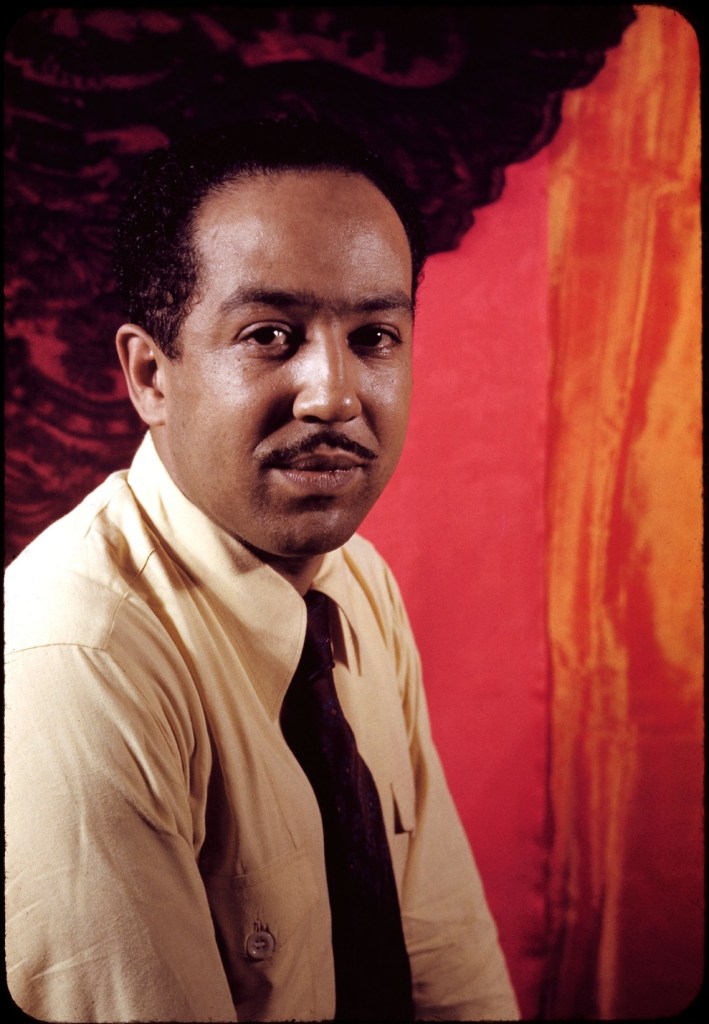
    Image: Langston Hughes  Carl Van Vechten Trust / Beinecke Library, Yale

    Life Sketch of Langston Hughes

    Hoyt W. Fuller, critic, editor, and founder of the Organization of Black American Culture (OBAC), has pointed out that Langston Hughes possessed a “deceptive and profound simplicity.”  Fuller insists that understanding these qualities in Hughes is key to understanding and appreciating his poetry.

    Early Life and Education

    On February 1, 1902, Langston Hughes was born in Joplin, Missouri, to James Nathaniel Hughes and Caroline Mercer Langston. The poet’s full name is James Mercer Langston Hughes. His parents divorced when Langston was very young, and he was raised primarily by his grandmother in Lawrence, Kansas [1].    In his first autobiography, The Big Sea, Hughes reveals,

    My grandmother raised me until I was twelve years old.  Sometimes I was with my mother, but not often.  My mother and father had separated.  And my mother, who worked, always traveled about a great deal, looking for a better job.

     When I first started to school, I was with my mother a while in Topeka. (And later, for a summer in Colorado, and another in Kansas City.)  She was a stenographer for a colored lawyer in Topeka, named Mr. Guy.  She rented a room near his office, downtown. So I went to a “white” school in the downtown district.[2]

    The poet’s father James Hughes had studied law and had planned to practice, but Jim Crow laws prevented him from taking the bar exam.  The elder Hughes then moved to Mexico, where not only was he admitted to the bar, but he also became very successful through the practice of law.  

    Langstons’ father’s financial success allowed him to become the owner of much property in Mexico City, where nearby he purchased and resided on a huge ranch in the hills.  He also became a money lender and foreclosed on mortgages.

    About his father, the poet has remarked, “my father was interested in making money to keep.”  This attitude contrasted with his mother and his stepfather, who were interested in making money to spend.  Thus, his mother and stepfather moved around a great deal to take advantage of better employment.

    In 1920, Langston Hughes graduated from Central High School in Cleveland, Ohio.  He had hopes of attending Columbia University to study to become a writer, but his father refused to pay for his son’s schooling unless the younger Hughes studied engineering. 

    Hughes started his university studies at Columbia but stayed for only a year.  He found racism at the school intolerable, so he left the university and took a number of jobs to support himself.  

    In 1929, Hughes completed his university studies at Lincoln University in Pennsylvania.   The school pays tribute to their most famous graduate with a library named in his honor, Langston Hughes Memorial Library [3].

    Full Image: Langston Hughes  Carl Van Vechten Trust / Beinecke Library, Yale

    Poetry

    Langston Hughes opens his first autobiography, The Big Sea, by reporting on a melodramatic event: he is tossing into the ocean one by one all the books he had studied while at Columbia University.  

    He had recently joined the large merchant ship S. S. Malone as a seaman; he was only twenty-one years old, and he made up his mind that nothing would ever again happen to him that he did not want to have happen.  

    He became intent on  securing his own freedom with his little dramatic ritual of unloading his college books into the ocean.  In the life of Langston Hughes, one poetic act often led to another.   Four years before this important, liberating act, however, the poet had traveled to Mexico to visit his father to ask for financial assistance to attend the university.  

    But he reports that his visits with his father in Mexico were mostly unsatisfactory; he could not identify with his father’s mindset.  His father hated his own race of people, and he was interested only in making money.  However, Langston needed his father’s financial support, so he spent time with him in Mexico.

    On this particular trip, while Hughes was only seventeen years old, the poet composed one of his most anthologized poems “The Negro Speaks of Rivers.”  He gives details of his inspiration for this poem in The Big Sea; he wrote the poem “just outside of St. Louis, as the train rolled toward Texas”:

    It came about in this way.  All day on the train I had been thinking about my father and his strong dislike of his own people.   I didn’t understand it, because I was a Negro, and I liked Negroes very much.

    He then describes meeting a number of blacks who had come “up from the South” as he worked at one of his “happiest jobs” at a soda fountain.   He reports that he enjoyed “hearing them talk, listening to the thunderclaps of their laughter, to their trouble, to their discussions of the war and the men who had gone to Europe from the Jim Crow South, their complaints over the high rent. . . .”   To Hughes, these people seemed to be the “gayest and bravest people possible” as they worked “trying to get somewhere in the world.”

    Crossing the Mississippi River at sunset, Hughes peered out of the Pullman window and saw “the great muddy river flowing down toward the heart of the South,” and he started musing on “what the river, the old Mississippi, has meant to Negroes in the past.”  

    He mused on the tragedy of slaves being sold down the river as the “worst fate” that a slave could suffer.  He then began musing on President Abraham Lincoln’s having rafted on the Mississippi down to New Orleans.  Lincoln had seen “slavery at it worst, and had decided within himself that it should be removed from American life.”

    Hughes’ musing in this creative reverie then turned to additional rivers that had affected the lives of members of his ethnicity: the Congo, the Niger, and the Nile.  And then the thought came to him: “I’ve known rivers.”  

    He wrote down that one line on an envelope holding the letter from his father which he carried in his pocket, and then within the next fifteen minutes, he had composed his magnificent poem, which he titled “The Negro Speaks of Rivers.”

    As one of the most important creative contributors to the Harlem Renaissance, Hughes has offered many poems to the American literary canon.  A small sample of his poems include “A Mother to Son,”  “Madame’s Calling Cards,” “Theme for English B,” “Night Funeral in Harlem,”  “Goodbye, Christ,” and “Cross.”

    Supporting Himself by Writing

    Langston Hughes has been most noted as a poet, and he managed to finish his college education after being awarded a full scholarship based on his proficiency as a poet.  After receiving his B.A. degree in 1929, he continued to publish widely, earning for himself the achievement of being a writer, who was able to support himself as an adult solely with his writings [4].

    In addition to poetry, which remained his first love, Hughes published three novels, Not without Laughter (1932), Scottsboro Limited (1932), and The Ways of White Folks (1934).   In 1935, Hughes was awarded a Guggenheim Fellowship.  The Gilpin Players (Karamu House) produced six of the poet’s plays in 1936 and 1937.  Hughes founded the Negro Theater in Los Angeles in 1939 and composed the script “Way Down South.”

    Hughes published eight collections of poems; he also published four books of fiction and six books for children and teens.  He added three books of humor to his resume as well as two autobiographies.  He also wrote essays and a number of books on black history.  As a prominent figure in the civil rights movement, he traveled and lectured widely throughout the world [5].

    Illness and Death

    In 1967,  at the Stuyvesant Polyclinic in New York City, Hughes submitted to t0 a surgical procedure to treat prostate cancer.  The surgery was a tragic failure, and he died from complications arising from that medical procedure [6].  Hughes’ body underwent cremation, and his ashes remain interred at the Schomburg Center for Research in Black Culture in Harlem, under the floor of the foyer in the institute.  

    The artwork on the flooring features a medallion of a human being formed by rivers and includes the line, “My soul has grown deep like the rivers,” from the poet’s inspirational poem “The Negro Speaks of Rivers.”

    Sources

    [1] Editors.  “Langston Hughes: 1902–1967.”  Poetry Foundation.  Accessed January 12, 2026.

    [2] Langston Hughes.  The Big Sea: An Autobiography.  Thunder’s Mouth Press.  New York.  1940. 1986. Print.

    [3] Editors.  “About the Library.”  Lincoln University.  Accessed January 12, 2026.

    [4] Langston Hughes.  I Wonder as I Wander: An Autobiographical Journey.  Thunder’s Mouth Press.  New York.  1956. 1986. Print.

    [5] Curators.  The Langston Hughes Society.  Horsham, Pennsylvania.  Accessed January 12, 2026.

    [6] Editors.  “Langston Hughes.”  Encyclopedia of Cleveland History: Case Western Reserve University.  Accessed January 12, 2026.

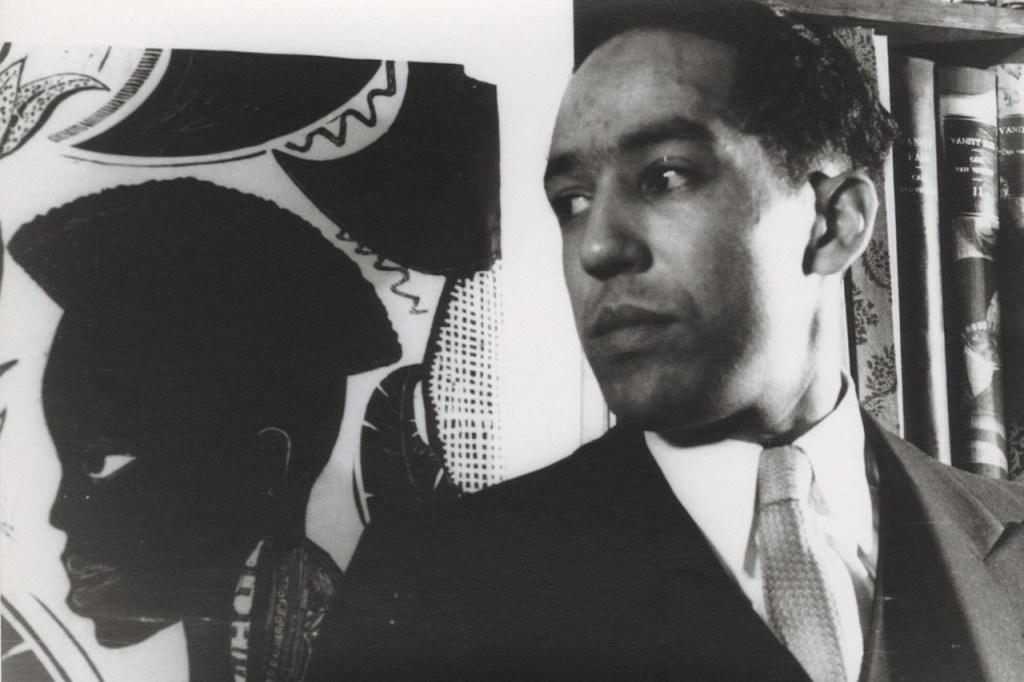
    Image: Langston Hughes – Poetry Foundation

    Commentaries on Langston Hughes Poems

    Note on Term Usage:  Before the late 1980s in the United States, the terms “Negro,” “colored,” and “black” were accepted widely in American English parlance.   While the term “Negro” had started to lose it popularity in the 1960s, it wasn’t until 1988 that the Reverend Jesse Jackson began insisting that Americans adopt the phrase “African American.”  The earlier more accurate terms were the custom at the time that Langston Hughes was writing.

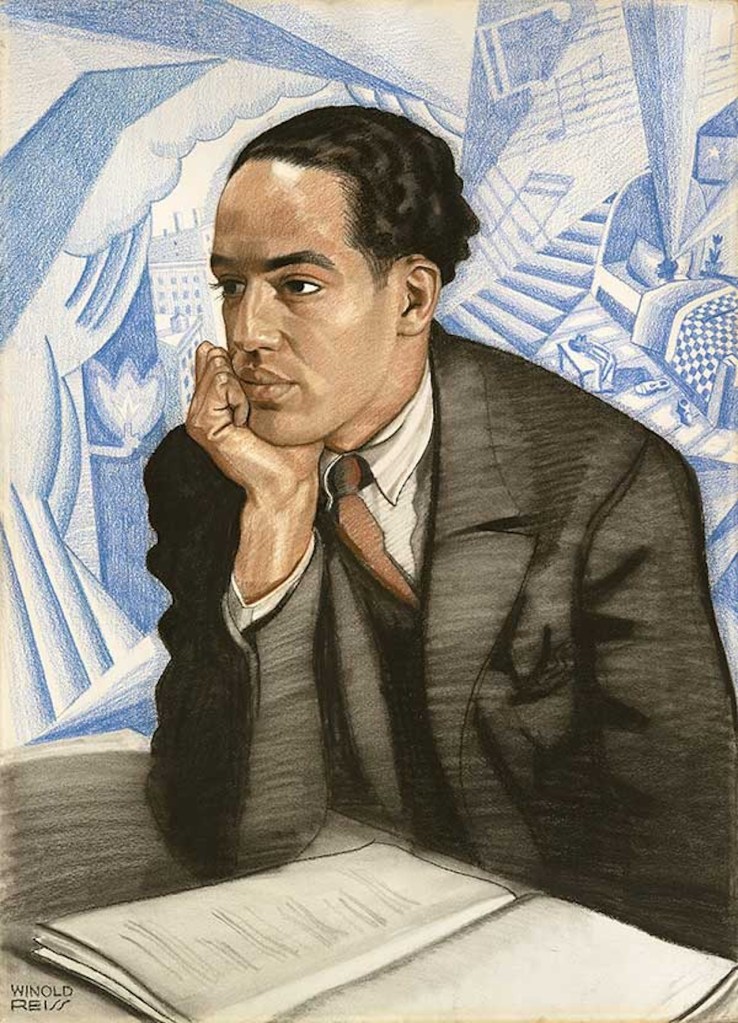
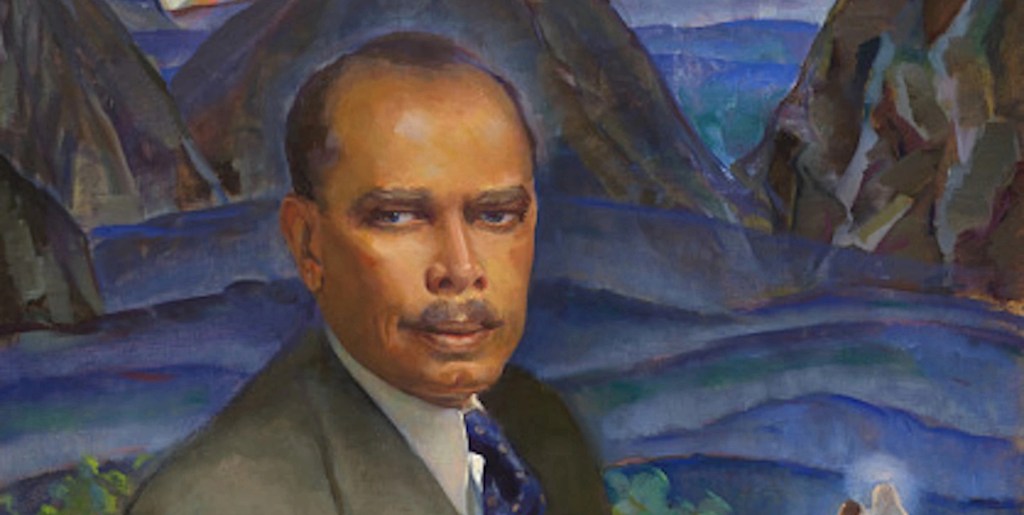
    Image: Langston Hughes.    Portrait by Winold Reiss (1886–1953) – National Portrait Gallery, Smithsonian Institution.

  • Gerard Manley Hopkins

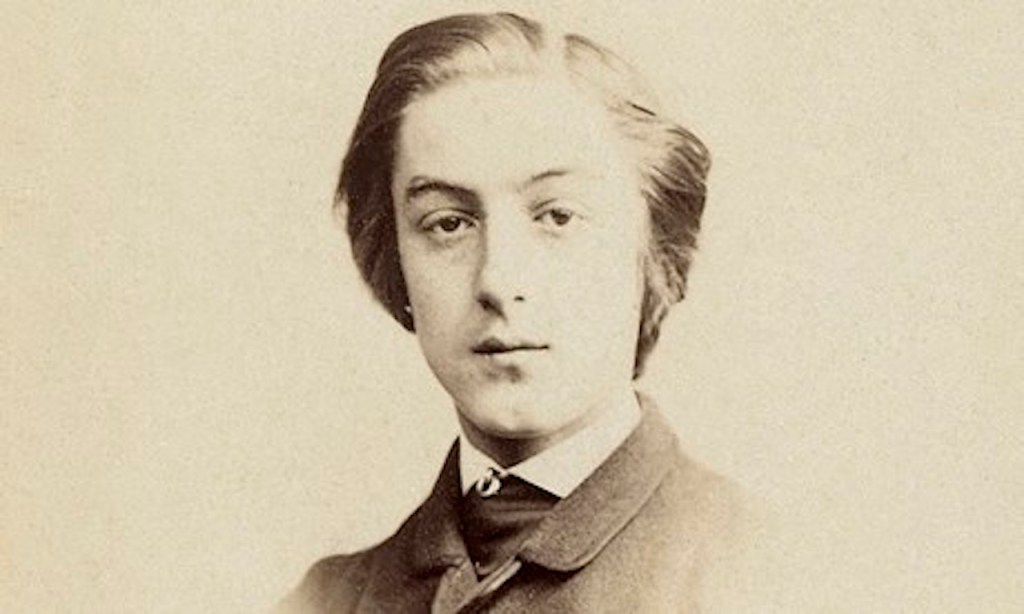
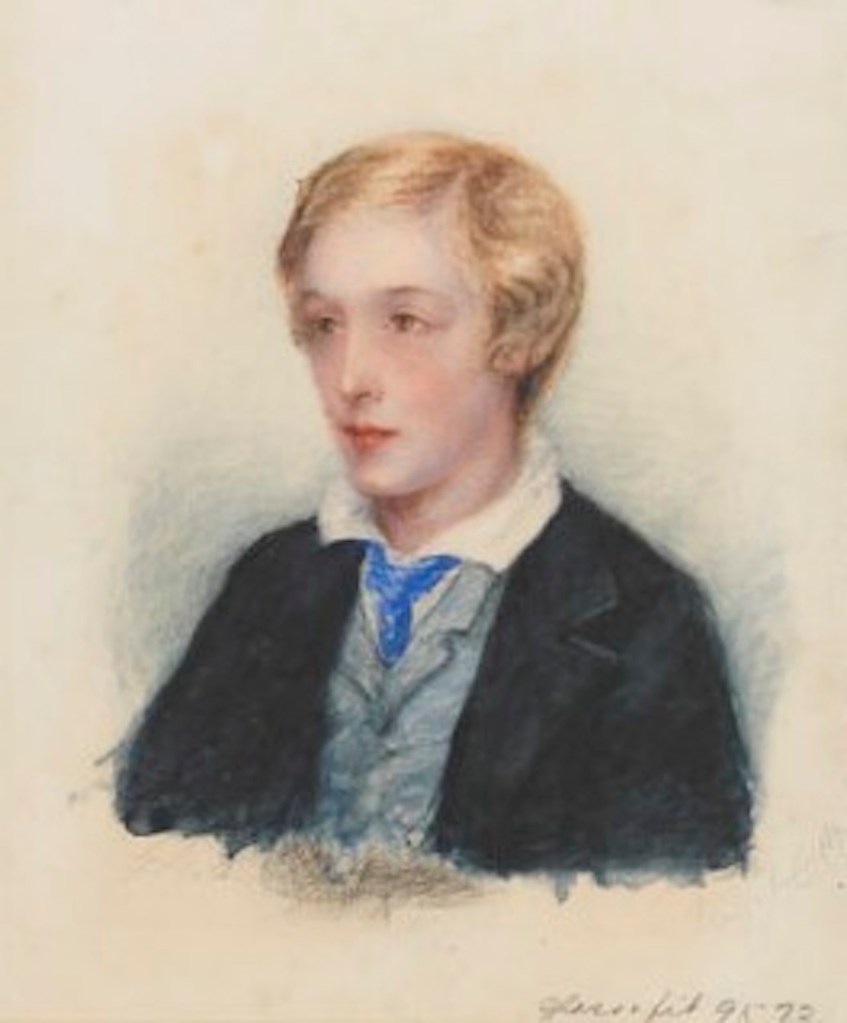
    Gerard Manley Hopkins – National Portrait Gallery, London

    Life Sketch of Gerard Manley Hopkins

    Gerard Manley Hopkins (1844–1889) was a poet of exceptional originality, with an innovative approach to language.  He remains one of English literature’s most enigmatic figures—a poet-priest whose work combines Victorian sensibilities with modernist experimentation.

    Introduction: Early Life and Family Background

    Though Gerard Manley Hopkins work was largely unpublished during his lifetime, the poet is now celebrated as one of the most significant poets of the Victorian era and a precursor to modernist poetry. 

    His life was marked by a profound tension between his religious vocation as a Jesuit priest and his artistic calling as a poet, a tension that shaped both his personal struggles and his creative achievements.

    Gerard Manley Hopkins was born on July 28, 1844, in Stratford, Essex (now part of Greater London), into a middle-class family with strong artistic and religious inclinations. He was the oldest of nine children born to Manley Hopkins and Catherine Smith Hopkins. 

    His father was a successful marine insurance adjuster, who also wrote poetry and published works such as A Philosopher’s Stone and Other Poems (1843) [1]. His mother Catherine was deeply religious and musically gifted, fostering an environment where intellectual and artistic pursuits were encouraged [2].

    The Hopkins household emphasized education and creativity. Gerard’s siblings also displayed artistic talents: his brother Arthur became an illustrator for Punch magazine, while another brother Everard pursued his calling to architecture [3]. The family’s Anglican faith played a central role in their lives; Gerard’s early exposure to religious devotion would later profoundly influence his poetry.

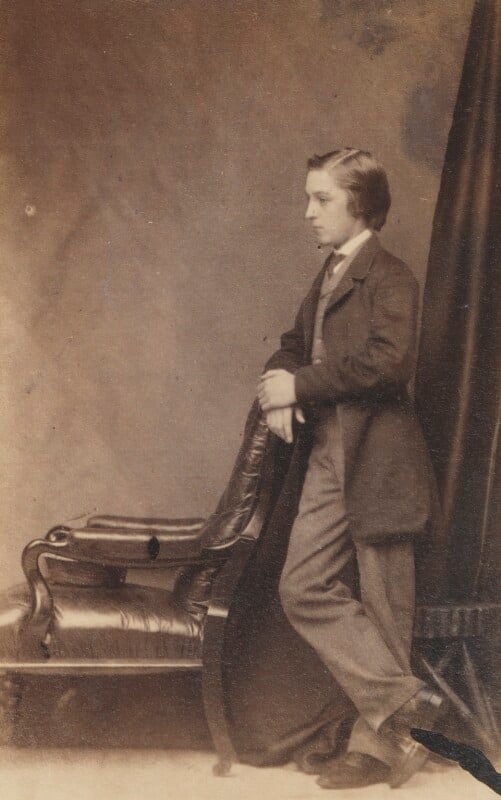
    Gerard Manley Hopkins – National Portrait Gallery, London

    Education at Highgate School

    In 1854, at the age of ten, Hopkins began attending Highgate School in London, where he excelled academically and demonstrated his early poetic talent. His school years were marked by a deep engagement with Romantic poetry, particularly the works of John Keats and Percy Bysshe Shelley. Keats’s lush imagery and musicality left a lasting impression on the young poet, as can be seem in some of his earliest compositions.

    While at Highgate, Hopkins also developed an interest in drawing and painting. He considered pursuing art as a career before ultimately deciding to focus on literature. While his early poems from this period reflect the Romantic tradition, they also hint at the originality that would later define his mature work [4].

    The Oxford Years: Intellectual Growth and Conversion

    In 1863, Hopkins entered Balliol College, Oxford, where he studied the Classics. Oxford in the mid-19th century was a hub of intellectual ferment, particularly regarding questions of faith and theology. 

    The Oxford Movement, led by figures such as John Henry Newman, sought to revive Catholic elements within Anglicanism [5]. This movement profoundly influenced Hopkins during his time at the university.

    At Balliol, Hopkins excelled academically and formed lasting friendships with notable contemporaries such as Robert Bridges (later Poet Laureate of England). Bridges would play a crucial role in preserving and publishing Hopkins’s poetry after his death. During this period, Hopkins continued writing poetry but also began engaging with questions of faith that would lead to a dramatic transformation of his life

    In 1866, under the influence of Newman’s writings and teachings, Hopkins converted to Roman Catholicism. This decision caused significant tension in his family, all of whom were devout Anglicans. However, for Hopkins, the conversion represented a profound spiritual awakening that would shape both his personal life and his artistic vision.

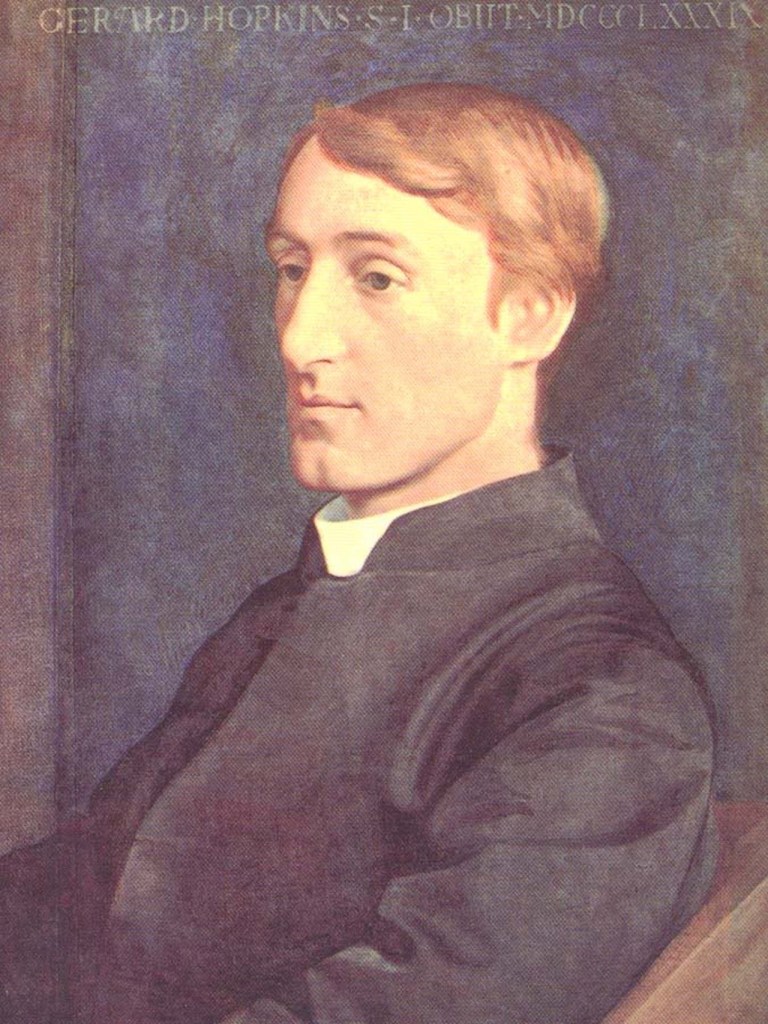
    Gerard Manley Hopkins – National Portrait Gallery, London

    Religious Vocation: Joining the Jesuit Order

    After graduating from Oxford with first-class honors in the Classics in 1867, Hopkins decided to pursue a religious vocation In 1868, he joined the Society of Jesus (the Jesuits), beginning his novitiate at Manresa House in Roehampton. As part of his training, he took vows of poverty, chastity, and obedience.

    Hopkins believed that his religious commitment required him to renounce personal ambition, including his aspirations as a poet. In an act of self-denial characteristic of his Jesuit discipline [3], he burned many of his early poems upon entering the order. For several years, he refrained from writing any poetry at all.

    During this pause from creative writing, Hopkins’s religious studies deepened his understanding of theology and philosophy. He studied at Stonyhurst College in Lancashire before moving to St. Beuno’s College in North Wales to study theology [6]. It was during this period that he began to reconcile his poetic gift with his spiritual calling.

    The Wreck of the Deutschland: A Return to Poetry

    In 1875, an event occurred that reignited Hopkins’ poetic creativity: the wreck of the German ship Deutschland off the coast of England. Among those who perished were five Franciscan nuns fleeing anti-Catholic persecution in Germany [1]. Deeply moved by their sacrifice and martyrdom, Hopkins composed The Wreck of the Deutschland, a long narrative poem that marked his return to writing.

    The poem is notable for its novel experimentation with language and form. It introduced what Hopkins called “sprung rhythm,” a metrical system based on stressed syllables rather than traditional foot-based metrics. Sprung rhythm allowed him greater flexibility in capturing natural speech patterns while maintaining musicality.

    Although The Wreck of the Deutschland was not published during Hopkins’s lifetime (it was deemed too unconventional), it signaled the beginning of his mature poetic phase. Over the next decade, he would compose some of his most celebrated and later anthologized works.

    Major Themes and Innovations

    Hopkins’s poetry is characterized by its vivid imagery, innovative use of language, and deep spiritual resonance. Central themes include the following:

    Nature

    Hopkins viewed nature as a manifestation of God’s glory—a concept he expressed through what he called “inscape,” or the unique essence of each created thing. Poems like “Pied Beauty” celebrate the variety and intricacy of nature:

    “Glory be to God for dappled things—
    For skies of couple-colour as a brinded cow;”

    Religion

    As a devout Jesuit priest, Hopkins often explored themes of faith, grace, and divine presence.  In “God’s Grandeur,” he reflects on humanity’s relationship with the Divine Reality (God):  “The world is charged with the grandeur of God.” 

    Human Struggle

    Hopkins did not shy away from depicting despair and inner turmoil. His so-called “terrible sonnets,” written during periods of depression in Dublin later in life (“No Worst There Is None” and “I Wake And Feel The Fell Of Dark”), are raw expressions of spiritual desolation.

    Language

    Hopkins’s creative inventiveness set him apart from other Victorian poets. He employed compound words (“dapple-dawn-drawn”), alliteration (“kingdom of daylight’s dauphin”), and unconventional syntax to create striking effects.  It might be noted that E. E. Cummings’ innovation remains a 20th century parallel to that of Father Hopkins 19th century foray into stylizing novelty.

    Academic Career in Dublin

    In 1884, after years serving as a parish priest in England and Scotland (often under challenging conditions), Hopkins was appointed Professor of Greek Literature at University College Dublin. 

    While teaching brought him some satisfaction intellectually, he still continued to struggled with feelings of isolation as an Englishman residing and working in Ireland during a time of political upheaval.

    Gerard Manley Hopkins – National Portrait Gallery, London

    Death and Legacy

    Father Hopkins’ final years were marked by declining health and bouts of depression—what he referred to as “the long dark night.” Despite these challenges, he continued writing poetry until shortly before his death.

    Father Hopkins died on June 8, 1889, at the age of 44 from typhoid fever in Dublin. At the time of his death, none of his major poems had been published; they existed only in manuscript form.

    It was not until 1918—nearly three decades after his death—that Robert Bridges edited and published  the collection simply titled Poems, bringing Hopkins’ work to public attention for the first time. The collection received mixed reviews initially but gained increasing recognition over time.

    By the mid-20th century, critics such as F.R. Leavis had established Hopkins as one of the most original voices in English poetry. His innovative techniques anticipated modernist trends seen later in poets like T.S. Eliot, Dylan Thomas, and E. E. Cummings.

    Father Gerard Manley Hopkins remains one of English literature’s most enigmatic figures—a poet-priest whose work brought together certain Victorian sensibilities with modernist experimentation. His legacy rests not only in his technical innovations but also in his ability to convey profound spiritual truths through language that continues to resonate with readers today.

    Sources

    [1]  Gerard Manley Hopkins. Poems. Edited by Robert Bridges. Oxford University Press. 1918.

    [2]  Gerard Manley Hopkins. Poems and Prose. Edited by W. H. Gardner. Penguin Classics. 1953.

    [3]  Eleanor Ruggles. Gerard Manley Hopkins: A Life. New York: W.W. Norton & Co. 1944.

    [4]  Norman H. Mackenzie. A Reader’s Guide to Gerard Manley Hopkins. Cornell U P. 1981.

    [5] John Cowie Reid.  “Gerard Manley Hopkins.” Encyclopaedia Britannica. Accessed January 1, 2026.

    [6] Curators. “Gerard Manley Hopkins.” Poetry Foundation.  Accessed January 1, 2026.

    🕉

    Poem Commentaries

    • God’s Grandeur” Father Gerard Manley Hopkins’ motivation to imitate Spirit (God) prompts him to craft his poems in forms, as Spirit creates entities in forms—from rocks to animals to plants to the human body.
    • Pied Beauty” Gerard Manley Hopkins’ “Pied Beauty” is an eleven-line curtal sonnet dedicated to honoring and praising God for the special beauty of His creation.  Father Hopkins coined the term “curtal” to label his eleven-line sonnets.
    • The Habit of Perfection”  The title “The Habit of Perfection” of Gerard Manley Hopkins’ poem features a pun on the term “habit.” As a monk, the poet had accepted the garb of the monastic, sometimes called a habit

    The Terrible Sonnets

    •  “To seem the stranger lies my lot, my life” Written with the same intensity that characterizes Hopkins’ work, the poem dramatizes exile as both an external condition and an inward trial.
    • I wake and feel the fell of dark, not day” The speaker Gerard Manley Hopkins’ “I wake and feel the fell of dark, not day” is confronting spiritual desolation, interior darkness, and the sense of abandonment by God. 
    • No worst, there is none.  Pitched past pitch of grief” The third in the group of sonnets widely known as “the terrible sonnets, this one,“No worst, there is none. Pitched past pitch of grief,” presents a speaker experiencing grief so intense that it feels beyond limit or measure.
    • Not, I’ll not, carrion comfort, Despair, not feast on thee” Father Hopkins’ “Not, I’ll not, carrion comfort, Despair, not feast on thee” dramatizes an intense spiritual struggle in which the speaker resists despair while enduring profound inner torment. 
    • Patience, hard thing! the hard thing but to pray” This terrible sonnet explores searchingly the nature of  spiritual endurance. The speaker is focusing on patience not as a soft virtue but as a challenging and difficult discipline, which oftentimes scars the pride, while exhausting the will. 
    • My own heart let me more have pity on; let” The speaker in this sonnet examines his inward struggle, through which he has learned mercy toward the self (soul) while undergoing heavy, sustained spiritual pressure.  My personal issue with this pressure assures me that Father Hopkins well understood its vicissitudes as well as its rewards.

  • Phillis Wheatley

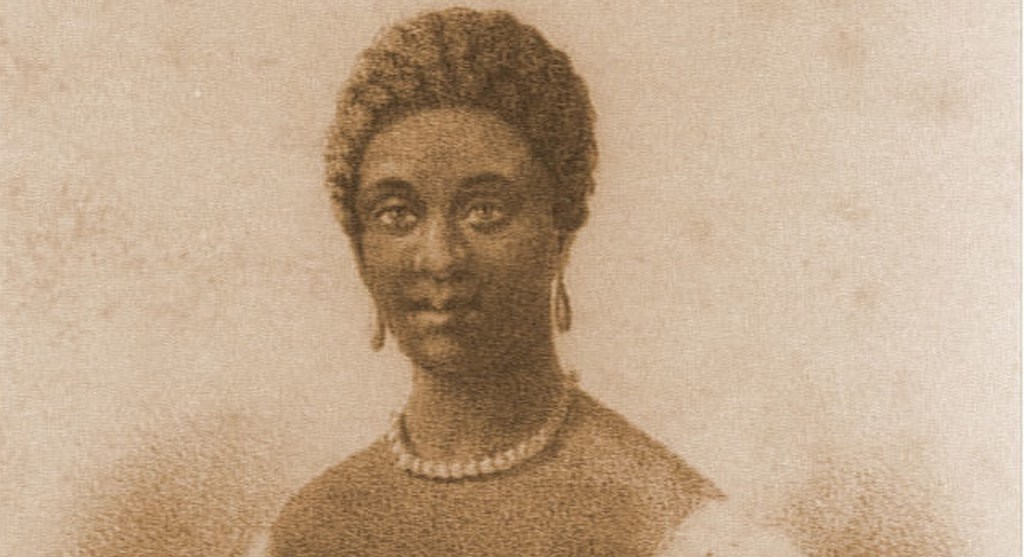
    Image: Phillis Wheatley 

    Life Sketch of Phillis Wheatley

    Phillis Wheatley’s talent was questioned but then authenticated during her lifetime, and she is now hailed by all but the most cynical as one of America’s finest poetic voices.

    Two Versions of a Publication History

    Although Phillis Wheatley’s talent was at first questioned [1], her authenticity was finally established during her lifetime. Today, she is widely recognized by all, except the most cynical [2], as one of America’s finest poetic voices.  

    Phillis Wheatley’s first and only collection of published poetry was titled Poems on Various Subjects, Religious and Moral; it was published in England.

    There are two versions of the history of this book’s publication [3]: one is that the Countess Selina of Huntington invited Phillis to London and found a publisher for the poet; the other is that Phillis suffered from asthma, and so the Wheatley family took her to England to recuperate, and while there, they sought publication of her work.  

    Either way, the book was published and Wheatley’s career was established. The Wheatley family’s insight played a major role in helping a slave rise above the hardships of that vile institution.

    The Value of One Poem

    In May 1968, one poem written by Phillis Wheatley brought $68,500 at Christie’s auction [4], Rockefeller Center in New York. It had been estimated to bring between $18,000 and $25,000.  

    The poem is titled “Ocean”; its seventy lines were written on three pages that had yellowed with time. It is thought to be the only copy.  

    Ocean

    Now muse divine, thy heav’nly aid impart,
    The feast of Genius, and the play of Art.
    From high Parnassus’ radiant top repair,
    Celestial Nine! propitious to my pray’r.
    In vain my Eyes explore the wat’ry reign,
    By you unaided with the flowing strain.
    When first old Chaos of tyrannic soul
    Wav’d his dread Sceptre o’er the boundless whole,
    Confusion reign’d till the divine Command
    On floating azure fix’d the Solid Land,
    Till first he call’d the latent seeds of light,
    And gave dominion o’er eternal Night.
    From deepest glooms he rais’d this ample Ball,
    And round its walls he bade its surges roll;
    With instant haste the new made seas complyd,
    And the globe rolls impervious to the Tide;
    Yet when the mighty Sire of Ocean frownd
    “His awful trident shook the solid Ground.”
    The King of Tempests thunders o’er the plain,
    And scorns the azure monarch of the main,
    He sweeps the surface, makes the billows rore,
    And furious, lash the loud resounding shore.
    His pinion’d race his dread commands obey,
    Syb’s, Eurus, Boreas, drive the foaming sea!
    See the whole stormy progeny descend!
    And waves on waves devolving without End,
    But cease Eolus, all thy winds restrain,
    And let us view the wonders of the main
    Where the proud Courser paws the blue abode,
    Impetuous bounds, and mocks the driver’s rod.
    There, too, the Heifer fair as that which bore
    Divine Europa to the Cretan shore.
    With guileless mein the gentle Creature strays.
    Quaffs the pure stream, and crops ambrosial Grass.
    Again with recent wonder I survey
    The finny sov’reign bask in hideous play.
    (So fancy sees) he makes a tempest rise
    And intercept the azure vaulted skies.
    Such is his sport:—but if his anger glow
    What kindling vengeance boils the deep below!
    Twas but e’er now an Eagle young and gay
    Pursu’d his passage thro’ the aierial way.
    He aim’d his piece, would C[ale]f’s hand do more ?
    Yes, him he brought to pluto’s dreary shore.
    Slow breathed his last, the painful minutes move
    With lingring pace his rashness to reprove;
    Perhaps his father’s Just commands he bore
    To fix dominion on some distant shore.
    Ah! me unblest he cries. Oh! had I staid
    Or swift my Father’s mandate had obey’d.
    But ah! too late.—Old Ocean heard his cries.
    He stroakes his hoary tresses and replies:
    What mean these plaints so near our wat’ry throne,
    And what the Cause of this distressful moan?
    Confess. Iscarius, let thy words be true
    Not let me find a faithless Bird in you.
    His voice struck terror thro’ the whole domain.
    Aw’d by his frowns the royal youth began,
    Saw you not. Sire, a tall and Gallant ship
    Which proudly skims the surface of the deep?
    With pompous form from Boston’s port she came.
    She flies, and London her resounding name.
    O’er the rough surge the dauntless Chief prevails
    For partial Aura fills his swelling sails.
    His fatal musket shortens thus my day
    And thus the victor takes my life away.
    Faint with his wound Iscarius said no more.
    His Spirit sought Oblivion’s sable shore.
    This Neptune saw, and with a hollow groan
    Resum’d the azure honours of his Throne.

    Coming to America

    Phillis Wheatley was born in Senegal/Gambia, Africa, in 1753. At age seven, she was brought to America and sold to John and Susannah Wheatley of Boston. She soon became a family member instead of a slave.  The Wheatleys taught Phillis to read, and she was soon reading classic literature in Greek and Latin, as well as English. 

    But her talent did not stop with reading, because she began to write poetry, influenced by the Bible and the English poets, particularly John Milton, Alexander Pope, and Thomas Gray. Her poetry reflected the classical forms and content which she closely studied [5].

    Phillis wrote her first poem at age thirteen, “On Messrs. Hussey and Coffin,” which was published in 1767 in the Newport Mercury [6]. But she gained wide recognition as a poet with “On the Death of the Reverend Mr. George Whitefield,” which appeared only three years later.   Chiefly, because of this poem, Phillis’ first book was later published. It is thought that she had a second book of poems, but the manuscript seems to have disappeared.

    In 1778, Phillis married John Peters, a failed businessman. They had three children, all of whom died in childhood. Phillis’ final years were spent in extreme poverty, despite her work as a seamstress.   She continued to write poetry and tried in vain to publish her second book of poetry. She died at age 31 in Boston.

    The Poet’s Authenticity Questioned

    As one might surmise, there was, indeed, a controversy over the authenticity of Phillis’ writing.   That a young black slave girl could write like a John Milton was not a fact easily digested back in Colonial America, when slaves were considered something less than human.

    Even Thomas Jefferson [7] showed disdain for Phillis’ writing; in his Notes on the State of Virginia, he remarked, “Religion indeed has produced a Phyllis Whately [sic] but it could not produce a poet. The compositions published under her name are below the dignity of criticism.”

    Yet Jefferson goes ahead and offers criticism in his next remark, “The heroes of the Dunciad are to her, as Hercules to the author of that poem.”

    Unlike Jefferson, George Washington [8].proved to be a fan; in 1776, she wrote a poem and a letter to Washington, who praised her efforts and invited her to visit. I wonder how seriously we can take Jefferson’s criticism, when he so badly misspelled her name; one wonders if he might be speaking of someone else.

    Important American Poet

    Readers can sample Phillis’ poetry online; her book of poems, Poems on Various Subjects, Religious and Moral, is offered in its entirety, including the front material that shows how strong the controversy over her talent was [9].  After suffering the ambivalence of the Colonial mind-set during her lifetime, today Phillis Wheatley is hailed as one of the most important early American poets.

    Sources

    [1]  Joel Gladd.  “Phillis Wheatley, Thomas Jefferson, and the Debate over Poetic Genius.”  CWI.  Accessed August 25, 2023.

    [2]  R. Lynn Matson.  “Phillis Wheatley—Soul Sister?Phylon (1960-), vol. 33, no. 3, 1972, pp. 222–30. JSTOR.

    [3]   Sondra A. O’Neale.  “Phillis Wheatley.”  Poetry Foundation.  Accessed August 25, 2023.

    [4] Paul P. Reuben.  “Phillis Wheatley.”  Perspectives in American Literature.  Accessed August 25, 2023.

    [5] Sydney Vaile.  “Phillis Wheatley’s Poetic Use of Classical Form and Content in Revolutionary America, 1767–1784.”  Researchgate. April 2015.

    [6]  Debra Michals.  “Phillis Wheatley.”  National Women’s History Museum.  2015.

    [7] Thomas Jefferson.  “Notes on the State of Virginia: Queries 14 and 18.”  Teaching American History.  Accessed August 25, 2023.

    [8] George Washington.  “George Washington to Phillis Wheatley, February 28, 1776.” Library of Congress.  Accessed August 25, 2023.

    [9]  Phillis Wheatley.  Poems on Various Subjects, Religious and Moral.  Gutenberg Project.  Accessed August 25, 2023.

    Commentaries on Phillis Wheatley Poems

  • William Butler Yeats

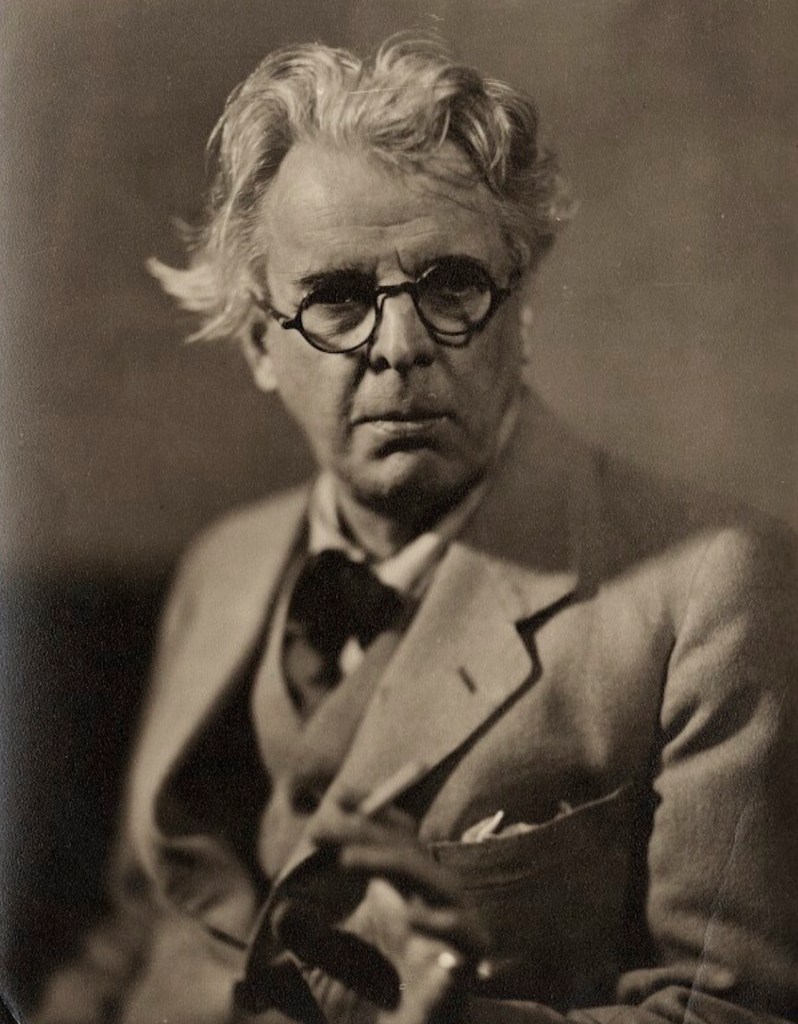
    Image:  William Butler Yeats NPG, London

    Life Sketch of William Butler Yeats

    William Butler Yeats possessed a lifelong dedication to the cultural and political rebirth of Ireland. He experienced life as a poet, playwright, and senator as he lived during turbulent shifts in Irish politics.  He had a lifelong unquenchable thirst for artistic and spiritual truth.

    William Butler Yeats remains one of the most influential literary figures of the modern era.  His canon, which includes examples of his interest in Eastern philosophy, Irish folklore, and the vicissitudes of life, eventually resulted in the production of various literary forms such as poetry, drama, and essays [1].

    Early Life and Education

    Born on June 13, 1865, in Sandymount, County Dublin, William Butler Yeats was raised in a household that placed a high value on intellectual curiosity bolstered by cultural heritage.

    His father, John Butler Yeats, was a skilled portrait painter, and his mother, Susan Pollexfen, created an environment steeped in Irish history and folklore. His early exposure to art, literature, and the stories of ancient Ireland instilled in Yeats a deep appreciation for myth and legend that would later become central themes in his work.

    As a young man, Yeats attended the Metropolitan School of Art in Dublin, where he developed keen observational skills and his ability to capture what he saw into dramatic literary form such as poetry and plays. 

    His early attempts to write poetry were heavily influenced by Romanticism, and he found inspiration in the rich treasure house of Irish mythology and the natural world. These early experiences laid the groundwork for a lifelong exploration of the interplay between the tangible and the transcendent [2].

    The Celtic Revival

    In the 1880s and 1890s, Yeats became as a principal figure in the Celtic Revival—a cultural movement, aimed at reclaiming Ireland’s heritage from centuries of British domination. 

    Along with contemporaries such as Lady Gregory and Edward Martyn, Yeats sought to regain Irish identity through renewed interest and influence of its ancient myths and folklore.   Yeats’ first poetry collections, including The Wanderings of Oisin and Other Poems (1889), offered a vision of Ireland as a land of fantastic beauty and heroic legend.

    Yeats’ involvement in the Irish literary revival was not merely rhetorical and philosophical; he assisted in the founding of the National Literary Society and became a driving force behind the establishment of the Abbey Theatre, which became the center stage for modern Irish drama. 

    Through the Abbey Theatre, Yeats teamed up with playwrights and dramatists to stage works, combining Irish mythology with contemporary social and political issues; thus he became responsible for creating a distinctly Irish voice in the performing arts [3].

    Changing Style and Interest in the Mysticism

    As Yeats’ career progressed, his creative writings faced an important transformation.  As he moved away from his early Romanticism, he took up themes of aging, disillusionment, and the search for spiritual meaning. This shift was influenced by his increasing interest in Eastern Philosophy and mystical traditions. 

    Yeats’ lifelong engagement with esoteric philosophy—ranging from Theosophy to the study of Eastern Philosophy—found expression in poems such as “The Second Coming” (1919) and “The Indian upon God” (1927). These works reflect a mind grappling with the decline of traditional values and the potential for rebirth through art and myth.

    Yeats’ fascination with mysticism was not a mere intellectual exercise; it became deeply personal. He was a member of the Hermetic Order of the Golden Dawn, an organization dedicated to the study and practice of magical rituals and mysticism. 

    This involvement influenced his poems with symbolic imagery and complex mythological references that continue to captivate readers. The cyclical view of history that Yeats espoused—wherein civilizations rise, decay, and ultimately transform—became a recurring theme of his later work.

    Unfortunately, Yeats’ study of Eastern Philosophy/Religion at times led him astray.  Some of his works demonstrated that he failed to understand [4] the most important aspects of the concepts that he tried to portray in his poems. 

    While his poem “The Indian upon God” accurately reflects Eastern tenets, his “The Second Coming” and “Lapis Lazuli” go far astray.  The bulk of his understanding of Eastern philosophical and religious concepts may be described no less than by the term assigned  by T. S. Eliot “romantic misunderstanding.”

    Politics and the Poet in Society

    The early twentieth century was a period of political upheaval in Ireland, and Yeats became increasingly involved with the nationalist movement.   Even though he never fully aligned himself with any particular political party, his writings and public statements often reflected a profound concern for the fate of his country. His poetry became the main medium through which he expressed hope but also anxiety about the future of his country.

    Poems such as “Easter 1916” suggest that whatever happens no one can deny that those rebels will have died for their dreams. This speaker still cannot completely commit to those dreams. All he can admit is that everything has changed and “A terrible beauty is born.”

    The Yeatsian musing of drama ultimately finds only that things have changed. The speaker cannot say if they have changed for better for worse. He and his generation will have to wait to see how that “terrible beauty” matures.   However, this duality—of destruction and creation—reflects the eternal cycles that he so frequently explored in his verse.

    Beyond his poetry, Yeats contributed directly to the political life of his nation. He served from 1922-1928 in the senate of the newly formed Irish Free State [5].  Although he was often seen as an outsider by both traditional nationalists and modernists, Yeats’ presence in the Senate suggested a belief in the vital role that artists and intellectuals play in shaping public discourse and guiding cultural evolution.

    Image b: Yeats and Gonne  

    Personal Life and Love

    Yeats’ personal life was distressed by a long, unrequited love for Maud Gonne [6], an Irish revolutionary and actress. His feelings for Gonne inspired many of his poems, imbuing them with themes of love, loss, and longing. Gonne’s rejection of his marriage proposals did not deter Yeats from writing some of his most passionate poetry, where she often appears as a muse or an ideal.

    Later in life, Yeats married Georgie Hyde-Lees, who not only became his companion but also a collaborator in his mystical explorations. They had two children, Anne and Michael, and their family life was documented in some of Yeats’ more personal poems, such as “A Prayer for My Daughter” and “The Circus Animals’ Desertion.”

    The Alignment of Myth and Modernity

    A central aspect of Yeats’ enduring appeal is his ability to weave together disparate strands of experience—myth and modernity, beauty and decay, hope and despair—into a coherent vision of the human condition. His poetry often reads as if it were both a dream and a prophecy, a blend of personal reflection and universal truth. 

    For instance, in “Sailing to Byzantium,” Yeats contrasts the ephemeral nature of the physical world with the possibility of spiritual transcendence [7]. The poem’s vivid imagery and rhythmic cadence invite readers to contemplate the eternal in the midst of the temporal, a duality that lies at the heart of Yeats’ artistic endeavor.

    Yeats’ engagement with myth was not limited to the realm of poetry; it also informed his political and cultural projects. By reviving ancient Irish legends and traditions, he sought to restore a sense of identity and continuity to a country grappling with the forces of modernity and colonialism. His poem “The Fisherman” offers an example of this engagement.

    His work with the Abbey Theatre was driven by the conviction that drama rooted in myth could foster a national spirit and provide a counterpoint to the homogenizing effects of globalization. In this way, Yeats not only redefined the poetic landscape but also contributed to a broader cultural renaissance in Ireland.

    An Enduring Influence on Literature and Beyond

    The influence of William Butler Yeats extends far beyond the confines of his own time. His exploration of spiritual and metaphysical themes paved the way for subsequent generations of poets and writers who sought to reconcile the material and the mystical. In the decades following his death, critics and scholars have revisited his work, probing its layers of symbolism and historical context to uncover new meanings and insights.

    Contemporary literary critics often highlight the innovative structure and language of Yeats’ later poetry, noting how his use of recurring symbols and motifs creates a dense network of associations that invites endless interpretation. 

    His ability to encapsulate the complexities of Irish identity, the ravages of time, and the interplay between art and life continues to resonate in today’s discussions of literature and culture. 

    Moreover, Yeats’ political engagement and his belief in the transformative power of art have inspired not only writers but also activists and cultural leaders who view the arts as a vital force for social change [8].

    That political engagement, however, begs for a caveat.  As postmodernism crept ever nearer the hearts of the contemporary artists, the loss of skill and lack of interest in truth began to blight both poetry and criticism.  That postmodern mind-set has little hope of heralding and power to transform society for the better.

    Yeats’ Legacy

    William Butler Yeats’ life and work remain a testament to the power of art to illuminate the deepest mysteries of existence. From his early days steeped in Irish folklore to his later explorations of mystical symbolism and political transformation, he navigated the tumultuous currents of change with a keen and reflective mind. His ability to articulate the paradoxes of beauty and decay, hope and despair, has left an indelible mark on the world of literature.

    Yeats’ legacy is a reminder that art is not merely a reflection of life but also can serve as an agent of transformation, when steeped in desire for truth. His vision of history as a series of cyclic renewals, his embrace of the occult and the mythical, and his commitment to cultural and political renewal have all contributed to a body of work that continues to inspire and challenge readers. In celebrating Yeats, one celebrates the eternal quest for meaning—a quest that, like his poetry, transcends time and place.

    Through his poetic innovations and his fervent commitment to the rebirth of Irish culture, William Butler Yeats carved out a unique space in the annals of literary history. His words continue to echo in classrooms, theaters, and the hearts of those who dare to dream beyond the confines of the everyday routine. 

    Death

    In his later years, Yeats’ poetry grew increasingly reflective and introspective. The themes of mortality, the nature of artistic creation, and the inexorable passage of time became ever more emphasized. 

    Works such as The Tower (1928) and The Winding Stair and Other Poems (1933) reveal a man deeply aware of his own aging and the inevitable approach of death. Yet, even as he grappled with the transient nature of human life, he remained committed to the idea that art could capture eternal truths.

    Despite experiencing poor health, Yeats continued to write and speak out on matters of art, politics, and philosophy until his final days. On the French Riviera, he spent his last months in quiet musing, as he sought solace and reflection away from the public eye. 

    On January 28, 1939, in Menton, France, [9] William Butler Yeats passed away peacefully . The world mourned not just the passing of a literary giant, but also the departure of a visionary who had continually challenged and enriched the cultural landscape of Ireland and beyond. 

    One of the most profound memorial poems to Yeats is W. H. Auden’s “In Memory of W. B. Yeats.”  The following excerpt contains some of the poem’s most memorable lines, for example, “Mad Ireland hurt you into poetry”:

    You were silly like us; your gift survived it all:
    The parish of rich women, physical decay,
    Yourself. Mad Ireland hurt you into poetry.
    Now Ireland has her madness and her weather still,
    For poetry makes nothing happen: it survives
    In the valley of its making where executives
    Would never want to tamper, flows on south
    From ranches of isolation and the busy griefs,
    Raw towns that we believe and die in; it survives,
    A way of happening, a mouth.

    Sources

    [1]  Richard Ellmann. Yeats. New York. Oxford University Press, 1989.

    [2]  Mark Fryer. The Life of W.B. Yeats: A Critical Biography. London. Bloomsbury Academic. 2001.

    [3]  A. Norman Jeffares. The Cambridge Companion to W.B. Yeats.  Cambridge University Press, 2006.

    [4]  Linda S. Grimes.  “William Butler Yeats’ Transformations of Eastern Religious Concepts.”  Ball State University. PhD Dissertation. 1987. 

    [5] Editors.  “W. B. Yeats:  Irish Author and Poet.”  Britannica.  Accessed February 22, 2025.

    [6] Lisa Fortin Jackson.  “Great Irish Romances: W.B. Yeats and Maud Gonne.”  Wild Geese.  February 4, 2014.

    [7]  C. S. Lieber. The Collected Works of W.B. Yeats. New York. Knopf.  1963.

    [8] William Butler Yeats. The Collected Poems of W.B. Yeats. Edited by Richard J. Finneran, New York. 2009.

    [9] Editors.  “William Butler Yeats.”  Biography. August 17, 2020.

    Commentaries on Yeats Poems

    • The Indian upon God” This poem is displayed in ten riming couplets. The theme of the poem dramatizes the biblical concept that God made man in His own image.
    • The Fisherman” In “The Fisherman,” Yeats has created a speaker who is voicing a call for genuine art for the common folk, an art that dramatizes the beauty and truth inherent in all great art.
    • The Second Coming” One of the most overrated and misunderstood works of the Western literary canon.
    • Sailing to Byzantium” This poem is a profound meditation on aging, art, and the quest for spiritual transcendence, despite his failure to clearly grasp the Eastern religious/philosophical concepts he strived to portray.
    • “Leda and the Swan”  Focuses on the ancient Greek myth, wherein the woman, Leda, wife of Tyndareus, was impregnated by the god Zeus in disguise as a swan. Yeats’ speaker is musing regarding the nature of such an act and how it might have impacted Leda’s mental capacities afterward.
    • “Among School Children”  One of Yeats’ most anthologized poems, this poem features numerous allusions to ancient Greek mythology and philosophy. Yeats was always a thinker, even if not always a clear thinking one.
    • “Lapis Lazuli”  In this poem,  William Butler Yeats has his speaker explore the issue of peace and tranquility despite a chaotic environment.
  • John Donne

    Image 1:  John Donne Portrait – Unknown Artist – National Portrait Gallery, London

    John Donne’s canon features two vastly different themes.  One might argue that they are diametrically opposed; his earlier works focus on sensual debauchery.  His later works take the theme of spirituality.

    Early Life and Education

    John Donne was born on June 19, 1572, into a wealthy Catholic family during the period of English history that saw the rise of anti-Catholicism.  His father, John Donne, Sr., was a successful, prosperous iron worker.  Donne’s mother was related to Sir Thomas More; her father was the noted playwright John Heywood.  Donne’s father died in 1576, while the future poet was only four years of age. His mother struggled to raise John, Jr. and his two siblings.

    When Donne was 11 years old, he and his younger brother Henry  entered school at Hart Hall at Oxford University.  John continued his studies at Hart Hall for three years, and then he enrolled in Cambridge University.  

    Donne rejected taking the mandatory supremacy oath that declared King Henry VIII the head of the church; this declaration remained an abomination in the eyes of truly devout Catholics.  And because of this refusal to take that mandated oath, Donne was not permitted to graduate.   Donne then studied law as a member of Thavies Inn and Lincoln’s Inn.  The influence of the Jesuits remained with Donne throughout his student years [1].

    Marriage to Anne More

    In 1601, Donne secretly married Anne More, who was only 17 years old at the time.  This marriage put an end to Donne’s career in government positions.    Anne’s father arranged to have Donne arrested and imprisoned [2] along with Donne’s fellow compatriots who assisted Donne in keeping secret his courtship with Anne.  

    After losing his government position, Donne remained without gainful employment for nearly a decade.  His growing family, including twelve children, struggled with poverty during this period. 

    Donne quipped about those lean years, “John Donne, Anne Donne, Undone.”  The family depended greatly on family and friends for their sustenance.  A cousin of Anne’s supplied them with a residence at Pyrford in Surrey.  Friends, including Lady Magdalen Herbert, mother of George Herbert, and the Countess of Bedford assisted the family.  Those individuals had also assisted Donne in his literary career.

    Despite the largess of family and friends, the family struggled bitterly during those years.  Donne’s pride was bruised; he was well aware that his intellectual capacity far exceeded those responsible for his poverty.  In 1609, Donne’s father-in-law, Sir George More, finally relented and consented to a reconciliation with his son-in-law and his family, whereupon Sir More paid his daughter’s dowry.

    Questioning Catholicism

    John Donne began to question his Catholic faith after his brother Henry died in prison.  The brother had been arrested and sentenced to prison for assisting a Catholic priest [3].  Donne’s first collection of poems titled Satires addresses the issue of the efficacy of faith.  

    At age forty, Donne composed and published two treatises that denounced the Catholic Church.  These publications served as the final statement regarding of his severance from his earlier faith.  His polemic titled Pseudo-Martyr asserted that Catholics in England should be permitted to pledge allegiance to the king, James I, without being accused of disavowing their loyalty to the Pope.  This publication won Donne favor with King James.

    During these same years, Donne was composing his love/lust poems, Songs and Sonnets, from which many of his most widely anthologized poems are taken; three example poems are “The Apparition,” “The Flea,” and “The Indifferent.”  John Donne, going by the informal moniker of “Jack,” spent a significant portion of his youth and a sizable amount of an inherited fortune on travel and womanizing.  He traveled with Robert Devereux, 2nd Earl of Essex on a naval expedition to Cádiz, Spain.  

    Donne later journeyed with another expedition to the Azores; from that trip, he was  inspired to compose his piece, “The Calm.”  After his return to England, he accepted a position as a private secretary to Thomas Egerton, whose status was Lord Keeper of the Great Seal.

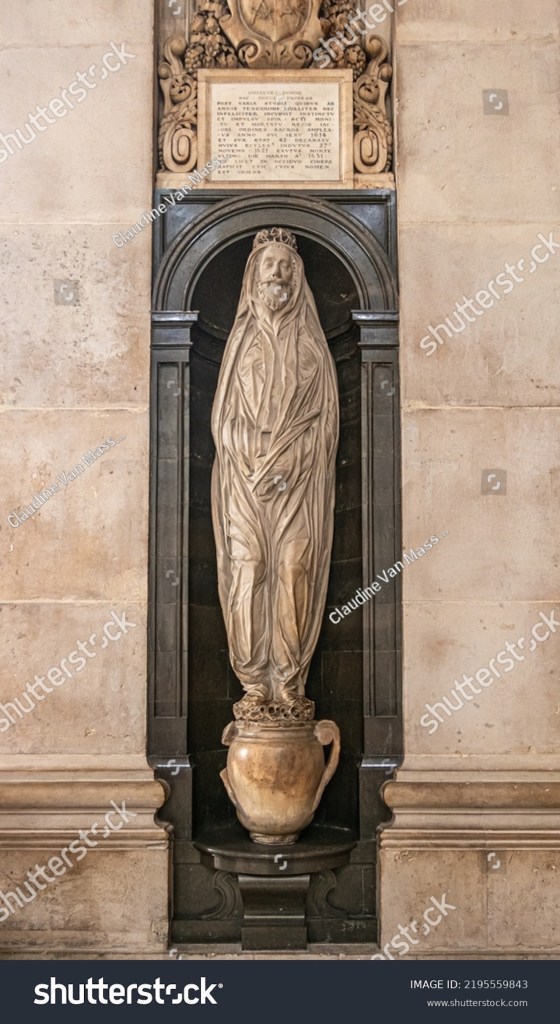
    Image 2:  John Donne Monument Effigy   Wenceslaus Hollar – National Portrait Gallery, London


    Renunciation of Catholics

    Although Donne had renounced Catholicism, King James insisted that Donne could receive no government employment unless it was church related.  Donne had continued to refuse to take Anglican orders.   However, in 1615, Donne finally entered the ministry and accepted the post of Royal Chaplain.

    After completing the doctorate in divinity, he was appointed to the post of Reader in Divinity at Lincoln’s Inn.   Donne’s elaborate style of oratory filled with spiritual metaphors and other religious symbols earned for him the reputation as one of the greatest ministers of that period.

    Although Donne had also practiced law for several years, his family had remained living at the substance level.  Then after he accepted the position of Royal Chaplain, life for the Donnes seemed to be improving [4].

    Anne’s Death

    However, tragedy struck the family when Anne at age 33 died on August 15, 1617, after giving birth to their twelfth child, who was stillborn.  Only seven of the couple’s children survived. The poet mourned his wife’s death in Holy Sonnet XVII: “Since she whom I lov’d hath paid her last debt.”

    According to Donne’s most important biographer and friend Izaak Walton [5], after Anne’s death Donne became “crucified to the world.”  Although Donne continued to compose his poems, he focused entirely upon the theme of spirituality and the search for meaning.

    Poems and Faith

    John Donne is often grouped with the Metaphysical poets.  However, according to T. S. Eliot, Donne’s poems along with other Metaphysicals such as Henry Vaughan, George Herbert,  and Andrew  Marvell do not, in fact, possess the attributes of the metaphysical label any “more than other serious poets” [6].

    The death of John Donn’e wife Anne exerted a strong influence on his poetic achievement.    He started composing his poems of faith, collected in The Holy Sonnets, including Hymn to God the Father,” “Batter my heart, three-person’d God,” and “Death, be not proud, though some have called thee”—three of the most widely anthologized holy sonnets.

    Donne also composed a collection of private meditations, published in 1624 as Devotions upon Emergent Occasions.   His collection of private meditations, a classic spiritual work, features “Meditation 17,” from which two of his most famous quotations have been taken:  “No man is an island” and “Therefore, send not to know  / For whom the bell tolls, / It tolls for thee.”

    In 1621, Donne was appointed Dean of St. Paul’s, and in 1624, he took up the position as vicar of St Dunstan’s-in-the-West [7],where he continued to serve as a minister until his death on March 31, 1631.   Interestingly, a mythology has grown up around the claim that he preached his own funeral sermon “Death’s Duel” only a few weeks before his death.

    Sources

    [1]  Anniina Jokinen.  “The Life of John Donne.”  Luminarium.  Accessed February 18, 2023.

    [2]  Editors.  “John Donne.”  Academy of American Poets.  Accessed February 18, 2023.

    [3]  Editors.  “Who Was John Donne?”  Biography.  Last Updated: November 12, 2021.

    [4]  Editors.  “John Donne – Biography.”  HumanitiesWeb.org.  Updated:  October 28, 2012.

    [5]  Izaak Walton.  The Life of Dr. John Donne.” Anglican History:  Project Canterbury.  Accessed February 18, 2023.

    [6] T. S. Eliot.  “Review of Metaphysical Lyrics and Poems of the Seventeenth Century: Donne to Butler.”  University of Wyoming.  Accessed February 23, 2023.

    [7] Editors.  “John Donne in the Archives.” City of London.  Date updated: May 15, 2022.

    Commentaries on Poems by John Donne

    1. Holy Sonnets 1—19
    2. The Apparition
    3. The Flea

    Reading of “Death’s Duel” 

    Image 3:  John Donne Luminarium

  • James Weldon Johnson

    Image:James Weldon Johnson – Portrait  by Laura Wheeler Waring

    Life Sketch of James Weldon Johnson

    A true “Renaissance man,” James Weldon Johnson wrote some the best spiritual poems and songs in the American literary canon.  He also held positions as attorney, diplomat, professor, and activist in a political party, fighting for the civil rights of black Americans.

    Note on Term Usage:  Before the late 1980s in the United States, the terms “Negro,” “colored,” and “black” were accepted widely in American English parlance.   While the term “Negro” had started to lose it popularity in the 1960s, it wasn’t until 1988 that the Reverend Jesse Jackson began insisting that Americans adopt the phrase “African American.”  The earlier more accurate terms were the custom at the time that James Weldon Johnson was writing.

    Early Life and Schooling

    James Weldon Johnson was born on June 17, 1871, in Jacksonville, Florida, [1] to James Johnson, of Virginia, who had held a position as headwaiter at a resort hotel, and Helen Louise Dillet, of the Bahamas, who had served as a teacher in Florida.  

    His parents raised James to be a strong, independent man.  The future poet became a free-thinker as his parents encouraged him to understand that he was capable of achieving all the success in life for which he sought to strive. 

    In 1894, after completing the bachelor’s degree at Atlanta University, he accepted a position as principal at the Edwin M. Stanton School.  His mother had taught at that school.  In his position as principal of Stanton, he made great improvements in the curriculum, adding grades 9 and 10.

    While serving at the Stanton school as principal, Johnson founded the newspaper, The Daily American.  The paper remained in publication for only a year, but it served as a lever for Johnson’s role as an activist, bringing him to the attention of Booker T. Washington and W.E.B. DuBois, two of the most influential activists of the civil rights movement.

    Johnson began the study of law in Thomas Ledwith’s law office in Jacksonville, Florida, in 1896 [2].  He passed the bar exam in 1898 and was admitted to the Florida bar.  He practiced law for several years and then decided to pursue other lines of work.

    From New York City to the Diplomatic Corp

    To engage a career in songwriting, in 1901 James and his brother Rosamond moved to New York City.  They became partners with Bob Cole and accepted a publishing contract which paid a $1200 monthly stipend.  That income amounted to a fortune in the early 20th century.  

    During the next half decade, the Johnson brothers wrote and produced a whopping 200 songs for both Broadway and for other formats.  Their substantial list of hits include titles such as  “Didn’t He Ramble,” “Under the Bamboo Tree,” and “The Old Flag Never Touched the Ground.”

    Along with Bob Cole, the Johnsons earned a outstanding reputation as a musical trio.   They became known affectionately as “Those Ebony Offenbachs.”  While they eschewed the artistry of the minstrel show stereotypes, they did agree to create simplified versions of black life of rustics for white audiences that seemed to relish such fare.  

    But their most important contribution includes a suite of six songs titled The Evolution of Ragtime, a documentary which has remained important for recording the black experience in contributing to music. Residing in New York also allowed Johnson the opportunity to attend Columbia University, where he engaged formally in the study literature and creative writing.  

    Johnson also began his civil rights activism in Republican Party politics.  While serving as the treasurer of New York’s Colored Republican Club, he wrote two songs for Theodore Roosevelt’s 1904 presidential campaign.  Roosevelt won that campaign, becoming the 26h president of the United States.

    The black national civil rights leadership divided into two factions: one remained traditional and was led by Booker T. Washington.  The other faction turned radical and was headed up by W.E.B. Du Bois.  Johnson chose to follow Washington and the traditionalists.  

    Washington’s leadership had offered the appropriate influence and had helped Roosevelt win the presidency.  Thus, Washington exerted his influence again to have Johnson appointed as the U.S. consulate to Venezuela.  

    Johnson’s stint in Venezuela afforded him time to create poetry. There he composed his magnificent, nearly perfect sonnet, “Mother Night,” during this time.  Also, during this three year period of service as consul on Venezuela, he was able to finish his novel, The Autobiography of an Ex-Coloured Man.  

    After Johnson’s service in Venezuela, he received a promotion that relocated him to Nicaragua. His job in Nicaragua became more demanding, allowing him less time for literary efforts.

    Back to New York and the Harlem Renaissance

    In 1900, Johnson composed the hymn “Lift Ev’ry Voice and Sing” for a school celebration of Abraham Lincoln’s birthday [3].  His brother Rosamond later added the melody to the lyric. In 1919, the National Association for Advancement of Colored People (NAACP) designated the song the “Negro National Hymn (Anthem).”

    In 1913, because of the inauguration of Woodrow Wilson, a Democrat, Johnson resigned his foreign service position and returned to the U.S.A.  In New York, Johnson began writing for New York’s prestigious black newspaper, the New York Age.  He wrote essays explaining and promoting the importance of the hard-work ethic and education.  

    Johnson’s traditionalism kept his position more in line with Booker T. Washington than with the radical militant W.E.B. Du Bois.  Despite those differences in ideologies, Johnson remained on good terms with both activists.

    In 1916, after Du Bois suggested the position to Johnson, he accepted the role as secretary in the NAACP.  In 1920, Johnson led the organization as president. Despite his many activist duties with the  NAACP, Johnson dedicated himself to writing full time. In 1917, he published his first collection of poems, Fifty Years and Other Poems.  That collection received great critical acclaim and established him as an important voice in the Harem Renaissance Movement.  

    Johnson continued writing and publishing; he also served as editor for numerous volumes of poetry, such as The Book of American Negro Poetry (1922), The Book of American Negro Spirituals (1925), and The Second Book of Negro Spirituals(1926).  

    In 1927, Johnson published his second book of poems God’s Trombones: Seven Negro Sermons in Verse [4]. Again, his collection received much praise from critics.  Dorothy Canfield Fisher, a best-selling author and activist for education reform, stated in a letter about Johnson’s style:

    . . . heart-shakingly beautiful and original, with the peculiar piercing tenderness and intimacy which seems to me special gifts of the Negro. It is a profound satisfaction to find those special qualities so exquisitely expressed.

    Back to Teaching

    After his retirement from the NAACP, Johnson continued writing.   He also served as professor  at New York University.  Johnson’s stellar reputation again preceded him; as he joined the NYU faculty, Deborah Shapiro testified:

    Dr. James Weldon Johnson was already a world-renowned poet, novelist, and educator when he arrived at the School of Education in 1934.  His faculty appointment was in the Department of Educational Sociology, yet Johnson’s influence did not end there.  As the first black professor at NYU, Johnson broke a crucial color barrier, inspiring further efforts toward racial equality both within and outside the boundaries of Washington Square.

    Death

    In 1938 at age 67, Johnson was killed in an automobile accident in Wiscasset, Maine, after a train crashed into the vehicle in which the poet was a passenger.  His funeral, held in Harlem, New York, was attended by over 2000 individuals.  

    Johnson’s creative power and activism rendered him a true “Renaissance man,” who lived a full life.  He penned some of the finest poetry and songs ever to appear on the American literary and music scenes. Johnson’s life creed bestows on the world an uplifting inspiration after which any individual might choose to chisel his life:

    I will not allow one prejudiced person or one million or one hundred million to blight my life. I will not let prejudice or any of its attendant humiliations and injustices bear me down to spiritual defeat. My inner life is mine, and I shall defend and maintain its integrity against all the powers of hell. [5]

    The poet’s body is interred in Green-Wood Cemetery in Brooklyn, New York [6]. In an unconventional final expression, his body has been arrayed in his favorite lounging cape, with his hands clutching a copy of his collection God’s Trombones.

    Sources

    [1] Editors. “James Weldon Johnson.”  Famous African Americans. Accessed January 27, 2023.

    [2] Malik Simba.  “Profile:  James Weldon Johnson (1871- 1938).”  Black Art Story.  Accessed January 27, 2023.

    [3] Editors. “The Story Behind the Black National Anthem.”  Black Excellence.  September 26, 2018.

    [4] Editors. “James Weldon Johnson.”  Poetry Foundation.  Accessed January 27, 2023.

    [5] Christine Weerts.  “How ‘Lift Every Voice And Sing’ Became A Song Of Hope For Generations.”  The Federalist.  February 12, 2021.

    [6] FindAGrave.  “James Weldon Johnson.”  Accessed January 27, 2023.

    Commentaries on Poems by James Weldon Johnson

    This room in my literary home holds links to poems written by James Weldon Johnson along with commentaries on the poems.  

    Poems with Commentaries

    1. Noah Built the Ark”
    2. “Go Down Death”
    3. “Sence You Went Away”
    4. “Fifty Years”
    5. “A Poet to His Baby Son”
    6. “Lift Every Voice and Sing”
    7. “Mother Night”
    8. “The Creation”
    9. “O Black and Unknown Bards”
    10. “My City”

    Full Image:James Weldon Johnson – Portrait  by Laura Wheeler Waring

  • The “Shakespeare” Writer

    Image – Edward de Vere, 17th Earl of Oxford

    Continued research seems to be confirming the claim by the Oxfordians that Edward de Vere, 17th Earl of Oxford—not Gulielmus Shakspere of Stratford-upon-Avon as insisted by the Stratfordians—wrote the canon of plays and poems left by the pseudonymous “William Shakespeare.”

    Who Is the Authentic “Shakespeare” Writer”?

    The mystery regarding the true identity of the writer traditionally known as “William Shakespeare” actually began in Elizabethan England, during the period in which most of the likely candidates for the position lived and wrote. 

    The controversy [1] has continued, and today there are two main groups that argue the point: the Oxfordians contend that the most likely writer of the Shakespeare canon is Edward de Vere, 17th Earl of Oxford.   Arguing the other side are the Stratfordians, who maintain that Gulielmus Shakspere of Stratford-upon-Avon, the traditionally held choice, remains the actual writer.

    The first biographical work on “William Shakespeare” appeared in 1769.   It focuses on Gulielmus Shakspere, the man from Stratford-upon-Avon in Warwickshire, traditionally hailed as the Shakespeare writer.  

    That same year, Herbert Lawrence in his work titled, The Life and Adventures of Common Sense, suggests the idea that “William Shakespeare” was likely the nom de plume of some other writer but not the Stratford man. 

    In 1780 a clergyman/scholar in Warwickshire, James Wilmot, examined records near and surrounding Stratford-upon-Avon, searching for data on William Shakespeare and the Shakespeare works.  Wilmot found nothing about the writer or his works.

    After Wilmot lacked success in locating any information leading to the identity of the Stratford man as the Shakespeare writer, he floated the notion that Francis Bacon using “William Shakespeare” nom de plume had written those plays and sonnets.  Wilmot, to the detriment of historical literary research, mandated that all of his research materials be burned upon his death.

    In 1857, Delia Bacon, an American short story writer and Shakespeare enthusiast, offered the suggestion that perhaps a committee and not just one individual had composed the Shakespeare canon.  For her suggested committee, Delia Bacon chose Edmund Spencer, Sir Walter Ralegh, and Edward de Vere; she placed Francis Bacon in the committee as its chairman.

    Since those early suggestions that an individual other than the Stratford man wrote the Shakespeare canon, the controversy has raged on.   Currently, the Oxfordians, who continue to gather evidence for Edward de Vere, 17th Earl of Oxford, as the Shakespeare writer are putting forth the strongest, most convincing argument.

    Literary scholars and critics are increasingly coming to the conclusion that the man from Stratford, Gulielmus Shakspere, widely held as the traditional Shakespeare, is the least qualified candidate for playing that authorial rôle.  From that conclusion emerges the likelihood that Edward de Vere, 17th Earl of Oxford, is the best candidate for consideration as the Shakespeare writer. 

    Walt Whitman, one of America’s greatest poets, agrees with the Oxfordians, who argue that the 17th Earl of Oxford is the actual author of the works published under the nom de plume, “William Shakespeare”: 

    Conceiv’d out of the fullest heat and pulse of European feudalism — personifying in unparalleled ways the medieval aristocracy, its towering spirit of ruthless and gigantic caste, with its own peculiar air and arrogance (no mere imitation) — only one of the “wolfish earls” so plenteous in the plays themselves, or some born descendant and knower, might seem to be the true author of those amazing works — works in some respects greater than anything else in recorded literature.  [2]

    From other respected writers such as Henry James and Ralph Waldo Emerson to actors such as Charlie Chaplin and Sir Derek Jacobi to supreme court justices such as Harry A. Blackmun and John Paul Stevens, famous individuals have expressed doubt about the tradition identification of the Shakespeare writer [3].

    Why the Oxfordians Are Likely Correct

    A study of the background of each man—Gulielmus Shakspere of Stratford-upon-Avon and Edward de Vere, 17th Earl of Oxford—reveals evidence that  suggests that only Oxford possessed the ability to have produced the complex, historically based, geographically accurate  works of the Shakespeare writer.

    Gulielmus Shakspere—”Stratford”—was semi-literate; his parents, his wife, and his children were all semi-literate.  He likely remained uneducated beyond age 14.  No records have been found that demonstrate that he wrote anything more complex than a list of beneficiaries in his last will and testament.

    But if the Stratfordians are correct, this semi-literate individual who traveled no farther than to London (if that far) and left no early writings just suddenly commenced the composition of complex historical dramas and perfectly modulated sonnets during the time period Shakespeare scholars call “Shakespeare’s Lost Years.” 

    In contrast, Edward de Vere—”Oxford”—had received a first class education, had traveled widely throughout the world, and had actually been known to be a writer of plays and poetry.

    It remains as unlikely that the man Gulielmus Shakspere could have composed any of the works attributed to “William Shakespeare,” as he could have invented the horseless carriage or discovered the Pacific Ocean.  

    Life Sketch of Gulielmus Shakspere:  Birth Date in Doubt

    The biographical documents of “William Shakespeare” are virtually blank pages, upon which scholars, critics, and enthusiasts have written versions of a life, for example, no record exists of the birth date of “William Shakespeare,” even under the name Gulielmus Shakspere.  Biographers, therefore, can only speculate [4]:

    William Shakespeare was born in Stratford-upon-Avon, England, in April 1564. The exact date of his birth is not recorded, but it is most often celebrated around the world on 23 April. . . . Shakespeare also died on 23 April; in 1616, when he was 52 years of age.

    And the speculation continues; the following represents a further example that is typical of any attempt to state when “William Shakespeare” was born:

    No birth records exist, but an old church record indicates that a William Shakespeare was baptized at Holy Trinity Church in Stratford-upon-Avon on April 26, 1564. 

    From this, it is believed he was born on or near April 23, 1564, and this is the date scholars acknowledge as Shakespeare’s birthday. [5]

    As would-be biographers speculate about the birth date and other details regarding the Shakespeare writer, they employ the nom de plume “William Shakespeare” instead of Gulielmus Shakspere, the name that appears on the man’s baptismal record.

    Remaining a nebulous figure, “William Shakespeare” as Gulielmus Shakspere has no actual day of birth.  His speculated birth date is April 23, 1564, as is his death date, April 23, 1616.    The fabulous coincidence of any man dying on his unknown birth date further suggests the vulnerability of the claim that Stratford is the actual Shakespeare writer.

    The Education of “William Shakespeare”

    While uncertainty abounds regarding the birth date of “William Shakespeare,” equal uncertainty persists regarding his education.  Again, no records [6] have been found to designate the level of education to which Stratford might have risen.

    Supposition and guess-work suggest that Stratford might have attended King Edward VI Grammar School between the ages of seven and fourteen.  After age fourteen, his formal education was finished.  However, speculation regarding Stratford’s education has been offered as actual biographical history: 

    Stratford enjoyed a grammar school of good quality, and the education there was free, the schoolmaster’s salary being paid by the borough. 

    No lists of the pupils who were at the school in the 16th century have survived, but it would be absurd to suppose the bailiff of the town did not send his son there. 

    The boy’s education would consist mostly of Latin studies—learning to read, write, and speak the language fairly well and studying some of the Classical historians, moralists, and poets. 

    Shakespeare did not go on to the university, and indeed it is unlikely that the scholarly round of logic, rhetoric, and other studies then followed there would have interested him. (my emphasis on “no lists of the pupils”) [7]

    It may seem absurd to deem that the Shakespearean father would not have insisted that his son attend an illustrious grammar school funded by the state.  In such a school,  the boy would have been immersed in Latin studies and the classics.  However, such deeming does not record that boy’s name in documents that reveal that he did actually attend such an illustrious grammar school.

    Also, if the son of the town’s bailiff had received such an excellent education and was taught to read and write Latin, which he did “fairly well,” one has to remain perplexed that Gulielmus Shakspere remained unable to write his own name and spell it consistently throughout his lifetime (see below “The Spelling of the Stratford’s Name”).

    The Importance of Education

    Although no documentation exists to validate the education of Stratford and only speculations are extant that he attended King Edward VI Grammar School in Stratford-upon-Avon, the educational record [8] for Edward de Vere is extensive.  

    Edward de Vere became a ward of the Crown and was educated by the Royal Court of Wards.  He attended Queen’s College, Cambridge, and later underwent training at Gray’s Inn in the study of law. 

    De Vere was early on considered a wunderkind; his mentor and tutor Laurence Nowell asserted in 1563, as de Vere turned 13 years old,  that his “work for the Earl of Oxford cannot be much longer required.”    By the next year, at age 14, de Vere had been awarded a Cambridge degree. In 1566, at age 16, he earned a master of arts degree from the universities of Oxford and Cambridge.

    Stratfordians like to emphasize the fact that genius can overcome station in life, but such is true only to a point.  The late Shakespeare scholar Daniel Wright [9] has elucidated the issue of education vs natural genius:

    A writer’s genius can elevate his or her poetry or prose beyond the mundane (indeed, in Shakespeare’s case, it endows his achievement with a magnificence that is almost transcendent in its resplendence), but it cannot of itself impart to any writer—not even to Shakespeare—a knowledge of particular facts. 

    Genius may animate the hand, but it does not do that which is not its office—it does not, for it cannot, supply the material with which the hand performs its work. Some things even a genius simply must be taught.

    The issue of education presents one of the best supports for the fact that Stratford would not have had knowledge of the facts needed to have written the Shakespeare canon.  Professor Wright has pointed out that “knowledge of particular facts” cannot come without the input of experience to the mind, even to a genius. 

    No evidence exists that Stratford had traveled even to London—only 100 miles from Stratford-upon-Avon—much less that he could have traveled a great deal in Italy.  Such a set of facts is necessary for the writer, who wrote the plays, to have experienced.   Despite natural talent and genius, an intimate knowledge of the Italian landscape cannot simply appear within the mind of said genius.

    “The Lost Years”

    The concept of “Lost years” in the lives of any biographical target provides a delicious opportunity to the biographer, who then has the opportunity to fill in those lost years.    Because “there is no documentary evidence of his life during this period of time,” suitable scenarios may be invented that have little or no relationship to real events.  Thus the would-be biographer is allowed to opine as he wishes, such as the following: 

    ‘The Lost Years’ refers to the period of Shakespeare’s life between the baptism of his twins, Hamnet and Judith in 1585 and his apparent arrival on the London theatre scene in 1592.

    We do not know when or why William Shakespeare left Stratford-upon-Avon for London, or what he was doing before becoming a professional actor and dramatist in the capital. There are various traditions and stories about the so-called ‘lost years’. 

    There is no documentary evidence of his life during this period of time.  A type of mythology has developed around these mysterious years, and many people have their favourite version of the story. (my emphasis added)  [10]

    These speculating Shakespearean biographers not only do not know “when or why” Stratford left Stratford-upon-Avon for London, but they also do not even know that he actually did make that trip to London.   That Stratford became “a professional actor and dramatist in the capital” remain likely one part of the confusion that has fused aspects from the lives of Stratford and Oxford.

    Further Evidence Oxford Is the Real “Shakespeare”

    In addition to the issue of the vast differences between the Stratford man and the Oxford earl in education, further issues advocate that Oxford continues to remain the better candidate for the real “Shakespeare” than Stratford.

    The Spelling of the Stratford’s Name

    The many variations in the spelling of the name “Shakspere” offer further evidence for the claim the Stratford could not have authored the Shakespeare canon.  Stratford could barely write his own name, much less a complex literary canon.  Stratford’s signature [11] varied, as he affixed his name with six different spellings in four legal documents:  

    1. deposition of the lawsuit, Bellott v Mountjoy (1612) 
    2. deed for a house sold in Blackfriars, London (1613)
    3. the mortgage document for a house acquired in Blackfriars (1613)
    4. a 3-page Last Will and Testament (1616), which he signed at the bottom of each page.

    Interestingly, none of the Stratford man’s many variations on the spelling of his name includes the spelling “Shakespeare” (12).

    Thomas Regnier on “Our Ever-Living Poet”

    Thomas Regnier, Shakespeare scholar and prominent Oxfordian, delineates the top “18 Reasons Why Edward de Vere, Earl of Oxford, Was “Shakespeare.”   Regnier’s Reason 18 clarifies the use of the phrase, “Our ever-living poet,” thus demonstrating that it refers to Oxford instead of Stratford:

    Shakespeare’s Sonnets were first published in 1609. There are indications on the dedication page that the author was no longer living at that time. 

    First, the dedication is signed by the publisher, Thomas Thorpe, not by the author, suggesting that the author was not alive to write the dedication. 

    More significantly, the dedication refers to the author as “ever-living.” This is a phrase that was used metaphorically to refer to a person who was no longer alive, but who would live on through his works in our minds and hearts. 

    The Earl of Oxford was no longer living in 1609, while the man from Stratford, who is usually credited with writing the works of Shakespeare, would live on for another seven years. Stratfordian scholars have never been able to explain why the phrase “ever-living” would have been applied to a living person.  [13]

    The controversy at the heart of the Stratford vs Oxford debate will likely continue because of the simple nature of the past, which perpetually remains in a kind of fog.   An unfortunate encumbrance that may interfere with the legitimacy of the debate to ultimately find the truth is that it might come to depend on which side affords the debaters greater financial and prestigious awards.  

    Questions that could use an airing are:  Do university grants go more often to those researchers who contend that Stratford is the real “William Shakespeare”?  Does Oxfordianism label one a royalist and an elitist while Stratfordianism offers the veneer of humbleness and dedication to the “little man”?

    The Stigma Attached to Oxfordianism

    The Stratfordians have in the past attached a stigma to the Oxfordians, for example, in 1920, J. Thomas Looney identified Oxford as the Shakespeare writer and offering the claim that “William Shakespeare” was a  pseudonym (pen name or nom de plume.)   While Looney’s name is pronounced with a long ō, stigmatizing Stratfordians engaging in the rhetorical fallacy called name-calling revels in calling Looney “loony” (14).

    Also if one entertains any lingering doubt that the Stratfordians have an equal argument to wield against the Oxfordians, one might want to have a look at the comments offered on amazon.com after Looney’s book, “Shakespeare” Identified,” a centenary edition edited by James Warren.  

    John Crowe Ransom’s New Criticism movement of the middle 20th century placed emphasis on the text above biography of the writer:  

    The central issue that new critical thought brought to literary studies is the emphasis on the text itself, rather than on the biography of the writer or the historical and societal circumstances in which the writer composed. While these issues may be considered overall, the first consideration must be the text itself. [15]

    Nevertheless, each scholar, critic, commentarian, or reader has to decided for himself which of the known facts are important and in which direction they point.  It is also important to remember that biography is only one portion of the information needed to understand and appreciate any work of literary art.

    My Personal View of the Shakespeare Controversy

    I have written commentaries on the 154 sonnets in the Shakespeare canon, and I have posted them on this site; thus I feel it necessary to make known my thoughts on the controversy and how they likely impact issues that I focus on in my sonnet commentaries.

    After studying the research of Oxfordians such as the late Professor Daniel Wright, Thomas Regnier, and many others, as well as the many who remain traditional Stratford supporters, I conclude that the Oxfordians have the far better argument, and the evidence is clear that the Shakespeare writer is most likely, if not in fact, Edward de Vere, 17th Earl of Oxford.

    I agree that the name “William Shakespeare” is most likely the pen name (nom de plume) of the Earl of Oxford.  I find no reason that Gulielmus Shakspere should have adopted a pen name, when as it has been fairly established the he seldom put pen to paper.

    Edward de Vere, as a ranking nobleman, needed to hide his association with the lower classes who engaged in writing and putting on plays.  Thus he did have the need for employing the use of a nom de plume, especially as he began to publish.  It is quiet easy to see that de Vere’s choice of a pen name “William Shakespeare” could be confused with the Stratford man’s name “Gulielmus Shakspere.”

    Because I find most compelling that argument that “William Shakespeare” is the nom de plume of Edward de Vere, 17th Earl of Oxford, I choose to refer to the works attributed to “William Shakespeare” as the “Shakespeare works” or the “Shakespeare sonnets,” instead of  “Shakespeare’s works” or “Shakespeare’s sonnets.”

    I suggest that ownership shown by the apostrophe should be reserved for a person, not a nom de plume.  In cases such a “Mark Twain” and “Lewis Carroll,” I relent because of their proximity to our contemporary world, and their identities are not in question.  In my opinion, however, the sonnets are Edward de Vere’s sonnets, but because they are published and traditionally known as “Shakespeare” sonnets, I refer to them as such.

    Sources

    [1]  Editors. “Controversy Timeline, Part 1.” Shakespeare Authorship Roundtable.  Accessed June 6, 2021.

    [2]  Walt Whitman.  “What Lurks Behind Shakspere’s Historical Plays?November Boughs. bartleby.com: Great Books Online. Accessed December 2020.

    [3]  Editors.  “Past Doubters.”  The Shakespeare Authorship Coalition.  Accessed September 27, 2024.

    [4] Editors.  “When Was Shakespeare Born?”  Shakespeare Birthplace Trust.  Accessed December 2020.

    [5]  Editors. “William Shakespeare Biography.”  Biography.  Updated: Dec 10, 2020. Original: Apr 24, 2015.

    [6]  Editors. “The Education of William Shakespeare.” Literary Genius. Accessed December 2020.

    [7]  David Bevington. “William Shakespeare.”  Britannica. November 4, 2020.

    [8] Curators.  “Chronology of Edward de Vere.”  The de Vere Society.  Accessed December 2020.

    [9] Daniel L. Wright.  “The Education of The 17th Earl of Oxford Mirrored in the Shakespeare Canon.”  Shakespeare Oxford Fellowship. May 1, 2006

    [10]  Editors. “Shakespeares’ Lost Years.” Shakespeare Birthplace Trust.  Accessed December 2020.

    [11]  Amanda Mabillard. “Playing Fast and Loose with Shakespeare’s Name.”  shakespeare online. July 20,  2011.

    [12]  Bryan H. Wildenthal.  “Reflections on Spelling and the Authorship Question.”  Shakespeare Oxford Fellowship.  August 9, 2018.

    (13)  Thomas Regnier.  “Top 18 Reasons Why Edward de Vere, Earl of Oxford, Was “Shakespeare.” Shakespeare Oxford Fellowship. August 18, 2019.

    [14]  Eve Siebert.  “Spot the Looney.”  Skeptical Humanities.  Accessed September 27, 2024.

    [15]  Linda Sue Grimes.  “The Fugitive-Agrarian Movement in Poetry.”  Linda’s Literary Home.  Updated November 17, 2025.  

    Edward de Vere, 17th Earl of Oxford – “William Shakespeare”

    Commentaries on the Shakespeare Sonnets 1—154

    1. The Marriage Sonnets 1—17

    2. The Muse Sonnets 18—126
        Part 1:  18—73
        Part 2:  74—126

    3. The Dark Lady Sonnets 127—154