Maybe his memories are locked Under a grin With rolling paper bags To keep them in. He probably pushes doll dresses Or stages wakes. You won’t see him in the thick Of things like shipwrecks, Although he might canoe downstream, If someone else paddles. He may use tools with short handles But no one knows where he keeps them. He is not a mystery, only a puzzle With a few missing pieces. He is volcanic but not violent. His flair for luster is sometimes bold. His lack of tolerance is rolled In mixed nerves and senses. He could be struggling for self-seizure Or maybe he is just getting off on the flowertops And saving the stems for later.
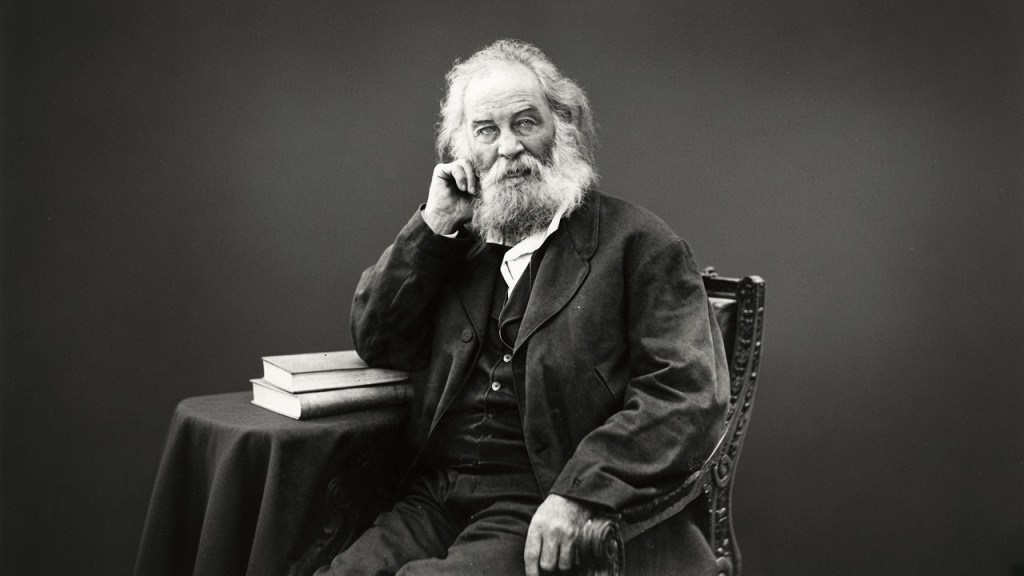
Image a: Walt Whitman – Mathew Brady – Walt Whitman Archive
Walt Whitman’s “Patroling Barnegat”
Walt Whitman’s American-Innovative sonnet demonstrates the power of the verb form known as the present participle, as his speaker dramatizes the activity of a severe storm at sea.
Introduction and Text of “Patroling Barnegat”
Walt Whitman’s “Patroling Barnegat” is an American-Innovative sonnet, a form which makes various transformations based upon the received sonnets from the past, particularly the Shakespearean (Elizabethan or English and Petrarchan (Italian) forms.
Unlike the English and Italian sonnet forms, the American-Innovative sonnet almost always features a much looser form. While the English sonnet is sectioned into three quatrains and a couplet and the Italian is sectioned into octave and sestet, the American-Innovative sonnets are often subdivided into “movements,” when it appears in its purest form.
The American-Innovative may, indeed, take the traditional form and section into quatrains and octaves, but as it does so, those stanzas are usually vastly altered from the traditional forms. Of course, the American-Innovative form usually dispenses with rime and meter, but again if it employs those devices, it does so in new and different ways.
These sonnet movements depend solely on the sonnet’s total environment. While some American-Innovative sonnets may move in ways similar to the English and Italian, they never feature the entire body of the early sonnet forms.
Walt Whitman’s American-Innovative sonnet moves on present participles: “running,” “muttering,” “pealing,” etc. The speaker is observing a wildly active situation, and in order to convey the activity, he keeps his descriptions moving through a piling on of the present participle verb forms.
Patroling Barnegat
Wild, wild the storm, and the sea high running, Steady the roar of the gale, with incessant undertone muttering, Shouts of demoniac laughter fitfully piercing and pealing, Waves, air, midnight, their savagest trinity lashing, Out in the shadows there milk-white combs careering, On beachy slush and sand spirts of snow fierce slanting, Where through the murk the easterly death-wind breasting, Through cutting swirl and spray watchful and firm advancing, (That in the distance! is that a wreck? is the red signal flaring?)
Slush and sand of the beach tireless till daylight wending, Steadily, slowly, through hoarse roar never remitting, Along the midnight edge by those milk-white combs careering, A group of dim, weird forms, struggling, the night confronting, That savage trinity warily watching.
Commentary on “Patroling Barnegat”
This American-Innovative sonnet “Patroling Barnegat” demonstrates the power of the verb form known as the present participle. The speaker is dramatizing the turbulence of a severe storm on the ocean.
First Movement: Setting the Scene
Wild, wild the storm, and the sea high running, Steady the roar of the gale, with incessant undertone muttering, Shouts of demoniac laughter fitfully piercing and pealing, Waves, air, midnight, their savagest trinity lashing,
The first movement of Walt Whitman’s “Patroling Barnegat” includes the poem’s introductory element of depicting the subject by creating the image of the sea wildly churning its wave into a “wild” storm, as the ocean waters are “running” high. The speaker is dramatizing the event of patroling the stormy waters of Barnegat Bay, off the coast of New Jersey.
The speaker emphasizes the severity of the storm by repeating the word “wild.” He shows the sea being whipped up in a frenzy which causes a “roar of the gale,” while a background noise creates an “incessant undertone” that seems to be “muttering.”
The noises bedevil the speaker; thus he calls them “shouts of demoniac laughter.” These sounds seem to pierce to speaker’s ears. He then invokes a “trinity” of “waves, air, midnight,” calling them the “savagest” that lash the sea vessel and the men who are manning it.
Second Movement: Drama of the Waves
Out in the shadows there milk-white combs careering, On beachy slush and sand spirts of snow fierce slanting, Where through the murk the easterly death-wind breasting, Through cutting swirl and spray watchful and firm advancing,
The second movement includes the drama of the waves as they appear “out of the shadows”; he calls them “milk-white combs” as they come “careering.” He then observes that over the “beachy slush” there are “sand spirts of snow” that come in “slanting” as they move inland.
The storm creates a murkiness through which “the easterly death-wind” comes “breasting.” As the patrol-boat plunges through the storm and snow-filled air, it seems to be “cutting” its way through as the men remain vigilant.
Third Movement: Two Questions
(That in the distance! is that a wreck? is the red signal flaring?)
The third movement, which consists of a single parenthetical line, dissects the sonnet to pose two questions regarding the sighting of a possible disaster. The speaker excitedly points to something he thinks my might be seeing in the distance. He seems to be asking someone if he is actually seeing something. His question includes the possibility that a wreck may have occurred.
And if there is something there, he then wonders if it may, in fact, be a wreck. Thus, he queries if there may be a “red signal” being sent out. The very purpose of this patrol in this storm is to search for people who might be in trouble on the sea as it whips up possible disasters.
The parenthetical questions are never answered. It seems to appear as a simple incidental thought, as the speaker continues to concentrate upon describing the storm and how it affects the water and the beach. The sounds of the water and winds become important for his description.
Fourth Movement: A Drama of Tension
Slush and sand of the beach tireless till daylight wending, Steadily, slowly, through hoarse roar never remitting, Along the midnight edge by those milk-white combs careering, A group of dim, weird forms, struggling, the night confronting, That savage trinity warily watching.
The final movement consists of the final five lines that dramatize the tension between the beach of “slush and sand” and that savage trinity of “waves, air, and midnight.” The patrol has lasted all night and finally at the “midnight edge” still “those milk-white combs” continue “careering.”
The speaker concludes by invoking the image of “a group of dim, weird forms” that persists in flailing about in the night as the “savage trinity” continues to watch.
Your Latin professor, who is seven months pregnant, Was extremely flushed and you felt obligated To walk her to her car.
You are still very much interested in my story— You talked to someone the other day For twenty minutes about it.
You do hope this isn’t the direction your life is taking, So formal, arranging times.
You will be free all day Next Wednesday not having to work And your afternoon class being cancelled.
But if I will suggest a time next week You are sure you will be able to drop by, you Probably can’t stay long but Wednesday right after Latin class looks the best to you right now so If that would work for me, let you know.
You are sorry that your life is not convenient For me, it is not too convenient for you either: Life is not easy in the hands of an irrational god.
Image: Emily Dickinson – Amherst College – Daguerrotype of the poet at age 17, circa 1847 – likely the only authentic, extant likeness of the poet
Emily Dickinson’s “‘Arcturus’ is his other name”
Emily Dickinson’s “‘Arcturus’ is his other name” reveals the speaker’s playful resistance to scientific classification and her determination to preserve the mystery, beauty, and spiritual significance of the world she experiences.
Introduction and Text of “‘Arcturus’ is his other name”
In “‘Arcturus’ is his other name,” the speaker objects to the intrusion of scientific terminology into her personal experience of nature. Stars, flowers, butterflies, Heaven, and the Kingdom of Heaven become threatened by labels, measurements, classifications, and maps.
Yet beneath her humor lies a serious spiritual concern. The speaker wonders whether scientific knowledge can ever replace direct experience. Her playful complaints finally become a defense of wonder, imagination, spiritual intuition, and her hope that Heaven remains a familiar place.
“Arcturus” is his other name
“Arcturus” is his other name – I’d rather call him “Star.” It’s very mean of Science To go and interfere!
I slew a worm the other day – A “Savant” passing by Murmured “Resurgam” – “Centipede”! “Oh Lord – how frail are we”!
I pull a flower from the woods – A monster with a glass Computes the stamens in a breath – And has her in a “class”!
Whereas I took the Butterfly Aforetime in my hat – He sits erect in “Cabinets” – The Clover bells forgot.
What once was “Heaven” Is “Zenith” now – Where I proposed to go When Time’s brief masquerade was done Is mapped and charted too.
What if the poles should frisk about And stand upon their heads! I hope I’m ready for “the worst” – Whatever prank betides!
Perhaps the “Kingdom of Heaven’s” changed – I hope the “Children” there Won’t be “new fashioned” when I come – And laugh at me – and stare –
I hope the Father in the skies Will lift his little girl – Old fashioned – naught – everything – Over the stile of “Pearl.”
Commentary on “‘Arcturus’ is his other name”
The speaker playfully challenges the authority of scientific terminology while defending a more intimate way of experiencing creation. Her humor gradually reveals a deeper concern: whether classification can cause human beings to lose their sense of wonder.
First Stanza: “‘Arcturus’ is his other name”
“Arcturus” is his other name – I’d rather call him “Star.” It’s very mean of Science To go and interfere!
The speaker begins with a seemingly simple complaint. She knows that the star has a scientific name, “Arcturus,” but she prefers the uncomplicated word “Star.” The capitalized “Star” preserves something that the technical name seems to remove: mystery.
Her complaint that science is “mean” gives the opening a delightful touch of humor. Science has apparently committed the offense of taking something beautiful and familiar and making it technical.
The speaker does not necessarily reject knowledge itself. Instead, she objects when knowledge interferes with personal experience. Her “Star” remains something capable of inspiring wonder precisely because she does not need to reduce it to a definition.
The word “Star” also seems more intimate than “Arcturus.” The speaker wants to retain a personal relationship with the heavenly object rather than allowing a scientific designation to become the whole of its meaning.
The distinction becomes important throughout the poem. Scientific language identifies, measures, categorizes, and organizes. The speaker wants to experience. Her preference for “Star” therefore becomes a defense of mystery.
Second Stanza: “I slew a worm the other day”
I slew a worm the other day – A “Savant” passing by Murmured “Resurgam” – “Centipede”! “Oh Lord – how frail are we”!
The speaker next turns from the heavens to a small creature on earth. She has killed a worm, and a passing “Savant” immediately converts the ordinary event into an opportunity for learned observation.
The strange word “Resurgam,” meaning “I shall rise again,” adds another layer of humor. The speaker seems amused by the learned man’s reaction because his elaborate terminology contrasts so sharply with her ordinary experience. She sees a worm; he sees an object requiring identification. The final cry, “Oh Lord – how frail are we”! introduces mortality into the scene.
The worm is tiny, yet its death causes the observer to reflect upon human frailty. The speaker therefore moves effortlessly from the physical world toward spiritual questions. The little creature becomes a reminder that life is temporary.
The speaker’s humor does not prevent seriousness. Her world is filled with death, but death also points beyond itself. The physical creature becomes an occasion for contemplating the larger mystery of existence.
In my earlier essays on Dickinsonian poems, I have discussed the speaker’s recurring interest in the relationship between earthly existence and a transcendent spiritual reality. That concern appears again here as ordinary nature opens into thoughts about mortality.
Third Stanza: “I pull a flower from the woods”
I pull a flower from the woods – A monster with a glass Computes the stamens in a breath – And has her in a “class”!
The speaker now presents a flower as another casualty of scientific classification. She simply “pull[s] a flower from the woods,” apparently enjoying its natural beauty. Suddenly, a “monster with a glass” appears.
The description is comic because the scientist has become almost frightening in the speaker’s imagination. The “glass” is presumably a scientific instrument, but the speaker transforms the observer into a “monster.”
The scientist’s instrument reduces the flower to measurable parts. The “stamens” can be counted and classified, but the speaker is interested in the flower as a living, beautiful presence.
Her use of the feminine pronoun “her” makes the flower seem almost like a little personality rather than an anonymous specimen. The individual flower possesses a presence that scientific classification does not adequately express. The phrase “has her in a ‘class’” is particularly important.
Classification gives the scientist information, but it also removes some of the flower’s individuality. Once assigned to a class, the particular flower becomes representative of a category. The speaker’s objection therefore concerns more than terminology. She is defending the individual against abstraction.
Paramahansa Yogananda offers an illuminating parallel when he describes spiritual investigation as something that should lead beyond discussion toward direct experience. He writes that spiritual seekers need “the satisfaction of knowing Truth by direct experience.”
Fourth Stanza: “Whereas I took the Butterfly”
Whereas I took the Butterfly Aforetime in my hat – He sits erect in “Cabinets” – The Clover bells forgot.
The butterfly provides an even stronger contrast between living experience and scientific preservation. The speaker remembers taking a butterfly in her hat, an intimate and almost childlike act.
The scientist, however, has placed the butterfly in a cabinet, where it sits rigidly displayed. The phrase “He sits erect” makes the preserved butterfly sound almost like a person forced to maintain proper posture.
The humor masks a sadness. The living creature that once moved among flowers has become a specimen. The butterfly has lost the freedom and movement that gave it its natural identity. The final phrase, “The Clover bells forgot,” is especially poignant. The butterfly no longer participates in the living world where it once moved among clover flowers.
The speaker therefore suggests that observation can become destructive when it separates a living thing from the world that gives it meaning. The scientist may possess knowledge about the butterfly, but the speaker remembers something different: the butterfly alive.
Paramahansa Yogananda similarly distinguishes between intellectual discussion and inward realization. He explains that meditation provides a means of experiencing spiritual truth directly rather than accepting it merely as “blind belief or dogma.”
The connection is important because the speaker also values experience over abstraction. Her butterfly is not merely something that can be preserved, named, and displayed. It is something she has encountered personally.
Fifth Stanza: “What once was ‘Heaven’”
What once was “Heaven” Is “Zenith” now – Where I proposed to go When Time’s brief masquerade was done Is mapped and charted too.
The speaker now carries her complaint into the spiritual realm. Earlier, “Science” interfered with a star, a worm, a flower, and a butterfly. Now it seems to have invaded Heaven itself.
The word “Heaven” has been replaced by “Zenith,” a technical astronomical term. This change is especially significant because Heaven is not merely a location in the physical universe. For the speaker, Heaven is the destination of the soul after “Time’s brief masquerade” is finished. The phrase makes earthly life seem temporary, almost theatrical.
But even this destination has apparently been “mapped and charted.” The speaker’s comic complaint therefore becomes more profound. If science can map the heavens, what remains mysterious about Heaven? The speaker does not appear to be rejecting Heaven. Quite the opposite is true. She cares deeply about preserving its mystery.
Her anxiety arises because something sacred has been transformed into something apparently measurable. The distinction between Heaven and “Zenith” therefore becomes a distinction between spiritual meaning and physical description.
In my earlier essays on Dickinsonian poems, I have discussed the speaker’s continuing interest in the relationship between earthly existence and a transcendent spiritual reality. Here again, the speaker refuses to confine existence to what can be measured by physical observation.
Sixth Stanza: “What if the poles should frisk about”
What if the poles should frisk about And stand upon their heads! I hope I’m ready for “the worst” – Whatever prank betides!
The speaker now turns the tables on scientific certainty. If scientists believe they understand the structure of the universe, what would happen if the poles suddenly “frisk about” and “stand upon their heads”?
Her imaginary catastrophe is deliberately absurd. Yet the absurdity serves a purpose. The speaker recognizes that the universe may be stranger than human beings imagine.
Her “worst” is not simply physical disaster; it is the possibility that reality may refuse to behave according to human expectations. The word “prank” makes cosmic disorder sound almost mischievous.
The universe itself becomes capable of surprising humanity. Instead of pretending that she understands everything, the speaker admits that she must remain prepared for whatever happens.
Her attitude contains a kind of spiritual humility. She is willing to acknowledge that human beings possess limited knowledge and that reality may extend far beyond what the senses reveal.
Paramahansa Yogananda likewise presents spiritual investigation as a disciplined search for realities that extend beyond ordinary sensory consciousness. He describes meditation as a systematic means through which consciousness can be turned inward toward a deeper spiritual reality. The speaker’s humor therefore conceals a serious virtue: she is willing to admit that the universe may be larger and stranger than her own understanding.
Seventh Stanza: “Perhaps the ‘Kingdom of Heaven’s’ changed”
Perhaps the “Kingdom of Heaven’s” changed – I hope the “Children” there Won’t be “new fashioned” when I come – And laugh at me – and stare –
The speaker’s anxiety becomes more personal here. She imagines that even Heaven may have become “new fashioned.” The scientific world has already changed the names and meanings of earthly things; perhaps Heaven itself has changed while she has been away.
The imagined inhabitants of Heaven are “Children,” and the speaker worries that they may regard her as old-fashioned. This image is amusing, but it also reveals her vulnerability.
Her concern is not really about fashion: ”New fashioned” represents a world that has changed so radically that her old understanding no longer seems acceptable. The speaker fears arriving in eternity only to discover that eternity has changed. The irony is delightful because Heaven is traditionally imagined as the place beyond time and change.
Dickinson’s speaker makes the infinite universe feel intimate enough to contain family-like embarrassment, affection, laughter, and acceptance. Heaven becomes almost like a household in which the speaker hopes she will still recognize everyone.
The capitalized “Children” may also suggest the innocent inhabitants of Heaven. The speaker hopes that spiritual innocence will not have been replaced by some new, unfamiliar order. Her concern ultimately reveals that what she seeks is continuity. She wants the spiritual world to remain recognizably connected to the one she has always imagined.
Eighth Stanza: “I hope the Father in the skies”
I hope the Father in the skies Will lift his little girl – Old fashioned – naught – everything – Over the stile of “Pearl.”
The final stanza transforms the speaker from a playful critic of “Science” into a vulnerable child. She imagines God as the “Father in the skies” who will lift her over the “stile of ‘Pearl.’”
The elaborate theological argument finally becomes a simple request for loving acceptance. The speaker calls herself “his little girl,” immediately establishing an intimate relationship between herself and the Divine Father.
She does not claim spiritual perfection. Instead, she describes herself as “Old fashioned – naught – everything.” The contradictory phrase suggests that she is simultaneously innocent, troublesome, imperfect, and completely herself. The “stile of ‘Pearl’” evokes the familiar Christian image of Heaven’s entrance—the pearly gates— while “stile” keeps the scene wonderfully rural and Dickinsonian.
Heaven is not imagined as an abstract theological doctrine. It becomes a little gate over which a loving Father helps his child. The image brings the enormous mysteries of eternity into an intimate, almost domestic scene.
Paramahansa Yogananda emphasizes the personal element of the search for God. Self-Realization Fellowship explains that the seeker may approach the Divine as “the Heavenly Father,” “Divine Mother,” “Friend,” or “Beloved.”
The speaker’s Father is similarly personal, intimate, and loving. She does not end by asking for an explanation of Heaven. She asks to be received by the Father whom she already trusts.
The poem therefore ends not with scientific certainty but with trust. After objecting to names, measurements, classifications, maps, and charts, the speaker returns to the simplest relationship of all: a little girl trusting her Father to carry her home.
Dickinson Riddles
“‘Arcturus’ is his other name” is one of Dickinson’s delightful riddles because the speaker never simply announces that science is wrong. Instead, she dramatizes the difference between knowing something intellectually and experiencing it intimately.
Arcturus remains a star whether it is called Arcturus or simply “Star.” The flower remains beautiful whether its stamens are classified. The butterfly remains a living creature regardless of its scientific category.
The problem arises when the label begins to replace the experience. The speaker therefore does not have to reject scientific knowledge in order to defend her own way of seeing. Her objections become increasingly spiritual. Science first names the star, then classifies the worm and flower, preserves the butterfly, maps the heavens, and finally seems capable of changing Heaven itself.
Yet the speaker does not end in despair. She ends in relationship. Her final hope is that the “Father” will recognize his “little girl” and carry her over the “stile of ‘Pearl.” The spiritual world remains meaningful because it is personal. The speaker does not need to understand every mystery before entering eternity. She needs only to trust that the Father will recognize her.
Paramahansa Yogananda’s teaching offers an illuminating parallel. He emphasizes direct realization rather than merely intellectual discussion, writing that the seeker ultimately comes to know spiritual truth through direct experience.
The speaker’s preference for “Star” over “Arcturus” similarly protects an experience that remains larger than its scientific designation. Her star is not merely an astronomical object; it is part of a universe capable of inspiring wonder.
In my earlier essays on Dickinsonian poems, I have discussed the speaker’s habit of privileging inner knowledge over outer awareness. That habit is especially evident here. The speaker does not require scientific approval before she can call Arcturus “Star,” cherish a flower, remember a butterfly, or trust in Heaven.
Her contemplative musing finally produces a charming spiritual confidence. The speaker can laugh at scientific interference, acknowledge her own uncertainty, imagine cosmic disorder, and still believe that the Father in the skies will recognize her.
The speaker’s confidence does not depend upon possessing complete knowledge. Indeed, she openly acknowledges uncertainty. What matters is that she retains her capacity for wonder and maintains faith in a reality that cannot be exhausted by scientific terminology.
The poem’s deepest opposition is consequently not simply between science and religion. It is between classification and experience, between an external description and an inward comprehension of reality. The speaker insists upon preserving room for wonder.
Paramahansa Yogananda likewise describes the spiritual path as a disciplined search for direct realization rather than a passive acceptance of religious ideas. Self-Realization Fellowship identifies this approach as a “scientific” search for direct personal experience of God.
This connection helps illuminate the speaker’s position. She objects when science claims too much authority over experiences that possess emotional and spiritual dimensions. At the same time, she remains curious about the universe and willing to admit that she does not know everything.
The final image is therefore both humorous and deeply tender. The speaker does not need to understand every mystery before entering eternity. She simply hopes that the Father will welcome and carry his “little girl” through the Heavenly gate.
The “stile of ‘Pearl’” becomes an appropriate final image because it is simultaneously ordinary and transcendent. A stile is something one climbs over in the countryside; Pearl evokes Heaven’s gate. The speaker joins the earthly and spiritual worlds in one affectionate image.
The poem has moved from a distant star to a worm, from a flower to a butterfly, from Heaven to the poles, from the Kingdom of Heaven to the Father. The movement becomes increasingly personal until the speaker finally stands before God as a child.
Science can name Arcturus, count stamens, classify butterflies, and map the heavens. But the speaker reserves for herself something that cannot be placed in a cabinet or charted on a map: her personal experience of wonder.
Her final hope is therefore not that she will arrive in Heaven as an expert who understands everything. She hopes instead to arrive as herself—”Old fashioned – naught – everything”—and to be recognized and lovingly carried across the threshold.
That ending captures the poem’s deepest charm. The speaker’s resistance to scientific interference is ultimately a defense of the mystery that makes existence meaningful. She wants the universe to remain large enough for beauty, uncertainty, faith, imagination, and love.
And so the speaker’s playful question about whether “Arcturus” should be called “Star” becomes a much larger question about the human desire to know. Knowledge can name the world, but the heart still wants to experience it. The speaker chooses “Star.” She chooses the flower before the classification, the butterfly before the cabinet, Heaven before the chart, and the Father before the theological explanation.
Her final confidence rests not upon possessing every answer but upon believing that beyond the world’s classifications there remains a spiritual reality that recognizes her. The little girl who began by objecting to science ends by trusting the Father in the skies.
The poem thus preserves the very mystery that the speaker fears science might take away. It leaves Arcturus shining, the flower alive in memory, the butterfly ringing with the forgotten “Clover bells,” Heaven still mysterious, and the Father ready to lift his little girl over the “stile of Pearl.”
This Dickinson poem actually dramatizes an idea regarding the effects of science that is similar to Walt Whitman’s much anthologized “When I Heard the Learn’d Astronomer,” wherein the speaker finds listening to the science of the heavens sickens him, so he moves outside and looks up at the stars from time to time—an act which he finds much more satisfying.
Walt Whitman’s “When I Heard the Learn’d Astronomer”
Walt Whitman’s sprawling eight-line poem showcases the poet’s freewheeling style while dramatizing the wildly romantic world view portrayed in almost all of his poems.
Introduction and Text “When I Heard the Learn’d Astronomer”
Whitman’s “When I Heard the Learn’d Astronomer” provides a study in contrasts between science and poetry. The speaker makes his preference known that he favors looking at the stars over studying them. The speaker is a transcendentalist-romantic individual who is more interested in the life of the senses than the life of the mind.
Interestingly, however, this speaker demonstrates that, in certain instances, the senses can lead to a more spiritual experience than the mind. The speaker prefers to indulge his fancy rather than pay attention to the measured distances between heavenly bodies.
When I Heard the Learn’d Astronomer
When I heard the learn’d astronomer, When the proofs, the figures, were ranged in columns before me, When I was shown the charts and diagrams, to add, divide, and measure them, When I sitting heard the astronomer where he lectured with much applause in the lecture-room, How soon unaccountable I became tired and sick, Till rising and gliding out I wander’d off by myself, In the mystical moist night-air, and from time to time, Look’d up in perfect silence at the stars.
Reading:
Commentary on ““When I Heard the Learn’d Astronomer”
Walt Whitman’s sprawling eight-line poem showcases the poet’s freewheeling style while dramatizing the wildly romantic world view portrayed in almost all of his poems.
First Movement: When vs After
When I heard the learn’d astronomer, When the proofs, the figures, were ranged in columns before me, When I was shown the charts and diagrams, to add, divide, and measure them, When I sitting heard the astronomer where he lectured with much applause in the lecture-room
The first movement of Whitman’s influential poem consists of four adverbial clauses beginning with “when”:
1. when he listened to the lecture, 2. when the numbers were presented, 3. when “the charts and the diagrams” were shown, 4. when he heard the audience’s cheer the “learn’d astronomer.”
A fascinating riddle poses the question: “When the man jumped off the building, where was he?”
Possible answers: —Until he hit the ground, he was in the air— What’s wrong with that answer? That was “after” he jumped.
Then the person riddled might respond: —still standing on the top of the building— Wrong because, that was “before” he jumped.
This riddle is instructive for language use especially use in poetry. The adverb “when” is a flabby word, causing the ambiguity of unclarity as associated with an action. Thus if possible, one needs to consider whether the action occurred “before” or “after” the first event.
Whitman was such an astute observer of both events and language, but this poem could use one last revision changing the “when” clauses to “after” clauses because that is the accurate time frames for each of the actions that he mentions.
The reader will note that is was, actually, “after” all the following that he became “tired and sick” and determined to get up and leave:
1. after he had heard the scientist 2. after he had seen the stats and numbers 3. after he had been presented the charts 4. after he had heard the other audience members applauding the astronomer.
Second Movement: After Growing Sick and Tired
How soon unaccountable I became tired and sick, Till rising and gliding out I wander’d off by myself, In the mystical moist night-air, and from time to time, Look’d up in perfect silence at the stars.
After the speaker had listened to a portion of the lecture, he gets up and leaves the lecture hall, goes out into the refreshing night air and looks up at the stars. The event is simple, but the speaker’s dramatic portrayal of his actions enhances the act and makes it so much more interesting and meaningful than the mere event.
For example, the use of the word “unaccountable” contrasts with all the counting that was going on by the lecturer. The speaker is simply remarking that he grew “tired and sick” while listening, but he does not know why.
The speaker seems to have no reason for this reaction. He is cleverly leaving that reasoning up the reader to discern, after he paints his portrait of natural beauty in the final three lines, in which reports that he rose from his seat, moved out into the night alone, and then off and on gazed upward to the heavens where he was treated to the “perfect silence at the stars.”
Those final lines contrast the stuffy lecture hall with the lushness of the great outdoors; they contrast the enjoyment of being alone as opposed to being surrounded by people in the stuffy lecture hall. The night air is “mystical”—the speaker is carried to a transcendental height by the simple “moist night-air.”
And the best of all the observant speaker saves for the last; in contrast to the steady pace of the lecture, he leisurely “from time to time”—no hurry, no schedule, no following someone else’s line of thought—gazes up into the heavens and observes the brilliance of the stars themselves, instead of merely hearing about them through charts, diagrams, and numbers.
Walt Whitman remains one of the most important poets in American history. He has influenced every generation of poets since he first began to publish. He is rightly credited for leading American poetry into modernity. His long-lined, sprawling style is always easily recognized.
Early Life, Education, Early Career
Walter Whitman, Jr., was born on May 31, 1819, in West Hills, Long Island, New York, to Walter Whitman, Sr., and Louisa Van Velsor Whitman, a lower middle class family [1]. Walt, Jr’s early life greatly influenced his idiosyncratic world-view and artistic outlook. He became known as “Bard of Democracy” [2] because of his liberating employment of his cosmic, singular poetic voice.
His working-class parents worked hard to meet expenses, and the family changed residences often during Walt’s early years, in order to find better employment. These frequent new locations exposed the future poet to various environments, giving him an expansive outlook on life, as he experienced many different people from various backgrounds.
Walt was the second of nine Whitman children, and similar to the TV family “The Waltons,” the Whitman family often encountered scarce resources and many hardships as the parents labored to meet the needs of a family of eleven.
The poet’s father worked as a carpenter and as a farmer, but his laboring efforts never led to prosperity. This family dynamic led Walt to entering the workforce at an early age in order to help with family stay afloat financially.
The ancestors of the Whitman family had arrived in America as early as the 17th century, which rooted the family’s affection for their country very deeply, as the future poet would so often express in his works.
The poet remained close to his mother for his whole life. Louisa was a very affectionate and compassionate human being, and her positive attitude toward life proved to be a great influence on the life of her son. The poet could always count on his mother for unconditional love and support throughout his life.
Walt Whitman’s experience with formal schooling was virtually nil: he abandoned formal education after he turned eleven years old [3]. After a short stint in the public school system in Brooklyn, he made a swift departure because he family needed him to work and earn money to assist with family finances.
Despite leaving the formal schooling of the public eduction system, Walt continued to read, study, think deeply for the rest of his life. He pursued knowledge as assiduously as a bird seeks its daily nutritional intake. He maintained a life-long, insatiable thirst for knowledge.
After abandoning public education, Walt took a job as an office boy in Brooklyn [4]. After serving as an office boy, he became a printer’s apprentice, eagerly learning the craft of print- and typesetting. Such on-the-job experience brought Walt in contact with literary composition through manipulation of words, making them ready to publish.
Whitman later engaged in school teaching in a number of rural schools on Long Island. The sensationalism of a rumor has it that Whitman was tarred and feathered and chased out of the town of Southold for committing sodomy [5] on a student.
The likelihood of that particular rumor being true is virtually nil, because it has not been clearly established that Whitman ever taught in Southold. Whitman simply abandoned teaching because he found the work stultifying.
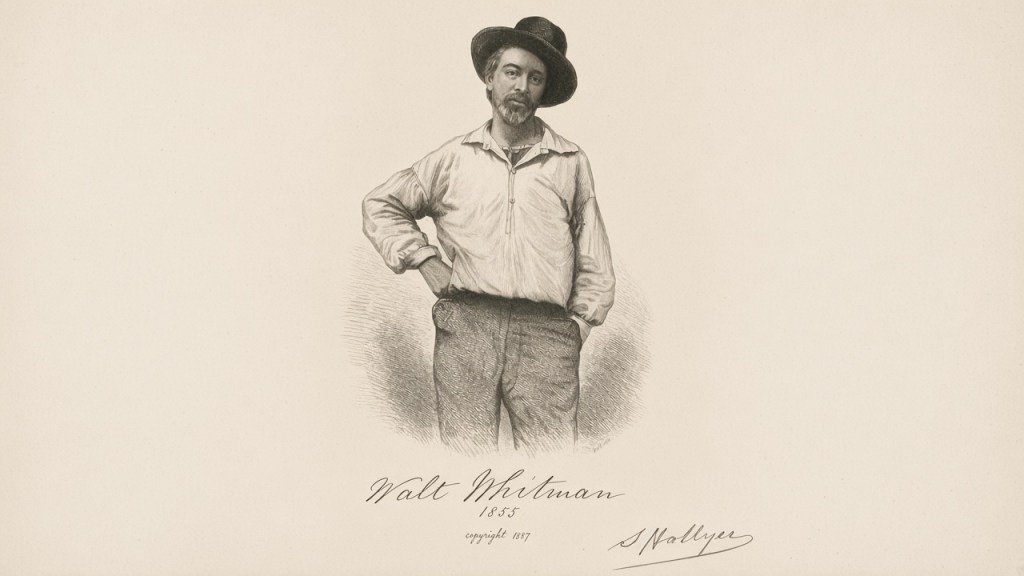
Image b: Walt Whitman portrait engraved by Samuel Hollyer, frontispiece to first edition of Leaves of Grass, 1855
Work in the Field of Journalism
Whitman’s actual career in journalism began in the late 1830s [6]. He founded and edited the Long Islander newspaper in Huntington. His early experience in the field of journalism allowed him to develop his writing skills and engage in public discourse.
At age 23, Whitman became the chief editor of the New York Aurora. By September of 1845, four months after turning 26 years of age, he had newspaper experience from working for at least a dozen newspapers.
He flitted from one newspaper to the next, often holding editorial duties. Whitman worked for several different papers in Brooklyn and New York City, including the Daily Aurora and the Brooklyn Eagle. His time as an editor sharpened his skills in crafting clear, concise prose. He also learned to handle deadlines.
Whitman’s experience in the field of journalism afforded him a stage upon which to elucidate his opinions and insight into political as well as social. issues. He became a staunch advocate for democratic principles and often broached topics such as abolition and temperance. His many editorials revealed his growing social awareness and reformist consciousness.
Dedication to Poetry
The publication of Leaves of Grass in 1855 [7], heralded a new era in American literature. Whitman self-published the first edition, which contained only twelve untitled poems. This innovative work defied conventional ideas of poetry, as it brazenly put on display free verse and non-traditional subject matter.
Famously, Whitman continued to revise and expand Leaves of Grass throughout his entire life, producing multiple editions. Each new revision revealed Whitman’s continuing artistic growth as well as the changing social worldviews and mores. The manuscript through its ever widening scope seemed to reflect the very growth of the nation itself.
His poetic style played out in a sweeping scope and direct address, all in celebration of the individual and the everyday person. Whitman wrapped his mind and heart around the entire spectrum of human experience—from the ordinary to the extraordinary, from the mundane to the transcendent. Within his poetry, Whitman strove to include all of America and all of what Americans had to offer the world.
Civil War and Humanitarian Work
The American Civil War (1861—1865) had a profound impact on the poet [8]. He diverted his intensity from writing to humanitarian efforts. He went to Washington, D.C., in 1862 after his brother George was wounded in battle. This experience showed the poet first hand the immense suffering caused by the war.
Whitman then became devoted to giving care to wounded soldiers in the military hospitals of Washington. He spent many hours calming and comforting the ill and dying.
Whitman helped the recovering soldiers write letters, and he even dressed their wounds, which was greatly appreciated by the overworked doctors and nurses. These selfless compassionate duties became the cardinal core of Whitman’s identity as a human being, as well as an expansive poet.
Whitman’s war-years experiences greatly affected his later poetry, particularly in works such as Drum-Taps and Memories of President Lincoln. He bore witness to the grim realities of conflict but also to the resilience of the human spirit. The war profoundly contributed to his understanding of the American identity.
Following the war, Whitman continued working in government offices, even as his health began to suffer. In 1873, he was afflicted by a paralytic stroke, severely limiting his ability to walk. Despite his physical health issues, he continued his writing and revising Leaves of Grass.
Whitman relocated to Camden, New Jersey and spent his final years in that city [9]. In Camden, he received visitors from around the world [10] who sought out the beloved poet. His home became a pilgrimage site for admirers of his innovative and influential works that focused on democratic ideals.
Walt Whitman died on March 26, 1892 [11], leaving an exceptional literary legacy. His Leaves of Grass remains a monumental achievement, influencing the course of American poetry for generations. The poet remains a towering, renowned personality in world of literature and literary studies, celebrated for his creativity, individualism, and originality.
Legacy
Whitman’s influence [12] has extended far beyond the field of poetry; it has continued to attract successive generations of poets, essayist, journalists, and thinkers. Whitman’s celebration of democratic principles, individualism, as well as the interconnectedness of all things continues to find positive responses from new readers.
The Whitman legacy, similar to that of Ella Wheeler Wilcox, can serve as a mollifying corrective to the obstructive impact that postmodernism has inflicted upon the poetry world. Decade upon decade, Walt Whitman’s poetry and prose, as well as his fascinating life story, continue to offer testimony to the power and influence of a truly unique voice.
Sources
[1] Editors. “Walt Whitman.” Family Search. Accessed September 19, 2026. [2] Curators. “Walt Whitman: Bard of Democracy.” The Morgan Library an Museum. Accessed June 2, 2025. [3] Ed Folsom and Kenneth M. Price. “Self-Education.” Walt Whitman Archive. Accessed June 2, 2025. [4] Editors. “Walt Whitman.” Biography. Updated: September 14, 2022. [5] Editors. “Schoolteaching Years.” Walt Whitman Archive. Accessed September 19, 2026. [6] Philip Eil. “On Walt Whitman, Unsung Newspaperman.” Literary Hub. May 29, 2019. [7] Editors. “Leaves of Grass, 1855-1861.” Library of Congress. Accessed September 19, 2026. [8] Editors. “Walt Whitman and the Civil War.” PBS. Accessed September 19, 2026. [9] Curators. “Walt Whitman.” The Historical Marker Database. Accessed September 19, 2026. [10] Curators. “Welcome.” The Walt Whitman House. Accessed September 19, 2026. [11] Rhys Griffiths. “Death of Walt Whitman.” History Today. March 3, 2017. [12] Curators. “The Powerful Influence of Walt Whitman.” Crystal Bridges Museum of American Art. April 27, 2017.
Recommended Print Sources for Walt Whitman
Gay Wilson Allen. The Solitary Singer: A Critical Biography of Walt Whitman. New York: The Macmillan Company. 1955.
James E. Miller, Jr., editor. Complete Poetry and Selected Prose by Walt Whitman. Boston: Houghton Mifflin Company. Riverside Editions. 1959. Walt Whitman. Leaves of Grass: The Deathbed Edition. New York: Simon & Schuster. 1992.
Image: Emily Dickinson – Amherst College – Daguerrotype of the poet at age 17, circa 1847 – likely the only authentic, extant likeness of the poet
Emily Dickinson’s “Low at my problem bending”
The speaker muses over a personal problem only to encounter a larger, calmer one that displaces all earthly calculation.
Introduction and Text of “Low at my problem bending”
In Emily Dickinson’s “Low at my problem bending,” the speaker bends intently over a private concern when a greater problem arrives. This new problem proves larger and serener, involving higher sums that dwarf the original figures.
The speaker then sets aside the “busy pencil” and lets the figures slip away. The “baffled fingers” question their own befuddlement in the face of this elevated demand. On the literal level the speaker appears engaged in arithmetic or accounting. Yet the intrusion of a calmer problem signals a shift from worldly sums to matters of the soul.
Low at my problem bending
Low at my problem bending, Another problem comes – Larger than mine – Serener – Involving statelier sums.
I check my busy pencil, My figures file away. Wherefore, my baffled fingers Thy perplexity?
Commentary on “Low at my problem bending”
Emily Dickinson’s “Low at my problem bending” dramatizes the speaker’s sudden elevation from a personal calculation to a higher, calmer demand that silences all earthly tools.
First Stanza: “Low at my problem bending”
Low at my problem bending, Another problem comes – Larger than mine – Serener – Involving statelier sums.
The speaker begins bending low over a private problem. At once another problem arrives, one larger than the original and marked by greater serenity. This new concern involves more important sums. The speaker senses that ordinary arithmetic cannot address the elevated scale now presented.
In my earlier essays on Dickinsonian poems, I have discussed the speaker’s habit of preferring inner information over outer, material level evidence. Here that same habit appears as the speaker recognizes the superior claim of the more placid problem.
Paramahansa Yogananda explains that the vastness is your real Self. The speaker, confronted by the larger problem, begins to sense that same vastness beyond finite sums. The contrast between the low bending posture and the calm elevation of the new problem suggests a movement from earthly worry to meditation on the eternal.
Second Stanza: “I check my busy pencil”
I check my busy pencil, My figures file away. Wherefore, my baffled fingers Thy perplexity?
The speaker immediately checks the “busy pencil.” All the carefully ordered figures are filed away as if dismissed by a higher authority. The confused fingers then address their own confusion. They wonder why their former skill proves useless before the statelier demand. The speaker’s tools of calculation prove inadequate once the larger problem appears.
Ordinary sums give way before the serene scale of the soul’s true concern. Paramahansa Yogananda explains that one must change consciousness from that of a mortal to a divine being. The speaker’s “baffled fingers” enact that very change as earthly figures vanish.
In my earlier essays on Dickinsonian poems, I have discussed the speaker’s reliance on mystical intuition to resolve riddles of existence. That same intuition now silences the pencil and leaves the fingers questioning their former busy work.
The final question hangs in the air, inviting the reader into the same contemplative musing that has lifted the speaker beyond finite problems to the calmer, cooler realm of the Infinite.
The stairs angled up the outside Of the building like those I climbed To the first apartment I lived in, After I got married the first time. He was an anthropology major, His girlfriend archaeology. She wanted him to move in there with her, But it’s easy to see why he Balked; at home he lived all the suburban Comforts: carpet, quiet plumbing, spacious, Fresh rooms his mommy kept tidy, plus his daddy’s Computer to write term papers on. A second story apartment in Old Town sucks: Noisy neighbors, roaches (I saw a big one Race down the ragged arm Of the sofa and zoom Into a crack in the baseboard), Little closet space, no garage; Convenient walking distance to campus Hoists the rent to scandalous. But while his girlfriend spent six weeks digging in Africa, We put it to use a couple of July afternoons. His fresh youth promised a good romp As he bulged a yeasty readiness—but alas! He lacked skill with his master tool, But still his succulent lips and skillful tongue Put a bounce in the balls of my feet As they mounted those stairs two at a time.








 Linda's Literary Home