Linda's Literary Home

Author: Linda Sue Grimes

  • Emily Dickinson’s “By such and such an offering”

    Image: Emily Dickinson - Amherst College - Daguerrotype of the poet at age 17, circa 1847 - likely the only authentic, extant likeness of the poet
    Image: Emily Dickinson – Amherst College – Daguerrotype of the poet at age 17, circa 1847 – likely the only authentic, extant likeness of the poet https://www.amherst.edu/library/archives/holdings/edickinson

    Emily Dickinson’s “By such and such an offering”

    The speaker in Emily Dickinson’s “By such and such an offering” is exploring the nature of duplicity by those who feign elevated status through appropriating experience that they have not in fact endured.

    Introduction and Text of “By such and such an offering”

    The speaker in Emily Dickinson’s four-line verse begins mysteriously but then suggests a remarkable indictment of those who feign martyrdom.  Those who exaggerate their suffering in life but have little to show for it are often those who put on display their complaints.  

    The phony religious who amble about with colorless, sad expressions, those who suffer from physical ailments but exaggerate for attention, those who remain boastful of their contributions to society that anyone paying attention will realize are meagre—these supposed “martyrs” remain so only to their own confused thinking.

    The speaker is calling attention to such bombastic displays.  As the “web of life” is woven, it does remain salient that it “takes all kinds.”  This speaker offers no remedy—just an insightful observation that such ilk exists, and perhaps a warning to watch out for them and not be fooled by insincerity and lack of clarity.

    By such and such an offering

    By such and such an offering
    To Mr. So and So,
    The web of life woven –
    So martyrs albums show!

    Commentary on “By such and such an offering”

    The speaker is offering an observation of a certain segment of the social order whose exaggerated rhetoric attempts to hoist their pettiness to the exalted status of martyrdom.

    First Movement:  The Undeclared

    By such and such an offering
    To Mr. So and So,

    The speaker begins with two prepositional phrases that point to some activity being directed to an unknown entity: specifically something is being given to someone.  The phrases “such and such” and “So and So” indicate that the speaker is not identifying the gift nor is she naming to whom the gift is given.  

    The speaker does, however, qualify the receiver of the gift as a masculine human being, signaled by “Mr.”; thus, the terms of the phrase “So and So” stand for a name and are capitalized.

    The speaker has thus set up a puzzling dynamic by essentially reporting somewhat mysteriously that something was given, or perhaps will be given, to someone (some man).  She allows her audience to remain puzzled by not only what the gift may be, or will be, but also by who will be, or has been, the receiver of that gift.

    At this point, the speaker has simply claimed that what was given was an “offering.”  She does not say that what was given was a “present” or a “gift”; instead she uses the more weighty term “offering,” which differs from other items given through its special status: an offering connotes something given for religious or worship purposes, or some other universally relevant purpose. An ordinary gift is usually something presented to an individual or small group of individuals.

    Thus this gift retains a different status from an ordinary gift, in that it must have some purpose other than the mere giving of a gift for Christmas or birthday or other culturally personalized holiday.  Thus instead of a personal gift, this offering will retain a wider, more inclusive purpose.

    Second Movement:  Completed Mystery

    The web of life woven –
    So martyrs albums show!

    The speaker then completes the thought begun in the first movement, but she still remains quite mysterious because she does not actually offer a complete sentence or statement.  Her musing thus remains fragmented, as if she were merely jotting down a note for later employment in a larger context.

    The speaker then makes the lofty claim about life: life’s “web” has been woven.  While only life’s Creator can be credited with weaving the “web of life,” the speaker again indicates that she will remain mysterious in her remarks by not elaborating her claim but by diverting the direction of her report to individuals who have experienced extreme suffering perhaps even death (“martyrs”), who then display their suffering through a series of blank pages (“albums”) filled with images from their history.

    The speaker has thus suggested her own puzzlement that life can be filled with so many perplexing events.  But she seizes upon the one turn of events that has impressed her mightily in likely a negative or perhaps even a humorous way:  that the sufferers who offer their oblations at the feet materiality and yet portend to suffer as martyrs nevertheless gather their badges and demonstrate them to an unsuspecting world.

    The true martyr to the spiritual cause may be celebrated by others down through the centuries.  Their adherence to truth is to be emulated, but it will be hoped that their being martyred unto death may be avoided.  

    But those who put on display their suffering through flagitiousness or deleterious behavior will be adjudicated duplicitous as they “show” their “albums” instead allowing them to work through the mystery of silent, masterful ascendance.

    Thus the vaunted “offering” is revealed as a profligate collection garnered by the supposed “martyrs” and bestowed on “Mr. So and So,” who has remained merely a nebulous, unsuspecting target of the feigning, exaggerating sufferers. 

    That unknown citizen—representing the conglomerate of the world’s citizens—remains an amorphous being to whom the would-be martyrs may put on display their imperfections and bleared commodities.

  • From the Deepest Well of My Soul

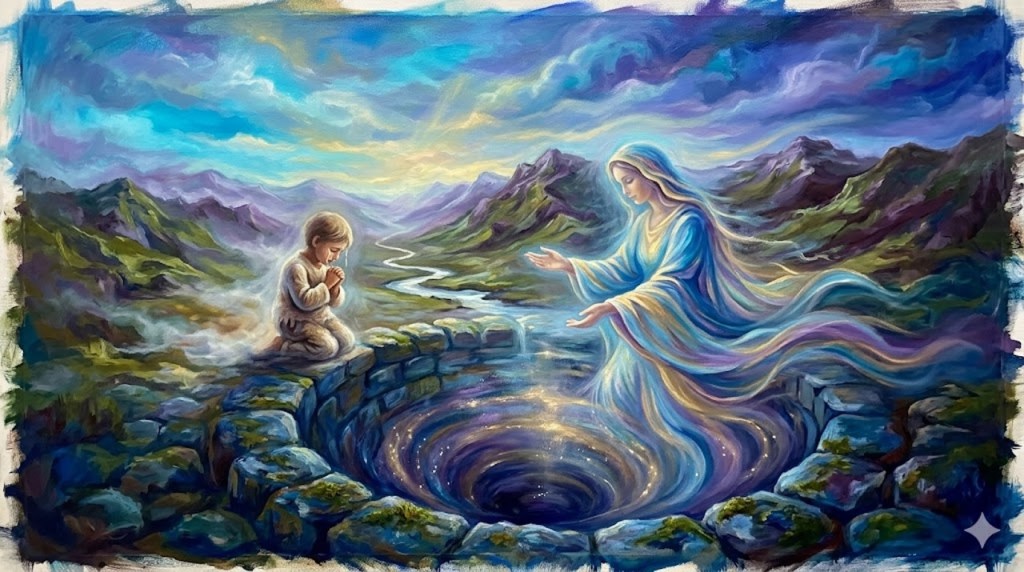
    Image: Created by Gemini, inspired by the poem
    Image: Created by Gemini, inspired by the poem

    From the Deepest Well of My Soul

    —after “I Give You My Soul Call”

    Divine Mother,
    Come to me from the blue vault
    Of the sky.

    Come to me from the mountains.
    Come to Thy child in the valley.

    I am calling, calling Thee,
    Mother, come to me, come to me.

    In the deepest well of my soul,
    Thou art hidden.

    Come out, O Mother, come out!
    I am calling Thee from the deepest well
    Of my soul.

  • Emily Dickinson’s “Before the ice is in the pools”

    Image: Emily Dickinson - Amherst College - Daguerrotype of the poet at age 17, circa 1847 - likely the only authentic, extant likeness of the poet
    Image: Emily Dickinson – Amherst College – Daguerrotype of the poet at age 17, circa 1847 – likely the only authentic, extant likeness of the poet

    Emily Dickinson’s “Before the ice is in the pools”

    Many of Emily Dickinson’s poems suggest that the poet experienced a number of mystical awakenings—events that, no doubt, informed and directed her skill in speaking about ineffable subjects.  This poem is one of her most profound in elucidating her situation after such an experience.

    Introduction and Text of “Before the ice is in the pools”

    This poem, “Before the ice is in the pools,” is one of Emily Dickinson’s most profound as it reveals the speaker’s experience in mystical awareness.  The skill with which the poet has fashioned this time-looping experience unveils the master craftsmanship possessed by this poet.  Her ability to unravel webs of time remains one of her chief strengths.  

    Emily Dickinson likely had the King James Version of the Holy Bible virtually by heart, and in this poem she employs an allusion to touching the hem of a garment that informs the poem as no other image could do.  Her ability to make the ineffable understandable has resulted in one of the most momentous literary accomplishments of all time.

    Before the ice is in the pools

    Before the ice is in the pools –
    Before the skaters go,
    Or any cheek at nightfall
    Is tarnished by the snow –

    Before the fields have finished,
    Before the Christmas tree,
    Wonder upon wonder
    Will arrive to me!

    What we touch the hems of
    On a summer’s day –
    What is only walking
    Just a bridge away –

    That which sings so – speaks so –
    When there’s no one here –
    Will the frock I wept in
    Answer me to wear?

    Commentary on “Before the ice is in the pools”

    With images from the seasons, references to physical activities, and an all important allusion to the King James Version of the Holy Bible, the speaker in this poem accomplishes the amazing feat of revealing the fact that she has undergone a mystical experience that will, in fact, change her life.

    First Stanza:  Before Winter

    Before the ice is in the pools –
    Before the skaters go,
    Or any cheek at nightfall
    Is tarnished by the snow –

    The speaker begins by delineating a period of time that is some time before winter, when pools of ice form in the New England freeze, and when people go skating on those slick tracts of frozen water.  

    She also describes that before-period as a time before nighttime will find snowflakes landing on the faces of the skaters.   Thus the speaker has referenced quite down-to-earth, physical images that any New Englander, nay any citizen residing north of the Mason-Dixon line, would have experienced.

    So before all of those events take place, some momentous event is likely in the offing.  The reader, at this point, will suspect s/he is being led to some occurrence that the speaker has experienced and found amazing. 

    Such suspicions come from even any cursory acquaintance with this particular poet, who fashions her speaker to deliver mysterious, minimally phrased, and very often mystical messages.

    Second Stanza:  Something Wonderful Will Happen

    Before the fields have finished,
    Before the Christmas tree,
    Wonder upon wonder
    Will arrive to me!

    The speaker continues with her insistence that this special event will happen—or has happened—before the winter season.  That targeted period of time remains, apparently while the fields planted in crops will still be flourishing and before “the Christmas tree” has begun to be decorated for that most important winter holiday, featuring the Christmas season.

    Unexpectedly, the speaker then reveals her claim of amazement: “[w]onder upon wonder / Will arrive to me!”  The speaker conflates time that would bamboozle readers, coming from any less skilled craftsman.  

    At first, it seems that she is referring to some event that occurred before winter, but then she seems to be stating that the event has not yet occurred but “will arrive to [her].”  The reader now seems to understand that whatever this momentous event is it has not actually happened yet.  

    Third Stanza:  Touching the Hem of Sacredness

    What we touch the hems of
    On a summer’s day –
    What is only walking
    Just a bridge away –

    The speaker now offers two “what” clauses that set up the situation that caused this momentous event.  She generalizes the situation, though, claiming that what “we” do causes certain things to happen.  

    What we do in summer will affect what we do in the seasons that follow.  The speaker is guiding the reader to visually experience a metaphoric likeness of what has happened in her mind.  

    The allusion to touching the hems echoes touching the hem of the garment of a sacred personage. For example, in the King James Version of the Bible, the line, “And, behold, a woman, which was diseased with an issue of blood twelve years, came behind him, and touched the hem of his garment” (Matthew 9:20) features the act of touching the hem of Christ Jesus’ garment. 

    It is without doubt that Dickinson is alluding to that singular event of hem touching in her line, “what we touch the hems of.”  Just as the woman experienced a mystical healing at the mere touch of Jesus’ garment, the speaker will—or has already—experience(d) such a mystical event by touching the hem of a “summer’s day.”

    By personifying a summer day, the speaker allows the reader to visualize the experience of a mystical visitation.  This particular being who like the mystery and beauty of a summer day, however, is walking or exists over the bridge between the physical and astral worlds.  

    What we visualize on this physical level of being influences what may appear across the heavenly “bridge.”  The place and time that is playing out beyond that bridge cannot be known, except by deep intuition and special visitation by angelic beings who inhabit that astral, mystical region.

    Fourth Stanza:  Remaining Humble

    That which sings so – speaks so –
    When there’s no one here –
    Will the frock I wept in
    Answer me to wear?

    The speaker has now revealed that she has experienced a mystical union with the Divine Reality, but she needs to put an even finer point on her revelation.  Thus she claims that something so beautiful that sings also speaks.

    And this Entity speaks to her when she is alone—in quietness and stillness, the only time that she can feel her soul unity with the Divine Creator—reflecting the biblical injunction, “Be still, and know that I am God” (KJV Psalm 46:10).

    The speaker then asks the question, will she remain worthy of such an experience as the seasons wear on?  She reveals that she “wept” upon experiencing this divine bestowal of enlightenment and grace.

    And she now wonders if it will occur to her again.  The reader will remember that the speaker has already claimed that such experience “will” remain hers, when she claimed “[w]onder upon wonder / Will arrive to me!”  

    Now the speaker backtracks a bit, wondering if she can again bear that same experience as when she first wept at its arrival.  Such an apparent contradiction, however, becomes little more than a paradox upon further thought.   Of course, such a daunting, revealing experience would give one pause to wonder if it will come again. 

    Her earlier effusion merely demonstrates the positivity of mind and heart that the mystical experience encourages, but upon further reflection because she continues to reside upon this mud ball of a plant, she must retain a certain level of skepticism in order to remain humble enough to even deserve the continuation of such mystical visitation.

  • With Thy Song in My Soul

    Image was created by Grok inspired by the poem
    Image: Created by Grok inspired by by the poem

    With Thy Song in My Soul

    —after “When Thy Song Flows Through Me”

    Duality rules, but Thy song is stronger
    Than the death-dealing demagogue:

    Living flows like honey, dying
    Is only a dream,
    With Thy song in my heart.

    Joy tastes of sweet nectar, sorrow
    Is only a dream,
    With Thy song in my brain.

    Health is divine wine, illness
    Is only a dream,
    Why Thy song in my mind.

    Praise is a shining bauble, blame
    Is only a dream,
    With Thy song in my soul.

    I scurry from all dreams
    To seek out Thy trove
    With Thy song transporting me.

  • Emily Dickinson’s “Snow flakes”

    Image: Emily Dickinson - Amherst College - Daguerrotype of the poet at age 17, circa 1847 - likely the only authentic, extant likeness of the poet
    Image: Emily Dickinson – Amherst College – Daguerrotype of the poet at age 17, circa 1847 – likely the only authentic, extant likeness of the poet

    Emily Dickinson’s “Snow flakes”

    Emily Dickinson’s speaker in this jaunty little poem dramatizes an effusion of emotion after becoming enthralled by watching the many machinations of snowflakes as they dance their way through the air before landing on their targets of earthly entities. 

    Introduction and Text of “Snow flakes”

    In Thomas Johnson’s The Complete Poems of Emily Dickinson, the text I use for these commentaries, the poem, “Snow flakes.,” appears to be the only poem with a title.  However, one might reasonably argue that the seeming title cannot be considered a true  title.  

    In none of the other poems—1,775 in all—does a title grace and define.  That any poet would appear so consistent and then offer such an anomaly should raise the doubt that only one poem out of close to two thousand has a title.  There are three reasons for doubting that the poem has a title and therefore realizing that the so-called title functions very differently from most titles. 

    First, the noun “snowflake” is one word, and Dickinson has clearly written two words, and that act converts the one word to a sentence. A snowflake is a piece of snow that has “flaked off” from a larger entity; thus “snow flakes.” Because of the fact that “Snow flakes.” looks like a sentence, it is wise to think of it as a sentence or first line of the poem, and not a title.

    Second, that form of the so-called title itself demonstrates that the title is indeed merely the first line of the poem, “Snow flakes.”  The period at the end—along with the fact that there are two words—indicates a sentence.  

    Emily Dickinson was a voracious reader, and she was well aware that titles contain no end punctuation.  And although she did engage in innovative capitalization, punctuation, and techniques employing the use of space and dash, there is no reason to assume that she would title one poem out 1,775, and deliberately make the title look like an ordinary sentence. 

    Three, by beginning with an act, claiming that “snow flakes,” the speaker is heralding the very active “dance” that she creates as she personifies the snowflakes as ballerinas.  Even though Johnson has placed, “Snow flakes.,” in the position which a title would occupy, I suggest that the proper form would simply place the line as the first line of the poem. 

    I do admit that the hand-written copy of “Snow flakes.” appears to center the line, still the spacing between the line and the rest of the poem is comparable to the remaining  lines of the poem.

    Riddle Poem?  Maybe Not

    “Snow flakes” seems to have been intended to function as one of Emily Dickinson’s riddle poems, but it may be that she decided to add the first line because that poem might have remained unintelligible as a riddle.  Readers may not be able to understand that this poem is speaking about flakes of snow without the poet offering that first line.  

    Unlike her obvious riddles that do not name the object such as “It sifts from Leaden Sieves” and “I like to see it lap the Miles,” this one would offer too many other possibilities to function as a workable riddle-poem, thus the addition of the first line, which can be mistaken for a title.

    Snow flakes

    Snow flakes.
    I counted till they danced so
    Their slippers leaped the town,
    And then I took a pencil
    To note the rebels down.
    And then they grew so jolly
    I did resign the prig,
    And ten of my once stately toes
    Are marshalled for a jig!

    Commentary on “Snow flakes”

    Observing fakes of snow create in the speaker’s mind a phantasmagoric dance with myriad ballerinas competing for visual attention. 

    First Movement:  Dancing Snow Ballerinas

    Snow flakes.
    I counted till they danced so
    Their slippers leaped the town,

    The speaker begins with the odd claim that snow can be perceived as breaking into little pieces or “flakes”; she likely wants the reader to take the term “flakes” as both a noun and a verb—a pun of sorts.  

    This kind of function can often be detected in Dickinson’s poems; she quite frequently employs one part of speech to function as another or both, as in “The Soul selects her own Society” where in the lines, “To her divine Majority – Present no more,” the word “Present” functions both as an adjective and a verb in the imperative mood.

    The speaker then begins the report of her activity.  She is observing flakes of snow falling, likely just outside her window, and she begins to count them.  She continues to count the flakes, and suddenly she realizes that they seem to be dancing.  

    It then occurs to her that they are like ballerinas, so she personifies the flake placing “slippers” on the imagined feet, and she is off to the races!  Those ballerinas are performing their dance, as they are leaping and bounding all over town.

    Second Movement:  Capturing the Scene

    And then I took a pencil
    To note the rebels down.

    At this point, watching the dancing snow flakes that have become countless graceful ballerinas in her imaginative mind, she then grabs “a pencil” to take notes on their movements.  Of course, she is referring to taking notes for a poem about what she is observing. 

    She calls the dancers “rebels”; they seem to rebel against any way of describing them.  Thought after thought is passing through her mind, and she has to grab that writing instrument and begin to capture some of those quickly passing images.

    Poets sometimes feel that a poem writes itself, but only if the poet can capture the words in time, for so often, an image will present itself only to be lost to the next rapidly occurring image.  

    Most writers keep writing equipment—paper and pen, nowadays computer tablets—in case some graceful ideas clothed in beautiful, meaningful language come dancing across the writer’s mental vision.

    Third Movement:  Overwhelmed by Jolly Dancers

    And then they grew so jolly
    I did resign the prig, 

    As the speaker continues to take notes and watch those dancers, they become “so jolly” that she feels that they are becoming downright decadent in their outlandish flurry.  Because of this decadence, she finds she has to discontinue this observation; likely she is feeling overwhelmed trying to take account of those millions of dancers.  

    If one tries to imagine a ballet stage with millions of ballerinas all competing for one’s attention, one gets the idea of how the speaker felt watching and trying to see each dancing snowflake.

    Fourth Movement:  Itching to Dance

    And ten of my once stately toes
    Are marshalled for a jig!

    The priggish or intrusively haughty nature of such a phantasmagoria stops the speaker from her fitful attempt to capture all the machinations of this metaphoric ballet; thus, she lays down her pencil, likely gives a sigh, but then an odd things occurs.  She notices that her own toes are hankering to imitate that dance that the speaker has just observed and described.  

    The speaker’s toes were “once stately,” remaining dignified and stationary in her shoes, but now they are becoming as rebellious as those dancing snow flakes; they want the speaker to get up and engage them in a dance.  They want to commit to a “jig,” having been prompted by all those flaking snow ballerinas.

  • Where Dreams Are no More

    Image was created by Gork inspired by the poem
    Image: Created by Gork inspired by the poem

    Where Dreams Are no More

    —after “When My Dream’s Dream Is Done”

    Where was I before I woke
    To dream this dream
    That so often is a nightmare?

    Where will I go after I go
    To sleep again to this
    World’s waking and dreaming?

    Divine Mother will enfold me
    In Her arms and comfort me
    In the land where dreams
    Are no more.

  • Emily Dickinson’s “Nobody knows this little Rose”

    Image: Emily Dickinson - Amherst College - Daguerrotype of the poet at age 17, circa 1847 - likely the only authentic, extant likeness of the poet
    Image: Emily Dickinson – Amherst College – Daguerrotype of the poet at age 17, circa 1847 – likely the only authentic, extant likeness of the poet

    Emily Dickinson’s “Nobody knows this little Rose”

    Emily Dickinson loved flowers, as well as all other creatures of nature.  The rose became a symbol for her, signifying beauty and the evanescence of all natural beings.  From a lament for a single rose, she begins to muse on the relationship of the Divine to His creation, including her own creations. 

    Introduction with Text of “Nobody knows this little Rose”

    The speaker in Emily Dickinson’s “Nobody knows this little Rose” is bemoaning the sadness that a “little Rose” will surely die without having attracted attention during its sojourn on the earthly plane.  Only a bee, a bird,  a butterfly,  along with a gentle wind and  the speaker will likely have even noticed that such a beautiful entity had existed. 

    In observing that it is quite easy for this little rose to succumb to death, the speaker goes into mourning for that death.  Such beauty, the speaker opines, should not be so easily lost but instead should attract the attention it deserves.Perhaps it should even have its stature elevated to a higher plane of being than the mere physical level of being, which it is so easily vanquished.  

    Nobody knows this little Rose

    Nobody knows this little Rose –
    It might a pilgrim be
    Did I not take it from the ways
    And lift it up to thee.
    Only a Bee will miss it –
    Only a Butterfly,
    Hastening from far journey –
    On its breast to lie –
    Only a Bird will wonder –
    Only a Breeze will sigh –
    Ah Little Rose – how easy
    For such as thee to die!

    Commentary on “Nobody knows this little Rose”

    The speaker is musing about the death of a small rose.  She imagines its family mourning the rose’s absence.  The speaker, while musing to herself, incidentally addresses God in the opening movement and then the rose itself in the final movement.

    First Movement:  Lamentation for the Unknown

    Nobody knows this little Rose –
    It might a pilgrim be
    Did I not take it from the ways
    And lift it up to thee.

    The speaker begins her lament by claiming that no one is acquainted with her subject, a simple, small rose.  She has plucked this little rose, which apparently was growing in the wild.  

    The speaker speculates that this little rose might be “a pilgrim” for it was growing away from other flower beds.   She then rather casually asks someone, likely God, or Mother Nature about her own act.  

    Although formed as a question, the speaker actually reveals the fact that she did pluck the little flower and then offered it up to “thee.”  It remains a strange confession, but it is likely that the act of plucking the rose has set her off to realizing that it will now die.  But instead of just enjoying its beauty, she continues to speculate about the life of the little flower.

    Second Movement:  Only Missing

    Only a Bee will miss it –
    Only a Butterfly,
    Hastening from far journey –
    On its breast to lie –

    In her speculation, the speaker takes into account who might have been its visitors.  She exaggerates that a solitary bee “will miss” the rose because of the speaker’s act.  But after saying “only” a bee will note that the little rose is missing, she remembers that likely a “butterfly” will also note its absence.  

    The butterfly will have traveled perhaps miles to rest upon the little rose’s “breast.”  And the butterfly, the speaker speculates, will have been hurrying to finish its “journey” that led it to the rose’s abode.  Now after it makes that hastened trip, it will be astonished, or perhaps frustrated, that the little flower has gone missing.

    Third Movement:  The Ease of Dying

    Only a Bird will wonder –
    Only a Breeze will sigh –
    Ah Little Rose – how easy
    For such as thee to die!

    The speaker continues to catalogue those creatures who will be missing the little rose.  She notes that in addition to the bee and the butterfly, some bird is going to wonder what happened to the flower.  The last entity to ponder the absence of the little rose is the “Breeze,” which will “sigh” as it wafts over the location that once held the sweet fragrance of the rose.

    After the speaker’s intense musing to herself and to the Blessèd Creator of nature, she then addresses the rose itself, but all she can do is offer a simple, humble remark about how “easy” it is for a creature such as the “Little Rose” “to die!”  Her excited utterance, however, belies the simplicity of the words.  Her heart is filled with the sadness and sorrow that accompany the missing of loved ones.

    The speaker has created and assembled a family for the little rose: a bee, a butterfly, a bird, and a breeze.  All of these creatures of nature have interacted with the rose, and now the speaker is musing on how they will be affected by the flower’s absence. 

    They will all miss her, and the speaker knows how missing a loved one feels.  The ease with which a little unknown creature dies does not assuage the pain its absence will cause.

  • Emily Dickinson’s “Garland for Queens, may be”

    The speaker in Emily Dickinson’s "Garland for Queens, may be" is paying tribute to the beautiful flower, the rose.  The treatment of this "Rose" contrasts greatly with the treatment of the "Little Rose" in Dickinson’s "Nobody knows this little Rose."
    Image: Emily Dickinson – Amherst College – Daguerrotype of the poet at age 17, circa 1847 – likely the only authentic, extant likeness of the poet

    Emily Dickinson’s “Garland for Queens, may be”

    The speaker in Emily Dickinson’s “Garland for Queens, may be” is paying tribute to the beautiful flower, the rose.  The treatment of this “Rose” contrasts greatly with the treatment of the “Little Rose” in Dickinson’s “Nobody knows this little Rose.”

    Introduction with Text of “Garland for Queens, may be”

    The speaker in Emily Dickinson’s “Garland for Queens, may be” holds a ceremony to announce that holy orders have been bestowed on this certain “Rose” that she has encountered and is visiting.  

    The speaker begins by hinting at the traditional description of the nature of garlanding and bestowing laurels on royalty and on others who have excelled in certain areas of achievement.  

    The treatment of this “Rose” contrasts greatly with the treatment of the “Little Rose” in Emily Dickinson’s “Nobody knows this little Rose.”

    The speaker holds the rose in such high regard that she feels it deserves more credit than a simple observance of its beauty and wonderful fragrance would afford.   Instead of offering a poem of ordinary appreciation, she is offering her highly formalized ceremony to honor that rose.  

    While some may argue that such exaggeration borders on the pathetic fallacy, it should be noted that the elegance with which the poet has crafted her ceremony is simply offering a way of looking at a natural object, and that way is filled with love and appreciation.

    Garland for Queens, may be

    Garland for Queens, may be –
    Laurels – for rare degree
    Of soul or sword.
    Ah – but remembering me –
    Ah – but remembering thee –
    Nature in chivalry –
    Nature in charity –
    Nature in equity –
    This Rose ordained!

    Commentary on “Garland for Queens, may be”

    Honoring with a solemn and formalized tribute, the speaker makes the “Rose” the honored guest on whom she is bestowing holy orders.  Her love for the beauty of the rose allows her to set the flower alongside queens and other high achievers without trepidation.

    First Movement:  Traditional Yet Unique

    Garland for Queens, may be –
    Laurels – for rare degree
    Of soul or sword.

    The speaker begins her tribute by offering a unique defining description of the nature of the garland and laurels for queens.  Although her definition hints at the traditional employment of those items, she does stipulate that that employment “may be”—indicating that such laurels and garlands may also be at times other than residing within the framework of her unique definition.  

    The speaker does acknowledge that the presenting of “laurels” remains “rare.”   But they remain within the purview of “soul or sword.”  

    One becomes garlanded with laurels for some uncommon, special achievement within the realm of creativity of accomplishment in any number of areas such a literature, science, or even sports as marked by “soul” or likely even more often in the realm of patriotic defense of one’s nation through service in the nation’s military or for vanquishing enemies foreign or domestic, that is, by “sword.”

    Second Movement:  Back to Everyday

    Ah – but remembering me –
    Ah – but remembering thee – 

    The speaker’s opening remark of her tribute has taken her listeners to supernal realms often considered far from the ordinary, everyday life of the average citizen.  She thus brings the discourse back to herself and to her listeners.  

    She insists that while keeping in mind the profound and royal plane of the employment of garlands and laurels, we must include ourselves in the vast journey of accomplishment or what’s tradition for?

    The speaker quite literally commands through the present participle that minds take their attention from the high and mighty to the representatives of the vast ordinary—”me” and “thee.”  

    Her employment of the informal second person demonstrates the intimate nature that she gently guides her listeners to accept with her otherwise highly formalized tribute.  Without such intimacy, she knows their acceptance of her ultimate bestowal on a flower of such a claim as she intends to make would be impossible.

    Third Movement:  Deserving Qualities

    Nature in chivalry –
    Nature in charity –
    Nature in equity – 

    The speaker then directs her audience, whom she envisions as gathered for such as a coronation or ceremony, to visualize the bestowing of a garland of laurels upon an important personage.  She thus announces the qualities that the target of her tribute possesses.  The nature of that important target can be detected in three qualities that guarantee the superior achievement of the recipient: chivalry, charity, and equity.  

    That recipient excels in “chivalry,” as she places herself in the arms of those who celebrate important events such as birthdays, christenings, and even funerals.  The nature of the recipient also includes that quality of  excellence in offering “charity.”  

    Flowers bloom, spread their beauty, their fragrance freely, gayly, as well as chivalrously.  This particular flower remains fair and evenhanded (“equity”) on all occasions in which it is often featured.  

    Its nature allows it to ascend to all sensibilities through its various physical parts as well as its strong impression on the minds and hearts of those who are fortunate enough to have been offered the rose in bouquets.

    Fourth Movement:  Bestowal of Holy Orders

    This Rose ordained!

    Finally, the speaker reveals the target of her praise, the recipient of this garland of praise.  She reports that the “Rose” has been ordained, singled out for its special achievement in the areas she has just specified.  

    By employing the term “ordain,” the speaker implies that not only is the rose to be garlanded with the ordinary laurels for praise, but that this Rose is receiving holy orders.

    This Rose may now go forth during its summer of splendor and preach its beauty and its fragrance to all who are fortunate enough to behold it.  The beauty of this particular rose has motived this speaker to praise it to high heaven.  

    After pronouncing the importance of garlanded queens through sometimes even mundane circumstances and achievement, and after assigning near divine qualities to this rose, the speaker had nowhere else to go for praise but to bestow those holy orders on it.  

    And to this speaker the truth that the rose speaks to her allows her to view its beautiful blossom and to breathe in the marvelous fragrance of the rose with even more joy and abandon.

  •  They Have Caught a Syllable

    Image was created by ChatGPT, inspired by the poem
    Image: Created by ChatGPT, inspired by the poem

     They Have Caught a Syllable

    —after “They Have Heard Thy Name”

    (A prayer for agnostics and atheists)

    Thou must have seen them
    Struggling to keep their pace,
    Not knowing they are blind,
    Crippled, and alone.
    They would come to Thee
    If only they knew.  How can they know?
    When they are blind and deaf?
    Thy Name is everywhere,
    But they cannot hear it.
    Thy Name is in their hearts,
    But they do not feel it.
    O Divine Beloved,
    Give Thyself to them anyway.
    They are Thy wondering pilgrims
    Though they know it not.
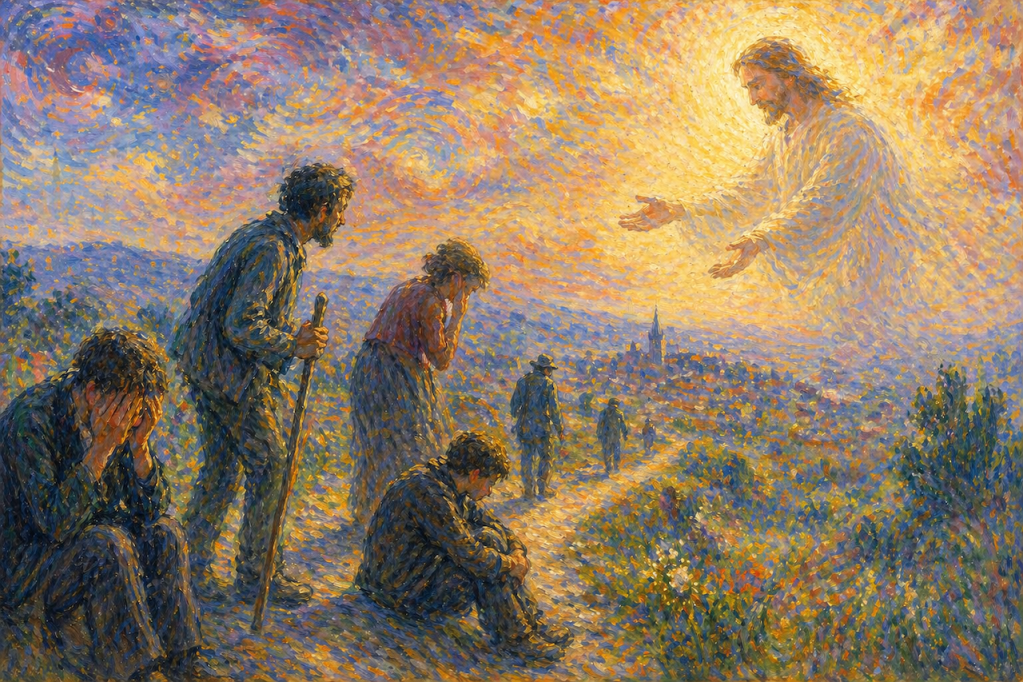
    O Divine Beloved,
    Grip their souls so tight
    That they can no longer
    Walk this hell
    With their smug hatred
    Of the Name they cannot hear,
    Of the Name they cannot say.
    O Divine Beloved,
    They have caught a syllable,
    They have caught a glimmer
    Of Thy sacredness.
    Give them more, give them more
    So they will know that they
    Can no longer go on without Thee.

    In a slightly different version of this poem/prayer appearing in my collection Singing in Soul Silence:  Voice of Faith, I employed the modern use of second person singular.  

  • Emily Dickinson’s “If recollecting were forgetting”

    Image: Emily Dickinson - Amherst College - Daguerrotype of the poet at age 17, circa 1847 - likely the only authentic, extant likeness of the poet
    Image: Emily Dickinson – Amherst College – Daguerrotype of the poet at age 17, circa 1847 – likely the only authentic, extant likeness of the poet

    Emily Dickinson’s “If recollecting were forgetting”

    Emily Dickinson’s speaker in “If recollecting were forgetting” follows a line of thought that mirrors obliquely that of Aristotelian logic—searching for a way of thinking in order to find a way of knowing.

    Introduction with Text of “If recollecting were forgetting”

    Emily Dickinson has been noted for having read and studied widely in history, science, and philosophy, and this little poem could likely have happened after she happened upon the discourses of Aristotle’s Organon.  

    While her speaker seems to be employing, however creatively, the premise of the syllogism, her language choices are so direct and simple that she makes her position quite clear without engaging in the jargon of philosophical logic.

    If recollecting were forgetting

    If recollecting were forgetting,
    Then I remember not.
    And if forgetting, recollecting,
    How near I had forgot.
    And if to miss, were merry,
    And to mourn, were gay,
    How very blithe the fingers
    That gathered this, Today!

    Commentary on “If recollecting were forgetting”

    The speaker is exploring the nature of meaning as it intrudes upon the engagement of the human mind and heart with sorrow and mourning.

    First Movement:  Musing and Meaning

    If recollecting were forgetting,
    Then I remember not.

    The speaker is musing on the nature of meaning, employing the “if/then” structure:  “if” one event occurs, “then” another event follows.  She first employs what appears to be a paradox, rendering one act the opposite of itself.  

    She inverts hypothetically the literal meanings of “recollecting” and “forgetting.”  She is playing both a word game and a meaning game: if the opposite of one act is, in fact, its opposite, then what will happen?

    The speaker specifically claims that she would not “remember,” that is, she would not be “recollecting” if remember meant “forgetting.”  Ultimately, this seemingly confusing turnabout simply emphasizes her strong determination not to forget.  She does not offer any clue regarding what she might remember or forget, but such information is not necessary to this complex philosophically juxtapostional cogitation.  

    The delineation regarding the definition of opposites renders thought both wavy and stationary.  The “if” clause introduces the meaning trade-off, while the “then” clause states a definitive claim.  The mind weaves in considering the “if” clause that reverses the meaning of the terms involved but then returns to a stationary position in order to accept the “then” clause.

    Second Movement:  The Emphasis of Reversal

    And if forgetting, recollecting,
    How near I had forgot.

    In the second movement, the speaker continues her musing on transference but in reverse.   Interestingly, this “if” clause juxtaposition does not result in the same event as when the very same two terms were first offered in opposition to each other. Instead of a stationary claim, the speaker now asserts that she merely got close to “forgetting.” 

     As readers refer back to her original claim in the first movement, they are struck by the fact that she is saying she prizes remembrance over forgetfulness—unsurprising that this speaker of minimalism would make such a choice.

    Of course, in the pairs of opposites that drive the world living under the delusive spell of maya, one of the pairs is nearly always a positive for the good while its opposite is usually considered negative, representing the opposite of good.  In the pairs of opposites focused on here—to forget vs. to remember—the obvious positive of the pair is to remember.

    The complexity of the second premise does lend itself to the difference that the speaker has infixed in the contrast she had created between the first two movements.  That she nearly forgot, but did not completely forget, demonstrates her favoring the positive peg of the pair of opposites, forgetting and remembering.  Thus, if she recalled, which is actually forgetting, she approached that state but did not enter it as she did in the first movement when remembering was actually forgetting.

    Third Movement:   Missing and Mourning

    And if to miss, were merry,
    And to mourn, were gay,

    Having resolved the issue of forgetting and remembering, the speaker moves on to a new set of opposites which are not of the same paired quality as those with which she began in the first two movements.  She is now simply reversing the traditionally accepted nature of missing and mourning.  When an individual is missing a loved one, that individual mourns.  

    When the human heart and mind mourn, they are anything but “gay,” that is, happy or cheerful.  But then the speaker makes it clear that she intends to follow the same line of thinking that she has explored in the two opening movements, the “if/then” structure.  

    But the “then” part of the structure has to wait to be expressed in the next movement because the speaker has now focused on two encompassing acts, not merely word meaning.  If missing someone were considered a happy, cheerful situation instead of “mourn[ing]” that loss, and if mourning the loss, or missing someone were considered also happy, cheerful, then what happens?  

    Instead of an exact tit-for-tat, that is, meaning for meaning, the speaker has offered two negative acts as representing a positive, setting up a mystery as to how this situation can be resolved.

    Fourth Movement:  Nullification or Homogenization

    How very blithe the fingers
    That gathered this, Today!

    Finally, the speaker concludes the implied “then” clause with the excited utterance indicating that the person who has concocted this little exercise has remained cheerfully unconcerned with it all.

     If all that went before were the actual situation instead of being their opposites, then those “fingers” responsible for “gather[ing]” this philosophical pastiche would be proven to be mindlessly unimpressive.  

    “Today!” placed with an exclamation mark heralds the excited notion that turning things upside down in order to look at them from a new position in the present, instead of accepting the pain and anguish of the past and dealing with it.  

    This bizarre heralding impels the mind to stiffen like “blithe . . . fingers.”  Fingers that are heedless, indifferent, and uncaring represent the mind that drives the fingers.  Quite obviously, fingers cannot gather, think, move, or do anything without the mind first engaging with an idea that will drive the activity.  Thus, it is the mind that is blithe working through the fingers.  

    The philosophical result of the four movements concludes that while the positive may be chosen by the masterfully thinking, moving mind, a simple juxtaposition that renders one quality its opposite may rearrange the very atoms of the brain that then will create a world that does not exist and never can.  The push for dominance of one pair of any pair of opposites will result in the nullification or homogenization of any blinkered philosophical stance.