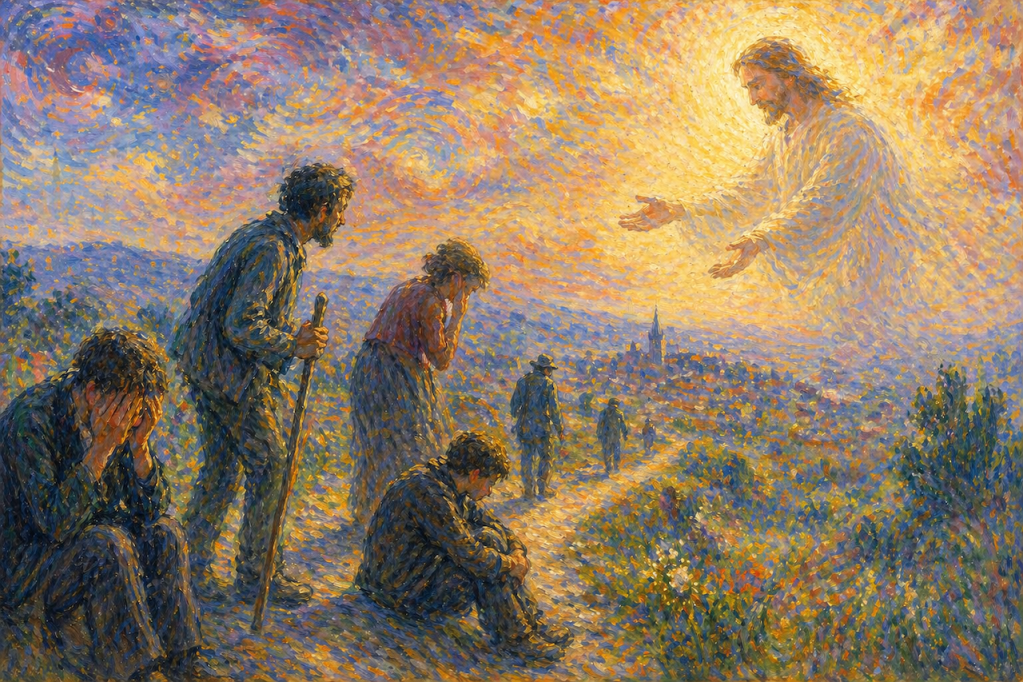
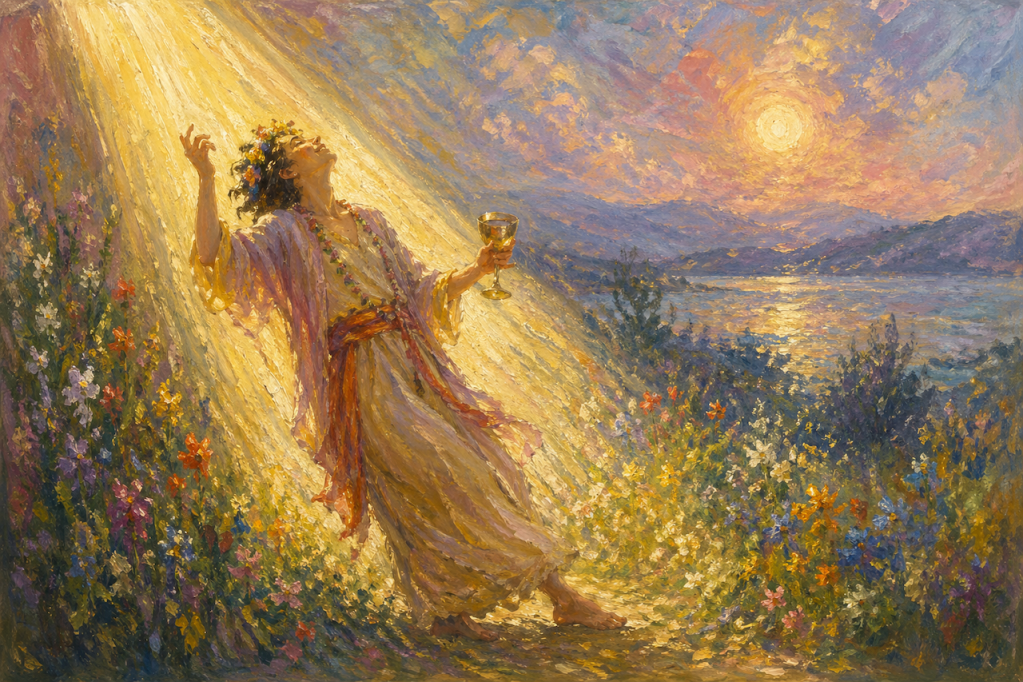
Thou must have seen them Struggling to keep their pace, Not knowing they are blind, Crippled, and alone. They would come to Thee If only they knew. How can they know? When they are blind and deaf? Thy Name is everywhere, But they cannot hear it. Thy Name is in their hearts, But they do not feel it. O Divine Beloved, Give Thyself to them anyway. They are Thy wondering pilgrims Though they know it not. O Divine Beloved, Grip their souls so tight That they can no longer Walk this hell With their smug hatred Of the Name they cannot hear, Of the Name they cannot say. O Divine Beloved, They have caught a syllable, They have caught a glimmer Of Thy sacredness. Give them more, give them more So they will know that they Can no longer go on without Thee.
In a slightly different version of this poem/prayer appearing in my collection Singing in Soul Silence: Voice of Faith, I employed the modern use of second person singular.
Image: Emily Dickinson – Amherst College – Daguerrotype of the poet at age 17, circa 1847 – likely the only authentic, extant likeness of the poet
Emily Dickinson’s “If recollecting were forgetting”
Emily Dickinson’s speaker in “If recollecting were forgetting” follows a line of thought that mirrors obliquely that of Aristotelian logic—searching for a way of thinking in order to find a way of knowing.
Introduction with Text of “If recollecting were forgetting”
Emily Dickinson has been noted for having read and studied widely in history, science, and philosophy, and this little poem could likely have happened after she happened upon the discourses of Aristotle’s Organon.
While her speaker seems to be employing, however creatively, the premise of the syllogism, her language choices are so direct and simple that she makes her position quite clear without engaging in the jargon of philosophical logic.
If recollecting were forgetting
If recollecting were forgetting, Then I remember not. And if forgetting, recollecting, How near I had forgot. And if to miss, were merry, And to mourn, were gay, How very blithe the fingers That gathered this, Today!
Commentary on “If recollecting were forgetting”
The speaker is exploring the nature of meaning as it intrudes upon the engagement of the human mind and heart with sorrow and mourning.
First Movement: Musing and Meaning
If recollecting were forgetting, Then I remember not.
The speaker is musing on the nature of meaning, employing the “if/then” structure: “if” one event occurs, “then” another event follows. She first employs what appears to be a paradox, rendering one act the opposite of itself.
She inverts hypothetically the literal meanings of “recollecting” and “forgetting.” She is playing both a word game and a meaning game: if the opposite of one act is, in fact, its opposite, then what will happen?
The speaker specifically claims that she would not “remember,” that is, she would not be “recollecting” if remember meant “forgetting.” Ultimately, this seemingly confusing turnabout simply emphasizes her strong determination not to forget. She does not offer any clue regarding what she might remember or forget, but such information is not necessary to this complex philosophically juxtapostional cogitation.
The delineation regarding the definition of opposites renders thought both wavy and stationary. The “if” clause introduces the meaning trade-off, while the “then” clause states a definitive claim. The mind weaves in considering the “if” clause that reverses the meaning of the terms involved but then returns to a stationary position in order to accept the “then” clause.
Second Movement: The Emphasis of Reversal
And if forgetting, recollecting, How near I had forgot.
In the second movement, the speaker continues her musing on transference but in reverse. Interestingly, this “if” clause juxtaposition does not result in the same event as when the very same two terms were first offered in opposition to each other. Instead of a stationary claim, the speaker now asserts that she merely got close to “forgetting.”
As readers refer back to her original claim in the first movement, they are struck by the fact that she is saying she prizes remembrance over forgetfulness—unsurprising that this speaker of minimalism would make such a choice.
Of course, in the pairs of opposites that drive the world living under the delusive spell of maya, one of the pairs is nearly always a positive for the good while its opposite is usually considered negative, representing the opposite of good. In the pairs of opposites focused on here—to forget vs. to remember—the obvious positive of the pair is to remember.
The complexity of the second premise does lend itself to the difference that the speaker has infixed in the contrast she had created between the first two movements. That she nearly forgot, but did not completely forget, demonstrates her favoring the positive peg of the pair of opposites, forgetting and remembering. Thus, if she recalled, which is actually forgetting, she approached that state but did not enter it as she did in the first movement when remembering was actually forgetting.
Third Movement: Missing and Mourning
And if to miss, were merry, And to mourn, were gay,
Having resolved the issue of forgetting and remembering, the speaker moves on to a new set of opposites which are not of the same paired quality as those with which she began in the first two movements. She is now simply reversing the traditionally accepted nature of missing and mourning. When an individual is missing a loved one, that individual mourns.
When the human heart and mind mourn, they are anything but “gay,” that is, happy or cheerful. But then the speaker makes it clear that she intends to follow the same line of thinking that she has explored in the two opening movements, the “if/then” structure.
But the “then” part of the structure has to wait to be expressed in the next movement because the speaker has now focused on two encompassing acts, not merely word meaning. If missing someone were considered a happy, cheerful situation instead of “mourn[ing]” that loss, and if mourning the loss, or missing someone were considered also happy, cheerful, then what happens?
Instead of an exact tit-for-tat, that is, meaning for meaning, the speaker has offered two negative acts as representing a positive, setting up a mystery as to how this situation can be resolved.
Fourth Movement: Nullification or Homogenization
How very blithe the fingers That gathered this, Today!
Finally, the speaker concludes the implied “then” clause with the excited utterance indicating that the person who has concocted this little exercise has remained cheerfully unconcerned with it all.
If all that went before were the actual situation instead of being their opposites, then those “fingers” responsible for “gather[ing]” this philosophical pastiche would be proven to be mindlessly unimpressive.
“Today!” placed with an exclamation mark heralds the excited notion that turning things upside down in order to look at them from a new position in the present, instead of accepting the pain and anguish of the past and dealing with it.
This bizarre heralding impels the mind to stiffen like “blithe . . . fingers.” Fingers that are heedless, indifferent, and uncaring represent the mind that drives the fingers. Quite obviously, fingers cannot gather, think, move, or do anything without the mind first engaging with an idea that will drive the activity. Thus, it is the mind that is blithe working through the fingers.
The philosophical result of the four movements concludes that while the positive may be chosen by the masterfully thinking, moving mind, a simple juxtaposition that renders one quality its opposite may rearrange the very atoms of the brain that then will create a world that does not exist and never can. The push for dominance of one pair of any pair of opposites will result in the nullification or homogenization of any blinkered philosophical stance.
Image: Emily Dickinson – Amherst College – Daguerrotype of the poet at age 17, circa 1847 – likely the only authentic, extant likeness of the poet
Emily Dickinson’s “I taste a liquor never brewed”
Emily Dickinson’s “I taste a liquor never brewed” is one of her most enthralling little poems. In this poem, the speaker is likening spiritual ardor to drunkenness.
Introduction and Text of “I taste a liquor never brewed”
The theme of Emily Dickinson’s “I taste a liquor never brewed” is similar to Paramahansa Yogananda’s chant: “I will sing thy Name, I will drink thy Name, and get all drunk, O, with thy Name!”
Dickinson’s speaker proclaims a spiritual consciousness. The poem extends the metaphor of drunkenness to describe the status of a soul in mystical union with the Divine.
Dickinson’s speaker in “I taste a liquor never brewed” describes a consciousness steeped in a mystical state that mimics inebriation. She is inspired and enthralled seemingly just by breathing the air around her.
The speaker’s consciousness becomes aware of itself and propels her into an immense universe that is difficult to describe. Thus she uses the alcohol metaphor to approximate the physical sensation of what she is experiencing spiritually.
Thomas H. Johnson numbered this poem #214 in his useful work, The Complete Poems of Emily Dickinson, which restored Dickinson’s peculiar punctuation and elliptical style. As usual, Dickinson employed slant rime or near rime; for example, she rimes Pearl and Alcohol.
I taste a liquor never brewed
I taste a liquor never brewed – From Tankards scooped in Pearl – Not all the Vats upon the Rhine Yield such an Alcohol!
Inebriate of Air – am I – And Debauchee of Dew – Reeling – thro endless summer days – From inns of Molten Blue –
When “Landlords” turn the drunken Bee Out of the Foxglove’s door – When Butterflies – renounce their “drams” – I shall but drink the more!
Till Seraphs swing their snowy Hats – And Saints – to windows run – To see the little Tippler Leaning against the – Sun —
Commentary on “I taste a liquor never brewed”
Emily Dickinson’s “I taste a liquor never brewed” is one of the poet’s most enthralling little poems, employing the metaphor of drunkenness to describe spiritual ardor.
Stanza 1: Imbibing a Non-Brewed Beverage
I taste a liquor never brewed – From Tankards scooped in Pearl – Not all the Vats upon the Rhine Yield such an Alcohol!
The speaker announces that she has been imbibing a drink, but that beverage is not one that has been brewed, which eliminates alcohol, tea, and coffee, this is, the beverages which have mind-altering capabilities. She then begins an extended metaphor, likening the effect of her “liquor” to that of an alcoholic beverage.
The “Tankards scooped in Pearl” simulate the vessels from which the speaker has been imbibing her rare concoction. The consciousness which the speaker wishes to describe transcends the physical consciousness of an alcohol hum; thus the speaker must resort to metaphor to communicate as nearly as possible this ineffable state.
Those rare tankards having been “scooped in Pearl” spiritually correspond to the nature of the soul. She has, in fact, drunk a beverage that has not been brewed from a vessel that has not been manufactured by human hands.
Stanza 2: It Resembles Being Drunk
Inebriate of Air – am I – And Debauchee of Dew – Reeling – thro endless summer days – From inns of Molten Blue –
Dickinson’s speaker continues her metaphor by revealing that the feeling she is experiencing is like being drunk on air; thus the act of simply taking a breath of air has the power to intoxicate her.
Not only air, but the “Dew” has this delicious effect. Further physical realities like a summer day make her feel that she has been drinking at a tavern, “Inns of Molten Blue.” All this imbibing leaves her “reeling” from this rare form of intoxicant.
Stanza 3: A Drunken State That Never Ceases
When “Landlords” turn the drunken Bee Out of the Foxglove’s door – When Butterflies – renounce their “drams” – I shall but drink the more!
On the stage of nature, the speaker is accompanied by “bees and butterflies,” and these fellow creatures quite literally imbibe nectar from flowers. The speaker’s brand of liquor has an advantage over that of the bees. They have to stop their imbibing and leave their blossoms or else they will become trapped as the petals close up for the night.
But because of the spiritual nature of this speaker’s intoxication, she does not have stop drinking. She can enjoy her drunken state without end. Only on the physical plane do activities begin and end; on the spiritual plane, the intoxication has no need to cease. The eternal soul is without boundaries of space and time.
Stanza 4; The Dash That Runs to Eternity
Till Seraphs swing their snowy Hats – And Saints – to windows run – To see the little Tippler Leaning against the – Sun –
The speaker boasts that she will never have to curtail her mode of mystical intoxication. As the penultimate stanza ends with the claim, “I shall but drink the more!,” the idea continues into the final stanza. By placing the time of her stopping her drinking at two fantastic events that will never occur, she emphatically asserts that she will never have to stop her drinking binge.
When the highest order of angels, the “Seraphs,” commit the unlikely act of “swing[ing] their snowy Hats,” and curious saints run to windows, only then shall she cease her imbibing. That time is never because Seraphs and saints do not comport themselves with such behavior.
The speaker calls herself “the little Tippler” and positions herself “[l]eaning against the — Sun.” Another impossible act on the physical level, but one quite possible on the mystical.
The final clue that the speaker is asserting her ability never to stop drinking of the mystical wine is the final punctuation of the dash — that concludes her report. The period, question mark, or exclamation mark, as some editors have employed, denote finality while the dash does not.
Thomas H. Johnson has restored the dash — to this poem in his The Complete Poems of Emily Dickinson. When other versions lose the Dickinsonian dash, they also lose a nuance of her meaning.
Image: Emily Dickinson – Amherst College – Daguerrotype of the poet at age 17, circa 1847 – likely the only authentic, extant likeness of the poet
Emily Dickinson’s “When Roses cease to bloom, Sir”
Emily Dickinson’s “When Roses cease to bloom, Sir” features prominently a surprising demand of the Divine Belovèd Creator. The Dickinsonian speaker always holds in great reverence and regard the Creator of the cosmic universe and all of earthly nature.
Introduction with Text of “When Roses cease to bloom, Sir”
Emily Dickinson’s poem, “When Roses cease to bloom, Sir,” demonstrates the poet’s depth of scientific knowledge of the world as well as her insight into the spiritual significance that such scientific knowledge implies for human evolution.
The poem features prominently a surprising demand of the Divine Belovèd Creator. The Dickinsonian speaker always holds in great reverence and regard the Creator of the cosmic universe and all of earthly nature.
She dramatizes in poetic form her physical world observations to reveal her awareness of the Divine Creator’s existence both within the natural world and outside of that natural world, extending into the realm of spirit.
The octave is structured by a “when-then” time sequence: when one thing happens, then the other may be expected to happen or may be desired to happen. In this poem, the structure adds a complex sub-feature to the equation.
Not only is the speaker offering a “when” structure that encompasses three natural phenomena of plant and animal kingdom activity, but she is also adding a third element from the human realm to the “when” clause.
The speaker has thus inserted herself into the narrative in an unobtrusive way through the employment of the synecdochic”hand.” After setting up the “when” application, she engages her own action and then offers the second half of the “when-then” function.
That “then” application, however, delivers a subtle demand of the Belovèd Creator—one that may at first appear somewhat shocking but yet remains comprehensible and infinitely appropriate.
When Roses cease to bloom, Sir
When Roses cease to bloom, Sir, And Violets are done – When Bumblebees in solemn flight Have passed beyond the Sun – The hand that paused to gather Upon this Summer’s day Will idle lie – in Auburn – Then take my flowers – pray!
“When Roses cease to bloom, Sir” rendered in song
Commentary on “When Roses cease to bloom, Sir”
Emily Dickinson’s “When Roses cease to bloom, Sir” demonstrates the poet’s depth of knowledge of the science of the evolutionary progress, as well as her insight into the spiritual significance that such knowledge suggests for the human mind and heart on its path through evolutionary advancement.
First Movement: Emphasis on Beauty
When Roses cease to bloom, Sir, And Violets are done –
The speaker begins the “when” function by addressing the Divine Ineffable Reality. She suggests that she will be asking for some favor after flowers have come and gone. She allows “Roses” and “Violets” to represent all natural vegetation, which would include all plants growing in the fields, along the streets, and in her own vegetable garden.
By allowing only two lovely flowers to represent all of the plant kingdom, the speaker is demonstrating her emphasis on her love of beauty. The speaker then demonstrates that she is including both domesticated plants—roses, and those that continue to grow wild—violets.
The Blessèd Author of creation as well as the speaker’s listeners/readers are invited to observe that the speaker keeps her mind firmly on her goal, her own creation of beauty and engagement in health and wholesomeness.
Second Movement: Evolution from Plant to Animal
When Bumblebees in solemn flight Have passed beyond the Sun –
The speaker then turns to the animal kingdom, allowing the simple bumblebee to represent that kingdom. The “Bumblebees” have engaged in “solemn flight” and like the roses and violets are now passing out of existence.
Unlike the rose that “cease[s] to bloom” and the violet whose passing out of existence is qualified as merely “done,” the bee, an evolutionarily higher-stationed member of the animal kingdom, “pass[es] beyond the Sun.”
The speaker makes the distinction between the two kingdoms in this marvelously ingenious way–how they cease their summer sojourn. As flowers simply pass away by simple cessation, the bees have engaged in the physical act of moving, which is denied plants rooted to the earth; thus, the speaker creates the bees’ metaphorical passing beyond light.
Even though the souls of all those creatures remain distinct entities in the mind of their Creator, they express in very different ways according to their current incarnation on earth, representative of their individual and collective karma. It is only natural that the higher evolved bee would demonstrate an ability beyond that of the lower plant world.
And the speaker’s ability to place this distinction in such a minimalist setting demonstrates this speaker’s understanding regarding the existence of the hierarchy to which earthly creatures remain attached until their final liberation. All created beings must pass through this hierarchical system on their way from lowest to highest form on the evolutionary scale.
Third Movement: The Human in Creation
The hand that paused to gather Upon this Summer’s day
The speaker has now quit her focus on the plant and animal kingdoms and is focusing on the simple human feature of a “hand,” a synecdochic representative of the human physical encasement.
That hand pauses. Instead of moving to pluck and collect those flowers before they are gone, this hand leaves them in place. Instead of shooing away the bees, the speaker simply takes the measure of their movement, while fashioning the observation that distinguishes the flowers from the bees.
All summer long, the speaker has observed the bees extracting nectar from the flowers. The relationship between the flowers and the nectar-gathering bees has impressed upon the mind of the speaker the symbiotic relationship that exists in nature and that extends to the human being as an integral part of that natural scenario.
But the speaker now holds her request of the Divine Creator until she has described her own situation, her own participation in the drama that she has created in the garden of her mind, heart, and soul.
Her poetic garden contains multitudes, and the ability to grow metaphorical, metaphysical flowers, bees, human hands remains her greatest challenge and strongest ability.
Fourth Movement: The Metaphysical Garden of Verse
Will idle lie – in Auburn – Then take my flowers – pray!
That human hand that pauses does so to continue its construction of her own metaphysical, poetic creation—that original garden into which she had early on invited her brother to visit.
After that hand becomes “idle,” it will cease creating those metaphysical flowers and those metaphysical bees. Therefore, the speaker then demands of the Belovèd “Sir” that He “take [her] flowers”—adding for emphasis, “pray!”
After the speaker herself has ceased blooming and flying beyond the sun and pausing from the labor of metaphorical, metaphysical garden creation, her physical form will exist like a bug in amber and become unresponsive and “lie – in Auburn.” Thus, the clever speaker is requesting through a strong demand that the Divine Gardener accept her metaphysical flowers.
Such a demand may seem infinitely cheeky of a mere created child of the Master Creator of the Cosmos, but the speaker has demonstrated repeatedly that she remains steadfast in her devotion and confident in her ability to create flowers—offerings—that are acceptable to a most discriminating Divine Creator.
Forests whisper Thy lush leafiness. Mountains testify to Thy majesty. Restless rivers rush to Thy unguarded sea Where Thy grave hand marks their madness.
O Divine Effulgence, We bow before Thy Beauty! O Divine Effulgence, We humbly bow to Thy Bounty!
Servers serve for Thy pleasure! Lovers love only through Thy treasure! Mourners mourn for Thee alone, Thee alone! Only Thy pure-hearted ones know Thy bliss!
Only Thy saints and yogis approach Thy bliss!
O Divine Effulgence, We bow before Thy Beauty! O Divine Effulgence, We humbly bow to Thy Bounty!
Human beings have a persistent tendency to classify themselves, often believing that such classifications clarify identity and improve understanding. Yet, when examined closely, many of these categories—whether rooted in physical identity, behavior, or personality—can obscure deeper truths about human nature.
Human Being: A Soul with a Body
While classification can offer a sense of order, it can also encourage individuals to identify too strongly with external labels, neglecting the deeper dimensions of consciousness, character, and inner development that define human experience.
According to Paramahansa Yogananda, the human being is essentially a soul who has a body. The human essence cannot be quantified, qualified, and classified. Any attempt to do so, simply limits the true nature of humanity to materialistic standards that remain incapable of distinguishing truth from fiction.
At the core of this argument is the distinction between essence and expression. The human being may be understood not merely as a physical organism, but as a conscious entity whose identity transcends bodily and social categories. When individuals define themselves primarily through classifications such as sex, race, or nationality, they risk losing sight of this deeper identity.
These classifications, though often fixed and socially reinforced, are ultimately temporary conditions of embodiment. For example, a person born in the United States, identified as female, and categorized within a particular racial group may spend much of her life navigating those labels. Yet none of these descriptors addresses her inner consciousness, moral capacity, or spiritual awareness.
A similar issue arises with psychological classifications such as “introvert” and “extrovert.” While these terms can describe tendencies, they often become limiting identities. Modern psychology acknowledges that personality exists on a spectrum, with most individuals exhibiting both introverted and extroverted traits depending on context [1].
For instance, a person who identifies as introverted may still display extroverted behavior when speaking on a subject of passion or when among trusted friends. Conversely, an extroverted individual may crave solitude after prolonged social interaction. These examples illustrate that such classifications are not fixed identities but fluctuating expressions of a more complex mind.
The broader philosophical concern is that classification often mistakes behavior for being. Actions, preferences, and tendencies are sometimes elevated to defining characteristics of the self, when in fact they represent only partial aspects of a person’s existence.
A person who prefers solitude is more than the label “introvert,” just as a person who engages in particular patterns of behavior cannot be reduced to those behaviors alone. Human identity encompasses thought, intention, awareness, and the capacity for change—qualities that resist rigid categorization.
Real-world examples further illustrate the limitations of classification. Consider the workplace: employees are often categorized as “team players” (extroverted) or “independent workers” (introverted).
While these distinctions can help with task allocation, they can also restrict growth. An employee labeled as introverted may be overlooked for leadership roles, despite possessing strong decision-making skills and emotional intelligence.
Research in organizational psychology shows that introverted leaders can be highly effective, particularly in environments that require careful listening and thoughtful strategy [2]. This demonstrates how labels, when taken too rigidly, can hinder both individual development and institutional success.
Another example arises in education. Students are frequently grouped by learning styles or personality traits, which can influence teacher expectations. A quiet student may be assumed disengaged, while a talkative student may be seen as more capable.
However, studies indicate that quieter students often process information deeply and may excel in written or reflective tasks [3]. Here again, classification simplifies what is actually a nuanced interplay of cognitive and emotional factors.
From a more reflective perspective, the danger of classification becomes even more pronounced when individuals neglect inner development. Practices such as meditation, contemplation, or prayer, which cultivate self-awareness and depth of understanding, often require stepping beyond labels altogether.
The inward turn associated with such practices resembles what is commonly labeled “introversion,” yet it is not a personality type so much as a universal human capacity. Even highly social individuals benefit from periods of silence and reflection, suggesting that the introvert-extrovert dichotomy reflects tendencies rather than fixed identities.
While classification can serve practical purposes, it becomes problematic when it is mistaken for essence. Both physical and psychological labels risk reducing the human being to partial truths, ignoring the deeper, unifying reality of human consciousness.
By recognizing that traits such as sociability, behavior, and identity categories are fluid and secondary, individuals can move toward a more integrated understanding of themselves. Such an understanding not only aligns with psychological evidence but also supports the broader view that the essence of the human being transcends all classification.
Image: Emily Dickinson – Amherst College – Daguerrotype of the poet at age 17, circa 1847 – likely the only authentic, extant likeness of the poet
Emily Dickinson’s “Adrift! A little boat adrift!”
In Emily Dickinson’s skilled employment of paradox and metaphor in her poem “Adrift! A little boat adrift!,” the speaker offers a complex drama played out seemingly on an earthly ocean but actually performed on the mystical sea, where life remains immortal and eternal.
Introduction and Text of “Adrift! A little boat adrift!”
Emily Dickinson enjoyed the riddle essence of poetry. She often employed that riddle essence in which she implies or directly asks a question. Other times, she simply offers her rather detailed description and allows the reader to answer. In this little drama, she elides the physical universe with the spiritual universe.
Metaphorically comparing the human being to a “little boat” floating without a guide on the sea of life, she deliberately sinks that boat before resurrecting that drowned life through the agency of the human soul, which cannot be drowned but which possesses all the power of its Creator to demolish all human suffering.
Adrift! A little boat adrift!
Adrift! A little boat adrift! And night is coming down! Will no one guide a little boat Unto the nearest town?
So Sailors say – on yesterday – Just as the dusk was brown One little boat gave up its strife And gurgled down and down.
So angels say – on yesterday – Just as the dawn was red One little boat – o’erspent with gales – Retrimmed its masts – redecked its sails – And shot – exultant on!
Commentary on “Adrift! A little boat adrift!”
This little drama offers a useful example of Dickinson’s most intense style, featuring her use of the riddle and her mystic appraisal of the human mind and heart, influenced by the human soul, whose guidance may seem rudderless, until that guidance becomes crucial.
First Stanza: Report of Danger
Adrift! A little boat adrift! And night is coming down! Will no one guide a little boat Unto the nearest town?
The speaker begins with an exclamation revealing that danger is on the horizon in the form of a small watercraft floating about unguided by a knowing pilot. Such a situation alerts the reader/listener that all sorts of calamity could ensue.
To make matters worse, nightfall is fast approaching. An unguided vessel drifting into the nighttime brings down a veil of fright and concern. Again the speaker is exclaiming for again she places the exclamation mark at the end of her brief outcry!
The speaker then cries for assistance for the little drifting sea craft, but instead of a command, she frames the cry as a question with a negative emphasis, “[w]ill no one . . . ?” She demonstrates that she suspects there is no one who will chaperone and usher this little vessel to a safe harbor, such as to “the nearest town.”
The painful negativity suggested by the speaker early on in her little drama foreshadows the ultimate outcome in her conclusion. She alerts her listeners that a likely catastrophe is on the horizon.
But truly alert readers/listeners will suspend judgment until the conclusion is revealed, for Emily Dickinson can be as tricky as any poet writing. She can out-trick Robert Frost by miles and miles.
Second Stanza: Disaster
So Sailors say – on yesterday – Just as the dusk was brown One little boat gave up its strife And gurgled down and down.
The speaker continues her report of the disastrous fate of this “little boat.” It has been reported by “Sailors,” those who would know, that this little sea vessel that so valiantly struggled nevertheless gave up the ghost and let the sea take it down into its depths.
The time of this sinking was dusk when the color of sunset spread its brown, saddening haze upon the land and sea. The sailors have reported that the vessel simply “gave up” because it could not overcome its “strife.”
It gave up its life, its cargo, all that was precious within it. It gave up and then went down with gurgling sounds–the sound of a living throat taking on water that will ultimately drown it.
The speaker has created a scenario of such pain and suffering that can only be assuaged with extraordinary finesse. The sinking of a little boat remains a sorrowful image, and the speaker has seared that painful image into the inner sight of her listeners/readers. She has dramatized the events surrounding that image in such a way as to heighten the pain and anguish experienced by her audience.
Third Stanza: Safety at Last
So angels say – on yesterday – Just as the dawn was red One little boat – o’erspent with gales – Retrimmed its masts – redecked its sails – And shot – exultant on!
Finally, the speaker quickly pulls the readers/listeners minds from the earthly tragedy on the physical level of existence on which the sinking of a sea craft causes pain and suffering. Despite what the “Sailors” have reported, there is another report by higher beings that will impart a different engagement, a different outcome of this earthly event.
Now, the report is brought by “angels.” The higher, mystical beings are reporting that this event happened the same day as the earthly report “yesterday.” But the time was early morning when “dawn was red,” setting up a dichotomy from yesterday when “dusk was brown.”
Instead of merely going down “gurgl[ing],” this little vessel when faced with ferocious “gales,” fought valiantly: it transformed itself by reshaping it “masts” and reinstalling stronger and better sea-worthy “sails.”
And after it completed those repairs, it sped past all earthy danger and triumphantly entered into the realm of mystic life (Christians call it “Heaven”) where no water can drown, no storm can toss, and no pain and suffering can stifle.
Paradox and Metaphor
Upon first encounter, the reader will detect what seems to be a contradiction or impossibility because of a reversal of two time periods. In the second stanza, it is reported that the little boat sank yesterday at “dusk.” But then in the third stanza, it is reported that the little boat encountered its difficulty yesterday at “dawn.”
The resolution of this paradox is accomplished through the realization that on the spiritual, mystical level of being, time remains eminently malleable. At the time the “little boat” experienced it difficulty, it realized its immortal, eternal aspect.
It became aware that it is, in fact, a spark of the Eternal, and therefore nothing can harm it. It realized that stature at dawn, thus by the time dusk had arrived to take its physical form, its mystic/spiritual form–or soul–had moved on.
This poem may be considered one of Emily Dickinson’s riddle poems. Although it does not seem to call for answering a riddle question, readers cannot fail to grasp that the “little boat” is a metaphor for a human being.
This metaphor becomes obvious, however, only after the angels offer their report. The “little boat” then is revealed to possess the human ability to realize its special power, its mystical spark, and its ability to transcend earthly trials and tribulations.
Image: Emily Dickinson – Amherst College – Daguerrotype of the poet at age 17, circa 1847 – likely the only authentic, extant likeness of the poet
Emily Dickinson’s “If those I loved were lost”
The speaker in Emily Dickinson’s “If those I loved were lost” is emphasizing the value she places on her loved ones. She likens their importance to significant events from the community level to the world stage, where bells ring to announce important happenings.
Introduction and Text of “If those I loved were lost”
Emily Dickinson’s “If those I loved were lost” features two stanzas, each with two movements. The speaker’s musing targets how the speaker would react to both losing and finding loved ones. Her emotions and behaviors signal the importance of those loved ones to her. The value she places on these individuals can only be suggested and not directly stated.
If those I loved were lost
If those I loved were lost The Crier’s voice would tell me – If those I loved were found The bells of Ghent would ring –
Did those I loved repose The Daisy would impel me. Philip – when bewildered Bore his riddle in!
Commentary on “If those I loved were lost”
This highly allusive poem takes readers from life in a small village to the world stage, on which famous bells herald momentous events. The allusions emphasize the significance the speaker places on those to whom she refers.
First Movement: An Important Announcement
If those I loved were lost The Crier’s voice would tell me –
The speaker is speculating about her emotions and behaviors after having lost a loved one, and then she adds a speculative note about those emotions and behavior as she suddenly has found a beloved.
The first movement finds the speaker claiming that the loss of a loved one would herald a “Crier” to announce the event. In earlier times, a “town crier” was employed to spread local news events on the streets of small villages.
The town crier’s position was noticeable because of his manner and elaborate dress: such a crier might be adorned in bright colors, a coat of red and gold with white pants, a three-cornered hat (tricon), and black boots. He usually carried a bell that he would ring to attract attention of the citizens. He often would begin his announcement with the cry, “Oyez! Oyez! Oyez!”
By making this simple claim that a “crier” would be letting her know about the loss of a loved one, the speaker is elevating the importance of everyone she loves to the status of a noted official or famous name in the community.
Second Movement: The Significance of Loss
If those I loved were found The bells of Ghent would ring –
The speaker then alludes to the famous Ghent Belfry, whose construction began in 1313 with ringing bells to announce religious events, later employed to signal other important occurrences.
The inscription on the belfry tower indicates the historical and legendary important of the construction: “My name is Roland. When I toll there is fire. / When I ring there is victory in the land.”
Dickinson was likely aware of Henry Wadsworth Longfellow’s lines, “Till the bell of Ghent responded o’er lagoon and dike of sand, I am Roland! I am Roland! there is victory in the land!”
Because the famous bells ring to herald important events, the speaker assigns great importance to the fact that she has found a loved one. Thus the speaker has molded her losing and finding those she loves into great and momentous events.
Third Movement: Daisy and Death
Did those I loved repose The Daisy would impel me.
The speaker then speculates about her reaction to the death of her loved ones. She refers to the flower, the “Daisy,” stating that it would “impel her.” The employment of the Daisy is likely prompted by the flower’s association with growing on graves as in Keats’ reference in the following excerpt from one of his letter to a friend:
I shall soon be laid in the quiet grave – thank God for the quiet grave – O! I can feel the cold earth upon me – the daisies growing over me – O for this quiet – it will be my first.
And, too, there is the old expression, “pushing up daisies,” of which Dickinson was, no doubt, aware. The flower would drive her to some of kind reaction which she fails to describe but only hints at. Although she simply suggests her reaction, she leaves a significant clue in the next movement, as she alludes again to Ghent, this time the leader named Philip.
Fourth Movement: The Riddle of Loss
Philip – when bewildered Bore his riddle in!
The speaker is then alluding to Philip van Artevelde (1340–82), who was a popular Flemish leader. He led a successful battle against the count of Flanders, but later met defeat and death. The Dickinson household library contained a book with a play that featured Philip’s last words before dying, “What have I done? Why such a death? Why thus?”
Thus the speaker makes it known that she would have many questions as she struggles with the death of a loved one. She would, like Philip, be overcome, having to bear such a “riddle.”
The speaker has shown how important and necessary her loved ones are to her, and she has also demonstrated that their loss would be devastating, and she has done all this through suggestions and hints, without any direct statement of pain and anguish. All of the sorrow is merely suggested by the high level of importance she is assigning to her loved ones.