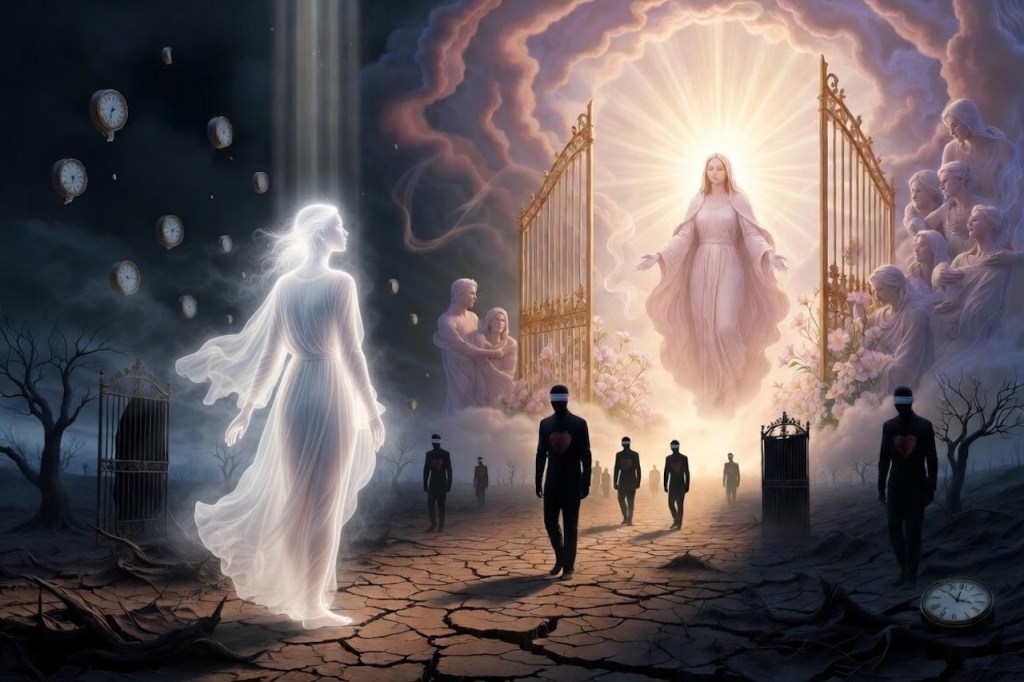
I am just a visitor here Where no one knows how to love me, Where few even think of the soul; Divine Mother, bless their blind eyes, Bless their dry hearts, open wide The gates of love that they may Behold Thy radiant face.
I am just a visitor here Where no one can love me, For only soul love will satisfy me. Divine Mother, bless this dark world Where no one knows how to love anyone, From where I yearn to travel to Thine abode Where true loving love offers solace.
I close the door to the world, Listen to the music of Aum, Listen to the hum of silence. I close the windows of the world, Welcome no more in my sanctuary.
Peace, silence, light, glorious, divine Love Coax me to my temple of silence, Coax me to my altar of peace, Where sacred love waits to wed My soul to the Soul of golden Bliss.
Thou wak’st my senses to clear sight, glorious sound, Intelligent touch, pure fragrance, tempered taste. Thou wak’st my senses by immersing them in Glory Inundating them in the silence of Thy vastness, Spilling on them the majestic light show Of Thy body, bound by boundlessness.
In the ocean of Thy love, my bubble heart Contracts and expands to eternity. My restless brain shrinks and extends Its reach to unknown realms of wisdom. My soul knows itself in the crash of breaking worlds Where it stands unshaken hand in hand with Thee. As Thou dost, so I wish to do forever, Engulfed in the Glory of Thy sacred presence.
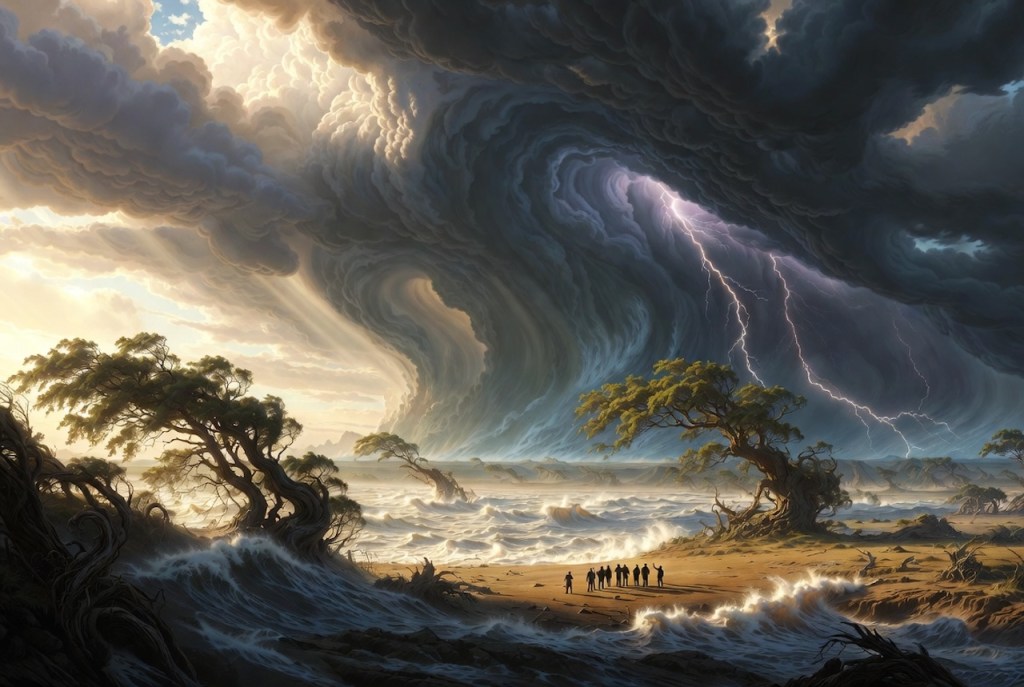
The climate changes itself to suit itself. Humankind’s arrogant bluster adds nor Subtracts not a tittle in the gravity of things. Rioting winds have destroyed and played On the flood plain since time began.
Humans controlling climate change is like Humans saving time: Daylight Saving Time— That imaginary figment of someone’s fevered brain: Imagine making a blanket longer by cutting off One end and sewing it to the other.
When the Divine Creator fashioned this mud ball Of a planet, he gave some people the ability to sense That this Earth is a really big orb, and no number Of little human beings no matter how much they breathe Can ever change what God made immutable.
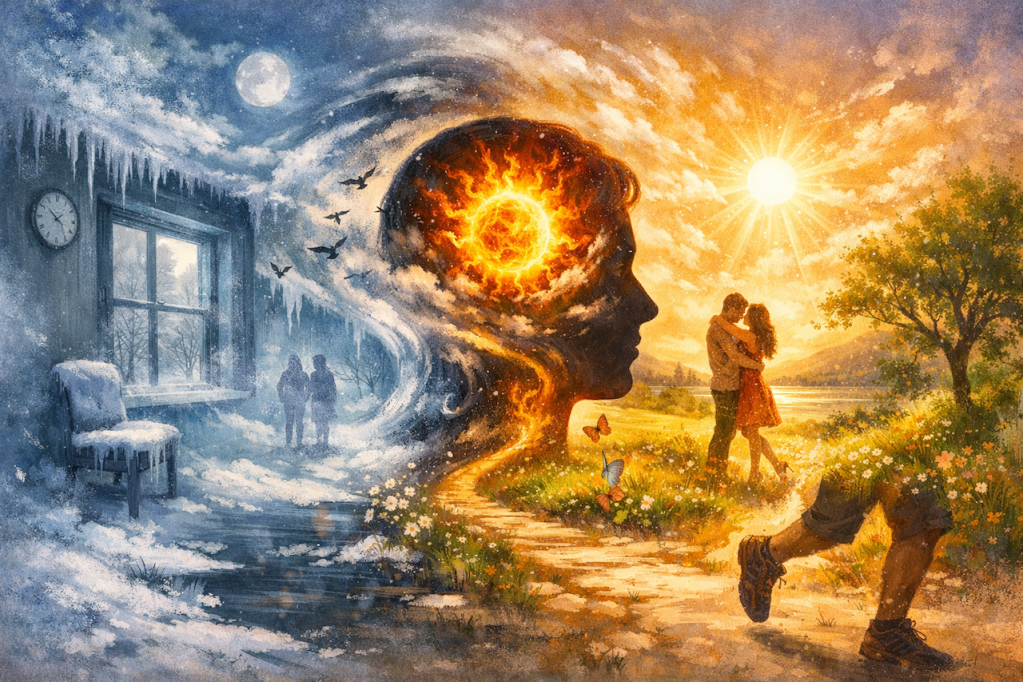
Winter kept me bound To the thought of warmer days. My tongue remained frozen, Figuring talk was later. Heat was all I sought, Waiting in rooms chilled with snow. We did not burn each other Or have the guts to move in a daze. If we listened to the song, We felt that nature would change us.
Love and knowledge may contradict Each other in the wait of uneven things But cold gives way to warm As winter gives way to spring And bodies of fire hang in the brain
Where turning feels right. Still, it is my summer mind I seek To keep in my heart its Fuel to keep the arms and legs Moving and the soul on fire.
Image: Original photo by Linda Sue Grimes, text added by Grok
A Prose Commentary on My Original Poem “My Summer Mind”
In my poem “My Summer Mind,” I have created a speaker who is musing upon the tension between dormancy and vitality, hesitation and movement, using the seasonal opposition of winter and summer as a governing metaphor for interior states of being. The poem is less concerned with external climate than with the mind’s fluctuating capacity for warmth, courage, and animation.
Where “Some Bones” dwelt in fragmentation and arrested spiritual development, this poem turns toward the possibility—though not the certainty—of renewal. Yet the tone remains guarded. My speaker does not claim arrival but instead reveals a consciousness caught in transition, aware of warmth as an aspiration rather than a constant possession.
The imagery moves between cold and heat, stillness and motion, silence and expression. My speaker situates herself in a liminal condition: waiting, anticipating, and attempting to summon a more vital state of mind. The poem’s underlying concern is not merely seasonal change but the discipline required to sustain inner fire once it has been glimpsed.
First Stanza: Winter as Suspension
In the opening stanza, my speaker situates herself in winter, a season that “kept [her] bound / To the thought of warmer days.” The emphasis here is not simply on cold but on deferral. The speaker is oriented toward the future, toward warmth that has not yet arrived.
The frozen tongue is especially significant. Speech is postponed, withheld under the assumption that expression belongs to a more favorable time—“Figuring talk was later.” This suggests a psychological habit of delay, a reluctance to engage fully with the present moment.
The stanza’s middle lines intensify the sense of enclosure. The rooms are interior, insulated, yet still pervaded by cold. My speaker implies that external shelter does not guarantee internal warmth.
The line “We did not burn each other / Or have the guts to move in a daze” introduces relational hesitation. Passion is avoided; risk is deferred. Even confusion—“a daze”—is rejected, suggesting that the speaker prefers stasis over the vulnerability of imperfect action.
The stanza closes with a tentative openness: “If we listened to the song, / We felt that nature would change us.” Here, my speaker gestures toward a passive hope that transformation might occur through attunement rather than effort. The “song” of nature becomes a kind of external agency, one that might effect change without requiring decisive internal movement.
Second Stanza: The Friction of Love and Knowledge
The second stanza complicates the earlier passivity by introducing an intellectual and emotional tension. My speaker acknowledges that human experience is rarely harmonious; feeling and understanding often pull in opposing directions.
The phrase “the wait of uneven things” reinforces the earlier motif of delay while adding a sense of imbalance. Time passes, but it does not resolve contradiction. Instead, it sustains it.
Yet my speaker reintroduces the natural cycle as a form of reassurance: “cold gives way to warm / As winter gives way to spring.” This transformation is not a dramatic revelation but a steady, almost inevitable progression. The movement from winter to spring serves as both metaphor and quiet argument: change is embedded in the structure of existence.
The line “And bodies of fire hang in the brain / Where turning feels right” marks a subtle but important shift inward. The warmth the speaker seeks is no longer purely external; it exists as potential within the mind itself. These “bodies of fire” suggest ideas, impulses, or passions suspended in a state of readiness.
The phrase “Where turning feels right” implies that transformation involves choice or orientation. The speaker begins to recognize that movement toward warmth is not entirely dependent on external seasons but on an internal willingness to turn.
Third Movement: Aspiration toward the Summer Mind
The closing lines crystallize the poem’s central desire: “Still, it is my summer mind I seek.” The phrasing is deliberate—my speaker does not claim to possess this state but actively seeks it.
The “summer mind” functions as a metaphor for sustained vitality: warmth, clarity, motion, and perhaps courage. It is not merely a seasonal mood but a disciplined condition the speaker wishes to “keep in [her] heart.”
The emphasis on “fuel” extends the metaphor into the realm of energy and maintenance. Warmth must be sustained; it requires ongoing attention. My speaker understands that vitality is not self-perpetuating but must be actively preserved.
The final lines—“to keep the arms and legs / Moving and the soul on fire”—bring the poem into the realm of embodied action. Unlike the earlier stasis of winter, the summer mind enables motion. Physical movement becomes a sign of inner animation, while the “soul on fire” suggests the divine union of energy and purpose.
An Afterthought
In “My Summer Mind,” I have attempted to articulate a transition from passivity to intentional vitality, though that transition remains incomplete. The poem does not celebrate arrival but instead dwells in the act of seeking—a condition that is, in itself, both necessary and unstable.
My speaker’s awareness of seasonal change serves as both comfort and challenge. While nature guarantees transformation, the maintenance of an inner “summer” requires more than passive observation. It demands orientation, effort, and a willingness to risk movement even before warmth is fully secured.
In contrast to the disintegration explored in “Some Bones,” this poem suggests the possibility of coherence, though it stops short of confirming it. The speaker recognizes that without cultivating this “summer mind,”she risks remaining in cycles of delay and hesitation.
Ultimately, the poem proposes that vitality is not merely given but chosen—and that the sustaining of inner fire is an ongoing, deliberate act.
Image: Created by Grok and ChatGPT from request by the poet. From a photo by Gerard Malanga.
The Poetaster
His poetastry sucked long before he wrote one line. His windbag approach to speech spews forth Rorschach gibberish, a kite loose in the wind.
He strings together bilge & blather in prosy, broken lines. Each syllable a sin against language, he sounds Like a broken record swimming in a thesaurus cesspool.
To him and his ilk, meaning is a four-letter word A limitation that blasts his own thing Cramps his style, like hippies against the Man.
Dead poets scald him in their perfection He’s not only jealous, he’s incredulous That anyone could really write a poem
His shyster ways are blistering ego trips Laid on the gullible who never have cared To understand or appreciate what poetry is
He’s the man behind the curtain At the end of yellow bricking Fanning his flame to fame.
A different version focusing on the same theme as this poem appears in my collection titled Turtle Woman & Other Poems.
Image: Original photo by Linda Sue Grimes, text added by Grok
A Prose Commentary on My Original Poem “The Poetaster”
In my poem “The Poetaster,” I have delivered a speaker, who delivers a blow with a pointed critique of a fraudulent artist—someone who takes on the guise of a poet without submitting to the discipline, humility, or responsibility that poetry demands.
The poem functions as both satire and indictment, using abrasive diction and exaggerated imagery to reveal the hollowness of pretension masquerading as creativity. In my humble artist opinion, human creativity is the most cherished possession held by the human heart and mind.
(Human creativity has resulted in some of humanity’s most important discoveries and inventions, making life on earth both comfortable, profitable, and inspirational. To degrade that human function with laughable, disgusting, idiotic fakery remains an abomination that corrodes the human spirit, as it mocks God and pretends to superiority it does not deserve.)
The term “poetaster” itself signals the speaker’s purpose: it is not merely a label for bad poetry but for imitation without substance. The speaker approaches the subject with sharpened disdain, defending the integrity of poetry against those who dilute it.
The language throughout is deliberately coarse—“windbag,” “bilge & blather,” “cesspool”—so that the revulsion is tangible. This discourse has no intention of remaining a polite literary critique; it is exposure. At the same time, the imagery is controlled, each metaphor reinforcing the disorder and emptiness that define the poetaster’s work.
First Stanza: Inherent Failure
The speaker opens by asserting that the poetaster’s failure precedes even the act of writing: “His poetry sucked long before he wrote one line.” The hyperbole suggests that the deficiency is fundamental, not merely technical.
The description “Rorschach gibberish, a kite loose in the wind” emphasizes randomness and lack of control. A Rorschach blot invites projection rather than meaning, while the loose kite suggests motion without direction. These images mark the poetaster as untethered, someone whose language drifts without intention.
Second Stanza: Abuse of Language
Here, the speaker focuses on the poetaster’s relationship to language. The phrases “bilge & blather” and “prosy, broken lines” highlight excess without purpose, the superficial adoption of form without discipline.
The simile “like a broken record swimming in a thesaurus cesspool” underscores repetition, artificiality, and overreliance on inflated diction. The poetaster does not shape language; he wallows in it. The speaker intends to convey that such writing actively degrades the medium it purports to serve.
Third Stanza: Rejection of Meaning
The third stanza identifies the poetaster’s central flaw: a willful rejection of meaning. “Meaning is a four-letter word” frames clarity and coherence as constraints.
(Scenario: One imagines the poor, teenage would-be poetaster sitting in high school English class, unable to ferret out the “meaning” of a line of verse, thus becoming convinced that meaning belongs to the elite, the teacherish class alone can understand “meaning.” Meaning shmeaning, the hell with that: words, words, words—that’s all I need for my poem.)
The comparison to “hippies against the Man” introduces cultural satire, suggesting reflexive rebellion without depth. The poetaster mistakes the absence of structure for freedom. The speaker implies that true poetry wrestles with meaning, whereas the poetaster abdicates it. Meaning—also one of the great necessities for living a decent life on this mud ball of a planet. To abdicate it is to abdicate life itself!
Fourth Stanza: Envy of the Canon
The speaker turns to the poetaster’s relation to literary tradition. “Dead poets scald him in their perfection” conveys both intimidation and resentment. The poetaster cannot reconcile himself to genuine mastery. Remember that teeny-bopper, would be poet sitting in the high school class, befuddled by the Greats!
His incredulity—“That anyone could really write a poem”—reveals insecurity. If real poetry exists, his own efforts are exposed as inadequate. Rather than aspiring to that standard, he dismisses it. Envy here becomes corrosive, curdling into denial rather than inspiring growth.
Fifth Stanza: Manipulation and Audience
The critique expands to include the poetaster’s audience. The “shyster ways” and “blistering ego trips” indicate a performative dimension: this performance is opportunism, not craft.
The poetaster relies on “the gullible who never have cared / To understand or appreciate what poetry is.” The speaker thus implicates the audience as complicit in perpetuating mediocrity. The poetaster survives not only through ego but through uncritical reception; he has become a sacred cow, impervious to criticism.
Sixth Stanza: Illusion of Grandeur
In the final stanza, the speaker employs imagery of spectacle and deception. “The man behind the curtain” evokes false authority, manipulating appearances to maintain influence. The reference to “yellow bricking” recalls a journey toward supposed revelation that leads instead to exposure—obvious allusion to The Wizard of Oz.
“Fanning his flame to fame” captures the poetaster’s self-promotional drive. The flame is ambition and vanity, maintained artificially rather than earned. The poem concludes without redemption: the poetaster remains what he is, sustained by ego and illusion.
An Afterthought
In “The Poetaster,” the speaker articulates a broader frustration with a cultural condition in which performance substitutes for substance and standards erode. The poem is intentionally harsh because the stakes are real: poetry, at its best, refines language, sharpens perception, deepens understanding, leading to spiritual rebirth for the human heard and mind.
When poetry is reduced to empty display, vitally essential human progress is lost.The speaker, therefore, does not merely condemn; she defends—aggressively—the possibility that poetry can and must still demand rigor, clarity, and truth.







 Linda's Literary Home