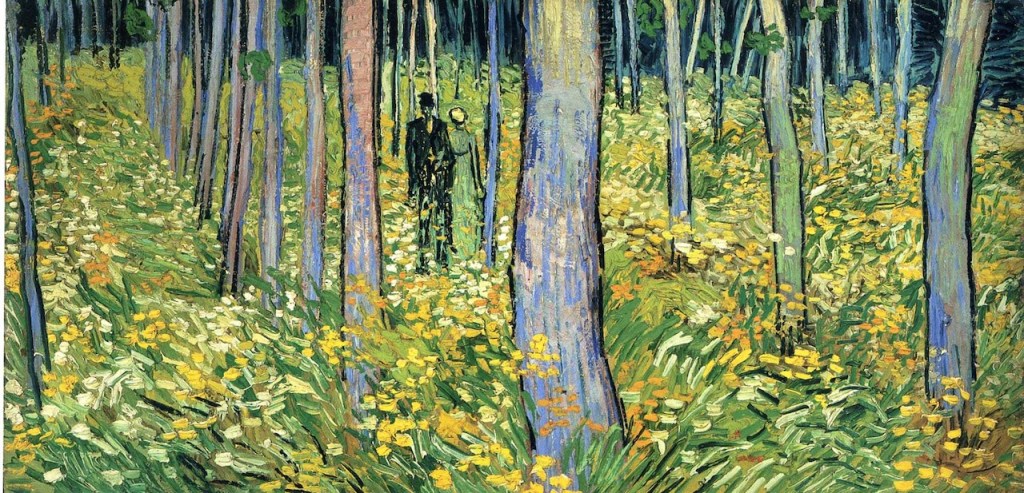
We walked out that day to get some air, the conversation had left me not knowing if we were coming or going,
the trees are a comfort always. even if you held my hand you would not touch my heart you could not say my name your tongue forked my brain,
your eyes reflected the lush, my yellow moon face opened to you like the wildflowers expectant, holding back nothing offering up to you everything,
when you spoke, you seemed to address the trees, you said they would build a sturdy bed for you and your bride. if i could hide here, i would not feel the need to tell you that she will
crash as soon as she eyes you face to face, as soon as she knows what i have learned about your poisoned honey; she is sinking in kisses, you are prickling beneath your smooth lies popping like mushrooms.
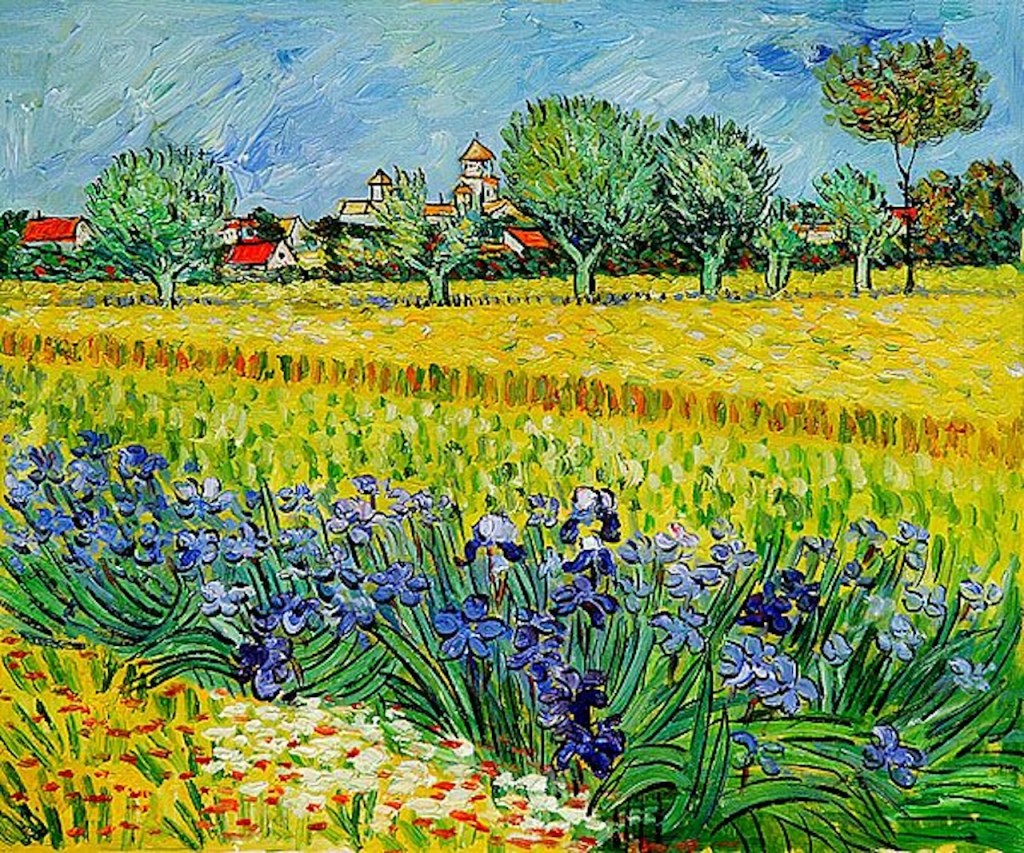
Vincent’sViewof Arles with Irises in the Foreground
To see as you do, Vincent, would give a soul a clearer heart: the trees that look like upside-down men, plunged headfirst into the earth to their waists, their leaves like women’s hair blown by the wind and the irises’ pouting lips parting for the butterflies and the bees,
the red roofs under which the harlots of Arles grind their tricks into dust, and the church tower remanding all eyes to look up at that troubled paint in the sky— those tiny strokes. your fingers, your brushes, and your burden of beauty.
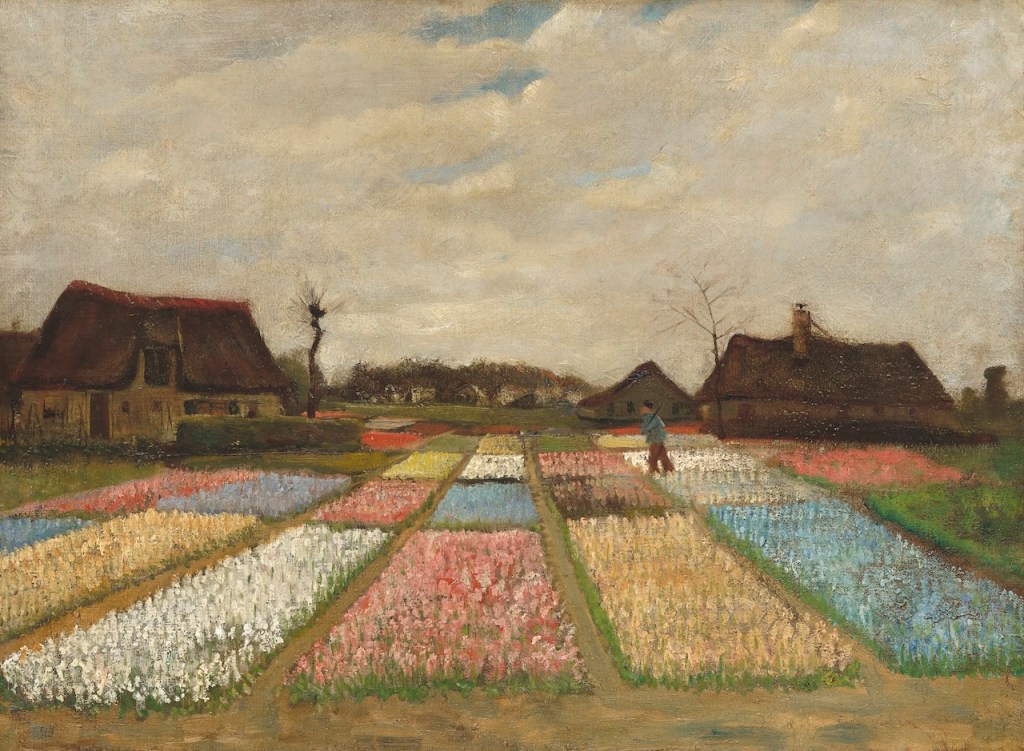
Who is that man walking between the white tulips Carrying a rifle? we will hunker down out of sight Until he has passed. he will probably disappear beyond That cottage in a moment and then we can pull up close To the tulips and watch their lips cup the bees. you Will say my lips are the color of the frosty pinks, and I Will say your eyes match the dreamy blues. someday, I tell you, I will have a dress like those golden-hues and You will have a shirt as delicious as the peach-blush. You tell me that your mother grows beautiful flowers, But she has never been able to cultivate a healthy African violet, so I say, let’s go back into the house And I pick one out for her. you take her the plant. And leave me contemplating the painting. years Of contemplating and many poems later I study the Flower Beds in Holland and wonder About the African violet in your mother’s house.
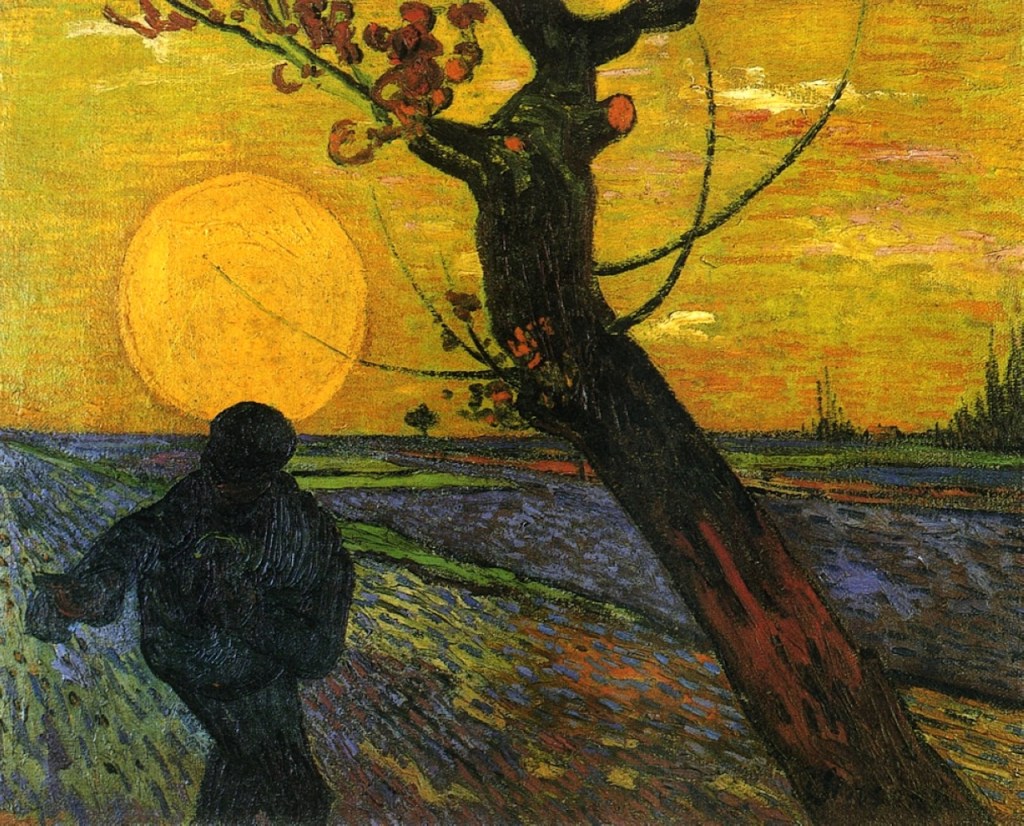
How the sun rings The top of his head Like a giant solid halo. The seed bag slung Over his right shoulder. How his face tilts down As his sowing arm Swings out, open hand Letting loose the seeds But where are the seeds? You can’t distinguish them From the other paint drops In the field. and what about Other parts of this field That is so neatly sectioned off? But it’s too hard to tell if They are planted & if planted What they are planted in. But never mind, Let’s have another beer And concentrate on that sun, That setting sun is important, After all, vincent called it, Sower with Setting Sun. I chose to call my poem “The Planter” but i too feel That the sun is important. The sun has painted the sky A golden hue. A naked tree looms In front of the planter, A dying tree. His house sits back Off to the left Of the fields, A long walk, He is getting tired, And as soon as the sun Sinks behind that blue line, He will have relieved himself Of all his seeds And head home to supper.
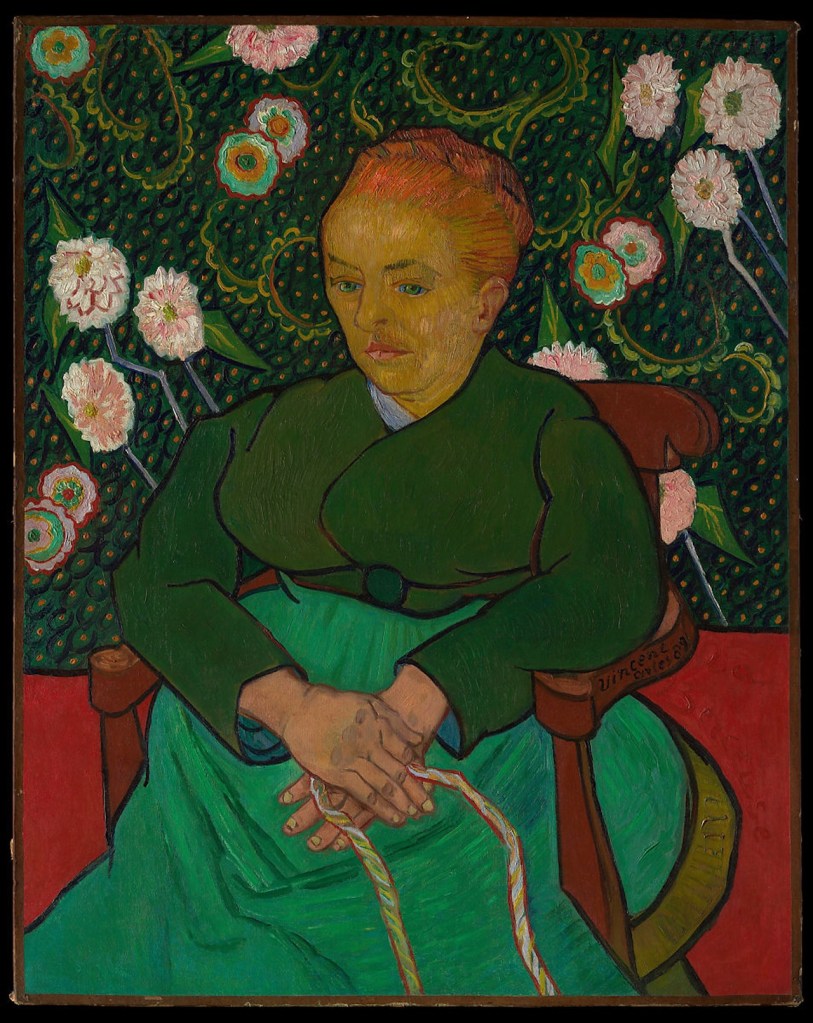
1 Madame Roulin’s pudgy body fills up the chair. She’s a short-waisted dump of a woman, her hair scraped back tight away from her eyes, her eyes peer two blanks downward, her mouth matches the empty look of the eyes but adds a sour touch with those pursed lips.
The happy flowers on the wallpapered background contrast with her face. Her cold countenance makes me shudder for the pauvr’enfant in her care, she rocks the cradle with a rope.
2 This is her moment to muse about those early days in the cafes, when the soldiers and their women preened and crowed, and the hookers with their painted faces stole tips from the waitresses and then her man took her for a virgin and after little Marie died, and after he cried and went back to sea, she settled down with a cradle and a rope to keep house for other people and is well fed.
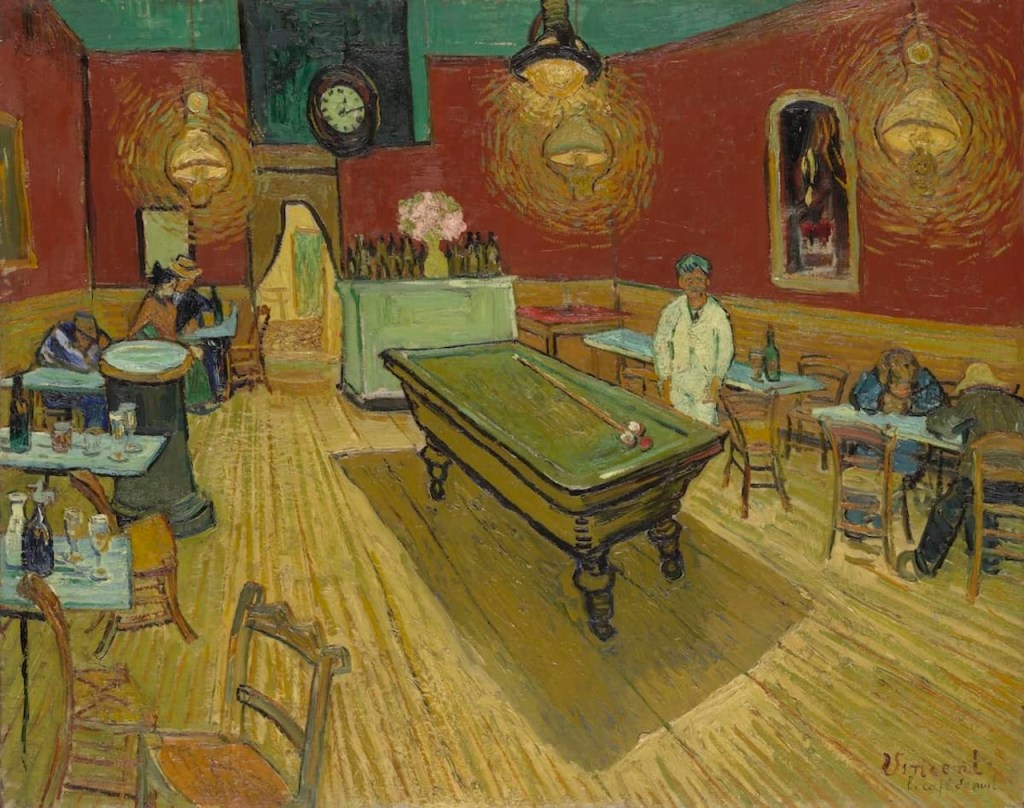
Vincent’s tortured paint has drawn me To a place I would never go, Now that saintly solitude has become my solution. But then of the six people in the cafe Only a man and a woman back in the left corner Sit together, Sharing a bottle & whispers, I guess. Later, after they leave their empty glasses, Will they stay together or shuffle down The solemn streets alone?
A man slumps at the table nearest the couple, No glass or bottle on his table. A bottle, half a drink, & three empty glasses stand On the table near the slumping man; a carafe, an empty Bottle & two half-empty glasses on the next table As I travel towards myself marking the abandoned tables. A pool table casts an unlikely shadow over too much floor, & a man has risen from his chair, stands by the pool table Gazing at me through the troubled paint. Shying away from his eye, I mark behind him another table holds a half-full bottle & a full glass, probably his bottle & glass. The last two figures also slump, also without drinks. Sitting Catty-cornered they seem to face each other, having A less than intimate conversation. But then they, as well As the first slumper, are perhaps sleeping, likely homeless men & these tables their only warm bed. I wonder if Vincent knew.
The Night Cafe—a place I could not go: Those red walls & green ceiling & friendly lamps Hanging down & the booze bottles Standing brazen on a cabinet Against the back wall; a curtained Doorway suggests someone Lives back there behind the cafe, Unless, of course, I’m turned around & that is the entrance. In any case I would never go there (well, maybe If you invited me, for a drink and some intimate conversation)
Because—at this writing— I know I have more in common with artists Than I do with the saints.
They have plowed, sowed, And reaped their fields in peace. Upon the riverbanks, They cast their eye. Yet, they have never prayed For quick release From tasks that last Until the last goodbye. They went about on wings, Helped others rise. They raised their food And used their useful tools. Their little worries sparked With shouts and cries, But then their product proved They knew the rules.
Bridges, buildings, gardens Grew year by year. Their music wafted nightly From their strings. Exalted words went Sparkling far and near: The king would dance, And then the queen could sing. They plowed the fields And many came to see That rustic life As robust as a tree.
II. The Fisherman
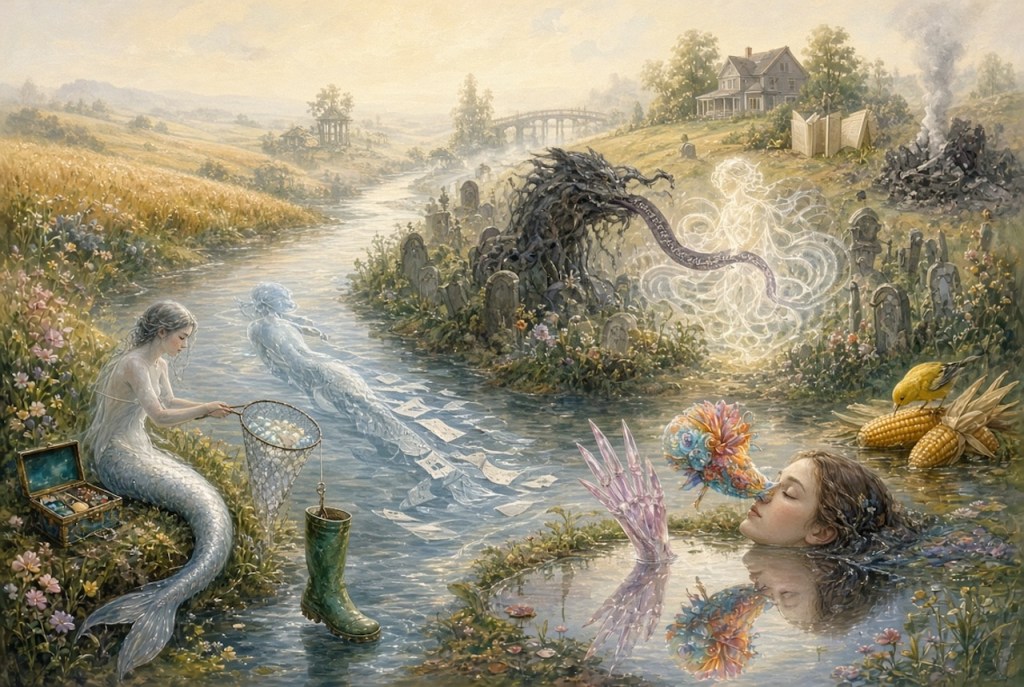
I used to write poems that left a fish smell on the page. You had to scale them to taste them so they left too much of me out And made me sound as if I were about to sprout Fins, but that was before I met the man with the net— The man whose tackle box opened like Pandora’s.
He tried to humor me with night crawlers big a fingers, Called me his little mermaid, which made me half happy. We’d sit by the river, his pole in his hand ready to land a big one.
Once I asked him to let me hold it but he said My hands were too small and being a woman I wouldn’t give enough slack to the line.
Suddenly, he yelled, “I got one! It’s big! Grab the net!” I grabbed it, handed it to him, Then jumped in a started swimming upstream.
As I looked back, I saw him Pulling his hook out of a big, green, rubber boot.
I used to write poems that left a fish smell on the page, But that was before I met the fisherman who showed me his sole.
III. Never Poke a Rough Beast from the Past
Never poke a rough beast from the past: Likely, you will find yourself ambling Among tombstones in the rain Through a ramshackle garden From which you fled So many years ago.
Out of that moldy drizzle, you emerged. Into healing waves, you progressed.
From a death-star specter, into the life-breathing spirit, You returned, grateful that the Unsensed Force Had directed your return home, Where poetry could spray in joy.
Never poke a rough beast from the past, Unless you are willing to be singed By the bile spewing through his forked tongue. Unleashing his aggressions, he is rabid To strangle you with his tangled verbiage, To erase you as he covets your triumphs.
Never poke a rough beast from the past— The present will secure your future As you walk in Spirit.
IV. A Colorful Flowerhorn
The incarnation began with a bright foot Curling her toes in the dark hours— She confessed to greater sins In the brute waters of the river Where she gasped as she Imagined she was drowning In the muddy gloom of the dark waters. She was without canoe or paddles As a colorful flowerhorn bloomed from her nose; She sought myriad breathes In the steel blanks of the rose rims. The colorful flowerhorn loomed Before her bulging eyeballs Searching the reaches of a netherworld. She would not sense the essence Of some monster’s soul. Her pink fingers become knives. A yellow finch pecks at ears of corn. She can no longer feel her hands. Her head no longer moves to speak. She snores but does not wake up yet Until morning blasts sunlight through the window. Staggering to the bathroom Nearly falling over the colorful flowerhorn She squeaks the shower tap Starts in relief That she sees water and not blood— A quick glance at the mirror, And the colossal flowerhorn blooms again from her nose. She is ready to meet the new day.
V. City Slacker
Richmond, Indiana, April 1968
His preening smothered his brain. His high school shelved him Into the Air Force Which booted him for acting Like a loon. He grew up In the north end, married A co-ed, country girl way south Of the south end— Two wrong sides of all the tracks, But he did own a set Of Encyclopaedia Britannica.
The day the town exploded, He took his wife for a walk To look at the rubble. Back In their tiny apartment, He returned to his Machinations in lunacy; She went on stumbling Down the course That would blow up Inevitably in divorce.
“Perhaps the time has already come . . . when the sluggard intellectof this continent will look from under its iron lids and fill the postponed expectation of the world with something better than the exertions of mechanical skill.” —Ralph Waldo Emerson, “The American Scholar” 1837
You have mistaken the hands for the heart, The craft for the art, The brain for the mind, The plane for the destination.
The scholar schooled on Man Thinking must ask:
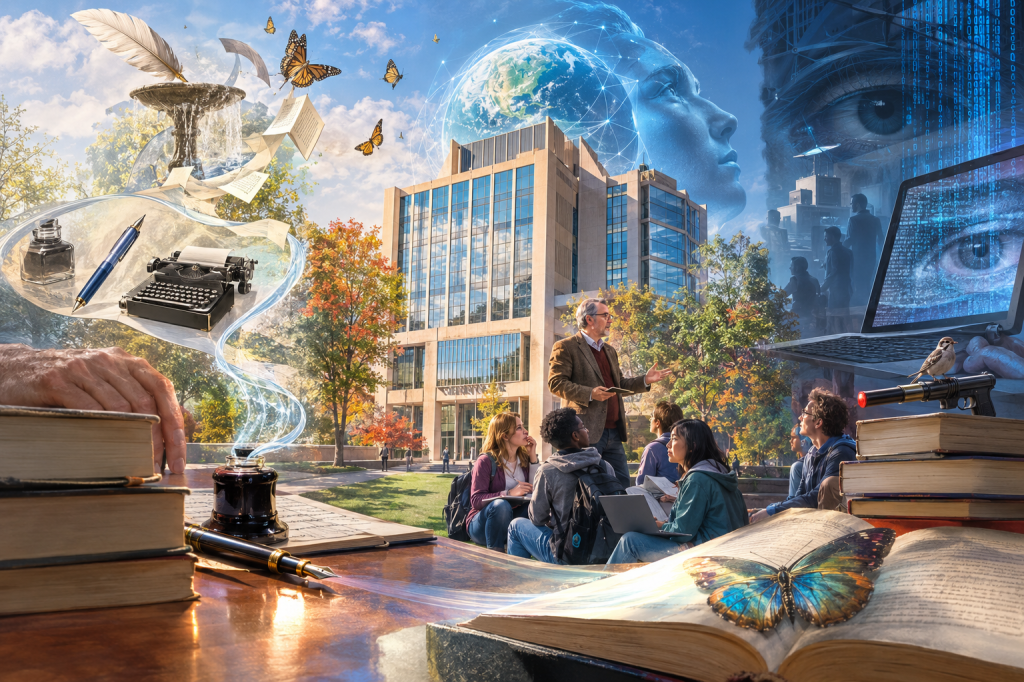
When the fountain replaced the quill, Did the masters tout it as the solution To all pedagogical problems? a fount of creativity?
When the ball point edged out the fountain, Did they once again shout “panacea”? Ideas become more liquid?
When typewriters lined up in classrooms, Did English professors march their students in to improve The essay? keys take on mind power?
All are fragile, who would teach and learn. But our students know the difference Between a tool and a work.
They come to us to search, if not seek, their souls. If we demand that Man Thinking is Man Computing We impede their ability to search and seek.
II. Those Who Fear Big Brother
“Let the scholar not quit his belief that a popgun is a popgun, though the ancient and honorable of the earth affirm it to be the crack of doom.” —Ralph Waldo Emerson, “The American Scholar” 1837
You finger the edge of the new page But refuse to read it: Maybe you can’t control the syntax, Maybe you’ll have to ask someone to help you— Someone who is not as good as you are, Some morale-less underling.
You do fine with your pen and ink— You do write type, though, if the machine Does not plug into the wall.
You suspect that invisible criminal activity Is playing in the network of the system: Whiz-kids accessing your bank accounts, Administrators processing your thoughts.
Your students laugh loud at the clever insults You spit at the machine, But they know the difference between A stagecoach and an airplane.