inspired by Paramahansa Yogananda’s “Consecration”
A sonnet’s full throat hast Thou, my Guru, Placed in Thy opening lay of “Consecration”— In Thy masterful Songs of the Soul— Where shower meets flower as grown follows born Where the loneliness of seeking Finds the seeker found.
A second sestet bursts into a humble offering— Thou spreadest before the All-Seeing Divine Thy sheaves of leaves—the best flowers From Thy garden of verse. Thy flowers’ scent exudes, soul-inspired. Thy riming power leaves the petals in tact.
Would that I may follow Thy lead, To that Cosmic Home in verse and in deed.
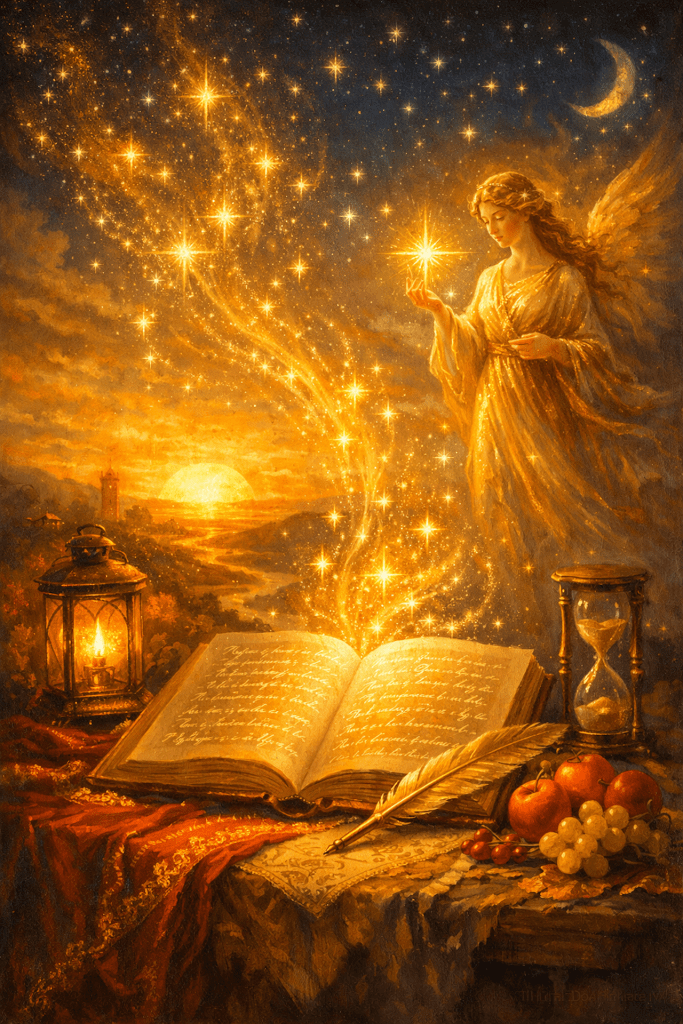
Image: Created by ChatGPT inspired by “Would that my sonnet shine”
Would that my sonnet shine
Would that my sonnet shine like burnished gold So thou canst marvel long at its pure gleam: A sonnet so warm that banishes cold And serves to guide and guard through a dark dream. Its lines would keep the heat of noonday sun. Their beauty would catch fire—a burning crest. The fruits of its labor would let it run To hearts and minds so sore in need of rest. Would that my sonnet be velvet to touch To show that truth is always here to serve. Would that each word become a star or such As any lantern lighted works with verve. I hope that riming truth thy soul will feed, And that my sonnets work to meet thy need.
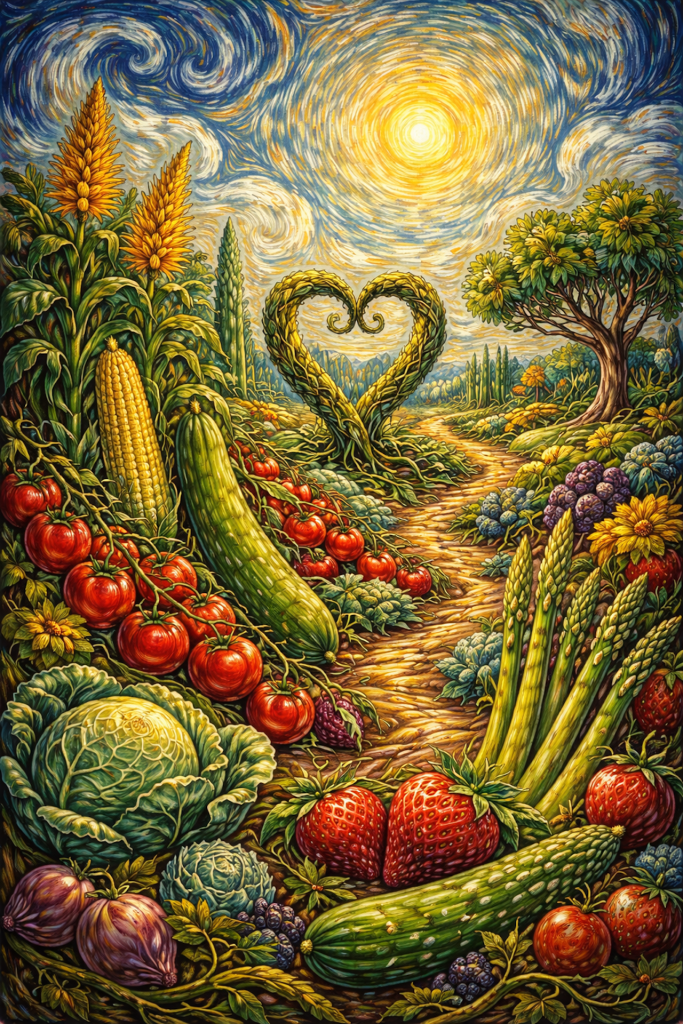
Image: Create by ChatGPT inspired by Vincent van Gogh and “Love Thoughts Are Green Things“
Love Thoughts Are Green Things
Love thoughts are green things growing in the garden of the brain Under the sun of smiles, in the moisture of metaphysical rain: One peppers your blood, another cucumbers your heart, Others stalk your heels in proud rows of corn, Some trail along your skin, juicy as strawberries in a patch, Others point your eye skyward in steeples of asparagus.
And then there is the thought of the hands that planted the seeds, And then plucked the fruit, and the tongue that tasted them: Peopling gods cavorting in the garden, expelled for wonder-lust, Rebelling against the very thought that created them, Lovers bury their heads to squash all these rioting thoughts. Love thoughts of the ultimate fruit in its ripe fullness And the cycle and the sun and the rain— All that unrequited love.
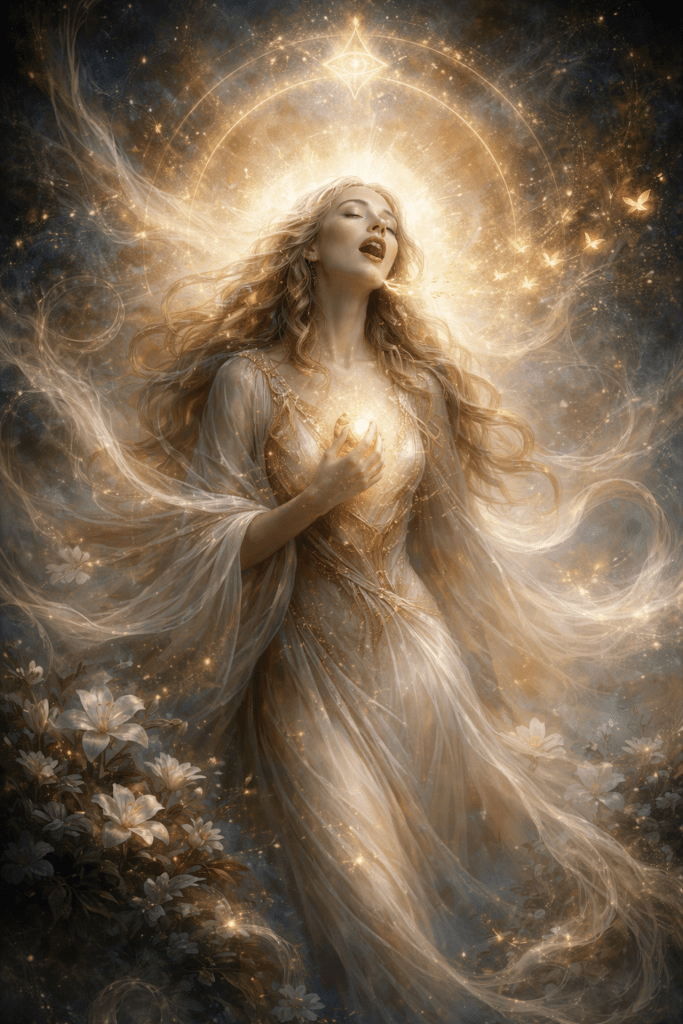
Image: Created by Grok inspired by “Abandoned Garden”
Abandoned Garden
Thou didst plough me; Thou didst plant Thy seed, But Thou didst not remain to tend my growing—
Now, Thou send’st sun to feed & rain to suckle me. Thou send’st fingerling thoughts to prod me & pluck my weeds— But without Thee, I grow only faint-hearted fruit.
Original Poems: “Dust of a Baptist” and “Southern Woman” – A Tribute to My Mother
Mother’s Day always reminds me the beautiful soul, who was my own belovèd earthly mother. Here is my musing tribute to her along with two original poems that she has inspired. I wondered why she called a certain wildflower “flags”—now I think I know.
Daylilies, aka “The Grand Old Flag”
You’ve seen them growing abundantly out in fields, along river banks and old country roads, even along busy highways and Interstates. They are orange wild flowers known as Daylilies.
They are hardy and so abundant that some folks feel they are intrusive and seek to stop their spreading abundance. Such an attitude baffles me because I have always loved those flowers, and I have always wondered why my mother called them “flags.”
I did not know until recently that they were a type of Daylily, and I had no name for them except what my mother called them. Why did she call them “flags”? I think I now know.
An Emily Dickinson Poem
I was writing a commentary on Emily Dickinson’s poem “All these my banners be” (number 22 in Thomas H. Johnson’s The Complete Poems of Emily Dickinson), which is a fascinating tribute to her love of nature (especially flowers). But tricky Dickinson once again is writing on the two distinct levels as poetry nearly always does. On the literal level, she is addressing flowers and on the figurative level she is addressing her little creations—her poems.
The controlling metaphor employed by Dickinson this poem is “banners,” which is another term for “flags.” I decided to do a little research on the term “flags” as flowers and soon was directed to the Daylily. On several sites the phrase, “The Grand Old Flag,” appears next the name of the Daylily, for example, here and here.
Things My Mommy Taught Me
I now feel safe in assuming that the name “flags” for the common Orange Daylily stems from certain types of Daylilies boasting the appellation, “The Grand Old Fag.” I’m sure my mother heard her mother or other relatives call those flowers “flags.” And thus that remained the term for them that she had and passed on to me.
As I write my commentaries about poems, from time to time, I become fascinated by the things I learn, and when those things take me down memory lane, reminding me of the rich treasure trove that was my mother’s mind, I feel blessed. My mother chafed under the fact that she possessed only a sixth-grade education.
My father had graduated from high school, and I think that my mother’s two brothers and two sisters had completed high school or at least managed to get a grade or two above her mere six grades. But she could read and write, and her memory was outstanding. She remained an avid reader and learner her whole life long.
I now chafe under the fact that I did not do all that was in my power to make my mother know just how much I appreciated her knowledge, her wisdom, her guidance, and her model for a moral life.
She could be testy, opinionated, provincial, and I know I disappointed her with some of my choices in life as I grew through my teen years and early adulthood. But I loved her more than I could even realize during my troubled teens and equally troubled early adulthood.
My mother left this earth on September 5, 1981, after having turned 58 years of age on her last birthday, June 27, 1981. Dying at such a young age always mystifies and saddens the living.
She seemed so vibrant and full of health, but it is likely that her suffering in childhood the illness of rheumatic fever weakened her heart. She was no hypochondriac, and she seldom visited doctors.
She studied nutrition and tried to improve her diet over the years. But she continued to smoke cigarettes, which likely contributed to her early passing. I am grateful for my mother’s love and the affection that she showed me as I grappled my way to adulthood. My love and appreciation for her has grown exponentially over the years.
But I do wish I had told her more often and more convincingly just how much she meant to me. My guru Paramahansa Yogananda said of his mother, whom he lost at the tender age of eleven,
I loved Mother as my dearest friend on earth. Her solacing black eyes had been my refuge in the trifling tragedies of childhood. ——Autobiography of a Yogi
I can say the same about my love for my mother.
While I loved my father, my sister, uncles, aunts, cousins, and other relatives with all my heart, love for my mother has always been and will always remain a special presence in my heart and mind.
She continues to call to me from her home in the astral level of being. I know she knows how I feel, how I miss her, and I long to be able to hold her in my arms and tell her just how much she has always meant to me.
All Things Spiritual
My spiritual arms embrace her always, my mystical mind communicates with her, and her soul power enlivens my thoughts as she continues to shed her special light in the Great Beyond.
My mother maintained a level of faith in all things spiritual that only one who had experienced the profound event of seeing her own beloved father after his death could afford. She knew that the soul did not “die.” She knew it because of that visitation from her father, whom she loved as her “dearest friend on earth.”
My gratitude to my mother has grown deeper over the years, as I have realized that her describing that experience of having seen her father after he died is likely responsible for my ability to understand and accept the teachings of Paramahansa Yogananda.
Without that early, tangible hint that life does not end at death, the concepts of reincarnation and karma would likely have been more than a “highly educated” college graduate could accept. The blight of agnosticism and atheism inflicted by a college education on so many unsuspecting minds remains a sad, destructive force in modern life.
If losing one’s faith in a spiritual level of being has to result from becoming “highly educated,” I would choose to stay at the sixth grade level where my mother’s formal education ended and instead remain steeped in the faith that there is more to life than books and professors have to offer, or as Hamlet put it to Horatio:
There are more things in heaven and earth, Horatio, Than are dreamt of in your philosophy. —-Hamlet, 1.5.167-8).
Without the concept of reincarnation and karma, very little in life on this mud ball of a planet makes sense. Accepting the notion—”Life is not fair”—is the sad result of a lazy mind; for if one continues to question, “Why is life not fair?,” keeping an open mind, eventually answers will come. And often they are likely to come in the concepts ofreincarnation and karma.
And although, I never got the chance to fully explore and examine those concepts with my mother, I have faith that she intuitively understood them without the intellectual fever such a discussion could entail.
She needed no philosophical discourse to convince her that the “afterlife” exists, because she knew that the soul was an everliving entity. On the day that he appeared before her, my mother’s father taught her that souls do not die.
My Poems and My Mother
My mother continues to provide me with material for poems, so any tribute to Mommy would remain incomplete without offering her a sampling of my poems, celebrating my affection and appreciation for her love and guidance.
Mommy, I love you, I miss the physical reality of you, but I feel your spiritual presence as my mystical mind opens itself to the astral home in which you continue your existence.
Accept this tribute that I am offering for the purpose of sharing with you my thoughts, prayers, and abiding love that I will always harbor in my core being for you, a beautiful soul.
Dust of a Baptist
In Memoriam: Helen Richardson June 27, 1923 – September 5, 1981
You let loose on this world a maudlin tongue And wore like a veil your woe and worries. Died of a broken heart at the edge of autumn, You are tucked away with the old fathers and mothers. You grieved like a child walking in a melancholy fog. Kept your dead alive in the wrinkles of your heart. Pain gathered you in his arms and sorrow became your passion. You hollowed out of life your space to mourn.
But I have felt your prayers and lived their answers. You spent your heart to save me from my miseries. If you could have, you would have spared me The evil that goaded me into marrying a devil.
The road through this life covers us with dust But the clear soul moves us to drink at the spring of living water.
Southern Woman
In Memoriam: Helen Richardson June 27, 1923 – September 5, 1981
Through astral reverie, I visit your essence, Lingering alongside that of your beloved father— The grandfather who escaped this earth prison Before I was sentenced to its concrete and bars.
You are the same small brown woman with blackHair and eyes of fire that flash, imparting to meYou intuit I am near, perceiving you both—my firstLook at the Greek grandfather I never met.
Our Greekness on this planet has ledUs back to a logical legendary ancestor—A strong Spartacus whose love of freedom spreadEven as he perished like Christ on a cross.
But you are a pure American South womanAnd if any Kentucky woman deserves the titleOf steel magnolia, it is you, who through a frailBody still attests the strength of a Sandow.
Your ethereal mind reminds me of the dayWe saw those two turtles come into the yard.Standing over them, we marveled, and I will neverForget what you said: “If we had shells like that,
We would be protected from the dangers of this world.”And I felt that I was in the presence of a wise master.It was only later that I realized the full impactOf what seemed a simple yet deep message—
We need a protective shell even more to shield The heart than the head, for it is through the emotions That we inflict enormous damage on our souls. I am Blessed and grateful to inform you I finally understand.
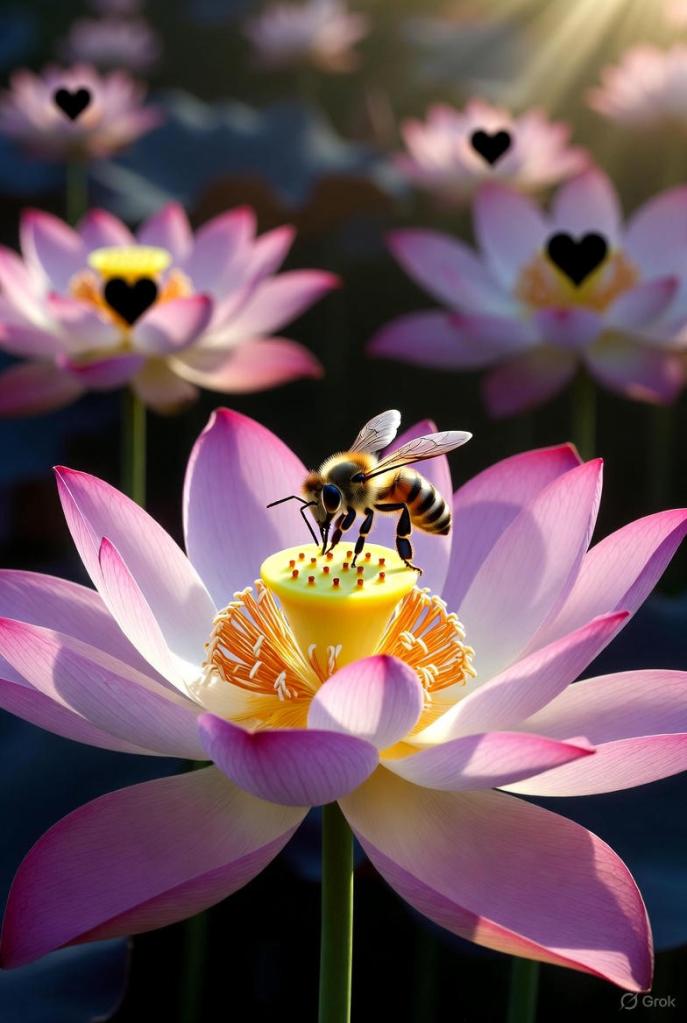
“Iam Thy little bee that yearned for the nectar of happiness, and I greedily drank from the blossoms of transient love. But when I came upon the eternal sweetness of Thy lotus heart, I hummed with desires no more.” —Paramahansa Yogananda
Greedily, I buzzed to sip love from the blossom of the black heart that held not a drop for me. Greedily, I craved the nectar of those lips on this parched tongue. Steadily, I hummed with the desire to hear that voice that never sang to me.
Hungrily, I now go down on my knees to know only the lotus heart of my Divine Belovèd—— O, Thou true heart of light! Thankfully, I am saved from debasing my soul in that greed for a black-hearted being. Steadily, Thou hast rescued me from the greed this flesh is heir to: I am Thy tiny bee!
Image: Created by Perplexity inspired by “Yea, though I Walk“
Yea, though I Walk
Through the valley where rock faces stick out of the moss— I walked that day until my feet had darkened like clay The color of rust in the sun sheeting off old automobile Bodies abandoned to the weeds by owners who Could no longer tolerate their undependability.
My heart stole the music of the thundering oaks Sharing their leaves and birds there in the coming rain That I smelled moments before it soaked my hair, My clothes, my skin while I had planted my feet In the ancient floor that curves and curves.
Upward, the hill led to the road and my dripping body Plodded the bend until a rainbow appeared in the east, Perfect, it stood one foot on Grimme’s fence The other on Richardson’s pond and my eyes worshiped The light and the process of creation and the ability
Of the mind to carry me through this valley Back to the road back across the grainfield
Along the edge of the water across the stone bridge To the other side of pain left by the still winter Until once again I had lowered my worn body
Until once again I could believe my soul would rise.



 Linda's Literary Home