Walt Whitman’s “When I Heard the Learn’d Astronomer”
Walt Whitman’s sprawling eight-line poem showcases the poet’s freewheeling style while dramatizing the wildly romantic world view portrayed in almost all of his poems.
Introduction and Text “When I Heard the Learn’d Astronomer”
Whitman’s “When I Heard the Learn’d Astronomer” provides a study in contrasts between science and poetry. The speaker makes his preference known that he favors looking at the stars over studying them. The speaker is a transcendentalist-romantic individual who is more interested in the life of the senses than the life of the mind.
Interestingly, however, this speaker demonstrates that, in certain instances, the senses can lead to a more spiritual experience than the mind. The speaker prefers to indulge his fancy rather than pay attention to the measured distances between heavenly bodies.
When I Heard the Learn’d Astronomer
When I heard the learn’d astronomer, When the proofs, the figures, were ranged in columns before me, When I was shown the charts and diagrams, to add, divide, and measure them, When I sitting heard the astronomer where he lectured with much applause in the lecture-room, How soon unaccountable I became tired and sick, Till rising and gliding out I wander’d off by myself, In the mystical moist night-air, and from time to time, Look’d up in perfect silence at the stars.
Reading:
Commentary on ““When I Heard the Learn’d Astronomer”
Walt Whitman’s sprawling eight-line poem showcases the poet’s freewheeling style while dramatizing the wildly romantic world view portrayed in almost all of his poems.
First Movement: When vs After
When I heard the learn’d astronomer, When the proofs, the figures, were ranged in columns before me, When I was shown the charts and diagrams, to add, divide, and measure them, When I sitting heard the astronomer where he lectured with much applause in the lecture-room
The first movement of Whitman’s influential poem consists of four adverbial clauses beginning with “when”:
1. when he listened to the lecture, 2. when the numbers were presented, 3. when “the charts and the diagrams” were shown, 4. when he heard the audience’s cheer the “learn’d astronomer.”
A fascinating riddle poses the question: “When the man jumped off the building, where was he?”
Possible answers: —Until he hit the ground, he was in the air— What’s wrong with that answer? That was “after” he jumped.
Then the person riddled might respond: —still standing on the top of the building— Wrong because, that was “before” he jumped.
This riddle is instructive for language use especially use in poetry. The adverb “when” is a flabby word, causing the ambiguity of unclarity as associated with an action. Thus if possible, one needs to consider whether the action occurred “before” or “after” the first event.
Whitman was such an astute observer of both events and language, but this poem could use one last revision changing the “when” clauses to “after” clauses because that is the accurate time frames for each of the actions that he mentions.
The reader will note that is was, actually, “after” all the following that he became “tired and sick” and determined to get up and leave:
1. after he had heard the scientist 2. after he had seen the stats and numbers 3. after he had been presented the charts 4. after he had heard the other audience members applauding the astronomer.
Second Movement: After Growing Sick and Tired
How soon unaccountable I became tired and sick, Till rising and gliding out I wander’d off by myself, In the mystical moist night-air, and from time to time, Look’d up in perfect silence at the stars.
After the speaker had listened to a portion of the lecture, he gets up and leaves the lecture hall, goes out into the refreshing night air and looks up at the stars. The event is simple, but the speaker’s dramatic portrayal of his actions enhances the act and makes it so much more interesting and meaningful than the mere event.
For example, the use of the word “unaccountable” contrasts with all the counting that was going on by the lecturer. The speaker is simply remarking that he grew “tired and sick” while listening, but he does not know why.
The speaker seems to have no reason for this reaction. He is cleverly leaving that reasoning up the reader to discern, after he paints his portrait of natural beauty in the final three lines, in which reports that he rose from his seat, moved out into the night alone, and then off and on gazed upward to the heavens where he was treated to the “perfect silence at the stars.”
Those final lines contrast the stuffy lecture hall with the lushness of the great outdoors; they contrast the enjoyment of being alone as opposed to being surrounded by people in the stuffy lecture hall. The night air is “mystical”—the speaker is carried to a transcendental height by the simple “moist night-air.”
And the best of all the observant speaker saves for the last; in contrast to the steady pace of the lecture, he leisurely “from time to time”—no hurry, no schedule, no following someone else’s line of thought—gazes up into the heavens and observes the brilliance of the stars themselves, instead of merely hearing about them through charts, diagrams, and numbers.
Walt Whitman remains one of the most important poets in American history. He has influenced every generation of poets since he first began to publish. He is rightly credited for leading American poetry into modernity. His long-lined, sprawling style is always easily recognized.
Early Life, Education, Early Career
Walter Whitman, Jr., was born on May 31, 1819, in West Hills, Long Island, New York, to Walter Whitman, Sr., and Louisa Van Velsor Whitman, a lower middle class family [1]. Walt, Jr’s early life greatly influenced his idiosyncratic world-view and artistic outlook. He became known as “Bard of Democracy” [2] because of his liberating employment of his cosmic, singular poetic voice.
His working-class parents worked hard to meet expenses, and the family changed residences often during Walt’s early years, in order to find better employment. These frequent new locations exposed the future poet to various environments, giving him an expansive outlook on life, as he experienced many different people from various backgrounds.
Walt was the second of nine Whitman children, and similar to the TV family “The Waltons,” the Whitman family often encountered scarce resources and many hardships as the parents labored to meet the needs of a family of eleven.
The poet’s father worked as a carpenter and as a farmer, but his laboring efforts never led to prosperity. This family dynamic led Walt to entering the workforce at an early age in order to help with family stay afloat financially.
The ancestors of the Whitman family had arrived in America as early as the 17th century, which rooted the family’s affection for their country very deeply, as the future poet would so often express in his works.
The poet remained close to his mother for his whole life. Louisa was a very affectionate and compassionate human being, and her positive attitude toward life proved to be a great influence on the life of her son. The poet could always count on his mother for unconditional love and support throughout his life.
Walt Whitman’s experience with formal schooling was virtually nil: he abandoned formal education after he turned eleven years old [3]. After a short stint in the public school system in Brooklyn, he made a swift departure because he family needed him to work and earn money to assist with family finances.
Despite leaving the formal schooling of the public eduction system, Walt continued to read, study, think deeply for the rest of his life. He pursued knowledge as assiduously as a bird seeks its daily nutritional intake. He maintained a life-long, insatiable thirst for knowledge.
After abandoning public education, Walt took a job as an office boy in Brooklyn [4]. After serving as an office boy, he became a printer’s apprentice, eagerly learning the craft of print- and typesetting. Such on-the-job experience brought Walt in contact with literary composition through manipulation of words, making them ready to publish.
Whitman later engaged in school teaching in a number of rural schools on Long Island. The sensationalism of a rumor has it that Whitman was tarred and feathered and chased out of the town of Southold for committing sodomy [5] on a student.
The likelihood of that particular rumor being true is virtually nil, because it has not been clearly established that Whitman ever taught in Southold. Whitman simply abandoned teaching because he found the work stultifying.
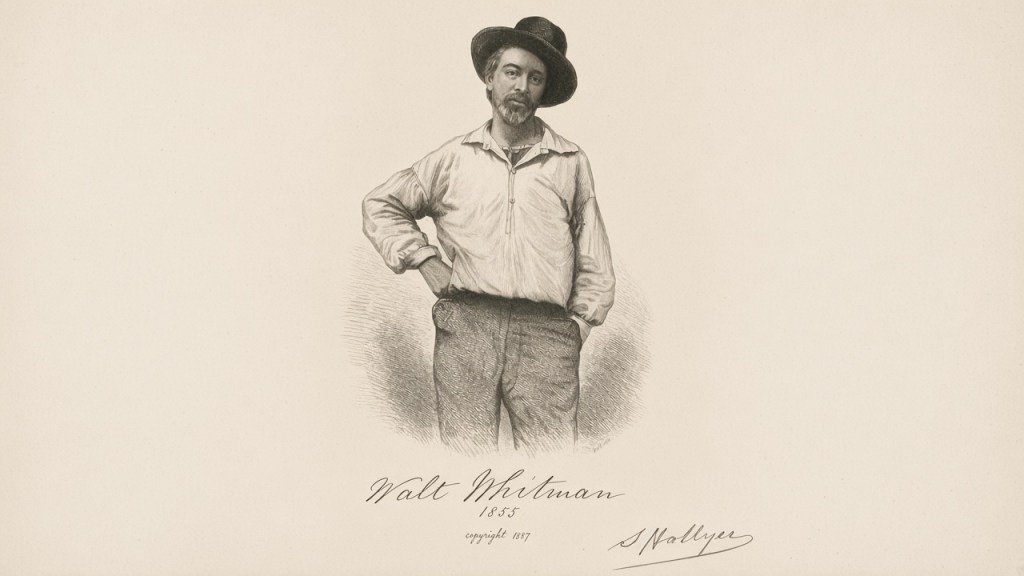
Image b: Walt Whitman portrait engraved by Samuel Hollyer, frontispiece to first edition of Leaves of Grass, 1855
Work in the Field of Journalism
Whitman’s actual career in journalism began in the late 1830s [6]. He founded and edited the Long Islander newspaper in Huntington. His early experience in the field of journalism allowed him to develop his writing skills and engage in public discourse.
At age 23, Whitman became the chief editor of the New York Aurora. By September of 1845, four months after turning 26 years of age, he had newspaper experience from working for at least a dozen newspapers.
He flitted from one newspaper to the next, often holding editorial duties. Whitman worked for several different papers in Brooklyn and New York City, including the Daily Aurora and the Brooklyn Eagle. His time as an editor sharpened his skills in crafting clear, concise prose. He also learned to handle deadlines.
Whitman’s experience in the field of journalism afforded him a stage upon which to elucidate his opinions and insight into political as well as social. issues. He became a staunch advocate for democratic principles and often broached topics such as abolition and temperance. His many editorials revealed his growing social awareness and reformist consciousness.
Dedication to Poetry
The publication of Leaves of Grass in 1855 [7], heralded a new era in American literature. Whitman self-published the first edition, which contained only twelve untitled poems. This innovative work defied conventional ideas of poetry, as it brazenly put on display free verse and non-traditional subject matter.
Famously, Whitman continued to revise and expand Leaves of Grass throughout his entire life, producing multiple editions. Each new revision revealed Whitman’s continuing artistic growth as well as the changing social worldviews and mores. The manuscript through its ever widening scope seemed to reflect the very growth of the nation itself.
His poetic style played out in a sweeping scope and direct address, all in celebration of the individual and the everyday person. Whitman wrapped his mind and heart around the entire spectrum of human experience—from the ordinary to the extraordinary, from the mundane to the transcendent. Within his poetry, Whitman strove to include all of America and all of what Americans had to offer the world.
Civil War and Humanitarian Work
The American Civil War (1861—1865) had a profound impact on the poet [8]. He diverted his intensity from writing to humanitarian efforts. He went to Washington, D.C., in 1862 after his brother George was wounded in battle. This experience showed the poet first hand the immense suffering caused by the war.
Whitman then became devoted to giving care to wounded soldiers in the military hospitals of Washington. He spent many hours calming and comforting the ill and dying.
Whitman helped the recovering soldiers write letters, and he even dressed their wounds, which was greatly appreciated by the overworked doctors and nurses. These selfless compassionate duties became the cardinal core of Whitman’s identity as a human being, as well as an expansive poet.
Whitman’s war-years experiences greatly affected his later poetry, particularly in works such as Drum-Taps and Memories of President Lincoln. He bore witness to the grim realities of conflict but also to the resilience of the human spirit. The war profoundly contributed to his understanding of the American identity.
Following the war, Whitman continued working in government offices, even as his health began to suffer. In 1873, he was afflicted by a paralytic stroke, severely limiting his ability to walk. Despite his physical health issues, he continued his writing and revising Leaves of Grass.
Whitman relocated to Camden, New Jersey and spent his final years in that city [9]. In Camden, he received visitors from around the world [10] who sought out the beloved poet. His home became a pilgrimage site for admirers of his innovative and influential works that focused on democratic ideals.
Walt Whitman died on March 26, 1892 [11], leaving an exceptional literary legacy. His Leaves of Grass remains a monumental achievement, influencing the course of American poetry for generations. The poet remains a towering, renowned personality in world of literature and literary studies, celebrated for his creativity, individualism, and originality.
Legacy
Whitman’s influence [12] has extended far beyond the field of poetry; it has continued to attract successive generations of poets, essayist, journalists, and thinkers. Whitman’s celebration of democratic principles, individualism, as well as the interconnectedness of all things continues to find positive responses from new readers.
The Whitman legacy, similar to that of Ella Wheeler Wilcox, can serve as a mollifying corrective to the obstructive impact that postmodernism has inflicted upon the poetry world. Decade upon decade, Walt Whitman’s poetry and prose, as well as his fascinating life story, continue to offer testimony to the power and influence of a truly unique voice.
Sources
[1] Editors. “Walt Whitman.” Family Search. Accessed September 19, 2026. [2] Curators. “Walt Whitman: Bard of Democracy.” The Morgan Library an Museum. Accessed June 2, 2025. [3] Ed Folsom and Kenneth M. Price. “Self-Education.” Walt Whitman Archive. Accessed June 2, 2025. [4] Editors. “Walt Whitman.” Biography. Updated: September 14, 2022. [5] Editors. “Schoolteaching Years.” Walt Whitman Archive. Accessed September 19, 2026. [6] Philip Eil. “On Walt Whitman, Unsung Newspaperman.” Literary Hub. May 29, 2019. [7] Editors. “Leaves of Grass, 1855-1861.” Library of Congress. Accessed September 19, 2026. [8] Editors. “Walt Whitman and the Civil War.” PBS. Accessed September 19, 2026. [9] Curators. “Walt Whitman.” The Historical Marker Database. Accessed September 19, 2026. [10] Curators. “Welcome.” The Walt Whitman House. Accessed September 19, 2026. [11] Rhys Griffiths. “Death of Walt Whitman.” History Today. March 3, 2017. [12] Curators. “The Powerful Influence of Walt Whitman.” Crystal Bridges Museum of American Art. April 27, 2017.
Recommended Print Sources for Walt Whitman
Gay Wilson Allen. The Solitary Singer: A Critical Biography of Walt Whitman. New York: The Macmillan Company. 1955.
James E. Miller, Jr., editor. Complete Poetry and Selected Prose by Walt Whitman. Boston: Houghton Mifflin Company. Riverside Editions. 1959. Walt Whitman. Leaves of Grass: The Deathbed Edition. New York: Simon & Schuster. 1992.
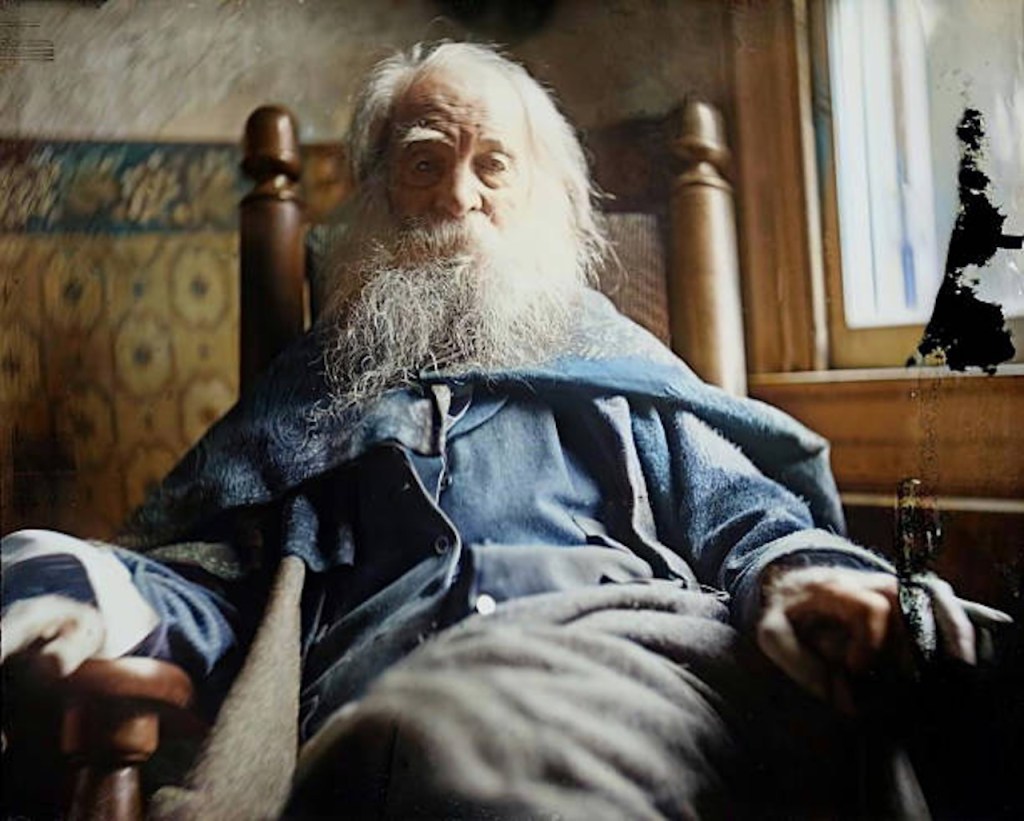
Walt Whitman in Camden, N.J., c. 1891. (Colorised black and white print). Creator: Thomas Eakins. (Photo by Heritage Art/Heritage Images via Getty Images)
Walt Whitman’s “When Lilacs Last in the Dooryard Bloom’d”
Walt Whitman’s admiration for President Lincoln is dramatized in the poet’s elegy “When Lilacs Last in the Dooryard Bloom’d,” mourning the death while celebrating the presidency of the sixteenth president, Abraham Lincoln.
Introduction and Text of “When Lilacs Last in the Dooryard Bloom’d”
In Walt Whitman’s “When Lilacs Last in the Dooryard Bloom’d,” the speaker laments the death of President Lincoln, but he does much more than merely offer his own sad and melancholy state of mind. This speaker creates a sacred myth through which he not only offers a tribute to the fallen president but also creates a symbolic triad that will henceforth bring readers’ and listeners’ attention to the momentous event.
The speaker also composes a “Death Carol,” in which rests the irony of elevating death from the lamentation it usually brings for a celebrated friend whom all suffering humanity can afford the fealty of welcome.
It might be observed that poet Walt Whitman sectioned his elegy into 16 parts, symbolizing the fact that Abraham Lincoln, the heroic subject of the poem, had served as the sixteenth president of the United States.
When Lilacs Last in the Dooryard Bloom’d
1
When lilacs last in the dooryard bloom’d, And the great star early droop’d in the western sky in the night, I mourn’d, and yet shall mourn with ever-returning spring.
Ever-returning spring, trinity sure to me you bring, Lilac blooming perennial and drooping star in the west, And thought of him I love.
2
O powerful western fallen star! O shades of night—O moody, tearful night! O great star disappear’d—O the black murk that hides the star! O cruel hands that hold me powerless—O helpless soul of me! O harsh surrounding cloud that will not free my soul.
3 In the dooryard fronting an old farm-house near the white-wash’d palings, Stands the lilac-bush tall-growing with heart-shaped leaves of rich green, With many a pointed blossom rising delicate, with the perfume strong I love, With every leaf a miracle—and from this bush in the dooryard, With delicate-color’d blossoms and heart-shaped leaves of rich green, A sprig with its flower I break.
4
In the swamp in secluded recesses, A shy and hidden bird is warbling a song.
Solitary the thrush, The hermit withdrawn to himself, avoiding the settlements, Sings by himself a song.
Song of the bleeding throat, Death’s outlet song of life, (for well dear brother I know, If thou wast not granted to sing thou would’st surely die.)
5
Over the breast of the spring, the land, amid cities, Amid lanes and through old woods, where lately the violets peep’d from the ground, spotting the gray debris, Amid the grass in the fields each side of the lanes, passing the endless grass, Passing the yellow-spear’d wheat, every grain from its shroud in the dark-brown fields uprisen, Passing the apple-tree blows of white and pink in the orchards, Carrying a corpse to where it shall rest in the grave, Night and day journeys a coffin
6
Coffin that passes through lanes and streets, Through day and night with the great cloud darkening the land, With the pomp of the inloop’d flags with the cities draped in black, With the show of the States themselves as of crape-veil’d women standing, With processions long and winding and the flambeaus of the night, With the countless torches lit, with the silent sea of faces and the unbared heads, With the waiting depot, the arriving coffin, and the sombre faces, With dirges through the night, with the thousand voices rising strong and solemn, With all the mournful voices of the dirges pour’d around the coffin, The dim-lit churches and the shuddering organs—where amid these you journey, With the tolling tolling bells’ perpetual clang, Here, coffin that slowly passes, I give you my sprig of lilac.
7
(Nor for you, for one alone, Blossoms and branches green to coffins all I bring, For fresh as the morning, thus would I chant a song for you O sane and sacred death.
All over bouquets of roses, O death, I cover you over with roses and early lilies, But mostly and now the lilac that blooms the first, Copious I break, I break the sprigs from the bushes, With loaded arms I come, pouring for you, For you and the coffins all of you O death.)
8
O western orb sailing the heaven, Now I know what you must have meant as a month since I walk’d, As I walk’d in silence the transparent shadowy night, As I saw you had something to tell as you bent to me night after night, As you droop’d from the sky low down as if to my side, (while the other stars all look’d on,) As we wander’d together the solemn night, (for something I know not what kept me from sleep,) As the night advanced, and I saw on the rim of the west how full you were of woe, As I stood on the rising ground in the breeze in the cool transparent night, As I watch’d where you pass’d and was lost in the netherward black of the night, As my soul in its trouble dissatisfied sank, as where you sad orb, Concluded, dropt in the night, and was gone.
9
Sing on there in the swamp, O singer bashful and tender, I hear your notes, I hear your call, I hear, I come presently, I understand you, But a moment I linger, for the lustrous star has detain’d me, The star my departing comrade holds and detains me.
10
O how shall I warble myself for the dead one there I loved? And how shall I deck my song for the large sweet soul that has gone? And what shall my perfume be for the grave of him I love?
Sea-winds blown from east and west, Blown from the Eastern sea and blown from the Western sea, till there on the prairies meeting, These and with these and the breath of my chant, I’ll perfume the grave of him I love.
11
O what shall I hang on the chamber walls? And what shall the pictures be that I hang on the walls, To adorn the burial-house of him I love?
Pictures of growing spring and farms and homes, With the Fourth-month eve at sundown, and the gray smoke lucid and bright, With floods of the yellow gold of the gorgeous, indolent, sinking sun, burning, expanding the air, With the fresh sweet herbage under foot, and the pale green leaves of the trees prolific, In the distance the flowing glaze, the breast of the river, with a wind-dapple here and there, With ranging hills on the banks, with many a line against the sky, and shadows, And the city at hand with dwellings so dense, and stacks of chimneys, And all the scenes of life and the workshops, and the workmen homeward returning.
12
Lo, body and soul—this land, My own Manhattan with spires, and the sparkling and hurrying tides, and the ships, The varied and ample land, the South and the North in the light, Ohio’s shores and flashing Missouri, And ever the far-spreading prairies cover’d with grass and corn.
Lo, the most excellent sun so calm and haughty, The violet and purple morn with just-felt breezes, The gentle soft-born measureless light, The miracle spreading bathing all, the fulfill’d noon, The coming eve delicious, the welcome night and the stars, Over my cities shining all, enveloping man and land.
13
Sing on, sing on you gray-brown bird, Sing from the swamps, the recesses, pour your chant from the bushes, Limitless out of the dusk, out of the cedars and pines.
Sing on dearest brother, warble your reedy song, Loud human song, with voice of uttermost woe.
O liquid and free and tender! O wild and loose to my soul—O wondrous singer! You only I hear—yet the star holds me, (but will soon depart,) Yet the lilac with mastering odor holds me.
14
Now while I sat in the day and look’d forth, In the close of the day with its light and the fields of spring, and the farmers preparing their crops, In the large unconscious scenery of my land with its lakes and forests, In the heavenly aerial beauty, (after the perturb’d winds and the storms,) Under the arching heavens of the afternoon swift passing, and the voices of children and women, The many-moving sea-tides, and I saw the ships how they sail’d, And the summer approaching with richness, and the fields all busy with labor, And the infinite separate houses, how they all went on, each with its meals and minutia of daily usages, And the streets how their throbbings throbb’d, and the cities pent—lo, then and there, Falling upon them all and among them all, enveloping me with the rest, Appear’d the cloud, appear’d the long black trail, And I knew death, its thought, and the sacred knowledge of death.
Then with the knowledge of death as walking one side of me, And the thought of death close-walking the other side of me, And I in the middle as with companions, and as holding the hands of companions, I fled forth to the hiding receiving night that talks not, Down to the shores of the water, the path by the swamp in the dimness, To the solemn shadowy cedars and ghostly pines so still.
And the singer so shy to the rest receiv’d me, The gray-brown bird I know receiv’d us comrades three, And he sang the carol of death, and a verse for him I love.
From deep secluded recesses, From the fragrant cedars and the ghostly pines so still, Came the carol of the bird.
And the charm of the carol rapt me, As I held as if by their hands my comrades in the night, And the voice of my spirit tallied the song of the bird.
Death Carol
Come lovely and soothing death, Undulate round the world, serenely arriving, arriving, In the day, in the night, to all, to each, Sooner or later delicate death.
Prais’d be the fathomless universe, For life and joy, and for objects and knowledge curious, And for love, sweet love—but praise! praise! praise! For the sure-enwinding arms of cool-enfolding death.
Dark mother always gliding near with soft feet, Have none chanted for thee a chant of fullest welcome? Then I chant it for thee, I glorify thee above all, I bring thee a song that when thou must indeed come, come unfalteringly.
Approach strong deliveress, When it is so, when thou hast taken them I joyously sing the dead, Lost in the loving floating ocean of thee, Laved in the flood of thy bliss O death.
From me to thee glad serenades, Dances for thee I propose saluting thee, adornments and feastings for thee, And the sights of the open landscape and the high-spread sky are fitting, And life and the fields, and the huge and thoughtful night.
The night in silence under many a star, The ocean shore and the husky whispering wave whose voice I know, And the soul turning to thee O vast and well-veil’d death, And the body gratefully nestling close to thee.
Over the tree-tops I float thee a song, Over the rising and sinking waves, over the myriad fields and the prairies wide, Over the dense-pack’d cities all and the teeming wharves and ways, I float this carol with joy, with joy to thee O death.
15
To the tally of my soul, Loud and strong kept up the gray-brown bird, With pure deliberate notes spreading filling the night.
Loud in the pines and cedars dim, Clear in the freshness moist and the swamp-perfume, And I with my comrades there in the night.
While my sight that was bound in my eyes unclosed, As to long panoramas of visions.
And I saw askant the armies, I saw as in noiseless dreams hundreds of battle-flags, Borne through the smoke of the battles and pierc’d with missiles I saw them, And carried hither and yon through the smoke, and torn and bloody, And at last but a few shreds left on the staffs, (and all in silence,) And the staffs all splinter’d and broken.
I saw battle-corpses, myriads of them, And the white skeletons of young men, I saw them, I saw the debris and debris of all the slain soldiers of the war, But I saw they were not as was thought, They themselves were fully at rest, they suffer’d not, The living remain’d and suffer’d, the mother suffer’d, And the wife and the child and the musing comrade suffer’d, And the armies that remain’d suffer’d.
16
Passing the visions, passing the night Passing, unloosing the hold of my comrades’ hands, Passing the song of the hermit bird and the tallying song of my soul, Victorious song, death’s outlet song, yet varying ever-altering song, As low and wailing, yet clear the notes, rising and falling, flooding the night, Sadly sinking and fainting, as warning and warning, and yet again bursting with joy, Covering the earth and filling the spread of the heaven, As that powerful psalm in the night I heard from recesses, Passing, I leave thee lilac with heart-shaped leaves, I leave thee there in the door-yard, blooming, returning with spring.
I cease from my song for thee, From my gaze on thee in the west, fronting the west, communing with thee, O comrade lustrous with silver face in the night.
Yet each to keep and all, retrievements out of the night, The song, the wondrous chant of the gray-brown bird, And the tallying chant, the echo arous’d in my soul, With the lustrous and drooping star with the countenance full of woe, With the holders holding my hand nearing the call of the bird, Comrades mine and I in the midst, and their memory ever to keep, for the dead I loved so well, For the sweetest, wisest soul of all my days and lands—and this for his dear sake, Lilac and star and bird twined with the chant of my soul, There in the fragrant pines and the cedars dusk and dim.
Commentary on “When Lilacs Last in the Dooryard Bloom’d”
Walt Whitman was deeply affected by the assassination of President Lincoln on April 14, 1865. The poet’s admiration is dramatized in his elegy as it emphasizes three symbols: a lilac, a star, and a bird.
First Movement 1-6: Springtime when Lilacs Bloom
The speaker begins by setting the time frame in spring when lilacs bloom. He is in mourning and suggests that Americans will continue to mourn this time of year, when three events continue to come together: the lilacs bloom, the star Venus appears, and the speaker’s thoughts of the president he venerated return.
The lilacs and the star of Venus immediately become symbolic of the speaker’s feelings and the momentous event that has engendered them. In the second section of the first movement, the speaker offers a set of keening laments prefaced by “O”:
O powerful western fallen star! O shades of night—O moody, tearful night! O great star disappear’d—O the black murk that hides the star! O cruel hands that hold me powerless—O helpless soul of me! O harsh surrounding cloud that will not free my soul.
Each keen grows more intense as it progresses to the final, ” O hard surrounding cloud that will not free my soul.” He picks a sprig of lilac whose leaves are heart-shaped. This act indicates that the lilac will henceforth become symbolic for the speaker; the lilac will symbolize the love the speaker bears for the fallen president.
The speaker then introduces the singing hermit thrush whose song will elevate the bird to symbolic significance for the speaker, as well as the lilacs and star. In the final two sections of the first movement, the speaker describes the landscape through which President Lincoln’s casketed body moved to its final resting place in Illinois.
Second Movement 7: The Symbolic Offering
The second movement consists of a parenthetical offering of flowers to the casketed corpse of the president but also suggests that the speaker would overlay the coffins of all the war dead with roses and lilies, “But mostly and now the lilac that blooms the first.”
Again, the suggestion that the lilac will remain a symbol because it is the first flower to bloom every spring. While showering the coffins of the fallen, the speaker says he will “chant a song for you O sane and sacred death.”
Third Movement 8-9: The Star of Venus
The speaker now confronts the “western orb” that star of Venus that he had observed a month earlier. He imagines that the symbolic star had been speaking to him of the tragic events to come.
The star seemed to drop to the speaker’s side as the other stars watched. The speaker felt a sadness as the star “drops in the night, and was gone.” Now that the month has passed, the speaker feels that he was being forewarned by the symbolic star.
The speaker says that the “star of my departing comrade hold and detains me,” as he addresses the “singer bashful and tender,” that is, the hermit thrush who sings his solitary song from the covering of leaves.
Fourth Movement 10-13: A Personal Shrine to a Slain President
The speaker now muses on how he will be able to “warble . . . for the dead one there I loved.” He continues to lament but knows he must compose a “song for the large sweet soul that has gone.”
The speaker then considers what he will “hang on the chamber walls,” indicating he will erect a personal shrine to the slain president. He offers a number of items that he feels must decorate that shrine, as he catalogues them; for example, “Pictures of growing spring and farms and homes.”
The famous Whitman catalogue finds its way into several movements of this elegy. As it is the president of the country who has died, the speaker places scenes from the country in his elegy:
Lo, body and soul—this land, My own Manhattan with spires, and the sparkling and hurrying tides, and the ships,The varied and ample land, the South and the North in the light, Ohio’s shores and flashing Missouri, And ever the far-spreading prairies cover’d with grass and corn.
The speaker then commands the bird to sing as he prepares to offer a “Death Carol” in the next movement.
Fifth Movement 14: A Hymn to Death
The speaker creates a moving tribute to the president by replacing the sorrow of death with the dignity and necessity of death. Death becomes a friend who gives respite to the weary body—a fact often referenced by the “Father of Yoga in the West” Paramahansa Yogananda.
The speaker prefaces his “Death Carol” with a scene of himself walking between two friends: “knowledge of death” walked on one side of the speaker, and the “thought of death” occupied the other.
The “Death Carol” virtually lovingly addresses death, inviting it to “come lovely and soothing death.” He welcomes death to “undulate round the world.” He has almost fully accepted that death comes “in the day, in the night, to all, to each, / Sooner or later.” The speaker’s lament has transformed death from a dreaded event to a sacred, sweet one to which he will float a song full of joy.
Sixth Movement 15-16: Entwining the Images and Symbols
The speaker credits the bird with the composition of the “Death Carol.” This crediting indicates that the speaker had become so closely in tune with the warbling bird that he cognizes a hymn from the singing.
The speaker then catalogues scenes that he had actually witnessed as he traveled the battlefields of the war during which time he had nursed the wounded and dying. He saw “battle-corpses, myriads of them.”
But he finally realizes something vital to the awareness of the reality of death: “. . . I saw they were not as was thought, / They themselves were fully at rest, they suffer’d not.” The speaker realized that it is the living who suffer the death of the deceased and not the deceased, who remained, “fully at rest.”
The speaker’s parting words offer his summation of the entwined images that now have become and will retain their symbolic significance for the speaker: “For the sweetest, wisest soul of all my days and lands—and this for his dear sake, / Lilac and star and bird twined with the chant of my soul.”
 Linda's Literary Home