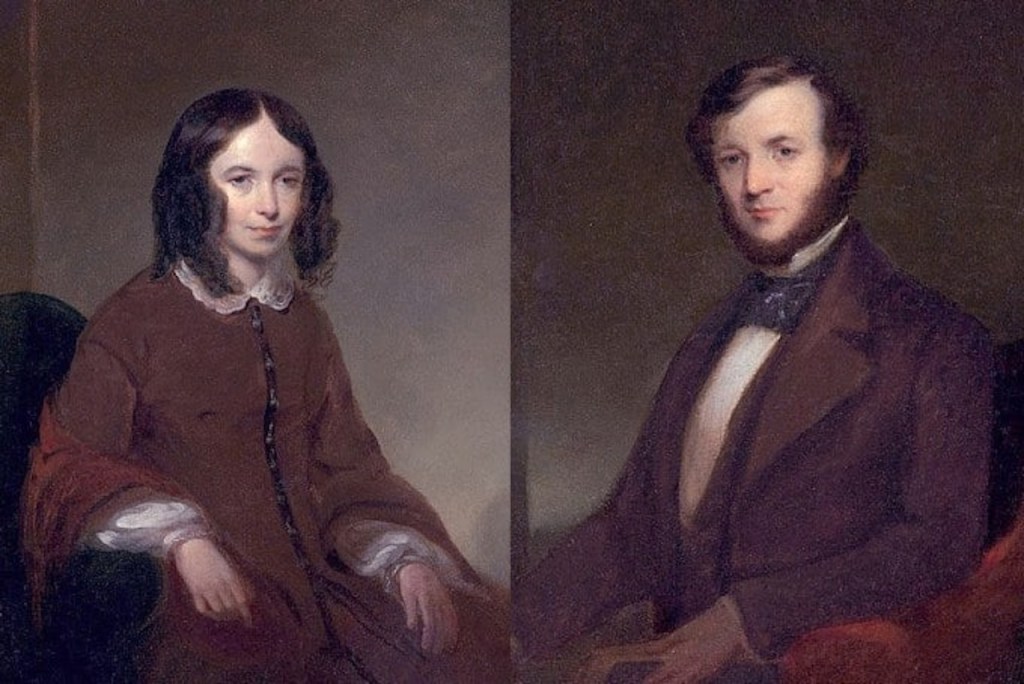
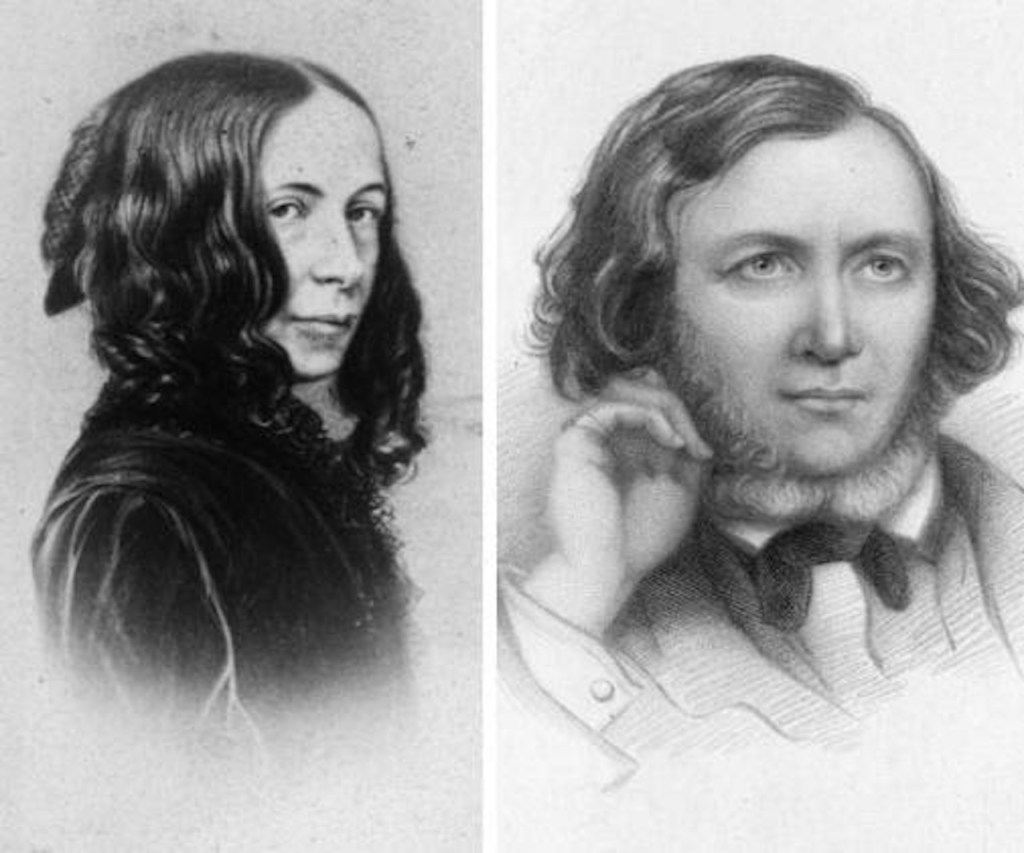
Image: Emily Dickinson – Amherst College – Daguerrotype of the poet at age 17, circa 1847 – likely the only authentic, extant likeness of the poet
The speaker in Emily Dickinson’s “I had a guinea golden” is expressing melancholy at the loss of a friend, whom she describes metaphorically in terms of three dear objects: a guinea, a robin, and a star.
Introduction with Text of “I had a guinea golden”
This fascinating Emily Dickinson poem of loss offers quite a tricky subversion of thought. The first three stanzas seem to explain the loss of three separate loved ones. Then the final stanza packs a wallop unloading on only one “missing friend,” who has caused the speaker to create this “mournful ditty” with tears in her eyes.
This poem demonstrates the depth of Dickinson’s education as she employs metaphors of the British coinage system and allusions to Greek mythology, which has been further employed by the science of astronomy to name stars.
Not only did Dickinson study widely in many subject areas, she possessed the ability to employ her learning in creative ways to fashion those beautiful flowers, allowing them to grow in her garden of verse.
I had a guinea golden
I had a guinea golden – I lost it in the sand – And tho’ the sum was simple And pounds were in the land – Still, had it such a value Unto my frugal eye – That when I could not find it – I sat me down to sigh.
I had a crimson Robin – Who sang full many a day But when the woods were painted, He, too, did fly away – Time brought me other Robins – Their ballads were the same – Still, for my missing Troubador I kept the “house at hame.”
I had a star in heaven – One “Pleiad” was its name – And when I was not heeding, It wandered from the same. And tho’ the skies are crowded – And all the night ashine – I do not care about it – Since none of them are mine.
My story has a moral – I have a missing friend – “Pleiad” its name, and Robin, And guinea in the sand. And when this mournful ditty Accompanied with tear – Shall meet the eye of traitor In country far from here – Grant that repentance solemn May seize upon his mind – And he no consolation Beneath the sun may find.
Reading
Commentary on “I had a guinea golden”
Each stanza builds to a magnificent crescendo of outrage that allows the speaker to lavish affection as well as harsh rebuke to the one leaving her in a state of melancholy.
First Stanza: The Value of Small Things
I had a guinea golden – I lost it in the sand – And tho’ the sum was simple And pounds were in the land – Still, had it such a value Unto my frugal eye – That when I could not find it – I sat me down to sigh.
The speaker begins by referring to the coin “guinea,” which was a British coin manufactured with the gold from the African nation of Guinea. The coin was worth 21 shillings and ceased circulating in 1813. The speaker maintains the British monetary metaphor by referring also to “pounds” in the fourth line of the poem.
Metaphorically, the speaker is calling her lost friend a “golden” coin, which she lost “in the sand.” She then admits that it was a small loss for much more valuable moneys—”pounds”—were all about her. Nevertheless, to her, because of her frugality, the value of the small coin was huge, and because it was lost to her, she just “sat down to sigh.”
Second Stanza: Missing the Music
I had a crimson Robin – Who sang full many a day But when the woods were painted, He, too, did fly away – Time brought me other Robins – Their ballads were the same – Still, for my missing Troubador I kept the “house at hame.”
The speaker then employs the metaphor of “crimson Robin.” This time she is likening her friend to the singing robin who “sang full many a day.” But when the autumn of the year came around, she loses this friend also.
Just as other moneys were abounding after the loss of a simple guinea, other robins presented themselves to the speaker after she lost her robin. But even though they sang the same songs as her lost robin, it just was not the same for the speaker. She continues to mourn the loss of her robin; thus she kept herself harnessed to her house, likely in case her own robin should show up again.
Third Stanza: The Mythology of Science
I had a star in heaven – One “Pleiad” was its name – And when I was not heeding, It wandered from the same. And tho’ the skies are crowded – And all the night ashine – I do not care about it – Since none of them are mine.
The speaker then finds herself once again mourning the loss of a loved one. This one she labels “Pleiad.” Pleiad is an allusion to Greek mythology but also a reference to astronomy.
In Greek mythology, the seven daughters of Atlas went into hiding up in the sky among the stars to escape being pursued by Orion. One the seven seems to disappear perhaps out of shame or grief.
In the science of astronomy, the constellation known as Taurus features a group of seven stars, but oddly enough only six can be seen, resulting in the same “Lost Pleiad” as exists in the Greek myth.
Dickinson, who studied widely the subjects of mythology, history, and science thus alludes to the myth of the “Lost Pleiad” to again elucidate the nature of her third lost beloved. She has now experienced the loss of money, a bird, and now a star–each more precious than the last.
The speaker loses the star as she was being heedless–not paying attention. In her negligent state, her star wanders away from her. Again, although the sky is full of other stars, they just don’t measure up because “none of them are mine.”
Fourth Stanza: Admonishing a Traitor
My story has a moral – I have a missing friend – “Pleiad” its name, and Robin, And guinea in the sand. And when this mournful ditty Accompanied with tear – Shall meet the eye of traitor In country far from here – Grant that repentance solemn May seize upon his mind – And he no consolation Beneath the sun may find.
While wildly famous for her riddles, Dickinson often breaks the riddle’s force by actually naming the object described. In the final stanza, she blatantly confesses that her little story “has a moral.” She then blurts out, “I have a missing friend.”
It is now that the reader understands the loss is not three different loved ones, but only one. She has thus been describing that “missing friend” using three different metaphoric images.
Now, however, she has a message for this friend whose description has revealed multiple times how much she misses the friend and laments the loss. After again rather baldly admitting her sorrow told in “this mournful ditty” and even “[a]ccompanied with tear,” she refers to that missing friend as a “traitor.”
If this friend who has betrayed her happens to see this “mournful ditty,” she hopes that it will grab that individual’s mind so that the person will experience “repentance solemn.” Furthermore, she wishes that the friend be unable to find any solace for the individual’s contrition no matter where that friend goes.
A Few Curiosities Regarding Edward de Vere and the WriterWho Called Himself Shake-speare
by Mark Alexander and Prof. Daniel Wright
Unlike William of Stratford—born to illiterate parents in a virtually bookless market town in provincial Warwickshire—Edward de Vere was born to a mother of prominent literary associations (Margaret Golding) and a father who kept an acting company (the Earl of Oxford’s Men) that his son inherited; Edward de Vere’s father also was one of the early nobleman patrons of the theatre and a patron to John Bale, one of the early writers of the history play, the genre with which the writer known as Shakespeare is widely regarded to have begun his own playwriting career.
The Shakespearean sonnet (also known as the English sonnet) was not original with Shakespeare (merely popularized by him). The Shakespearean sonnet actually was invented by Edward de Vere’s paternal uncle—Henry Howard, the 5th earl of Surrey.
Scholars regard Arthur Golding’s translation of Ovid’s Metamorphoses as a leading influence on Shakespeare, second only to the Bible. Arthur Golding was Edward de Vere’s maternal uncle, and Edward, when a teen, lived with him. Golding, in a dedication of one of his works to the young Edward de Vere, saluted his nephew’s interest in and command of history.
The Geneva Bible, widely recognised by scholars as Shakespeare’s Bible, was the edition of the Scriptures owned by Edward de Vere, and his personal copy (now in the possession of the Folger Shakespeare Library) contains notations and marginalia that bear striking correspondence to passages, themes and image clusters that appear in the works of the writer who called himself Shakespeare. William of Stratford, to the best of our knowledge, not only owned no Protestant Bible but, as many Stratfordian adherents attest, was, in personal conviction, a deeply-committed, radical Roman Catholic who went so far as to purchase the notorious Blackfriars Gatehouse in 1613 – a den of Catholic conspiracy and sedition – a purchase that is utterly unaccountable and laughably ridiculous if the buyer were the demonstrably Anglican playwright, Shakespeare.
Shakespeare’s history plays rewrite the histories of the earls of Oxford—even in incidental ways that are inconsequential to the plays’ substance—in order to bestow a uniformly shining and patriotic legacy on the de Veres.
The writer who called himself Shakespeare was multi-lingual. He had access to a massive, rarefied library, the works of which (many yet untranslated into English in Shakespeare’s era) saturate the poems and plays of Shakespeare. Oxford lived, and was tutored, in Cecil House, the household with not only the best library in England but one of the finest libraries in Europe. There is no evidence, however, that William of Stratford ever owned—let alone read—so much as a single essay or book; indeed, not only do we have no correspondence from William of Stratford to his supposed colleagues—we have no record of any correspondence from him to anyone. No writer of the Elizabethan age ever wrote or even hinted that William of Stratford was a poet or a playwright. No one ever dedicated anything to him. Astonishingly, Phillip Henslowe, the great diarist of the Elizabethan theatre, makes no mention of even knowing the man.
Shakespeare’s intimate knowledge of politics and law has always impressed but bewildered scholars, particularly as Will Shakspere of Stratford is not known ever to have attended so much as a single day of school. Astonishingly, no tutor or pedagogue of the era ever left any record that he taught William of Stratford or recorded that he knew him to be anyone else’s student. Unlike Kit Marlowe, no one offered Will Shakspere any scholarly aid or assistance in furthering his education. Edward de Vere, however, was praised by scholars for the breadth of his learning. He received tutelage from some of the finest minds in Europe—most notably, Sir Thomas Smith; he was awarded degrees from Cambridge and Oxford Universities and enrolled at Gray’s Inn to study law. He served on the Privy Council during the reign of King James. One writer of a book on Renaissance politics has said that Shakespeare is the age’s best tutor on the inside workings of political power. Accordingly, and perhaps unsurprisingly, the man to whom Oxford’s care and education was entrusted was England’s chief politician and statesman, William Cecil, and Oxford, following his father’s death, was raised in Cecil House—arguably the most political house in England. Oxford’s tutors, moreover, were experienced as well as learned men; Smith, for example, was Regius Professor of Civil Law at Cambridge University, twice Ambassador to France, and later, Principal Secretary.
Edward de Vere owned the lease to the Blackfriars’ Theatre, was an acknowledged poet and playwright himself, was a patron to players and was a playhouse producer. He provided dramatic entertainment for the court at Whitehall. According to the writer of The Arte of English Poesie (1589), he was known, however, as a courtier who did not reveal the authorship of the works he wrote.
Scholars regard John Lyly and Anthony Munday as writers who exerted prominent influence on Shakespeare. Both, interestingly enough, were employed by Edward de Vere. Anthony Munday was Oxford’s secretary and an actor in Oxford’s Men; the playwright, John Lyly, was also a private secretary to Oxford, and he and Oxford co-produced plays. No evidence has ever been uncovered to establish that Lyly and Munday even knew Will Shakspere of Stratford-Upon-Avon.
George Baker’s medical book, The Newe Jewell of Health (1576) is widely acknowledged as a book that was a key influence on Shakespeare. George Baker was the household physician of Edward de Vere, and Baker’s medical book that Shakespeare used was dedicated to the Countess of Oxford. Stephen Booth is one prominent orthodox scholar who, in his study of the Sonnets, points to the importance of Baker’s book to Shakespeare, but he excludes any mention of Baker’s connection to Oxford or Baker’s dedication of his book to Oxford’s wife, Anne.
Scholars long have noted that Baldesar Castiglione’s The Courtier was an influence on the writer who created Hamlet. When he was 21, Oxford wrote a Latin preface to Clerke’s translation of The Courtier.
Scholars note that Cardan’s Comforte was an influence on the writer who created Hamlet. The English translation of this book was dedicated to Oxford; Oxford himself commanded that this work be translated and published.
We know from Thomas Nashe’s preface to Greene’s Menaphon that Hamlet was in performance as early as 1589. Some orthodox scholars, however, believe that William of Stratford had barely settled in London by that time. This still does not deter some Stratfordians from arguing that in the space of perhaps less than a year, Stratford Will, after or while working as an ostler, and without any known literary background, education, apprenticeship or theatrical experience, launched his dramatic career by writing and staging what today is broadly regarded as perhaps the greatest play ever written. Other Stratfordians choose to sail past Scylla rather than navigate this Charybdis by imaginatively suggesting that the Hamlet to which Nashe referred must have been—had to have been!—a play called Hamlet that someone else wrote; this Hamlet, they propose, Stratford Will later stole, adapted and made his own.
Many traditional scholars, for almost 100 years, have acknowledged that Polonius (originally named Corambis) from Hamlet is based on Oxford’s guardian and father-in-law—the Queen’s chief minister of State, William Cecil, Lord Burghley—whose family motto, cor unam via una (one heart, one way) is parodied in the earliest version of Hamlet (Corambis effectively means “double-hearted” or “two-faced”). Burghley’s daughter, Anne, the wife of Edward de Vere, they have argued, was the basis for Ophelia, Polonius’s daughter. There is no evidence that the commoner, William of Stratford, even knew Lord Burghley or his daughter, the Countess of Oxford.
Scientists have observed that Shakespeare’s record of astronomical knowledge acquired during the Elizabethan Age (such as the discovery of Mars’ retrograde orbit) and the record of major celestial events (such as the supernova of 1572) cease with the occurrence of astronomical events and discoveries that had been made by mid-1604. William of Stratford, however, lived until 23 April 1616—long enough, if he were Shakespeare, to continue to record in the Shakespeare plays the discovery of sunspots, the invention of the telescope, the discovery of Jupiter’s moons, and other significant celestial phenomena and developments in astronomical science that occurred between 1604 and 1616. But the Shakespeare plays, while abundantly referential to such discoveries prior to 1604, are silent on those astronomical discoveries and celestial phenomena that were made or observed between 1604 and 1616. Edward de Vere died on 24 June 1604.
Shakespeare’s intimate knowledge of Italy has perplexed scholars, especially as William of Stratford never traveled farther from Stratford-Upon-Avon than London. Oxford’s travels, however, took him to practically all of the locations in Shakespeare’s Italian plays, including Milan, Padua, Verona, Venice (where he built a home), Mantua, Sicily and a host of other Italian cities and sites. The orthodox Italian scholar, Professor Ernesto Grillo, accordingly, has declared that Shakespeare’s familiarity with his native land indicates that Shakespeare had to have traveled extensively in Italy; as he writes: “When we consider that in the north of Italy he [Shakespeare] reveals a more profound knowledge of Milan, Bergamo, Verona, Mantua, Padua and Venice, the very limitation of the poet’s notion of geography proves that he derived his information from an actual journey through Italy and not from books.”
When Oxford was in Venice, he borrowed 500 crowns from a man named Baptista Nigrone. When in Padua, he borrowed more money from a man named Pasquino Spinola. In Shakespeare’s Taming of the Shrew, Kate’s father is described as a man “rich in crowns.” Where does this character in Shakespeare’s play live? Padua. What is his name? Baptista Minola—a conflation of Baptista Nigrone and Pasquino Spinola.
In May 1573, in a letter to William Cecil, two of Oxford’s former employees accused three of Oxford’s friends of attacking them on “the highway from Gravesend to Rochester.” In Shakespeare’s 1 Henry IV, Falstaff and three roguish friends of Prince Hal also waylay unwary travelers—on the highway from Gravesend to Rochester.
Such singular events in the plays as the Gad’s Hill robbery in 1 Henry IV, the attack on and release of Hamlet by pirates at sea, and the bed trick of All’s Well That Ends Well—any one of which would constitute a highly unusual event in any man’s experience—are all documented events in Oxford’s life.
The three dedicatees of Shakespeare’s works (the earls of Southampton, Montgomery and Pembroke) were each proposed as husbands for the three daughters of Edward de Vere. (Venus and Adonis and The Rape of Lucrece were dedicated to Southampton and the First Folio of Shakespeare’s plays was dedicated to Montgomery and Pembroke.) Southampton declined the hand of Elizabeth Vere to marry Elizabeth Vernon (Elizabeth Vere later married William Stanley, the 6th earl of Derby, himself a man of the theatre); Montgomery married Oxford’s daughter, Susan, in 1604; and Bridget Vere, proposed by her prospective father-in-law, the earl of Pembroke, as a bride for his son, married Lord Norris after her father’s death. There is no record, anywhere, that any of these powerful aristocrats, exclusively connected with the works of Shakespeare, even knew Will Shakspere. (Needless to say, none of them proposed to or married any of his daughters!)
Following the death of his father, the 18th earl of Oxford, Henry de Vere, participated in the formation of a Protestant resistance to a proposed English alliance with Catholic Spain. Who were Henry de Vere’s leading compatriots in this resistance? The earls of Southampton, Montgomery and Pembroke—the three dedicatees of the poems and plays of Shakespeare.
The writer who called himself Shakespeare possessed the largest published vocabulary of any writer who has ever lived. Like many other orthodox scholars, Edward T. Oakes, in “Shakespeare’s Millennium,” recognizes Shakespeare’s unique achievement as a wordsmith; he notes that “one-twelfth of the words in the Shakespeare canon make their appearance, at least in print, for the first time in English,” and he acknowledges that “most of [these] must have been of his coinage.” Oakes also records that “nearly half of Shakespeare’s words were what scholars call hapax legomena, that is, words that Shakespeare used only once.” Even allowing William of Stratford the benefit of an elementary schooling that there is no evidence he received, Oakes himself declares “[t]he idea that the greatest playwright of the human race could have poured forth such a cornucopia of genius with only the benefit of a grammar school education does seem to stretch stupefaction past the point of credulity.”
Researchers have discovered that words frequently credited by the Oxford English Dictionary and other sources as having had their first usage in Shakespeare actually have shown up earlier in Edward de Vere’s personal letters.
“I am that I am” is peculiar to Shakespeare as an appropriation from Scripture (Exodus 3: 14)—but it shows up, in the same form, in a letter from Edward de Vere to Lord Burghley. (See Sonnet 121 and Hank Whittemore’s Shakepseare Blog)
In 1589, in order to raise much-needed funds, Edward de Vere hurriedly sold his London residence, Fisher’s Folly, to William Cornwallis who, with his young daughter, Anne, took up residence in the earl’s former home. In 1852, Shakespeare biographer J. O. Halliwell-Phillips discovered Anne Cornwallis’s copybook from her days at Fisher’s Folly in which she had transcribed verses from Edward de Vere, presumably from manuscripts left behind when the residence changed hands. Interestingly, however, Halliwell-Phillips observed that Anne’s copybook included not only then-unpublished poetry by Edward de Vere but two unpublished sonnets that later would be attributed to Shakespeare. Anne’s copybook, moreover, included another poem scholars later would attribute to Shakespeare that was printed by William Jaggard in 1599 in his miscellanies of Elizabethan poetry, The Passionate Pilgrim. Halliwell-Phillips estimated that Anne Cornwallis made her transcriptions of these then-unpublished verses in 1590, the year after she and her father took up residence at Fisher’s Folly. Of course, how Anne Cornwallis, in 1590, would have acquired unpublished poems by Shakespeare in the former home of Edward de Vere no one in orthodox circles ever has been able to persuasively explain.
On 22 July 1598, the Stationers’ Register records: “Entred for his copie under the handes of bothe the wardens, a booke of the Merchaunt of Venyce or otherwise called the Iewe of Venice. / Provided that yt bee not printed by the said Iames Robertes [the printer who presented the work for registration]; or anye other whatsoever without lycence first had from the Right honorable the lord Chamberlen.” As (1) no such license was ever extended by the Stationers’ Office to anyone other than an author of a registered work, and as (2) no Lord Chamberlain of the Royal Household ever licensed (or possessed the authority to license) the publication of another’s work, and as (3) numerous examples exist of Oxford and others referencing Oxford as Lord Chamberlain (rather than Lord Great Chamberlain— the title that formally distinguished him from the Lord Chamberlain of the Royal Household), one can reach no other conclusion than that the Stationers’ Register entry of 22 July 1598 indicates Oxford to be the author of The Merchant of Venice and, accordingly, the only person with the legal authority to oversee and authorise its publication. The attendant conclusion, based on all the evidence, is unmistakable: if Oxford is the author of The Merchant of Venice, Oxford is Shakespeare.
Henry Peacham, in The Compleat Gentleman [1622], praised Oxford above all other writers among the Golden Age writers during the reign of Queen Elizabeth — and his list makes no mention of any William Shakespeare.
Oxford received the kinds of literary accolades worthy of (and that one would expect would go to) Shakespeare. William of Stratford, however, never had anything dedicated to him, from anyone, in the whole of his life. Yet, despite the accolades accorded Oxford by his contemporaries, no traditional scholar has yet identified what plays of the era that were so highly praised of Oxford might be Oxford’s; if his works are not those of the great Elizabethan spear-shaker, where are they? Is it credible to assert that every single one of his plays was lost?
Gabriel Harvey saluted (in English translation from the Latin) the 17th Earl of Oxford in Gratulationes Valdinenses, libri quatuor (1578): “English poetical measures have been sung thee long enough. Let that Courtly Epistle—more polished even than the writings of Castiglione himself—witness how greatly thou dost excel in letters. I have seen many Latin verses of thine, yea, even more English verses are extant; thou hast drunk deep draughts not only of the Muses of France and Italy, but hast learned the manners of many men, and the arts of foreign countries . . . . Thine eyes flash fire, thy countenance shakes a spear . . . .”
William Webbe, in A Discourse on English Poetry (1586) wrote: “I may not omit the deserved commendations of many honourable and noble Lords and Gentlemen in Her Majesty’s Court, which, in the rare devices of poetry, have been and yet are most skilful; among whom the right honourable Earl of Oxford may challenge to himself the title of most excellent among the rest.”
George Puttenham, in The Arte of English Poesie (1589) wrote: “And in Her Majesty’s time that now are have sprung up another crew of Courtly makers, Noblemen and Gentlemen of Her Majesty’s own servants, who have written excellently well as it would appear if their doings could be found out and made public with the rest, of which number is first the noble gentleman Edward Earl of Oxford.”
John Marston, in Scourge of Villanie (1598) hailed a great, unacknowledged writer with a “silent name” bounded by “one letter” who one day would achieve the recognition he was due when pretenders to his greatness would be exposed: “Far fly thy fame, / Most, most of me beloved, whose silent name [Edward de Vere?] / One letter [e?] bounds . . . . [T]hy unvalu’d worth / Shall mount fair place when Apes are turned forth.”
Francis Meres, in Palladis Tamia (1598) declared of the era’s playwrights: “The best for comedy amongst us be Edward Earl of Oxford.”
Edmund Spenser, in his dedication to Oxford in Fairie Queene (1590) wrote of Edward de Vere’s favour with the nation’s literary elite: “And also for the love, which thou doest beare / To th’ Heliconian ymps, and they to thee, / They unto thee, and thou to them most deare….”
John Soowthern, in Pandora (1584) wrote: “De Vere, that hath given him in part: / The love, the war, honour and art, / And with them an eternal fame. / Among our well-renowned men, / De Vere merits a silver pen / Eternally to write his honour. / A man so honoured as thee, / And both of the Muses and me.”
In The Revenge of Bussy d’Ambois, George Chapman recalled: “I over-tooke, coming from Italie / a great and famous Earle / Of England . . . / He was beside of spirit passing great, / Valiant, and learn’d, and liberall as the Sunne, / Spoke and writ sweetly, or of learned subjects, / Or of the discipline of publike weals; / And ’twas the Earle of Oxford . . . .”
When Shake-speares Sonnets were published in 1609, the work’s dedication (composed, unlike Shakespear’s earlier dedications, not by the poet but by the poems’ editor, Thomas Thorpe) memorialized the writer as “our ever-living poet”—an acclamation not used for a living person and a clear indication, thereby, that Shakespeare was dead. In 1609, Edward de Vere was dead; Stratford Will lived until 1616.
When Shakespeare “went public” in 1593, he connected his name, irrevocably and exclusively, to Henry Wriothesley, the 3rd earl of Southampton. Southampton, like Oxford, was one of the great peers of England and he, like Oxford, was one of the royal wards who had been raised and educated by Lord Burghley in Cecil House. Southampton also was actively encouraged by Burghley, at age 17, to marry Elizabeth Vere, Oxford’s eldest daughter, and many scholars are convinced that the first 17 “marriage sonnets” of Shakespeare were composed by the great poet in 1590 as an inducement for Southampton to marry Elizabeth Vere. But who is the more likely poet to have undertaken that charge? A yet-unpublished provincial from Warwickshire — or Edward de Vere, the acclaimed poet who himself had married Burghley’s only daughter in 1571?
The Sonnets were not the only works of Shakespeare to appear with an enigmatic prefatory note in 1609. When Troilus and Cressida was published in 1609 (the first publication of a new Shakespeare play since 1604, the year Edward de Vere died), a cryptic preface on the title page of the play (suppressed when Shakespeare’s plays were published in folio in 1623), enigmatically declared that the play was from “A never writer to an ever reader” (an E. Vere writer to an E. Vere reader?). The preface declared, as well, that the manuscript had not come to the printer from the playwright; rather, the unnamed writer of the preface invites the reader of the play to “thanke fortune for the scape it hath made” from a group which the writer of the preface refers to as “the grand possessors.”
As Prince Charles, the Prince of Wales, has expressed his astonishment at Shakespeare’s ability to know the intimate character of royalty: “When I re-read [Henry V] nearly twenty years after performing it at school, I found myself wondering in amazement at Shakespeare’s insight into the mind of someone born into this kind of position.”
by Professor Daniel Wright, Ph.D. Director, The Shakespeare Authorship Research Centre
In the early 1780s, the Reverend Dr James Wilmot, a friend of Dr. Samuel Johnson and rector of a small parish church near Stratford-Upon-Avon, went searching for the legacy of England’s greatest literary prodigy, an artist of unrivaled achievement whose poetry and drama were renowned but about whose person very little was known. Dr Wilmot searched for years in the poet’s environs for information of any kind that might illuminate this prominent man (arguably the most celebrated resident in the history of Cotswolds England). He wished to learn what was known of this man as a writer, dramatist and poet by his family, neighbors, peers and other friends and acquaintances. For four years, he searched diligently for letters to or from the man; he sought records and anecdotes about his personal life in diaries and family histories; he combed the region for books and other artifacts. To his consternation, he found absolutely nothing that linked Tradition’s candidate to the writing of those incomparable works that had appeared in England two centuries earlier under the name of “William Shakespeare.”
What Dr Wilmot found, instead, was the record of the son of a simple, untutored merchant, baptized Gulielmus Shakspere, who apparently began life as a butcher’s apprentice and later excelled in various business ventures, but who otherwise had lived a fairly non-descript life. He discovered, in short, a rather ordinary man who had no connection to the literary world and who, at the conclusion of an ostensibly uneventful life, was buried without ceremony in a grave that didn’t even identify its occupant by name. His findings stunned him into dazed silence about the matter, and he confided nothing of his discovery for years.
Dr Wilmot eventually confessed to a friend that despite his arduous labors in Warwickshire, he had unearthed nothing in his expeditions to connect Will Shakspere of Stratford-Upon-Avon to the works of the Elizabethan dramatic giant that Ben Jonson had apostrophized as a “Starre of Poets” and the “Soule of the Age.” Serious doubts about the authorship of the Shakespeare canon followed hard thereon—doubts that continue to bewilder and puzzle readers of Shakespeare. However, the collapse of all the quixotic campaigns of the past two centuries that have attempted to establish the man from Stratford as the author of the plays (or even corroborate his reputation as a writer!) are now leading many scholars to conclude that would-be discoverers of Shakespeare repeatedly fail, not due to their lack of zeal or skill, but because, like good Dr Wilmot, they are seeking a writer where no writer (or, more accurately, another writer) exists.
In contrast to the defenders of orthodox myths about Stratford Will, skeptics propose that the Shake-speare poems and plays were not the throwaway work of a butcher-turned-poet-and-playwright who, in his first foray into poetic and dramatic composition, produced such works as Venus and Adonis, The Rape of Lucrece and Loves Labour’s Lost. They argue, instead, that these works are the mature achievements of a worldly and urbane litterateur, a dexterous and experienced writer endowed with vast linguistic ability and an extraordinarily particularized knowledge of many arcane and specialized studies, an erudite, well-traveled, multi-lingual man of prior achievement who could not tell the world his name.
One might well ask, therefore, if the writer who called himself Shakespeare were this versatile and formidable talent, why would he disguise himself and evade recognition? What possible reasons could he have had to cloak himself in obscurity? Such questions can be answered by considering the conventions that governed writing and publication in Elizabethan England.
The invention of the printing press terrified absolutist regimes such as the Tudors. It created unprecedented opportunities for writers to stir up partisan constituencies and create audiences for new ideas. The capacity to anonymously publish pamphlets, books, plays, essays, tracts and other texts limited the ability of authorities to silence individuals for disseminating seditious ideas or advancing unflattering satires that exposed the government’s incompetence or corruption. Because this revolutionary technology threatened to place writers beyond the effective control of the State, it led the English government to establish various civil and ecclesiastical licensing measures and censorial offices to regulate and control the press with the goal of stifling the flow of disapproved ideas. Therefore, by the last half of the sixteenth century, although the ability to communicate had been extended, the freedom to say what one would without penalty had not. Unlicensed presses were destroyed; pamphlets were seized; writers were imprisoned; theatres were closed.
A writer who sought protection from discovery and persecution needed to dissemble. For playwrights, this was especially urgent, particularly as the public theatre (already much mistrusted and often suppressed by authorities for its alleged traffic in corrupt matter) was exiled in Shakespeare’s day to the darker districts of London (such as Southwark) where the theatre’s supposed viciousness could be restricted to people who commonly were regarded as derelicts and scoundrels. Writers of public entertainments and / or their families were likely to be impugned, therefore, by such disreputable associations if they were discovered; many had personal reputations to protect. Writers who disdained anonymity, moreover, often faced frightful consequences for their daring in sallying forth to publish under their own names. Many were hauled before the Privy Council for interrogation (as was Samuel Daniel for Philotas); others were imprisoned (as were Ben Jonson and George Chapman for Eastward Ho! and Sir John Hayward for his Life of Henry IV); others were savagely mutilated (as were John Stubbs, Alexander Leighton and William Prynne); some may even have been assassinated (as perhaps was Christopher Marlowe).
Many playwrights, accordingly, published anonymously, shielding themselves and—perhaps more importantly—their families from bad repute and persecution. The consequence of this is that we, today, still do not know the origins of many dramatic works that appeared in the age of Shakespeare. In fact, as Professor Gerald Eades Bentley of Princeton tells us, “the large majority of all English plays before the reign of Elizabeth are anonymous, and even from 1558 to 1590 the authors of most plays are unknown.” The unattributable nature of these works illuminates the problem confounding scholars’ attempts to resolve the Shakespeare authorship controversy, for, unbeknownst to most people, the playwriting career of the writer who called himself Shakespeare also was maintained in secrecy. Even when the plays of Shakespeare were published (and publication almost always followed many years of performance), they were published without attribution. In fact, for seven years after the Shakespeare plays began to be printed, they were published without any name affixed to them at all. Not until the end of the sixteenth century (well into the Shakespeare playwright’s career) did any plays begin to appear in print under the name of “William Shakespeare.” Even then, several of them (such as The London Prodigall and A Yorkshire Tragedy) were clearly misidentified by the publishers. One might wonder if even the publishers of his works knew who he was!
If, as Oxfordians maintain, the writer behind the Shakespeare pseudonym was Edward de Vere, as the 17th Earl of Oxford and Lord Great Chamberlain of England, he would have been constrained by more than ordinary apprehensions about publishing his poems and plays. Convention discouraged nobility from publishing any works—especially plays—they composed; to have indugled in such act an act outside of one’s station would have been regarded within court culture as infra dignitatem—a slur on the code of nobility itself; a nobleman’s reputation, after all, was to be won by sword and shield, not achieved by pen and ink in the midst of the roguish antics and rough-and-tumble recreations of the common herd at public theatres. Accordingly, several high-born poets’ works, such as those of Sir Philip Sidney and Robert Devereaux, 2nd Earl of Essex, were never published under their authors’ names during their lifetimes. If Oxford was the poet-playwright Shakespeare, he would have been prompted to shield his name from discovery (apart from other legitimate considerations) because Court practice and precedent urged it; the Lord Great Chamberlain of England and the son-in-law of the Lord Treasurer and chief minister of the Crown simply could not be known as a writer for the public stage.
Oxford, therefore, probably masked his identity from the larger public because he was compelled by his family and the Crown to do so. A writer for the public stage could ill afford to be linked to the Court. If he were to become publically known as a courtier poet and playwright, his poems and plays might be interpreted as government-financed propaganda or—perhaps more ominously—satirical commentary on the life, mores and personages of the Court, and no courtier, after all, was more prominent than Oxford’s own father-in-law: the great Lord Treasurer, spymaster and chief counselor to the Queen, William Cecil, Lord Burghley, to whom Oxford was personally as well as politically beholden (Burghley, as Master of the Court of Wards, had overseen and provided for Oxford’s youth in his own household before Oxford became his son-in-law).
Therefore, by adopting the pseudonym of William Shakespeare, Edward de Vere provided himself, his family and the Crown with the means of preventing the public from looking to the Court in search of the Shakespeare playwright. His use of the nom de plume, Shakespeare, likely would have been known among only a few intimates, fellow courtier poets, principals of the Lord Chamberlain’s Men and the Crown’s chief officers. Indeed, that the “secret” was something of an open one, particularly in certain literary circles, seems confirmed by Oxford’s receipt of a continuing stream of dedications and acclaim by his contemporaries, over many years—although, curiously, he is purported by most Traditionalists to have published nothing under his own name after 1576. By contrast, no one ever dedicated a single literary work to anyone named William Shakespeare in that writer’s supposed lifetime, the merchant from Stratford never spelled his name as “Shakespeare,” and he never is identified by anyone during the whole of his life as the Shakespeare poet-playwright.
But why “Shakespeare”? Why would Edward de Vere adopt that name as his playwriting name? There is no mystery here. Like that of Martin Marprelate, the well-known sobriquet of a Puritan dissident (still unknown to us) in the late 1580s, Shakespeare was a pseudonym that addressed the chief realm of the writer’s attention; in Marprelate’s case, his focal point was the prelacy of the Anglican Church; in Shakespeare’s case, it was the theatre.
“William Shakespeare” is a name that might have been adopted by almost any writer who wished to conceal from the public his title, office or his baptismal name but who yet wished to assert his identity as a playwright. After all, Pallas Athena, the mythological patron goddess of Athens (the ancient home of the theatre) wore a helmet, crowned by a Sphinx, that, when its visor was drawn, made her invisible. In her hand she carried a great spear. For a writer to be such a “spear-shaker” could therefore suggest that he was a writer of plays—an invisible writer of plays. That Oxford should have resorted to this pseudonym makes eminent sense, for he also was known as a champion battler in the lists—a spear-shaker of military renown. Similarly, Oxford’s occasional hyphenated spelling of his poet-playwright name may also have been adopted to allude, with a more obvious wink and a nudge, to the author’s role as a warrior with a pen as his spear. The possible suggestiveness of the name “Will-i-am Shake-speare” (“I will be [a] spear-shaker”) as one whose words are intended to disturb the complacent takes on additional significance when we read Ben Jonson’s knowing commemoration of Shakespeare in the First Folio: “He seems to shake a lance / As brandish’t at the eyes of ignorance.”
Writers always have taken terrible risks by writing “offensive” works. Ovid so offended Caesar Augustus’ puritanical sensibilities by his erotic verse that he suffered the indignity of life-long exile from the empire. Dante, too, was exiled from his beloved Florence. When the brilliant British novelist, Matthew Gregory Lewis, owned up to his authorship of the Gothic novel, The Monk, he faced savage rebuke from ossified old Tories like Samuel Taylor Coleridge and risked charges of blasphemy being leveled against him in Parliament. Voltaire (the pseudonym of François-Marie Arouet) was imprisoned and subsequently exiled. Emile Zola was driven from France following his publication of J’accuse. Jean-Baptiste Pocquelin concealed himself, and protected his family, behind the name of Molière. Women, in particular, have invoked pseudonyms merely to get into print. Consider Mary Ann Evans (George Eliot) and the Brontë sisters (who published under the names of Currer, Ellis and Acton Bell); Jane Austen wrote anonymously (her name was attached to her work only after her death). Oscar Wilde, while in exile, wrote as Sebastian Melmoth (the martyred wanderer). The sobriquet “O. Henry” shielded William Sidney Porter’s family from association with Porter’s personal disgrace following his conviction and imprisonment for embezzlement. In the 1950s, America’s Hollywood Ten resorted to a host of pseudonyms and front men to try to get around the barriers to work that were established by the McCarthy-era blacklists. Daniel Defoe concealed himself behind more than twenty pseudonyms. In retrospect, Salman Rushdie probably wishes that he had chosen to hide behind at least one…!
English nobility who have employed pseudonyms since Elizabethan days include King George III, who published as Ralph Robinson. Lord Tennyson sometimes published his poetry under the name of Merlin. Lord Hardinge of Penshurst published crime fiction in the 1940s as George Milner. Edward de Vere might be comforted to know that the tradition of adopting a disguise when venturing into publication continues even today among England’s peers. In any event, that the chief courtier poet-playwright of Elizabethan England, son-in-law of the Lord Treasurer and cousin to the Queen should have chosen the devices of anonymity and pseudonymity to assure himself freedom of expression in his repressive, suspicious and censorious culture should hardly be surprising. That such an accomplished writer is likely to be the poet-dramatist we know by the name of Shakespeare—as opposed to an unlettered merchant from Warwickshire whose own offspring were illiterate—is even less so.
Professor Daniel Wright, Ph.D. Director, The Shakespeare Authorship Research Centre
The Shakespeare Authorship Controversy: The Case Summarily Stated
by Professor Daniel L. Wright Director, The Shakespeare Authorship Research Centre
Who wrote the works of Shakespeare? Tradition reports that the author was a tradesman from provincial Warwickshire who was baptized Gulielmus Shakspere, a man who, to the best of our knowledge, never had a day’s schooling, and yet we are told – and are expected to believe – that, in his twenties, this man began to publish (having written nothing before in the whole of his life!) the most erudite works of literature the world has ever seen. We are told by traditionalists that this man (who literally could not spell his own name the same way twice) wrote poems and plays that are dense in their reliance on the literature of classical antiquity as well as Continental verse and narrative which had not even been translated into English in Shakespeare’s day. We are told that this man, who never owned so much as a single book, wrote, without any education or apprenticeship in the literary and dramatic arts, poems and plays that invoke the legends of hundreds of figures from Greek and Roman mythology – poems and plays that demonstrate the writer’s easy familiarity with and competence in Latin, Greek, Italian and French – poems and plays demonstrative of a linguistic facility so agile and confident that he sometimes would compose (as in scenes such as Henry the Fifth III. iv) in languages other than English.
When, where and from whom did this man who never traveled farther than London from his hometown, and who reputedly spent the years prior to his early marriage in apprenticeship to a butcher, supposedly learn all of this? In what educational domain did he acquire the ability to become the rarest of men: the chief wordsmith of the English language – a linguistic creator whose fecundity humbles Milton and overrides the Bible? How was it that he appeared in London, suddenly and with no preparation – like a genie from a lamp – an urbane, cultivated, accomplished, knowledgeable and unrivaled poet; a masterful practitioner of rhetoric; a scholar of his own and other nations’ literatures, histories, customs, painting and sculpture; a man intimately versed in the character of many ages’ political and religious disputes – both foreign and domestic? Where did he study astronomy, read Copernicus, become capable in the field of medicine, and demonstrate remarkable competence in and familiarity with English case law as well as Continental civil law? Where did he learn the arcane jargon of aristocratic sport and military command if all he did for the first half of his life was chop meat in a provincial and virtually bookless burg of perhaps forty families’ size (none of which families, incidentally, although they knew him well, ever acknowledged their townsman as a poet, playwright or even a writer)?
Can anyone truly think the scenario likely? Is this – a process that defies everything we know about the development of literary creativity and skill – a credible explanation of how Shakespeare attained the highest achievements in literary art? Are we seriously to believe that a man of no education, who wrote no letters (nor received any from anyone [they must have known he couldn’t read]), who wrote absolutely nothing – not so much as a mundane shopping list (and who, though wealthy, owned no books even at the end of his life) – who had no journeyman experience in the literary arts, no apprenticeship or tutelage in the classics, no foundation in music, law, statecraft, theology, aristocratic sport or courtly custom – would sit down at a desk in his mid-twenties and, in his first foray into writing, compose the works of Shakespeare? Would such a man – the world’s greatest wordsmith and lover of language – not have taught his own family to read and write rather than leave them gaping illiterates? Would the only literate member of his extended family (his son-in-law) praise, in print, fellow Warwickshire poet Michael Drayton but never write a line acknowledging that his own father-in-law was England’s most accomplished poet-dramatist (or even a writer)? Would this Shakespeare not have been feted and received tributes like his peers-rather than fail in his own lifetime to be acknowledged as a poet or playwright by anyone in letters, memorandae, dedications or diary entries?
If the writer who called himself Shakespeare were this rustic from Stratford-Upon-Avon, he is the most improbable person ever to have lived, and his story is the most implausible tale in history – one that, as Concordia University professors of psychological and educational theory Drs Kevin Simpson and Steven Steffens have demonstrated, utterly defies rational explanation and overthrows everything that learning theorists and psychologists of cognitive development know about how creative talents are cultivated and mature.
How likely, therefore, is it that this man from Stratford-Upon-Avon – this man who, in his own day, no literary figure (not even Phillip Henslowe, the age’s chief diarist of the theatre) acknowledged as so much as an acquaintance – was the author of the works that bear the name of William Shakespeare? More scholars, each year, swell the ranks of those of us who say that whoever Shakespeare was, he was not this pedestrian merchant from Warwickshire for which there is no evidence of any kind of literary career – let alone any evidence for his being, in A.L. Rowse’s words, “the best-known dramatist” of the age.
But if Shakespeare were not this man from Stratford-Upon-Avon, who was he? I would propose that the most probable candidate is Edward de Vere, the Lord Great Chamberlain of England and the 17th earl of Oxford – a brilliant poet and playwright who also was a favourite of the Queen as well as her ward and the son-in-law of her chief minister of state, William Cecil, the first Baron Burghley, Lord Treasurer of England.
Unlike the butcher from Stratford, Edward de Vere was nurtured in the arts of poetry and stagecraft from his youth. Steeped in the art of the theatre, Edward and his father were the patrons of one of England’s earliest acting companies that performed under aristocratic patronage. Following his father’s death, the Queen directed that Edward be raised in the home of the man who owned the largest library in England. He was tutored by England’s finest scholars – men such as Lawrence Nowell (owner of the world’s only copy of the Beowulf manuscript) and Sir Thomas Smith (Regius Professor of Civil Law at Cambridge University and Ambassador to France); he was multi-lingual, a fluent speaker and writer of Latin, Italian and French. He traveled extensively on the European Continent (and to almost [and perhaps] all the Italian sites recorded in the Shakespeare plays – sojourns that, as Richard Roe has meticulously demonstrated in his book, The Shakespeare Guide to Italy: Retracing the Bard’s Unknown Travels, the Shakespeare writer had to have undertaken); he owned a house in Venice; John Lyly, the playwright, was his personal secretary (as was the dramatist, Anthony Munday). He received degrees from both Oxford University and Cambridge University before he was 17 years old. To study law, he matriculated at Gray’s Inn – one of the revered Inns of Court – and the Inn, incidentally, that was one of the principal sites of theatrical performance in late sixteenth-century London. He created lavish entertainment for the Queen and her Court, was a patron of writers
and playwrights, and he held the lease to the Blackfriars Theatre, the principal private theatre in London. He was an acclaimed writer, poet and playwright in his own lifetime; indeed, he was recognized as the foremost writer of his age by Henry Peacham, declared the “most excellent” of all Elizabethan court poets by William Webbe and acknowledged by George Puttenham as the best of those Elizabethan writers who, as Puttenham revealed in The Arte of English Poesie, were publishing without appending their own names to their works.
Oxford also received a host of literary dedications that distinguished him as pre-eminent among writers of the Elizabethan Age; Angel Day, for example, hailed him as a writer “sacred to the Muses”; Edmund Spenser praised him in The Fairie Queene, and John Brooke congratulated Cambridge University for its special recognition and commendation of Oxford’s “rare learning.” By contrast, to the man who supposedly brought the Renaissance to England – butcher-turned- poet and playwright Will Shakspere of Stratford-Upon-Avon – no one in his own lifetime ever dedicated a thing. Moreover, when Stratford Will died, he was buried in a grave that did not even bear his name but chewed out, instead, some doggerel curse against anyone who would disturb his corpse. His passing was not marked with any of the mourning and ceremony that attended the passing of far less notable (and now all-but-forgotten) writers of the day. Despite possessing wealth that, as Stratfordian Professor Stanley Wells has noted, made him the equivalent of a modern millionaire, he created no fellowships and (unlike the actor, Edward Alleyn, who founded Dulwich College), he endowed no colleges or universities (let alone the grammar school that stood directly across the street from his home); he founded no libraries nor supplied them; he patronized no scholars or writers, nor did he fund any legacies in arts or letters.
The case for Edward de Vere as the pseudonymous author of the Shakespeare canon, of course, is one that requires more than a few summary statements for an adequate presentation. Massive and detailed scholarly investigations by some of America’s, Britain’s and Europe’s best scholars are available for study by those who may wish to join their efforts with others in order to help us attain a definitive resolution to the Shakespeare Authorship Question and impart to the true author of the works of Shakespeare the long-neglected distinction that is his due. To the pursuit of this end, an international convocation of scholars gathers each year to explore and share the latest research on the Authorship Question at Concordia University’s Shakespeare Authorship Studies Conference – an annual assembly, convened by the university’s Shakespeare Authorship Research Centre, to which all who are interested in seeing the Shakespeare Authorship Question debated, studied and resolved are invited.
Professor Daniel Wright Director, The Shakespeare Authorship Research Centre
Image: Thomas Thornburg, Back Book Cover American Ballads
American Ballads
Published by Author House, Bloomington IN, 2009
Bag Ladies
Bag ladies are this season wearing field-jackets gleaned from K-MART shoppers and KEDS cast off by charioteers on skateboards fleeing from the cops; hooded and rope-cinched at their waists (doomed matched pairs shuffling westward). vespers et matins in their quest they toss and comb the city’s trash, each empty can discovered, cash. Sometimes drunk they will confess it, and sometimes cough the alley retching pink spittle in their sad kermess. Sometimes we talk (they ask my pardon for sifting through these things discarded) for better homes and other gardens.
Other Gardens
When children, we dreamed Of sailing to Baghdad. Hoosier gardens teemed Like Iram; Kaikobad Led Persian cavalry Down to an inland sea.
Those magic minarets Are with childhood hidden, Our children in the desert Killing children.
Serving the South
deadended on a siding in Midway, Alabama, stand 6.5 miles of RR cars. covered in kudzu and time, they stand, iron cheeks squaring their gothic mouths; they are Southern and Serve the South (hub-deep in red clay) this land, this ekkuklema of southern drama. still, it is Bike Week in Daytona, and the Lady is sold in yards from rucksacks where a tattooed mama fucks & sucks (her name is not Ramona). here will come no deus ex machina, this American South, this defeated dream. drunken, drugged, dolorous in their dementia, forbidden by Law to wear their colors, these cavaliers race their engines and scream where the marble figure in every square shielding his eyes as the century turns stands hillbilly stubborn and declares. heading back north having spent our earnings, honeyed and robbed we are fed on hatred cold as our dollar they cannot spurn, and we are in that confederate.
Poor Eddie Poe collapsed in the snow and exhaled no more in old Baltimore
Poor Mary Mallon wept o’er many a gallon of soapsuds, avoiding the cops, and typhoiding.
W. B. Yeats believed in the fates, but on Sunday in Spiritus Mundi.
. . .
Koan
Once in this journey, following the call I broke my bones falling Now I go hobbled to a distant star My shippe a heavy bar Friends come asking how we are My friends, my friends, we are alone. He who would know must break his own bones
A Ballad of My Grandfather
My grandfather was a Wobbly, sirs, And as such he was banned And blackballed from his daily bread Across your promised land.
My grandfather polished metal, sirs, And ripped his skilly hands Whenever you allowed him to Across your promised land.
My grandfather suffered somewhat, sirs, And worked till he could stand No more before your wheel; he loafs Beneath your promised land.
My father walked a picket, sirs, In nineteen-forty-five, His son beside, and with them walked His father, man alive.
That was a bitter solstice, sirs, The wind complained like ghosts, The cold struck home, the striker stood Frozen to their posts.
The people in the city, sirs, Sequestered in their hate, Supped in communal kitchens there And massed at every gate.
Consider all such service, sirs, Kindred to your time, A long apprenticeship to cast Such mettle into rime:
The pain these fathers weathered, sirs, The freedoms you forsook, Is polished into pickets here And winters in their book.
to be continued, check back for updates
Publication status of American Ballads
Copies of American Ballads are readily available on Amazon and reasonably priced at $10.99, even offered as Prime. This Amazon page features a commentary by the wife of the poet, who felt that the book deserved further description.
the sick cat in the clowder calls, (the little girl who loved her lost) wanders in the alley, falls and stiffens like a frozen coat; a powder of November palls on the despair of hunted dusks, a dumb husk of hares; that creature in the corner there sprawling in the drunken chair ringing silver on the table has no business being here and is in trouble.
TETSUMARO HAYASHI
When these feathered sing In fawdled magnolia It is truly spring.
GILLESPIE TOWERS
This winter sun again is centered Above Gillespie Towers where Each dawn discovers lights declaring Early risers there. Infirm and ill and some demented, Why do they rise in winder, staring When each in her cell might bask instead In summer dreams beneath the snows Of memory, secure and somnolent? The weak light rallies, and I know: A car awaits her who is newly dead. I must take leave of this, prepare my readings (Poems of death) for students, show Them the journey we must go.
VALEDICTORY
Not, if nothing else, a free Thing one spends his red time making, Fit words: between you and me (One’s self abides though every shaking Star whipsaw on any side) This talk wrought for all your taking, This song, one’s self abides. There are lives no need to move to laughter One’s debtors dying as alone, To ink one’s name is writ in water: The polished stanza is a stone.
Thus was this is, and this to be Horseman nor hearse in passing see, Or lovers in the quarreling world Read any but their now stones knurled; Nothing but poetry forgives Beauty for being so; we live Until we die, and die until, Rising like any spring a round us, God or godlessness unground us.
to be continued, check back for updates
Publication Status of Munseetown
Currently, no copies of Munseetown are available anywhere on the Internet. That status may change, and maybe even with some research, copies may be found. I will continue to search for copies.
One wonders whom the next elected Criminal for these troubled times Will the feckless public, suspect, Lever in the long direction (Between the last war and the next) We take in our quotidian crimes; How long our matrons skirt the leering Lawless on main ways to market; How long our aged folk in fear Imprisoned at their portals peering On them convicted in their derring And that with such cocksureness wear The scutum of their darknesses, Petronius? (I pray you, burn these letters.)
Agrippina
After the last trick had been turned in the game, The bumpers drunk, the galley fallen apart; The lying maid having drunk to a different name A cup for the journey, so to speak, at the start; One wonders whether that harried dame ever thought In terms of that fat man she and she father had wrought. Surely in knowing she would have aborted that plan Before it came forth in this world and assumed the shape of a man, Perhaps. Nine gods were enough of a problem; she laid it on fate; She even exclaimed on how simple it was and absurd (She was dead for some time before they came to kill her, too late) To have birthed and been part of the proof and power of Hate. The guise it assumed and its manner have also endured: Took its place in the capitol, developed a merchant for fire, Was witty and sullen, hired artists to teach it the lyre, Gave games for the people, and like an innocent bird.
Homage to Catullus
1
SWEET Lesbia,would you know the half of all my pleasure when your husband laughs delighted at your flyting and the flashing spite that lights your countenance when we two fight? watch out, my girl, your fat fool’s treasure, I may absent myself and rob the only pleasure he takes in both of us. O, what frustration should I reave your table of my conversation— no, no, do not start up so hastily to weep; this is a lover’s promise not to keep. but still . . . his pleasure when your latest insult flies against me, and the room lights from your brilliant eyes as when I goad you fast between your thighs.
2
OCTAVIA, you bitch, when you deride me in the taverns, it is time you knew you build the envious world you hide in, and every drunkard there suspects the true. why is it now, fat forty, you should blame my cold pursuits at something you’d not give me years ago, now when you wear my best friends’s name? sweet Mercury, the weird world we live in! how you condemn me, now I am a poet who never knew you slim, nor know you fat, so stop pretending, dear, your friends all know it, even they know that.
3
FLAVIVS, do you know rising in the Forum, lisping your meums, tuums, how your colleagues snicker to one another common knowledge about your extra-curricular quorums? could you believe the pupils would not talk you in their graffiti in the public stalls? why have you let the praetors and plebeians mock your courses you offer on the taverns walls? O tempora, mores! we all know you, dear, each several senator and charioteer.
to be continued, check back for updates
Publication Status of Ancient Letters
Amazon currently features one copy available at $7.00. This copy does not feature the original book cover. An additional option is offered by another seller, priced at $85.00 plus shipping.
The following poems are from Thomas Thornburg’s first published collection, Saturday Town & other poems, published in 1976 by Dragon’s Teeth Press.
INTRODUCTION
You, man or woman who hand this book Alive in this red world, looking To your own in your human heart The charged color of my high art, The word made flesh and the fleshed hoarding, Edged as one’s arm is, a supple knifing When knives come out and the thrust is in, Bone and blood is, kith and kinning, Hearth is and homeward, child and wiving Is this samethingness, blood and wording That is my labor, You are only my farthest neighbor.
SATURDAY TOWN
When I was a young stud heeling down The reebing streets of Saturday town The houses mewed and rafters rollicked, And who didn’t know me for a rounder? I played knick-knack while the sun fell, frolicked My heart like seven on the sawdust flooring Where the women boomed and the basses faddled I forked me a singular journey, saddled All the long moon where the dogstar diddled Till the cats closed shop for the dearth of dorking And the town turned over to see such sport; Oh, it was red money I spent indooring. One jig my heart snapped like a locket And I kissed it off to the fat and faring, Buckled my knees to the silver caring And hawsered my heart to an apron pocket. It’s luck I sing to the he and seeing, To the sidewalk shuffle of Saturday town (While the moon turns over and mountains scree) Where the owl and the pussycat buoy their drowning Ding-bat times in a stagging sea— Harts tine where the roe-bucked does are downing— And the Saturday man I used to be.
AS I WALKED OUT IN THUNDERING APRIL
As I walked out in thundering April And all the streets were runing And the day green-good went rilling for me, Freely I strolled in the curtained sunning; The world wave-wet, joyed and easily I nithing was, but not alone; There tulip and crocus and windy anemone Gayed in the giving rains, pleasing The very crows that the black wood cawed me, The trees in the rainy park applauded. As I youthed out in April, latching The careful door of my fathers’s house, A wind turned, catching my fellow slicker And the trafficking plash to market doused My sunday Pants; to the sexy dickering Town I puddled; it was time I forded, The pavement running seaward; There cunning I Brought fisted tulips to a boobing lady Who dawdled in her kinsman’s house; By back-alley ways where the lilac fawdled Rain-heavy blooms on my shoulder, purple; Sheer-bloused there in the corner-nook chair She sang an ancient turtling song, The morning ran over, the tall wood rooking. As I stepped into another April And capped my head, O, the winding day Carried the calling birds who circled In the peevish wet where the woods were graying; My hard-monied house stood still behind me Spelt home to children as they came hilling; It was a luffing wind my hart spilled, From the shrouding hangings of myself came, rilling Tulip and crocus and windy anemone To the hawser nithings, the port of onlies; It was not April ran my face But the figured sum of April tracing: Stood in that cycled hubbing weather Rounding my compassed heart until, My deaths aprilling my august knees, We walked the runing streets together
to be continued, check back for updates
Publication Status of Saturday Town
Currently, no copies of Saturday Town are available anywhere on the Internet. That status may change, and perhaps with some research, copies may be found. I will continue to search for copies.
Original Short Fiction: “Graveyard Whistler’s Fourth Flash Fiction Find” (4)
The Graveyard Whistler has become quite enthusiastic about “flash fiction,” offering his fourth installment of the little stories. Stay tuned for a brief bio of “Belmonte Segwic” (aka “The Graveyard Whistler”) coming soon!
Fiction Alert! This story is fiction. It does not depict any real person or actual event.
Introduction by the Graveyard Whistler
Graveyard Whistler at it, again! I continue to find pieces of literature that just blow my mind, so I feel compelled to share them. Thus, I am continuing with this series of little narrations that have come to be known as “flash fiction.”
There are several online sites that offer this genre of literature, but most have upward of a 500 words or more. These little gems that I found seldom break 50, including the title! They exemplify an amazing feat and thus continue to fascinate me! I think I am in love!
And now I am considering a new label for this very, very short narrative. “Flash fiction” does not seem to fit. I’ll get back to you on that. Maybe I could run a contest to get help me rename this genre. Maybe! Maybe! Maybe!
A Bit of Background
The following set of five that I offer here are reconstituted narratives based on a set I found on a site that no longer exists, “Stone Gulch Literary Arts,” also known as “Stone Gulch Literary Home,” whose owner has given me permission to use the literary offerings he had place on the site. He lost his interest in literature and will likely become an attorney once he finishes law school and passes the bar exam.
Interestingly, “Stoney,” my nickname for him because he refuses to reveal his identity, sports a PhD in American Literature and serves as a full professor in the English department at a midwestern state university. He has given me permission to anything I want with his abandoned works.
And I might add, for my purposes, that lit site offers a treasure chest of goodies—from the flash fiction to highly sensual poems to short stories full of dark and dreary twists and turns to airy mystical stuff. It even delves into some political treatises analysis that is quite fascinating even insightful.
Five Flash Fiction Pieces
So, I am continuing to share the flash fiction pieces. Here are the new five. Each story contains only five sentences. But each boasts an opening, a conflict, and a conclusion—a feat which I am finding fascinating!
Getting Forgetful
The unsigned card arrived two days after Edna’s birthday. The card was beautiful and very personal. But it gave no clue as to who had posted it. Edna asked relatives and friends about the card. Six weeks later, Edna’s mother remembered sending the card.
A Country Picnic
I’ll bring the tea, and Sue can bring the cake. Where should we have our picnic this year? Same as last year, at Eddie’s Country Hide-a-Way. But Eddie sold that home. Yeah, I know; I bought it but kept the name!
Poems with Chunks of Ice
Winton wanted so much to become a famous poet. At college she became friends with Ashton and Flannory. Flannory became jealous that Ashton liked Winton’s poems. Winton had no interest in Ashton, Flannory, or their poems. After graduation, Flannory left Ashton for a novelist.
Raising the Pane
Lucette did not understand English well. She hired Johann to help her with her English lessons. Johann asked Lucette for a raise to keep tutoring her. Lucette put up the window. Johann jumped out and never returned.
Of Course, You Don’t Know Me
Candy brought six pies to the reunion banquet at Chicago Town High School. Jackson brought his fiddle and played it for the dancing. Astrid danced and ate pie and conversed with everyone. Martha finally admitted she did not know Astrid. Astrid finally admitted she had crashed the reunion and had actually graduated from a school in Toledo.
A Final Statement from the Graveyard Whistler
This installment features five of these flash fiction pieces. I’ll continue to add more later. But I’ll probably explore into other genres before I continue with these.
I am procrastinating hugely in writing my dissertation because at this point I am not finding as much information as I had anticipated on the topic of irony. I am considering changing my focus to a simple ideas of “variety” in the literary world because I am finding that literature, both ancient and modern contemporary, does offer such a wide array of different topics, genres, issues, attitudes, and styles. I could likely revamp a whole new glossary of literary devices if I put my mind to it, and I might just have to do that!
My advisor is somewhat dismayed at my dilly-dallying but hey, it’s my life—not hers!
The Graveyard Whistler continues with his enthusiasm for his finds in “flash fiction.” He is adding ten more brief stories to the mix. Enjoy!
Fiction Alert! This story is fiction. It does not depict any real person or actual event.
Introduction by the Graveyard Whistler
It’s the Graveyard Whistler again!
The following set of ten that I offer here are also little pieces I have culled from the former literary site that was titled “Stone Gulch Literary Arts.” The owner of that lit site explained that he chose that name because of a sign he had seen as a child down the road from where he lived. The sign belonged to a businessman who operated a machine tool business in the town about eight miles from that country road.
The sign read, “Stony Gulch,” and indicated a club house that the business man operated. The lit site owner had no idea what kind of club it was but he was impressed with the name on the sign so he coopted it changing it only a little.
Ten Flash Fiction Pieces
So, here is the second installment of those “flash” fiction pieces. Remember that each story boasts only five sentences, and each has an opening, a conflict, and a conclusion. I remain convinced that writing these pieces would make a marvelous exercise for a creative writing workshop or class. You’re welcome, instructors!
I Need My Keys, Please
I left my coat hanging on the back of chair in the library with my keys in the pocket. Martha Walls, the librarian, had asked me to help her look for some papers in the backroom. Returning to get my coat, I found it missing. As I was looking for my coat, I saw it walk by on Hillery Glover. Before she could head out the door, I stopped her, told her she had a lovely coat but that I really have to have my keys.
Peaches, Bananas, and an Apple
Albert brought three peaches to school to share with his buddies. Walter brought three bananas and an apple to share with his friends. Johnny wanted the apple but not the peaches or bananas. Walter wanted to keep the apple. Bette Sue swiped the peaches, bananas, and the apple, leaving the boys fruitless.
Jackie Goes Hijacking
The bus to Tulsa was over an hour late. While waiting for his sister, Andy was afraid there might have been an accident. At last, the reason for the delay was announced over the loud speakers. The bus had been hijacked to Palm Beach, FL. Andy’s sister, Jackie, had been talking about going to Palm Beach, FL, but was having trouble raising enough cash for the bus ticket.
The Saga of Edward Lee and Sally Fay
Martin asked Sally Fay to the autumn dinner dance in the village of Braintree. Sally Fay had wished to go to that outing with Edward Lee but said yes to Martin anyway. Maybelle asked Edward Lee to go with her to the dance but he turned her down. Martin then determined to go with Elane. Sally Fay and Edward Lee married the next summer and lived a very happy life together.
It’s a Tea Party
Janie planned a tea party for two of her gal pals—Suzette and Bonnie. Bonnie liked tea parties very much; Suzette—not so much! The tea was hot and ready, and the cookies looked delicious, ready for the guests. Bonnie showed up bringing a bouquet of lovely flowers. Suzette reluctantly appeared 20 minutes later—no flowers, just a bee in her bonnet.
Just Hand Him the Heineken
Ben tells Tony that he was invited to dinner by Lesley. After Lesley fails to show up at the restaurant, Ben decides to walk over to Lissly’s Bar & Grill. Bartender Max sees Ben and begins teasing him about being stood up by Lesley. Tony walks into the bar, sees Ben, and is surprised to see Ben there. Ben keeps his cool; he just tells Bartender Max to hand him a Heineken.
Crossing State Lines
Eugene lands in jail just across the state line for boosting a cell phone from a Radio Shack. Dotty is kind enough to drive over and bail him out of the hoosegow. Noreen had warned Dotty not to bail him out but just let him rot where he is. They stop for gas just shy of the state line, and Eugene lifts three cartons of cigarettes and a dozen Bic lighters from the convenience mart. Now Dotty and Eugene both end up in the hoosegow just across that state line.
At the Purple Penguin Pub
Alice is waiting for her cousin Eddie to bring over her lawn mower that he had borrowed. She waits and then waits some more, really needing he mower. She finally calls Eddie’s house. Eddie’s wife, Dora, tells Alice that Eddie has been gone about five hours. Eddie was sitting quietly on his usual stool enjoying a few beers at the Purple Penguin Pub.
Drowning in Nightmares
Marjorie was dreaming night after night that her four kids gang up and try to drown her in her bathtub. She tells Morry about those hideous nightmares. Morry replies that he thinks that very well might happen, knowing her kids as he does. Marjorie decides that she had keep her kids from drowning her. She tells the police that she thought she had shot four burglars who were breaking into her house.
Ignorance Is Bliss!
Nigel asks Margaret to cease her constant commenting about him on Facebook. But Margaret continues with her comments, more voluminous than before. So Nigel blocks Margaret, and she writes even more about Nigel. Now, however, Nigel is unable to read Margaret’s comments. Nigel is fine with not knowing because he always claims, “Ignorance is bliss!”
An Afterthought from the Graveyard Whistler
This installment continued featuring the flash fiction pieces. As I finish refurbishing them, I’ll add more. I guess my dissertation will change from its lazer-like focus on irony to literary variety. I think when most non-lit folks think of literature, mostly made-up stuff comes to mind, the stuff we call “fiction.”
Because there is such a vast variety of kinds of fiction, kinds of poetry, kinds of every which genre that is generated, I will likely start looking for a common denominator for all that vastness.
I don’t think I’m likely to switch my studies to anything really practical like medicine or law, but then I am a free-wheeling kind of guy who goes where interest takes me. I am having a lot of fun with my research, even if I have not determined exactly what I intend to do with it. Later, Gator!