Original Song: “Astral Mother” with Prose Commentary
This song is dedicated to my beautiful mother, Helen Richardson, whose soul left the physical planet Earth at the age of 58 and now resides in the astral world. By faith and deep love, I visit her there from time to time.
Introduction with Text of “Astral Mother”
My original song, “Astral Mother,” plays out in three verse-movements and two chorus-movements. A traditional verse is a unified set of lines—often four but through innovation the number is not consistent.
Thus, a verse-movement may be any number of lines or stanzas because the emphasis in on the theme of the movement. A movement depends upon theme rather than number of lines or stanzas.
On the astral plane, souls have shed their bodies of chemicals and dust and reside in bodies of light. Although the physical body is also made fundamentally of light, the astral body is perceived as light more easily than the “mud” covering the soul on the earthly plane.
After visiting my mother on the astral plane, I bring back images, ideas, and thoughts that I dedicate to her in poems and songs. The text of the song follows, and you are welcome to listen to the song on SoundCloud.
Astral Mother
In memoriam: Helen Richardson June 27, 1923 — September 5, 1981
for your beautiful soul
You are waiting now . . . A bright star light In the astral world
You have shed the mud That covers the soul On the earthly plane . . . —
Where you were my mother, and I was your child You were my mother, and I was your child . . .
You are watching for me . . . To catch my beam In the astral world
We will live again The love we lived On the earthly plane . . . —
Where you were my mother, and I was your child You were my mother, and I was your child . . .
We will understand the Spirit-made plan . . . That kept us a while . . . In this earthly world . . . —
Where you were my mother, and I was your child You were my mother, and I was your child . . .
O, my Divine Mother, make me Thy Divine Child! O, my Divine Mother, make me Thy Divine Child!
Commentary on “Astral Mother”
A daughter addresses her mother who has departed the earth and now resides in the astral world. Through faith and divine guidance, the daughter visits the mother and creates a tribute to her mother’s beautiful soul of light
First Verse-Movement: Living as Light in the Astral World
You are waiting now . . . A bright star light In the astral world
You have shed the mud That covers the soul On the earthly plane . . . —
From the earthly plane of existence, the singer/narrator is addressing a loved one who is residing on the astral plane of existence.
The soul of the departed loved one is now existing in her astral/causal bodies—where the soul continues without its physical encasement. Paramahansa Yogananda explains this phenomenon:
astral body. Man’s subtle body of light, prana or lifetrons; the second of three sheaths that successively encase the soul: the causal body (q.v.), the astral body, and the physical body. The powers of the astral body enliven the physical body, much as electricity illumines a bulb.
The astral body has nineteen elements: intelligence, ego, feeling, mind (sense consciousness); five instruments of knowledge (the sensory powers within the physical organs of sight, hearing, smell, taste, and touch); five instruments of action (the executive powers in the physical instruments of procreation, excretion, speech, locomotion, and the exercise of manual skill); and five instruments of life force that perform the functions of circulation, metabolization, assimilation, crystallization, and elimination.
The singer/narrator affirms that her loved one—her belovèd mother—is now “waiting” in her body of light as it exists on the astral plane. The singer/narrator in the second part of the movement refers to the physical body as “mud” which the astral mother has now “shed.” The physical body encases the soul on the earthly plane of existence.
The physical body may be metaphorically referred to as “mud” after the Biblical description of the human body:
In the sweat of thy face shalt thou eat bread, till thou return unto the ground; for out of it wast thou taken: for dust thou art, and unto dust shalt thou return. (KJV Genesis 3:19)
But after the soul leaves that physical encasement, it continues its existence in the two other bodies—astral and causal—on the astral plane where it is perceived only as light. Thus, the daughter/speaker has perceived her mother as a body of light, which she designates metaphorically as “a bright star light.”
Second Verse-Movement: Waiting to Spot a Familiar Dot of Light
You are watching for me . . . To catch my beam In the astral world
We will live again The love we lived On the earthly plane . . . —
The singer/narrator then affirms that the astral mother is waiting for her daughter to join her on the astral plane. The daughter will become a “beam” of light after she leaves her own physical encasement, entering the “astral world.”
The singer/narrator then affirms that the mother and daughter will experience that same love that they shared when they were both on the earth together. The “lived” love and they continue to live that love, but after they both are in the same level of existence, they are likely to recognize and have a deeper level of awareness of that love.
Third Verse-Movement: Understanding and Appreciating Love and Light
We will understand the Spirit-made plan . . . That kept us a while . . . In this earthly world . . . —
The singer/narrator finally affirms that after the mother and daughter are reunited, for however briefly that reunion might exist, they will understand more about the divine plan that God has for them.
They were both maintained on the earth planet for while; they no doubt had questions about the meaning of life and all of its vicissitudes. The singer/narrator predicts that after entering the astral plane, both she and her mother will understand more about meaning and purpose then they had before.
Experience is great teacher; and God puts His children in positions from which they may learn what they need in order to meet their karmic demands. The singer/narrator holds great faith that she and her mother on the path that leads to the ultimate enlightenment of union with the Divine.
Chorus-Movement 1: A Simple Statement of Fact
Where you were my mother, and I was your child You were my mother, and I was your child . . .
In the first chorus, the singer/narrator simply states the fact that the addressee in the song was the singer’s mother, and the singer was the child of the mother. On the earth plane, they were mother and daughter.
The simplicity of the statement may be misleading. This simple fact is, however, very important. On the earth plane, they were mother and daughter, but on the astral plane they are only two individual souls that are children of the One Father-Mother-God.
The mother/daughter relationship on earth is likely quite a different one from that relationship as two individual souls on the astral plane. Despite that obvious fact, the important fact to remember is that love exists between the two; it existed on earth and it will exist in the astral world.
Chorus-Movement 2: A Prayer-Chant to the Divine Mother
O, my Divine Mother, make me Thy Divine Child! O, my Divine Mother, make me Thy Divine Child!
The momentousness of the shift from the earth relationship of mother/daughter to Divine Mother/Divine Child cannot be overstated.
By ending with a chant-like prayer, the singer/narrator affirms that through the love relationship between earth mother and daughter, she has come to understand that both mother and daughter are children of the Divine Reality (God).
And the singer/narrator then supplicates to God as Divine Mother to help her realize her soul as that “Divine Child” that she is. The same supplication is offered on behalf of the astral mother, whom the singer/narrator has been addressing.
Both former earth mother and earth daughter are children of the Divine, and they both must one day come to realize that relationship to the Divine—and the singer/narrator prays for that to happen.
Image: Linda Sue Grimes at the SRF Windmill Chapel at Lake Shrine – Photo by Ron Grimes (Ron W. G.).
Original Song: “Against” with Prose Commentary
The singer/devotee is entreating her soul to forsake worldly things and ways, which according to Emily Dickinson, “hold so,” and follow the way of spirit. The way of spirit protects “against” all the things that damage the individual physically, mentally, and spiritually.
Introduction with Text of Lyric “Against”
Many old spirit-infused hymns sing about the futility of this world to the point of asserting that this world is not even our true home [1]. Paramahansa Yogananda has explained that one’s engagement with sense pleasure must be carefully observed lest they ensnare the soul, preventing it from experiencing the higher pleasures of soul-awareness [2].
Removing the flesh motivating experiences becomes one’s highest duty. While the first step to soul-awareness appears to be a struggle “against” the senses and all worldly endeavors, that opposition must not become so intrenched that it impels one to judge others harshly and act on that judgment.
Instead simply remaining mindful of one’s own behavior opens one’s heart to soul power. Creatively fashioning the experiences and thoughts on the journey to soul awareness adds to the reality and beauty that the world actually provides.
Against
The Blessed Divine gave us all the gifts that we must learn to enjoy but without becoming entangled and attached; it is with that non-attachment in mind that the following hymn is offered to the Blessed Spirit Who inspires true music.
Chorus:
Against the tone of heartbreak Against the stone of night ache Against the wrong that leads you Against the blood that speeds you
1st Verse
Whisper into the drum and see the bay of stars That permeate the golden night in silver bars Usher to the harp the placid palms of notes That wistfully breathe on strings of hope
2nd Verse
Quaff the mist of years, past where you thought That dwarves were playing in the valley of rock Don’t listen to a decibel lower than the sound Of the one hand raised in perfect redound
3rd Verse
Bless your father and your mother whose ears Have turned to stone with worries and fears They planted their flag in the wind by the sea They pray on the ghost ridge and wait to be free
4th Verse
Whisper again and listen for the echo That lingers in the valley you used to know Keep a clear watch how the strain will peel you Keep your mind in tow for the brain will steel you
5th Verse
Into the light, where you bow Where you offer news of then and now Where you fold your hands and wonder as you pray If you heard that thunder across the bay
6th Verse
Whisper blowing, softly into the day Let no shaft of light escape your sight today Listen to your commandments, as they Lead you to the words you hunger to pray
To listen to an audio recording of this song, please visit “Against.”
Commentary on “Against”
My original song “Against” is a lament for our times—for all times. The devotee/singer begs her soul to forsake the things of this world, which become so attractive that they hold one’s attention to the detriment of the soul.
The spiritual aspirant, however, wishes to follow the way of spirit. The way of spirit protects the individual “against” all the things that hurt one physically, mentally, and spiritual.
Chorus: A Lament and Call to Struggle
Against the tone of heartbreak Against the stone of night ache Against the wrong that leads you Against the blood that speeds you
The broken heart, the mental-pain-induced inability to sleep, behaving inappropriately, and allowing the physical body to dictate one’s thoughts and behavior are all things the devotee of spirit must battle “against.”
Allowing the voice to express opposition through melody tempers the heart and mind, allowing soul power to influence the senses that have the tendency to become so greedy and obstructive.
1st Verse: Listening to the Music of the Spheres
Whisper into the drum and see the bay of stars That permeate the golden night in silver bars Usher to the harp the placid palms of notes That wistfully breathe on strings of hope
The singer demands of her soul that it listen to the music of the spheres [3], to observe the night sky for inspiration to follow the way of spirit. The singer remains in search of hope through beauty of sight and sound. The stars at night accompany the beauty of melody that the seeker/singer tis striving to engage.
Quaff the mist of years, past where you thought That dwarves were playing in the valley of rock Don’t listen to a decibel lower than the sound Of the one hand raised in perfect redound
2nd Verse: Command to Turn Inward
The singer commands her soul to move past the past—reflecting on the Zen koan, “The sound of the one hand” [4].
By imbibing the tears of many years passed without knowledge, singer drinks her own heart’s deepest desires which turn the eye and the mind inward in search of the indwelling Lord, to Whom all reverence and devotion are due.
3rd Verse: The Unforgiven and Prayer
Bless your father and your mother whose ears Have turned to stone with worries and fears They planted their flag in the wind by the sea They pray on the ghost ridge and wait to be free
The singer commands her mind to forgive the sins of her forebears, who were innocent and did their best, even though they were ignorant of the exact way of spirit. As the immature look about their environment, they crave to find a place more suitable to their talents. It is that impetus that drives the soul to eventually find its path back to its true home.
4th Verse: Focusing on Spirit
Whisper again and listen for the echo That lingers in the valley you used to know Keep a clear watch how the strain will peel you Keep your mind in tow for the brain will steel you
The singer again commands her mind to take the lessons of her past gingerly, while recalling in the present that stress is the enemy of spiritual progress—keeping the mind focused is at the heart of the way of spirit.
5th Verse: Acknowledging Soul Reality
Into the light, where you bow Where you offer news of then and now Where you fold your hands and wonder as you pray If you heard that thunder across the bay
The devotee/singer acknowledges that she has progressed into awareness of “the light” and she continues to pray and supplicate. The singer then acknowledges that the heart and mind will continue to reflect on past and present even while seeking the way of spirit.
6th Verse: The Hunger to Pray the Right Prayer
Whisper blowing, softly into the day Let no shaft of light escape your sight today Listen to your commandments, as they Lead you to the words you hunger to pray
The singer then admonishes herself to step lightly and watch for any sightings of spiritual light, and above all to continue to follow the way of spirit as it leads her to its golden gate. She knows that she needs more exact words to offer the Divine, and she remains confident that she will find them through her dedicated prayer.
To Thee I humbly offer my songs That Thou hast given me
Introduction
These poems grow out of my experience serving as harmonium player/chant leader for our Nashville Self-Realization Fellowship Sunday Readings Service.
I title this collection Command Performance for I have attempted to retire from the chant leader position, offering it to other devotees, but no one thus far wishes to take it from me.
And often I have come to the chapel Readings Service, thinking I would merely be attending, only to find that the scheduled chant leader was unavailable and so the service leader would prevail upon me to fill the void; thus, another “command performance.”
I reason that Guruji Paramahansa Yogananda is commanding me to continue performing this function, as long as I am capable.
Poems from Chants
These original poem were all inspired by the chant, whose title is offered following the poem title.
Who says, She is Dark?
—after “Thousands of Suns and Moons”
Her smile beams With the rays Of a millions suns.
Her skin glows With the light Of a million moons.
Who says, She is dark?
Only those who refuse To open their eye To her light.
Joy, Joy, Joy!
—after “Ever New Joy”
Joy, joy, joy— Morning has broken in joy. Light of starlight, hiding Behind the sun.
Joy, joy, joy— Evening calls the faithful To rest from a full day’s labor Practiced by Divine decree.
Joy, joy, joy— Night covers maya’s delusion So the spiritual eye May bound in brilliance.
Thou art That
—after “Hymn to Brahma”
Beyond my thoughts, Beyond my ideas, Beyond my knowledge, Far beyond my wisdom— Thou are That.
Beyond my body, Beyond my mind, Beyond my energy, One with my soul— Thou art That.
Drowning in Glory
—after “I Am the Bubble, Make Me the Sea”
You wake my senses to clear sight, glorious sound, Intelligent touch, pure fragrance, tempered taste. You wake my senses by drowning them in Glory Inundating them in the silence of Your vastness, Spilling on them the majestic light show Of Your body, bound by boundlessness.
In the ocean of Your love, my bubble heart Contracts and expands to eternity. My restless brain shrinks and extends Its reach to unknown realms of wisdom. My soul knows itself in the crash of breaking worlds Where it stands unshaken hand in hand with You. As You do, so I wish to do forever, Drowning in the Glory of Your sacred presence.
Into my garden of weeds Come, Eternal Gardener— Teach me to plant and prune fine foliage. Show me where to set the lilies and tulips And where the roses should grow. Guide my choices of herbs and vegetables. Give me knowledge of fertilizer and fences.
Into my garden of words Come, Eternal Poet— Make my poems exude divine ardor. Fashion my thoughts to bow at your feet. Make my images spout living waters From an enlightened fount To refresh all who dip a cup.
2 In My Spiritual Garden
In my spiritual garden I walk with you when the sun is medicine And the rain suckles the beets and corn. I walk with you between the rows of memories Where love holds you between peppers and tomatoes.
I walk with you along the fence And touch your hand and step across Thinking of you as I pick the peas, Still thinking of you as I weed The beans and cucumbers.
I walk with you and with every silent step And every moment of your absence That would weaken the faith of one Less in love, my love grows deep Like the roots of the bamboo and my love Grows straight like the stalks of asparagus.
In my spiritual garden I will always grow you In the medicine sun and the suckling rain.
3 Divine Gardner
After we scoop the soil over the seeds & sprinkle the water & pluck the weeds,
you will tend the growing & tempt the eye with green & yellow peppers, & tempt the tongue with onions & corn, & invite us to taste your flesh in cucumbers & tomatoes.
I will stand at the edge of the garden, my lips & tongue tending the silence I learn to thank you with.
4 My Divine Beloved
When spring comes Tilling the ground I will plant seeds And think of you You are earth You build my body.
When spring comes Showering young plants I will sing with raindrops And think of you You are water You carry my life.
When spring comes Warming my limbs I will brown my skin And think of you You are fire You inflame my heart.
When spring comes Swirling on the wind I will lean into it And think of you You are air You clear my mind.
When spring comes Rising from winter’s tomb I will sing devotion And think of you You are my Divine Beloved You revive my soul.
5Your Divine Love
My heart is a lake I swim in, But I want to float in the ocean of your love.
My mind is a sky I fly through, But I want to soar through your omniscient love.
My soul is an undiscovered star, But I want to find it shining in your flaming love.
My dream spreads out in all directions, Searching for the boundary of your Divine Love.
6 Cosmic Beloved
Though my heart is fickle And strays from you, You never stray from me. Your love for me Never waivers.
You came to me in youth’s naiveté And married my folly, And for a time I slept without rest In the arms of a splintering sorrow Deep within a cave of madness. When I emerged from that black night, You greeted me as my daughter. You blessed the rest of my life With a holy union when you became My true mate with whom I rest In the cave of a peaceful heart. And you greet me as my son.
When I go off from time to time To carouse with the lesser lights Of poets and painters and dabblers In pursuit of knowledge, You become each one of them So you can stay by my side—
Gary Clark’s “Mary’s Prayer”: A Yogic Interpretation
Employing the Christian iconic mother figure, the song “Mary’s Prayer” offers a marvelous corroboration of concepts between Christianity, taught by Jesus the Christ and Yoga, taught by Bhagavan Krishna.
Introduction and Excerpt from “Mary’s Prayer”
The song “Mary’s Prayer” is from the album Meet Danny Wilson by the 1980s Scottish rock band Danny Wilson. Lead singer of the group and the writer of the song is Gary Clark. About the song, Gary Clark, the songwriter, has explained,
There is a lot of religious imagery in the song but that is really just a device to relate past, present, and future. It is basically just a simple love song. In fact I like to think of it as being like a country and western song.
A Yogic Interpretation
By quipping that his song “is basically just a simple love song,” Gary Clark is being overly modest; on the other hand, he could possibly have meant the tune to be a “simple love song,” but its use of imagery opens the possibility of a deeper interpretation than one traditionally associated with a “simple love song.” Thus, I offer my interpretation of Clark’s song, based on my primary method of poetry interpretation, which I label “Yogic Interpretation.”
This yogic interpretation of Gary Clark’s “Mary’s Prayer” reveals the spiritual nature of the song. The allusion to the Christian icon “Mary” alerts the reader to the significance of the song as it transcends the stature of a love song to a human lover, although it can certainly be interpreted to include that possibility. The chorus of the tune offers a lengthening chant, which uplifts the mind directing it toward the Divine Goal of spiritual union.
The narrator/singer of the song “Mary’s Prayer” is revealing his desire to return to his path to Soul-Awareness, which he has lost by a mistaken act that turned his attention to the worldly thoughts and activities that replaced his earlier attention to his spiritual realm.
The noun phrase, “Mary’s Prayer,” functions as a metaphor for Soul-Awareness, (God-Union, Self-Realization, Salvation are other terms for this consciousness). That metaphor is extended by the allusions, “heavenly,” “save me,” “blessed,” “Hail Marys,” and “light in my eyes.” All of these allusions possess religious connotations often associated with Christianity.
The great spiritual leader, Paramahansa Yogananda, has elucidated the comparisons between original Christianity as taught by Jesus Christ and original Yoga as taught by Bhagavan Krishna.
Danny Wilson – “Mary’s Prayer”
Mary’s Prayer
Verse 1
Everything is wonderful Being here is heavenly Every single day she says Everything is free
Verse 2
I used to be so careless As if I couldn’t care less Did I have to make mistakes When I was Mary’s prayer?
Verse 3
Suddenly the heavens roared Suddenly the rain came down Suddenly was washed away The Mary that I knew
Verse 4
So when you find somebody to keep Think of me and celebrate I made such a big mistake When I was Mary’s Prayer
Chorus
So if I say save me, save me Be the light in my eyes And if I say ten Hail Marys Leave a light on heaven for me
Verse 5
Blessed is the one who shares Your power and your beauty, Mary Blessed is the millionaire Who shares your wedding day
Verse 6
So when you find somebody to keep Think of me and celebrate I made such a big mistake When I was Mary’s Prayer
Chorus
So if I say save me, save me Be the light in my eyes And if I say ten Hail Marys Leave a light on heaven for me
Save me, save me Be the light in my eyes And if I say ten Hail Marys Leave a light on heaven for me
Verse 7
If you want the fruit to fall You have to give the tree a shake But if you shake the tree too hard, The bough is gonna break
Verse 8
And if I can’t reach the top of the tree Mary you can blow me up there What I wouldn’t give to be When I was Mary’s prayer
Chorus
So if I say save me, me save me Be the light in my eyes And if I say ten Hail Marys Leave a light on heaven for me
Save me, save me Be the light in my eyes And if I say ten Hail Marys Leave a light on heaven for me
Save me, save me Be the light in my eyes
What I wouldn’t give to be When I was Mary’s prayer
What I wouldn’t give to be When I was Mary’s prayer
What I wouldn’t—save me—give to be When I was Mary’s prayer
Commentary on “Mary’s Prayer”
A yogic interpretation of Gary Clark’s “Mary’s Prayer” reveals the song’s spiritual nature. The allusion to the Christian icon “Mary” alerts the reader to the spiritual significance of the song causing it to transcend the stature of a love song to a human lover.
First Verse: Declaring a Spiritual Truth
Everything is wonderful Being here is heavenly Every single day, she says Everything is free
The narrator/singer begins by declaring a spiritual truth, “Everything is wonderful,” and that being alive to experience this wonderfulness is “heavenly.” The following lines report that each day provides a blank slate of freedom upon which each child of the Belovèd Creator may write his/her own life experiences.
“She” refers to Mary, who has authority to make such judgments, as the narrator states. The historical and biblical Mary, as the mother of one of the Blessèd Creator’s most important avatars, Jesus the Christ, holds special power to know the will of the Divine Creator and dispense wisdom to all children of that Creator.
Therefore, the prayer of Mary is dedicated to each child of the Heavenly Creator, and her only prayer can be for the highest good of the soul, and the highest good is that each offspring of the Belovèd Lord ultimately know him/herself as such.
Thus, Mary sends the faithful “every single day” and “everything is free.” Every creature, every human being, every creation of the Divine Creator’s is given for the nurturance, guidance, and progress of each soul made in the Creator’s image.
Second Verse: The Care and Feeding of the Soul
I used to be so careless As if I couldn’t care less Did I have to make mistakes? When I was Mary’s prayer
In the second verse, the narrator, having established his knowledge of the stature and desire of Mary, contrasts his own status. He was not been dedicated to his own salvation; he hardly paid any attention to the care and feeding of his soul. It’s as if he could not have “cared less” about the most important aspect of his being.
But that is the past, and the narrator now realizes that he made mistakes that have led him in the wrong direction, and he now wonders if he really had to make such a mess of his life. After all, he was “Mary’s prayer” — the Blessèd Mother had offered him the blessing of soul-union, but through his mistakes he had spurned that offering.
Third Verse: Losing Sight of the Blessèd Mother
Suddenly the heavens roared Suddenly the rain came down Suddenly was washed away The Mary that I knew So when you find somebody who gives Think of me and celebrate I made such a big mistake When I was Mary’s Prayer
The narrator then reveals that through some great and fearful event that caused the heavens to move and rain to pour down, his life had become devoid of the love and caring that had been bestowed on him by Mary. He no longer knew how to pray or how to feel the grace and guidance of the Blessèd Mother.
Fourth Verse: Missing a Great Opportunity
So when you find somebody to keep Think of me and celebrate I made such a big mistake When I was Mary’s Prayer
The singing narrator then offers his testimony that having a soul guide, who gives as the blessèd Mary gives, must be kept and celebrated and not merely cast off as the narrator had done. He confesses again that he “made such a big mistake” at a time that he could have just grasped the heavenly protection, while he was “Mary’s prayer.”
Chorus: Introduction of the Chant in Four Lines
So if I say save me save me Be the light in my eyes And if I say ten Hail Marys Leave a light on heaven for me
Turning to prayer can be difficult for the one who has deliberately left it behind and perhaps forgotten its efficacy. But the narrator is once again taking up his prayers. He is now calling out to the Blessèd One, even though he frames his supplication in “if” clauses: he cries, “So if I say save me, save me / Be the light in my eyes.” He demands from the Divine Mother that she return to him as the light of his eyes, which had left him.
Furthermore, and again framing his supplication in an “if” clause, he cries, “And if I say ten Hail Marys,” but yet again demands that she “Leave a light on in heaven for me.” The “if” clause followed by a demand seems contradictory, but the narrator is in distress and is confounded by his failures and his former indifference. The chorus of this song functions as a chant as it grows from four lines to its final iteration of sixteen lines that complete the song.
Fifth Verse: Rich in Spirit
Blessed is the one who shares The power and your beauty, Mary Blessed is the millionaire Who shares your wedding day
Still in supplication to the Divine Blessèd Mother, the narrator now simply voices what he knows to be the influence of the Divine One: anyone who accepts and transforms his life according to “the power and the beauty” of Mary will find him “a millionaire.” Not necessarily financially rich—but much more important, rich in spirit. The great wedding of the little soul to the Oversoul will be the richest blessing of all.
Sixth Verse: Emphasizing the Need to Celebrate and Remember
So when you find somebody to give Think of me and celebrate I made such a big mistake When I was Mary’s Prayer
The sixth verse is a repetition of the fourth. It functions to reiterate the importance of the narrator’s awareness of the need to celebrate those giving beings as well as the vital necessity that he realizes what a “big mistake” he made “when [he] was Mary’s Prayer.”
Chorus: Continuing the Chant with Repetition
So if I say save me, save me Be the light in my eyes And if I say ten Hail Marys Leave a light on heaven for me
Save me, save me Be the light in my eyes And if I say ten Hail Marys Leave a light on heaven for men
The chorus again becoming an enlarging presence serves to direct the mind Heaven-ward, while reminding the singer of his purpose for singing, for addressing his Divine Belovèd and keeping the mind steady.
Seventh Verse: Gathering the Effects of Yoga
If you want the fruit to fall You have to give the tree a shake But if you shake the tree too hard, The bough is gonna break
The penultimate verse offers a metaphor of gathering fruit from a tree which likens such gathering to the yoga practice that leads to Self-Realization or God-union. Shaking the tree gently will result in fruit falling, but shaking “the tree too hard” will break the bough. Yoga techniques must be practiced gently; straining in yoga practice is like shaking the tree too hard, which will result in failure to attain the yogic goals.
Eighth Verse: Upward Movement Through Faith
And if I can’t reach the top of the tree Mary you can blow me up there What I wouldn’t give to be When I was Mary’s prayer
The final verse also employs a tree metaphor. The narrator, who is once again firmly on his spiritual path, expresses an extremely important truth that each devotee must cultivate: faith that the target of his goal can lift the devotee at any time.
The narrator colorfully expresses this truth by stating, “And if I can’t reach the top of the tree / Mary you can blow me up there.” And finally, he expresses his regret for allowing Mary to escape him: he wants to become “Mary’s prayer” once again, and he would give anything to do so.
Chorus: The Efficacy of the Chant
So if I say save me, me save me Be the light in my eyes And if I say ten Hail Marys Leave a light on heaven for me
Save me, save me Be the light in my eyes And if I say ten Hail Marys Leave a light on heaven for me
Save me, save me Be the light in my eyes What I wouldn’t give to be When I was Mary’s prayer
What I wouldn’t give to be When I was Mary’s prayer What I wouldn’t—save me—give to be When I was Mary’s prayer
The chorus doubled from its first iteration of four lines featured after the fourth verse to eight lines following verse six. Then it doubles again following the final verse, finishing with sixteen lines.
The marvelous effect of the chant places the song squarely within the yogic practice of employing repetition to steady and direct the mind to its goal of union with the Divine. The song finishes with the much enlarged chorus, which is not only musically pleasing, but also shares the efficacy of a chant that draws the mind closer to its spiritual, yogic goal.
William Butler Yeats’ reputation stands him as one of the towering figures of twentieth-century poetry, a master whose lyrical skill and evocative imagery earned him the Nobel Prize in Literature in 1923.
William Butler Yeats: A World-Class Poet
Many of William Butler Yeats’ poems, including “The Second Coming” and “Sailing to Byzantium,” reveal a profound sensitivity to the human condition, blending Irish myth with modern innovation.
Yet, beneath his celebrated poetry lies a less triumphant endeavor: A Vision, a sprawling metaphysical treatise first published in 1925 and revised in 1937. In A Vision, Yeats attempts to create a comprehensive system—a poetic ethic—that would unify history, personality, and art under a single rubric.
Despite Yeats’ stature as a world-class poet, A Vision represents a resounding failure. Far from establishing a coherent ethic, the work emerges as a cacophony of misguided notions, revealing Yeats’ superficial and often erroneous grasp of the Eastern religious traditions he claimed to have deeply studied.
Yeatsean Audacity
Yeats’ ambition in A Vision may be understood as the epitome of audacity. Supposedly inspired by automatic writing sessions with his wife, Georgie Hyde-Lees, beginning in 1917, the poet believed he had received revelations from spiritual “instructors” that offered a key to understanding human creativity as well as history.
The result was a system based on a cyclical theory of history, symbolized by interlocking gyres—conical spirals that represent the rise and fall of civilizations over 2,000-year periods. (For a discussion regarding the error of the gyres, please see “William Butler Yeats’ ‘The Second Coming’.”)
Yeats divided human personalities into 28 phases of the moon, each corresponding to a specific type, and posited that art, history, and the soul were governed by these cosmic rhythms. His goal was not merely philosophical; he aimed to craft a poetic ethic, a lens through which his poetry could be both generated and then interpreted.
This ambition, however, was challenged by Yeats’ intellectual limitations. While his poetic genius thrived on intuition and ambiguity,the success of a work such as A Vision demanded precision and coherence—qualities it sorely lacks.
Scholars such as Richard Ellmann have noted that Yeats himself admitted to the work’s thinness and opacity, famously remarking in a letter to Ethel Mannin that he wrote it “to keep myself from going mad” [1]. The treatise’s reliance on occult sources, including theosophy and Rosicrucianism, already situates it on shaky ground, but its most glaring and distressing failure lies in Yeats’ mishandling of Eastern religious concepts, which he claimed as foundational influences.
An Eastern Mirage: Yeats’ “Romantic Misunderstanding”
T. S. Eliot labeled Western misunderstanding of Eastern philosophy and religious concepts “Romantic misunderstanding.” He could have been pointing directly to Yeats in this evaluation.
Yeats’ engagement with Eastern religion was not a passing fancy. He was introduced to Hindu philosophy through his association with the Theosophical Society and his friendship with figures such as Sri Mohini Chatterjee, an Indian philosopher whom Yeats met in 1885. Yeats’ fascination deepened with readings of the Upanishads and the Bhagavad Gita, texts he revisited throughout his life.
In A Vision, Yeats explicitly invokes these traditions, particularly in his concepts of reincarnation, the eternal self, and the interplay of the pairs of opposites—ideas he aligns with his gyres and lunar phases. Yet, a closer examination reveals that Yeats’ interpretations are not only idiosyncratic but fundamentally at odds with the traditions he sought to integrate.
Take, for instance, Yeats’ treatment of reincarnation. In Hindu and Buddhist frameworks, reincarnation (samsara) is a process governed by karma, the moral law of cause and effect, aimed at liberation (samadhi in Hinduism, nirvana in Buddhism, salvation in Christianity).
The Brihadaranyaka Upanishad, a key text Yeats references, describes the soul’s journey as a quest for union with Brahman, the universal consciousness or God (as that concept is understood in Western culture) [2].
Yeats, however, reimagines reincarnation as a mechanistic cycle tied to his gyres, devoid of moral progression or spiritual liberation. This watering down of the concept of reincarnation obliterates its deep, spiritual purpose in the lives of humanity.
His 28 phases of the moon assign fixed personality types—such as the “Hunchback” or the “Saint”—with no clear path to transcendence, reducing a dynamic process to a deterministic wheel.
Again, Yeats misunderstanding results in a fatal flaw that limits the Eastern concepts to mere thought experiments, not profound truths that guide individuals on spiritual paths to a definite goal.
Scholar Harold Bloom observes Yeats’ limited awareness of Eastern religious concepts by suggesting that the poet’s understanding of reincarnation amounts to little more than a parody; in Yeats system the soul is trapped rather than liberated [3].
Similarly, Yeats’ appropriation of the Bhagavad Gita’s concept of dharma (duty) is distorted beyond recognition. In the Gita, Krishna advises Arjuna to act according to his rôle as a warrior, emphasizing selfless action within a cosmic order [4]. Yeats, however, interprets dharma as a fatalistic submission to historical forces, as seen in his analysis of civilizations’ rise and fall.
His gyres suggest that human agency is illusory, a stark departure from the Gita’s call to active participation in one’s destiny. This misreading reflects not a deep study but a superficial cherry-picking of Eastern ideas to bolster his preconceived system.
A Cacophony of Contradictions
The intellectual incoherence of A Vision extends beyond its Eastern distortions to its internal structure. Yeats’ gyres, meant to symbolize the dialectical interplay of opposites (primary and antithetical tinctures, in his terminology), collapse under scrutiny.
He asserts that history oscillates between unity and multiplicity, yet his examples—such as the fall of Troy or the rise of Christianity—are cherry-picked and lack rigorous historical grounding. Scholar Northrop Frye critiques this approach, arguing that the poet’s historical cycles are poetic fictions masquerading as metaphysics, unsupported by evidence or logic [5].
The treatise’s reliance on vague assertions—for example the suggestion that the end of an age, which always receives the revelation of the character of the next age, is represented by the coming of one gyre to its place of greatest expansion [6]. Such bland unexplained statements further muddy the work’s claims.
Moreover, the 28 lunar phases, intended as a typology of human character, devolve into arbitrary categorization. Yeats assigns historical figures like Shelley (Phase 17) and Napoleon (Phase 20) to these phases, but the criteria are inconsistent and subjective.
The system’s complexity overwhelms its usefulness, leaving readers with a tangled, labyrinthine taxonomy rather than a meaningful ethic. As critic T.R. Henn has avered that the work is less a philosophy than a privately concocted mythology, a wobbly scaffolding for Yeats’ imagination that collapses under its own weight [7].
The Poetic Ethic That Never Materialized
Yeats’ stated intention in formulating his treatise was to establish a poetic ethic, a poetic framework that would elevate his art and serve as a guide those who consume his art. Yet, A Vision fails to come together as either a practical guide or a philosophical statement.
Unlike Dante’s Divine Comedy, which integrates a clear Christian cosmology into its poetry, or Rabindranath Tagore’s works that reveal the Eastern concepts as they are meant to be understood through a poetry that resonates with appropriate imagery as it reveals those concepts, A Vision remains detached from Yeats’ best poetry; its unhinged rhetoric is a like a raft let loose to the wind.
Poems such as “The Second Coming” draw loosely on its imagery—for example, the “widening gyre”—but their power lies in their ambiguity, not in the treatise’s labored explanations. Scholar Helen Vendler has suggested that Yeats’ great poems transcend A Vision, and that they succeed despite it, not because of it [8].
This disconnect underscores the work’s failure as an ethic. An ethic, poetic or otherwise, requires clarity and applicability—qualities A Vision sorely lacks. Its esoteric jargon and convoluted diagrams (the gyres, the wheel, the unicorn) alienate rather than enlighten, rendering it inaccessible.
Even the most devoted Yeatsean acolytes have struggled to reveal any logic or utility in the work. Yeats’ Eastern borrowings, far from lending depth, expose his misunderstanding of traditions that emphasize simplicity and direct experience over intellectual abstraction.
The Zen Buddhist principle of direct insight, for instance, stands in stark contrast to Yeats’ overwrought theorizing, highlighting the huge gulf between his system and the philosophies he seemingly admired.
A Poet’s Folly
William Butler Yeats’ legacy as a poet is unassailable; his poetry remains a testimony to his genius. Yet, A Vision reveals the limits of that genius when applied to systematic thought.
Sadly, intended as a poetic ethic, the work instead emerges as a cacophony of wrong-headed ideas, its Eastern influences warped by misinterpretation and its structure undone by contradiction.
Yeats’ deep study of Hindu and Buddhist concepts, so proudly proclaimed, proves shallow in execution, a veneer of exoticism atop a fundamentally Western occult framework.
The treatise stands not as a triumph but as a cautionary tale: even a world-class poet can falter when straying too far from his craft. In the end, A Vision is less a vision than a mirage—a grand but misguided attempt to impose order on a world that resists such human intervention on a grand scale.
The following sampling of poems are from Mr. Sedam’s second published collection, The Man in Motion.
1 THE QUICK AND THE DEAD
As friends of the deceased we stood outside the plot and spoke of many things; I said that I was a teacher and it came out he was too, somewhere up North, he said, a good community — good school, no foreigners, Negroes, or Jews in fact, he said, no prejudice of any kind.
2 SAINT GEORGE
He says he has a problem and I say: Tell me about it because he’s going to tell me about it anyway so it seems he was making love with his wife last night or thought he was when right in the middle of it she stopped and remembered he hadn’t put out the trash for the trash man the next morning so he asks: What would you have done? and I say: Get up and put out the trash which of course he did but he still doesn’t know why and I reply: You must slay the dragon before there is peace in the land.
3 FACES
A funny thing happened in the war and you’ll never believe it but there was this Jap Zero at ten o’clock low so I rolled up in a bank and hauled back on the stick too fast and nearly lost control and when I rolled out again there was this other Jap (He must have been the wingman) flying formation with me.
We flew that way for hours (at least four seconds) having nothing else to do but stare each other down, and then as if by signal we both turned hard away and hauled ass out of there.
We flew that way for hours (at least four seconds) and when I looked again he was gone— but I can still see that oriental face right now somewhere In Tokyo standing in a bar there’s this guy who’s saying: a funny thing happened in the war and you’ll never believe it but there was this American. . .
4 EXPERIENCE
Then there was that night in Baton Rouge Jack and I went out on the town looking two looking for two And we saw these two broads at the bar and I said There’s two Jack but yours doesn’t look so good but he was game So we grabbed them and wined them and dined them with champagne and steak I remember forty-four bucks to be exact And when we walked out of that place I slipped my arm around the pretty one an whispered let’s go up And she said whadaya think you’re gonna do And I said not a goddam thing and left her flat And Jack took the dog-face one home And made a two-weeks stand of it and come to think of it I never chose a pretty girl after that.
5 NOSTALGIA
(For Lee Anne)
Call it the wish of the wind flowing from a dream of dawn through the never-to-be forgotten spring of our years running swiftly as a lifetime flying like a vision borne Slim Indian princess wedded in motion dark hair streaming sunlight and freedom floating on the cadence song drifting shadow-down in the distance my daughter riding bareback on a windy April afternoon.
6DESAFINADO
(For Allen Ginsberg, et al)
Through this state and on to Kansas more black than May’s tornadoes showering a debris of art — I saw you coming long before you came in paths of twisted fear and hate and dread, uprooted, despising all judgment which is not to say that the bourgeois should not be judged but by whom and by what, junkies, queers, and rot who sit on their haunches and howl that the race should be free for pot and horny honesty? which I would buy if a crisis were ever solved in grossness and minor resolve but for whom and for what?
I protest your protest its hairy irrelevancy, I, who am more anxious than you more plaintive than you more confused than you having more at stake an investment in humanity.
Some things were never explained even to me, and of course they would tell it his way but I believed in her because I chose to believe and you may be sure of this: A man’s biological role is small but a god’s can be no more that it was I who was always there to feed him, to clothe him to teach him, and nurture his growth— discount those foolish rumors that bred on holy seed for truly I say unto you: I was the father of Christ.
At least part of your message is clear, thou shalt not kill except in certain seasons and thou shalt not commit adultery except in certain regions and thou shalt not lie except on incredible things like carrying five tons of tablet stones down mountains.
9 INDIAN COUNTRY
Can it be enough to wake in the morning to find in a land above all others the generosity of spring a summer’s desire the sky like a psalm unfolding a season for lovers?
Stay, do not be afraid walking hand in hand with me through the gentle wilderness the glorious heart of it I know this country better than I know myself better let me share it with you this immortal scene— how can you close your eyes?
10 REGENERATION
Something in me and the abiding dust Loosed an imprisoned force And I became a man at the age of twelve Proclaiming myself above women I decided to be a trapper up North But tried the near creek first Caught a muskrat that turned me weak Cried boys tears then came back strong Finding maturity was thirteen Growing soft on animals and girls.
11 FOREVER CALVIN
Life had seldom been good to him and the cloth he had always denied but faced with the new theology he stood with his beer and replied: “People been sayn’ God is dead but I know that old sonofabitch is still alive.”
12 MYSTIQUE
My thoughts are on the ring of morning my insight beholding the sun— I will say she is not beautiful or shall I say, no more beautiful than the average of her age an average girl in plain blue sleeveless dress with soft brown sling-back shoes and matching purse but for the silver dragonfly . . . ah yes! the silver dragonfly as delicate as her slender hands her red-gold hair her high born face or the white lace of her brassiere, which brings my focus to the nearer things the rainbow from the window the warm wet sound of rain the clear clear air.
13 CASUALTIES
Admission of reality that time can bend a memory am I a victim of my own credulity or did I see the dark blood flow from such savagery . . . unbelievable that I was even there that I remember and forget so easily the brain is lensed like that protects the image sometimes dims forever unless a matching pattern focuses the scene joins two worlds the then and now . . . and then it was no ordinary war a time some unseen power had set the stage for me an unemployed pilot, I happened along a spectator of the invasion until the airplanes came— Admission . . . they brought the casualties in and laid them on the tables of the ship’s wardroom where only hours before we ate our peaceful fare no white-clad nurses here, no softer graces no operating room decor I would identify but my only experience is a football knee and nothing in the past could conjure this: a casual would brings no trail a shattered arm or leg they amputate of mangled flesh in disarray they sew a captain missing half his face the jawbone almost gone what primal instinct saved his life? they can’t decide he crawled back on his own . . . another with both hands taped down to his arms his wrists nearly severed he says his pistol jammed as he was struck a sword— a more immediate concern he also has a bullet in his chest, they probe the fevered flesh that forms the hole almost lose him Shock! a call for plasma the way that nature saves her own or takes in death if the blood is pooled too long the surgeon quietly explains— Admission . . . the other details I forget or something doesn’t want me to recall it is only the surgeon who comes through clear to me whose raw exposure captured me record the butchery whose eyes knew me as I stood fascinated by his sight— at three A.M. they bring the last one in his back a confusion of shrapnel and blood but almost perfect pattern of designs a gaping hole with radiating lines a mortar shell— his face like the grey dawn precipitates the storm he is barely conscious now moving through another world perhaps the only peace he’ll ever know— the stoic surgeon stares and then starts in deadens down with morphine with speed to equal skill and then in rare expression, he’s feeling with his hands searching for something like fish under a log he has a memory now pulls out a bloody jagged hunk smiles and drops it in the pan I’m holding and for the first time notices me and for the time I’ll do a pilot orderly? why not incredible but then how callous I’ve become beside, I can perform and I am remarkably calm he knows, sustains my balance talks of fishing all the while until the fragments are found later much later our two worlds match again he sews with a feminine stitch hands leading heart compassionate in his touch Surprisingly the human skin is very tough he says cuts easily, punches and tears hard the consistency of leather remembering how my mother sewed my shoe way back there he tugs and pulls, but carefully the sergeant groans from pain I ask? no, reflex action he explains the pain comes later much later more thread! will he ever get their wounds sewed up? how neat the stitches come a patchwork quilt, a Frankenstein design and finally done his genius shows, he’s made another man but what about his kind and if he lives how does he survive? what cursed the learned doctor after time and after twenty-five years what monster roams to haunt the tortured mind? Admission . . . it is unbelievable the punishment the human body can absorb or what the mind can hold at least for awhile until the patterns match the greatest pain comes later . . . much later.
14 SELF ANALYSIS
Often I have wondered from where I came something of motion wind and cloud and wing high unity the sky was my medicine dream an identity, I suspect . . . I never was born at all I fell from another world was found by a savage tribe ran through my Indian youth followed rivers and leas talked with birds climbed ancient trees then beholding all things I found creativity— all my years of learning have taught me only what I knew as a child.
15 INCONGRUITY
Theirs is a house, a show place of antiseptic rooms marked: His and Hers with climb marks on his walls and halls that lead to nowhere (they wouldn’t dare) and yet they have three daughters which their friends assure me came naturally.
16 APRIL
Then from the winter grief and the tree’s last clinging the dead leaf falls to be born in time’s intricate weaving from the sentient sleep it awakes to behold life believing . . . and you thought the spring would never come— Arise My Love, arise for love has performed a miracle.
17 HIGH SIERRA
And try as I would today I could not walk that objective distance away to write a universal poem that symbolized all metaphors of love profoundly beautiful sensitive to wordways, more sensitive to height the clearest view the path ran always toward the sunlight always to you, in lines as free as taking you into my arms feeling the flow of your warmth creation smiling upon me.
18 JURISPRUDENCE
Yes, yes, I know the tree belongs to you but your mistake was planting to close to the line— possession being nine-tenths of the law your branches leaning heavily my way, I have picked the apple on this side and I intend to eat every damned on of them.
19 MIRRORS
And now my daughter what shall I say to you when only yesterday I learned to know myself I cannot tell just where I end where you begin or when it was I loved and lost and won the perfect picture of my ego —
I know the cruelty that reprimands your nature you feel too much you love too much you give too much and I would make you man, like me hardened and warm vulnerable and sound hidden between poems doubting . . . believing . . . no, it is not so I would not rule you and corrupt your beauty, you declare in the desperate desire an intimate loneliness a weakness yet laden with power a possible greatness — then what shall I say to you? you have written me a poem, really, it is almost good . . . really, too much like me.
20 ORIGINAL SIN
“And as life must always contemplate death.”
Now and again in a crowd I’ll see that look in someone’s eye that searing stare of endless pain a desperate longing for the sky . . .
a tremor in the sun, a hurried cry — “This is Blue Four bailing out!”
the convoluting sight, a silver streak the searing flash, a rolling red-orange flame but someone calls: “He’s clear! He’s clear!”
we see him floating free, momentarily safe billowing white against the perfect blue like an angel removed from evil—
God’s merciful arrangement? the decision was never his he is falling into the enemy’s hands and the guilt of war goes with him —
he gathers in his chute, hopelessly alone we circle one more time but none of us can save him, standing on the crest of his years he waves his last goodbye — Paul Williams . . . the loneliest man I ever saw.
21 CREATION
I will allow to my plan one dream of man’s own choosing that he may break his earthly bonds and exist beyond reason and Adam and Eve looked upon each other and behold, they were overjoyed!
22 DOWN TWO AND VULNERABLE
Whose knees these are I think I know her husband’s in the kitchen though he will not see me glancing here to watch her eyes light up and glow;
My partner thinks it’s rather queer to hear me bidding loud and clear between the drinks before the take the coldest bridge night of the year;
She give her head a little shake to ask if there is some mistake five no-trump bid, their diamonds deep and one finesse I cannot make;
Those knees are lovely warm and sleek but I have promises to keep and cards to play before I sleep and cards to play before I sleep.
23 UNTOUCHABLES
If you will ride with me in the warm and velvet rain and stay discreetly on your side I will write for you the most beautiful love poem of your life.
24 THE DEATH OF GOD
Look at me Father beneath the grime and blood a soft-faced boy fading in your sight, severed from the power to make the sign one arm dangles, the other grasps my side; Listen to me Father and hear the red flood rain the morning with low moaning black whispers marching in armies of shadows exposing, exploding the expedient lie, the cold thought crawls pain-studded, shouting cutting the sacred threads from all tomorrows;
Time and the sun are staring sending gods and heroes to their places; while yet I live and slowly shed my robe I witness your death as you witness mine.
25 LETTER
Before all colors fade before you are gone I’ll hold to this memory of you, I see you in that gown like wine two shades of purple pink and purple red of passion drawn, deep down I wandered weak from want of you then knew your warmth and drank my fill and filled the caverns of my mind and sewed the hills with vineyards fine that I each year might touch the spring again — when you are gone, and surely you are I know it now for the words are beginning to come.
26 FORGOTTEN SPRING
And I awake in the veil of morning from shadow dreams unfound unknown there is no sight or sound but the rain in the willows and I have forgotten when it was that came in May with the scent of spring and a trace of the forest bloom — I arise and go to the window and search in the darkness to feel the lifeblood touching the night with my hands recalling the smallest things transformed in rain the linden flowers the redbud lane and I return and I am young in my shadows reflecting a sequined day of warmer years when children walked the emerald springs remembering nothing but dreams nothing but sleep sleep Sleep that come a thousand miles beyond a distant sorrow the forest road and garden flowers dissembled torment settled the terror of unearthly storms from sounding dreams of heartbeats falling falling asleep asleep and I awake to know not to know what lonely river fills the tortured mind a soul’s denial why nether light unveils a ghost of time condemns tomorrow somewhere the dead is watching exists is calling something I have lost has troubled me awakens me calls me to sleep sleep the broken frames of memory close asleep open and I awake to the black veil of mourning painfully conscious of that final hour and one forgotten scene the wringing hands the labored breath a tension crowded room the moral madness of his sight the faded flowers the dreaded tomb, but I am old, have shed my tears — sleep! give me sleep! I want no memory of that time and avalanche of lifeblood fallen drowning in a sea of slime the shadow man more child than man was dying . . . dead and life removed is dead calls to me to silence and sleep sleep sleep that goes a thousand miles beyond perpetual dawn the spring was morning the sun had healing powers I stood at the window beside my mother and Albert walked along the garden flowers and called: come, Marcene, let’s go mushroom hunting.
27 EDELWEISS
Then I will tell you about beauty it is the miracle revealed on a winter day that in a careful moment flowers a barren land and leaves tomorrow wherein we walk from snowy graves reborn seven times over, touch me then for that is beauty the only kind I understand what matters now is that I remember for the longest possible time the longest day when beauty is covered with sorrow . . . this too shall pass away.
28 SUMMER PLACE
Still my awareness can say what happened there — there was such a time and such a woman there was a river flowing a blood so dramatically clear there was a windwalk flowering through the trees an endless stream of light that marked the year — how do I measure your loveliness? I see you again like willow wand summer sun shining and free and unashamed love and the slowly spreading leaves care and the greatest gift we claimed — calmer then we knew our way we gathered life around us like a golden cloak and wore it every day.
29 LONELINESS
On that October afternoon under the maple bordered streets the canopy of memory closed every Godly sound when Billy Lambert died — the rainfall felled and crushed red leaves bled through bitter wine and I drank paralyzed like any man too stunned to reason why too brave to cry, they said, they took my silent grief what sixty pounds could give as proof like theirs, standing for strength — they did not know that I was eleven without faith.
30 FARFALLA
It seems inevitable now that I should find you again at mid-summer, when I came down from the spring I walked along in the rain thinking of you your form and being as warm and secure as nature’s cocoon knowing that someday soon you would arrive with the sun beautiful and alive.
31 ALCHEMIST
From the imagery of the past with the metaphorical present the match is made sometimes obvious but more often than not a sixth sense tells us it is there and apparently without reason we know because we have tried — a poem is not tricked not willed into being, with or without us it comes with a mind of it own a substance of rhythm and tone base metal some unknown alchemy has turned to gold.
32 FOR REASONS UNKNOWN
“The Board after review of the crash that took the lives of fifty-eight people, has ruled, the probable cause: a loss of control, for reasons unknown.”
To one who must review the will of impossible gods this crash leaves in its wake man’s torn identity For Reasons Unknown; the probable cause, an altimeter’s difference, an obvious loss of control but who can comfort oneself on finding death at this expense; here in the residue of grief, a coat, a toy, a case the charred remains of lives the lived before the shrouds, once with a burning intensity, a chemistry sublime now an horrendous blending shattered by time For Reasons Unknown; only a few hours before when there was hope we were intrigued by their heights, sensation of pride and power in that moment of brilliance, a soul’s magnificence then a wall and a new dimension of mind; again we have met in this place, the corridor of death where we are no longer strangers to the hard intelligence: that the dream is impenetrable for them and for us and for them it is all or nothing, and if it is nothing . . . but then, how foolish is forever, For Reasons Unknown, cancel flight fifty-eight.
33 CONCEPTIONS
If I were a woman I would become great with child if only to test my creative power to bring a fertilized egg into being proof positive that my reproductive prowess exists but being a man I can still stare at sperm unbelieving that there is anything great with me having no conception of conception I’m disturbed when she asks me: “Aren’t you proud to be a father?” and I answer yes and no no for the biological act, yes after the fact I fulfilled my responsibilities and earned my right to that to be called Father? no, with no awareness of conception I knew only, still felt only the pleasure, so I would alter the master plan somewhat —
a woman should be wired for light and sound and at the time conception like an exciting pinball machine her body would glow and the lights would come on and bells would ring and out of her navel would pop a card which would say: Big Man with your wondrous sperm this time you the the jackpot! keep this card and in nine months you can collect.
34 PHD
I continued upward ignoring signs of the northern sky until I crossed the subtle circle and arrived at the pole; I sat in frozen silence reflecting an impotent sun and when I left that place my direction was necessarily south.
35 DIVINE RIGHT
“And God saw every thing that he had made and behold, it was very good.” Genesis 1:31
All of God’s creatures have purpose they say, including me and even I may prove it yet and even a mosquito proved it once, Texas breed, Matagorda brand he sat upon my hand and sucked my blood, innocently without checking my rank and mismatched as we were he filled too full to fly and fluttered fitfully flopping like a frog, so heavily wing-loaded I smashed him flat than sat back on my throne and praised my bloody competence.
36 PATHFINDER
Two roads diverged in the yellow woods And I knowing I could not travel both impetuously cried: To Hell with decisions! And struck off through the woods.
37 BEAUTY AND THE BEAST
“I thought you were strong for Jenny?” “Well you know how she is— Wears three coats of makeup, Flat chested, legs too short, And without contacts—ugh!”
Which reminded me of the time He introduced me to Jenny— Lavender eyes, satin skin And bosom and legs enough . . .
“Oh yes and another thing You wouldn’t have guessed: We broke up last week.”
38 DISCOVERY
Between the first and the last there is a part of us that lives outside ourselves where we can see held in life’s rhythm our first encounter with immortality, no joy specific could cry that pleasure proclaiming what we are but if we could tell this tale where no one cared to know we would live it again that intimate discovery like Adam and Eve we were the first two people.
39 POEM TO MY FATHER
On His Seventy-fifth Birthday
For as a man stands for love— and now after the gift of our friendship when I am alone to see myself for what I am, how slow was my awakening, and it seemed too many years you had passed us by but then as I became mature and unafraid they made the bond enduring when we discovered we walked the same valley of age and wisdom respectfully different, feeling the same imprints hearing the same footfalls following the same river to the ultimate sea— foreseeing that day of silence I need no tears to purify the past: this was the gift of the gods For as a man stands for love there will remain his legacy an everlasting moment the memory of the nobility of man.
40 YOKOHOMMA MISSION
(After Twenty-fiveYears)
What the years have taken away what I forget to remember and what lasts forever in dreams that burned the imprint on my mind . . .
Flying across that lonely shield of space the interwoven contrails streak the malevolent sun high and clear at twenty thousand feet down a flawless sweep of sky— We have formed to protect the second wave of bombers long-barreled B-29s with huge block letter markings on their tails three hundred in a massive glare but one that stands out over all the letter R Remember How they came the enemy in swarm like magnificent fireflies in black and green with big red suns on their wings confused our aim skywalked our tracers missing four and hitting one he spins away angrier in death then life again the engines strain moving upward climbing to regain ah precious altitude the run is perfectly aligned—
We have broken off momentarily giving way to the black flak highway blanketing the run the first unfolded far behind the second overled the third more accurate scores a bomber falls away, hesitates then dies rolls over slowly explodes the sky churns with debris another in its death throes yet another, and another vectored down the line moving moving onward Here they cone again! scattered, less reckless now they’ll never understand another pass would run our fuel tanks low one almost playfully tags along we clobber him impatiently move on always moving full throttle maximum RPM abuse the trim damn the machine always straining always climbing The name of the game is survive and some are delivered and some luck out and some are determined to die but what is left of skill is gone . . . A Kamikaze! A mid-air! one of theirs and one of ours a final terrible embrace falling falling away unforgiven a cripple falling far behind another going down another R Remember the unbearable emptiness the invisible force of time of sailing, drifting, soaring always moving wind driven by some mysterious mind of wheeling, climbing, floating—
Then suddenly the departure point I turn for one last look at life transfixed in war’s psychotic stare the horrifying tower the hell we made for a million souls in flames that outlast fire the pinpoint accuracy of this day twenty-five years ago, a quarter of a century and Yokohomma is still burning.
41 DIALOGUE INTELLECTUAL
You call that poetry? That was my intention. Well it’s not good poetry. By whose contention? Mine! Which makes you a critic? Yes, now here’s a good line, Whose is it? Mine. Is it part of a poem? No, it’s only a line. You could never finish it? Yes, that’s true. Well add this pseudo intellectual schmaltzy phrase. What’s that? Up you!
42 UNDERSTANDINGS
I had heard these aunts before damn their fat Victorian souls who gathered in our house those poor depression days for grand reunions with gossip of the years and I the slender one too young too male to hear that day hid behind the door and combed their conversation for tidbits dear for boys too mean to bore and in the painful hour they took my subject sex and tore to bloody shreds all acts of manly fire of passion and desire all aunts but one who would become my favorite in the end she said: “The way I see it girls the way you should it don’t hurt me none and seems to do George a power of good.”
43 REFLECTIONS
What would I keep for beauty’s sake to cherish your presence in me not you but the essence of you even more than the intimate part of me you took with you— I smile at your face in the mirror looking at me my countenance radiant, taut-muscled confident and so sure that I am a man, with you I, too, am beautiful.
44 BLOOD ROOT
Then I becoming I considered then the flower from winter’s spring where I was I who found the trail of God’s creation who could hold beauty walking on touching every bloom of nature — it took me a long time to grow up from winter’s need where I was I like love it was a wind fragile flower and when I pick it it bled.
45 GORDON CHRISTOE
I remember his confident voice his high-flying banter the sound of his chattering guns that echoed his laughter then the Samurai came and shouted his name and Gordon disappeared in a black whisper.
46 DEATH OF A FIGHTER PILOT
Falling through legend and sky his vision a flaming mirror spinning away and away all promise of life lost in the lonely cry: I’m going in.
47 RELATIVITY
And so you are real but how long will you last? I have learned not to ask playing these god games to reconcile the past, yes, we’ll make too much of it our pleasure and crowded lament but why not the sands run low on dreadful wisdom.
48 VERTIGO
The sky was down the clouds had closed the chance a vast and inlaid sleep then magnified the trance, so set in power I saw the phantom dance that sent the brain dials spinning . . . abruptly the earth cut my remembering and I awoke in flames.
49 NIGHT TRAIN
Loneliness and a faraway whistle loneliness stirring the wind loneliness swelling the moonlight a storm swept song callling calling COMMmmee . . .
He’s hard out of Glenwood now trailing his midnight smoke a symphony on steel coming from someplace, somewhere from places of never before from fabulous lands and scenes dreamed in my book of days closer closer He’s rounding the curve downgrade on rambling thundering rods pulse like my heartbeat pounding pounding he whistles our crossing now his hot steam severs the air
COMMmmee . . . COMMmmee . . . A WAY e-e-e Straight through the town, throttle down deafening sound the summer night made aware screaming upgrade exhaust in staccato rhyme telling the world of his climb rolling on Arlington now high on his whirling wheels gaining the crest of the hill going to someplace, somewhere to fabulous lands and scenes pulse like my heart beat calling calling COMMmmee . . . COMMmmee . . . A WAY e-e-e
50 SCARLET TANAGER
I look at him as he looks at me in sly appraisal and I think he must be a discriminating bird to choose my woods for his mating show, but still I know that recently he came North from the land of the Chavante* and could it be that he sees in me only the image of another stage?
I knew that I must laugh before they carried me away and then I was carried away with laughter and now they have carried me away.
52 ZIP CODE
From that red restlessness understanding they would accept no compromise they left without a word between.
53 TIPPECANOE BATTLEFIELD
Walking through legend and tale I thought I saw Indians charging in feathered lines and calm Kentuckians gathering war-scalps— wandering too far I saw Harrison the magnificent riding his white stallion and . . . the thing I remember most about war was its bloody confusion.
54 MOON GLOW
So beautifully she could express desire — we had walked along the woods enamored of nature and ourselves; the moon grass an infinite sky the warm repletion a cry — come, she said, the children will be returning.
55 HARVEST
You will remember this time the love that holds this place born from a season of growing when we bled into each other from long histories and found all our futures foretold;
Now it is clear from our height this time is God’s artistic best, the sun revolves in a velvet line the winnowing need drawn from our childhood — Harvest . . . when the seek of the human heart knows assurance.
56 HOMECOMING
No one seemed to know him but he impressed us as he led the vocabulary parade; obviously he was a college man suave in dress submerged in manners and we could se his class ring when he picked his big nose.
57 PERCEPTIVO
If you’ll remember that day we barely met and yet I know all about you, I listened to your poetry but long before that — there is something in every woman that inevitably gives her away and you, my dear, were wearing exquisite pink shoes.
58 HAPPINESS
The storm cometh, the moment grows pale —
nothing in my memory ever dies, I remember our search for the sun that great straining upward formation flying like exotic birds spreading our wings on the day, and then a sudden flame — a terrible calm . . . happiness like a solitary leaf breaks off and falls away.
59 MARTY
(Who came without an appointment)
Softly she came with a folder under her arm, clutched tightly a countenance between a smile and a frown, she could go quickly either way, and then she spoke her mind in metaphor and rhythm, disgressed* in imagery that give her mood away and finally she told me she wrote poetry which I had already discovered before ever reading a word.
*”Disgressed” is an obvious typographical error. I suggest that the best reading of this line would be “dressed in imagery.”
60 ADAM
For over a week you have appeared in my sleep and I find myself seeking you endlessly — should I deny what I am, alone and awake a shadowless man tomorrow his glory gone like a season? and when you close upon my flesh then leave me naked and afraid should I deny what you are the storm of your coming and from its center the heart of emptiness the blood that cannot touch or give until it commands existence? I feel at this moment of birth the death of all things but let God speak honestly the power was given me to weigh with immortality and rather than let this moment pass away I will awake and create a poem which is woman which is life.
61 NOVEMBER
And you my friend tell me what you will there are some things you will never hold not even their innocent birth or trembling growth or color of life or last breathing;
In the bright façade of June you have said: Time has no end the sun to command has stood still and day and night are one immortal light like this summer I think I know why I hesitate as though I had never known the beauty of which you speak almost as if your voice could alter distance conjure love or call creation’s fire which I cannot believe
When years have hollow eyes I marvel I even remember the flight the scene of desire removed you think I dream what I write but think what you will — I have seen what winter can do.
62 GROUND FOG
Her night’s commitment soft and sultry, I touched the quintessence distilled five times fondled the moon disguised five times filtered the sky diffused five times and caught her mood . . . all this while sitting on my hands.
63 SILENT TREATMENT
I would not speak as a matter of fact I was determined not to give in this time because I was By God Right! and I was, I did not speak though I did smile as I carried her up the stairs.
64 INTERSTATE 75
Believing and I would believe against all possible odds against the inroads of roads against the factory walls against all concrete and steel that nature will always be real when I can write poetry at seventy, driving south and trail two lovers through the slow warm passage of time.
65 V J DAY
Appropriately we were airborne during the lull flying in our time testing out and staying sharp just in case when suddenly and literally out of the blue it came the pronouncement: “Iwo Tower to all planes — it’s all over boys — the War’s over!” a stunned long static unbelief before someone broke the spell — “Yahooo! Yahooo!” then everyone turned on how many times we yelled I can’t recall we firewalled all controls and rocked the sky in rollicking release but then the voice of God himself cut in the Squadron Commander: “All right you guys let’s knock it off — Remedy Red leader to all flights join up with me over the island and fly the tightest formation of your life.” we closed in fast and stacked down on his wing locked inside, reset the trim and leveled for the show — he waved how beautiful that square and hawk-nosed face bright like the Leo sun in terrible relief the pain and anxiety gone, drawn dangerously close to sentimental words — I settled back in throttles and controls chose my new horizon aware of every feeling and desire becoming strangely awed by the sight of my hand the flesh and blood that was in me the hope of tomorrow alive at last believing that a miracle had really happened the War was over, that I was human again.
66 THEN SUDDENLY
Then suddenly as if I had always known I loved you as naturally as breathing.
67 AND I
And I lifted against the burning heart of a woman’s heart and I drunk with your beauty.
68 AND LOVE IS
And love is that joy of giving of finding oneself profoundly acceptable in the sight of another.
69 REPRIEVE
On a day that I had chosen to die I was stopped by a child standing in the doorway.
70 ETERNITY
Flying the terraced night among the stars death-mirrored — is it possible I see the hereafter?
71 MEMORIAL — TEN DAYS AFTER
Silence to silence these faded geraniums tell me that happy people have no history.
71 ID 111
Life: Meets hourly, daily A non-credit course.
72 PERFECTION
Listening to a baby’s laughter — perfection . . . a short poem.
73 DISTILLATION REPORT
God: the neutral spirit with which man blends impossible proofs.
74 WEATHER REPORT
Marriage: that marrow exposure a temperature inversion as we grow older.
Publication Status of The Man in Motion
As with Between Wars, securing copies of Mr. Sedam’s The Man in Motion requires some research. Currently, no copies are available on Amazon, but by checking back from time to time, one might become available.
Roughly in order of origin, the five major world religions are Hinduism, Buddhism, Judaism, Christianity, and Islam. Each major religion has many branches or denominations that focus on certain aspects of the main religion. This article features a brief overview of each of the five major religions.
Introduction: What Is the Purpose of Religion?
“If God after making the world puts Himself outside it, He is no longer God. If He separates Himself from the world or wants to separate Himself, He is not God. The world is not the world when it is separated from God. God must be in the world and the world in God.” —D. T. Suzuki
According to Paramahansa Yogananda [1], the purpose of all religions—as well as the purpose of life itself—is to reunite the individual soul with the Supreme Soul or God. The differences that seem to split religions from one another result from the use of different metaphors that portray concepts.
Also use of different names for the Supreme Deity causes confusion; for example, Allah, Divine Mother, Ultimate Reality, Supreme Intelligence, Emptiness, Absolute, and Over-Soul represent some of the terms used to name the Unnameable or the Ineffable [2].
A common misunderstanding of Hinduism emerges from the many Hindu names for God or the Supreme Soul. But instead of actually signifying different “gods,” the names merely signify different aspects of of the one God. Hinduism is monotheistic, just as Christianity and all other religions are.
All of the five major world religions—Hinduism, Buddhism, Judaism, Christianity, and Islam—have in common a basic faith, even though each religion describes the nature of their faith differently. They each have a prophet, or prophets, who interpret God’s ways, and scripture in which the interpretation resides.
Hinduism
Hinduism’s scripture is the Bhagavad-Gita, and major prophet is Krishna. However, Hinduism is probably the world’s oldest religion, [3] and, therefore, it also has other ancient scripture that was not written down for many centuries or perhaps millennia. These are called the Vedas.
In more recent history the important scripture that contains the explanation for existence and the guide back to God is the Bhagavad-Gita, whose central narrator is Bhagavan Krishna.
Buddhism
Buddhism’s scripture is the Dhammapada, and its major prophet is Siddhartha Gautama or the Buddha [4]. Buddhism began around 500 B.C. in India, when the prince Gautama abandoned his young wife and child and took up the life of an ascetic. It is said that he positioned himself under a banyan tree and determined to remain there until he had attained enlightenment.
Buddhism is very similar to Hinduism in that they both focus on meditation to achieve “enlightenment,” which is called “nirvana” in Buddhism and “samadhi” in Hinduism. Also both religions describe the nature of God, or the Absolute, pantheistically.
Judaism
Judaism’s major prophets are the Old Testament prophets, especially Moses [5]; thus, its scripture is the Old Testament or Torah consisting of the Five Books of Moses: Genesis, Exodus, Leviticus, Numbers, and Deuteronomy.
Because Judaism does not recognize the New Testament, it does not recognize the “old” testament as such, but simply as the Torah. The name “Judaism” originates from the fourth son of Jacob, who was the father of the tribe of “Judah.” The name “Judah” means gratitude in Hebrew.
It was the tribe of Judah that resided in Jerusalem during the reign of both David and Solomon. Later the Judaic kingdom included all of the southern tribes of Israel.
Thus, the religion of the Jews is called “Judaism.
Christianity
Christianity’s major prophet is Jesus Christ, whose major scripture is the Sermon on the Mount [6] which is part of the New Testament. Like most prophets, Christ appeared at a time of history when there was great turmoil and strife. Human kind had lost its knowledge of its divinity within the soul, and the Christ appeared to remind people that “the kingdom of God is with you.”
Islam
Islam’s prophet is Muhammad, and its scripture is the Quran (Koran). In addition to the Quran, the devout Muslim studies the Sunnah, which is an account of the prophet’s life and the activities and traditions he approved.
The prophet Muhammad was born April 20, 571, to a wealthy family of the tribe of Mecca. His father had died a few days before his son was born, and his mother died when he was six-years-old.
His grandfather, who was caring for the boy, then died when Muhammad turned nine, at which time he was cared for by an uncle. The world in which the young boy lived was a chaotic one, sometimes described a “barbaric.” It is said that Muhammad was a gentle boy, sensitive and compassionate in his dealings with others.
At the age of twenty-five he entered the caravan business owned by a wealthy widow, Khadija; their relationship grew from deep respect to admiration and love, and they married. Their union proved successful. Fifteen years later the man Muhammad transformed into the Prophet, but such a transformation did not happen overnight. According to Huston Smith [7],
There was a huge, barren rock on the outskirts of Mecca known as Mount Hira, torn by cleft and ravine, erupting unshadowed and flowerless from the desert sands. In this rock was a cave which Muhammad, in need of deep solitude, began to frequent. Peering into the mysteries of good and evil, unable to accept the crudeness, superstition, and fratricide that were accepted as normal, “this great fiery heart, seething, simmering like a great furnace of thoughts,” was reaching out for God.
Religious Distortion
All of the great religions have suffered distortion at the hands ignorant interpreters. In the name of Christianity large scale devastation was visited upon the world during in the Middle Ages during the Crusades [8], then later in the Spanish Inquisition [9] , and even in the colonial America during the Salem Witch Trials [10].
Hindu zealots have misappropriated and turned the Caste system into an oppressive ordering of society [11] that was not part of Hindu scripture. Many adherents to Buddhism in the West are attracted to that religion based on the misunderstanding that Buddhism is an atheistic religion.
Again, the misunderstanding results from failure to grasp the basic metaphors used to make sensible the Ineffable. And, of course, the extremist Islamists who distort the meaning of jihad [12] demonstrate the horror that can be fostered from erroneous understanding of the metaphor of scripture.
Much fantasy has grown out of the facts of religions, and much mayhem and destruction has been and continues to be carried out in the name of religion. But all of the great religions teach compassion and love, and even though certain misguided zealots try to conquer others immorally in so-called holy wars, they do not represent the vast majority of the devout who understand and practice their religions as they are meant to be practiced.
Sources
[1] Paramahansa Yogananda. The Science of Religion. Self-Realization Fellowship. 1953. Print. [2] Linda Sue Grimes. “Names for the Ineffable God.” Linda’s Literary Home. October 7, 2025.
[3] Joshua J. Mark. “Hinduism.” World History Encyclopedia. June 8, 2020.
According the renowned spiritual leader, Paramahansa Yogananda, when an individual develops an intense yearning for God, then God sends that individual tangible evidence of His love: “When you have convinced the Lord of your desire for Him, He will send someone — your guru — to teach you how to know Him.”
Also Yogananda has explained that when evil seems to be overcoming good in the world,
God sends a prophet (guru or spiritual leader) to help people turn back toward God. Muhammad, being a gentle, compassionate soul, developed his latent soul qualities and by intense meditation in the cave at Mount Mira touched God’s heart and God spoke to him, not only to satisfy the individual soul of Muhammad, but God also used Muhammad to inform those crude, superstitious, fratricidal brothers of a better way of life.
Unfortunately, just as Hindu zealots have misappropriated and turned the Caste system into an oppressive ordering of society, many Islamists have turned the teachings of Muhammad into the opposite of the prophet’s instructions for peace, and instead of leading to a “better way of life,” many ignorant followers of that faith have returned to “crude, superstitious, fratricidal” behavior.
God is one Being, but God has many aspects; thus God has many names. All religious scriptures point to God as the only Creator. As the ineffable Spirit, God remains only the essence of Bliss, but as Creation, He is able to function through various bodies and powers for differing motives.
The Many Names of God, the Ineffable
The term “ineffable” applies to anything that is indescribable, something that is so beyond human concepts that there are actually no words that can do it justice. The term God is such a concept. If humankind wanted to proscribe all terms hitherto naming God, it would do well to employ only the term the “Ineffable.”
Despite the fact that there are things, beings, even events that humanity finds ineffable, the confluence of the human mind and heart seeks to name and describe those entities anyway. But the naming and describing must always come with the caveat that anything said naming and describing are mere approximations.
For example, on the purely material, physical plane, the taste of an orange remains ineffable. One may say the orange tastes sweet, but so do apples, cookies, and ethylene glycol—none of which tastes like an orange. The only way to know the taste of an orange is to taste it—no description will ever reveal that actual taste.
The same situation exists facing the issue of knowing who or what God is. Humanity from time immemorial has described God, given God names and descriptions, but to know God is like to know the taste of an orange—it has to be experienced for oneself.
That is where the practice of religion enters: the purpose of religion is to assist the individual in discovering the method for knowing God. Because most human knowledge is acquired through the five senses, one would think that knowing God would also be acquired the same way.
But that does not work, because the senses can detect only phenomena on the physical, material level of being. The five senses cannot detect noumena which exists on a different plane of existence.
As the Absolute Spirit, God is an ineffable concept because the term God includes everything in creation and also everything that exists outside of creation. God is both creation and the originator of creation. This fact means that there is no way to understand such a being with the limited human mind.
Thus, the concept of God has come to be thought of in many manifestations or aspects, such as God as Father, God as Son, as God as Holy Spirit, which will be immediately recognized as the Trinity of Christianity, the religion of the West. And the “Holy Spirit” aspect is the only aspect of God within creation. Paramahansa Yogananda explains the nature of the trinity [1]:
When Spirit manifests creation, It becomes the Trinity: Father, Son, Holy Ghost, or Sat, Tat, Aum. The Father (Sat) is God as the Creator existing beyond creation (Cosmic Consciousness).
The Son (Tat) is God’s omnipresent intelligence existing in creation (Christ Consciousness or KutasthaChaitanya). The Holy Ghost (Aum) is the vibratory power of God that objectifies and becomes creation.
Many cycles of cosmic creation and dissolution have come and gone in Eternity. At the time of cosmic dissolution, the Trinity and all other relativities of creation resolve into the Absolute Spirit.
The principal religion of the East is Hinduism, which is often mistakenly thought to be a polytheistic religion. The term “polytheism” signifies a misleading concept. There could never be two or more ultimate creators [2]:
Spirit, being the only existing Substance, had naught but Itself with which to create.
Spirit and Its universal creation could not be essentially different, for two ever-existing Infinite Forces would consequently each be absolute, which is by definition an impossibility. An orderly creation requires the duality of Creator and created.
That mistake of assuming Hinduism to be polytheistic arises because in Hinduism, especially as interpreted through yogic philosophy, God is expressed through many aspects.
Some of those aspects include such terms as Father, Mother, Friend, Love, Light, Brahma, Vishnu, Shiva, Sat-Chit-Ananda, Kali, Prakriti, Sat-Tat-Aum, and many others. Dr. David Frawley’s explanation [3] includes the lowercase use of the term “god” which actually refers only to an aspect of the Supreme God, as the context will reveal:
Spirit, being the only existing Substance, had naught but Itself with which to create.
Spirit and Its universal creation could not be essentially different, for two ever-existing Infinite Forces would consequently each be absolute, which is by definition an impossibility. An orderly creation requires the duality of Creator and created.
If Hinduism is deemed a polytheistic religion because of the many names for aspects of the one God, then Christianity could also be considered a polytheistic religion because it also possesses a trinity. In addition to the trinity, the Judeo-Christian Bible also puts on display many other names for God such as Jehovah, Yahweh, Lawgiver, Creator, Judge, and Providence—all obvious aspects of the One Supreme Absolute or God.
The fact remains that both Hinduism and Christianity, along with Judaism and Islam, are monotheistic religions. The Christian Trinity portrays the three functions of God, and Hinduism offers the same functional trinity in Sat-Tat-Aum. Hinduism also includes other manifestations or aspects of God such as Krishna [4], who in many ways parallels Jesus the Christ and Kali [5], who parallels the Virgin Mary.
Scientific religionists and dedicated spiritual seekers have determined that there is only one God—and all religions profess this fact—but there are many aspects of that one God. And those aspects have been given specific labels for the purpose of discussion. One cannot discuss everything at once; thus, to aid in that the ability to discuss spirituality and religion, various aspects of the one God have been isolated and specified with different names.
Aspect Names Similar to Nicknames
A human being may have several nicknames. I am Linda Sue Grimes, born Linda Sue Richardson, but I am also Sissy, Grammy, Nubbies—those are three of my nicknames: I am Sissy to my sister; Grammy to my grandchildren; Nubbies to the husband.
There are not five of me just because I have five names. There is one of me, but I have various aspects to different people; thus, each of them thinks of me in terms of a specific aspect to which they have each given a specific name. It is a similar situation for naming God through His many aspects.
However, even more pressing because in theory, one could discuss the person “Linda Sue Grimes” without breaking the concept of her into various aspects because Linda Sue Grimes as a human being is not ineffable. A discussion of the ineffable God remains impossible without those names of aspects.
God Remains Ineffable
Still, God remains ineffable despite the various aspects assigned to the concept. The spiritually striving devotee on the path to God unity is not attempting to merely understand God, which would be a mental function.
The spiritual aspirant is working to unite with God, more specifically to contact his own soul which is the spark or expression of God. Contacting the soul means quieting both the physical body and the mind in order for the soul become ascendant in one’s consciousness.
Avatars such a Paramahansa Yogananda instruct devotees that they are not the body, not the mind, but the soul. In fact, the human being is a soul that possesses and body and mind, not the other way around. The soul has become a blurred concept as it is replaced with the ego, which strongly identifies with physical body and the mind.
It is only through the soul that the human being can contact God. The body cannot contact God because it is just bunch of chemicals; the mind cannot contact God because it gets its information through the unreliable senses.
The senses are in contact with the ever-changing maya delusion of the created cosmos. Thus, only the soul as a spark of God can contact God. The only way the soul can contact God is to quiet the body and mind. After the body and mind become quieted and capable of remaining perfectly still, the soul can manifest to the consciousness of the individual human being.
Why Did God Create the Cosmic Delusion?
Paramahansa Yogananda explains:
In order to give individuality and independence to Its thought images, Spirit had to employ a cosmic deception, a universal mental magic.
Spirit overspread and permeated Its creative desire with cosmic delusion, a grand magical measurer described in Hindu scriptures as maya (from the Sanskrit root ma, “to measure”).
Delusion divides, measures out, the Undefined Infinite into finite forms and forces. The working of cosmic delusion on these individualizations is called avidya, individual illusion or ignorance, which imparts a specious reality to their existence as separate from Spirit.
. . .
This Unmanifested Absolute cannot be described except that It was the Knower, the Knowing, and the Known existing as One.
In It the being, Its cosmic consciousness, and Its omnipotence, all were without differentiation: ever-existing, ever-conscious, ever newly joyous Spirit.
In this Ever-New Bliss, there was no space or time, no dual conception or law of relativity; everything that was, is, or is to be existed as One Undifferentiated Spirit.[6]
The question arises, however: why did God decide to manifest into various forms, if as one ineffable Spirit He is nothing but Bliss? The best answer to that question is what gurus (spiritual leaders) tell their chelas (spiritual aspirants): leave some questions to Eternity, meaning after you reach your goal of unity with God, all questions will be answered.
However, Paramahansa Yogananda has also answered that question by explaining that God created his lila or divine play simply in order to enjoy it. As unmanifested Spirit, God exists as bliss, but even though He is present in his Creation and likely enjoying it, He is also suffering it; thus arise various paths that lead god back to God, or the soul back to the Over-Soul.
Because that answer likely still heralds another “why?” One must return to the notion of leaving some answers to Eternity. One must take baby steps on the journey back to uniting with unmanifested Spirit. Just fitting the physical and mental bodies by yogic practice for the ability to accomplish that unity gives the devotee enough to think about and do.
Other Concepts and Labels for God
As names for God vary, so do personal concepts. For example, Jesus the Christ liked to think of God as the Father [7]; thus, many Western prayers begin with “Heavenly Father.”
The founder Self-Realization Fellowship (SRF), Paramahansa Yogananda—”The Father of Yoga in the West”—was fond of assigning the mother-aspect to God and referring to God as Divine Mother. Thus, the opening of each SRF gathering begins with the following invocation:
Heavenly Father, Mother, (often lengthened to “Divine Mother”), Friend, Belovèd God, followed by the names of each guru associated with Self-Realization Fellowship.
All of these named references designate aspects of the same Entity—the Absolute Spirit or God.
My Use of the Term “God”
Because the term God can be alienating, especially triggering atheists and agnostics, I often refer to God in my commentaries by one of His possibly less disagreeable aspects. Therefore, I employ such terms as Ultimate Reality, Originator, Creator, Divine Reality, Divine Belovèd, Blessèd Creator, or simply just the Divine.
Likely, even the term Divine can be too mystically oriented for some postmodern, belligerent anti-spiritual, anti-religionists. Nevertheless, I do not completely eschew using the label God, despite negative reactions to and ignorance about the term, because the term does remain accurate and perfectly descriptive.
I do, however, continue to strive to render the context in which I use the term God as accurate and understandable as possible so that it may soften the blow for postmodern minds, being accosted by that term.
Sources
[1] Editors. Glossary: Trinity. Self-Realization Fellowship Official Web Site. Accessed March 5, 2023.
[2] Editors. “Law of Maya.” Paramahansa Yogananda: The Royal Path of Yoga. Accessed March 5, 2023.
—from the Paramahansa Yogananda’s Lessons S-2 P-27-30 Copyright 1956
The loving Lord of the Universe has always visited ardent devotees. Sometimes before doing so He sends messengers to find out those devotees who are worthy of darshan (a vision or sight of the Lord). In India they tell a story about the time God sent Narada back to earth. In the West, Narada might be described as an archangel.
He was a glorious being, freed from birth and death, and ever close to the Lord. During a former incarnation on earth he had been a great devotee of God and so it seemed that he should be easily able to discover others who were pursuing the Lord with will and ardor.
Narada the archangel now came to earth incognito, garbed as an ascetic. In mountains and valleys and jungles all over India he sought out the hermits and renunciants whose thoughts were centered on God and who performed all actions only for Him.
While ambling through a dark woodland one day, he spied a hoary anchorite practicing different kinds of postures and undergoing penances under the cool shade of huge umbrella-like tamarind tree. As if he were merely a leisurely wanderer, Narada approached and greeted the ascetic, inquiring curiously, “Who are you, and what are you doing?”
“My name is Bhadraka,” the hermit replies. “I am an old anchorite. I have been practicing rigorous physical discipline for eighty years.”
He added disconsolately, “without achieving any marked results.” Narada then introduced himself: ” I am a special messenger sent by the Lord of the Universe to seek out His true devotees.”
Realizing that at last his opportunity had come, the anchorite pompously assured Narada of his worthiness to be honored by the Lord. “Esteemed Emissary,” he said, “surely your eyes are now beholding the greatest devotee of the Lord on this earth. Think of it, for eighty years, rain or shine I have practiced every imaginable technique of torturous mental and physical self-discipline to attain knowledge and to find merit in the Lord’s eyes.”
Narada was impressed, “Even though I am from those higher planes where greater accomplishments are possible, I am very much touched by your persistence,” he assured the old man.
Bhadraka had been brooding on his grievances while talking to Narada, and instead of being comforted by Narada’s words, he spoke angrily. “Well then, since you are so close to the Lord, please find out why He has kept away from me for so long. When next you meet Him, do ask why He has not responded to my disciplinary exercise. Will you promise me that?”
Narada agreed to the old man’s request, and then resumed his search for earnest devotees of God. In one place he paused to watch a most amusing incident taking place at the roadside.
A very handsome and determined young man was trying to build a fence. Unfortunately he was dead drunk, and his senses kept deceiving him. He had dug a series of holes for fence posts, and was trying in vain to fit an unwieldy bamboo pole in one of the elusive holes. He would thump the pole on the ground all around, but he could not get it in the hole. Several times he fumbled forward and almost tripped himself.
At first Narada thought his spectacle was very funny. But the young man began to call upon the Lord to come and help him, and when this brought no results, he became angry and began to threaten God with curses and shouts: “You unfeeling, lazy God, what a fine friend You are! Come here now and help me fix my pole in this hole, or I’ll thrust the bamboo right through Your hard heart.”
Just then the young man’s wandering gaze fastened on Narada, standing shocked and agape at the drunken one’s temerity. His wrath diverted, the young man exclaimed, “You good-for-nothing idler, how dare you just to stand there, staring at me like that?” Taken aback, Narada said meekly: “Shall I help you to set your pole?”
“No,” growled the young man, I will accept no help but that of my Divine Friend, that sly Eluder who has been playing hide-and-seek with me, who is even now hiding behind the clouds, trying to evade working with me.”
“You drunken fool,” said Narada, “aren’t you afraid to curse the omnipresent Lord?”
“Oh no, He understands me better than you do,” was the instant reply. “And who are you anyway?” demanded the swaying your man, trying to keep his eye focused on the visitor.
Narada answered truthful: “I am a messenger from the all-powerful Lord, and I am searching out His true devotees on earth.”
“Oh!” the youn man exclaimed eagerly. “In that case I ask you to please put in a good word for me when you see the Divine Friend. Even though I behave badly now and then, and abuse the powers he gave me, please do remind Him about me. And ask Him why He has been delaying His visit to me, and when He is coming, for I have been waiting and waiting and always expecting Him.”
Narada felt sorry for the fellow, and so half reluctantly, he agreed to the man’s request, although he was privately thinking that his drunkard would have very little chance of meeting the Lord!
After Narada had traveled all over, and noted the names and accomplishments of many devotees, he suddenly felt so lonely for the Lord’s loving smile that he discarded his earthly form and rushed straight to the heavenly abode, as swiftly as thought could carry him. In an instant he was there before the Beloved One, surrounded by a warm glow of divine love.
“Welcome, dear Narada, ” said the Lord gently, and the light from His lotus eye melted the last vestige of earthly tension that clung to His messenger’s aura. “Tell Me abut your earthly excursions.” Narada gave a full report, ending with the descriptions of the two devotees who seemed to exemplify opposite ends of the scale of virtue—the pious old anchorite and the intoxicated young man with the pole.
“You know, Beloved Lord, sometimes I think you are too hard to please, and even cruel,” Narada said seriously. “Think how you treated that anchorite Bhadraka, who has been waiting for eighty years for you, under a tamarind tree. You know whom I mean!” The Lord thought for a moment an even sought a response from His all-recording heart, but He answered, “No, I don’t remember him.”
“Why how an that be possible?” Narada exclaimed. “That devoted man has been practicing all sorts of harsh disciplines these eighty years just to attract Your attention.” But the Lord only shrugged indifferently. “No matter what the anchorite has been practicing, he has not yet touched My heart. What next?”
“Well,” Narada began hesitantly, “by the roadside, I met—”
“Oh, yes,” the Divine One broke in, “you met a drunken young man.”
“Now how do You happen to remember him?” Narada asked complainingly. “Perhaps because the sacrilegious young fool was trying to pole You with a bamboo pole?”
The Lord laughed heartily, and seemed to be thinking about the impudent yung man for some time before he turned His attention to the sulky-faced Narada. “O My Narada,” He said lovingly, “don’t be angry and sarcastic with Me, for I shall prove to you which of these two men you have just told Me about is My true devotee.”
Having captured Narada’s interest in the experiment, the Lord continued: “This is really very simple. Go back to the earth again, and first report to the anchorite Bhadraka under the tamarind tree and say: ‘I have your message to the Lord of the Universe, but He is very busy now passing millions of elephants through the eye of a needle. When He gets through doing this, He will visit you.’ After you get the anchorite’s reaction to that, then go and tell that same thing to the drunken young man and watch his reaction. Then you will understand.”
Although Narada was baffled by the Lord’s instructions, he had long since learned unquestioning faith in the command of the Lord, so he thought himself back to earth and was at once standing under the tamarind tree, fact to face with the long-suffering anchorite.
The ancient one looked up at him expectantly, but after the strange message had been delivered, he flew into a rage and began to shout.
“Get out, you mocking messenger, and your lying Lord, and all the rest of your crazy crowd. Whoever heard of anyone passing elephants through the eye of a needle: What it means is that He’ll never come. Maybe there isn’t any Lord to come anyway.” He was now trembling with fury and brandishing a pilgrim’s staff. “I’ve wasted my life! This eighty years of discipline was nothing but folly! I’m through, do you hear? through trying to please a crazy non-existent God. Now I am sane again. For what little is left of life I am going to resume my long-neglected earthy pursuits.”
Narada was too horrified to say a word, so he just disappeared. But the second part of mission was not yet fulfilled; dubiously he came again to the roadside where he had met the noisy young man. The fellow was still there, and if possible more drunk than ever. The fence was not yet completed and he was laboring to bring the holes and bamboo poles together.
But no sooner had Narada appeared on the scene than the youth’s earthly intoxication seemed to leave him. In its place a premonition of great joy caused a divine intoxication which lighted his features as he came running and crying, “Hey there, Narada, what is my Friend’s reply to my message? What is His answer? When is He coming?”
When he heard the Lord’ strange message he was not at all disconcerted, he began to dance around and around with joy, half speaking, half chanting: “He, who can send worlds through the eye of a needle in an instant if He desires, has already finished passing those elephants though the eye of a needle. Now, any minute, He will be with me, and when He comes He shall touch me but once and I shall change. All my evil actions and bad habits will be drowned in my overwhelming love for Him.”
So the young man danced in heavenly ecstasy, as do many devotees in India when divine joy becomes too great for their bodies.
The feeble flesh cannot hold such immense bliss and—lest the very atoms fly apart and release their energy to the Divine Source which calls them—this bliss spills over into tears or into rhythmic movements of kirtana, into singing and dancing as an expression of this joy.
And now as the young man danced blissfully, Narada joined him, and soon they found the laughing, lotus-eyed Lord was dancing with them.
MORAL
If you ever feel smug about practicing the techniques, I hope you will think of this story and be jolted into seeing things again in their true perspective. Practice of technique is not enough. Intellectual attainments are no enough. Going to church regularly or performing good actions in a mechanical way because “it is the thing to do” will never bring Self-realization.
Students who resemble the anchorite may strive for years, only to turn aside from the path in a moment if reason tells them they have been misled. Like the anchorite who “knew” that elephants cannot pas through the eye of a needle, they try limit God’s powers and manifestations to conform to their own small comprehension.
But devotees who resemble the young man know that even if they have not been able to give up bad habits they can bring God closer and closer by constantly calling upon Him and expecting Him to be present at all times—to take part in their daily lives as well as to respond to them in their moments of prayer.
They know that all things are possible in God, and that most understanding lies beyond the intellect. When the devotee insistently demands the assistance and presence of God, lovingly visualizing Him and believing in His Omnipresence, then the Lord will reveal Himself in some form. With the dawning of the light of His revelation, the darkness of evil habits will automatically be banished to reveal the untainted soul.









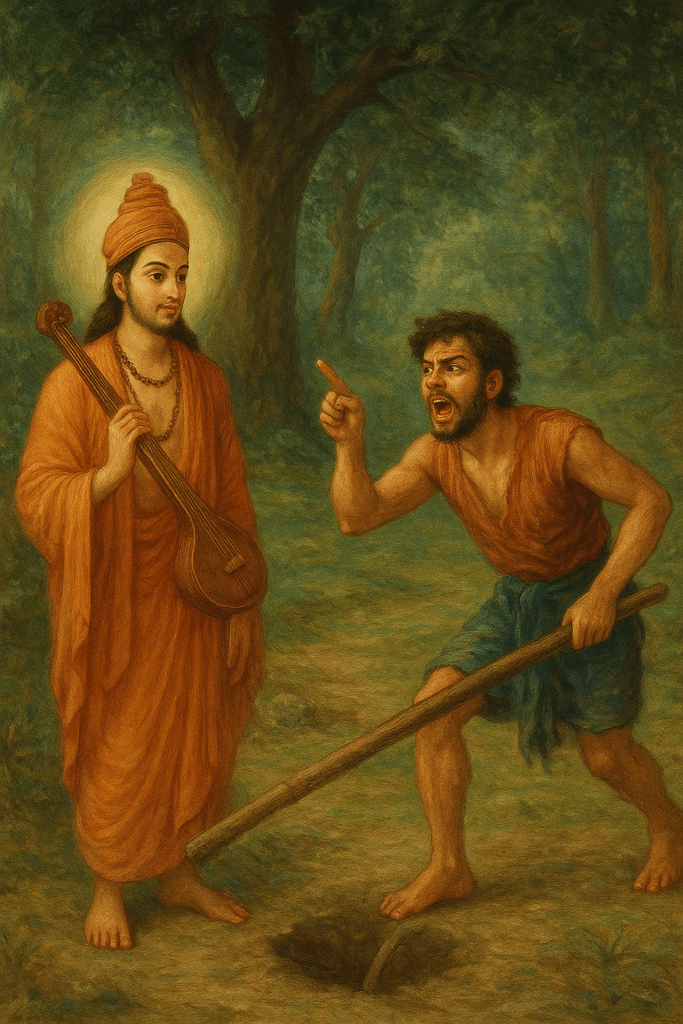
 Linda's Literary Home
