
William Butler Yeats’ “Lapis Lazuli”
In his poem “Lapis Lazuli,” William Butler Yeats has his speaker explore the issue of peace and tranquility despite a chaotic environment.
Introduction and Text of “Lapis Lazuli”
The speaker of William Butler Yeats’ Eastern-philosophically influenced piece “Lapis Lazuli” opens his disquisition by announcing to his readers that the hysterical women are dismayed by artists who remain in non-attachment, while the times seem to require some definite movement against evil in order that they do not fall victim to obliteration.
Yeats composed “Lapis Lazuli” in 1938 as WWII was gearing up in Europe; thus the women are afraid that they will be become targets of the Zeppelins and airplanes that were employed to bomb London in WWI. The allusion to “King Billy bomb-balls in” consists of a pun on William III at the Battle of the Boyne and Kaiser Wilhelm.
Lapis Lazuli
(for Harry Clifton)
I have heard that hysterical women say
They are sick of the palette and fiddle-bow,
Of poets that are always gay,
For everybody knows or else should know
That if nothing drastic is done
Aeroplane and Zeppelin will come out,
Pitch like King Billy bomb-balls in
Until the town lie beaten flat.
All perform their tragic play,
There struts Hamlet, there is Lear,
That’s Ophelia, that Cordelia;
Yet they, should the last scene be there,
The great stage curtain about to drop,
If worthy their prominent part in the play,
Do not break up their lines to weep.
They know that Hamlet and Lear are gay;
Gaiety transfiguring all that dread.
All men have aimed at, found and lost;
Black out; Heaven blazing into the head:
Tragedy wrought to its uttermost.
Though Hamlet rambles and Lear rages,
And all the drop scenes drop at once
Upon a hundred thousand stages,
It cannot grow by an inch or an ounce.
On their own feet they came, or on shipboard,
Camel-back, horse-back, ass-back, mule-back,
Old civilisations put to the sword.
Then they and their wisdom went to rack:
No handiwork of Callimachus
Who handled marble as if it were bronze,
Made draperies that seemed to rise
When sea-wind swept the corner, stands;
His long lamp chimney shaped like the stem
Of a slender palm, stood but a day;
All things fall and are built again
And those that build them again are gay.
Two Chinamen, behind them a third,
Are carved in Lapis Lazuli,
Over them flies a long-legged bird
A symbol of longevity;
The third, doubtless a serving-man,
Carries a musical instrument.
Every discolouration of the stone,
Every accidental crack or dent
Seems a water-course or an avalanche,
Or lofty slope where it still snows
Though doubtless plum or cherry-branch
Sweetens the little half-way house
Those Chinamen climb towards, and I
Delight to imagine them seated there;
There, on the mountain and the sky,
On all the tragic scene they stare.
One asks for mournful melodies;
Accomplished fingers begin to play.
Their eyes mid many wrinkles, their eyes,
Their ancient, glittering eyes, are gay.
Dylan Thomas’ dramatic reading
Commentary on “Lapis Lazuli”
The speaker is examining the issue of peace and tranquility despite a chaotic environment.
First Stanza: What the Speaker Believes
I have heard that hysterical women say
They are sick of the palette and fiddle-bow,
Of poets that are always gay,
For everybody knows or else should know
That if nothing drastic is done
Aeroplane and Zeppelin will come out,
Pitch like King Billy bomb-balls in
Until the town lie beaten flat.
The speaker sets up his argument to show that he believes certain complaining women are hysterical because they are lamenting a rather natural flux of history. The speaker will be attempting to demonstrate the healing affects of art, despite what those who descend into hysterics cry and wail about.
Second Stanza: Scenes from Plays
All perform their tragic play,
There struts Hamlet, there is Lear,
That’s Ophelia, that Cordelia;
Yet they, should the last scene be there,
The great stage curtain about to drop,
If worthy their prominent part in the play,
Do not break up their lines to weep.
They know that Hamlet and Lear are gay;
Gaiety transfiguring all that dread.
All men have aimed at, found and lost;
Black out; Heaven blazing into the head:
Tragedy wrought to its uttermost.
Though Hamlet rambles and Lear rages,
And all the drop scenes drop at once
Upon a hundred thousand stages,
It cannot grow by an inch or an ounce.
The second stanza continues by exemplifying scenes from famous plays. The speaker is alluding to Shakespearean dramas of Hamlet and King Lear. As actors portray the characters in the plays, they do so in a dignified and rather unattached manner. The actors fulfill the drama with their roles but do not allow their feelings to intrude upon their lines with weeping.
The actors never stop to lament over the tragedy that infuses their characters. The actors know that the characters they are dramatizing while sporting great depth of emotion must be portrayed accurately. Therefore they are not steeped in outward displays of lamentation.
Those actors pursuing theatre art remain self-possessed. Otherwise their art would have suffered from over-emotional dabbing. If art is to assist in mitigating sorrow, turbulence, and evil, then it must filter out the bathos that brings on hysterics. The art of the actors prevents them from descending into deep depression over their characters, despite the depth of feeling that they must portray.
While tragedy by definition holds a range of emotion from despair to disdain to sorrowful outbursts, the act of making art brings on a settlement of feeling, otherwise no art could sustain itself.
Theatre art has always served society as a sort of safety valve wherein both actors and audience can view the subject of the performances with some distance. That distance must then be framed in a way that not only lowers the temperature on sorrow but also elevates with the beauty of the truth that the content portrays.
Third Stanza: Civilizations Come and Go
On their own feet they came, or on shipboard,
Camel-back, horse-back, ass-back, mule-back,
Old civilisations put to the sword.
Then they and their wisdom went to rack:
No handiwork of Callimachus
Who handled marble as if it were bronze,
Made draperies that seemed to rise
When sea-wind swept the corner, stands;
His long lamp chimney shaped like the stem
Of a slender palm, stood but a day;
All things fall and are built again
And those that build them again are gay.
The third stanza reminds readers/listeners that civilization come and go, that the story of humankind is replete with societies rising and falling, like waves in the ocean. While the thought may provoke gloom, it remains a fact that those civilization have indeed been vanquished. Even the great art of a Callimachus has come and gone.
That great sculptor was able to work his magic on marble as if it were a softer material, but where is he now? Like those great civilization, he has come and gone. Despite the fact that societies and great artists come and go, there is still hope because just as they are torn down, they rise again. Civilizations rise again, edifices are rebuilt, and new artists replace the old.
Fourth Stanza: The Carving
Two Chinamen, behind them a third,
Are carved in Lapis Lazuli,
Over them flies a long-legged bird
A symbol of longevity;
The third, doubtless a serving-man,
Carries a musical instrument.
In 1935, four years before the death of William Butler Yeats, the poet Harry Clifton gave Yeats a carving that according to Yeats some Chinese sculptor had done in lapis lazuli. The gift accounts for Yeats’ dedication of the poem to Clifton. That carving of lapis lazuli feature a scene in which three Chinese men are trekking up a mountain-side.
Also featured is a long-legged bird flying overhead. The speaker claims that this bird is a symbol of a long life. One of the Chinese men, the speaker claims, is a servant because he is transporting a musical instrument.
Fifth Stanza: Men on a Stone
Every discolouration of the stone,
Every accidental crack or dent
Seems a water-course or an avalanche,
Or lofty slope where it still snows
Though doubtless plum or cherry-branch
Sweetens the little half-way house
Those Chinamen climb towards, and I
Delight to imagine them seated there;
There, on the mountain and the sky,
On all the tragic scene they stare.
One asks for mournful melodies;
Accomplished fingers begin to play.
Their eyes mid many wrinkles, their eyes,
Their ancient, glittering eyes, are gay.
The three men are hiking up the mountain toward what Yeats’ speaker assumes is a little half-way house. Readers, however, might sense that that little house might be a temple. (Oddly, Yeats even claims that building is a “temple” in his letter to Dorothy Wellesley. See below.)
Yeats’ speaker is interpreting that edifice as a building that resembles an Irish pub, in which the men may stop for refreshment and listen to some sorrowful tunes before trekking on.
It may also be likely that the men are Buddhist monks, and they will stop at a temple to meditate, worship, and pray; the musical instrument will be employed for their chanting. But for the Yeatsian sensibility, as the scene unfolds, one may ask to hear a sad, melancholy tune, and the player begins to offer a rendition.
Thus, Chinese men listening to melancholy tunes may parallel the Western theatre audience watching Hamlet or King Lear. The ancient faces of the Chinese men look on smiling but rather detached as they enjoy the melodies.
The Lapis Lazuli Sculpture
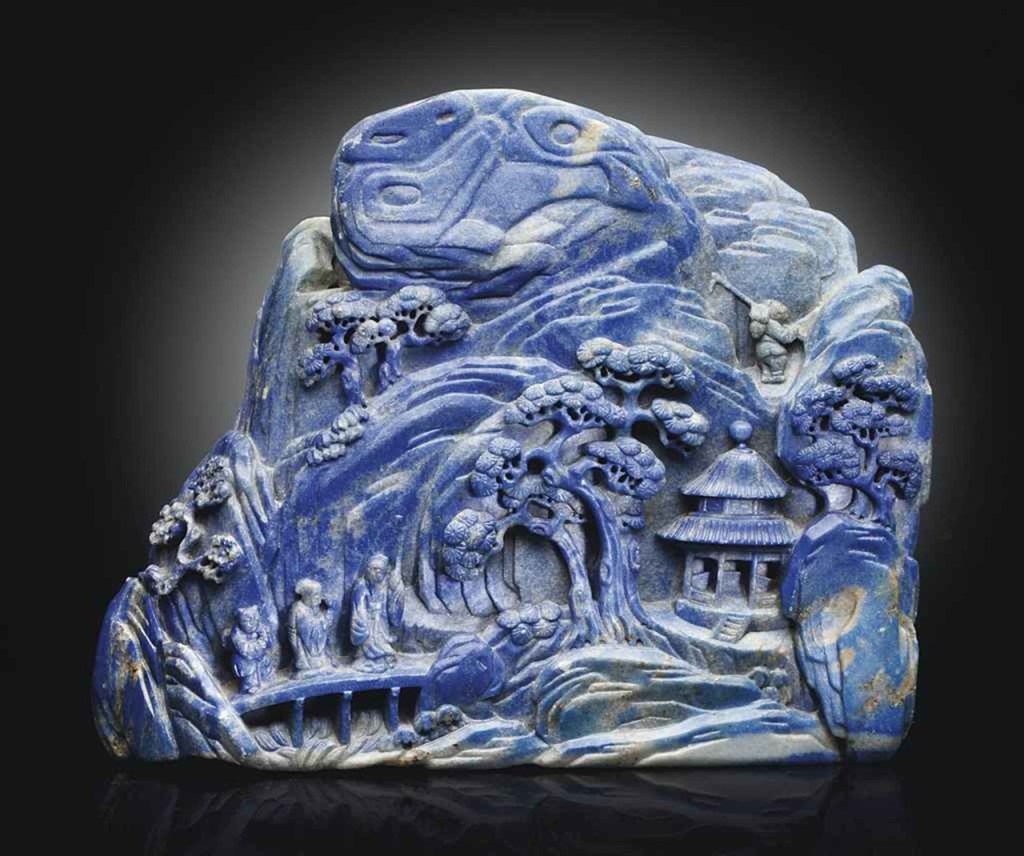
The painter, Sesshu, produced a long scroll of his painting inspired by his trek through China in the 15th century. Both the theme and the appearance of the painting and this sculpture in lapis lazuli are similar.
Letter to Dorothy Wellesley, July 6 1935
The following excerpt from his letter to Dorothy Wellesley describes the sculpture that inspired his poem “Lapis Lazuli”:
[Lapis Lazuli] carved by some Chinese sculptor into the semblance of a mountain with temple, trees, paths, and an ascetic and pupil about to climb the mountain. Ascetic, pupil, hard stone, eternal theme of the sensual east. The heroic cry in the midst of despair. But no, I am wrong, the east has its solutions always and therefore knows nothing of tragedy. It is we, not the east, that must raise the heroic cry.”
William Butler Yeats retained an interest in Eastern philosophy and art, and many of his poems, plays, and essays reflect that interest. Although his understanding of Eastern religious philosophy was tantamount to a “romantic misunderstanding,” as described by T. S. Eliot, his poems are still worth studying.


