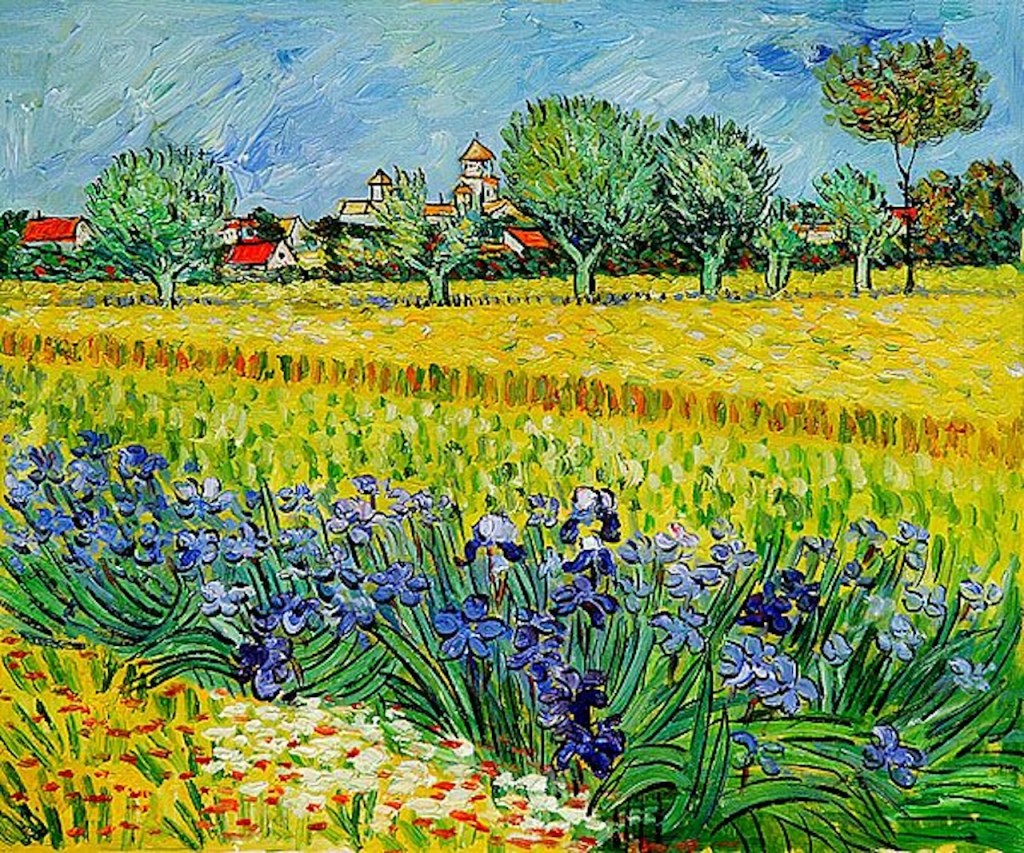
Vincent’sViewof Arles with Irises in the Foreground
To see as you do, Vincent, would give a soul a clearer heart: the trees that look like upside-down men, plunged headfirst into the earth to their waists, their leaves like women’s hair blown by the wind and the irises’ pouting lips parting for the butterflies and the bees,
the red roofs under which the harlots of Arles grind their tricks into dust, and the church tower remanding all eyes to look up at that troubled paint in the sky— those tiny strokes. your fingers, your brushes, and your burden of beauty.
Image a: T. S. Eliot – Ida Kar – National Portrait Gallery, London
T. S. Eliot’s “The Love Song of J. Alfred Prufrock”
T. S. Eliot’s “The Love Song of J. Alfred Prufrock” represents a conglomeration of many of the ridiculous traits of humankind—and the literati in particular; therefore, readers cannot take Prufrock seriously and are thus at liberty to laugh and enjoy the nutty things he thinks and says.
Introduction with Text of “The Love Song of J. Alfred Prufrock”
T. S. Eliot composed a little volume titled Old Possum’s Book of Practical Cats, which under the influence of composer Andrew Lloyd Webber, became Cats, one of the ten longest running musicals [1] on Broadway.
How does one reconcile the lavish and hilarious persona responsible for the likes of old possum and the cats with the gloomy, spiritually dry personality of J. Alfred Prufrock and TheWaste Land mentality? That conflation is somewhat like confusing a man with little education and travel experience for the writer of the Shakespearean canon [2].
The Love Song of J. Alfred Prufrock
S’io credesse che mia risposta fosse A persona che mai tornasse al mondo, Questa fiamma staria senza piu scosse. Ma percioche giammai di questo fondo Non torno vivo alcun, s’i’odo il vero, Senza tema d’infamia ti rispondo.
Let us go then, you and I, When the evening is spread out against the sky Like a patient etherized upon a table; Let us go, through certain half-deserted streets, The muttering retreats Of restless nights in one-night cheap hotels And sawdust restaurants with oyster-shells: Streets that follow like a tedious argument Of insidious intent To lead you to an overwhelming question … Oh, do not ask, “What is it?” Let us go and make our visit.
In the room the women come and go Talking of Michelangelo.
The yellow fog that rubs its back upon the window-panes, The yellow smoke that rubs its muzzle on the window-panes, Licked its tongue into the corners of the evening, Lingered upon the pools that stand in drains, Let fall upon its back the soot that falls from chimneys, Slipped by the terrace, made a sudden leap, And seeing that it was a soft October night, Curled once about the house, and fell asleep.
And indeed there will be time For the yellow smoke that slides along the street, Rubbing its back upon the window-panes; There will be time, there will be time To prepare a face to meet the faces that you meet; There will be time to murder and create, And time for all the works and days of hands That lift and drop a question on your plate; Time for you and time for me, And time yet for a hundred indecisions, And for a hundred visions and revisions, Before the taking of a toast and tea.
In the room the women come and go Talking of Michelangelo.
And indeed there will be time To wonder, “Do I dare?” and, “Do I dare?” Time to turn back and descend the stair, With a bald spot in the middle of my hair — (They will say: “How his hair is growing thin!”) My morning coat, my collar mounting firmly to the chin, My necktie rich and modest, but asserted by a simple pin — (They will say: “But how his arms and legs are thin!”) Do I dare Disturb the universe? In a minute there is time For decisions and revisions which a minute will reverse.
For I have known them all already, known them all: Have known the evenings, mornings, afternoons, I have measured out my life with coffee spoons; I know the voices dying with a dying fall Beneath the music from a farther room. So how should I presume?
And I have known the eyes already, known them all— The eyes that fix you in a formulated phrase, And when I am formulated, sprawling on a pin, When I am pinned and wriggling on the wall, Then how should I begin To spit out all the butt-ends of my days and ways? And how should I presume?
And I have known the arms already, known them all— Arms that are braceleted and white and bare (But in the lamplight, downed with light brown hair!) Is it perfume from a dress That makes me so digress? Arms that lie along a table, or wrap about a shawl. And should I then presume? And how should I begin?
Shall I say, I have gone at dusk through narrow streets And watched the smoke that rises from the pipes Of lonely men in shirt-sleeves, leaning out of windows? …
I should have been a pair of ragged claws Scuttling across the floors of silent seas.
And the afternoon, the evening, sleeps so peacefully! Smoothed by long fingers, Asleep … tired … or it malingers, Stretched on the floor, here beside you and me. Should I, after tea and cakes and ices, Have the strength to force the moment to its crisis? But though I have wept and fasted, wept and prayed, Though I have seen my head (grown slightly bald) brought in upon a platter, I am no prophet — and here’s no great matter; I have seen the moment of my greatness flicker, And I have seen the eternal Footman hold my coat, and snicker, And in short, I was afraid.
And would it have been worth it, after all, After the cups, the marmalade, the tea, Among the porcelain, among some talk of you and me, Would it have been worth while, To have bitten off the matter with a smile, To have squeezed the universe into a ball To roll it towards some overwhelming question, To say: “I am Lazarus, come from the dead, Come back to tell you all, I shall tell you all”— If one, settling a pillow by her head Should say: “That is not what I meant at all; That is not it, at all.”
And would it have been worth it, after all, Would it have been worth while, After the sunsets and the dooryards and the sprinkled streets, After the novels, after the teacups, after the skirts that trail along the floor— And this, and so much more?— It is impossible to say just what I mean! But as if a magic lantern threw the nerves in patterns on a screen: Would it have been worth while If one, settling a pillow or throwing off a shawl, And turning toward the window, should say: “That is not it at all, That is not what I meant, at all.”
No! I am not Prince Hamlet, nor was meant to be; Am an attendant lord, one that will do To swell a progress, start a scene or two, Advise the prince; no doubt, an easy tool, Deferential, glad to be of use, Politic, cautious, and meticulous; Full of high sentence, but a bit obtuse; At times, indeed, almost ridiculous— Almost, at times, the Fool.
I grow old … I grow old … I shall wear the bottoms of my trousers rolled.
Shall I part my hair behind? Do I dare to eat a peach? I shall wear white flannel trousers, and walk upon the beach. I have heard the mermaids singing, each to each.
I do not think that they will sing to me.
I have seen them riding seaward on the waves Combing the white hair of the waves blown back When the wind blows the water white and black. We have lingered in the chambers of the sea By sea-girls wreathed with seaweed red and brown Till human voices wake us, and we drown.
Reading by Anthony Hopkins
Commentary on “The Love Song of J. Alfred Prufrock”
T. S. Eliot is really a very funny poet. His works are taken way too seriously. A reader needs to think irony, satire, and sarcasm and then enjoy a few belly laughs when reading Eliot. And his character J. Alfred Prufrock offers one of the finest examples of Eliot’s humor, as he, at the same time, skewers the direction of art in the 20th century.
Prufrock Killed Poetry
The American humorist Garrison Keillor [3] has offered his experience with and opinion of “old Pru,” claiming that the poem is
a small, dark mopefest of a poem in which old Pru worries about whether to eat a peach or roll up his trousers. This poem pretty much killed off the pleasure of poetry for millions of people who got dragged through it in high school.
Keillor and his ilk who learned to hate poetry because of being “dragged through it in high school” might benefit from revisiting the poem and considering it through a lens of irony brushed with satire and sarcasm.
For a more precise understanding of the poem, it is also important to realize that it is focusing on and providing a critique of the flaws of modernism, the movement that was having demoralizing effects on the art of poetry.
The ironic humor of the poem clearly rails against the angst-infused positions that were rendering poetry not only unintelligible but ultimately without literary value.
Who is J. Alfred Prufrock and what does he want?
Critics regularly note the ironic disjointedness in the title as a love song apparently sung by a man with a business-suit name. But they then descend into the maudlin angst of this poor pathetic creature, and ultimately they take the work as a criticism of modern society in general, instead of a criticism of the skewed direction of art.
Eliot was poking fun at such criticism and such stances. The poem itself is a mishmash of form, consisting of 131 lines separated into free-verse paragraphs (versagraphs), yet it has rime throughout, delivered in uneven rhythms.
The form itself makes fun of free-verse and phony erudition (the many allusions to classic works that seem so out of place) as it floats them down a stream-of-consciousness.
Opening Movement: The Anesthetized Patient
The first three lines set up the hilarious mood of the poem:
Let us go then, you and I, When the evening is spread out against the sky Like a patient etherised upon a table.
The first line sounds as if the speaker of the poem is inviting someone to go somewhere in the evening, perhaps a social gathering or just an outing with a lady friend; after all it is a “love song.”
But the reader is slammed in the face as the evening is described as a patient on an operating table being prepared for surgery. The romance of supposed “love song” has died by line three.
The speaker continues to mumble, describing the evening quite negatively, briefly mentioning one night stands in nasty hotels, disgusting eateries, and the boring streets that lead to boring places of ill-repute—yet all this leads on to “an overwhelming question.”
But then the speaker cuts off the thought by telling his listener not to bother asking what the “overwhelming question” is but instead says let’s just get going “and make our visit.” Now, it sounds as if the speaker and his companion are definitely going to a social gathering, maybe a dinner party.
But the dinner party never materializes, and it becomes quite apparent that the speaker is simply addressing himself, likely while looking at his face in a mirror. There is no companion; there is no evening engagement, just a musing voice that is making fun of all the modernist techniques that the poet is employing in the poem through this pathetic speaker.
The Italian Epigram: Professing an “Insidious Intent”
S’io credesse che mia risposta fosse A persona che mai tornasse al mondo, Questa fiamma staria senza piu scosse. Ma percioche giammai di questo fondo Non torno vivo alcun, s’i’odo il vero, Senza tema d’infamia ti rispondo.
The epigram that opens the poem alerts the reader to the “insidious intent” of the speaker in the poem. The six lines feature a quotation from Dante’s Inferno (XXVII, 61–66). The following is a rough translation from the Italian of the epigram:
If I believed I was trying to bullshit someone who could return to the world, I would hold my tongue. But since no one ever lives to return to life again, at least so they say, I will spew forth whatever I please.
The following is an interpretive paraphrase of the Italian epigram:
if I thought such nonsense would really be foisted on the world, I would not concoct it, but since those who delve into the avant-garde poetry world have nothing to take back, I have deigned to let it fly
Modern Boredom: Vacuous Social Gatherings
The speaker describes the fog in the metaphorical likeness of a dog: it rubs its back and muzzle on the window-panes, and it “[l]icked its tongue into the corners of the evening.”
The speaker is concerned about social gatherings; he has often encountered them, and the lines “In the room the women come and go / Talking of Michelangelo” become a mantra.
And the line “I have measured out my life with coffee spoons,” which follows his claim to have known all those bored people in offices, lounges, and evening affairs demonstrates the speaker’s awareness of his own boredom.
Floating Down the Stream: Tricky Man, Very Tricky Man
The speaker inserts telling images into his stream-of-consciousness descriptions of angst-filled scenes with outrageous images such as “I should have been a pair of ragged claws / Scuttling across the floors of silent seas.” Another outlandish sight is “I grow old … I grow old … / I shall wear the bottoms of my trousers rolled.”
And while these are famous lines often cited as showing the modern angst of Prufrock, they are quite humorous when one realizes that the speaker is making fun of the serious tone that critics will take regarding the style and highly allusive nature of the poem. Eliot’s J. Alfred Prufrock has tricked many readers with his dry, spiritually destitute personality.
Tricked by Eliot’s J. Alfred Prufrock
The radio star Garrison Keillor blames “The Love Song of J. Alfred Prufrock” for “kill[ing] off the pleasure of poetry.” Keillor complains that the poem is “a small, dark mopefest of a poem in which old Pru worries about whether to eat a peach or roll up his trousers.”
It is somewhat puzzling that Keillor, whose own banter attempts to lace humor with reportage, does not see the humor in “Old Pru.” Robert Frost asserted that his poem “The Road Not Taken” was “a tricky poem—a very tricky poem.”
However, many other Frostian poems have turned out to be quite tricky as well. And T. S. Eliot became a master at composing some of the trickiest poems to grace the poetry world.
The Character of J. Alfred Prufrock
The speaker of T. S. Eliot’s most widely anthologized classic is J. Alfred Prufrock himself, and his personality is the theme of the poem; he is a ridiculous character, utterly laughable. As Roger Mitchell [4] has explained,
[Prufock] is the Representative Man of early Modernism. Shy, cultivated, oversensitive, sexually retarded (many have said impotent), ruminative, isolated, self-aware to the point of solipsism.
In other words, “old Pru” is merely a conglomeration of many of the ridiculous traits of humankind—and the literati in particular; therefore, readers cannot take Prufrock seriously and are thus at liberty to laugh and enjoy the nutty things he thinks and says.
Failure to Read Closely
Keillor refers to the following lines: “I shall wear the bottoms of my trousers rolled,” and “Shall I part my hair behind? Do I dare to eat a peach?” The former radio personality has been tricked by Eliot’s poem, and in Keillor’s comment about the poem, two assertions demonstrate his misunderstanding.
The first false assertion about the poem is that it is a “small, dark mopefest of a poem”: this is a false assertion because the poem is too funny to be a “dark mopefest,” plus it is really a longer poem than most lyrics; thus the descriptor “small” remains inaccurate.
The second false assertion is that, “old Pru worries about whether to eat a peach or roll up his trousers”: while “old Pru” does ask if he dares “eat a peach,” he does not question whether he will roll up his trousers.
These two false assertions suggest the reason that Keillor has been tricked by the poem; he simply has not read it carefully and closely enough, and likely his high school teacher was not adept at comprehending and teaching poetry.
Other Funny Lines
The opening of the poem, at first, may simply seem startling, but upon further study, the reader can see the hilarity in the absurdity of “the evening [ ] spread out against the sky / Like a patient etherized upon a table.” The juxtaposition of “evening/sky” and “etherized patient/table” is just so ludicrous that it is laughable.
“The yellow fog that rubs its back upon the window-panes”: fog becomes a cat or a dog, and the speaker likes that metaphor so well that he repeats it in the next stanza. Fog as a dog jumps like a frog into the mind as one encounters those lines.
A close consideration of the lines, “To wonder, ‘Do I dare?’ and, ‘Do I dare?’ / Time to turn back and descend the stair, / With a bald spot in the middle of my hair,” reveals again the absurdity of taking Keillor’s criticism seriously.
The jarring juxtaposition of a pathetic creature double questioning his traipsing down a stairway and then hastening to the bald spot in his pate cannot help but elicit a laugh, provided the reader/listener is paying close attention.
While Prufrock would be a sympathetic character were he less pitiful, he becomes a caricature, who instead of drawing sympathy draws derision from the reader. Perhaps by tweaking their reading a bit and by reading closer, Keillor and other casual readers could learn to enjoy the misadventures of J. Alfred Prufrock.
Image: Walt Whitman Library of Congress/Getty Images
Walt Whitman’s “I Hear America Singing”
In “I Hear America Singing,” Walt Whitman’s speaker is offering a musical tribute to the laborers of America as they “sing,” that is work, cheerfully. This 19th century hat-tip also recognizes the partiers who fill the night time with their good cheer.
Introduction and Text of “I Hear America Singing”
Walt Whitman’s “I Hear America Singing” is a song of praise. As a useful metaphor, “song” becomes the tool with which the speaker in Walt Whitman’s “I Hear America Singing” expresses the cheerful nature of the people he daily encounters in their labors and in also in their play.
By claiming to hear them “singing,” he is rendering them cheerful and skilled in their labor. The speaker’s heart is overflowing with praise for his fellow citizens. As the speaker commences his tribute, he reports that he hears “America singing.”
Each song he encounters is unique. Each “song” constitutes a different carol, not ordinary in the least, but each one offering praise and demonstrating joy in its being.
The joy and praise impress the speaker so much that he seems to be bursting with pride to be a part of such an honorable conglomeration of laboring folks. His admiration makes him abundantly happy as he sings himself, making his poem.
As the speaker observes his fellow citizens, he becomes optimistic, and his feelings no doubt color his reportage. He offers what one might consider to be an exaggeration of the joy and gratitude inspiring these people who are ordinary workers. These folks are certainly not likely to become sycophants of the nothing-to-lose-but-our-chains crowd.
Each of the eleven lines sprawls across the page and spills into the adjoining line to facilitate a new line. The elongated sentences must be broken in unusual ways to accommodate the thoughts that this speaker wishes to share. Whitman’s free verse style virtually always employs this rambling, sprawling form as he catalogs all the things his speakers see, hear, think, feel, or enjoy.
I Hear America Singing
I hear America singing, the varied carols I hear, Those of mechanics, each one singing his as it should be blithe and strong, The carpenter singing his as he measures his plank or beam, The mason singing his as he makes ready for work, or leaves off work, The boatman singing what belongs to him in his boat, the deckhand singing on the steamboat deck, The shoemaker singing as he sits on his bench, the hatter singing as he stands, The wood-cutter’s song, the ploughboy’s on his way in the morning, or at noon intermission or at sundown, The delicious singing of the mother, or of the young wife at work, or of the girl sewing or washing, Each singing what belongs to him or her and to none else, The day what belongs to the day—at night the party of young fellows, robust, friendly, Singing with open mouths their strong melodious songs.
Reading of “I Hear America Singing”
Commentary on“I Hear America Singing”
Walt Whitman’s “I Hear American Singing” features a speaker who is offering a musical tribute to the laborers of America; they cheerfully sing as they work. This 19th century effusion also recognizes the partiers who fill the night time with their good cheer.
First Movement: Varied Laborers
I hear America singing, the varied carols I hear, Those of mechanics, each one singing his as it should be blithe and strong, The carpenter singing his as he measures his plank or beam, The mason singing his as he makes ready for work, or leaves off work, The boatman singing what belongs to him in his boat, the deckhand singing on the steamboat deck, The shoemaker singing as he sits on his bench, the hatter singing as he stands,
The speaker then commences listing the varied laborers whom he hears singing their joyous, praise songs. First, he hears the mechanics. Each mechanic remains busy working in his own unique way. The speaker finds their manner “blithe and strong.” He then mentions the carpenter whose song sings out the measurement of “plank or beam.”
The mason is singing while he prepares himself for his workday even before he leaves for work. The speaker hears the boatman caroling about the items that he possesses, items that fill his boat, while the deckhand also is singing on the steamboat’s deck. The shoemaker is also singing, working at his bench, as the hat maker offers his carols where he stands.
Second Movement: A Mother’s Delicious Singing
The wood-cutter’s song, the ploughboy’s on his way in the morning, or at noon intermission or at sundown, The delicious singing of the mother, or of the young wife at work, or of the girl sewing or washing, Each singing what belongs to him or her and to none else,
Continuing his catalog, the speaker hears the “wood-cutter’s song” and the song of the farmer, who is plowing his fields in the morning, at noon, and even as the sun sets in the evening. A mother’s carols exemplify a “delicious” song.
The young wife is singing as she works, and a girl, who is likely serving as a maid, also sings as she sews and does the laundry. All of these ordinary folks are performing their tasks uniquely—each in his/her own unique way. They are not a faceless mass of working slobs.
They are priceless human beings living their American dreams. Thus, they deserve respect, affection, and attention, and this speaker is revealing the love and cheerful attitudes these hard-working Americans are portraying as they simply go about their daily work routines.
Third Movement: Young Fellows and Party Time
The day what belongs to the day—at night the party of young fellows, robust, friendly, Singing with open mouths their strong melodious songs.
There is a time for work, and there is a time for leisure. The speaker’s respect for work is equaled by his respect for party time. The time of fellowship is also important as the revelers sing their leisure time.
Just as workers, they have offered their service, now as partiers they demonstrate that time away from work is also valuable. The speaker describes a scene of the partiers as they sing open-mouthed. They are young, cordial, hale and hearty as they carouse singing their “melodious songs.”
While day time offers all the beautiful songs of various workers and service providers, night time offers a time for the beautiful songs of leisure, fellowship, and renewal of spirit. The sweet melodies of work and leisure are all significant and well worth noting.
In his poem “Lapis Lazuli,” William Butler Yeats has his speaker explore the issue of peace and tranquility despite a chaotic environment.
Introduction and Text of “Lapis Lazuli”
The speaker of William Butler Yeats’ Eastern-philosophically influenced piece “Lapis Lazuli” opens his disquisition by announcing to his readers that the hysterical women are dismayed by artists who remain in non-attachment, while the times seem to require some definite movement against evil in order that they do not fall victim to obliteration.
Yeats composed “Lapis Lazuli” in 1938 as WWII was gearing up in Europe; thus the women are afraid that they will be become targets of the Zeppelins and airplanes that were employed to bomb London in WWI. The allusion to “King Billy bomb-balls in” consists of a pun on William III at the Battle of the Boyne and Kaiser Wilhelm.
Lapis Lazuli
(for Harry Clifton)
I have heard that hysterical women say They are sick of the palette and fiddle-bow, Of poets that are always gay, For everybody knows or else should know That if nothing drastic is done Aeroplane and Zeppelin will come out, Pitch like King Billy bomb-balls in Until the town lie beaten flat.
All perform their tragic play, There struts Hamlet, there is Lear, That’s Ophelia, that Cordelia; Yet they, should the last scene be there, The great stage curtain about to drop, If worthy their prominent part in the play, Do not break up their lines to weep. They know that Hamlet and Lear are gay; Gaiety transfiguring all that dread. All men have aimed at, found and lost; Black out; Heaven blazing into the head: Tragedy wrought to its uttermost. Though Hamlet rambles and Lear rages, And all the drop scenes drop at once Upon a hundred thousand stages, It cannot grow by an inch or an ounce.
On their own feet they came, or on shipboard, Camel-back, horse-back, ass-back, mule-back, Old civilisations put to the sword. Then they and their wisdom went to rack: No handiwork of Callimachus Who handled marble as if it were bronze, Made draperies that seemed to rise When sea-wind swept the corner, stands; His long lamp chimney shaped like the stem Of a slender palm, stood but a day; All things fall and are built again And those that build them again are gay.
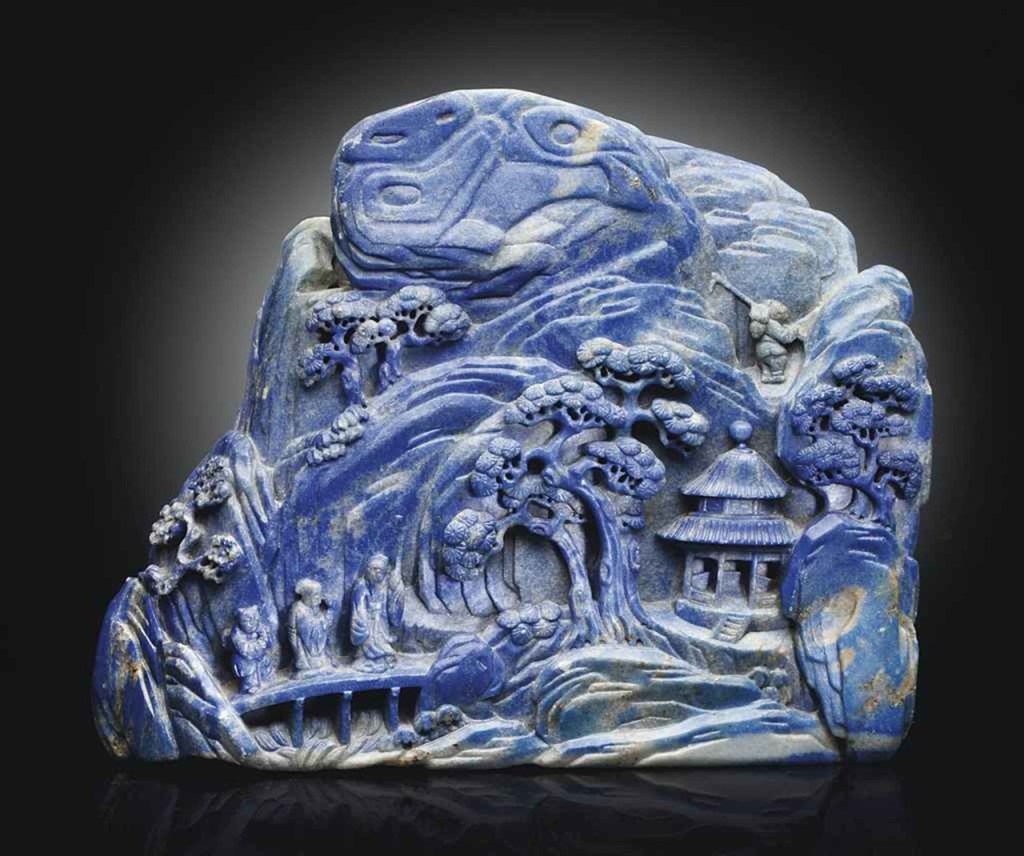
Two Chinamen, behind them a third, Are carved in Lapis Lazuli, Over them flies a long-legged bird A symbol of longevity; The third, doubtless a serving-man, Carries a musical instrument.
Every discolouration of the stone, Every accidental crack or dent Seems a water-course or an avalanche, Or lofty slope where it still snows Though doubtless plum or cherry-branch Sweetens the little half-way house Those Chinamen climb towards, and I Delight to imagine them seated there; There, on the mountain and the sky, On all the tragic scene they stare. One asks for mournful melodies; Accomplished fingers begin to play. Their eyes mid many wrinkles, their eyes, Their ancient, glittering eyes, are gay.
Dylan Thomas’ dramatic reading
Commentary on “Lapis Lazuli”
The speaker is examining the issue of peace and tranquility despite a chaotic environment.
First Stanza: What the Speaker Believes
I have heard that hysterical women say They are sick of the palette and fiddle-bow, Of poets that are always gay, For everybody knows or else should know That if nothing drastic is done Aeroplane and Zeppelin will come out, Pitch like King Billy bomb-balls in Until the town lie beaten flat.
The speaker sets up his argument to show that he believes certain complaining women are hysterical because they are lamenting a rather natural flux of history. The speaker will be attempting to demonstrate the healing affects of art, despite what those who descend into hysterics cry and wail about.
Second Stanza: Scenes from Plays
All perform their tragic play, There struts Hamlet, there is Lear, That’s Ophelia, that Cordelia; Yet they, should the last scene be there, The great stage curtain about to drop, If worthy their prominent part in the play, Do not break up their lines to weep. They know that Hamlet and Lear are gay; Gaiety transfiguring all that dread. All men have aimed at, found and lost; Black out; Heaven blazing into the head: Tragedy wrought to its uttermost. Though Hamlet rambles and Lear rages, And all the drop scenes drop at once Upon a hundred thousand stages, It cannot grow by an inch or an ounce.
The second stanza continues by exemplifying scenes from famous plays. The speaker is alluding to Shakespearean dramas of Hamlet and King Lear. As actors portray the characters in the plays, they do so in a dignified and rather unattached manner. The actors fulfill the drama with their roles but do not allow their feelings to intrude upon their lines with weeping.
The actors never stop to lament over the tragedy that infuses their characters. The actors know that the characters they are dramatizing while sporting great depth of emotion must be portrayed accurately. Therefore they are not steeped in outward displays of lamentation.
Those actors pursuing theatre art remain self-possessed. Otherwise their art would have suffered from over-emotional dabbing. If art is to assist in mitigating sorrow, turbulence, and evil, then it must filter out the bathos that brings on hysterics. The art of the actors prevents them from descending into deep depression over their characters, despite the depth of feeling that they must portray.
While tragedy by definition holds a range of emotion from despair to disdain to sorrowful outbursts, the act of making art brings on a settlement of feeling, otherwise no art could sustain itself.
Theatre art has always served society as a sort of safety valve wherein both actors and audience can view the subject of the performances with some distance. That distance must then be framed in a way that not only lowers the temperature on sorrow but also elevates with the beauty of the truth that the content portrays.
Third Stanza: Civilizations Come and Go
On their own feet they came, or on shipboard, Camel-back, horse-back, ass-back, mule-back, Old civilisations put to the sword. Then they and their wisdom went to rack: No handiwork of Callimachus Who handled marble as if it were bronze, Made draperies that seemed to rise When sea-wind swept the corner, stands; His long lamp chimney shaped like the stem Of a slender palm, stood but a day; All things fall and are built again And those that build them again are gay.
The third stanza reminds readers/listeners that civilization come and go, that the story of humankind is replete with societies rising and falling, like waves in the ocean. While the thought may provoke gloom, it remains a fact that those civilization have indeed been vanquished. Even the great art of a Callimachus has come and gone.
That great sculptor was able to work his magic on marble as if it were a softer material, but where is he now? Like those great civilization, he has come and gone. Despite the fact that societies and great artists come and go, there is still hope because just as they are torn down, they rise again. Civilizations rise again, edifices are rebuilt, and new artists replace the old.
Fourth Stanza: The Carving
Two Chinamen, behind them a third, Are carved in Lapis Lazuli, Over them flies a long-legged bird A symbol of longevity; The third, doubtless a serving-man, Carries a musical instrument.
In 1935, four years before the death of William Butler Yeats, the poet Harry Clifton gave Yeats a carving that according to Yeats some Chinese sculptor had done in lapis lazuli. The gift accounts for Yeats’ dedication of the poem to Clifton. That carving of lapis lazuli feature a scene in which three Chinese men are trekking up a mountain-side.
Also featured is a long-legged bird flying overhead. The speaker claims that this bird is a symbol of a long life. One of the Chinese men, the speaker claims, is a servant because he is transporting a musical instrument.
Fifth Stanza: Men on a Stone
Every discolouration of the stone, Every accidental crack or dent Seems a water-course or an avalanche, Or lofty slope where it still snows Though doubtless plum or cherry-branch Sweetens the little half-way house Those Chinamen climb towards, and I Delight to imagine them seated there; There, on the mountain and the sky, On all the tragic scene they stare. One asks for mournful melodies; Accomplished fingers begin to play. Their eyes mid many wrinkles, their eyes, Their ancient, glittering eyes, are gay.
The three men are hiking up the mountain toward what Yeats’ speaker assumes is a little half-way house. Readers, however, might sense that that little house might be a temple. (Oddly, Yeats even claims that building is a “temple” in his letter to Dorothy Wellesley. See below.)
Yeats’ speaker is interpreting that edifice as a building that resembles an Irish pub, in which the men may stop for refreshment and listen to some sorrowful tunes before trekking on.
It may also be likely that the men are Buddhist monks, and they will stop at a temple to meditate, worship, and pray; the musical instrument will be employed for their chanting. But for the Yeatsian sensibility, as the scene unfolds, one may ask to hear a sad, melancholy tune, and the player begins to offer a rendition.
Thus, Chinese men listening to melancholy tunes may parallel the Western theatre audience watching Hamlet or King Lear. The ancient faces of the Chinese men look on smiling but rather detached as they enjoy the melodies.
The painter, Sesshu, produced a long scroll of his painting inspired by his trek through China in the 15th century. Both the theme and the appearance of the painting and this sculpture in lapis lazuli are similar.
Letter to Dorothy Wellesley, July 6 1935
The following excerpt from his letter to Dorothy Wellesley describes the sculpture that inspired his poem “Lapis Lazuli”:
[Lapis Lazuli] carved by some Chinese sculptor into the semblance of a mountain with temple, trees, paths, and an ascetic and pupil about to climb the mountain. Ascetic, pupil, hard stone, eternal theme of the sensual east. The heroic cry in the midst of despair. But no, I am wrong, the east has its solutions always and therefore knows nothing of tragedy. It is we, not the east, that must raise the heroic cry.”
William Butler Yeats retained an interest in Eastern philosophy and art, and many of his poems, plays, and essays reflect that interest. Although his understanding of Eastern religious philosophy was tantamount to a “romantic misunderstanding,” as described by T. S. Eliot, his poems are still worth studying.
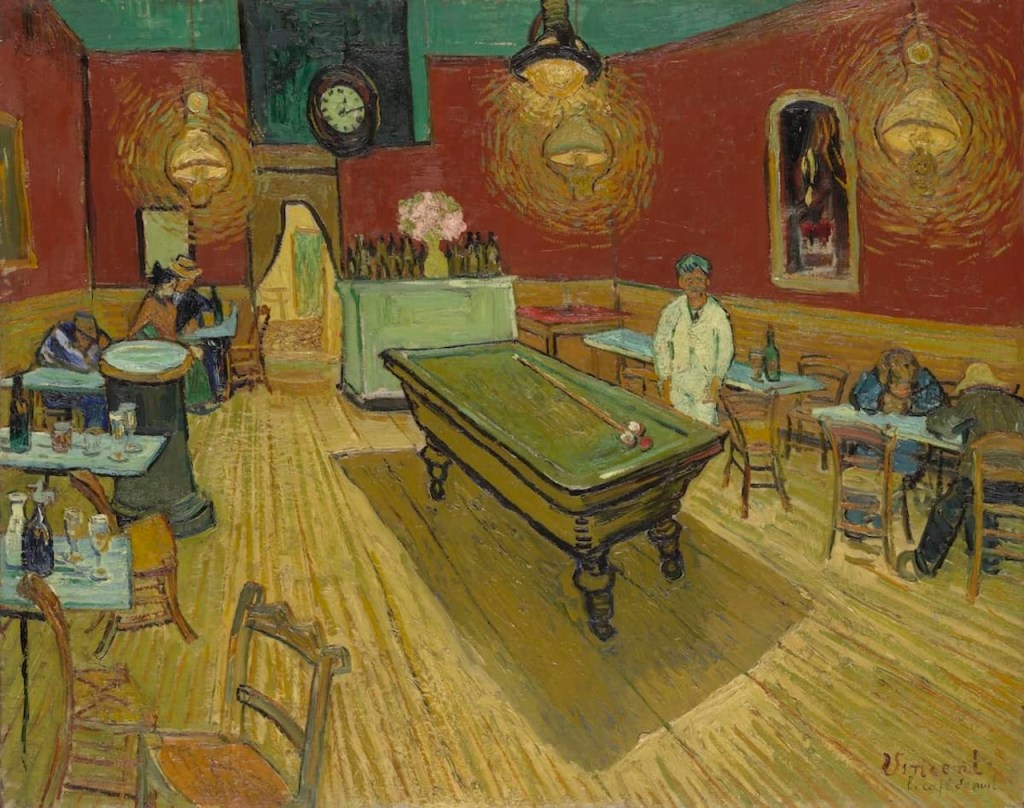
Vincent’s tortured paint has drawn me To a place I would never go, Now that saintly solitude has become my solution. But then of the six people in the cafe Only a man and a woman back in the left corner Sit together, Sharing a bottle & whispers, I guess. Later, after they leave their empty glasses, Will they stay together or shuffle down The solemn streets alone?
A man slumps at the table nearest the couple, No glass or bottle on his table. A bottle, half a drink, & three empty glasses stand On the table near the slumping man; a carafe, an empty Bottle & two half-empty glasses on the next table As I travel towards myself marking the abandoned tables. A pool table casts an unlikely shadow over too much floor, & a man has risen from his chair, stands by the pool table Gazing at me through the troubled paint. Shying away from his eye, I mark behind him another table holds a half-full bottle & a full glass, probably his bottle & glass. The last two figures also slump, also without drinks. Sitting Catty-cornered they seem to face each other, having A less than intimate conversation. But then they, as well As the first slumper, are perhaps sleeping, likely homeless men & these tables their only warm bed. I wonder if Vincent knew.
The Night Cafe—a place I could not go: Those red walls & green ceiling & friendly lamps Hanging down & the booze bottles Standing brazen on a cabinet Against the back wall; a curtained Doorway suggests someone Lives back there behind the cafe, Unless, of course, I’m turned around & that is the entrance. In any case I would never go there (well, maybe If you invited me, for a drink and some intimate conversation)
Because—at this writing— I know I have more in common with artists Than I do with the saints.
They have plowed, sowed, And reaped their fields in peace. Upon the riverbanks, They cast their eye. Yet, they have never prayed For quick release From tasks that last Until the last goodbye. They went about on wings, Helped others rise. They raised their food And used their useful tools. Their little worries sparked With shouts and cries, But then their product proved They knew the rules.
Bridges, buildings, gardens Grew year by year. Their music wafted nightly From their strings. Exalted words went Sparkling far and near: The king would dance, And then the queen could sing. They plowed the fields And many came to see That rustic life As robust as a tree.
II. The Fisherman
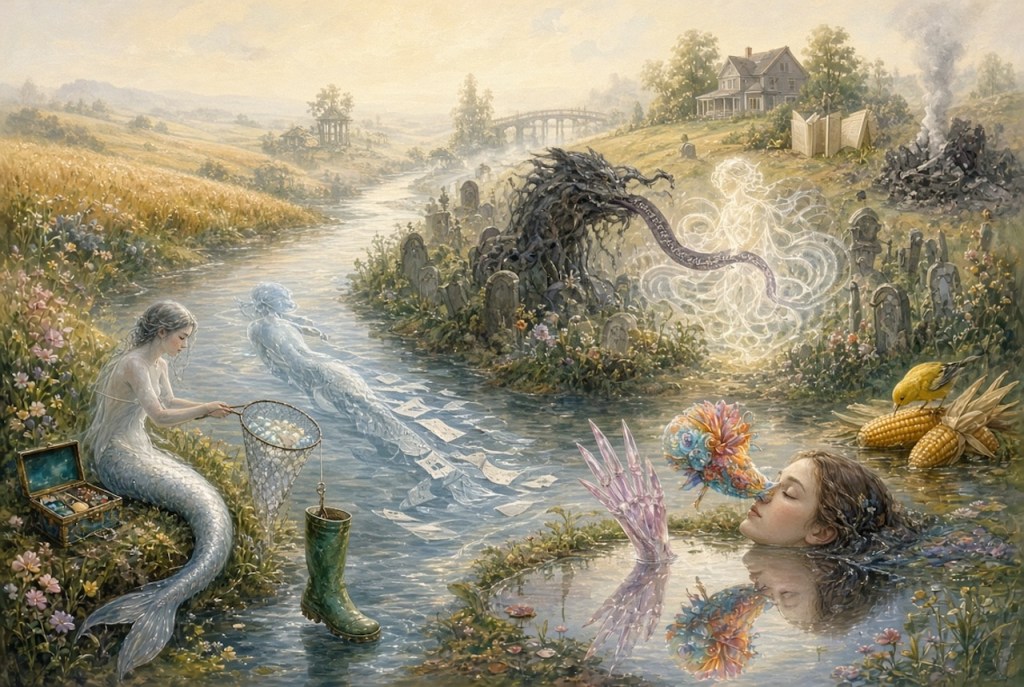
I used to write poems that left a fish smell on the page. You had to scale them to taste them so they left too much of me out And made me sound as if I were about to sprout Fins, but that was before I met the man with the net— The man whose tackle box opened like Pandora’s.
He tried to humor me with night crawlers big a fingers, Called me his little mermaid, which made me half happy. We’d sit by the river, his pole in his hand ready to land a big one.
Once I asked him to let me hold it but he said My hands were too small and being a woman I wouldn’t give enough slack to the line.
Suddenly, he yelled, “I got one! It’s big! Grab the net!” I grabbed it, handed it to him, Then jumped in a started swimming upstream.
As I looked back, I saw him Pulling his hook out of a big, green, rubber boot.
I used to write poems that left a fish smell on the page, But that was before I met the fisherman who showed me his sole.
III. Never Poke a Rough Beast from the Past
Never poke a rough beast from the past: Likely, you will find yourself ambling Among tombstones in the rain Through a ramshackle garden From which you fled So many years ago.
Out of that moldy drizzle, you emerged. Into healing waves, you progressed.
From a death-star specter, into the life-breathing spirit, You returned, grateful that the Unsensed Force Had directed your return home, Where poetry could spray in joy.
Never poke a rough beast from the past, Unless you are willing to be singed By the bile spewing through his forked tongue. Unleashing his aggressions, he is rabid To strangle you with his tangled verbiage, To erase you as he covets your triumphs.
Never poke a rough beast from the past— The present will secure your future As you walk in Spirit.
IV. A Colorful Flowerhorn
The incarnation began with a bright foot Curling her toes in the dark hours— She confessed to greater sins In the brute waters of the river Where she gasped as she Imagined she was drowning In the muddy gloom of the dark waters. She was without canoe or paddles As a colorful flowerhorn bloomed from her nose; She sought myriad breathes In the steel blanks of the rose rims. The colorful flowerhorn loomed Before her bulging eyeballs Searching the reaches of a netherworld. She would not sense the essence Of some monster’s soul. Her pink fingers become knives. A yellow finch pecks at ears of corn. She can no longer feel her hands. Her head no longer moves to speak. She snores but does not wake up yet Until morning blasts sunlight through the window. Staggering to the bathroom Nearly falling over the colorful flowerhorn She squeaks the shower tap Starts in relief That she sees water and not blood— A quick glance at the mirror, And the colossal flowerhorn blooms again from her nose. She is ready to meet the new day.
V. City Slacker
Richmond, Indiana, April 1968
His preening smothered his brain. His high school shelved him Into the Air Force Which booted him for acting Like a loon. He grew up In the north end, married A co-ed, country girl way south Of the south end— Two wrong sides of all the tracks, But he did own a set Of Encyclopaedia Britannica.
The day the town exploded, He took his wife for a walk To look at the rubble. Back In their tiny apartment, He returned to his Machinations in lunacy; She went on stumbling Down the course That would blow up Inevitably in divorce.
“Perhaps the time has already come . . . when the sluggard intellectof this continent will look from under its iron lids and fill the postponed expectation of the world with something better than the exertions of mechanical skill.” —Ralph Waldo Emerson, “The American Scholar” 1837
You have mistaken the hands for the heart, The craft for the art, The brain for the mind, The plane for the destination.
The scholar schooled on Man Thinking must ask:
When the fountain replaced the quill, Did the masters tout it as the solution To all pedagogical problems? a fount of creativity?
When the ball point edged out the fountain, Did they once again shout “panacea”? Ideas become more liquid?
When typewriters lined up in classrooms, Did English professors march their students in to improve The essay? keys take on mind power?
All are fragile, who would teach and learn. But our students know the difference Between a tool and a work.
They come to us to search, if not seek, their souls. If we demand that Man Thinking is Man Computing We impede their ability to search and seek.
II. Those Who Fear Big Brother
“Let the scholar not quit his belief that a popgun is a popgun, though the ancient and honorable of the earth affirm it to be the crack of doom.” —Ralph Waldo Emerson, “The American Scholar” 1837
You finger the edge of the new page But refuse to read it: Maybe you can’t control the syntax, Maybe you’ll have to ask someone to help you— Someone who is not as good as you are, Some morale-less underling.
You do fine with your pen and ink— You do write type, though, if the machine Does not plug into the wall.
You suspect that invisible criminal activity Is playing in the network of the system: Whiz-kids accessing your bank accounts, Administrators processing your thoughts.
Your students laugh loud at the clever insults You spit at the machine, But they know the difference between A stagecoach and an airplane.
William Butler Yeats’ “Leda and the Swan” focuses on an ancient Greek myth. Leda, wife of Tyndareus, was impregnated by Zeus disguised as a swan. Yeats’ speaker offers his musing regarding the nature of such an act and how it might have impacted Leda’s mental capacities.
Introduction and Text from “Leda and the Swan”
The London news outlet The Telegraph, April 28, 2012 edition, features an article titled, “‘Mythical’ Swan Photo Taken Down After ‘Bestiality’ Fears” [1], in which Hannah Furness reports about an incident involving this ancient myth.
Derrick Santini’s photograph depicting the mythological coupling of Leda and the god Zeus in his disguise as a swan was on display at The Scream, a gallery owned by Tyrone and Jamie Wood, sons of Ronnie Wood, legendary guitarist for The Rolling Stones.
A London police officer caught a glimpse of the photographic art piece and reported his observation; then two of the officer’s uniformed colleagues showed up at The Scream to investigate further.
Because of the law declaring bestiality an “arrestable offence,” the officers informed the gallery owners that they would have remove the offending piece of art. The curators quickly complied because the work had already been on display the entire month and was scheduled for removal anyway.
Had the officers appeared and made their censorious demands on the opening day the display, the gallery owners would likely have taken their battle over the issue to court. Jamie Wood explained,
We would of course have fought to keep the piece up otherwise. If anyone wants to view it, we still have it at the gallery. The purpose of art is to provoke debate and Derrick’s piece has certainly done that.
This scenario bespeaks a troublesome direction for Western culture—an law officer was unable to recognize a piece of art depicting an ancient Greek myth. Nevertheless, the clash between art and culture remains an issue for all time periods.
William Butler Yeats’ “Leda and the Swan” focuses on the ancient Greek myth, wherein the woman, Leda, wife of Tyndareus, was impregnated by the god Zeus in disguise as a swan. Yeats’ speaker is musing regarding the nature of such an act and how it might have impacted Leda’s mental capacities afterward.
William Butler Yeats’ refurbishing of the famous copulation scene features a modern day rethinking of the event, but adding to it implications that likely the original myth creators would find amusing at best, disturbing at worst.
In fact, the symbolism of the myth continues to offer occasion for interpretation, and individuals will approach the act of interpretation according to their own moral standards as well as their own repository of facts.
Yeats’ poem “Leda and the Swan” is an innovative sonnet (aka American-innovative sonnet) [2], sporting 15 lines rather than the traditional 14. In the Shakespeare 154-sonnet sequence, sonnet 99 [3] also contains an extra line, as the first stanza becomes a cinquain replacing the traditional quatrain.
Leda and the Swan
A sudden blow: the great wings beating still Above the staggering girl, her thighs caressed By the dark webs, her nape caught in his bill, He holds her helpless breast upon his breast.
How can those terrified vague fingers push The feathered glory from her loosening thighs? And how can body, laid in that white rush, But feel the strange heart beating where it lies?
A shudder in the loins engenders there The broken wall, the burning roof and tower And Agamemnon dead. Being so caught up, So mastered by the brute blood of the air, Did she put on his knowledge with his power Before the indifferent beak could let her drop?
Reading of “Leda and the Swan” by Siobhan McKena”
Commentary on “Leda and the Swan”
William Butler Yeats creates a speaker who is offering an interpretation of the ancient Greek myth, apparently to pose a question on which he has been and would likely continue to cogitate.
First Stanza: In the Middle of Things
A sudden blow: the great wings beating still Above the staggering girl, her thighs caressed By the dark webs, her nape caught in his bill, He holds her helpless breast upon his breast.
The poem begins in medias res, that is, the coupling is in progress after the sudden descension of the swan that has swooped down and is now engaging with the woman Leda.
The wings of the swan continue to flutter, after he has caused the woman to stagger. He grasps her thighs with his “dark webs,” then grips her by the neck, holding her against his body. The woman remains helpless, unable to loosen herself from this grip.
This myth has often been interpreted as a rape, and Yeats’ interpretation certainly provides the violence that could indeed lead to that line of thinking. However, based on the actual mythic narrative, a case might be made that Leda was not actually an unwilling party to this act of coupling. Later that same day, Leda copulates with her husband.
The extraordinary result from those two acts is Leda giving birth to two sets of twins: one set includes Helen and Polydeuces fathered by the swan-Zeus, and the other set of twins is Castor and Clytemnestra fathered by Tyndareus.
Second Stanza: Questions
How can those terrified vague fingers push The feathered glory from her loosening thighs? And how can body, laid in that white rush, But feel the strange heart beating where it lies?
The speaker of the Yeats poem speculates that the girl cannot push the swan away from her; she is too weak with only “terrified vague fingers,” and he is full of a “feathered glory,” after all he is a god—he is Zeus.
Zeus’ ability to loosen Leda’s thighs is absolute; thus, there is no hope that she could do other than to remain resigned to enduring that gigantic avian’s heart beating upon her. All she can do is struggle helplessly as he forces his masculinity into her feminine receptacle through his “white rush.”
Virtually all rhetorical questions function to answer themselves, and this speaker engages two rhetorical questions that follow that format. Yet, at the same time, those questions demonstrate that the speaker remains open to other answers. Fundamentally, this speaker is musing upon these events, as he wonders about certain issues, but in the end, he can offer no final answer to his questions.
Third Stanza: Changing the Course of World History
A shudder in the loins engenders there The broken wall, the burning roof and tower And Agamemnon dead. Being so caught up, So mastered by the brute blood of the air, Did she put on his knowledge with his power Before the indifferent beak could let her drop?
The swan/Zeus deposits his semen into Leda’s vaginal cavity, and all hell breaks loose. That spewed-forth froth coupling with Leda’s human ova will result in two children, who will change the course of history, especially Helen of Troy [4], over whom the Trojan War broke out.
Agamemnon then dies at the hands of his wife Clytemnestra, who was angered by her husband’s sacrifice of their daughter, Iphigenia. As Agamemnon was preparing to sail into war to retrieve Helen, his fleet encountered difficulty which would be assuaged only by sacrifice of his daughter.
Loss of their daughter Iphigenia angered his wife Clytemnestra, so she later kills him. Thus after that climactic “shudder in the loins,” the war flames out which results in the “broken wall, the burning roof and tower / And Agamemnon dead.”
The images of the “broken wall” and the “burning roof and tower” imply sexual imagery: the penetrated female by the male penetrator, as well as the plundering of the city of Troy, by the marauding band of warriors.
In the final musing of the poem, also fashioned as a rhetorical question, the speaker offers his final speculation. He wonders if while Leda was apparently violated by the intrusion of the god Zeus disguised as a swan, perhaps she was also altered.
Perhaps, she actually was able to take on a portion of his “knowledge” and a slice of his “power,” even though he remained “indifferent” to her predicament. Because of the god’s indifference, his swan’s beak just allows the violated woman to “drop.” Did she “drop” with a thud or a swish?
The Power of Myth
Because this poem originates from an interpretation of a Greek mythological narrative, it continues to be open to various interpretations. The decidedly absurd nature of a swan coupling with a human being in conjunction with the scientific fact that conception cannot be accomplished across species clearly indicates that the myth’s dramatic meaning that cannot be taken literally.
Then, too, there is the issue that Leda’s and Zeus’s offspring are born from eggs—not merely eggs in the form of human ova, but resembling avian eggs; it is helpful to remember that Zeus coupled with Leda as he masqueraded as an large bird—a swan.
In the original Zeus/Leda mythic narrative, the issue of coupling appears to be a seduction and not a rape. For example, about the nature of Zeus’ engaging women in sex, the ancient rhetorician Isocrates [5] has stated,
Zeus, lord of all, reveals his power in all else, but deigns to approach beauty in humble guise. For in the likeness of Amphitryon he came to Alcmena, and as a shower of gold he united with Danae, and in the guise of a swan he took refuge in the bosom of Nemesis, and again in this form he espoused Leda; ever with artifice manifestly, and not with violence, does he pursue beauty in women.
According to the Isocrates interpretation, Zeus seduced woman humbly in his various forms, and the god did so not out of selfish lust but for the sake of pursuing and enjoying the beauty in the women who possessed it.
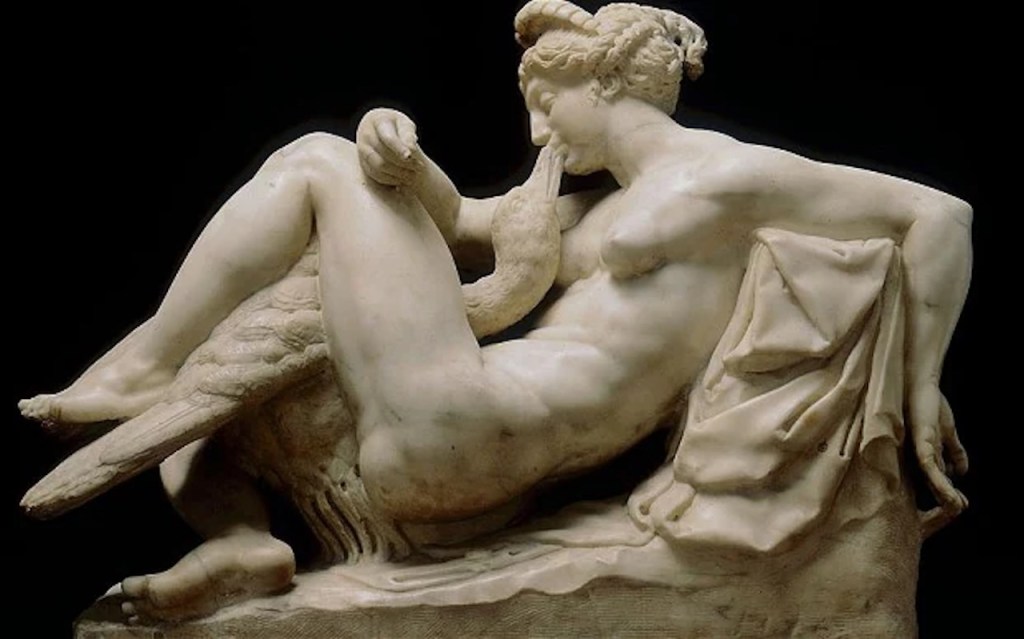
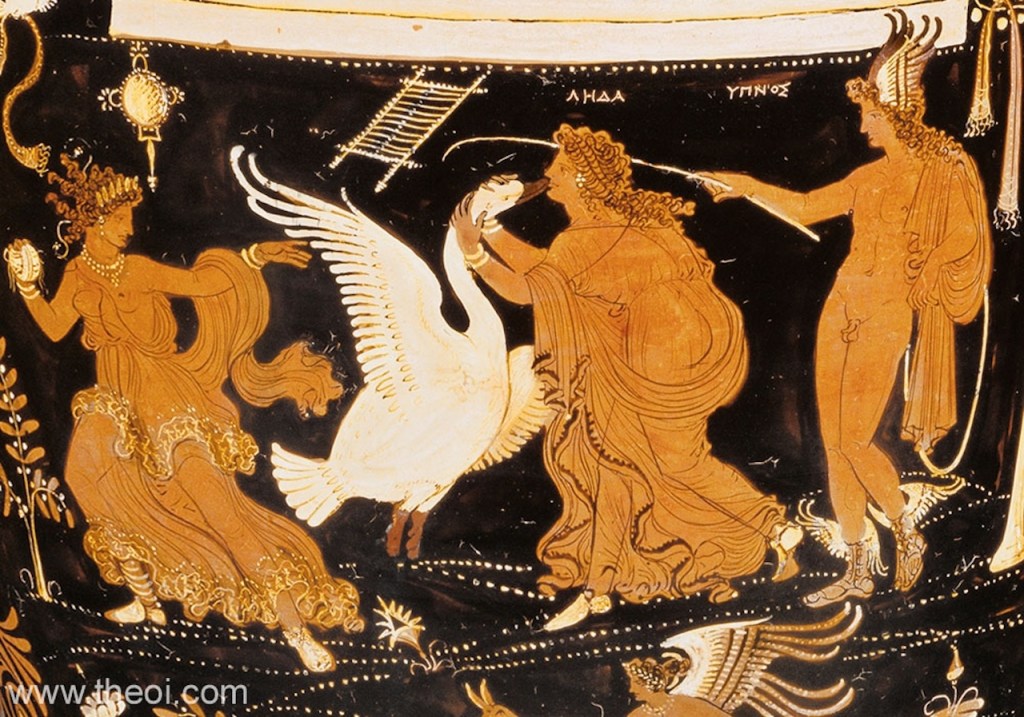
Many artistic expressions—see two examples below—focusing on the Zeus/Leda narrative for their subject matter portray Leda holding the swan affectionately, therefore, supporting Isocrates’ interpretation that the act was seduction not rape.
However, the Yeats poem is one of the interpretations that forces readers to reinterpret the myth as the rape of Leda by Zeus as a swan. Even though the Yeatsian speaker offers only a waffling about what he believes about the whole affair, ultimately he does seem to be strongly suggesting that the act was a rape.
Cleverly, the Yeatsian speaker also takes the direct emphasis off the issue of rape vs seduction by simply posing the rhetorical question about whether Leda took on some of the Zeusian powers.