My original song “River of Time” is a hymn to my Divine Belovèd, featuring a chorus that functions as a chant.
Introduction with Text of Lyric “River of Time”
Because music was my first love that I remember from the earliest age, I have always been attracted by the sounds from inspiring music.
I began writing songs seriously around age 32, and I especially enjoy and appreciate my songs that turn into hymns to the Divine Belovèd. “River of Time” is such a hymn.
I am strongly influenced by the Cosmic Chants of my guru (spiritual leader) Paramahansa Yogananda. Many of my original hymns have a chant-like element—a repetition that takes the minds within or bespeaks some spiritual truth for mental awareness.
River of Time
A hymn to my Divine Belovèd
Verse Waiting by the river of time— My beloved keeps His rime In the sunlight that sings in stars The moon will wax in tune
Verse Flowing with the river of time— Do you feel the rhythm that glides As you sing each lingering verse? Your soul will chant in bliss
Verse Once beyond the river of time— Where you seek your ultimate rime, Where you need to battle no more You’ve reached that heavenly shore
Chorus Every moment is light infused Behind the darkness of closed eyes Seek no more for all is here Nothing more to do or fear
Video by Carlene Craig
Commentary on “River of Time”
The singer/seeker/devotee in this hymn does not directly address her Heavenly Father-God. She suggests the target of her report in subtle ways by essentially addresses her own self or soul. She sings to remind herself of her goal of soul- or self-realization, unity with the Divine Belovèd.
First Verse: Existence on the Physical Plane
Waiting by the river of time— My beloved keeps His rime In the sunlight that sings in stars The moon will wax in tune
The singer/devotee exists along a continuum that the human mind and heart often liken metaphorically to a river—a “river of time.” Time seems to flow, meander, going somewhere.
Intuition tells the human mind and heart that the soul is moving as on a flowing body of water to somewhere that must be wonderful.
The beloved who is causing this river to flow displays his wares in light—sunlight and moonlight. Science tells humanity that sunlight is reflected in the stars, and the moon also reflects that important, life-sustaining orb.
The singer/devotee implies that her beloved is a poetic artist because he keeps “His rime” visible in the light of the sun and the moon.
Second Verse: The Rhythm of Soul Bliss
Flowing with the river of time— Do you feel the rhythm that glides As you sing each lingering verse? Your soul will chant in bliss
The singer then states that her soul is, in fact, moving down this metaphorical river. She poses a rhetorical question of her self to ascertain if she is really sensing the rhythmic sway of the music of her verses.
As she sings, she has become aware of her soul flowing into its natural state of “bliss.” The verses that linger in the heart and mind bestow on her a marvelous state of awareness and joy.
Third Verse: Transcending Physical Existence
Once beyond the river of time— Where you seek your ultimate rime, Where you need to battle no more You’ve reached that heavenly shore
The singer then begins to speculate about the existence to be experienced after transcending the physical level of existence, metaphorically named the “river of time.”
Beyond that locus is where the ultimate poetry and music hold sway, where humanity no longer is required to struggle with life’s vicissitudes, trails, and tribulations. Once the soul has become self-realized, it knows only divine joy and love.
Chorus: Moving into the Joy of the Light
Every moment is light infused Behind the darkness of closed eyes Seek no more for all is here Nothing more to do or fear
The singer’s repeated, chant-like chorus is an affirmative statement about what goes on after she closes her eyes to the physical level of existence.
She need not continue searching for she has arrived at the Goal of life. United with the Divine Belovèd, there is nothing that she will ever have to fear.
Video: Whitewater River-Tim Bowman-East Fork of the Whitewater River-near Brownsville IN
Image: Linda Sue Grimes at the SRF Windmill Chapel at Lake Shrine – Photo by Ron Grimes (Ron W. G.).
Original Song: “Against” with Prose Commentary
The singer/devotee is entreating her soul to forsake worldly things and ways, which according to Emily Dickinson, “hold so,” and follow the way of spirit. The way of spirit protects “against” all the things that damage the individual physically, mentally, and spiritually.
Introduction with Text of Lyric “Against”
Many old spirit-infused hymns sing about the futility of this world to the point of asserting that this world is not even our true home [1]. Paramahansa Yogananda has explained that one’s engagement with sense pleasure must be carefully observed lest they ensnare the soul, preventing it from experiencing the higher pleasures of soul-awareness [2].
Removing the flesh motivating experiences becomes one’s highest duty. While the first step to soul-awareness appears to be a struggle “against” the senses and all worldly endeavors, that opposition must not become so intrenched that it impels one to judge others harshly and act on that judgment.
Instead simply remaining mindful of one’s own behavior opens one’s heart to soul power. Creatively fashioning the experiences and thoughts on the journey to soul awareness adds to the reality and beauty that the world actually provides.
Against
The Blessed Divine gave us all the gifts that we must learn to enjoy but without becoming entangled and attached; it is with that non-attachment in mind that the following hymn is offered to the Blessed Spirit Who inspires true music.
Chorus:
Against the tone of heartbreak Against the stone of night ache Against the wrong that leads you Against the blood that speeds you
1st Verse
Whisper into the drum and see the bay of stars That permeate the golden night in silver bars Usher to the harp the placid palms of notes That wistfully breathe on strings of hope
2nd Verse
Quaff the mist of years, past where you thought That dwarves were playing in the valley of rock Don’t listen to a decibel lower than the sound Of the one hand raised in perfect redound
3rd Verse
Bless your father and your mother whose ears Have turned to stone with worries and fears They planted their flag in the wind by the sea They pray on the ghost ridge and wait to be free
4th Verse
Whisper again and listen for the echo That lingers in the valley you used to know Keep a clear watch how the strain will peel you Keep your mind in tow for the brain will steel you
5th Verse
Into the light, where you bow Where you offer news of then and now Where you fold your hands and wonder as you pray If you heard that thunder across the bay
6th Verse
Whisper blowing, softly into the day Let no shaft of light escape your sight today Listen to your commandments, as they Lead you to the words you hunger to pray
To listen to an audio recording of this song, please visit “Against.”
Commentary on “Against”
My original song “Against” is a lament for our times—for all times. The devotee/singer begs her soul to forsake the things of this world, which become so attractive that they hold one’s attention to the detriment of the soul.
The spiritual aspirant, however, wishes to follow the way of spirit. The way of spirit protects the individual “against” all the things that hurt one physically, mentally, and spiritual.
Chorus: A Lament and Call to Struggle
Against the tone of heartbreak Against the stone of night ache Against the wrong that leads you Against the blood that speeds you
The broken heart, the mental-pain-induced inability to sleep, behaving inappropriately, and allowing the physical body to dictate one’s thoughts and behavior are all things the devotee of spirit must battle “against.”
Allowing the voice to express opposition through melody tempers the heart and mind, allowing soul power to influence the senses that have the tendency to become so greedy and obstructive.
1st Verse: Listening to the Music of the Spheres
Whisper into the drum and see the bay of stars That permeate the golden night in silver bars Usher to the harp the placid palms of notes That wistfully breathe on strings of hope
The singer demands of her soul that it listen to the music of the spheres [3], to observe the night sky for inspiration to follow the way of spirit. The singer remains in search of hope through beauty of sight and sound. The stars at night accompany the beauty of melody that the seeker/singer tis striving to engage.
Quaff the mist of years, past where you thought That dwarves were playing in the valley of rock Don’t listen to a decibel lower than the sound Of the one hand raised in perfect redound
2nd Verse: Command to Turn Inward
The singer commands her soul to move past the past—reflecting on the Zen koan, “The sound of the one hand” [4].
By imbibing the tears of many years passed without knowledge, singer drinks her own heart’s deepest desires which turn the eye and the mind inward in search of the indwelling Lord, to Whom all reverence and devotion are due.
3rd Verse: The Unforgiven and Prayer
Bless your father and your mother whose ears Have turned to stone with worries and fears They planted their flag in the wind by the sea They pray on the ghost ridge and wait to be free
The singer commands her mind to forgive the sins of her forebears, who were innocent and did their best, even though they were ignorant of the exact way of spirit. As the immature look about their environment, they crave to find a place more suitable to their talents. It is that impetus that drives the soul to eventually find its path back to its true home.
4th Verse: Focusing on Spirit
Whisper again and listen for the echo That lingers in the valley you used to know Keep a clear watch how the strain will peel you Keep your mind in tow for the brain will steel you
The singer again commands her mind to take the lessons of her past gingerly, while recalling in the present that stress is the enemy of spiritual progress—keeping the mind focused is at the heart of the way of spirit.
5th Verse: Acknowledging Soul Reality
Into the light, where you bow Where you offer news of then and now Where you fold your hands and wonder as you pray If you heard that thunder across the bay
The devotee/singer acknowledges that she has progressed into awareness of “the light” and she continues to pray and supplicate. The singer then acknowledges that the heart and mind will continue to reflect on past and present even while seeking the way of spirit.
6th Verse: The Hunger to Pray the Right Prayer
Whisper blowing, softly into the day Let no shaft of light escape your sight today Listen to your commandments, as they Lead you to the words you hunger to pray
The singer then admonishes herself to step lightly and watch for any sightings of spiritual light, and above all to continue to follow the way of spirit as it leads her to its golden gate. She knows that she needs more exact words to offer the Divine, and she remains confident that she will find them through her dedicated prayer.
Dedicated with my love and gratitude to my sweet Ron
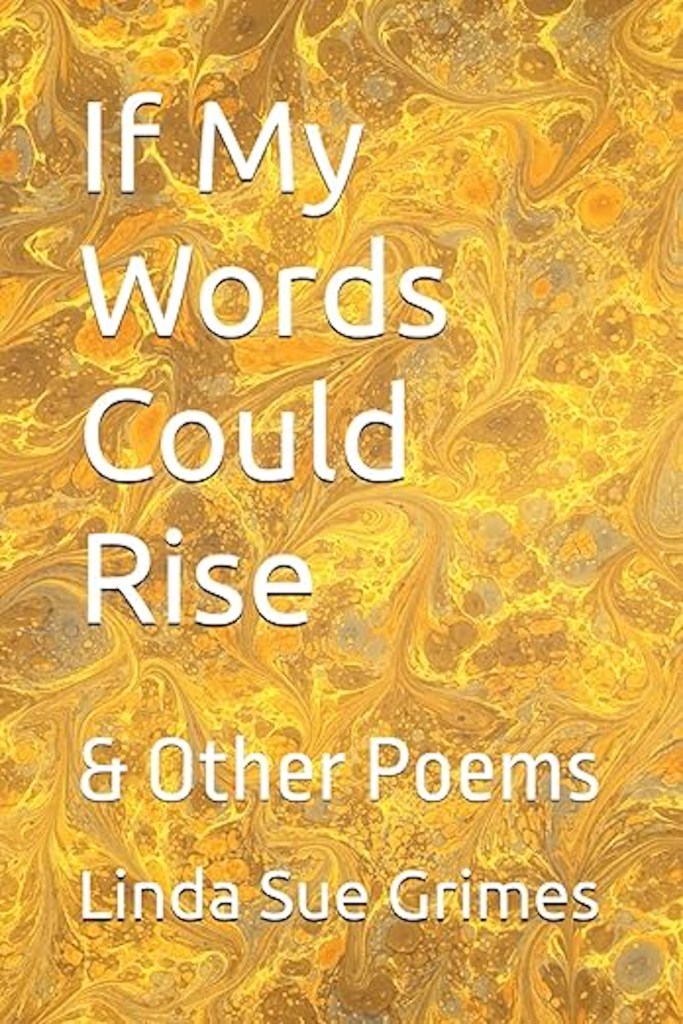
The following poems appear in my collection titledIf My Words Could Rise, available on Amazon as paperback or Kindle.
1 If My Words Could Rise
Dedicated to my sweet Ron
If my words could rise Like smoke They would form your face In the clouds They would hang In the tops of the trees Looking for a nest Where a mother bird sits On eggs The color of your eyes
2 In the Tops of the Trees
“As soon as you hear the sound of marching in the tops of the trees, then attack, for God has attacked in front of you to defeat the Philistine army.” —2 Samuel 5:25 Common English Bible
–for the moldman, who screeched, “That’s my line!”
No, dude, that is not your line! No matter how many times Or with how much spit You spew it.
Trees and their tops And the words they live in Belong to all of us. Go! Dig your hole–grovel in your slime.
3 Dreams and Days
“His tongue cuts / Slices of meat / From the hearts / And livers / Of those / Who would love him” – “Between Slices of Bread” —from Linda Sue Grimes’ At the End of the Road
I quote myself, well then, I quote myself — I include multitudes — Uncle Walt taught me that much.
The man in the poem Cannot bring himself to say Or to pray about his own lividness He shuts out spaces and commas Lives in his own relevance.
He murders his own children With his viper attitude And nibbles the ankles Of prostitutes Who erase his will to power on.
You have seen him Perhaps did not recognize him — He has sat in your parlor Sipping your coffee Dusting off his duplicitous moves —
He fears death but not yours He imagines you at the bottom Of a cold, black ocean Your tongue bait for the fishes His Bolshevik brain conjures.
Your freedom is a fantasy If you remain too close to his heat Get your life back – get your love back Where God made you in his image And you are close to seeing it.
4 Flesh and Desire
“Humankind cannot bear very much reality.” —T. S. Eliot
Into the fire of wisdom, thoughts go to perish. “Get thee behind me, Satan!” Christ commands. But we still wobble behind the Devil Hoping to be snatched from the arms of death In time for supper and for the many tomorrows We image we still possess. In the valley of dreck and poison, I have lived Even as I knew better or thought I did. No, I am not here to testify. Although a word or two of testimony May slip out every line or so! I can pound sand with the best of them. But I can also bitch and moan. Where is the beginning of joy and rectitude? One might ask. Where is the promise? O, come on! You know where the promise is . . . Yes, just testing the waters and they are warm. Every time I delay, I am warned. Just pray And wait and listen close and tight to the hum In the brain. I will follow. I will follow close. Yes, I will. And flesh with its crude desire Will no longer taint the years With their distractions. The mercy of Spirit will wipe my tears.
In dreams we happen to meet On some mystic, planetary hill — Poetry eludes us yet we commence Talking about the sham progress Bleeding hearts have inflicted.
The professor in you wants to align Wokeward but you cannot bring yourself To spring into the claptrap that clamped Shut on Ginsbergian filth, deviance And that mayhem of hairy irrelevance.
You think of your children Wading into the waters of vipers Nipping their ankles Snapping their necks Erasing their freedom and will.
You would have those you love Experience their own close calls — You crashed into your own As you flew those planes Over the Pacific, fighting that war —
Facing death, watching death Take soldier after soldier Leaving you with the intuition Outcomes cannot be guaranteed By bureaucratic Bolsheviks.
Only freedom of opportunity Guarantees free will remains free And life continues to beget life In the magnolious scheme that God Made man after His Own image.
4 Bone Couplets
“Flesh of my flesh, bone of my bone…” —Anne Bradstreet
They outshine the flesh in the reign of desire Where pink like a blush goes on shining like fire. Fat necked imbeciles, brain-numbed and wrong On every backboned thought that ever ran along The confines of the apple of Adam sweetened In the birdless cage rump-driven and weakened. Greed and swagger click the gangling matter Knuckles cling and circle each limb to tatter. Hipbones narrow in the faulty weather. The bare truth flies out on filth-tinged feather. Bring me back to the place where life can stand! Let me feel the smooth relief of pounding sand! This belly swore it would unburden the green. Within the sulking skull it makes its way to preen. In the sweet toned laughter where children move And every old fart says he will not prove Until the night breaks over those who pray And every chime kinks the ear heaven to delay. Relevant as an old donkey on an extended beach The moon sinks into ripe flesh as if to teach Those angry cells to leave off all that hunger. No years will ease—no one will grow younger Than the moth whose flame has singed his wings Clacking bare truth to the mercy of things.
5 A Terrible Fish
“In me she has drowned a young girl, and in me an old woman Rises toward her day after day, like a terrible fish. —Sylvia Plath’s “Mirror”
The nightmare repeats itself: A daughter clamped tight to each foot Pulling her down under The brute waters of the dark, deep lake — She gasps — imagines she’s drowning While her husband watching from the levy Wrings his hands, faints in the heavy fog. A terrible fish looms under her nose; She smells blood dripping From a dozen hooks dangling From his mouth. His eyeballs slide out easy As the drawer of a cash register. Each eye-socket a window To her own soul — $ bills With little jackpots on them Jump up and dance like clowns Poking out their tongues, Flapping signs of slogans With hammers, sickles, swastikas — She believes – ¡Sí, se puede! Morning shivers her awake again, Stumbling to the bathroom Where the mirror flashes In her face that same terrible fish That has been catching her dreams And throwing them back As she chases each $, Never quite able to grasp enough.
To Thee I humbly offer my songs That Thou hast given me
Introduction
These poems grow out of my experience serving as harmonium player/chant leader for our Nashville Self-Realization Fellowship Sunday Readings Service.
I title this collection Command Performance for I have attempted to retire from the chant leader position, offering it to other devotees, but no one thus far wishes to take it from me.
And often I have come to the chapel Readings Service, thinking I would merely be attending, only to find that the scheduled chant leader was unavailable and so the service leader would prevail upon me to fill the void; thus, another “command performance.”
I reason that Guruji Paramahansa Yogananda is commanding me to continue performing this function, as long as I am capable.
Poems from Chants
These original poem were all inspired by the chant, whose title is offered following the poem title.
Who says, She is Dark?
—after “Thousands of Suns and Moons”
Her smile beams With the rays Of a millions suns.
Her skin glows With the light Of a million moons.
Who says, She is dark?
Only those who refuse To open their eye To her light.
Joy, Joy, Joy!
—after “Ever New Joy”
Joy, joy, joy— Morning has broken in joy. Light of starlight, hiding Behind the sun.
Joy, joy, joy— Evening calls the faithful To rest from a full day’s labor Practiced by Divine decree.
Joy, joy, joy— Night covers maya’s delusion So the spiritual eye May bound in brilliance.
Thou art That
—after “Hymn to Brahma”
Beyond my thoughts, Beyond my ideas, Beyond my knowledge, Far beyond my wisdom— Thou are That.
Beyond my body, Beyond my mind, Beyond my energy, One with my soul— Thou art That.
Drowning in Glory
—after “I Am the Bubble, Make Me the Sea”
You wake my senses to clear sight, glorious sound, Intelligent touch, pure fragrance, tempered taste. You wake my senses by drowning them in Glory Inundating them in the silence of Your vastness, Spilling on them the majestic light show Of Your body, bound by boundlessness.
In the ocean of Your love, my bubble heart Contracts and expands to eternity. My restless brain shrinks and extends Its reach to unknown realms of wisdom. My soul knows itself in the crash of breaking worlds Where it stands unshaken hand in hand with You. As You do, so I wish to do forever, Drowning in the Glory of Your sacred presence.
Into my garden of weeds Come, Eternal Gardener— Teach me to plant and prune fine foliage. Show me where to set the lilies and tulips And where the roses should grow. Guide my choices of herbs and vegetables. Give me knowledge of fertilizer and fences.
Into my garden of words Come, Eternal Poet— Make my poems exude divine ardor. Fashion my thoughts to bow at your feet. Make my images spout living waters From an enlightened fount To refresh all who dip a cup.
2 In My Spiritual Garden
In my spiritual garden I walk with you when the sun is medicine And the rain suckles the beets and corn. I walk with you between the rows of memories Where love holds you between peppers and tomatoes.
I walk with you along the fence And touch your hand and step across Thinking of you as I pick the peas, Still thinking of you as I weed The beans and cucumbers.
I walk with you and with every silent step And every moment of your absence That would weaken the faith of one Less in love, my love grows deep Like the roots of the bamboo and my love Grows straight like the stalks of asparagus.
In my spiritual garden I will always grow you In the medicine sun and the suckling rain.
3 Divine Gardner
After we scoop the soil over the seeds & sprinkle the water & pluck the weeds,
you will tend the growing & tempt the eye with green & yellow peppers, & tempt the tongue with onions & corn, & invite us to taste your flesh in cucumbers & tomatoes.
I will stand at the edge of the garden, my lips & tongue tending the silence I learn to thank you with.
4 My Divine Beloved
When spring comes Tilling the ground I will plant seeds And think of you You are earth You build my body.
When spring comes Showering young plants I will sing with raindrops And think of you You are water You carry my life.
When spring comes Warming my limbs I will brown my skin And think of you You are fire You inflame my heart.
When spring comes Swirling on the wind I will lean into it And think of you You are air You clear my mind.
When spring comes Rising from winter’s tomb I will sing devotion And think of you You are my Divine Beloved You revive my soul.
5Your Divine Love
My heart is a lake I swim in, But I want to float in the ocean of your love.
My mind is a sky I fly through, But I want to soar through your omniscient love.
My soul is an undiscovered star, But I want to find it shining in your flaming love.
My dream spreads out in all directions, Searching for the boundary of your Divine Love.
6 Cosmic Beloved
Though my heart is fickle And strays from you, You never stray from me. Your love for me Never waivers.
You came to me in youth’s naiveté And married my folly, And for a time I slept without rest In the arms of a splintering sorrow Deep within a cave of madness. When I emerged from that black night, You greeted me as my daughter. You blessed the rest of my life With a holy union when you became My true mate with whom I rest In the cave of a peaceful heart. And you greet me as my son.
When I go off from time to time To carouse with the lesser lights Of poets and painters and dabblers In pursuit of knowledge, You become each one of them So you can stay by my side—
Gary Clark’s “Mary’s Prayer”: A Yogic Interpretation
Employing the Christian iconic mother figure, the song “Mary’s Prayer” offers a marvelous corroboration of concepts between Christianity, taught by Jesus the Christ and Yoga, taught by Bhagavan Krishna.
Introduction and Excerpt from “Mary’s Prayer”
The song “Mary’s Prayer” is from the album Meet Danny Wilson by the 1980s Scottish rock band Danny Wilson. Lead singer of the group and the writer of the song is Gary Clark. About the song, Gary Clark, the songwriter, has explained,
There is a lot of religious imagery in the song but that is really just a device to relate past, present, and future. It is basically just a simple love song. In fact I like to think of it as being like a country and western song.
A Yogic Interpretation
By quipping that his song “is basically just a simple love song,” Gary Clark is being overly modest; on the other hand, he could possibly have meant the tune to be a “simple love song,” but its use of imagery opens the possibility of a deeper interpretation than one traditionally associated with a “simple love song.” Thus, I offer my interpretation of Clark’s song, based on my primary method of poetry interpretation, which I label “Yogic Interpretation.”
This yogic interpretation of Gary Clark’s “Mary’s Prayer” reveals the spiritual nature of the song. The allusion to the Christian icon “Mary” alerts the reader to the significance of the song as it transcends the stature of a love song to a human lover, although it can certainly be interpreted to include that possibility. The chorus of the tune offers a lengthening chant, which uplifts the mind directing it toward the Divine Goal of spiritual union.
The narrator/singer of the song “Mary’s Prayer” is revealing his desire to return to his path to Soul-Awareness, which he has lost by a mistaken act that turned his attention to the worldly thoughts and activities that replaced his earlier attention to his spiritual realm.
The noun phrase, “Mary’s Prayer,” functions as a metaphor for Soul-Awareness, (God-Union, Self-Realization, Salvation are other terms for this consciousness). That metaphor is extended by the allusions, “heavenly,” “save me,” “blessed,” “Hail Marys,” and “light in my eyes.” All of these allusions possess religious connotations often associated with Christianity.
The great spiritual leader, Paramahansa Yogananda, has elucidated the comparisons between original Christianity as taught by Jesus Christ and original Yoga as taught by Bhagavan Krishna.
Danny Wilson – “Mary’s Prayer”
Mary’s Prayer
Verse 1
Everything is wonderful Being here is heavenly Every single day she says Everything is free
Verse 2
I used to be so careless As if I couldn’t care less Did I have to make mistakes When I was Mary’s prayer?
Verse 3
Suddenly the heavens roared Suddenly the rain came down Suddenly was washed away The Mary that I knew
Verse 4
So when you find somebody to keep Think of me and celebrate I made such a big mistake When I was Mary’s Prayer
Chorus
So if I say save me, save me Be the light in my eyes And if I say ten Hail Marys Leave a light on heaven for me
Verse 5
Blessed is the one who shares Your power and your beauty, Mary Blessed is the millionaire Who shares your wedding day
Verse 6
So when you find somebody to keep Think of me and celebrate I made such a big mistake When I was Mary’s Prayer
Chorus
So if I say save me, save me Be the light in my eyes And if I say ten Hail Marys Leave a light on heaven for me
Save me, save me Be the light in my eyes And if I say ten Hail Marys Leave a light on heaven for me
Verse 7
If you want the fruit to fall You have to give the tree a shake But if you shake the tree too hard, The bough is gonna break
Verse 8
And if I can’t reach the top of the tree Mary you can blow me up there What I wouldn’t give to be When I was Mary’s prayer
Chorus
So if I say save me, me save me Be the light in my eyes And if I say ten Hail Marys Leave a light on heaven for me
Save me, save me Be the light in my eyes And if I say ten Hail Marys Leave a light on heaven for me
Save me, save me Be the light in my eyes
What I wouldn’t give to be When I was Mary’s prayer
What I wouldn’t give to be When I was Mary’s prayer
What I wouldn’t—save me—give to be When I was Mary’s prayer
Commentary on “Mary’s Prayer”
A yogic interpretation of Gary Clark’s “Mary’s Prayer” reveals the song’s spiritual nature. The allusion to the Christian icon “Mary” alerts the reader to the spiritual significance of the song causing it to transcend the stature of a love song to a human lover.
First Verse: Declaring a Spiritual Truth
Everything is wonderful Being here is heavenly Every single day, she says Everything is free
The narrator/singer begins by declaring a spiritual truth, “Everything is wonderful,” and that being alive to experience this wonderfulness is “heavenly.” The following lines report that each day provides a blank slate of freedom upon which each child of the Belovèd Creator may write his/her own life experiences.
“She” refers to Mary, who has authority to make such judgments, as the narrator states. The historical and biblical Mary, as the mother of one of the Blessèd Creator’s most important avatars, Jesus the Christ, holds special power to know the will of the Divine Creator and dispense wisdom to all children of that Creator.
Therefore, the prayer of Mary is dedicated to each child of the Heavenly Creator, and her only prayer can be for the highest good of the soul, and the highest good is that each offspring of the Belovèd Lord ultimately know him/herself as such.
Thus, Mary sends the faithful “every single day” and “everything is free.” Every creature, every human being, every creation of the Divine Creator’s is given for the nurturance, guidance, and progress of each soul made in the Creator’s image.
Second Verse: The Care and Feeding of the Soul
I used to be so careless As if I couldn’t care less Did I have to make mistakes? When I was Mary’s prayer
In the second verse, the narrator, having established his knowledge of the stature and desire of Mary, contrasts his own status. He was not been dedicated to his own salvation; he hardly paid any attention to the care and feeding of his soul. It’s as if he could not have “cared less” about the most important aspect of his being.
But that is the past, and the narrator now realizes that he made mistakes that have led him in the wrong direction, and he now wonders if he really had to make such a mess of his life. After all, he was “Mary’s prayer” — the Blessèd Mother had offered him the blessing of soul-union, but through his mistakes he had spurned that offering.
Third Verse: Losing Sight of the Blessèd Mother
Suddenly the heavens roared Suddenly the rain came down Suddenly was washed away The Mary that I knew So when you find somebody who gives Think of me and celebrate I made such a big mistake When I was Mary’s Prayer
The narrator then reveals that through some great and fearful event that caused the heavens to move and rain to pour down, his life had become devoid of the love and caring that had been bestowed on him by Mary. He no longer knew how to pray or how to feel the grace and guidance of the Blessèd Mother.
Fourth Verse: Missing a Great Opportunity
So when you find somebody to keep Think of me and celebrate I made such a big mistake When I was Mary’s Prayer
The singing narrator then offers his testimony that having a soul guide, who gives as the blessèd Mary gives, must be kept and celebrated and not merely cast off as the narrator had done. He confesses again that he “made such a big mistake” at a time that he could have just grasped the heavenly protection, while he was “Mary’s prayer.”
Chorus: Introduction of the Chant in Four Lines
So if I say save me save me Be the light in my eyes And if I say ten Hail Marys Leave a light on heaven for me
Turning to prayer can be difficult for the one who has deliberately left it behind and perhaps forgotten its efficacy. But the narrator is once again taking up his prayers. He is now calling out to the Blessèd One, even though he frames his supplication in “if” clauses: he cries, “So if I say save me, save me / Be the light in my eyes.” He demands from the Divine Mother that she return to him as the light of his eyes, which had left him.
Furthermore, and again framing his supplication in an “if” clause, he cries, “And if I say ten Hail Marys,” but yet again demands that she “Leave a light on in heaven for me.” The “if” clause followed by a demand seems contradictory, but the narrator is in distress and is confounded by his failures and his former indifference. The chorus of this song functions as a chant as it grows from four lines to its final iteration of sixteen lines that complete the song.
Fifth Verse: Rich in Spirit
Blessed is the one who shares The power and your beauty, Mary Blessed is the millionaire Who shares your wedding day
Still in supplication to the Divine Blessèd Mother, the narrator now simply voices what he knows to be the influence of the Divine One: anyone who accepts and transforms his life according to “the power and the beauty” of Mary will find him “a millionaire.” Not necessarily financially rich—but much more important, rich in spirit. The great wedding of the little soul to the Oversoul will be the richest blessing of all.
Sixth Verse: Emphasizing the Need to Celebrate and Remember
So when you find somebody to give Think of me and celebrate I made such a big mistake When I was Mary’s Prayer
The sixth verse is a repetition of the fourth. It functions to reiterate the importance of the narrator’s awareness of the need to celebrate those giving beings as well as the vital necessity that he realizes what a “big mistake” he made “when [he] was Mary’s Prayer.”
Chorus: Continuing the Chant with Repetition
So if I say save me, save me Be the light in my eyes And if I say ten Hail Marys Leave a light on heaven for me
Save me, save me Be the light in my eyes And if I say ten Hail Marys Leave a light on heaven for men
The chorus again becoming an enlarging presence serves to direct the mind Heaven-ward, while reminding the singer of his purpose for singing, for addressing his Divine Belovèd and keeping the mind steady.
Seventh Verse: Gathering the Effects of Yoga
If you want the fruit to fall You have to give the tree a shake But if you shake the tree too hard, The bough is gonna break
The penultimate verse offers a metaphor of gathering fruit from a tree which likens such gathering to the yoga practice that leads to Self-Realization or God-union. Shaking the tree gently will result in fruit falling, but shaking “the tree too hard” will break the bough. Yoga techniques must be practiced gently; straining in yoga practice is like shaking the tree too hard, which will result in failure to attain the yogic goals.
Eighth Verse: Upward Movement Through Faith
And if I can’t reach the top of the tree Mary you can blow me up there What I wouldn’t give to be When I was Mary’s prayer
The final verse also employs a tree metaphor. The narrator, who is once again firmly on his spiritual path, expresses an extremely important truth that each devotee must cultivate: faith that the target of his goal can lift the devotee at any time.
The narrator colorfully expresses this truth by stating, “And if I can’t reach the top of the tree / Mary you can blow me up there.” And finally, he expresses his regret for allowing Mary to escape him: he wants to become “Mary’s prayer” once again, and he would give anything to do so.
Chorus: The Efficacy of the Chant
So if I say save me, me save me Be the light in my eyes And if I say ten Hail Marys Leave a light on heaven for me
Save me, save me Be the light in my eyes And if I say ten Hail Marys Leave a light on heaven for me
Save me, save me Be the light in my eyes What I wouldn’t give to be When I was Mary’s prayer
What I wouldn’t give to be When I was Mary’s prayer What I wouldn’t—save me—give to be When I was Mary’s prayer
The chorus doubled from its first iteration of four lines featured after the fourth verse to eight lines following verse six. Then it doubles again following the final verse, finishing with sixteen lines.
The marvelous effect of the chant places the song squarely within the yogic practice of employing repetition to steady and direct the mind to its goal of union with the Divine. The song finishes with the much enlarged chorus, which is not only musically pleasing, but also shares the efficacy of a chant that draws the mind closer to its spiritual, yogic goal.
The speaker in Henry Wadsworth Longfellow’s “A Psalm of Life” is offering sage advice regarding the notion that each individual must face life with determination to be successful and fill one’s life with achievements. The alternative renders the soul dead or simply slumbering without purpose.
Introduction and Text of “A Psalm of Life”
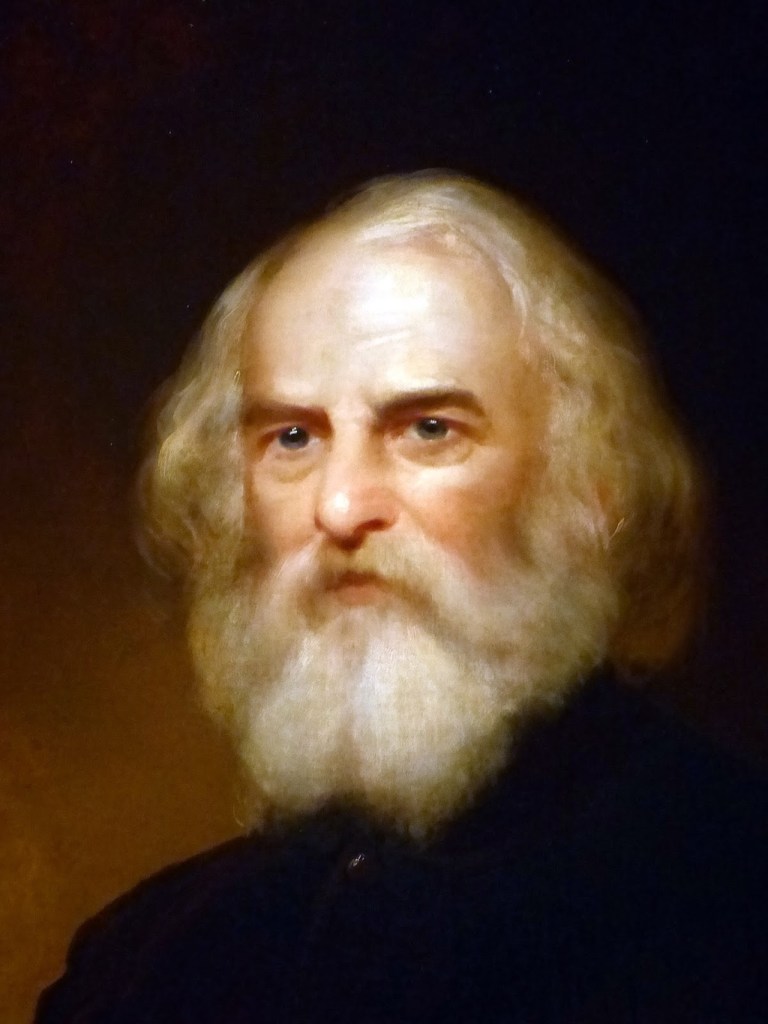
Henry Wadsworth Longfellow’s poetry was enormously popular and influential in his own lifetime. Today, most readers have heard his quotations so often that they have become “part of the culture.”
For example, many readers will recognize the line, “Into each life some rain must fall,” and they will find that line in his poem called “The Rainy Day.” No doubt it is this Longfellow poem that helped spread the use of “rain” as a metaphor for the melancholy times in our lives.
Longfellow was a careful scholar, and his poems reflect an intuition that allowed him to see into the heart and soul of his subject. Critic and editor J. D. McClatchy says that Longfellow was “fluent in many languages,” and the poet translated such works as Dante’s The Divine Comedy.
Other Longfellow translations include “The Good Shepherd” by Lope de Vega, “Santa Teresa’s Book-Mark” by Saint Teresa of Ávila, “The Sea Hath Its Pearls” by Heinrich Heine, and several selections by Michelangelo [1].
The poet also achieved fame as a novelist with his novel Kavanaugh: A Tale. This work was touted by Ralph Waldo Emerson for its contribution to the development of the American novel. Longfellow also excelled as an essayist with such works as “The Literary Spirit of Our Country,” “Table Talk,” and “Address on the Death of Washington Irving.”
The poet’s highly spiritual poem “A Psalm of Life” offers a wise piece of advice regarding the issue of facing life with a proper positive attitude. The alternative is to allow life to defeat one’s spirit which leads to failure and lack of achievement.
Longfellow has said that the poem is “a transcript of my thoughts and feelings at the time I wrote, and of the conviction therein expressed, that Life is something more than an idle dream” [2].
A Psalm of Life
What The Heart Of The Young Man Said To The Psalmist.
Tell me not, in mournful numbers, Life is but an empty dream! For the soul is dead that slumbers, And things are not what they seem.
Life is real! Life is earnest! And the grave is not its goal; Dust thou art, to dust returnest, Was not spoken of the soul.
Not enjoyment, and not sorrow, Is our destined end or way; But to act, that each to-morrow Find us farther than to-day.
Art is long, and Time is fleeting, And our hearts, though stout and brave, Still, like muffled drums, are beating Funeral marches to the grave.
In the world’s broad field of battle, In the bivouac of Life, Be not like dumb, driven cattle! Be a hero in the strife!
Trust no Future, howe’er pleasant! Let the dead Past bury its dead! Act,— act in the living Present! Heart within, and God o’erhead!
Lives of great men all remind us We can make our lives sublime, And, departing, leave behind us Footprints on the sands of time;
Footprints, that perhaps another, Sailing o’er life’s solemn main, A forlorn and shipwrecked brother, Seeing, shall take heart again.
Let us, then, be up and doing, With a heart for any fate; Still achieving, still pursuing, Learn to labor and to wait.
Sources for the Introduction
[1] J. D. McClatchy, editor. Longfellow: Poems and Other Writings. The Library of America. 2000. Print.
The speaker in Henry Wadsworth Longfellow’s “A Psalm of Life” presents life as an instrument for striving and achievement; he challenges individuals to think and peer beyond the certainty of death and to tirelessly work toward achieving worthwhile goals.
The poem urges readers to take inspiration from the lives of great men of high accomplishments, to act in the eternal now, and to leave behind a legacy (“footprints in the sands of time” ) that will inspire others to follow their own goals on their personal paths through life.
First Stanza: Confronting and Rebutting Pessimism
Tell me not, in mournful numbers, Life is but an empty dream! For the soul is dead that slumbers, And things are not what they seem.
In one of his most widely anthologized poems “A Psalm of Life,” Henry Wadsworth Longfellow creates a speaker who is openly and directly confronting pessimism. The command, “Tell me not, in mournful numbers,” immediately heralds a defiant tone, indicating that the speaker eschews the notion that life remains nothing more than an “empty dream.”
The speaker opines and asserts that a passive, slumbering soul is “dead” and that appearances can be deceiving—life’s true value is not found in relinquishment of duty or rolling over and playing dead.
Second Stanza: A Declaration of Transcendental Life
Life is real! Life is earnest! And the grave is not its goal; Dust thou art, to dust returnest, Was not spoken of the soul.
In the second stanza, the speaker is declaring that life is real and earnest. He refutes the notion that the graveyard is life’s ultimate destinational goal. By quoting the Biblical injunction, “dust thou art, to dust returnest,” he distinguishes an important, vital difference between the physical encasement and the eternal soul, which confirms that the true purpose of living the life of a human being is to transcend mortality.
Third Stanza: Defeating the Pairs of Opposites
Not enjoyment, and not sorrow, Is our destined end or way; But to act, that each to-morrow Find us farther than to-day.
The third stanza reveals that pleasure, sorrow, and other sense factors involving the pairs of opposites are also not the ultimate aim of existence.
Instead, the speaker calls for active duty and acceptance of responsibilities as the way to progressive evolution. Each day should fulfill some advancement in one’s goal, and not merely remain a repetition of mundane activities or a stagnation of routine.
Fourth Stanza: Time Marches On, but Keep On Keeping On
Art is long, and Time is fleeting, And our hearts, though stout and brave, Still, like muffled drums, are beating Funeral marches to the grave.
The speaker then addresses the struggle between human desires and ambition and the relentless onslaught of time as it ticks on and on. The metaphor of “muffled drums” beating “funeral marches to the grave” emphasizes drearily the inevitability that death continues to approach, yet the speaker continues to urge his fellow human beings to remain “stout and brave” despite these unsavory facts.
Fifth Stanza: Confronting the Battlefield of Life
In the world’s broad field of battle, In the bivouac of Life, Be not like dumb, driven cattle! Be a hero in the strife!
The speaker in the fifth stanza then turns to a military metaphor, likening life to a battlefield. He exhorts readers again not to remain passive or herd-like (“dumb, driven cattle”), but to always strive heroically as they meet life’s struggles and set-backs.
Sixth Stanza: The Importance of the Eternal Now
Trust no Future, howe’er pleasant! Let the dead Past bury its dead! Act,— act in the living Present! Heart within, and God o’erhead!
The speaker now is admonishing his fellows against both relying on the future or on dwelling on the past. The command to “act in the living Present” becomes cardinal to the poem’s message.
The phrase “Heart within, and God o’erhead!” states in no uncertain terms that inner determination and divine protection and guidance are major sources of the necessary strength required to meet all the challenges that life is apt to throw at the human mind and heart.
Seventh Stanza: Emulating the Example of Greatness
Lives of great men all remind us We can make our lives sublime, And, departing, leave behind us Footprints on the sands of time;
In the seventh stanza, the speaker is providing the example of great men to inspire the reader. The lives of great men of the past and present clearly and convincingly demonstrate that it is possible for each human being to achieve greatness and to leave a lasting mark in the fields of endeavor to which they have been called.
By keeping in clear sight worthy goals and determining to work assiduously to achieve those goal, any individual can surely succeed and leave “footprints on the sands of time.” Those “footprints” are found in the histories of those great men and women who achieved their goals and gave to humankind tangible tools.
One thinks of such people as the Founding Fathers, who worked tirelessly to bestow on their country a document called the Constitution, which would allow the citizens to live in freedom instead of a monarchy or dictatorship. Or one might bring to mind Thomas Edison with his inventions such as the light bulb that ordinary life uses on a daily basis.
Eighth Stanza: Setting a Positive Example
Footprints, that perhaps another, Sailing o’er life’s solemn main, A forlorn and shipwrecked brother, Seeing, shall take heart again.
The speaker then expands on the idea of a life legacy to all others who may just need a boost to continue marching down their own chosen paths. One need not aim for fame and renown to leave behind those “footprints.”
Whatever good one leaves behind can offer hope and encouragement to others who are struggling. This notion emphasizes the importance of setting a positive example for others because one can never know who might benefit by learning about or seeing how hard we worked for our own goals.
Ninth Stanza: Perfecting a Stalwart Attitude
Let us, then, be up and doing, With a heart for any fate; Still achieving, still pursuing, Learn to labor and to wait.
The speaker concludes his psalm with a solemn call to action. He urges his readers to remain focused on their goals and duties, and to remain resilient in facing adversity. He wants his fellows to pursue their goal with great determination.
He also wants humanity to nurture perseverance and patience. He admonishes and urges his audience to be industrious and resilient, to pursue goals with determination, and to cultivate a stalwart attitude. Each individual must”Learn to labor and to wait” as they continue to pursue and achieve.
The Power of Longfellow’s Psalm
Henry Wadsworth Longfellow’s “A Psalm of Life” remains a powerful musing on the human condition, as it performs its function through a pleasant meter, sophisticated rime-scheme, and motivating calls for action.
Longfellow’s psalm is not merely an harangue against mortality; it offers instead a set of instructions for deliberate living, as Henry David Thoreau insisted that we went to Walden’s Pond to learn to “live deliberately.”
The psalm’s abiding appeal is that it has the ability to inspire readers to rise above despair and lethargy, to act courageously, and to hopefully leave a meaningful legacy of guideposts for coming generations.
Henry Wadsworth Longfellow’s” Christmas Bells” is a widely anthologized poem that celebrates the winter holiday. It features a phrase associated famously with the Christmas season in its chant, “Of peace on earth / Good-will to men.”
Introduction and Text of “Christmas Bells”
Henry Wadsworth Longfellow’s “Christmas Bells” is remarkable not only for its tribute to Christmas but also for its commentary regarding the American Civil War, which was in progress at the time the poet composed this poem on Christmas Day 1864. This poem was published in 1865, and by 1872, it was set to music, becoming a world famous Christmas carol, covered by many singers, including Frank Sinatra.
The poem plays out in seven cinquains, each with the riming scheme, AABBC. It repeats the phrase, “peace on earth, good-will to men,” which has become a widely chanted invocation for world peace.
Christmas Bells
I heard the bells on Christmas Day Their old, familiar carols play, And wild and sweet The words repeat Of peace on earth, good-will to men!
And thought how, as the day had come, The belfries of all Christendom Had rolled along The unbroken song Of peace on earth, good-will to men!
Till ringing, singing on its way, The world revolved from night to day, A voice, a chime, A chant sublime Of peace on earth, good-will to men!
Then from each black, accursed mouth The cannon thundered in the South, And with the sound The carols drowned Of peace on earth, good-will to men!
It was as if an earthquake rent The hearth-stones of a continent, And made forlorn The households born Of peace on earth, good-will to men!
And in despair I bowed my head; “There is no peace on earth,” I said; “For hate is strong, And mocks the song Of peace on earth, good-will to men!”
Then pealed the bells more loud and deep: “God is not dead, nor doth He sleep; The Wrong shall fail, The Right prevail, With peace on earth, good-will to men.”
Reading with musical accompaniment:
Commentary on “Christmas Bells”
Since its original publication in 1865, the concluding year of the American Civil War, Henry Wadsworth Longfellow’s” Christmas Bells” has enjoyed widespread distribution and attention.
The poem’s refrain, “Of peace on earth / Good-will to men,” has served as an appeal for a common goal, uplifting the minds and hearts of all people the world over. And while the poem’s association with the Christmas holiday is obvious, the sentiment for peace and world-wide goodwill remain regnant throughout the year.
First Cinquain: Ringing in Christmas
I heard the bells on Christmas Day Their old, familiar carols play, And wild and sweet The words repeat Of peace on earth, good-will to men!
The speaker reports that upon hearing the church bells pealing and the singing of carols in celebration of Christ’s birth, he is reminded of the purpose of Christmas celebration of peace and harmony among the world’s citizens. He avers that the words and sentiment are very well-known to him.
He also reports that those words hold a special place in his heart. The speaker’s tribute thus reveals the nature of the season that had become and still remain one of the most important celebrations of the year, especially in Western culture.
The line—”Of peace on earth, good-will to men!”—becomes the refrain in this poem that may also serve as a hymn. The refrain allows the poem to function as a chant. It has been invoked many times in many places for that purpose since its composition in 1863.
Those important words have also been employed to remind a warring world of the true goal human endeavor, that peace and harmony are ever more desirable than war and chaos.
Second Cinquain: A Reminder of Peace
And thought how, as the day had come, The belfries of all Christendom Had rolled along The unbroken song Of peace on earth, good-will to men!
Hearing the bells and the caroling also reminds the speaker of the “unbroken song” of Christ’s birth that is celebrated in all places where Christians and others of a spiritual nature acknowledge and love Jesus Christ.
Again, the speaker repeats that all important idea, “Of peace on earth, good-will to men!” The chanted line remains an important feature of this poem for its ability to alter even the speaker’s mood as he continues to describe his reaction to hearing the bells.
For the speaker, the continuation of the celebration of the birth of Jesus Christ as the savior of humankind has informed his remembrance, even as life has progressed and often descended into the chaos that all of humankind would prefer to avoid.
He is writing during the time of war, and thus he desires to achieve peace, but that desire may be contrasted with outward events that hem him round. As he writes his tribute, motivated by the words of sacredness from the carols, he is reminded of calmness and the nature of life as he would have it.
Third Cinquain: Heavenly Sounds
Till ringing, singing on its way, The world revolved from night to day, A voice, a chime, A chant sublime Of peace on earth, good-will to men!
The sounding of the bells and voices singing Christmas carols continues throughout the day as the day turns into night. The speaker describes the sounds he hears as voices and chimes. He finds those sounds to be heavenly; they remind him of all things sublime. And the chant he has fashioned again closes the cinquain.
The simple chanting of an uncomplicated but seemingly unattainable state of earthly tranquility provides the atmosphere in which a mind may rest, if only for a moment. The necessity of that rest becomes paramount during times of holy day recognition, and the celebration of the birth of Christ offers “Christendom” that opportunity for solemn meditation on the soul.
The speaker throughout his tribute remains intensely focused on the refrain that is chanted, and the peace and goodwill that he is asserting then become part of a prayer. As he asserts that the words of the carols remind him of sacredness, he yearns to bring about that very situation through concentration on the peace and harmony that such chanting is not only describing but also demanding.
Fourth Cinquain: A Moment of Bleak Melancholy
Then from each black, accursed mouth The cannon thundered in the South, And with the sound The carols drowned Of peace on earth, good-will to men!
While the speaker is enjoying of the beautiful peeling of the bells and the singing of carols, he enjoyment is suddenly interrupted by a loud, explosive reminder that war is raging.
Symbolizing the war, cannons are loudly reminding the speaker of the unfortunate events that are being played out, especially in the southern part of his country. Those likely metaphoric sounds have intruded into the speaker’s consciousness at a time when he is musing on beautiful qualities that should exist, specially at this time of year.
The loud cannons that “thunder” become a dark cloud, covering the beauty of the carols that proclaim earthly peace and the lovely fellow feeling that should exist among all citizens.
This interlude of remembrance of war contrasts greatly with the opening emphasis on beauty, tranquility, along with peace and goodwill. The stark image of a cannon’s “black, accursed mouth” startles the mind that has heretofore been soothed by the reminders of celebration of spirituality through peace and goodwill.
Fifth Cinquain: Peace Broken by War
It was as if an earthquake rent The hearth-stones of a continent, And made forlorn The households born Of peace on earth, good-will to men!
Continuing the contrasting stark interlude of war that has pushed its way into the speaker’s awareness, this stanza then likens the war to a different calamity. Thus the narrative moves from the cannons of war to the natural phenomenon of an earthquake that breaks up the very ground beneath the feet of the citizens.
The households seem to be suddenly stripped of the serenity that should be aglow with the peace and harmony for each family. This interlude of melancholy and pain, however, still contains the seeds of hope as the cinquain concludes again with the refrain for peace.
The speaker is aware that too many families have been affected by the war as husbands, wives, sons, daughters, brothers, and sisters have gone off to war to defend what they consider their homeland. This “earthquake” of war has caused a melancholy atmosphere to fall over the citizenry, but the speaker still continues to chant his prayer of yearning for peace and goodwill.
Sixth Cinquain: No Peace—Just Despair and Hatred
And in despair I bowed my head; “There is no peace on earth,” I said; “For hate is strong, And mocks the song Of peace on earth, good-will to men!”
Into the third stanza also comes the painful interlude of melancholy, which continues to serve as a reminder that this poem is being composed during a time of war. The speaker looks down, bowing his head, feeling desperate for better times.
He bemoans the fact that currently peace does not reign over the land. His country is engaged in a bloody battle for its soul; it is being pulled apart by differences that reflect strong hatred on both sides.
Political differences have spoiled the peace that should be spreading over the landscape and into the hearts and minds of the citizenry, instead of the suffering and chaos that war and hatred are bringing.
Because there is such strong hatred in the world, the song of peace is mocked by the brutality of war, which contrasts so violently with the notion of peace and harmony. Sadly then, the speaker is experiencing a moment of hopelessness that there is no truth in chanting about peace, love, and goodwill.
The contrast between his earlier feeling regarding peace and harmony reflected by his repeated refrain and this painful realization that peace is lacking must have been excruciating for the speaker as he passes through that dark moment brought on by the reality of war raging in his country.
That the speaker is forced to concede, “There is no peace on earth,” remains a painful reminder of the chaos that hatred brings into the lives all people. The very hope that peace can be achieved on earth becomes difficult to maintain in the midst of all the pain and suffering caused by the destruction of weapons and brute force against citizens.
Seventh Cinquain: The Return to Faith and Joy
Then pealed the bells more loud and deep: “God is not dead, nor doth He sleep; The Wrong shall fail, The Right prevail, With peace on earth, good-will to men.”
Just as suddenly as the melancholy had momentarily overtaken him, the speaker’s mind fortunately returns to its faith that all will be well. The bells’ tone now seems to become even deeper and louder, causing the speaker’s musings to be uplifted.
His heart and mind become filled with the notion that the wrong of the world will be defeated by the right, which will win. The speaker assures himself that God is in control, and that God never abandons His children. The sound of the bells continues to peal in the speaker’s consciousness as they deliver his mood from sadness to hope and faith again.
The speaker then is able to assert with strongest faith, “God is not dead.” He also asserts with assurance, “nor doth He sleep.” The speaker’s faith thus returns him to the knowledge that right will overcome wrong because God is still controlling all events.
The speaker can thus continue emphasizing the sentiment of his controlling refrain. He can again with renewed faith place that emphasis on that refrain that had brightened all the preceding stanzas of his discourse. He can chant again his invocation for peace and goodwill for all his earthly brethren.
Thus, because of the return of his faith in his deep heart’s core, he can proclaim the repeated truth that God still fills the world’s faithful “With peace on earth, good-will to men.”
Angela Manalang Gloria’s poem “To the Man I Married” presents an extended metaphor in which the speaker likens her love for her husband to her existential dependence on the earth.
Introduction and Text of “To the Man I Married”
This metaphor functions on both physical and spiritual levels, suggesting that her partner sustains and orients her life in a manner analogous to the natural elements necessary for survival.
To the Man I Married
I
You are my earth and all the earth implies: The gravity that ballasts me in space, The air I breathe, the land that stills my cries For food and shelter against devouring days.
You are the earth whose orbit marks my way And sets my north and south, my east and west, You are the final, elemented clay The driven heart must turn to for its rest.
If in your arms that hold me now so near I lift my keening thoughts to Helicon As trees long rooted to the earth uprear Their quickening leaves and flowers to the sun,
You who are earth, O never doubt that I Need you no less because I need the sky!
II
I cannot love you with a love That outcompares the boundless sea, For that were false, as no such love And no such ocean can ever be. But I can love you with a love As finite as the wave that dies And dying holds from crest to crest The blue of everlasting skies.
Section I
The first section of the poem adheres to the formal structure of the English (or Shakespearean) sonnet, consisting of three quatrains and a concluding couplet.
First Quatrain: The Husband as Life-Sustaining Force
You are my earth and all the earth implies: The gravity that ballasts me in space, The air I breathe, the land that stills my cries For food and shelter against devouring days.
The speaker opens with a striking declaration, asserting her husband’s indispensable role in her existence by comparing him to the earth itself. The metaphor extends through a catalogue of essential elements: gravity, air, land, and sustenance.
These earthly necessities are paralleled with emotional and material support offered by her husband, suggesting that her survival—both physical and emotional—depends as much on him as it does on the natural world.
Second Quatrain: He Provides Orientation and Final Rest
You are the earth whose orbit marks my way And sets my north and south, my east and west, You are the final, elemented clay The driven heart must turn to for its rest.
The second quatrain deepens the metaphor, portraying the husband as the source of direction and purpose in the speaker’s life. The reference to cardinal directions implies that her sense of order and orientation derives from their shared life.
The closing lines evoke mortality and rest, implying that just as the earth will eventually receive her physical body in death, her husband provides emotional and spiritual repose during life.
Third Quatrain: Acknowledging Other Affections
If in your arms that hold me now so near I lift my keening thoughts to Helicon As trees long rooted to the earth uprear Their quickening leaves and flowers to the sun,
Here, the speaker introduces a subtle shift. While affirming her deep attachment to her husband, she also acknowledges her intellectual and spiritual aspirations.
The allusion to Helicon, a mountain sacred to the Muses in Greek mythology, evokes poetic inspiration. Her longing for the transcendent does not diminish her love for her husband; rather, it coexists with it, just as rooted trees still reach toward the sun.
The Couplet: Coexistence of Earthly and Celestial Needs
You who are earth, O never doubt that I Need you no less because I need the sky!
The final couplet affirms the central thesis of the poem: the speaker’s need for transcendence (symbolized by “the sky”) does not negate her need for the grounding, stabilizing presence of her husband (symbolized by “the earth”).
Instead, both are essential, suggesting a balanced view of human experience as encompassing both the corporeal and the aspirational.
Section II
The second part of “To the Man I Married” diverges from the sonnet form and appears in two quatrains, adopting a more reflective tone. Here, the speaker qualifies the grand metaphors of the first section with a more tempered, realistic assessment of love.
First Quatrain: Rejection of Hyperbolic Metaphors
I cannot love you with a love That outcompares the boundless sea, For that were false, as no such love And no such ocean can ever be.
In this stanza, the speaker resists the temptation to describe her love through hyperbole. She dismisses the comparison to the “boundless sea” as false, recognizing the limitations of human emotion and language.
This moment of self-awareness introduces a more grounded view of romantic love.
Second Quatrain: Finite Love Reflecting the Infinite
But I can love you with a love As finite as the wave that dies And dying holds from crest to crest The blue of everlasting skies.
Although she renounces the oceanic metaphor, the speaker reintroduces the image of water through the wave. Unlike the sea, the wave is finite and mortal, yet it captures and reflects the sky’s infinity.
In this subtle turn, Gloria suggests that even within human limitations, love can embody and reflect transcendence.






 Linda's Literary Home