Linda's Literary Home

Tag: Jesus

  • James Weldon Johnson’s “Mother Night”

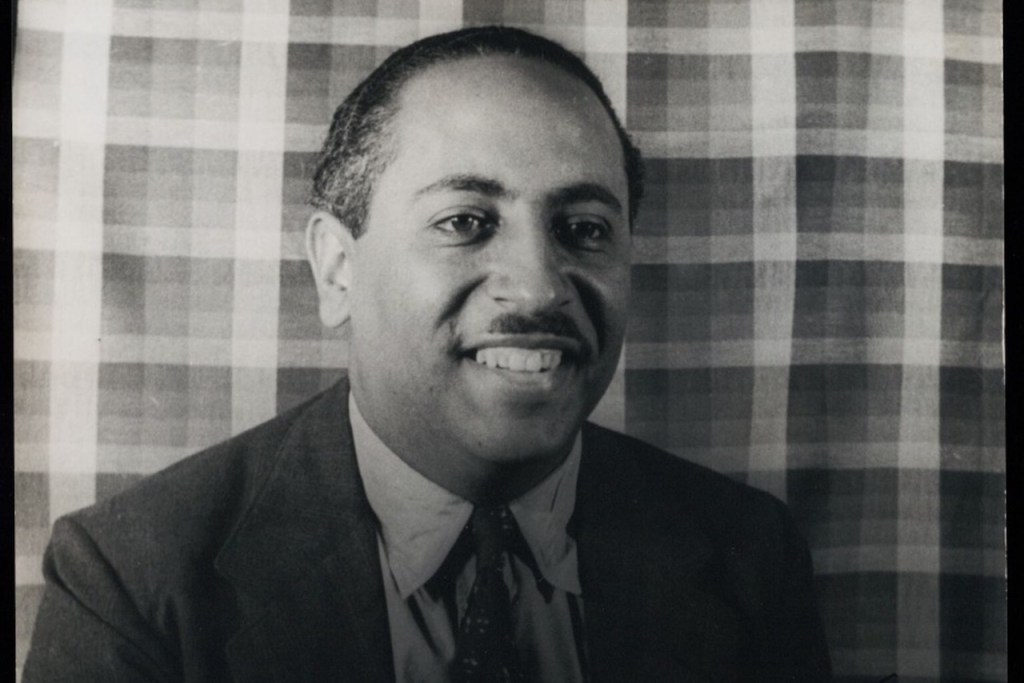
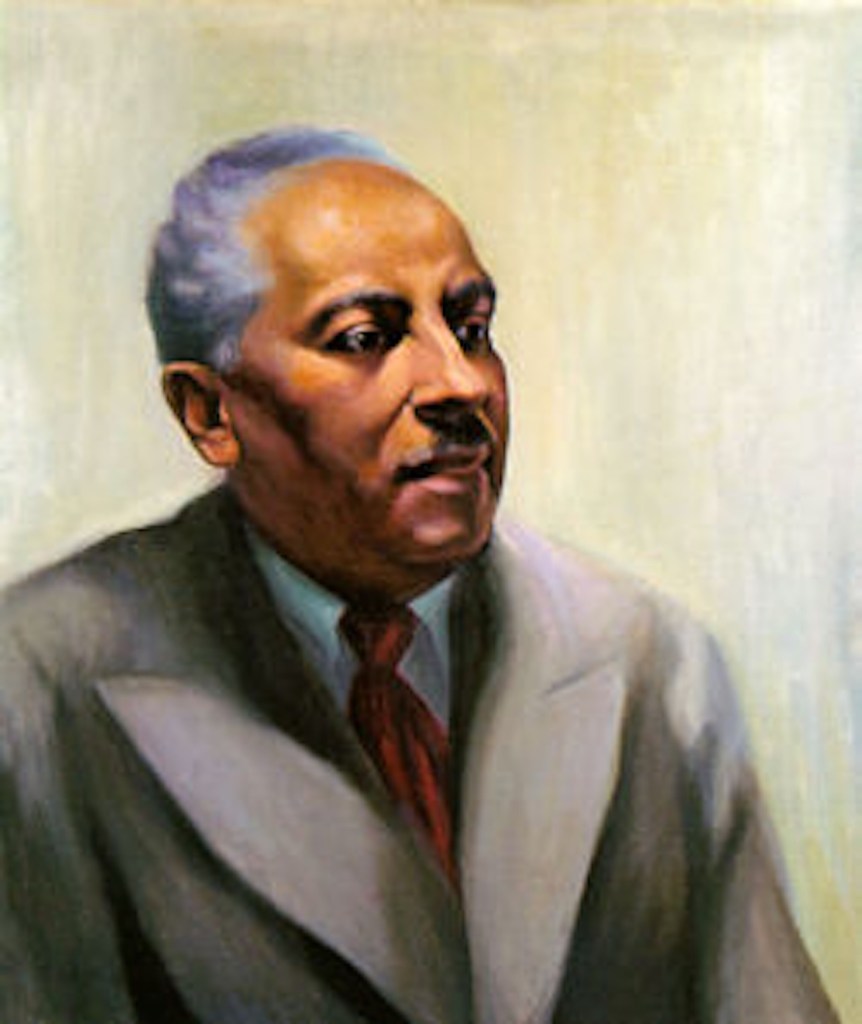
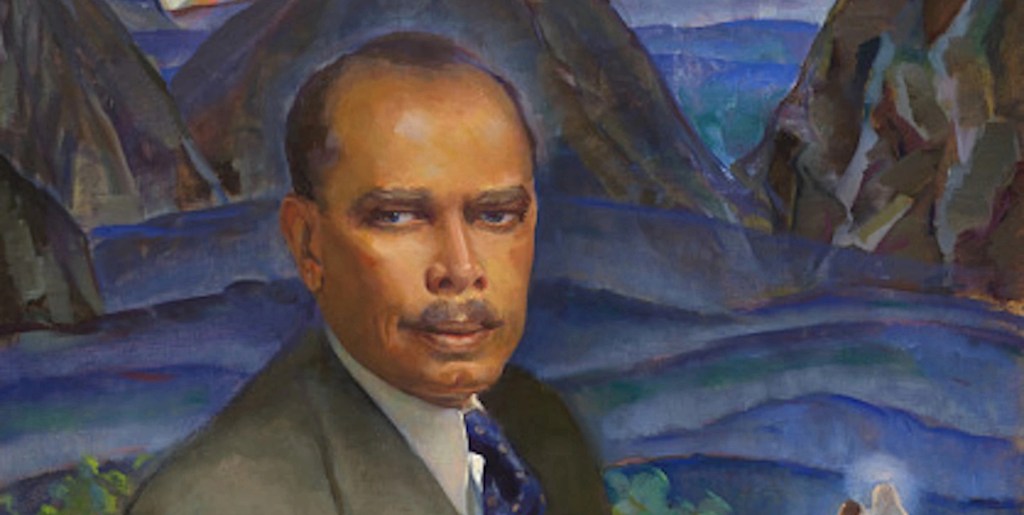
    Image: James Weldon Johnson - Portrait by Laura Wheeler Waring https://npg.si.edu/object/npg_NPG.67.40
    Image: James Weldon Johnson – Portrait by Laura Wheeler Waring

    James Weldon Johnson’s “Mother Night”

    The speaker in Johnson’s sonnet, “Mother Night,” likens his own existence and protection to that of the planets—all are created and protected by the same Divine Entity.  Thus his soul remains a spark from the Original Divine Flame.

    Introduction with Text of “Mother Night”

    James Weldon Johnson’s “Mother Night,” a Petrarchan (or Italian) sonnet, metaphorically dramatizes night as the calm union of the soul with the Oversoul or the individual self with Divine Self.

    The speaker, influenced by Eastern as well as Christian philosophical tenets, draws a parallel between the conflict of day and night in the cosmos and his own struggle with the pairs of opposites in his earthly sojourn.   This sonnet’s form offers polished Petrarchan rime-scheme:  ABBAABBA in the octave, and CDECDE in the sestet.

    Mother Night

    Eternities before the first-born day,
    Or ere the first sun fledged his wings of flame,
    Calm Night, the everlasting and the same,
    A brooding mother over chaos lay.
    And whirling suns shall blaze and then decay,
    Shall run their fiery courses and then claim
    The haven of the darkness whence they came;
    Back to Nirvanic peace shall grope their way. 

    So when my feeble sun of life burns out,
    And sounded is the hour for my long sleep,
    I shall, full weary of the feverish light,
    Welcome the darkness without fear or doubt,
    And heavy-lidded, I shall softly creep
    Into the quiet bosom of the Night.

    Commentary on “Mother Night”

    All creation is protected by its Creator, Who performs in various guises somewhat like a mother bird, who protects her progeny.  Nighttime is the time for rest, peaceful contemplation, and retreat from the hustle and bustle of day time activities.

    Thus, nighttime may be perceived as a protecting entity that offers solace and comfort to those in need and those who wish for such qualities in their lives.

    First Quatrain:  Existence Was Brooding before the First Created Day

    Eternities before the first-born day,
    Or ere the first sun fledged his wings of flame,
    Calm Night, the everlasting and the same,
    A brooding mother over chaos lay.

    Like a brooding mother, that is, a mother bird who is sitting on her brood of eggs and then who continues to protect and keep them warm as baby birds, “Calm Night” kept watch over the unmanifested entity until the first-born day, before the first planets were created and hurled into activity: “ere the first sun fledged his wings of flame.” 

    The mature planet of the sun is like a bird that is now flying off on its own, after having been tenderly nurtured by its mother.

    Mother Night tenderly nurtured the growing cosmos that ultimately resulted in planets and people. Johnson’s metaphoric Night represents the non-vibratory realm of reality where nothing is manifested, and only the mind of God exists in that vibrationless realm.

    There is no creation only a peaceful possibility, a potential. Until God chooses to create beings to populate His cosmos, He simply broods like a mother over chaos. 

    Here the term chaos does not refer to our modern usage of confusion and disorder but to infinite formlessness. The term originates from the Greek Khaos, indicating a dark void from which the gods originated.

    Second Quatrain:  The Projection of Light as It Creates the Cosmos

    And whirling suns shall blaze and then decay,
    Shall run their fiery courses and then claim
    The haven of the darkness whence they came;
    Back to Nirvanic peace shall grope their way. 

    The second quatrain describes the plight of whirling suns as they “blaze and then decay.” Those planets of fire will eventually burn out and after they do, they will return “[b]ack to Nirvanic peace.” 

    The speaker employs the term Nirvanic, adjectival form for “Nirvana,” the Buddhist term for God-union, which is “Samadhi” in  Hinduism, “Salvation” in Christianity, and “Fana” in Sufism, the mystical branch of Islam.

    The speaker cleverly plays by punning “whirling suns,” whereas sun puns son. With God as Mother Night, Her suns (sons) will “run their fiery courses” (live their passionate lives) and then recede back into the arms of the brooding mother or God. 

    First Tercet:  The Individual Self as It Careens Toward Oblivion

    So when my feeble sun of life burns out,
    And sounded is the hour for my long sleep,
    I shall, full weary of the feverish light,

    The sestet then shifts from the cosmos to the speaker himself, a son of the night mother. The speaker vows that he will react to his death a certain way, but he does not clarify that way yet, but merely sets up the conditions for his final claim. 

    As his life comes to an end, as he knows that it “is the hour for [his] long sleep,” he will be fully aware that his life is ebbing.

    Second Tercet:  Faith That Leads the Faithful toward Their True Home

    Welcome the darkness without fear or doubt,
    And heavy-lidded, I shall softly creep
    Into the quiet bosom of the Night.

    And the speaker will “[w]elcome the darkness without fear or doubt.” His strong faith and intuition allow him to realize that his soul is going home. 

    This speaker has mused long and hard upon the profundities that puzzle every thinking brain.  He has contemplated what science has discovered about the nature of the created Cosmos.

    The speaker has likewise compared the knowledge  of scientists to that of the tenets of religion and philosophy.  And the result of his in depth study now allows him to formulate a pathway to Divine Reality.  

    This prescient speaker has come to understand that his own soul is simply a spark of the Divine Flame, Who has fashioned out of chaos a marvelous entity of joy, peace, hope, and love.

    This speaker’s eyelids may droop, but his soul is ever ensconced in the omnipresent protection of the beautiful mother, the Mother Night—who parallels the Blessèd Divine Reality—who will throughout eternity continue to brood over and fiercely guide and guard her beloved son.  

  • Elizabeth Barrett Browning’s Sonnet 44 “Belovèd, thou hast brought me many flowers”

    Image: Elizabeth Barrett Browning – NPG, London

    Elizabeth Barrett Browning’s Sonnet 44 “Belovèd, thou hast brought me many flowers”

    Elizabeth Barrett Browning’s final sonnet 44 “Belovèd, thou hast brought me many flowers”  from the sequence assures her belovèd that she has finally accepted his gift of love.

    Introduction and Text of Sonnet 44 “Belovèd, thou hast brought me many flowers”

    Elizabeth Barrett Browning’s final sonnet from the Sonnets from the Portuguese sequence assures her belovèd that she has finally accepted his gift of love.  Sonnet 44 “Belovèd, thou hast brought me many flowers” is the final poem, which completes this remarkable sequence of love poems.  

    This sonnet finds the speaker musing on the flowers that her belovèd has brought to her.   The speaker quickly transforms the physical blossoms into metaphysical blooms that symbolize the lovers’ bond.

    After all the handwringing of self-doubt that has plagued the speaker throughout this sequence, she must now find a way to assure both herself and her belovèd that her mind set has transformed itself from the dull negative to a shining positive.  The speaker must show her fiancé that they are bound together with an exceptional love.  She must also make it clear that she understands the strong ties they now possess.

    The speaker’s metaphoric comparison of the love gifts of  physical flowers and the symbolic flowers that she has created from her own heart soil will remain an eternal reminder to both herself and her belovèd as they travel the road of marriage together.

    Sonnet 44 “Belovèd, thou hast brought me many flowers”

    Belovèd, thou hast brought me many flowers
    Plucked in the garden, all the summer through
    And winter, and it seemed as if they grew
    In this close room, nor missed the sun and showers.
    So, in the like name of that love of ours,
    Take back these thoughts which here unfolded too,
    And which on warm and cold days I withdrew
    From my heart’s ground. Indeed, those beds and bowers
    Be overgrown with bitter weeds and rue,
    And wait thy weeding; yet here’s eglantine,
    Here’s ivy!—take them, as I used to do
    Thy flowers, and keep them where they shall not pine
    Instruct thine eyes to keep their colors true,
    And tell thy soul their roots are left in mine.

    Commentary on Sonnet 44 “Belovèd, thou hast brought me many flowers”

    The final sonnet in the sequence assures the speaker’s belovèd that she has finally accepted his gift of love, without any further doubts.

    First Quatrain:  A Gift of Flowers

    Belovèd, thou hast brought me many flowers
    Plucked in the garden, all the summer through
    And winter, and it seemed as if they grew
    In this close room, nor missed the sun and showers.

    The speaker muses about the flowers that her belovèd has given her during summer. To her it seems that the flowers have remained as vibrant indoors in her “close room” as they were outside in the “sun and showers.” 

    These miraculous flowers seem to have remained healthy and glowing even during winter.  The speaker then insists that they “grew / In this close room” and that they did not miss “the sun and showers.” 

    Of course, the physical flowers are just the motivation for the musing, which transforms the physical blooms into flowers of a metaphysical sort—those that have impressed images upon her soul, beyond the image on the retina.

    Second Quatrain:   Sonnets as Flower-Thoughts

    So, in the like name of that love of ours,
    Take back these thoughts which here unfolded too,
    And which on warm and cold days I withdrew
    From my heart’s ground. Indeed, those beds and bowers

    Thus the speaker commands her belovèd to “take back these thoughts which here unfolded too.” She is referring to her sonnets, which are her flower-thoughts given to her belovèd to honor their love. 

    The speaker affirms that she has plucked her sonnet-flowers “from [her] heart’s ground.” And the creative speaker has composed her tributes on “warm and cold days.” 

    The weather in the speaker’s heart and soul was always equal to producing fine blossoms for her loved one.   As the speaker basked in his love, the flower “beds and bowers” produced these poems with floral fragrance and hues.

    First Tercet:  Correcting Her Clumsiness

    Be overgrown with bitter weeds and rue,
    And wait thy weeding; yet here’s eglantine,
    Here’s ivy!—take them, as I used to do

    The speaker then inserts her usual self-deprecatory thoughts, admitting that her floral efforts are surely, “overgrown with bitter weeds and rue,” but she gladly submits them for him to “weed” as needed. 

    The speaker’s gifted and talented belovèd can correct her clumsiness. She names two of her poems “eglantine” and “ivy” and commands him to “take them,” as she used to take his gifts of flowers, and probably gifts of his own poems to her as well.

    Second Tercet:  In His Care

    Thy flowers, and keep them where they shall not pine
    Instruct thine eyes to keep their colors true,
    And tell thy soul their roots are left in mine.

    The speaker commands her belovèd to safeguard her pieces so “they shall not pine.” In his care, she will also not pine.  And the poem will “instruct [his] eyes” to the true feelings she bears for him.

    The speaker’s poems will henceforth remind him that she feels bound to him at the soul.  Soul qualities have always been more important to this speaker than physical and mental qualities.  

    The “colors true” of this speaker’s sonnets will continue to pour forth her love for her belovèd and “tell [his] soul their roots are left in [hers].”   Each sonnet will reinforce their love and celebrate the life they will make together.

  • Elizabeth Barrett Browning’s Sonnet 6  “Go from me. Yet I feel that I shall stand”

    Image: Elizabeth Barrett Browning – Getty Images

    Elizabeth Barrett Browning’s Sonnet 6  “Go from me. Yet I feel that I shall stand”

    Elizabeth Barrett Browning’s sonnet 6 is a clever seduction sonnet; as the speaker seems to be giving the suitor every reason to leave her, she is also giving him very good reasons to remain.

    Introduction and Text of Sonnet 6  “Go from me. Yet I feel that I shall stand”

    Elizabeth Barrett Browning’s sonnet 6 from Sonnets from the Portuguese may be thought of as the seeming reversal of a seduction theme.  At first the speaker seems to be dismissing her lover.  But as she continues, she shows just how close they already are.

    The speaker’s revelation that he will always be with her, even though she has sent him away from the relationship, is bolstered by many instances of intensity that is surely meant to keep the love attracted instead of repelling him.

    Sonnet 6  “Go from me. Yet I feel that I shall stand”

    Go from me. Yet I feel that I shall stand
    Hence forward in thy shadow. Nevermore
    Alone upon the threshold of my door
    Of individual life, I shall command
    The uses of my soul, nor lift my hand
    Serenely in the sunshine as before,
    Without the sense of that which I forbore—
    Thy touch upon the palm. The widest land
    Doom takes to part us, leaves thy heart in mine
    With pulses that beat double. What I do
    And what I dream include thee, as the wine
    Must taste of its own grapes. And when I sue
    God for myself, He hears that name of thine,
    And sees within my eyes the tears of two.

    Reading:  

    Commentary on Sonnet 6 “Go from me. Yet I feel that I shall stand”

    This sonnet is a clever seduction sonnet; as the speaker seems to be giving the suitor every reason to leave her, she is also giving him very good reasons that they should remain together.

    She is always trying to convince herself more than her suitor, for she already intuits that he believes their union is meant to be.  He knows the depth of his love for her. But she must convince herself that that depth is genuine.

    First Quatrain:  No Equal Partnership

    Go from me. Yet I feel that I shall stand
    Hence forward in thy shadow. Nevermore
    Alone upon the threshold of my door
    Of individual life, I shall command

    In Elizabeth Barrett Browning’s sonnet 6 from Sonnets from the Portuguese, the speaker is commanding her beloved to leave her.  As she has protested in earlier sonnets, she does not believe she is equal to his stature, and such a match could not withstand the scrutiny of their class society. 

    But the clever speaker also hastens to add that his spirit will always remain with her, and she will henceforth be “[n]evermore / Alone upon the threshold of my door / Of individual life.”

    That the speaker once met and touched one so esteemed will continue to play as a presence in her mind and heart.  She is grateful for the opportunity just to have briefly known him, but she cannot presume that they could have a permanent relationship.

    Second Quatrain:  Never to Forget

    The uses of my soul, nor lift my hand
    Serenely in the sunshine as before,
    Without the sense of that which I forbore—
    Thy touch upon the palm. The widest land

    The speaker continues the thought that her beloved’s presence will remain with her as she commands her own soul’s activities.  Even as she may “lift [her] hand” and view it in the sunlight, she will be reminded that a wonderful man once held it and touched “the palm.”

    The speaker has married herself so securely to her beloved’s essence that she avows that she cannot henceforth be without him.  As she attempts to convince herself that such a life will suffice, she also attempts to convince her beloved that they are already inseparable.

    First Tercet:  Metaphysically Together Always

    Doom takes to part us, leaves thy heart in mine
    With pulses that beat double. What I do
    And what I dream include thee, as the wine

    No matter how far apart the two may travel, no matter how many miles the landscape “doom[s]” them to separation, their two hearts will forever beat together, as “pulses that beat double.” 

    Everything she does in future will include him, and in her every dream, he will appear.  She is binding them together on the metaphysical level, where such bonds can never be broken, as they can on the physical level of being.

    Second Tercet:  Prayers That Include Her Beloved

    Must taste of its own grapes. And when I sue
    God for myself, He hears that name of thine,
    And sees within my eyes the tears of two.

    They will be a union as close as grapes and wine: “as the wine / / Must taste of its own grapes.” Her juxtaposition of wine and tears becomes symbolic of their liquid love, running together as any stream to the sea.

    And when she supplicates to God, she will always include the name of her beloved. She will never be able to pray only for herself but will always pray for him as well. And when the speaker sheds tears before God, she will be shedding “the tears of two.”  In her spiritual life, the two are already bound together.

    Her life will be so bound together with her beloved that there is no need for him to remain with her physically, and she has given reasons that he should depart and not feel any pangs of sorrow for her. 

    In fact, he will not be leaving her if they are so closely united already.  They can never be parted despite any measure of physical distance. While the speaker seems to be giving the suitor every opportunity to leave her by exaggerating their union, her pleadings also reveal that she is giving him every reason to remain with her. 

    If they are already as close and wine and grapes, and she adores him so greatly as to continue to remember that he touched her palm, such strong love and adoration would be difficult to turn down.

    Despite the class differences that superficially separate them, the speaker must somehow come to understand that their parting is not an option.  The metaphysical level of being must be explored for the sake of reality.

  • Brad McClain’s “Cowboy Christmas”

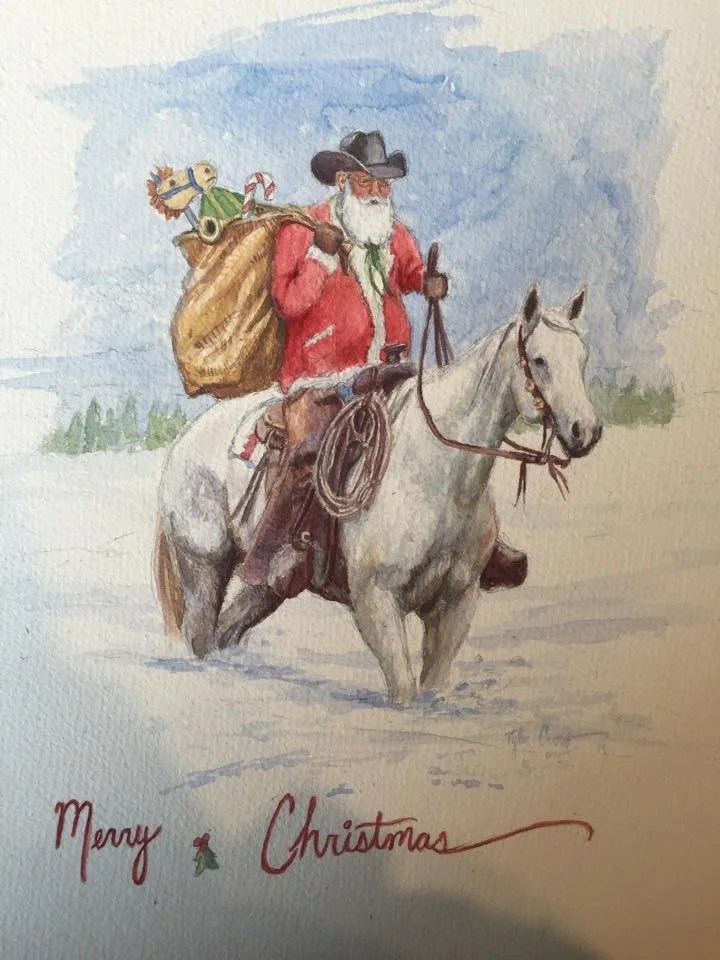
    Image: Merry Christmas  – Art by Tyler Crow, used by permission

    From an internet site dedicated to his Christian faith and affinity for cowboy culture God’s Horseback Gospel, Brad McClain’s “Cowboy Christmas” celebrates the congeniality of friends gathering to observe the Christmas season.  It offers the traditional energy and fun-loving atmosphere of most cowboy Christmas poetry.

    The two prose pieces following the poem further extend the faithful worship included in Mr. McClain’s purpose for creating his webpage—to glorify God and introduce others to a kind of spiritual awakening that they may not have known existed.

    Brad McClain’s “Cowboy Christmas”

    A countrified tradition,
    Was part of yester-year,
    When the cowboys’ main ambition,
    Was to spread some Christmas cheer.

    The ranch folk friend and families,
    Would come from far and wide,
    Trottin’ through the winter breeze,
    On Christmas Eve they’d ride.

    For food and fun and merriment,
    Twin fiddles filled the air,
    And everyone’s so glad they went,
    And goodwill everywhere.

    Kids a’chasin’ kids around,
    Oldsters smile and wave,
    All the festive sights and sounds,
    And a cowboy gettin’ brave,

    Enough to ask that gal to dance,
    And of course she says she will,
    He never thought he had a chance,
    And if a look could kill,

    Her Daddy watches carefully,
    He remembers to that age,
    Her mama takes it prayerfully,
    It helps her fear assuage.

    But nothin’ like a Christmas waltz,
    And nothin’ like young love,
    And nobody is findin’ faults,
    And lots to be proud of.

    And when the egg nog’s mostly gone,
    And the kids are ‘bout asleep,
    The hugs and handshakes linger long,
    And the night is gettin’ deep,

    And then all head for hearth and home,
    They jingle all the way,
    Snow drifts ‘cross the sandy loam,
    And soon comes Christmas Day.

    The evening wanes, kids tucked in bed,
    Gifts set beneath the tree,
    Stockings filled all green and red,
    A prayer for you and me.

    The Cowboy Christmas, all are blessed,
    Praise for the Savior’s birth,
    God gave to each His gracious rest,
    Good will and peace on earth.

    “Praise the Lord, the God of Israel, because He has visited and redeemed His people.  He has sent us a mighty Savior from the royal line of His servant David.” (Luke 1:68-69, NLT)

    Christmas is a festival of praise.  All the fun, food, music, lights and fellowship are because God has given us His greatest give- the Savior!  God has always been the One who saves, but now the ultimate salvation has entered the world and for one reason- to save that which is lost.  How sad that some of those who need it the most seem to feel it the least.  And how wonderful it is when someone discovers the love that meets them exactly where they are in order to take them where they have always should have been!  The devil lies when he claims to have the best party.  Jesus is the Lord of the dance and it’s time we put aside our fickleness and followed Him.  Christmas is a good time to get the party started!

  • S. Omar Barker’s “A Cowboy’s Christmas Prayer”

    Image:  S. Omar Barker – Texas Trail of Fame

    S. Omar Barker’s “A Cowboy’s Christmas Prayer”

    S. Omar Barker’s Christmas poem “A Cowboy’s Christmas Prayer” features a humble cowpoke, who is not accustomed to praying but is offering his heart-felt supplication at Christmas time.  As he prays, he reveals the qualities and issues of his life that are most important to him.

    Introduction with Text of “A Cowboy’s Christmas Prayer”

    This Christmas prayer/poem composed by cowboy poet, S. Omar Barker, allows a humble rider-of-the-range to express his deeply held wishes as he offers a supplication to the Lord for the good of all mankind.  The cowboy prayer is framed as a ballad-style narration emphasizing the simple, humble nature of the cowpoke.

    The ballad-influenced piece plays out in cowboy dialect and  in riming couplets.  Its stanza breaks are uneven with two single-line bridges that dissect the drama at important points to emphasize the shift in theme and tone.

    A Cowboy’s Christmas Prayer

    I ain’t much good at prayin’, and You may not know me, Lord —
    For I ain’t much seen in churches, where they preach Thy Holy Word.
    But you may have observed me out here on the lonely plains,
    A-lookin’ after cattle, feelin’ thankful when it rains.

    Admirin’ Thy great handiwork.

    The miracle of the grass,
    Aware of Thy kind Spirit, in the way it comes to pass
    That hired men on horseback and the livestock that we tend
    Can look up at the stars at night, and know we’ve got a Friend.

    So here’s ol’ Christmas comin’ on, remindin’ us again
    Of Him whose coming brought good will into the hearts of men.
    A cowboy ain’t a preacher, Lord, but if You’ll hear my prayer,
    I’ll ask as good as we have got for all men everywhere

    Don’t let no hearts be bitter, Lord.
    Don’t let no child be cold.
    Make easy the beds for them that’s sick and them that’s weak and old.
    Let kindness bless the trail we ride, no matter what we’re after,
    And sorter keep us on Your side, in tears as well as laughter.

    I’ve seen ol’ cows a-starvin’ — and it ain’t no happy sight;
    Please don’t leave no one hungry, Lord, on Thy Good Christmas Night —
    No man, no child, no woman, and no critter on four feet
    I’ll do my doggone best to help you find ’em chuck to eat.

    I’m just a sinful cowpoke, Lord — ain’t got no business prayin’
    But still I hope you’ll ketch a word or two, of what I’m sayin’:
    We speak of Merry Christmas, Lord—

    I reckon You’ll agree —

    There ain’t no Merry Christmas for nobody that ain’t free!
    So one thing more I ask You, Lord: just help us what You can
    To save some seeds of freedom for the future Sons of Man!

    Reading

    Commentary on “A Cowboy’s Christmas Prayer”

    S. Omar Barker’s “A Cowboy’s Christmas Prayer” dramatizes the prayer offered by a humble cowboy who is unaccustomed to praying and unacquainted with church services but who holds the blessings from the Creator very dear to his heart.  He expresses his gratitude for the simple life he lives and asks his Creator to bless others with kindness and prosperity.

    First Movement:  A Humble Prayer

    I ain’t much good at prayin’, and You may not know me, Lord —
    For I ain’t much seen in churches, where they preach Thy Holy Word.
    But you may have observed me out here on the lonely plains,
    A-lookin’ after cattle, feelin’ thankful when it rains.

    In the first quatrain, the supplicating cowboy begins by addressing the Lord, suggesting that the Lord may not even be acquainted with the cowboy; he then gives the reasons that he feels the Lord may not know him.  He has not attended church very often, and he knows that’s where they preach His “Holy Word.”

    However, the cowboy then suggests that perhaps the Creator has seen him out on the plains doing his work of watching “after cattle.”  The cowboy adds what he likely feels may be a useful introduction to the Lord Creator:  he has felt thankful for the rain that keeps life supported.

    Second Movement:  A Single-Line Bridge

    Admirin’ Thy great handiwork.

    The cowboy adds another positive feature in his heretofore somewhat tentative relationship with the Almighty: he has always admired the “great handiwork” that he often observes as he rides the range in the great outdoors.

    This line appears alone and emphasizes the important idea that the cowboy has always kept the Creator near to his heart by feeling enthralled by all of what He has created.  The cowboy is likely remembering the wide-open plains, the mountains, the trees, vegetation of the prairie, the night sky full of stars, and the cattle that he himself drives and protects. 

    This single line offers a useful bridge between the moments of prayer that supplicates, as it brings the Divine back into the cowboy’s consciousness.

    Third Movement:   Miracles in Creation

    The miracle of the grass,
    Aware of Thy kind Spirit, in the way it comes to pass
    That hired men on horseback and the livestock that we tend
    Can look up at the stars at night, and know we’ve got a Friend.

    The next quatrain offers a few specific examples of the great Lord’s “handiwork.”  The cowboy first mentions the grass, which he describes as a “miracle.”  He then avers that even as a simply cowpoke he feels the nature of the Lord is kindness.

    And through that “kind Spirit,” he reports that somehow the graceful occasion exists that those hired hands who work riding horseback and tending livestock are able to observe the sky full of “stars at night.”

    The cowboy makes it clear that such a sight fills his heart with gratitude that he and his fellow workers “got a Friend.”  His relationship with the Lord has blossomed even as he admits his tentative relationship with church and prayer.

    Fourth Movement:  Good Will

    So here’s ol’ Christmas comin’ on, remindin’ us again
    Of Him whose coming brought good will into the hearts of men.
    A cowboy ain’t a preacher, Lord, but if You’ll hear my prayer,
    I’ll ask as good as we have got for all men everywhere.

    Likely the coming of the season of Christmas has been the impetus for the cowboy to be offering this halting prayer.  So he now tells the Lord that the coming of Christmas has reminded him of Jesus the Christ, Who “brought good will” into men’s hearts.

    Even though he “ain’t a preacher,” the cowboy expresses the hope that the Lord will still hear his prayer.  He promises to supplicate for the “good” of everyone everywhere.  He wishes that all men may be as blessed as he his.  His gratitude keeps his own heart open to the Lord’s grace.

    Fifth Movement:  Prayer of a Simple Soul

    Don’t let no hearts be bitter, Lord.
    Don’t let no child be cold.
    Make easy the beds for them that’s sick and them that’s weak and old.
    Let kindness bless the trail we ride, no matter what we’re after,
    And sorter keep us on Your side, in tears as well as laughter.

    In the next cinquain, the speaker offers a catalogue of blessings that he wishes to ask of the Lord.  He asks that no bitterness reside in the hearts of men, as he asks that “no child be cold.”  

    He asks the Lord comfort those who are ill and make their convalescence go smoothly.  He also wish ease and comfort for those who are old and weak.  He asks kind-heartedness remain a feature of the “trail we ride.” He then asks the Creator to keep humanity on His side throughout good times as well as bad times.

    Sixth Movement:  Praying for Others’ Welfare

    I’ve seen ol’ cows a-starvin’ — and it ain’t no happy sight;
    Please don’t leave no one hungry, Lord, on Thy Good Christmas Night —
    No man, no child, no woman, and no critter on four feet
    I’ll do my doggone best to help you find ’em chuck to eat.

    Returning to the quatrain-form for the sixth movement, the speaker focuses on hunger; he has observed cows that are starving to death, and that sight weighs heavily on his heart and mind; thus, he begs the Lord to “leave no one hungry.” 

    This deprivation is so important to him that he asks that “no man, no child, no woman” be allowed to go hungry.  But he also wants the Lord to protect all animals from the fate of hunger.  He then promises to help the Lord in finding food for all who are hungry.

    Seventh Movement:  Self-Deprecation 

    I’m just a sinful cowpoke, Lord — ain’t got no business prayin’
    But still I hope you’ll ketch a word or two, of what I’m sayin’:
    We speak of Merry Christmas, Lord—

    In the next tercet, the cowboy again engages in self-deprecation, saying he is “just a sinful cowpoke” and he does not deserve to be “prayin’.”  Still, he expresses the hope that the Creator will hear at least “a word or two” of his prayer.  

    The cowboy/speaker then begins a thought which is so important that he offers merely the opening of it, allowing its conclusion to spread over another bridge and into the final tercet.  He begins by reporting that “[w]e speak of Merry Christmas, Lord—.”

    Eighth Movement:  Agreement with His Lord

    I reckon You’ll agree —

    The speaker then creates a second bridge between thoughts.  This time he inserts the important notion he thinks the Lord will agree with what he is about to propose. By beginning the thought in the conclusion of the seventh movement, allowing it to marinate through the eighth bridge movement, he has created a small mystery that emphasizes the utterly vital importance of his final thought.

    Ninth Movement:  Freedom Is Vital

    There ain’t no Merry Christmas for nobody that ain’t free!
    So one thing more I ask You, Lord: just help us what You can
    To save some seeds of freedom for the future Sons of Man!

    Finally, the cowboy issues his important claim before God and world that the most important possession that mankind must retain is “freedom.”  There can be no “Merry Christmas” unless humanity is free to enjoy it; no happiness can exists for any individual “that ain’t free!”

    Thus, the cowboy’s final supplication is that the Lord “save some seeds of freedom for the future Sons of Man!”  He asks his Creator to allow the love and hope of freedom to grow with mankind in all lands for all time.

  • Badger Clark’s “A Cowboy’s Prayer”

    Image: Badger Clark

    Badger Clark’s “A Cowboy’s Prayer”

    Badger Clark’s ballad consists of four riming octets, nostalgically dramatizing a celebration of his gratitude to God for his way of life.

    Introduction and Text of “A Cowboy’s Prayer”

    Badger Clark’s “A Cowboy’s Prayer” with the subtitle “Written for Mother”offers a prayer that would make any mother proud, as he celebrates his free lifestyle of living on the open range. Each octet stanza features the rime scheme ABABCDCD. This Badger classic was first published in  The Pacific Monthly, in December of 1906.

    About this poem/prayer, Katie Lee writes in her classic history of cowboy songs and poems starkly titled Ten Thousand Goddam Cattle, A History of the American Cowboy in Song, Story, and Verse, “The language is true to his free-roving spirit and gives insight to the code he lived by the things he expected of himself.”

    A Cowboy’s Prayer

    (Written for Mother)

    Oh Lord, I’ve never lived where churches grow.
    I love creation better as it stood
    That day You finished it so long ago
    And looked upon Your work and called it good.
    I know that others find You in the light
    That’s sifted down through tinted window panes,
    And yet I seem to feel You near tonight
    In this dim, quiet starlight on the plains. 

    I thank You, Lord, that I am placed so well,
    That You have made my freedom so complete;
    That I’m no slave of whistle, clock or bell,
    Nor weak-eyed prisoner of wall and street.
    Just let me live my life as I’ve begun
    And give me work that’s open to the sky;
    Make me a pardner of the wind and sun,
    And I won’t ask a life that’s soft or high.

    Let me be easy on the man that’s down;
    Let me be square and generous with all.
    I’m careless sometimes, Lord, when I’m in town,
    But never let ’em say I’m mean or small!
    Make me as big and open as the plains,
    As honest as the hawse between my knees,
    Clean as the wind that blows behind the rains,
    Free as the hawk that circles down the breeze!

    Forgive me, Lord, if sometimes I forget.
    You know about the reasons that are hid.
    You understand the things that gall and fret;
    You know me better than my mother did.
    Just keep an eye on all that’s done and said
    And right me, sometimes, when I turn aside,
    And guide me on the long, dim, trail ahead
    That stretches upward toward the Great Divide.

    Clark’s “A Cowboy’s Prayer”

    Commentary on “A Cowboy’s Prayer”

    This poem, written in the traditional ballad form, reveals a grateful cowboy, who loves his rustic way of life and gives thanks for God for it. 

    First Stanza:  Addressing the Lord

    Oh Lord, I’ve never lived where churches grow.
    I love creation better as it stood
    That day You finished it so long ago
    And looked upon Your work and called it good.
    I know that others find You in the light
    That’s sifted down through tinted window panes,
    And yet I seem to feel You near tonight
    In this dim, quiet starlight on the plains. 

    The speaker begins his payer by addressing the Lord, telling Him that he has never been one to attend church, because “[he’s]  never lived where churches grow.” But he admits that he loves creation just as the Lord finished it before mankind began to build things.

    The speaker then confides that while others may find the Lord “in the light that is sifted down through tinted window panes,” he feels Him near, “In this dim, quiet starlight on the plains.” The speaker wants to assure the Divine that despite his absence from houses of worship, he worships without a house while simply stationed out on the open plains created by the Great Creator.

    Second Stanza:  Thanking the Lord

    I thank You, Lord, that I am placed so well,
    That You have made my freedom so complete;
    That I’m no slave of whistle, clock or bell,
    Nor weak-eyed prisoner of wall and street.
    Just let me live my life as I’ve begun
    And give me work that’s open to the sky;
    Make me a pardner of the wind and sun,
    And I won’t ask a life that’s soft or high.

    The speaker offers his heartfelt gratitude to the Lord for his blessings. He is especially grateful that the Lord has made “[his] freedom so complete.” He then catalogues the places where he would not feel so free, places where he would have to heed the call “of whistle, clock or bell.”

    He asks the Lord to continue blessing him this way: “Just let me live my life as I’ve begun / And give me work that’s open to the sky.” He avers that he will not ever be asking “for a life that’s soft or high.”

    Third Stanza:  Praying for Wisdom

    Let me be easy on the man that’s down;
    Let me be square and generous with all.
    I’m careless sometimes, Lord, when I’m in town,
    But never let ’em say I’m mean or small!
    Make me as big and open as the plains,
    As honest as the hawse between my knees,
    Clean as the wind that blows behind the rains,
    Free as the hawk that circles down the breeze!

    The speaker then asks for the guidance and wisdom to treat other people with respect and honor. He admits that sometimes he is careless, especially when he is in town. But he asks that he never be mean or small. He wants others to think well of him because he behaves properly.

    The speaker asks for three things, honesty, cleanliness, and freedom. Thus, he asks the Lord to make him,  “As honest as the hawse between my knees, / Clean as the wind that blows behind the rains, / Free as the hawk that circles down the breeze!”

    Fourth Stanza:  Praying for Guidance

    Forgive me, Lord, if sometimes I forget.
    You know about the reasons that are hid.
    You understand the things that gall and fret;
    You know me better than my mother did.
    Just keep an eye on all that’s done and said
    And right me, sometimes, when I turn aside,
    And guide me on the long, dim, trail ahead
    That stretches upward toward the Great Divide.

    Again, the speaker acknowledges that he is not perfect, that at times he forgets proper behavior. He admits that he does not know all that God knows: “You know about the reasons that are hid.” And he declares that the Lord knows him “better than my mother did.”

    So the speaker asks God to guard and guide him by watching over him, and when he misbehaves, he begs the Lord to “right me, sometimes, when I turn aside.” He asks God to be with him as he moves “on the long, dim, trail ahead / That stretches up toward the Great Divide”. He masterly employs the metaphoric Great Divide to signal the afterworld as well as a great Western geological phenomenon.

    Image: Badger Clark

  • David Althouse’s “Cowboy Christmas Carol”

    Image:  David Althouse

    David Althouse’s “Cowboy Christmas Carol”

    A “hard-bitten ol’ cowpoke” experiences a mystical experience that changes his heart in the Christmas ballad.  He will carry his new change of heart into his daily cow poking life as he honors “the Great Trail Boss in the Sky.”

    Introduction with Text of “Cowboy Christmas Carol”

    The speaker in cowboy poet David Althouse’s “Cowboy Christmas Carol” spins a deeply spiritual yarn about an old cowboy whose mystical experience leads him to a state of grace and thankfulness that he had been lacking—even though he had lived a relatively carefree life in the open prairie that he loved.

    Cowboy Christmas Carol

    For a hard-bitten ol’ cowpoke like me a Christmas ain’t always merry;
    I’ve spent most of ’em  a-ridin’ fences, a-sleepin’ in line cabins out on the prairie.
    So for most a my hard life the spirit of Christmas did not abide within my heart.
    How I come to possess the spirit is the story I hafta impart.

    Tha year was ’87 and I was a-follerin’ doggie trails,
    A-drinkin’ rot gut whiskey to forget about my life’s travails.
    Ih was two days from the line cabin, at a far off lonely place,
    A-roundin’ up some strays, the snow whippin’ crost my face.

    Night came of a-suddin’ so’s I bedded down to rest,
    A tin can full o’ hot coffee a-restin’ crost my chest.
    Of a-suddin’ I heard somthin’ a-flutterin’ down from the skies.
    I taken a closer look an I couldn’t believe my eyes.

    It looked to be some kind o’ Christmas Angel from the first I did suspect,
    What with all the sugar plums a-hangin’ ’round ‘er neck.
    Holly laced ‘er halo an’ lustrous pearls adorned ‘er wings,
    An’ ‘er sweet little silver bell voice was a-trillin’ little ting-a-ling-a-lings.

    “Cast away your fears, cowboy,” she says,  “I’m an Angel sent from on High,
    And I’m here to do the bidding of the Great Trail Boss in the Sky.”
    Dadgumit she talked! She’s a bonafide Angel fer shore!
    Was I’a-goin’ feral or was it that bad hooch I drank the night afore?

    “It isn’t the whiskey,” she says, a-readin’ my mind.
    “You don’t even know it cowboy, but it’s Christmas time.”
    She had me dead to rights on that one, an’ it caused me much chagrin,
    Causin’ the last time I partook a Christmas was back in … heck, I don’t know when.

    “Why, thar ain’t no time fer Christmas out ‘ere Angel,” I says. “It’s absolut’ absurd.
    I’ve got fences to mend an’ orn’ry doggies to git back to the herd!”
    She says, “You’ve sunk lower than the wild beasts, lower than a longhorn steer,
    For even the furry animals keep Christmas once a year.”

    “Critters a-keepin’ Christmas?” I says. “Now this I gotta see!”
    “Very well, cowboy,” she says. “Come fly the night sky with me.”
    Well my eyes got as big as poker chips when flyin’ she did suggest.
     “Just take hold of my arm, cowboy,”  she says, “and I’ll do the rest.”

    To a quiet faraway meadow we flew, to a lonely stand o’ pines,
    An’ when I looked down a’neath them trees I was in fer a big surprise.
    Fer a-layin’ thar a’neath them trees all cuddled up on the ground,
    Was ever’ kind o’ furry critter anywhere to be found.

    Rabbits, squirrels, birds and deer all a-layin’ in one spot,
    With a coyote, wolf and mountain lion a-standin’ guard over the entire lot.
    She says, “They’re huddled together because the spirit of Christmas fills the air.”
    “Mebbe so,” I says, “But them smaller critters should be a-scampin’ outa thar!”

    “They’ve nothing of which to worry,” she says. “Peace fill their hearts upon this night.”
    “Whatever ya thank,” I says, ” but they’d best make dust afore first  light.”
    Yet, as I beheld this miracle, I recollect I shed some tears,
    A-rememberin’ all the wasted Christmases of my long-gone yesteryears.

    I vowed I’d do thangs different, that I’d make another start,
    That ever’ day I had left I’d keep Christmas merry in my heart.
    Then I gave thanks to this ‘ere Angel fer a-savin’ me from my demise.
    She just smiled an angelic smile then she a-fluttered back up to the skies.

    A-many a year has passed since I beheld that angelic sight,
    An’ I’ve tried to keep the promise I made to her upon that night.
    Now I’m proud to herd these doggies, an watch over ’em  with all I know —
    Like extry hay fer the runt calves, when it’s a-freezin’ an’ a-blowin’ snow.

    And now I’m thankful that I’m a cowboy, a-roamin’ the trails a-wild an’ free,
    A-watchin’ over these orn’ry doggies like the Great Trail Boss a-watches over me.

    Commentary on “Cowboy Christmas Carol”

    The idea that the sentiment of Christmas belongs in each heart every day of the year and not just on one celebrated day enjoys widespread lip-service, although it is seldom achieved.  This old cowboy intends to change that fact, at least, for himself .

    First Movement:   Cowboy Work Comes First

    For a hard-bitten ol’ cowpoke like me a Christmas ain’t always merry;
    I’ve spent most of ’em  a-ridin’ fences, a-sleepin’ in line cabins out on the prairie.
    So for most a my hard life the spirit of Christmas did not abide within my heart.
    How I come to possess the spirit is the story I hafta impart.

    Tha year was ’87 and I was a-follerin’ doggie trails,
    A-drinkin’ rot gut whiskey to forget about my life’s travails.
    Ih was two days from the line cabin, at a far off lonely place,
    A-roundin’ up some strays, the snow whippin’ crost my face.

    The speaker is a cowboy who has been practicing his profession for many years, and he admits that mending fences while tending cattle out on the prairie has not always been conducive to observing and celebrating Christmas.  He has felt that his mind and heart had been spiritually dry for a long time, but then something happened to change his heart.

    During one Christmas season, the speaker was out on the prairie rounding up some stray “doggies,” drinking “rot gut whiskey,” which helped him forget his hard life.  He found himself alone, many miles from the “line cabin.”  It was cold with snow whipping about his face.

    Second Movement:   A Mystical Being Appears

    Night came of a-suddin’ so’s I bedded down to rest,
    A tin can full o’ hot coffee a-restin’ crost my chest.
    Of a-suddin’ I heard somthin’ a-flutterin’ down from the skies.
    I taken a closer look an I couldn’t believe my eyes.

    It looked to be some kind o’ Christmas Angel from the first I did suspect,
    What with all the sugar plums a-hangin’ ’round ‘er neck.
    Holly laced ‘er halo an’ lustrous pearls adorned ‘er wings,
    An’ ‘er sweet little silver bell voice was a-trillin’ little ting-a-ling-a-lings.

    The speaker has bedded down for the night with a tin of hot coffee placed on his chest to help drive out some of the cold.  With the night’s seemingly sudden arrival, he sees a celestial being approaching from the sky.

    The cowboy describes the being in typical cowboy fashion, mentioning “sugar plums,” decorating the form of what appears to be an angel with “lustrous pearls” on her wings.  He even hears her voice that sounds like a “sweet little silver bell.”  

    Third Movement:   Sent by the “Great Trail Boss”

    “Cast away your fears, cowboy,” she says,  “I’m an Angel sent from on High,
    And I’m here to do the bidding of the Great Trail Boss in the Sky.”
    Dadgumit she talked! She’s a bonafide Angel fer shore!
    Was I’a-goin’ feral or was it that bad hooch I drank the night afore?

    “It isn’t the whiskey,” she says, a-readin’ my mind.
    “You don’t even know it cowboy, but it’s Christmas time.”
    She had me dead to rights on that one, an’ it caused me much chagrin,
    Causin’ the last time I partook a Christmas was back in … heck, I don’t know when.

    The being does not keep the cowboy guessing who she is; she identifies herself as an “Angel,” and she informs him that she is being sent by the Divine or in cowboy talk that “Great Trail Boss in the Sky.”   Furthermore, she instructs him not to fear.

    Of course, the speaker is wonderstruck at first that this Angel sent from “on High” would be visiting him.  He suspects he is hallucinating from the bad whiskey or that he is just going wild in the brain.

    The Angel tells him that her appearance has nothing to do with the whiskey.  He knows then he is in the presence of something divine because she is reading his mind.  She then informs him that it is Christmas time, insisting that he did not even know that season was upon him.

    The cowboy has to admit that she has him “dead to rights”—he had not been aware of Christmas for so long that he had actually forgotten the last time he had thought about that season.

    Fourth Movement:   Too Busy to Celebrate

    “Why, thar ain’t no time fer Christmas out ‘ere Angel,” I says. “It’s absolut’ absurd.
    I’ve got fences to mend an’ orn’ry doggies to git back to the herd!”
    She says, “You’ve sunk lower than the wild beasts, lower than a longhorn steer,
    For even the furry animals keep Christmas once a year.”

    “Critters a-keepin’ Christmas?” I says. “Now this I gotta see!”
    “Very well, cowboy,” she says. “Come fly the night sky with me.”
    Well my eyes got as big as poker chips when flyin’ she did suggest.
     “Just take hold of my arm, cowboy,”  she says, “and I’ll do the rest.”

    Then the speaker protests that there is no opportunity for observing Christmas out here on the prairie with “orn’ry doggies” and “fences to mend.”  But to his excuses, the Angel counters that he has allowed himself to sink lower than the animals, adding that at this time of year even the animals celebrate the spirit of Christmas.

    The cowboy protests that “critters a-keepin’ Christmas” is something he would have to see to believe.  And so the Angel tells him to take hold of her arm, and they will “fly the night sky” to a place where she will prove the truth of her statement. With eyes as big as “poker chips,” the cowboy obeys the Angel, and they fly off.

    Fifth Movement:   An Astral Meadow

    To a quiet faraway meadow we flew, to a lonely stand o’ pines,
    An’ when I looked down a’neath them trees I was in fer a big surprise.
    Fer a-layin’ thar a’neath them trees all cuddled up on the ground,
    Was ever’ kind o’ furry critter anywhere to be found.

    Rabbits, squirrels, birds and deer all a-layin’ in one spot,
    With a coyote, wolf and mountain lion a-standin’ guard over the entire lot.
    She says, “They’re huddled together because the spirit of Christmas fills the air.”
    “Mebbe so,” I says, “But them smaller critters should be a-scampin’ outa thar!”

    The Angel brings him to an astral meadow that looks very much like a place the cowboy would recognize with a “lonely stand o’ pines.”  But when he looks down, he can see “rabbits, squirrels, birds and deer,” and “a coyote, wolf and mountain lion” are guarding them all as they rest peacefully in one area.

    This inspiring scene offers an allusion to Isaiah 11:6 (KJV), describing the peace that reigns with the experience of Christ-consciousness:  

    The wolf also shall dwell with the lamb, and the leopard shall lie down with the kid; and the calf and the young lion and the fatling together; and a little child shall lead them.

    The Angel explains that the animals had all huddled together because the spirit of Christmas is filling the atmosphere  But the cowboy, practical man that he is, remarks that those little critters ought be scampering away from those bigger, dangerous ones.

    Sixth Movement:   The Peaceful Night

    “They’ve nothing of which to worry,” she says. “Peace fill their hearts upon this night.”
    “Whatever ya thank,” I says, ” but they’d best make dust afore first  light.”
    Yet, as I beheld this miracle, I recollect I shed some tears,
    A-rememberin’ all the wasted Christmases of my long-gone yesteryears.

    I vowed I’d do thangs different, that I’d make another start,
    That ever’ day I had left I’d keep Christmas merry in my heart.
    Then I gave thanks to this ‘ere Angel fer a-savin’ me from my demise.
    She just smiled an angelic smile then she a-fluttered back up to the skies.


    The Angel insists that it is only peace that reigns upon this night; yet the cowboy still insists that those little critter better be making “dust” before dawn. Yet, even in his practical, worldly stance, the cowboy finds himself moved to tears, remembering all of his many past “wasted Christmases.”   And he then finds that his heart is changed.  

    The cowboy vows to keep Christmas in his heart from now on. He knows that his life has been saved from his “demise” by this Angel of God, who after smiling at the cowboy’s gratitude “a-fluttered back up” from whence she came.

    Seventh Movement:   Thankful for Being a Cowboy

    A-many a year has passed since I beheld that angelic sight,
    An’ I’ve tried to keep the promise I made to her upon that night.
    Now I’m proud to herd these doggies, an watch over ’em  with all I know—
    Like extry hay fer the runt calves, when it’s a-freezin’ an’ a-blowin’ snow.

    And now I’m thankful that I’m a cowboy, a-roamin’ the trails a-wild an’ free,
    A-watchin’ over these orn’ry doggies like the Great Trail Boss a-watches over me.

    The cowboy’s story demonstrates a change of heart, from one who had focused too much on the material world to one who would henceforth keep the spiritual world in his consciousness.   Although he had always been a good man, because of the mystical experience of being reminded to keep Christ-Consciousness in his heart, mind, and soul, he becomes even better.

    From the moment of that experience on, the speaker becomes thankful for his life.  He becomes more aware that “the Great Trail Boss” watches over him the way He watches over the cattle.  That mystical experience places God’s essence in the cowboy’s awareness, allowing the cowboy to realize his love for the Divine every day of his life.

    This inspirational tale reminds readers of the omnipresence of God.  The cowboy speaks his own language and honors his Maker in his own personal terms.  The name of God used by the cowpoke—”the Great Trail Boss”—demonstrates the uniqueness and closeness that he personally maintains with his Divine Creator. 

    The many names for God simply represent God’s different aspects and varied relationships with His children, as only One Divine Being exists and unifies each heart, mind, and soul of humanity.

  • Phillis Wheatley’s “On Imagination”

    Image 1:  Phillis Wheatley:  Engraving, reproduced from her book, “Poems on Various Subjects, Religious and Moral.” London, 1773.  New York Public Library

    Phillis Wheatley’s “On Imagination”

    Phillis Wheatley’s classically influenced poem, “On Imagination,” explores the powerful force of human imagination.  Wheatley demonstrates her remarkable talent for use of mythological allusion and the classical forms in which she was trained and in which she excelled.

    Introduction and Text of “On Imagination”

    Phillis Wheatley’s “On Imagination” explores the nature of the human mind as it engages in the fanciful act of imagining.   In the opening movement, Wheatley’s speaker offers an invocation [1] to the “imperial queen,” on whom she bestows the royal label, while personifying her subject.  

    Phillis Wheatley’s classical training in poetry is on full display as she composes a useful “invocation” that helps set the tone for her poem.  Wheatley’s invocation also performs the traditional function of supplicating to the muses or to a deity for guidance and inspiration in composing the poem in progress. 

    The poet has her speaker follow such luminaries as the world-renowned, classical Greek poet, Homer, in his Odyssey [2 ]and the British mastercraftsman and classic poet, John Milton, in his Paradise Lost [3] .

    On Imagination

    Thy various works, imperial queen, we see,
        How bright their forms! how deck’d with pomp by thee!
    Thy wond’rous acts in beauteous order stand,
    And all attest how potent is thine hand.

        From Helicon’s refulgent heights attend,
    Ye sacred choir, and my attempts befriend:
    To tell her glories with a faithful tongue,
    Ye blooming graces, triumph in my song.

        Now here, now there, the roving Fancy flies,
    Till some lov’d object strikes her wand’ring eyes,
    Whose silken fetters all the senses bind,
    And soft captivity involves the mind.

        Imagination! who can sing thy force?
    Or who describe the swiftness of thy course?
    Soaring through air to find the bright abode,
    Th’ empyreal palace of the thund’ring God,
    We on thy pinions can surpass the wind,
    And leave the rolling universe behind:
    From star to star the mental optics rove,
    Measure the skies, and range the realms above.
    There in one view we grasp the mighty whole,
    Or with new worlds amaze th’ unbounded soul.

        Though Winter frowns to Fancy’s raptur’d eyes
    The fields may flourish, and gay scenes arise;
    The frozen deeps may break their iron bands,
    And bid their waters murmur o’er the sands.
    Fair Flora may resume her fragrant reign,
    And with her flow’ry riches deck the plain;
    Sylvanus may diffuse his honours round,
    And all the forest may with leaves be crown’d:
    Show’rs may descend, and dews their gems disclose,
    And nectar sparkle on the blooming rose.

        Such is thy pow’r, nor are thine orders vain,
    O thou the leader of the mental train:
    In full perfection all thy works are wrought,
    And thine the sceptre o’er the realms of thought.
    Before thy throne the subject-passions bow,
    Of subject-passions sov’reign ruler thou;
    At thy command joy rushes on the heart,
    And through the glowing veins the spirits dart.

        Fancy might now her silken pinions try
    To rise from earth, and sweep th’ expanse on high:
    From Tithon’s bed now might Aurora rise,
    Her cheeks all glowing with celestial dies,
    While a pure stream of light o’erflows the skies.
    The monarch of the day I might behold,
    And all the mountains tipt with radiant gold,
    But I reluctant leave the pleasing views,
    Which Fancy dresses to delight the Muse;
    Winter austere forbids me to aspire,
    And northern tempests damp the rising fire;
    They chill the tides of Fancy’s flowing sea,
    Cease then, my song, cease the unequal lay.

    Commentary on “On Imagination”

    The speaker of Phillis Wheatley’s “On Imagination” is dramatizing the power of the human imagination to create any situation it desires.  However, remaining a rational, thinking mind ensconced in reality, the speaker returns to the physical plane of being to make a humble claim about her own use of imagination.

    Opening Movement:  The Classical Invocation

    Thy various works, imperial queen, we see,
        How bright their forms! how deck’d with pomp by thee!
    Thy wond’rous acts in beauteous order stand,
    And all attest how potent is thine hand.

        From Helicon’s refulgent heights attend,
    Ye sacred choir, and my attempts befriend:
    To tell her glories with a faithful tongue,
    Ye blooming graces, triumph in my song.

        Now here, now there, the roving Fancy flies,
    Till some lov’d object strikes her wand’ring eyes,
    Whose silken fetters all the senses bind,
    And soft captivity involves the mind.

    The speaker begins by describing some of the creations that have resulted from the works of this imperial queen, Imagination.  She asserts that the queen’s many varied “works” reveal bright forms that have been accompanied by “pomp.”   The works are also “wond’rous” as they appear in a “beauteous order.”  And they all prove the exquisite power that rests in that imperial queen’s hand.

    The speaker engages an allusion to the Greek mythological mountain of Helicon [4], whose springs became known as a fount of poetic inspiration. It was there that the poet, Hesiod, was inspired to compose his Theogony, a work that offers a narration about the origin of the world as it was formed from chaos.

    Hesiod’s famous opus also describes the genesis and historical progression of the Greek gods. Also allusive is her brilliant invocation. This speaker wishes to tell with “a faithful tongue” the glories of the work of the Imagination. She avers that as “Fancy flies,” that facility eventually lands on some object of intense interest, and then the mind takes over to wrap that object in “silken fetters.”

    Second Movement:  The Astonishing Force

    The second movement begins the intense exploration of the “force” that the human mind through employment of its tool, the imagination, wields upon nature, time, and space.  

    The speaker implies that the imagination, in fact, has such a force that it is likely that no one can do it justice by speaking about it: no one can “sing” it force, and no one can fully “describe” the speed at which the imagination can move along its path.  Still, she is motivated to offer her attempt to shed some light on the subject.

    The speaker avers that through the powerful force of imagination the human mind can fly through space in search of the abode of the “thund’ring God.”  The mind through the imagination can fly past the wind and abandon the confines of the “rolling universe.”  

    On the wings of imagination, the human mind may flit from “star to star” and take a measuring tape to the skies, while roaming above the sky.  The mind through imagination can bring the human consciousness to a pinnacle from which s/he may “grasp the mighty whole,” while also discovering new places that will astonish even the “unbounded soul.”

    Third Stanza:   Imaginative Declarations

    The speaker then makes an amazing claim that through the imagination the ravages of the season of winter can be transformed, and spring-like weather may again become refulgent.  

    The fields may again hold the growing grain.  Frozen soil and streams may come alive and move unfettered. Flowers again may send out their fragrance as their colorful beauty again decorates the landscape.  

    Alluding to the Roman god, Sylvanus [5], the speaker insists that the “forest”—”silva” is Latin for “forest”—may become festooned with green leaves, replacing the brown, bare branches of winter.

    Spring rains may sprinkle the landscape while dew may form and gleam in the morning sunlight.  And roses may hold their “nectar sparkle.”  All of this is made possible by the forceful functioning of the mental process known as “imagination.”

    Fourth Stanza:   The Powerful Force for Creativity

    The speaker then affirms that what she has described as issuing from the force of imagination is, in fact, true.   She asserts that the power of imagination remains in effect and what that power orders comes into being because imagination is the “leader of the mental train.”  According to the dictates of this speaker’s thinking, the central invigorating feature of the mind is imagination.

    After the imperial queen, the imagination, lifts her staff over the heads of the “realms of thought,” her subjects, like all good subjects, “bow.”  This queen remains their “sovereign ruler.”  

    Interestingly, the speaker finds that as this ruler asserts her power, instead of resistance and doubt claiming the subjects, their hearts are filled with joy.  This joy rushes in and then “spirits dart” through those “glowing veins.”

    Thus, the presence and powerful force of the imagination offers the host mental facility only positive attributes.  With an inspirational joy flooding the body and mind, the host remains in a regenerative state of awareness.

    Fifth Movement:   A Humble Return to Reality

    The speaker next refers to the wildly imaginative venture of “ris[ing] from earth” and rushing through the expanse far distant above the earth-planet.   Alluding again to Greek mythology, she employs the character Tithon [6], whose bed from which dawn (Aurora) may awaken in a stream of pure light—an occasion that would be quite different from the activities experienced by those characters.  

    The imagination can change all negativity to positivity, but the speaker, however, must return to earthly reality by admitting that she must leave those halcyon realms to which her imaginative journey has aspired.  While an imaginative winter may turn to spring, the reality of the empirical winter forbids such flights of fancy.

    Thus, the speaker reluctantly returns to “northern tempests” that will douse the fire of pure imagination.  While Fancy’s “flowing sea” begins to chill, the speaker must end her song, which she claims is inferior to the imaginative heights she had reached earlier in her singing.

    Sources

    [1]  Editors.  “Invocation.”  Britannica.  Accessed August 26, 2023.

    [2]  Homer. Odyssey. Translation by  Classics Archive.  Accessed August 26, 2023.

    [3]  John Milton.Paradise Lost.   Poetry Foundation.  Accessed August 26, 2023.

    [4]  Curators. “Helicon.”  Fandom: Greek Mythology. Accessed August 26, 2023.

    [5]  Editors. “Sylvanus: Roman God.”  Britannica.  Accessed August 26, 2023.

    [6]  Curators.  “Tithon.”  GreekMythology.com.  Accessed August 26, 2023.

  • James Weldon Johnson’s “Go Down Death”

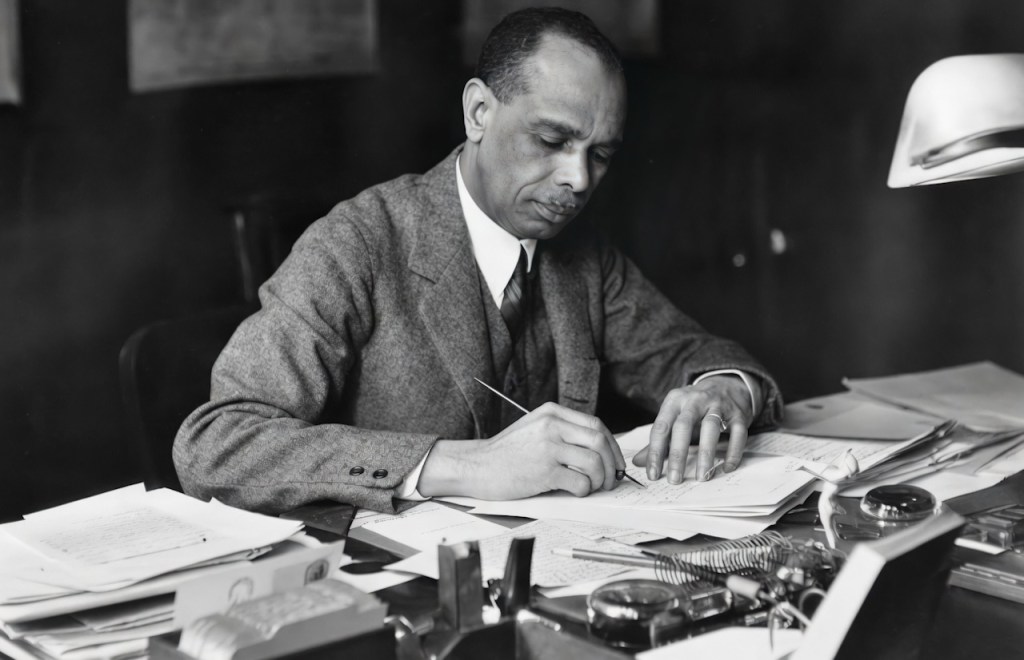
    Image: James Weldon Johnson - https://www.green-wood.com/event/the-autobiography-of-an-ex-colored-man-110-years-later/
    Image: James Weldon Johnson Green-Wood

    James Weldon Johnson’s “Go Down Death”

    James Weldon Johnson’s funeral oration, “Go Down Death,” offers one the most beautiful and heartfelt expressions of the soul’s journey through life.

    Introduction and Text of “Go Down Death”

    The epigraph to James Weldon Johnson’s poem, “Go Down Death,” from God’s Trombones: Seven Negro Sermons in Verse, identifies the poem as a dramatic “funeral oration.” This dramatization of the soul’s journey from life to death and beyond remains one of the most beautiful metaphoric expressions on the subject.

    The poem, “Go Down Death,” features ten versagraphs in which a pastor ministers to a grieving family.  The uplifting sermon remains  an example of Johnson’s marvelous craftsmanship with words and profound ideas regarding life and death.

    Go Down Death

    (A Funeral Sermon

    Weep not, weep not,
    She is not dead;
    She’s resting in the bosom of Jesus.
    Heart-broken husband—weep no more;
    Grief-stricken son—weep no more;
    Left-lonesome daughter —weep no more;
    She only just gone home.

    Day before yesterday morning,
    God was looking down from his great, high heaven,
    Looking down on all his children,
    And his eye fell on Sister Caroline,
    Tossing on her bed of pain.
    And God’s big heart was touched with pity,
    With the everlasting pity.

    And God sat back on his throne,
    And he commanded that tall, bright angel standing at his right hand:
    Call me Death!
    And that tall, bright angel cried in a voice
    That broke like a clap of thunder:
    Call Death!—Call Death!
    And the echo sounded down the streets of heaven
    Till it reached away back to that shadowy place,
    Where Death waits with his pale, white horses.

    And Death heard the summons,
    And he leaped on his fastest horse,
    Pale as a sheet in the moonlight.
    Up the golden street Death galloped,
    And the hooves of his horses struck fire from the gold,
    But they didn’t make no sound.
    Up Death rode to the Great White Throne,
    And waited for God’s command.

    And God said: Go down, Death, go down,
    Go down to Savannah, Georgia,
    Down in Yamacraw,
    And find Sister Caroline.
    She’s borne the burden and heat of the day,
    She’s labored long in my vineyard,
    And she’s tired—
    She’s weary—
    Go down, Death, and bring her to me.

    And Death didn’t say a word,
    But he loosed the reins on his pale, white horse,
    And he clamped the spurs to his bloodless sides,
    And out and down he rode,
    Through heaven’s pearly gates,
    Past suns and moons and stars;
    on Death rode,
    Leaving the lightning’s flash behind;
    Straight down he came.

    While we were watching round her bed,
    She turned her eyes and looked away,
    She saw what we couldn’t see;
    She saw Old Death.  She saw Old Death
    Coming like a falling star.
    But Death didn’t frighten Sister Caroline;
    He looked to her like a welcome friend.
    And she whispered to us: I’m going home,
    And she smiled and closed her eyes.

    And Death took her up like a baby,
    And she lay in his icy arms,
    But she didn’t feel no chill.
    And death began to ride again—
    Up beyond the evening star,
    Into the glittering light of glory,
    On to the Great White Throne.
    And there he laid Sister Caroline
    On the loving breast of Jesus.

    And Jesus took his own hand and wiped away her tears,
    And he smoothed the furrows from her face,
    And the angels sang a little song,
    And Jesus rocked her in his arms,
    And kept a-saying: Take your rest,
    Take your rest.

    Weep not—weep not,
    She is not dead;
    She’s resting in the bosom of Jesus.

    Wintley Phipps’ amazing recitation of “Go Down, Death”  

    Commentary on “Go Down Death”

    James Weldon Johnson’s “Go Down Death,” a dramatization of the soul’s journey from life to death and beyond, remains one of the most beautiful metaphoric expressions on the subject.

    First Versagraph:  A Command not to Weep  

    Weep not, weep not,
    She is not dead;
    She’s resting in the bosom of Jesus.
    Heart-broken husband—weep no more;
    Grief-stricken son—weep no more;
    Left-lonesome daughter —weep no more;
    She only just gone home.

    The often rhythmic, deeply dramatic oration begins with a refrain, “Weep not, weep not.” This command is directed to the family of a deceased woman, who is survived by a “Heart-broken husband, a Grief-stricken son, and a Left-lonesome daughter.”

    The minister delivering the funeral sermon tasks himself with convincing the grieving family that their loved one is not dead, because she is resting in the bosom of Jesus, and she has only just gone home.

    Second Versagraph:  God’s Pity and What’s Often Forgotten

    Day before yesterday morning,
    God was looking down from his great, high heaven,
    Looking down on all his children,
    And his eye fell on Sister Caroline,
    Tossing on her bed of pain.
    And God’s big heart was touched with pity,
    With the everlasting pity.

    The minister creates a beautiful narrative beginning on the day just before the beloved died. He says that God was looking down from his great, high heaven, and He happened to glimpse Sister Caroline, who was “tossing on her bed of pain.”  God in His great mercy was filled “with everlasting pity.” 

    The minister weaves a beautiful narrative designed not only to relieve the pain of the mourners but also to let them know a truth that is so often forgotten at the time of loss and grieving at death.

    Third Versagraph:   A Creature not to be Feared

    And God sat back on his throne,
    And he commanded that tall, bright angel standing at his right hand:
    Call me Death!
    And that tall, bright angel cried in a voice
    That broke like a clap of thunder:
    Call Death!—Call Death!
    And the echo sounded down the streets of heaven
    Till it reached away back to that shadowy place,
    Where Death waits with his pale, white horses.

    God instructed His “tall, bright angel” standing on His right to summon Death. The angel then summoned Death from the darkness in which he is always waiting with his pack of white horses.

    Death is now becoming an anthropomorphic creature who will perform a function directed by God.  If God is directing the creative Death, then mourners will begin to understand that Death is not a creature to be feared, only to be understood as a servant of the Belovèd Lord.

    Fourth Versagraph:   Death before the Great White Throne

    And Death heard the summons,
    And he leaped on his fastest horse,
    Pale as a sheet in the moonlight.
    Up the golden street Death galloped,
    And the hooves of his horses struck fire from the gold,
    But they didn’t make no sound.
    Up Death rode to the Great White Throne,
    And waited for God’s command.

    Hearing the call, Death leaps on his fastest stead.  Death is pale in the moonlight, but he continues on, speeding down the golden street.  And although the horses’ hooves “struck fire f rom the the gold,” no sound emanated from the clash.   Finally, Death arrives at the Great White Throne, where he waits for God to give him his orders.

    Fifth Versagraph:  Death Goes down to Georgia

    And God said: Go down, Death, go down,
    Go down to Savannah, Georgia,
    Down in Yamacraw,
    And find Sister Caroline.
    She’s borne the burden and heat of the day,
    She’s labored long in my vineyard,
    And she’s tired—
    She’s weary—
    Go down, Death, and bring her to me.

    God commands Death to travel down to Georgia in Savannah.  There he must find “Sister Caroline.”  The poor sister has suffered for a long time; she has been a valiant laborer for God.  Now she has grown too tired and too debilitated to continue on in her present incarnation.  

    Thus, God instructs Death to fetch the soul of Sister Caroline to Him.  Knowing that Death is simply the conveyance employed by the Blessèd Creator to bring His children home is a concept that can bring comfort and relief to the mourners.

    Sixth Versagraph:   Death Obeys God’s Command  

    And Death didn’t say a word,
    But he loosed the reins on his pale, white horse,
    And he clamped the spurs to his bloodless sides,
    And out and down he rode,
    Through heaven’s pearly gates,
    Past suns and moons and stars;
    on Death rode,
    Leaving the lightning’s flash behind;
    Straight down he came.

    Without uttering a sound, Death immediately complies with God’s command. Death rides out through “the pearly gates, / Past suns and moons and stars.” He heads straight down to Sister Caroline, to whom God had directed him. 

    Understanding the nature of God’s servant “Death” continues to build hope and understanding in the heart of the mourners.  Their grieving can be assuaged and directed to a whole new arena of theological thought and practice.

    Seventh Versagraph:  Welcoming God’s Emissary

    While we were watching round her bed,
    She turned her eyes and looked away,
    She saw what we couldn’t see;
    She saw Old Death.  She saw Old Death
    Coming like a falling star.
    But Death didn’t frighten Sister Caroline;
    He looked to her like a welcome friend.
    And she whispered to us: I’m going home,
    And she smiled and closed her eyes.

    Upon seeing Death approaching, Sister Caroline welcomes him as if he were an old friend, and she informs the others who were standing around her, ministering to her, that she was not afraid. Sister Caroline then tells them she is going home, as she smiles and closes her eyes for the last time.

    By seeing that the dying soul can be so accepting of her new circumstance of leaving the physical body and the earth level of existence, the mourners continue to grow in acceptance as they become capable of letting their grief go.  They can replace grief with the joy of knowing God and God’s ways.  

    That God simply uses Death for his own purposes goes a long way to healing the misunderstanding that one life on earth is all each soul has.  The physical level of being becomes a mere step in the evolution through which the soul passes on its way back to its permanent home in God.

    Eighth Versagraph:   The Soul Moving into the Astral World  

    And Death took her up like a baby,
    And she lay in his icy arms,
    But she didn’t feel no chill.
    And death began to ride again—
    Up beyond the evening star,
    Into the glittering light of glory,
    On to the Great White Throne.
    And there he laid Sister Caroline
    On the loving breast of Jesus.

    Death then takes Sister Caroline in his arms as he would a baby.  Even though Death’s arm were icy, she experiences no cold.   Sister is now able to feel with her astral body, not her physical encasement.  

    Again Death rides beyond the physical evening star and on into the astral light of “glory.”   He approaches the great throne of God and commits the soul of Sister Caroline to the loving care of Christ.

    Ninth Versagraph:  Sister Shed Delusion of Earth Life

    And Jesus took his own hand and wiped away her tears,
    And he smoothed the furrows from her face,
    And the angels sang a little song,
    And Jesus rocked her in his arms,
    And kept a-saying: Take your rest,
    Take your rest.

    Jesus brushes away all sorrow from the soul of Sister Caroline.  She soothes her, and she loses the deep furrows that marred her face, after long living in the world of sorrows and trials.   The angels then serenade her as Christ comforts her.   Sister Caroline can finally rest from her all her trials and tribulations; she can now shed the delusion that kept her hidebound as she passed through life on the physical plane.

    Tenth Versagraph:  Repeated Command not to Weep

    Weep not—weep not,
    She is not dead;
    She’s resting in the bosom of Jesus.

    The minister then repeats his opening refrain, “Weep not—weep not, / She is not dead; / She’s resting in the bosom of Jesus.”  The refrain becomes a chant that will relieve all souls of pain and headache.  Resting in the bosom of Christ will now become the aspiration for all listeners as they begin to understand truly that, “she is not dead.”  

    They will become aware that if Sister Caroline is not dead, neither will they die, when the time to leave this earth comes.  They will understand that their own souls can look forward to resting in the arms of Jesus the Christ.

  • James Weldon Johnson’s “Noah Built the Ark”

    Image: James Weldon Johnson – National Portrait Galley – Smithsonian

    James Weldon Johnson’s “Noah Built the Ark”

    A poetic retelling of the story about Noah and the Ark, this dramatic poem is one of Johnson’s seven sermons in verse from his collection, God’s Trombones.  At certain points in the story, the narrator offers his own interpretations, embellishing the tale and adding further interesting features.

    Introduction and Text of “Noah Built the Ark”

    James Weldon Johnson’s “Noah Built the Ark” offers an entertaining and educational experience in poetry.  Johnson’s clear vision in biblical lore is on full display in his narrative retelling of the Noah and the Ark story from Genesis 6:9–9:17 KJV.    The poet is offering an oratory tone in the style of a southern black preacher.  His retelling features such plain language that even a child can understand the images and events immediately.

    Johnson brought out his collection God’s Trombones: Seven Negro Sermons in Verse in 1927.  The collection begins with a prayer, “Listen Lord–A Prayer,” and then features seven verse-sermons, “The Creation,” “The Prodigal Son,” “Go Down Death,” “Noah Built the Ark,” “The Crucifixion,” “Let My People Go,” and “The Judgment Day.”

    During his lifetime, Johnson had attended many church services throughout the South, and he was inspired by the oratorical style of the many black preachers, whose preaching he admired.   A Southerner himself born in Jacksonville, Florida, Johnson had an ear for dialect and rhythms in speech.  All of his poetry is enhanced by his talent for language and its specialties of speech.

    Noah Built the Ark

    In the cool of the day—
    God was walking—
    Around in the Garden of Eden.
    And except for the beasts, eating in the fields,
    And except for the birds, flying through the trees,
    The garden looked like it was deserted.
    And God called out and said: Adam,
    Adam, where art thou?
    And Adam, with Eve behind his back,
    Came out from where he was hiding.
    And God said: Adam,
    What hast thou done?
    Thou hast eaten of the tree!
    And Adam,
    With his head hung down,
    Blamed it on the woman.

    For after God made the first man Adam,
    He breathed a sleep upon him;
    Then he took out of Adam one of his ribs,
    And out of that rib made woman.
    And God put the man and woman together
    In the beautiful Garden of Eden,
    With nothing to do the whole day long
    But play all around in the garden.
    And God called Adam before him,
    And he said to him;
    Listen now, Adam,
    Of all the fruit in the garden you can eat,
    Except of the tree of knowledge;
    For the day thou eatest of that tree,
    Thou shalt surely die.

    Then pretty soon along came Satan.
    Old Satan came like a snake in the grass
    To try out his tricks on the woman.
    I imagine I can see Old Satan now
    A-sidling up to the woman,
    I imagine the first word Satan said was:
    Eve, you’re surely good looking.
    I imagine he brought her a present, too,—
    And, if there was such a thing in those ancient days,
    He brought her a looking-glass.

    And Eve and Satan got friendly—
    Then Eve got to walking on shaky ground;
    Don’t ever get friendly with Satan.—
    And they started to talk about the garden,
    And Satan said: Tell me, how do you like
    The fruit on the nice, tall, blooming tree
    Standing in the middle of the garden?
    And Eve said:
    That’s the forbidden fruit,
    Which if we eat we die.

    And Satan laughed a devilish little laugh,
    And he said to the woman: God’s fooling you, Eve;
    That’s the sweetest fruit in the garden,
    I know you can eat that forbidden fruit,
    And I know that you will not die.

    And Eve looked at the forbidden fruit,
    And it was red and ripe and juicy.
    And Eve took a taste, and she offered it to Adam,
    And Adam wasn’t able to refuse;
    So he took a bite, and they both sat down
    And ate the forbidden fruit.—
    Back there, six thousand years ago,
    Man first fell by woman—
    Lord, and he’s doing the same today.

    And that’s how sin got into this world.
    And man, as he multiplied on the earth,
    Increased in wickedness and sin.
    He went on down from sin to sin,
    From wickedness to wickedness,
    Murder and lust and violence,
    All kinds of fornications,
    Till the earth was corrupt and rotten with flesh,
    An abomination in God’s sight.

    And God was angry at the sins of men.
    And God got sorry that he ever made man.
    And he said: I will destroy him.
    I’ll bring down judgment on him with a flood.
    I’ll destroy ev’rything on the face of the earth,
    Man, beasts and birds, and creeping things.
    And he did—
    Ev’rything but the fishes.

    But Noah was a just and righteous man.
    Noah walked and talked with God.
    And, one day, God said to Noah,
    He said: Noah, build thee an ark.
    Build it out of gopher wood.
    Build it good and strong.
    Pitch it within and pitch it without.
    And build it according to the measurements
    That I will give to thee.
    Build it for you and all your house,
    And to save the seeds of life on earth;
    For I’m going to send down a mighty flood
    To destroy this wicked world

    And Noah commenced to work on the ark.
    And he worked for about one hundred years.
    And ev’ry day the crowd came round
    To make fun of Old Man Noah.
    And they laughed and they said: Tell us, old man,
    Where do you expect to sail that boat
    Up here amongst the hills?

    But Noah kept on a-working.
    And ev’ry once in a while Old Noah would stop,
    He’d lay down his hammer and lay down his saw,
    And take his staff in hand;
    And with his long, white beard a-flying in the wind,
    And the gospel light a-gleaming from his eye,
    Old Noah would preach God’s word:

    Sinners, oh, sinners,
    Repent, for the judgment is at hand.
    Sinners, oh, sinners,
    Repent, for the time is drawing nigh.
    God’s wrath is gathering in the sky.
    God’s a-going to rain down rain on rain.
    God’s a-going to loosen up the bottom of the deep,
    And drown this wicked world.
    Sinners, repent while yet there’s time
    For God to change his mind.

    Some smart young fellow said: This old man’s
    Got water on the brain.
    And the crowd all laughed—Lord, but didn’t they laugh;
    And they paid no mind to Noah,
    But kept on sinning just the same.

    One bright and sunny morning,
    Not a cloud nowhere to be seen,
    God said to Noah: Get in the ark!
    And Noah and his folks all got in the ark,
    And all the animals, two by two,
    A he and a she marched in.
    Then God said: Noah, Bar the door!
    And Noah barred the door.

    And a little black spot begun to spread,
    Like a bottle of ink spilling over the sky;
    And the thunder rolled like a rumbling drum;
    And the lightning jumped from pole to pole;
    And it rained down rain, rain, rain,
    Great God, but didn’t it rain!
    For forty days and forty nights
    Waters poured down and waters gushed up;
    And the dry land turned to sea.
    And the old ark-a she begun to ride;
    The old ark-a she begun to rock;
    Sinners came a-running down to the ark;
    Sinners came a-swimming all round the ark;
    Sinners pleaded and sinners prayed—
    Sinners wept and sinners wailed—
    But Noah’d done barred the door.

    And the trees and the hills and the mountain tops
    Slipped underneath the waters.
    And the old ark sailed that lonely sea—
    For twelve long months she sailed that sea,
    A sea without a shore.

    Then the waters begun to settle down,
    And the ark touched bottom on the tallest peak
    Of old Mount Ararat.
    The dove brought Noah the olive leaf,
    And Noah when he saw that the grass was green,
    Opened up the ark, and they all climbed down,
    The folks, and the animals, two by two,
    Down from the mount to the valley.
    And Noah wept and fell on his face
    And hugged and kissed the dry ground.

    And then—
    God hung out his rainbow cross the sky,
    And he said to Noah: That’s my sign!
    No more will I judge the world by flood—
    Next time I’ll rain down fire.

    Recitation of “Noah Built the Ark”:  

    Commentary on “Noah Built the Ark”

    While the basic story remains a parallel to the original, the narrator offers his own embellishments at certain points that any listener will recognize as departures from the biblical version.  This embellishments stem from the narrator’s personal interpretations of the image and events.

    First Movement:  Original Creation

    The actual story featuring Noah and the ark begins in the third movement; the narrator first builds up to the purpose for Noah having to build the ark.  Thus, the opening scenes show God just after having created Adam and Eve, summoning them to hold them responsible for their disobedience.  

    God knows that they have done the one and only thing He had told them not to do: they have eaten of the “tree of knowledge.”  God had told them if they disobeyed this one rule, they would die.  

    Unfortunately, Satan had persuaded Eve to eat of the fruit, making her believe that God was lying to her.  Thus, she ate and convinced Adam to eat, and soon they had lost their paradise in Eden.

    The narrator creatively describes the characters in his narrative in colorful ways, for example he had “Old Satan” “[a]-silding up the woman.”  Then Satan, who moves “like a snake in the grass,” appeals to the woman’s vanity telling her “you’re surely good looking” and then imagining that Satan gave Eve a gift of a “looking-glass” to emphasize her vanity.

    Second Movement:  Satan’s Seduction

    The narrator now goes into some detail as he has Satan seducing Eve to commit the one sin she had been warned against.  Satan belts forth a “devilish little laugh” upon hearing that God had told that pair that they would die if they ate of the forbidden fruit.   Satan tells Eve, “God’s fooling you.”  He then tells her that the fruit she is forbidden is the “sweetest fruit in the garden” and insists that she can enjoy that fruit without dying.

    Eve is convinced, eats the fruit, convinces Adam to eat the fruit, and “Man first fell by woman— / Lord, and he’s doing the same today.”  The narrator jokingly demonstrates the rift that began between man and woman with the committing of the original sin.

    So now mankind multiplied upon the earth, and not only did people increase, but “wickedness and sin” also increased, and kept on increasing until the corruption became “[a]n abomination in God’s sight.”

    Third Movement:  Corruption and Anger

    The corruption made God angry, and the narrator states that “God got sorry that he ever made man.”  And then God decides to destroy mankind by flooding the earth.  The narrator says that God planned to destroy all life on earth—except “the fishes.”  

    The narrator is inserting a bit of comedy into his narration because he knows everyone already is aware that God, in fact, instructed Noah to save all animal life.  The claim that God would save only the “fishes” is funny, though, because the fishes are the only life forms that can live in the water, a fact that would obviate the necessity of bringing a pair of them into the ark for saving, as was done with the land animals.

    Because Noah was not a man of sin and corruption but a “just and righteous man,” who “walked and talked with God,” God chooses Noah to be his instrument in saving a portion of His Creation.  

    Thus, God instructs Noah to build an ark for which God gives specific instructions:  to be made of gopherwood, “good and strong,” pitched inside and out, and according to the dimensions handed down by the Creator.

    God tells Noah that He is going to send down a flood to “destroy this wicked world.”  But the house/family of Noah would be spared, and God wanted Noah to help Him “save the seeds of life on earth.”

    Noah then obeys God’s command, begins building the ark, working for “one hundred years,” experiencing ridicule daily as folks “make fun of Old Man Noah,” quipping, “Where do you expect to sail that boat / Up here amongst the hills?”

    Fourth Movement:  Building and Preaching

    Noah remains undeterred, working on the ark, but every now and then, he would cease his ark building and offer a sermon.  In his sermon, he would tell the “sinners” that they needed to repent because God was going to send “rain down rain on rain.”  

    Because of all the sinning and corruption, God’s wrath would “drown this wicked world.”  Noah encourages the sinners to turn their lives around while there is still time for “God to change his mind.” In response to Noah, a laughing young reprobate quips: “This old man’s / Got water on the brain.”  And then everyone else laughs.  

    Paying no attention to Noah’s warning, they keep on sinning. Then on a bright, sunny morning, the day had come.  God instructs Noah to gather pairs of animals and take them along with his family into the ark and “Bar the door!”  Then similar to ink spilling over a page, a black spot in the sky begins to spread, and the rain begins—pouring rain for forty days and night.

    And many sinners come to the ark “a-running” and “a-swimming” around the ark, pleading to be let in, but it is too late.  Though the sinners continue to weep and wail, “Noah’d done barred the door.”

    Fifth Movement:  The Promise

    The narrator then describes the flooded earth, where trees, hills, mountain tops all “slipped underneath the waters.”  And for “twelve long months,” the ark sails on a sea that possesses no shore.

    Finally, the waters begin to recede, and ark settles down on the tall peak of Mount Ararat.  A dove appears to Noah with an olive leaf, altering him that the flood is over, and anew beginning is at hand for all of the inmates of the Ark.

    After leaving the ark, the righteous Noah “wept and fell on his face / And hugged and kissed the dry ground.”  God then stretches a “rainbow across the sky” and promises Noah that the rainbow would be his reminder that He would never again “judge the world by flood.”

    But then God warns that “Next time I’ll rain down fire.”  Throughout his retelling of the Noah and the Ark story, the narrator has often added embellishments stemming from his own idiosyncratic interpretations.  

    The narrator’s final embellishment that God promised to end the world next by fire cannot be found in the biblical KJV version of that tale, but many instances in that version of the Holy Scripture do imply that God might employ the fire element the next time He feels compelled to destroy His Creation.

    Image:  Book Cover – Original Publication of God’s Trombones