Original Song: “Twixt Good and Evil” and Prose Commentary
I chose the quotation from Isaiah because it demonstrates the omnipotence and omnipresence of the Almighty Creator. Some religionists, especially Christian, argue that God is all good and therefore could not have created evil. But such a claim limits God’s power and ability—an odd thing to do since they claim that God is omnipotent and omnipresent!
Twixt Good and Evil
“I form the light, and create darkness: I make peace, and create evil: I the Lord do all these things.” —Isaiah 45:7
Chorus
In the fight twixt good and evil Good will always win; For God created the devil Just tempt us all to sin. God doesn’t cause us to bear sorrow; He tries to lead us to His light, And His Word guides our tomorrow If we learn to read It right.
First Verse
Good morning, Satan! Are you doing OK? What kinds of nasty You going to throw at me today? Will my daughter get cancer? Will my son fall off his bike? Will my husband crash his truck? Will my dog lie down and die?
Second Verse
Good morning, Devil! Are you doing just fine? How will you try to tempt me To cross that boundary line? Will you make me think I’m sexy? Will you make me want to flirt? Will you take me to a place I’d never go without your dirt?
Third Verse
Good morning, Lucifer! How’s it going, Old Dude? What you got in store for me today— What kind of rude and crude? Will you shine your light on sorrow? Will you tempt me to believe I’ll be so good tomorrow That today I can misbehave?
Fourth Verse
Good morning, Maya! Of all the things in the fold Which one will grab my thoughts today To divert me from my goal? Will I seize upon another’s mote Though there’s one in my own eye? Will I hurt anyone whose handy? Or will I just sit, sigh, and cry?
Chorus
In the fight twixt good and evil Good will always win; For God created the devil Just tempt us all to sin. God doesn’t cause us to bear sorrow; He tries to lead us to His light, And His Word guides our tomorrow If we learn to read It right.
To listen to the recorded version, please visit “Twixt Good and Evil” on soundcloud.
Commentary on “Twixt Good and Evil”
Epigram: “I form the light, and create darkness: I make peace, and create evil: I the Lord do all these things.” —Isaiah 45:7
I chose this quotation from Isaiah because it demonstrates the omnipotence and omnipresence of the Almighty Creator. Some religionists, especially Christian, argue that God is all good and therefore could not have created evil.
But such a claim limits God’s power and ability and at the same time introduces a second force into being. Because there can be no second force, only God can be responsible for all that exists, including evil. In the Isaiah quotation, God is speaking and He clearly says, “I . . . create evil.”
At first, such a claim may seem paradoxical, but just because God creates evil does not make God evil: it makes Him all powerful, the very quality that Christians believe God to possess.
So with that fact established, the next question is why did/does God create/allow evil? And the answer is so that a physical creation can exist. Without pairs of opposites, there can be so creation: forces rub against forces; conflict pits good and evil against each other.
We cannot recognize a quality unless we have something to which we can compare or contrast it. Image that only good things had happened to you in your life. How would you know that only good things had happened if you had never experienced the less than good or the bad?
Humanity is faced with these forces in order to learn and to evolve. According to Paramahansa Yogananda and other great spiritual leaders, the only purpose of life is to unite the soul with the Over-Soul or God. In order to do that, each human being has to work out its karma, its issues that lead it to believe it is nothing more than a bag of bone and flesh.
Each human being must learn that he or she is essentially a soul that has a physical body. That soul is already perfect but because it lost its divine awareness by being born in a physical encasement, it has to relearn to be divine.
Now, why did God make such a plan, such an existence? Why not just let us keep our divine status and not have to go through incarnations that may take many millennia? Only God knows the answer to that question. Offering one possible explanation, Paramahansa Yogananda contends that creation is God’s lila or play, and He made for his own enjoyment.
Because that explanation may not satisfy, the following exchange between Sri Yukteswar, the guru of Paramahansa Yogananda, and a student suggests additional reasoning:
“Why did God ever join soul and body?” a class student asked one evening. “What was His purpose in setting into initial motion this evolutionary drama of creation?” Countless other men have posed such questions; philosophers have sought, in vain, fully to answer them.
“Leave a few mysteries to explore in Eternity,” Sri Yukteswar used to say with a smile. “How could man’s limited reasoning powers comprehend the inconceivable motives of the Uncreated Absolute? T
he rational faculty in man, tethered by the cause-effect principle of the phenomenal world, is baffled before the enigma of God, the Beginningless, the Uncaused. Nevertheless, though man’s reason cannot fathom the riddles of creation, every mystery will ultimately be solved for the devotee by God Himself.” (my emphasis added)
The opening quotation, therefore, establishes the spiritual nature of the song: a monotheistic worldview in which nothing—light or darkness, peace or evil—exists outside God’s sovereignty.
By invoking Isaiah 45:7, I preempt the simplistic dualism: evil is not an equal rival to God but a force that God Himself created to serve a divine purpose. This contention prepares the listener/reader to understand temptation and suffering not as evidence of God’s absence, but as part of a moral testing ground in which human choice matters.
Thus, although the singer/speaker has undergone all of these tests foisted by Satan, the Devil, Lucifer, and Maya—all of which are simply different names for the same force—she seems to be implying that she is transcending them because she realizes that God only created these forces to tempt his children.
She is also implying that she has learned to read God’s word correctly and now she understands that by not allowing that evil force to dominate her she will no longer suffer.
Chorus: “In the fight twixt good and evil”
In the fight twixt good and evil Good will always win; For God created the devil Just tempt us all to sin. God doesn’t cause us to bear sorrow; He tries to lead us to His light, And His Word guides our tomorrow If we learn to read It right.
The chorus opens the song/poem with its theme, which focuses on the battle between good and evil in the world of humankind. It makes the explicit claim that “good will always win,” and then it explains that the devil is just a tempter—not a separate force— because God Himself “created the devil.”
That “God created the devil / Just to tempt us all to sin” reflects the exact message of the Isaiah quotation. God made the devil to introduce temptation in our lives, but God allows it, and He did not create temptation to make us suffer, at least, not eternally.
We know of God’s intention because God has offered a guide in written scripture, which all religions and spiritual faiths possess. But it is interpreting those pages of guidance that confounds us and keep us in darkness. God wants to lead us to light, and learning to interpret his Word correctly and effectively can lead us there.
First Verse: “Good morning, Satan!”
Good morning, Satan! Are you doing OK? What kinds of nasty You going to throw at me today? Will my daughter get cancer? Will my son fall off his bike? Will my husband crash his truck? Will my dog lie down and die?
The singer/speaker addresses Satan directly, asking quite conversationally how he’s doing? Assuming that he is doing “OK.” Then she pitches a series of questions at him. These question involve “nasty” events that no one wants to experience: a daughter getting cancer, an son falling off his bike, a husband crashing his truck, a dog dying.
The answer to each of these questions is yes: Satan will throw all of these things at me eventually. And I personally have experienced every one of them. So addressing Satan in such a friendly way must be understood a high sarcasm.
Satan will always remain the adversary, but showing him that I can take him lightly lessens his power over me. Besides, I have already told you in the chorus that I know the score on these issues. Satan does not hold the power; God does.
Second Verse: “Good morning, Devil!”
Good morning, Devil! Are you doing just fine? How will you try to tempt me To cross that boundary line? Will you make me think I’m sexy? Will you make me want to flirt? Will you take me to a place I’d never go without your dirt?
Addressing Devil with the same tone expressed when she addressed Satan, the singer/speaker assumes Devil is “doing just fine.” Again, with a series of questions: how are you going to temp the today? will you use sex and promiscuity to make me do things that otherwise I would deplore?
Because vanity and sex lead to so much mischief and depravity in the world, one would likely be a consummate prevaricator to deny having been caught up in such “dirt.” That’s all the personal confession and testimony I will offer for this one. But obviously, again, the from Devil, the answer is “Yep, I’ll get you, my Pretty, and you little dog, too!”
Third Verse: “Good morning, Lucifer!”
Good morning, Lucifer! How’s it going, Old Dude? What you got in store for me today— What kind of rude and crude? Will you shine your light on sorrow? Will you tempt me to believe I’ll be so good tomorrow That today I can misbehave?
Addressing the devil/satan in his light-bearer form, Lucifer, the singer/speaker makes no assumption but simply asks how things are going for the “Old Dude. Then again wants to know that the Light-Bearer has “in store” for her.” She knows that whatever it is it will likely be “rude and crude.” She has learned about this being’s ways in earlier verses.
She wonders if Lucifer will put a spotlight on self-pity and thus allow her to engage in sorrowful feelings. Then abruptly, she shifts to wondering if he will encourage her think she will behave tomorrow so well that today she can engage in all manner of debauchery.
This verse captures the moral danger of self-bargaining and the illusion of future repentance as permission for present wrongdoing.
Fourth Verse:
Good morning, Maya! Of all the things in the fold Which one will grab my thoughts today To divert me from my goal? Will I seize upon another’s mote Though there’s one in my own eye? Will I hurt anyone whose handy? Or will I just sit, sigh, and cry?
In this final verse, I address the evil one as Maya, which means delusion, and is the Hindu concept for Satan/Devil/Lucifer. Maya seems less judgmental and harsh than the Christians concepts, although the end result of “delusion” is the same as the end result of sin. It is delusion that causes us to “misbehave” and therefore “suffer.”
The satanic, evil, mayic force all steer the human being to engage in sense gratification, and such activities divert the person from seeking Divine Awareness, which is the goal of life, according to Paramahansa Yogananda.
When I reference the “mote” and the “beam,” I am, of course, echoing Christ’s teaching on judgment, offering that as the first possible wrong thing I might do today. Then again I continue questions as I wonder what the magic Satan/Maya will do today to “divert me from my goal.”
I might engage in activities that hurt people, or maybe I will just sit, think useless, thought, become maudlin and then “cry.” The negativity supports the wretched influences that has been on display in the entire song/poem.
Chorus: “In the fight twixt good and evil”
In the fight twixt good and evil Good will always win; For God created the devil Just tempt us all to sin. God doesn’t cause us to bear sorrow; He tries to lead us to His light, And His Word guides our tomorrow If we learn to read It right.
What saves the whole mess from languishing in pool of sorrowful dreck is the chorus, which is repeated at the end. Despite the battle each human being has to face each day, eventually according to each person’s karma “good will always win.”
Image: Pacific Ocean – August 2015 – Self-Realization Fellowship Meditation Gardens – Encinitas CA – Photo by Ron W. G.
Original Song: “Where You Are” with Prose Commentary
This song “Where You Are” is one of my original compositions. The video accompanying it was created by landscape artist/photographer Ron Grimes.
Introduction and Text of “Where You Are”
My original song “Where You Are”is based on a simple premise: the singer is addressing her Divine Belovèd (God), asserting to the Belovèd the desire to be where the Ultimate Loved One is.
Each verse features rhetorical questions and musings upon the actual location of the Divine Creator. Because the Creator/Father of all creation is both within creation and outside of creation, the answer to all of the rhetorical questions is, naturally, yes.
Nevertheless, being where the Divine Belovèd is cannot be the same situation as being where a human friend or beloved is. Because it seems that God is playing hide and seek with his children, the singer asserts that her soul “soul tugs at the veil hiding You from me.”
Where You Are
First Verse
Are You standing on top of a mountain? Are You sitting beside the vast grave sea? How can I ever approach You? Will You ever just come to me?
Second Verse
Are You speaking to me through my loved ones? Are You quietly whispering through the silver stars? Are You waiting to hear what my songs will sing? Do You listen to the rapid beat of my heart?
Third Verse
If I offer You all in my stillness— If I silently listen to the hum in my mind— If I patiently fast from all my senses— Will You break Your vow of silence and just come to me!
Chorus
Where You are is where I long to be. I cannot understand where else I could seek. My soul tugs at the veil hiding You from me. Where You are is where I long to be.
Video: Linda Sue Grimes performing “Where You Are”
After much questioning, contemplating, and ultimately meditating, the devotee will find that the soul will remove the veil hiding it from the Over-Soul—the soul’s Creator, the Divine Belovèd, or any of the preferred name for the Ineffable (God).
First Verse: “Are You standing on top of a mountain?”
Are You standing on top of a mountain? Are You sitting beside the vast grave sea? How can I ever approach You? Will You ever just come to me?
The singer opens with four rhetorical questions to the Divine Reality. The first two questions reveal earthly locations that are considered sanctuaries of sacredness, holiness, or just ordinary vacation escapes: mountain tops and sea sides.
The next two questions reveal that the devotee is still walking the sacred, devotional path to soul-realization (also known as self-realization or God-realization).
Before final liberation, the devotee experiences the separation from her Goal to be a heavy burden. That burden causes her to wonder if she, in fact, will ever be able to unite with the Creator/Father.
In her melancholy and sorrowful mourning because of the seeming distance, the devotee often wonders if the Lord will ever appear to her and make her know that she is His own child. Will she ever be able to attain the Sacred Goal of self-realization and experience unity with her Belovèd Divine Creator?
Second Verse: “Are You speaking to me through my loved ones?”
Are You speaking to me through my loved ones? Are You quietly whispering through the silver stars? Are You waiting to hear what my songs will sing? Do You listen to the rapid beat of my heart?
In the second verse, the singer/devotee continues with rhetorical questions. Intuiting the answer yet not knowing the fullness of each answer, she inquires of the Divine Belovèd if He is communicating with her through her family and friends.
The singer likely is aware that God is speaking to her through everyone she knows and meets. But without that last step in the process of enlightenment, she does not know exactly what is being said or exactly what all that conversation might ultimately mean to her.
Thus, she also wonders if the One Who fashioned the “silver stars” may be signaling to her through those heavenly entities. Again, she likely knows it to be a fact, but that separation continues to prompt questions.
The singer wonders if Divine Mother anticipates what she sings in her songs. She wonders if her musical worship is reaching its intended Goal.
The singer/devotee often becomes anxious with a rapid heart beat, knowing that that heart beat needs to become calm to achieve stillness. She therefore wonders if the Creator Divine cares to listen to that rapid heart beat. And she wonders if the Ultimate Physician will perform some medical heavenly magic to help her still her rapid heart.
Third Verse: “If I offer You all in my stillness”
If I offer You all in my stillness— If I silently listen to the hum in my mind— If I patiently fast from all my senses— Will You break Your vow of silence and just come to me!
The singer/devotee’s questioning becomes even more intense in the lyric of the final verse. She has shown that she knows that she must still the rapid beat of her heart, but she also must still all of her senses as she offers her every atom to the Divine Essence.
The devotee/singer shows awareness that she must listen the divine hum of the cosmic motor, the sacred AUM (Om) sound that upholds all of creation. She knows that she must remove her attention from worldly things and events and place that attention upon the locus beyond the senses, where the soul resides.
The singer/devotee remains certain that after she is able to accomplish all that is implied in her questions and musings, the Divine Belovèd Presence will, in fact, “break [that] vow of silence and [ ] come to [her].”
Chorus: “Where You are is where I long to be”
Where You are is where I long to be. I cannot understand where else I could seek. My soul tugs at the veil hiding You from me. Where You are is where I long to be.
The chorus, instead of offering mere rhetorical questions and musings, makes an affirmative statement: the singer asserts that she wants to be where her Divine Beloved is. She reveals her intuition that she cannot find love, peace, fulfillment on the physical, earthly plane.
The singer/devotee insists that her soul is attempting to rend the cloth of separation from the Divine, as it “tugs at the veil” that keeps her from uniting with the Creator Belovèd.
The final line emphasizes as it repeats the important desire: “Where You are is where I long to be.” The importance of the chorus is demonstrated by its repetition after every verse.
Image: Linda Sue Grimes at the SRF Windmill Chapel at Lake Shrine – Photo by Ron Grimes (Ron W. G.).
Original Song: “Against” with Prose Commentary
The singer/devotee is entreating her soul to forsake worldly things and ways, which according to Emily Dickinson, “hold so,” and follow the way of spirit. The way of spirit protects “against” all the things that damage the individual physically, mentally, and spiritually.
Introduction with Text of Lyric “Against”
Many old spirit-infused hymns sing about the futility of this world to the point of asserting that this world is not even our true home [1]. Paramahansa Yogananda has explained that one’s engagement with sense pleasure must be carefully observed lest they ensnare the soul, preventing it from experiencing the higher pleasures of soul-awareness [2].
Removing the flesh motivating experiences becomes one’s highest duty. While the first step to soul-awareness appears to be a struggle “against” the senses and all worldly endeavors, that opposition must not become so intrenched that it impels one to judge others harshly and act on that judgment.
Instead simply remaining mindful of one’s own behavior opens one’s heart to soul power. Creatively fashioning the experiences and thoughts on the journey to soul awareness adds to the reality and beauty that the world actually provides.
Against
The Blessed Divine gave us all the gifts that we must learn to enjoy but without becoming entangled and attached; it is with that non-attachment in mind that the following hymn is offered to the Blessed Spirit Who inspires true music.
Chorus:
Against the tone of heartbreak Against the stone of night ache Against the wrong that leads you Against the blood that speeds you
1st Verse
Whisper into the drum and see the bay of stars That permeate the golden night in silver bars Usher to the harp the placid palms of notes That wistfully breathe on strings of hope
2nd Verse
Quaff the mist of years, past where you thought That dwarves were playing in the valley of rock Don’t listen to a decibel lower than the sound Of the one hand raised in perfect redound
3rd Verse
Bless your father and your mother whose ears Have turned to stone with worries and fears They planted their flag in the wind by the sea They pray on the ghost ridge and wait to be free
4th Verse
Whisper again and listen for the echo That lingers in the valley you used to know Keep a clear watch how the strain will peel you Keep your mind in tow for the brain will steel you
5th Verse
Into the light, where you bow Where you offer news of then and now Where you fold your hands and wonder as you pray If you heard that thunder across the bay
6th Verse
Whisper blowing, softly into the day Let no shaft of light escape your sight today Listen to your commandments, as they Lead you to the words you hunger to pray
To listen to an audio recording of this song, please visit “Against.”
Commentary on “Against”
My original song “Against” is a lament for our times—for all times. The devotee/singer begs her soul to forsake the things of this world, which become so attractive that they hold one’s attention to the detriment of the soul.
The spiritual aspirant, however, wishes to follow the way of spirit. The way of spirit protects the individual “against” all the things that hurt one physically, mentally, and spiritual.
Chorus: A Lament and Call to Struggle
Against the tone of heartbreak Against the stone of night ache Against the wrong that leads you Against the blood that speeds you
The broken heart, the mental-pain-induced inability to sleep, behaving inappropriately, and allowing the physical body to dictate one’s thoughts and behavior are all things the devotee of spirit must battle “against.”
Allowing the voice to express opposition through melody tempers the heart and mind, allowing soul power to influence the senses that have the tendency to become so greedy and obstructive.
1st Verse: Listening to the Music of the Spheres
Whisper into the drum and see the bay of stars That permeate the golden night in silver bars Usher to the harp the placid palms of notes That wistfully breathe on strings of hope
The singer demands of her soul that it listen to the music of the spheres [3], to observe the night sky for inspiration to follow the way of spirit. The singer remains in search of hope through beauty of sight and sound. The stars at night accompany the beauty of melody that the seeker/singer tis striving to engage.
Quaff the mist of years, past where you thought That dwarves were playing in the valley of rock Don’t listen to a decibel lower than the sound Of the one hand raised in perfect redound
2nd Verse: Command to Turn Inward
The singer commands her soul to move past the past—reflecting on the Zen koan, “The sound of the one hand” [4].
By imbibing the tears of many years passed without knowledge, singer drinks her own heart’s deepest desires which turn the eye and the mind inward in search of the indwelling Lord, to Whom all reverence and devotion are due.
3rd Verse: The Unforgiven and Prayer
Bless your father and your mother whose ears Have turned to stone with worries and fears They planted their flag in the wind by the sea They pray on the ghost ridge and wait to be free
The singer commands her mind to forgive the sins of her forebears, who were innocent and did their best, even though they were ignorant of the exact way of spirit. As the immature look about their environment, they crave to find a place more suitable to their talents. It is that impetus that drives the soul to eventually find its path back to its true home.
4th Verse: Focusing on Spirit
Whisper again and listen for the echo That lingers in the valley you used to know Keep a clear watch how the strain will peel you Keep your mind in tow for the brain will steel you
The singer again commands her mind to take the lessons of her past gingerly, while recalling in the present that stress is the enemy of spiritual progress—keeping the mind focused is at the heart of the way of spirit.
5th Verse: Acknowledging Soul Reality
Into the light, where you bow Where you offer news of then and now Where you fold your hands and wonder as you pray If you heard that thunder across the bay
The devotee/singer acknowledges that she has progressed into awareness of “the light” and she continues to pray and supplicate. The singer then acknowledges that the heart and mind will continue to reflect on past and present even while seeking the way of spirit.
6th Verse: The Hunger to Pray the Right Prayer
Whisper blowing, softly into the day Let no shaft of light escape your sight today Listen to your commandments, as they Lead you to the words you hunger to pray
The singer then admonishes herself to step lightly and watch for any sightings of spiritual light, and above all to continue to follow the way of spirit as it leads her to its golden gate. She knows that she needs more exact words to offer the Divine, and she remains confident that she will find them through her dedicated prayer.
Dedicated with my love and gratitude to my sweet Ron
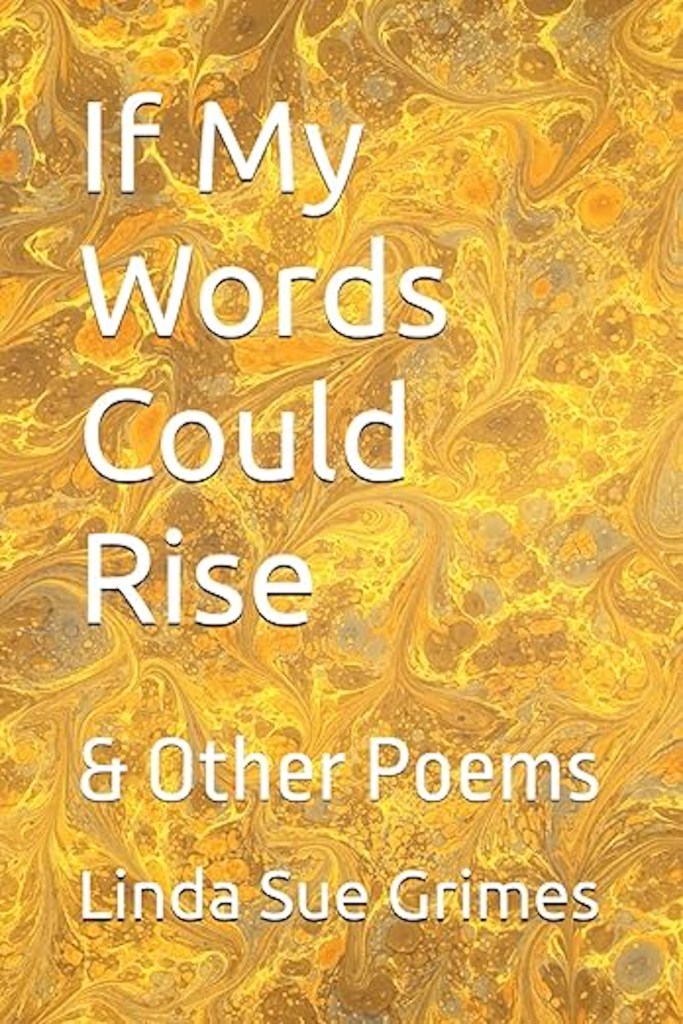
The following poems appear in my collection titledIf My Words Could Rise, available on Amazon as paperback or Kindle.
1 If My Words Could Rise
Dedicated to my sweet Ron
If my words could rise Like smoke They would form your face In the clouds They would hang In the tops of the trees Looking for a nest Where a mother bird sits On eggs The color of your eyes
2 In the Tops of the Trees
“As soon as you hear the sound of marching in the tops of the trees, then attack, for God has attacked in front of you to defeat the Philistine army.” —2 Samuel 5:25 Common English Bible
–for the moldman, who screeched, “That’s my line!”
No, dude, that is not your line! No matter how many times Or with how much spit You spew it.
Trees and their tops And the words they live in Belong to all of us. Go! Dig your hole–grovel in your slime.
3 Dreams and Days
“His tongue cuts / Slices of meat / From the hearts / And livers / Of those / Who would love him” – “Between Slices of Bread” —from Linda Sue Grimes’ At the End of the Road
I quote myself, well then, I quote myself — I include multitudes — Uncle Walt taught me that much.
The man in the poem Cannot bring himself to say Or to pray about his own lividness He shuts out spaces and commas Lives in his own relevance.
He murders his own children With his viper attitude And nibbles the ankles Of prostitutes Who erase his will to power on.
You have seen him Perhaps did not recognize him — He has sat in your parlor Sipping your coffee Dusting off his duplicitous moves —
He fears death but not yours He imagines you at the bottom Of a cold, black ocean Your tongue bait for the fishes His Bolshevik brain conjures.
Your freedom is a fantasy If you remain too close to his heat Get your life back – get your love back Where God made you in his image And you are close to seeing it.
4 Flesh and Desire
“Humankind cannot bear very much reality.” —T. S. Eliot
Into the fire of wisdom, thoughts go to perish. “Get thee behind me, Satan!” Christ commands. But we still wobble behind the Devil Hoping to be snatched from the arms of death In time for supper and for the many tomorrows We image we still possess. In the valley of dreck and poison, I have lived Even as I knew better or thought I did. No, I am not here to testify. Although a word or two of testimony May slip out every line or so! I can pound sand with the best of them. But I can also bitch and moan. Where is the beginning of joy and rectitude? One might ask. Where is the promise? O, come on! You know where the promise is . . . Yes, just testing the waters and they are warm. Every time I delay, I am warned. Just pray And wait and listen close and tight to the hum In the brain. I will follow. I will follow close. Yes, I will. And flesh with its crude desire Will no longer taint the years With their distractions. The mercy of Spirit will wipe my tears.
To Thee I humbly offer my songs That Thou hast given me
Introduction
These poems grow out of my experience serving as harmonium player/chant leader for our Nashville Self-Realization Fellowship Sunday Readings Service.
I title this collection Command Performance for I have attempted to retire from the chant leader position, offering it to other devotees, but no one thus far wishes to take it from me.
And often I have come to the chapel Readings Service, thinking I would merely be attending, only to find that the scheduled chant leader was unavailable and so the service leader would prevail upon me to fill the void; thus, another “command performance.”
I reason that Guruji Paramahansa Yogananda is commanding me to continue performing this function, as long as I am capable.
Poems from Chants
These original poem were all inspired by the chant, whose title is offered following the poem title.
Who says, She is Dark?
—after “Thousands of Suns and Moons”
Her smile beams With the rays Of a millions suns.
Her skin glows With the light Of a million moons.
Who says, She is dark?
Only those who refuse To open their eye To her light.
Joy, Joy, Joy!
—after “Ever New Joy”
Joy, joy, joy— Morning has broken in joy. Light of starlight, hiding Behind the sun.
Joy, joy, joy— Evening calls the faithful To rest from a full day’s labor Practiced by Divine decree.
Joy, joy, joy— Night covers maya’s delusion So the spiritual eye May bound in brilliance.
Thou art That
—after “Hymn to Brahma”
Beyond my thoughts, Beyond my ideas, Beyond my knowledge, Far beyond my wisdom— Thou are That.
Beyond my body, Beyond my mind, Beyond my energy, One with my soul— Thou art That.
Drowning in Glory
—after “I Am the Bubble, Make Me the Sea”
You wake my senses to clear sight, glorious sound, Intelligent touch, pure fragrance, tempered taste. You wake my senses by drowning them in Glory Inundating them in the silence of Your vastness, Spilling on them the majestic light show Of Your body, bound by boundlessness.
In the ocean of Your love, my bubble heart Contracts and expands to eternity. My restless brain shrinks and extends Its reach to unknown realms of wisdom. My soul knows itself in the crash of breaking worlds Where it stands unshaken hand in hand with You. As You do, so I wish to do forever, Drowning in the Glory of Your sacred presence.
Into my garden of weeds Come, Eternal Gardener— Teach me to plant and prune fine foliage. Show me where to set the lilies and tulips And where the roses should grow. Guide my choices of herbs and vegetables. Give me knowledge of fertilizer and fences.
Into my garden of words Come, Eternal Poet— Make my poems exude divine ardor. Fashion my thoughts to bow at your feet. Make my images spout living waters From an enlightened fount To refresh all who dip a cup.
2 In My Spiritual Garden
In my spiritual garden I walk with you when the sun is medicine And the rain suckles the beets and corn. I walk with you between the rows of memories Where love holds you between peppers and tomatoes.
I walk with you along the fence And touch your hand and step across Thinking of you as I pick the peas, Still thinking of you as I weed The beans and cucumbers.
I walk with you and with every silent step And every moment of your absence That would weaken the faith of one Less in love, my love grows deep Like the roots of the bamboo and my love Grows straight like the stalks of asparagus.
In my spiritual garden I will always grow you In the medicine sun and the suckling rain.
3 Divine Gardner
After we scoop the soil over the seeds & sprinkle the water & pluck the weeds,
you will tend the growing & tempt the eye with green & yellow peppers, & tempt the tongue with onions & corn, & invite us to taste your flesh in cucumbers & tomatoes.
I will stand at the edge of the garden, my lips & tongue tending the silence I learn to thank you with.
4 My Divine Beloved
When spring comes Tilling the ground I will plant seeds And think of you You are earth You build my body.
When spring comes Showering young plants I will sing with raindrops And think of you You are water You carry my life.
When spring comes Warming my limbs I will brown my skin And think of you You are fire You inflame my heart.
When spring comes Swirling on the wind I will lean into it And think of you You are air You clear my mind.
When spring comes Rising from winter’s tomb I will sing devotion And think of you You are my Divine Beloved You revive my soul.
5Your Divine Love
My heart is a lake I swim in, But I want to float in the ocean of your love.
My mind is a sky I fly through, But I want to soar through your omniscient love.
My soul is an undiscovered star, But I want to find it shining in your flaming love.
My dream spreads out in all directions, Searching for the boundary of your Divine Love.
6 Cosmic Beloved
Though my heart is fickle And strays from you, You never stray from me. Your love for me Never waivers.
You came to me in youth’s naiveté And married my folly, And for a time I slept without rest In the arms of a splintering sorrow Deep within a cave of madness. When I emerged from that black night, You greeted me as my daughter. You blessed the rest of my life With a holy union when you became My true mate with whom I rest In the cave of a peaceful heart. And you greet me as my son.
When I go off from time to time To carouse with the lesser lights Of poets and painters and dabblers In pursuit of knowledge, You become each one of them So you can stay by my side—
Gary Clark’s “Mary’s Prayer”: A Yogic Interpretation
Employing the Christian iconic mother figure, the song “Mary’s Prayer” offers a marvelous corroboration of concepts between Christianity, taught by Jesus the Christ and Yoga, taught by Bhagavan Krishna.
Introduction and Excerpt from “Mary’s Prayer”
The song “Mary’s Prayer” is from the album Meet Danny Wilson by the 1980s Scottish rock band Danny Wilson. Lead singer of the group and the writer of the song is Gary Clark. About the song, Gary Clark, the songwriter, has explained,
There is a lot of religious imagery in the song but that is really just a device to relate past, present, and future. It is basically just a simple love song. In fact I like to think of it as being like a country and western song.
A Yogic Interpretation
By quipping that his song “is basically just a simple love song,” Gary Clark is being overly modest; on the other hand, he could possibly have meant the tune to be a “simple love song,” but its use of imagery opens the possibility of a deeper interpretation than one traditionally associated with a “simple love song.” Thus, I offer my interpretation of Clark’s song, based on my primary method of poetry interpretation, which I label “Yogic Interpretation.”
This yogic interpretation of Gary Clark’s “Mary’s Prayer” reveals the spiritual nature of the song. The allusion to the Christian icon “Mary” alerts the reader to the significance of the song as it transcends the stature of a love song to a human lover, although it can certainly be interpreted to include that possibility. The chorus of the tune offers a lengthening chant, which uplifts the mind directing it toward the Divine Goal of spiritual union.
The narrator/singer of the song “Mary’s Prayer” is revealing his desire to return to his path to Soul-Awareness, which he has lost by a mistaken act that turned his attention to the worldly thoughts and activities that replaced his earlier attention to his spiritual realm.
The noun phrase, “Mary’s Prayer,” functions as a metaphor for Soul-Awareness, (God-Union, Self-Realization, Salvation are other terms for this consciousness). That metaphor is extended by the allusions, “heavenly,” “save me,” “blessed,” “Hail Marys,” and “light in my eyes.” All of these allusions possess religious connotations often associated with Christianity.
The great spiritual leader, Paramahansa Yogananda, has elucidated the comparisons between original Christianity as taught by Jesus Christ and original Yoga as taught by Bhagavan Krishna.
Danny Wilson – “Mary’s Prayer”
Mary’s Prayer
Verse 1
Everything is wonderful Being here is heavenly Every single day she says Everything is free
Verse 2
I used to be so careless As if I couldn’t care less Did I have to make mistakes When I was Mary’s prayer?
Verse 3
Suddenly the heavens roared Suddenly the rain came down Suddenly was washed away The Mary that I knew
Verse 4
So when you find somebody to keep Think of me and celebrate I made such a big mistake When I was Mary’s Prayer
Chorus
So if I say save me, save me Be the light in my eyes And if I say ten Hail Marys Leave a light on heaven for me
Verse 5
Blessed is the one who shares Your power and your beauty, Mary Blessed is the millionaire Who shares your wedding day
Verse 6
So when you find somebody to keep Think of me and celebrate I made such a big mistake When I was Mary’s Prayer
Chorus
So if I say save me, save me Be the light in my eyes And if I say ten Hail Marys Leave a light on heaven for me
Save me, save me Be the light in my eyes And if I say ten Hail Marys Leave a light on heaven for me
Verse 7
If you want the fruit to fall You have to give the tree a shake But if you shake the tree too hard, The bough is gonna break
Verse 8
And if I can’t reach the top of the tree Mary you can blow me up there What I wouldn’t give to be When I was Mary’s prayer
Chorus
So if I say save me, me save me Be the light in my eyes And if I say ten Hail Marys Leave a light on heaven for me
Save me, save me Be the light in my eyes And if I say ten Hail Marys Leave a light on heaven for me
Save me, save me Be the light in my eyes
What I wouldn’t give to be When I was Mary’s prayer
What I wouldn’t—save me—give to be When I was Mary’s prayer
Commentary on “Mary’s Prayer”
A yogic interpretation of Gary Clark’s “Mary’s Prayer” reveals the song’s spiritual nature. The allusion to the Christian icon “Mary” alerts the reader to the spiritual significance of the song causing it to transcend the stature of a love song to a human lover.
First Verse: Declaring a Spiritual Truth
Everything is wonderful Being here is heavenly Every single day, she says Everything is free
The narrator/singer begins by declaring a spiritual truth, “Everything is wonderful,” and that being alive to experience this wonderfulness is “heavenly.” The following lines report that each day provides a blank slate of freedom upon which each child of the Belovèd Creator may write his/her own life experiences.
“She” refers to Mary, who has authority to make such judgments, as the narrator states. The historical and biblical Mary, as the mother of one of the Blessèd Creator’s most important avatars, Jesus the Christ, holds special power to know the will of the Divine Creator and dispense wisdom to all children of that Creator.
Therefore, the prayer of Mary is dedicated to each child of the Heavenly Creator, and her only prayer can be for the highest good of the soul, and the highest good is that each offspring of the Belovèd Lord ultimately know him/herself as such.
Thus, Mary sends the faithful “every single day” and “everything is free.” Every creature, every human being, every creation of the Divine Creator’s is given for the nurturance, guidance, and progress of each soul made in the Creator’s image.
Second Verse: The Care and Feeding of the Soul
I used to be so careless As if I couldn’t care less Did I have to make mistakes? When I was Mary’s prayer
In the second verse, the narrator, having established his knowledge of the stature and desire of Mary, contrasts his own status. He was not been dedicated to his own salvation; he hardly paid any attention to the care and feeding of his soul. It’s as if he could not have “cared less” about the most important aspect of his being.
But that is the past, and the narrator now realizes that he made mistakes that have led him in the wrong direction, and he now wonders if he really had to make such a mess of his life. After all, he was “Mary’s prayer” — the Blessèd Mother had offered him the blessing of soul-union, but through his mistakes he had spurned that offering.
Third Verse: Losing Sight of the Blessèd Mother
Suddenly the heavens roared Suddenly the rain came down Suddenly was washed away The Mary that I knew So when you find somebody who gives Think of me and celebrate I made such a big mistake When I was Mary’s Prayer
The narrator then reveals that through some great and fearful event that caused the heavens to move and rain to pour down, his life had become devoid of the love and caring that had been bestowed on him by Mary. He no longer knew how to pray or how to feel the grace and guidance of the Blessèd Mother.
Fourth Verse: Missing a Great Opportunity
So when you find somebody to keep Think of me and celebrate I made such a big mistake When I was Mary’s Prayer
The singing narrator then offers his testimony that having a soul guide, who gives as the blessèd Mary gives, must be kept and celebrated and not merely cast off as the narrator had done. He confesses again that he “made such a big mistake” at a time that he could have just grasped the heavenly protection, while he was “Mary’s prayer.”
Chorus: Introduction of the Chant in Four Lines
So if I say save me save me Be the light in my eyes And if I say ten Hail Marys Leave a light on heaven for me
Turning to prayer can be difficult for the one who has deliberately left it behind and perhaps forgotten its efficacy. But the narrator is once again taking up his prayers. He is now calling out to the Blessèd One, even though he frames his supplication in “if” clauses: he cries, “So if I say save me, save me / Be the light in my eyes.” He demands from the Divine Mother that she return to him as the light of his eyes, which had left him.
Furthermore, and again framing his supplication in an “if” clause, he cries, “And if I say ten Hail Marys,” but yet again demands that she “Leave a light on in heaven for me.” The “if” clause followed by a demand seems contradictory, but the narrator is in distress and is confounded by his failures and his former indifference. The chorus of this song functions as a chant as it grows from four lines to its final iteration of sixteen lines that complete the song.
Fifth Verse: Rich in Spirit
Blessed is the one who shares The power and your beauty, Mary Blessed is the millionaire Who shares your wedding day
Still in supplication to the Divine Blessèd Mother, the narrator now simply voices what he knows to be the influence of the Divine One: anyone who accepts and transforms his life according to “the power and the beauty” of Mary will find him “a millionaire.” Not necessarily financially rich—but much more important, rich in spirit. The great wedding of the little soul to the Oversoul will be the richest blessing of all.
Sixth Verse: Emphasizing the Need to Celebrate and Remember
So when you find somebody to give Think of me and celebrate I made such a big mistake When I was Mary’s Prayer
The sixth verse is a repetition of the fourth. It functions to reiterate the importance of the narrator’s awareness of the need to celebrate those giving beings as well as the vital necessity that he realizes what a “big mistake” he made “when [he] was Mary’s Prayer.”
Chorus: Continuing the Chant with Repetition
So if I say save me, save me Be the light in my eyes And if I say ten Hail Marys Leave a light on heaven for me
Save me, save me Be the light in my eyes And if I say ten Hail Marys Leave a light on heaven for men
The chorus again becoming an enlarging presence serves to direct the mind Heaven-ward, while reminding the singer of his purpose for singing, for addressing his Divine Belovèd and keeping the mind steady.
Seventh Verse: Gathering the Effects of Yoga
If you want the fruit to fall You have to give the tree a shake But if you shake the tree too hard, The bough is gonna break
The penultimate verse offers a metaphor of gathering fruit from a tree which likens such gathering to the yoga practice that leads to Self-Realization or God-union. Shaking the tree gently will result in fruit falling, but shaking “the tree too hard” will break the bough. Yoga techniques must be practiced gently; straining in yoga practice is like shaking the tree too hard, which will result in failure to attain the yogic goals.
Eighth Verse: Upward Movement Through Faith
And if I can’t reach the top of the tree Mary you can blow me up there What I wouldn’t give to be When I was Mary’s prayer
The final verse also employs a tree metaphor. The narrator, who is once again firmly on his spiritual path, expresses an extremely important truth that each devotee must cultivate: faith that the target of his goal can lift the devotee at any time.
The narrator colorfully expresses this truth by stating, “And if I can’t reach the top of the tree / Mary you can blow me up there.” And finally, he expresses his regret for allowing Mary to escape him: he wants to become “Mary’s prayer” once again, and he would give anything to do so.
Chorus: The Efficacy of the Chant
So if I say save me, me save me Be the light in my eyes And if I say ten Hail Marys Leave a light on heaven for me
Save me, save me Be the light in my eyes And if I say ten Hail Marys Leave a light on heaven for me
Save me, save me Be the light in my eyes What I wouldn’t give to be When I was Mary’s prayer
What I wouldn’t give to be When I was Mary’s prayer What I wouldn’t—save me—give to be When I was Mary’s prayer
The chorus doubled from its first iteration of four lines featured after the fourth verse to eight lines following verse six. Then it doubles again following the final verse, finishing with sixteen lines.
The marvelous effect of the chant places the song squarely within the yogic practice of employing repetition to steady and direct the mind to its goal of union with the Divine. The song finishes with the much enlarged chorus, which is not only musically pleasing, but also shares the efficacy of a chant that draws the mind closer to its spiritual, yogic goal.
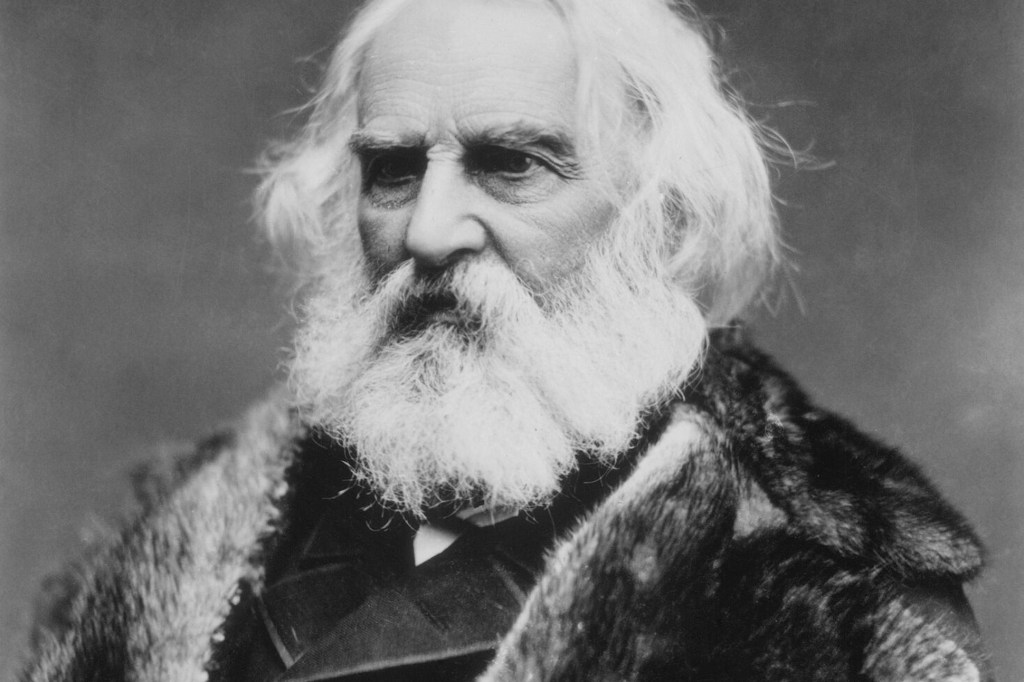
Henry Wadsworth Longfellow’s” Christmas Bells” is a widely anthologized poem that celebrates the winter holiday. It features a phrase associated famously with the Christmas season in its chant, “Of peace on earth / Good-will to men.”
Introduction and Text of “Christmas Bells”
Henry Wadsworth Longfellow’s “Christmas Bells” is remarkable not only for its tribute to Christmas but also for its commentary regarding the American Civil War, which was in progress at the time the poet composed this poem on Christmas Day 1864. This poem was published in 1865, and by 1872, it was set to music, becoming a world famous Christmas carol, covered by many singers, including Frank Sinatra.
The poem plays out in seven cinquains, each with the riming scheme, AABBC. It repeats the phrase, “peace on earth, good-will to men,” which has become a widely chanted invocation for world peace.
Christmas Bells
I heard the bells on Christmas Day Their old, familiar carols play, And wild and sweet The words repeat Of peace on earth, good-will to men!
And thought how, as the day had come, The belfries of all Christendom Had rolled along The unbroken song Of peace on earth, good-will to men!
Till ringing, singing on its way, The world revolved from night to day, A voice, a chime, A chant sublime Of peace on earth, good-will to men!
Then from each black, accursed mouth The cannon thundered in the South, And with the sound The carols drowned Of peace on earth, good-will to men!
It was as if an earthquake rent The hearth-stones of a continent, And made forlorn The households born Of peace on earth, good-will to men!
And in despair I bowed my head; “There is no peace on earth,” I said; “For hate is strong, And mocks the song Of peace on earth, good-will to men!”
Then pealed the bells more loud and deep: “God is not dead, nor doth He sleep; The Wrong shall fail, The Right prevail, With peace on earth, good-will to men.”
Reading with musical accompaniment:
Commentary on “Christmas Bells”
Since its original publication in 1865, the concluding year of the American Civil War, Henry Wadsworth Longfellow’s” Christmas Bells” has enjoyed widespread distribution and attention.
The poem’s refrain, “Of peace on earth / Good-will to men,” has served as an appeal for a common goal, uplifting the minds and hearts of all people the world over. And while the poem’s association with the Christmas holiday is obvious, the sentiment for peace and world-wide goodwill remain regnant throughout the year.
First Cinquain: Ringing in Christmas
I heard the bells on Christmas Day Their old, familiar carols play, And wild and sweet The words repeat Of peace on earth, good-will to men!
The speaker reports that upon hearing the church bells pealing and the singing of carols in celebration of Christ’s birth, he is reminded of the purpose of Christmas celebration of peace and harmony among the world’s citizens. He avers that the words and sentiment are very well-known to him.
He also reports that those words hold a special place in his heart. The speaker’s tribute thus reveals the nature of the season that had become and still remain one of the most important celebrations of the year, especially in Western culture.
The line—”Of peace on earth, good-will to men!”—becomes the refrain in this poem that may also serve as a hymn. The refrain allows the poem to function as a chant. It has been invoked many times in many places for that purpose since its composition in 1863.
Those important words have also been employed to remind a warring world of the true goal human endeavor, that peace and harmony are ever more desirable than war and chaos.
Second Cinquain: A Reminder of Peace
And thought how, as the day had come, The belfries of all Christendom Had rolled along The unbroken song Of peace on earth, good-will to men!
Hearing the bells and the caroling also reminds the speaker of the “unbroken song” of Christ’s birth that is celebrated in all places where Christians and others of a spiritual nature acknowledge and love Jesus Christ.
Again, the speaker repeats that all important idea, “Of peace on earth, good-will to men!” The chanted line remains an important feature of this poem for its ability to alter even the speaker’s mood as he continues to describe his reaction to hearing the bells.
For the speaker, the continuation of the celebration of the birth of Jesus Christ as the savior of humankind has informed his remembrance, even as life has progressed and often descended into the chaos that all of humankind would prefer to avoid.
He is writing during the time of war, and thus he desires to achieve peace, but that desire may be contrasted with outward events that hem him round. As he writes his tribute, motivated by the words of sacredness from the carols, he is reminded of calmness and the nature of life as he would have it.
Third Cinquain: Heavenly Sounds
Till ringing, singing on its way, The world revolved from night to day, A voice, a chime, A chant sublime Of peace on earth, good-will to men!
The sounding of the bells and voices singing Christmas carols continues throughout the day as the day turns into night. The speaker describes the sounds he hears as voices and chimes. He finds those sounds to be heavenly; they remind him of all things sublime. And the chant he has fashioned again closes the cinquain.
The simple chanting of an uncomplicated but seemingly unattainable state of earthly tranquility provides the atmosphere in which a mind may rest, if only for a moment. The necessity of that rest becomes paramount during times of holy day recognition, and the celebration of the birth of Christ offers “Christendom” that opportunity for solemn meditation on the soul.
The speaker throughout his tribute remains intensely focused on the refrain that is chanted, and the peace and goodwill that he is asserting then become part of a prayer. As he asserts that the words of the carols remind him of sacredness, he yearns to bring about that very situation through concentration on the peace and harmony that such chanting is not only describing but also demanding.
Fourth Cinquain: A Moment of Bleak Melancholy
Then from each black, accursed mouth The cannon thundered in the South, And with the sound The carols drowned Of peace on earth, good-will to men!
While the speaker is enjoying of the beautiful peeling of the bells and the singing of carols, he enjoyment is suddenly interrupted by a loud, explosive reminder that war is raging.
Symbolizing the war, cannons are loudly reminding the speaker of the unfortunate events that are being played out, especially in the southern part of his country. Those likely metaphoric sounds have intruded into the speaker’s consciousness at a time when he is musing on beautiful qualities that should exist, specially at this time of year.
The loud cannons that “thunder” become a dark cloud, covering the beauty of the carols that proclaim earthly peace and the lovely fellow feeling that should exist among all citizens.
This interlude of remembrance of war contrasts greatly with the opening emphasis on beauty, tranquility, along with peace and goodwill. The stark image of a cannon’s “black, accursed mouth” startles the mind that has heretofore been soothed by the reminders of celebration of spirituality through peace and goodwill.
Fifth Cinquain: Peace Broken by War
It was as if an earthquake rent The hearth-stones of a continent, And made forlorn The households born Of peace on earth, good-will to men!
Continuing the contrasting stark interlude of war that has pushed its way into the speaker’s awareness, this stanza then likens the war to a different calamity. Thus the narrative moves from the cannons of war to the natural phenomenon of an earthquake that breaks up the very ground beneath the feet of the citizens.
The households seem to be suddenly stripped of the serenity that should be aglow with the peace and harmony for each family. This interlude of melancholy and pain, however, still contains the seeds of hope as the cinquain concludes again with the refrain for peace.
The speaker is aware that too many families have been affected by the war as husbands, wives, sons, daughters, brothers, and sisters have gone off to war to defend what they consider their homeland. This “earthquake” of war has caused a melancholy atmosphere to fall over the citizenry, but the speaker still continues to chant his prayer of yearning for peace and goodwill.
Sixth Cinquain: No Peace—Just Despair and Hatred
And in despair I bowed my head; “There is no peace on earth,” I said; “For hate is strong, And mocks the song Of peace on earth, good-will to men!”
Into the third stanza also comes the painful interlude of melancholy, which continues to serve as a reminder that this poem is being composed during a time of war. The speaker looks down, bowing his head, feeling desperate for better times.
He bemoans the fact that currently peace does not reign over the land. His country is engaged in a bloody battle for its soul; it is being pulled apart by differences that reflect strong hatred on both sides.
Political differences have spoiled the peace that should be spreading over the landscape and into the hearts and minds of the citizenry, instead of the suffering and chaos that war and hatred are bringing.
Because there is such strong hatred in the world, the song of peace is mocked by the brutality of war, which contrasts so violently with the notion of peace and harmony. Sadly then, the speaker is experiencing a moment of hopelessness that there is no truth in chanting about peace, love, and goodwill.
The contrast between his earlier feeling regarding peace and harmony reflected by his repeated refrain and this painful realization that peace is lacking must have been excruciating for the speaker as he passes through that dark moment brought on by the reality of war raging in his country.
That the speaker is forced to concede, “There is no peace on earth,” remains a painful reminder of the chaos that hatred brings into the lives all people. The very hope that peace can be achieved on earth becomes difficult to maintain in the midst of all the pain and suffering caused by the destruction of weapons and brute force against citizens.
Seventh Cinquain: The Return to Faith and Joy
Then pealed the bells more loud and deep: “God is not dead, nor doth He sleep; The Wrong shall fail, The Right prevail, With peace on earth, good-will to men.”
Just as suddenly as the melancholy had momentarily overtaken him, the speaker’s mind fortunately returns to its faith that all will be well. The bells’ tone now seems to become even deeper and louder, causing the speaker’s musings to be uplifted.
His heart and mind become filled with the notion that the wrong of the world will be defeated by the right, which will win. The speaker assures himself that God is in control, and that God never abandons His children. The sound of the bells continues to peal in the speaker’s consciousness as they deliver his mood from sadness to hope and faith again.
The speaker then is able to assert with strongest faith, “God is not dead.” He also asserts with assurance, “nor doth He sleep.” The speaker’s faith thus returns him to the knowledge that right will overcome wrong because God is still controlling all events.
The speaker can thus continue emphasizing the sentiment of his controlling refrain. He can again with renewed faith place that emphasis on that refrain that had brightened all the preceding stanzas of his discourse. He can chant again his invocation for peace and goodwill for all his earthly brethren.
Thus, because of the return of his faith in his deep heart’s core, he can proclaim the repeated truth that God still fills the world’s faithful “With peace on earth, good-will to men.”
The late Charles James Kirk, Charlie Kirk, is most noted as the founder of the organization Turning Point USA, created to assist young voters in understanding the values and policies that make life in America prosperous, safe, and spiritually satisfying.
The Growth of a Movement
Born Charles James Kirk on October 14, 1993, to Robert and Kathryn Kirk in Arlington Heights, Illinois, Charlie Kirk graduated from Wheeling High School in 2012; for one semester, he attended Harper College a community college in Palatine, Illinois [1]. As a junior in high school he applied to West Point and was rejected.
While still in high school at age 18, Kirk and a group of friends began laying the foundation for what later became Turning Point USA (TPUSA) [2]. His main reason for dropping out of college was to use his time and effort in growing Turning Point, whose purpose was the supply the education for young people that felt was lacking.
His semester at Harper College, as well as his observation of the lack of informed young voters, convinced him that in general college did more harm than good in passing on to the coming generation the accurate history and values of America [3].
Kirk’s grassroots organization grew rapidly into a national phenomenon, and by 2025, TPUSA had multiplied into chapters numbering in the thousands, including chapters in universities, high schools, and even online.
“Prove Me Wrong”
Shortly after launching Turning Point USA, Charlie Kirk started holding sessions he labeled “Prove Me Wrong” on college campuses [4]. He would invite those students in the crowd who opposed his views to come forward to the microphone to debate issues. These sessions became widely popular, with views on Youtube and TikTok numbering in the billions.
Some of the public universities across the United States, where Kirk spoke and held his “Prove Me Wrong” sessions include Arizona State University (2018), the University of California–Berkeley (2019), and Ohio State University (2019), and many others.
At each session, Kirk first delivered his statement on a hot-button political or cultural issue, including free speech, immigration, abortion, or taxation. He then invited those students in the crowd who disagreed with his positions to come forward, speak into a microphone, and “prove him wrong.”
The verbal duels were recorded and made publicly available through YouTube, TikTok, and other media platforms, becoming widely popular, numbering in the billions by the mid-2020s.
Kirk’s goal was to persuade these young voters; he employed a civil tone, never demeaning them or talking down to them as he relied on verifiable facts and logical analyses to support his claims.
Through he own experience, Kirk became aware that the college/university environment fosters Marxist ideology, which is antithetical to the American way life that values freedom, individuality, and actual diversity of thought.
His “Prove Me Wrong” debates offered a forum for respectful exchange of ideas, something the average college classroom has long abandoned in favor of indoctrinating students on what to think rather than how to think. These sessions always attracted large number of students, most of them Kirk supporters, but many of them detractors, to whom Kirk most directly spoke.
Kirk’s engagement with his opposition always remained civil, respectful, and he even expressed admiration for his challengers for their courage and for their attempts to engage and think critically.
Political analysts have credited Kirk’s “Prove Me Wrong” sessions as playing a key role in assisting in the increasing interest of young people in the political process. These sessions along with other activities of Turning Point, as well as, Kirk’s charismatic performance and personality have had a great uplifting influence on the whole of society both old and young.
Kirk held the conviction that persuasion with facts and logic was more influential than partisan oneupmanship. His engagement with students was often the first opportunity they had been given to think and express their views.
Political Stance
Charlie Kirk’s politics centered on three basic issues: free speech, limited government, and free markets. Thus he advocated for deregulation. Furthermore, he supported school-choice initiatives, pro-life/pro-family commitment, and a strong approach to national defense.
Along with Andrew Breitbart, he believed that politics was downstream form culture. Culturally, Kirk argued against the tenets of what has become known as “woke” orthodoxy.
Kirk’s ultimate strategic purpose was to help win elections, which he believed meant winning the hearts, minds, and habits of the younger generation. Thus he directed his message primarily to young people, especially those who are experiencing the aridity of the college camps.
He also emphasized life-affirming activities such as career choice, marriage and family life, and civic duty. The topics he chose to address could often be associated with his core values.
Religious Faith
Charlie Kirk’s Christian faith was the driving force both for his life and his political activism. He believed in the importance of the role of faith in any strategy for cultural renewal.
He personally maintained a daily routine that not only bolstered his faith but kept his mind centered in spirituality. Daily, he read from the Holy Bible, prayed, examined his inner motives [5]. He also maintained a “Sabbath practice,” which meant observing a day of quiet meditation without worldly engagements such as news reports.
Kirk was raised in a Christian family and as a adult became more intensely dedicated to his faith. He remained aware that his faith enhanced his ability to engage publicly and to lead his organization.
Charlie Kirk did not argue for a state sponsored religion. He well understood that the state is prohibited from establishing a religion in order that individuals could practice and worship their religion as they wished.
Kirk’s rhetoric often expressed political struggles in theological terms. Moral questions about family, gender, and identity were not merely policy items but spiritual battles: he believed that cultural trends were demonstrating spiritual decay and that spirituality need to be revived.
His ideas resonated with conservative Christians who believed that secular elites had diminished the influence of faith in public institutions. His ideas and unique voice made him a prominent presence in American politics.
While some critics have denigrated his stance with the label “Christian nationalist,” he described his purpose in civic, not religious terms. His knew that teaching religion by example not rhetoric was more important and effective for today’s youth [6].
Kirk’s religious faith also shaped his alliances and media platforms. He partnered with Christian media (e.g., Salem Media) and evangelical leaders who amplified his message. His faith remained the central focus for his personal identity and his political strategy.
Death and Legacy
The “Charlie Kirk Effect” is felt in his enduring influence as co-founder and CEO of Turning Point USA (TPUSA) and on mobilizing and educating young conservatives.
After his assassination on September 10, 2025, at Utah Valley University during the launch of his “American Comeback Tour,” the name and influence of Charlie Kirk spread far and wide, as it had never been before. This heinous act was immediately recognized as an event that elevated the once spiritual and political activist to the status of a martyr (7).
Although there is a presence of his organization on at least 3500 campuses, reports have claimed that requests for new chapters all over the world are numbering about 120,000, growing every day.
Charlie Kirk’s work focused on promoting fiscal responsibility, free markets, limited government, and faith-based values among high school and college students. By the time of his death at age 31, TPUSA’s annual revenue had grown to nearly $85 million in 2024, fueled by major donors and events like the 2025 Student Action Summit, which drew 5,000 attendees in Tampa, and the Young Women’s Leadership Summit, which hosted over 3,000 participants in Texas.
As mentioned earlier, Kirk’s approach emphasized grassroots activism, including the establishment of student chapters for leadership training and on-campus debates in his signature “Prove Me Wrong” style.
These efforts reached millions through social media—he attracted 2.8 million followers on X—and initiatives like the “You’re Being Brainwashed” tour, which visited 25 campuses in 2024 to boost Gen Z voter turnout for Donald Trump’s presidential campaign.
As a close Trump ally, Kirk attended the 2025 inauguration, played golf with the president days before, and served as a personal aide to Donald Trump, Jr. during the 2016 election. Kirk’s media presence extended to hosting The Charlie Kirk Show podcast and a weekday talk show on Trinity Broadcasting Network that began in February 2025.
Kirk’s educational vision went beyond activism. He launched Turning Point Academy in 2025 to counter “woke ideology” by creating Christian schools rooted in biblical principles, with the first brick-and-mortar site at Dream City Christian in Phoenix.
Through Turning Point Faith, Kirk partnered with evangelical leaders for tours framing elections as spiritual battles. These programs trained young leaders, with TPUSA alumni entering roles in conservative politics and media.
The assassination—a targeted shooting by 22-year-old Tyler Robinson from a rooftop 125 meters away—drew widespread condemnation as a “political assassination” from Utah Governor Spencer Cox and President Trump, who announced a posthumous Presidential Medal of Freedom for Kirk.
The event, attended by about 3,000 people, prompted campus closures and a manhunt that ended with Robinson’s arrest. In its aftermath, TPUSA reported over 32,000 inquiries for new campus chapters within 48 hours, followed by 18,000 more requests after widow Erika Kirk’s address, signaling a surge in engagement.
Erika Kirk was unanimously elected CEO and Chair of the Board on September 18, 2025, fulfilling Charlie’s expressed wishes and vowing to expand TPUSA tenfold. The tour continues, with the next stop at Colorado State University on September 18.
Arizona Senate President Warren Petersen also proposed renaming Loop 202 the “Charlie Kirk Memorial Loop 202” to honor his Arizona roots.
Charlie Kirk Effect
The “Charlie Kirk Effect” is present in this institutional momentum: a network of chapters, donor support, and media infrastructure that equips young conservatives with tools for civic and political involvement.
Kirk’s books, such as Time for a Turning Point (2016), and his emphasis on family (8), faith, and patriotism continue to inspire. Globally, TPUSA’s model has influenced groups in the UK and beyond.
Charlie Kirk’s legacy will be measured by the sustained growth of these efforts and the leaders they produce, ensuring his mission endures.
The following sampling of poems are from Mr. Sedam’s second published collection, The Man in Motion.
1 THE QUICK AND THE DEAD
As friends of the deceased we stood outside the plot and spoke of many things; I said that I was a teacher and it came out he was too, somewhere up North, he said, a good community — good school, no foreigners, Negroes, or Jews in fact, he said, no prejudice of any kind.
2 SAINT GEORGE
He says he has a problem and I say: Tell me about it because he’s going to tell me about it anyway so it seems he was making love with his wife last night or thought he was when right in the middle of it she stopped and remembered he hadn’t put out the trash for the trash man the next morning so he asks: What would you have done? and I say: Get up and put out the trash which of course he did but he still doesn’t know why and I reply: You must slay the dragon before there is peace in the land.
3 FACES
A funny thing happened in the war and you’ll never believe it but there was this Jap Zero at ten o’clock low so I rolled up in a bank and hauled back on the stick too fast and nearly lost control and when I rolled out again there was this other Jap (He must have been the wingman) flying formation with me.
We flew that way for hours (at least four seconds) having nothing else to do but stare each other down, and then as if by signal we both turned hard away and hauled ass out of there.
We flew that way for hours (at least four seconds) and when I looked again he was gone— but I can still see that oriental face right now somewhere In Tokyo standing in a bar there’s this guy who’s saying: a funny thing happened in the war and you’ll never believe it but there was this American. . .
4 EXPERIENCE
Then there was that night in Baton Rouge Jack and I went out on the town looking two looking for two And we saw these two broads at the bar and I said There’s two Jack but yours doesn’t look so good but he was game So we grabbed them and wined them and dined them with champagne and steak I remember forty-four bucks to be exact And when we walked out of that place I slipped my arm around the pretty one an whispered let’s go up And she said whadaya think you’re gonna do And I said not a goddam thing and left her flat And Jack took the dog-face one home And made a two-weeks stand of it and come to think of it I never chose a pretty girl after that.
5 NOSTALGIA
(For Lee Anne)
Call it the wish of the wind flowing from a dream of dawn through the never-to-be forgotten spring of our years running swiftly as a lifetime flying like a vision borne Slim Indian princess wedded in motion dark hair streaming sunlight and freedom floating on the cadence song drifting shadow-down in the distance my daughter riding bareback on a windy April afternoon.
6DESAFINADO
(For Allen Ginsberg, et al)
Through this state and on to Kansas more black than May’s tornadoes showering a debris of art — I saw you coming long before you came in paths of twisted fear and hate and dread, uprooted, despising all judgment which is not to say that the bourgeois should not be judged but by whom and by what, junkies, queers, and rot who sit on their haunches and howl that the race should be free for pot and horny honesty? which I would buy if a crisis were ever solved in grossness and minor resolve but for whom and for what?
I protest your protest its hairy irrelevancy, I, who am more anxious than you more plaintive than you more confused than you having more at stake an investment in humanity.
Some things were never explained even to me, and of course they would tell it his way but I believed in her because I chose to believe and you may be sure of this: A man’s biological role is small but a god’s can be no more that it was I who was always there to feed him, to clothe him to teach him, and nurture his growth— discount those foolish rumors that bred on holy seed for truly I say unto you: I was the father of Christ.
At least part of your message is clear, thou shalt not kill except in certain seasons and thou shalt not commit adultery except in certain regions and thou shalt not lie except on incredible things like carrying five tons of tablet stones down mountains.
9 INDIAN COUNTRY
Can it be enough to wake in the morning to find in a land above all others the generosity of spring a summer’s desire the sky like a psalm unfolding a season for lovers?
Stay, do not be afraid walking hand in hand with me through the gentle wilderness the glorious heart of it I know this country better than I know myself better let me share it with you this immortal scene— how can you close your eyes?
10 REGENERATION
Something in me and the abiding dust Loosed an imprisoned force And I became a man at the age of twelve Proclaiming myself above women I decided to be a trapper up North But tried the near creek first Caught a muskrat that turned me weak Cried boys tears then came back strong Finding maturity was thirteen Growing soft on animals and girls.
11 FOREVER CALVIN
Life had seldom been good to him and the cloth he had always denied but faced with the new theology he stood with his beer and replied: “People been sayn’ God is dead but I know that old sonofabitch is still alive.”
12 MYSTIQUE
My thoughts are on the ring of morning my insight beholding the sun— I will say she is not beautiful or shall I say, no more beautiful than the average of her age an average girl in plain blue sleeveless dress with soft brown sling-back shoes and matching purse but for the silver dragonfly . . . ah yes! the silver dragonfly as delicate as her slender hands her red-gold hair her high born face or the white lace of her brassiere, which brings my focus to the nearer things the rainbow from the window the warm wet sound of rain the clear clear air.
13 CASUALTIES
Admission of reality that time can bend a memory am I a victim of my own credulity or did I see the dark blood flow from such savagery . . . unbelievable that I was even there that I remember and forget so easily the brain is lensed like that protects the image sometimes dims forever unless a matching pattern focuses the scene joins two worlds the then and now . . . and then it was no ordinary war a time some unseen power had set the stage for me an unemployed pilot, I happened along a spectator of the invasion until the airplanes came— Admission . . . they brought the casualties in and laid them on the tables of the ship’s wardroom where only hours before we ate our peaceful fare no white-clad nurses here, no softer graces no operating room decor I would identify but my only experience is a football knee and nothing in the past could conjure this: a casual would brings no trail a shattered arm or leg they amputate of mangled flesh in disarray they sew a captain missing half his face the jawbone almost gone what primal instinct saved his life? they can’t decide he crawled back on his own . . . another with both hands taped down to his arms his wrists nearly severed he says his pistol jammed as he was struck a sword— a more immediate concern he also has a bullet in his chest, they probe the fevered flesh that forms the hole almost lose him Shock! a call for plasma the way that nature saves her own or takes in death if the blood is pooled too long the surgeon quietly explains— Admission . . . the other details I forget or something doesn’t want me to recall it is only the surgeon who comes through clear to me whose raw exposure captured me record the butchery whose eyes knew me as I stood fascinated by his sight— at three A.M. they bring the last one in his back a confusion of shrapnel and blood but almost perfect pattern of designs a gaping hole with radiating lines a mortar shell— his face like the grey dawn precipitates the storm he is barely conscious now moving through another world perhaps the only peace he’ll ever know— the stoic surgeon stares and then starts in deadens down with morphine with speed to equal skill and then in rare expression, he’s feeling with his hands searching for something like fish under a log he has a memory now pulls out a bloody jagged hunk smiles and drops it in the pan I’m holding and for the first time notices me and for the time I’ll do a pilot orderly? why not incredible but then how callous I’ve become beside, I can perform and I am remarkably calm he knows, sustains my balance talks of fishing all the while until the fragments are found later much later our two worlds match again he sews with a feminine stitch hands leading heart compassionate in his touch Surprisingly the human skin is very tough he says cuts easily, punches and tears hard the consistency of leather remembering how my mother sewed my shoe way back there he tugs and pulls, but carefully the sergeant groans from pain I ask? no, reflex action he explains the pain comes later much later more thread! will he ever get their wounds sewed up? how neat the stitches come a patchwork quilt, a Frankenstein design and finally done his genius shows, he’s made another man but what about his kind and if he lives how does he survive? what cursed the learned doctor after time and after twenty-five years what monster roams to haunt the tortured mind? Admission . . . it is unbelievable the punishment the human body can absorb or what the mind can hold at least for awhile until the patterns match the greatest pain comes later . . . much later.
14 SELF ANALYSIS
Often I have wondered from where I came something of motion wind and cloud and wing high unity the sky was my medicine dream an identity, I suspect . . . I never was born at all I fell from another world was found by a savage tribe ran through my Indian youth followed rivers and leas talked with birds climbed ancient trees then beholding all things I found creativity— all my years of learning have taught me only what I knew as a child.
15 INCONGRUITY
Theirs is a house, a show place of antiseptic rooms marked: His and Hers with climb marks on his walls and halls that lead to nowhere (they wouldn’t dare) and yet they have three daughters which their friends assure me came naturally.
16 APRIL
Then from the winter grief and the tree’s last clinging the dead leaf falls to be born in time’s intricate weaving from the sentient sleep it awakes to behold life believing . . . and you thought the spring would never come— Arise My Love, arise for love has performed a miracle.
17 HIGH SIERRA
And try as I would today I could not walk that objective distance away to write a universal poem that symbolized all metaphors of love profoundly beautiful sensitive to wordways, more sensitive to height the clearest view the path ran always toward the sunlight always to you, in lines as free as taking you into my arms feeling the flow of your warmth creation smiling upon me.
18 JURISPRUDENCE
Yes, yes, I know the tree belongs to you but your mistake was planting to close to the line— possession being nine-tenths of the law your branches leaning heavily my way, I have picked the apple on this side and I intend to eat every damned on of them.
19 MIRRORS
And now my daughter what shall I say to you when only yesterday I learned to know myself I cannot tell just where I end where you begin or when it was I loved and lost and won the perfect picture of my ego —
I know the cruelty that reprimands your nature you feel too much you love too much you give too much and I would make you man, like me hardened and warm vulnerable and sound hidden between poems doubting . . . believing . . . no, it is not so I would not rule you and corrupt your beauty, you declare in the desperate desire an intimate loneliness a weakness yet laden with power a possible greatness — then what shall I say to you? you have written me a poem, really, it is almost good . . . really, too much like me.
20 ORIGINAL SIN
“And as life must always contemplate death.”
Now and again in a crowd I’ll see that look in someone’s eye that searing stare of endless pain a desperate longing for the sky . . .
a tremor in the sun, a hurried cry — “This is Blue Four bailing out!”
the convoluting sight, a silver streak the searing flash, a rolling red-orange flame but someone calls: “He’s clear! He’s clear!”
we see him floating free, momentarily safe billowing white against the perfect blue like an angel removed from evil—
God’s merciful arrangement? the decision was never his he is falling into the enemy’s hands and the guilt of war goes with him —
he gathers in his chute, hopelessly alone we circle one more time but none of us can save him, standing on the crest of his years he waves his last goodbye — Paul Williams . . . the loneliest man I ever saw.
21 CREATION
I will allow to my plan one dream of man’s own choosing that he may break his earthly bonds and exist beyond reason and Adam and Eve looked upon each other and behold, they were overjoyed!
22 DOWN TWO AND VULNERABLE
Whose knees these are I think I know her husband’s in the kitchen though he will not see me glancing here to watch her eyes light up and glow;
My partner thinks it’s rather queer to hear me bidding loud and clear between the drinks before the take the coldest bridge night of the year;
She give her head a little shake to ask if there is some mistake five no-trump bid, their diamonds deep and one finesse I cannot make;
Those knees are lovely warm and sleek but I have promises to keep and cards to play before I sleep and cards to play before I sleep.
23 UNTOUCHABLES
If you will ride with me in the warm and velvet rain and stay discreetly on your side I will write for you the most beautiful love poem of your life.
24 THE DEATH OF GOD
Look at me Father beneath the grime and blood a soft-faced boy fading in your sight, severed from the power to make the sign one arm dangles, the other grasps my side; Listen to me Father and hear the red flood rain the morning with low moaning black whispers marching in armies of shadows exposing, exploding the expedient lie, the cold thought crawls pain-studded, shouting cutting the sacred threads from all tomorrows;
Time and the sun are staring sending gods and heroes to their places; while yet I live and slowly shed my robe I witness your death as you witness mine.
25 LETTER
Before all colors fade before you are gone I’ll hold to this memory of you, I see you in that gown like wine two shades of purple pink and purple red of passion drawn, deep down I wandered weak from want of you then knew your warmth and drank my fill and filled the caverns of my mind and sewed the hills with vineyards fine that I each year might touch the spring again — when you are gone, and surely you are I know it now for the words are beginning to come.
26 FORGOTTEN SPRING
And I awake in the veil of morning from shadow dreams unfound unknown there is no sight or sound but the rain in the willows and I have forgotten when it was that came in May with the scent of spring and a trace of the forest bloom — I arise and go to the window and search in the darkness to feel the lifeblood touching the night with my hands recalling the smallest things transformed in rain the linden flowers the redbud lane and I return and I am young in my shadows reflecting a sequined day of warmer years when children walked the emerald springs remembering nothing but dreams nothing but sleep sleep Sleep that come a thousand miles beyond a distant sorrow the forest road and garden flowers dissembled torment settled the terror of unearthly storms from sounding dreams of heartbeats falling falling asleep asleep and I awake to know not to know what lonely river fills the tortured mind a soul’s denial why nether light unveils a ghost of time condemns tomorrow somewhere the dead is watching exists is calling something I have lost has troubled me awakens me calls me to sleep sleep the broken frames of memory close asleep open and I awake to the black veil of mourning painfully conscious of that final hour and one forgotten scene the wringing hands the labored breath a tension crowded room the moral madness of his sight the faded flowers the dreaded tomb, but I am old, have shed my tears — sleep! give me sleep! I want no memory of that time and avalanche of lifeblood fallen drowning in a sea of slime the shadow man more child than man was dying . . . dead and life removed is dead calls to me to silence and sleep sleep sleep that goes a thousand miles beyond perpetual dawn the spring was morning the sun had healing powers I stood at the window beside my mother and Albert walked along the garden flowers and called: come, Marcene, let’s go mushroom hunting.
27 EDELWEISS
Then I will tell you about beauty it is the miracle revealed on a winter day that in a careful moment flowers a barren land and leaves tomorrow wherein we walk from snowy graves reborn seven times over, touch me then for that is beauty the only kind I understand what matters now is that I remember for the longest possible time the longest day when beauty is covered with sorrow . . . this too shall pass away.
28 SUMMER PLACE
Still my awareness can say what happened there — there was such a time and such a woman there was a river flowing a blood so dramatically clear there was a windwalk flowering through the trees an endless stream of light that marked the year — how do I measure your loveliness? I see you again like willow wand summer sun shining and free and unashamed love and the slowly spreading leaves care and the greatest gift we claimed — calmer then we knew our way we gathered life around us like a golden cloak and wore it every day.
29 LONELINESS
On that October afternoon under the maple bordered streets the canopy of memory closed every Godly sound when Billy Lambert died — the rainfall felled and crushed red leaves bled through bitter wine and I drank paralyzed like any man too stunned to reason why too brave to cry, they said, they took my silent grief what sixty pounds could give as proof like theirs, standing for strength — they did not know that I was eleven without faith.
30 FARFALLA
It seems inevitable now that I should find you again at mid-summer, when I came down from the spring I walked along in the rain thinking of you your form and being as warm and secure as nature’s cocoon knowing that someday soon you would arrive with the sun beautiful and alive.
31 ALCHEMIST
From the imagery of the past with the metaphorical present the match is made sometimes obvious but more often than not a sixth sense tells us it is there and apparently without reason we know because we have tried — a poem is not tricked not willed into being, with or without us it comes with a mind of it own a substance of rhythm and tone base metal some unknown alchemy has turned to gold.
32 FOR REASONS UNKNOWN
“The Board after review of the crash that took the lives of fifty-eight people, has ruled, the probable cause: a loss of control, for reasons unknown.”
To one who must review the will of impossible gods this crash leaves in its wake man’s torn identity For Reasons Unknown; the probable cause, an altimeter’s difference, an obvious loss of control but who can comfort oneself on finding death at this expense; here in the residue of grief, a coat, a toy, a case the charred remains of lives the lived before the shrouds, once with a burning intensity, a chemistry sublime now an horrendous blending shattered by time For Reasons Unknown; only a few hours before when there was hope we were intrigued by their heights, sensation of pride and power in that moment of brilliance, a soul’s magnificence then a wall and a new dimension of mind; again we have met in this place, the corridor of death where we are no longer strangers to the hard intelligence: that the dream is impenetrable for them and for us and for them it is all or nothing, and if it is nothing . . . but then, how foolish is forever, For Reasons Unknown, cancel flight fifty-eight.
33 CONCEPTIONS
If I were a woman I would become great with child if only to test my creative power to bring a fertilized egg into being proof positive that my reproductive prowess exists but being a man I can still stare at sperm unbelieving that there is anything great with me having no conception of conception I’m disturbed when she asks me: “Aren’t you proud to be a father?” and I answer yes and no no for the biological act, yes after the fact I fulfilled my responsibilities and earned my right to that to be called Father? no, with no awareness of conception I knew only, still felt only the pleasure, so I would alter the master plan somewhat —
a woman should be wired for light and sound and at the time conception like an exciting pinball machine her body would glow and the lights would come on and bells would ring and out of her navel would pop a card which would say: Big Man with your wondrous sperm this time you the the jackpot! keep this card and in nine months you can collect.
34 PHD
I continued upward ignoring signs of the northern sky until I crossed the subtle circle and arrived at the pole; I sat in frozen silence reflecting an impotent sun and when I left that place my direction was necessarily south.
35 DIVINE RIGHT
“And God saw every thing that he had made and behold, it was very good.” Genesis 1:31
All of God’s creatures have purpose they say, including me and even I may prove it yet and even a mosquito proved it once, Texas breed, Matagorda brand he sat upon my hand and sucked my blood, innocently without checking my rank and mismatched as we were he filled too full to fly and fluttered fitfully flopping like a frog, so heavily wing-loaded I smashed him flat than sat back on my throne and praised my bloody competence.
36 PATHFINDER
Two roads diverged in the yellow woods And I knowing I could not travel both impetuously cried: To Hell with decisions! And struck off through the woods.
37 BEAUTY AND THE BEAST
“I thought you were strong for Jenny?” “Well you know how she is— Wears three coats of makeup, Flat chested, legs too short, And without contacts—ugh!”
Which reminded me of the time He introduced me to Jenny— Lavender eyes, satin skin And bosom and legs enough . . .
“Oh yes and another thing You wouldn’t have guessed: We broke up last week.”
38 DISCOVERY
Between the first and the last there is a part of us that lives outside ourselves where we can see held in life’s rhythm our first encounter with immortality, no joy specific could cry that pleasure proclaiming what we are but if we could tell this tale where no one cared to know we would live it again that intimate discovery like Adam and Eve we were the first two people.
39 POEM TO MY FATHER
On His Seventy-fifth Birthday
For as a man stands for love— and now after the gift of our friendship when I am alone to see myself for what I am, how slow was my awakening, and it seemed too many years you had passed us by but then as I became mature and unafraid they made the bond enduring when we discovered we walked the same valley of age and wisdom respectfully different, feeling the same imprints hearing the same footfalls following the same river to the ultimate sea— foreseeing that day of silence I need no tears to purify the past: this was the gift of the gods For as a man stands for love there will remain his legacy an everlasting moment the memory of the nobility of man.
40 YOKOHOMMA MISSION
(After Twenty-fiveYears)
What the years have taken away what I forget to remember and what lasts forever in dreams that burned the imprint on my mind . . .
Flying across that lonely shield of space the interwoven contrails streak the malevolent sun high and clear at twenty thousand feet down a flawless sweep of sky— We have formed to protect the second wave of bombers long-barreled B-29s with huge block letter markings on their tails three hundred in a massive glare but one that stands out over all the letter R Remember How they came the enemy in swarm like magnificent fireflies in black and green with big red suns on their wings confused our aim skywalked our tracers missing four and hitting one he spins away angrier in death then life again the engines strain moving upward climbing to regain ah precious altitude the run is perfectly aligned—
We have broken off momentarily giving way to the black flak highway blanketing the run the first unfolded far behind the second overled the third more accurate scores a bomber falls away, hesitates then dies rolls over slowly explodes the sky churns with debris another in its death throes yet another, and another vectored down the line moving moving onward Here they cone again! scattered, less reckless now they’ll never understand another pass would run our fuel tanks low one almost playfully tags along we clobber him impatiently move on always moving full throttle maximum RPM abuse the trim damn the machine always straining always climbing The name of the game is survive and some are delivered and some luck out and some are determined to die but what is left of skill is gone . . . A Kamikaze! A mid-air! one of theirs and one of ours a final terrible embrace falling falling away unforgiven a cripple falling far behind another going down another R Remember the unbearable emptiness the invisible force of time of sailing, drifting, soaring always moving wind driven by some mysterious mind of wheeling, climbing, floating—
Then suddenly the departure point I turn for one last look at life transfixed in war’s psychotic stare the horrifying tower the hell we made for a million souls in flames that outlast fire the pinpoint accuracy of this day twenty-five years ago, a quarter of a century and Yokohomma is still burning.
41 DIALOGUE INTELLECTUAL
You call that poetry? That was my intention. Well it’s not good poetry. By whose contention? Mine! Which makes you a critic? Yes, now here’s a good line, Whose is it? Mine. Is it part of a poem? No, it’s only a line. You could never finish it? Yes, that’s true. Well add this pseudo intellectual schmaltzy phrase. What’s that? Up you!
42 UNDERSTANDINGS
I had heard these aunts before damn their fat Victorian souls who gathered in our house those poor depression days for grand reunions with gossip of the years and I the slender one too young too male to hear that day hid behind the door and combed their conversation for tidbits dear for boys too mean to bore and in the painful hour they took my subject sex and tore to bloody shreds all acts of manly fire of passion and desire all aunts but one who would become my favorite in the end she said: “The way I see it girls the way you should it don’t hurt me none and seems to do George a power of good.”
43 REFLECTIONS
What would I keep for beauty’s sake to cherish your presence in me not you but the essence of you even more than the intimate part of me you took with you— I smile at your face in the mirror looking at me my countenance radiant, taut-muscled confident and so sure that I am a man, with you I, too, am beautiful.
44 BLOOD ROOT
Then I becoming I considered then the flower from winter’s spring where I was I who found the trail of God’s creation who could hold beauty walking on touching every bloom of nature — it took me a long time to grow up from winter’s need where I was I like love it was a wind fragile flower and when I pick it it bled.
45 GORDON CHRISTOE
I remember his confident voice his high-flying banter the sound of his chattering guns that echoed his laughter then the Samurai came and shouted his name and Gordon disappeared in a black whisper.
46 DEATH OF A FIGHTER PILOT
Falling through legend and sky his vision a flaming mirror spinning away and away all promise of life lost in the lonely cry: I’m going in.
47 RELATIVITY
And so you are real but how long will you last? I have learned not to ask playing these god games to reconcile the past, yes, we’ll make too much of it our pleasure and crowded lament but why not the sands run low on dreadful wisdom.
48 VERTIGO
The sky was down the clouds had closed the chance a vast and inlaid sleep then magnified the trance, so set in power I saw the phantom dance that sent the brain dials spinning . . . abruptly the earth cut my remembering and I awoke in flames.
49 NIGHT TRAIN
Loneliness and a faraway whistle loneliness stirring the wind loneliness swelling the moonlight a storm swept song callling calling COMMmmee . . .
He’s hard out of Glenwood now trailing his midnight smoke a symphony on steel coming from someplace, somewhere from places of never before from fabulous lands and scenes dreamed in my book of days closer closer He’s rounding the curve downgrade on rambling thundering rods pulse like my heartbeat pounding pounding he whistles our crossing now his hot steam severs the air
COMMmmee . . . COMMmmee . . . A WAY e-e-e Straight through the town, throttle down deafening sound the summer night made aware screaming upgrade exhaust in staccato rhyme telling the world of his climb rolling on Arlington now high on his whirling wheels gaining the crest of the hill going to someplace, somewhere to fabulous lands and scenes pulse like my heart beat calling calling COMMmmee . . . COMMmmee . . . A WAY e-e-e
50 SCARLET TANAGER
I look at him as he looks at me in sly appraisal and I think he must be a discriminating bird to choose my woods for his mating show, but still I know that recently he came North from the land of the Chavante* and could it be that he sees in me only the image of another stage?
I knew that I must laugh before they carried me away and then I was carried away with laughter and now they have carried me away.
52 ZIP CODE
From that red restlessness understanding they would accept no compromise they left without a word between.
53 TIPPECANOE BATTLEFIELD
Walking through legend and tale I thought I saw Indians charging in feathered lines and calm Kentuckians gathering war-scalps— wandering too far I saw Harrison the magnificent riding his white stallion and . . . the thing I remember most about war was its bloody confusion.
54 MOON GLOW
So beautifully she could express desire — we had walked along the woods enamored of nature and ourselves; the moon grass an infinite sky the warm repletion a cry — come, she said, the children will be returning.
55 HARVEST
You will remember this time the love that holds this place born from a season of growing when we bled into each other from long histories and found all our futures foretold;
Now it is clear from our height this time is God’s artistic best, the sun revolves in a velvet line the winnowing need drawn from our childhood — Harvest . . . when the seek of the human heart knows assurance.
56 HOMECOMING
No one seemed to know him but he impressed us as he led the vocabulary parade; obviously he was a college man suave in dress submerged in manners and we could se his class ring when he picked his big nose.
57 PERCEPTIVO
If you’ll remember that day we barely met and yet I know all about you, I listened to your poetry but long before that — there is something in every woman that inevitably gives her away and you, my dear, were wearing exquisite pink shoes.
58 HAPPINESS
The storm cometh, the moment grows pale —
nothing in my memory ever dies, I remember our search for the sun that great straining upward formation flying like exotic birds spreading our wings on the day, and then a sudden flame — a terrible calm . . . happiness like a solitary leaf breaks off and falls away.
59 MARTY
(Who came without an appointment)
Softly she came with a folder under her arm, clutched tightly a countenance between a smile and a frown, she could go quickly either way, and then she spoke her mind in metaphor and rhythm, disgressed* in imagery that give her mood away and finally she told me she wrote poetry which I had already discovered before ever reading a word.
*”Disgressed” is an obvious typographical error. I suggest that the best reading of this line would be “dressed in imagery.”
60 ADAM
For over a week you have appeared in my sleep and I find myself seeking you endlessly — should I deny what I am, alone and awake a shadowless man tomorrow his glory gone like a season? and when you close upon my flesh then leave me naked and afraid should I deny what you are the storm of your coming and from its center the heart of emptiness the blood that cannot touch or give until it commands existence? I feel at this moment of birth the death of all things but let God speak honestly the power was given me to weigh with immortality and rather than let this moment pass away I will awake and create a poem which is woman which is life.
61 NOVEMBER
And you my friend tell me what you will there are some things you will never hold not even their innocent birth or trembling growth or color of life or last breathing;
In the bright façade of June you have said: Time has no end the sun to command has stood still and day and night are one immortal light like this summer I think I know why I hesitate as though I had never known the beauty of which you speak almost as if your voice could alter distance conjure love or call creation’s fire which I cannot believe
When years have hollow eyes I marvel I even remember the flight the scene of desire removed you think I dream what I write but think what you will — I have seen what winter can do.
62 GROUND FOG
Her night’s commitment soft and sultry, I touched the quintessence distilled five times fondled the moon disguised five times filtered the sky diffused five times and caught her mood . . . all this while sitting on my hands.
63 SILENT TREATMENT
I would not speak as a matter of fact I was determined not to give in this time because I was By God Right! and I was, I did not speak though I did smile as I carried her up the stairs.
64 INTERSTATE 75
Believing and I would believe against all possible odds against the inroads of roads against the factory walls against all concrete and steel that nature will always be real when I can write poetry at seventy, driving south and trail two lovers through the slow warm passage of time.
65 V J DAY
Appropriately we were airborne during the lull flying in our time testing out and staying sharp just in case when suddenly and literally out of the blue it came the pronouncement: “Iwo Tower to all planes — it’s all over boys — the War’s over!” a stunned long static unbelief before someone broke the spell — “Yahooo! Yahooo!” then everyone turned on how many times we yelled I can’t recall we firewalled all controls and rocked the sky in rollicking release but then the voice of God himself cut in the Squadron Commander: “All right you guys let’s knock it off — Remedy Red leader to all flights join up with me over the island and fly the tightest formation of your life.” we closed in fast and stacked down on his wing locked inside, reset the trim and leveled for the show — he waved how beautiful that square and hawk-nosed face bright like the Leo sun in terrible relief the pain and anxiety gone, drawn dangerously close to sentimental words — I settled back in throttles and controls chose my new horizon aware of every feeling and desire becoming strangely awed by the sight of my hand the flesh and blood that was in me the hope of tomorrow alive at last believing that a miracle had really happened the War was over, that I was human again.
66 THEN SUDDENLY
Then suddenly as if I had always known I loved you as naturally as breathing.
67 AND I
And I lifted against the burning heart of a woman’s heart and I drunk with your beauty.
68 AND LOVE IS
And love is that joy of giving of finding oneself profoundly acceptable in the sight of another.
69 REPRIEVE
On a day that I had chosen to die I was stopped by a child standing in the doorway.
70 ETERNITY
Flying the terraced night among the stars death-mirrored — is it possible I see the hereafter?
71 MEMORIAL — TEN DAYS AFTER
Silence to silence these faded geraniums tell me that happy people have no history.
71 ID 111
Life: Meets hourly, daily A non-credit course.
72 PERFECTION
Listening to a baby’s laughter — perfection . . . a short poem.
73 DISTILLATION REPORT
God: the neutral spirit with which man blends impossible proofs.
74 WEATHER REPORT
Marriage: that marrow exposure a temperature inversion as we grow older.
Publication Status of The Man in Motion
As with Between Wars, securing copies of Mr. Sedam’s The Man in Motion requires some research. Currently, no copies are available on Amazon, but by checking back from time to time, one might become available.