Linda's Literary Home

Tag: literature

  • Introduction to the Shakespeare 154-Sonnet Sequence

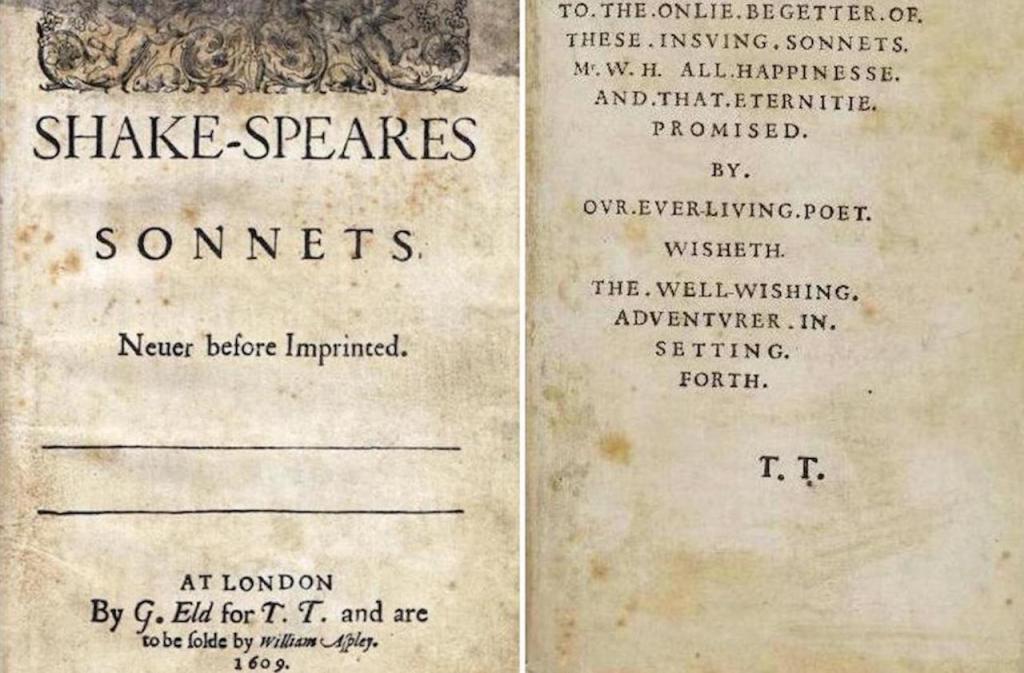
    Image: Shake-speares Sonnets Hank Whittemore’s Shakespeare Blog

    Introduction to the Shakespeare 154-Sonnet Sequence

    The Shakespeare 154-sonnet sequence offers a study of the mind of the poet.   The first 17 have a speaker persuading a young man to marry and produce lovely offspring.  Sonnets 18–126 address issues relating to talent and art creation. The final 28 explore and lament an unhealthy romance.

    Commentaries on the Shakespeare 154-Sonnet Sequence

    My Shakespeare sonnet commentaries are being offered to assist beginning poetry readers and students in understanding and appreciating the Shakespeare sonnet sequence.  Because I argue alongside the Oxfordians regarding the identity of “William Shakespeare,” some of my commentaries on the sonnets include information related to the Shakespeare writer as Edward de Vere, 17th Earl of Oxford.  

    However, consideration of the poet’s biography remains only one small factor in understanding and appreciating his art, especially the sonnets.  The sonnets’ messages are what they are regardless of the biography of who wrote them.   The “Shakespeare” identity is not the only issue with which I take exception to traditional Shakespeare studies.  

    I do not agree with the traditional view that sonnets 18–126 focus on a “fair youth.” I will show that in most of that group of sonnets there is no person at all, much less a “fair youth” or young man.

    I assert instead that those sonnets put on display the theme of the poet’s relationships with his muse, with his own heart and mind, with his art—including his doubts and fears regarding his ability to maintain and perfect his writing abilities.

    The Sonnet Sequence

    Some online Shakespeare sonnet enthusiasts have divided the 154 sequence into two thematic categories:  “The Fair Youth Sonnets” (1–126) and “The Dark Lady Sonnets” (127–154).  Such a categorization remains problematic because there is a distinct change of subject matter from the first section 1-17 to the second 18–126.

    In the first section of sonnets 1–17, the speaker is clearly imploring a young man to marry and procreate; in the second section 18–126, the speaker remains highly contemplative as he muses upon his considerable talent.

    The only feature that the first two categories have in common would be a “fair youth”; however, it is a misinterpretation that assigns a “fair youth” to sonnets 18–126.  As I mentioned above, in most of that group of sonnets there is no person at all.

    In opposition to the two category theory, a number of scholars and critics of Elizabethan literary studies have categorized the Shakespeare 154-sonnet sequence into three thematic groups:

    1.  Marriage Sonnets: 1–17    (17 total)
    2.  Fair Youth Sonnets: 18–126 (109 total)
    3.  Dark Lady Sonnets: 127–154 (28 total)

    Sonnets 1–17:  The Marriage Sonnets

    The group labeled the “Marriage Sonnets” stars a speaker, attempting to persuade a young man to marry and produce beautiful children.  Oxfordians, who hold that the actual Shakespeare writer was Edward de Vere, 17th Earl of Oxford, suggest that the young man is probably Henry Wriothesley, the third Earl of Southhampton and that the speaker of sonnets 1–17 is striving to convince the young earl to marry Elizabeth de Vere, the eldest daughter of Edward de Vere.

    Sonnets 18–126:  The Fair Youth Sonnets

    By tradition, the “Faith Youth Sonnets” are interpreted as further entreaties to a young man.  However, there is no young man in these sonnets; there are no persons at all in that group of sonnets.  Even though sonnets 108 and 126 do address a “sweet boy” or “lovely boy,” they  remain problematic and are likely miscategorized.  

    The Category “Muse Sonnets” Replaces the “Fair Youth Sonnets”

    Instead of speaking directly to a young man, as the “Marriage Sonnets” quite obviously do, the speaker in sonnets 17–126 is musing on, examining, and exploring issues of writing, thinking, and making poetry.  In some of the sonnets, the speaker addresses his muse,  and in others, his talent, and in still others, he is speaking  directly to the sonnet itself. 

    The speaker in sonnet after sonnet is exploring the entire territory of his talent, his dedication to writing and the power of his heart and soul.  He even goes into battle with the bane of a writer’s existence—periods of low inspiration for creating. He also struggles with the ennui and dryness that the writing experience undergoes.

    The result of my understanding and interpretation of this “Fair Youth” category offers a very different line of thinking from the traditionally received position of this issue.  I have, therefore, relabeled the category the “Muse Sonnets”—replacing the traditional “Fair Youth Sonnets.”

    The motive for the continued labeling the bulk of the Shakespeare sonnets “Fair Youth” likely rests with the social justice movement in rehabilitation of the same-sex orientation.  Finding evidence of homosexuality in long respected writers and artists has become a cottage industry, especially for the statist-leaning, higher education system.

    While a number of academics have bloviated in the direction of finding of Shakespeare was “gay,” others have convincingly debunked the notion.  Interestingly, those who favor the gay Shakespeare use the “Fair Youth” sonnets as their main supporting evidence.

    Also interestingly, the debunking of the notion of same-sex orientation in “Shakespeare” would be much easier if those critics assumed the real “Shakespeare” to be Edward de Vere, whose biography is known and well documented, while that of the traditional “Shakespeare,” Gulielmus Shakspere of Stratford, remains rather thin and sketchy.

    Sonnets 127–154:  The Dark Lady Sonnets

    The “Dark Lady” sonnets offer an exploration of an adulterous relationship with a woman who possesses an unsavory character.  The term “dark” is describing the woman’s shady character flaws, rather than the shade or hue of her complexion.

    Six Problematic Sonnets: 108, 126, 99, 130, 153, 154

    Sonnets 108 and 126 offer a different kind of categorization issue.   Most of the “Muse Sonnets” are speaking to writing issues, wherein the speaker examines his talent, dedication, and other issues relating to his artist skills.  There are no other human beings in most of these muse sonnets.

    However, sonnets 108 and 126 do address a young man, calling him “sweet boy” and “lovely boy.” And then poem 126 is not technically a “sonnet.” It plays out in six rimed couplets, not the traditional sonnet form with three quatrains and one couplet.

    The possibility remains that sonnets 108 and 126 have helped cause the misnaming of this group of sonnets as the “Fair Youth Sonnets.”  Those poems should logically reside with the “Marriage Sonnets,” which do address a young man.  

    Sonnets 108 and 126 could also be responsible for some scholars categorizing the sonnets into two groups, instead of three—combining the “Marriage Sonnets” with the “Fair Youth Sonnets” and naming them the “Young Man Sonnets.”  

    However, the two category alternative remains flawed because the bulk of the “Fair Youth Sonnets” do not address a young man, nor do they address any person, except on occasion as the speaker addresses himself. 

    Sonnet 99 contains 15 lines, instead of the traditional sonnet form with 14 lines.  The first quatrain expands to a cinquain, converting its rime scheme from ABAB to ABABA.  The rest of the sonnet continues traditionally, following the rime, rhythm, and function of the traditional sonnet.

    Although sonnet 130 “My mistress’ eyes are nothing like the sun” is grouped with the “Dark Lady” subsequence, it seems to prove an anomaly because in many of the others in this group the lady does not merit such positive effusions as offered in the speaker’s claim that his “love” for her is rare.  

    The “Dark Lady” sonnets explore the negative results of unchecked lust, while the execution of sonnet 130 takes for its purpose the criticism of hyperbolic displays that idealize cosmetic beauty.  This speaker remains consistent in his striving for truth as well as his striving for beauty.

    The Two Final Sonnets

    Sonnets 153 and 154 are problematic also, at least to some extent.  Although they are categorized thematically with the “Dark Lady Sonnets,” they function a bit differently from most of the poems in that thematic group.  Sonnet 154 simply features a paraphrase of sonnet 153, dramatizing identical messaging—the complaint of unrequited love.  

    Those two final sonnets then decorate that complaint with the tinsel of mythological allusion.  The speaker alludes to the force of Cupid, the Roman god of love and the power of the goddess Diana.  

    The speaker thereby maintains a secure distance from his feelings.  He possibly hopes such distancing may liberate him from the oppression of his lust and then re-establish for him the harmonious balance of mind and heart.

    In the majority of the “Dark Lady Sonnets,” the speaker has continued to offer a monologue to the woman, making it clear that he intends for her to hear about that which he is complaining.  

    Finally, in the two concluding sonnets, the speaker is no longer addressing the dark lady.  He does mention her, but instead of speaking directly to her, he is declaiming about her.  He is employing this strategy to engage and demonstrate that he is withdrawing from the woman and her unsavory mannerisms.

    The conclusion of this sequence seems to be dramatizing the fact that the speaker has become disillusioned by and weary from his battle for this disagreeable woman’s love, affection, and respect.

    The speaker concludes that he is determined to fashion a high-principled, classic,  dramatic statement to put an end to this ill-omened relationship, with an unmistakeable  pronouncement that he is finished, it is over, he is through.

    Image: Edward de Vere, 17th Earl of Oxford-The Writer of the Shakespeare Canon
  • Phillis Wheatley’s “An Hymn to the Morning”

    Phillis Wheatley’s “An Hymn to the Morning”

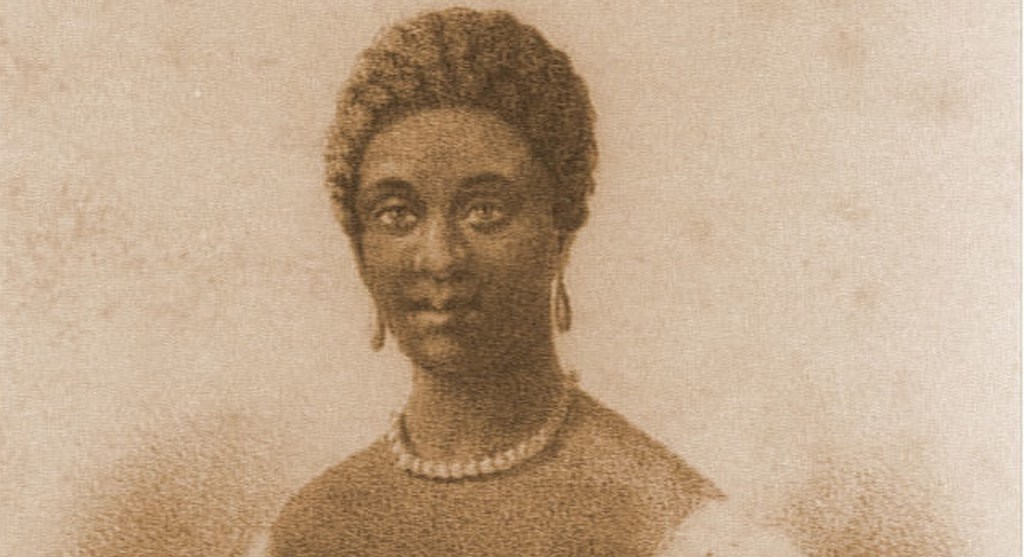
    Phillis Wheatley was influenced by Greek and Roman classical literature, as well as by early 18th century British poets, who were also influenced by that same literature.

    Introduction and Text of “An Hymn to the Morning”

    Phillis Wheatley’s talent was recognized by George Washington, who became a fan of the poet.  Wheatley’s verse has earned her the status of a first class American poet, whose style resembles the great British poets, who were also influenced by the classical literature of the early Greeks and Romans.

    Phillis Wheatley’s poem “An Hymn to the Morning” consists of ten riming couplets, separated into two quatrains (first and fourth stanzas) and two sestets (second and third stanzas).

    An Hymn to the Morning

    Attend my lays, ye ever honour’d nine,
    Assist my labours, and my strains refine;
    In smoothest numbers pour the notes along,
    For bright Aurora now demands my song.

    Aurora hail, and all the thousand dies,
    Which deck thy progress through the vaulted skies:
    The morn awakes, and wide extends her rays,
    On ev’ry leaf the gentle zephyr plays;
    Harmonious lays the feather’d race resume,
    Dart the bright eye, and shake the painted plume.

    Ye shady groves, your verdant gloom display
    To shield your poet from the burning day:
    Calliope awake the sacred lyre,
    While thy fair sisters fan the pleasing fire:
    The bow’rs, the gales, the variegated skies
    In all their pleasures in my bosom rise.

    See in the east th’ illustrious king of day!
    His rising radiance drives the shades away—
    But Oh! I feel his fervid beams too strong,
    And scarce begun, concludes th’ abortive song.

    Commentary “An Hymn to the Morning”

    Phillis Wheatley was influenced by Greek and Roman classical literature, as well as by early 18th century British poets, who were also influenced by that same literature.

    First Quatrain:  Invocation to the Muses

    Attend my lays, ye ever honour’d nine,
    Assist my labours, and my strains refine;
    In smoothest numbers pour the notes along,
    For bright Aurora now demands my song.

    As the early 18th century poets such as Alexander Pope did, the speaker of Wheatley’s poem addresses the nine muses, asking them to guide her hand, heart, and mind as she composes her song.

    The nine muses are the goddesses who guide and guard the various arts and sciences: Cleo (heroes), Urania (astronomy), Calliope (music), Melpomene (tragedy), Euterpe (lyric poetry), Erato (love), Terpsichore (dance), Thalia (comedy), and Polyhymnia (sacred hymns). 

    Then the speaker says that dawn, “Aurora” or goddess of dawn, is motivating her to write her song dedicated to the goddess of morning, and the speaker wants the song to flow smoothly like a gentle brook, so she asks the muses to “pour the notes along.”  The speaker want to be sure her song is worthy of being dedicated to the important morning deity. 

    First Sestet:  Honoring Dawn’s Arrival

    Aurora hail, and all the thousand dies,
    Which deck thy progress through the vaulted skies:
    The morn awakes, and wide extends her rays,
    On ev’ry leaf the gentle zephyr plays;
    Harmonious lays the feather’d race resume,
    Dart the bright eye, and shake the painted plume.

    As morning approaches, the stars recede from view, and the speaker asks the muses to help her honor dawn’s victory of arrival. The speaker describes the morning’s sun with its far-reaching rays of light. She observes that the light is falling on every leaf, and a gentle breeze is playing upon them. 

    The humble speaker pays homage to the songs of the birds as she describes their singing as “harmonious,” and she notes that as the birds are looking around, their eyes are darting about, and they are shaking their feathers as they wake up. 

    Second Sestet:  Playful Foregrounding

    Ye shady groves, your verdant gloom display
    To shield your poet from the burning day:
    Calliope awake the sacred lyre,
    While thy fair sisters fan the pleasing fire:
    The bow’rs, the gales, the variegated skies
    In all their pleasures in my bosom rise.

    The speaker bids the trees to “shield your poet from the burning day.” She is over-emphasizing a bit, calling the shade of the trees, “verdant gloom.” The playful comparison moves in service of  foregrounding the sun’s brightness as well as the colorful morning’s sun rise. 

    She addresses Calliope, the muse of music, to play upon the lyre, while her sisters, the other muses, “fan the pleasing fire.” Fanning fire makes it burn brighter, and she is celebrating the rising sun that becomes warmer and brighter as it becomes more visible. The little drama is pleasing the poet as she composes. 

    Second Quatrain:  Light into the Darkness

    See in the east th’ illustrious king of day!
    His rising radiance drives the shades away—
    But Oh! I feel his fervid beams too strong,
    And scarce begun, concludes th’ abortive song.

    The speaker thinks of leafy alcoves, and gentle breezes, and the sky with its many colors of purple, pink, orange stretching across the vast panorama of blue, and these things give her much pleasure. Then she suddenly exclaims, “look! the sun!,” to whom she refers as the “king of day.”

    As the sun rises, all darkness has gradually faded away. The radiance of the sun inspires the speaker so immensely, but then she feels something of a let down: “But Oh! I feel his fervid beams too strong, / And scarce begun, concludes th’ abortive song.”  As soon as the sun has fully arrived, then the morning is gone, and her song was celebrating morning, and thus the song must end.

  • James Weldon Johnson’s “Sence You Went Away”

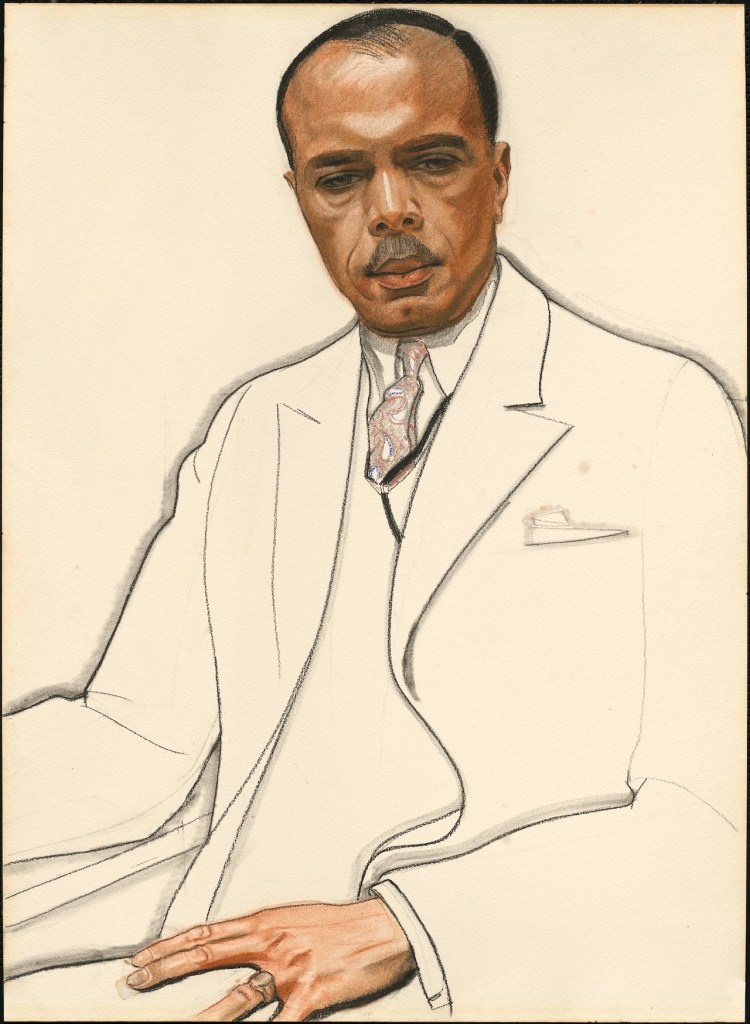
    Image:  James Weldon Johnson – Drawing – Winold Reiss

    James Weldon Johnson’s “Sence You Went Away

    In addition to poetry, James Weldon Johnson also composed many songs that have become popular.  His bluesy poem/song “Sence You Went Away” features a southern dialect and captures the melancholy that surrounds the individual who has lost a loved one.

    Introduction and Text “Sence You Went Away”

    James Weldon Johnson’s “Sence You Went Away” creates a speaker/singer who bemoans the loss of a loved one. The poem/song consists of four stanzas, each with the rime scheme AAAB, wherein the final line constitutes the refrain in which the speaker reveals the reason for his melancholy. 

    The repetition of “seems lak to me” and “sence you went away” emphasizes the pain and sorrow the speaker is experiencing.  The refrain becomes a chant-like repetition as he progresses through his report of all that is making him sad.  And he is addressing his expressions of sorrow to the individual, who is now absent from his life.

    As a poem this works quite well, and as a song it works even more nicely.  The poem/song’s use of dialect gives it an authenticity that increases the communication of pain and sorrow.  The speaker/singer incorporates and inflicts his sorrow on the world around him, while at the same time making it clear that these transformations are happening within himself.

    Sence You Went Away

    Seems lak to me de stars don’t shine so bright,   
    Seems lak to me de sun done loss his light,   
    Seems lak to me der’s nothin’ goin’ right, 
          Sence you went away. 

    Seems lak to me de sky ain’t half so blue,  
    Seems lak to me dat eve’ything wants you,   
    Seems lak to me I don’t know what to do, 
          Sence you went away. 

    Seems lak to me dat eve’ything is wrong,  
    Seems lak to me de day’s jes twice ez long,   
    Seems lak to me de bird’s forgot his song, 
          Sence you went away. 

    Seems lak to me I jes can’t he’p but sigh,   
    Seems lak to me ma th’oat keeps gittin’ dry,   
    Seems lak to me a tear stays in ma eye, 
          Sence you went away.

    Commentary on “Sence You Went Away”

    James Weldon Johnson, an accomplished poet, also composed many songs that have become quite popular. His bluesy “Sence You Went Away” features a southern dialect.  Johnson was a Southerner, having been born in 1871 and raised in Jacksonville, Florida, only relocating to New York in 1901.

    First Stanza:  Expressing Sorrow

    Seems lak to me de stars don’t shine so bright,   
    Seems lak to me de sun done loss his light,   
    Seems lak to me der’s nothin’ goin’ right, 
          Sence you went away. 

    The speaker is addressing an individual, who is likely a former lover or very good friend.  The speaker expresses his sorrow by reporting that both the sun and stars do not seem to be shedding light now because of the absence of the addressee.  The reader/listener learns nothing about the person who has gone away, only that the speaker’s life has been adversely affected by the loved one’s absence. 

    Not only do the speaker’s eyes seem no longer to perceive light, but he also feels that nothing in his life is proceeding correctly.  He makes it clear that he is not asserting that the world itself has changed; he is merely revealing how things “seem” to him as he repeats throughout the poem, “seems lak to me,” that is, “seems like to me.”

    Second Stanza:   Absence of Sun

    Seems lak to me de sky ain’t half so blue,  
    Seems lak to me dat eve’ything wants you,   
    Seems lak to me I don’t know what to do, 
          Sence you went away. 

    The absence of sun and starlight affect the shade of the blue sky, which is now presenting itself as only “half” its normal shade.  Everything reminds him that he is missing his belovèd. It even appears that everything he sees and does yearns to have this individual back in its purview.

    The speaker’s intense exaggeration emphasizes his desire for the return of his missing loved one.  Everywhere he looks he sees merely an absence that causes him pain and suffering.  He even confesses that he feels unable to decide what he should be doing, if anything at all.

    Third Stanza:  Nothing Is Right

    Seems lak to me dat eve’ything is wrong,  
    Seems lak to me de day’s jes twice ez long,   
    Seems lak to me de bird’s forgot his song, 
          Sence you went away. 

    Again, the speaker/singer asserts that nothing seems right for him anymore; thus, he feels that “ev’ything is wrong.” And he reveals that time seems to lag because of his sorrow.  Pain and suffering cause the human mind and heart to feel time as an oppressor, and that kind of oppression makes minutes seem like hours and days like weeks.

    Nature in the form of singing birds is lost on him, and he thus suggests that those birds have even forgotten to sings. His melancholy grays out all of his senses, especially seeing and hearing. Life has lost its luster, light has escaped him, and even pleasant sounds are no longer detectable.  And still again, he repeats the reason for his feeling that everything is so wrong in his life.

    Fourth Stanza:  Fog of Sorrow

    Seems lak to me I jes can’t he’p but sigh,   
    Seems lak to me ma th’oat keeps gittin’ dry,   
    Seems lak to me a tear stays in ma eye, 
          Sence you went away.

    Finally, the speaker reveals his own behavior has been influenced by the sad fact that the addressee has gone away.  He cannot seem to stop sighing, and his throat dries up.  He also continue to weep, as he endures the pain of loss. 

    His physical functions are out of kilter: what needs to be wet is dry, and what needs to be dry is wet.  The speaker’s world has transformed into a melancholy fog of sorrow and disorientation—all because his belovèd has gone away. 

    Kris Delmhorst’s Musical Version of Johnson’s Lyric

    There are extant several different musical versions of James Weldon Johnson’s lyric “Sence You Went Away.”  I suggest that Kris Delmhorst’s rendition fits perfectly with the sentiment and atmosphere of that lyric.  While the other versions are entertaining and well-done, Delmhorst’s version and her singing remain the best in accomplishing the task of capturing the exact feeling of Johnson’s lyric.

    Kris Delmhorst singing her version of Johnson’s “Sense You Went Away”  

  • Robert Frost’s “Stopping by Woods on a Snowy Evening”

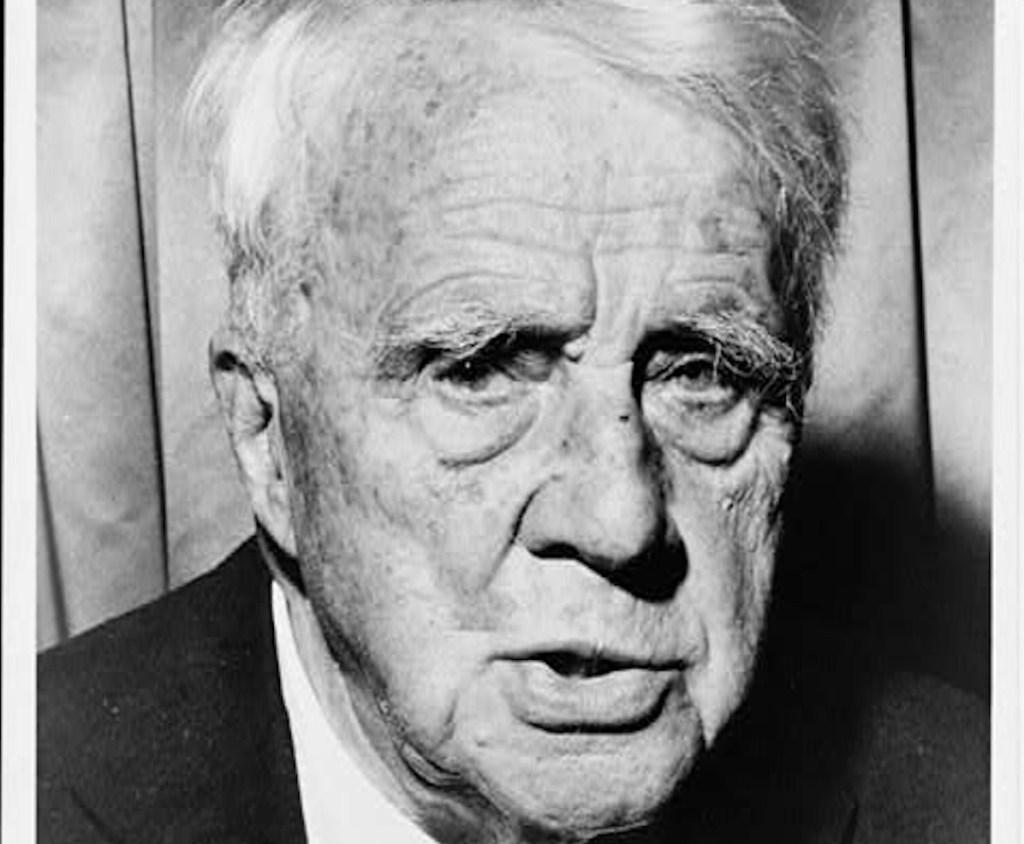
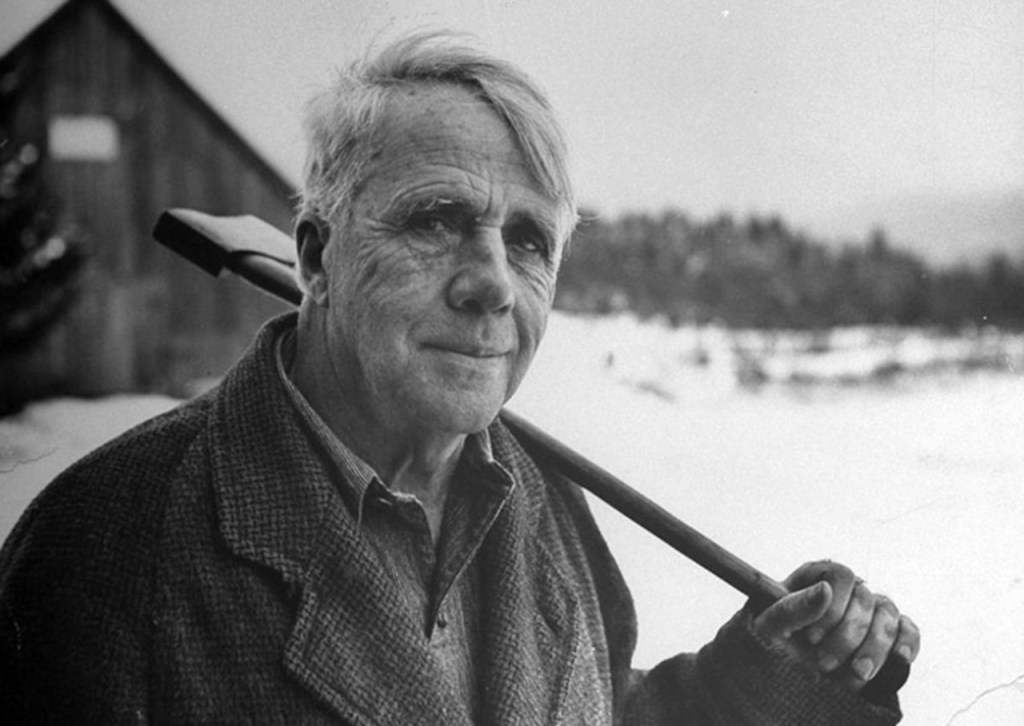
    Image: Robert Frost – Library of Congress

    Robert Frost’s “Stopping by Woods on a Snowy Evening”

    Robert Frost’s “Stopping by Woods on a Snowy Evening” seems simple, but its repeated phrase, “And miles to go before I sleep,” offers room for speculation.  Many of Frost’s poems present a tricky element, as he quipped about “The Road Not Taken” being “very tricky.”

    Introduction with Text of “Stopping by Woods on a Snowy Evening”

    The beloved American poet, Robert Frost, wrote many “tricky poems.” Frost has even quipped that his “The Road Not Taken” is a “very tricky poem.” One might wonder if he also thought that many of his other poems are tricky.  Chiefly because of the final repeated line, his “Stopping by Woods on a Snowy Evening” may also be considered a highly tricky poem.

    The main event of the poem remains uncomplicated: a man has paused his trek home  and sits by a woodland viewing the scene as the snow is piling up in the woods.  And the man’s thoughts as he continues to view the scene and what he expresses as he watches may suggest many questions regarding his thoughts and musings. 

    The speaker’s audience then must remain curious about the speaker’s reasons for stopping to muse: was it only to watch the snow filling up the woods?  Why does he think his stopping is “queer”—a qualification he projected onto his horse?  Why does he care if the owner of the woods would see him?

    The questions raised are only suggested in the speaker’s report but never answered.  Although the poem is very simple and uncomplicated without even the use of a literary device such as metaphor, it encourages much speculation. 

    Then too, a further puzzlement might be: what seemed to cause him to return to his ordinary consciousness from his trance-like musing on the loveliness of snow piling up in the woods?

    Although critics who have interpreted the notion of suicide from the last repeated line can offer nothing concrete for such a bizarre reading,  still that repetition may suggest something other than its literal claim.  Readers are, of course, free to speculate about the difference in meanings of the repeated line, but at the same time they can still enjoy the simple beauty of the poem.

    Stopping by Woods on a Snowy Evening

    Whose woods these are I think I know. 
    His house is in the village though; 
    He will not see me stopping here  
    To watch his woods fill up with snow.   

    My little horse must think it queer   
    To stop without a farmhouse near   
    Between the woods and frozen lake   
    The darkest evening of the year.   

    He gives his harness bells a shake   
    To ask if there is some mistake.
    The only other sound’s the sweep   
    Of easy wind and downy flake.  

    The woods are lovely, dark and deep,   
    But I have promises to keep,   
    And miles to go before I sleep,   
    And miles to go before I sleep.

    Reading


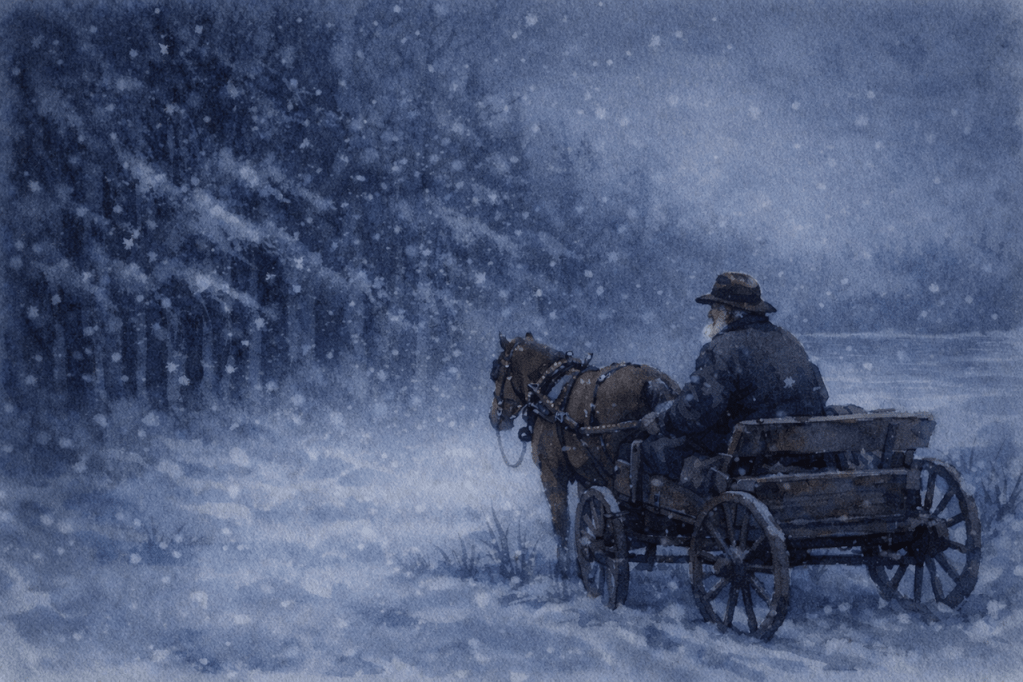
    Image: “Musing on a Snowy Evening” – Created by ChatGPT – Titled by Linda Sue Grimes

    Commentary on “Stopping by Woods on a Snowy Evening”

    One of his tricky poems, Robert Frost’s “Stopping by Woods on a Snowy Evening” seems simple, but the repetition of its nuanced phrase, “And miles to go before I sleep,” offers room for interpretation.

    Stanza 1: The Reason for Stopping

    Whose woods these are I think I know. 
    His house is in the village though; 
    He will not see me stopping here  
    To watch his woods fill up with snow. 

    Robert Frost’s simple poem, “Stopping by Woods on a Snowy Evening,” offers an uncomplicated scene wherein a man who was riding a horse pauses his ride by the roadside near a wooded area to observe as the snow is falling and piling up in the woods.

    The poem is executed without extensive figurative language and literary devices such as metaphor and metonymy.  However, the speaker’s claims do herald questions as noted in the introduction.

    One is likely to wonder if the speaker would not have stopped if he thought the owner of the land would see him.  Because the speaker mentions that fact, the listener cannot help but wonder why.

    Stanza 2:  The Horse Thinks What the Man Thinks

    My little horse must think it queer   
    To stop without a farmhouse near   
    Between the woods and frozen lake   
    The darkest evening of the year.   

    The speaker then reports what he thinks his horse thinks:  he claims that his horse must be thinking it an odd thing to be stopping before reaching home, and equally strange that the man would want to stop beside a woodland and lake while it is becoming dark outside.

    The speaker suggests that the time of year is around December 22, the shortest day of the year and the beginning of winter in the Northern Hemisphere.  That is the reason it is “the darkest evening of the year.”

    It is obvious that it is the speaker himself who thinks his behavior is odd, stopping in the cold, dark winter weather to watch snow falling in a woods.  That he projects his thoughts onto his “little horse” is, of course, merely a ruse that dramatizes his own actions.

    Stanza 3: Soft Breezes and Flaky Snow

    He gives his harness bells a shake   
    To ask if there is some mistake.
    The only other sound’s the sweep   
    Of easy wind and downy flake.  

    In stanza 3, the speaker reveals that he thinks the horse has deemed this stopping as odd because the horse is shaking his head and rattling his harness.  The speaker continues to speculate about what the horse thinks; this time he suggests that his horse thinks he made a “mistake.”  Such speculation about the cogitation of a horse actually becomes rather comical.

    It has become quite clear that all of the thoughts the speaker has speculated about what the horse thinks is simply what the speaker himself is thinking.  He seems to want to suggest that this stopping to watch snow filling up a woods is somehow unseemly or at least “queer”—in the original definition of the term.

    The speaker then notices that other than the rattling of the horse’s harness it is utterly quiet with the only sound he hears being the wind gently blowing as the snowflakes whirl around and into the woodland.

    Stanza 4: Many Miles to Keep Promises

    The woods are lovely, dark and deep,   
    But I have promises to keep,   
    And miles to go before I sleep,   
    And miles to go before I sleep.

    In stanza 4,  the speaker paints the only pictorial details about what he is viewing, as he reports that the woodland is “lovely, dark and deep.”  The bulk of the poem simply offers speculation about who might have seen him and what his little horse may be thinking.  

    Finally, the speaker ends his musing by claiming that he has made promises, and he must keep them.  He must still be a fairly great distance from his residence as he claims that he has miles yet to travel before he can “sleep.”  Those final three lines, actually, state the reason that the speaker must cease his musing on the beauty and quiet of the woodland and continue on with he journey back home.

    But the claim that he “has miles to go before [he] sleep[s]” because it is repeated offers room for interpretation.  Perhaps the second repetition has a different meaning from the first, or just perhaps that is the only way to end poem.

    The Rime Scheme

    It is quite likely that the final repetition has no further meaning from it first iteration.  The rime scheme that the poet has crafted simply offers no way out of the poem except to repeat the line:  AABA BBCB CCDC DDDD.

    Notice that the poet has taken the last word in the third line of the first stanza—”here”—and rimed it with last word in the first—”queer,” second—”near,” and fourth—”year” lines in the second stanza.

    He then repeats that scheme until the end of the poem.  In theory, he could have continued down through the entire alphabet. With such a connected system of riming, there is no useful, harmonious way to end the poem, except the way he actually did.

    Perhaps merely stopping is a option but not as graceful, and too, by the repetition in this particular poem, because of the subject matter, the repetition adds a nuance of meaning, promulgating the suggestion that the first part of the repetition has a different meaning form the second.

    Repeated Line Open to Interpretation

    By repeating the line, “And miles to go before I sleep,” the speaker has crafted an intriguing curiosity that cannot be mollified by the reader, scholar, critic, or commentarian.   The poem offers no support for the idea that the speaker is suggesting he might be thinking about suicide.  That interpretive speculation is overly melodramatic.  

    However, the speaker seems to awaken from a trance-like musing as he watches the snow piling up in the woods, and it does remain unclear what caused him to wake up from that dream-like musing. As laid out in the introduction, the piece does herald questions without providing any concrete answers.

    Because these questions are not answered by the speaker of the poem, but also because Robert Frost called his poem, “The Road Not Taken,” “a tricky poem,” readers may possibly speculate that Frost held that his “Stopping by Woods on a Snowy Evening” was also a “very tricky poem.” 

    Ultimately, answers to those questions do not matter.  The poem offers a serene scene of a man observing nature and then moving on.  The meaningful beauty of the poem, one might argue, is in the lack of details and how a consummate poet can create a stunning, impressive piece of art based on such simplicity.

    Image:  Robert Frost – Library of Congress

  • Robert Frost’s “The Road Not Taken”

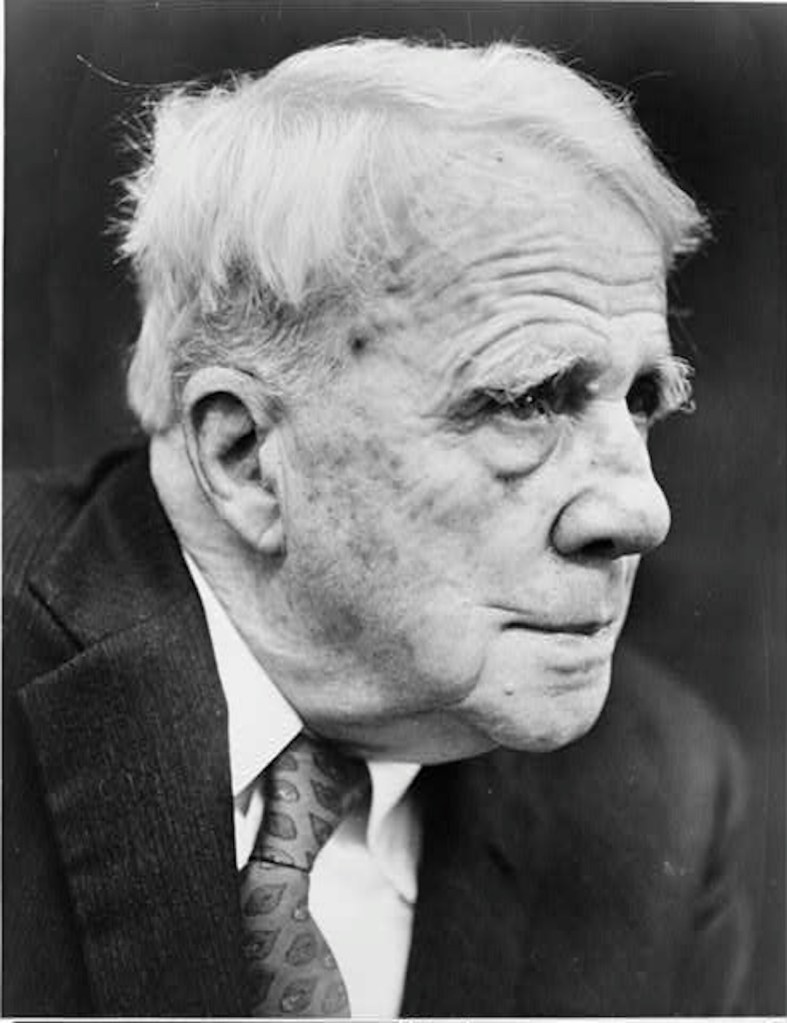
    Image:   Robert Frost in 1943

    Robert Frost’s “The Road Not Taken”

    Robert Frost’s “The Road Not Taken” is often misinterpreted; it does not encourage nonconformity.  It dramatizes the difficulty of making choices and then living with the consequences. 

    Introduction with Text of “The Road Not Taken”

    Robert Frost’s “The Road Not Taken” has been one of the most anthologized, analyzed, and quoted poems in American poetry.   It has also remained one of the most misunderstood and thus misinterpreted poems in the English language.

    Published in 1916 in Robert Frost’s poetry collection titled, Mountain Interval, the poem has since been interpreted primarily as piece that prompts non-conforming behavior, a philosophy of the efficacy of striking out on one’s own, instead of following the herd.  Thus the poem is often quoted at commencement ceremonies.  However, a close look at the poem reveals a different focus.

    Instead of offering a moralizing piece of advice, the poem merely demonstrates how memory often glamorizes past choices despite the fact that the differences between the choices were not so great.  It also shows how the mind tends to focus on the choice one had to abandon in favor of the one selected.

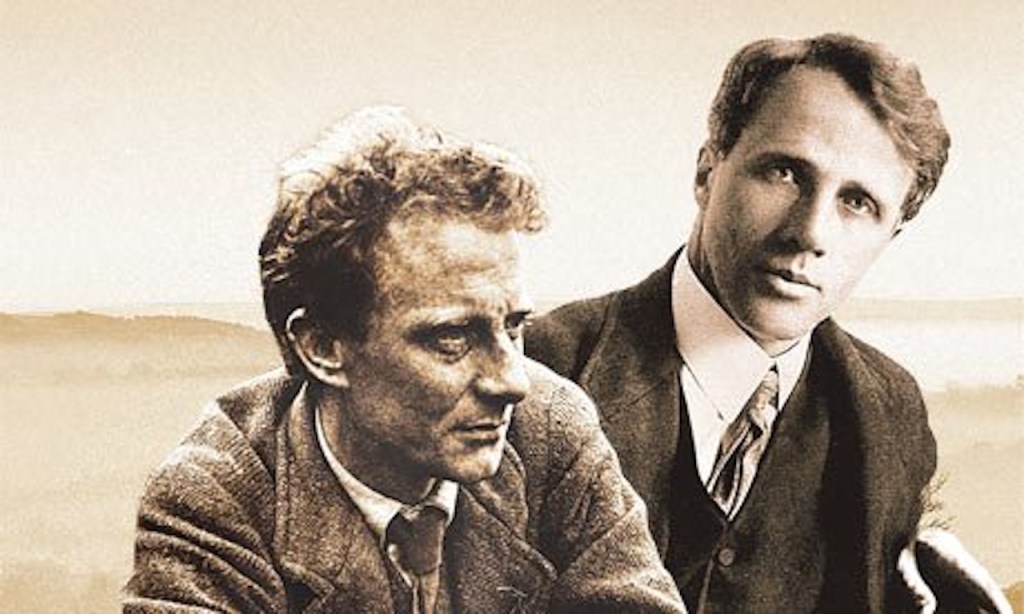
    Edward Thomas and “The Road Not Taken”

    Robert Frost lived in England from 1912 to 1914; he became fast friends with fellow poet Edward Thomas.  Frost has explained that “The Road Not Taken” was prompted by Thomas, who would continue to fret over the path the couple could not take as they were out walking in the woods near their village.

    The Road Not Taken

    Two roads diverged in a yellow wood,
    And sorry I could not travel both
    And be one traveler, long I stood
    And looked down one as far as I could
    To where it bent in the undergrowth;

    Then took the other, as just as fair,
    And having perhaps the better claim,
    Because it was grassy and wanted wear;
    Though as for that the passing there
    Had worn them really about the same,

    And both that morning equally lay
    In leaves no step had trodden black.
    Oh, I kept the first for another day!
    Yet knowing how way leads on to way,
    I doubted if I should ever come back.

    I shall be telling this with a sigh
    Somewhere ages and ages hence:
    Two roads diverged in a wood, and I—
    I took the one less traveled by,
    And that has made all the difference.

    Robert Frost Reads “The Road Not Taken” 

    Commentary on “The Road Not Taken”

    Robert Frost called “The Road Not Taken” “very tricky.”   Some readers have not heeded his advice to be careful with this one. Thus, a misunderstanding brings this poem into places for which it is not suitable, such as graduation ceremonies, wherein the speaker has taken as his theme the efficacy of strong individualism as opposed to herd conformity.

    First Stanza:  The Decision and the Process of Deciding

    Two roads diverged in a yellow wood,
    And sorry I could not travel both
    And be one traveler, long I stood
    And looked down one as far as I could
    To where it bent in the undergrowth;

    In the first stanza, the speaker reveals that he has been out walking in the woods, and he approaches two diverging pathways; he stops and peers down each path as far as he can.  He then avers that he would like to walk down each path, but he is sure he does not have enough time to experience both.  He knows he must take one path and leave the other behind, and so he commences his decision making process.

    Second Stanza:  The Reluctant Choice

    Then took the other, as just as fair,
    And having perhaps the better claim,
    Because it was grassy and wanted wear;
    Though as for that the passing there
    Had worn them really about the same,

    After scrutinizing both pathways, he decides to start walking down the one that seems “less traveled.” He admits they were “really about the same.”  They were, of course, not exactly the same, but in reality there was not much difference between them as far as he could tell from where he stood. Both paths had been “traveled,” but he fancies that he chooses the one because it was a little less traveled than the other.

    Notice at this point how the actual choice in the poem seems to deviate from the title.  The speaker takes the road less taken, not the one “not taken,” as the title seems to suggest.  That fact was, no doubt, part of the trickiness that Frost mentioned as he discussed the genesis of this poem, calling it “very tricky.”

    The title also lends to  the moralizing interpretation.  The path not taken is the one not taken by the speaker—both roads have been taken by others, but the speaker being just one individual could take only one.

    Third Stanza:  Really More Similar Than Different

    And both that morning equally lay
    In leaves no step had trodden black.
    Oh, I kept the first for another day!
    Yet knowing how way leads on to way,
    I doubted if I should ever come back.

    Because the decision making process can be complex and lengthy, the speaker continues to reveal his thinking about the two paths into the third stanza.  But again he reports how the paths were really more similar than different.

    Fourth Stanza:  The Ambiguous Sigh

    I shall be telling this with a sigh
    Somewhere ages and ages hence:
    Two roads diverged in a wood, and I—
    I took the one less traveled by,
    And that has made all the difference.

    In the final stanza, the speaker projects how he  will look back on his decision in the distant future.  He surmises that he will remember taking a “less traveled” road, and that decision “has made all the difference.”  

    The problem with interpreting the poem as advice for individualism and non-conformity is that the  speaker is only speculating about how his decision will affect his future.  He cannot know for certain that his decision was a wise one, because he has not yet lived it.  

    Even though he predicts that he will think it was a positive choice when he says, it “made all the difference,” a phrase that usually indicates a good difference, in reality, he cannot know for sure.  

    The use of the word “sigh” is also ambiguous.  A sigh can indicate relief or regret——two nearly opposite states of mind.  Therefore, whether the sigh comports with a positive difference or negative cannot be known to the speaker at the time he is musing in the poem.  He simply has not lived the experience yet.  

    “Tricky Poem”

    Frost referred to this poem as a tricky poem, and he admonished readers “to be careful of that one.” He knew that human memory tends to gloss over past mistakes and glamorize the trivial.   He also was aware that a quick, simplistic perusal of the poem could yield an erroneous understanding of it.  

    The poet also has stated that this poem reflects his friend Edward Thomas’ attitude while out walking in the woods near London, England.  Thomas continued to wonder what he might be missing by not being able to walk both paths, thus the title’s emphasis on the road “not taken.”

    “Road” as a Symbol for Life’s “Path”

    In this commentary, readers may notice that I have used the term “path” instead of road in most the references to that entity in the poem.  The poem begins by placing the speaker in a “yellow wood.” Thus, the speaker has encountered two different pathways through the wood because it more likely that a wood has paths (pathways) than roads.  Paths are for walking; roads are for vehicle traffic.  

    Thus, I suggest that the speaker is employing the term “road” as a symbol of one’s pathway through life——not a a literal road in a wood. Even though the speaker had used the term “travel” in the opening lines, he later limits that mode of travel to foot travel when he says, “long I stood” and later, “In leaves no step had trodden black.” He “stood” because he had been walking.  And “step had trodden black” refers to the condition of the leaves having been walked upon. 

    Image:  Robert Frost and Edward Thomas 

  • Emily Dickinson’s “The Soul selects her own Society”

    Image: Emily Dickinson – Amherst College – Daguerrotype of the poet at age 17, circa 1847 – likely the only authentic, extant likeness of the poet

    Emily Dickinson’s “The Soul selects her own Society”

    Emily Dickinson’s “The Soul selects her own Society” portrays the nature of individual self-sufficiency, spiritual power, and the deliberate choice of isolation over social engagement.  The result is a positive statement that the strength of the soul remains ascendent, despite a world of chaos.

    Introduction and Text of “The Soul selects her own Society”

    In only three innovative quatrains, Emily Dickinson’s poem, “The Soul selects her own Society,” reveals the power of the soul’s skill in selecting its companions and rejecting external influences.  

    This profound theme is one of many that similarly focus on issues of individuality in Dickinson’s 1775 span of poems. The poet grappled with questions of personal autonomy and the inner life by creating speakers who address those inquiries in unique, strong voices.

    Emily Dickinson’s themes, poetic techniques, as well as the cultural and philosophical contexts that inform her poems all lend heft to the notion that the poet remained steadfast in her determination to live deliberately and independently.

    The claims that Dickinson’s speaker makes about the soul’s choices illuminate this poem’s celebration of individuality, and those claims offer a subtle critique of societal pressures. This important theme can be found in a number of Dickinson’s poems. The poet continued to create speakers who share her love of privacy.

    The Soul selects her own Society –

    The Soul selects her own Society –
    Then – shuts the Door –
    To her divine Majority –
    Present no more –

    Unmoved – she notes the Chariots – pausing –
    At her low Gate –
    Unmoved – an Emperor be kneeling
    Upon her Mat –

    I’ve known her – from an ample nation –
    Choose One –
    Then – close the Valves of her attention –
    Like Stone –

    Commentary on “The Soul selects her own Society”

    Emily Dickinson’s “The Soul selects her own Society” stands as the emblematic poem for not only the poet’s entire oeuvre but also for her life choice of isolation as well.  She continued to create speakers, whose voices remain strong and unique.  Her elliptical, minimalist expressions demonstrate an economy of language use seldom experienced to such a high degree.

    First Stanza: The Soul’s Decision

    The Soul selects her own Society –
    Then – shuts the Door –
    To her divine Majority –
    Present no more –

    The first stanza establishes the soul’s autonomy and power as the target of the poem. Dickinson’s speaker is personifying the soul as a feminine being, a choice that comports with her frequent portrayal of the self as an introspective consciousness. 

    The verb “selects” remains essential in distinguishing a deliberate act of choice. Unlike passive acceptance or arbitrary selection, the soul’s decision to choose its “Society” reflects a profound exercise of individual agency and strength. 

    The capitalization of “Soul” and “Society” ennobles these terms, attesting to spiritual and metaphysical power.  “Society” indicates a selected group of companions that the soul deems worthy of its attention.

    The second line, “Then – shuts the Door,” introduces an intense metaphor of exclusion. The act of shutting the door symbolizes the rejection of all that lies outside the soul’s chosen circle. 

    This exclusionary image invokes both physical and psychological barriers, making clear that the soul’s decision is not merely a preference but instead remains a absolute act of isolation. 

    The door, a boundary between the inner and outer worlds, becomes an instrument of both inclusion and exclusion, emphasizing the soul’s desire for control over its environment.

    The phrase “divine Majority” in the third line refers to a spiritual unity, such as a divine assembly representing the will of a Higher Power, and the soul accepts that “Majority” and its divinity as evidence of its own affirmative judgment. 

    The “divine Majority” also includes tangentially certain members of the broader societal collective–family and friends–on the earth plane, implying that the soul dismisses the opinions or expectations of the masses but accepts willingly and graciously all those who understand and respect the choices of the speaker.   

    The adjective “divine” imbues this majority with a sacred quality that it must possess, if the speaker is to sanction it.  The final line, “Present no more,” reinforces the irrevocability of this decision. The soul’s chosen society is now its sole focus, and all others are rendered absent, both physically and metaphysically.

    Interestingly, the word “present” can be interpreted as either an adjective or a verb, but either interpretation results in the same meaning of the phrase in this context.  As a verb, it is a command, “Offer no more suggestions for my perusal.”   As an adjective, the speaker is making the simple statement that other than her chosen “divine Majority,” no further admittance is allowed; her group remains complete.

    Dickinson’s use of her liberal spray of dashes throughout the stanza creates a spacing  rhythm, mirroring the deliberate and measured nature of the soul’s actions. These pauses invite readers or listeners to linger on each phrase, reflecting the weight of the soul’s choices. 

    The stanza’s brevity and syntactic compression further enhance its impact, distilling complex ideas into a few carefully chosen words. By framing the soul’s selection as both an act of inclusion and exclusion, the speaker has set the stage for the poem’s expression of individualism and its consequences.

    Second Stanza: Resisting External Influence

    Unmoved – she notes the Chariots – pausing –
    At her low Gate –
    Unmoved – an Emperor be kneeling
    Upon her Mat –

    The second stanza shifts its focus from it affirmative declaration to the soul’s unwavering stance in the face of external temptations, reinforcing the theme of absolute individual sovereignty. 

    The repetition of “Unmoved” at the beginning of the first and third lines serves as a rhetorical anchor, emphasizing the soul’s emotional detachment and unchanging resolve. 

    This word choice suggests not only indifference but also a deliberate refusal to be swayed by external grandeur or authority. The soul’s ability to remain “unmoved” underscores its inner strength, positioning it as a self-sustaining entity invulnerable to worldly, earthly allure.

    The imagery of “Chariots – pausing – / At her low Gate” heralds a scene of pomp and power, seeking entry. Chariots, often associated with military might or royal processions, symbolize societal prestige and influence. 

    This chariots pausing at the soul’s “low Gate” creates a striking contrast between the grandeur of the material world-at-large and the humility of the soul’s inner mystical domain. 

    The adjective “low” suggests simplicity and humility—qualities that perfectly align with Dickinson’s speakers’ recurring portrayal of the self as unpretentious yet profoundly self-aware.  The gate, like the door in the first stanza, functions as a boundary, reinforcing the soul’s control over who may enter its realm.

    The second image of “an Emperor be kneeling / Upon her Mat” magnifies this contrast. The emperor, a figure of supreme authority, is portrayed in a position of supplication—”kneeling” on the soul’s humble mat. 

    This inversion of power dynamics is astonishing: the soul—humble, modest, and tranquil—commands the respect of even the most powerful figures.  The mat, a simple household item, further emphasizes  the soul’s unassuming nature, yet its presence in this context elevates it to a symbol of the soul’s complete sovereignty. 

    The emperor’s kneeling suggests not only deference but also a recognition of the soul’s authority, which transcends all worldly hierarchies. Dickinson’s traditional, abundant splash of dashes in this stanza furthers the pauses, mirroring the soul’s contemplative resistance. Each dash invites the reader to pause and consider the significance of the soul’s indifference to such potent symbols of power. 

    The stanza’s structure, with its parallel clauses beginning with “Unmoved,” reinforces the soul’s consistency and resolve. By juxtaposing the soul’s simplicity with the grandeur of chariots and emperors, the speaker celebrates the power of inner conviction over external splendor, a theme that resonates with the Dickinsonian broader critique of societal conformity.

    Third Stanza: The Final Choice

    I’ve known her – from an ample nation –
    Choose One –
    Then – close the Valves of her attention –
    Like Stone –

    The third stanza shifts to a personal perspective, as the speaker reveals intimate knowledge of the soul’s behavior with the phrase “I’ve known her.” This shift to the first person opens up her deep familiarity, confirming the speaker’s own experience as one who often chooses solitude over societal engagement. 

    The phrase “from an ample nation” implies a vast array of potential companions, whether individuals, ideas, or influences. The word “ample” denotes abundance, yet the soul’s choice is singular and exclusive, as it selects only “One.”  This act of choosing remains both deliberate as well as reductive, narrowing the soul’s focus to a single entity or ideal.

    The metaphor of closing “the Valves of her attention” is particularly salient. The term “Valves” introduces a mechanical image, indicating a controlled and deliberate mechanism for regulating attention.  Unlike the organic imagery of doors or gates, valves imply precision and finality, as if the soul is sealing off its consciousness with mechanical efficacy. 

    The simile, “Like Stone,” further emphasizes this irrevocability, vouchsafing an unyielding, determined state. Stone is nearly immutable and enduring, indicating that the soul’s decision is permanent and secure against change.  This image also carries a sense of weight and stillness, contrasting with the dynamic imagery of chariots and emperors in the previous stanza.

    The stanza’s brevity enhances its impact, as each line dramatically builds toward the final, evocative image of stone. The dashes keep their rhythm punctuating the lines, creating the important pauses that reflect the gravity of the soul’s withdrawal. 

    By framing the soul’s choice as selective—inclusive as well as exclusive—the speaker emphasizes the result of such individual autonomy: the soul expresses its sovereignty, and the less important connection with the broader world is exposed and laid to rest. 

    A Resolute Act of Agency

    Emily Dickinson’s “The Soul selects her own Society” is a masterful exploration of individuality, autonomy, and the consequences of deliberate isolation. Through its three quatrains, the poem traces the soul’s journey from selection to rejection to final withdrawal, each stage completed by a resolute act of agency. 

    The first stanza establishes the soul’s sovereignty through its careful selection of companions, while the second illustrates its resistance to external temptations, and the third underscores the finality of its withdrawal. 

    Dickinson’s use of vivid imagery–doors, gates, chariots, emperors, valves, and stone–creates a rich tapestry of meaning, inviting readers to contemplate the power and cost of personal choice.  The poem’s formal elements, including its concise structure, halting rhythm, and strategic use of dashes, enhance its thematic depth. 

    The dashes, in particular, serve as a stylistic hallmark, creating pauses that mirror the soul’s contemplative resolve and invite readers to engage with the text on a deeper level.

    The capitalization of key terms, such as “Soul,” “Society,” and “Majority,” imbues them with metaphysical significance, elevating the poem’s exploration of individuality to a universal plane.

    Contextually, the poem reflects Dickinson’s own life as a poet who chose solitude over societal engagement. Living in Amherst, Massachusetts, Dickinson maintained a reclusive lifestyle, corresponding with a select few while withdrawing from public life.  This personal context informs the poem’s celebration of inner conviction, as well as its acknowledgment of the isolation that such conviction entails. 

    Philosophically, the poem aligns with transcendentalist ideas of self-reliance, as espoused by contemporaries like Ralph Waldo Emerson, though Dickinson’s perspective is more introspective and less optimistic about the individual’s connection to the broader world.

    Ultimately, “The Soul selects her own Society” is a testament to Dickinson’s ability to distill complex ideas into concise, evocative verse. The poem invites readers to reflect on the nature of choice, the value of autonomy, and the delicate balance between connection and solitude. 

    By portraying the soul as a sovereign entity capable of shaping its own destiny, Dickinson’s speaker has affirmed the power of individuality while acknowledging the profound solitude that accompanies such freedom.

  • Emily Dickinson’s “There’s been a Death, in the Opposite House”

    Image: Emily Dickinson – Amherst College – Daguerrotype of the poet at age 17, circa 1847 – likely the only authentic, extant likeness of the poet

    Emily Dickinson’s “There’s been a Death, in the Opposite House”

    Emily Dickinson’s “There’s been a Death, in the Opposite House” features a glimpse at the skill of this poet as she speaks through a created character—an adult male looking back at the daunting experience of becoming aware that a neighbor had died.

    Introduction with Text of “There’s been a Death, in the Opposite House”

    The following version of Emily Dickinson’s “There’s been a Death, in the Opposite House” in Thomas Johnson’s The Complete Poems of Emily Dickinson displays the poem as the poet wrote it.  

    Some editors have tinkered with Dickinson’s texts over the years to make her poems look more “normal,” i.e., without so many dashes, capitalizations, and seemingly odd spacing, and in this poem, they convert the fifth stanza into a perfect quatrain.

    Dickinson’s poems, however, actually depend on her odd form to express her exact meaning.  Editors who tinker with her oddities fritter away the poet’s actual achievement.

    There’s been a Death, in the Opposite House

    There’s been a Death, in the Opposite House,
    As lately as Today –
    I know it, by the numb look
    Such Houses have – alway –

    The Neighbors rustle in and out –
    The Doctor – drives away –
    A Window opens like a Pod –
    Abrupt – mechanically –

    Somebody flings a Mattress out –
    The Children hurry by –
    They wonder if it died – on that –
    I used to – when a Boy –

    The Minister – goes stiffly in –
    As if the House were His –
    And He owned all the Mourners – now –
    And little Boys – besides –

    And then the Milliner – and the Man
    Of the Appalling Trade –
    To take the measure of the House –

    There’ll be that Dark Parade –

    Of Tassels – and of Coaches – soon –
    It’s easy as a Sign –
    The Intuition of the News –
    In just a Country Town –

    Reading 

    Commentary on “There’s been a Death, in the Opposite House”

    This poem offers much food for thought: Dickinson’s use of a male character and the perfidy of editors who regularize her text, as well as the events depicted in the narrative.

    Stanza 1:   The House Speaks of Death

    There’s been a Death, in the Opposite House,
    As lately as Today –
    I know it, by the numb look
    Such Houses have – alway –

    The speaker announces that he can tell that a death has occurred in the house just across the street from where he lives.  He then explains that he can tell by the “numb look” the house has, and he intuits that the death has taken place quite recently.

    Note that I have designated that the speaker is male as I call him “he.”  In stanza 3, it will be revealed that the speaker is indeed an adult male, who mentions what he wondered about “when a Boy.”   Thus it becomes apparent that Dickinson is speaking through a character she has created specifically for this little drama.

    Stanza 2:  The Comings and Goings

    The Neighbors rustle in and out –
    The Doctor – drives away –
    A Window opens like a Pod –
    Abrupt – mechanically –

    The speaker then continues to describe the scene he has observed which offers further evidence that a death has recently occurred in that opposite house.  He sees neighbors coming and going.  He sees a physician leave the house, and then suddenly someone opens a window, and the speaker claims that the person abruptly “mechanically” opens the window.

    Stanza 3:  The Death Bed

    Somebody flings a Mattress out –
    The Children hurry by –
    They wonder if it died – on that –
    I used to – when a Boy –

    The speaker then sees why the window was opened: someone then throws out a mattress.  Then gruesomely he adds that it is likely that the person died on that mattress, and the children who are scurrying past the house likely wonder if that is why the mattress was tossed out.  The speaker then reveals that he used to wonder that same thing when he was a boy.

    Stanza 4:  The Mourners Are Owned by Clergy

    The Minister – goes stiffly in –
    As if the House were His –
    And He owned all the Mourners – now –
    And little Boys – besides –

    Continuing to describe the macabre events occurring across the street, the speaker then reports seeing “the Minister” enter the house.  It seems to the speaker that the minister behaves as if he must take possession of everything even “the Mourners”—and the speaker adds that the minister also owns the “little Boys” as well.

    Stanza 5:   That Eerie Funeral Procession

    And then the Milliner – and the Man
    Of the Appalling Trade –
    To take the measure of the House –

    There’ll be that Dark Parade –

    The speaker then reports that the milliner, who will dress the body, has arrived.  Then finally the mortician, who will measure both the corpse and the house for the coffin.  The speaker finds the mortician’s “Trade” to be “Appalling.”

    The line “There’ll be that Dark Parade –” is separated from the first three lines of the stanza.  This placement adds a nuance of meaning as it imitates what will happen:  the funeral procession, “Dark Parade,” will separate from the house.  And the line departing from the rest of the stanza demonstrates that action quite concretely and literally.  (More on this below in “Regularizing Emily Dickinson’s Text”)

    Stanza 6:   Intuition Spells News

    Of Tassels – and of Coaches – soon –
    It’s easy as a Sign –
    The Intuition of the News –
    In just a Country Town –

    The speaker then finishes his description of the “Dark Parade” with its “Tassels” and “Coaches” and finally concludes by remarking how easy it is to spot a house whose residents have become mourners.  All those people and events elaborated by the speaker add up to “Intuition of the News” in the simple “Country Town.”

    The Created Character

    The poet has offered a genuine depiction of what is occurring in present time as well as what occurred in the past. And she is doing so using the character of an adult male who is looking back to his memories of seeing such a sight as a child.

    The authenticity of a woman speaking though a male voice demonstrates the mystic as well as poetic skill of this poet to put herself in the persona of the opposite sex in order to create a dramatic event. Poets, however, need not be mystically inclined to achieve this level of authenticity, but certainly not all poets can pull off such a feat.  

    For example, Langston Hughes created a mixed race character in his poem “Cross” and spoke in first person, but his depiction remains questionable as he assigned feelings to a person not of his own ethnicity based solely on stereotypes. 

    Dickinson’s character is offering insights into an event that are not limited to the observations of one sex; a little girl could make those same observations.   Dickinson’s reason for creating a male character to report this event remains unknown, but it is likely she simply felt a more compelling drama could be achieved if her character were a little boy.

    Regularizing Emily Dickinson’s Text

    One of the many arguments over the reclusive 19th century American poet, Emily Dickinson, includes the one directed at editors who regularize Dickinson’s idiosyncratic style—her many dashes, her seemingly haphazard capitalization, and her sometimes irregular use of spacing.

    One can sympathize with those editors who wish to make Emily Dickinson’s poems more palatable for readers, but now and then one can find instances in which the editor’s regularization has limited the poet’s meaning.  That limitation occurs in this poem, “There has been a Death, in the Opposite House.” 

    Poetry textbook editors Louis Simpson (Introduction to Poetry) and Robert N. Linscott (Selected Poems and Letters of Emily Dickinson) alter the text of this Dickinson’s poem in a way that weakens the total impact of the poem. 

    The widely noted textbook editor Laurence Perrine employed that altered form until the ninth edition of his Sound and Sense: An Introduction to Poetry, when he changed it to reflect Dickinson’s meaning more accurately, after reading my explication of the poem in The Explicator

    (Thomas Arp, Perrine’s coeditor, related to me that that change was Perrine’s last editorial decision before turning over the editorship to Arp.)

    Limiting Meaning

    That slight alteration is the omission of the empty line separating the last line of the fifth stanza from the preceding three.  That omission regularizes the stanza, resulting in a poem of six four-line stanzas.   Closing up stanza five gives the poem a uniform appearance but limits Dickinson’s meaning. 

    Considering the meaning of the line that Dickinson separated from the rest of the stanza, I suggest that she had a specific reason for the separation.  The line “There’ll be that Dark Parade” indicates that a funeral procession will soon be seen.  

    The lines preceding this one state that various persons who serve the dead will be appearing, including the “Man / Of the Appalling Trade – / To take the measure of the House.” 

    The funeral procession “that Dark Parade” will occur after the measurement of the house and will literally separate itself from the house; and Dickinson, to show this progression concretely, separated the line from the rest of the stanza, whose last word is “House.” By regularizing Dickinson’s stanza, the editors make her poem look neater, but they eliminate the special nuance of meaning that Dickinson achieved in her original.

    In Thomas H. Johnson’s The Complete Poems of Emily Dickinson, the line is not attached to the previous three, as shown above in the text of the poem.  Johnson restored Dickinson’s poems to their original forms, without intrusions that would change meaning.  

    He did make quiet changes in spelling such as “visiter” to “visitor” and repositioned misplaced apostrophes such as “does’nt” to “doesn’t.” Dickinson’s own handwritten version of the poem can be seen in R. W. Franklin’s The Manuscript Books of Emily Dickinson or on theEmily Dickinson Archive site that clearly shows the poet’s intension that the line be separated from the rest of the stanza.

  • Emily Dickinson’s “The feet of people walking home”

    Image: Emily Dickinson – Amherst College – Daguerrotype of the poet at age 17, circa 1847 – likely the only authentic, extant likeness of the poet

    Emily Dickinson’s “The feet of people walking home”

    In a uniquely dramatic way, Dickinson’s speaker reveals the simple truth that people are happier when they are on their way home.

    Introduction with Text of “The feet of people walking home”

    Emily Dickinson’s “The feet of people walking home” plays out its little drama in three octaves or eight-line stanzas.  Instead of the literal meaning of the word, “home,” this poem employs the figurative meaning as in the old hymn lyric “This World Is Not My Home.”  This Dickinson poem features highly symbolic imagery, while at times seeming to point to things of this physical world. 

    Every image works in service of supporting the claim that each human soul wears “gayer sandals” as it strides toward its permanent “home” in the abode of the Divine Creator.  Again, the Dickinsonian mysticism provides the poet’s speaker with an abundance of mystic meaning garnered from that “Bird” of hers that ventures out and returns with new melodies.

    The feet of people walking home

    The feet of people walking home
    With gayer sandals go  –
    The Crocus  – till she rises
    The Vassal of the snow  –
    The lips at Hallelujah
    Long years of practise bore
    Till bye and bye these Bargemen
    Walked singing on the shore.

    Pearls are the Diver’s farthings
    Extorted from the Sea  –
    Pinions  – the Seraph’s wagon
    Pedestrian once  – as we  –
    Night is the morning’s Canvas
    Larceny  – legacy  –
    Death, but our rapt attention
    To Immortality.

    My figures fail to tell me
    How far the Village lies  –
    Whose peasants are the angels  –
    Whose Cantons dot the skies  –
    My Classics vail their faces  –
    My faith that Dark adores  –
    Which from its solemn abbeys
    Such resurrection pours.

    Reading: 

    Commentary on “The feet of people walking home”

    In a uniquely dramatic way, Dickinson’s speaker reveals the simple truth that people are happier when they are on their way home–especially as they are making progress toward their Divine Abode.

    First Stanza:  Happier on the Way Home

    The feet of people walking home
    With gayer sandals go  –
    The Crocus  – till she rises
    The Vassal of the snow  –
    The lips at Hallelujah
    Long years of practise bore
    Till bye and bye these Bargemen
    Walked singing on the shore.

    A paraphrase of the first two lines of Dickinson’s “The feet of people walking home” might be:  People are happier when they are on their way back to the abode of the Divine Creator.  The physical earthly place called “home” serves as a metaphor for Heaven or the Divine Place where the belovèd Lord resides.  

    That “Divine Place” is ineffable, and therefore has no earthly counterpart, but for most human beings and especially for Emily Dickinson, home is the nearest thing on earth, that is, in this world to the spiritual level of being known as “Heaven.”    So according to this speaker even the shoes of people who are on their way “home” are “gayer,” happier, more peaceful, filled with delight.  

    The speaker then begins to offer support for her claim: the flower exemplified by the “Crocus” is restrained by the “snow” until it pushes up through the ground and displays it marvelous colors.   Similarly, the human soul remains restrained by maya delusion until it pushes up through the dirt of this world to reveal its true colors in God.  

    Those who have practiced meditating on the name of the Divine for many years ultimately find themselves walking and “singing on the shore” like “Bargemen,” who have come ashore after a long haul of work.

    Second Stanza:  The Value of Commodities

    Pearls are the Diver’s farthings
    Extorted from the Sea  –
    Pinions  – the Seraph’s wagon
    Pedestrian once  – as we  –
    Night is the morning’s Canvas
    Larceny  – legacy  –
    Death, but our rapt attention
    To Immortality.

    Further examples of those who are going “home” are divers for pearls who are able to “extort” those valuable commodities “from the sea.”  Again, highly symbolic is the act of diving for pearls.  The meditating devotee is diving for the pearls of love and wisdom that only the Blessed Creator provides his striving children.  

    This image is comparable to the line in the chant by Paramahansa Yogananda “Today My Mind Has Dived”:  “Today my mind has dived deep in Thee / for Thy pearls of love from my depthless sea.”  

    The metaphoric diving for pearls enlivens and strengthens the message regarding the spiritual seeker’s search for God’s wisdom and love.  In both discourses, the “sea” serves as a metaphor for the Divine.   

    The “Seraph” before getting his wings once was confined to walking, not riding in a wagon.  His wings or pinions now serve him as a useful vehicle to alleviate his need to take the shoe-leather express.  “Night” serves the “morning” as a “canvas” on which can be painted taking and giving.  

    If in dreams, the poet can see herself as a channel for providing mystic truths, she will be leaving a “legacy,” but if she has envisioned only selfish wish fulfillment, she will be committing “larceny.”   

    Therefore, as night serves morning, morning serves the soul as it allows expression to blossom.   “Death” is not the end of life, not the life of the soul, because the soul is immortal; therefore, the only purpose for death is to focus the human being’s mind on the ultimate fact of “Immortality.”  Without the duality of death vs immortality, the latter could not be grasped in the physical world on the material plane.

    Third Stanza:  Ultimate Home in Heaven

    My figures fail to tell me
    How far the Village lies  –
    Whose peasants are the angels  –
    Whose Cantons dot the skies  –
    My Classics vail their faces  –
    My faith that Dark adores  –
    Which from its solemn abbeys
    Such resurrection pours.

    The speaker now admits that she has no idea how far away the “Village” is, that is, how far or how long it will take to reach her Ultimate Home in Heaven.   But she then makes sure that her audience knows that she is indeed referring to Heaven when she asserts that Heaven’s “peasants are the angels.”  

    The souls that have already entered that Kingdom of Ineffable Reality have joined the angels.  The speaker then refers to the stars calling them “Cantons” that “dot the skies.”   The speaker is implying that the “Village” she speaks of is full of light, and the only earthly comparison is the stars in the sky.  The speaker reports that her old, established expressions have hidden themselves, as her faith remains cloistered and “solemn.”

    But from those “abbeys” of her faith, she senses that the “resurrection” of her soul is certain, as the pouring out of sunshine from a dark cloud that divides to reveal those marvelous, warm rays.

    Dickinson’s Grammar/Spelling Errors

    Some of Dickinson’s poems contain grammatical and/or spelling errors; for example, in “The feet of people walking home” in line 6,”Long years of practise bore,” she employs the British spelling—a verb form—instead of the noun form “practice,” which is actually required in this phrase.  

    Interestingly, while American English currently uses “practice” for both noun and verb, the British forms use “practice” to function as a noun and “practise” as a verb. It remains unclear why editor Thomas H. Johnson did not quietly correct that error, because he reports in the introduction to his The Complete Poems of Emily Dickinson

    I have silently corrected obvious misspelling (witheld, visiter, etc), and misplaced apostrophes (does’nt).

    However, those errors do tend to give her work a human flavor that perfection would not have rendered.

    The Metaphor of Divinity

    The impossibility of expressing the ineffable has scooped up poets of all ages.   The poet who intuits that only the Divine exists and that all Creation is simply a plethora of manifestations emanating from that Ultimate Reality has always been motivated to express that intuition.  

    But putting into words that which is beyond words remains a daunting task.   Because Dickinson was blessed with a mystic’s vision, she was able to express metaphorically her intuition that the soul of the human being is immortal, even though her sometimes awkward expressions seem to lurch forward in fits and starts.   But many of her best efforts feature the divine drama, which she often plays out in her poems.

  • Emily Dickinson’s “A Bird came down the Walk”

    Image: Emily Dickinson – Amherst College – Daguerrotype of the poet at age 17, circa 1847 – likely the only authentic, extant likeness of the poet

    Emily Dickinson’s “A Bird came down the Walk”

    Emily Dickinson’s “A Bird came down the Walk” using clever plays on words offers a keen observation, reminding listeners and readers of images which they can likely recognize.

    Introduction with Text of “A Bird came down the Walk”

    Emily Dickinson’s “A Bird came down the Walk” is one of the poet’s many fun poems loaded with clever word plays—a technique that creates a drama based on keen observation.

    The little drama functions to remind readers and listeners of images stored in memory and scenes that they have also experienced in their lifetimes.  In other words, the little fun poem is performing the primary function of any genuine poem. This Dickinson poem (#328 in Thomas H. Johnson’s Complete Poems) is one of the poet’s most anthologized poems. 

    The poem displays in five quatrains, employing a loose rime scheme in which the second and fourth lines sound out in either perfect (saw-raw) or slant (around-Head) rimes. Thomas H. Johnson’s Complete Poems offers the version that most closely represents the  Dickinson manuscript, in which the line is “That hurried all around.”  

    Some editors have tried to improve or correct the poet’s rime scheme by changing “around” to “abroad.”  The notion is that “abroad” is a better rime with “head” than “around.” But, as is nearly always the case, the poet’s subtle meanings are lost with these unfortunate editorial “corrections.”

    For example, “abroad” suggests a much farther distance than “around.”  The bird simply moved its head in such a way as to glimpse its immediate surroundings. The bird did not attempt to look searching into areas as far from it as in another country, as the term “abroad” suggests.

    A Bird came down the Walk

    A Bird came down the Walk –
    He did not know I saw –
    He bit an Angleworm in halves
    And ate the fellow, raw,

    And then he drank a Dew
    From a convenient Grass –
    And then hopped sidewise to the Wall
    To let a Beetle pass –

    He glanced with rapid eyes
    That hurried all around –
    They looked like frightened Beads, I thought –
    He stirred his Velvet Head

    Like one in danger, Cautious,
    I offered him a Crumb
    And he unrolled his feathers
    And rowed him softer home –

    Than Oars divide the Ocean,
    Too silver for a seam –
    Or Butterflies, off Banks of Noon
    Leap, plashless as they swim.

    Reading 

    Commentary on “A Bird came down the Walk”

    Emily Dickinson’s poem “A Bird came down the Walk” is one of the poet’s many fun poems filled  with entertaining plays on words.  The little drama originates from the poet’s keen observation, and it functions as do all genuine poems to engage the reader’s own lived experience.

    First Quatrain:  Human Eyes Observe a Bird

    A Bird came down the Walk –
    He did not know I saw –
    He bit an Angleworm in halves
    And ate the fellow, raw,

    In the first quatrain, the speaker states simply that “A Bird came down the Walk.” Then she reports what happened next after assuring her audience that the bird remained unaware that it was being closely observed by a pair of inquisitive human eyes.

    The bird grasps a worm, clips the worm in two pieces, and then swallows the unlucky creature.   The bird does not bother to cook the worm—just gobbles it up “raw.” Dickinson seems to enjoy inserting some fun into her poems, and this one put on displays her sense of hilarity.

    Second Quatrain:  Clever and Playful Use of Terms

    And then he drank a Dew
    From a convenient Grass –
    And then hopped sidewise to the Wall
    To let a Beetle pass –

    The speaker then continues to report to her audience what she sees next: the bird sips some water from a blade of grass and then jumps out of the way so a beetle could crawl by.  The poet must have enjoyed the cleverness of saying that the bird “drank a Dew / From a convenient Grass.”

    The term “grass” clearly will remind the reader of the term “glass” from which the human beings are accustomed to drinking. While having the bird take a sip of the dew off a piece of grass is perfectly natural, it is equally convenient that the words so seemingly accidentally align with human experience.   

    After imbibing his sip of dew, the polite avian steps aside allowing another creature of nature to continue on with his journey.  The speaker is portraying little acts of civility a she describes the antics of nature which she has so keenly observed.

    Third Quatrain:  Fidgeting, Frightened Eyes

    He glanced with rapid eyes
    That hurried all around –
    They looked like frightened Beads, I thought –
    He stirred his Velvet Head

    The speaker then reports the details regarding  the eyes of the bird. This report seems to suggest the speaker was quite close to the bird.  She was able to detect that his eyes moved quickly as they glimpsed “all around.”  She also noticed that they resembled “frightened Beads.”

    The absurdity of beads having the sensibility to become frightened simply strikes the consciousness as an appropriate use of exaggeration.  No one would be confused and think that the speaker actually believes beads can experience emotion—especially since the speaker employs a simile and then inserts the claim “I thought.”

    Also, it is likely that somewhere in the reader’s memory is the same sight—having seen a bird’s rapid eye movement.  Thus, in this poem, the poet’s dramatic re-creation gives the reader back that image stored in memory.   The observation, the image, the memory, and the experience all coming to support the fact that the claim is absolutely accurate.

    It is, in fact, a perfectly accurate observation:  those little black avian eyes “looked like frightened Beads.”   And then the bird’s head begins to move: “He stirred his Velvet Head.”

    Fourth Quatrain:   Fear of Feeding

    Like one in danger, Cautious,
    I offered him a Crumb
    And he unrolled his feathers
    And rowed him softer home –

    The speaker understands exactly why the bird seemed suddenly to experience frightened eyes.  And the bird begins to move his head because he has become fearful that the speaker has approached so close to the bird—close enough to attempt to bestow on him a morsel of food.  The speaker says she offered him “a Crumb.” 

    Immediately after she offers him a bit of food, he does not stick around to accept that crumb—he flies off.   The speaker then dramatizes that avian exit: “he unrolled his feathers / And rowed him softer home.”

    Fifth Quatrain:  Seamless Rowing

    Than Oars divide the Ocean,
    Too silver for a seam –
    Or Butterflies, off Banks of Noon
    Leap, plashless as they swim.

    In the final quatrain, the speaker fashions her vitally important re-creation of the velvety smoothness of the bird’s flight.  At the end of the fourth quatrain, the speaker had begun a comparison, stating that “he rowed him softer home.  

    She then continues and concludes that comparison in the first line of the final quatrain with “Than oars divide the Ocean.”   The bird’s flight through the air remains invisible, as one does not see the air parting as the bird’s wings cut through it.

    Thus, the bird flight is much softer in sight and sound than when one rows a boat through water using oars.  The bird’s “rowing” was “Too silver for a seam.”  And not only was it softer and seamless compared to rowing a boat on water, the bird’s flight was even smoother than the flight of butterflies jumping into the rivers of “Noon” swimming and splashing about.  

    The line “off Banks of Noon” likely encouraged another smile of satisfaction to poet’s face as she swam around in her own drama of cleverness.  After all, she had created those immortal images that will reawaken the dormant memories in readers and listeners years and years hence.

    🕉

    You are welcome to join me on the following social media:
    TruthSocial, Locals, Gettr, X, Bluesky, Facebook, Pinterest 

    🕉

    Share

  • Emily Dickinson’s “It did not surprise me”

    Image: Emily Dickinson – Amherst College – This daguerrotype circa 1847 at age 17 is likely the only authentic, extant image of the poet.

    Emily Dickinson’s “It did not surprise me”

    In Emily Dickinson’s “It did not surprise me,” the speaker has created a bird metaphor as she begins to muse on the unlikely event that she may lose her intuitive ability to perceive beyond sense awareness.

    Introduction with Text of “It did not surprise me”

    With a similar motivational purpose of her riddle-poem “I have a Bird in spring,” Emily Dickinson’s speaker in “It did not surprise me” employs a bird metaphor to contemplate the notion that her special intuitive ability to perceive events, ideas, and entities beyond sense awareness might abandon her.

    The bird metaphor remains a useful poetic device for Emily Dickinson‘s speakers as they bestow flight on their ability to create poetic dramas. Also, similar to her riddle-poem “I have a Bird in spring” in this little drama, the speaker is unveiling the metaphorical bird as a mystical muse, as the speaker ruminates on the idea that if that little birdling were to fly away from her, she would become heartbroken.

    However, unlike the riddle aspect in “I have a Bird in spring,” the poet allows her speaker to report first as if she is merely describing a literal bird. The speaker then moves into a questioning format which shines a light on the possibility that her muse might just up and fly off as any real bird might do.

    The speaker is obliged, however, to leave the issue without answering it, because she will keep that question as long as she continues in her mission of poetry creation. Ultimately, no creative artist can ever know in advance, if or when inspiration will vanish and possibly never return.

    Despite temporary flights into the clairvoyance of certain noumena, as long as the poet remains earth bound, she remains dependent to a certain extent on ordinary sense awareness.

    It did not surprise me

    It did not surprise me –
    So I said – or thought –
    She will stir her pinions
    And the nest forgot,

    Traverse broader forests –
    Build in gayer boughs,
    Breathe in Ear more modern
    God’s old fashioned vows – 

    This was but a Birdling –
    What and if it be
    One within my bosom
    Had departed me?

    This was but a story –
    What and if indeed
    There were just such coffin
    In the heart instead?

    Reading of “It did not surprise me”  

    Commentary on “It did not surprise me”

    Dickinson’s speaker metaphorically likens her muse—which she knows is bound to her mystical insight—to a bird, as she contemplates the possibility of losing the blessing provided by her innate, God-given talent and mystical ability.

    First Stanza:  A Thought Awakening

    It did not surprise me –
    So I said  –  or thought –
    She will stir her pinions
    And the nest forgot,

    The speaker begins her soliloquy by admitting that her lack of “surprise” at some event has been prompted by the thought of a bird stirring and flying off from its nest.  Between her opening statement and the bird’s first movement, the speaker asserts that upon realizing her lack of surprise, she spoke out but then changed her claim to the fact that she merely thought about the coming event without actually giving it voice.

    The final two lines of the stanza express the possibility of an activity as she states that this particular bird will start fluttering its wings, readying itself for flight and then fly off from its nest.  Such an avian forsaking its nest will then likely not even recall that it had ever stayed there.

    That status is simply the essential nature of natural creatures, as well as specific metaphorical birds that may be likened to the muse.  If this style of muse abandons its target permanently, it will likely not recall that it had ever inspired any such soul.

    Interestingly, Dickinson has her speaker employ the past tense “forgot” but clearly the actual meaning is present tense “forget.”  She possibly employed the past tense because it stands in as a closer rime to “thought.”  

    However, a different interpretation of the meaning may call for the term “forgot” to be understood as the shortened form of the past participle, as in the nest will be “forgotten.”  Through her widespread employment of minimalism and ellipsis, the poet has her speaker leave out “nest will be,” requiring the phrase to be understood and, therefore, supplied by the reader’s mind.

    Second Stanza:  Ranging to New Territories

    Traverse broader forests –
    Build in gayer boughs,
    Breathe in Ear more modern
    God’s old fashioned vows –

    After rousing its pinions and flying from its nest, this bird will roam in new territories or through “broader forests.”  It may reconstruct a new nest in a place deemed happier for its circumstances, that is, “gayer boughs.”  The bird will listen to fresh sounds, as it enjoys the many blessings of its Divine Creator, Who has promised to guard and guide all of His creatures.

    At this point, the bird has taken on only a few metaphorical qualities.  The message could thus be that of merely dramatizing what any young bird might do, after awakening to the marvelous reality of possessing the delicious ability to fly and range wide from its original location.

    Third Stanza:  Bird in the Heart

    This was but a Birdling –
    What and if it be
    One within my bosom
    Had departed me?

    The speaker now admits that the little flying creature she has been describing was, in actuality, a simple little bird, or “Birdling.”  But then she changes her focus to the “One” that lives in her heart, asking the basic question—what if my little bird-muse leaves me?

    In her poem “I have a Bird in spring,” the poet also had her speaker describe her mystical muse as a bird.   That poem also plays out as one of her numerous riddle-poems, as she seems to be describing some impossible entity that can fly from her but then return to her and  bring her gifts from beyond the sea.  

    That special metaphorical bird has the power to calm her in times of stress.  Similar to “I have a Bird in spring,” which is one of her most profound poems, this one, “It did not surprise me,” remains on the exact same consistent plane of mystical perception.  

    Unquestionably, the natural creature known as a “bird” as a metaphorical vehicle for the soul (muse or mystically creative spirit) remains quite appropriate, as poet Paul Laurence Dunbar has also demonstrated in his classic masterpiece “Sympathy.”

    Fourth Stanza:  A Intriguing Inquiry

    This was but a story –
    What and if indeed
    There were just such coffin
    In the heart instead?

    The speaker offers another admission that up to this point she has been merely speculating about her bird/muse flying off from its nest in her heart/mind/soul.  She crafts another inquiry, repeating the curious phrase “[w]hat and if” before her question.

    This poignant question employs the term “coffin” indicating the drastic and deadly situation that would exist in her mind/heart/soul, if her bird/muse did actually fly off from her to explore more extensive forests and build nests on more joyful boughs.  The speaker affirms her belief that such a loss to her heart and mind would materialize that “coffin,” if such an event ever transpired.

    🕉

    You are welcome to join me on the following social media:
    TruthSocial, Locals, Gettr, X, Bluesky, Facebook, Pinterest 

    🕉

    Share