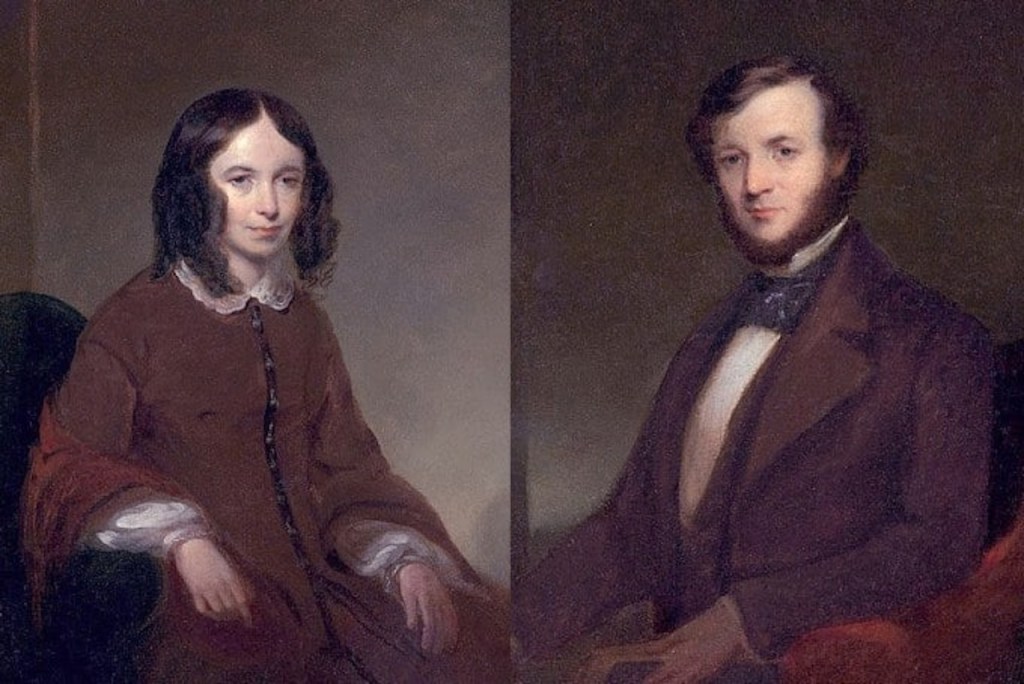
The years have dressed us in golden threads, Warmly woven brighter than those first bright seams. Through winter’s bitter and springs remembered, We find our love outlives our youthful dreams.
Our steps did falter on unsteady ground Like toddlers with legs weak and unsure. Now our roots run deep; patient hearts we found And time has given us what only time can secure.
The orchard has secured us year after year— Love walks with joy and promise on the earth. Our fallen apples drip and disappear. New blossoms crown the harvest with new birth.
Glad boughs hang low with fruit ripe and sweet— God’s grace bestows each new day we greet.
Elizabeth Barrett Browning’s Sonnet 44 “Belovèd, thou hast brought me many flowers”
Elizabeth Barrett Browning’s final sonnet 44 “Belovèd, thou hast brought me many flowers” from the sequence assures her belovèd that she has finally accepted his gift of love.
Introduction and Text of Sonnet 44 “Belovèd, thou hast brought me many flowers”
Elizabeth Barrett Browning’s final sonnet from the Sonnets from the Portuguese sequence assures her belovèd that she has finally accepted his gift of love. Sonnet 44 “Belovèd, thou hast brought me many flowers” is the final poem, which completes this remarkable sequence of love poems.
This sonnet finds the speaker musing on the flowers that her belovèd has brought to her. The speaker quickly transforms the physical blossoms into metaphysical blooms that symbolize the lovers’ bond.
After all the handwringing of self-doubt that has plagued the speaker throughout this sequence, she must now find a way to assure both herself and her belovèd that her mind set has transformed itself from the dull negative to a shining positive. The speaker must show her fiancé that they are bound together with an exceptional love. She must also make it clear that she understands the strong ties they now possess.
The speaker’s metaphoric comparison of the love gifts of physical flowers and the symbolic flowers that she has created from her own heart soil will remain an eternal reminder to both herself and her belovèd as they travel the road of marriage together.
Sonnet 44 “Belovèd, thou hast brought me many flowers”
Belovèd, thou hast brought me many flowers Plucked in the garden, all the summer through And winter, and it seemed as if they grew In this close room, nor missed the sun and showers. So, in the like name of that love of ours, Take back these thoughts which here unfolded too, And which on warm and cold days I withdrew From my heart’s ground. Indeed, those beds and bowers Be overgrown with bitter weeds and rue, And wait thy weeding; yet here’s eglantine, Here’s ivy!—take them, as I used to do Thy flowers, and keep them where they shall not pine Instruct thine eyes to keep their colors true, And tell thy soul their roots are left in mine.
Commentary on Sonnet 44 “Belovèd, thou hast brought me many flowers”
The final sonnet in the sequence assures the speaker’s belovèd that she has finally accepted his gift of love, without any further doubts.
First Quatrain: A Gift of Flowers
Belovèd, thou hast brought me many flowers Plucked in the garden, all the summer through And winter, and it seemed as if they grew In this close room, nor missed the sun and showers.
The speaker muses about the flowers that her belovèd has given her during summer. To her it seems that the flowers have remained as vibrant indoors in her “close room” as they were outside in the “sun and showers.”
These miraculous flowers seem to have remained healthy and glowing even during winter. The speaker then insists that they “grew / In this close room” and that they did not miss “the sun and showers.”
Of course, the physical flowers are just the motivation for the musing, which transforms the physical blooms into flowers of a metaphysical sort—those that have impressed images upon her soul, beyond the image on the retina.
Second Quatrain: Sonnets as Flower-Thoughts
So, in the like name of that love of ours, Take back these thoughts which here unfolded too, And which on warm and cold days I withdrew From my heart’s ground. Indeed, those beds and bowers
Thus the speaker commands her belovèd to “take back these thoughts which here unfolded too.” She is referring to her sonnets, which are her flower-thoughts given to her belovèd to honor their love.
The speaker affirms that she has plucked her sonnet-flowers “from [her] heart’s ground.” And the creative speaker has composed her tributes on “warm and cold days.”
The weather in the speaker’s heart and soul was always equal to producing fine blossoms for her loved one. As the speaker basked in his love, the flower “beds and bowers” produced these poems with floral fragrance and hues.
First Tercet: Correcting Her Clumsiness
Be overgrown with bitter weeds and rue, And wait thy weeding; yet here’s eglantine, Here’s ivy!—take them, as I used to do
The speaker then inserts her usual self-deprecatory thoughts, admitting that her floral efforts are surely, “overgrown with bitter weeds and rue,” but she gladly submits them for him to “weed” as needed.
The speaker’s gifted and talented belovèd can correct her clumsiness. She names two of her poems “eglantine” and “ivy” and commands him to “take them,” as she used to take his gifts of flowers, and probably gifts of his own poems to her as well.
Second Tercet: In His Care
Thy flowers, and keep them where they shall not pine Instruct thine eyes to keep their colors true, And tell thy soul their roots are left in mine.
The speaker commands her belovèd to safeguard her pieces so “they shall not pine.” In his care, she will also not pine. And the poem will “instruct [his] eyes” to the true feelings she bears for him.
The speaker’s poems will henceforth remind him that she feels bound to him at the soul. Soul qualities have always been more important to this speaker than physical and mental qualities.
The “colors true” of this speaker’s sonnets will continue to pour forth her love for her belovèd and “tell [his] soul their roots are left in [hers].” Each sonnet will reinforce their love and celebrate the life they will make together.
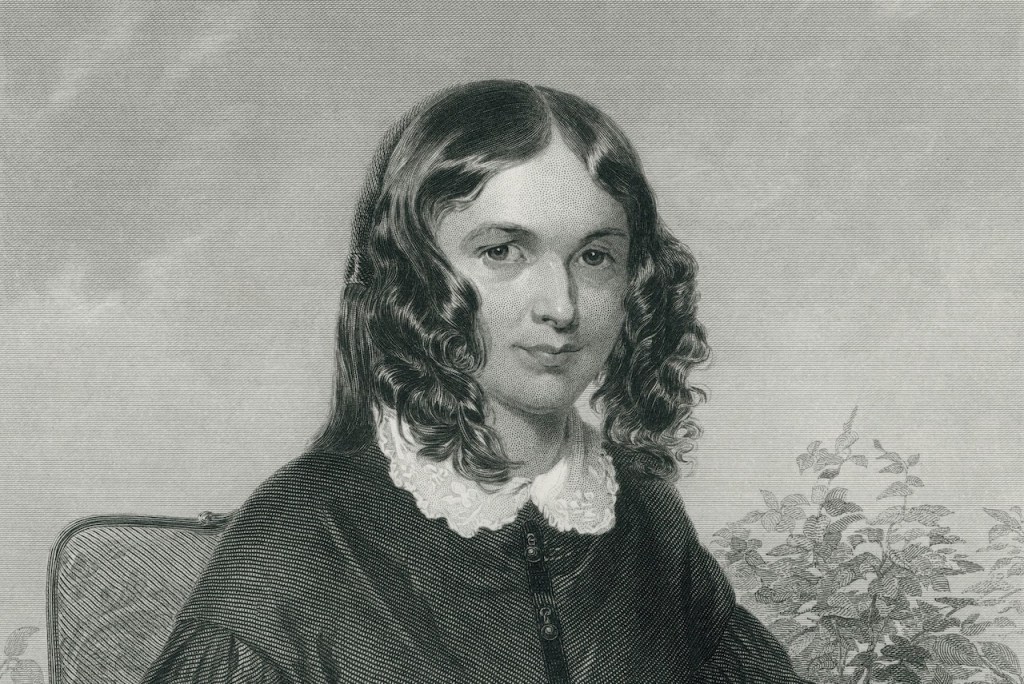
Image: Elizabeth Barrett Browning – Engraving from original Painting by Chappel, 1872. (Photo by: Universal History Archive/Universal Images Group via Getty Images)
Elizabeth Barrett Browning’s Sonnet 43 “How do I love thee? Let me count the ways”
The sonnet “How do I love thee? Let me count the ways”—number 43 in Sonnets from the Portuguese—remains the most famous and widely read sonnet of the sequence. The speaker is offering a summary of all the ways she has come to love her soon to be husband.
Introduction and Text of Sonnet 43 “How do I love thee? Let me count the ways”
Sonnet 43 “How do I love thee? Let me count the ways” is the most widely anthologized sonnet from Elizabeth Barrett Browning’s sequence titled Sonnets from the Portuguese. It is likely the many high school or college graduates remember that line but may have remained unaware that it is only #43 from its accompanying sequence of 43 other sonnets.
The sonnet is a Petrarchan sonnet as are all of the other sonnets in the sequence. In the octave, the speaker is musing about how much she loves her belovèd suitor, and she asks the question, “How do I love thee?”
Then the speaker proceeds to answer the question, so the reader becomes aware that the speaker is not literally addressing her belovèd, but she is addressing the thought or perhaps even an image of that belovèd. In the sestet, the speaker counts three definite ways and one possible way that she will love him throughout eternity.
Sonnet 43 “H0w do I love thee? Let me count the ways”
How do I love thee? Let me count the ways. I love thee to the depth and breadth and height My soul can reach, when feeling out of sight For the ends of Being and ideal Grace. I love thee to the level of everyday’s Most quiet need, by sun and candle-light. I love thee freely, as men strive for Right; I love thee purely, as they turn from Praise. I love thee with the passion put to use In my old griefs, and with my childhood’s faith. I love thee with a love I seemed to lose With my lost saints,—I love thee with the breath, Smiles, tears, of all my life!—and, if God choose, I shall but love thee better after death.
Commentary on Sonnet 43 “How do I love thee? Let me count the ways”
Sonnet 43 “How do I love thee? Let me count the ways” remains the most famous and widely read sonnet of the sequence.
First Quatrain: An Emphatic Rhetorical Question
How do I love thee? Let me count the ways. I love thee to the depth and breadth and height My soul can reach, when feeling out of sight For the ends of Being and ideal Grace.
The speaker asks an obvious rhetorical question that requires only her feeling to fill out; thus she continues, “Let me count the ways.” She loves him with all her soul, as that soul strives for an idealism that has to be left up to faith. The soul searches in all directions through “depth and breadth and height” for this idealism, which this speaker calls “the ends of Being and ideal Grace.”
Second Quatrain: Love and All Levels
I love thee to the level of everyday’s Most quiet need, by sun and candle-light. I love thee freely, as men strive for Right; I love thee purely, as they turn from Praise.
The speaker has begun with the sublime, ethereal level of her love by invoking how she loves her belovèd on the spiritual level. The speaker then brings herself quickly back to the mundane activities of daily life by saying that another way she loves him is through even the smallest daily act whether that act is performed during the daylight hours or during the night, “by sun and candle-light.”
The speaker then asserts that her love for her belovèd is spontaneous and “freely” given; therefore, she loves him in the way humankind loves freedom and acts correctly in striving to secure and maintain that freedom. She then claims that her love is as pure as those who are humble when praised. In the octave, the speaker has signified four ways she loves her belovèd: spiritually, materially, “freely,” and “purely.”
First Tercet: All Encompassing Love
I love thee with the passion put to use In my old griefs, and with my childhood’s faith. I love thee with a love I seemed to lose
The speaker loves him with the same ardor that used to grip her when she faced difficulties, but this “passion” is tempered by the fact that that love is also similar to the love that childhood provided her, an opposite kind of emotion from the one that caused her “old griefs.” This love includes the polar opposites of fear and love, with love tempering the fear in a balanced and useful way.
The speaker also loves her belovèd life mate with a kind of respect and admiration that she thought she had outgrown; this group of people could be a fairly large one, including friends, teachers, relatives, and even religious “saints,” the term she uses. But the key word is that she “seemed” to lose this love, but with her belovèd suitor, that love is returned to her.
Second Tercet: Love unto Eternity
With my lost saints,—I love thee with the breath, Smiles, tears, of all my life!—and, if God choose, I shall but love thee better after death.
The next way she loves her belovèd she asserts in a breathless, almost ecstatic pronouncement: “— I love thee with the breath, / Smiles, tears, of all my life! —.” Placed between dashes, these terms then signal an emphasis of expression.
This assertion captures the excitement and underscores the passion in the speaker’s claim, while it prepares the reader or listener, for the last breathtaking claim that, “if God choose, I shall but love thee better after death.”
So in the sestet, the speaker again professes four ways in which she loves the belovèd: with a passion of meeting former challenges but tempered by a childlike faith, with a kind of love she thought she had lost, and with her whole being. But most importantly for this speaker, she has faith that she will love this belovèd soul mate eternally.
Elizabeth Barrett Browning’s Sonnet 42 “‘My future will not copy fair my past’”
Musing and reflecting over some old pieces of her writing, the speaker in Elizabeth Barrett Browning’s sonnet 42 “‘My future will not copy fair my past’” compares her thoughts from the past to her present state of mind.
Introduction and Text of Sonnet 42 “‘My future will not copy fair my past‘”
In Elizabeth Barrett Browning’s sonnet 42 “‘My future will not copy fair my past’,” the speaker has been reading an earlier piece of writing that displays her state of mind back before she had the good fortune to meet her belovèd suitor. She reveals how extremely hopeless she had been regarding her future. Her heavenly muse had warned her to always take care and seems to agree with her assessment.
The speaker’s life trajectory, however, has since taken an happy turn. The speaker now has passed much time musing about her good fortune. In the earlier 41 sonnets, she has often shown her contemplation trying to determine if she, in face, is deserving of the love that has come to her from such a brilliant man of accomplishment.
She has often been found musing and reflecting over her new situation. In sonnet 42, she has come up on some old pieces that she earlier had written. Thus, she begins to compare and contrast her thoughts from yesteryear to her present state of mind.
Sonnet 42 “‘My future will not copy fair my past‘”
“My future will not copy fair my past“— I wrote that once; and thinking at my side My ministering life-angel justified The word by his appealing look upcast To the white throne of God, I turned at last, And there, instead, saw thee, not unallied To angels in thy soul! Then I, long tried By natural ills, received the comfort fast, While budding, at thy sight, my pilgrim’s staff Gave out green leaves with morning dews impearled. I seek no copy now of life’s first half: Leave here the pages with long musing curled, And write me new my future’s epigraph, New angel mine, unhoped for in the world!
Commentary on Sonnet 42 “‘My future will not copy fair my past‘”
The speaker is musing and reflecting over some old pieces of writing; she is comparing her thoughts of the past to her present state of mind.
First Quatrain: Then and Now
“My future will not copy fair my past“— I wrote that once; and thinking at my side My ministering life-angel justified The word by his appealing look upcast
The speaker is musing over a copy of some notes or pieces of memoir that she had written sometime in her past long before she met her belovèd. At the time she wrote this line, “My future will not copy fair my past,” she believed it was true because her muse which she calls her “ministering life-angel” approved the words by glancing upward. This glance seemed to be a signal that the thought came directly from God.
Second Quatrain: Looking to God
To the white throne of God, I turned at last, And there, instead, saw thee, not unallied To angels in thy soul! Then I, long tried By natural ills, received the comfort fast,
Later, the speaker looked directly to God, instead of through her muse/angel. She then saw her belovèd who was clearly bound to “angels in [his] soul.” The speaker’s long journey from suffering and pain had finally led her to a veritable fountain of healing.
The comforting balm of the speaker’s belovèd quickly revived her spirit, though it took her mind much contemplation and even agitation to understand and finally accept what she had been given by him.
First Tercet: Beginning to Live
While budding, at thy sight, my pilgrim’s staff Gave out green leaves with morning dews impearled. I seek no copy now of life’s first half:
During the journey, the speaker’s “pilgrim’s staff / Gave out green leaves with morning dews impearled.” A youthful freshness revived the speaker’s thinking and inspired her so fully that she finally felt she was beginning to live.
After at last realizing the beauty and majesty of this man’s feelings for her, the speaker now understands that the second half of her life will be very different from the first half, and she is very grateful for this fortunate change in her situation. Because of her good fortune, the speaker “seek[s] no copy now of life’s first half.” The pain of the past has been erased, and the future portends brightness and happiness.
Second Tercet: The Courage to Hope
Leave here the pages with long musing curled, And write me new my future’s epigraph, New angel mine, unhoped for in the world!
Regarding the “pages with long musing,” the speaker wishes to allow them to yellow and age and remain unremarkable. She can “write [herself] new [her] future’s epigraph.” The speaker credits her belovèd whom she calls, “New angel mine,” with her transformation, as she admits that she had not even had the courage to hope for such a love “in the world.”
Elizabeth Barrett Browning’s Sonnet 41 “I thank all who have loved me in their hearts”
The speaker in Elizabeth Barrett Browning’s sonnet 41 “I thank all who have loved me in their hearts” is expressing her gratitude for all those who have loved her-including, of course, a special debt to her belovèd suitor.
Introduction and Text of Sonnet 41 “I thank all who have loved me in their hearts”
The speaker in Elizabeth Barrett Browning’s sonnet 41 “I thank all who have loved me in their hearts” from Sonnets from the Portuguese focuses on gratitude for all who have loved her, while hoping that she will be able to express the extent of her gratitude to her belovèd. Again, however, this speaker imparts her own short-comings. She will never be able to act with total confidence in her ability, or so it seems at his point.
While expressing a special debt to her belovèd suitor, the speaker explores her ability to experience gratitude for all the loves she has known in the past. Yet, the speaker again places her trust in her belovèd’s ability to teach her true gratitude. She continues to rely on her suitor to offer her direction in how to feel as well as how to behave.
Sonnet 41 “I thank all who have loved me in their hearts”
I thank all who have loved me in their hearts, With thanks and love from mine. Deep thanks to all Who paused a little near the prison-wall To hear my music in its louder parts Ere they went onward, each one to the mart’s Or temple’s occupation, beyond call. But thou, who, in my voice’s sink and fall When the sob took it, thy divinest Art’s Own instrument didst drop down at thy foot To hearken what I said between my tears, … Instruct me how to thank thee! Oh, to shoot My soul’s full meaning into future years, That they should lend it utterance, and salute Love that endures, from Life that disappears!
Commentary on Sonnet 41 “I thank all who have loved me in their hearts”
In sonnet 41 “I thank all who have loved me in their hearts,” Barrett Browning’s speaker reveals how deep is her gratitude for all those in her life who have loved her. She has a special expression for her belovèd suitor.
First Quatrain: An Expression of Gratitude
I thank all who have loved me in their hearts, With thanks and love from mine. Deep thanks to all Who paused a little near the prison-wall To hear my music in its louder parts
The speaker begins with a simple statement to thank all the people she has had surrounding her who have actually loved her deeply. She then offers her own heart’s love in return. Continuing, she reveals her gratitude as “deep thanks” to all those who have paid some attention to her, especially when they listened to her complaints.
Then, the speaker metaphorically characterizes her tantrumesque outbursts as “music” with “louder parts.” The speaker nearly always demands decorum for herself that will not allow her to demonize herself even as she freely admits error and sorrowful dissatisfaction. The pain and sorrow in the speaker’s life has moved her to expressions, as heretofore love never had done.
Second Quatrain: A Different Expression of Love
Ere they went onward, each one to the mart’s Or temple’s occupation, beyond call. But thou, who, in my voice’s sink and fall When the sob took it, thy divinest Art’s
All the others who had paid the speaker attention, however, were otherwise engaged; some had to scurry off to shopping, others to church, and they all remained far from her. She could not reach them, if she even had needed them.
Of course, her belovèd fiancé not only is near and able to listening to her pleasant thoughts, but he also lovingly remains to listen to her sorrowful outbursts. The speaker’s belovèd suitor would cease his own musing to listen to her, and she now feels ready to voice her complete attention to his love, patience and devotion.
First Tercet: His Art Divine
Own instrument didst drop down at thy foot To hearken what I said between my tears, … Instruct me how to thank thee! Oh, to shoot
The speaker is grateful that her belovèd suitor would even interrupt his own work of “divinest Art’s” to attend to her needs and “hearken what I said between my tears.” But in offering such gratitude, the speaker implies that she actually does not know how to thank him for such devotion.
Thus the speaker demands of him to teach her all he knows about the profound state of gratitude. She feels she lacks the words to convey such gratitude; her need is so great, and her gratitude seems so paltry to fulfill the debt that she owes this man.
Second Tercet: Evidence of Thankfulness
My soul’s full meaning into future years, That they should lend it utterance, and salute Love that endures, from Life that disappears!
The speaker then projects a deep desire that her soul can reveal sometime in future just how grateful she is to her belovèd. She hopes that she can fill her “future years” with evidence of her thankfulness.
The humble speaker prays that her very being will be able to “salute / Love that endures, from Life that disappears!” Even though the living are in a state of gradual dying, the speaker prays that the love which she has received will somehow be returned along with the sincere gratitude she now feels.
Elizabeth Barrett Browning’s Sonnet 40 “Oh, yes! they love through all this world of ours!”
In sonnet 40 “Oh, yes! they love through all this world of ours!,” the speaker is musing on love as a universal phenomenon and stressing her appreciation for the patient love of her belovèd suitor.
Introduction and Text of Sonnet 40 “Oh, yes! they love through all this world of ours!”
In Elizabeth Barrett Browning’s sonnet 40 “Oh, yes! they love through all this world of ours!” from Sonnets from the Portuguese, the speaker has discovered that her belovèd offers her the love that she finds most satisfying.
This special love demonstrates that it is unlike so many love behaviors and attitudes that have prevailed over the centuries all over the world. Thus the speaker is musing on love as a general, universal phenomenon. She then emphasizes her appreciation for the patient love of her belovèd suitor.
Sonnet 40 “Oh, yes! they love through all this world of ours!”
Oh, yes! they love through all this world of ours! I will not gainsay love, called love forsooth. I have heard love talked in my early youth, And since, not so long back but that the flowers Then gathered, smell still. Mussulmans and Giaours Throw kerchiefs at a smile, and have no ruth For any weeping. Polypheme’s white tooth Slips on the nut if, after frequent showers, The shell is over-smooth,—and not so much Will turn the thing called love, aside to hate, Or else to oblivion. But thou art not such A lover, my Belovèd! thou canst wait Through sorrow and sickness, to bring souls to touch, And think it soon when others cry “Too late.”
Commentary on Sonnet 40 “Oh, yes! they love through all this world of ours!”
The speaker is musing on love as a universal phenomenon and then places a special emphasis on her appreciation for the patient love she is experiencing from her belovèd suitor.
First Quatrain: An Excited Outburst
Oh, yes! they love through all this world of ours! I will not gainsay love, called love forsooth. I have heard love talked in my early youth, And since, not so long back but that the flowers
The speaker begins with an outburst, “Oh, yes!” She then reports that people love all over the world. The musing speaker then claims that she will not speak ill of the concept of love, especially when the term is used correctly to mean love and not merely lust or sex.
The speaker then states that she remembers hearing people talk about love when she still a young girl, and even recently, she has also heard the word bandied about along with the gifts of flowers. Yet, this speaker is painfully aware that at times that professed love has lasted only as long as the scent of the flowers.
Second Quatrain: Different Ideologies on Love
Then gathered, smell still. Mussulmans and Giaours Throw kerchiefs at a smile, and have no ruth For any weeping. Polypheme’s white tooth Slips on the nut if, after frequent showers
Differing ideologies perceive love through varying lenses from the devout exemplified by the “Mussulmans” to the “Giaours” or other faiths considered infidels to the “Mussulmans.” Each group has its own way of professing and conducting its behavior based on their respective beliefs.
Fanatics will continue in their fanaticism regardless of the evidence. Once smitten by love some folks will not let go of the object it deems worth its attention. From classical mythology, the character Polypheme, who was obsessed with Galatea, offers an additional example of the varieties of behaviors motivated by love.
First Tercet: Drawing a Contrast
The shell is over-smooth,—and not so much Will turn the thing called love, aside to hate, Or else to oblivion. But thou art not such
Nothing can turn these various lovers from their own folly. The speaker is especially interested in drawing a complete contrast between her lover and those others, whose obsessive and compulsive behaviors are never welcome in the name of love. By comparing and contrasting the varied love stories through history, the speaker can demonstrate the quiet, gentle nature of her own belovèd inamorato.
Second Tercet: Dramatizing a Favored Quality
A lover, my Belovèd! thou canst wait Through sorrow and sickness, to bring souls to touch, And think it soon when others cry “Too late.”
In the final analysis, the speaker dramatizes the best quality of her own belovèd fiancé. This confident speaker can now assert that, ” . . . thou art not such // A lover, my Belovèd!” He is not one of those who dwell on superficial qualities.
This speaker’s suitor practices patience; thus he can “wait / Through sorrow and sickness.” More importantly, this speaker’s belovèd suitor is capable of looking to the soul to forge his adventure in love, “to bring souls to touch.”
The speaker always reveals that she is more interested in the spiritual level of love than in the physical and mental. This deep-thinking and creative speaker has realized that her belovèd suitor’s thinking is so different from those who seek the petty over the profound.
This speaker is pleased to stress that he “think[s] it soon when others cry, ‘Too late’.” Finding the right soul mate seems soon when one is focusing on the genuine instead of the counterfeit. The speaker is happy to celebrate her belovèd fiancé’s genuine and proper focus.
Elizabeth Barrett Browning’s Sonnet 39 “Because thou hast the power and own’st the grace”
In sonnet 39 “Because thou hast the power and own’st the grace,” the speaker is crediting her belovèd with being able to see her true soul through all of the despair that the years have heaped upon her.
Introduction and Text of Sonnet 39 “Because thou hast the power and own’st the grace”
In Elizabeth Barrett Browning’s sonnet 39 from Sonnets from the Portuguese, the speaker endeavors to leave her former diminished stature behind now that she is unconditionally loved by a wonderful man.
The speaker is heaping all the credit upon her belovèd fiancé for her acquiring the ability to perceive her true nature despite all of the sorrow that years of pining away have left in her life.
Sonnet 39 “Because thou hast the power and own’st the grace”
Because thou hast the power and own’st the grace To look through and behind this mask of me (Against which years have beat thus blanchingly With their rains), and behold my soul’s true face, The dim and weary witness of life’s race,— Because thou hast the faith and love to see, Through that same soul’s distracting lethargy, The patient angel waiting for a place In the new Heavens,—because nor sin nor woe,Nor God’s infliction, nor death’s neighborhood, Nor all which others viewing, turn to go, Nor all which makes me tired of all, self-viewed,— Nothing repels thee, … Dearest, teach me so To pour out gratitude, as thou dost, good!
Commentary on Sonnet 39 “Because thou hast the power and own’st the grace”
The speakers revealing the importance of the influence of her belovèd for her newly acquired, delicious ability to see her true soul through all of the despair that the years have foisted upon her.
First Quatrain: Powers of Vision
Because thou hast the power and own’st the grace To look through and behind this mask of me (Against which years have beat thus blanchingly With their rains), and behold my soul’s true face,
Addressing her belovèd, the speaker credits him with the ability to see through the veil she has drooped around herself for protection. Throughout her life, the years of feeling sad and sorrowful have taken a tremendous toll on her physical beauty and mental attitude.
However, her new love is able to pierce through those superficialities to perceive the value of her soul. The speaker implies that she has spent many hours crying; therefore, she metaphorically transforms the tears and years into “rains” that have “beat thus blanchingly.”
Second Quatrain: A Forlorn Life
The dim and weary witness of life’s race,— Because thou hast the faith and love to see, Through that same soul’s distracting lethargy, The patient angel waiting for a place
The speaker avers that her forlorn life has been witnessed by her soul, which has come to identify itself as “dim and weary.” The melancholy speaker then reports and concludes that her new love has both the “faith and love” that enable him to intuit the true nature or her soul.
Though the speaker’s soul has been abused in the senses as she experienced so much pain, doubt, and anguish and thus has grown dull with “distracting lethargy,” it remained a “patient angel,” biding its time for better things to come.
First Tercet: A New Blossoming
In the new Heavens,—because nor sin nor woe,Nor God’s infliction, nor death’s neighborhood, Nor all which others viewing, turn to go, Nor all which makes me tired of all, self-viewed,— Nothing repels thee, … Dearest, teach me so To pour out gratitude, as thou dost, good!
As the speaker’s heavy-burdened soul waited “for a place / / In the new Heavens,” she now realizes the extent to which she has become aware of a new blossoming through the love of her suitor. The speaker then begins a catalogue of negativity that has not been able to impede her belovèd from sensing the face of her real soul.
That list includes “nor sin nor woe.” Furthermore, “God’s infliction” and “death’s neighborhood” could not hide her soul from him. And even other impediments of her personality that repelled others could not make her belovèd abandon her.
Second Tercet: A Catalogue of Maladies
Nor all which makes me tired of all, self-viewed,— Nothing repels thee, … Dearest, teach me so To pour out gratitude, as thou dost, good!
Continuing the catalogue of maladies, the speaker includes “all which makes me tired of all, self-viewed.” When she judged herself most harshly, she had found so many imperfections that the accumulation of them weakened her will to live a productive life. Yet even these worst qualities of character have not been able to route the speaker’s new love from her, and her final remark shows the nature of her true soul.
The recovering melancholic speaker now commands her belovèd to offer her instruction in remaining and showing thankfulness. The speaker’s miserable life has made her feel that she hitherto had nothing for which to be thankful, and now she needs to learn how to show gratitude, instead of masking it behind a veil of tears.
The speaker finally asserts that her belovèd has the ability to pour out “good” with such a spontaneous ease that she wants to learn to do so as well. If her belovèd suitor is so generous with being “good,” then the speaker wants to become generous in being thankful.
Elizabeth Barrett Browning’s Sonnet 38 “First time he kissed me, he but only kissed”
Elizabeth Barrett Browning’s sonnet 38 “First time he kissed me, he but only kissed” dramatizes the speaker’s elated feelings after the first three kisses shared with her belovèd: the first was on her hand with which she writes, the second was on her forehead, and third on her lips.
Introduction and Text of Sonnet 38 “First time he kissed me, he but only kissed”
In Elizabeth Barrett Browning’s sonnet 38 “First time he kissed me, he but only kissed, ” the speaker demonstrates that the love relationship with her suitor has continued to grow stronger even as she has continued to have serious doubts about it.
Readers likely have begun to wonder if this speaker will ever surrender to this desire and accept the fact that her suitor is actually offering her the love she so desperately wants to accept. In this sonnet, the speaker hints that she is ready to surrender to the love that she doubted even as it has grown stronger.
Sonnet 38 “First time he kissed me, he but only kissed”
First time he kissed me, he but only kissed The fingers of this hand wherewith I write; And ever since, it grew more clean and white, Slow to world-greetings, quick with its “Oh, list,” When the angels speak. A ring of amethyst I could not wear here, plainer to my sight, Than that first kiss. The second passed in height The first, and sought the forehead, and half missed, Half falling on the hair. O beyond meed! That was the chrism of love, which love’s own crown, With sanctifying sweetness, did precede. The third upon my lips was folded down In perfect, purple state; since when, indeed, I have been proud and said, “My love, my own.”
Commentary on Sonnet 38 “First time he kissed me, he but only kissed”
Even as their love relationship grows stronger, there still remains a tinge of doubt that the speaker will ever completely surrender to that love.But it remains clear that she is striving sincerely to accept that the relationship is genuine and will endure.
First Quatrain: Kissing the Hand
First time he kissed me, he but only kissed The fingers of this hand wherewith I write; And ever since, it grew more clean and white, Slow to world-greetings, quick with its “Oh, list,”
The speaker’s belovèd first kissed her on her writing hand. After this first kiss, she has noticed a remarkable transition of that hand: it appears cleaner and lighter. That hand has grown “slow to world-greetings,” but “quick” to caution her to listen to the angels when they speak.
In a stroke of technical brilliance, the speaker/poet again uses the device of breaking the line between “Oh, list,” and “When angels speak,” over the two quatrains. This improvised special emphasis gives the same sense as an extended sigh with the facial expression of one seeing some magical being.
Second Quatrain: The Honored Kiss
When the angels speak. A ring of amethyst I could not wear here, plainer to my sight, Than that first kiss. The second passed in height The first, and sought the forehead, and half missed,
The speaker’s hand could not be more real and have any better decoration, such as “a ring of amethyst,” than it does now that her belovèd has honored it with his kiss. The enchanted speaker then scurries on to report about the second kiss, which sounds rather comical: the second kiss was aimed at her forehead, but “half-missed” and lands half in her hair and half on the flesh.
First Tercet: Ecstatic Joy
Half falling on the hair. O beyond meed! That was the chrism of love, which love’s own crown, With sanctifying sweetness, did precede.
Despite the comical half-hair/half-forehead miss, the speaker is carried away in an ecstatic joy, “O beyond meed!” The clever speaker puns on the word “meed” to include the meaning of “reward” as well as the famously intoxicating beverage mead. The speaker has become drunk with the delight of this new level of intimacy.
This kiss is “the chrism of love”; she is baptized in the love of her belovèd suitor. This kiss is also “love’s own crown”; again, similar to the “meed” pun, the speaker exploits the double meaning of the term “crown,” as the headdress of a king or simply the crown of the head. The “sanctifying sweetness” of this kiss has preceded and grown out of the love that now is so sweet and electrifying.
Second Tercet: A Royal Kiss
The third upon my lips was folded down In perfect, purple state; since when, indeed, I have been proud and said, “My love, my own.”
Finally, the third kiss “folded down” “upon [her] lips.” And it was perfect. It possessed her in a “purple state.” This royal kiss elevated her mind to pure royalty. She thus returns again to referring to her belovèd in royal terms as she had done in earlier sonnets.
So since that series of kisses, especially that third royal embrace, the speaker has “been proud and said, ‘My love, my own.’” This reluctant speaker is finally accepting her belovèd as the love of her life and allows herself the luxury of placing her newly awakened faith in his love.
Elizabeth Barrett Browning’s Sonnet 34 “With the same heart, I said, I’ll answer thee”
Returning to the melancholy character in sonnet 34 “With the same heart, I said, I’ll answer thee,” as she has so often maintained, the speaker contrasts her light-hearted childhood’s response with her serious maturity.
Introduction and Text of Sonnet 34 “With the same heart, I said, I’ll answer thee”
The character speaking in Barrett Browning’s Sonnet 34 “With the same heart, I said, I’ll answer thee” from Sonnets from the Portuguese has returned to her melancholy attitude. Now she is contrasting her happy, carefree childhood years to her very stern and serious life as a mature adult.
The speaker however is addressing her belovèd, imploring him to consider how important he is to her. As earnest, obedient, and steadfast as she was as a child, now her constancy with her belovèd is even more in evidence. The speaker continues to build her case for deserving the love of such an accomplished man, whom she considers to be much above her own station in life.
Sonnet 34 “With the same heart, I said, I’ll answer thee”
With the same heart, I said, I’ll answer thee As those, when thou shalt call me by my name— Lo, the vain promise! is the same, the same, Perplexed and ruffled by life’s strategy? When called before, I told how hastily I dropped my flowers or brake off from a game, To run and answer with the smile that came At play last moment, and went on with me Through my obedience. When I answer now, I drop a grave thought, break from solitude; Yet still my heart goes to thee—ponder how— Not as to a single good, but all my good! Lay thy hand on it, best one, and allow That no child’s foot could run fast as this blood.
Commentary on Sonnet 34 “With the same heart, I said, I’ll answer thee”
Returning to the melancholy character she has so often maintained, the speaker contrasts her light-hearted childhood’s response with her serious maturity.
First Quatrain: The Necessity of Consistency
With the same heart, I said, I’ll answer thee As those, when thou shalt call me by my name— Lo, the vain promise! is the same, the same, Perplexed and ruffled by life’s strategy?
The pensive speaker professes a need to be consistent; thus, she repeats the word “same” three times in three lines. She is of the “same heart” as she was earlier in her lifetime. She is called by “[her] name. But she is unsure about “life’s strategy.” She is even “perplexed and ruffled” by it.
The speaker hopes to convince herself that love has merely continued to flow into around her life. She also demands from her new love relationship a constant heart as she lovingly and gently makes demands on her belovèd.
Second Quatrain: The Obedient One
When called before, I told how hastily I dropped my flowers or brake off from a game, To run and answer with the smile that came At play last moment, and went on with me
Earlier in her lifetime, the melancholy speaker had played the obedient one, coming when called, dropping her “flowers” or leaving off her “game.” She ran to answer and even “with a smile” she appeared. Such behavior continued because of her dedication to obedience.
The speaker needs to be always consistent in her emotional responses. The static melancholy that she has experienced has programmed her to need a steady environment, even if she must create it from fragments of memory and emotional responses from the past.
First Tercet: Adult Life Different Details
Through my obedience. When I answer now, I drop a grave thought, break from solitude; Yet still my heart goes to thee—ponder how—
Now the specific details of life are a bit different. Instead of games and flowers, she answers from the position of having dropped “a grave thought” or a “break from solitude.” But her heart goes now always to the belovèd. She spills out a command before venturing on, telling her beloved to “ponder how . . . .”
Even though the details of her adult life are different, her emotional responses are essentially the same. Her same heart-responses continue to guide her. Her new love relationship has become even more important to her than any relationship before.
Second Tercet: From Childhood to Adulthood
Not as to a single good, but all my good! Lay thy hand on it, best one, and allow That no child’s foot could run fast as this blood.
The speaker then concludes that the good her beloved has done her is not one in one single area but in “all my good!” She asks her beloved to understand that as fleet foot as she was at obedience as child, she is much faster at running to her belovèd than she could have ever been in her earlier life.
The speaker’s blood now runs faster and with more passion than ever her foot did as a child. As important to her as were her earlier loves, her new belovèd has become even more vital to her life.
The speaker’s melancholy seems to be desperate for her lover to grasp his importance to her. Thus, she continues to compare and contrast her life’s environments from childhood to maturity.
Elizabeth Barrett Browning’s Sonnet 32 “The first time that the sun rose on thine oath”
The speaker in Elizabeth Barrett Browning’s sonnet 32 finds her confidence first expanding and then shrinking again on her journey through her adventure to love.
Introduction and Text of Sonnet 32 “The first time that the sun rose on thine oath”
In Elizabeth Barrett Browning’s sonnet 32, the speaker once more struggles with her persistent lack of self-worth. However, the speaker finally decides that by choosing to devalue her own self-worth, at the same time, she is also assigning less value to her belovèd, an intolerable idea that she then attempts mightily to immediately correct.
Sonnet 32 “The first time that the sun rose on thine oath”
The first time that the sun rose on thine oath To love me, I looked forward to the moon To slacken all those bonds which seemed too soon And quickly tied to make a lasting troth. Quick-loving hearts, I thought, may quickly loathe; And, looking on myself, I seemed not one For such man’s love;—more like an out-of-tune Worn viol, a good singer would be wroth To spoil his song with, and which, snatched in haste, Is laid down at the first ill-sounding note. I did not wrong myself so, but I placed A wrong on thee. For perfect strains may float ’Neath master-hands, from instruments defaced,— And great souls, at one stroke, may do and doat.
Commentary on Sonnet 32 “The first time that the sun rose on thine oath”
The speaker in sonnet 32 finds her confidence first increasing and then shrinking again on her journey to her adventures in love.
First Quatrain: To Soon to Endure
The first time that the sun rose on thine oath To love me, I looked forward to the moon To slacken all those bonds which seemed too soon And quickly tied to make a lasting troth.
The first quatrain finds the speaker announcing that after her belovèd first pronounced his love for her, she became lodged in the sorrowful thought that this love might have come “too soon / And quickly tied” to endure for long.
The ensuing vow of love which was completed with the rising sun caused her to “look forward” to night time and the moon. She assumed that time of day would abstract her weakened possession of her new love situation.
This speaker is, of course, again doubting her ability to bring out such a love from this high-stationed man. The powerful feelings of negative self-worth seem to be permeating and leading her heart’s feelings and her head’s thought processes.
Second Quatrain: Come Quickly, Leave Quickly
Quick-loving hearts, I thought, may quickly loathe; And, looking on myself, I seemed not one For such man’s love;—more like an out-of-tune Worn viol, a good singer would be wroth
The speaker believes that if love comes too quickly, it will then be apt to leave just as quickly. She thus also emphasizes her sad thought that she does not believe she is entirely worthy of “such man’s love.” The speaker then likens herself to some “out-of-tune / Worn viol,” which implies that she possesses not enough gifts to play along side such “a good singer.”
The speaker deems that the good singer, represented in her accomplished poet/suitor, “would be wroth,” to let her accompany him. She suspects that her own lack of talent would besmirch that of her lover’s brilliant talents.
First Tercet: An Out-of-Tune Instrument
To spoil his song with, and which, snatched in haste, Is laid down at the first ill-sounding note. I did not wrong myself so, but I placed
The speaker therefore suggests that her belovèd might have made a rash decision in picking her as his partner; thus, she thinks that she will be sent away, “at the first ill-sounding note.” However, the speaker then immediately shifts her gaze.
As the speaker still clings to her assessment of herself as an “out-of-tuned viol,” she goes on to maintain that she has not incorrectly evaluated herself, but she does believe that she has been mistaken about her belovèd’s possessions of knowledge, strength, and capability.
Second Tercet: Clinging to Inferiority
A wrong on thee. For perfect strains may float ’Neath master-hands, from instruments defaced,— And great souls, at one stroke, may do and doat.
Despite the fact that the speaker may be an out-of-tune musical instrument, her belovèd, who is a skillful master may possess the delicious ability of heralding forth from her damaged instrument, “perfect strains.”
The speaker’s belovèd after all possesses “master-hands.” She determines her acceptance, with a sufficient and thoroughly axiomatic bit of wit, as she states that, “great souls, at one stroke, may do and dote.”
The speaker’s timid thought and evaluation of her own inferiority remains so entrenched that she always seems to manage to cling to it. She implies that the great souls, who are capable of achieving great things, also possess the talent for “doat[ing]” on the things they love, despite any lack of worthiness those things may possess.