Linda's Literary Home

Tag: love sonnets

  • Elizabeth Barrett Browning’s Sonnet 30 “I see thine image through my tears to-night”

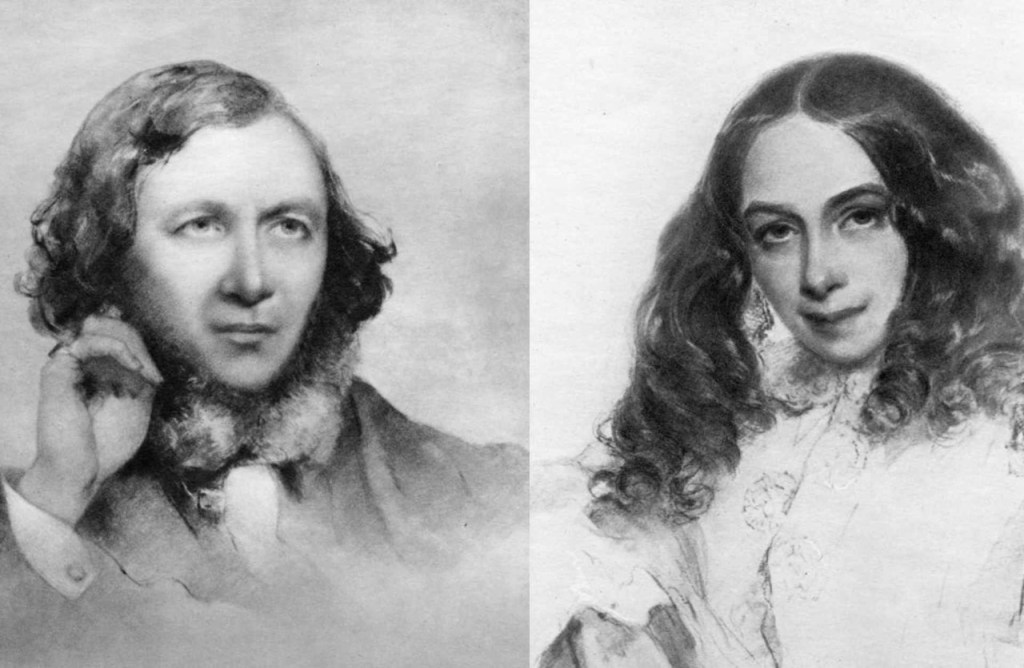
    Image:  Robert Browning and Elizabeth Barrett Browning – history.com

    Elizabeth Barrett Browning’s Sonnet 30 “I see thine image through my tears to-night”

    The speaker in Elizabeth Barrett Browning’s sonnet 30 “I see thine image through my tears to-night” is indulging herself in doubts as she contemplates the thought that her belovèd is little more than a fantasy.

    Introduction and Text of Sonnet 30 “I see thine image through my tears to-night”

    Elizabeth Barrett Browning’s sonnet 30 “I see thine image through my tears to-night” from Sonnets from the Portuguese dramatizes the regression of the speaker as she wonders if she has merely created dreamlike the love of her belovèd.

    Sonnet 30 “I see thine image through my tears to-night” gives the speaker the space to indulge  in doubts.  She allows herself to go backward to her earlier stage of melancholy.  To her distress, she is now contemplating the possibility, and to her the likelihood, that her lover is little more than a fantasy without a shred of reality.

    Sonnet 30 “I see thine image through my tears to-night”

    I see thine image through my tears to-night,
    And yet to-day I saw thee smiling. How
    Refer the cause?—Beloved, is it thou
    Or I, who makes me sad? The acolyte
    Amid the chanted joy and thankful rite
    May so fall flat, with pale insensate brow,
    On the altar-stair. I hear thy voice and vow,
    Perplexed, uncertain, since thou art out of sight,
    As he, in his swooning ears, the choir’s Amen.
    Beloved, dost thou love? or did I see all
    The glory as I dreamed, and fainted when
    Too vehement light dilated my ideal,
    For my soul’s eyes? Will that light come again,
    As now these tears come—falling hot and real?

    Commentary on Sonnet 30 “I see thine image through my tears to-night”

    The speaker is indulging herself in doubts as she contemplates the thought that her belovèd is little more than a fantasy.  She is finding it difficult again to maintain her posture of happiness because her habit for sorrow.

    First Quatrain:  Remembering An Earlier Visit

    I see thine image through my tears to-night,
    And yet to-day I saw thee smiling. How
    Refer the cause?—Beloved, is it thou
    Or I, who makes me sad? The acolyte

    The speaker remarks that she is shedding tears as she appears to be looking at his picture or perhaps just visualizing him as in a dream.  The now sorrowful speaker ponders the cause of her tears, addressing her belovèd with a question regarding the origin of her tears. 

    She asks him if she is the cause of her sadness or if he is the origin.  With a strange juxtaposition, the speaker then begins to imagine a ceremony, perhaps, the wedding of her belovèd and herself.

    Second Quatrain:  A Dream-State Visualization

    Amid the chanted joy and thankful rite
    May so fall flat, with pale insensate brow,
    On the altar-stair. I hear thy voice and vow,
    Perplexed, uncertain, since thou art out of sight,

    In her dream-state, the speaker visualizes an attendant to the service, and “the acolyte” stumbles and falls “flat” “[o]n the altar-stair.”   Such an unexpected accident provides not only a comic outrage but also a farcical intrusion into such the solemn occasion.

    The speaker’s imagination is allowing her to hallucinate; no doubt such a nightmare comes from the hypersensitive nature of the speaker.   The reader is aware of the intensity of this speaker’s emotions as she has gone from a nearly complete recluse with feelings of abandonment to the betrothed of a suitor, whom she deems much above her class in society.

    The speaker then asserts that she “hear[s his] voice and vow.” But his voice and vow are “perplexed” and “uncertain.” And he is “out of sight.” Again, the reader detects those old feelings of doubt that the speaker has suffered since the beginning of these adventures in romance.

    First Tercet:  Contemplating Possibilities

    As he, in his swooning ears, the choir’s Amen.
    Beloved, dost thou love? or did I see all
    The glory as I dreamed, and fainted when

    The speaker wonders if the stumbling attendant has been overwhelmed by “the choir’s Amen.” And then she contemplates the possibility that she is dreaming this love that has become so important to her, and thus she questions, “Belovèd, dost thou love?”  Or perhaps, the agitated speaker has, in fact, dreamed it all, for she wonders, “did I see all / The glory as I dreamed?” 

    If it is nothing but a dream, it would be quite natural for her to stumble and fall; thus, it was not an assistant but the speaker herself who has stumbled and fallen upon those altar steps.

    Second Tercet:  To Believe Good Fortune

    Too vehement light dilated my ideal,
    For my soul’s eyes? Will that light come again,
    As now these tears come—falling hot and real?

    The speaker considers the possibility that again she has allowed herself to believe in the good fortune of finding a loving mate as brilliant as her belovèd suitor seems to be.  And now the fact may be that it was all a fantasy; perhaps, the glow from her suitor has been exaggerated in her own mine.

    The speaker cannot help but wonder and therefore she puts to him the question, “Will that light come again?”   And the desperate speaker then compares that urgency to “these tears” that she now emphasizes are “falling hot and real?”

  • Elizabeth Barrett Browning’s Sonnet 28 “My letters! all dead paper, mute and white!”

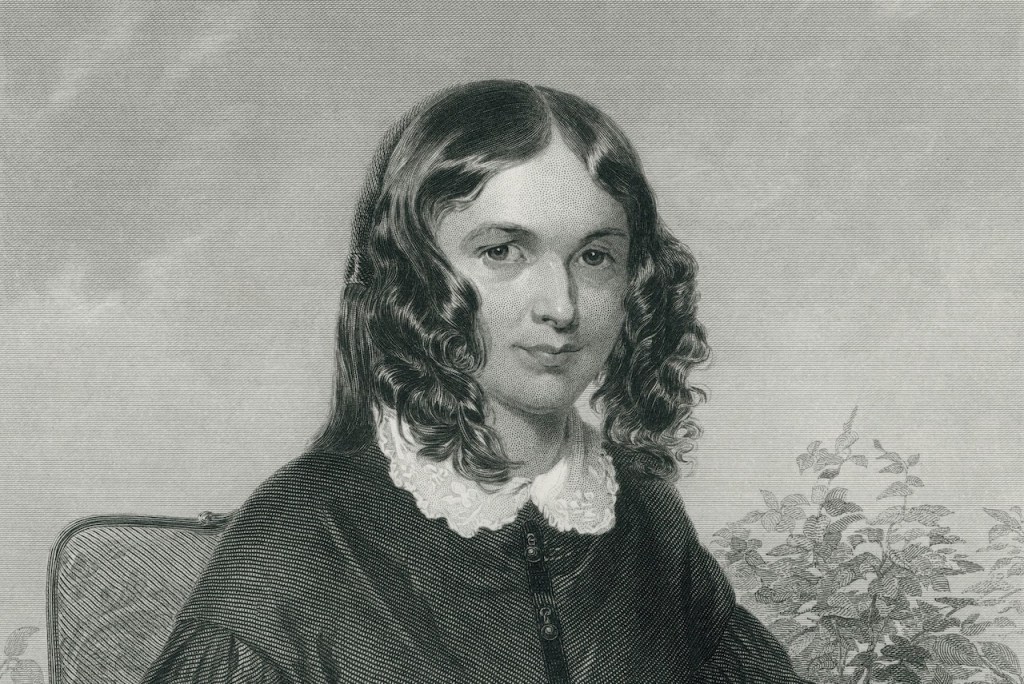
    Image: Elizabeth Barrett Browning – Engraving from original Painting by Chappel, 1872. (Photo by: Universal History Archive/Universal Images Group via Getty Images)

    Elizabeth Barrett Browning’s Sonnet 28 “My letters! all dead paper, mute and white!”

    In Elizabeth Barrett Browning’s sonnet 28 “My letters! all dead paper, mute and white!,” the speaker reacts to each stage of the growing love relationship, while she is looking through a bundle of love letters. 

    Introduction and Text of Sonnet 28 “My letters! all dead paper, mute and white!

    Elizabeth Barrett Browning’s sonnet 28 “My letters! all dead paper, mute and white!” from Sonnets from the Portuguese is dramatizing the speaker’s uncomplicated activity of perusing a bunch of her love letters.  

    She loosens the cord that binds them and then begins to report certain significant details from each missive.  Each one,  on which the decides to report, unveils a stage in the maturing relationship of the two lovers from friend to soul-mate.

    Sonnet 28  “My letters! all dead paper, mute and white!”

    My letters! all dead paper, mute and white!
    And yet they seem alive and quivering
    Against my tremulous hands which lose the string
    And let them drop down on my knee to-night.
    This said,—he wished to have me in his sight
    Once, as a friend: this fixed a day in spring
    To come and touch my hand … a simple thing,
    Yet I wept for it!—this, … the paper’s light …
    Said, Dear, I love thee; and I sank and quailed
    As if God’s future thundered on my past.
    This said, I am thine—and so its ink has paled
    With lying at my heart that beat too fast.
    And this … O Love, thy words have ill availed
    If, what this said, I dared repeat at last!

    Commentary on Sonnet 28 “My letters! all dead paper, mute and white!”

    The speaker in Elizabeth Barrett Browning’s Sonnet 28 “My letters! all dead paper, mute and white!” is looking at the love letters from her beloved suitor and reacting to each step in the growth of their love relationship.

    First Quatrain: Letters That Live

    My letters! all dead paper, mute and white!
    And yet they seem alive and quivering
    Against my tremulous hands which lose the string
    And let them drop down on my knee to-night.

    The speaker begins by exclaiming “My letters!” She sits with a bundle of her letters in her hands and commences to muse aloud her response to fact that they even exist. She insists that they are actually nothing more than “dead paper, mute and white!”  But because she is aware of the story that they contain, she claims that they seem to be “alive and quivering.” 

    Of course, it is the trembling of her hands that causes them to “quiver.” She has untied the cord that binds the letters together in a bunch, and her “tremulous hands” then permit those letters to “drop down on her knee.”

    Second Quatrain:  Each Letter a Pronouncement

    This said,—he wished to have me in his sight
    Once, as a friend: this fixed a day in spring
    To come and touch my hand … a simple thing,
    Yet I wept for it!—this, … the paper’s light …

    The speaker, in the second quatrain, commences her report on what each letter pronounces. The first one that she selects is telling her that her suitor at first desired to visit her for the purpose of friendship.  

    After all they are both poets, and poets are likely to enjoy friendship with other poets.  Thus, at the outset, the two poets experienced friendship, and she was pleasantly surprised that he even wished to visit her.

    In the next missive she on which she focuses, he informs her her that he would like to visit and hold her hand; appropriately and timely, that day was a spring day.  The romance inherent in these image choices is full of possibilities; yet, she regards the event “a simple thing.”  Still, even though it may be simple, it brings tears to her eyes.

    First Tercet:   What God Judges

    Said, Dear, I love thee; and I sank and quailed
    As if God’s future thundered on my past.
    This said, I am thine—and so its ink has paled

    The next epistle with paper that is “light” informs her, “Dear, I love thee.” To this astonishing avowal, she exerts a passionate and extreme reaction.  She sinks back in her seat with a startled cry for she felt as if God had declared some momentous decree on her past life.

    As this sonnet sequence has progressively revealed, this speaker has passed quite a solitary and painfully sorrowful life.  However, her past now is being put in judgment by God, and God is proclaiming that her future will not be replicating her sad past.

    Second Tercet:  Next to a Fast-Beating Heart

    With lying at my heart that beat too fast.
    And this … O Love, thy words have ill availed
    If, what this said, I dared repeat at last!

    The next letter avows to her that he belongs to her. The speaker has so treasured this letter that she has caused the ink to become pale from holding it to her fast-beating heart.  The speaker has figuratively held this letter to her fast-beating heart, and that holding has metaphorically caused the ink to lighten.

    The last epistle inflames her so much that she cannot allow herself to voice any of it nor even offer a hint of what it announces.  Nevertheless, the continuing progress of the sonnet sequence allows the reader to remain perfectly satisfied with what might be a unsatisfying because inconclusive conclusion because the speaker chose to reveal nothing from the final letter’s contents.

  • Elizabeth Barrett Browning’s Sonnet 27 “My own Belovèd, who hast lifted me”

    Image: Elizabeth Barrett and Robert Browning – Two Poets in Love

    Elizabeth Barrett Browning’s Sonnet 27 “My own Belovèd, who hast lifted me”

    The speaker in Elizabeth Barrett Browning’s sonnet 27  “My own Belovèd, who hast lifted me” alludes to the Greek mythological Asphodel Meadows to dramatize her life’s transformation after meeting her belovèd.

    Introduction and Text of Sonnet 27 “My own Belovèd, who hast lifted me”

    In Elizabeth Barrett Browning’s sonnet 27 “My own Belovèd, who hast lifted me” from Sonnets from the Portuguese, the speaker again is dramatizing the contrast between how her life was before she met her belovèd fiancé and how it is now that she has found the love of her life. 

    In this sonnet, the speaker employs an allusion to the Greek mythological “Asphodel Meadows” in order to dramatize the transformation her life has undergone after meeting and growing close to her belovèd.

    The speaker asserts the contrast between her life after meeting her belovèd to her former miserable state of being in order to establish herself firmly in the relationship, which she had earlier attempted to deny.

    Sonnet 27 “My own Belovèd, who hast lifted me”

    My own Belovèd, who hast lifted me
    From this drear flat of earth where I was thrown,
    And, in betwixt the languid ringlets, blown
    A life-breath, till the forehead hopefully
    Shines out again, as all the angels see,
    Before thy saving kiss! My own, my own,
    Who camest to me when the world was gone,
    And I who looked for only God, found thee!
    I find thee; I am safe, and strong, and glad.
    As one who stands in dewless asphodel,
    Looks backward on the tedious time he had
    In the upper life,—so I, with bosom-swell,
    Make witness, here, between the good and bad,
    That Love, as strong as Death, retrieves as well.

    Commentary on Sonnet 27 “My own Belovèd, who hast lifted me”

    The speaker in sonnet 27 “My own Belovèd, who hast lifted me” is alluding to the Greek mythological Asphodel Meadows to dramatize her life’s transformation after meeting her belovèd.

    First Quatrain:  A Cruel Life

    My own Belovèd, who hast lifted me
    From this drear flat of earth where I was thrown,
    And, in betwixt the languid ringlets, blown
    A life-breath, till the forehead hopefully

    The speaker begins by addressing her belovèd directly, telling him again about how he came to her at her lowest point of depression.  Her belovèd has raised the speaker from the depths of utter despair which she now describes as “this drear flat of earth where I was thrown.” 

    The speaker’s life has been so cruel to her that she felt that she was not only sinking but was also violently “thrown” to her lowest level. Even the speaker’s hair had become limp and lifeless as her “languid ringlets” attested, until her lover had “blown / A life-breath” and her forehead would finally come alive with brightness.

    Second Quatrain:  An Infusion of Hope

    Shines out again, as all the angels see,
    Before thy saving kiss! My own, my own,
    Who camest to me when the world was gone,
    And I who looked for only God, found thee!

    After the speaker’s belovèd suitor had lovingly kissed her pale forehead, she then became infused with the hope that she would brighten, “as all the angels see.” 

    The speaker then exclaims and repeats, “My own, my own”; he is now her own belovèd who has entered her life at a time when there seemed to be nothing in the world for which she could go on living.

    This sonnet, unfortunately, may sounds a bit as if the speaker has chosen her human lover over God. The speaker reports that she sought “only God,” before her belovèd’s arrival, but then unexpectedly she “found thee!” 

    However, in earlier sonnets, this speaker has made it clear that she is thankful to God for sending her belovèd and that God knows what is appropriate for His children.

    Thus, the speaker is not suggesting that her suitor is replacing God in the life; she is expressing the fact that now she has a human love in her life, as well as God’s. 

    She has already acknowledged that God was in her life as she struggled to become closer to the Divine Creator.  The difference is that her Creator has now brought her together with a soul mate for the continuation of her earthy incarnation.

    First Tercet:   Celebration of Love

    I find thee; I am safe, and strong, and glad.
    As one who stands in dewless asphodel,
    Looks backward on the tedious time he had

    The speaker continues to celebrate finding her human love, as she reports the uplifting feelings she now experiences: “I am safe, and strong, and glad.”  The speaker then employs the allusion to the Greek mythological positioning of souls in the afterlife, stating, “As one who stands in dewless asphodel.” 

    The “Asphodel Meadows” are located between heaven and hell, and she thus likens herself to an individual positioned between the ultimate good and ultimate bad.   As the speaker “looks backward” to her old life, she deems that time “tedious” compared to how she feels now.

    Second Tercet:  The Superior Action of Love 

    In the upper life,—so I, with bosom-swell,
    Make witness, here, between the good and bad,
    That Love, as strong as Death, retrieves as well.

    The speaker now sees herself as one testifying that while “Death” ushers a soul to a different level of being, she has discovered that “Love” does so as well.   And the speaker’s reaction with a “bosom-swell” demonstrates that she is witness to the superior action of love.

  • Elizabeth Barrett Browning’s Sonnet 25 “A heavy heart, Belovèd, have I borne”

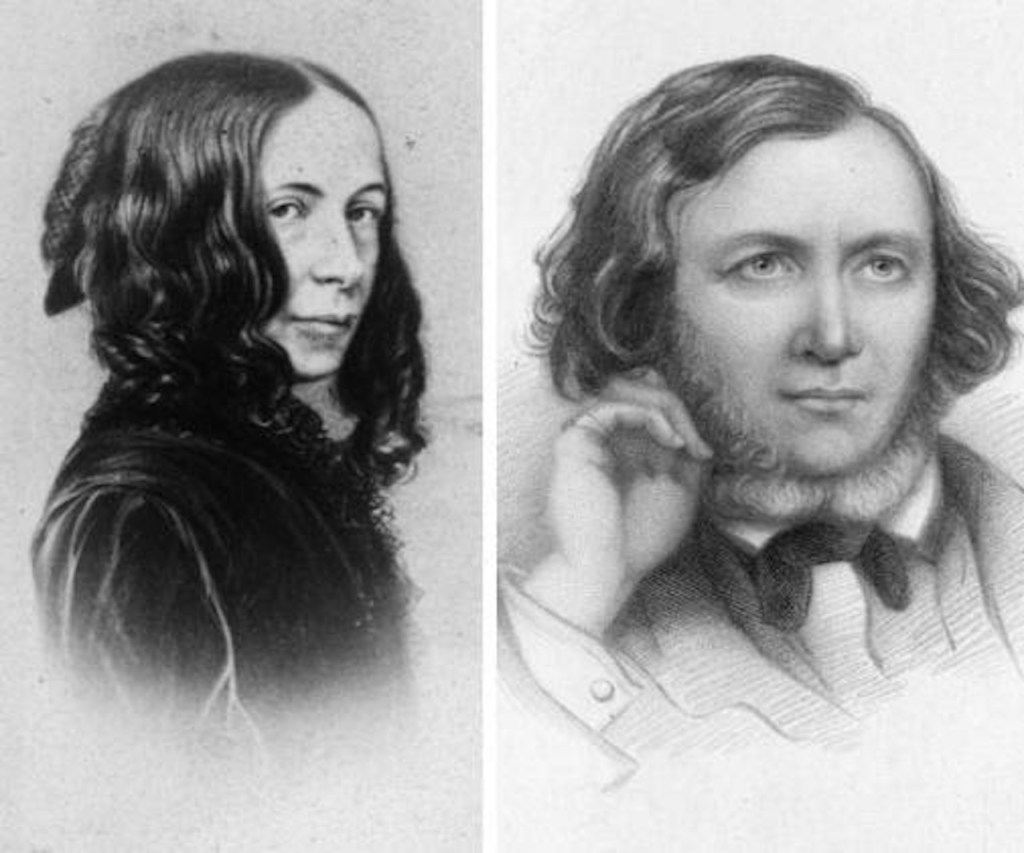
    Image:  Robert Browning and Elizabeth Barrett Browning – history.com

    Elizabeth Barrett Browning’s Sonnet 25 “A heavy heart, Belovèd, have I borne”

    Elizabeth Barrett Browning’s speaker revisits her former sorrow to contrast her earlier “heavy heart” with the light heartedness she now enjoys because of her belovèd fiancé.

    Introduction and Text of Sonnet 25 “A heavy heart, Belovèd, have I borne”

    Elizabeth Barrett Browning’s sonnet 25 from Sonnets from the Portuguese dramatizes the transformation of the speaker’s “heavy heart” of misery into a welcoming home of life and love. She credits her belovèd suitor for her ability to transcend her earlier sorrows.

    The speaker continues to gain confidence in herself and the possibility that she can be loved by one whose status she deems so far above her own.  She began in utter denial of any such luck, but as the muses, prays, and contemplates the motives and the behavior of her beloved, she becomes more convinced of his genuine affection for her.

    Elizabeth Barrett Browning’s speaker revisits her former sadness and melancholy in order to contrast that earlier “heavy heart” with the light heartedness she now has begun to enjoy because of the genuine feelings she now detects in her belovèd life partner.

    Sonnet 25 “A heavy heart, Belovèd, have I borne”

    A heavy heart, Belovèd, have I borne
    From year to year until I saw thy face,
    And sorrow after sorrow took the place
    Of all those natural joys as lightly worn
    As the stringed pearls, each lifted in its turn
    By a beating heart at dance-time. Hopes apace
    Were changed to long despairs, till God’s own grace
    Could scarcely lift above the world forlorn
    My heavy heart. Then thou didst bid me bring
    And let it drop adown thy calmly great
    Deep being! Fast it sinketh, as a thing
    Which its own nature doth precipitate,
    While thine doth close above it, mediating
    Betwixt the stars and the unaccomplished fate.

    Commentary on Sonnet 25 “A heavy heart, Belovèd, have I borne”

    The speaker is revisiting her former sorrow and contrasting her earlier “heavy heart” to the light heartedness she now enjoys because of her belovèd suitor.

    First Quatrain:   A Storehouse of Metaphors for Misery

    A heavy heart, Belovèd, have I borne
    From year to year until I saw thy face,
    And sorrow after sorrow took the place
    Of all those natural joys as lightly worn

    The speaker addressing her belovèd recalls that before she “saw [his] face,” she was afflicted with a “heavy heart.” She suffered a long line of sorrows instead of “all those natural joys” that young woman usually experience so easily.

    This speaker has so often alluded to her sorrow that the reader is not surprised that it appears again in dramatic form. Her storehouse of metaphors that elucidate her misery is large and varied.

    Second Quatrain:  Sorrows Like a String of Pearls

    As the stringed pearls, each lifted in its turn
    By a beating heart at dance-time. Hopes apace
    Were changed to long despairs, till God’s own grace
    Could scarcely lift above the world forlorn

    The speaker compares that long life of “sorrow after sorrow” to a string of pearls and supplies the image of a young woman at a dance, who fingers her pearls as she waits with rapidly “beating heart” to be asked to dance.

    The speaker sees herself as a wallflower and as that metaphoric self stood waiting to be chosen, her hopes were dashed and “were changed to long despairs.” She remained alone and lonely until her belovèd, now future life partner,  mercifully through the grace of God rescued her.

    First Tercet:   Love Warm and Soothing

    My heavy heart. Then thou didst bid me bring
    And let it drop adown thy calmly great
    Deep being! Fast it sinketh, as a thing

    Inordinately, the speaker was so distressed with her burden of a sad, depressed heart that it was difficult even for “God’s own grace” to raise from her that melancholy. In a pain-producing world, her heart that had felt complete dejection. But fortunately her belovèd appeared. He beckoned her, accepted her, and welcomed her to let go of her suspicion and take into her soul the reality of his love for her.

    The speaker’s gentleman friend’s loving affection was like a warm soothing pool of fresh water into which she could drop her painful “heavy heart” to have it washed clean of its sorrowful burden. Her heavy heart sank quickly to bottom of his welcoming comfort as if it belonged in that very place.

    Second Tercet:   Adoring Care

    Which its own nature doth precipitate,
    While thine doth close above it, mediating
    Betwixt the stars and the unaccomplished fate.

    The speaker’s emotional self was thus comforted by her belovèd’s adoring care; she felt that she had come home for the first time. His love enclosed her and lifted her to where she could sense her destiny as majestic as a celestial being “mediating / Betwixt the stars and the unaccomplished fate.”

    The speaker has offered her belovèd a dramatic celebration of her change of heart and credited him with transforming her heavy load of sorrow and dejection into a light sensory gift that has become conducive of heaven.

  • Elizabeth Barrett Browning’s Sonnet 23 “Is it indeed so? If I lay here dead”

    Image: Elizabeth Barrett Browning – Engraving from original Painting by Chappel, 1872. (Photo by: Universal History Archive/Universal Images Group via Getty Images)

    Elizabeth Barrett Browning’s Sonnet 23 “Is it indeed so? If I lay here dead”

    The speaker is responding to a sweet love letter from her dear belovèd fiancé.  She concludes that instead of desiring the deliverance by death of her woes, she can remain an earth resident because of the love that has healed her melancholy.

    Introduction and Text of Sonnet 23 “Is it indeed so? If I lay here dead”

    In Elizabeth Barrett Browning’s sonnet 23 “Is it indeed so? If I lay here dead” from Sonnets from the Portuguese, the speaker dramatizes the ever-growing confidence and profound love the speaker is enjoying with her belovèd.  

    She is responding to a love letter from her lover with her usual dazzling, amazement that he can love her so genuinely.  The speaker is finally accepting the still a bit unbelievable fact that she is loved very deeply by this incredible man, whom she still holds in such high esteem.

    Sonnet 23 “Is it indeed so? If I lay here dead”

    Is it indeed so? If I lay here dead,
    Wouldst thou miss any life in losing mine?
    And would the sun for thee more coldly shine
    Because of grave-damps falling round my head?
    I marvelled, my Beloved, when I read
    Thy thought so in the letter. I am thine—
    But . . . so much to thee? Can I pour thy wine
    While my hands tremble ? Then my soul, instead
    Of dreams of death, resumes life’s lower range.
    Then, love me, Love! look on me—breathe on me!
    As brighter ladies do not count it strange,
    For love, to give up acres and degree,
    I yield the grave for thy sake, and exchange
    My near sweet view of Heaven, for earth with thee!

    Commentary on Sonnet 23:  “Is it indeed so? If I lay here dead”

    The speaker inElizabeth Barrett Browning’s sonnet 23 “Is it indeed so? If I lay here dead” is dramatizing her reaction to n affectionate love letter from her dear belovèd suitor.

    First Quatrain:   Framing a Question

    Is it indeed so? If I lay here dead,
    Wouldst thou miss any life in losing mine?
    And would the sun for thee more coldly shine
    Because of grave-damps falling round my head?

    Beginning with a simple, yet somewhat vague at first, question, the speaker asks if something is really true. Next, she supplies the idea that prompts her inquiry, but then appends two additional questions. She is asking her lover if it is really true that he would miss her if she died.

    But the speaker dramatizes this simple notion by asking her questions in such a vivid manner. She wonders if for her belovèd, it would seem that the sun’s warmth had cooled.  Because only cold dampness would be “falling round [her] head” as she lay in the grave, she senses that coldness would also become her lover’s sensibilities. 

    The speaker may be echoing her lover’s words, but she enhances them by placing them in question form.  The eerie image of “grave-damps falling” around her head evokes the mighty contrast between her imagined situation in a coffin and her moving about live upon the earth.

    Second Quatrain:   Filled with Wonder

    I marvelled, my Beloved, when I read
    Thy thought so in the letter. I am thine—
    But . . . so much to thee? Can I pour thy wine
    While my hands tremble ? Then my soul, instead

    Directly addressing her belovèd, the speaker reveals that she was filled with wonder as she was reading the words communicating those very thoughts in a letter that she had received from him.  Thus, the speaker then is creating her sonnet in response to her lover’s effusions in the love-letter, which reveals that the two are at the height of their passion.  

    The speaker has finally accepted that she is loved very deeply by this man, but she still can be overcome with emotion when he speaks to her from his heart. She repeats those long-wished-for, delicious words, “I am thine.” 

    However, the speaker then finds herself in awe that she could mean so much to this accomplished suitor. She lets him know that his admission has touched her so deeply that she is trembling, and thus she queries, wondering if she could even pour wine into a glass as her hands trembled so violently.

    Again, the speaker dramatizes her avowal by placing it in a question.  This emphasis assumes to communicate her still amazement at her good fortune in experiencing love with this wonderful mate.

    First Tercet:  Unique Love

    Of dreams of death, resumes life’s lower range.
    Then, love me, Love! look on me—breathe on me!
    As brighter ladies do not count it strange,

    The speaker, accepting that the answers to her questions are positive, reports that because of this unique love, she is touched to the soul and wants more than ever to live.   Even though the speaker has dreamed of death to quell her misery, she now insists she will dream of life because now, her soul can move through life in a quieter atmosphere, where contentment can hold sway in her moods.

    The speaker then effuses, “Then, love, Love! Look on me—breathe on me!” Her passion is rousing her language; she wants to make him know how strongly her ardor has become.

    Second Tercet:  Earthbound for the Sake of Love

    For love, to give up acres and degree,
    I yield the grave for thy sake, and exchange
    My near sweet view of Heaven, for earth with thee!

    The speaker then asserts that as those women, who are “brighter” than she is, are willing to give up possessions and station for love, she is willing to give up her desire for death to deliver her from her misery.  She has held view that residing her her concept of heaven would be preferable to the life she has been assigned on earth.

    However, now through the blessings of her love relationship with her suitor, she now wishes to give up those heavenly blessings for which she had yearned, and remain earthbound.  She is willing to remain earthbound and keep her physical encasement for his sake.

    Introduction to the Sonnet Sequence

  • Elizabeth Barrett Browning’s Sonnet 22 “When our two souls stand up erect and strong”

    Image: Elizabeth Barrett Browning – Getty Images

    Elizabeth Barrett Browning’s Sonnet 22 “When our two souls stand up erect and strong”

    The speaker in Elizabeth Barrett Browning’s sonnet 22 “When our two souls stand up erect and strong” from “Sonnets from the Portuguese” contrasts the heaven created by the soul force of the lovers with the contrary state of worldly existence.

    Introduction with Text of Sonnet 22 “When our two souls stand up erect and strong”

    The speaker in Elizabeth Barrett Browning’s sonnet 22 “When our two souls stand up erect and strong” from Sonnets from the Portuguese is drawing a contrast between the paradisiacal state effected in the relationship between her beloved and herself and the oppositional state that a worldly existence has erected around them. 

    In order to ennoble their growing relationship to its highest level, the speaker creates a description of the  melding of two souls. Instead of the mere, mundane marriage of minds and physical encasements as most ordinary human beings emphasize, this speaker is concerned with eternal verities. This speaker is engaged in creating a world within a world wherein the spiritual is more real than the material level of existence.

    Sonnet 22 “When our two souls stand up erect and strong”

    When our two souls stand up erect and strong,
    Face to face, silent, drawing nigh and nigher,
    Until the lengthening wings break into fire
    At either curvèd point,—what bitter wrong
    Can the earth do to us, that we should not long
    Be here contented? Think. In mounting higher,
    The angels would press on us and aspire
    To drop some golden orb of perfect song
    Into our deep, dear silence. Let us stay
    Rather on earth, Belovèd,—where the unfit
    Contrarious moods of men recoil away
    And isolate pure spirits, and permit
    A place to stand and love in for a day,
    With darkness and the death-hour rounding it.

    Commentary on Sonnet 22 “When our two souls stand up erect and strong”

    In sonnet 22 “When our two souls stand up erect and strong,” the speaker is waxing ever more fanciful, painting a safe harbor for herself and her beloved as a loving couple whose union is heightened by the power and force of their souls.

    First Quatrain:  Imagining a Wedding

    When our two souls stand up erect and strong,
    Face to face, silent, drawing nigh and nigher,
    Until the lengthening wings break into fire
    At either curvèd point,—what bitter wrong

    The speaker dramatizes the couple’s wedding, fancying that their souls are standing and meeting as they draw closer and closer together in the silence facing each other. The couple resembles two angels who will merge into one. But before they merge, she allows the tips of their wings to catch fire as they form a curve in touching.

    At first, the speaker’s other-worldly depiction seems to imply that she perceives that their love does not belong to this world, but the reader must remember that this speaker’s exaggeration often lowers expectations as much as it elevates them.  

    This speaker is convinced that the two lovers are soul-mates; thus, she would stage their marriage first at the soul level, where nothing on earth could ever detract from their union.

    Second Quatrain:  United by Soul

    Can the earth do to us, that we should not long
    Be here contented? Think. In mounting higher,
    The angels would press on us and aspire
    To drop some golden orb of perfect song

    The speaker then asks the question, what could anyone or anything earthly do to hamper their happiness? Because they are united through soul force, even on earth they can “be here contented.”  Indeed, they could be content anywhere, for as the marriage vow declares, “what God hath joined together, let not man put asunder” (Matthew 19:6).

    The speaker commands her belovèd to “think”; she wants him to reflect on the efficacy of remaining earth-bound in their love relationship.  If they allow themselves to ascend too high, then heavily beings might interfere with their engaging at the soul level with their beloved state of silence.  Silence at the soul level remains the best, most congenial locus for true love.

    If an angel-like being intrudes with even some lovely sounding song, that intrusion would be too much for the couple during the sacred moments wherein they are becoming joined as one.

    First Tercet:  Working out Karma

    Into our deep, dear silence. Let us stay
    Rather on earth, Belovèd,—where the unfit
    Contrarious moods of men recoil away
    And isolate pure spirits, and permit
    A place to stand and love in for a day,
    With darkness and the death-hour rounding it.

    The speaker implies that they are not ready for total perfection; they must remain earthbound and contend with whatever circumstances other individuals might cause.  The negative repercussions that society might place upon this couple will have to be strongly rebuked they the couple in the here and how.

    So they must remain earthbound and practical in order to put down any such rebellions against them.  However, the speaker is certain that the couple will be able to overcome all adversity offered by others, and their love will cause their adversaries to “recoil away.”

    Second Tercet:   Better Together

    And isolate pure spirits, and permit
    A place to stand and love in for a day,
    With darkness and the death-hour rounding it.

    The speaker’s faith in the united soul force of the two lovers deems them “pure spirits,” and they will endure like a strong, self-sustaining island.  Their love will be “a place to stand and love in for a day.” Even though around them the darkness of earthly, worldly existence will trudge on, for them their haven will endure indefinitely.

  • Elizabeth Barrett Browning’s Sonnet 21 “Say over again, and yet once over again”

    Image: Elizabeth Barrett Browning – NPG, London

    Elizabeth Barrett Browning’s Sonnet 21 “Say over again, and yet once over again”

    The speaker in Barrett Browning’s sonnet 21 “Say over again, and yet once over again” is becoming habituated to hearing her belovèd suitor tell her that he loves her.  Thus she acquires the audacity to demand of him that he express to her repeatedly those beautiful, majestic words.

    Introduction with Text of Sonnet 21 “Say over again, and yet once over again”

    Elizabeth Barrett Browning’s speaker in sonnet 21 “Say over again, and yet once over again” from Sonnets from the Portuguese seems to be speaking in an uncharacteristic manner, as she is sounding somewhat giddy. The speaker is encouraging her belovèd to keep on repeating these delicious words that she has so long craved to hear.

    She is in a long but steady process of reforming her attitudinal behavior from a timid, unhealthily woman to one of happiness, contentment, and self-assuredness. The speaker is becoming habituated to listening to her suitor say those magic words to her—”I love you.” Thus she is playfully commanding him to continue to  repeat those beautiful words.

    Sonnet 21 “Say over again, and yet once over again”

    Say over again, and yet once over again,
    That thou dost love me. Though the word repeated
    Should seem “a cuckoo-song,” as thou dost treat it,
    Remember, never to the hill or plain,
    Valley and wood, without her cuckoo-strain
    Comes the fresh Spring in all her green completed.
    Belovèd, I, amid the darkness greeted
    By a doubtful spirit-voice, in that doubt’s pain
    Cry, “Speak once more—thou lovest!” Who can fear
    Too many stars, though each in heaven shall roll,
    Too many flowers, though each shall crown the year?
    Say thou dost love me, love me, love me—toll
    The silver iterance!—only minding, Dear,
    To love me also in silence with thy soul.

    Commentary on Sonnet 21 “Say over again, and yet once over again”

    The speaker getting used to hearing to her belovèd suitor tell her that he loves her, and therefore, she begins to playfully demand to hear those magic words repeatedly from the lips of her adored mate.

    First Quatrain:  Giddy with Love

    Say over again, and yet once over again,
    That thou dost love me. Though the word repeated
    Should seem “a cuckoo-song,” as thou dost treat it,
    Remember, never to the hill or plain,

    The speaker playfully and with utmost respect begins to command of her beloved suitor that he continue to repeat to her the words of love that she has so long craved to hear from a companion in a love relationship.  She wants to hear him say he loves her “over again, and yet once over again.”

    Although the speaker does admit that the repetition of the same words repeatedly over and over again may likely be thought of as a bit giddy and as vainly repetitious as the cuckoo bird’s outcries, she can justify her orders by insisting that nature itself is full of marvelous examples of repetition that is glorious.

    The speaker then brings to mind for her belovèd and also for herself that the breathtaking beautiful season of spring never comes until the meadows and hills have become festooned and spread with the repetitions of the green that the woods and valleys also put on display and still further with the same silly cuckoo’s repetition of plaintive cries.

    Second Quatrain:  Human Nature’s Over-Sensitivity

    Valley and wood, without her cuckoo-strain
    Comes the fresh Spring in all her green completed.
    Belovèd, I, amid the darkness greeted
    By a doubtful spirit-voice, in that doubt’s pain

    The speaker is comparing the status of humanity to the machinations of nature in order to clarify and even rehabilitate human nature’s penchant for over-sensitivity.  She in particular wishes to make right her own penchant for being too sensitive.  

    The speaker has become transformed by her feeling of delight in hearing her suitor declare his love for her repeatedly.  She is finally acquiring the ability to accept and believe in the truth of  his words. 

    The speaker then feels it need to continue expressing herself in her newly acquired giddy state.   She feels justified in engaging in seeming frivolity to demand that her suitor keep on repeating his declarations of affection and love to her. She then abruptly lets him know that during the night her old melancholy and thought of gross negativity had accosted her and caused to return to doubt and sorrow.

    Those returning doubts that caused pain have now motivated her to ask him to repeat his words that express his feelings for her.  She yearns to hear those lovely words again and again.  It is for this reason that she is so giddily adamant that he continue to repeat his words of love to her.

    Likely, she feels that she must justify her seemingly erratic commands.  Her doubts, thus, remain part of her behavior despite the fact that she seems to have completely accepted as fact that her suitor does love her very much and that he holds her dearly in his heart.

    First Tercet:   Too Many Stars or Flowers

    Cry, “Speak once more—thou lovest!” Who can fear
    Too many stars, though each in heaven shall roll,
    Too many flowers, though each shall crown the year?


    After her confession, the speaker positions an inquiry that further makes her feel more comfortable in repeating her demand to hear those words from the lips of her belovèd.  She insists that people would not likely be against “too many stars”  or even “too many flowers.”  

    It is thus that the speaker feels there is no problem with her asking him to repeat his declamation.  She, in fact, wants to hear it repeatedly.  As stars and flowers repeat their presence in the cosmos, her little demand will leave little intrusion.

    Second Tercet:  A Bold Request

    Say thou dost love me, love me, love me—toll
    The silver iterance!—only minding, Dear,
    To love me also in silence with thy soul.

    The second tercet finds the speaker  dramatizing the repetition as she repeats it herself: “Say thou dost love me, love me, love me.”  The speaker describes the repetition as a “silver iterance,” which asserts its quality as that of a bell.  The speaker has come to strongly desire to hear the “toll” of her lover’s “silver iterance!”

    The speaker then offers a startling yet supremely appropriate command.  As much as she loves hearing aloud the words of love, she craves even more that her belovèd, “love me also in silence with thy soul.”  

    Without her lover also loving her quietly in his soul, that love would be like a husk of corn with the grain—somewhat protective yet nutritionally useless.  Hearing the words is wonderful, but intuiting the love in the heart and soul is sublime.

  • Elizabeth Barrett Browning’s Sonnet 20 “Beloved, my Beloved, when I think”

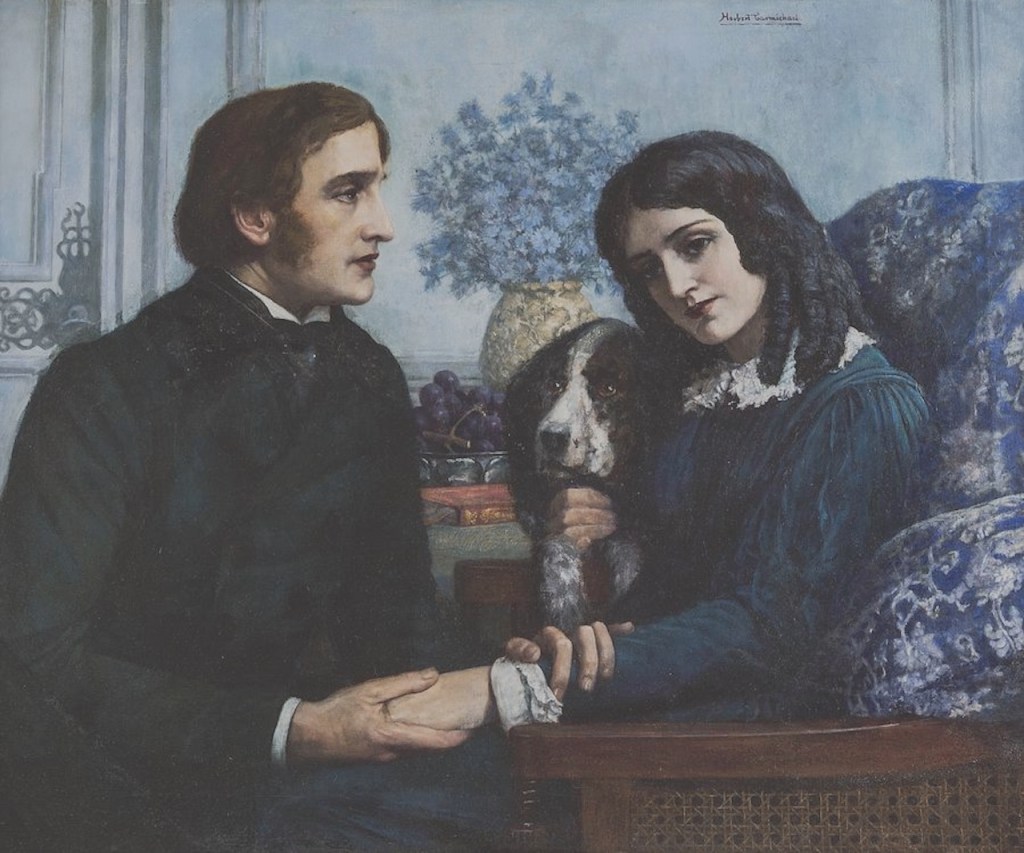
    Image:  Robert Browning visits Elizabeth Barrett at 50 Wimpole Street painting by Celestial Images

    Elizabeth Barrett Browning’s Sonnet 20 “Beloved, my Beloved, when I think”

    Sonnet 20 “Beloved, my Beloved, when I think” from Sonnets from the Portuguese finds the speaker in a pensive mood, dramatizing her awe at the difference a year has made in her life.

    Introduction with Text of Sonnet 20 “Beloved, my Beloved, when I think”

    The speaker in Elizabeth Barrett Browning’s sonnet 20 “Beloved, my Beloved, when I think” from Sonnets from the Portuguese remembers that just year ago she would not have been able to imagine that a love relationship with someone so important as her belovèd would break the chains of sorrow with which she has been bound for many years.

    This sonnet finds the speaker in a pensive mood, dramatizing her awe at the difference a year has made in her life.  The speaker is gaining confidence in her ability to attract and return the kind of love that she has yearned for but heretofore considered herself unworthy of possessing. 

    Sonnet 20 “Beloved, my Beloved, when I think”

    Beloved, my Beloved, when I think
    That thou wast in the world a year ago,
    What time I sate alone here in the snow
    And saw no footprint, heard the silence sink
    No moment at thy voice … but, link by link,
    Went counting all my chains, as if that so
    They never could fall off at any blow
    Struck by thy possible hand … why, thus I drink
    Of life’s great cup of wonder! Wonderful,
    Never to feel thee thrill the day or night
    With personal act or speech,—nor ever cull
    Some prescience of thee with the blossoms white
    Thou sawest growing! Atheists are as dull,
    Who cannot guess God’s presence out of sight.

    Commentary on Sonnet 20 “Beloved, my Beloved, when I think”

    Sonnet 20 “Beloved, my Beloved, when I think” finds the speaker in a pensive mood, dramatizing her awe at the difference a year has made in her life.

    First Quatrain:  The Difference a Year Makes

    Beloved, my Beloved, when I think
    That thou wast in the world a year ago,
    What time I sate alone here in the snow
    And saw no footprint, heard the silence sink 

    The speaker is reminiscing about her feelings “a year ago” before she had met her belovèd. She sat watching the snow that remained without his “footprint.” The silence surrounding her lingered without her hearing his voice. The speaker is structuring her remarks in when/then clauses; she will be saying, “when” this was true, “then” something else was true.

    In the first quatrain, she is thus beginning her clause with “when I think” and what she is thinking about is the time before her belovèd and she had met. She continues the “when” clause until the last line of the second quatrain.

    Second Quatrain:  Never to be Broken Chains

    No moment at thy voice … but, link by link,
    Went counting all my chains, as if that so
    They never could fall off at any blow
    Struck by thy possible hand … why, thus I drink 

    Continuing to recount what she did and how she felt before her ne love came into her life, she reminds her audience that she was bound by “all my chains” which she “went counting” and believing would never be broken.  The speaker makes it clear that her belovèd has, in fact, been responsible for breaking those chains of pain and sorrow that kept her bound and weeping.

    The speaker then moves into the “then” construction, averring that the arrival of her belovèd is, indeed, the reason that she can now look on the world as a place “of wonder.”  At this point, she is simply experiencing the awe of wonder that she should be so fortunate to have her belovèd strike those metaphorical blows against the chains of sorrow that kept her in misery.

    First Tercet:  Near Incredulous

    Of life’s great cup of wonder! Wonderful,
    Never to feel thee thrill the day or night
    With personal act or speech,—nor ever cull 

    The speaker then expounds on what she had not been able to foretell as she remained unable to experience the joy and thrill of living that her belovèd has now afforded her through his acts of kindness and his verbal expressions of affection.  The speaker is nearly incredulous that she could have remained without the love that has become so important to her.

    Second Tercet:  Dull as Atheists

    Some prescience of thee with the blossoms white
    Thou sawest growing! Atheists are as dull,
    Who cannot guess God’s presence out of sight.

    The speaker adds another part of her astonishing “wonder”: that she was not able to sense that such a being might actually be living and amenable to having a relationship with her.  She feels that she should have had some inkling of awareness that such might be the case.

    She sees now that she was “as dull” as “atheists,” those unimaginative souls, “who cannot guess God’s presence out of sight.”   The speaker’s belovèd is such a marvelous work of nature that she imbues him with a certain divine stature, and she considers herself somewhat “dull” for not being about to guess that such a one existed. 

    As atheists are unable to surmise of Supreme Intelligence guiding the ordered cosmos, she was incapable of imagining that one such as her belovèd would come along and free her from her self-induced coma of sadness.

  • Elizabeth Barrett Browning’s Sonnet 19 “The soul’s Rialto hath its merchandise”

    Image: Elizabeth Barrett Browning and Robert Browning – Global Love Museum

    Elizabeth Barrett Browning’s Sonnet 19 “The soul’s Rialto hath its merchandise”

    The two lovers exchange locks of hair, and the speaker makes a ceremony of the exchange as she again emphasizes the royalty of her lover’s station and talent.

    Introduction with Text of Sonnet 19 “The soul’s Rialto hath its merchandise”

    In sonnet 18 “I never gave a lock of hair away” from Elizabeth Barrett Browning’s Sonnets from the Portuguese, the speaker dramatically celebrates giving a lock of her hair to her belovèd.

    The little drama continues with sonnet 19 “The soul’s Rialto hath its merchandise,” as she receives a lock from him.  The two lovers exchange their locks of hair, and the speaker dramatizes a ceremony of the exchange, as she again celebrates the royalty of her lover’s station and talent.

    Sonnet 19 “The soul’s Rialto hath its merchandise”

    The soul’s Rialto hath its merchandise;
    I barter curl for curl upon that mart,
    And from my poet’s forehead to my heart
    Receive this lock which outweighs argosies,—
    As purply black, as erst to Pindar’s eyes
    The dim purpureal tresses gloomed athwart
    The nine white Muse-brows. For this counterpart,
    The bay-crown’s shade, Belovèd, I surmise,
    Still lingers on thy curl, it is so black!
    Thus, with a fillet of smooth-kissing breath,
    I tie the shadows safe from gliding back,
    And lay the gift where nothing hindereth;
    Here on my heart, as on thy brow, to lack
    No natural heat till mine grows cold in death.

    Commentary on Sonnet 19 “The soul’s Rialto hath its merchandise”

    The two lovers exchange locks of hair, and the speaker makes a ceremony of the exchange as she again emphasizes the royalty of her lover’s station and talent.

    First Quatrain:  Oration and Commemoration

    The soul’s Rialto hath its merchandise;
    I barter curl for curl upon that mart,
    And from my poet’s forehead to my heart
    Receive this lock which outweighs argosies,—

    As in sonnet 18 “I never gave a lock of hair away,” the speaker offers a bit of an oration, commemorating the exchange of locks of hair between the two lovers. She metaphorically compares the soul to a marketplace, the Rialto, an important commercial district in Venice.  The speaker employs a commercial metaphor because of the trading of items that the two lovers are engaging in.

    The speaker then reveals that she is accepting the lock of hair from the head of her beloved with all the enthusiasm that an individual might express if she were presented with large loads of valuable cargoes from vast commercial sailing ships.

    The speaker enhances the value of that lock of hair by stating that it weighs even more than “argosies.” It is even more valuable than all the cargo arriving in vast commercial vessels that travel the seas.

    Second Quatrain:  Purple Black

    As purply black, as erst to Pindar’s eyes
    The dim purpureal tresses gloomed athwart
    The nine white Muse-brows. For this counterpart,
    The bay-crown’s shade, Belovèd, I surmise,

    In the second quatrain, the speaker emphasizes the blackness of her lover’s lock. The “curl,” she claims, is so black that it is “purply black.”  Again, she employs the color of royalty to distinguish the high station of her talented, handsome, accomplished lover.

    The speaker alludes to the ancient Greek poet Pindar, who is considered the greatest of the nine most famous ancient Greek poets, whom she references as “the nine white Muse-brows.”  The speaker’s lover’s lock is as significant because he is as important to the poetry world as those Greek poets are.

    First Tercet:  Pindar Allusion

    Still lingers on thy curl, it is so black!
    Thus, with a fillet of smooth-kissing breath,
    I tie the shadows safe from gliding back,

    The speaker voices her assumption that “the bay-crown’s shade, Beloved / / Still lingers on the curl.” The “bay-crown” refers to that most famous poet, Pindar, whose shadow-presence influences her lover’s talent through his “purpureal tresses.”

    The speaker insists that because of the high value she places on that black lock of hair, she will keep the lock close to her heart to keep it warm.  Likely, the speaker will place it in a locket, but she exaggerates her drama by saying she is binding it with her “smooth-kissing breath” and tying “the shadows safe from gliding back.”

    Second Tercet:  Ceremony of the Lock

    And lay the gift where nothing hindereth;
    Here on my heart, as on thy brow, to lack
    No natural heat till mine grows cold in death.

    In placing the lock next to her heart, the speaker is safe-guarding the “gift where nothing” can disturb it.  Close to the speaker’s heart, the lock will “lack / No natural heat” until, of course, the speaker “grows cold in death.”  The ceremony of the lock exchange is complete, and the love relationship will then progress to the next important stage.

  • Elizabeth Barrett Browning’s Sonnet 18 “I never gave a lock of hair away”

    Image: Elizabeth Barrett Browning and Robert Browning – 1852. Portraits painted by Thomas Buchanan Read

    Elizabeth Barrett Browning’s Sonnet 18 “I never gave a lock of hair away”

    In sonnet 18 “I never gave a lock of hair away” from Elizabeth Barrett Browning’s “Sonnets from the Portuguese,” the speaker dramatizes the simple act of giving a lock of her hair to her belovèd.

    Introduction with Text of Sonnet 18 “I never gave a lock of hair away”

    Sonnet 18 “I never gave a lock of hair away” from Elizabeth Barrett Browning’s Sonnets from the Portuguese reveals the speaker musing on her feelings as she affords her belovèd the gift of a lock of her hair, of which she emphasizes its purity in that no other man has touched it.

    The tentative and lonely speaker continues to create little dramas in her developing relationship with her friend and belovèd, who happens to be a fellow poet.  No doubt her lover appreciates her musing and feels a great sense of pride in having her composing for his benefit.

    And the poet/speaker herself continues to develop from the shy individual whose countenance had thus far bespoken only melancholy, derived from much physical and mental suffering.

    Sonnet 18 “I never gave a lock of hair away”

    I never gave a lock of hair away
    To a man, Dearest, except this to thee,
    Which now upon my fingers thoughtfully,
    I ring out to the full brown length and say
    ‘Take it.’ My day of youth went yesterday;
    My hair no longer bounds to my foot’s glee,
    Nor plant I it from rose or myrtle-tree,
    As girls do, any more: it only may
    Now shade on two pale cheeks the mark of tears,
    Taught drooping from the head that hangs aside
    Through sorrow’s trick. I thought the funeral-shears
    Would take this first, but Love is justified,—
    Take it thou,—finding pure, from all those years,
    The kiss my mother left here when she died.

    Commentary on Sonnet 18  “I never gave a lock of hair away”v

    In sonnet 18 “I never gave a lock of hair away,” the speaker is dramatizing a little ritual of the simple act of giving a lock of her hair to her lover.  Such gift giving was a common occurrence in that era, but to this speaker, it becomes a momentous event owing to her years of solitary confinement and physical as well a mental suffering.

    First Quatrain:  A Virgin Lock

    I never gave a lock of hair away
    To a man, Dearest, except this to thee,
    Which now upon my fingers thoughtfully,
    I ring out to the full brown length and say

    The speaker begins by claiming that she has never given any other man a lock of her hair; it is, therefore, to her a particularly special act that she is now conferring on her lover this special lock. 

    She has excised a few strands that extend are the exact full length of her hair which she designates as brown in color, even though she later affirms that she is no longer a young woman.

    The strands rest upon her “fingers” as she philosophically dramatizes the event by saying a few words over them.  The object takes on a status of a sacred relic as she seems almost prayerful in handling them.

    This speaker is almost always full of drama, from agonizing over her miseries to proclaiming her now vast and growing love and affection for her belovèd. Her life is the stuff and substance of her poetry, and she lives it in each and every moment.

    This speaker’s intensity remains the very stuff of living life “deliberately” as promulgated by Barrett Browning’s contemporary, the American philosopher Henry David Thoreau, who affirmed, “I went to the woods because I wished to live deliberately.”  This speaker, in nurturing a love relationship with a fellow poet, is living deliberately as she composes verses exploring and celebrating that relationship.

    Second Quatrain:  Justifying the Gift

    ‘Take it.’ My day of youth went yesterday;
    My hair no longer bounds to my foot’s glee,
    Nor plant I it from rose or myrtle-tree,
    As girls do, any more: it only may

    The speaker hands the hair to her lover and commands him, “Take it.” She then reveals the fact that she is no longer a young woman.  She emphasizes that her youth has already passed her by.  She no longer runs and jumps and skips thus causing her hair to jostle about as she did when she was a child. 

    The speaker no longer performs little rituals with it such as offering strands of her hair to birds to build their nests.  She needs to justify giving away this lock of hair, just as her personality motivates her to justify everything she does and feels.  Such justification remains part of her notion of living life through deliberate acts.

    First Tercet:  Covering Her Poor Cheeks

    Now shade on two pale cheeks the mark of tears,
    Taught drooping from the head that hangs aside
    Through sorrow’s trick. I thought the funeral-shears

    In the first tercet of the sestet, the speaker then divulges the use to which she has long put her locks of hair, and it is not surprising that that use would be bound closely to her sorrow with which has lived her entire life. 

    The speaker does not disappoint as she reveals that the only use for those locks of brown hair has been to cover her poor cheeks which are so often streaked with tears.  She has shed tears so often and so profusely that she hardly recognizes herself without those streak running down her face.

    Those locks of hair have simply hung down over those tear-stained cheeks, and they have learned to hide the sorrow that urges those tears. She has become habituated to tilting her head a certain way to encourage the hair to act as a curtain to shield her sadness.

    This speaker’s framing of the rituals with simple strands of falling hair reveals the clever artist whose dramatic verse offers such colorful images that unfold the nature of her cloistered life.  Such drama emphasizes the importance of her new relationship with the important belovèd, who can now help her release the past agony with which she has had to contend.

    Second Tercet:  Her Chaste Hair

    Would take this first, but Love is justified,—
    Take it thou,—finding pure, from all those years,
    The kiss my mother left here when she died.

    The speaker’s final dramatic pose reveals that she thought some mortician would be the one to cut her hair. This image again emphasizes the morbidity of the thoughts with which the speaker has had to grapple for so many empty years. 

    But now her lover has came along and “justified” her cutting it herself and presenting it to him.  Her relief from the past morbid imagery becomes palpable.  She is finally free to accept that happiness may actually become a central feature in the existence.

    The speaker then emphasizes again that the hair is as pure as the day her mother left “the kiss” on it before she died.  She is repeating and emphasizing her claim that no other man has had access to her chaste hair.  The purity of this lock of hair becomes symbolic of the purity of the love relationship between the speaker and her belovèd.