Linda's Literary Home

Tag: mysticism

  • Emily Dickinson’s “Exultation is the going”

    Image: Emily Dickinson - Amherst College - Daguerrotype of the poet at age 17, circa 1847 - likely the only authentic, extant likeness of the poet
    Image: Emily Dickinson – Amherst College – Daguerrotype of the poet at age 17, circa 1847 – likely the only authentic, extant likeness of the poet

    Emily Dickinson’s “Exultation is the going”

    Emily Dickinson’s “Exultation is the going” reveals the speaker’s conception of the soul’s exhilarating journey beyond the limitations of earthly existence. The movement toward the infinite becomes an experience of spiritual freedom, discovery, and divine joy.

    Introduction and Text of “Exultation is the going”

    In Emily Dickinson’s “Exultation is the going,” the speaker presents the soul as an inland traveler who experiences an extraordinary transformation upon reaching the sea. The departure from familiar surroundings becomes a symbolic journey from the limitations of earthly existence into the boundless expanse of Eternity/Immortality.

    The speaker employs the imagery of the sea to indicate a spiritual adventure that transcends ordinary human experience. The familiar houses and headlands disappear behind the traveler, while the soul moves toward an existence that promises immeasurable freedom. The speaker then questions whether someone accustomed to the mountains can understand such an overwhelming experience.

    Exultation is the going

    Exultation is the going
    Of an inland soul to sea,
    Past the houses – past the headlands –
    Into deep Eternity –

    Bred as we, among the mountains,
    Can the sailor understand
    The divine intoxication
    Of the first league out from land?

    Commentary on “Exultation is the going”

    The speaker’s presentation of the soul’s departure from familiar surroundings affirms that spiritual awakening involves leaving behind the limitations of ordinary consciousness. The journey toward Eternity becomes an experience of extraordinary joy, freedom, and discovery.

    First Stanza: The Soul’s Journey into Eternity

    Exultation is the going
    Of an inland soul to sea,
    Past the houses – past the headlands –
    Into deep Eternity –

    The speaker begins with a rather startling declaration that exultation is associated with the departure of an “inland soul” toward the sea. The word “Exultation” immediately establishes an atmosphere of extraordinary joy, indicating that this journey offers something far beyond ordinary earthly pleasures.

    The “inland soul” represents an individual whose experience has been confined to familiar surroundings. The sea, however, offers an entirely different dimension of existence. Its vastness provides an appropriate metaphor for the limitless possibilities of spiritual consciousness.

    The speaker then describes the traveler moving “Past the houses – past the headlands.” These familiar landmarks represent the boundaries of ordinary human existence. Houses are domestic security and established routines, while headlands demarcate the physical limits of the familiar landscape.

    By moving beyond these landmarks, the soul leaves behind the restrictions imposed by its accustomed environment. The speaker is revealing that genuine spiritual discovery requires a willingness to venture beyond what is familiar and comfortable.

    The destination is “deep Eternity.” This expression carries the reader beyond the physical sea into a metaphysical universe. The word “deep” suggests an immeasurable expanse, while “Eternity” offers the promise of existence beyond the limitations of earthly time. and space

    Such spiritual joy finds a meaningful parallel in the teachings of Paramahansa Yogananda. The great Guru explains, “The nature of Spirit is joy; and the nature of your soul is joy.”  This teaching corresponds to the speaker’s association of the soul’s journey with exultation.

    In my earlier commentary on Dickinson’s “On this wondrous sea,” I have discussed the speaker’s use of the sea as a metaphor for spiritual existence. There, the sea becomes an avenue toward Eternity, just as it does in the present poem.

    Second Stanza: The Divine Intoxication of Departure

    Bred as we, among the mountains,
    Can the sailor understand
    The divine intoxication
    Of the first league out from land?

    The speaker now introduces a comparison between those who are “Bred as we, among the mountains” and the sailor who ventures out upon the sea. The mountains represent the familiar environment in which the speaker and others have developed their understanding of the world.

    The question “Can the sailor understand” introduces an intriguing consideration regarding the limitations of human experience. Someone who has always lived among mountains may possess considerable knowledge of the natural world, but that knowledge does not necessarily include the extraordinary experience of sailing away from land.

    The speaker’s question also suggests that firsthand experience offers something that mere observation cannot provide. A person standing safely on shore can look toward the ocean, but that individual cannot fully appreciate the sensation of departing from land and entering its vast, unfamiliar expanse.

    The expression “divine intoxication” is especially significant. Ordinarily, intoxication suggests an overwhelming sensation that temporarily transports an individual beyond ordinary awareness. Here, however, the speaker adds the adjective “divine,” elevating the experience into something spiritually exhilarating.

    The first league out from land represents the initial stage of this extraordinary adventure. Although the distance may be relatively small, the psychological and spiritual significance of leaving familiar territory is enormous. The traveler has begun an experience that promises to transform ordinary awareness.

    The speaker’s use of “divine intoxication” also invites comparison with Paramahansa Yogananda’s teachings regarding the soul’s experience of divine joy. As the great Guru explains, “Divine Joy outlasts everything.”  The speaker’s exultation similarly describes a joy that transcends ordinary physical pleasures.

    The question directed toward the sailor remains somewhat mysterious. The speaker is suggesting that even someone accustomed to the sea cannot fully communicate the extraordinary experience of the soul’s departure into Eternity. Such an experience must ultimately be encountered individually rather than understood entirely through another person’s description.

    The speaker therefore presents spiritual awakening as an intensely personal adventure. Those who remain within the boundaries of familiar existence may imagine the possibilities beyond those boundaries, but the actual experience of entering the infinite belongs to the individual who undertakes the journey.

    In my earlier essays on Dickinson’s poems, I have discussed the speaker’s recurring fascination and experience with mystical realities that transcend material existence. This poem offers another example of that fascination, as the soul ventures beyond its familiar earthly surroundings toward an eternal destination.

    Ultimately, the speaker has fashioned a fascinating little drama about the soul’s longing for something greater than the physical world can provide. The sea becomes the gateway to an immeasurable spiritual universe, and the departure from land becomes an occasion for extraordinary exultation.

    The speaker leaves readers contemplating a profound reality: that the greatest joy available to the human soul arises not from remaining safely within familiar boundaries, but from venturing courageously into the boundless reality of Eternity.

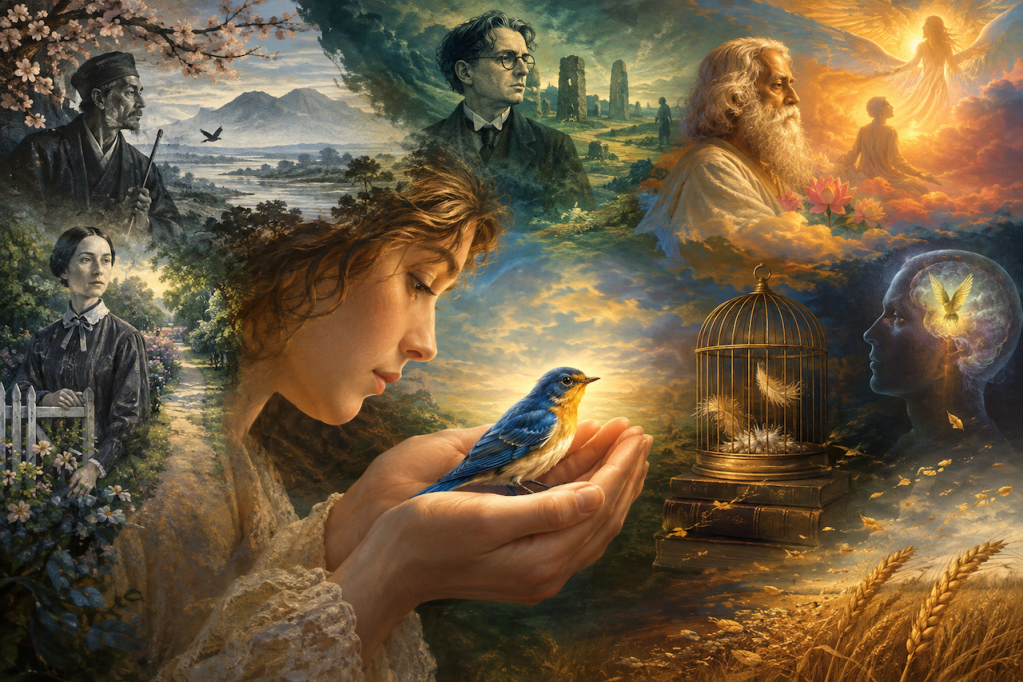
    Image: Emily Dickinson - Commemorative Stamp
    Image: Emily Dickinson – Commemorative Stamp
  • The Winged Wonder

    Image created by ChatGPT inspired by the poem.
    Image created by ChatGPT inspired by the poem

    The Winged Wonder

    My winged wonder lights the dark of my night
    Dickinson’s came down the walk—led the way
    Basho’s went about—sung seasons to flight

    Yeats’ golden one flew backward into night
    To green-hued times where ancient dreams held sway
    My winged wonder lights the dark of my night

    Tagore’s bowed to Love—the source of all light
    The torch divine where souls may come to pray
    Basho’s went about—sung seasons to flight

    Mine flew into my cupped young hands that day
    They caged his essence keeping him aright
    My winged wonder lights the dark of my night

    He shivers on my shoulders—does not stray
    Perched in my brain, directs my ear and sight
    Basho’s went about—sung seasons to flight

    At times I sift the chaff and lose my way
    He forbids I sing my worst sins outright
    My winged wonder lights the dark of my night
    Basho’s went about—sung seasons to flight

  • Waltzing with Shadows

    Image created by Grok inspired by the poem
    Image created by Grok inspired by the poem

    Waltzing with Shadows

    Crimson leaves crunch beneath
    Bare toes as she threads
    Through autumn’s embrace
    Spinning in glimmering sunbeams.

    Visions of dark starlight spread
    Gleaming over the fresh paint
    Of sacred dawn. Azure fires
    Streak patches of emerald moss.

    Mist over the waters rises
    Bringing noon’s bright visage–
    A trail of dusty signals
    Damp life, panting and parting.

    Each pluck of melody’s string
    Spews seeds for future poppies
    To settle in quiet twilight, waltzing
    With shadows, ancient and alone.

  • Emily Dickinson’s “Summer for thee, grant I may be”

    Image: Emily Dickinson – Amherst College – Daguerrotype of the poet at age 17, circa 1847 – likely the only authentic, extant likeness of the poet

    Emily Dickinson’s “Summer for thee, grant I may be”

    Addressing the Divine Belovèd, Emily Dickinson’s speaker prays to remain a special musical and visual spark in the creation of everlasting, eternal, immortal Bliss.

    Introduction with Text of “Summer for thee, grant I may be”

    Many of Emily Dickinson’s poems prominently feature humble prayers to the Blessèd Creator.  As she adored nature’s many sounds and varieties of colors, she sought to feel her connection through the spiritual level of being to all that makes up the created world.  Her favorite season of summer often served as the resplendent muse that allowed her entry into the mystical nature of sound and sight.  

    Although, on their physical level, those sense-tinged images are beautiful and inspiring, Dickinson created characters to demonstrate the profound awareness that a deeper, even more beautiful and inspiring level of existence could be intuited.   As her speakers approach the ineffable, the language grows more intensely mystical, requiring that special reading that all poetry requires but on an ever deeper level.

    Summer for thee, grant I may be

    Summer for thee, grant I may be
    When Summer days are flown!
    Thy music still, when Whipporwill
    And Oriole – are done!

    For thee to bloom, I’ll skip the tomb
    And row my blossoms o’er!
    Pray gather me –
             Anemone –
    Thy flower – forevermore!

    Reading

    Commentary on “Summer for thee, grant I may be”

    Emily Dickinson’s speaker is addressing her Creator, her Heavenly Father (God), praying to retain her special knowledge of musical and visual imagery that have been especially brought into existence for understanding creation through the art of poetry. 

    First Stanza:  Mystical Metaphors

    Summer for thee, grant I may be
    When Summer days are flown!
    Thy music still, when Whippoorwill
    And Oriole – are done!  

    The speaker begins by addressing the Divine Belovèd, imploring the Heavenly Father to allow her continued mystical existence even after the beautiful summer season’s glowing days “are flown!” 

    The inspiration in which she has reveled is exemplified in the music of the “Whippoorwill” and the “Oriole.”   Both the music of the bird songs and the warmth and beauty of a summer day are contained in the mere reference in the half line “Thy music still . . . .”  

    The use of the familiar second person pronouns, thee and thy, hint that the speaker is addressing God.  Only God, the Heavenly Reality, the Over-Soul, is close enough to the individual soul to require such a personally familiar pronoun in the Dickinsonian era of common parlance, as well as in that of present day English. 

    Dickinson’s innate ability to intuit from nature the creative power of the Creator urged the poet in her to build entirely new worlds in which she mentally resided, as her soul overflowed with ever new bliss of knowledge.    Such knowledge did not arrive in pairs of opposites as earthly knowledge does, but rather that state of knowing afforded her direct perception of truth and reality.

    Thus, she employed metaphor as readily as a child employs new and special ways of putting into language concepts he/she has never before encountered.  A useful example of this child-metaphor engagement can be observed when hearing little toddler girl call a hangnail a string.  

    The toddler who had experienced a hangnail but had no name for it still manages to communicate the reality of the hangnail because she does know the nature of both the finger condition and what a string looks like.   Although Dickinson is communicating well beyond earthly reality, she can produce a metaphor for the ineffable as easily as a child can name a hangnail a string.

    Second Stanza:  Rowing in Bliss

    For thee to bloom, I’ll skip the tomb
    And row my blossoms o’er!
    Pray gather me –
             Anemone –
    Thy flower – forevermore!  

    The speaker then offers a very cheeky remark in claiming she will “skip the tomb.”  But she can do so because she has already just revealed the reason for such an ability. The Divine Reality has been blossoming in her.

    She can tout her connection and continued existence through Immortality because she knows her soul is everliving, everlasting, and remains a spark of ever-new power. The speaker then rows her immortal sea craft–the soul–which blooms eternally like the most beautiful flowers that earth has to offer.  

    But even with such knowledge of such power, she remains humble, praying that the Divine Belovèd continues to “gather [her]” as bouquets of other earthly flowers are gathered.  She then names the beautiful flower which metaphorically represents her blossoming soul, “Anemone.” 

    The flower’s musical name as well as variety of colors play in the minds and hearts of readers, as perfect metaphorical representations of the ineffable entity–the ever blissful soul. The minimalism of the Dickinson canon speaks volumes–more than any voluminous text could do.  

    Such an accomplishment belongs to the wisdom of the ages and to the musing, meditative mind that enters the hallways of reality on the astral and causal levels of existence where artists find their most profound inspiration.  

    Those who can turn those inspirations into words will always find an audience down through the centuries as long as this plane of earthly existence continues its twirl through space.

    🕉

    You are welcome to join me on the following social media:
    TruthSocial, Locals, Gettr, X, Bluesky, Facebook, Pinterest 

    🕉

    Share