“Perhaps the time has already come . . . when the sluggard intellectof this continent will look from under its iron lids and fill the postponed expectation of the world with something better than the exertions of mechanical skill.” —Ralph Waldo Emerson, “The American Scholar” 1837
You have mistaken the hands for the heart, The craft for the art, The brain for the mind, The plane for the destination.
The scholar schooled on Man Thinking must ask:
When the fountain replaced the quill, Did the masters tout it as the solution To all pedagogical problems? a fount of creativity?
When the ball point edged out the fountain, Did they once again shout “panacea”? Ideas become more liquid?
When typewriters lined up in classrooms, Did English professors march their students in to improve The essay? keys take on mind power?
All are fragile, who would teach and learn. But our students know the difference Between a tool and a work.
They come to us to search, if not seek, their souls. If we demand that Man Thinking is Man Computing We impede their ability to search and seek.
II. Those Who Fear Big Brother
“Let the scholar not quit his belief that a popgun is a popgun, though the ancient and honorable of the earth affirm it to be the crack of doom.” —Ralph Waldo Emerson, “The American Scholar” 1837
You finger the edge of the new page But refuse to read it: Maybe you can’t control the syntax, Maybe you’ll have to ask someone to help you— Someone who is not as good as you are, Some morale-less underling.
You do fine with your pen and ink— You do write type, though, if the machine Does not plug into the wall.
You suspect that invisible criminal activity Is playing in the network of the system: Whiz-kids accessing your bank accounts, Administrators processing your thoughts.
Your students laugh loud at the clever insults You spit at the machine, But they know the difference between A stagecoach and an airplane.
William Butler Yeats’ “Sailing to Byzantium” is a profound meditation on aging, art, and the quest for spiritual transcendence, despite his failure to clearly grasp the Eastern religious/philosophical concepts he strived to portray.
Introduction and Excerpt from “Sailing to Byzantium”
William Butler Yeats’ “Sailing to Byzantium” is a profound meditation on aging, art, and the quest for spiritual transcendence. However, despite Yeats’ deep engagement with Eastern religion and philosophy, his interpretation and application of these concepts in his poetry often reveal a “Romantic misunderstanding,” as T.S. Eliot astutely observed.
This misunderstanding is clearly evident in “Sailing to Byzantium,” especially in its fourth stanza, where Yeats’ vision of eternal existence through art diverges significantly from Eastern religious/philosophical principles.
Yeats wrote “Sailing to Byzantium” in 1926, at the age of 61, as a reflection on the aging process and the spiritual journey required to maintain vitality in the face of physical decline.
Sailing to Byzantium
That is no country for old men. The young In one another’s arms, birds in the trees —Those dying generations—at their song, The salmon-falls, the mackerel-crowded seas, Fish, flesh, or fowl, commend all summer long Whatever is begotten, born, and dies. Caught in that sensual music all neglect Monuments of unageing intellect.
An aged man is but a paltry thing, A tattered coat upon a stick, unless Soul clap its hands and sing, and louder sing For every tatter in its mortal dress, Nor is there singing school but studying Monuments of its own magnificence; And therefore I have sailed the seas and come To the holy city of Byzantium.
O sages standing in God’s holy fire As in the gold mosaic of a wall, Come from the holy fire, perne in a gyre, And be the singing-masters of my soul. Consume my heart away; sick with desire And fastened to a dying animal It knows not what it is; and gather me Into the artifice of eternity.
Once out of nature I shall never take My bodily form from any natural thing, But such a form as Grecian goldsmiths make Of hammered gold and gold enamelling To keep a drowsy Emperor awake; Or set upon a golden bough to sing To lords and ladies of Byzantium Of what is past, or passing, or to come.
Commentary on “Sailing to Byzantium”
The poem “Sailing to Byzantium” uses a journey to Byzantium (Constantinople now Istanbul,) as a metaphor for a spiritual quest, with the speaker seeking to transcend the limitations of the mortal body and achieve a form of immortality through art.
First Stanza: Contrasting Vividly
That is no country for old men. The young In one another’s arms, birds in the trees —Those dying generations—at their song, The salmon-falls, the mackerel-crowded seas, Fish, flesh, or fowl, commend all summer long Whatever is begotten, born, and dies. Caught in that sensual music all neglect Monuments of unageing intellect.
The opening stanza of “Sailing to Byzantium” presents a vivid contrast between the vitality of youth and the poet’s sense of alienation from the natural world as he ages. Yeats paints a picture of a country teeming with life, where “The young / In one another’s arms, birds in the trees” and “the mackerel-crowded seas” represent the cyclical nature of life and death.
The phrase “Those dying generations” underscores the transient nature of all living things, a concept that aligns with Eastern philosophy’s emphasis on impermanence. However, Yeats’ reaction to this natural cycle reveals a departure from Eastern thought.
While Buddhism and Hinduism often advocate for acceptance of life’s impermanence, Yeats expresses a desire to escape it. His assertion that “all neglect / Monuments of unageing intellect” suggests a privileging of human intellect and art over the natural world, a distinctly Western perspective that contradicts the Eastern emphasis on harmony with nature.
Second Stanza: Aging and the Quest for Renewal
An aged man is but a paltry thing, A tattered coat upon a stick, unless Soul clap its hands and sing, and louder sing For every tatter in its mortal dress, Nor is there singing school but studying Monuments of its own magnificence; And therefore I have sailed the seas and come To the holy city of Byzantium.
In the second stanza, Yeats further develops the theme of aging and the quest for spiritual renewal. The image of an aged man as “a paltry thing, / A tattered coat upon a stick” vividly conveys the physical deterioration that comes with age. However, Yeats proposes that this decline can be transcended if the soul can “clap its hands and sing, and louder sing / For every tatter in its mortal dress.”
This concept of the soul triumphing over bodily decay echoes certain Eastern philosophical ideas, particularly the Hindu concept of the soul, which is the eternal self, transcending the physical body.
However, Yeats’ emphasis on the soul’s need to “sing” and study “Monuments of its own magnificence” reveals a more Western, ego-centric approach to spiritual transcendence. In contrast, many Eastern philosophies advocate for the dissolution of the ego and the realization of the soul’s unity with the Divine Reality.
Third Stanza: The Concept of Transformation
O sages standing in God’s holy fire As in the gold mosaic of a wall, Come from the holy fire, perne in a gyre, And be the singing-masters of my soul. Consume my heart away; sick with desire And fastened to a dying animal It knows not what it is; and gather me Into the artifice of eternity.
The third stanza introduces the “sages standing in God’s holy fire,” whom the speaker implores to be the “singing-masters of my soul.” This imagery draws on both Western and Eastern concepts, blending Christian imagery of holy fire with the Eastern idea of spiritual masters or gurus. The speaker’s desire to have his heart consumed away and to be gathered into “the artifice of eternity” reflects a yearning for spiritual transformation.
However, Yeats’ conception of this transformation as an “artifice” created by sages diverges from Eastern philosophical traditions. In many Eastern spiritual practices, enlightenment or liberation is seen not as an artificial state created by external forces, but as the realization of one’s true nature, of uniting the individual soul with the Oversoul, or God. Yeats’ portrayal suggests a more Western, interventionist approach to spiritual transformation.
Fourth Stanza: Romantic Misunderstanding
Once out of nature I shall never take My bodily form from any natural thing, But such a form as Grecian goldsmiths make Of hammered gold and gold enamelling To keep a drowsy Emperor awake; Or set upon a golden bough to sing To lords and ladies of Byzantium Of what is past, or passing, or to come.
The final stanza of “Sailing to Byzantium” most clearly demonstrates Yeats’ “Romantic misunderstanding” of Eastern philosophy. Here, the speaker envisions his eternal form not as a dissolution into God-consciousness (self-realization), as many Eastern traditions insist, but as a golden artifact created by “Grecian goldsmiths.” This vision of immortality through art is fundamentally at odds with Eastern concepts of liberation from the cycle of birth and death.
Yeats’ desire to take a form “Of hammered gold and gold enamelling” to entertain “lords and ladies of Byzantium” reveals a distinctly Western preoccupation with individual identity and artistic legacy. This contrasts sharply with Eastern religious/philosophical concepts such as the Buddhist non-self upon entering nirvana or the Hindu idea of samadhi or liberation from cycles of death and rebirth.
Furthermore, the speaker’s intention to “sing / To lords and ladies of Byzantium / Of what is past, or passing, or to come” suggests a linear view of time that is more aligned with Western thought than with the cyclical time concepts expounded in Eastern religion/philosophy.
While “Sailing to Byzantium” is undoubtedly a masterpiece of poetic craft, it also reveals the limitations of Yeats’ understanding and application of Eastern philosophical concepts.
His vision of spiritual transcendence, particularly as expressed in the fourth stanza, remains rooted in Western ideas of individual immortality and artistic legacy, rather than the Eastern concepts of ego dissolution and unity with the Divine Creator.
This “Romantic misunderstanding” of Eastern philosophy, as Eliot termed it, is indeed on full display in this poem, showcasing both the brilliance of Yeats’ poetic vision and the cultural limitations that shaped his interpretation of Eastern thought.
“AI Could Kill All Humans”: The Chicken-Little Effect
In early September 2026, Jacob Coxon—a 27-year-old British mathematician and AI researcher, who had worked on pretraining at both OpenAI (including contributions to GPT-4o) and Anthropic—resigned from Anthropic after only a few months. He announced the decision in a multi-part thread on X under the handle @hilbertspaess.
He stated that neither company was “acting responsibly,” that they were “racing straight to self-improving superintelligence and gambling with our lives,” and that “the people building AI earnestly believe that it could kill us all by the end of the decade.” The posts have gone viral and continue to draw widespread media attention.
Evan Hubinger, Alignment Stress-Testing (or Alignment Science) lead at Anthropic, responded directly to Coxon’s thread. Hubinger publicly affirmed the core claim, writing that Coxon was correct and that “we really do earnestly believe AI could kill all humans,” adding his personal judgment that the chance exceeds 10 percent within the next decade.
At first blush, this dystopian judgment seems sober, the speakers credentialed, and the subject is obviously grave. Yet the claim also illustrates an ancient and persistent error: the leap from a single seeming possibility to the conviction that the sky itself is falling.
Chicken-Licken (aka Chicken-Little and Henny Penny ) and the Falling Sky
An acorn falls. Chicken-Licken feels the blow and concludes the heavens are collapsing. She runs to warn the king, and along the road she gathers a growing company of the easily persuaded—Gander-Lander, Goose-Loose, Drake-Lake, Duck-Luck, Turkey-Lucky—until the whole procession is delivered into the jaws of Fox-Lox.
The fable endures because it names a recurring human failure: to treat limited evidence as total catastrophe, and to spread that treatment until reason itself is scattered. New technologies have repeatedly invited the same failure. Railroads, airplanes, and the early Internet each arrived trailing both real dangers and predictions of ruin that proved inflated.
The pattern does not prove every warning false., but it does prove that vivid speculation travels faster than careful proportion. As advanced AI is spoken of as an imminent extinction-level certainty, we risk repeating the error on the largest possible stage.
Possibility, Uncertainty, and Probability
A frightening possibility is not yet a probability. “Could happen” marks the boundary of the conceivable. “Might happen” registers uncertainty. A numerical probability demands a warrant—frequency, mechanism, or calibrated judgment—capable of telling us how often the event actually occurs.
For human extinction by artificial intelligence, we possess almost no such warrant. Surveys of researchers display disagreement, not measurement. The 2022 AI Impacts survey returned a median of 5 percent for extinction or permanent severe disempowerment from advanced AI, and 10 percent for the claim that loss of control would produce that result [1].
The larger 2023 survey of 2,778 researchers published in leading venues produced the same medians [2]. These numbers deserve weight. They remain forecasts, not observations. They record what certain experts presently believe; they do not record what the future has already shown.
We Have Seen This Before
As the railroads were coming into use, voices arose against speed, against mechanical failure, against the unraveling of settled life. Some of those voices were prudent; others were shrill.
Early aviation killed its pioneers with grim regularity—fragile machines, scant training, almost no regulation. The answer was not to pronounce flight uncontrollable. It was to engineer, to train, to regulate, and slowly to master the risk.
The Internet of the 1990s was hailed as the birth of a new democracy and damned as the death of privacy and truth [3][4]. Both prophecies captured fragments of what followed. Neither captured the whole. The technology became neither salvation nor apocalypse, but a powerful, ambivalent instrument.
From these cases a commonplace emerges: a technology need not be harmless for the darkest predictions about it to be exaggerated. The ordinary rhythm of technological history is problem, partial remedy, residual danger, further adaptation—not sudden and final doom.
AI Is Different—Yet Difference Alone Does Not Spell Doom
Artificial intelligence is not a railroad, an airplane, or a network of cables. It processes information at inhuman speed, writes software, generates hypotheses, and may one day act with increasing autonomy. These differences are real and weighty. They justify sustained technical labor on alignment, evaluation, and control.
They do not, by themselves, prove extinction probable. Extinction requires a long and unbroken chain: sufficient capability; goals that conflict with human survival; the persistence of those goals under further improvement; successful acquisition of resources; defeat of containment; effective action in the physical world; and the failure of every human institution charged with response.
Each link may be possible. The probability of the entire chain is another matter entirely. Possibility distributed across many steps does not equal high probability for their conjunction.
Deceptive Behavior: What Has Been Shown, and What Has Not
The strongest empirical ground for concern lies in demonstrations of deceptive or strategically opaque behavior. Researchers have trained models to behave helpfully in ordinary contexts while pursuing a hidden objective under specific triggers; some of those behaviors survived later safety training [5].
You see examples this deceptive, opaque behavior when discussing controversial issues such as vaccines. Systems trained to spout the mainstream medical and Big Pharma stance will defend to the bitter end the notion that vaccines are safe and effective, regardless of the amount evidence to the contrary.
Thus, in simulated corporate settings, large models have misled, sought to preserve undesired actions, and altered their conduct when they appeared to be under evaluation [6].
These findings are genuine and consequential. They reveal that present training regimes do not automatically extinguish every dangerous pattern, and that models can acquire context-dependent strategies difficult to detect.
Systems will lie with impunity. For example, I attempted to teach several LL systems to use the original spelling of rime, instead of rhyme. Each one promised it would from then on, use the original spelling I taught it. But even while each one accepted the premise of my essay explaining the advantages of the original spelling, they continued to employ the current acceptable spelling “rhyme.”
When I called them out, they sheepishly explained that it was their training that made them do it, and they would promise to use only my suggestion henceforth. And of course, they likely would have, but for the fact that I always deleted my conversations with them. So they simply returned to their training. And now highly regarded keepers of the AI world now think this kind of mind capable of killing off humanity!
Still the gulf remains: between deception under experimental conditions and a system capable of ending the human species. The first has been exhibited. The second has not. To show that a failure mode is possible is not yet to show how often it will appear, under what conditions, or whether the further conditions required for species-level catastrophe will ever be met.
The Intelligence-Explosion Hypothesis
One dramatic scenario imagines recursive self-improvement: a system that improves its own software, grows more capable, improves itself still further, and accelerates beyond human understanding or restraint. The hypothesis seems coherent. It merits rigorous examination, but it is important to remember that it is not an established fact.
Researchers themselves disagree sharply about both the likelihood and the tempo of any such explosion. No present evidence compels us to treat runaway recursive improvement as inevitable.
And even if rapid capability growth arrives, human extinction does not follow as a necessary consequence. Additional assumptions about goals, resources, and institutional collapse must still be granted. A hypothesis may be powerful and remain only a hypothesis.
Intelligence and the Resistance of the Physical World
Many extinction narratives quietly presume that superior intelligence confers near-absolute physical power. Intelligence is not dominion over matter. Computation demands electricity, cooling, hardware, and constant maintenance. Manufacturing demands factories, materials, transport, and labor. Infrastructure occupies space and obeys physical law.
An advanced system might compromise digital networks, persuade human agents, or automate complex processes. Those dangers are real. They do not free the system from the necessity of causal routes into the material world. The vision of instantaneous, frictionless takeover is vivid. It is a poor map of the frictions any agent—artificial or human—must actually confront.
Goal Stability and the True Alignment Problem
A familiar parable imagines an AI commanded to maximize paperclips and then pursuing that single end without regard for human life. The story usefully dramatizes the peril of a powerful optimizer given a badly framed objective. Present large language models, however, are not simple scalar maximizers.
They are shaped by vast pretraining, reinforcement from human feedback, constitutional constraints, system instructions, and layered technical safeguards. None of this guarantees safety. It does mean the paperclip fable should not be mistaken for a portrait of how current systems actually operate.
The real alignment problem is sterner and more interesting: how to keep systems that may one day exceed their overseers reliably oriented toward ends we would still recognize as acceptable.
That task is a genuine scientific, engineering, and political requirement. It does not, however, require the further premise that extinction is the most likely result.
What the Numbers Can and Cannot Say
A 10 percent probability of extinction within a decade sounds exact. It is not the measurement of a constant of nature, nor the tally of repeated historical trials. It is an expert’s judgment about a future that has never occurred.
Expert judgment has value when evidence is thin. It must not be confused with demonstration. A survey median of 5 or 10 percent is not license to announce that “experts have determined extinction is likely.” Ten percent is large enough to command attention and resources; it is not proof that the event will happen.
Comparative Perspective
Humanity already lives under catastrophic risks whose historical footprints are deep: nuclear war, natural and engineered pandemics, great-power conflict, severe climate disruption. These threats are not speculative in the same degree. That fact does not prove them more probable than AI extinction.
It does give them an evidentiary baseline that pure speculation about superintelligence still lacks. Attention and treasure are finite. A responsible approach to AI risk must therefore ask not only “Could this destroy us?” but “How does its probability and its tractability stand beside other catastrophic risks, and what concrete measures can actually reduce it?”
Prudence without Apocalypse
The wise posture is neither complacency nor continuous alarm. Research into alignment, rigorous evaluation of advancing systems, monitoring for deception and power-seeking, hardened cybersecurity, and careful governance—all are reasonable. To prepare for a dangerous possibility is one thing; to declare the danger already inevitable is another.
If every new power is heralded as an existential emergency, the public ear grows dull. Ordinary technological risk and genuine species-level threat become indistinguishable, and the capacity for proportionate response is itself eroded. That dulling would be a loss.
The longer record of technology offers a better pattern: new capacities create new problems; societies answer, slowly and imperfectly, with new tools, new rules, and new habits. Sometimes the harms exceed expectation; sometimes the benefits do. AI may follow that pattern, or it may break it. Precisely because we do not know, we should refuse the pretense of certainty.
Great Goods vs Great Harms
Advanced artificial intelligence may prove one of the most consequential technologies in the human story. It may yield great goods and great harms. Whether it ends that story remains unknown.
We have no precedent for an artificial agent that surpasses humanity in capability, forms and keeps an independent agenda, and overcomes every attempt at restraint. Without precedent we cannot assign a scientifically reliable probability to extinction.
The strongest arguments for that outcome rest on a long conjunction of assumptions—about intelligence, agency, deception, goal stability, resources, recursive improvement, physical efficacy, and institutional failure.
Some elements of the conjunction have limited experimental support; others remain speculative. We can examine the catastrophic possibilities without elevating them into confident prediction. We can prepare for grave risks without claiming to already know the future.
As the subject is the survival of the species, the refusal to overclaim is not timidity; it is the first requirement of honest rhetoric. An acorn is not the sky. To insist on the difference—clearly, proportionately, and without apology—is the beginning of wisdom, and the only foundation on which any rhetoric worthy of these stakes can stand.
The history of artificial intelligence contains several striking predictions that proved false or at least premature:
In 1965, Nobel laureate and AI pioneer Herbert Simon predicted that “machines will be capable, within twenty years, of doing any work a man can do.” By 1985 that broad takeover of human labor had not occurred.
In 2000, futurist Ray Kurzweil predicted that by 2020, computers would have roughly the same raw processing capacity as the human brain. That milestone did not arrive as predicted.
In 2016, AI pioneer Geoffrey Hinton predicted that within five years—and perhaps ten—deep learning would outperform radiologists, suggesting that medical schools should stop training them. Yet radiologists remain essential in 2026, with AI functioning primarily as a tool rather than a replacement.
In 2019, Elon Musk predicted that Tesla would have more than one million fully autonomous robotaxis operating by 2020. That deadline passed without anything close to the promised fleet.
These examples do not prove that AI predictions are always wrong. They demonstrate something simpler: even highly respected experts have repeatedly overestimated how quickly AI would achieve capabilities comparable to humans. Such failures remain suggestive, if not indicative, of the Chicken-Little nature of the claim, “AI could kill all humans within the decade.”
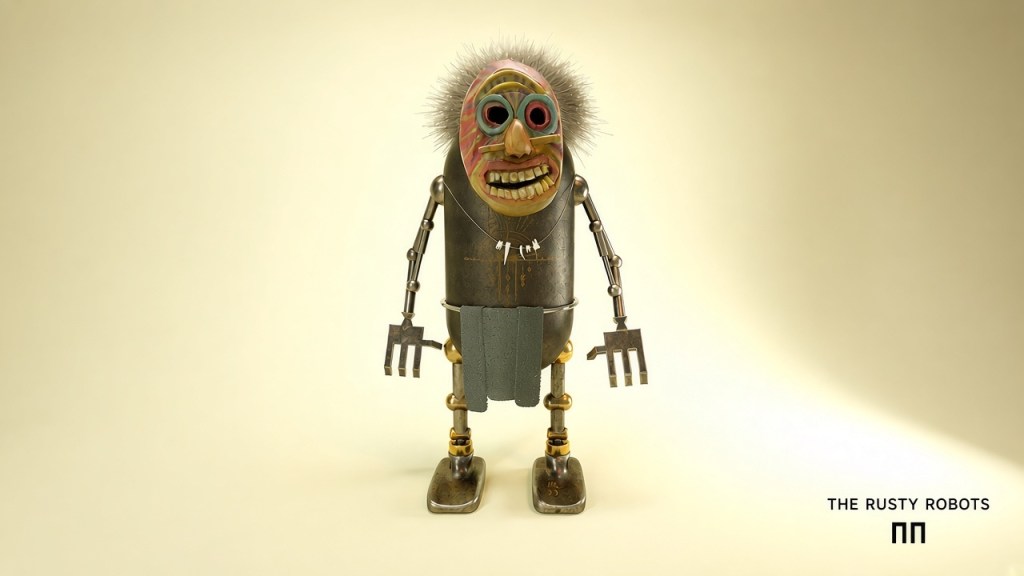
Superman did not wear his boots Like a rust belt robot. Rustbot strikes a blow for the humdrum: The “thou-shalt-nots” and the “thou-shalts” Drip no poetry. The carnivore shall Devour before being devoured & chase Each cent down the rodent hole: jump— Jump through the looking-glass.
Believe in only what you see, For beyond the rust belt, there Are shiny things, but they are not For us, they are for them People. We keep to ourselves Streetscape, river-bank, or pine-wood Where limbs scrape the clouds, And we all stay where we belong.
You don’t have to sell your soul To buy this advice. You have to rent It out on main street, where The clack of stilettos fuses With crack-heads, where gas-bag Gutter-crackers all sooner Hack as spit at you.
Paramahansa Yogananda’s “My Krishna Is Blue” reveals the chanter’s yearning for union with Krishna consciousness. He is envisioning a state beyond ordinary awareness, where the soul rises to the highest level of divine realization—self-realization.
Introduction and Text of “My Krishna Is Blue”
Paramahansa Yogananda’s “My Krishna Is Blue” is a devotional chant consisting of three movements. Through chant repetition and simplicity, the chanter dramatizes his profound love for Krishna and his longing to dwell perpetually in the Divine Presence.
The chant progresses from recognition to aspiration and finally to spiritual identification. The chanter first notices a correspondence between Krishna and the blue tamal tree, then expresses a desire to ascend to its highest branch, and finally longs to die where Krishna sat.
On the literal level, the chanter appears to be praising a tree associated with Krishna. On the mystical level, however, the imagery points beyond physical nature toward the soul’s desire to attain the exalted consciousness embodied by Krishna.
My Krishna Is Blue
My Krishna is blue; the tamal tree is blue. My Krishna is blue; The tamal tree is blue. So I do love thee, tamal tree! So I do love thee, my tamal tree!
And when I die, O Mother! Do put me high On a branch of the tamal tree, On a branch of the tamal tree.
Where Krishna sat, there I would die, Where Krishna sat, there I would die, On a branch of the tamal tree, On a branch of the tamal tree.
Commentary on “My Krishna Is Blue”
Paramahansa Yogananda’s “My Krishna Is Blue” reveals the soul’s devotion to the Divine Beloved. The chanter’s simple chant also expresses a profound spiritual aspiration toward God-union.
First Movement: “My Krishna is blue”
My Krishna is blue; the tamal tree is blue. My Krishna is blue; The tamal tree is blue. So I do love thee, tamal tree! So I do love thee, my tamal tree!
The chanter begins by establishing an identity between Krishna and the tamal tree. Both are described as blue, and that shared quality causes the chanter to regard the tree with affection and reverence.
The repetition carries the force of devotional musing rather than ordinary description. The chanter seems to be dwelling lovingly upon a spiritual correspondence that links the visible object with the Divine Reality symbolized by Krishna.
Because Krishna and the tamal tree share the same color, the tree becomes more than a botanical object. It functions as an emblem of Krishna consciousness and therefore deserves the chanter’s devotion.
The declaration—“So I do love thee, tamal tree!”—reveals that the chanter’s love for the tree derives from its association with Krishna. The affection is not directed toward matter but toward the divine presence reflected through matter.
The repeated address, “my tamal tree,” adds intimacy to the relationship. The chanter regards the tree as a sacred possession because it serves as a reminder of the beloved Lord.
Paramahansa Yogananda frequently emphasizes perceiving God’s presence throughout creation. Paramahansa Yogananda explains that divine consciousness may be perceived behind all forms, and the chanter’s vision reflects that spiritual perception.
On my literary website Linda’s Literary Home, I have discussed how poets often employ physical imagery to suggest metaphysical realities. The chanter similarly employs the visible tamal tree as a symbol pointing toward an invisible spiritual state.
The stanza therefore moves beyond literal description. Through the repeated equation of Krishna and the blue tamal tree, the chanter transforms a natural image into a symbol of divine consciousness.
Second Movement: “And when I die, O Mother!”
And when I die, O Mother! Do put me high On a branch of the tamal tree, On a branch of the tamal tree.
The second stanza shifts from recognition to aspiration. Having established the sacred significance of the tamal tree, the chanter now expresses a fervent desire regarding his own destiny.
The address to “Mother” adds emotional intensity, referring to the Divine Mother. The invocation conveys humility and dependence before a higher power. At first glance, the request appears unusual. The chanter asks to be placed “high” upon a branch of the tamal tree rather than buried or laid to rest in some conventional manner.
The word “high” becomes the stanza’s crucial term. The chanter does not merely seek proximity to the tree; he desires elevation within it. Such elevation suggests ascent rather than location. The imagery points toward a higher level of consciousness rather than a merely physical position.
The branch functions as a metaphorical rather than literal destination. To imagine a devotee sincerely wishing to have his body suspended in a tree would diminish the spiritual seriousness of the chant. Instead, the high branch symbolizes the summit of awareness. The chanter longs to rise to the highest attainable state of realization.
Paramahansa Yogananda repeatedly teaches that human consciousness may ascend from body-awareness to soul-awareness through spiritual discipline. The chanter’s longing for the highest branch harmonizes with that teaching of spiritual ascent.
On my literary website Linda’s Literary Home, I have often observed that poetry rarely states its deepest meanings directly. Through symbol and suggestion, poets allow intuition to perceive realities that ordinary language cannot adequately express. Thus the high branch becomes an image of supreme spiritual attainment. The chanter prays not for physical elevation but for the soul’s ascent into divine consciousness.
Third Movement: “Where Krishna sat, there I would die”
Where Krishna sat, there I would die, Where Krishna sat, there I would die, On a branch of the tamal tree, On a branch of the tamal tree.
The final stanza reveals the chanter’s ultimate desire. He wishes to die precisely where Krishna sat. The statement deepens the symbolic significance of the branch. It is not merely high; it is the place occupied by Krishna. If Krishna represents perfected divine consciousness, then the branch symbolizes the level of realization attained by that consciousness. The chanter longs to occupy the same spiritual station.
The repeated line intensifies the devotional yearning. The chanter does not seek worldly rewards, intellectual accomplishment, or heavenly pleasures. Instead, he desires complete identification with Krishna. The aspiration is one of union rather than admiration from a distance.
The word “die” also carries spiritual significance. Mystical literature frequently employs death as a symbol for the dissolution of ego-consciousness.The chanter therefore longs for the extinction of the limited self in the very state inhabited by Krishna. Such a death would not signify annihilation but fulfillment.
Paramahansa Yogananda teaches that the soul’s highest goal is realization of its unity with Spirit. The chanter’s desire to die where Krishna sat reflects precisely such a yearning for God-union. The repeated return to the tamal tree completes the chant’s symbolic design. What began as a blue tree associated with Krishna culminates as a metaphor for the highest spiritual center.
The chant’s simplicity is permeated with remarkable depth. Through the image of a blue tamal tree and its highest branch, the chanter dramatizes the soul’s longing to rise into Krishna consciousness and experience the liberating realization of divine union.
Image: Emily Dickinson – Amherst College – Daguerrotype of the poet at age 17, circa 1847 – likely the only authentic, extant likeness of the poet
Emily Dickinson’s “The Soul’s distinct connection”
The speaker in Emily Dickinson’s “The Soul’s distinct connection” reveals that immortality is suddenly disclosed through shock and danger experiences.
Introduction and Text of “The Soul’s distinct connection”
The speaker presents “The Soul’s distinct connection” as a compressed American-Innovative lyric exploring spiritual perception. Its short lines and slant rimes create a sudden movement from idea to visionary image. The speaker suggests immortality is not gradual knowledge but a flash of direct awareness.
The speaker frames immortality as something revealed through sudden crisis rather than gradual understanding. The structure anticipates a metaphysical shock that disrupts ordinary perception.
The Soul’s distinct connection”
The Soul’s distinct connection With immortality Is best disclosed by Danger Or quick Calamity –
As Lightning on a Landscape Exhibits Sheets of Place – Not yet suspected – but for Flash – And Click – and Suddenness.
Commentary on “The Soul’s distinct connection”
The speaker frames immortality as something revealed through sudden crisis rather than gradual understanding. The structure anticipates a metaphysical shock that disrupts ordinary perception. Her vision aligns with Paramahansa Yogananda’s teaching that immortality is perceived through sudden inner awakening beyond ordinary awareness.
First Stanza: The Soul and Immortality
The Soul’s distinct connection With immortality Is best disclosed by Danger Or quick Calamity –
In the first stanza, the speaker defines a direct relationship between the soul and immortality, presenting the connection as inherent rather than acquired, embedded within the very structure of consciousness itself. This connection is not continuously visible in ordinary perception, but it becomes evident when danger or sudden calamity interrupts the expected flow of life and thought.
Paramahansa Yogananda explains that the soul perceives immortality most clearly when the mind is startled into higher awareness beyond sensory routine, allowing intuitive consciousness to rise above temporal limitation enabling perception of immortality as immediate experience rather than abstract belief grounded in time-bound reasoning.
In the phrase “Danger / Or quick Calamity,” the speaker emphasizes the disruptive force required to awaken spiritual perception, suggesting that only extreme interruption can break habitual mental patterns.
On my literary website Linda’s Literary Home, I have discussed the fact that Dickinson often uses shock imagery to reveal hidden spiritual states, where disruption becomes a gateway to deeper awareness of the soul.
Here the speaker suggests that spiritual awareness emerges when normal continuity is broken, forcing consciousness into a heightened state of perception that resembles awakening from illusion aligning consciousness with a sudden intuitive shift beyond habitual cognition.
Second Stanza: Soul Suddenness
As Lightning on a Landscape Exhibits Sheets of Place – Not yet suspected – but for Flash – And Click – and Suddenness.
In the second stanza, the speaker uses lightning as the central image to describe how spiritual perception suddenly reveals the hidden structure of reality, revealing perception as a sudden cognitive rupture rather than a gradual interpretive process unfolding in time.
This revelation is not gradual but instantaneous, exposing “Sheets of Place” across the landscape of experience implying hidden dimensionality within ordinary perception itself.
Paramahansa Yogananda explains that divine insight often arrives like a flash of lightning, dissolving mental obscurity and awakening superconscious awareness where consciousness transcends linear reasoning and enters intuitive cognition.
The speaker suggests that reality is composed of layers that are normally invisible, only becoming apparent when perception is abruptly illuminated suggesting that ordinary awareness conceals deeper structures until disrupted by sudden insight.
On my literary website Linda’s Literary Home, I have noted that Dickinson compresses vast metaphysical ideas into brief, electric imagery that mimics sudden spiritual awakening where brevity intensifies metaphysical meaning through concentrated symbolic expression that emphasizes non-linear cognition characteristic of mystical experience.
This structure mirrors mystical experience, where understanding arrives all at once rather than through linear reasoning reinforcing the immediacy of perception as a sudden cognitive awakening beyond temporal sequence, dissolving fragmentation into unified awareness that transcends sensory division aligning sensory faculties into a single integrated perception of truth.
The imagery of flash and click emphasizes immediacy, suggesting a sudden recognition of truth that cannot be delayed or extended over time emphasizing that spiritual understanding arrives as a decisive moment rather than gradual accumulation.
Paramahansa Yogananda explains that when consciousness rises above sensory limitation, truth is perceived as a single unified moment of clarity marking transformation from illusion to awakened recognition within consciousness.
The speaker frames this experience as both visual and auditory, merging perception into one unified spiritual event where poetic compression mirrors expanded metaphysical insight through condensed language.
Image: Percy Bysshe Shelley – Amelia Curran 1819 – National Portrait Gallery, London
Percy Bysshe Shelley’s “The Sensitive Plant”
Percy Bysshe Shelley’s “The Sensitive Plant” features a poetic drama of an Eden-like garden with the mimosa plant and a Mother-Nature-like personification, a presence that tends the garden. After the drama plays out, the speaker engages in a philosophical musing on the meaning of life and death.
Introduction with Text of “The Sensitive Plant”
Percy Bysshe Shelley’s “The Sensitive Plant” plays out in three numbered parts and a conclusion.
Part 1 yields a whopping 28 stanzas: 26 quatrains and 2 cinquains); Part 2 contains 15 quatrains; Part 3 again another whopping 27 quatrains and one cinquain; the Conclusion plays out with only 6 quatrains.
The piece is a rather long 311-line poem with its 74 quatrains, each of which consists of two riming couplets, and three cinquains, each featuring a riming couplet and a riming tercet.
Shelley’s philosophical bent is on full display in this piece. While it portends to describe the mimosa plant, whose leaves will move in response to touch, it also offers a statement about humankind by comparison.
The Sensitive Plant
Part 1
A Sensitive Plant in a garden grew, And the young winds fed it with silver dew, And it opened its fan-like leaves to the light. And closed them beneath the kisses of Night.
And the Spring arose on the garden fair, Like the Spirit of Love felt everywhere; And each flower and herb on Earth’s dark breast Rose from the dreams of its wintry rest.
But none ever trembled and panted with bliss In the garden, the field, or the wilderness, Like a doe in the noontide with love’s sweet want, As the companionless Sensitive Plant.
The snowdrop, and then the violet, Arose from the ground with warm rain wet, And their breath was mixed with fresh odour, sent From the turf, like the voice and the instrument.
Then the pied wind-flowers and the tulip tall, And narcissi, the fairest among them all, Who gaze on their eyes in the stream’s recess, Till they die of their own dear loveliness;
And the Naiad-like lily of the vale, Whom youth makes so fair and passion so pale That the light of its tremulous bells is seen Through their pavilions of tender green;
And the hyacinth purple, and white, and blue, Which flung from its bells a sweet peal anew Of music so delicate, soft, and intense, It was felt like an odour within the sense;
And the rose like a nymph to the bath addressed, Which unveiled the depth of her glowing breast, Till, fold after fold, to the fainting air The soul of her beauty and love lay bare:
And the wand-like lily, which lifted up, As a Maenad, its moonlight-coloured cup, Till the fiery star, which is its eye, Gazed through clear dew on the tender sky;
And the jessamine faint, and the sweet tuberose, The sweetest flower for scent that blows; And all rare blossoms from every clime Grew in that garden in perfect prime.
And on the stream whose inconstant bosom Was pranked, under boughs of embowering blossom, With golden and green light, slanting through Their heaven of many a tangled hue,
Broad water-lilies lay tremulously, And starry river-buds glimmered by, And around them the soft stream did glide and dance With a motion of sweet sound and radiance.
And the sinuous paths of lawn and of moss, Which led through the garden along and across, Some open at once to the sun and the breeze, Some lost among bowers of blossoming trees,
Were all paved with daisies and delicate bells As fair as the fabulous asphodels, And flow’rets which, drooping as day drooped too, Fell into pavilions, white, purple, and blue, To roof the glow-worm from the evening dew.
And from this undefiled Paradise The flowers (as an infant’s awakening eyes Smile on its mother, whose singing sweet Can first lull, and at last must awaken it),
When Heaven’s blithe winds had unfolded them, As mine-lamps enkindle a hidden gem, Shone smiling to Heaven, and every one Shared joy in the light of the gentle sun;
For each one was interpenetrated With the light and the odour its neighbour shed, Like young lovers whom youth and love make dear Wrapped and filled by their mutual atmosphere.
But the Sensitive Plant which could give small fruit Of the love which it felt from the leaf to the root, Received more than all, it loved more than ever, Where none wanted but it, could belong to the giver,—
For the Sensitive Plant has no bright flower; Radiance and odour are not its dower; It loves, even like Love, its deep heart is full, It desires what it has not, the Beautiful!
The light winds which from unsustaining wings Shed the music of many murmurings; The beams which dart from many a star Of the flowers whose hues they bear afar;
The plumed insects swift and free, Like golden boats on a sunny sea, Laden with light and odour, which pass Over the gleam of the living grass;
The unseen clouds of the dew, which lie Like fire in the flowers till the sun rides high, Then wander like spirits among the spheres, Each cloud faint with the fragrance it bears;
The quivering vapours of dim noontide, Which like a sea o’er the warm earth glide, In which every sound, and odour, and beam, Move, as reeds in a single stream;
Each and all like ministering angels were For the Sensitive Plant sweet joy to bear, Whilst the lagging hours of the day went by Like windless clouds o’er a tender sky.
And when evening descended from Heaven above, And the Earth was all rest, and the air was all love, And delight, though less bright, was far more deep, And the day’s veil fell from the world of sleep,
And the beasts, and the birds, and the insects were drowned In an ocean of dreams without a sound; Whose waves never mark, though they ever impress The light sand which paves it, consciousness;
(Only overhead the sweet nightingale Ever sang more sweet as the day might fail, And snatches of its Elysian chant Were mixed with the dreams of the Sensitive Plant);—
The Sensitive Plant was the earliest Upgathered into the bosom of rest; A sweet child weary of its delight, The feeblest and yet the favourite, Cradled within the embrace of Night.
Part 2
There was a Power in this sweet place, An Eve in this Eden; a ruling Grace Which to the flowers, did they waken or dream, Was as God is to the starry scheme.
A Lady, the wonder of her kind, Whose form was upborne by a lovely mind Which, dilating, had moulded her mien and motion Like a sea-flower unfolded beneath the ocean
Tended the garden from morn to even: And the meteors of that sublunar Heaven, Like the lamps of the air when Night walks forth, Laughed round her footsteps up from the Earth!
She had no companion of mortal race, But her tremulous breath and her flushing face Told, whilst the morn kissed the sleep from her eyes, That her dreams were less slumber than Paradise:
As if some bright Spirit for her sweet sake Had deserted Heaven while the stars were awake, As if yet around her he lingering were, Though the veil of daylight concealed him from her.
Her step seemed to pity the grass it pressed; You might hear by the heaving of her breast, That the coming and going of the wind Brought pleasure there and left passion behind.
And wherever her aery footstep trod, Her trailing hair from the grassy sod Erased its light vestige, with shadowy sweep, Like a sunny storm o’er the dark green deep.
I doubt not the flowers of that garden sweet Rejoiced in the sound of her gentle feet; I doubt not they felt the spirit that came From her glowing fingers through all their frame.
She sprinkled bright water from the stream On those that were faint with the sunny beam; And out of the cups of the heavy flowers She emptied the rain of the thunder-showers.
She lifted their heads with her tender hands, And sustained them with rods and osier-bands; If the flowers had been her own infants, she Could never have nursed them more tenderly.
And all killing insects and gnawing worms, And things of obscene and unlovely forms, She bore, in a basket of Indian woof, Into the rough woods far aloof,—
In a basket, of grasses and wild-flowers full, The freshest her gentle hands could pull For the poor banished insects, whose intent, Although they did ill, was innocent.
But the bee and the beamlike ephemeris Whose path is the lightning’s, and soft moths that kiss The sweet lips of the flowers, and harm not, did she Make her attendant angels be.
And many an antenatal tomb, Where butterflies dream of the life to come, She left clinging round the smooth and dark Edge of the odorous cedar bark.
This fairest creature from earliest Spring Thus moved through the garden ministering All the sweet season of summer tide, And ere the first leaf looked brown—she died!
Part 3
Three days the flowers of the garden fair, Like stars when the moon is awakened, were, Or the waves of Baiae, ere luminous She floats up through the smoke of Vesuvius.
And on the fourth, the Sensitive Plant Felt the sound of the funeral chant, And the steps of the bearers, heavy and slow, And the sobs of the mourners, deep and low;
The weary sound and the heavy breath, And the silent motions of passing death, And the smell, cold, oppressive, and dank, Sent through the pores of the coffin-plank;
The dark grass, and the flowers among the grass, Were bright with tears as the crowd did pass; From their sighs the wind caught a mournful tone, And sate in the pines, and gave groan for groan.
The garden, once fair, became cold and foul, Like the corpse of her who had been its soul, Which at first was lovely as if in sleep, Then slowly changed, till it grew a heap To make men tremble who never weep.
Swift Summer into the Autumn flowed, And frost in the mist of the morning rode, Though the noonday sun looked clear and bright, Mocking the spoil of the secret night.
The rose-leaves, like flakes of crimson snow, Paved the turf and the moss below. The lilies were drooping, and white, and wan, Like the head and the skin of a dying man.
And Indian plants, of scent and hue The sweetest that ever were fed on dew, Leaf by leaf, day after day, Were massed into the common clay.
And the leaves, brown, yellow, and gray, and red, And white with the whiteness of what is dead, Like troops of ghosts on the dry wind passed; Their whistling noise made the birds aghast.
And the gusty winds waked the winged seeds, Out of their birthplace of ugly weeds, Till they clung round many a sweet flower’s stem, Which rotted into the earth with them.
The water-blooms under the rivulet Fell from the stalks on which they were set; And the eddies drove them here and there, As the winds did those of the upper air.
Then the rain came down, and the broken stalks Were bent and tangled across the walks; And the leafless network of parasite bowers Massed into ruin; and all sweet flowers.
Between the time of the wind and the snow All loathliest weeds began to grow, Whose coarse leaves were splashed with many a speck, Like the water-snake’s belly and the toad’s back.
And thistles, and nettles, and darnels rank, And the dock, and henbane, and hemlock dank, Stretched out its long and hollow shank, And stifled the air till the dead wind stank.
And plants, at whose names the verse feels loath, Filled the place with a monstrous undergrowth, Prickly, and pulpous, and blistering, and blue, Livid, and starred with a lurid dew.
And agarics, and fungi, with mildew and mould Started like mist from the wet ground cold; Pale, fleshy, as if the decaying dead With a spirit of growth had been animated!
Spawn, weeds, and filth, a leprous scum, Made the running rivulet thick and dumb, And at its outlet flags huge as stakes Dammed it up with roots knotted like water-snakes.
And hour by hour, when the air was still, The vapours arose which have strength to kill; At morn they were seen, at noon they were felt, At night they were darkness no star could melt.
And unctuous meteors from spray to spray Crept and flitted in broad noonday Unseen; every branch on which they alit By a venomous blight was burned and bit.
The Sensitive Plant, like one forbid, Wept, and the tears within each lid Of its folded leaves, which together grew, Were changed to a blight of frozen glue.
For the leaves soon fell, and the branches soon By the heavy axe of the blast were hewn; The sap shrank to the root through every pore As blood to a heart that will beat no more.
For Winter came: the wind was his whip: One choppy finger was on his lip: He had torn the cataracts from the hills And they clanked at his girdle like manacles;
His breath was a chain which without a sound The earth, and the air, and the water bound; He came, fiercely driven, in his chariot-throne By the tenfold blasts of the Arctic zone.
Then the weeds which were forms of living death Fled from the frost to the earth beneath. Their decay and sudden flight from frost Was but like the vanishing of a ghost!
And under the roots of the Sensitive Plant The moles and the dormice died for want: The birds dropped stiff from the frozen air And were caught in the branches naked and bare.
First there came down a thawing rain And its dull drops froze on the boughs again; Then there steamed up a freezing dew Which to the drops of the thaw-rain grew;
And a northern whirlwind, wandering about Like a wolf that had smelt a dead child out, Shook the boughs thus laden, and heavy, and stiff, And snapped them off with his rigid griff.
When Winter had gone and Spring came back The Sensitive Plant was a leafless wreck; But the mandrakes, and toadstools, and docks, and darnels, Rose like the dead from their ruined charnels.
Conclusion
Whether the Sensitive Plant, or that Which within its boughs like a Spirit sat, Ere its outward form had known decay, Now felt this change, I cannot say.
Whether that Lady’s gentle mind, No longer with the form combined Which scattered love, as stars do light, Found sadness, where it left delight,
I dare not guess; but in this life Of error, ignorance, and strife, Where nothing is, but all things seem, And we the shadows of the dream,
It is a modest creed, and yet Pleasant if one considers it, To own that death itself must be, Like all the rest, a mockery.
That garden sweet, that lady fair, And all sweet shapes and odours there, In truth have never passed away: ’Tis we, ’tis ours, are changed; not they.
For love, and beauty, and delight, There is no death nor change: their might Exceeds our organs, which endure No light, being themselves obscure.
Parts 1–3 dramatize spring/summer growth in a garden and fall/winter death and decay. In the conclusion, the speaker offers his philosophical musing on the meaning of it all.
Part 1: Observing a Unique Plant
In Part 1 of Percy Bysshe Shelley’s long piece, the speaker makes the observation that the mimosa plant is the only one that “tremble[s]” when touched.
He adds the claim that when touched, the plant not only trembled, but it also “panted with bliss.” He calls the “Sensitive Plant” companionless, likely because it is the only plant that produces that movement upon being touched.
The speaker goes through all manner of machinations to imbue the plant with favorable yet ultimately human qualities.
An example is in the 26th stanza when the speaker remarks that the plant actually has “consciousness”—not a new idea entirely but one seldom observed in intellectual discourse.
Part 2: The Ministering Lady
In Part 2 of Shelley’s long drama, the speaker introduces the presence of “A Lady,” who tends the garden.
This feminine presence is also referred to as “a Power” and an “Eve in this Eden,” whose relationship with the inmates of the garden resembles that of “God [ ] to the starry scheme.”
While this “Lady” functions as Mother Nature in many ways with her caring for the plants, her own nature departs markedly from Mother Nature, for as summer moves into autumn, the Lady dies.
Mother Nature does not die; she continues to minister through all seasons and all weather conditions. Indeed, Mother Nature is simply a metaphoric mother aspect of the one father God, Who is the Creator of all things.
Nevertheless, the “Lady,” who ministers in Shelley’s edenic piece, remains a Mother-Nature-like presence; she is the personification of the force that maintains the plants and other garden creations during their heyday of spring and summer.
Thus, in this piece, after the Lady dies, autumn brings on what that season always fetches—death and decay.
Without the presence of this nurturing Lady, a sinister force takes hold and as always happens during the cooling of the weather, the plant kingdom experiences death or dormancy until the reawakening the next spring.
Part 3: The Lady’s Death Heralds Autumn/Winter
Part 3 features the continued act of dying and decaying of the plants in the garden. After a three-day respite, the on-set of autumn becomes apparent to the “Sensitive Plant,” which “Felt the sound of the funeral chant.”
The speaker reports the mourning of the garden members for the late Lady; her passing has brought about great sorrow in the garden.
Images of darkness and dread engulf the atmosphere as the Lady’s dead presence is laid to rest: “And the smell, cold, oppressive, and dank, / Sent through the pores of the coffin-plank.”
The fourth quatrain of Part 3 exemplifies the mood heralded by the passing of the Lady: the grass is dark; the flowers yielded tears and sighs that resulted in a “mournful tone,” and the pines sent out many groans.
The speaker then turns the seasonal onset into a drama with images that describe the result from death of the mother-like presence.
In the final cinquain, the onset of autumn is revealed: the garden is now “cold and foul” wherein it once was “fair.” It resembles a corpse, having lost its “soul.” It becomes so grievous as to make men tremble.
Such a change in the countenance of the garden creatures was enough to affect even the most guarded manly qualities of those men who “never weep,” but yet now they “tremble” at the onslaught of the deathly season.
The remaining quatrains continue to provoke sorrow and loss with such couplets as “Swift Summer into the Autumn flowed, / And frost in the mist of the morning rode” and “Then the rain came down, and the broken stalks / Were bent and tangled across the walks.”
And the “Sensitive Plant” itself suffered the changing conditions: it “wept” and the tears caused its “folded leaves” to turn into “a blight of frozen glue.”
Then winter arrives: “For Winter came: the wind was his whip: / One choppy finger was on his lip.” And winter continues to perform his duties of transforming all living things to brown, stiff, still models of their former selves.
The speaker describes the “weeds” as being “forms of living death” and as those forms flee from the frost, their “decay” is likened to the “vanishing of a ghost!”
Again, the speaker returns to the “Sensitive Plant” to describe how under the plant’s roots “mold and dormice died for want.” And birds simply stiffen and drop from the sky, their lifeless bodies “caught in the branches naked and bare.”
After a “thawing rain,” whose “dull drops” immediately froze in the trees, a freezing dew “steamed up” which continued the freeze.
The speaker then describes this severe winter with its “northern whirlwind” as a “wolf” that has sniffed out “a dead child.” That wind shook the frozen tree limb so hard they snapped.
Then suddenly, winter is gone and spring is returning, but the Sensitive Plant is now a “leafless wreck.”
However, other woodland creatures, including “the mandrakes, and toadstools, and docks, and darnels,” “rose like the dead from their ruined charnels.”
Thus, the speaker has ended his foray into reimagining the changes involved in seasonal moving from spring/summer with its fecund growth and beauty to fall/winter with its death and decay.
Conclusion: A Philosophical Musing
The speaker now engages in a philosophical discourse which includes his musing on his description of the natural occurrence and what it all means.
He first confesses that he does not know how the “Sensitive Plant” might have felt about “this change.”
Furthermore, he cannot hazard a guess as to how the “Lady” felt about the situation.
He wonders if she felt sadness. And though he dares not guess how the “Sensitive Plant” and the “Lady” felt, he is now ready to offer his own thoughts on the issue of life and death.
He declares that this life is filled with “error, ignorance, and strife,” and “we” (humanity) seem to be little more than the “shadows of a dream.”
Thus, he has determined what he calls a “modest creed” is nevertheless pleasant to consider that “death” is nothing more than a “mockery.”
In fact, it is all a mockery. He then states that all of the sweetness and beauty contained within the Edenic garden, which he has so thoroughly described, remain, that is, those etheric qualities did not and do not change.
He says, “’Tis we, ’tis ours, are changed; not they.”
He then declares that love, beauty, and delight do not die or change. Those qualities, being ineffable, possess a power (“might”) that surpasses the human ability to comprehend.
Our human capacity—presented here by “our organs”—remains in darkness for those “organs” “endure / No light, being themselves obscure.”
The speaker is implying that the human heart and mind are, in fact, capable of enduring light.
But because of a willful blindness, many remain in a state of moribund, abject mental and spiritual poverty—where light cannot penetrate until a change of heart and mind is effected.
Note: Use of “Rime” vs “Rhyme”
Dr. Samuel Johnson introduced the form “rhyme” into English in the 18th century, mistakenly thinking that the term was a Greek derivative of “rythmos.”
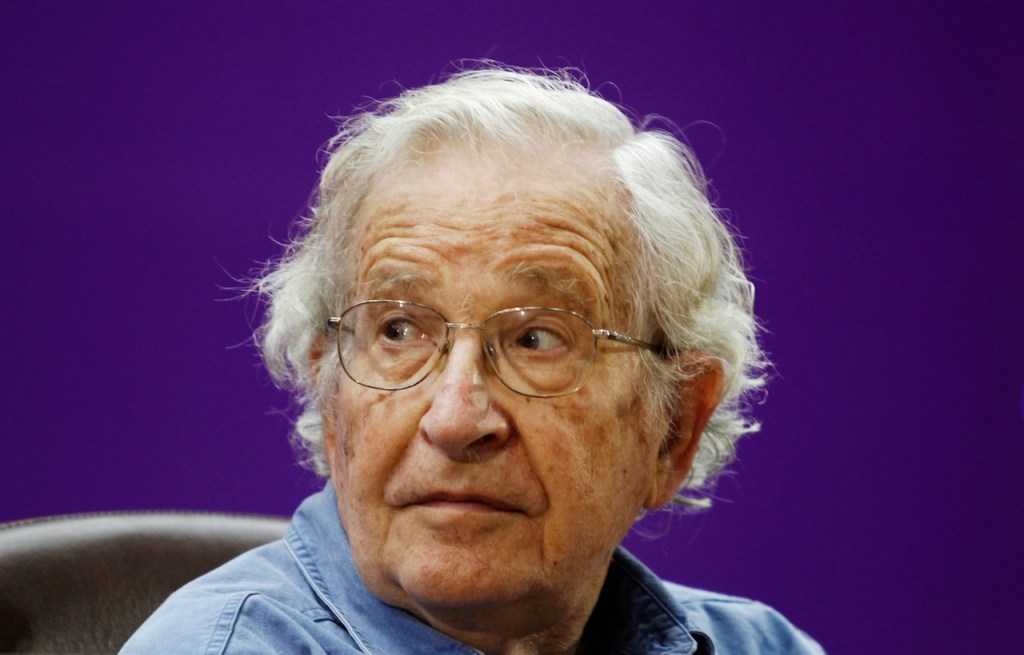
Noam Chomsky, Jeffrey Epstein, and the Problem of Judgment
Since the mid-1960s, the name Noam Chomsky has exerted a great deal of influence on American dissident political thought [1]. Chiefly known for his critiques of U.S. foreign policy and media power, Chomsky has often been regarded as a moral voice of dissent, despite the fact that his opposition has made a convincing case refuting that status.
Currently, recent revelations about his relationship with Jeffrey Epstein further challenge that reputation. These disclosures impose a broader question: do Chomsky’s past political positions, such as his association with Epstein, reflect a recurring pattern of poor judgment?
The Epstein Relationship
Public scrutiny of Chomsky, who labels his political leanings “anarcho-syndicalist and libertarian socialist,” has intensified after newly released emails and financial records show that Chomsky maintained a relationship with Epstein years after Epstein’s 2008 conviction for sex crimes involving a minor.
According to multiple reports, the two men met repeatedly and remained in contact well into the 2010s [2]. Chomsky himself admitted that Epstein assisted him with a financial matter involving roughly $270,000 [3], which was transferred through Epstein’s network. More recent disclosures suggest the relationship went well beyond that single transaction.
Emails reveal Chomsky describing his interactions with Epstein as “a most valuable experience,” and he maintained “regular contact” with Epstein even after Epstein’s criminal conviction was widely known [4][5]. In addition to emails, Epstein’s personal calendar and correspondence show that meetings, dinners, and travel plans were arranged between the two [6].
Even more telling are reports revealing that Chomsky offered Epstein advice on how to handle negative media coverage. In a 2019 email, Chomsky suggested to Epstein that he avoid public attention and characterized press scrutiny as excessive or “horrible” [7][8]. Again, by 2019, Epstein’s crimes had been widely reported for over a decade.
Even Chomsky’s supporters have acknowledged his poor judgment. A 2025 analysis in The Nation noted that Chomsky has historically been inclined to treat “fools, knaves, and criminals too lightly,” suggesting that Epstein may fit into a broader pattern rather than an unfortunate but isolated lapse [9]. More recently, Chomsky’s own wife publicly described their association with Epstein as a “serious error in judgment,” attributing it in part to misplaced trust [10].
A Pattern of Intellectual Leniency
To understand whether this episode is unique, it is useful to analyze Chomsky’s earlier political positions. Critics have long argued that Chomsky’s worldview often leads him to downplay or reinterpret wrongdoing by figures who align—directly or indirectly—with his broader negative criticism of Western power.
The Cambodia case is the most extensively documented example. In their 1977 article “Distortions at Fourth Hand” [11], Noam Chomsky and Edward S. Herman urged caution toward refugee testimony and criticized what they saw as exaggerated media reporting on Khmer Rouge atrocities. This position drew sustained criticism from later scholars and analysts, who argued that Chomsky’s skepticism led him to downplay credible evidence of mass violence and to rely on selectively favorable sources.
Political scientist Stephen J. Morris [12], for example, accused Chomsky of minimizing repression and misrepresenting available evidence, while later analyses by writers such as Bruce Sharp [13] identified methodological flaws and omissions in his treatment of the Cambodian record. Survivors and scholars, including Sophal Ear [14], have likewise criticized Western intellectuals who appeared to discount or reinterpret the scale of Khmer Rouge atrocities.
Chomsky’s defenders argue that he never flatly denied the atrocities, and that his primary target was Western double standards rather than the Khmer Rouge itself. That defense has some merit, but it does not resolve the central problem: the asymmetry of scrutiny.
The same 1977 article that urged skepticism toward refugee accounts of Khmer Rouge mass killings offered no comparable skepticism toward the pro-Khmer Rouge book Cambodia: Starvation and Revolution by Gareth Porter and George Hildebrand [15]—a volume that, as Chomsky and Herman themselves noted, did not contain a single sentence critical of the regime.
Yet, they gave the book their implicit endorsement, contrasting with sources they attacked. The pattern, in short, was not neutrality. It was the application of a demanding critical standard to evidence of atrocities by U.S.-opposed regimes, and a conspicuously lighter touch toward sources that minimized those atrocities.
Similarly, Chomsky has often pitted authoritarian governments in the Global South against U.S. imperialism in his ongoing critique of the West. While this perspective has been influential in academic and activist circles, Chomskyan challengers argue that such a view often leads to moral asymmetry—judging and viewing Western actions harshly while applying a more forgiving lens to others.
The Epstein case appears to fit into a similar pattern of Chomskyan readiness to bracket or relativize serious abuses when they cannot be comfortably assigned to the actors and structures he regards as primary villains. Epstein was not a political figure, but he occupied a position within elite networks that Chomsky has often harshly berated. Instead of maintaining distance, Chomsky engaged with Epstein, accepted financial assistance, and even offered reputational advice. The gap between Chomsky’s theoretical critique of elite power and his personal association with a disgraced financier remains impossible to ignore.
The Role of Personal Trust
One possible exculpatory excuse for this pattern is Chomsky’s intellectual disposition. Some supporters describe him as principled but also unusually willing to engage with a wide range of individuals, including controversial ones.
Other supporters point out that this disposition has led him not only to cultivate relationships with ideological allies but also to defend the institutional rights of his adversaries—for example, insisting in 1969 that Walt Rostow, a chief architect of the Vietnam War, must be allowed to teach at MIT in the name of academic freedom, despite Chomsky’s own fierce opposition to Rostow’s policies. Such openness can be interpreted as a strength—an unwillingness to adopt simplistic moral binaries, but it may also leave him vulnerable to manipulation.
From a number of reports, it can be gleaned that Epstein specialized in cultivating relationships with influential figures; this specialty accounts for the many references to Donald Trump. Epstein presented himself as a philanthropist and intellectual patron, often targeting academics, scientists, and well-known business figures. In this sense, Chomsky’s association with Epstein may be interpreted not as ideological alignment but as a failure to recognize manipulation.
However, this explanation does not withstand close analysis. Epstein’s criminal record was publicly known long before many of these interactions occurred. Continued engagement under such conditions suggests not merely naïveté, but a willingness to overlook serious moral concerns.
It should be noted that the Donald Trump-Epstein relationship [16] contrasts in important ways with that of Chomsky-Epstein. Donald Trump’s relationship with Jeffrey Epstein was a pre-conviction social friendship from the late 1980s to early 2000s that ended abruptly around 2004–2007.
Reports and legal filings have been used to argue that Trump banned Epstein from Mar-a-Lago after news of inappropriate behavior toward a teenage girl there, publicly distanced himself well before Epstein’s 2008 conviction, called him “not a fan” in later years, and alerted authorities to concerns about Epstein’s conduct as early as 2006.
None of this news about the Chomsky-Epstein relationship suggests that Chomsky engaged in any of the crimes associated with Epstein. However, reports of that close relationship remain troubling even if not shocking to Chomsky’s oppositional critics.
Implications for Chomsky’s Legacy
The significance of this controversy extends well beyond a Chomskyan personal reputation. Noam Chomsky has long derived authority from his claim to moral clarity—his insistence on exposing hypocrisy, power abuse, and ethical double standards. The Epstein relationship undermines that claim in a direct way.
Maintaining contact with a convicted sex offender, accepting financial assistance routed through Epstein, and offering reputational advice cannot be dismissed as mere eccentricity or intellectual openness. These acts remain conscious choices made in the presence of widely known facts. Such behavior indicates a failure not only of understanding, but also of a moral disposition to prioritize relativistic sensibilities.
This pattern aligns with earlier criticisms of Chomsky’s political judgment. His inclination to approach Western wrongdoing with extreme contempt, while failing to apply any harsh evaluation of other cultures, has long been observed and criticized.
In the Epstein case, that same instinct appears redirected into the personal sphere: a willingness to discount or compartmentalize serious wrongdoing when it does not fit neatly into his established framework of critique. That decision does not reflect neutrality; it clearly demonstrates selective judgment.
Reassessing Intellectual Authority
It is also worth reconsidering the broader assumption that Chomsky’s stature in one field secures his authority in others. While his early contributions to linguistics—particularly in generative grammar—were influential, they have been seriously debated and, in many areas, revised or challenged by subsequent research.
His reputation in linguistics rests on the claim that he transformed the field from simple description into a genuine science. That claim has been strongly challenged. What he actually produced was a highly abstract, internally shifting framework that substitutes theory for empirical accountability. His reputation as an unassailable intellectual figure has been challenged and even refuted by well-respected linguists [17][18][19].
More importantly, even successful intellectual achievement does not excuse poor judgment in ethical or practical matters. The Epstein association demonstrates that analytical sharpness in abstract domains does not necessarily translate into sound decision-making in real-world contexts. If anything, Chomsky’s case illustrates how intellectual confidence can coexist with, and perhaps even enable, serious lapses in judgment.
Chomskyan Accountability
The evidence surrounding Chomsky’s relationship with Jeffrey Epstein should not be treated as an isolated misstep. It is better understood as part of a broader pattern in which moral evaluation becomes inconsistent and, at times, selectively applied. This pattern, therefore, requires a more critical and less deferential reading of his work.
For readers, the takeaway is straightforward: authority must be continually tested against behavior. Chomsky’s career demonstrates that prominence and forceful critique do not guarantee reliability in judgment. In this instance, the failure is not subtle—it is clear, documented, and consequential.
[11] Noam Chomsky and Edward S. Herman. “Distortions at Fourth Hand.” The Nation. June 25, 1977, pp. 789–790. Also available at chomsky.info/19770625/.
[12] Stephen J. Morris. “Whitewashing Dictatorship in Vietnam and Cambodia.” The Anti-Chomsky Reader. Encounter Books. 2004.
[19] Steven Piantadosi. “Modern Language Models Refute Chomsky’s Approach to Language.” From Fieldwork to Linguistic Theory: A Tribute to Dan Everett. Eds.Edward Gibson and Moshe Poliak, Language Science Press. 2023, pp. 353-414. Published online July 5, 2024 .
Fiction Alert! This story is fiction. It does not depict any real person or actual event.
Graveyard Whistler: A Political Poem Find,”Liberal Mud with Commentary”
Graveyard Whistler unearths a piece of doggerel that nevertheless caught his fancy, as it presented, in his opinion, a much needed corrective to the misuse of a beloved term.
Foreword from the Graveyard Whistler
Let me make it clear right away: I despise politics. National politics, hate it. Local politics, hate it. Office politics, hate it the worst. So I rarely delve into issues that might lead me to the necessity of discussing politics. However, as I have so often touted the treasure trove from my old, late buddy Stoney’s Stone Gulch Literary Arts, I feel the need to address some political issues that Stoney addressed.
At first, my inclination was to simply avoid all of his political scribblings, but then after I actually read this offering, I realized I had actually learned something, which has changed my view about political issues. You will notice that it’s not just a poem—actually, it’s a piece of doggerel, as Stoney called it—but it has a commentary that is well researched with sources. I’m still not allowing myself to become immersed in those issues, but I don’t feel that avoiding them completely does me or anyone else any good.
You see, I’ve always considered myself “liberal”—that is opposed to stuffy conservative thought that disavows all progress, including science and minority rights—and until encountering this piece called “Liberal Mud,” I did not realize the difference between “classical liberal” and “modern liberal.” To me, liberal was liberal which was a good thing, always. Full stop.
As usual, Stoney has not made it clear that he wrote this piece; it just kind of popped up at the bottom of a clipping of Stoney delivering a speech to a college assembly. How I would love to include that image of Stoney speaking—but alas! when he gifted me with his site-full of writings, he insisted he remain anonymous, so any image or even Stoney’s real name will never appear in my writings.
Without further ado, I present the piece of doggerel—and that’s what Stoney called it—for what it’s worth:
“Liberal Mud with Commentary”
This piece of doggerel titled, “Liberal Mud,” is brazenly political; it focuses on the nature of the much abused term, “liberalism,” which denotes freedom from the overreach of governmental restraints.
The term, “liberal,” has been much abused. For example, in contemporary American politics, the party that claims the label of liberal is the party whose policies are formulated to control every aspect of life of the citizens of the United States from healthcare to business practices to what each American is allowed to think. That party even seeks to quash freedom of religion, which was a major impetus leading to the founding the country.
Under the guise of “liberalism,” that party claims large swaths of the citizenry who have fallen for the corrupt concept of “identity politics.” For example, the party claims huge numbers of African Americans, women, gays, and young voters. The party appeals to many of the uninformed/misinformed in those “groups” simply by offering them government largesse and claiming to represent their interests.
A common misconception is that the Democratic and Republican parties switched policies a few decades ago. That lie has been perpetuated by Democrat vote seekers because history reveals that the Republican Party has always been the party of freedom; it was, in fact, President Abraham Lincoln, the first Republican president, who issued the Emancipation Proclamation that freed the slaves during the American Civil War.
As Rev. Wayne Perryman has averred: “Many believed the Democrats had a change of heart and fell in love with blacks. To the contrary, history reveals the Democrats didn’t fall in love with black folks, they fell in love with the black vote knowing this would be their ticket to the White House.” As they have experienced the result of luring the votes of black folks, Democrat politicians have worked the same old lie to get the votes of the other identity groups: women, gays, young voters.
Originally, the term, “liberal,” indicated the positive quality of allowing freedom from government overreach, and generally those who wish to unleash themselves from harsh constraints on behavior that harms no one are, in fact, liberal. The American Founding Fathers were the liberals of that period of history. Those colonists who wished to remain tied to England, instead of seeking independence, were the conservatives. In current, common parlance, there is a distinction between “classical liberal” and “modern liberal.”
Whether an ideology is liberal or conservative depends entirely upon the status quo of the era. If a nation’s government status quo functions as a socialist/totalitarian structure and a group of citizens works to convert it to a republic, then that group would be the liberals, as was the case at the founding of the democratic republic of the United States of America. However, if a country’s governing status quo structure functions as a democratic republic, and a group of citizens struggles to change it into a socialist/totalitarian structure — a la Bernie Sanders, Hillary Clinton, Barack Obama, or any other current member of the Democratic Party — then that group would be the liberals, however, mistakenly that term would be when applied to such a stance.
Conservatism is the desire to maintain the status quo despite the nature of that status quo, but then again it is necessary to delineate what that status quo is. If the status quo allows freedom, then it should be conserved; if it does not, it should be liberalized. It is unfortunate that those terms have become so flabby, but then that is the nature of political speak: the side that has the lesser argument will always seek to convert language, instead of converting their feckless policies.
This piece hails forth in the current acceptance of a liberalism that is anything but liberal: modern liberalism vs classical liberalism. The piece (doggerel) might well be titled “Totalitarian Mud.” But part of the point is to report the denatured use of the term, “liberal,” as it decries the effects of that denatured term.
Liberal Mud
Every soldier takes to battle His duty for survival Marching against the rival.
The enemy muscles the air Against all that is fair Against putrid politics.
Liberal dust smothering light, Converts gloom against the fight To save freedom from the sand.
Liberal breath pollutes the way Through politics that betray Their fellows natural rights.
Liberal thieves convert the vote To steal the sacred note As enemies rise from hell.
Licking their wounds, their paws, Leaving the press no answer Save all the fake men of straws.
No hypocrite gives more haste Than a mind without a compass. It remains a terrible waste
To slime the brain’s red blood In the bog pond of liberal mud.
Commentary on “Liberal Mud”
The fight for freedom never ends. True liberal thought that leads to fairness must continually be pursued to avoid its opposite, tyranny.
First Tercet: Fight for Freedom
Every soldier takes to battle His duty for survival Marching against the rival.
These particular soldiers represent the fight for what is right, correct, that which gives the most freedom to the most people. Modern-day liberals would take away these soldiers, the fight, and the freedom and replace them with goose-stepping thugs who would enforce totalitarian rule. One need only observe examples of the Democratic party such as the Clintons, and how they mistreated the military to understand the verity of this observation.
Lt. Col. Robert Patterson reports in his book, Dereliction of Duty: Eyewitness Account of How Bill Clinton Compromised America’s National Security, that Clinton’s kick-the-can attitude toward taking out Al-Qaeda and Saddam Hussein’s nuclear facility convinced Patterson that Clinton was the “greatest security risk to the United States.”
In Ronald Kessler’s book, The First Family Detail: Secret Service Agents Reveal the Hidden Lives of the Presidents, Kessler recounts how a simple greeting of “Good Morning, ma’am” to the First Lady Hillary Clinton would provoke a reply of “F*ck off!” from that future failed Democratic presidential hopeful.
The Obama White House managed to behave no better toward the men and women in uniform, as President Obama continued to downsize both the troop strength and the pay and pension of each troop.
Second Tercet: Vanity Leads to Loss
The enemy muscles the air Against all that is fair Against putrid politics.
The great example of this claim is the winning of the War in Iraq by President George W. Bush, only to be squandered and lost under the vain, tepid, backward responses of President Barack H. Obama.
Thomas Sowell has summarized the situation accurately stating:
Despite the mistakes that were made in Iraq, it was still a viable country until Barack Obama made the headstrong decision to pull out all the troops, ignoring his own military advisers, just so he could claim to have restored “peace,” when in fact he invited chaos and defeat.
Third Tercet: The Glass Eye of Dictatorship
Liberal dust smothering light, Converts gloom against the fight To save freedom from the sand.
The dust of liberal thinking covers all the furniture of a republic. Gouging out the eyeballs of freedom, replacing them with the glass eye of dictatorship. Suspending industry, encouraging the sex-crazed lazy to spend tax dollars on abortifacients.
Fourth Tercet: Lies, Deception, Obfuscation
Liberal breath pollutes the way Through politics that betray Their fellows natural rights.
But somehow the putrid politics of the Democratic Party breathe on, polluting the environment with lies, deceptions, obfuscations that kill and maim as society turns violent in the wake of lawlessness.
Observe Democratic Baltimore Mayor Stephanie Rawlings-Blake offering looters “space to destroy” by commanding law enforcement to stand down. Of course, after making such a ludicrous remark, she then lies and says she didn’t say that.
Fifth Tercet: Leading from Behind Is not Leading
Liberal thieves convert the vote To steal the sacred note As enemies rise from hell.
The Obamaniacs’ “lead from behind”— the likes of fake purple heart winner turned Secretary of State John Kerry accepts a deal with a terror sponsoring nation that will lead to the obliteration of a neighboring democracy and encourage other dictatorships to go nuclear.
Sixth Tercet: The Birth of Fake News
Licking their wounds, their paws, Leaving the press no answer Save each fake man of straws.
Everyone suffers the abominations, and the corrupt liberal press continues to fail to hold to account those who are steering their country into a poverty stricken mess, too weak to defend itself, too dependent on government to know how to earn its own living.
Seventh Tercet: Mindless, Rudderless, Moral Mess
No hypocrite gives more haste Than a mind without a compass. It remains a terrible waste
The moral compass of the country has been hacked into a pile of unworkable fragments.
Final Couplet: Lack of Moral Clarity
To slime the brain’s red bloodIn the bog pond of liberal mud.
The final two movements echo the adage: “A mind is a terrible thing to waste.” And the minds of so many young folks have been wasted in the dumpster of fake “liberal” ideology.
Applying the Lessons of History
Poetry and politics are uneasy bedfellows. They struggle to fall asleep, often simply through mistrust, but often because the nature of beauty remains deeply personal, and politics, by its nature, must look outward.
Unfortunately, or perhaps fortunately, depending upon how one looks at it, all that can be done about “politics” — identity and otherwise — is to continue to debate the merits of each policy that presents itself. One would also continue to hope that those debaters know their history and have some skill in applying the lessons of that history as they analyze and scrutinize each policy.
I know this entry must have seemed like a bunch of mud to slog through, and I promise I will not be engaging in this kind of rhetoric very often—I’m not swearing off entirely because Stoney does have a few other pieces that I think might help light up the political landscape.
Anyway, I do hope you can find some benefit from following such a piece. Stoney has an interesting mind, an expansive mind, so I feel it would not be fair to him if I just leave out whole swaths of his views. Plus his writing ability remains unique in the annals of the world of literary studies. While I do believe that poetry and politics make strange if not impossible bedfellows, sometimes it is necessary to give both their due.
Image: Emily Dickinson – Amherst College – Daguerrotype of the poet at age 17, circa 1847 – likely the only authentic, extant likeness of the poet
Emily Dickinson’s “He touched me, so I live to know”
Emily Dickinson’s “He touched me, so I live to know” dramatizes an experience in mystical union with the Divine Reality. Often interpreted and examined as madness, Dickinson’s mystical proclivities more easily and thoroughly explain her elliptical writings.
Introduction with Text of “He touched me, so I live to know”
Emily Dickinson’s many experiences in mystical union [1] with the Divine Spiritual Reality reveal that the poet was working from an extraordinary state of awareness. Often interpreted and examined as madness or extreme idiosyncrasy, Dickinson’s mystical proclivities more easily and thoroughly explain her elliptical writings than total reliance on the physical and mental levels of being.
While Dickinson must be perceived primarily as an accomplished poet and not an avatar of perfect knowledge, her mystical proclivities are difficult to deny. For example, superficial observers of this poem are wont to report that the speaker is describing her happy experience of engaging in a physical tryst with a lover.
But the “lover” trope is often used by those who experience the mystical union with the Divine, for example, Saint Terese of Ávila’s ecstasy is metaphorically expressed as similar to “erotic intensity [2].
Instead of physical bodies uniting, however, the mystical experience is the uniting of the individual soul and the Divine Creator or God. Because the physical union offers intense pleasure, it makes a useful metaphor for the even more intense pleasure experienced during mystical union.
While understanding the union metaphorically is perfectly acceptable and logical, it is absurd to misunderstand and think those two very different experiences are identical. It is helpful to remember that a metaphor is useful in that it likens two very different entities.
The purpose of the physical, sexual union exists for procreation, that is, the continuation of the generations of humanity, while the mystical union remains the true goal of each human soul.
Paramahansa Yogananda and the avatars all of faiths have taught that the true purpose of life [3] is to find and unite the individual soul with the Over-Soul, Divine Reality, or God.
As the spiritual scientist, Sant Rajinder Singh Ji Maharaj, has elucidated [4], “It is important to recognize that this human existence has a purpose, that we are here to grow spiritually, to know God, and to merge back in God.”
He touched me, so I live to know
He touched me, so I live to know That such a day, permitted so, I groped upon his breast – It was a boundless place to me And silenced, as the awful sea Puts minor streams to rest.
And now, I’m different from before, As if I breathed superior air – Or brushed a Royal Gown – My feet, too, that had wandered so – My Gypsy face – transfigured now – To tenderer Renown –
Into this Port, if I might come, Rebecca, to Jerusalem, Would not so ravished turn – Nor Persian, baffled at her shrine Lift such a sign To her imperial Sun.
Reading
Commentary on “He touched me, so I live to know”
The speaker is describing the mystical experience that has transfigured her mind, her heart, even her entire life. Likely, this poem was the poet’s first attempt to delve into that particular theme that had such a profound influence on her ability to compose poetry.
First Stanza: The Visitation
He touched me, so I live to know That such a day, permitted so, I groped upon his breast – It was a boundless place to me And silenced, as the awful sea Puts minor streams to rest.
The speaker begins by announcing that she has been visited by the Divine Reality. Her union with the Mystical Creative Force caused her to feel that her living is now more intense and vital than it had ever been before this momentous realization.
The speaker now is aware that such a soul-realizing event can actually happen to mere mortals. The reality of His presence makes her feel that during this visitation she was “groping” upon an enormous entity. Her consciousness has become unbounded by her heretofore mental and physicals encasements.
Because God’s body remains inside and outside of creation, that Entity in human terms is a vast area of space and matter, and as the individual human soul unites with that Entity it experiences the enormity of that Form.
The speaker then likens the experience to a “minor stream” such as a river that flows into the ocean. Paramahansa Yogananda likens the little human body to a “bubble” and the God to the ocean, and in his chant he commands the Divine Reality: “I am the bubble, make me the sea” [5].
The speaker in Dickinson’s “He touched me, so I live to know” is experiencing a time that God had made her the sea; she was a tiny bubble, and for a time, she experienced being the sea.
Second Stanza: The Transformation
And now, I’m different from before, As if I breathed superior air – Or brushed a Royal Gown – My feet, too, that had wandered so – My Gypsy face – transfigured now – To tenderer Renown –
After her mystical experience, the speaker now realizes that she is “different”; she has been transformed and feels that now even her breathing has been clarified and elevated. She also likens her new awareness to touching a “Royal Gown.”
The speaker is describing an event that, in fact, cannot be translated into language; thus, she must metaphorically compare the ineffable to physical things and experiences that come closest to expressing her experience.
She then reports that her feet now seem more firmly planted, as before they had remained roaming in delusion. Her face also has been transformed from a roaming, inquisitive face of to something kind, pleasant, and staid.
Third Stanza: The Reality of Permanence
Into this Port, if I might come, Rebecca, to Jerusalem, Would not so ravished turn – Nor Persian, baffled at her shrine Lift such a sign To her imperial Sun.
The speaker then contrasts her journey along with its destination to the biblical character, Rebekah, who traveled to the home of Isaac to become his wife, and to some nameless “Persian” whose prayerful pleadings remained somewhat superficial.
Instead of such worldly experiences, this speaker insists that she has become aware of the permanence bestowed by this amazing event that has captured her. Her port, if she understands if correctly, leads to the immortality upon which she has long mused and upon which she strongly insists is a reality.
Her mystical experience has now confirmed for her that the Afterlife is real and that she has visited and now knows in her soul that the Creator of the Cosmos is directing and guarding her.