Linda's Literary Home

Tag: philosophy

  • Original Song:  “Astral Mother” with Prose Commentary

    Image: Mommy and MePhoto by Ron W. G.

    Original Song:  “Astral Mother” with Prose Commentary

    This song is dedicated to my beautiful mother, Helen Richardson, whose soul left the physical planet Earth at the age of 58 and now resides in the astral world.  By faith and deep love, I visit her there from time to time.

    Introduction with Text of “Astral Mother”

    My original song, “Astral Mother,” plays out in three verse-movements and two chorus-movements.  A traditional verse is a unified set of lines—often four but through innovation the number is not consistent.

    Thus, a verse-movement may be any number of lines or stanzas because the emphasis in on the theme of the movement.  A movement depends upon theme rather than number of lines or stanzas.

    On the astral plane, souls have shed their bodies of chemicals and dust and reside in bodies of light.  Although the physical body is also made fundamentally of light, the astral body is perceived as light more easily than the “mud” covering the soul on the earthly plane.

    After visiting my mother on the astral plane, I bring back images, ideas, and thoughts that I dedicate to her in poems and songs.  The text of the song follows, and you are welcome to listen to the song on SoundCloud.

    Astral Mother

    In memoriam: Helen Richardson
    June 27, 1923 — September 5, 1981

    for your beautiful soul

    You are waiting now . . .
    A bright star light
    In the astral world

    You have shed the mud
    That covers the soul
    On the earthly plane . . . —

    Where you were my mother, and I was your child
    You were my mother, and I was your child . . . 

    You are watching for me . . .
    To catch my beam
    In the astral world

    We will live again
    The love we lived
    On the earthly plane . . . —

    Where you were my mother, and I was your child
    You were my mother, and I was your child . . .

    We will understand the Spirit-made plan . . .
    That kept us a while . . .
    In this earthly world . . . —

    Where you were my mother, and I was your child
    You were my mother, and I was your child . . .

    O, my Divine Mother, make me Thy Divine Child!
    O, my Divine Mother, make me Thy Divine Child!

    Commentary on “Astral Mother”

    A daughter addresses her mother who has departed the earth and now resides in the astral world.  Through faith and divine guidance, the daughter visits the mother and creates a tribute to her mother’s beautiful soul of light

    First Verse-Movement:  Living as Light in the Astral World

    You are waiting now . . .
    A bright star light
    In the astral world

    You have shed the mud
    That covers the soul
    On the earthly plane . . . —

    From the earthly plane of existence, the singer/narrator is addressing a loved one who is residing on the astral plane of existence.  

    The soul of the departed loved one is now existing in her astral/causal bodies—where the soul continues without its physical encasement.  Paramahansa Yogananda explains this phenomenon:

    astral body. Man’s subtle body of light, prana or lifetrons; the second of three sheaths that successively encase the soul: the causal body (q.v.), the astral body, and the physical body. The powers of the astral body enliven the physical body, much as electricity illumines a bulb. 

    The astral body has nineteen elements: intelligence, ego, feeling, mind (sense consciousness); five instruments of knowledge (the sensory powers within the physical organs of sight, hearing, smell, taste, and touch); five instruments of action (the executive powers in the physical instruments of procreation, excretion, speech, locomotion, and the exercise of manual skill); and five instruments of life force that perform the functions of circulation, metabolization, assimilation, crystallization, and elimination.

    The singer/narrator affirms that her loved one—her belovèd mother—is now “waiting” in her body of light as it exists on the astral plane. The singer/narrator in the second part of the movement refers to the physical body as “mud” which the astral mother has now “shed.”  The physical body encases the soul on the earthly plane of existence.

    The physical body may be metaphorically referred to as “mud” after the Biblical description of the human body:

    In the sweat of thy face shalt thou eat bread, till thou return unto the ground; for out of it wast thou taken: for dust thou art, and unto dust shalt thou return. (KJV Genesis 3:19)

    But after the soul leaves that physical encasement, it continues its existence in the two other bodies—astral and causal—on the astral plane where it is perceived only as light. Thus, the daughter/speaker has perceived her mother as a body of light, which she designates metaphorically as “a bright star light.”

    Second Verse-Movement:  Waiting to Spot a Familiar Dot of Light

    You are watching for me . . .
    To catch my beam
    In the astral world

    We will live again
    The love we lived
    On the earthly plane . . . —

    The singer/narrator then affirms that the astral mother is waiting for her daughter to join her on the astral plane.  The daughter will become a “beam” of light after she leaves her own physical encasement, entering the “astral world.”

    The singer/narrator then affirms that the mother and daughter will experience that same love that they shared when they were both on the earth together.   The “lived” love and they continue to live that love, but after they both are in the same level of existence, they are likely to recognize and have a deeper level of awareness of that love.

    Third Verse-Movement:  Understanding and Appreciating Love and Light

    We will understand the Spirit-made plan . . .
    That kept us a while . . .
    In this earthly world . . . —

    The singer/narrator finally affirms that after the mother and daughter are reunited, for however briefly that reunion might exist, they will understand more about the divine plan that God has for them.

    They were both maintained on the earth planet for while; they no doubt had questions about the meaning of life and all of its vicissitudes.  The singer/narrator predicts that after entering the astral plane, both she and her mother will understand more about meaning and purpose then they had before.

    Experience is great teacher; and God puts His children in positions from which they may learn what they need in order to meet their karmic demands. The singer/narrator holds great faith that she and her mother on the path that leads to the ultimate enlightenment of union with the Divine.

    Chorus-Movement 1:  A Simple Statement of Fact

    Where you were my mother, and I was your child
    You were my mother, and I was your child . . .

    In the first chorus, the singer/narrator simply states the fact that the addressee in the song was the singer’s mother, and the singer was the child of the mother.   On the earth plane, they were mother and daughter.

    The simplicity of the statement may be misleading.  This simple fact is, however, very important.  On the earth plane, they were mother and daughter, but on the astral plane they are only two individual souls that are children of the One Father-Mother-God.

    The mother/daughter relationship on earth is likely quite a different one from that relationship as two individual souls on the astral plane.  Despite that obvious fact, the important fact to remember is that love exists between the two; it existed on earth and it will exist in the astral world.

    Chorus-Movement 2:  A Prayer-Chant to the Divine Mother

    O, my Divine Mother, make me Thy Divine Child!
    O, my Divine Mother, make me Thy Divine Child!

    The momentousness of the shift from the earth relationship of mother/daughter to Divine Mother/Divine Child cannot be overstated.  

    By ending with a chant-like prayer, the singer/narrator affirms that through the love relationship between earth mother and daughter, she has come to understand that both mother and daughter are children of the Divine Reality (Heavenly Father or Divine Mother) or God.

    And the singer/narrator then supplicates to God as Divine Mother to help her realize her soul as that “Divine Child” that she is.  The same supplication is offered on behalf of the astral mother, whom the singer/narrator has been addressing.

    Both former earth mother and earth daughter are children of the Divine, and they both must one day come to realize that relationship to the Divine—and the singer/narrator prays for that to happen.

  • Quotations

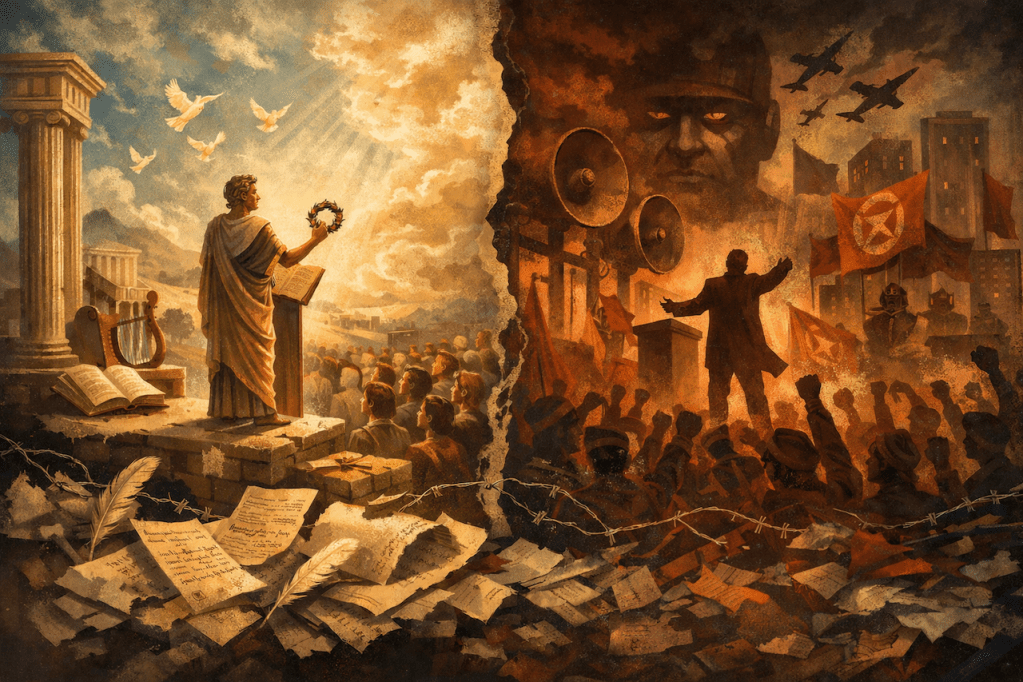
    Image:  Open AI created inspired by the lines “Noise blossoms in the mind / Bursting into a riot of sound color”

    Quotations

    Paramahansa Yogananda:  People interested in developing their memory should avoid the regular use of stimulants such as coffee, tea, and tobacco, which contain caffeine, theine, and nicotine, respectively.* Strictly avoid using strong stimulants such as liquor and drugs.  Such substances intoxicate, drug, and deteriorate the intelligence and memory cells of the brain, preventing them from recording noble ideas and sense impressions in general.  Memory cells that are constantly anesthetized by intoxicants lose their retentive power, and become lazy and inert. Intoxication obliterates the functions of the conscious mind by harmful chemicals, hence injures the cerebral memory-organ.  When the brain is affected the memory is impaired. — SRF Lesson 51:  “Yoga Methods for Developing Memory” (*Editor’s Note: Some modern research indicates that light to moderate use of caffeine improves short-term memory for brief periods.  Yogis, however, assert that continuous use over a long period erodes rather than enhances the capacity of this divine faculty.)

    Paramahansa Yogananda:  In the natural course of evolution through reincarnation, souls are automatically reincarnated by cosmic law in a higher form or species in each incarnation.  The soul is never reborn in the same animal species:  a dog is never a dog again. — SRF Lesson 78: “Conscious Evolution”

    Paramahansa Yogananda:  There is nothing more powerful than will.  Everything in this universe is produced by will.  Physiological changes may even be made to occur in the body by will power.  There is no time element involved; place a thought in the mind and hold it there, and think that the thing is done and your whole body and mind will respond to it.  Nor does it take time to acquire or discard a habit if you exercise sufficient will power.  It is all in your mind. —SRF Lesson S-4 P-79

    Paramahansa Yogananda:   Remember that when you are unhappy it is generally because you do not visualize strongly enough the great things that you definitely want to accomplish in life, nor do you employ steadfastly enough your will power, your creative ability, and your patience until your dreams are materialized. —SRF Lessons and Spiritual Diary, April 22 – Will Power, Creative Ability, & Patience

    Paramahansa Yogananda: The Sanskrit word for ‘musician’ is bhagavathar, “he who sings the praises of God.” —Autobiography of a Yogi

    Sri YukteswarForget the past.  The vanished lives of all men are dark with many shames.  Human conduct is ever unreliable until man is anchored in the Divine.  Everything in future will improve if you are making a spiritual effort now.   —Autobiography of a Yogi

    Sri Yukteswar: “How can sense slaves enjoy the world? Its subtle flavors escape them while they grovel in primal mud. All nice discriminations are lost to the man of elemental lusts.”  —Autobiography of a Yogi

    Sri YukteswarSri Yukteswar’s interpretation of the Adam and Eve creation story in Genesis—from Autobiography of a Yogi, pages 169-171, Twelfth Edition, First quality paperback printing 1994:

    Genesis is deeply symbolic, and cannot be grasped by a literal interpretation; its “tree of life” is the human body.  The spinal cord is like an upturned tree, with man’s hair as its roots, and afferent and efferent nerves as branches.  The tree of the nervous system bears many enjoyable fruits, or sensations of sight, sound, smell, taste, and touch.  In these, man may rightfully indulge; but he was forbidden the experience of sex, the “apple” at the center of the body (“in the midst of the garden”).  (my emphasis)

    The “serpent” represents the coiled-up spinal energy that stimulates the sex nerves.  “Adam” is reason, and “Eve” is feeling.  When the emotion or Eve-consciousness in any human being is overpowered by the sex impulse, his reason or Adam also succumbs.

    God created the human species by materializing the bodies of man and woman through the force of His will; He endowed the new species with the power to create children in a similar “immaculate” or divine manner.  Because His manifestation in the individualized soul had hitherto been limited to animals, instinct-bound and lacking the potentialities of full reason, God made the first human bodies, symbolically called Adam and Eve.  To these, for advantageous upward evolution, He transferred the souls or divine essence of two animals.  In Adam or man, reason predominated; in Eve or woman, feeling was ascendant.  Thus was expressed the duality or polarity that underlies the phenomenal worlds.  Reason and feeling remain in the heaven of cooperative joy so long as the human mind is not tricked by the serpentine energy of animal propensities.

    The human body was therefore not solely a result of evolution from beasts, but was produced through an act of special creation by God.  The animal forms were too crude to express full divinity; man was uniquely given the potentially omniscient “thousand-petaled lotus” in the brain, as well as acutely awakened occult centers in the spine.

    God, or the Divine Consciousness present within the first created pair, counseled them to enjoy all human sensibilities, with one exception: sex sensations.  These were banned, lest humanity enmesh itself in the inferior animal method of propagation.  (my emphasis)  The warning not to revive subconsciously present bestial memories was unheeded.  Resuming the way of brute procreation, Adam and Eve fell from the state of heavenly joy natural to the original perfect man.  When “they knew they were naked,” their consciousness of immortality was lost, even as God had warned them; they had placed themselves under the physical law by which bodily birth must be followed by bodily death.

    The knowledge of “good and evil,” promised Eve by the “serpent,” refers to the dualistic and oppositional experiences that mortals under maya must undergo.  Falling into delusion through misuse of his feeling and reason, or Eve- and Adam-consciousness, man relinquishes his right to enter the heavenly garden of divine self-sufficiency.  The personal responsibility of every human being is to restore his “parents” or dual nature to a unified harmony or Eden.

    Alexander Pope: Hope springs eternal in the human breast. —An Essay on Man: “Epistle 1”

    Alexander Pope:  All are but parts of one stupendous whole, / Whose body Nature is, and God the soul. —An Essay on Man: “Epistle 1”

    Alexander Pope: And, spite of pride, in erring reason’s spite, / One truth is clear, Whatever is, is right. —An Essay on Man: “Epistle 1”

    Alexander Pope:  Know then thyself, presume not God to scan; / The proper study of mankind is man.  —An Essay on Man: “Epistle 2”

    Alexander Pope: What Reason weaves, by Passion is undone.  —An Essay on Man: “Epistle 2”

    T. S. Eliot:  Man is man because he can recognize supernatural realities, not because he can invent them.

    Evan Sayet:  “The modern liberal will invariably side with evil over good, wrong over right, and the behaviors that lead to failure over those that lead to success.”

  • Daniel L. Wright Memorial

    Image: Professor Danial L. Wright – Authorship Studies Conference at Concordia

    Dan Wright: Innovative Shakespeare Scholar

    The late Daniel L. Wright was the director of the Shakespeare Authorship Research Centre at Concordia University in Portland, Oregon, where he also served as professor of English from 1991 to 2013.  

    The following message is from the homepage of the SARC site, featuring the welcome and explanation of what the center was about:

    Welcome to Concordia University in Portland, Oregon — home of the Shakespeare Authorship Research Centre (SARC). The SARC is an academic setting for annual gatherings that unite professors, teachers, students, playwrights, actors, directors and lovers of Shakespeare from all over the world to share research and insights into the Elizabethan world’s most acclaimed poet-playwright.

    The primary goals of the SARC:  (1) Determine who the Shakespeare writer was and (2) Explore why he wrote anonymously and pseudonymously. 

    That website also offers information regarding the numerous conferences held to discuss that authorship question. 

    My Gratitude to Dan Wright

    From 1983 to 1991, Dan Wright and I were classmates and colleagues in the English department at Ball State University, where we both completed our PhD degrees; I completed mine in 1987 and Dan finished in 1990.  We both benefited from the excellent guidance of Professor Thomas Thornburg, who directed our dissertations.  

    I owe Dan a debt of gratitude for the identification of the kind of interpretation that I engage in.  As we attended Dr. Frances Rippy’s class in research, Dan’s response to one of my presentations offered the term “yogic interpretation,” a term I had not heard or even thought of until he said those words.

    From then on, I have understood the kind of commentary, criticism, and other scholarly work I engage is indeed “yogic” in nature.  I employed a “yogic interpretation” in my dissertation, “William Butler Yeats’ Transformations of Eastern Religious Concepts,” and I continue to engage that yogic concept as I comment on the poems of various poets, including Emily Dickinson, Edgar Lee Masters, the Shakespeare sonnets, and others.

    Dan and I both had religion in common, even though those religious traditions are from very different perspectives: mine is from the union of original yoga and original Christianity as taught by Paramahansa Yogananda, and Dan’s was from the historical and theological tradition of Christianity as perceived through Lutheranism.  

    Dan’s religious training included a Master of Divinity degree from the Lutheran School of Theology in Chicago, from which he graduated in 1980. After his ordination in 1980, he entered the Navy and  served for two years as a Navy Chaplain.  

    At Ball State during our sojourn to our advanced degrees, one would see Dan walking through in the hallways wearing his cleric collar because he remained an active churchman as he studied for his PhD in the English program.

    I also owe Dan a debt of gratitude for alerting me to the issue of the Shakespeare authorship.  During my research for information relating to Shakespeare, I happened upon Dan’s articles at the Shakespeare Authorship Research Centre (SARC).  His brilliant analyses of and excellent clarity on the issue convinced me that Edward de Vere, 17 th Earl of Oxford, is in, indeed, the real “Shakespeare,” or is, at least, the best candidate offered to date.

    Unfortunately, I never had the privilege of communicating my appreciation and gratitude to Dan for his fine scholarship.  I would like to have let him know that his label of “yogic interpretation” has served as a bright light for my studies, and being introduced to the Shakespeare authorship controversy has further enhanced my literary studies.  

    Dan died on October 5, 2018, in Vancouver, Washington, of complications from diabetes.  I wish soul rest for my former illustrious classmate/colleague, whose academic career has offered his many students a fine example in scholarship and the love of learning.

    Requiescat in pace, Dan!

    Dan Wright Memorial on Youtube

    Articles by Professor Wright on the Shakespeare Authorship